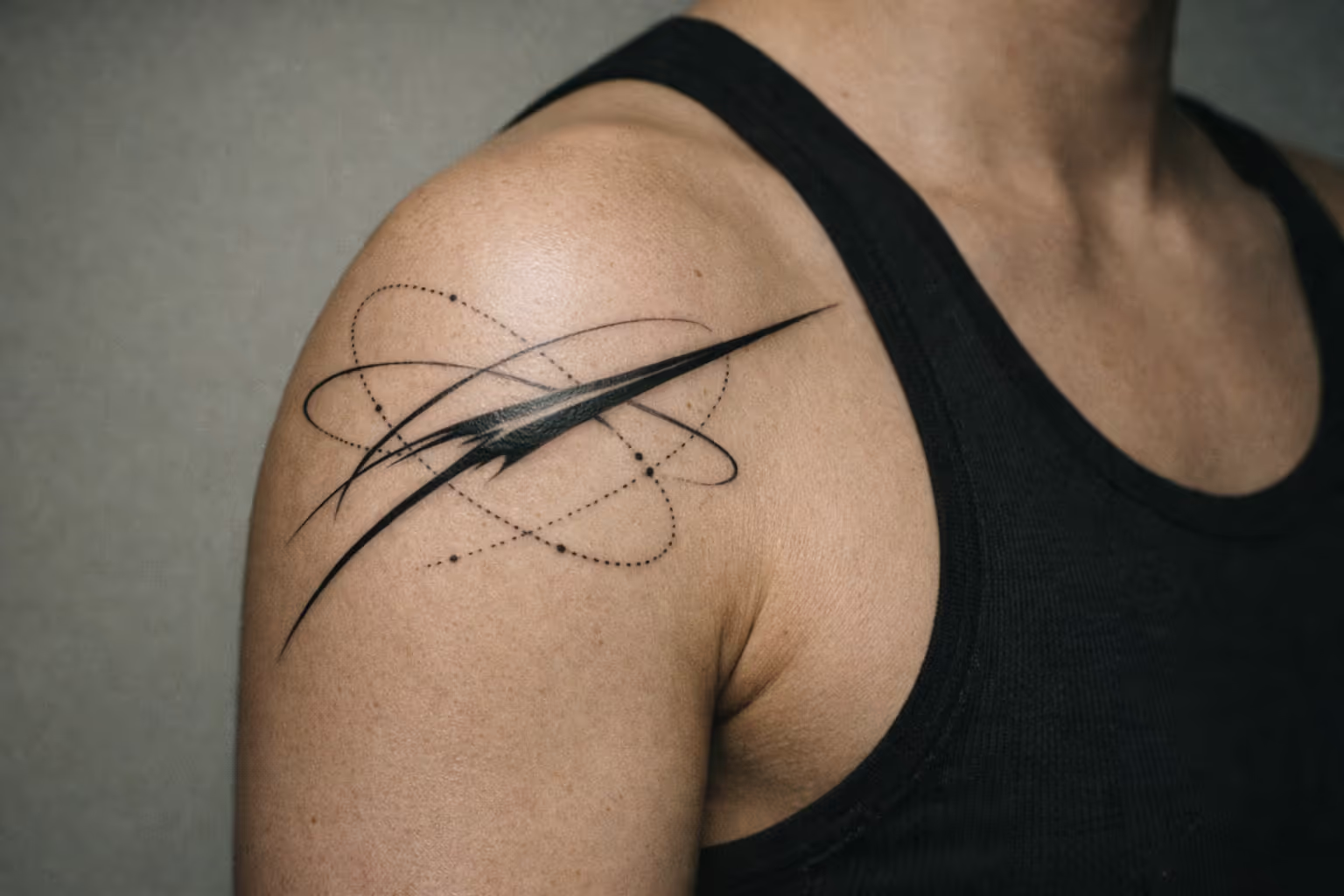
The sternum piece you keep seeing on your feed isn’t tribal. The lines are too thin, the spikes too deliberate, the negative space too intentional. A cyber sigilism tattoo is a fine-line blackwork style built from blade-tipped strokes, S-curves, and circuit-like accents, the opposite technical logic of the solid black masses that defined 90s tribal. By 2025 it had become one of the most searched tattoo styles online (4), and if you’ve already decided you like the look, what you actually need is the practical part: what makes it distinct, where those hairline strokes hold up on skin, and whether it’ll date the way barbed-wire armbands did.
Cyber Sigilism Tattoo: Honest Overview
✓ Pros
- Highly customizable: no fixed symbol dictionary, so the design is genuinely personal
- Works with body anatomy; the flowing, spike-terminated lines follow muscle contour naturally
- Pure blackwork ages more gracefully than color; no pigment to fade into muddy tones
- Scales from a small sternum cluster to a full back piece without losing coherence
- Negative-space-heavy design means slight line softening over time reads as refinement, not damage, if the piece is sized correctly
✗ Cons
- Ultra-fine lines (≈0.20 mm) fade faster than bold blackwork: visible softening in 3-4 years on sun-exposed skin and within 18 months on fingers, while protected placements stay crisp for 5-7 years
- Style is strongly tied to 2020s internet culture; risk of dating like 90s tribal is real and worth planning around
- Demands an artist with proven fine-line control; a shaky hand at 0.20-0.35 mm is immediately visible
- High-demand placements (hands, fingers, inner wrist) are the worst for longevity in this style
- AI-generated stencils are common and often unprintable at tattoo-ready resolution, so the artist has to rebuild them
What a Cyber Sigilism Tattoo Actually Is
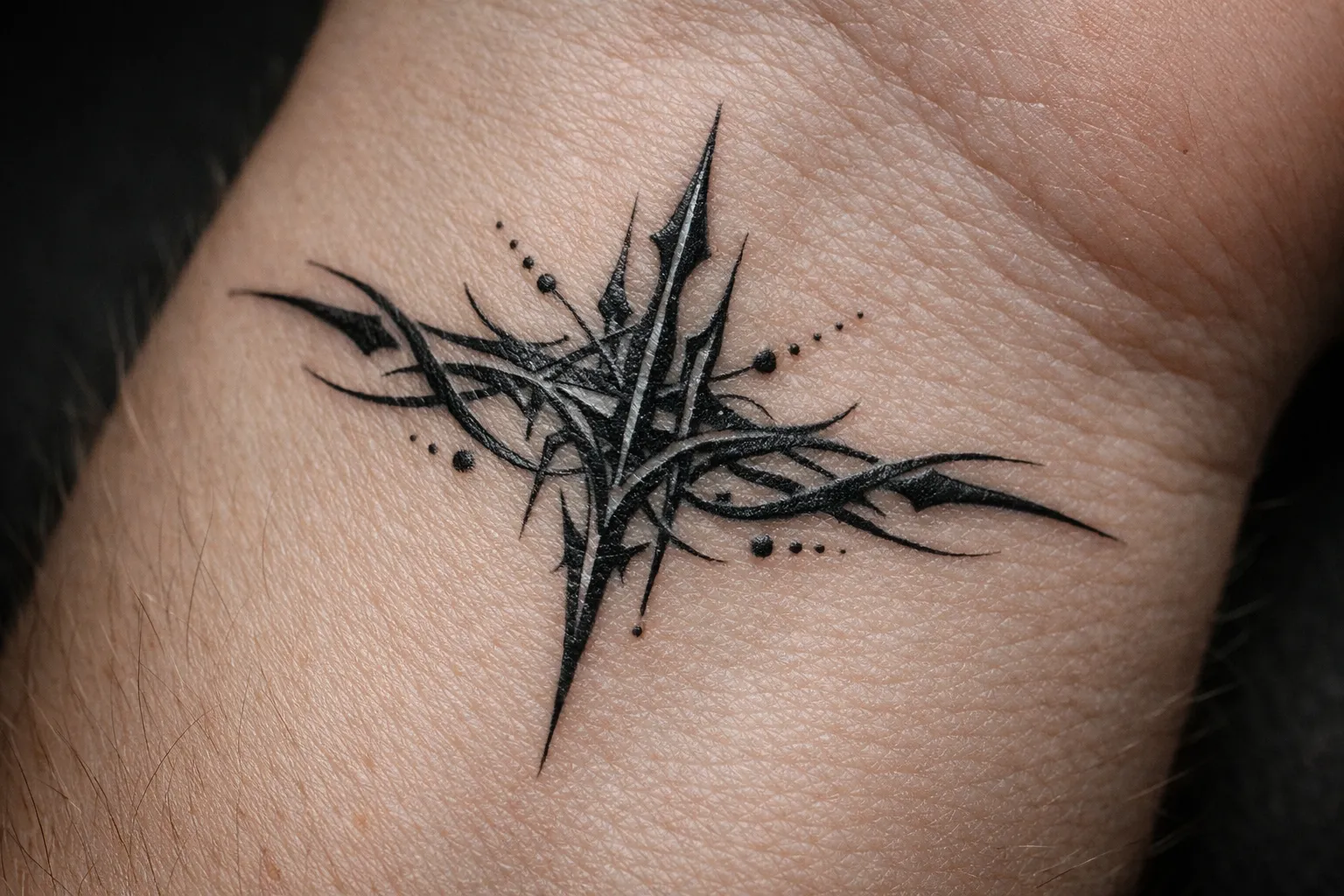
A cyber sigilism tattoo is a fine-line blackwork style that fuses occult sigil craft with the visual language of digital technology, rendered in hairline strokes with heavy negative space. The name isn’t a metaphor; it’s a literal design vocabulary. “Sigil” comes from Western occult practice: a symbol charged with intent, deliberately abstract so that its meaning is encoded rather than readable (1). “Cyber” is the aesthetic layer: circuit traces, glitch marks, the look of machines. Put together, you get a symbol whose meaning is yours alone, drawn in the vocabulary of the internet-native generation that made it.
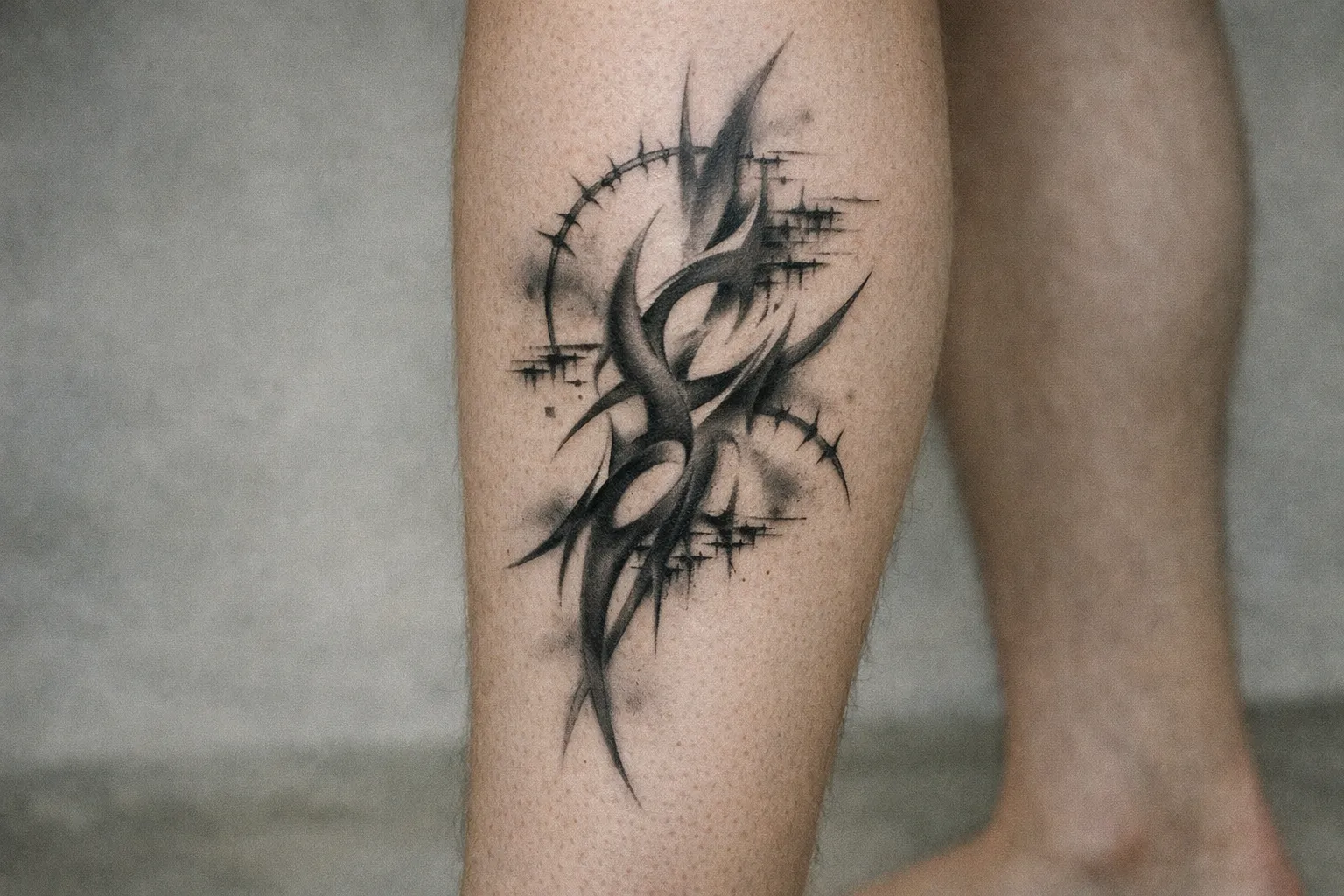
LA-based artist A.i (known as @cybersigilism and @aingelblood) began experimenting with cybernetic variants of sigils around 2018 (12). In an interview with 032c, the artist traces the aesthetic to video game culture of the early 2000s and describes a deliberate move away from traditional American tattooing, toward designs that feel meditative and intentional. The name itself came from a passion project about bodily autonomy and reclaiming one’s worth through magical symbols and ornamental shapes (11).
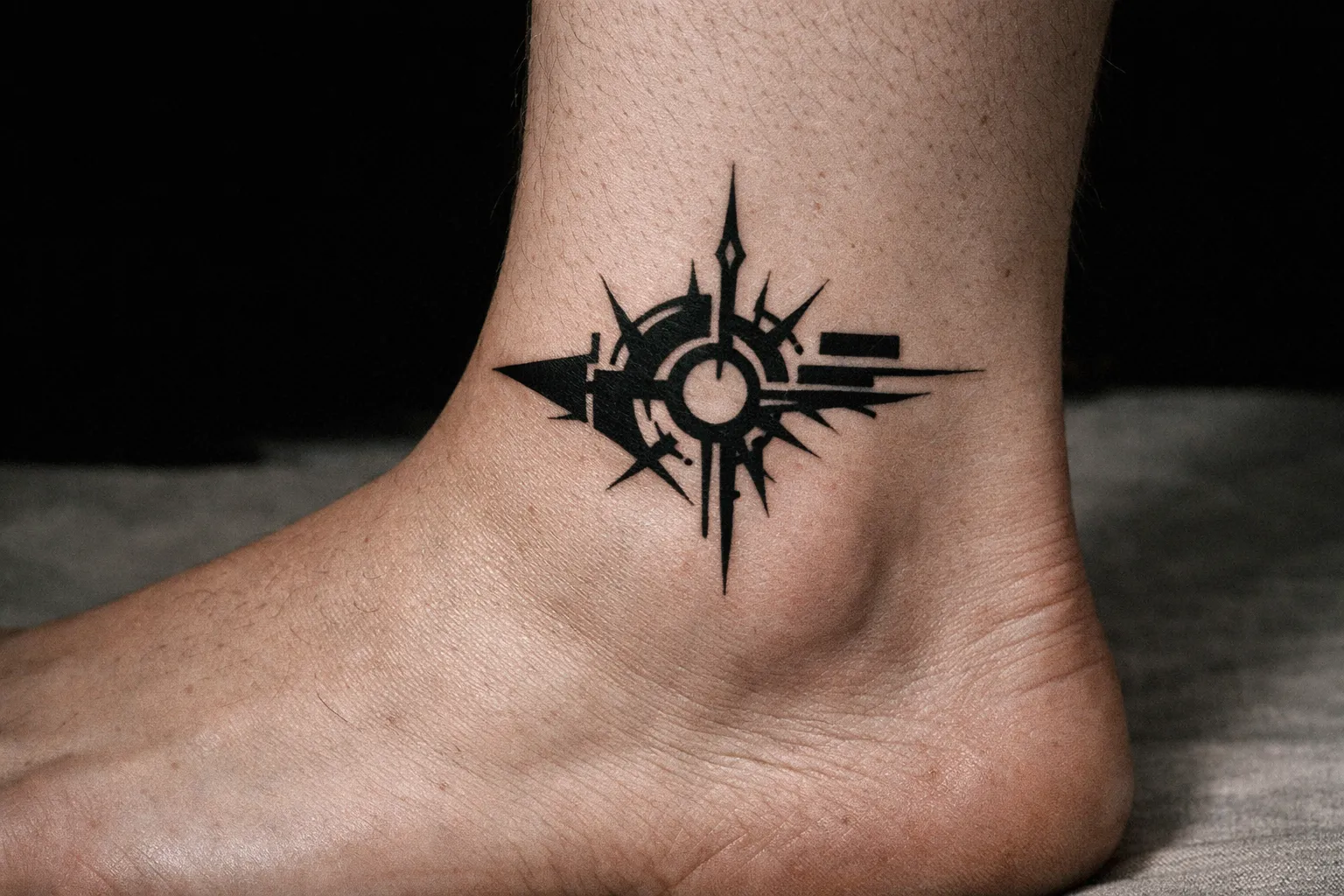
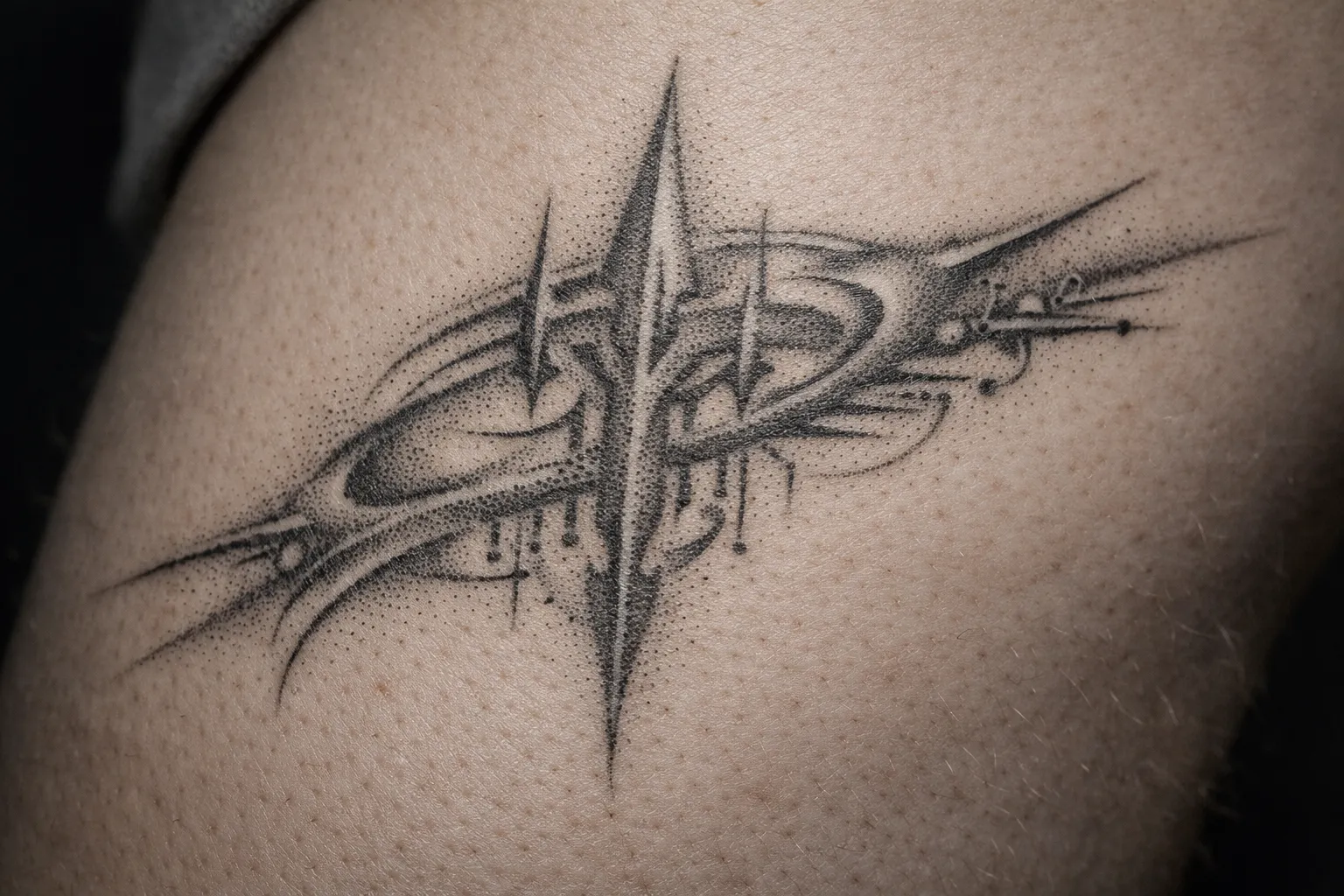
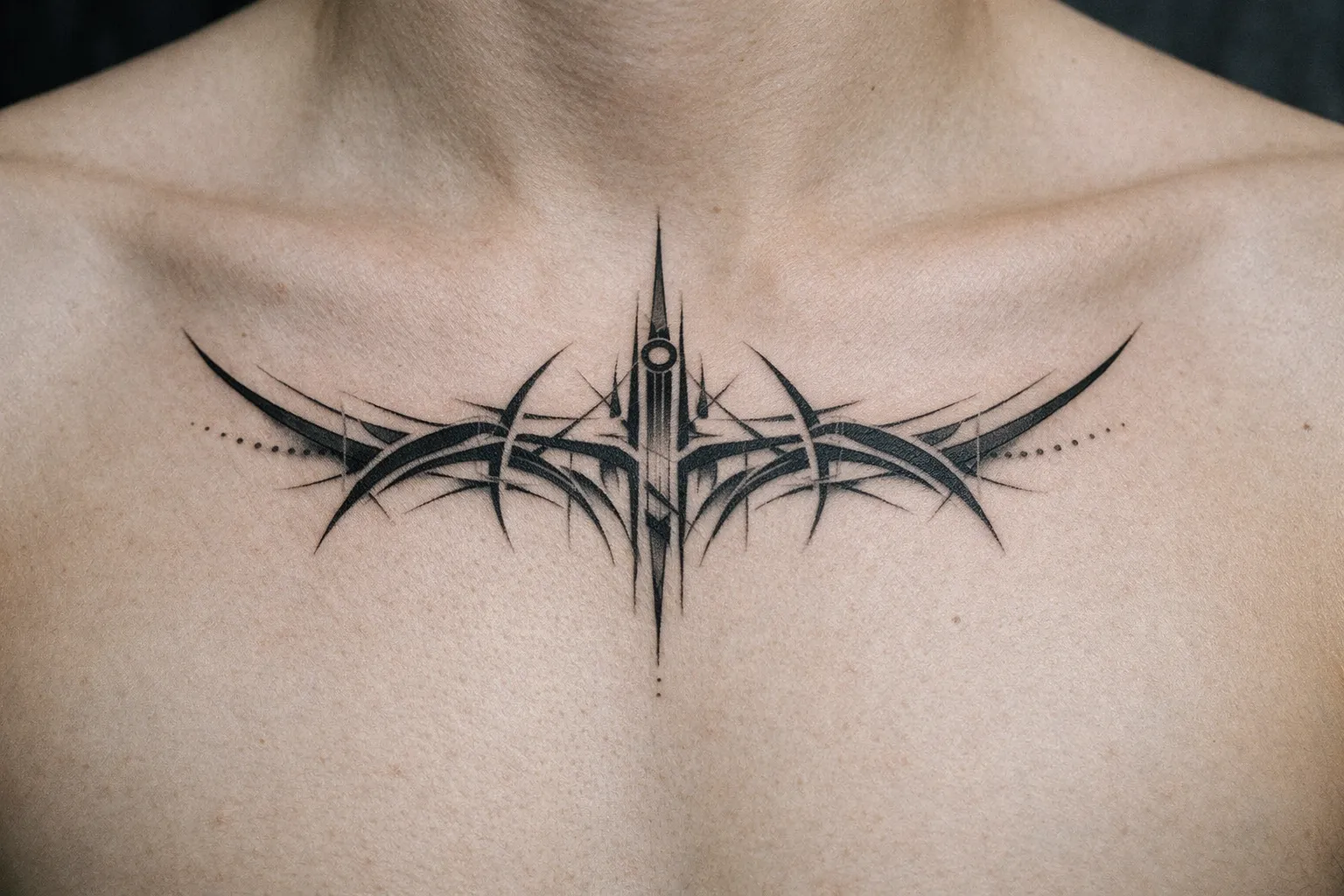
Every strong piece shares five visual hallmarks: blade-like spike terminals, wiry linework in the 0.20 to 0.35 mm range, S-curves and barbed arcs, circuit and glitch accents (dashed lines, dot trails, pixel fragments), and pure black ink with roughly 40 to 60% negative space (3). What it is not matters just as much. It’s not a thinner version of 90s blackwork, and not a spiritual practice in any formal occult sense: most glyphs are invented for visual composition and carry no fixed meaning (3).
Look closely at a good piece and you’ll often find hidden figures: butterflies, daggers, eyes, or angelic and feminine forms embedded inside the abstraction, rewarding a second glance (5). The design side has changed too. Tablets with symmetry assistants and AI image generators have made the look far easier to imitate, which one of the artists interviewed by 032c reads, in most cases, as a sign of opportunism (11).
The Visual Rules at a Glance
- Line weight: 0.20 to 0.35 mm, single-needle (1RL) or tight 3RL
- Ink: solid black only, with occasional soft grey wash as shadow
- Density target: 40 to 60% negative space by area
- Shape language: blade-like spikes, S-curves, barbed arcs, dot trails
- Composition: one hero cluster, a framing arc, scattered accent marks
Where Cyber Sigilism Came From (and Why It Isn’t Tribal)
Cyber sigilism emerged from late-2010s underground club culture and internet art scenes, not from any Indigenous tattooing tradition (5). A 2025 feature in 032c places its birth in Berlin, describing a style that “started growing like a weed in the dark corners of the Berlin club scene” (11). The term is most often credited to Aingelblood (A.i), an American LGBTQ+ tattooer (10). The designs went viral on TikTok in 2020 (12), marking the jump from underground aesthetic to mainstream trend.
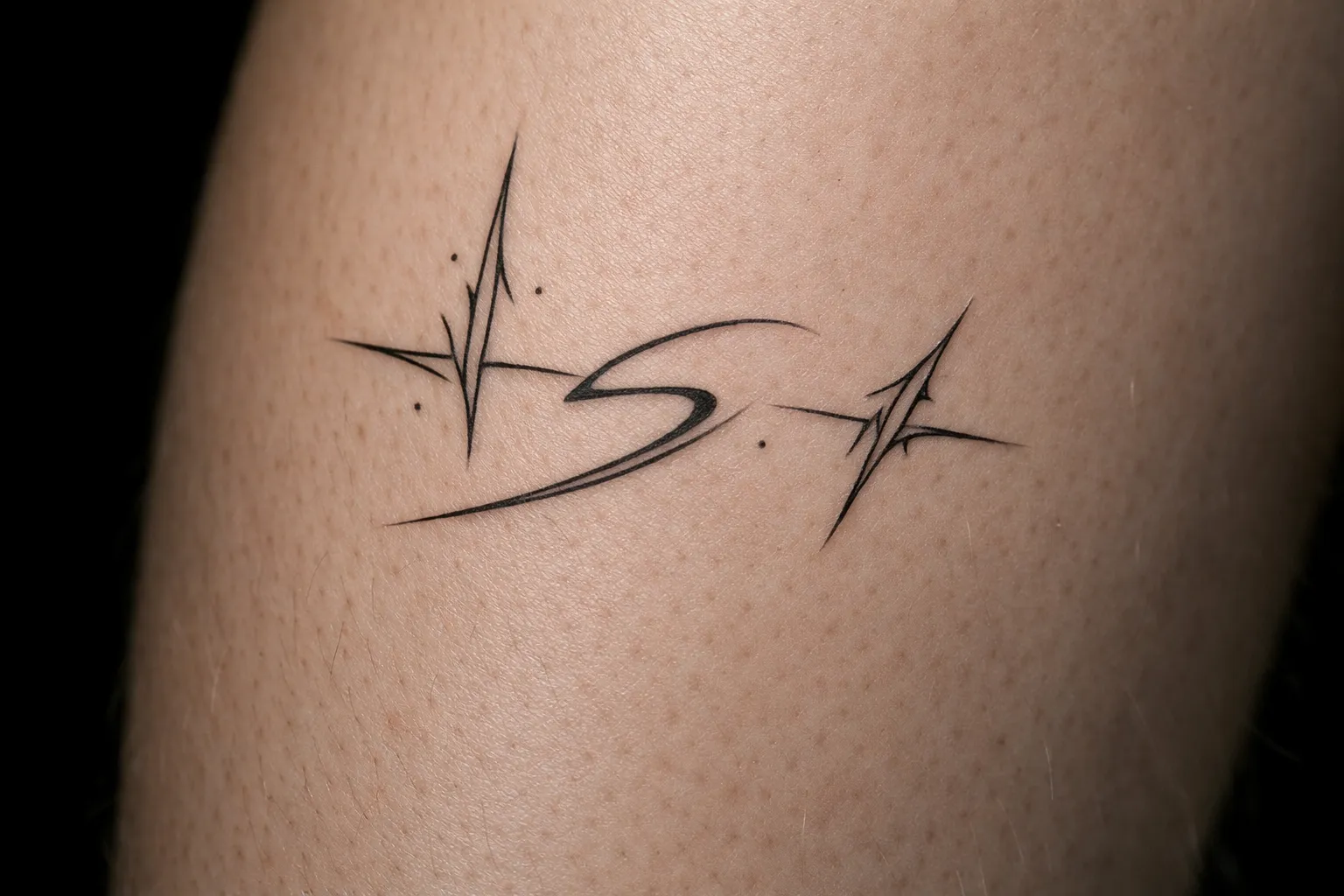
Its visual ancestors are specific, and none of them are tribal in the cultural sense: Y2K graphic design, extreme metal typography, and H.R. Giger’s biomechanical surrealism (5), plus the witch-house and darkwave music that grew up alongside it (10). In the early 2020s the look moved from Berlin club queues into high fashion, with close cousins on the runways of Vetements and Balenciaga (11), and into music branding (5), which is what cemented it as a broader visual code rather than a niche tattoo trend.
The tribal confusion is worth unpacking technically, because it’s the source of most misunderstanding. 90s tribal, shaped by the neotribal style Leo Zulueta established in the 1980s (10), uses multi-needle bold lines and solid black masses. Cyber sigilism uses 1RL to 3RL needles, hairline-to-fine strokes, and 40 to 60% negative space. That’s opposite technical logic. One fills space with mass; the other carves space with line.
Cyber Sigilism vs. 90s Tribal Tattoo Styles
| 90s Tribal | Cyber Sigilism | |
|---|---|---|
| Line Weight | Bold, multi-needle fills | 0.20-0.35 mm, 1RL-3RL |
| Black Coverage | Mostly solid black fill | 40-60% negative space |
| Shape Language | Rounded, flame-like, filled masses | Blade-like spikes, S-curves, barbed arcs |
| Cultural Roots | Polynesian/Māori-influenced neotribal | Late-2010s Berlin club and internet art |
| Aging Timeline | 25-30 years (bold fills hold) | 18 months to about 10 years, depending on placement and aftercare |
| Aging Failure Mode | Spreads but stays readable | Hairlines blur into soft grey |
On the cultural appropriation question: cyber sigilism is a deliberately internet-native, abstract style with no cultural symbols to appropriate (5). It borrows neotribal’s form language (flow, body-following shapes), not its cultural content. Studios that specialize in the style make that distinction explicitly.
The “controversial” label exists for two reasons. First, traditionalists mock it as a fad comparable to 90s barbed-wire armbands, and critics lean hard on the argument that its thin lines will age poorly (5). Second, the neo-tribal label keeps the appropriation debate alive, since 90s tribal itself drew on aesthetics from Borneo and Polynesia. As for whether it’s demonic: no. The “sigil” concept comes from Western occult practice, but most cyber sigilism glyphs are invented purely for composition and carry no formal occult meaning (3). The aesthetic borrows the look of mysticism, not the practice.
The Graphic Vocabulary: Design Families and What They Look Like
Knowing the main design directions lets you brief an artist intelligently instead of pointing at a Pinterest save. There are a handful of recognizable families, each suited to different placements and longevity goals.
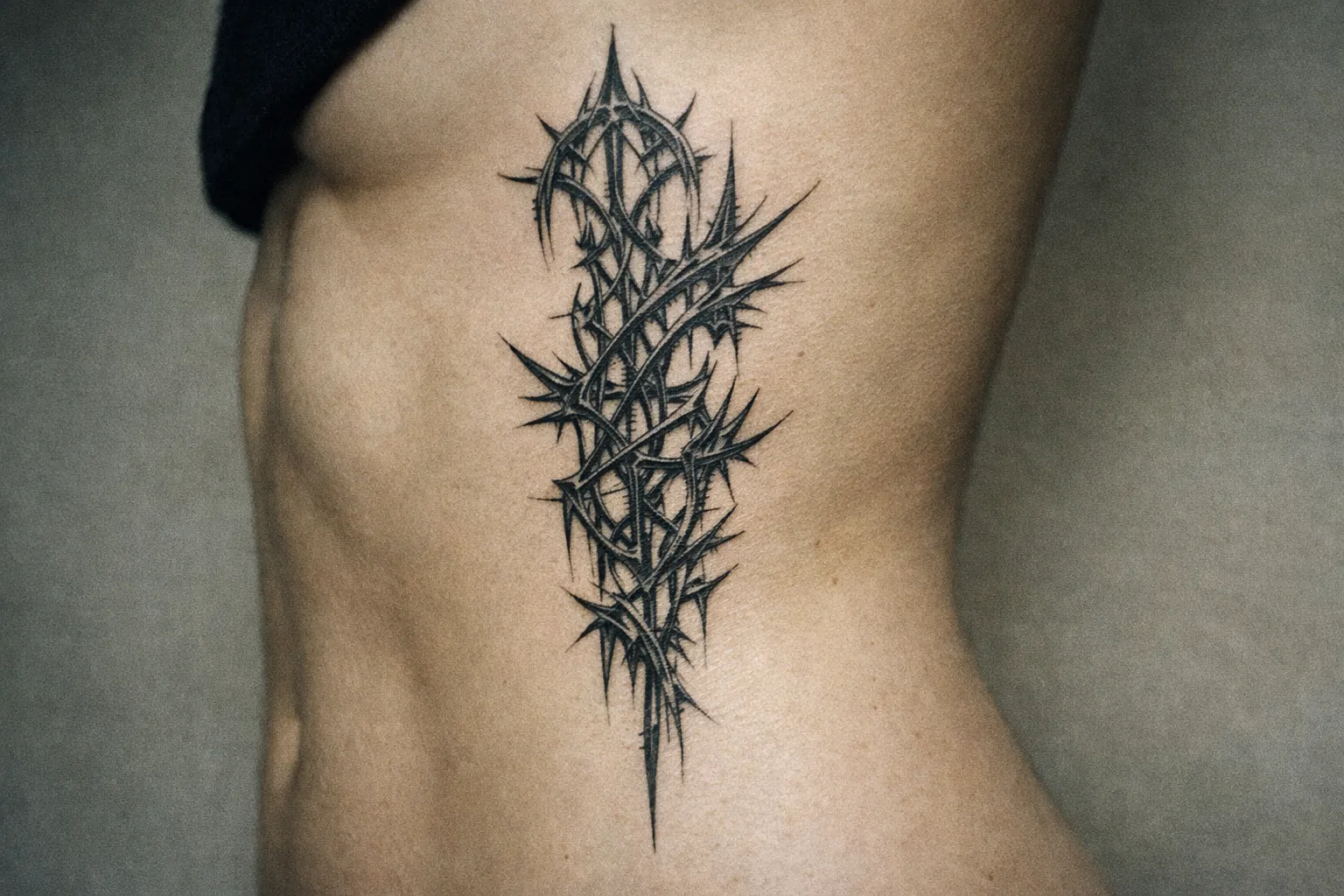
Gothic cyber sigilism pulls from blackletter, gothic arches, and medieval ornament, with more dramatic curves and darker, heavier anchors. It’s typically centered on the chest or back where the drama has room to read.
Organic and biomechanical work echoes H.R. Giger directly: forms read like alien tendons, vascular networks, or circuitry sitting under the skin. It’s less symmetrical and more body-following, which makes it demanding to design and place well.
Minimal micro-sigils are a single glyph or small cluster, suited to the wrist, behind the ear, or the collarbone, and a lower entry cost. The catch: they need slightly thicker lines to survive, because there’s no structural redundancy to fall back on when the finest strokes soften.
Medium “orbit” compositions are the most common format in portfolios: one hero cluster surrounded by orbital arcs and dot trails. They sit well on the forearm or calf, where a flat-to-gently-curved surface keeps the orbital lines geometrically clean (3).
Large architectural pieces (full spine, sternum-to-abdomen, full back) allow bolder lines and generous spacing, which is why they age best. Scale lets the artist use thicker structural strokes that hold their shape far longer.
Across all of these, hidden figures are the reward for close inspection. Recurring motifs include the cyber butterfly and a heart wrapped in spiraling thorns (7), cross-inspired symbols with blade-like forms (6), wings, and eyes. Many pieces spell a word or embed a message you have to look closely to read, which is a large part of why they feel personal to the wearer (7).
The design family that doesn’t work is copying a viral AI-generated design verbatim. Because cyber sigilism is built on body-specific flow, a composition that sits perfectly on one anatomy creates alignment problems on another. The best pieces are drawn on your body’s lines, not traced from someone else’s Pinterest save (5).
What to Bring to the Consultation
Bring references of composition (digital art, album covers, graphic logos) that capture the line sharpness and density you want, rather than finished tattoos you want duplicated. Your artist designs around your body; screenshots of someone else’s forearm piece don’t transfer. And raise this directly with your artist: never let a stencil be scaled down. The finest lines are already at the practical limit, and shrinking the design can make them drop out entirely (1).
Placement Strategy: Where Cyber Sigilism Holds and Where It Doesn’t
Placement is the single biggest factor in whether a cyber sigilism piece survives, because the style’s defining feature, hairline linework, fails fastest on the wrong skin. A useful frame is the “three read distances” principle: a strong piece should read across the room (the overall silhouette), at one meter (the major arcs and clusters), and up close (the fine sigils). If it only works at macro zoom, it will blur into noise within a few years.
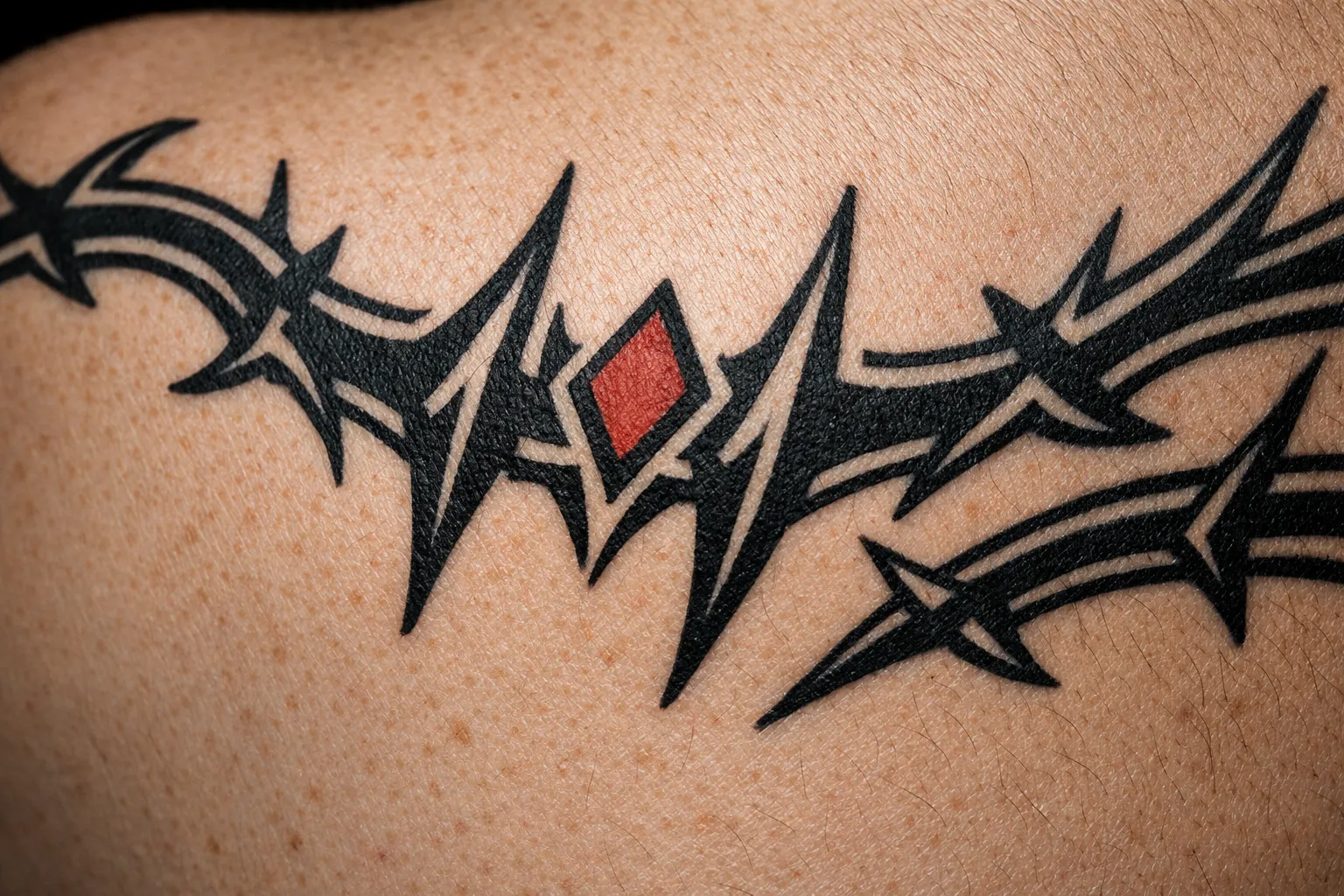
The placements that hold up share three traits: stable skin, low sun exposure, and low friction.
- Inner forearm is the most-requested spot for good reason. It’s a flat canvas, the wearer can see the piece without a mirror, and a well-executed piece stays crisp roughly 5 to 7 years before softening (3). Ideal for medium orbit compositions.
- Sternum is the classic cyber sigilism canvas: the design mirrors on the body’s own midline (1), and it stays protected from sun. Fair warning: it’s a bony, thin-skinned placement, and the pain is significant. A sternum tattoo is noticeably harder to sit through than a forearm piece, so it’s best reserved for experienced collectors.
- Spine is what some studios call the definitive cybersigilism placement: a symmetrical column from nape to lower back (5). Same pain caveat as the sternum, and our spine tattoo guide covers what holds there.
- Upper back and shoulder blades give a large, low-sun canvas where radiating compositions work well (4).
- Outer forearm and calf age moderately: sun-exposed but stable skin. Plan for visible softening in 3 to 4 years without daily SPF 50 (3).
The high-risk placements are, frustratingly, some of the most requested:
- Hands and fingers: ultra-fine sigil lines can blow out or fade within 18 months, because the skin regenerates faster and the ink migrates. If you commit anyway, use 0.35 to 0.40 mm lines and expect a touch-up at the two-year mark (3). The same fade reality applies to any finger tattoo, whatever the style.
- Inner wrist and side of hand: consistently flagged by artists. Certified Tattoo gives hands about two years before constant washing and sun exposure leave a blurry, faded mess, and calls the wrists, in constant motion and rubbed by clothing and accessories, tattoo purgatory for fine lines (13).
- Neck and nape: high-visibility and high-commitment, and sun exposure accelerates fading. Works better with slightly thicker lines.
I’ve had clients come in specifically requesting hand pieces in this style, and I tell them the same thing every time: you can do it, but you’re signing up for a touch-up in 18 months, not a decade of clean linework. Some people are fine with that. Know which one you are before you sit down.
Placement-by-Aging Matrix
- Inner forearm: crisp about 5-7 years
- Outer forearm: visible softening in about 3-4 years without SPF
- Sternum: crisp about 5-7 years (protected)
- Spine and upper back: among the slowest-aging placements (limited sun, low friction)
- Hands/fingers: 18 months to visible loss; 0.35-0.40 mm lines minimum
- Neck/nape: accelerated by sun; needs a daily SPF habit
How Cyber Sigilism Tattoos Age: The Honest 5-10 Year Picture
Cyber sigilism sits at the faster-fading end of the tattoo longevity spectrum. One style-by-style aging ranking puts fine-line and micro work at 5 to 10 years, the worst of the major styles, with lines under 0.4 mm able to blur within 5 years on fingers, feet, and wrists (9). Certified Tattoo describes the same spread from the studio side: some fine-line pieces still look decent after a decade, while others turn into a shadowy blob within three years (13). Sun-exposed work compresses that toward the lower end. That’s physics, not a knock on the style. Three forces work on every healed tattoo: macrophages slowly migrate ink particles (causing line spread), collagen breakdown reduces skin elasticity (distorting the design), and UV breaks down pigment (9). Fine lines start with less ink volume, so all three show on them sooner.
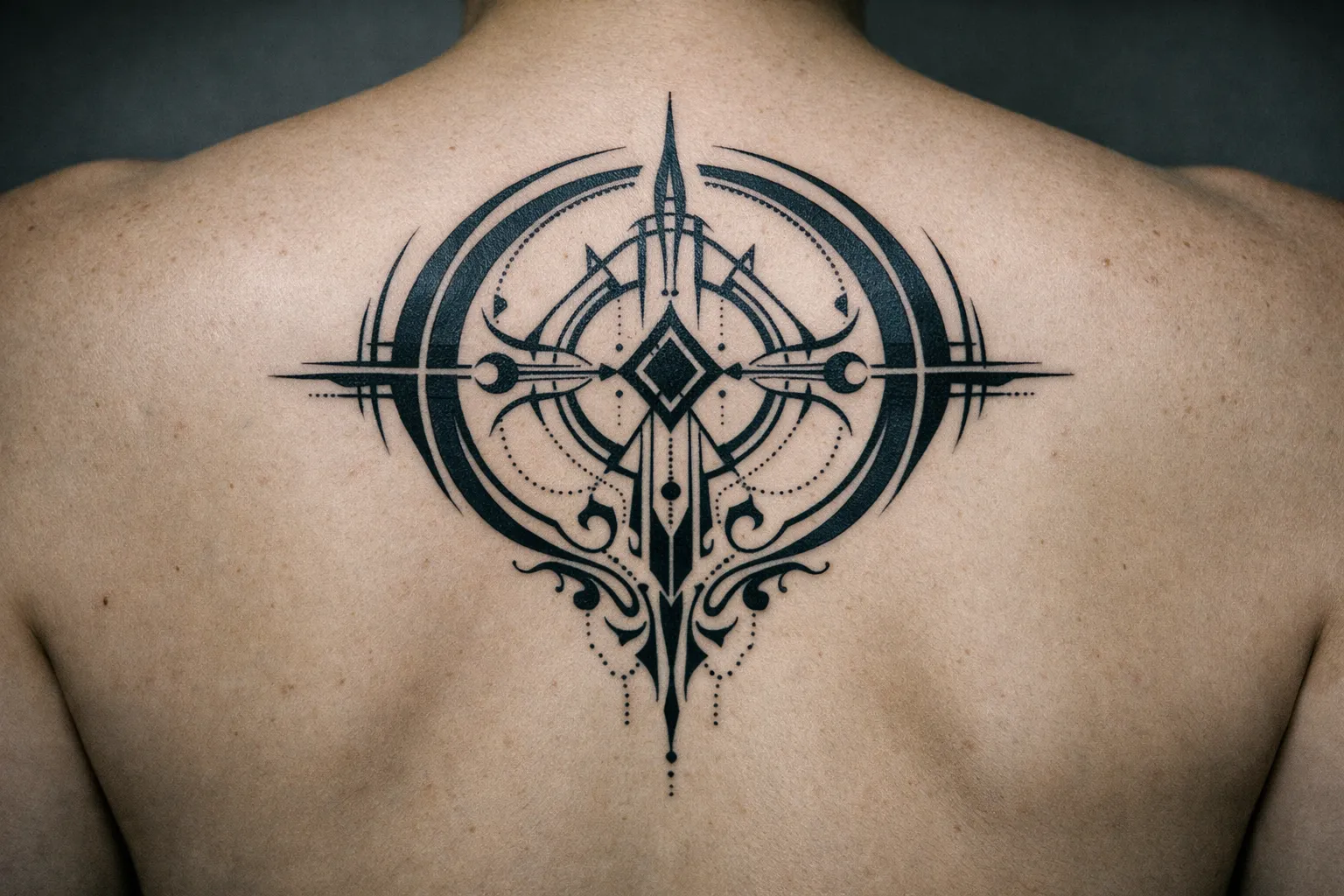
For a well-executed inner forearm piece, the year-by-year expectation runs like this. Year 0 to 1: the tattoo settles, with slight softening that’s normal and expected. Years 1 to 5: a stable plateau, with the finest lines just beginning to soften. Years 5 to 7: visible softening on hairline strokes, with dot fields fading first and solid arcs holding longer (3). From there, the fine detail is in touch-up territory. On sun-exposed skin (outer forearm, calf, hand), compress all of that, with visible softening arriving in 3 to 4 years (3).
Studios that tattoo the style say the same thing without drama. American Tattoo Society calls the aging risk real but manageable: properly spaced linework at adequate size, placed on low-friction skin, holds up well, while crammed micro-detail doesn’t (5).
The fix built into strong design work is the line-weight hierarchy. Good pieces use two or three weights: slightly thicker structural arcs around 0.35 to 0.40 mm, medium secondary lines, and ultra-fine accents. As the thinnest lines fade, the piece keeps its readable structure instead of collapsing into fuzz. Dot fields and stippling fade fastest of all: plan a touch-up on those elements by year 3 (3).
For comparison: American traditional work holds 30-plus years and bold blackwork 25 to 30, because bold shapes mask line spread (9). Cyber sigilism’s razor-thin detail sits at the opposite end of the aging spectrum. That’s the honest trade-off for the aesthetic, and worth accepting consciously rather than discovering later.
When clients ask me whether this style ages badly, I don’t say yes or no. I say it ages differently, and then I show them a healed example at five years so they can decide if they’re okay with that version of the piece.
What Slows the Clock
- Daily SPF 50 on any exposed tattoo, year-round: UV is the dominant aging accelerator, not just a summer concern
- Moisturize twice daily for the first six months; hydrated skin holds pigment more evenly
- Avoid retinol, glycolic acid, and physical scrubs directly over the piece; these degrade ink over years
- Plan touch-ups by year 3 for dot fields, year 5 to 7 for fine strokes
Designing a Cyber Sigilism Piece That Survives the Trend Cycle
The barbed-wire armband and the solid tribal panel are now shorthand for “dated 90s tattoo,” and cyber sigilism carries the same risk for the same reason. It’s tightly bound to 2020s internet culture, Y2K revival, and specific music scenes: sigilkore, krushclub, witch-house. The cultural specificity that makes it feel current is exactly what will date it. There’s no getting around that entirely, but there are concrete ways to weight the odds in your favor.
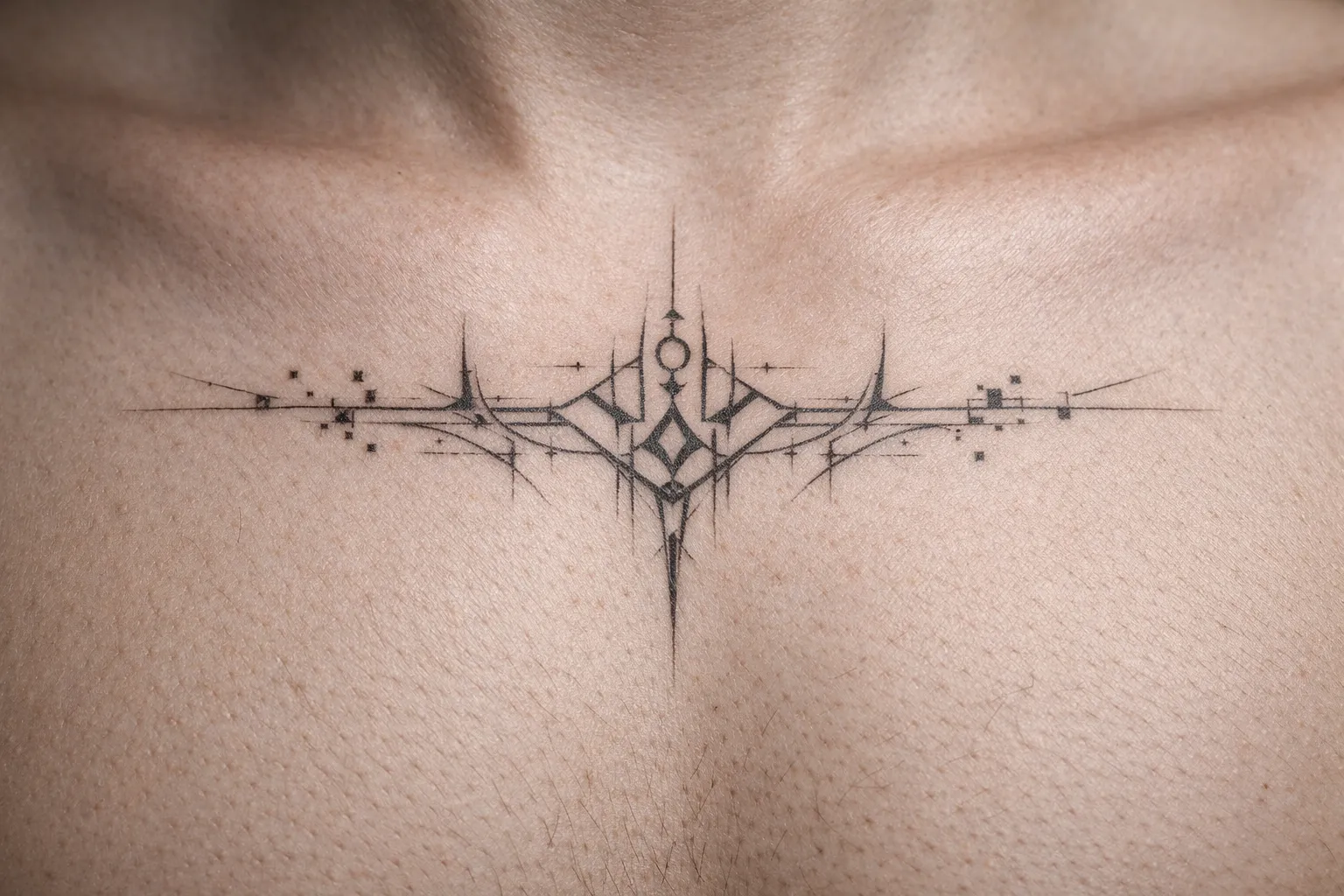
Build a personal symbolic alphabet. Assign meaning to specific spike forms, orbital breaks, and dot clusters. A.i’s own framing of the style is about intention rather than decoration (11), and a design built around personal meaning is harder to read as pure trend and more likely to feel relevant in 15 years than a generic Pinterest composition.
Size up instead of adding detail. Experienced artists prefer increasing scale and spacing over cramming micro-detail at the same size. Larger pieces with moderated detail stay legible longer, on the same principle that keeps bold traditional work readable.
Integrate solid blackwork anchors. Small areas of solid black, dotwork gradients, or geometric frameworks borrow longevity from blackwork and geometric traditions. They stabilize the composition visually as the fine lines soften, so the piece degrades into something intentional rather than something vague.
Avoid copying viral designs. Beyond the anatomy-alignment problem, a custom composition is inherently harder to date because it isn’t a screenshot everyone else also got. Body-mapped work is both more personal and more future-proof.
Choose adaptable layouts. Designs with clear negative space and modular structure can be extended or integrated into future styles (geometric, blackwork, ornamental) rather than sitting as a closed, trend-specific panel that can only ever be covered up.
There’s a real spectrum here, and neither end is wrong as long as the choice is conscious. Visible placements like the neck and hands with intricate shapes accept faster aging and possible dating in exchange for immediate impact. Larger-scale back and thigh pieces with moderated detail are designed to stay readable for much longer. Decide which trade you’re making before you’re in the chair.
Finding the Right Artist and What to Expect in the Chair
Vet artists on their healed portfolio at three to five years, not just fresh work. Fresh cyber sigilism looks stunning on everyone; healed examples are where blowouts and rapid fading show up. Look for consistent 0.20 to 0.35 mm line control, clean single-needle work, and body-flow composition: the design should follow muscle structure, not just sit on top of it. An artist who pushes back on a design that’s too dense or too small is more trustworthy than one who says yes to everything.
Ask specifically how they handle stencils. Cyber sigilism is hugely popular on AI image platforms, and AI-generated linework is often low-resolution and unprintable at tattoo-ready scale. A good artist rebuilds the stencil from scratch rather than printing AI output directly. Related discipline: print the stencil at 100% scale and check the calibration ruler on the sheet (1).
Session lengths run shorter than heavy blackwork because it’s primarily linework. A small single-cluster piece (2 to 3 inches) takes 90 minutes to 3 hours including stencil placement. A forearm composition (5 to 7 inches) runs 4 to 6 hours in one session. A half sleeve of three to five clusters takes two to three sessions of around four hours each, spaced three to six weeks apart to let skin heal between passes (3).
On cost, in North American and Western European markets: shop minimums for fine-line black-ink work sit at $150 to $250, a competent fine-line artist charges $180 to $350 per hour, and named cyber sigilism specialists with six-month-plus waitlists run $400 to $600 per hour (3). By project: a small single-cluster piece runs $250 to $500, a forearm composition $500 to $1,200, a half sleeve $1,500 to $3,500, and a full sleeve $4,000 to $9,000 across three to five sessions (3). Equivalent-quality work in Southeast Asia and Eastern Europe runs 40 to 60% lower than Western rates (3).
For the appointment itself: bring composition references (not finished tattoos), wear clothing that exposes the placement cleanly, eat a real meal beforehand, and bring water and a snack for anything over two hours. Fine-line work is faster than blackwork, but the concentration it demands means longer uninterrupted stretches on the machine (3).
Red Flags in a Portfolio
- Only fresh photos, no healed examples at the 3-to-5-year mark
- Visible blowouts on fine lines
- Designs that look copied from Pinterest rather than custom-composed
- No evidence of body-flow awareness: pieces that sit flat and ignore muscle structure
Aftercare That Protects Fine-Line Work
The first weeks set the tone for the next decade, but with fine-line work the long-term habits matter even more than the initial heal. The general tattoo aftercare rules apply; here’s how the timeline plays out for fine-line work.
Days 1 to 3: Follow your artist’s wrapping protocol, second-skin or cling film. Wash twice daily with a fragrance-free antimicrobial soap, then pat dry. No rubbing.
Days 4 to 14: Apply a thin layer of the recommended healing balm or a fragrance-free lotion. Avoid submersion, scratching, and direct sunlight entirely.
Weeks 3 to 6: Transition to a lighter lotion. Once the piece is fully healed, begin applying SPF 50+ mineral sunscreen.
The long-term habits are the ones that actually decide fine-line longevity. Apply daily SPF 50 to any exposed tattoo, year-round rather than only in summer, since UV is the dominant aging accelerator. Moisturize twice daily for the first six months, then switch to a ceramide-rich lotion. And avoid retinol, glycolic acid, and physical scrubs directly over the piece, since these degrade ink over years (3).
Build touch-ups into your plan from the start. Dot fields and hairline strokes often need a refresh by year 3 to 5; larger structural arcs around 0.35 to 0.40 mm last longer. Returning to the original artist keeps the linework consistent.
Frequently Asked Questions
- What is a cyber sigilism tattoo?
- A fine-line blackwork style defined by blade-like spike terminals, 0.20-0.35 mm linework, S-curves, circuit/glitch accents, and pure black ink with 40-60% negative space. It grew out of late-2010s Berlin club and internet art scenes, went viral on TikTok in 2020, and is categorically different from 90s tribal.
- Why is cybersigilism controversial?
- Traditionalists see it as a fad tied to 2020s internet culture likely to date. The 'neo-tribal' label raises appropriation concerns since 90s tribal borrowed from Indigenous Polynesian and Bornean traditions. Studios that specialize in it describe it as internet-native and abstract, with no cultural symbols in it.
- Is cybersigilism demonic?
- No. 'Sigil' comes from Western occult practice, but most cyber sigilism glyphs are invented purely for visual composition with no formal occult meaning. The aesthetic borrows the look of mysticism without the practice.
- How big should a $500 tattoo be?
- In 2026 North America and Western Europe, $500 covers a small single-cluster cyber sigilism piece about 2-3 inches, roughly 90 minutes to 3 hours at a shop minimum or lower hourly rate. Specialist rates may cover only consultation and small accents. In Southeast Asia and Eastern Europe the same work costs 40-60% less, so the same budget goes considerably further.
- Do cyber sigilism tattoos age badly?
- They age faster than bold blackwork due to fine lines. Lines around 0.20 mm on sun-exposed skin soften visibly in 3-4 years, and on fingers within 18 months. Protected skin pieces stay crisp 5-7 years before softening. Dot fields fade first. Proper sizing, spacing, and daily SPF 50 help the style age into a softer version rather than illegibility.
- Can I get a cyber sigilism tattoo on my hands or fingers?
- Yes, but ultra-fine lines fade or blow out within 18 months due to friction and washing. Use 0.35-0.40 mm lines, simpler shapes, and clear breathing room. Expect touch-ups at two years. Detail won't match inner forearm pieces.
- What makes a cyber sigilism artist worth booking?
- Healed portfolio examples at 3-5 years, clean single-needle or 3RL linework with no blowouts, custom body-flow composition, stencil rebuilding from AI designs, and honest sizing conversations. Artists who push back on overly dense designs are more trustworthy.
- Will cyber sigilism date like 90s tribal?
- Possibly. It's tied to 2020s internet culture and specific music scenes, which may date it. Mitigate by building designs around personal symbolic content, sizing up instead of adding micro-detail, integrating solid blackwork anchors, and choosing adaptable layouts for future style extensions.
The Bottom Line
Whether a cyber sigilism tattoo still works in ten years comes down to three decisions made before the needle touches skin. Placement: inner forearm, sternum, and upper back hold; hands and fingers don’t. Line weight: use 0.35 to 0.40 mm structural arcs with finer accents on top, never hairline-only, so the piece keeps its structure as the thinnest lines soften. Artist: healed portfolio at three to five years, custom body-mapped composition, and honesty about density limits.
Get those three right and daily SPF 50 does most of the rest. And if the style’s cultural moment concerns you, design around personal symbolic content rather than trending motifs: a piece built on intent is far harder to date than one built on aesthetics alone.