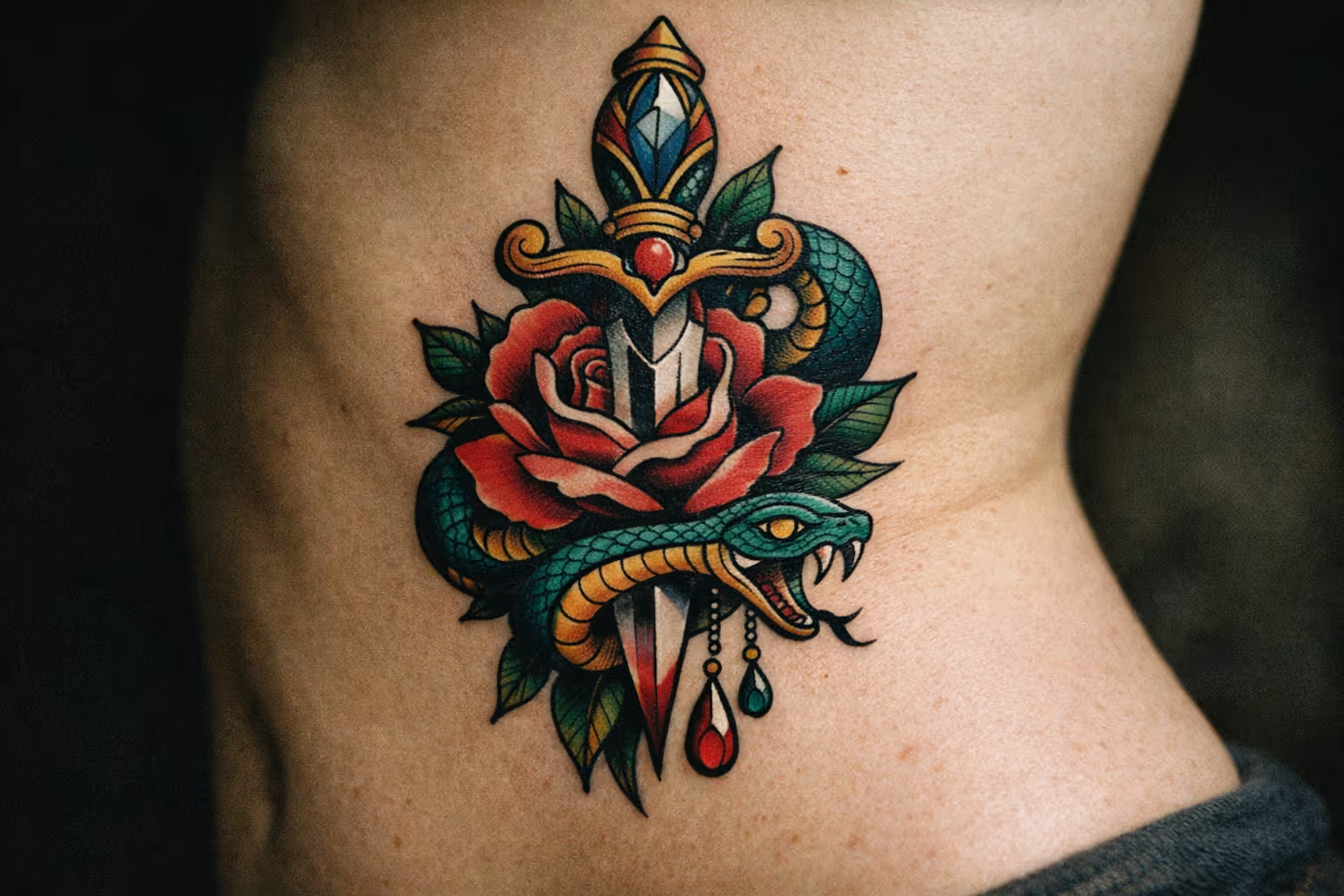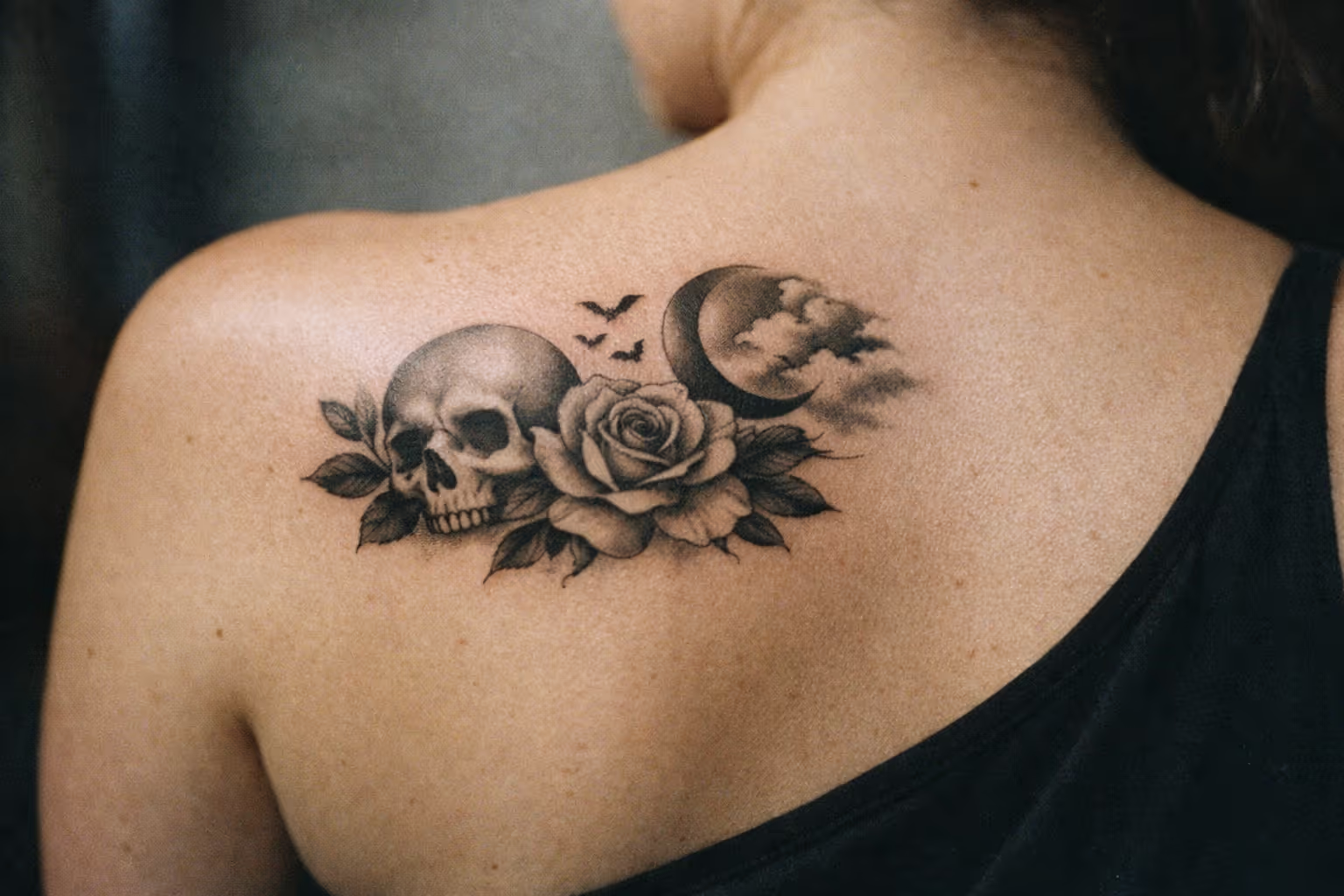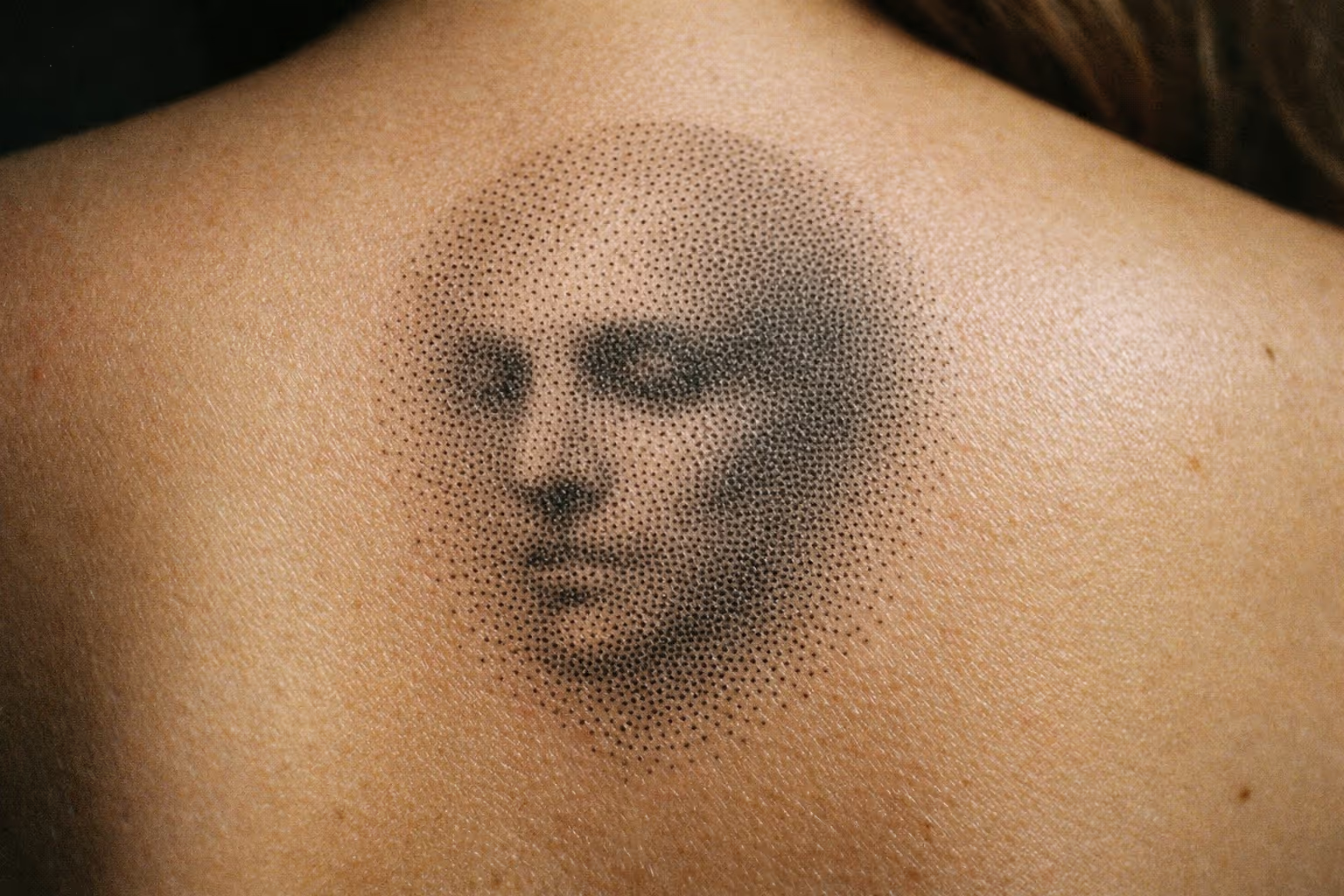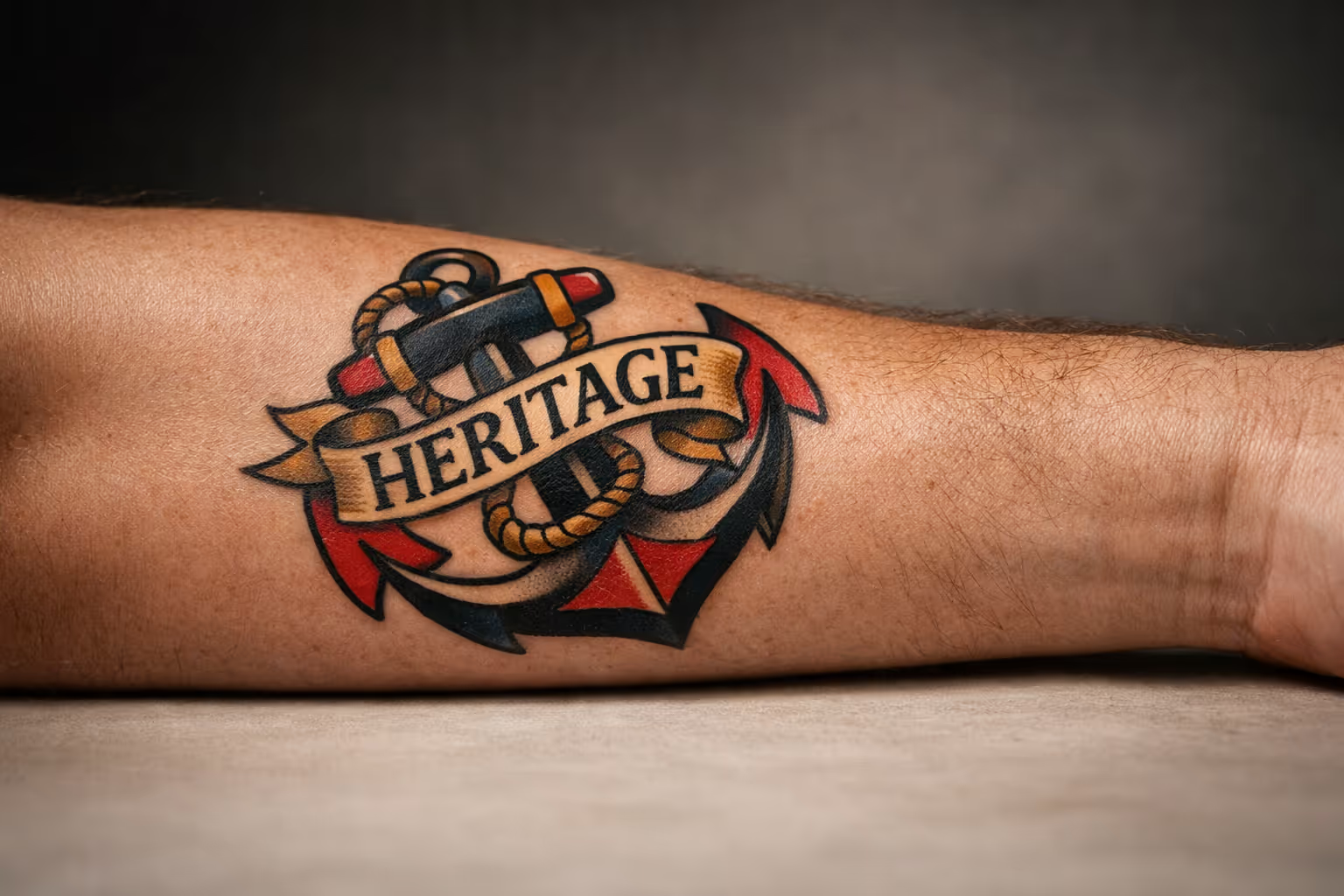
American traditional tattoo styles are the ones that still read cleanly at 20 years - and that longevity is the whole point of the style, not a lucky side effect. Bold single-weight lines and a tight four-color palette were built to survive decades of skin movement and sun, exactly where fine-line and pastel work blurs. If you want a piece that ages instead of fades, this is the school engineered for it. Here’s what defines it, and what a sleeve runs ($1,500-$6,000).
What Defines the American Traditional Tattoo Styles
American traditional tattoo styles - also called old school, Western traditional, sailor style, or classic - were codified in 1930s-40s shops near U.S. naval ports. Artists like Norman “Sailor Jerry” Collins, Bert Grimm, Don Ed Hardy, and Lyle Tuttle set the rules (2). The rules are strict, and that’s the point. Strict rules are why these tattoos still look like tattoos 40 years later.
Two technical hallmarks define the style:
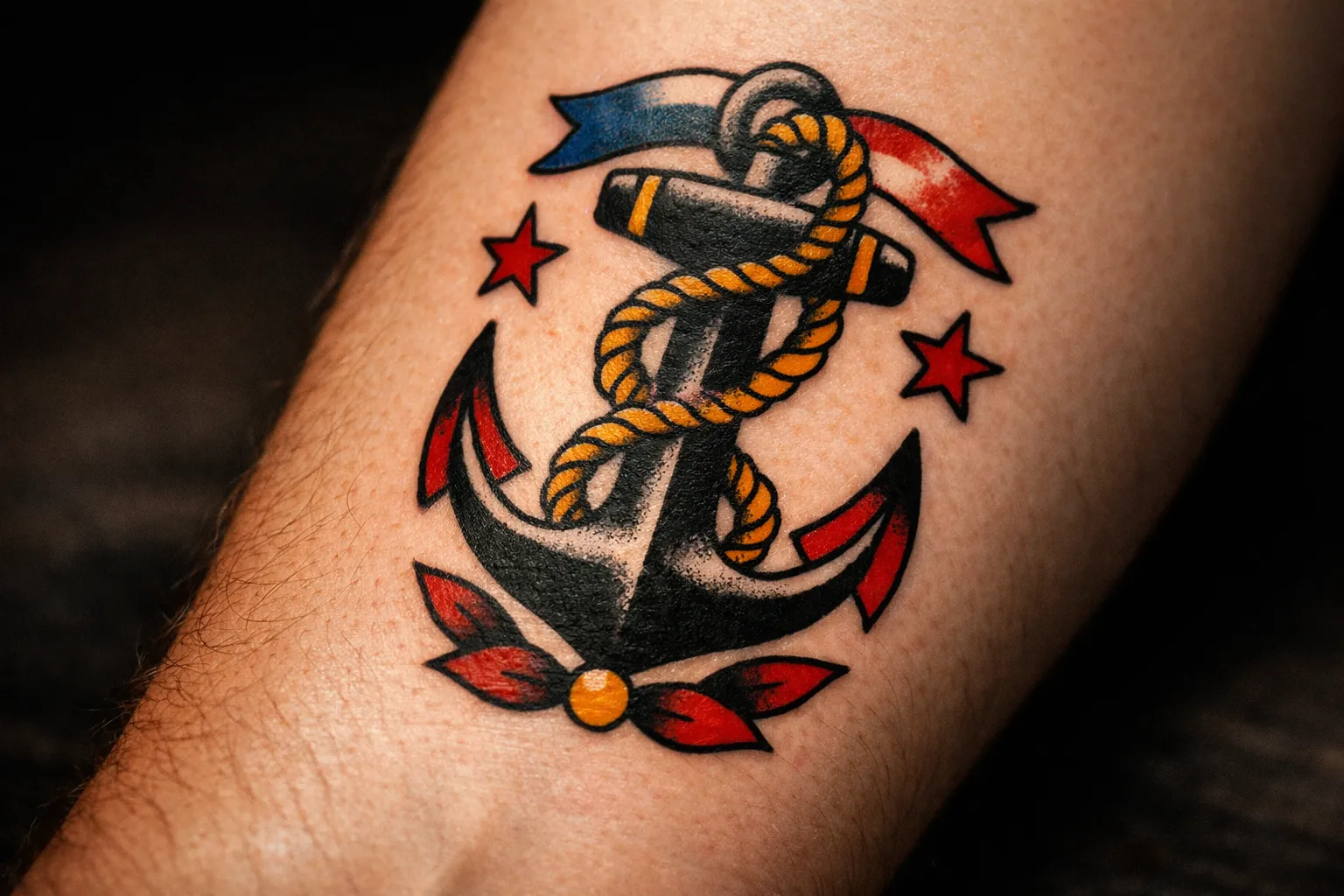
- One line weight throughout. Purists work with a single round liner - commonly an 11 or 14 RL - so every outline has the same thickness. No tapering, no hairlines (4). The result is a silhouette that reads from across the room.
- A limited, super-saturated palette. Red, yellow, green, black, sometimes blue or brown. Black underpins every color block, which is what keeps roses red and not orange-pink after a decade in the sun (4)(5).
The common pitfall: artists who trained on neo-traditional or illustrative work try to “improve” old school with extra colors, soft shading, or thin detail lines. It looks great healed at 6 weeks and muddy at 6 years. I’ve seen this happen enough times that I’ll say it plainly - if you want American traditional, you want flat color, hard black, and a silhouette you could recognize as a wallet outline.
The style also ages better on a wider range of skin tones than fine-line or watercolor work. Heavy black outlines hold contrast where micro-shading disappears (4)(5).
✓ Pros
- Design rules ensure tattoos remain legible and bold for decades
- Strong black outlines maintain contrast on diverse skin tones
- Limited color palette reduces fading and color shift over time
✗ Cons
- Strict style rules limit artistic flexibility and color variety
- Poorly executed attempts at soft shading or extra colors can muddy the design
- Heavier color packing requires more intensive aftercare
Common Motifs and Features
Every old school flash sheet pulls from the same iconography. These motifs were originally tied to sailors, soldiers, and working-class subcultures, and most carry layered meanings - some of which have shifted considerably in modern Western tattoo culture.
Animals
- Eagles (patriotism, freedom, courage)
- Swallows and sparrows (a sailor’s mileage at sea - originally one swallow per 5,000 nautical miles)
- Panthers, tigers, snakes (power, danger, protection)
- Wolves and bears (loyalty, strength)
Objects
- Anchors (stability, “hold fast”)
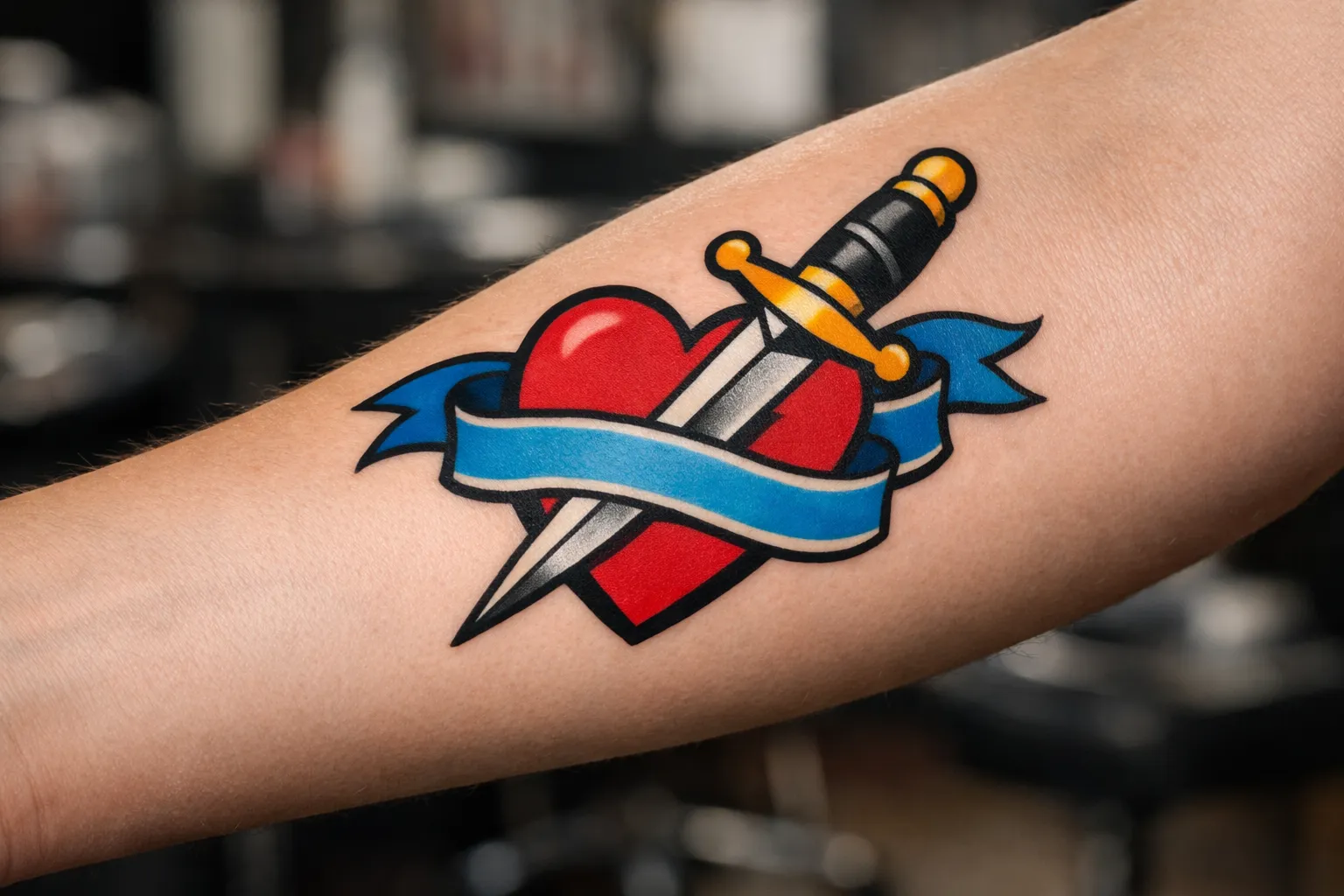
- Daggers (sacrifice, betrayal - often paired with a heart or rose)
- Hearts, banners, horseshoes, dice, skulls, pistols, ships
Human figures
- Pin-up girls, hula girls, lady heads, sailors, cowboys
Flowers
- Roses, peonies, lotuses, chrysanthemums - drawn with 3-7 chunky petals and a solid black shadow block, never delicate botanical detail
For sleeves and chest panels, filler vocabulary matters just as much as the anchor pieces: stars, dots, leaves, water swirls, banners with 1-3 words, and small repeating shapes that fill 30-50% of the negative space and stitch the larger pieces together visually.
27 American Traditional Tattoo Ideas Worth Stealing
1. The Howling Wolf Head
Aggressive, almost cartoonish wolf heads have been on flash sheets for nearly a century. Best at 4-6 inches on the outer bicep or thigh - small wolf heads lose the snarl detail fast.
2. American Traditional Eagle Tattoo
Eagles are the cornerstone american traditional chest tattoo. A spread-wing eagle running collarbone to collarbone at 10-12 inches wide is the classic - bold, symmetrical, and built around the natural curve of the pecs.
3. Heart and Dagger
A dagger slicing a heart with three blood drops. Reads well at 3-4 inches on the forearm or outer bicep. The meaning ranges from betrayal to sacrifice depending on the banner you add.
4. American Traditional Tattoo Sleeve
A full American traditional tattoo sleeve runs from shoulder to wrist with 5-7 anchor motifs plus filler. Full breakdown on cost, hours, and layout below.
5. King of Hearts
Playing cards have been old school staples since the Korean War era. Works as a single card at 3-4 inches on the forearm, or as part of a card-spread piece.
6. Woman of the Apocalypse
A crowned lady head with a halo of stars, traditionally referencing the Virgin Mary from Revelation. Best at 5-7 inches on the upper arm or thigh - smaller and the facial features blur.
7. Zombie Cowboy
A skeletal cowboy under a sun. Combines two old school favorites - the cowboy and the skull. Good tricep or outer shoulder piece at 4-6 inches.
8. Rose and Dagger
The rose says beauty, the dagger says it’ll cost you. 3-5 inches works on the forearm; scale up to 6-8 inches for the thigh.
9. Mini Scorpion on the Wrist
A small all-black scorpion at 1.5-2 inches. Honest caveat: wrists get a lot of sun and friction, so even bold black work needs reliable sunscreen to stay sharp past year five.
10. Deer in the Flames
A leaping deer surrounded by flame tongues. Reads best at 6-8 inches on the thigh, calf, or upper back - too much linework to shrink small.
11. American Traditional Butterfly
Symmetrical, flat-color butterflies with bold outlines. Skip the realistic wing patterns - old school butterflies are graphic shapes, not nature studies. 3-4 inches on the shoulder blade or sternum.
12. American Traditional Snake
Coiled snakes with diamond-pattern backs, often paired with a rose or dagger. A snake wrapping the calf at 8-10 inches is a workhorse design.
13. Colorful Roses
The most common American traditional flower tattoo. A single rose is 2-3 inches; a cluster of three for the shoulder or thigh runs 5-7 inches. Stick to traditional reds, pinks, and yellows for longevity (4).
14. Anchor
A 3-4 inch anchor with a banner reading “Hold Fast” or a name. Forearm or outer calf. Sailor Jerry’s original anchor flash is still tattooed almost daily.
15. American Traditional Ship
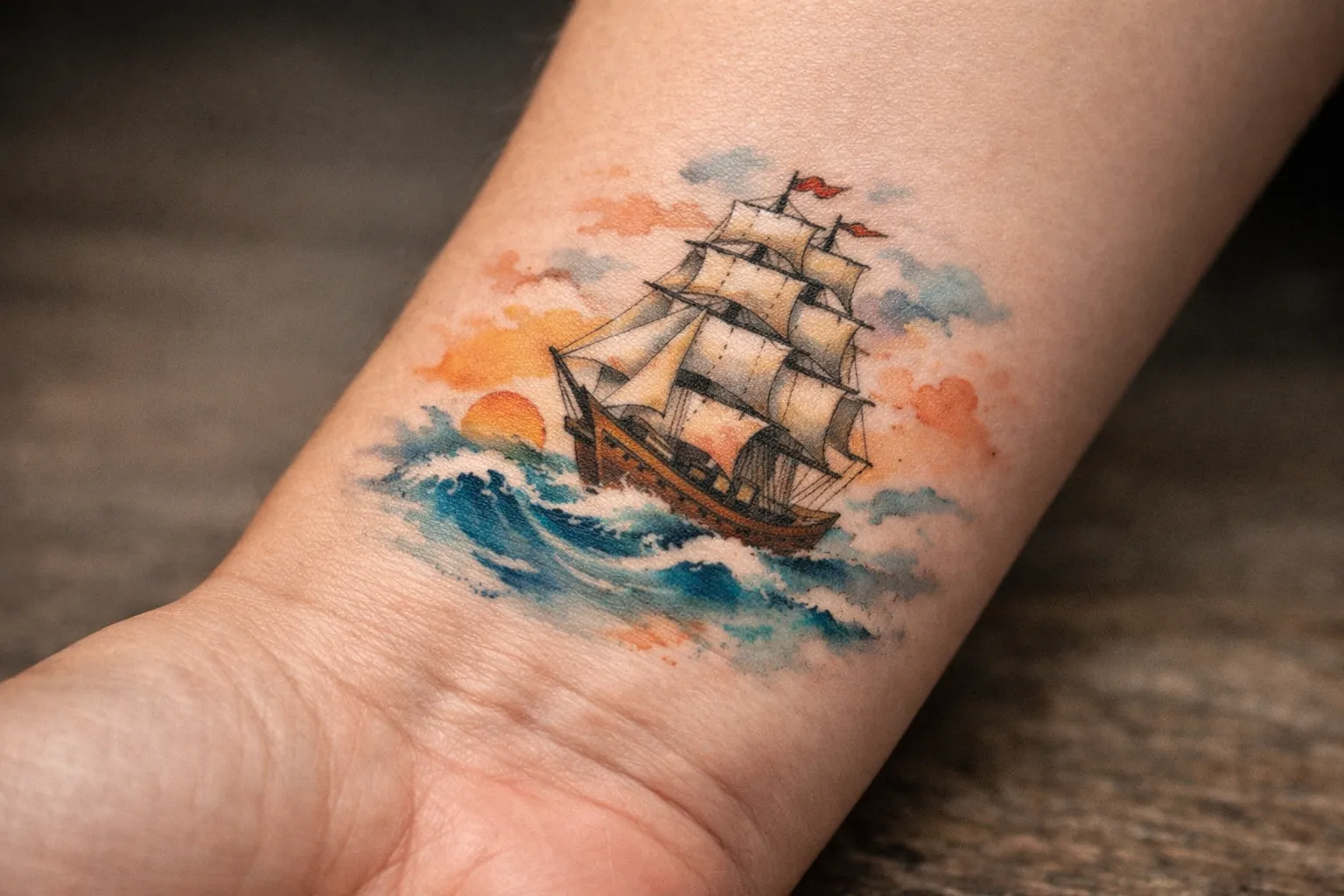
A clipper ship under full sail, often with a sun or moon behind it. Needs at least 5 inches to read - the rigging gets lost at smaller sizes.
16. Hummingbird and Swallow Pair
Two birds in mirrored flight, classically placed on the collarbones or upper chest. Each bird 2-3 inches.
17. Octopus on the Calf
A tentacled octopus wrapping the calf, sometimes pulling a ship under. Big project - 8-12 inches, often 4-6 hours of work.
18. Skull
The all-purpose old school motif. Works at any size from a 2-inch finger piece to an 8-inch chest centerpiece. Pair with roses, daggers, or a banner.
19. Bear on the Chest
A bear head, mouth open, centered on the chest at 8-10 inches. Heavy black saturation in the fur reads from across the room.
20. Tiger and Snake
A tiger and snake locked in combat - old school shorthand for self-control versus instinct. 8-12 inches on the upper arm or thigh, and budget 4-6 hours.
21. Lion on the Chest
A lion head with mane radiating outward, mirroring the eagle layout. 8-10 inches works for most chests.
22. Compass
A nautical compass rose with 4 or 8 points. Forearm-friendly at 3-4 inches. Common pitfall: artists pack too much detail into the dial face. Keep it bold and graphic.
23. American Traditional Owl
Front-facing owl with wide eyes, sometimes perched on a skull. 4-6 inches on the chest, forearm, or upper back.
24. Lighthouse with a Rose
A lighthouse beam cutting through clouds, framed by a rose. Vertical composition - fits the outer calf or forearm at 6-8 inches.
25. Portrait on the Thigh
Old school portraits are stylized lady heads, not photorealism. 5-7 inches on the thigh. If you want a realistic portrait of someone, that’s a different style entirely - and a different artist.
26. Deck of Cards
A fanned spread of cards, often with dice and a banner. 4-6 inches on the forearm or bicep.
27. Plant Tattoo
Cactus, palm fronds, monstera - drawn with the same chunky outlines and flat color blocks. 3-5 inches on the forearm or calf works well.
Old School Flower Tattoos: What Actually Works
The American traditional flower tattoo isn’t a botanical illustration. The petals are simplified to 3-7 chunky shapes, the leaves are paddle-flat, and there’s almost always a thick black shadow block under the bloom to give it weight (4).
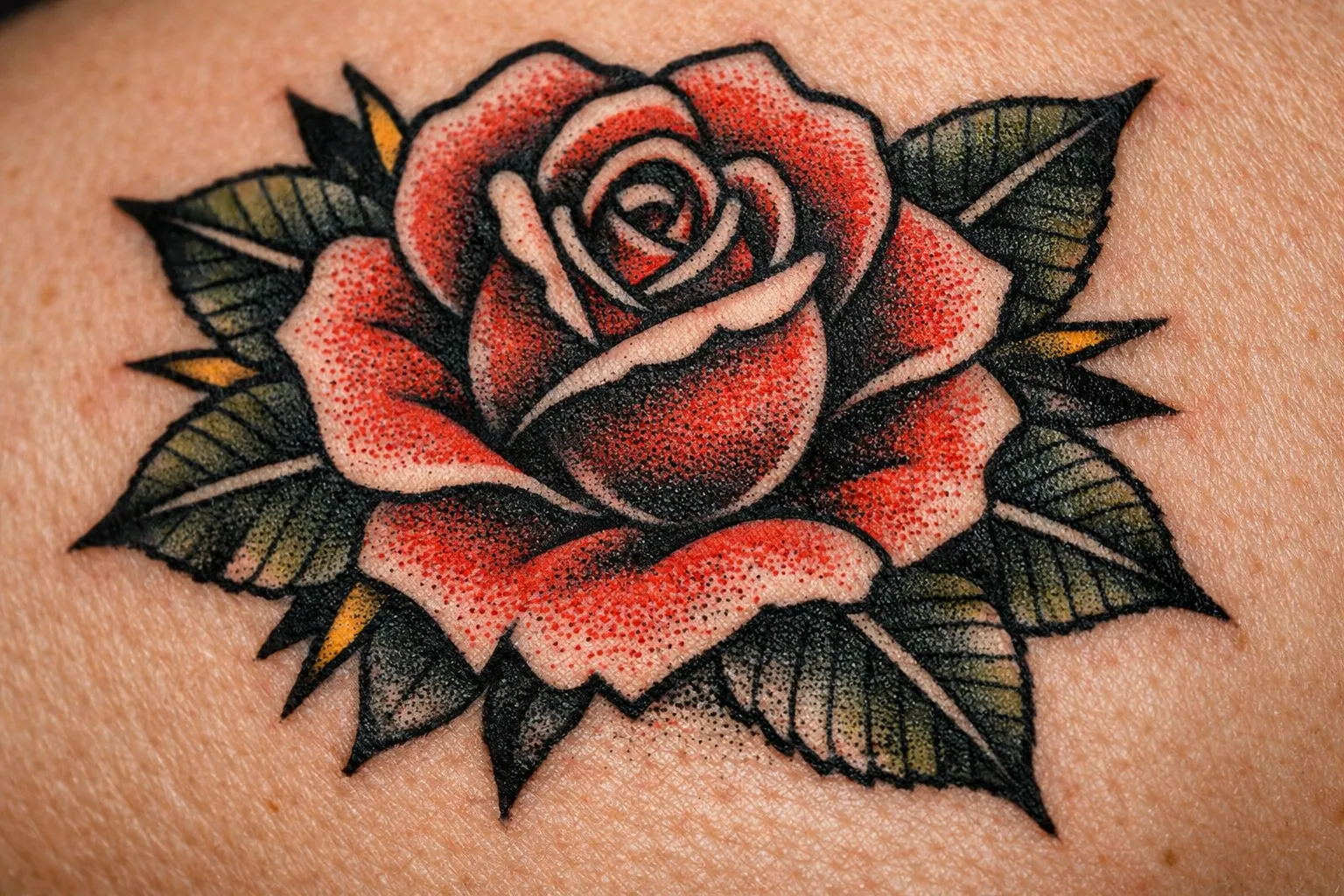
The rose is the default - usually red, sometimes yellow or pink, with green leaves. A single rose runs $150-$300 and 1-2 hours. A three-rose shoulder cluster sits in the $400-$700 range.
Peony and chrysanthemum borrow from Japanese irezumi but get the old school treatment: heavier outlines, fewer colors. These work especially well at 5-7 inches scaling up to sleeve filler. Lotus appears less often but suits the style - its silhouette is naturally graphic.
One pitfall I see constantly: pastel palettes. Pale yellows and dusty pinks fade fastest. Stick to saturated primaries if you want the tattoo to still look like a tattoo in 20 years (1)(5).
Flash Sheets: How to Use Them
American traditional tattoo flash is the pre-drawn artwork hanging on shop walls and now sold as PDF books online. A typical flash sheet has 20-60 designs, each 2-6 inches, arranged on 11×14 or A3 paper. Adobe Stock alone lists over 25,000 American traditional assets, most of them flash-oriented (6).
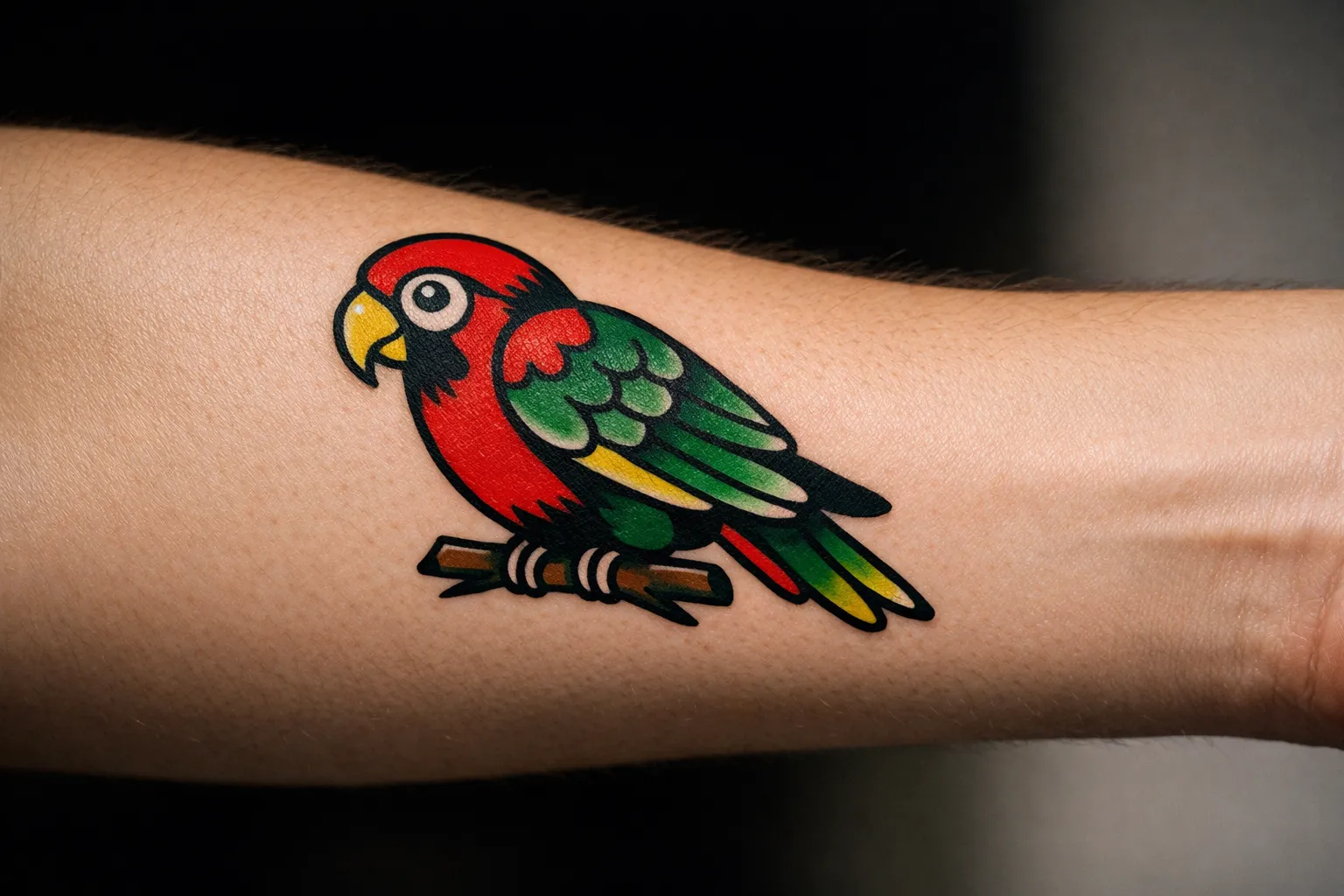
Why pick flash off the wall instead of commissioning custom work:
- Cheaper. No design fee. A small flash piece typically runs $150-$300 versus $400+ for custom of the same size.
- Faster. No back-and-forth on sketches. Walk in, point, get tattooed.
- Historically accurate. Old school is a tradition. Getting a piece of someone else’s flash isn’t unoriginal - it’s how the style has always worked.
When you’re browsing flash, ask the artist whether the sheet is studio-exclusive or widely circulated stock. Exclusive flash gives you a more unique piece. Most artists will let you tweak banner wording and swap colors within the traditional palette without charging a custom fee.
Watch for flash days - set-price events around Friday the 13th, Halloween, or July 4th, where shops run $100-$200 per pre-drawn design. These are the cheapest way to start a collection.
Sleeve Layout: Cost, Hours, and How to Plan It
A cohesive American traditional tattoo sleeve isn’t 30 random small tattoos crammed together. It’s 3-7 anchor motifs - eagle, lady head, panther, ship, two or three roses - plus consistent filler that ties everything visually. Stars, dots, leaves, water swirls. The filler is what makes it look planned rather than collected.
Time and cost benchmarks:
- Half sleeve (shoulder-to-elbow or elbow-to-wrist): 10-20 hours, $1,500-$3,000 total at typical urban rates of $150-$250/hour.
- Full sleeve: 20-40 hours, $2,500-$6,000+ depending on city and artist demand. New York and LA top-tier artists run $300+/hour; second-tier cities often $120-$160/hour.
- Sessions: typically 3-8, spaced 2-6 weeks apart for healing. A full sleeve from blank arm to finished touch-ups usually spans 3-12 months.
Layout strategy: plan the largest pieces first - eagle on outer shoulder, panther on forearm - then fill in mid-size motifs like roses and daggers, then connect with filler. Use the same star and leaf shapes throughout. Repeated fillers act as visual glue across the whole arm.
Pain ranking by sleeve zone (relative): inner bicep > elbow ditch > armpit > outer forearm > outer bicep. Plan the inner bicep for a session when you’re rested. I’m not being dramatic - the elbow ditch is the session most clients want to cut short.
Chest Placement: Layout and Healing
A classic American traditional chest tattoo is built around the natural geometry of the body: collarbones frame the top, the sternum runs the center, the pec curve carries the eagle’s wings or lion’s mane outward.
Common chest layouts:
- Center eagle, spread wings collarbone to collarbone (10-12 inches wide). 2-4 sessions of 3-5 hours. $1,500-$3,500.
- Single-side panel (one pec): heart with banner, panther, lady head. Small center piece 6-8 inches, $400-$800.
- Full chest panel with flanking roses, banners, and stars filling the negative space: 10-25 hours, $1,500-$4,000+.
Chest skin is high-movement, so it heals slower than the forearm. Here’s the realistic timeline:
- Day 1-3: plasma weeping, swelling. Keep the bandage on per your artist’s instructions - usually 24 hours for plastic wrap, up to 5 days for Saniderm. Wash twice daily with fragrance-free soap.
- Week 1: itchy scabbing phase. Apply a thin layer of fragrance-free moisturizer 2-3 times daily. No gym, no swimming, no soaking. Sleep on your back.
- Week 2-4: scabs flake off, the tattoo looks dull and cloudy. This is normal - the “milky” phase. Keep moisturizing.
- Week 4-8: color fully settles. This is when you’ll see the true saturation. Schedule any touch-ups now.
Chest pain ranks high. Sternum > collarbone > outer pec. The sternum sits right over bone with no fat padding, and the vibration of the machine on bone is the part most clients underestimate. I’ve had clients who sailed through their ribs come off the table pale after a sternum session.
Tipping Your Tattoo Artist
Tipping isn’t optional in U.S. shops - it’s how artists make most of their take-home after shop cut and supplies. Standard is 15-25% of the total tattoo price.
So is $100 a good tip on a $400 tattoo? Yes - that’s 25%, which is considered generous. On a $400 piece:
- $60 = 15%, the floor of acceptable
- $80 = 20%, solid standard
- $100 = 25%, generous
For multi-session sleeves and chest pieces, tip at each session, not just the final one. If you booked through a high-demand artist and got a same-week cancellation slot, an extra $20-$40 above your normal tip is a reasonable gesture.
Health Conditions and Tattoo Eligibility
Reputable shops increasingly require medical clearance for clients with chronic conditions, and the policies have tightened over the last few years. The standard requirements at most shops:
- Age: 18+ in most U.S. states, 16-17 with parental consent in some
- Not intoxicated - alcohol thins blood and most shops will turn you away if you smell like a bar
- Not pregnant or breastfeeding - most shops decline as a risk policy, not because there’s proven harm
- Disclose any bleeding disorders, uncontrolled diabetes, immunosuppressive therapy, or recent surgery
What Is the American Classic Tattoo Style?
“American classic” is just another name for American traditional - the terms are interchangeable in shop language. You’ll also see old school, Western traditional, sailor style, and sometimes just traditional, though that last one is ambiguous since Japanese traditional irezumi is also a major style with its own lineage.
What makes it “classic” is the rulebook: bold outlines in one line weight, flat saturated color in a limited palette, recognizable iconography drawn from sailor and military culture, and motifs built to hold up across decades (1)(2).
How American Traditional Compares to Other Tattoo Styles
Quick rundown of the major contemporary styles and where American traditional sits among them:
1. Traditional tattoo style (American traditional). Bold black outlines, limited palette (red, yellow, green, black), iconic flat motifs. Ages best of any color style.
2. Realism or realistic tattoo style. Fine lines, smooth gradient shading, wide color range, photo-like portraits. Looks vivid when fresh; needs touch-ups more often than traditional.
3. Watercolor. Splashes and washes of color, often with minimal black linework. The least durable style - soft edges blur within 5-10 years.
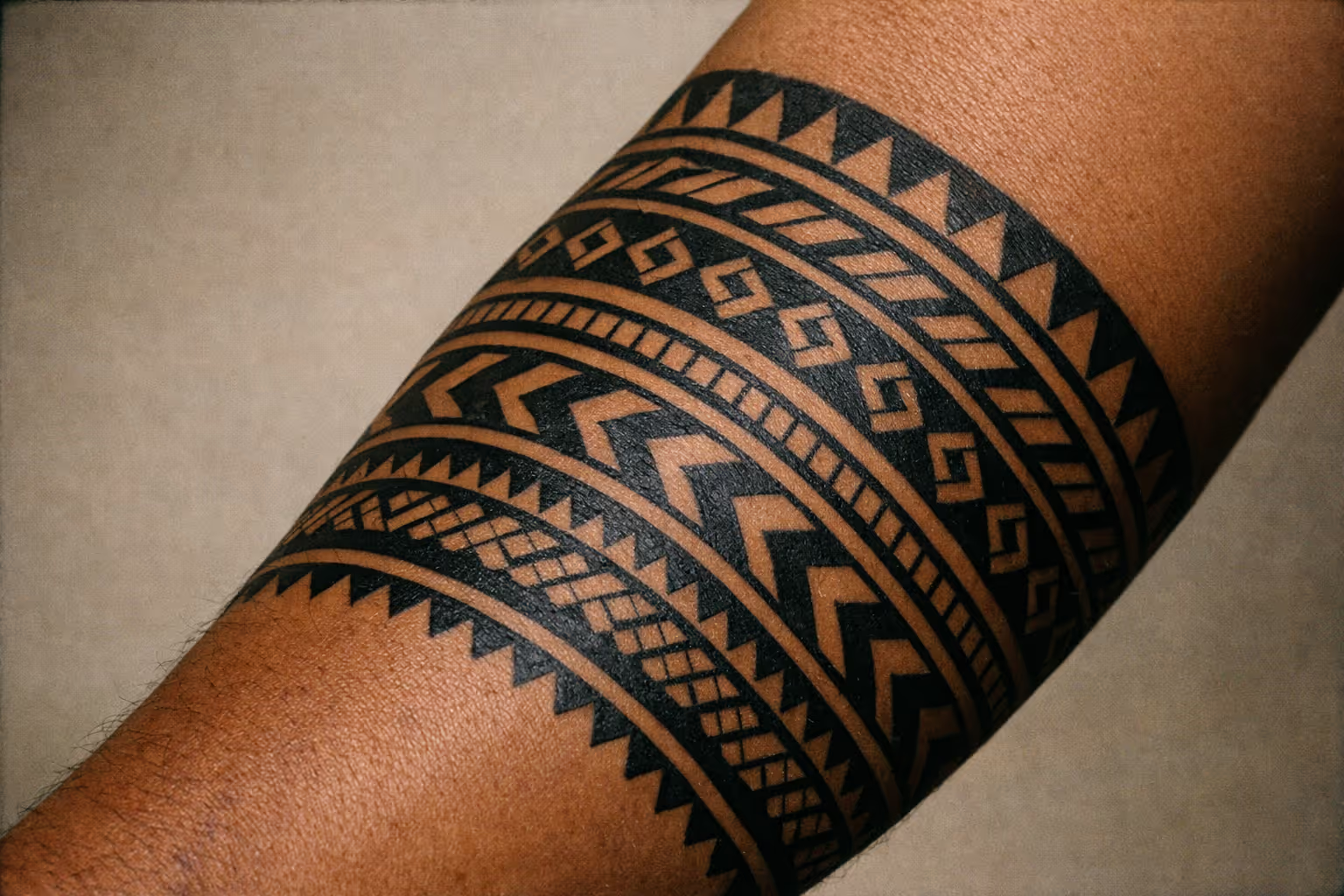
4. Tribal. Solid black geometric patterns rooted in Polynesian, Maori, Filipino, and other Indigenous traditions. Strong cultural origins - research before getting one outside your heritage.
5. New school tattoo style. Cartoonish exaggeration, neon palette, heavy 3D shading. Takes cues from graffiti and comics, breaks old school rules deliberately (2).
6. Neo-traditional. American traditional motifs with expanded color (pastels, jewel tones) and added detail. The bridge between old school and illustrative work.
7. Japanese (irezumi). Large-scale narrative work - dragons, koi, hannya masks - with wind bars and water filler. The other major “traditional” style globally, and a completely different tradition from American old school.
8. Blackwork. Solid black-only designs, from heavy geometric to illustrative. Ages well alongside American traditional.
9. Illustrative. Drawing-style work that mimics ink-on-paper aesthetics. Varies wildly by artist.
10. Chicano tattoo style. Mostly black and grey, fine single-needle linework, religious imagery and script. Roots in Mexican-American prison and street culture (2).
If you like the iconography of American traditional but want more color flexibility, neo-traditional is your bridge. If you like the bold simplicity but want black-only, blackwork is the move.
How to Choose an American Traditional Artist
Not every tattooer who lists “traditional” in their bio is actually an old school specialist. I check portfolios the same way every time:
- 80-90% American traditional work. If their feed is mostly fine-line, realism, or color realism, they may take your booking but the result will likely drift toward their actual specialty.
- Consistent line weight across pieces. Healed photos matter more than fresh ones - ask to see tattoos at 6 months or older.
- Saturated, flat color. Look at how their reds and yellows hold up in healed shots. If healed reds look washed out, the artist isn’t packing color properly.
- Studio bios that explicitly list “American traditional” or “old school.” Generic “traditional” can mean anything.
Modern American traditional specialists frequently referenced in the scene include Myke Chambers, whose educational content breaks down the style’s technical fundamentals (5), alongside countless regional shop specialists. The historical reference points - Sailor Jerry, Don Ed Hardy, Bert Grimm, Lyle Tuttle - are still the foundation most working artists trained on (3).
Top American traditional artists routinely carry 1-6 month waitlists for medium pieces and longer for sleeves and chests. Plan accordingly. When evaluating candidates, the same principles covered in choosing the right tattoo artist apply here - healed portfolio work in your desired style is the single most reliable signal.
Related Styles Worth Knowing
If American traditional pulls you in, these adjacent styles often appeal to the same collectors:
- Neo-traditional for more color range with the same iconography
- Chicano for black-and-grey with strong cultural and narrative roots
- Japanese irezumi for large-scale traditional work in a different lineage
- Blackwork for solid black versions of old school motifs
Many sleeve and bodysuit collectors mix two or three of these - a Japanese back piece with American traditional fillers on the chest, or Chicano script under an old school rose. The bold outline philosophy translates across all of them.
Before You Book
American traditional tattoo styles aren’t a trend. They’re the closest thing tattooing has to a permanent design language, which is exactly why they keep showing up on flash walls 90 years after Sailor Jerry first inked them (3). Pick motifs that read at scale, respect the palette rules, give the artist room to work at proper size - most pieces need at least 3-4 inches - and budget for the heavier aftercare that color packing demands.
If you’re getting your first piece, start with a small flash design: a swallow, an anchor, a single rose at 2-3 inches. See how your skin holds saturated color before committing to a sleeve. If you’re planning a chest or sleeve, book a consultation 3-6 months out, plan the anchor motifs first, and let the filler develop as the project goes.
Either way: sunscreen on the healed tattoo is the single biggest factor in how it looks at year 10. That’s not aftercare advice, that’s just physics.
Frequently Asked Questions
- Can I customize flash tattoo designs?
- Most artists allow minor tweaks like changing banner text or swapping colors within the traditional palette without charging extra, but large changes may require a custom design fee.
- How long should I wait between sleeve tattoo sessions?
- Sessions are typically spaced 2-6 weeks apart to allow proper healing before continuing work.
- What size is too small for American traditional tattoos?
- Designs under 2-3 inches often lose detail and clarity, especially motifs with intricate linework or facial features.
- Are American traditional tattoos suitable for all skin tones?
- Yes, the heavy black outlines and saturated colors hold contrast well across a wide range of skin tones, aging better than fine-line or watercolor styles.
- Is it safe to get a tattoo if I have a chronic health condition?
- Medical clearance is often required for chronic conditions. Disclose your condition to your artist well in advance and follow their guidance.
- Why do some artists charge more for American traditional sleeves?
- Pricing depends on artist reputation, city, and demand. Top-tier artists in major cities charge more per hour, and sleeves require many hours and sessions.
- How should I care for a new American traditional chest tattoo?
- Follow your artist's instructions carefully: keep the bandage on for 24 hours or more, wash with fragrance-free soap twice daily, moisturize with fragrance-free lotion, avoid gym and soaking, and sleep on your back.