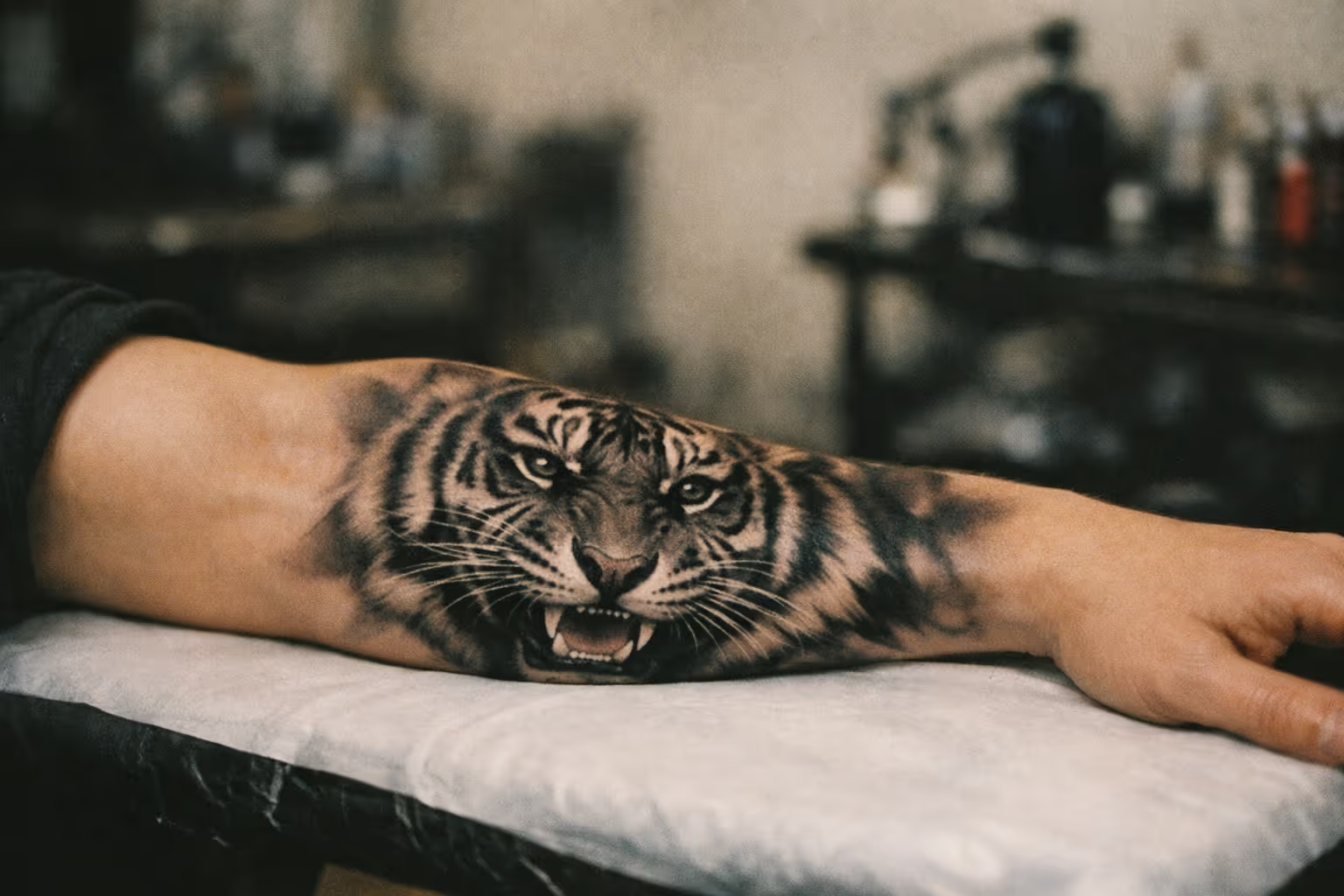
A tiger tattoo doesn’t mean one thing - it means whatever the style says it means. The same animal reads as American-traditional grit, as an irezumi guardian, or as a Sak Yant blessing, and those aren’t small differences; they carry different cultural weight and different rules. Pick the style before you pick the tiger. Here’s how the tiger tattoo meaning shifts across five traditions, and how to choose the one that fits.
Tiger Tattoo Meaning: The Real Symbolism
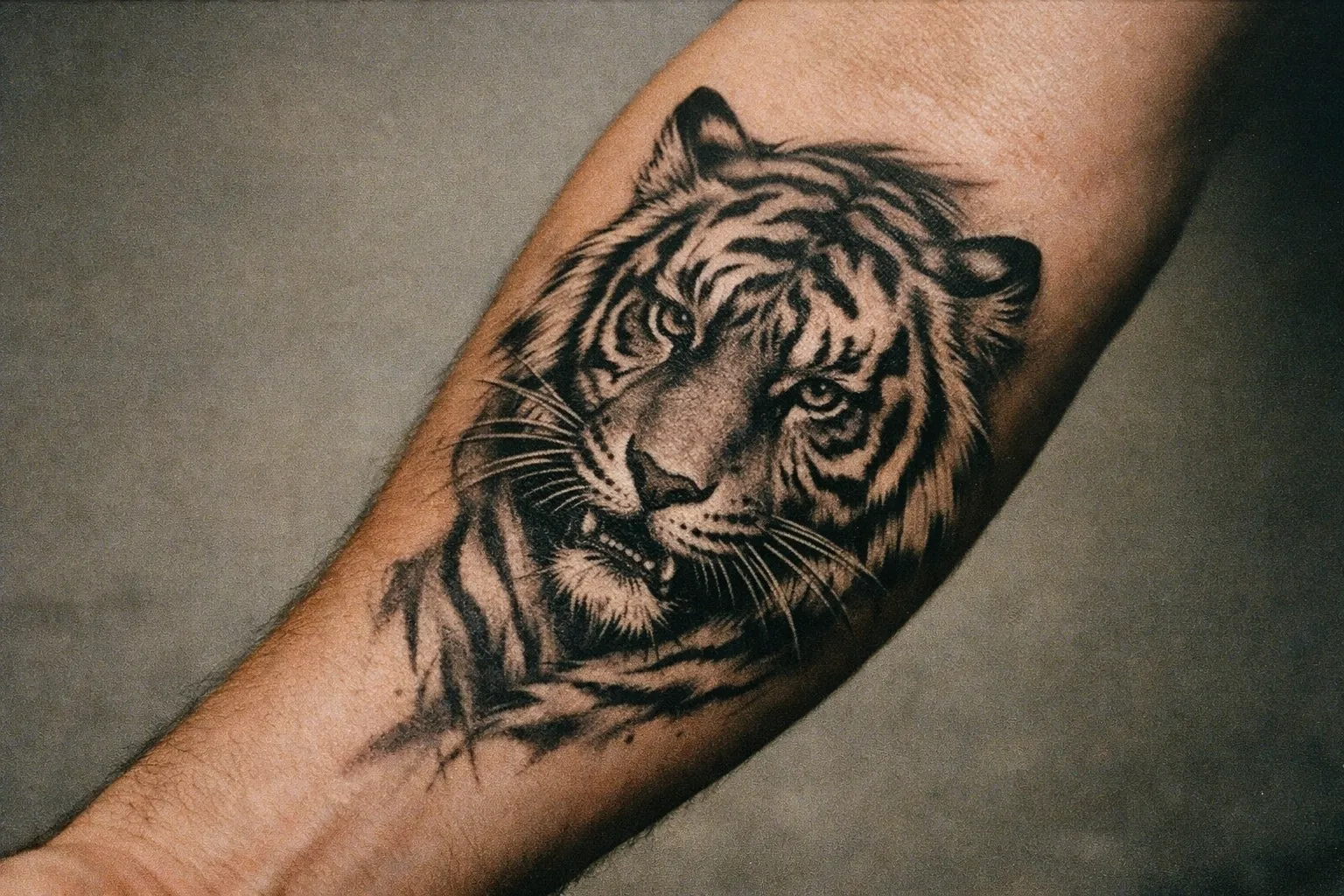
The tiger tattoo meaning often centers on a short list repeated across studios specializing in this motif: power, courage, protection, independence, passion, ferocity, and primal instinct (3)(4)(6). Tigers are apex predators that hunt alone, so the symbolism naturally splits two ways - outward (dominance, fearlessness) and inward (self-reliance, walking your own path).
A few specifics worth knowing:
- Strength and survival. Many clients book a tiger after coming through something heavy - illness, recovery, a brutal stretch at work. The tiger functions as an “I fought and won” emblem, not a flex.
- Protection. In East Asian traditions, the tiger is a guardian figure that wards off evil spirits and demons (4)(6). This shows up directly in Japanese irezumi compositions.
- Independence. Tigers don’t run in packs. Getting one inked often signals comfort with going it alone - not loneliness, but autonomy.
- Passion and intensity. A roaring tiger with bared teeth reads aggressive; a closed-mouth tiger with calm eyes reads protective. You’re choosing a tone, not just an animal.
The meaning is not fixed. One client I consulted with wanted a tiger specifically because lions felt “too regal” - he wanted raw, not royal. That distinction matters when you’re sitting across from an artist trying to nail down a pose.
Is a Tiger Tattoo Good or Bad?
Symbolically, a tiger tattoo is not “bad.” There’s no culture in which tigers are universally evil - even in traditions that fear them, they’re respected (6). The concern people raise with this question is usually social, not spiritual: will a tiger tattoo make me look aggressive, intimidating, or like I’m signaling something I don’t mean to signal?
A few honest answers:
- Workplace perception. A snarling, full-color tiger on the forearm reads differently in a courtroom than a tech office. If visibility at work matters, a forearm tiger tattoo with a calm pose - or a placement that hides under a sleeve - solves most of it.
- Gang or “tough guy” misreads. This is overstated. Tigers aren’t tied to any specific gang iconography in the U.S. or Europe. The misread usually comes from heavy black-and-grey realism with aggressive expressions, not the motif itself.
- Cultural sensitivity. Where it actually gets dicey is borrowing Sak Yant or specific irezumi compositions without understanding what they mean. More on that in the pitfalls section.
So: not bad, but the design choices you make determine the tone. Aggressive vs. protective is dialed in through pose, expression, and color palette.
Why People Get Tiger Tattoos
The patterns I see most often, across twelve years of consults:
- Marking a survival moment. Cancer remission, leaving an abusive relationship, getting clean. The tiger is shorthand for “I made it through.”
- Professional or athletic identity. Fighters, soldiers, first responders, lifters. The tiger fits a life that already values courage and controlled aggression.
- Independence after a major change. Divorce, leaving a controlling job, moving countries. The solitary tiger lines up with the new chapter.
- Cultural connection. People with Chinese, Japanese, Thai, or Korean heritage often pick tigers tied to family stories, zodiac signs, or guardian traditions.
- Pure aesthetic. Some people just love how a tiger sits on the body. That’s a legitimate reason - meaning can develop later.
I’ve had clients come in with all five of those motivations in the same week. None of them is more valid than the others.
Tiger Tattoo Designs by Style
This is where the tiger tattoo meaning starts to bend depending on the style you pick. Each tradition has its own visual language and its own symbolic baggage.
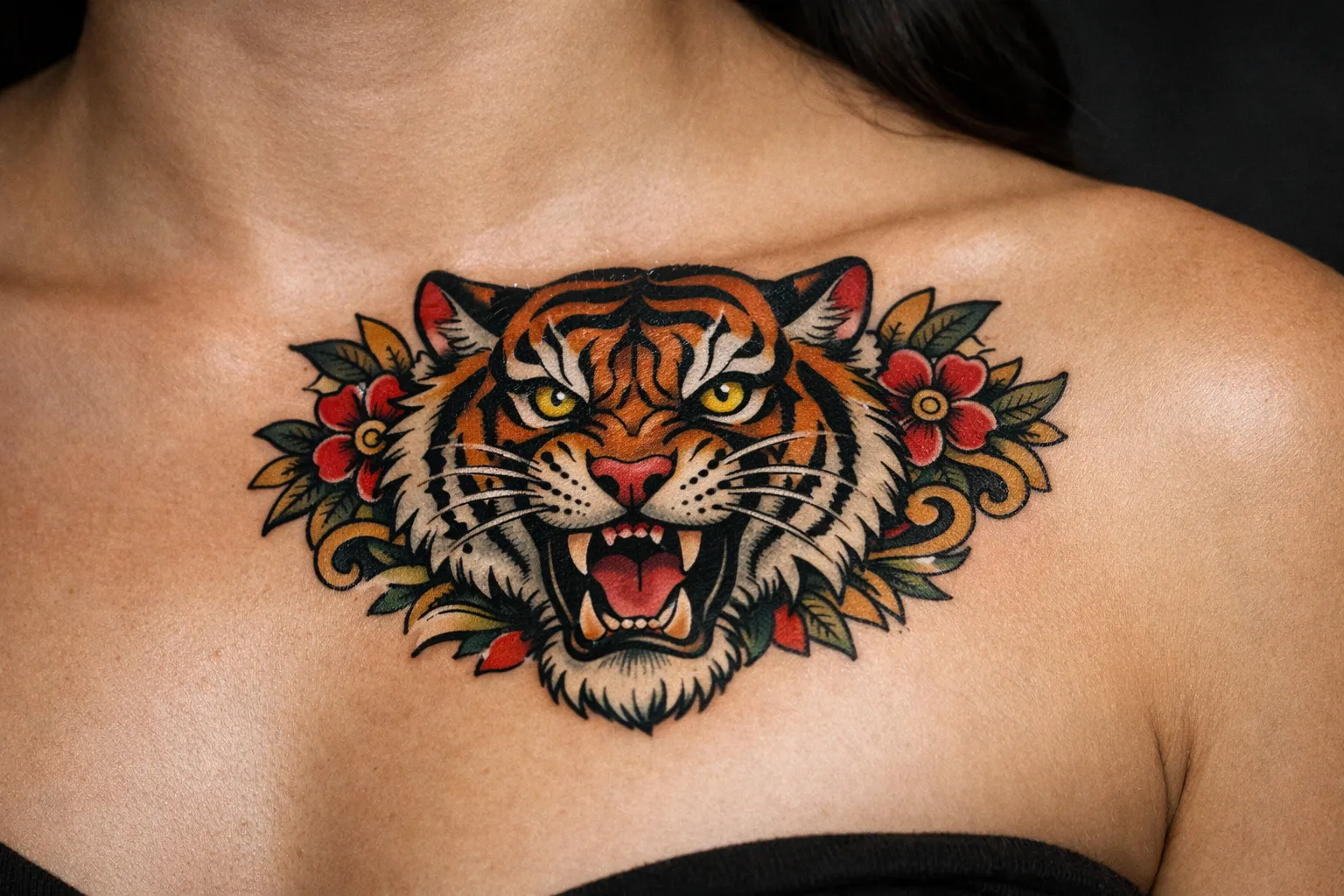
Traditional Tiger Tattoo (American Traditional)
Two technical hallmarks: thick black outlines and a limited, saturated palette - usually black, orange, yellow, sometimes red and green. The tiger is stylized, not realistic. Think old sailor flash sheets: roaring head, bared teeth, sometimes a knife or rose alongside it.
Symbolism leans toward grit, toughness, and survival - the same energy as anchor and eagle tattoos from the same era. Common pitfall: artists who chase realism inside an American traditional frame end up with muddy designs that age poorly. The whole point of the style is bold lines that read clearly from across a room ten years later.
Best placements: outer forearm (5-7 inches), upper arm, calf, chest panel.
Japanese Tiger Tattoo (Irezumi)
The Japanese tiger (虎, tora) is a guardian. In irezumi compositions, tigers are often paired with wind bars, bamboo, peonies, or dragons - the dragon-tiger pairing represents yin-yang balance, two opposing forces in harmony.
Technical hallmarks: flowing linework, stylized fur in clean directional groups, integrated background (wind, water, foliage) that follows body flow. Meaning ties to bravery, demon-slaying, protection from evil spirits, and control over storms (6).
This is not a small-piece style. Japanese tigers want room - half-sleeve minimum, full sleeve or back piece ideal. Sizing it down to a 3-inch patch on the forearm strips out the background and loses the entire point of the style.
Common pitfall: booking a Japanese tiger with an artist who doesn’t actually do Japanese work. The style has specific rules about line weight, negative space, and composition. A “Japanese-style” tiger from a generalist usually reads as a realistic tiger with some waves around it. I’ve seen this go wrong more times than I can count - the client shows up with a reference from a master like Horiyoshi III and leaves with something that looks like clip art with water splashes.
Thai Sak Yant Tiger
A spiritual tradition, not just an aesthetic. Sak Yant tigers (Suea) are considered protective amulets granting power and courage, traditionally tattooed by monks or ajarns using a long metal rod.
A few specific Yant designs:
- Suea Koo (Twin Tigers) - “great power,” protection in 8 directions, overcoming enemies.
- Suea Phen (Running Tiger) - the ability to avoid trouble and danger (1).
- Headless Tiger - life transformation, reduction of bad luck.
If you want a real Sak Yant, the traditional path is going to Thailand and getting it done by an ajarn at a temple - donations typically run $50-$200+, plus travel costs. Some Yants come with behavioral codes (rules about diet, conduct, sexual behavior) that the wearer is expected to follow. Getting one done as decoration at a Western studio is technically possible but loses the spiritual frame entirely, and some practitioners view it as appropriation.
Realistic Black-and-Grey Tiger
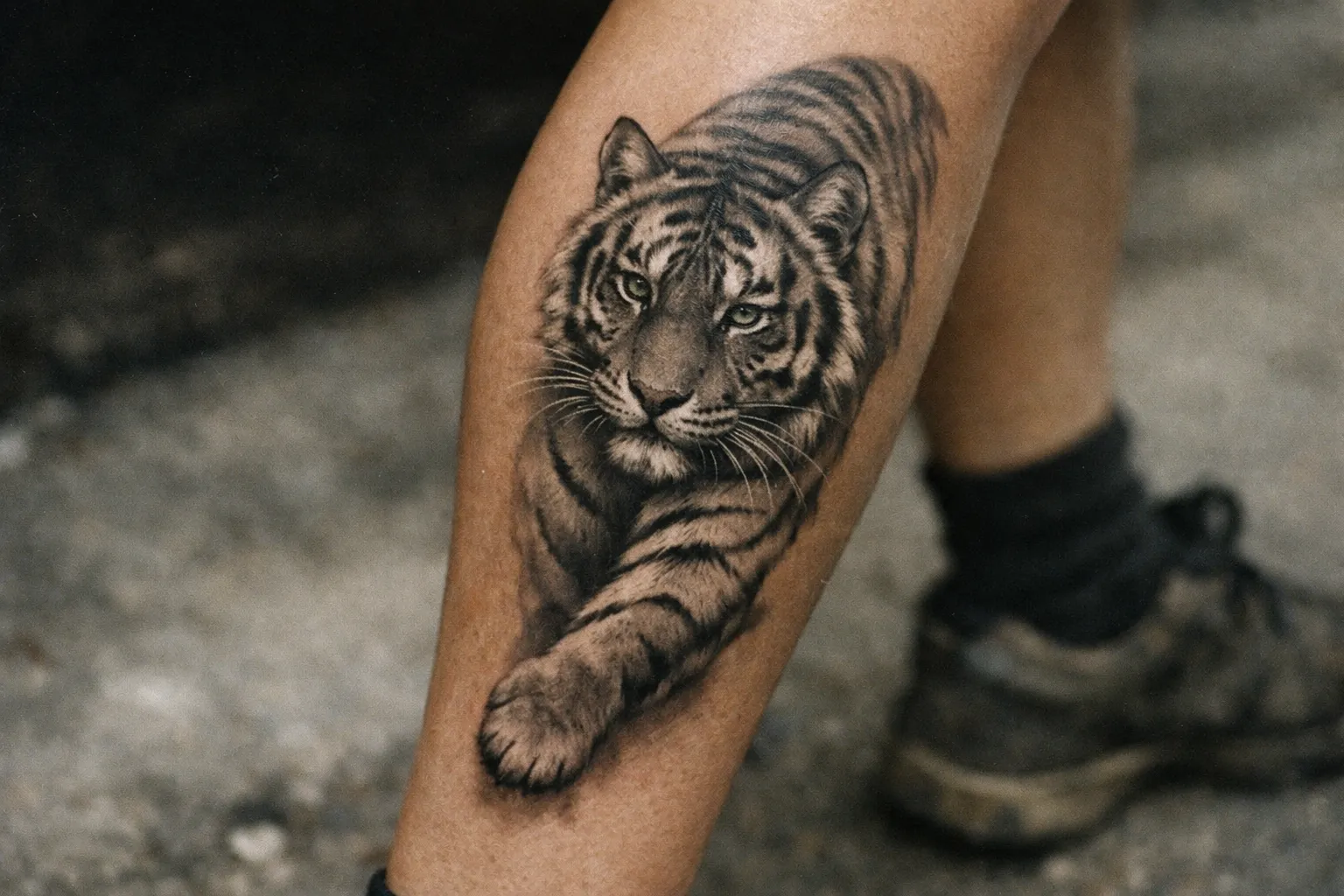
The Instagram-dominant style right now. Hyper-detailed fur, photoreal eyes, heavy shading. Reads as power and presence without the cultural baggage of irezumi or Sak Yant.
Hallmarks: fine-needle work, soft gradient shading, careful attention to anatomy. Sizing matters here - a realistic tiger smaller than about 5 inches loses detail fast because the eyes and fur are what sell it.
Neo-Traditional and Watercolor Tigers
Neo-traditional blends bold outlines with painterly shading and richer color palettes (deeper oranges, blues, purples). Watercolor tigers add splashes of color that bleed outside the linework for an artistic, less aggressive read (2). Both work well on forearms and thighs.
Honest note on watercolor: it ages harder than traditional or Japanese. The “splash” effect blurs over a decade because there’s no anchoring black line under the color. Plan for touch-ups every 5-7 years.
Small Tiger Tattoo (Minimalist)
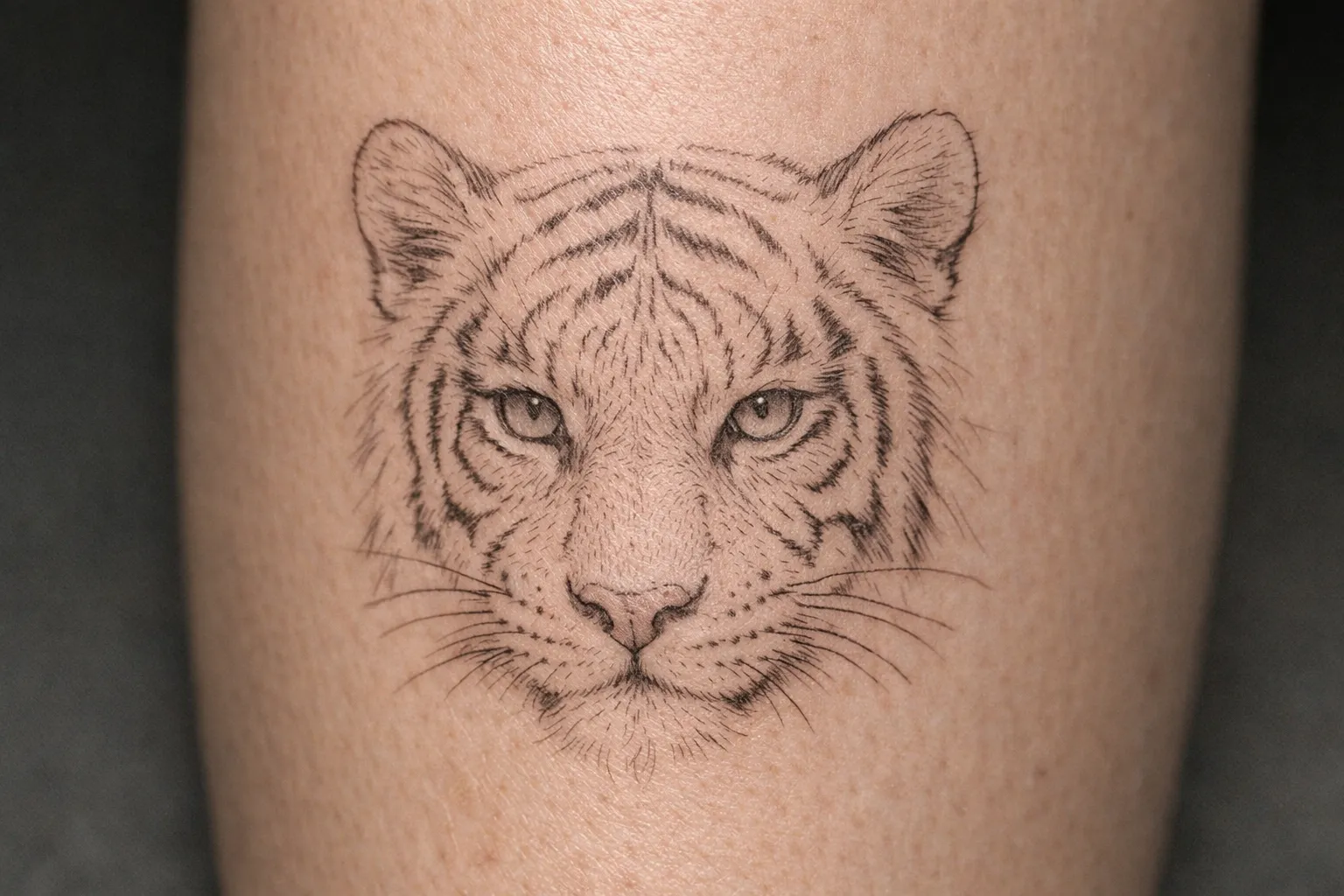
For a small tiger tattoo under 3 inches, pick one element and commit to it: a tiger head silhouette, just the eyes, a single fine-line profile. Trying to cram a full body with stripes into 2 inches gives you a smudge by year five.
Best placements for small work: inner forearm (2-3 inches), behind the ear (1 inch), back of the wrist, ankle, sternum. Avoid fingers - tigers don’t survive there, the detail blows out within a year.
Tiger Forearm Tattoo: Sizing and Orientation
The forearm is the most-requested placement for tiger forearm tattoos, and for good reason - it’s flat, large enough for detail, easy to show or hide, and the muscle flow doesn’t distort the design much.
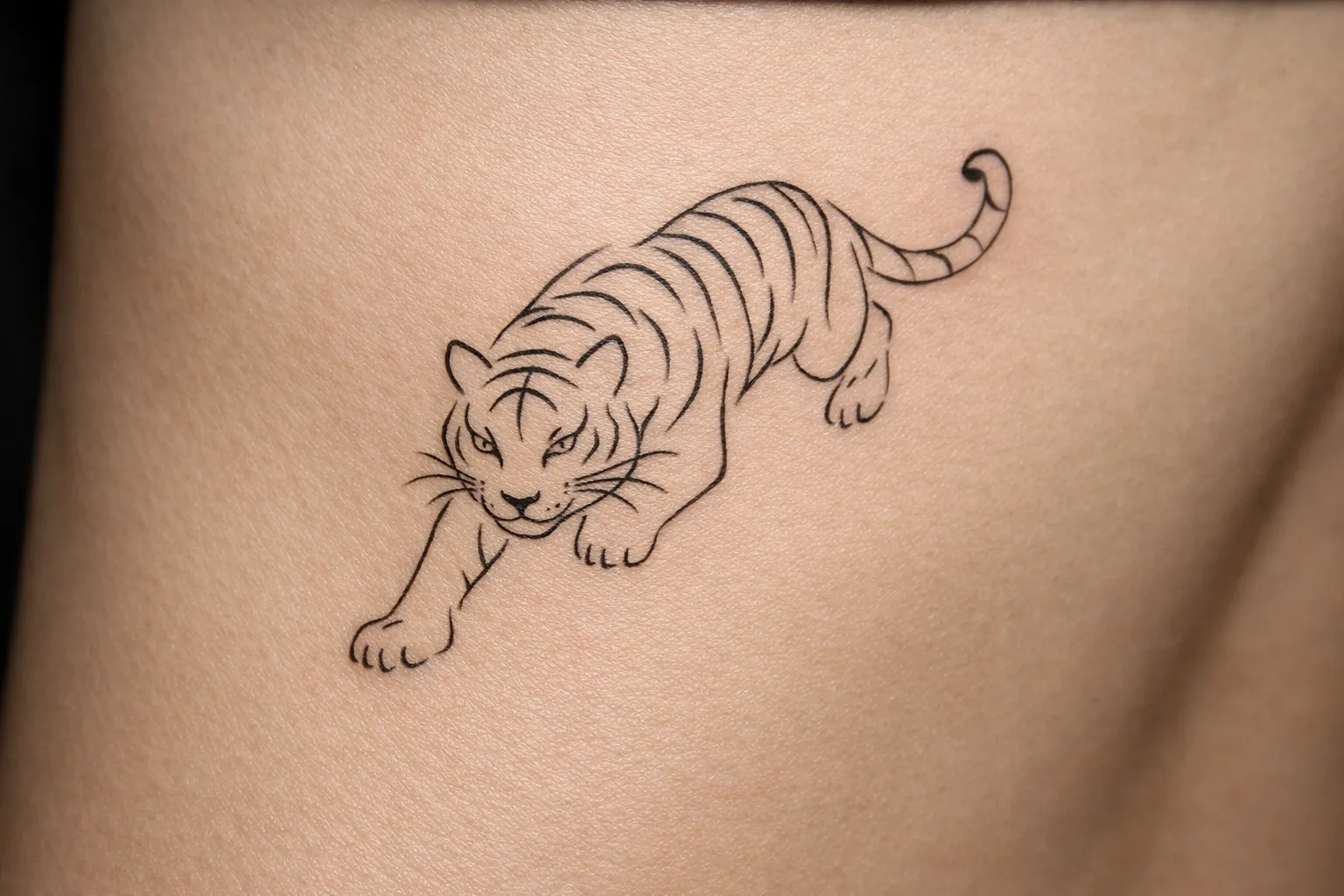
Practical specs:
- Inner forearm: 4-6 inches (10-15 cm). Good for portrait-style tiger heads, minimal background.
- Outer forearm: 5-7 inches (12-18 cm). Better for full-body or roaring tigers because the surface is flatter.
- Full forearm wrap: 7-9 inches (18-23 cm), often part of a sleeve start.
Orient the head so that when your arm hangs at rest, the tiger’s face is upright - not when your arm is extended on the table. This is the position other people see every day. I bring this up in every forearm consult because it’s the most commonly skipped conversation, and it’s the one that leads to tigers that only “look right” when you’re holding a coffee cup.
Pain on the forearm sits in the lower half of the relative scale. The outer forearm is mild. The inner forearm closer to the wrist is sharper because the skin is thinner and nerves cluster there. Ribcage and sternum are significantly worse if you’re comparing.
Tiger Tattoo for Men: What It Actually Communicates
Two questions come up constantly: what does tiger tattoo meaning signal if a guy has one, and is the tiger tattoo a “men’s” design?
On the second one: no. Tigers work for any gender. Studios increasingly state this explicitly, and the “tiger = masculine” framing is mostly an artifact of older tattoo marketing. Pose, accompaniment, and palette do more to gender a piece than the animal itself.
On the first: a tiger tattoo on a man typically signals confidence, assertiveness, willingness to defend what he cares about, and comfort with intensity (6). It’s not a reliable signal of aggression - most guys with tiger tattoos are quieter about it than the tattoo suggests. The aggressive read comes from specific design choices: bared teeth, locked-in roar, heavy black-and-grey realism, large scale on visible skin.
If the goal is to communicate strength without reading as intimidating, ask the artist for:
- A closed-mouth, calm-eyed tiger instead of a snarl.
- Side profile or three-quarter view rather than a head-on charge.
- Softer accompaniment - peonies, cherry blossoms, geometric framing - instead of skulls or weapons.
If the goal is to lean into the intensity, go the other direction: roaring head, high contrast, dynamic pose, larger scale.
Tiger Tattoo Placements Beyond the Forearm
Each placement changes how the design is read and how it ages over time.
- Chest panel (one-sided): 8-12 inches. Reads as personal/private - usually only visible to people you choose. Good for Japanese tigers because the pec gives the head a natural anchor.
- Full back piece: 14-20+ inches. The only placement that really lets a full Japanese composition breathe. Long project - expect 20-40 hours across multiple sessions.
- Upper arm / shoulder cap: 5-8 inches. Versatile, ages well, easy to hide under a t-shirt.
- Ribcage: 6-10 inches. Powerful canvas for a stalking or curled pose. Pain here is significantly higher than forearm - thin skin over bone, no muscle padding.
- Thigh: 6-12 inches. Generous canvas, ages well (less sun, less friction), easy to conceal. Popular for tigers with floral accompaniment.
- Behind the ear / neck: 1-3 inches. Only works for minimalist designs - small tiger head silhouette or eyes only.
- Sternum: 5-8 inches. Symmetrical compositions only. High pain placement, but the centerline gives the tiger a striking presence.
Cost and Time by Size
Approximate ranges in mid-tier urban studios (North America, UK, Australia):
- Small tiger tattoo (2-3 inches, line work): $100-$250, 1-2 hours.
- Tiger forearm tattoo (medium, partial forearm): $300-$700, 2-4 hours at $120-$200/hour.
- Half sleeve Japanese tiger with background: $1,000-$2,500, 8-15 hours across 2-4 sessions.
- Full sleeve or back piece: $1,500-$4,000+, 15-30+ hours.
- Specialist Japanese or Sak Yant masters: $200-$350/hour, often booked as day sessions around $1,000-$1,500/day.
Budget reality: complex realistic and Japanese tigers almost always run longer than the artist’s initial quote. Build a 20-30% buffer in. Stopping a Japanese composition halfway because you ran out of money leaves you with a tiger floating in white space, which looks worse than getting something smaller in the first place. I’ve seen this happen. It’s not a good look.
Aftercare and How Tiger Tattoos Heal
Tigers are saturation-heavy designs - lots of black, often with packed color - which means more trauma to the skin and a more intense peel.
Day 1-3: The tattoo is essentially an open wound. Keep the artist’s wrap on for whatever they specified (2 hours for traditional plastic wrap, 3-5 days for Saniderm-style adhesive). Once removed, wash gently 2-3x daily with a fragrance-free antibacterial soap and pat dry. Apply a thin layer of fragrance-free moisturizer or healing balm ($6-$25 range).
Week 1: Peak peeling and itching, especially over the densely shaded areas. The orange and black flake off - this is normal, the color underneath is still there. Do not pick. Continue light moisturizing 2-3x daily.
Week 2-4: Surface healing completes. The tattoo may look slightly cloudy as the new skin layer settles - this clears up. Switch to regular fragrance-free body lotion.
Months 2-3: Full dermal healing. Color settles into its final saturation. Touch-ups, if needed, are done after this window.
Long-term: Sun is the single biggest threat to a tiger tattoo. Orange, yellow, and red fade significantly faster than black under UV exposure. Use SPF 30+ on any visible tiger work whenever you’re outside for extended periods, and reapply. Sun-protective clothing on big pieces - long sleeves, rash guards at the beach - extends the life of color work by years.
For tigers with heavy color, plan on a touch-up every 7-10 years. Black-and-grey tigers can go 15+ years before needing work if cared for.
Tattoos to Avoid (and Tiger Design Choices to Reconsider)
A few categories that come up in consults and almost always end in regret:
- Tiger combined with hate symbols or extremist iconography. Obvious, but it happens. The tiger doesn’t neutralize anything paired with it.
- Sak Yant from a non-traditional artist with no understanding of the symbolism. The Yant script around the tiger is not decorative - those are specific blessings and protective phrases. Getting them done randomly or scrambled is, at best, meaningless, and at worst, disrespectful to the tradition.
- Tribal patterns from indigenous cultures you have no connection to, slapped onto a tiger because it “looks cool.” Textbook appropriation problem.
- Names of current partners stitched into a tiger composition. Tigers last. Relationships sometimes don’t. Cover-ups on dense color work are expensive and ugly.
- Finger tigers. The detail blows out within 12-18 months. Studios warn against this consistently.
- Hyper-trendy styles applied to tigers - flash-in-the-pan techniques like extreme blown-out watercolor or “glitch” effects that look dated within a few years. Tigers are a classic motif; pick a classic execution.
- Tigers smaller than the design supports. A full-body realistic tiger crammed into 2 inches is just a brown smudge. If you want small, pick a minimalist treatment, not a shrunken realistic one.
Tiger Combinations and Companion Elements
If you want to layer meaning, the most-requested pairings:
- Dragon and tiger - yin-yang, balance of opposing forces. Classic East Asian composition. Usually rendered as the two facing each other or wrapped around the same body section. If you’re drawn to that pairing, it’s worth looking at dedicated dragon tattoo designs to understand how the dragon’s symbolism holds up on its own.
- Tiger and peony - strength and beauty, brutality and softness. Standard in Japanese irezumi.
- Tiger and cherry blossom - impermanence paired with power. Reads as “ferocity, but the moment is fleeting.”
- Tiger cub - innocence, new beginnings, parental love, inner child. Works well as a smaller companion piece to an existing tiger.
- Tiger and bamboo or wind bars - Japanese-style framing, reinforces the protector/storm-controller symbolism.
- Tiger eyes only - focus, determination, “always watching.” Works in small sizes where a full body wouldn’t.
Frequently Asked Questions
- Is a tiger tattoo good or bad?
- Symbolically, it's not bad - tigers represent strength, courage, and protection across most cultures. Social perception depends on your design choices: a snarling, hyper-realistic tiger reads more aggressive than a calm, stylized one.
- Why do people get tiger tattoos?
- Common reasons include marking survival or recovery, professional identity, independence after major changes, cultural connection, and aesthetic appreciation. Meaning varies by individual.
- What does it mean if a guy has a tiger tattoo?
- Typically signals confidence, assertiveness, and comfort with intensity. It's not a reliable aggression signal; design elements like pose and expression matter more.
- Is a tiger tattoo lucky?
- In Chinese and Thai traditions, tigers are linked to protection and reducing bad luck, but outside those contexts, luck isn't a primary symbolism.
- What does a white tiger tattoo mean?
- White tigers symbolize purity, rarity, spiritual growth, and in East Asian tradition, the White Tiger is a guardian associated with the west and autumn.
- How much does a tiger forearm tattoo cost?
- Mid-tier studios charge $300-$700 for partial forearm pieces, with specialized artists charging $200-$350 per hour, increasing total cost.
- How painful is a tiger tattoo?
- Pain varies by placement: outer forearm and upper arm are mild; ribcage, sternum, and inner bicep are more painful. Saturation-heavy designs increase session intensity.
- Can I get a tiger tattoo if I'm not Asian?
- Generic tiger tattoos are culturally widespread and fine. Sak Yant and specific irezumi styles require cultural sensitivity and should be done by tradition-versed artists.