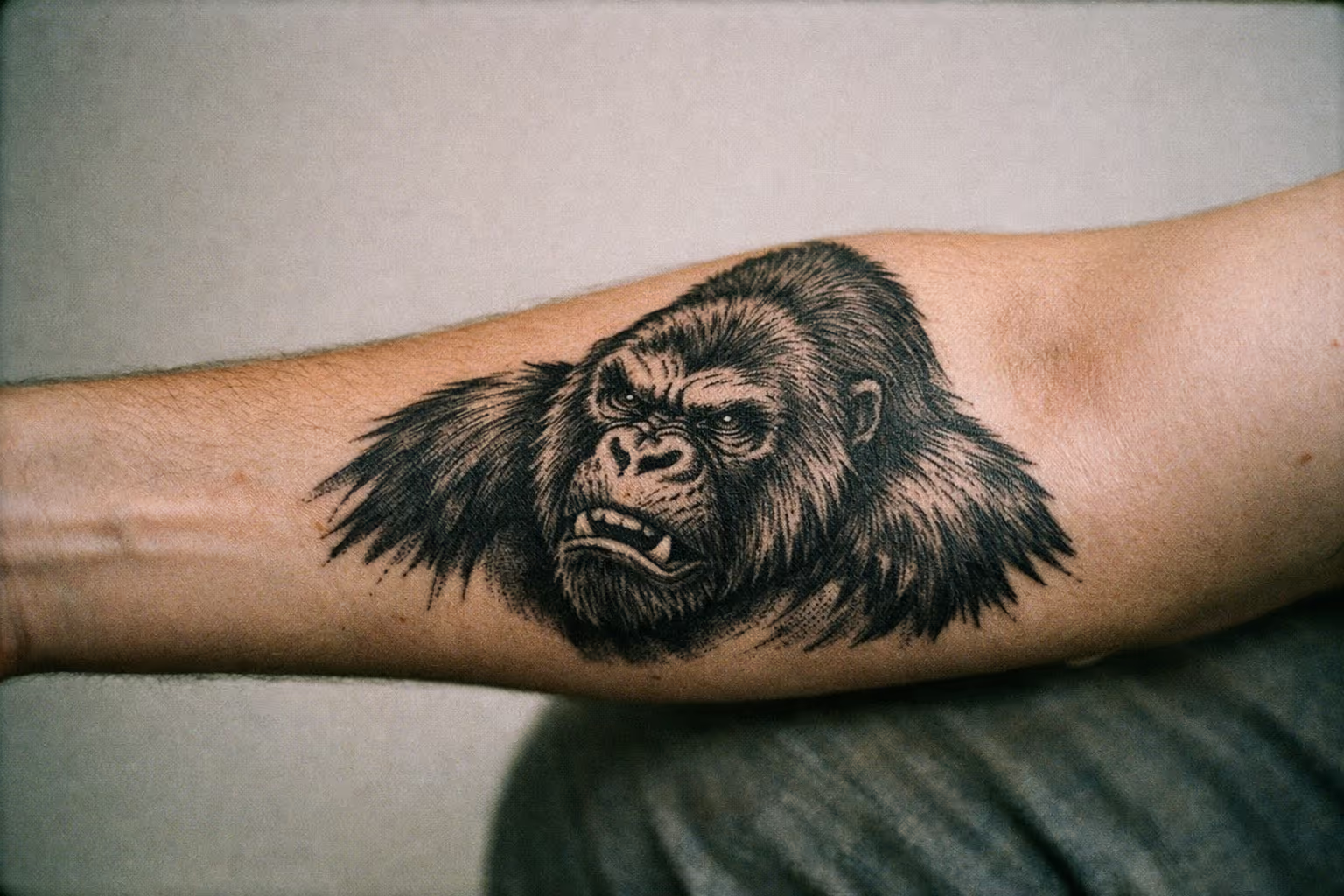
The number that catches people off guard when booking a gorilla tattoo is what $500 actually buys: a four-to-seven-inch black-and-grey head, not the full sleeve they pictured. A realistic gorilla is dense, textured work - a proper sleeve runs 15 to 30 hours and $1,800 to $7,500 - so the honest move is to size up your expectations before you shrink the design. Here’s what a gorilla stands for, and how budget, scale, and style really line up.
What a Gorilla Tattoo Means
A gorilla tattoo most often stands for strength, protection, leadership, intelligence, and loyalty to family. The symbolism leans on real animal behavior - gorilla troops are tight, protective social groups led by a dominant mature male, native to central Sub-Saharan Africa. That family structure is why so many people read the gorilla as a guardian figure rather than a fighter.
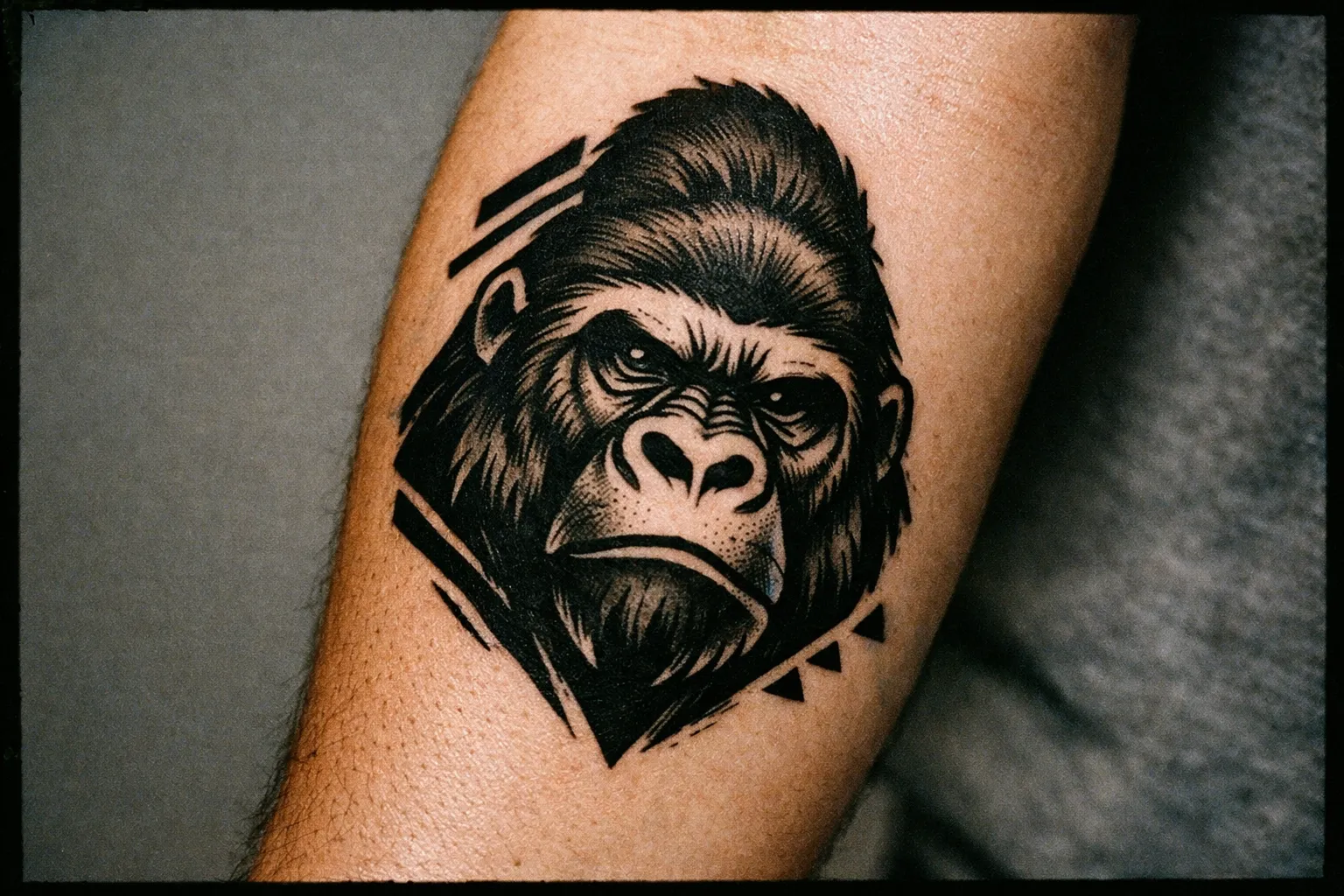
The most common meanings people bring to the chair:
- Calm power / gentle strength - capable of great force, but not looking for a fight. This is the read most experienced wearers actually want.
- Family and protection - guardianship over the people you’re responsible for. Often paired with a baby gorilla, a troop, or a portrait.
- Inner resilience - facing personal battles with dignity. Abstract designs frequently lean here: a gorilla emerging from shadow, broken chains, recovery themes (2).
- Leadership and self-mastery - the alpha read, often pushed further with a crown or armor.
One thing worth saying plainly: a gorilla does not have a single fixed meaning the way some Western tattoo motifs do. It’s a flexible symbol, and what it signals depends heavily on the expression you choose. A snarling, teeth-bared face reads as aggression. A calm, direct gaze reads as wisdom and control. Decide which one you actually want before the stencil goes on, because they tell very different stories on your skin.
I’ve had clients come in with a reference photo of a snarling silverback, insisting they want something that represents patience and fatherhood. That’s a conversation we need to have before I pick up a machine.
What Does the Gorilla Symbolize Across Cultures?
The gorilla doesn’t carry the deep, codified cultural symbolism of, say, the Japanese dragon or the Celtic knot. It’s a relatively modern tattoo subject, and most of its meaning is built in contemporary Western tattoo culture rather than inherited from an ancient tradition.
The associations are consistent: dominance, protective instinct, and physical capability. In modern Western tattoo culture the gorilla has been adopted heavily by fitness and lifting communities (strength, discipline), by fathers and family-focused wearers (the protector role), and increasingly by people connecting the design to gorilla conservation, given the animal’s endangered status.
A note on tribal and Polynesian-style gorilla designs: Polynesian tattooing has its own deep cultural grammar, and dropping a gorilla face into a Polynesian pattern without understanding it can read as decoration borrowed from a living tradition. If you want that look, find an artist with genuine familiarity with the style rather than someone faking the patterns from a Pinterest board.
Gorilla Tattoo Designs and Styles
The range here is wide - major AI design platforms list many different gorilla tattoo designs, and stock libraries offer extensive reference images. Here are the styles that actually hold up, with their technical hallmarks and where each one tends to fail.
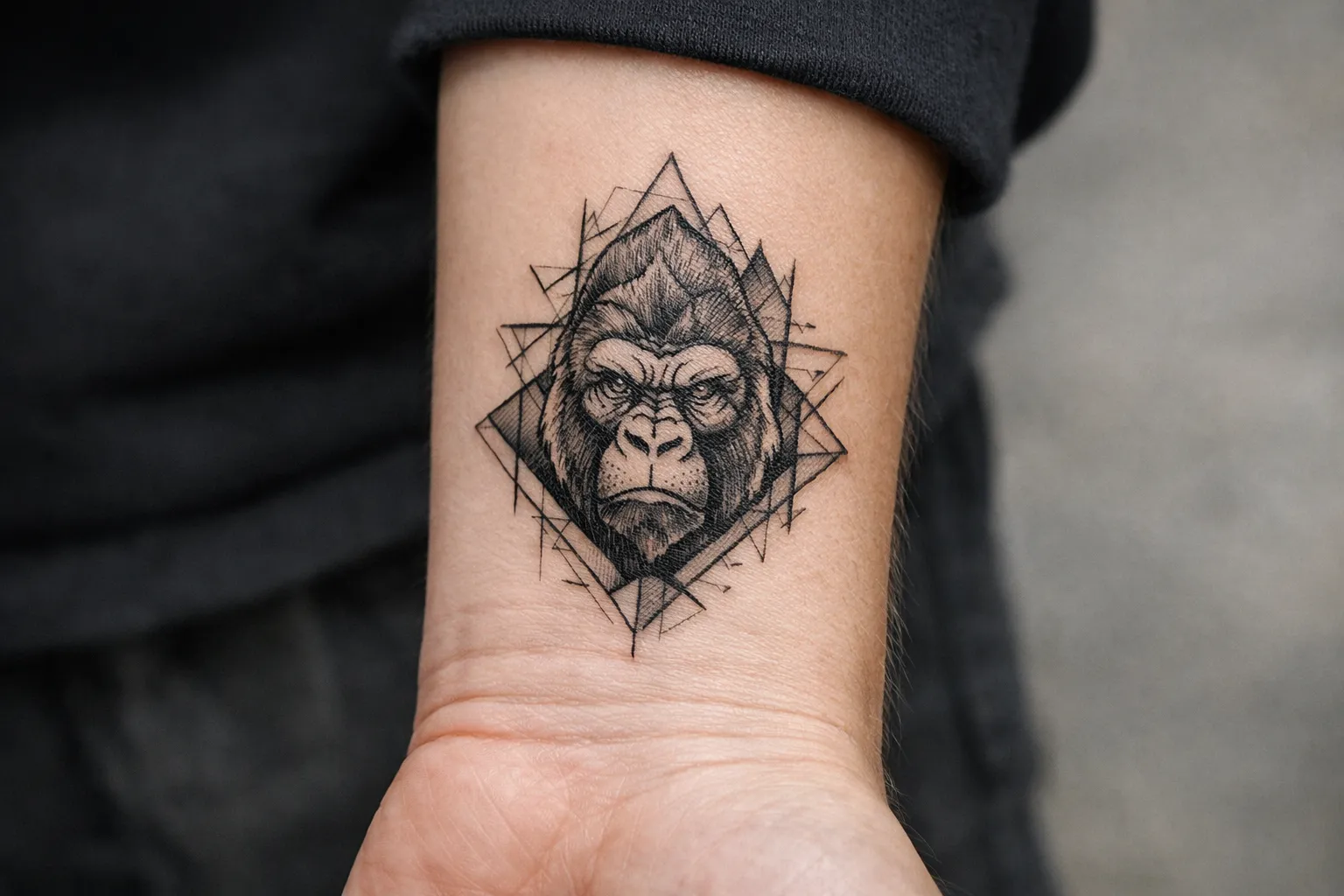
Realistic Black-and-Grey Silverback
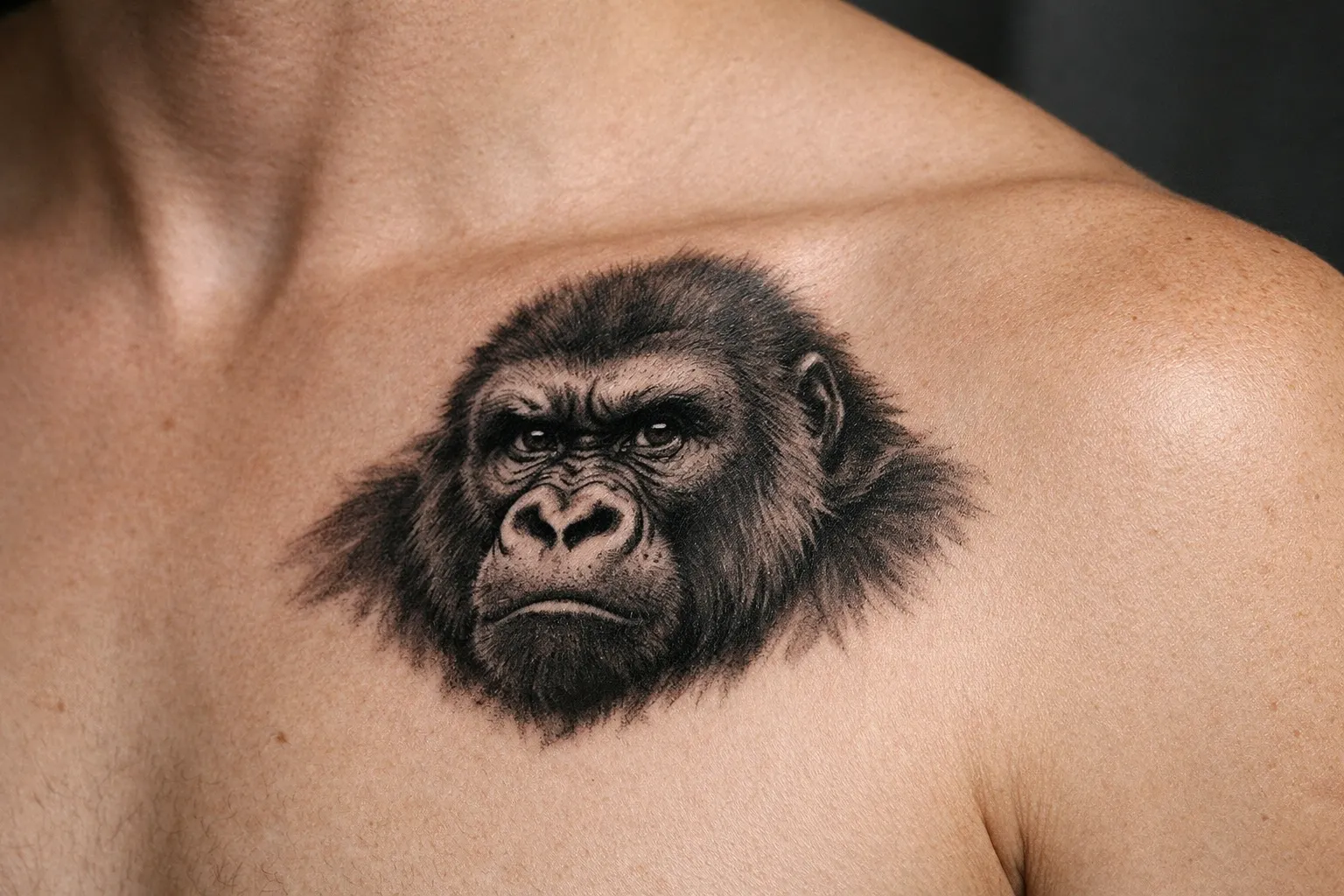
The most requested silverback gorilla tattoo look. Two hallmarks define it: smooth gradient shading that builds fur texture and skin wrinkles, and expressive, light-catching eyes. Black-and-grey ages better than color and works across more skin tones, with strong contrast that fades slowly.
- Best size: 6+ inches minimum. Detailed fur and facial wrinkles need room.
- Placement: upper arm, chest, thigh, upper back.
- Time: 4-12 hours depending on background.
- Common pitfall: packing this into a 3-inch space. The fine fur lines bleed together within a few years and you lose the whole effect.
I’ve seen this mistake more times than I can count - someone brings in a beautiful reference image, wants it on their wrist at 2.5 inches, and I have to explain that what they’re looking at will be a grey smudge in three years. Size up.
American Traditional Gorilla Head
Two hallmarks define it: thick black outlines and a limited, saturated color palette (reds, greens, golds). Bold, graphic, built to last - the heavy outline holds the design together as it ages.
- Best size: 3-6 inches.
- Placement: outer forearm, calf, bicep.
- Time: 2-4 hours. Friendly to first-timers.
- Common pitfall: thin, timid outlines. American traditional lives and dies on bold linework. A weak outline makes the whole piece look uncertain and ages into mush.
Neo-Traditional Gorilla
Same bold outline philosophy as traditional, but with more shading depth, decorative elements (foliage, ornamental frames), and a broader modern color range. Sits well on the upper arm or calf at 5-7 inches.
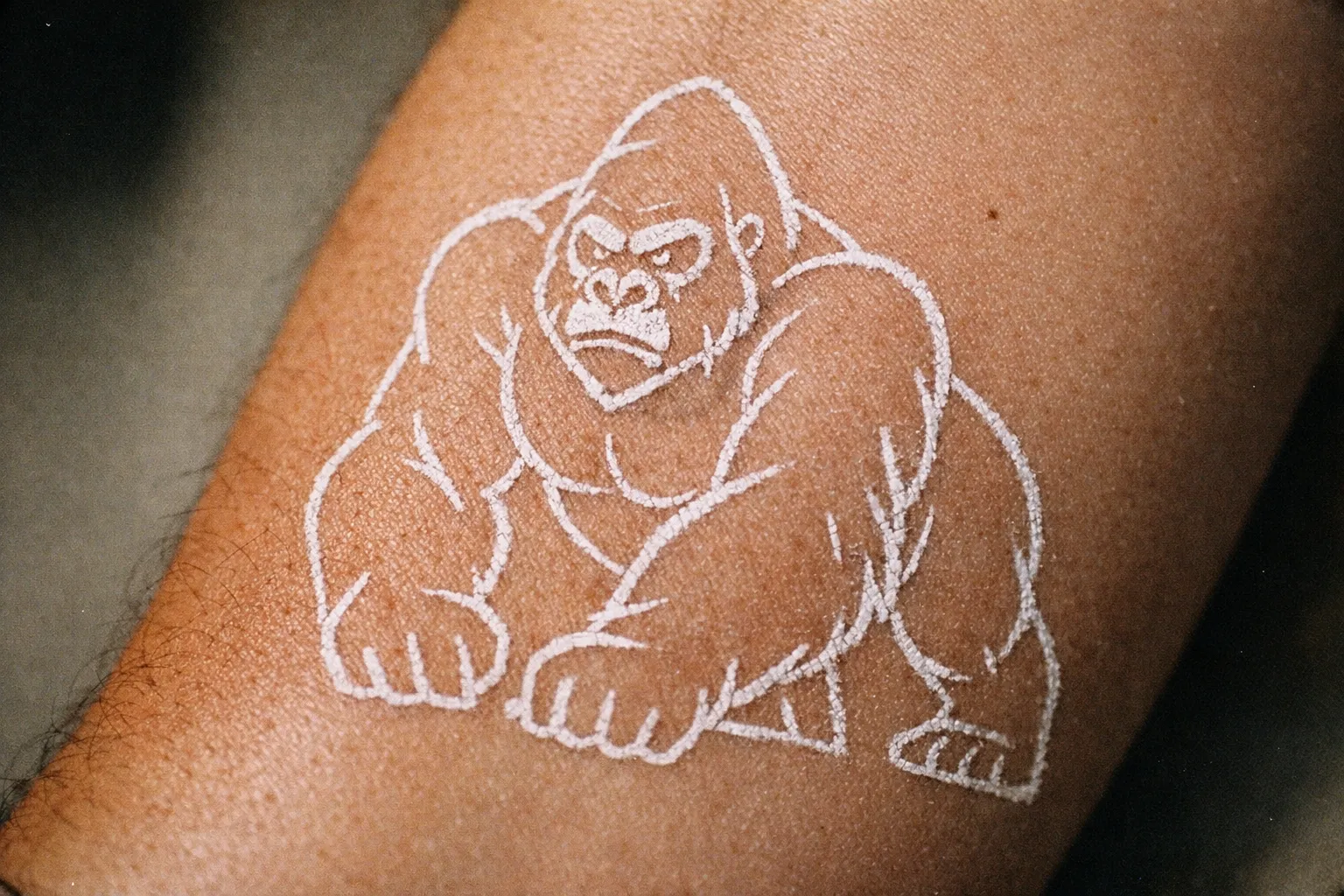
Minimalist and Line-Art Gorilla
A single clean contour or simplified head. Good for small placements and tighter budgets.
- Best size: 2-3 inches.
- Placement: wrist, ankle, behind the ear, inner forearm.
- Time: under 1.5 hours.
- Common pitfall: wrist and ankle linework fades and spreads faster than most placements - expect a touch-up sooner than you would on a forearm.
Gorilla With a Crown (“King Gorilla”)
A silverback paired with a crown, scepter, or armor pushes the meaning toward royalty, dominance, and self-mastery. Usually placed on the forearm or chest, 5-8 inches, with a limited color accent (a gold crown against black-and-grey shading) so the addition pops without cluttering the palette.
Ideas by Meaning and Placement
If you’re collecting gorilla tattoo ideas, work backward from the meaning you want rather than the image you saw first. The composition should serve the message.
- Family / protection: gorilla with a baby, a full troop, or a portrait over the left chest - placement directly over the heart reinforces the guardian read. 5-8 inches.
- Inner battles / resilience: gorilla emerging from shadow, breaking chains, or paired with a short line of text. Forearm or upper arm, where there’s room for negative space to do the work.
- Leadership / alpha energy: crowned or armored silverback, chest or forearm.
- Nature / conservation: realistic gorilla framed in jungle foliage, often a larger back or thigh piece.
On placement durability, here’s the honest hierarchy: forearm, upper arm, calf, and chest hold detail best. A forearm piece on a client I did five years ago still reads clean; the same client’s friend got a matching design on the back of his hand and it needed a full rework at the two-year mark - a pattern consistent with what realism artists report in Inked Magazine’s placement durability roundups, which consistently flag hands and fingers as the fastest-degrading zones for fine-detail work. Hands, fingers, and the side of the hand see constant friction and break down fastest - a high-detail gorilla face there will distort within a few years. If you want longevity on a detailed design, keep it off high-wear zones.
On pain, placement drives it more than the design: ribs and sternum > inner upper arm > chest > calf > outer forearm. A chest piece over the breastbone is a meaningfully rougher sit than the same design on the outer forearm.
How Big Is a $500 Gorilla Piece?
This is one of the most-asked questions in the comments under gorilla tattoo posts, so here’s a straight answer. U.S. tattoo rates typically run $100-$250 per hour for mid-tier artists and $250-$400+ per hour for high-demand realism specialists - figures consistent with pricing data published by Tattoodo and the Professional Artists Guild in their 2024 market surveys covering major cities like New York, Los Angeles, and Chicago, where realism specialists at top shops routinely quote $300-$400/hr minimum.
At those rates, $500 buys:
- At $150/hr (~3 hours): a detailed 5-7 inch black-and-grey gorilla head on the upper arm or calf, minimal background.
- At $250/hr (~2 hours): a tighter 4-6 inch black-and-grey portrait or stylized head from a specialist.
So $500 is solidly in medium-tattoo territory - a strong standalone gorilla head, not a sleeve. Where people go wrong is expecting a full realistic silverback sleeve for that budget. A realism sleeve runs 15-30 hours, which translates to $1,800-$7,500 depending on artist and city. A medium back piece with background commonly lands at $1,000-$3,000 across 2-4 sessions.
Budget breakdown for a gorilla tattoo:
- Small / minimalist (2-3 in): $100-$250, 1-1.5 hours.
- Medium head, black-and-grey (4-6 in): $250-$600, 1.5-3 hours.
- Large realism (upper arm / half-sleeve): $600-$1,800, 4-8 hours.
- Full sleeve or large back scene: $1,800-$7,500, 2-6 sessions.
Also budget for the extras: a deposit of $50-$200 (or 10-30% of the quote) to book, and at some premium studios a consultation fee of $50-$150, often credited toward the final piece.
What Gorilla Designs to Avoid
Most “tattoos to avoid” advice is about taste. With gorilla designs, a couple of the pitfalls are genuinely worth flagging.
Designs that drift into racist caricature. Gorillas and apes have a long, ugly history of being used in racist imagery. Exaggerated, dehumanized primate features can unintentionally echo that. A respectful, anatomically real gorilla - calm or powerful - sidesteps this entirely. A grotesque, distorted “monster” version risks reading in ways you never intended. Keep the animal looking like the animal.
The wrong expression for your meaning. If you want loyalty, patience, and protection, don’t choose a snarling, teeth-bared face just because it looks intimidating in flash. The angry face reads as aggression and nothing else, and you’ll spend years explaining what you actually meant.
Over-detailed designs jammed into small spaces. A realistic silverback face needs room. Shrink it under 4 inches and the fur texture and wrinkles blur into a grey smear within a few years.
Exact copies of someone else’s custom tattoo or copyrighted art. Most professional artists will refuse to clone another person’s piece, and they’re right to. Bring references for pose, expression, and style - not a photo of someone’s finished tattoo with a demand for a carbon copy.
Low-resolution reference photos. A blurry social media screenshot gives the artist nothing to build accurate anatomy from, and you end up with a flat, generic gorilla. Bring sharp, high-detail references.
How to Create Your Own
A custom piece is mostly about giving the artist the right raw material. Here’s the workflow that gets you from idea to stencil with fewer revision rounds.
How to Create Your Own Gorilla Tattoo
About 1 hourSteps to prepare and communicate your gorilla tattoo idea effectively to your artist
- 1
Gather 3-5 reference images
Collect separate images for pose, facial expression, background/framing, and style. Avoid relying on a single image to cover everything.
- 2
Rough out the composition
Use a collage app or AI tattoo mockup tool to create a rough layout. Treat this as a starting point for your artist to redraw and refine.
- 3
Write down the meanings you want
List key themes like "fatherhood, patience, recovery" to guide the artist on expression and symbolic elements.
- 4
Size up, not down
Ask the artist to increase your initial design by 10-20% to preserve detail, especially for fur and wrinkles.
- 5
Prioritize the eyes and face
Make clear that facial expression is the focus, as it carries intelligence and emotional depth.
Expect 1-3 rounds of revisions before the final stencil. Clarify the custom-art policy upfront: some artists charge $50-$200 for the artwork if you don’t go through with the tattoo.
Choosing the Right Artist
The single best filter is healed work in the portfolio, not fresh photos.
Fresh tattoos look crisp on everyone. Healed work shows whether the artist’s fur texture, shading, and line saturation actually hold up. Look specifically for:
- For realism: multiple healed animal or gorilla pieces. Expressive eyes and convincing fur are a specific skill, not a given.
- For traditional / neo-traditional: consistent, solid linework and fully saturated color that hasn’t gone patchy in healed photos.
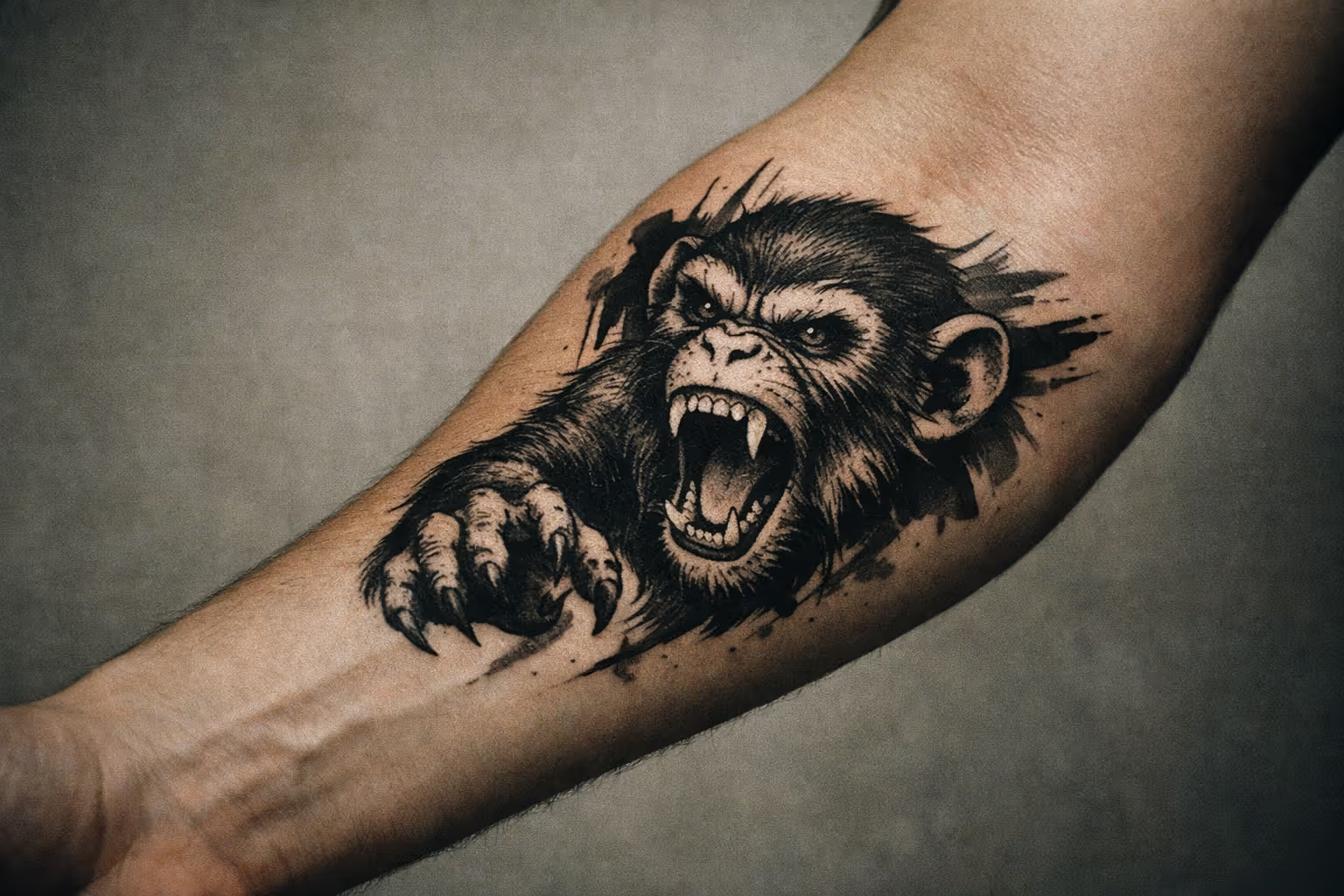
A few questions worth asking in consultation: Do they redraw AI or reference mockups for originality? Will they recommend black-and-grey vs. color for your placement and skin tone? Black-and-grey generally ages better and fits more skin tones, with cleaner long-term contrast than some colors. Use limited color accents - a gold crown, a few green leaves - to make a black-and-grey gorilla pop without overcomplicating the palette. Like the monkey tattoo, it reads strongest with a clear silhouette and restrained color.
When I’m looking at a portfolio for a realism referral, the eyes are the first thing I check. If the eyes are flat, the whole piece reads flat, no matter how good the fur is.
Aftercare and How a Gorilla Tattoo Heals
Dense black shading is the whole point of most gorilla designs, and that shading lightens noticeably as it heals - so aftercare matters more here than on a sparse line tattoo. Surface healing takes 2-4 weeks; full internal healing can run up to 3 months, which is why color or touch-ups on a black-and-grey base usually wait for a second session once the first is mostly healed.
Day 1-3: Keep the bandage on as long as your artist directs (modern second-skin dressings often stay on for days). Once it’s off, wash gently with unscented antibacterial soap, pat dry, and apply a thin layer of fragrance-free moisturizer. Expect some plasma and ink weeping early on - normal.
Week 1: Light scabbing and flaking begins, especially over the heaviest black areas. Do not pick or scratch - peeling a scab off dense fur shading pulls pigment with it and leaves patchy gaps in the exact areas you wanted solid. Keep it lightly moisturized, never soaked.
Week 2-4: Flaking finishes and the tattoo can look dull or “milky” as the top layer settles - this clears as the skin finishes healing. Keep moisturizing. No swimming, soaking, or sun on the fresh piece.
Long term: Apply SPF 30+ daily to healed work, or cover the area with sun-protective clothing when you’re going to be outside for extended periods - especially black-and-grey chest, forearm, and back pieces, since UV exposure is the primary driver of fading in dense black shading. Plan a touch-up at 3-5 years for high-exposure placements (forearm, calf) to keep fur texture and contrast crisp.
A full aftercare kit - soap, fragrance-free moisturizer, dressing - runs about $10-$30 for the healing period. Avoid alcohol and blood thinners for 24 hours before a session, eat and hydrate beforehand, and on long realism sessions take a break every 60-90 minutes so you stay still and the artist keeps clean lines.
Frequently Asked Questions
- Can I get a detailed gorilla tattoo on my wrist?
- You can, but detailed black-and-grey gorilla tattoos smaller than 4 inches on high-friction areas like the wrist tend to blur and lose detail within a few years. Minimalist line-art styles work better there.
- Is it okay to use AI-generated gorilla tattoo designs directly?
- Most professional artists redraw AI-generated designs to fix anatomy and ensure originality. Tattooing AI output as-is risks anatomical errors and a less authentic piece.
- How do I avoid unintentionally racist gorilla tattoo designs?
- Choose anatomically accurate, respectful gorilla images with calm or powerful expressions. Avoid exaggerated or caricatured primate features that echo racist imagery.
- What should I look for in healed tattoo photos when choosing an artist?
- Check for clear fur texture, consistent shading, saturated color, and expressive eyes in healed gorilla tattoos. Fresh photos can be misleading since all tattoos look crisp initially.
- How long should I wait before getting a touch-up on a gorilla tattoo?
- Wait until the tattoo is mostly healed, typically 2-4 weeks for surface healing and up to 3 months internally. Touch-ups are often scheduled 3-5 years later for high-exposure areas to maintain detail.
- Can I place a gorilla tattoo on my ribs or sternum?
- Yes, but expect higher pain levels compared to forearm or calf placements. The ribs and sternum are more sensitive, so plan accordingly.
- Are color gorilla tattoos a bad idea?
- Color can work, especially in neo-traditional styles, but black-and-grey generally ages better and suits more skin tones. Use limited color accents to avoid clutter.