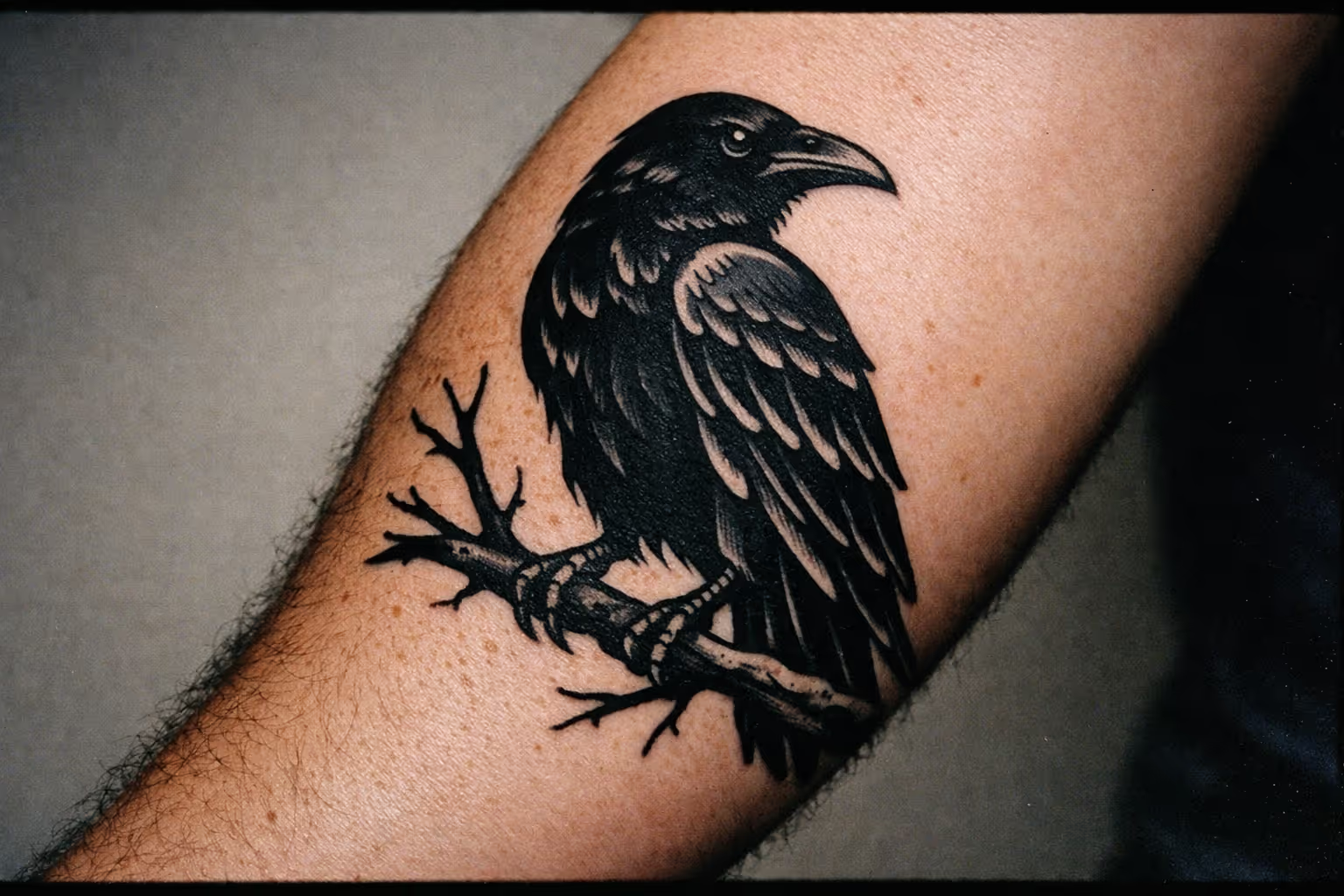
With a raven tattoo, the bird itself barely sets the meaning - what pins it down is the pose and the pairings. A raven in flight, one perched on a skull, one ringed with Norse runes, one caught mid-caw: each pulls the same animal toward a different one of its five traditions, from Odin’s messenger to a Celtic omen. Choose those details on looks alone and you may say something you didn’t intend. Here’s how pose and pairing steer a raven’s meaning, and the design calls that keep it sharp.
What a Raven Tattoo Means
The short version: a raven tattoo symbolizes mystery, intelligence, transformation, death-and-rebirth, and a connection to the spirit world (1)(2)(4). Almost every meaning guide circles back to those five.
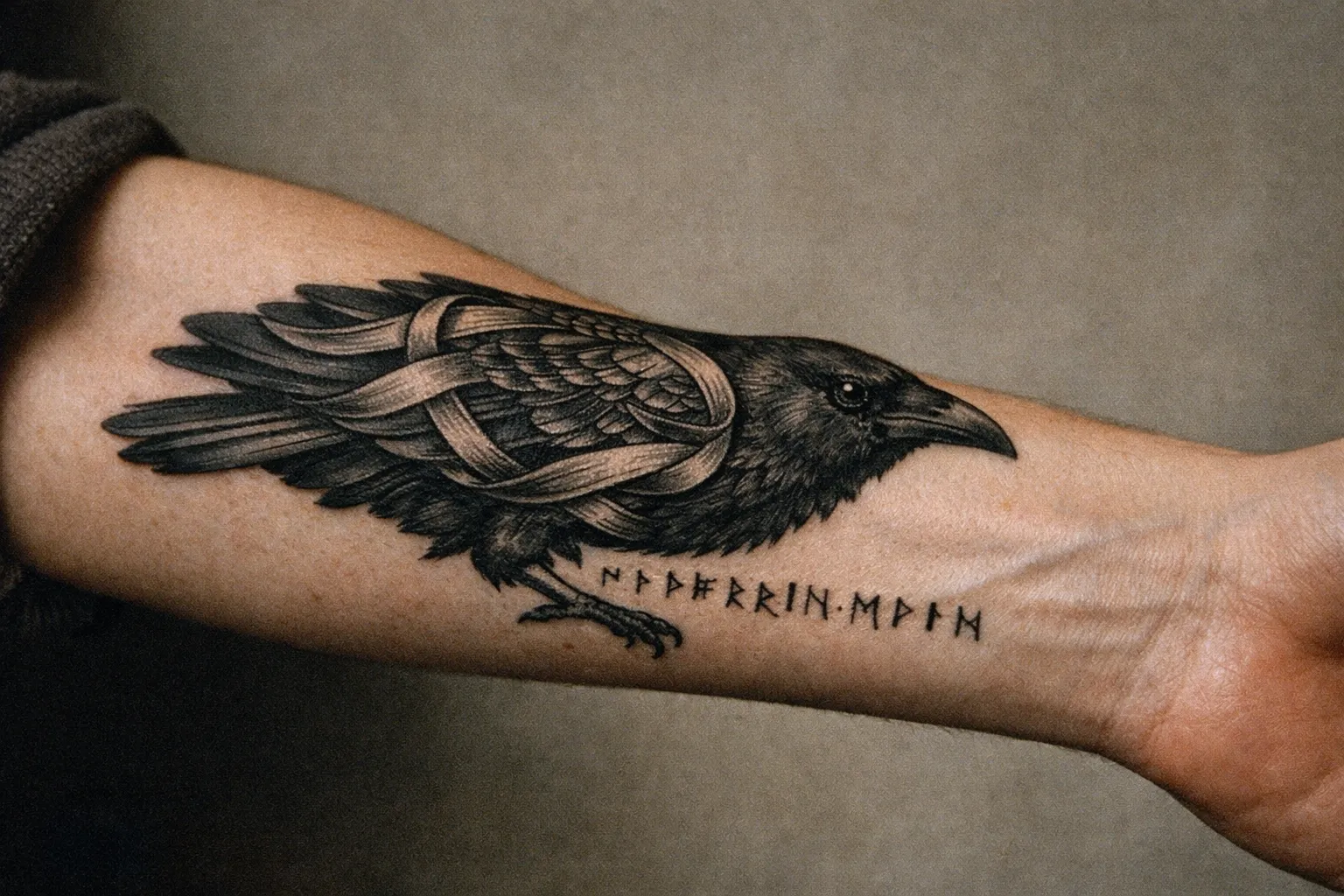
The longer version depends on what you bring to it:
- Transformation and rebirth - the most common modern reading. The raven crosses between life and death, so it gets used as a symbol for personal change, recovery, or shedding an old identity (1)(4).
- Wisdom and foresight - tied directly to Odin’s ravens in Norse myth. If you want the “thought and memory” angle, this is the lane (2).
- Spiritual messenger - a guide between the mortal world and whatever comes after. Common choice for memorial and grief tattoos.
- Magic and prophecy - the witchy reading, often paired with moons, tarot imagery, or alchemical symbols.
- Trickster and creator - pulled from Native American storytelling traditions, where the raven brings light, steals fire, or generally stirs things up (2).
A raven on its own doesn’t pick one of these for you. The pose, the objects around it, and the style do.
A flying raven with open wings reads as freedom and transformation. A perched raven with its head lowered reads as mourning. A screaming raven mid-caw reads as warning or aggression. Decide the feeling first, then let your artist build the pose around it.
What a Raven Represents Across Cultures
This is where the symbolism gets genuinely interesting, because no single tradition owns the raven.
Norse Mythology: Huginn and Muninn
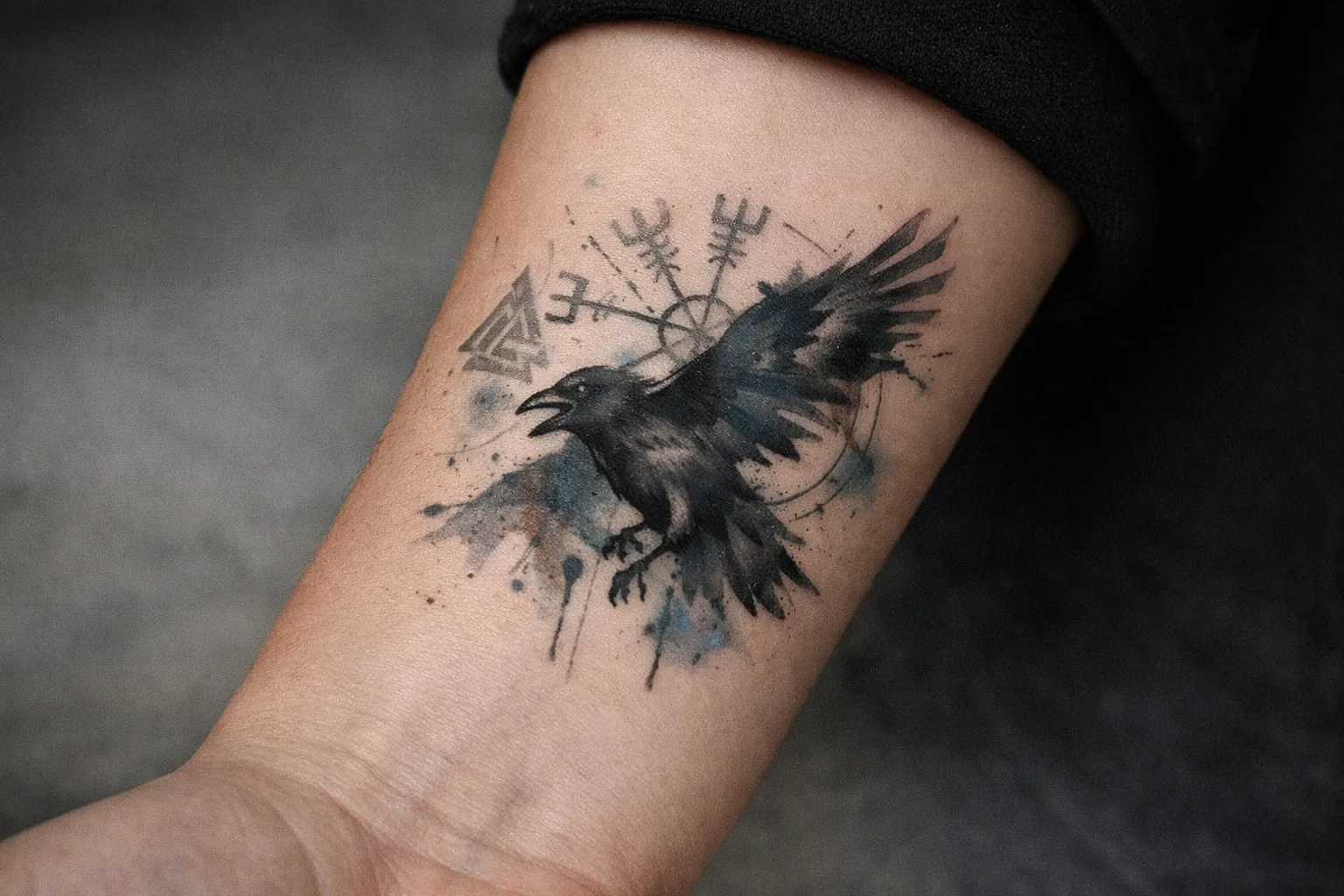
Odin’s two ravens - Huginn (“thought”) and Muninn (“memory”) - fly across the world each day and report back what they’ve seen (2). If you want a raven tattoo rooted in wisdom and knowledge, this is the heaviest reference you can pull.
Design options that actually work:
- Both ravens perched on Odin’s shoulders (chest, back, or upper-arm placements at 6-10 in / 15-25 cm to keep the faces readable)
- The two birds in flight on either side of a central element - a tree, a rune, an eye
- A single raven with the names Huginn and Muninn worked into the feathers or branch
If you add runes, get them right. Don’t pull random characters off a Pinterest board - some Norse symbols have been co-opted by hate groups, and your artist may decline to tattoo specific combinations. Ask before you commit.
Celtic Mythology: the Morrigan
In Irish myth, the Morrigan is a war goddess associated with fate, death, and rebirth, and she appears as a crow or raven on battlefields. A traditional raven tattoo rooted in Celtic imagery often pairs the bird with knotwork or spirals - eternity, interconnectedness, the cycle that runs from death back to new growth.
The Celtic angle works well on forearm or calf placements at 4-6 in, where the knot detail has room to breathe without collapsing into a black smudge.
Native American Traditions
Across many North American Indigenous traditions, the raven is a trickster and a creator - the bird that stole the sun, brought light, shaped the world by accident. Some traditions also treat ravens and crows as spirit guides or messengers between realms.
A caution worth taking seriously: the stylized formline raven you see in Pacific Northwest Coast art (Haida, Tlingit, Tsimshian) is not generic flash. Those are specific clan and ceremonial symbols. Don’t lift them off Google Images. If you’re drawn to that aesthetic, commission an artist who works in that tradition with permission, or pick a different style entirely.
Chinese and East Asian Symbolism
In older Chinese mythology, three-legged crows are associated with the sun - a much warmer reading than the Western one. The same three-legged crow shows up in Japanese myth as Yatagarasu, a divine guide. If you want a crow tattoo that doesn’t lean gothic, this is a workable angle.
Modern Western Reading
In contemporary Western tattoo culture, the raven has shifted. Older readings treated it as a portent of death and bad luck (1). Newer work - especially in the last few years - emphasizes transformation, shadow work, and psychological growth (1)(4). Same bird, softer reframe.
Are Ravens Good Luck or Bad Luck?
Both. That’s the honest answer and the one most blogs dance around.
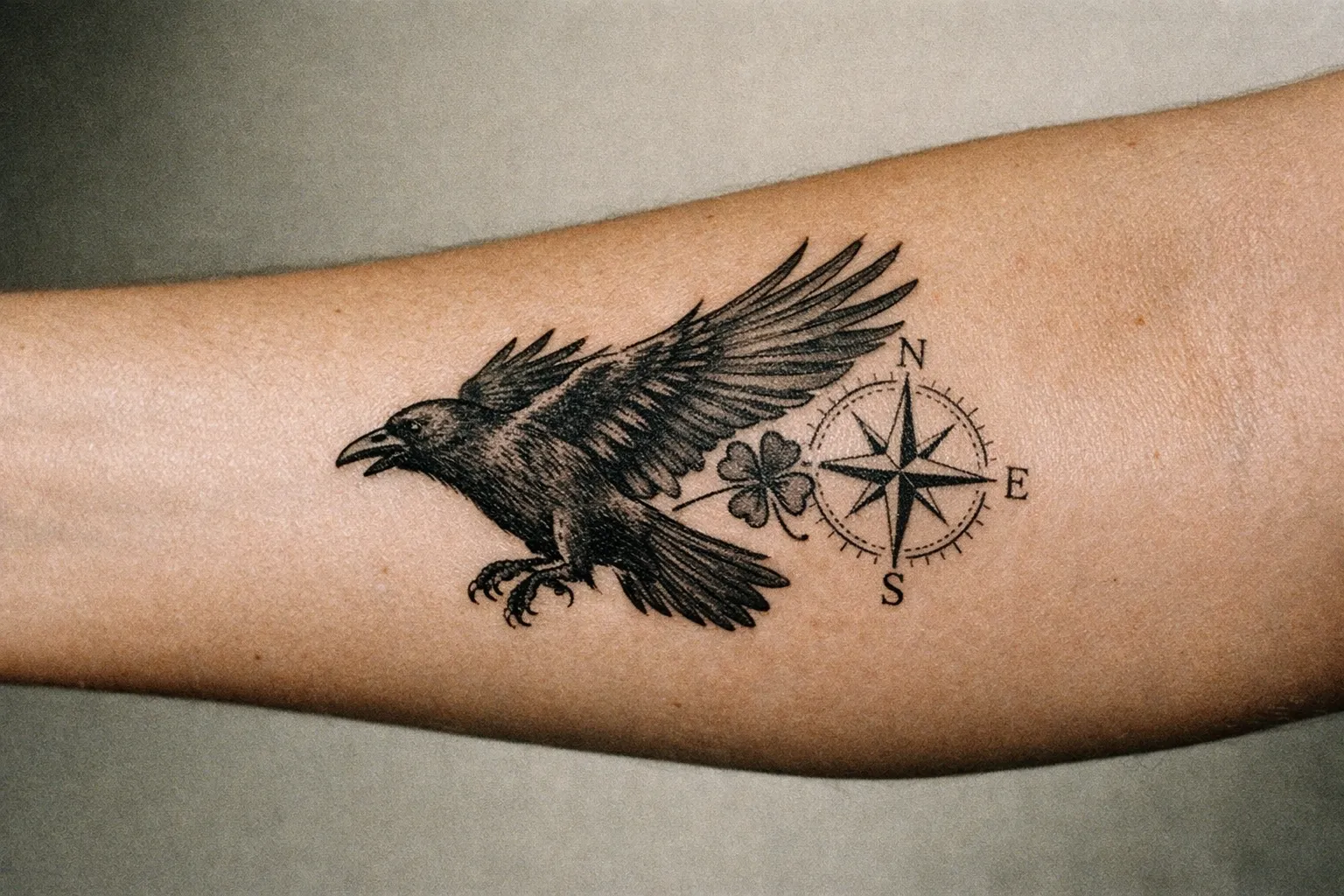
Across cultures, ravens function as dual symbols - protective and destructive, wise and ominous, creator and trickster (1)(2). In Norse and Celtic traditions they carry positive weight: wisdom, prophecy, divine messenger. In Western folklore they were historically read as death omens. In Native American stories they’re catalysts for change, which can cut either way.
If you’re getting a raven tattoo because you’re worried about which side it lands on, you’re thinking about it wrong. The bird doesn’t decide for you - the imagery around it does. A raven with a sunrise, an open hand, or flowers reads as renewal. A raven with a skull, an hourglass, or a dying tree reads as endings. Build the message you want.
Crow Tattoo Meaning vs. Raven: Which One Should You Pick?
Visually they’re close, but they carry different weights.
Raven: larger body, heavier beak, wedge-shaped tail. Reads as majestic, mystical, mythological. Pulls from Norse and Celtic lore. Works at larger sizes and rewards detail in the feathers.
Crow: smaller, sleeker, more urban. Reads as adaptable, cunning, survivalist - the bird that figured out how to live in cities and remembers your face for five years if you wronged it. The crow tattoo meaning leans practical: street-smart, resourceful, transformation through everyday adaptation rather than mythic upheaval.
Some clients pair both - a raven for spirit and wisdom, a crow for survival and cunning. The composition usually puts one bird in flight and one perched, or shows them facing each other across a shared element like a branch or a moon. It’s a nuance that almost no inspiration blog explains, and it gives the tattoo a real conversation between two ideas instead of just two birds.
✓ Pros
- Rich cultural symbolism spanning Norse, Celtic, Native American, and East Asian traditions
- Versatile design options from minimalist to realism that age well with proper size
- Dual symbolism allows personal meaning customization through pose and accompanying elements
✗ Cons
- Fine-line and small detailed tattoos age poorly, especially on high-movement areas like wrists
- Misuse of cultural symbols (e.g., Indigenous formline art, Norse runes) can cause offense or tattoo rejection
- Blackwork styles risk ink spreading and muddiness if not executed with deliberate negative space
Traditional Raven Tattoo Styles That Hold Up
Style choice does more for longevity than placement does. Here are the buckets that actually work for corvid tattoos:
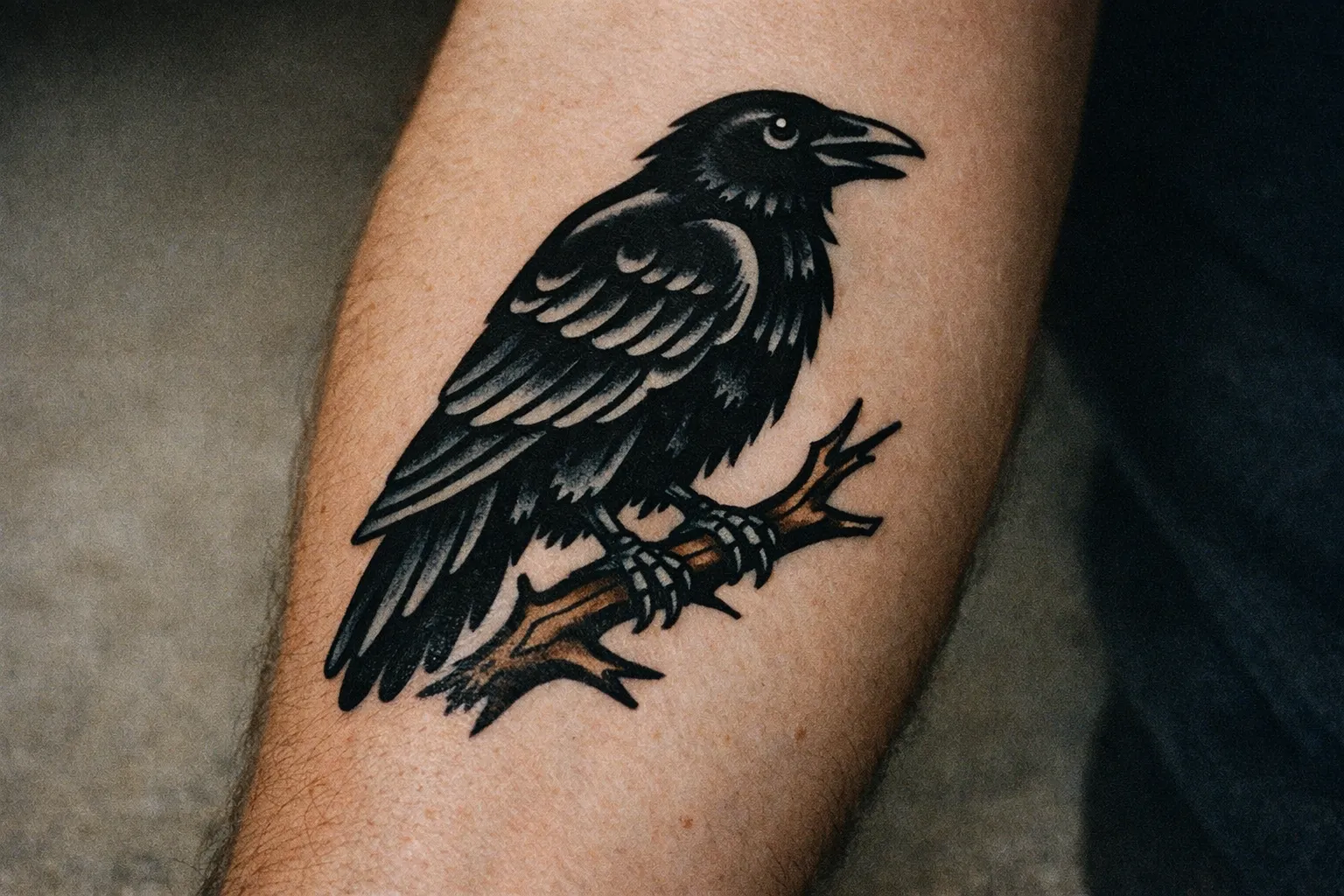
American Traditional
Thick black outline, limited palette (black, red, sometimes yellow or green), bold shading. A traditional raven tattoo in this style uses chunky lines that hold up for decades because there’s no fine detail to blur. Common pitfall: artists who try to “modernize” traditional by thinning the lines. It stops being traditional and starts being a tattoo that won’t read at six feet in ten years.
Sizes: 3-5 in on a forearm, 5-8 in on a thigh or upper arm.
Neo-Traditional
Same bold-outline DNA as American traditional but with expanded color and more illustrative detail. Good for ravens with flowers, skulls, moons, or hourglasses. Works at 4-7 in on a forearm or calf.
Blackwork and Dotwork
All black ink, often with negative space carrying the feather detail. This is where the witchy and gothic ravens live. The pitfall: artists who over-pack black into small feather areas. Within 1-3 years, that ink spreads under the skin and turns into a muddy silhouette. A good blackwork artist leaves deliberate skin breaks in the wings so the bird stays readable for ten-plus years.
Minimum size: 3-4 in if you want any feather detail at all.
Black and Grey Realism
A realistic raven portrait with soft shading and high contrast. Beautiful when done by a realism specialist, brutal when done by anyone else. Bring high-resolution reference photos from multiple angles. Sizes: 5-8 in minimum - realism shrinks badly.
Fine-Line and Minimalist
Single-needle silhouettes, often on wrists or ankles. The trend has grown in the last year or two alongside the broader minimalist blackwork movement. Sizes: 1.5-3 in. The honest caveat: fine line ages faster than bold linework, especially on the wrist where skin moves constantly. Expect to touch it up at the 5-7 year mark.
Watercolor and Geometric
Watercolor splashes around a black silhouette (freedom, imagination); geometric backgrounds with mandalas or sacred geometry (balance, spiritual weight). Geometric backgrounds have been showing up more often in 2024-2025 design galleries (3)(5). If you like the idea of pairing a raven with bold geometric shapes, the same logic applies to a mountain tattoo - the geometry gives the design structure and spiritual weight without overloading the composition.
Placement and Size: What Actually Works
Pain on a raven tattoo follows the same map as any other piece - ribcage > sternum > inner bicep > forearm > outer thigh. Pick placement for how the design fits the body, not for how it photographs.
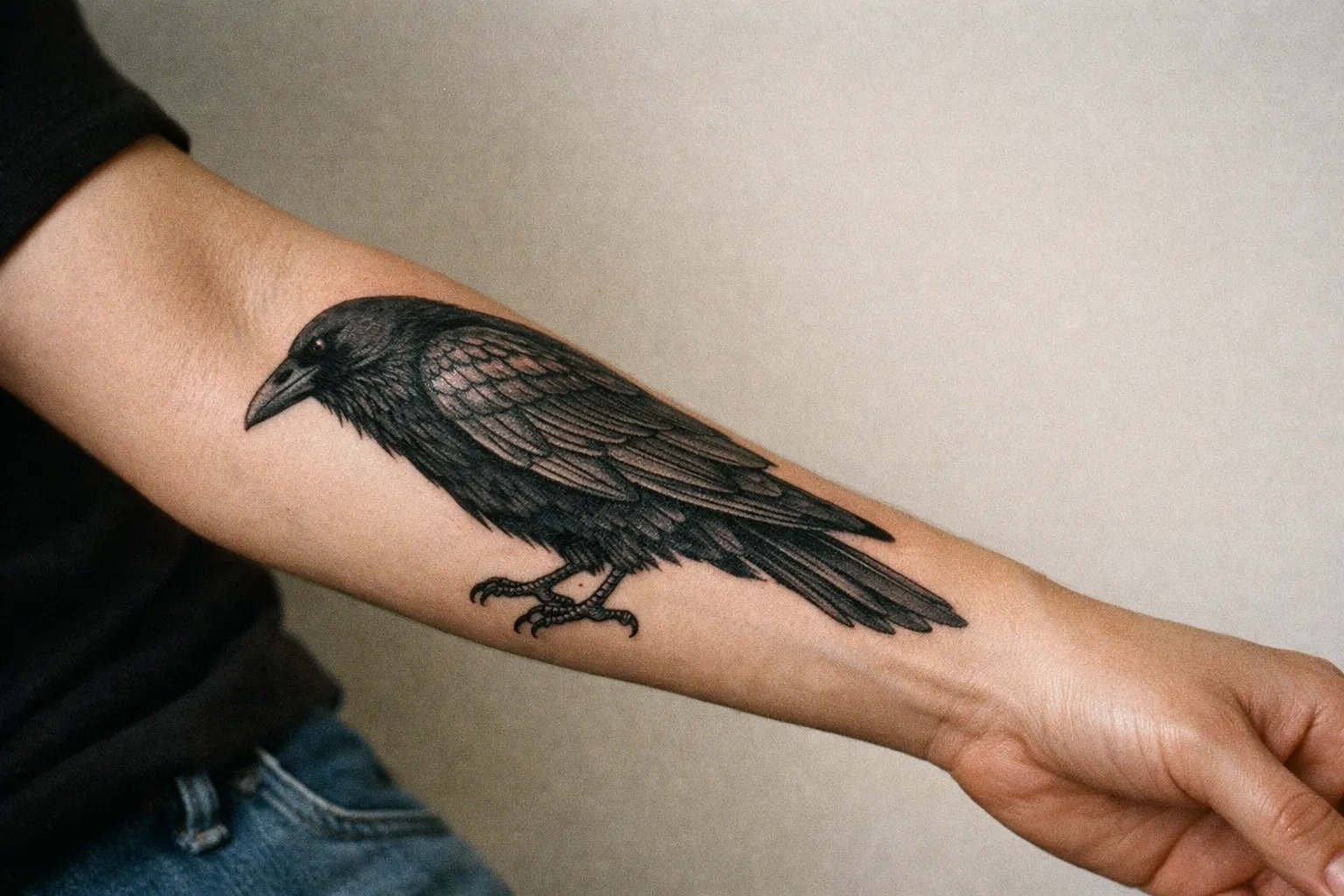
Forearm (inner or outer) - 3-5 in perched raven, or a flying raven wrapping the arm. Easy to show, easy to cover, moderate pain.
Upper back / between shoulder blades - 6-10 in flying raven with full wingspan. Lots of canvas for detail, lower pain. Best placement for Huginn and Muninn together.
Chest (over pectoral) - 5-8 in raven facing inward or outward. Higher pain near the sternum, easier on the outer chest.
Thigh - 6-12 in allows large illustrative scenes. Low-to-moderate pain, ages well because the skin moves less than the forearm.
Ribcage - high pain, beautiful canvas for a perched raven facing downward. Expect a long session and don’t get this one as your first tattoo.
Calf - 4-7 in perched raven works cleanly. Wraps well for flying compositions.
Wrist or behind the ear - 1.5-3 in silhouettes only. Don’t try to fit detail at this size.
Avoid throat, hand, and face placements unless you’ve thought hard about what they mean for your job and your future. Also avoid high-movement spots like the elbow ditch, knee, and side of finger - beak and eye detail distorts fast there.
Cost and Time: What to Budget
US studio rates in 2024-2025 generally run $120-$200 per hour at mid-tier shops, with high-demand artists charging $250+/hr. Real ranges for raven tattoos:
- Small silhouette crow or raven (2-3 in) - often the shop minimum, $80-$200. About 1-2 hours including setup.
- Medium neo-traditional forearm raven (4-6 in, color) - $250-$500, roughly 2-3 hours.
- Black and grey realism forearm or calf raven (5-7 in) - $400-$800, 3-5 hours.
- Large back piece or half sleeve with full raven scene - $900-$2,500+, 10+ hours across 2-4 sessions spaced 2-4 weeks apart.
Plan for a 15-20% tip on top. Don’t shop on price - a cheap raven with sloppy blackwork will need an expensive cover-up in five years.
Time on the day: consult and design discussion is usually 30-60 minutes (often a separate appointment), stencil and setup runs 20-40 minutes, and the tattoo session itself depends on size. Bring food and water for anything over two hours.
Healing and Aftercare Timeline
Standard tattoo healing, with one note: heavy-black corvid tattoos punish sun exposure harder than colored work, because UV fades black to a flat grey faster than you’d expect.
Day 1-3: Second-skin or Saniderm bandage left on for 24-72 hours per your artist’s instructions. Wash gently with unscented soap when you remove it. Expect some plasma and ink weep - that’s normal.
Week 1: Apply a thin layer of fragrance-free moisturizer 2-3 times a day. The tattoo will look dull, then start to peel like a sunburn around day 5-7. Don’t pick at it. No swimming, no soaking, no gym sweat directly on it.
Week 2-4: Peeling finishes. The skin underneath will look slightly cloudy - that’s the deeper layer still healing. Keep moisturizing. Avoid direct sun and tanning beds entirely for at least 4 weeks.
Long-term: SPF 30-50 on the tattoo anytime it’s exposed. This is non-negotiable for black ravens. Without it, you’ll see visible fade in 6-12 months of regular sun.
Full internal healing takes about 4-6 weeks. If you booked a multi-session back piece, the artist will want at least 2-4 weeks between sessions.
What Are Some Tattoos to Avoid?
Most guides skip this question. They shouldn’t.
Indigenous formline raven art - the stylized Haida, Tlingit, and Tsimshian raven figures from Pacific Northwest Coast traditions are clan and ceremonial symbols, not free clip art. Don’t lift them.
Norse runes you can’t translate - some rune combinations have been co-opted by white supremacist groups and are now monitored by anti-hate organizations. The Othala and Sonnenrad are the most flagged, but there are others. If you want runes around your Huginn and Muninn tattoo, run them by your artist and look them up first.
Gang or extremist imagery you don’t recognize - certain skull-and-raven combinations carry specific affiliations in certain regions. Your artist should catch this. Not all do.
Trendy aesthetic mashups you don’t understand - the “witchy raven with sigil” trend pulls real sigils from Solomonic, Goetic, and other occult traditions. Some of those sigils invoke specific entities. If you don’t know what the symbol does within the tradition it came from, don’t tattoo it.
Highly visible placements on day one - throat, hand, and face ravens limit your options in ways that compound over time. Wait until you have a few healed tattoos and know your style.
Memorial tattoos with someone’s full name and dates while you’re still grieving - give yourself six months minimum. The raven itself works as a memorial. You can add text later if you still want it.
Common Mistakes That Ruin a Raven Piece
Most regrets fall into the same buckets:
- Too small for the detail. A realistic raven at 2 inches turns into a black blob in three years. Match the size to the style.
- Overloaded compositions. Raven + wolf + skull + moon + forest + runes + text looks great on a Pinterest board. On real skin at realistic sizes, it loses every element. Pick two or three.
- Solid black feathers with no negative space. Black ink spreads under the skin. A skilled artist leaves deliberate gaps. An unskilled one packs solid black and watches it go muddy.
- Pose mismatched to meaning. A screaming raven for a memorial tattoo. An open-wing transformation raven for someone who wanted solemn. Talk through the pose before the stencil goes on.
- Skipping sun protection. Black ravens fade visibly in under a year of unprotected sun.
Designs Often Paired With Ravens and Crows
If you’re browsing inspiration galleries, the same elements show up over and over (3)(5). Each one shifts the meaning:
- Skulls - mortality, death-and-rebirth
- Moons (full, crescent, phases) - cycles, magic, intuition
- Roses or peonies - beauty alongside darkness, often used in neo-traditional
- Hourglasses - time, mortality, urgency
- Trees (especially dead or bare) - life-death cycle, Yggdrasil reference in Norse work
- Runes - wisdom, fate (use carefully - see above)
- Books, keys, eyes - knowledge, secrets, foresight
- Wolves - paired symbolism: raven for intellect, wolf for instinct
- Tarot imagery (especially the Death card) - transformation, endings as beginnings
Pick one or two. The tattoo will read better at any size and age better over time. Some clients also extend the composition with an arrow tattoo - the directional symbolism of an arrow (upward for aspiration, downward for protection) pairs naturally with a raven’s role as a messenger or guide, and the two elements together tell a cleaner story than adding a third bird or a text banner.
Frequently Asked Questions
- What does a raven tattoo mean?
- Common meanings include mystery, intelligence, transformation, death-and-rebirth, and connection to the spirit world. The specific meaning depends on the imagery around the bird, such as a sunrise for rebirth or a skull for mortality.
- What does a raven represent across cultures?
- It symbolizes wisdom and prophecy in Norse mythology, fate and rebirth in Celtic tradition, trickster and creator roles in Native American stories, and solar symbolism in East Asian myths. Modern Western tattoos emphasize transformation and personal growth.
- Are ravens good luck or bad luck?
- They are both, depending on cultural context. Western folklore sees them as death omens, Norse and Celtic traditions view them as wise protectors, and Native American tales portray them as catalysts for change. The tattoo's surrounding imagery shapes the interpretation.
- What are some tattoos to avoid when planning a raven design?
- Avoid Indigenous formline raven art without permission, Norse runes co-opted by hate groups, occult sigils you don't understand, highly visible throat/hand/face placements as first tattoos, and memorial tattoos with full names and dates during active grief.
- What's the difference between a raven tattoo and a crow tattoo?
- Ravens are larger with heavier beaks and wedge-shaped tails, symbolizing mythology, wisdom, and prophecy. Crows are smaller, sleeker, and represent survival, adaptability, and street smarts. Some combine both for a layered meaning.
- How much does a raven tattoo cost?
- Small silhouettes start at $80-$200, medium forearm pieces run $250-$500, realism work costs $400-$800, and large back pieces or sleeves range from $900 to $2,500+ across multiple sessions.
- What's the minimum size for a detailed raven tattoo?
- For feather and eye detail, minimum size is 3-4 inches. Realism requires 5-8 inches to age well. Fine-line silhouettes can work at 1.5-3 inches but need touch-ups after 5-7 years.
A raven tattoo works because it holds multiple meanings without forcing you to commit to one. The bird is neutral - wise and dangerous, mournful and transformative, mythic and street-smart. Your pose, your composition, your style, and the elements around it decide what the piece actually says.
Before you book: write down three to five words for what you want this to mean, find an artist whose portfolio shows strong black-bird work, pick a placement that fits the size you actually need rather than the size you wish would fit, and budget for a tip and aftercare. Then protect it from the sun for the rest of its life. That’s what keeps a raven readable in twenty years instead of turning into a smudge.