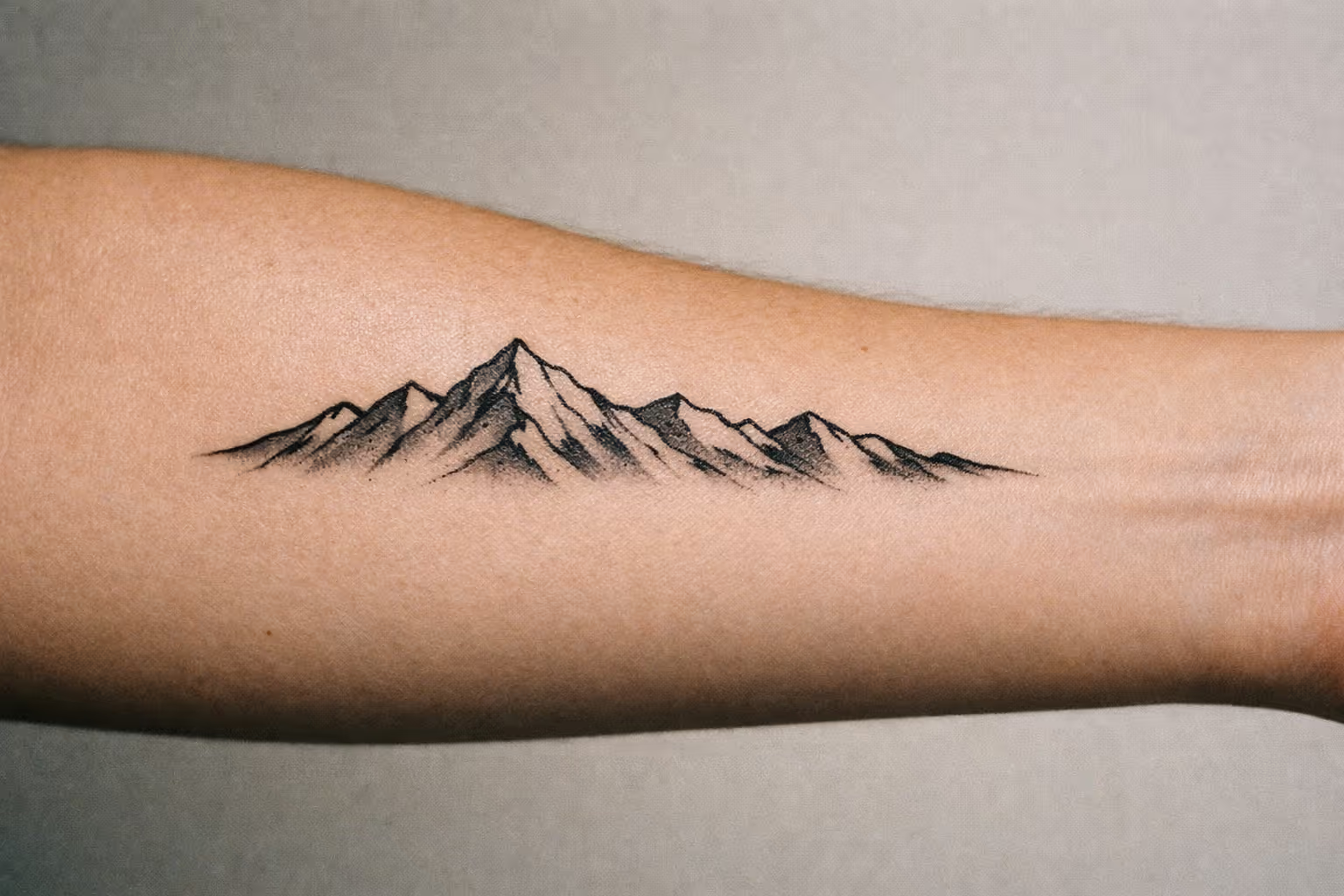
Planning a mountain tattoo is mostly budget math, since the same motif can be a $100 fine-line peak or a 15-hour back piece. Placement matters just as much: it’s the kind of detail that separates a clean heal from a bad one. Here’s where a mountain ages well and what it costs at each size.
What a Mountain Tattoo Actually Means
A mountain tattoo is one of the most adaptable nature motifs you can put on skin. It ranges from a single black peak the size of a thumbnail to a full back panel of forested ridges and storm clouds. The reason it works across so many bodies and styles: a mountain reads instantly even when stripped down to three lines, and it scales up to hold an enormous amount of detail without losing its silhouette. This guide covers what the design actually means, where it ages well, how much you’ll pay, the styles that are trending right now, and the aftercare details most idea galleries skip entirely.
✓ Pros
- Highly adaptable design scale and style
- Strong symbolic meanings across cultures
- Works well in minimalist to detailed styles
- Many placement options with varying pain levels
✗ Cons
- Fine-line and watercolor styles age faster and need touch-ups
- Poor artist technique can ruin minimalist or geometric designs
- Certain placements (fingers, hands) fade quickly or heal poorly
- Cultural symbols require respectful consideration
Mountain Tattoo Meaning: What People Actually Bring to the Chair
Mountains carry weight as a symbol because they’re physically immovable and visually dominant. That’s why the meanings tend to cluster around the same ideas across cultures - strength, endurance, overcoming something, and a connection to nature or the outdoors.
The most common readings clients bring in:
- Resilience and overcoming obstacles - the climb as metaphor. Often paired with a switchback path or storm clouds at the summit.
- Adventure and freedom - hiking, climbing, vanlife, “the mountains are calling.” Usually paired with a compass, tent, or pine trees.
- Personal growth and goals - base as where you started, summit as where you’re heading.
- Spirituality and grounding - calm, perspective, a reminder to stay rooted. Often softened with watercolor or fineline treatment.
- A specific place - a peak you climbed, grew up near, lost someone on. These are the tattoos that age best emotionally because the meaning doesn’t drift.
Cultural meanings worth knowing
Specific mountains carry their own context, and this is where mountain tattoo meaning gets more layered.
Mt. Fuji in Japanese irezumi symbolizes immortality, rebirth, and beauty. It’s traditionally paired with cherry blossoms, waves, or cranes. If you want a Fuji design in a traditional Japanese style, work with an artist who actually does Japanese tattooing - the conventions for clouds, wind bars, and wave caps are specific, and a generic illustrator will get them wrong. I’ve seen plenty of Fuji pieces that look fine as flash but fall apart the moment you compare the cloud rendering to actual irezumi conventions.
Sacred peaks like Kailash, Olympus, or Indigenous holy mountains carry religious significance. If you’re not from that tradition, think hard about whether you want to wear it. This is one of the few categories where the concern is about respect rather than aesthetics.
In modern Western tattoo culture, the meaning has shifted toward adventure and self-determination - less about the mountain as a deity, more about the climb as a personal marker. Both readings are valid. Just know which one you’re signing up for.
Mountain Design Ideas by Style
There’s no single mountain tattoo aesthetic. The style drives the meaning almost as much as the subject does. Here are the styles people actually book right now, with the technical hallmarks and the common pitfalls when artists do them badly.
Minimalist Mountain Tattoo
The minimalist mountain tattoo is the most-booked version of this design and the best entry point if it’s your first tattoo. Technical hallmarks: clean single-weight linework, no shading, deliberate use of negative space. Two or three peaks, sometimes a sun or moon, and that’s it.
- Size range: 1-3 inches works best. Push past 4 inches and the design starts to look empty rather than minimal.
- Placement: inner forearm, wrist, ankle, behind the ear, sternum, ribcage.
- Cost: $100-$250 for a small piece, usually under a 60-minute session.
- Common pitfall: artists who don’t have steady line confidence end up with wobbly peaks, and there’s nowhere to hide it. Ask to see healed photos, not just fresh ones.
Fineline Mountain Tattoo
Fineline overlaps with minimalist but uses single-needle or 3RL needles to pack dense detail into small spaces - tiny trees, stars, a thin moon, a horizon line. It’s the style trending hardest right now.
- Size range: 2-5 inches. Smaller than 2 inches and the fine lines will blur as they spread over the years.
- Placement: forearm, calf, upper thigh, ribcage. Avoid fingers and the side of the wrist - friction kills fine lines.
- Longevity flag: fineline ages faster than traditional bold-line work. Expect a touch-up at the 5-8 year mark.
Geometric Mountain Tattoo
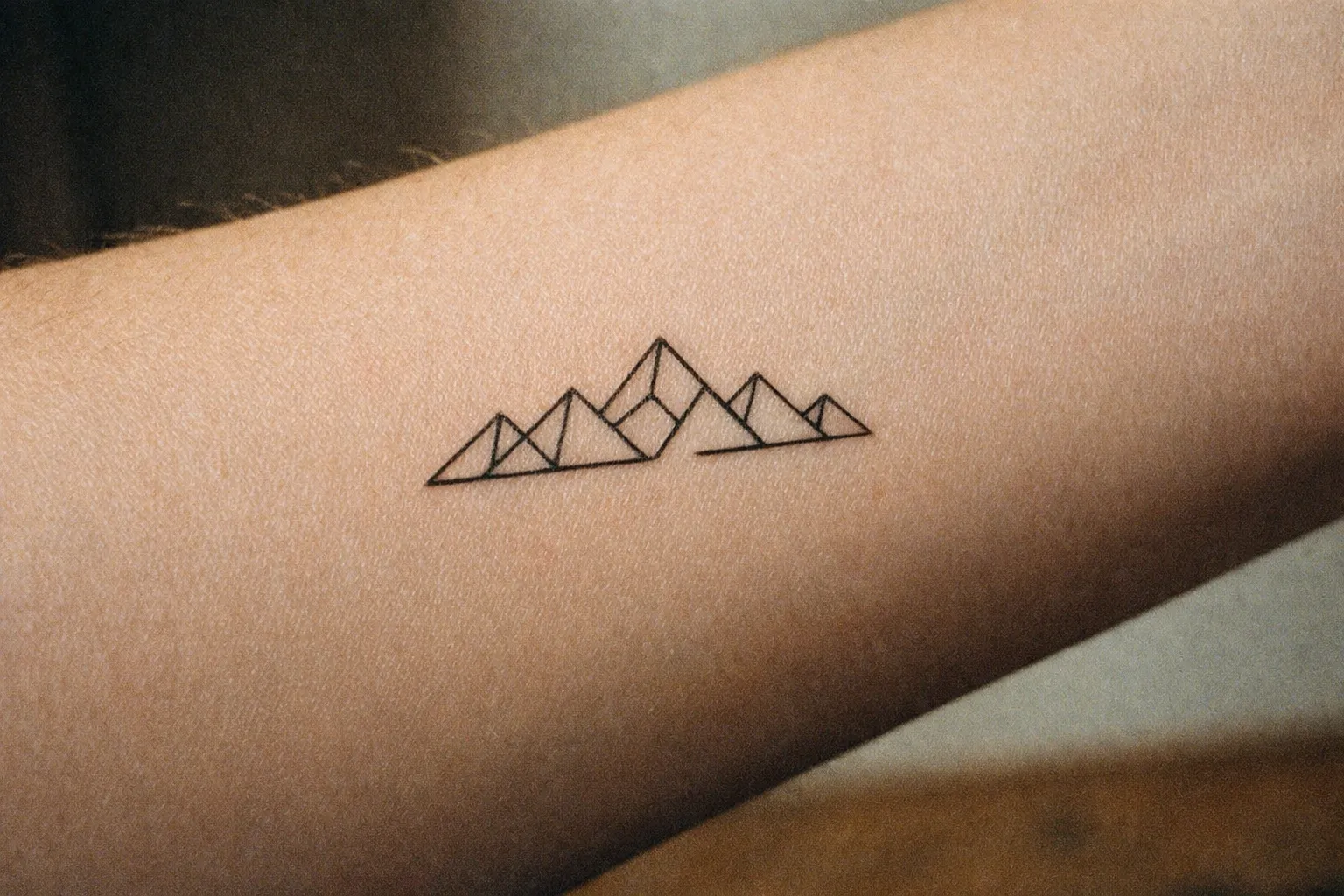
Triangles, hexagons, mandala elements wrapped around or behind the peaks. Two technical hallmarks: precise stencil alignment and consistent line weight throughout the geometry. When it works, it looks architectural. When it’s done badly, the off-axis triangles are the only thing your eye lands on. If you’re drawn to this style, you might also appreciate how sacred geometry tattoo symbols like the Flower of Life or Metatron’s Cube can be layered into the background geometry for added meaning.
- Size range: 3-7 inches.
- Placement: outer forearm, upper arm, calf, chest.
- Pitfall: any artist who freehands the geometric elements is a no. This style needs measuring tools and stencils, full stop.
Watercolor Abstract Mountain Tattoo
Loose washes of blue, purple, and grey that suggest peaks rather than draw them, often without a hard black outline. It looks like a watercolor study - soft edges, drips, color bleeding into negative space.
- Size range: 4-8 inches. Watercolor needs room to breathe.
- Placement: forearm, upper thigh, back, shoulder blade. Avoid high-friction or high-sun areas.
- Cost: typically 20-40% more time than equivalent blackwork because of layered color passes, usually 3-5 passes for depth.
- Aging: the honest take - watercolor fades faster than blackwork, especially without an anchor line. Plan for touch-ups every 4-6 years and rigorous SPF.
Splatter Paint Mountain Tattoo
Black mountain silhouettes with ink splatter behind or around them - flicked dots, drips, paint-thrown texture. Looks dynamic and modern, less “outdoorsy” and more art-print.
- Size range: 4-7 inches.
- Cost: $200-$400+ for mid-sized work.
- Pitfall: the splatter has to look intentional. Too sparse and it reads like a mistake; too dense and it competes with the mountain.
Contained Mountain Tattoo
A nature scene inside a defined shape - a circle, hexagon, diamond, or rectangular frame. The frame does a lot of heavy lifting: it makes the design feel finished and gives a clean stopping point if you ever want to add to the piece later.
- Size range: 1.5-3 inches for simple peaks inside a circle; 3-4 inches if you’re adding trees, stars, or water.
- Placement: forearm, upper arm, calf, sternum.
- Why it works: contained designs age cleaner than open-edge designs because the frame hides minor line spread.
Mountain Range Armband
A continuous silhouette of peaks wrapping the upper arm or forearm. Usually 8-10 inches of design wrapping around. The trick is the seam - where the start meets the end has to be invisible.
Pitfall: if the stencil isn’t wrapped with the arm both flexed and relaxed, the band ends up crooked. Always ask the artist to do a test wrap and stand up to check it from multiple angles before they start. I’ve had clients come in for cover-up consultations specifically because a previous artist skipped this step.
Nature Scene with Forest, Sky, or Water
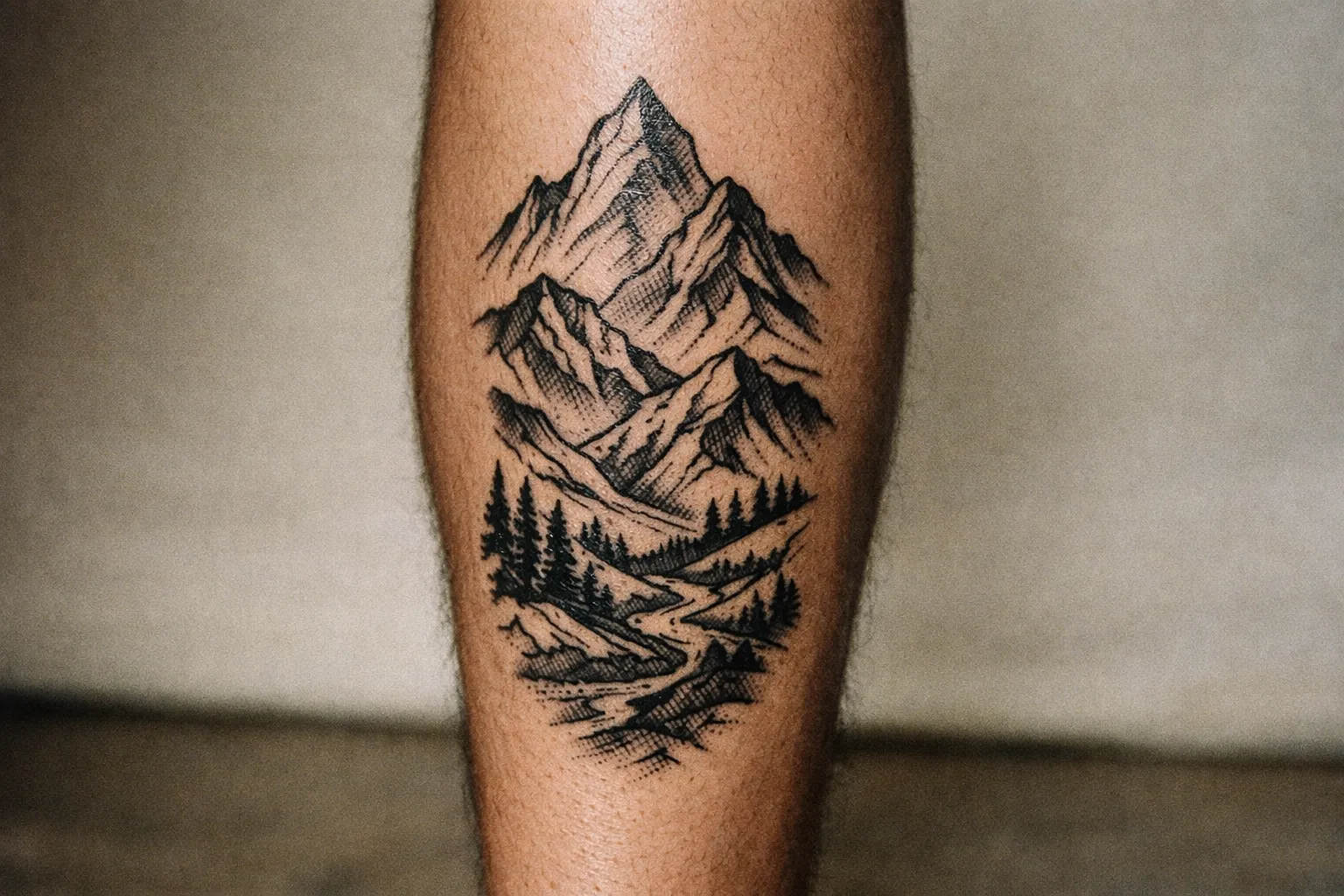
The maximalist option. Mountains plus pine forest, a lake, stars, sometimes a campfire, van, or wildlife. This is where a mountain tattoo turns into a small landscape painting.
- Size range: 6-14 inches for forearm or calf placements; larger for back or thigh.
- Cost: $600-$1,500 for forearm-scale work, $2,500-$6,000+ for full back pieces.
- Pitfall: trying to fit too many elements into a small canvas. A mountain + wolf + compass + quote + galaxy in 4 inches will read as muddy noise within five years.
Mt. Fuji Designs
Mt. Fuji deserves its own callout because it’s one of the most-requested specific mountains. Done in traditional Japanese style, it’s paired with waves (often a Hokusai reference), clouds with curl details, and cherry blossoms. Done in fineline or minimalist style, it’s a clean trapezoid with a small snow cap - works beautifully in a 2-3 inch circle on the inner forearm.
Placement and Sizing That Actually Works for Men
The mountain tattoo for men category online is dominated by larger blackwork pieces - bold lines, high contrast, scenes that read across a room. That’s not a rule, but it’s where most male clients land when they walk in.
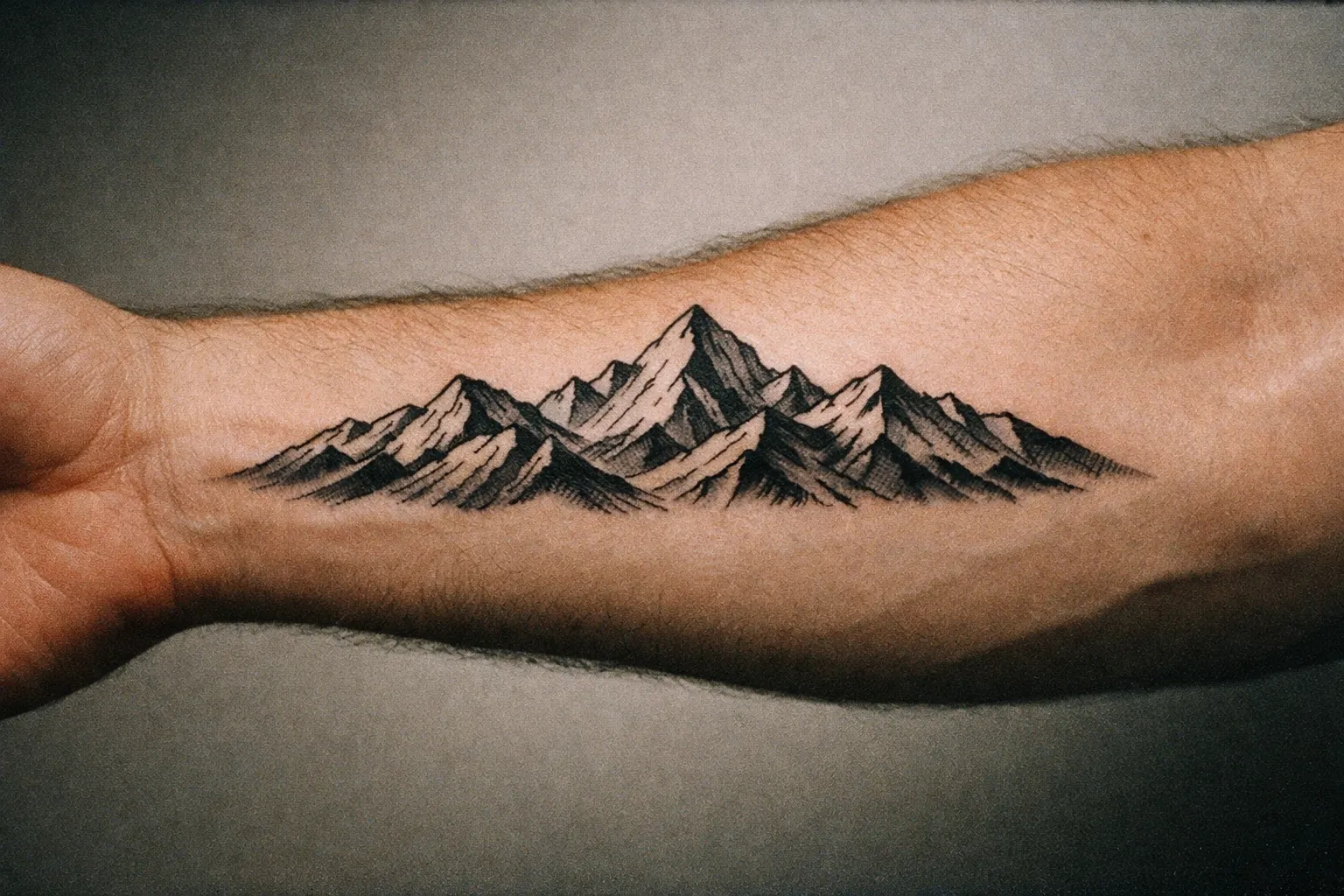
Most-requested placements and what works there:
- Inner or outer forearm (5-8 inches): the strongest canvas for a mountain range. The forearm’s long axis matches the horizontal sweep of peaks, so the design flows with the arm instead of fighting it.
- Upper arm / bicep band (8-10 inches wrap): good for armband silhouettes or a contained circular scene on the outer bicep.
- Calf (6-10 inches): the vertical canvas works for tall, narrow scenes with a single dominant peak and forest below.
- Chest panel (8-12 inches): mountain range across the pectorals, often paired with a compass over the heart.
- Full back (15-20 inches): the home of large landscapes, Mt. Fuji pieces, and multi-session work.
Pain reference for placement: ribcage > sternum > inner bicep > outer forearm > calf. The forearm and calf are the most forgiving placements if it’s your first sitting. If you’re considering the breastbone area, it’s worth reading up on sternum tattoo pain and healing specifics before you commit to that placement.
How to Make a Mountain Range Tattoo Personal
A mountain range tattoo is one of the easiest designs to make uniquely yours, and most people skip the one step that actually does it: using a real range instead of a generic silhouette.
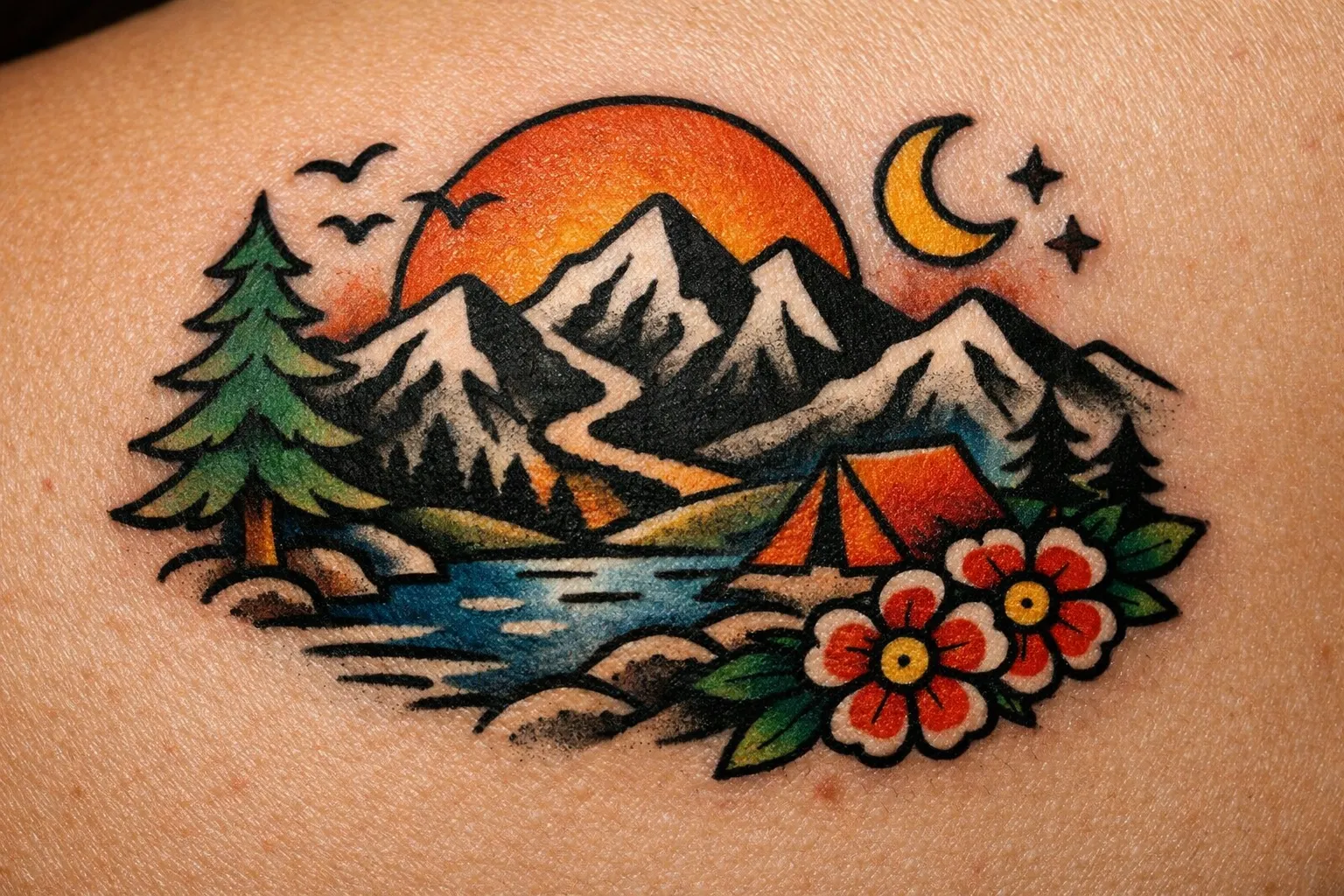
Three ways to personalize:
- Trace a topographic profile of a specific range from a map. The Tetons, the Sawtooths, the Dolomites - each has a recognizable skyline. Your artist can pull the contour from a topo map and stylize it.
- Use your own photo from a hike or climb. A skilled artist will adapt it into the chosen style rather than copying it literally.
- Add coordinates or a date in small script below the range - the summit you reached, the trip that mattered. Keep the script small and the line short; long quotes age into illegible blobs.
A range tattoo also lets you build over time. Start with the peaks. Add a treeline in session two. Add a sky or a foreground in session three. Each session can run 1-2 hours, which keeps the cost manageable and gives you time to decide whether you want more.
How Much a Mountain Piece Costs in 2026
Tattoo pricing varies by city, artist demand, and shop minimums, but these ranges are realistic for U.S. and comparable Western markets right now.
- Shop minimum (tiny minimalist peak, under 1 inch): $80-$150
- Small fineline or minimalist (1-3 inches, 30-60 min): $100-$250
- Medium forearm or calf range (4-7 inches, 2-4 hours): $300-$800
- Large nature scene half-sleeve or rib panel (8-14 inches, 6-12 hours): $900-$3,000
- Full back landscape (15-20+ hours, often multi-session): $2,500-$6,000+
Hourly rates run $150-$300/hour in most major U.S. cities, with high-demand fineline and Japanese specialists charging more.
How Big Is a $3,000 Tattoo?
At a common $200/hour rate, $3,000 buys roughly 15 hours of work. That translates to:
- A detailed half sleeve with a mountain range, forest, and sky
- A 3/4 back piece mountain landscape with color
- A full thigh or rib panel nature scene with mountains, lake, and wildlife
If you’re booking with a fineline or hyperrealism specialist at $250-$300/hour, $3,000 covers 10-12 hours - smaller coverage but much more intricate detail per square inch.
Budget extras most people forget:
- Tip: 15-20% is standard. On a $3,000 tattoo that’s $450-$600.
- Aftercare products: $15-$40 for fragrance-free soap, ointment, and lotion.
- Time off active stuff: 2-7 days of modified workouts for medium and large pieces.
Tattoos to Avoid - and What That Actually Means
“Tattoos to avoid” gets searched a lot, and the honest answer is less about specific designs and more about categories of risk. For a mountain tattoo specifically:
Placement to think twice about as a first tattoo:
- Hands, face, neck - visible in every job interview, harder to heal cleanly, and many shops won’t tattoo these on first-timers.
- Fingers - friction and constant washing fade tattoos here fastest. A “tiny mountain on the finger” almost always blurs within 2-3 years.
- Inner lip, ear cartilage - won’t hold ink long-term.
Skin and anatomy issues:
- Tattooing over scar tissue, varicose veins, active eczema, or psoriasis leads to poor ink retention and possible flare-ups. If you’re considering tattoo over a scar or birthmark, the timing and keloid risk guidance there applies directly to mountain placements on scarred skin.
- Sunburned skin - wait until it’s fully healed.
Design choices that age badly:
- A partner’s name worked into the summit. These are some of the most common laser removal cases. If you want to honor a relationship, pick a date or a place you went together - not a name.
- Over-cluttered scenes in too small an area. A mountain + wolf + compass + quote in 3 inches will turn into mush.
- Cultural symbols outside your tradition - sacred peaks in styles you don’t belong to. Not illegal, but worth thinking about.
- Trend-only designs with no personal meaning. Trends shift; the tattoo doesn’t.
What Style Pairs Well with a Mountain
Most people don’t get just a mountain - they pair it with one or two supporting elements. The combinations that hold up, and the ones to skip:
Pairs that age well:
- Mountain + pine trees (a foreground forest grounds the scene)
- Mountain + sun or moon (one circular focal point above the peaks)
- Mountain + ocean wave (the earth/water duality, especially in Japanese-style work)
- Mountain + compass (adventure narrative, usually on the chest or forearm)
- Mountain + single bird in flight (scale and freedom)
Pairs that get crowded fast:
- Mountain + multiple animals + script + stars + sun + trees - pick two supporting elements, not five
- Mountain + long quote - text in a small tattoo turns illegible within a decade
Aftercare Timeline
Mountain tattoos with fine lines or watercolor washes are particularly sensitive to bad aftercare because there’s no margin. A missing segment of a thin line ruins the silhouette. I’ve touched up more fineline mountain pieces than I can count where the client picked a scab or over-moisturized in week one - and both of those mistakes are avoidable.
Day 1-3:
- Keep the bandage on as long as your artist instructed (usually 2-24 hours; longer for second-skin film).
- Wash gently with fragrance-free soap twice a day. Pat dry with a clean paper towel.
- Apply a thin layer of the ointment your artist recommends. A thin layer - not a glob. Suffocating the tattoo causes cloudy healing.
Week 1:
- Switch from ointment to a fragrance-free moisturizer once the tattoo stops weeping, usually day 3-4.
- Avoid swimming, soaking, saunas, and direct sun.
- Don’t pick or scratch scabs, especially on fineline work. Pulling a scab off a thin line can pull the ink with it.
Week 2-4:
- The tattoo will look dull and flaky. This is normal. It’s a layer of dead skin over the healing ink.
- Keep moisturizing 2-3 times daily.
- You can return to most workouts by week 2, but avoid friction on the tattoo - long sleeves under gym equipment, that kind of thing.
Some clients experience fatigue or flu-like symptoms in the first 24-72 hours after a longer session - this is a normal immune response sometimes called tattoo flu, and it typically resolves on its own within a few days.
Long-term:
- SPF 30+ minimum on the tattoo any time it’s exposed to sun. Black mountain tattoos can turn blue-green or pale after a few summers without sun protection. This is the single biggest factor in how your tattoo looks at year ten.
- Sun-protective clothing is even better than sunscreen if you’re hiking or at the beach.
- Plan a touch-up at the 5-8 year mark for fineline and watercolor work; blackwork can usually go 10+ years before needing one.
Privacy and Image Use at the Studio
Most studios photograph their work for social media. If you want a meaningful but private tattoo, have this conversation before the session, not after.
What to ask:
- Will my tattoo be posted on Instagram, TikTok, or the shop’s portfolio?
- Can I opt out of online posting entirely, or request anonymous or cropped photos only?
- For intimate placements (ribs, hip, upper thigh), who else will be in the room, and is there a curtain or private area available?
Reputable shops have a photo and image-use clause in their consent form. Read it. You can usually opt out, but you have to ask.
Frequently Asked Questions
- What does a mountain tattoo signify?
- A mountain tattoo signifies strength, resilience, and the ability to overcome obstacles in most modern Western tattoo culture. It also represents a love of nature, adventure, and personal growth. Specific mountains like Mt. Fuji or sacred peaks carry additional cultural or religious meanings.
- How big is a $3,000 tattoo?
- At a typical $200/hour rate, a $3,000 tattoo represents about 15 hours of work, enough for a detailed half sleeve mountain range, a 3/4 back landscape, or a full thigh nature scene. Higher-end artists charge more, so coverage might be smaller but more detailed.
- What are tattoos to avoid?
- Avoid visible placements like face, hands, and neck for first-timers, tattoos over scar tissue or active skin conditions, partner names in designs, over-cluttered small tattoos, and cultural symbols outside your tradition.
- Are mountain tattoos popular?
- Yes, mountain tattoos are highly popular with thousands of designs on stock sites and social media. Minimalist and fineline styles are trending, especially among hikers, climbers, and vanlife communities.
- Where do mountain tattoos age best?
- They age best on areas with less friction and sun exposure: upper outer arm, upper thigh, upper back, outer calf, and inner forearm. Fingers, hands, and feet fade fastest due to washing and friction.