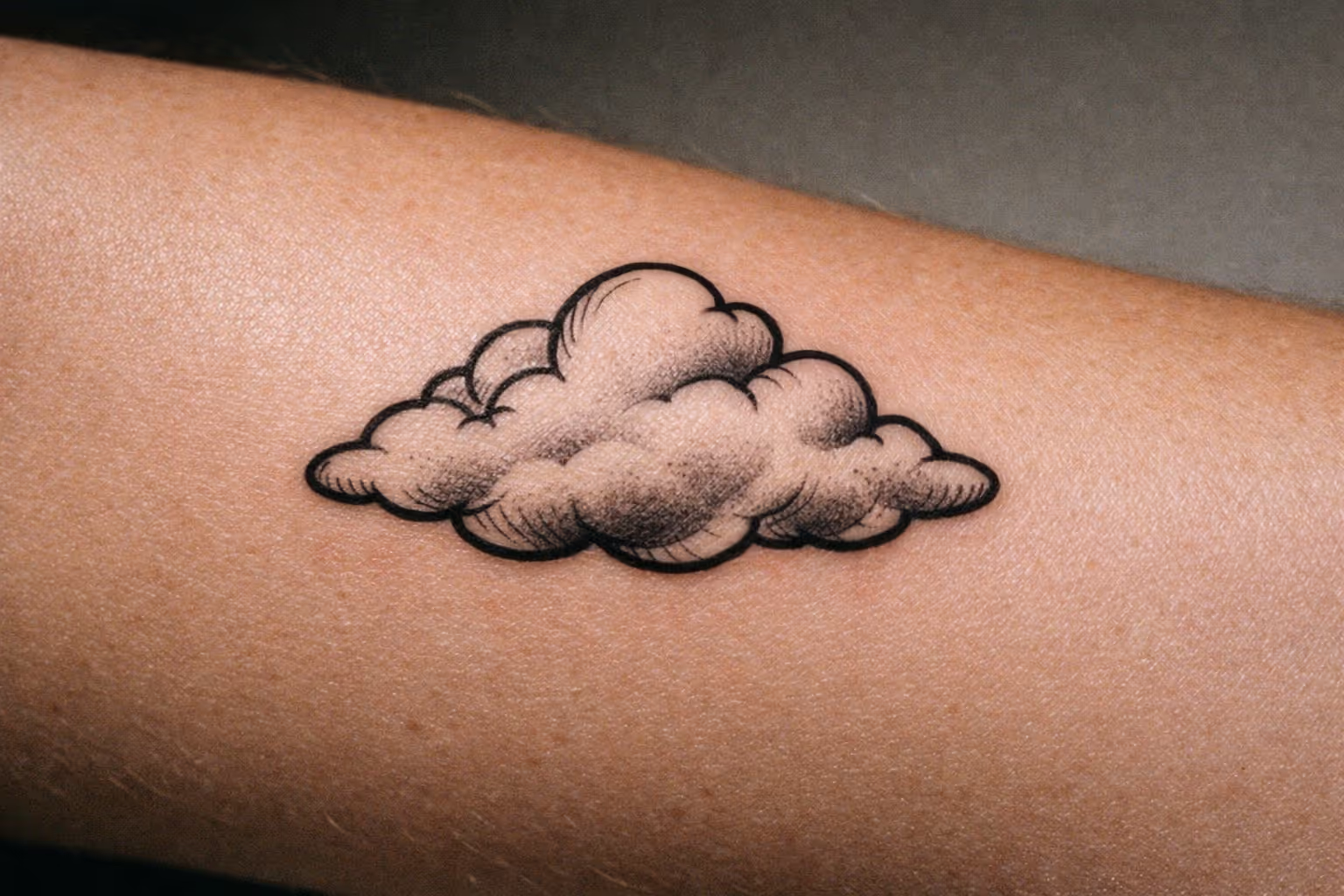
A cloud tattoo is mostly soft grey shading with no bold outline to hold it together, which makes it one of the more fragile designs to age well. Get the aftercare or the sun protection wrong and that smooth grey goes patchy fast. Style matters too: a stormy Japanese cloud and a simple minimalist puff are completely different commitments. Here’s how the styles compare, what $3,000 buys, and the care timeline that protects the shading.
What a Cloud Tattoo Actually Means
Cloud tattoos sit in a small group of motifs that read instantly but carry different weight depending on style and culture. The core associations are impermanence, change, and the transient nature of life (1)(3). Clouds form, drift, dissolve - that’s the whole symbolic argument. Most people choosing one are marking a transition: a loss, a recovery, a chapter that ended.
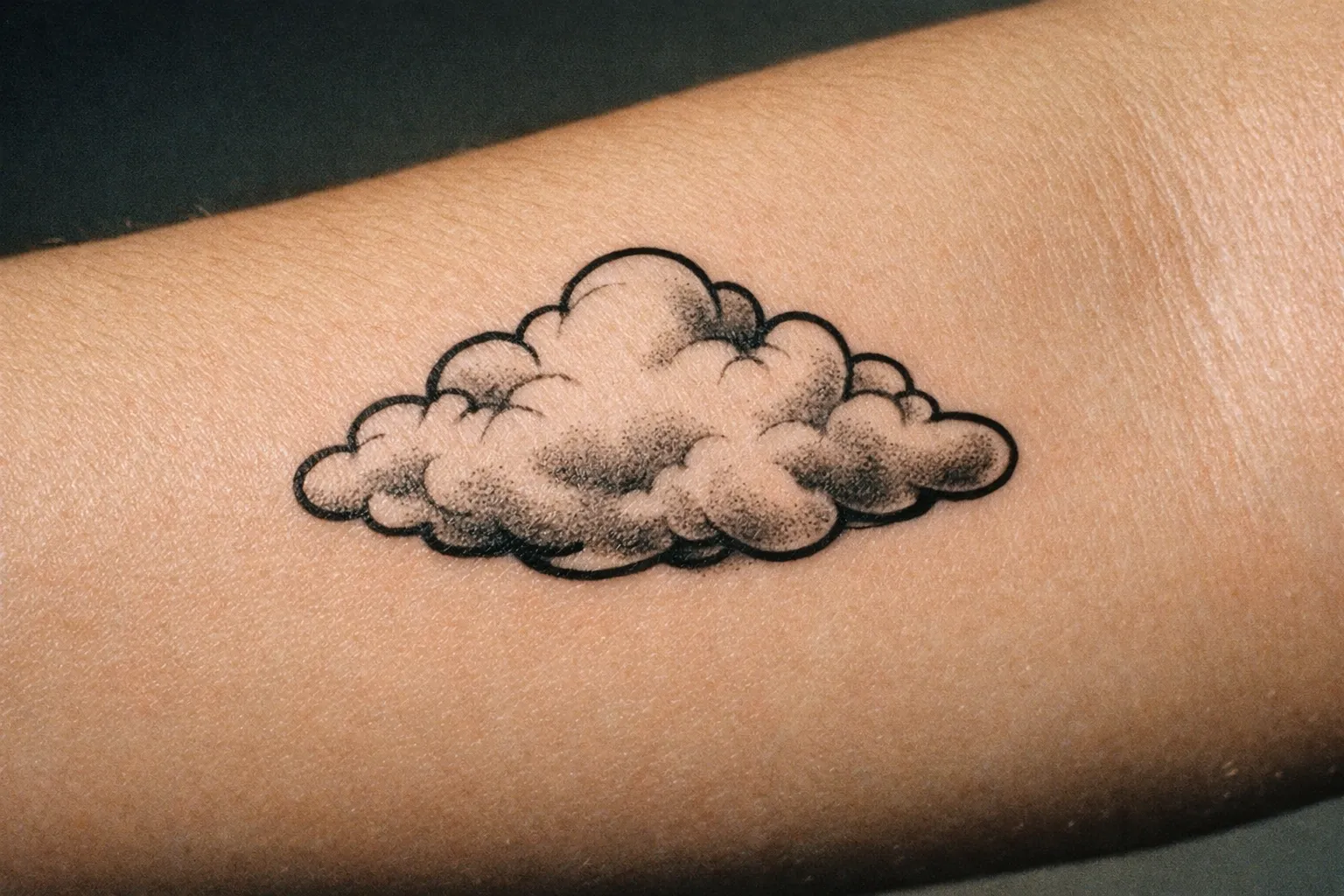
The meanings break down roughly like this:
- General clouds: change, impermanence, dreams, aspiration (1).
- Storm clouds: inner turmoil, hard seasons, and - depending on how you read it - bad luck or the act of getting through bad luck (2).
- Japanese clouds (kumo): transformation, strength, and the fleeting beauty of life, usually inside a larger mythological composition with dragons, koi, or tigers.
- Native American-influenced clouds: communication with the divine, prayer carried upward (1).
- “Silver lining” clouds: a storm cloud with a sun break or rays - the modern mental-health and recovery version, very common on TikTok cloud content with views in the hundreds of thousands (5).
The meaning was never fixed. A cloud with rain can mean grief on one body and growth on another. If symbolism matters to you, decide what you want it to say before you bring references to an artist, because the design choices - storm vs. fluffy, dark vs. light, isolated vs. background - are what lock the meaning in.
Style Breakdown: Simple, Storm, and Japanese
The three styles below cover roughly 90% of cloud tattoo requests. Each has different technical hallmarks and different failure modes.
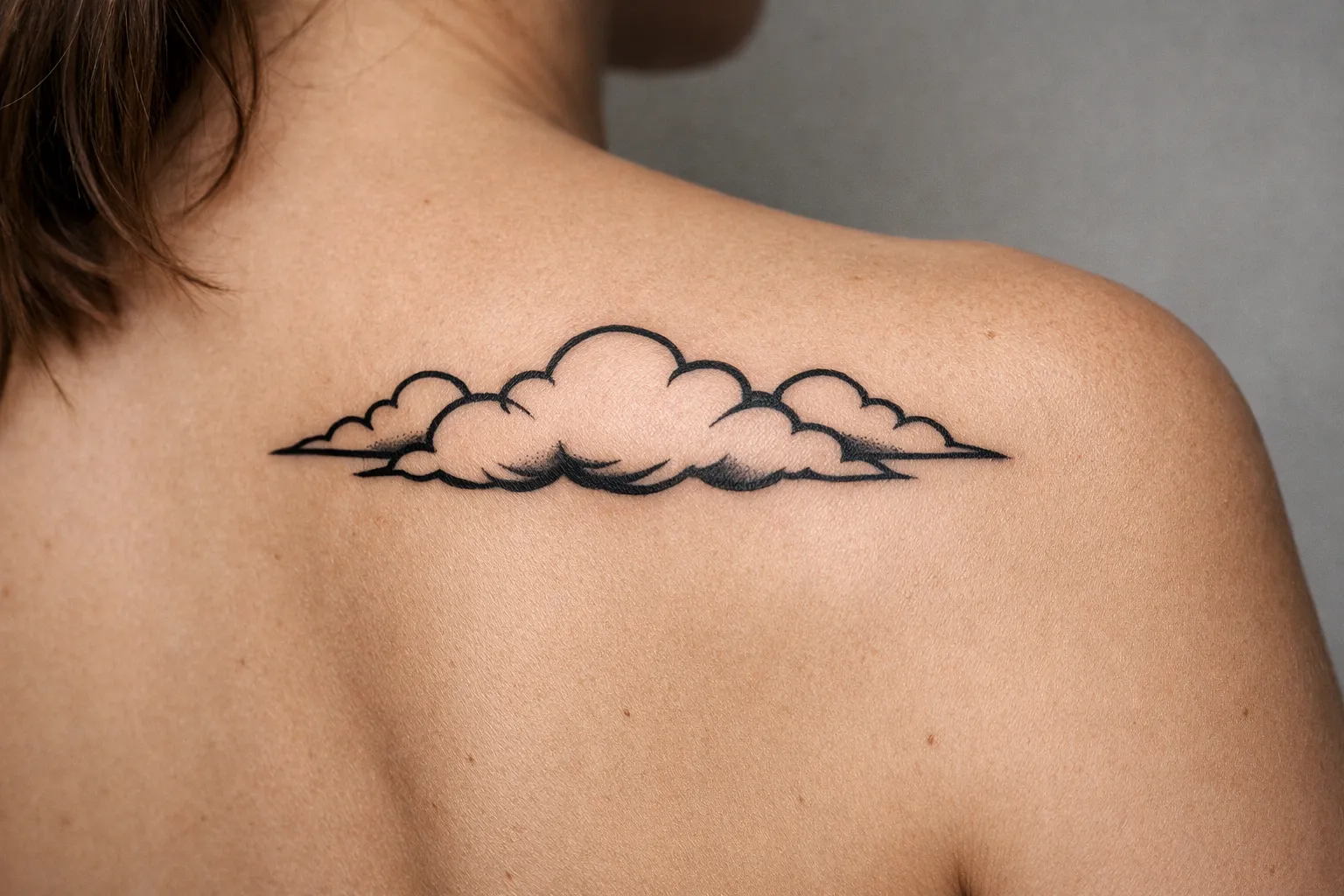
Simple Cloud Tattoo
A simple Cloud Tattoo is a clean outline, sometimes with light dotwork or a single shadow under the belly of the cloud. Sizes typically run 2-5 cm wide, often placed on the wrist, ankle, behind the ear, or inside the bicep.
Technical hallmarks: one consistent line weight, clear negative space inside the cloud, no over-detailed curls. Done well, it reads from across a room and holds up for a decade without a touch-up.
Common pitfall: artists going too thin. A 0.25 mm single-needle cloud at 2 cm looks crisp the day it’s done and starts blurring within 1-3 years, especially on the wrist where friction is constant. If you want it small, ask for at least a 3RL outline and don’t pack the inside with micro-detail. I’ve seen clients come back two years after getting a delicate single-needle cloud on their wrist, and what was once a clean shape has softened into something that looks like a smudge of ink. The design was fine. The line weight wasn’t.
Storm Cloud Tattoo
A storm Cloud Tattoo is a darker, denser shape - usually with rain lines, a lightning bolt, or both. Typical sizes run 5-10 cm, with calf, outer forearm, and upper back as the placements that handle the contrast best.
Technical hallmarks: high contrast between the cloud body and the surrounding skin, sharp angular lightning against soft cloud forms, and shading layered in multiple passes rather than one heavy hit.
Common pitfall: trying to cram a storm scene into 3 cm. Storm clouds need contrast to read as storm clouds, and contrast needs space. Under 5 cm, the rain blends into the cloud and the whole thing heals as a grey smudge. If you have limited space, drop the rain and keep the lightning.
Japanese Cloud Tattoo
The Japanese Cloud Tattoo - kumo in irezumi - is stylized rather than realistic. Repeating curls, wind bars, and bold outlines that flow around other motifs. These are almost always part of a larger composition. A Japanese cloud floating alone tends to look unfinished, and most artists who know the style will tell you the same.
Technical hallmarks: thick, consistent linework; rhythmic repeating curl shapes; clear separation between cloud and wind elements; black outlines that hold the design together as it ages. Traditional palettes lean black, grey, red, yellow, and teal.
Common pitfall: inconsistent line weight or uneven curl spacing - the design reads “muddy” instead of dynamic. This style demands an artist who understands the grammar of irezumi, not someone freelancing the curls. Look at healed work in their portfolio, not just fresh shots.
Fine-Line and Watercolor Clouds
Trendy, but worth a warning. Single-needle fine-line clouds (0.18-0.25 mm) and watercolor wash backgrounds look great on day one and fade noticeably faster than bold black-and-grey. Plan for touch-ups every 3-5 years, sooner if the placement gets UV exposure. White-ink-only clouds frequently fade to near-invisibility within 1-2 years - skip them unless you’re genuinely fine with that outcome.
Cloud Tattoo Cost: What a $3,000 Budget Buys
Pricing varies by city and artist reputation, but the 2024-2025 US ranges are reasonably consistent:
- Tiny simple cloud (shop minimum): $80-$150
- Small to medium storm cloud with shading and lightning: $200-$500
- Japanese cloud background, half-sleeve: $1,200-$2,500 at $150-$250/hour
- Full sleeve or large back piece with cloud work: $2,500-$4,500+ across 3-6 sessions of 3-4 hours
A $3,000 tattoo at a typical $200/hour rate buys you roughly 15 hours of needle time. In practical coverage, that’s:
- A detailed half-sleeve Japanese cloud composition with one or two focal motifs (koi, dragon head, tiger), or
- A large upper-back storm cloud scene covering 60-80% of the upper back with full shading and a few smaller elements, or
- A nearly complete forearm-to-elbow sleeve in black and grey with cloud background and 2-3 integrated subjects.
If an artist quotes you $3,000 for something that should be a 4-hour piece, walk. If you want a half-sleeve and have $800, your options are: save longer, scale down, or accept a less experienced artist with predictable trade-offs in linework and consistency. That’s not a judgment - it’s just math.
Where Clouds Sit Best on the Body
Placement does more for a cloud tattoo than the design itself, because clouds have to flow with the body to look like clouds and not like blobs.
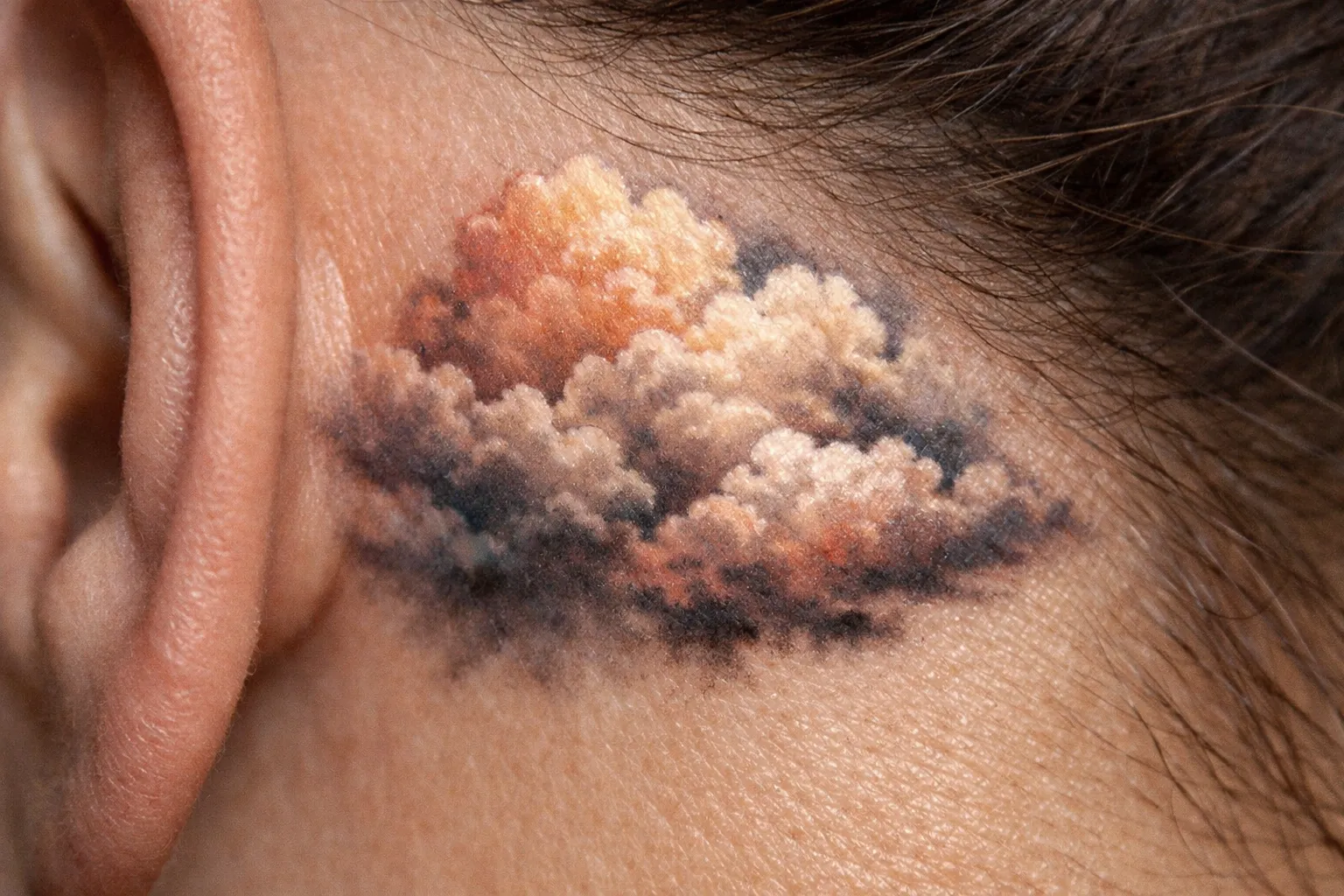
Forearm (outer): 8-15 cm cloud scenes work here, with room for storm elements without crowding. Pain is moderate - easier than ribs, harder than outer bicep. Good visibility, but full UV exposure means planning on touch-ups.
Upper back and shoulder blade: ideal for larger compositions, 15-30 cm. Skin is flat, stretches little, holds detail well. Low pain relative to most placements.
Calf and outer thigh: good for medium pieces (10-20 cm). Flat enough for storm scenes, hidden enough for conservative workplaces.
Ribs and sternum: dramatic but painful. Ribcage hurts more than forearm by a wide margin, and skin moves with breathing - fine detail can distort. Reserve for pieces where the placement genuinely serves the design.
Wrist, behind the ear, inner finger: only for simple Cloud Tattoo work under 3 cm. Fingers in particular fade and blur fast because of friction - expect touch-ups within 6-12 months if you go there.
Full sleeve / back piece: Japanese cloud work shines here because it’s designed to flow across large areas, often covering 40-70% of the visible skin as background that ties other motifs together.
One thing I always tell clients: orient the cloud “flow” along the muscle line - biceps curve, forearm taper, shoulder cap. Clouds drawn perpendicular to the muscle look wrong the moment you flex.
How to Tattoo a Cloud (The Actual Process)
For readers who want to understand what the artist is doing - or who are training and looking for a process breakdown:
How to Tattoo a Cloud
About 3 hours for a medium pieceStep-by-step process from design to final pass
- 1
Design and reference
Start with clear high-res references, not low-res screenshots. Sketch the cloud form with deliberate negative space and flowing outer edges. For Japanese clouds, plan the curl rhythm before you ink a single line.
- 2
Stencil placement
Apply the stencil along the muscle flow. Have the client stand, sit, and move the limb - anywhere the stencil distorts unnaturally, reposition. This is the last cheap moment to change anything.
- 3
Linework
Outline with consistent weight. For simple clouds, 3RL to 7RL depending on size. For Japanese clouds, bolder still - 9RL or larger for the main outlines, because thick lines hold the design together as it ages.
- 4
Shading
Build volume in layered passes with 7M-15M magnums, low voltage, slow hand speed. One heavy pass on a small cloud heals as a flat grey blob - multiple light passes create the soft, voluminous fluff that makes a cloud read as a cloud.
- 5
Details and highlights
Inner curls for Japanese clouds. Sharp zig-zag with high contrast for lightning. Strategic negative space for highlights - leaving bare skin reads better than white ink, which tends to yellow or blur over years.
- 6
Final pass
Clean up linework, deepen the darkest shadows, and check the composition under different lighting before wrapping.
If you’re training: fill an entire synthetic skin sheet with 10-20 different cloud shapes before you put a cloud on a client. Consistent fluff comes from repetition, not talent.
Aftercare Timeline for Cloud Work
Cloud tattoos heal like any other black-and-grey work, but the soft gradients in cloud shading are the first thing to suffer if aftercare goes wrong.
Day 1-3: Keep the original wrap on as long as the artist specified - typically 2-24 hours for traditional wrap, or 3-5 days for second-skin (polyurethane film) dressings, which most studios now use. Once it’s off, wash 2-3 times daily with fragrance-free soap, pat dry, and apply a thin layer of fragrance-free moisturizer.
Week 1: Peak peeling and itching. Do not pick. Keep moisturizing, keep clean, no soaking. Showers are fine; baths and pools are not.
Week 2-4: Surface heals, but the deeper layers are still settling. Avoid direct sun exposure entirely for 2-4 weeks, and use sun-protective clothing or high-SPF over the area for the first few months. No tanning beds for at least 1-2 months.
Month 2 onward: Fully healed. Ongoing care is just sun protection - UV is the single biggest enemy of grey shading in cloud tattoos.
If you’re doing multi-session work like a Japanese sleeve, leave at least 2 weeks between sessions for the same area. Less than that increases irritation and scarring risk.
Combining Clouds with Other Motifs
Clouds are background motifs as much as standalone ones. The combinations that work consistently:
Lightning: sharp angular contrast against soft cloud bodies. Reads as power, sudden change, revelation. Use bold black for the bolt and keep the cloud shading darker around it for separation. If you want to explore that motif further, the lightning tattoo carries its own layered symbolism worth understanding before you commit to a design.
Sun rays or sun break: the visual shorthand for “silver lining” - recovery, hope, getting through it. Pairs especially well with storm clouds for mental-health themed pieces.
Stars and moon: clouds with a crescent moon and stars peeking through reads as night-sky scenery. Good for dream and aspiration themes.
Waves and mountains: classic Japanese composition. Clouds at the top, waves at the bottom, mountains or a dragon connecting them. Works as a full sleeve or back piece structure. A mountain tattoo in this context carries its own symbolism of resilience and growth that reinforces the cloud’s meaning.
Dragons, koi, tigers: the standard Japanese pairing. Clouds carry these subjects across the composition; without cloud background, the subjects float in dead space (3).
Wind bars: thin horizontal black lines that suggest motion. Almost mandatory in traditional Japanese cloud work.
Birds, paper planes: modern additions for impermanence and transformation themes - something passing through the cloud emphasizes the “moving on” reading.
Skip the generic Pinterest combos - cloud with a tiny airplane silhouette at micro scale, cloud with a single dangling raindrop the size of a pinhead. These look identical on thousands of bodies and don’t survive five years of fading.
Mistakes That Ruin a Cloud Piece
The cloud-specific failures I see over and over:
- Too small with too much detail. A cloud under 1.5 cm with internal curls blurs into a smudge within 1-3 years. If you want tiny, keep it to a single clean outline.
- Over-shading in small areas. Too much grey packed into a 3 cm cloud heals as one flat tone instead of dimensional fluff.
- White-ink-only clouds. Often invisible within 1-2 years. Pretty in fresh photos, gone before you finish paying it off.
- Wrong placement for the size. Storm scenes on fingers, watercolor washes on the inner wrist crease - both blow out fast.
- Pinterest copies without customization. High duplication rate, common cover-up category, and your tattoo artist’s least favorite request.
- Pastel blue/grey clouds. They look soft now and yellow within a few years. Strong blacks and mid-tones hold up.
- Budgeting a half-sleeve at $300. The artist will either refuse or compromise quality. For cloud sleeves, $1,200 is a floor, not a ceiling.
Basic Tattoos to Avoid (Cloud Edition)
Beyond cloud-specific mistakes, there are categories of tattoo that artists almost universally talk clients out of - and several intersect with cloud designs:
- Micro tattoos with internal detail. Anything under 1 cm with shading inside it.
- Trend-driven script paired with cloud micro-art. “Vibes” in cursive next to a tiny thundercloud - dates fast.
- Finger tattoos with any fine detail. Fingers are friction zones; even bold linework fades within a year or two.
- Matching tattoos done impulsively. Relationship clouds where one of you got the rain and the other got the sun - fine if you’re sure, regrettable if you’re not.
- White-ink-only anything. As above, fades to near-nothing.
None of this means don’t get a cloud tattoo. It means: don’t get the version that’s set up to fail.
Cloud Tattoo Trends Right Now
A few shifts worth knowing if you’re planning a piece in the next year:
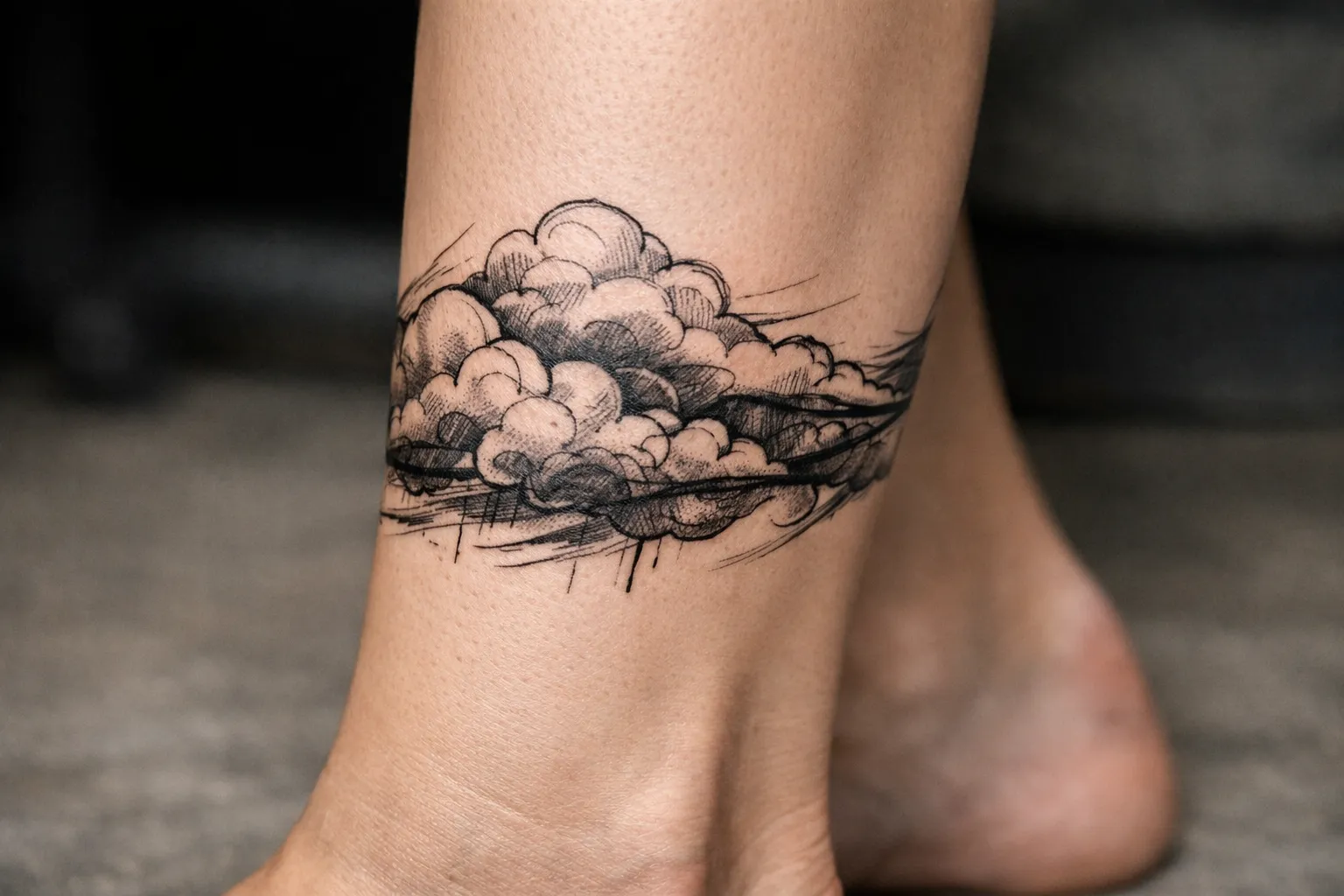
Mental-health themed cloud work is rising on TikTok and Instagram, often pairing storm clouds with semi-colon motifs, dates, or short text (5). Japanese cloud designs are increasingly blended with neo-traditional color palettes and illustrative shading, rather than strict old-school irezumi rules. Some purists hate it. Some artists are doing it beautifully. Watercolor wash backgrounds behind clouds - especially blue-purple for storm imagery - are more requested but still fade fast.
EU pigment regulations (REACH-related) have pushed studios toward compliant black and grey inks. Cloud styles are largely unaffected, though some grey washes heal slightly differently depending on the specific pigment formula.
Booking times for popular Japanese and illustrative artists run 3-9 months. If you want a sleeve from a specific artist, start the conversation early.
Frequently Asked Questions
- What does the cloud tattoo mean?
- Cloud tattoos symbolize change, impermanence, and transformation, but the exact meaning varies widely by style and cultural context. For example, storm clouds can represent inner turmoil or recovery, while Japanese clouds emphasize strength and fleeting beauty within mythological scenes.
- How big is a $3,000 tattoo?
- At a typical $200/hour rate, $3,000 covers about 15 hours of work, enough for a detailed half-sleeve Japanese cloud piece, a large upper-back storm cloud scene, or a near-complete forearm-to-elbow sleeve in black and grey. Higher hourly rates reduce the coverage accordingly.
- What are basic tattoos to avoid?
- Avoid tiny clouds under 1.5 cm with internal detail, white-ink-only designs, fine-line clouds on high-friction spots like fingers or inner wrists, generic Pinterest flash with no customization, and any design your artist advises against due to poor longevity or fading.
- How to tattoo a cloud?
- Tattooing clouds involves sketching with deliberate negative space, placing the stencil along muscle flow, consistent linework with appropriate needle sizes, layered shading passes for volume, and careful use of negative space for highlights. Practice on synthetic skin before client work.
- Do cloud tattoos age well?
- Bold black-and-grey clouds can last 10+ years with minimal touch-ups. Fine-line, white-ink, and pastel watercolor clouds fade faster, needing attention every 3-5 years. Placement is key: forearms and backs hold up better than wrists and fingers.
- How long does a cloud tattoo take to heal?
- Surface healing takes 1-2 weeks, with deeper layers settling over 4-6 weeks. Multi-session pieces require at least 2 weeks between sessions on the same area to avoid irritation and scarring.