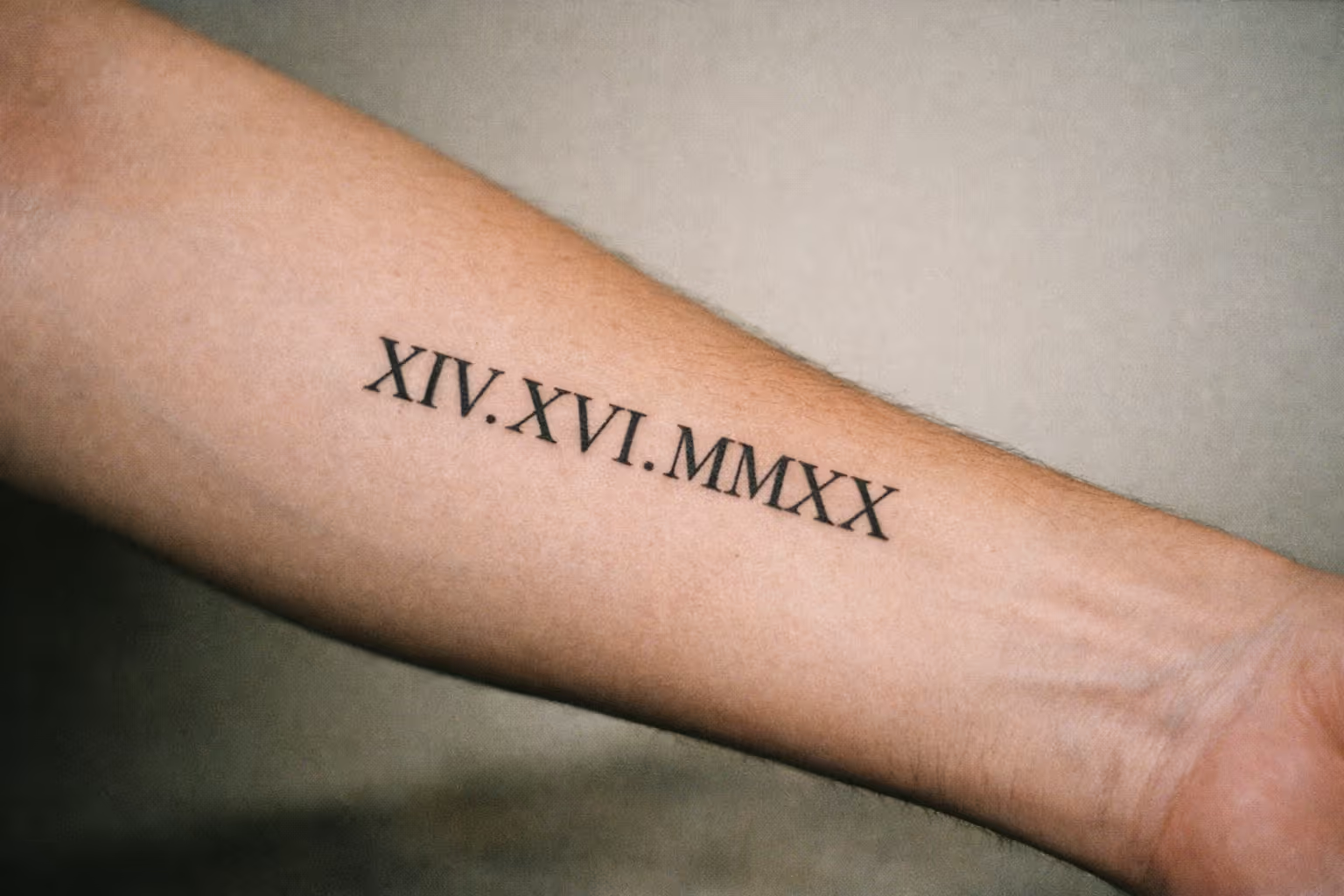
The scariest thing about a roman numerals tattoo is how easy it is to get the number wrong - and how permanent that mistake is. Convert a date by hand, trust the stencil without checking, and you can walk out with the wrong year etched forever; it happens more than you’d think. The fix is boring and essential: verify the conversion twice, then pick a font that survives at 6 mm. Here’s how to do both, and where numerals age best.
What Roman Numerals Tattoo Actually Means and Its Meaning
The meaning isn’t in the numerals themselves. It’s in what you’re marking. The numerals are a quiet typographic system that lets you put a specific date or number on your body without spelling it out in plain language. Someone glancing at your forearm sees XII • IX • MCMXC; you see December 9, 1990.
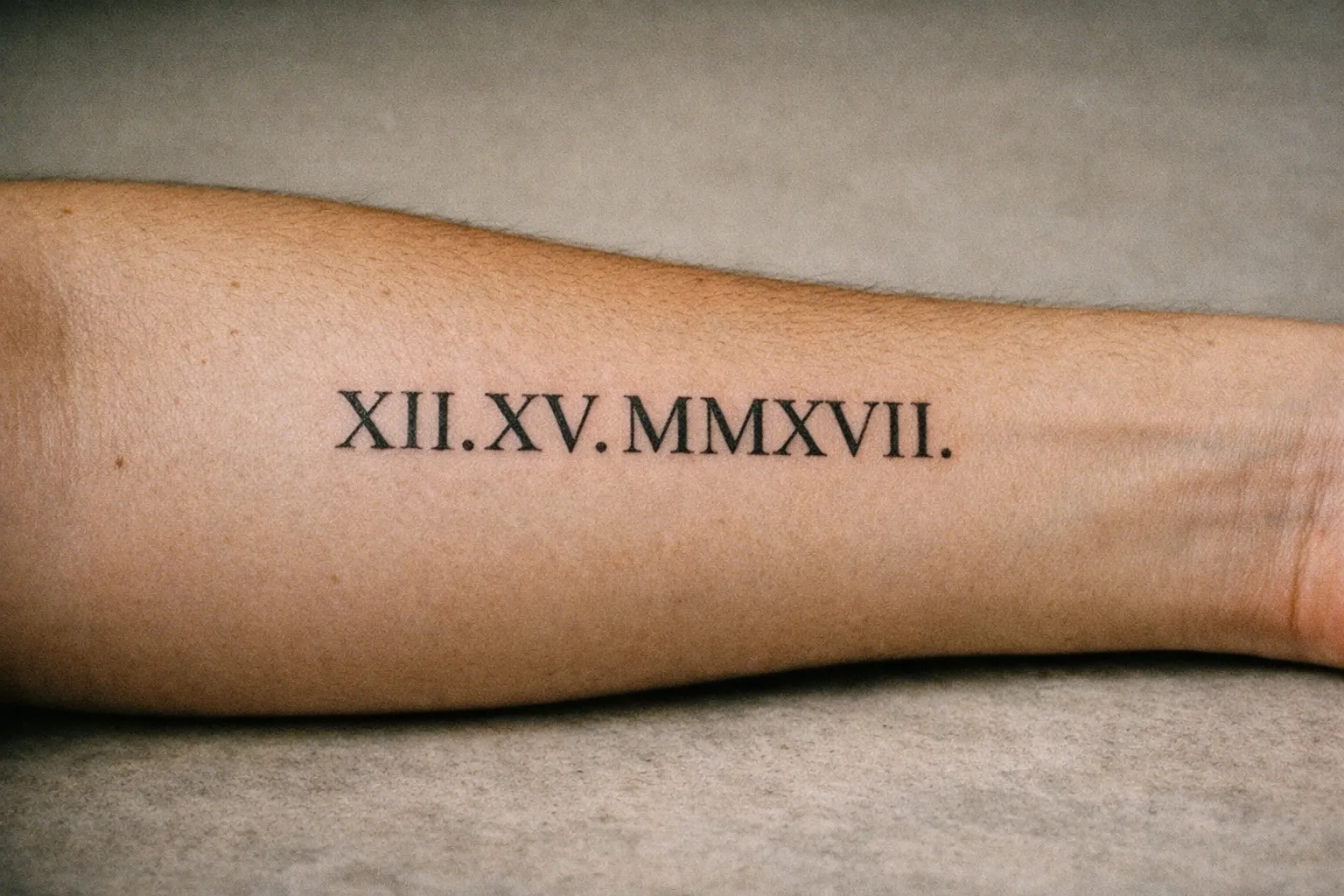
That’s the appeal, and it’s also why Roman Numerals tattoo meaning varies so widely from one person to the next.
✓ Pros
- Highly personal - the meaning is whatever date or number you bring to the chair
- Versatile sizing: works from 2 cm wrist pieces to 25 cm spine stacks
- Ages well on low-friction placements like the inner forearm
- Discreet - reads as abstract to most people, specific to you
- Easy to pair with one supporting element (rose, moon, cross) without overcrowding
✗ Cons
- Conversion errors are the top regret driver - one wrong numeral and the date is wrong permanently
- Fine-line work on fingers, wrists, and hands softens within 1-3 years and needs touch-ups
- Long dates (8+ characters) crammed under 2 cm merge into unreadable blocks as ink settles
- No cultural tradition anchoring the meaning - the symbolism is entirely personal, which also means it can feel generic
- Numerals below ¼ inch (6 mm) character height bleed together as the ink spreads, serif feet first
The most common categories:
- Birth and death dates - your own birthday, a child’s, a parent who passed
- Anniversaries - wedding, the day you met, sobriety dates
- Bible verses - John 3:16 becomes JOHN III:XVI
- Jersey numbers, lucky numbers, life path numbers - a single numeral as a personal symbol
- Coordinates - latitude or longitude of a meaningful place, in part or whole
Roman numerals carry a connotation of permanence and history in modern Western tattoo culture - they look chiseled, archival, deliberate. That’s a vibe choice, not a fixed cultural meaning. They’re not tied to a specific tradition the way Polynesian or Japanese motifs are, which is part of why they’re so widely chosen: the meaning is whatever date you bring to the chair.
The numeral system, without the schoolroom
If you skipped this part of fourth grade, here’s the working version:
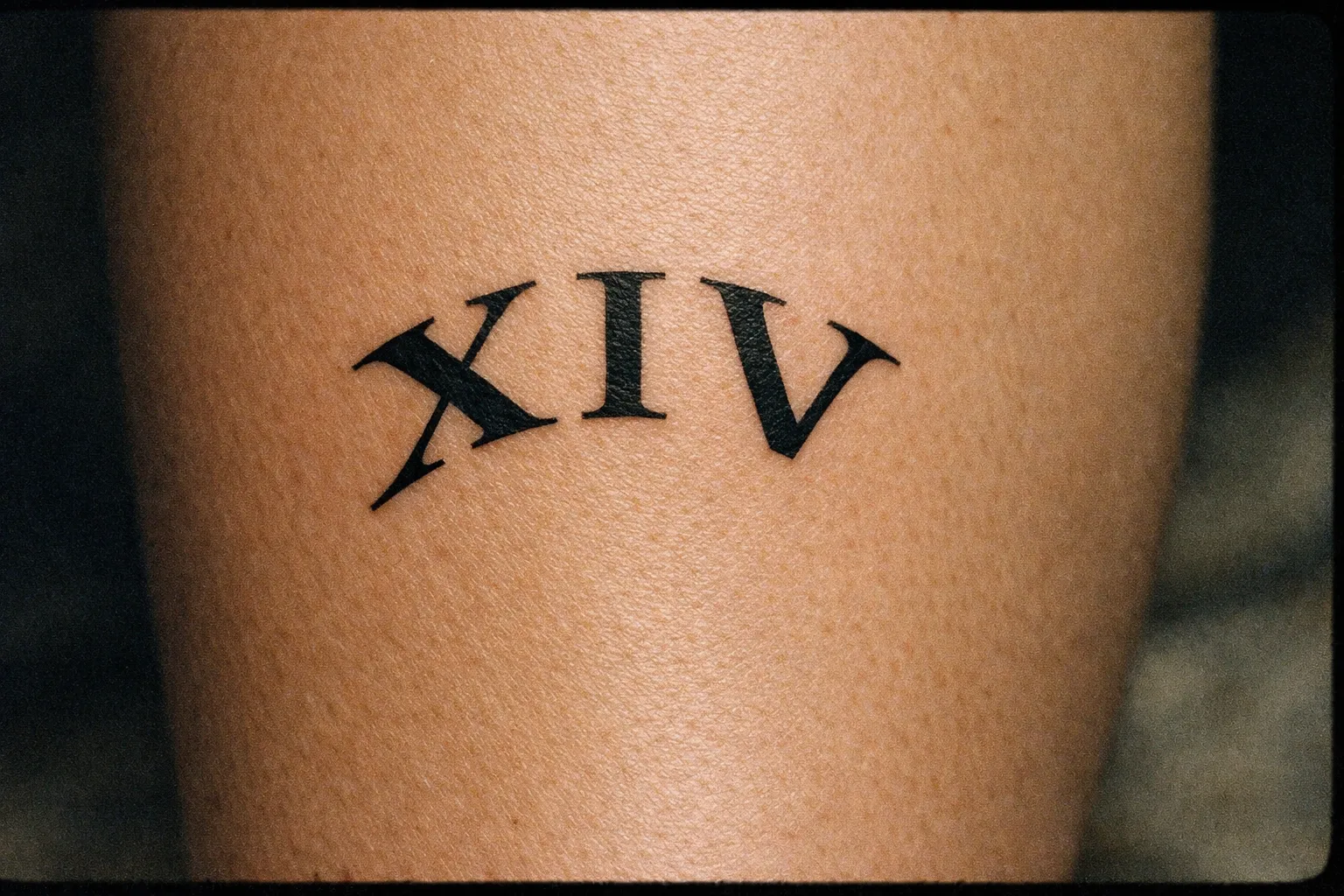
- I = 1
- V = 5
- X = 10
- L = 50
- C = 100
- D = 500
- M = 1,000
Smaller numeral before a larger one subtracts (IV = 4, IX = 9, XL = 40, CM = 900). Smaller numeral after a larger one adds (VI = 6, XI = 11, LX = 60).
A few things worth knowing before you ink anything:
- There’s no zero. Classical Roman numerals have no symbol for it (1). If you need to represent “10/05” the zeros just disappear: X • V, not X • 0V.
- 2026 is MMXXVI. 2000 is MM, 1999 is MCMXCIX, 1985 is MCMLXXXV.
- Date format matters. The US writes month/day/year; most of Europe writes day/month/year. Decide which convention you’re using before you stencil. III • VIII • MMI reads as March 8 or August 3 depending on where you’re standing.
- IV vs. IIII. Standard is IV. Some watch dials use IIII for visual balance - fine as a deliberate stylistic choice, not as an accident.
Triple-check the conversion using at least two independent sources, or run it through a Roman numeral tattoo generator (1) and then verify by hand. This is the single biggest source of regret with these tattoos. I’ve seen it go wrong more times than I’d like to count, and it’s always the same story: one source, one check, total confidence.
Small roman numerals tattoo: placement and size
A small Roman Numerals tattoo is the most-requested version of this design. Discreet, personal, fits almost anywhere - which is exactly why it’s also where people make sizing mistakes.
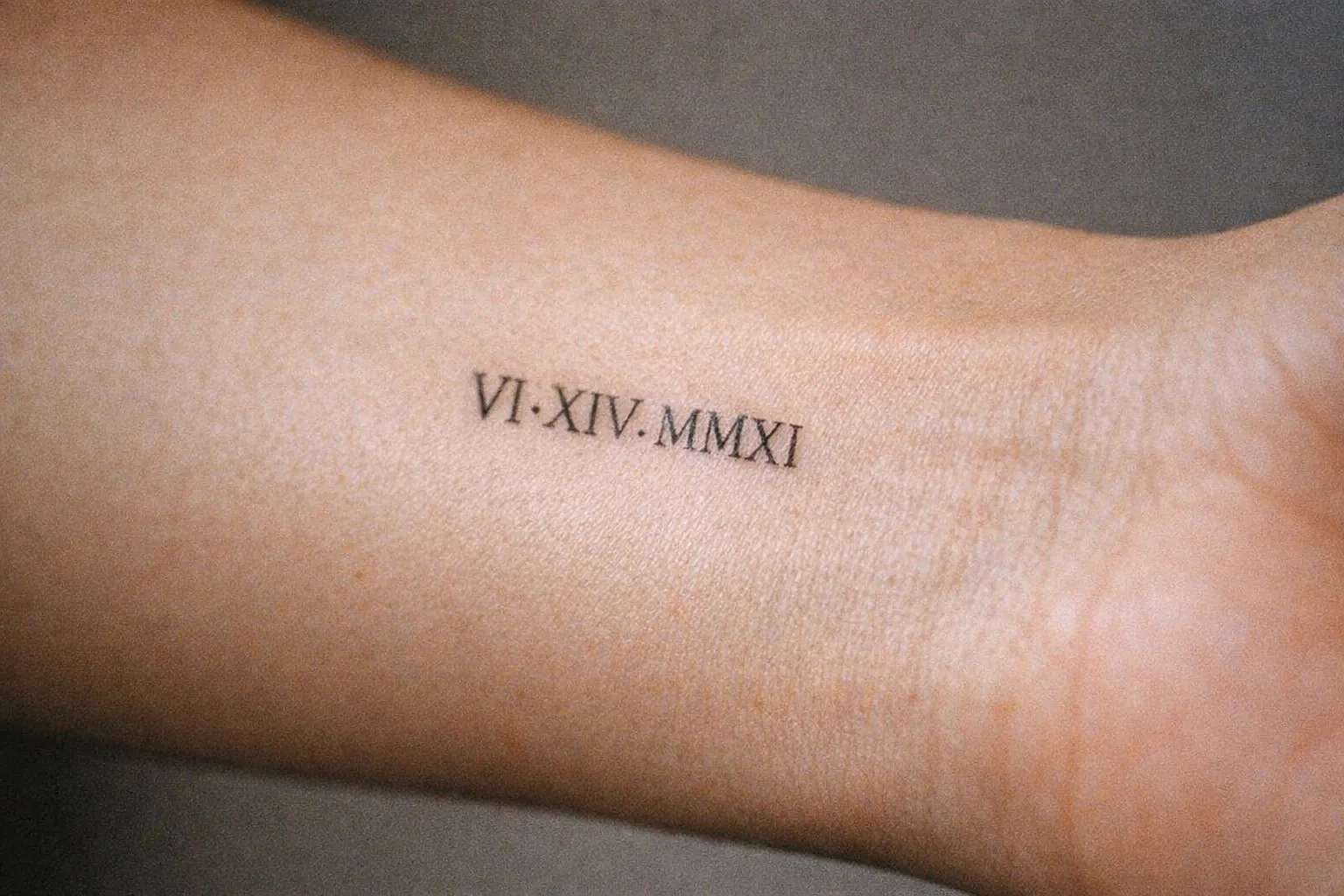
Realistic size ranges for small placements:
- Inner wrist: 2-6 cm length, 0.5-1 cm character height
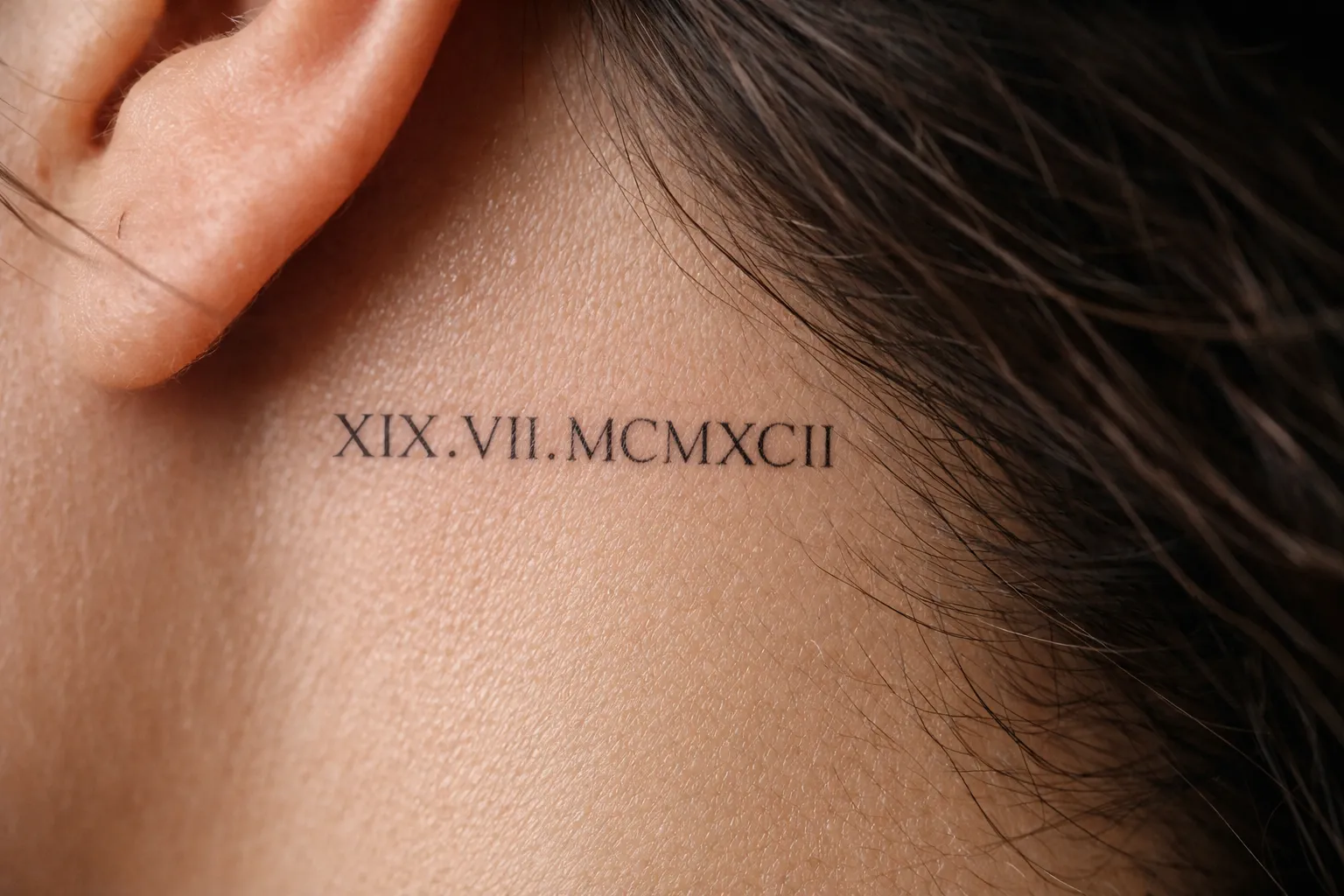
- Behind the ear: 2-4 cm
- Finger (side or top): 1.5-3 cm
- Collarbone (single date): 5-8 cm
- Ankle: 3-6 cm
The pitfall is trying to cram a long date - eight characters or more - into under 2 cm. VIII and XIII start merging into solid blocks once the lines settle and spread over a few years. Fine-line work on fingers and the side of the wrist softens fastest because those areas see constant friction from clothes, watches, and washing. I tell clients this upfront, not to talk them out of the placement, but so they’re not surprised when they need a touch-up at eighteen months.
If you want a small piece, simplify the content before you shrink the size. Two numerals (VI • IX) at 3 cm reads cleaner at year five than a full eight-character date crammed into 2 cm.
Getting the format right for a roman numeral date tattoo
A Roman numeral date tattoo is the most common reason people walk into a shop asking for this design. The decision that matters more than font, more than placement, is how you separate the day, month, and year.
Common separator conventions:
- Interpuncts (•): XII • IX • MCMXC - clean, classic, the most common modern choice (1)
- Periods: XII.IX.MCMXC - tighter, slightly more modern
- Hyphens: XII-IX-MCMXC - reads more like a written date
- Slashes: XII/IX/MCMXC - closest to how we write dates in plain text
- Line breaks (stacked): day on one line, month below, year below - works vertically along the spine or ribs
Whichever you pick, the separator improves readability and gives the eye somewhere to rest. A numerals tattoo with no separator (XIIIXMCMXC) is technically legible but harder to parse - and looks like a single long number rather than a date.
If you might want to add more dates later (a second child, a future anniversary), tell your artist now. They can build the layout so a second line of numerals fits below without crowding, or space the design as part of a planned series.
Forearm placement as the most versatile option for roman numerals
The Roman Numerals forearm tattoo is the sweet spot for visibility, size, and aging. The inner forearm gives you 6-15 cm of flat, low-friction skin that holds linework well over decades. I’ve done forearm date pieces on clients who came back years later for something else, and the numerals still looked sharp. That’s not guaranteed everywhere.
Why the forearm works:
- Flat surface means straight numerals stay straight - they don’t warp around a joint
- Low movement and low friction compared to wrists, fingers, or ankles
- Enough real estate for embellishments (florals, a clock face, a small constellation) without crowding
- Easy to cover with a long sleeve if your workplace cares
Inner forearm reads as more personal - you see it constantly, others see it only when you turn your arm. Outer forearm is more public. Both age well at typical sizes (8-12 cm date).
Pain on the forearm sits at the low end of the relative scale - meaningfully less than the ribs, sternum, or inner bicep. Most clients sit through a forearm date in one short session without needing a break.
Font: what reads and what blurs
The Roman Numerals tattoo font decision is where small designs live or die. Numerals are unforgiving - there’s no curve to hide a blowout, no shading to mask a wobble.
Three font categories that work:
- Classic serif (Times New Roman, Trajan, Cinzel) - the chiseled, monument-inscription look. Best for medium and large pieces; the serifs need enough room to render cleanly. Don’t go below ¼ inch (6 mm) character height, and give serifs extra room above that, or the feet bleed together.
- Sans-serif / monoline - clean vertical lines, even weight throughout. Best for fine-line and small tattoos, down to the ¼ inch (6 mm) floor. Reads modern and minimalist.
- Custom calligraphic / script - italic numerals or hand-drawn variants. High visual interest but harder to read at small sizes; only worth doing if your artist has examples of healed work in that style.
Ask your artist what needle configuration they’ll use. Single-needle and 3RL groupings give the crispest fine lines; 5RL gives more durability. A 0.25-0.35 mm apparent line after healing is the realistic target for small numerals - anything finer may soften within 1-3 years on the wrist or hand.
How big is a $500 tattoo?
At a typical fine-line rate of $150 per hour, a $500 budget buys roughly 3-3.5 hours in the chair. For a roman numerals tattoo, that translates to:
- A detailed forearm piece (8-12 cm) with decorative elements - small florals, a clock face, a moon phase, or a thin frame around the numerals
- A long vertical spine or rib stack (15-25 cm) in fine-line with light shading
- A multi-element collarbone composition combining numerals with a name in script or a small symbol
For a plain wrist date with no embellishments, you’ll spend nowhere near $500. Most small black-ink dates run $80-$150 at shops with an $80-$100 minimum. Mid-range forearm pieces with custom font work and light decoration land at $150-$350. Premium fine-line specialists in NYC, LA, or London often start at $200 minimum and $150-$250 per hour, which is where a $500 budget gets eaten quickly.
Tip pricing on top is 15-20% on the labor total, not the minimum.
Pairing numerals with symbols: roses, crosses, feathers, celestial
Plain numerals work. Numerals with one supporting element work better when there’s a specific reason for that element - and worse when the element is added to “fill space.”
What pairs well, and why:
- Roses - classic for love, anniversaries, partner-tied dates. Pairs structurally with serif numerals because the curved organic shape contrasts the chiseled geometry. Best at 8 cm+ so the rose has room to breathe.
- Crosses - for faith-related dates (baptism, religious milestones) or memorial pieces. Works as a vertical anchor with stacked numerals below.
- Feathers - often chosen for memorial pieces. Cultural origins vary: in some Indigenous traditions feathers carry specific spiritual meaning; in modern Western tattoo culture they read more generically as freedom or remembrance. Worth being aware of the difference.
- Celestial elements (moon phases, single stars, constellations) - trending strongly in 2026, especially for memorial and birth-date tattoos. A small crescent moon next to a date reads as quiet rather than busy.
- Clock faces - direct symbolic overlap with the numerals themselves. Works when the date represents a specific moment in time (birth time, time of passing); feels redundant when the date is just an anniversary.
The pitfall is stacking three or four symbols around a date because each one “means something.” Pick one. The numerals are already doing the heavy meaning-lifting.
Matching roman numeral tattoos
Matching dates are the safer end of the couple-tattoo spectrum. Partner-name tattoos are explicitly flagged as high-regret across 2026 couple tattoo trend coverage (3) - the American Academy of Dermatology notes that name tattoos are among the most-requested cover-up subjects - a name is unambiguously tied to one person, while a date is just a date. If the relationship ends, the numerals don’t shout the ex’s name across a room.
That said: a wedding date or “the day we met” date is still relationship-tied. You’re not bulletproof, just better-positioned than someone with “JESSICA” in script across their forearm.
Placement options that work for matching pieces:
- Inner wrist on both partners (most common)
- Inner bicep or upper rib (more private)
- Behind the ear (most discreet)
- Inner forearm, mirrored - one partner left arm, one right
Keep the design identical down to the separator style and font. A small format consistency now prevents the “mine looks different from yours” conversation later.
Stacked and vertical layouts
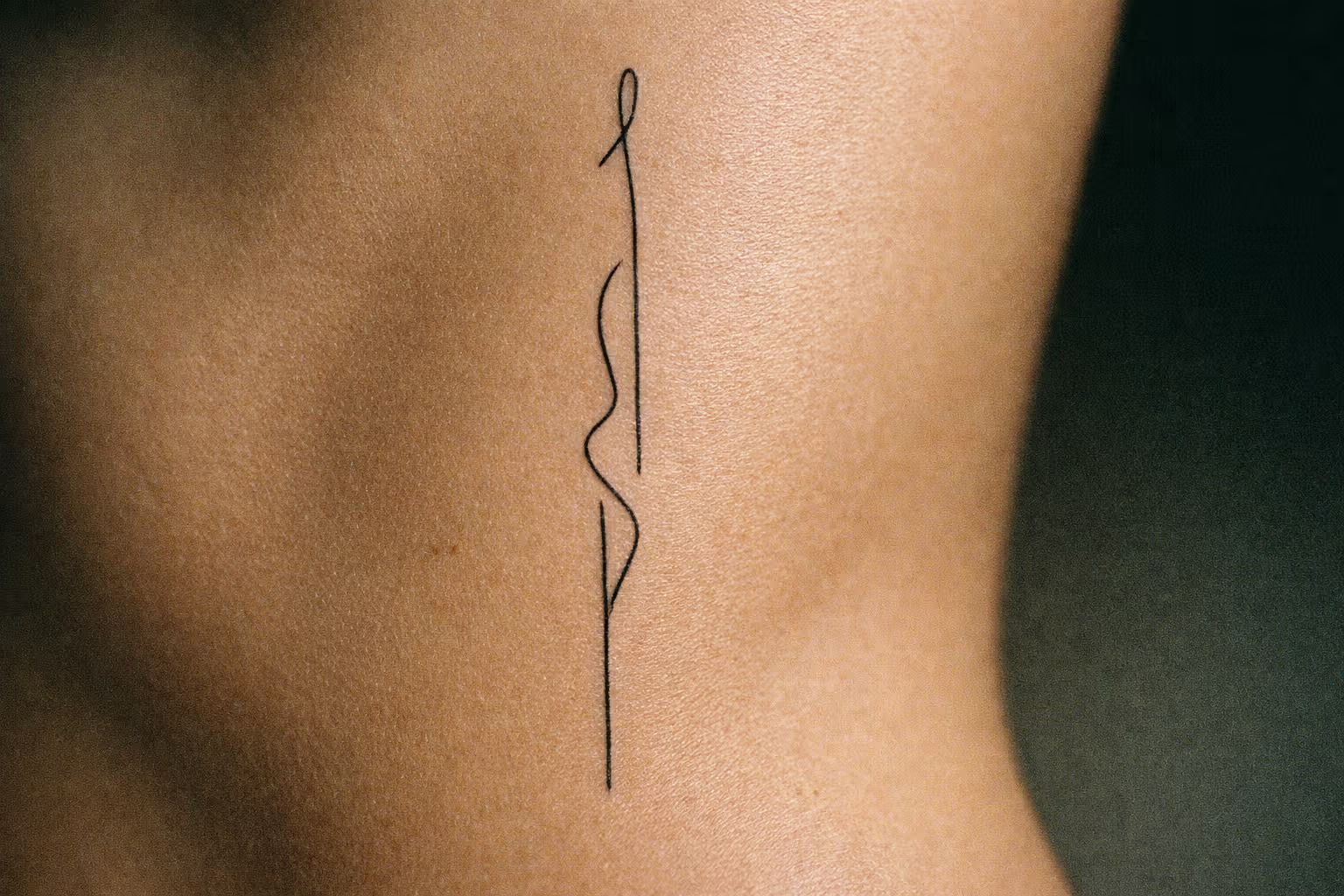
Stacked numerals - day, month, and year on three separate lines - are the trending layout for 2026, particularly on the spine and ribs (1). They turn a horizontal date into a vertical column, which fits the geometry of those placements naturally. Like a mountain tattoo that uses the body’s vertical real estate to its advantage, stacked numerals work with the natural lines of the torso rather than against them.
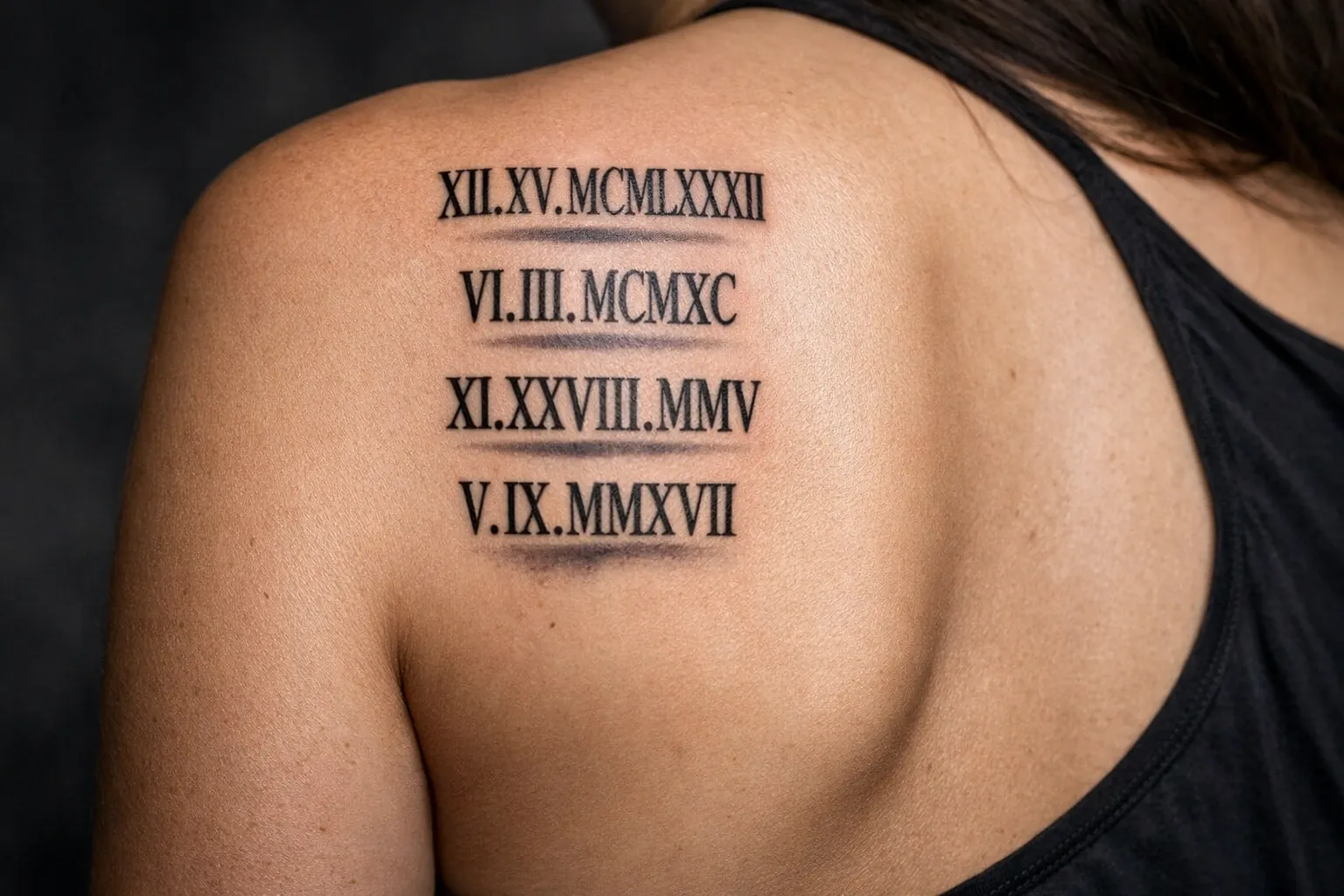
Why it works:
- The spine and side ribs are vertical real estate; horizontal text fights the body
- Stacking lets each numeral group carry its own visual weight
- You can read it walking past a mirror without tilting your head
Size ranges for stacked work: 10-25 cm total height on the spine, 8-15 cm on the ribcage. Expect a 2-4 hour session for a clean stacked piece. Rib work sits among the more painful placements - ribs > forearm > wrist by a wide margin - and breathing movement can cause line wobble if you can’t stay still.
Aftercare timeline
The numerals will look sharpest the day you walk out of the shop. From there:
- Day 1-3: Keep the wrap on per your artist’s instructions (usually 2-24 hours). Wash twice daily with unscented soap, pat dry, apply a thin layer of fragrance-free moisturizer. No soaking, no swimming, no gym.
- Week 1: Light peeling starts around day 4-7. Don’t pick. Keep moisturized but not saturated - wet skin slows healing. Wear loose clothing over the area.
- Week 2-4: Surface healing is mostly done by day 14, but the deeper layers settle over the next 4-6 weeks. Lines may look slightly cloudy or soft during this window - that’s normal, not a blowout.
- Months 2-6: Final settling. This is when you’ll see whether any character thickened or any line softened. Most reputable studios offer a free or discounted touch-up within 6-12 months - book it if you need one.
- Lifetime: Sun fades black ink faster than anything else. Sun-protective clothing or SPF 30+ on the area whenever it’s exposed will add years to the linework.
Fine-line numerals on the wrist or fingers may need a touch-up in 6-18 months even with perfect aftercare. Plan for it. It’s not a failure of the artist - it’s the trade-off for that look.
Tattoos to avoid with roman numerals
Plenty of guides treat this question vaguely. Here are the actual high-regret categories an experienced artist will push back on:
- Partner names in plain script. Repeatedly flagged as the top regret tattoo. A roman numeral date is the safer substitute for a relationship marker (3).
- Impulsive dates with no buffer. The “we met last weekend, let’s get the date tattooed” tattoo. Wait at least six months on relationship-tied numerals.
- Hyper-fine lines on high-friction zones. Single-needle work on fingers, hands, or feet can soften meaningfully within 1-3 years. Get it knowing it’ll need touch-ups.
- Designs chosen to match a current trend with no personal meaning. Trends shift; the ink doesn’t.
- Designs you haven’t lived with on paper for at least 30 days. Stencil it, draw it on with eyeliner, screenshot it daily. If you’re still into it a month later, book the appointment.
- Inside-lip and white-ink tattoos. Both age unpredictably - inside-lip can fade in months, white ink often yellows or becomes invisible.
- Designs that require the artist to freestyle something culturally specific. Polynesian, Japanese irezumi, and Indigenous motifs done by artists without training in those traditions often end up culturally inaccurate and aesthetically off.
For a roman numerals tattoo specifically, the avoidable mistake is almost always the same: the wrong numeral, the wrong date format, or the wrong size for the chosen content.
What is the tattoo symbol for ADHD?
There’s no standardized, universally recognized tattoo symbol for ADHD. A few motifs circulate in neurodivergent communities, each with different connotations:
- Dopamine molecule - the most common. Reads as a clean, scientific reference; well-understood within the community, opaque to outsiders.
- Lightning bolt - used for ADHD, but also widely used for energy, speed, and unrelated meanings. If you’re drawn to this option, it’s worth reading about lightning bolt symbolism more broadly before committing, since the design carries associations beyond neurodivergent identity. Less specific.
- Puzzle piece - historically associated with autism rather than ADHD, and increasingly controversial within autistic communities. Best avoided unless you specifically understand the debate around it.
- Squirrel, butterfly, or scattered-dot motifs - informal, often chosen for the “easily distracted” association.
- Custom personal symbol - increasingly common. Something abstract that means ADHD to you and nobody else has to decode.
If you want to combine an ADHD symbol with numerals (a diagnosis date, for example), a small dopamine molecule paired with a fine-line date on the inner forearm is the cleanest pairing. Discuss the symbolism with your artist; they may have done variants before and can flag any common pitfalls.
Frequently Asked Questions
- What is the best font for a roman numerals tattoo?
- Classic serif fonts like Times New Roman, Trajan, and Cinzel work best for medium and large tattoos because the serifs need space to render cleanly. For small tattoos close to the ¼ inch (6 mm) character-height floor, sans-serif or monoline fonts hold up better since serifs tend to blur as the ink settles. Always ask your artist to print the design at the exact size before stenciling.
- Where should I put a roman numerals tattoo?
- The inner forearm offers the best balance of visibility, size flexibility, and aging because it's flat, low-friction skin that holds linework well. Other common spots include the inner wrist, behind the ear, collarbone, and spine. Keep in mind that wrists and fingers look great fresh but tend to soften faster.
- How much does a small roman numerals tattoo cost?
- In the US, small wrist or ankle tattoos (2-4 cm) typically cost between $80 and $150 at reputable shops with an $80-$100 minimum. Mid-range forearm pieces range from $150 to $350. Fine-line specialists in major cities often start at $200 minimum and charge $150-$250 per hour.
- Do roman numerals tattoos hurt?
- Pain depends on placement rather than design. Forearm and outer bicep are on the low end of the scale, wrists and ankles are mid-range, and ribs, spine, sternum, and inner bicep are significantly more painful. Small date tattoos usually take 20-45 minutes, limiting the time you need to endure discomfort.
- Can I add more dates later?
- Yes, but you should plan for it. Inform your artist at the first appointment if you might add more dates later so they can space the original design accordingly. Vertical stacks and concentric layouts accommodate additions more gracefully than single-line horizontal dates.
- What if I get the numerals wrong?
- Getting the numerals wrong usually means cover-up or laser removal. Small black-ink errors typically cost $200-$500 per laser session, and multiple sessions are often needed. Cover-ups require the original tattoo to be small and the new design larger and darker. Prevention through double-checking conversions with independent sources is much cheaper.
The strongest version of this tattoo is the one where the numerals are correct, the size matches the content, the placement suits how you actually live, and the font holds up at the scale you chose. Everything else - the rose, the clock, the constellation - is decoration around a decision that’s already been made. Take a month with the design before you book. Check the conversion twice. Then sit down and get it.