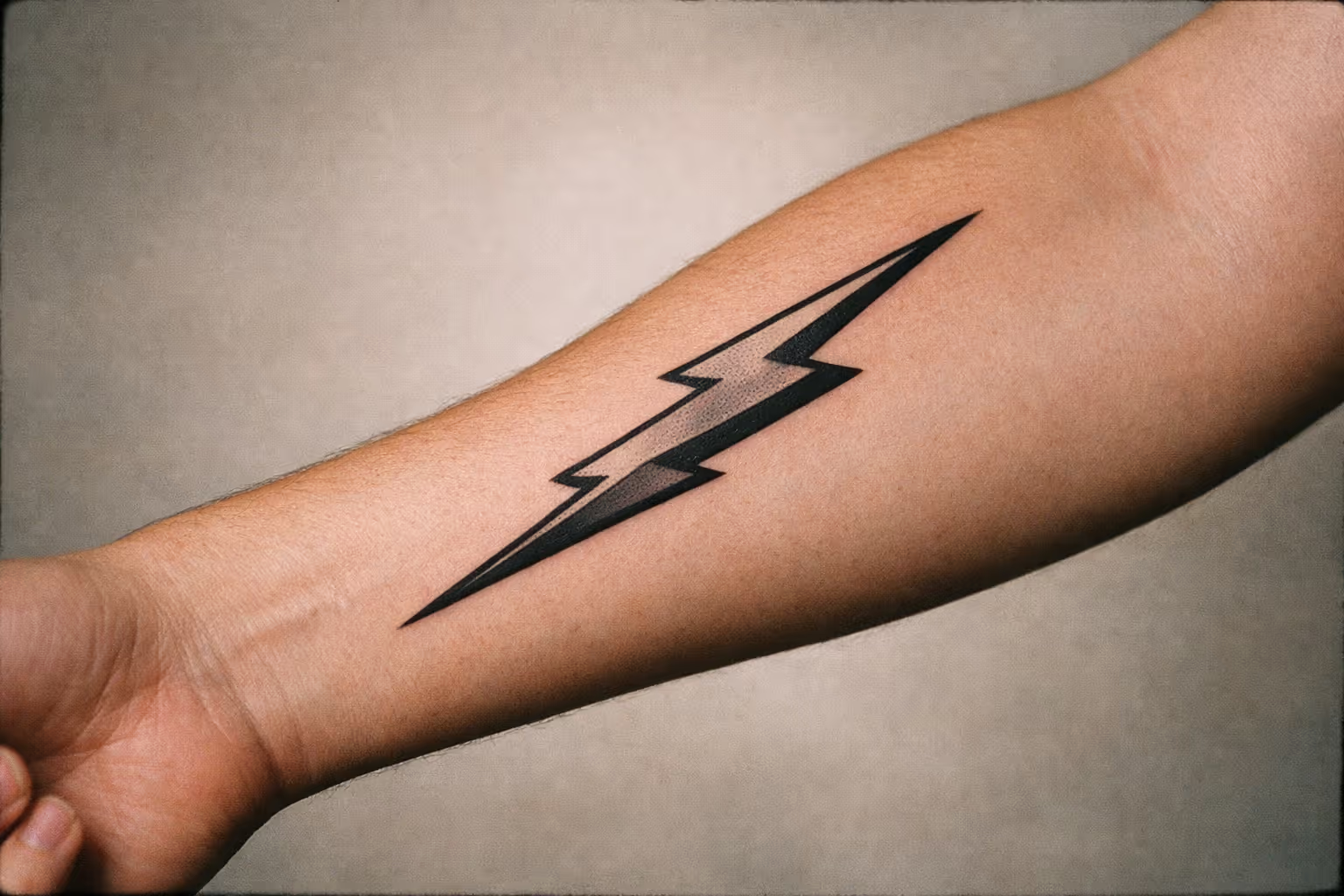
Two small choices decide whether a lightning tattoo still reads in ten years. First, single bolts beat double: one clean, angular strike holds where a tangle of two or three starts to look like noise. Second, line weight - anything under 0.3mm blurs into a soft grey streak within five years. It’s a design that punishes both over-complication and under-inking. Here’s how to build a bolt that ages sharp, and what a lightning tattoo can signify.
What a Lightning Tattoo Actually Means
A lightning tattoo looks simple on paper - a jagged bolt, two or three angles, done. But the design carries more weight than most clients realize when they sit down in the chair. Depending on how you draw it, where you place it, and what you pair it with, the same shape can read as raw power, surf-culture freedom, a Harry Potter reference, or - and this matters - a coded hate symbol. This guide covers the full Lightning Tattoo meaning spectrum, the design choices that age well, the ones that don’t, and the specific bolt configurations you should ask your artist to avoid.
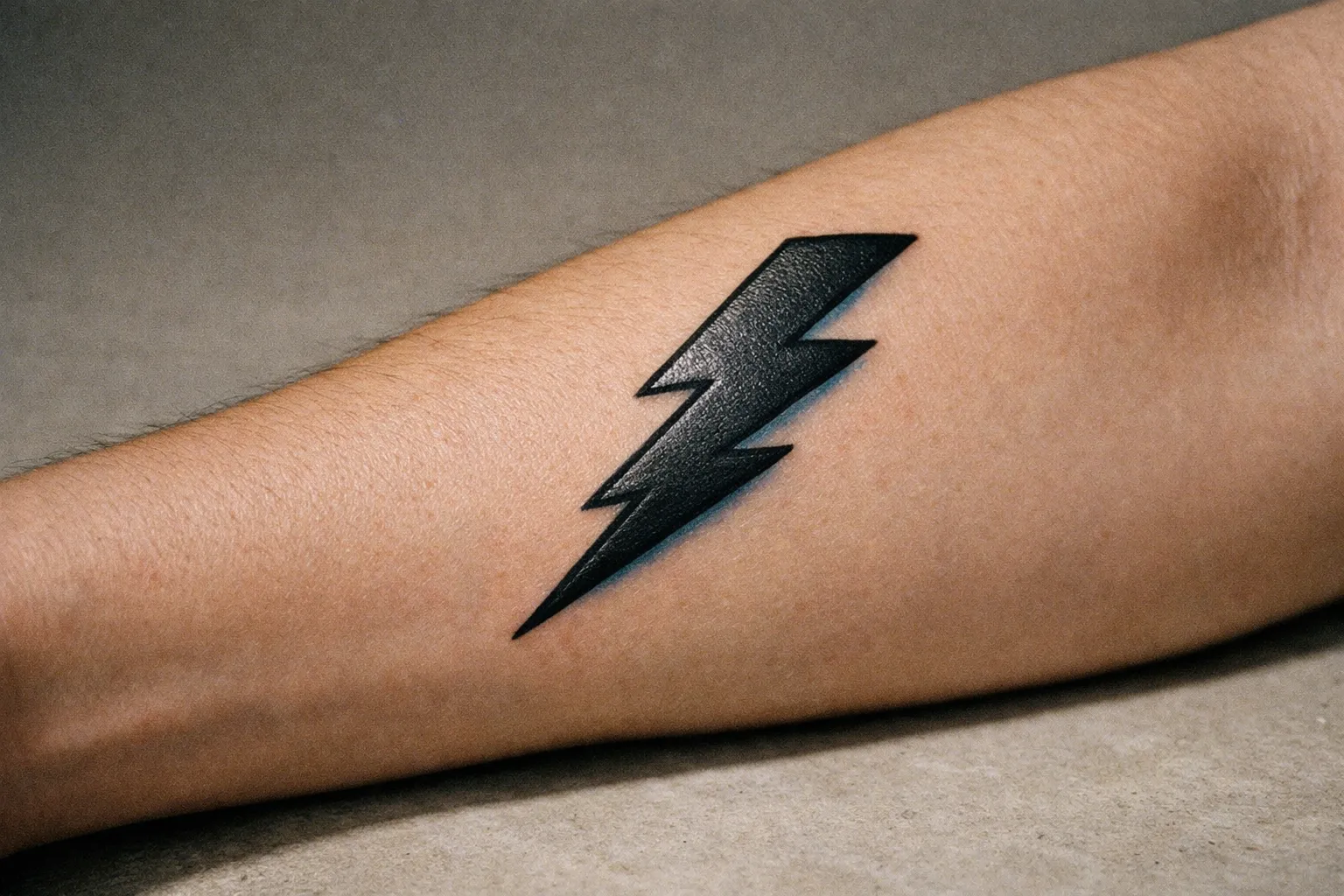
Across tattoo meaning guides, the consensus on the Lightning bolt Tattoo lands on a tight cluster of themes: power and energy, speed, sudden transformation, divine intervention, and creative spark (1)(2)(3). Most people getting a bolt today are reaching for one of those - usually strength after a hard stretch, or a marker of a moment when life turned on a dime.
The shape itself does a lot of the work. A bolt is angular, sharp, immediate. It reads from across a room even at 1 inch. That’s why it survives so well as a minimalist piece - there’s no ambiguity in the silhouette, and your eye fills in the meaning fast.
Common readings clients bring into the consult:
- Resilience - surviving something that hit fast and hard
- Speed and decisiveness - common with athletes, runners, gamers
- Creative or intellectual spark - the “aha” moment, often paired with a bulb or brain
- Divine power - Zeus, Thor, or storm deities, usually as part of a larger piece
- Surf or skate lifestyle - tied to the Lightning Bolt brand (more on that below)
The bolt is flexible, which is the appeal and the trap. Flexible means it personalizes well. It also means a random Pinterest pull without context is one of the more common regret tattoos - and I’ve had that conversation with clients more times than I’d like.
✓ Pros
- Strong, clear silhouette that reads well even small
- Flexible symbolism adaptable to personal meaning
- Ages well with proper size and line weight
✗ Cons
- Risk of unintentional association with hate symbols if poorly designed
- Fine lines and tiny sizes blur quickly
- Some designs become basic or cliché without intent
What Does It Mean to Have a Bolt Like This?
Short answer: it depends on what you bring to it. There’s no single fixed meaning - the bolt is read through its context.
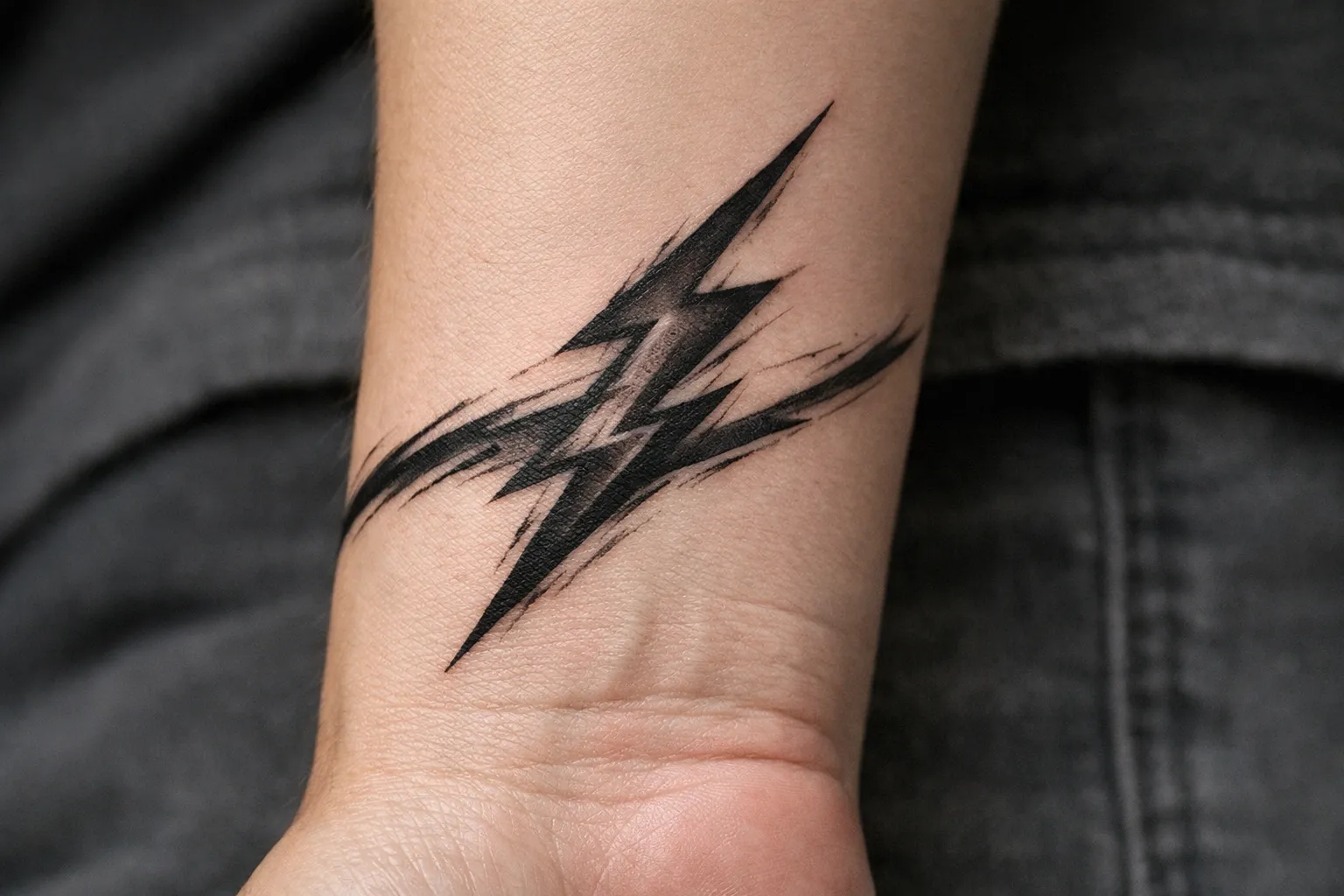
A small bolt on the inside of a wrist usually reads as personal: a private reminder of strength, a milestone, a person, or an energy you want to keep close. A bold bolt across the forearm reads outward - this is who I am, fast-moving, charged up. A bolt inside a stylized storm scene reads as narrative: I came through something.
If you want the tattoo to communicate a specific meaning, tell your artist directly. “I want this to feel like resilience” produces a different bolt than “I want this to feel like speed.” The first leans into a thicker, grounded line with maybe a small crack motif. The second leans into motion lines, a sharper angle, sometimes a trailing afterimage. Same symbol, different execution.
This is where I usually ask clients to bring two or three references that capture the feeling they’re after - not necessarily other bolt tattoos, but anything that has the right energy. That conversation shapes the design more than any single reference image.
What Does the ⚡ Tattoo Mean?
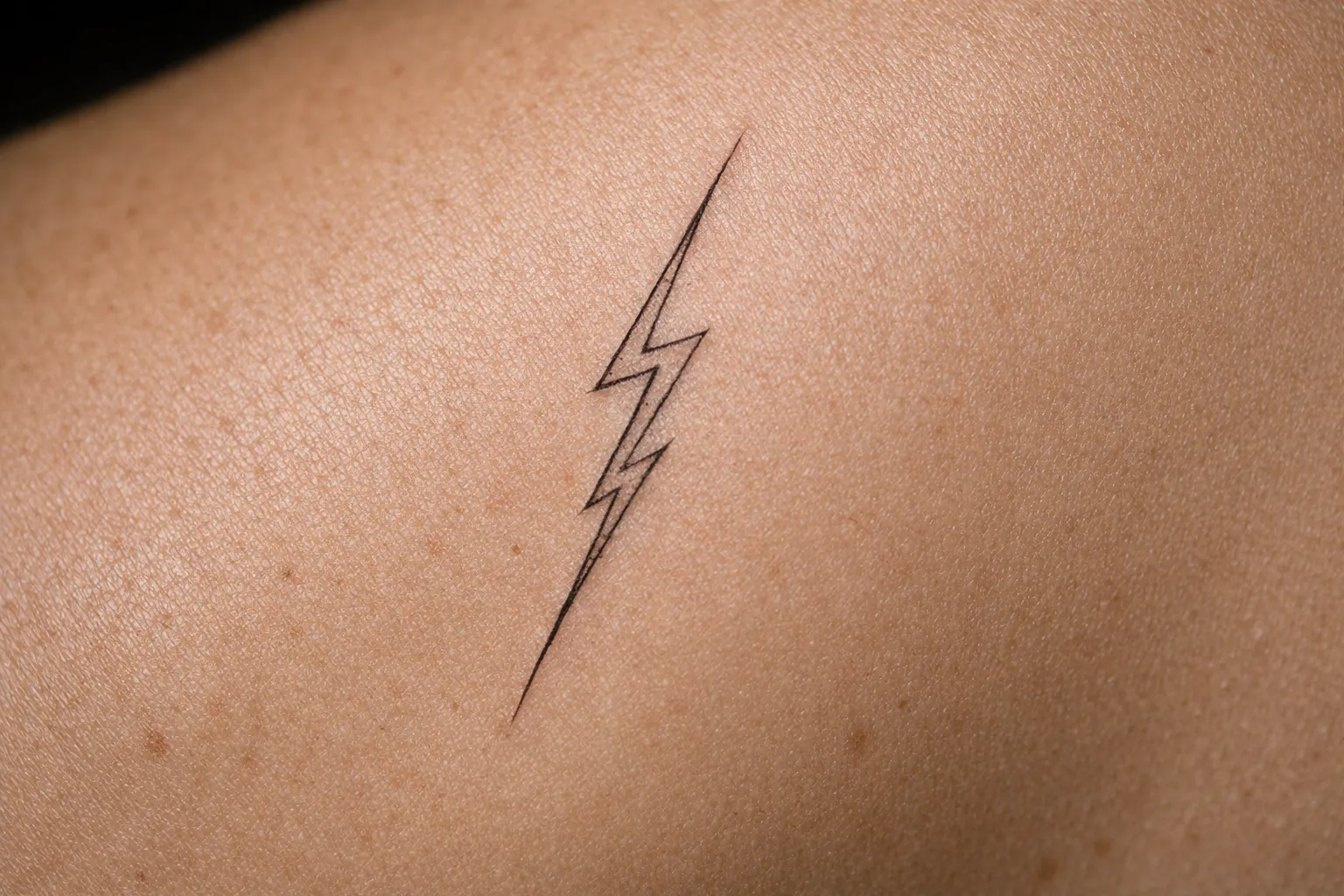
The ⚡ emoji tattoo is its own micro-trend, and it carries the digital-culture meaning of the emoji itself: energy, hype, “charged up,” high-output personality. It’s almost always small - under 1 inch - and usually placed on a finger, behind the ear, on the inside of the wrist, or on the ankle.
A few honest notes on this one:
- The emoji shape is stylized - the bolt has a flat top and bottom and specific angles. If you want it to read as the emoji and not a generic bolt, ask your artist to reference the actual glyph.
- At under 1 cm, line weight matters. Anything under ~0.3 mm tends to blur within a few years, so a hair more weight than the on-screen version will age better.
- These read as casual, fun, energetic. They don’t carry the weight of a mythology piece, and that’s fine - just don’t expect strangers to read deep meaning into it.
The Bolt Across Cultures: What the Symbolism Actually Comes From
Lightning has shown up as a sacred or charged symbol in nearly every storm-prone culture, and the inherited meaning depends heavily on which tradition you’re drawing from.
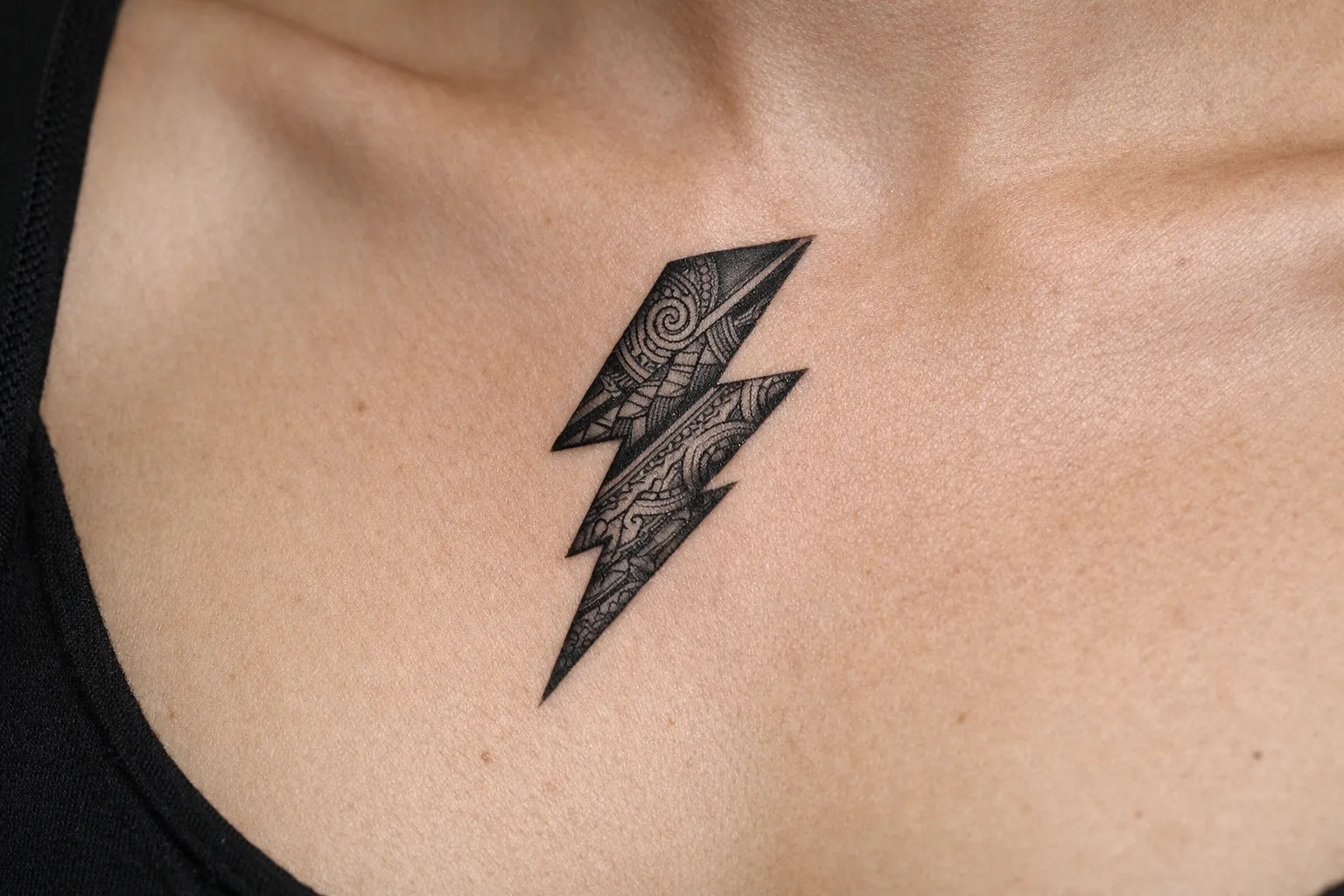
Greek mythology. Zeus throws bolts from Olympus. The bolt is the visual signature of divine authority and swift judgment. A Zeus-themed piece - bearded deity, raised arm, bolt in fist - works best at 5-7 inches or larger, usually on the upper arm, thigh, or calf, because the face needs room to read.
Norse mythology. Thor’s hammer Mjölnir summons lightning. Less commonly tattooed as a pure bolt, more often as the hammer with bolts radiating out. Worth knowing: certain Norse imagery has been appropriated by extremist groups, so if you go this route, talk it through with an artist who knows the territory.
Native American traditions. In several Plains and Pacific Northwest tribes, the Thunderbird controls storms and lightning, and the symbolism leans toward moral force and truth-telling rather than wrath. If you’re not from those communities, treat this as context to understand - not a motif to take.
Chinese folklore. Lightning precedes the rains that grow crops, so the symbolism leans toward fertility, renewal, and the start of a productive cycle.
Celtic tradition. Ground struck by lightning was considered marked or sacred - chance becoming meaningful.
Modern Western tattoo culture has flattened most of these into a general “power” reading, which is fine for personal use. But if you’re citing a specific tradition as your reason for getting the piece, get the symbolism right before you commit. I’ve seen clients walk in with a “Celtic lightning” concept that had no actual Celtic basis - just a vague Pinterest aesthetic. Not a disaster, but worth knowing what you’re actually referencing.
Bolts on Skin: It’s All About the Energy
The Lightning Bolt surf brand, founded in Hawaii in 1971, built its identity around the tagline “It’s all about the Energy,” and that phrase has become shorthand for a whole subset of bolt tattoos (3). When someone gets a Lightning Bolt brand logo tattooed - usually the clean, stylized double-tapered bolt - they’re signaling surf culture, board sports lifestyle, freedom, and a specific lineage of Hawaiian surfing.
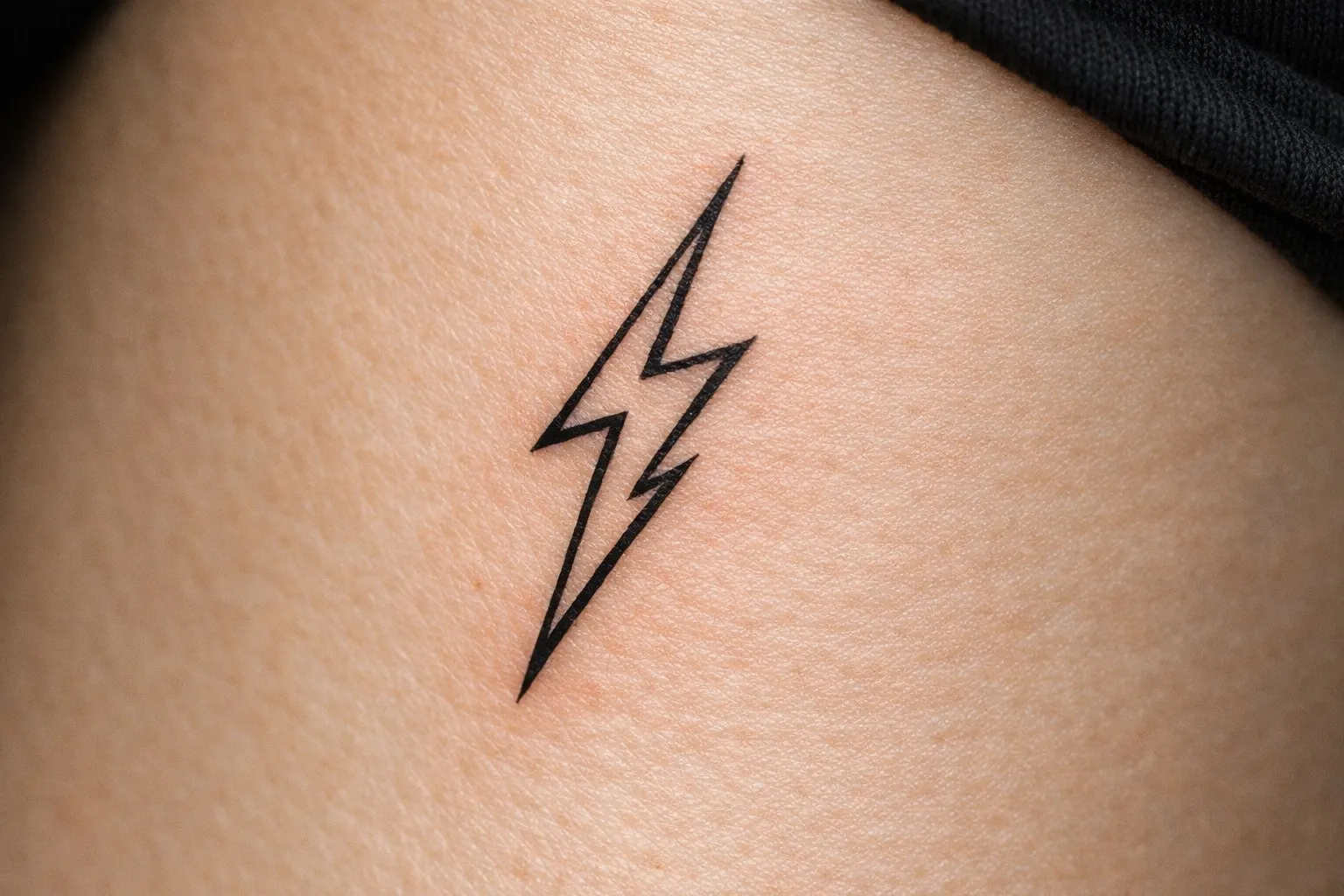
This is a brand mark, so a few things to think about:
- Get the proportions right. The logo has a specific taper and angle. A sloppy version reads as a generic bolt, not the brand.
- Common placements: outer calf, ribs, upper arm, or inside bicep at 2-4 inches.
- Pairs well with a wave silhouette, a board outline, or a single line horizon - visual cues that lock in the surf reading.
The broader “energy” idea works even if you’re not a surfer. A bolt tattooed with intention - placed where you’ll see it, drawn at a size that holds up - functions as a daily marker. Athletes use it before competition. People in recovery use it as a milestone. Creatives use it as a reminder to start the work. The symbol is doing the same job in each case: storing a charge you can draw on.
To make a bolt feel genuinely electric rather than flat, artists often add:
- Radiating dots or stippling around the tip, suggesting discharge
- Short motion lines trailing behind the bolt
- A subtle glow in white ink or negative space around the edges
- A cracked or fractured base where the bolt meets skin
These details push the design from “shape of a bolt” toward “bolt mid-strike.” The difference is significant at any size above 2 inches. If you enjoy pairing elemental imagery, a cloud tattoo can extend the storm narrative and give a bolt composition more visual context.
The Dark Side: SS Bolts, Prison Tattoos, and What to Avoid
This is the section most tattoo articles skip, and it’s the one that matters most before you commit.
Double lightning bolts in the SS configuration are a documented white supremacist and neo-Nazi symbol. The Anti-Defamation League catalogs the SS bolts as a hate symbol derived from the Schutzstaffel insignia and the sowilo rune, and they appear regularly in prison tattoos tied to white supremacist gangs (4).
The specific shape to know: two angular, lightning-shaped runes side by side, often with pointed rather than flat ends, drawn in a way that mirrors the original SS uniform insignia. Some prison variants use sharper, more pointed bolt tips than the standard “Z-shaped” civilian bolt.
What does a lightning bolt tattoo mean in jail?
In US carceral settings, double lightning bolts - particularly in the SS style - commonly signal white supremacist gang affiliation (4). Single bolts can also carry coded meanings in specific prison populations, though the double-bolt SS form is the most consistently documented.
This matters even if you have zero connection to those groups. A poorly drawn double bolt on a forearm can be misread by strangers, employers, or - if you ever end up in a setting where it matters - by people who do read those codes. Artists who work in this style are increasingly proactive about asking clients to confirm intent and steering them away from SS-adjacent configurations. I ask about it directly during every consultation involving paired bolts. It’s not an awkward conversation - it’s a necessary one.
How to avoid the wrong read
- Stick to single bolts for most designs. One bolt is unambiguously a bolt.
- If you want two bolts, don’t mirror them side by side at the same angle. Stagger them, cross them, or use different sizes.
- Avoid sharp, pointed bolt tips on paired bolts - that’s the configuration most associated with SS imagery (4).
- Round or slightly curve the angles on stylized bolts to push them further from the SS rune profile.
- Show your artist a reference and explicitly say you want to avoid any SS or hate-symbol resemblance. A competent artist will adjust the design.
What Are Basic Tattoos to Avoid?
Lightning bolts show up on most “basic tattoos” lists, and the criticism is usually fair when the design is copied directly from a celebrity post or Pinterest pin with no personal connection, when it’s a tiny single bolt with no thought to placement, size, or composition, when the reference is a brand logo or fictional character the wearer has no real relationship with, or when the design echoes the SS configuration without the wearer realizing.
A lightning tattoo isn’t basic because of the shape - it’s basic because of the lack of intent behind it. If you can answer “why this bolt, why this placement, why this size” in a sentence, you’re past the basic-tattoo problem.
Placement and Size - What Works, What Doesn’t
The bolt is one of the more placement-flexible designs in the tattoo world, but a few combinations work better than others.
Inside wrist (1-2 inches). Private, easy to cover, ages well. Good for first tattoos. Pain is moderate - bony, but quick.
Behind the ear (under 1 inch). Suits the ⚡ emoji style. Heals fast, low pain. Watch the line weight - too thin and it blurs within a few years.
Forearm (2-5 inches). The strongest all-around spot. Reads at a distance, ages well because of even skin tension, low pain relative to other placements.
Upper arm or shoulder (3-6 inches). Room for a fuller composition - bolt with clouds, bolt with deity, bolt with motion lines. Easy to cover for work.
Ribcage (4-8 inches, vertical). Looks dramatic with a long, trailing bolt. Pain is significantly higher here than the forearm - ribcage > forearm by a wide margin. Plan for a longer session and more breaks.
Sternum (3-5 inches). Striking placement, but painful and slower to heal. Best for a clean, bold bolt rather than fine detail.
Finger or hand (under 1 inch). Looks great fresh, fades fastest. Hands lose ink quickly because of constant skin turnover and washing. Expect touch-ups every 2-4 years.
Neck (2-4 inches). High visibility, high commitment. Think hard about employment implications before booking.
Size and longevity
For a bolt to still read clearly at 10 years, aim for minimum line lengths of 1-1.5 inches with line weights thick enough to survive the spread that happens as skin ages. Ultra-fine single-needle bolts look gorgeous fresh - I won’t pretend otherwise - but artists are increasingly cautioning clients that those lines blur faster than thicker traditional outlines. If you want fine line, go in eyes open, and budget for a touch-up at the 5-year mark.
Design Variations Worth Considering
Lightning with clouds or storm
The bolt-and-cloud pairing tells a clearer story than the bolt alone. Clouds add narrative - chaos, weather, something passed through. Works at 4 inches and up, usually on the forearm, upper arm, or thigh. Black-and-grey shading on the clouds with a clean bolt is the most durable execution.
White ink lightning
A bolt done entirely in white ink reads almost like a scar or a glow on the skin. It’s subtle, unusual, and ages unpredictably - white ink can yellow, fade, or take on the skin’s undertone over time. Best on lighter skin tones and on placements with minimal sun exposure. Not a first-tattoo choice.
Lightning bug (firefly)
A different reading of “lightning” - the firefly carries meanings of hope and small light in darkness. Works at 1-3 inches on the wrist, ankle, or shoulder. Pairs well with botanical elements. Clients drawn to guiding-light symbolism sometimes also consider a lighthouse tattoo for similar reasons - both images center on illumination cutting through darkness.
Sleeve compositions
Lightning works beautifully as a connective element in a sleeve - bolts threading between other imagery, tying a storm scene to a deity, a wave, or a portrait. If you’re starting small but might want a sleeve later, place your first bolt where it can be extended - upper forearm rather than mid-wrist, for example.
Fandom references
The Harry Potter scar and the Flash logo are the two most common fandom bolts. Both work, both age fine if drawn at adequate size. The scar reads as personal narrative more than fandom when placed somewhere other than the forehead. The Flash logo is a registered symbol - fine as a personal tattoo, just know it’s a brand mark.
What It Costs and How Long It Takes
US shop pricing in 2026, based on typical artist hourly rates of $120-$250:
- Tiny minimalist ⚡ under 1 inch: $80-$150 (shop minimum territory)
- Small bolt with light shading, 2-3 inches: $150-$300, 30-60 minutes
- Medium bolt with clouds or detail, 3-5 inches: $300-$600, 1.5-3 hours
- Large storm or deity piece, 6-10 inches: $400-$1,000+, often split across 2-3 sessions
- Full color realism or sleeve work: $1,000-$3,000+, multiple sittings
Most shops offer free or low-cost consultations - 10-30 minutes, sometimes $20-$50 credited toward the tattoo. Use that consultation specifically to talk through symbolism, confirm the design isn’t drifting toward SS territory, and lock in placement and scale. That 20 minutes is the most useful part of the whole process.
Aftercare Timeline
A lightning tattoo heals like any other linework piece. The size mostly affects how much surface you’re managing, not the timeline itself.
Day 1-3: Leave the initial bandage or second-skin on for the time your artist specifies - usually 24 hours, up to several days for second-skin. Wash gently with a fragrance-free cleanser once or twice daily. Pat dry - no rubbing. Expect some plasma weeping and a little redness around the lines. No soaking, no swimming, no gym.
Week 1: The tattoo will start to flake and itch. Do not pick or scratch. Apply a thin layer of fragrance-free moisturizer 2-3 times a day. The bolt will look dull and a little scabby - this is normal and doesn’t mean anything went wrong.
Week 2-4: Flaking finishes, the lines settle, and the saturation returns. Keep moisturizing. Stay out of direct sun and tanning beds. No submersion (pools, hot tubs, baths) until the skin is fully closed - usually around the 2-week mark.
Month 2 onward: The tattoo is healed on the surface but still settling underneath for several more weeks. Use sun-protective clothing or high-SPF sunscreen on the area indefinitely. UV is what fades tattoos faster than anything else - more than friction, more than skin type, more than ink quality.
If you used a topical numbing cream before the session, follow the application timing on the package - usually 30-60 minutes pre-session - and let the artist know. Some numbing agents affect how the skin takes ink (1).
Lightning Tattoo Aftercare Timeline
1 monthStep-by-step care instructions to ensure proper healing and longevity of your lightning tattoo.
- 1
Day 1-3: Initial Care
Keep the bandage or second-skin on as directed (usually 24 hours). Wash gently with fragrance-free cleanser once or twice daily. Pat dry without rubbing. Avoid soaking, swimming, or gym.
- 2
Week 1: Flaking and Moisturizing
Expect flaking and itching. Do not pick or scratch. Apply a thin layer of fragrance-free moisturizer 2-3 times daily.
- 3
Week 2-4: Settling and Protection
Flaking finishes and saturation returns. Continue moisturizing. Avoid direct sun, tanning beds, and submersion until fully healed.
- 4
Month 2 Onward: Long-Term Care
Tattoo is healed on the surface but still settling. Use sun-protective clothing or high-SPF sunscreen indefinitely to prevent fading.
How a Lightning Tattoo Ages
A well-drawn bolt at adequate size is one of the more durable designs in tattooing. The simple geometry holds up as skin shifts. The risks come from three places:
Lines too thin. Single-needle work under 0.3 mm tends to spread or blur within 3-5 years.
Too small a design. A 5 mm bolt with internal detail will blur into a smudge. Either go bigger or go simpler.
Sun exposure. The single biggest cause of fade. Black ink holds up better than color, but both lose contrast without sun protection.
Plan for a touch-up around year 5-7 for fine line work, longer for traditional bold-line designs. Hand and finger bolts will need touch-ups sooner - usually every 2-4 years. That’s not a flaw in the design, it’s just where those placements land on the longevity curve.
Frequently Asked Questions
- Can a lightning bolt tattoo have different meanings depending on culture?
- Yes, lightning symbolism varies widely across cultures - from divine authority in Greek mythology to fertility in Chinese folklore. Modern Western tattoos often generalize this to 'power,' but specific cultural meanings should be researched before committing.
- How can I ensure my lightning tattoo doesn't resemble hate symbols?
- Avoid double bolts in the SS configuration, don't mirror bolts side by side at the same angle, round the angles slightly, and explicitly communicate with your artist to steer clear of any hate-symbol resemblance.
- Is white ink a good choice for a lightning tattoo?
- White ink lightning tattoos are subtle and unusual but age unpredictably, often yellowing or fading. They work best on lighter skin tones and low sun-exposure areas and are not recommended as a first tattoo.
- What placements are best for a lightning tattoo that ages well?
- Inside the wrist (1-2 inches), forearm (2-5 inches), and upper arm (3-6 inches) are good spots with stable skin tension and lower pain. Avoid finger and hand placements if you want longevity without frequent touch-ups.
- How important is line weight in a lightning tattoo?
- Line weight is critical. Lines under 0.3 mm blur within a few years, especially on small tattoos. Thicker lines age better and maintain clarity over time.
- Can I cover up a lightning bolt tattoo if I change my mind?
- Yes, single bolts under 4 inches are easier to cover due to their angular geometry. They can be integrated into waves, feathers, branches, or blackwork.
- Does the lightning bolt emoji tattoo carry deep symbolism?
- No, the ⚡ emoji tattoo is mostly a casual, fun symbol representing energy and hype, usually small and placed visibly. It doesn't carry the weight of mythology or traditional symbolism.
Before You Book
A lightning tattoo earns its place when there’s intent behind it - a clear reason, a placement that fits your life, a size that will hold up, and a design that doesn’t accidentally echo something you didn’t sign up for.
Single bolts are safer than double bolts. Bolder lines age better than ultra-fine ones. And a 15-minute conversation with your artist about what the bolt means to you is the single best investment you can make before the needle touches skin - because the tattoo you’re living with in 10 years should still read the way you wanted it to today.