A Zeus tattoo starts with a design problem: a lone lightning bolt reads as “lightning,” not as Zeus. In Greek myth the thunderbolt was a gift. The Kyklopes (Cyclopes) armed Zeus with it after he freed them from Tartaros (6). Athenian vase painters were already showing him with an eagle and lightning in the fifth century BC (6). Before you book, decide whether you want a compact emblem, a recognizable bearded portrait, or a full myth scene, because each one needs a different placement, a different budget, and a different amount of skin.
✓ Pros
- Classical attributes let the design point to a specific role, not just a general idea of power.
- A compact emblem can keep the concept legible when a larger portrait is outside the budget.
- The motif can shift from restrained linework to high-contrast portraiture without losing its mythological basis.
✗ Cons
- A symbol-only design leaves the viewer to infer the Greek reference.
- Portrait detail requires enough space to keep facial features distinct as the tattoo ages.
- The wearer must weigh ink-related health risks even when studio hygiene is strong.
The motifs work in your favor. They are historically grounded, they scale from a small emblem to a full back piece, they suit black-and-grey, realism, and bolder graphic styles, and they cover a wide range of meanings: rulership, protection, weather, and justice. The limits are just as real. A single symbol isn’t identifiable as Zeus without context. Realism portraits need a larger canvas and a bigger budget. Beard and facial detail don’t shrink well. Every tattoo, however clean the studio, carries some infection and allergy risk.
Zeus Tattoo Meaning: Rulership, Protection, and Storm Symbolism
A Zeus tattoo draws on Zeus’s role as king of the Greek gods and god of the sky and weather, so it most credibly signals authority, protection, justice, and command over storms. Theoi describes him as the King of the Gods and the god of the sky, weather, law and order, destiny and fate, and kingship (6). The Romans identified their own god Jupiter, or Jove, with Zeus (6), but Jupiter belongs to Roman religion, so decide early whether you’re pulling reference from Greek vase painting or from Roman statuary of Jupiter.
His origin story explains why he reads as a ruler and protector rather than a lone warrior. Zeus escaped being swallowed by his father Kronos, was raised in hiding on Crete, had Kronos disgorge his swallowed siblings with the help of the goddess Metis, and led the war that overthrew the Titans (6). In the Homeric picture that Theoi summarizes, he is the founder of kingly power, law and order, the guardian of oaths and of the law of hospitality, and the god who punishes those who commit crimes (6). That explains the strong pull toward justice and law in his symbolism, and a wearer can reasonably read a Zeus tattoo as “I’m in charge” or “I keep things fair,” though both are personal takes on that role rather than meanings fixed by the myths themselves.
So what is Zeus a symbol of in the ancient sources? Four things hold up well in Theoi’s summary (6):
- Rulership and kingship: the sceptre, the throne, the title “King of the Gods.”
- Protection: of the assembly and the council, of every house and family, of guests and suppliants.
- Weather and sky: the thunderbolt, storm clouds, the eagle as a creature of the sky.
- Justice, law, and order: his role as the god who enforces oaths and punishes wrongdoing.
Tattoo-design writing adds more on top. One Zeus design guide lists supreme power, authority, justice, protection, and “personal revolution,” and assigns the eagle to vision and protection, the bull to virility, and the oak to strength and endurance (2). A Greek mythology tattoo guide frames Zeus as power, leadership, authority, justice, and protection (3). Theoi confirms the ancient side of that kit: the eagle and the bull were his sacred animals, and the evergreen holm oak and the olive his sacred plants (6). Several of those meanings overlap with the roles Theoi lists. “Personal revolution” and “leadership” as a self-help trait are modern readings.
Historical attributes vs. personal symbolism
Keep two layers separate when you explain your piece to the artist, or to anyone who asks about it at a barbecue. The first layer is what the Greek sources support: rulership, protection, weather, and justice. The second layer is your own reading, like “transformation,” “taking control of my life,” or “surviving a storm.” The second layer is legitimate. It just isn’t one of the roles the ancient sources give him, so don’t present it as ancient symbolism.
This matters for design choices. If your meaning is personal transformation, the mythology doesn’t hand you a ready-made symbol for it. You’d pick the image that carries your reading best, like a storm breaking over a portrait, and accept that the link is yours rather than Homer’s. If your meaning is authority or protection, the classical attributes do the work for you, and you can lean on them without explanation.
Don’t expect one fixed meaning. Zeus is also the god of a long list of seductions, abductions, and punishments in myth, from Europa carried off by Zeus in the guise of a bull to Ganymede taken by him in the shape of an eagle (6). Most wearers aren’t referencing that side, but someone who knows the stories may. A Zeus tattoo isn’t a neutral “power” badge, and a design that leans into his justice and protection roles reads differently from one that leans into raw dominance.
Greek God Tattoo Context: Where Zeus Fits Among the Pantheon
In the Greek god tattoo category, Zeus is the power subject. One Greek mythology tattoo guide sets him against Athena (wisdom), Poseidon (sea), Hades (underworld), and Ares (war), and builds a pantheon sleeve around Zeus, Poseidon, and Hades, or around a single god portrait on the upper arm with symbols as transitions down the forearm (3).
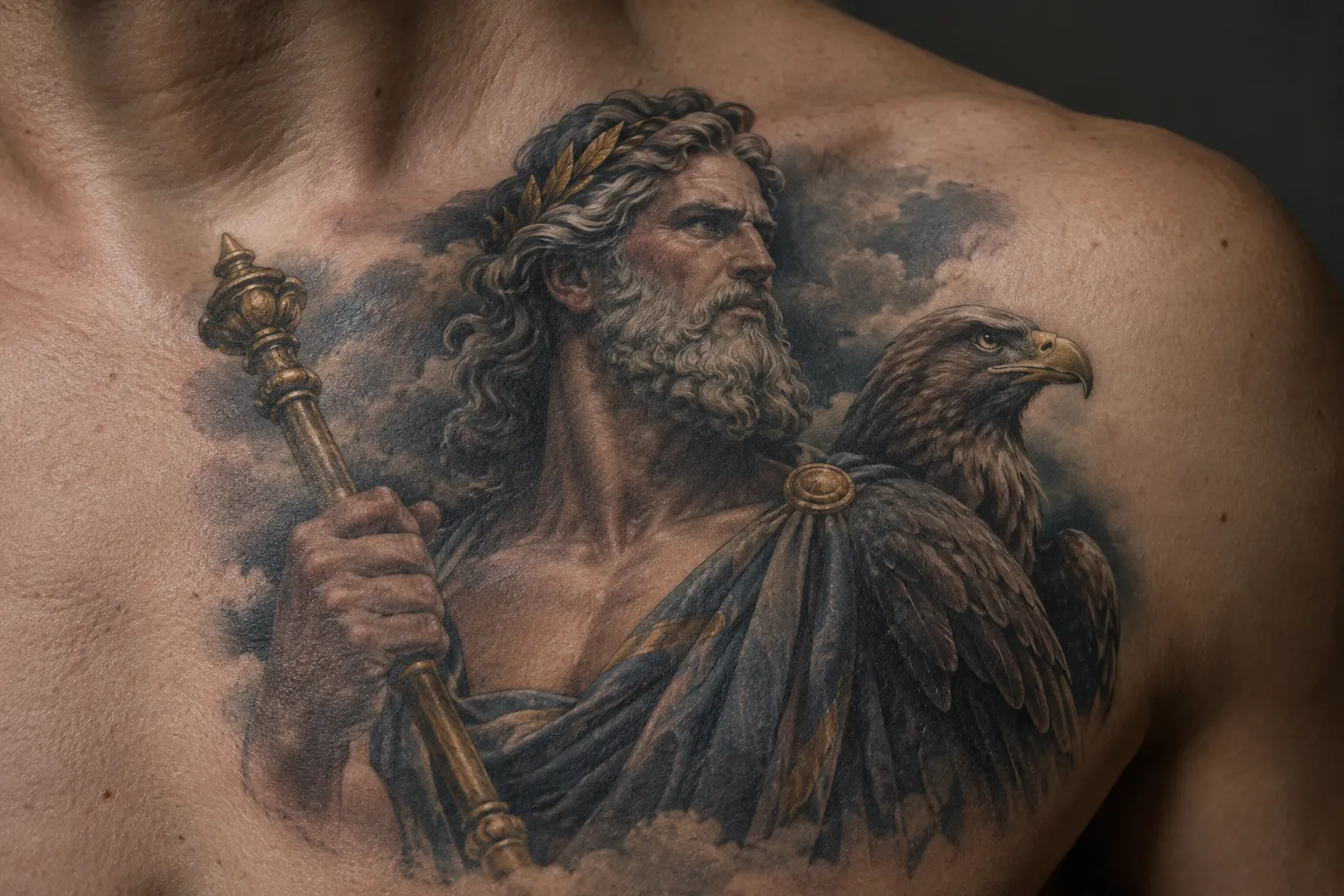
The trouble is that almost every Zeus design reaches for the same thing: lightning. Theoi’s iconography gives you a wider kit. His usual attributes are the lightning bolt, the royal sceptre, and the eagle, and he also appears with a throne, a miniature Nike (the winged goddess of victory) held in his hand, and the aigis, a goat-skin arm-guard (6). Ancient Greek artists used these props to tell viewers who they were looking at, and they still work that way in a tattoo.
Each attribute shifts the emphasis:
- Royal sceptre: kingship and rule. A long vertical element that suits an outer forearm or the side of a calf.
- Throne: settled authority rather than action. Works as the base of a seated-figure composition on a back piece or thigh.
- Miniature Nike: victory. A small winged figure in Zeus’s palm reads clearly in a portrait and is rarely seen in tattoos.
- Aigis: storm. Theoi, citing the Iliad, says the shaking of his aegis produces storm and tempest (6). A textured goat-skin wrap gives a black-and-grey artist something interesting to shade.
A recognizable Zeus needs more than one generic symbol. Lightning alone could be Thor, a band logo, or just weather. A bearded man alone could be Poseidon, Hades, or a philosopher bust. Put the beard with a sceptre and eagle, or a bolt with an eagle gripping it, and the reference becomes unambiguous. The pairing does the identifying, and that’s how ancient artists handled it too.
If you want the regal side of Zeus rather than the storm side, start your reference board with seated statues and Nike-bearing figures, not the lightning-throwing poses most Zeus designs reach for.
Zeus Lightning Tattoo Ideas: The Bolt and the Eagle
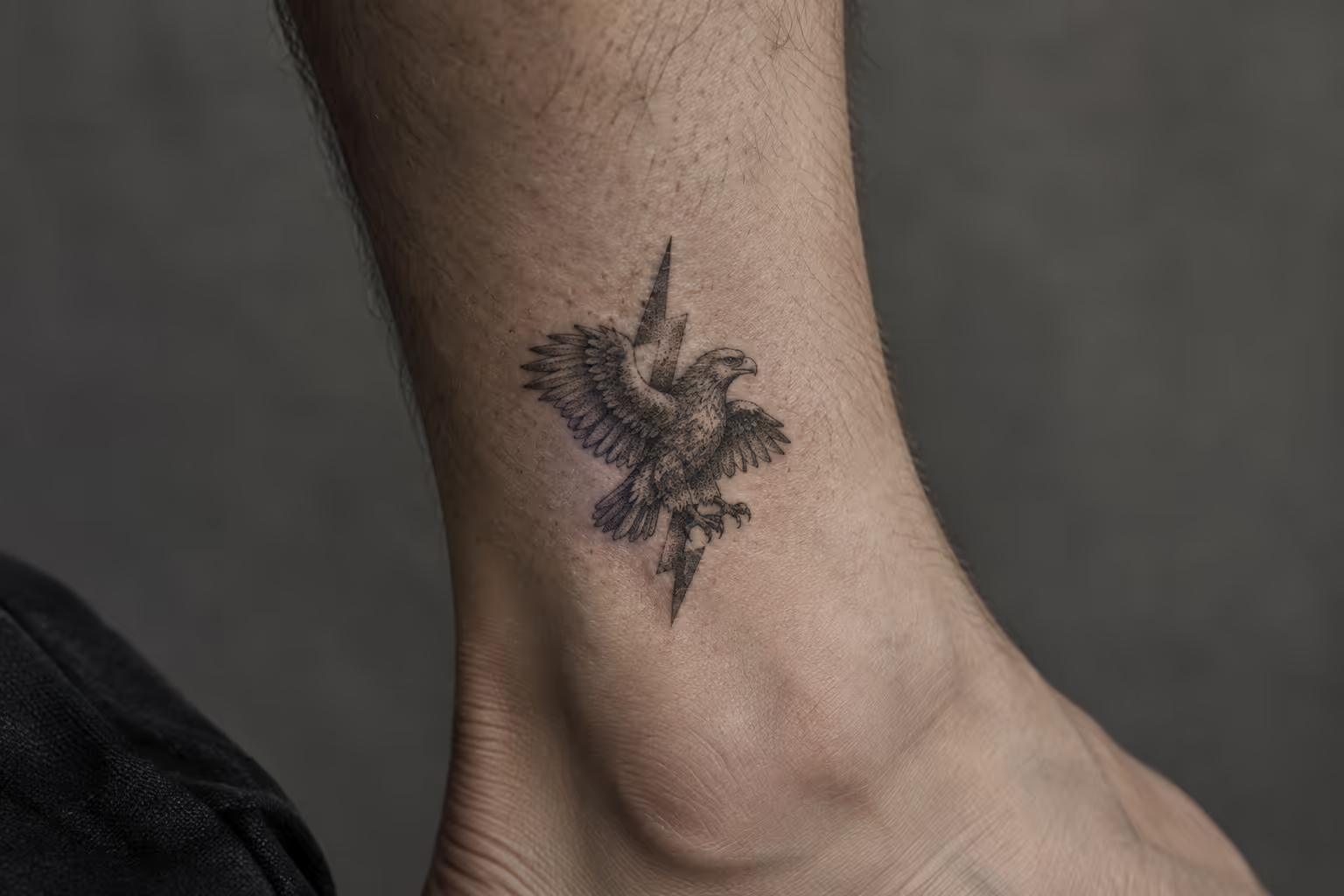
A Zeus lightning tattoo is the most compact and affordable way to reference Zeus, but a lone bolt only reads as Zeus when paired with a second cue like the eagle. The standalone thunderbolt works as a simple emblem (2). Small thunderbolt pieces run roughly $150-$300 as of November 2026 (2), which makes the bolt the cheapest entry point into the motif.
A classical bolt doesn’t look like the zigzag on a power socket. Theoi describes it as a stylized lightning bolt that Zeus wielded in his hand like a javelin, and shows examples from ancient Greek art (6). Ask your artist for the classical form if you want people who know their mythology to read it correctly.
Placements that suit a bolt or eagle on its own:
- Inner forearm: enough flat space for a vertical bolt, easy to see, moderate pain.
- Outer forearm: good for a bolt-and-eagle pairing laid out along the arm.
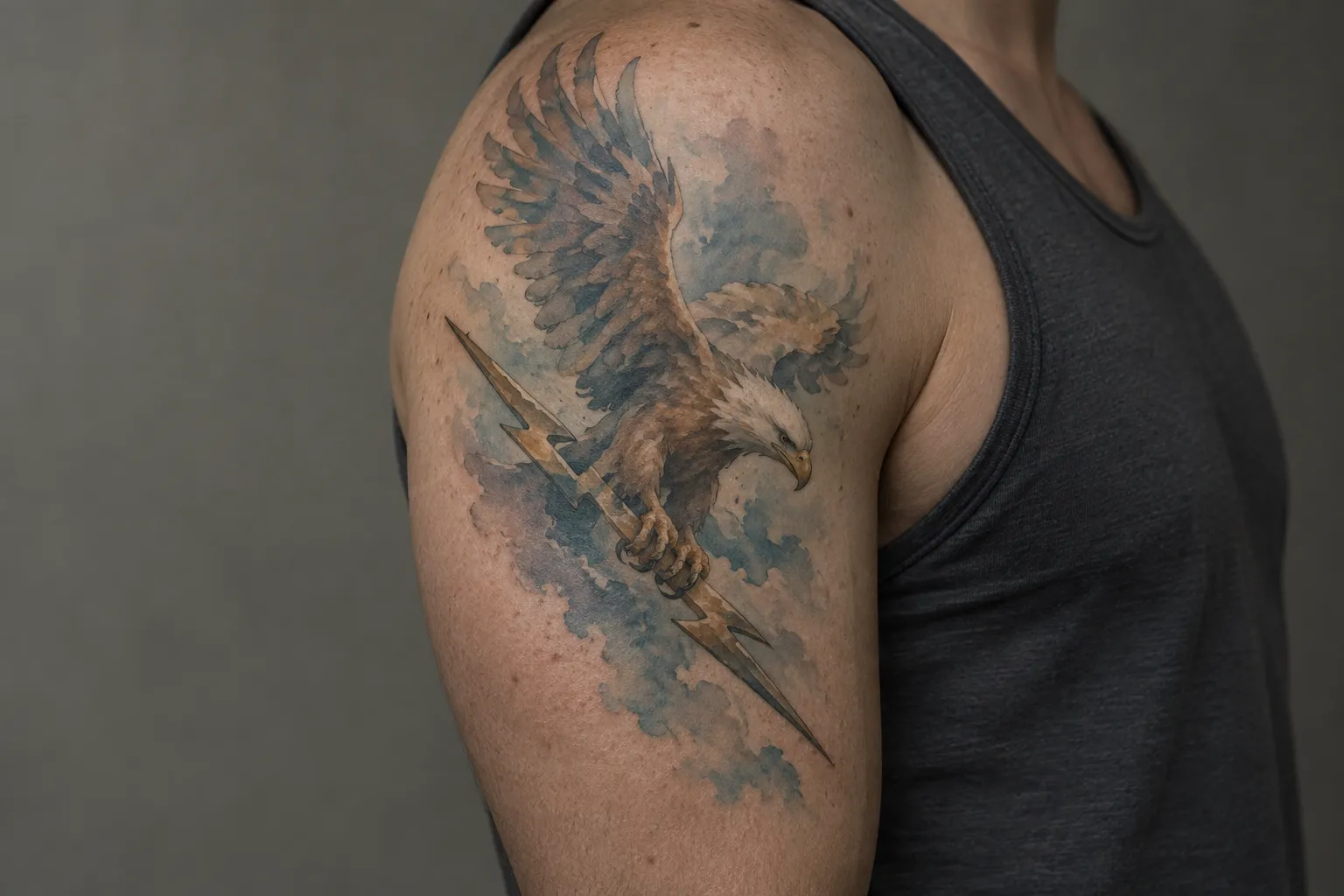
- Upper arm or back of the arm: fits a small eagle with spread wings.
- Behind the ear or side of the neck: small bolt only, with clean, open linework.
- Ankle or calf: a vertical bolt follows the leg’s line well.
Work out the stencil with your artist before anything is permanent, and trust their guidance on sizing so the details survive aging (2). Fine detail packed tightly along a small bolt tends to blur together over the years, so fewer, bolder lines hold up better than many fine ones, especially on hands and fingers.
Standalone bolt vs. full portrait: what each signals
Choosing between a bolt and a portrait means trading simplicity and cost against recognizability, not just picking a style. A bolt is fast, cheap, and fits almost anywhere. It also leaves the reference open: to a stranger it’s lightning, and only you know it means Zeus. A bearded portrait with an eagle, sceptre, or storm clouds costs more and takes more skin, but it makes the reference unambiguous (2)(6).
Ask yourself who needs to read it. If the meaning is private, a bolt does the job. If you want people to see Zeus without asking, you need the face or a combination of attributes.
The eagle as a companion motif
The eagle is sacred to Zeus, and Theoi lists it among his usual attributes alongside the bolt and sceptre (6). A Louvre red-figure amphora from the fifth century BC shows Zeus with both eagle and lightning (6), so the pairing has a long history. In design terms, an eagle gripping a thunderbolt in its talons is the most efficient Zeus emblem there is: two attributes, one compact shape, and no face to render.
The eagle also carries well in American traditional, with a heavy black outline, solid fills, and a limited palette, if you want a bolder look than black-and-grey realism. Treat the eagle as an option, not a requirement. A sceptre-and-throne composition is just as legitimate if kingship is your point.
Zeus Portrait Styles: Realism, Black-and-Grey, and Statue Busts
One Zeus design guide names Greek statue-style, realism, and black-and-grey as the dominant styles (2), and all three lean on the mature bearded face. Theoi describes the classical Zeus as a regal, mature man with a sturdy figure and a dark beard (6). That beard is your main visual shorthand. Apollo, by contrast, was depicted as a handsome, beardless youth with long hair (11), so the beard is what keeps a Zeus bust from reading as Apollo.
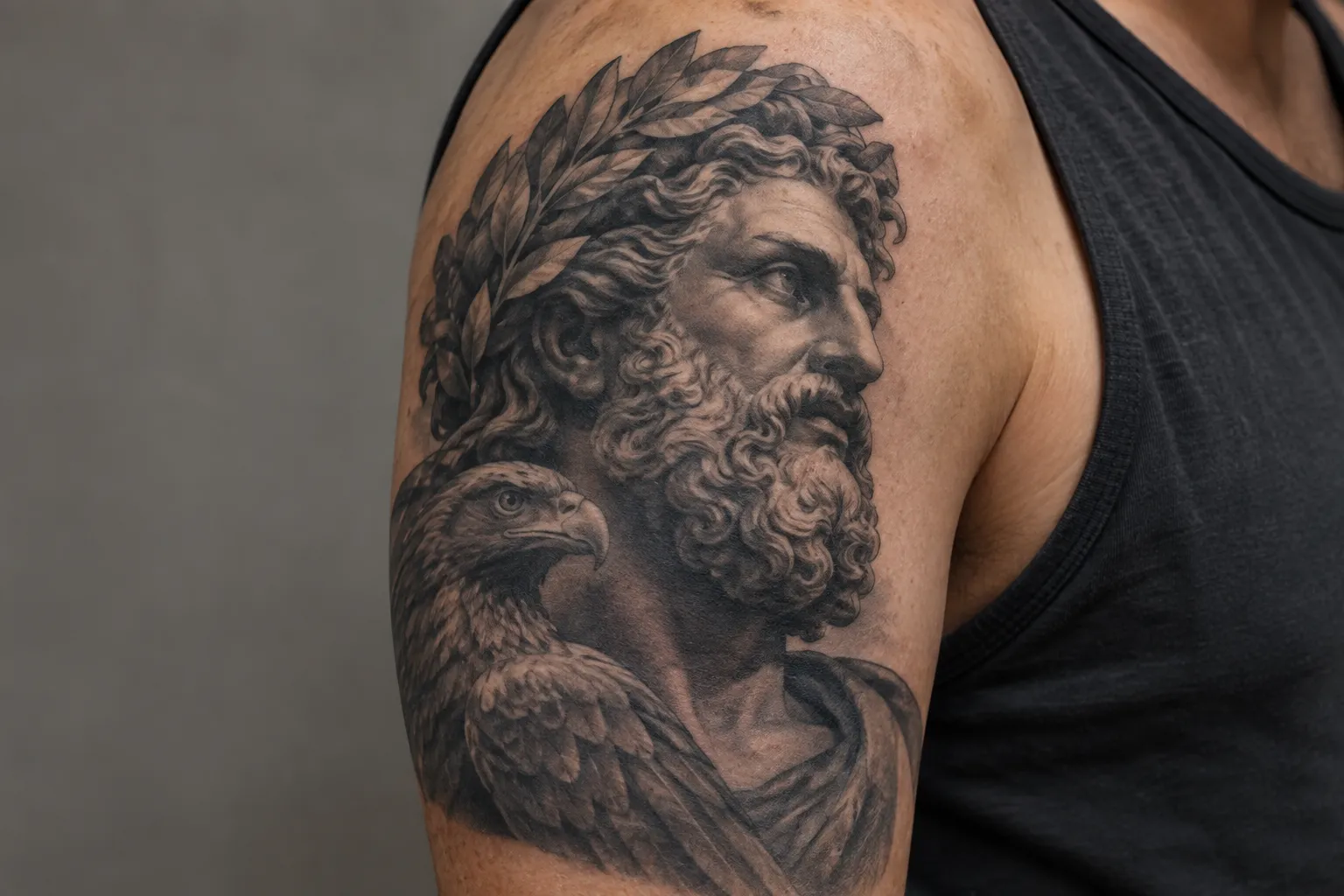
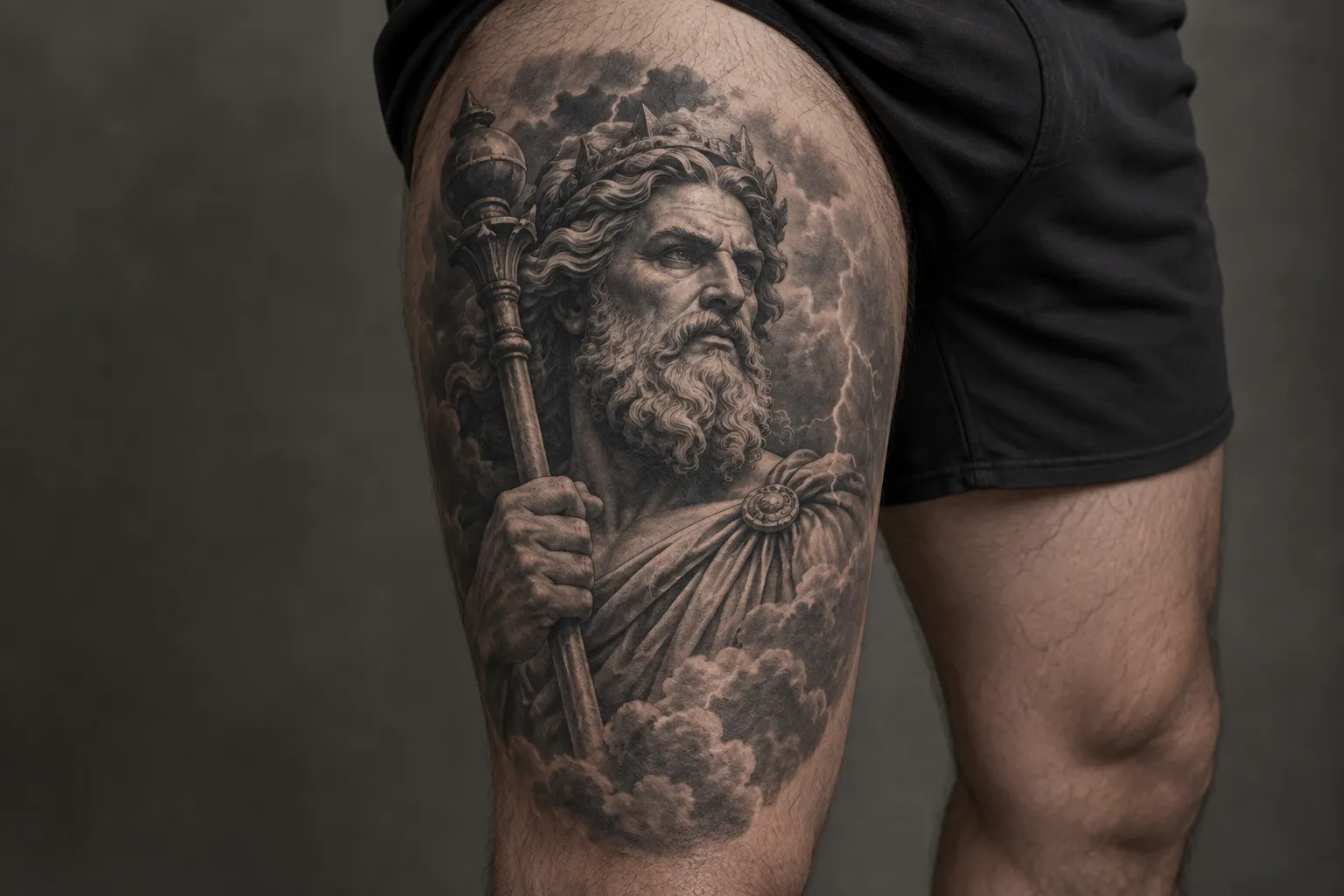
Black-and-grey statue bust. This style copies the look of carved marble: blank or carved pupils, crisp hair and beard curls, sometimes a cracked or broken edge to suggest an excavated statue. Its two technical hallmarks are a smooth grey wash gradient that mimics stone, and a deliberately limited value range, with bright skin left as highlights against deep blacks in the eye sockets and beard. The common pitfall is too much mid-grey and not enough black. A statue bust without deep shadows heals flat and muddy, and over time it reads as a grey smudge with a beard. A Greek mythology tattoo guide recommends black-and-grey realism for how it ages, and says Zeus works best as a high-contrast portrait or statue-style piece with strong highlights and deep shadows (3).
Realism. A realistic portrait renders Zeus as a living person: skin texture, wet eyes, individual beard hairs, sometimes storm light falling across the face. Its hallmarks are soft, outline-free edges built entirely from shading, and fine textural detail that rewards close viewing. The pitfall is scale. Realism depends on tiny details, and tiny details are what ink spread erases first. Pores, fine hair strands, and iris texture need room to stay separate over decades.
That’s why realism needs a larger canvas. A realistic face that fits on the inner wrist looks impressive on Instagram the day it’s done. Healed, it softens, and over the years the eyes and mouth begin to merge. A face given most of an upper arm or a large section of the thigh keeps its features distinct as the skin ages. A Greek mythology tattoo guide calls the upper arm and outer bicep the perfect canvas for realism portraits, and keeps the forearm for statue busts and symbols (3).
Add attributes deliberately. An eagle over one shoulder, a sceptre crossing the frame, or lightning in the background behind the bust clearly identify the face as Zeus. Each also adds rendering time, which pushes you toward the larger price tiers. If you’re on a budget, a strong bust with one well-placed bolt beats a crowded composition that has to shrink every element to fit.
Pick an artist whose healed portfolio shows portraits, not fresh ones. Fresh black-and-grey always looks crisp, while healed photos at a year or more show you whether their contrast lasts.
Placement and Size: Matching the Canvas to Your Budget
Budget and available canvas should pick your Zeus design: a minimal bolt suits a small, affordable spot, while a full myth scene needs the back, chest, or thigh and a much larger budget. A Greek mythology tattoo guide lists the upper arm, forearm, chest, back, and thigh as the best placements for Greek god portraits (3). One Zeus design guide names the back, chest, and thigh as the best canvases for large work (2).
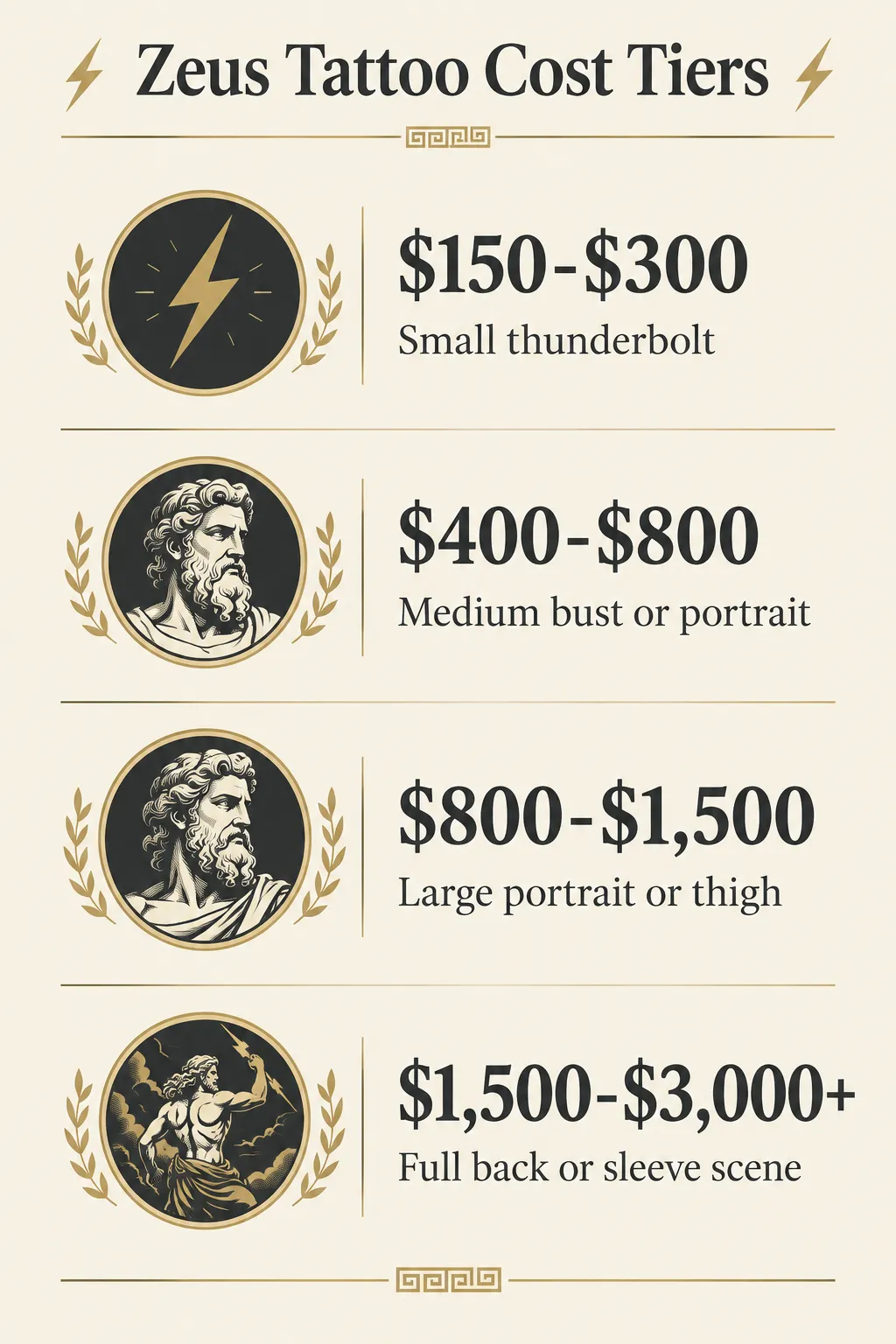 Zeus tattoo costs range from $150-$300 for a small thunderbolt to $1,500-$3,000+ for a full back or sleeve myth scene, with medium and large portraits between those tiers.
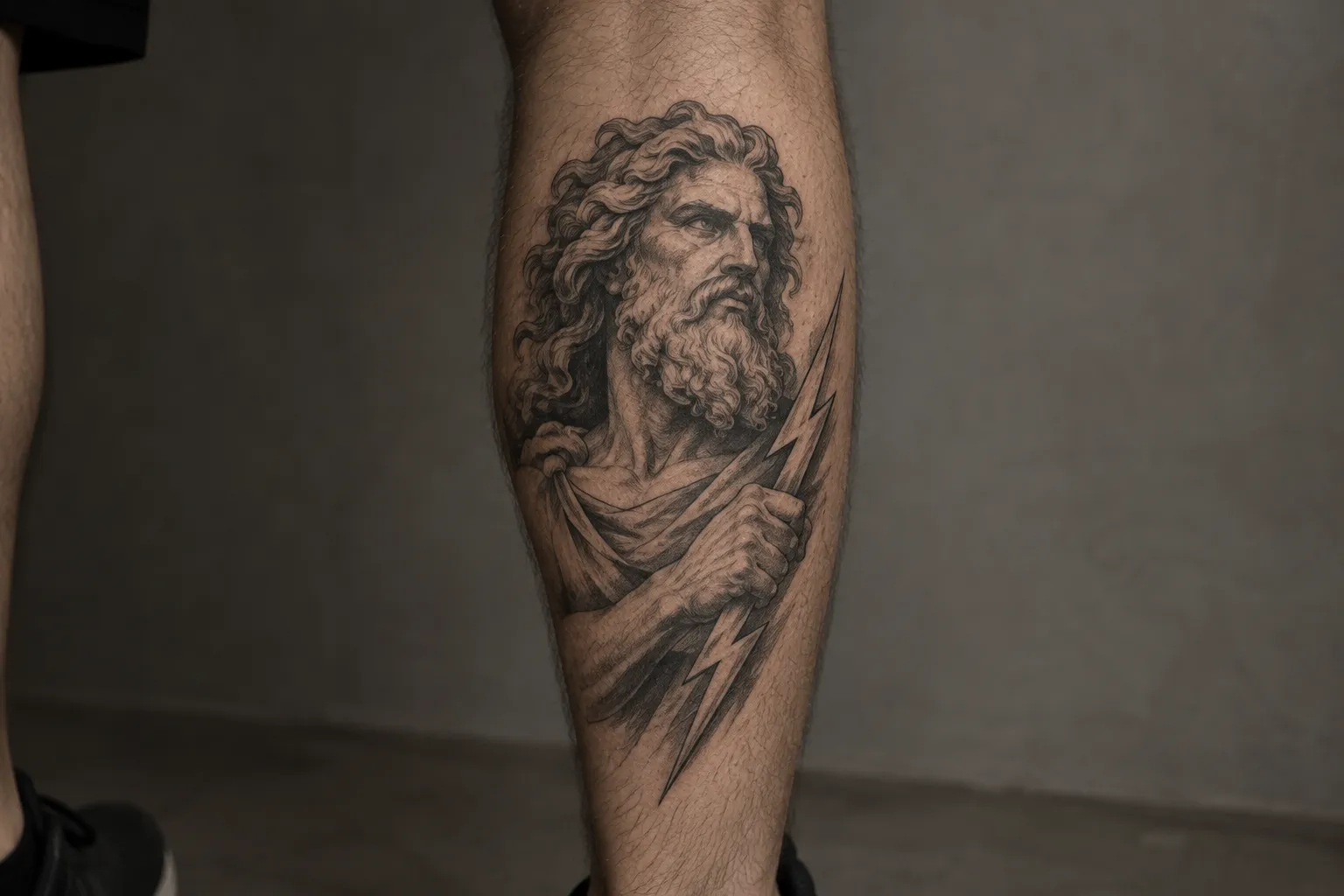
Your decision rule: small canvas, simple symbol; large canvas, detailed scene. Every step up in detail needs a step up in skin area, and the price climbs with both.
How the main placements compare:
- Inner or outer forearm: a bolt, an eagle-and-bolt emblem, or a black-and-grey bust large enough to cover the outer forearm. Lower pain than the torso. Highly visible, and it needs sunscreen often.
- Upper arm: the canvas one Greek mythology guide calls perfect for realism portraits (3). The rounded surface wraps well around a face in three-quarter view.
- Chest: room for a portrait centered on the sternum, or a two-panel design with Zeus on one pec. The sternum hurts more than the pecs.
- Thigh: a large, flat area that suits a realistic portrait with storm elements. It’s easy to cover and stays out of the sun.
- Back: the only placement that comfortably holds a multi-figure myth scene, such as the Titanomachy or Zeus enthroned with eagle and Nike.
On pain, one Zeus design guide rates ribs and sternum as the most painful spots (2), which matches the tattoo pain scale: ribs and sternum sit near the top, the upper back away from the spine is moderate, and the outer upper arm, outer forearm, and outer thigh are among the least painful placements. Long realism sessions over the ribs are hard to sit through, which affects how many sessions you’ll need and how the work comes out.
What each price tier buys
These ranges come from one Zeus design guide published in September 2026, and were still listed as of November 2026 (2). Treat them as a starting point. Your local shop rates, artist experience, and the number of sessions will move them.
- Small or minimal thunderbolt, around $150-$300 (2). Forearm, ankle, behind the ear, or upper arm. Low detail, clean linework. Recognizable as Zeus only if you pair the bolt with an eagle or use the classical bolt form.
- Medium statue bust or portrait, around $400-$800 (2). Upper arm, shoulder, or outer forearm. Moderate detail: beard, facial structure, maybe one attribute. Clearly reads as a Greek god, and as Zeus when the bolt or eagle is included.
- Large realistic portrait or thigh piece, around $800-$1,500 (2). Thigh, chest, or a large section of the upper arm. High detail: skin texture, storm light, multiple attributes. Unmistakably Zeus.
- Full back or sleeve myth scene, around $1,500-$3,000+ (2). Full back or a full sleeve. Narrative detail across several figures and elements. Fully identifiable, and it can tell a specific episode from the myths.
The jump between tiers comes from time in the chair. A bolt is one short session. A back scene is many sessions spread over months, with healing time between each. Budget for the full piece before you start the outline. An abandoned half-shaded back panel costs more to fix than to finish.
Safety, Healing, and Long-Term Care
Every tattoo breaks the skin barrier. FDA has received reports of infections from contaminated inks and of allergic reactions to the inks themselves (7), and contaminated inks have caused infections even when the tattoo artist followed hygienic procedures (9). That point is the one people skip. A spotless shop with autoclaves and gloves lowers the risk from equipment, but it can’t fully protect you from ink that was contaminated before it reached the studio. FDA notes that even unopened, sealed inks have been found to harbor bacteria and other microorganisms (7).
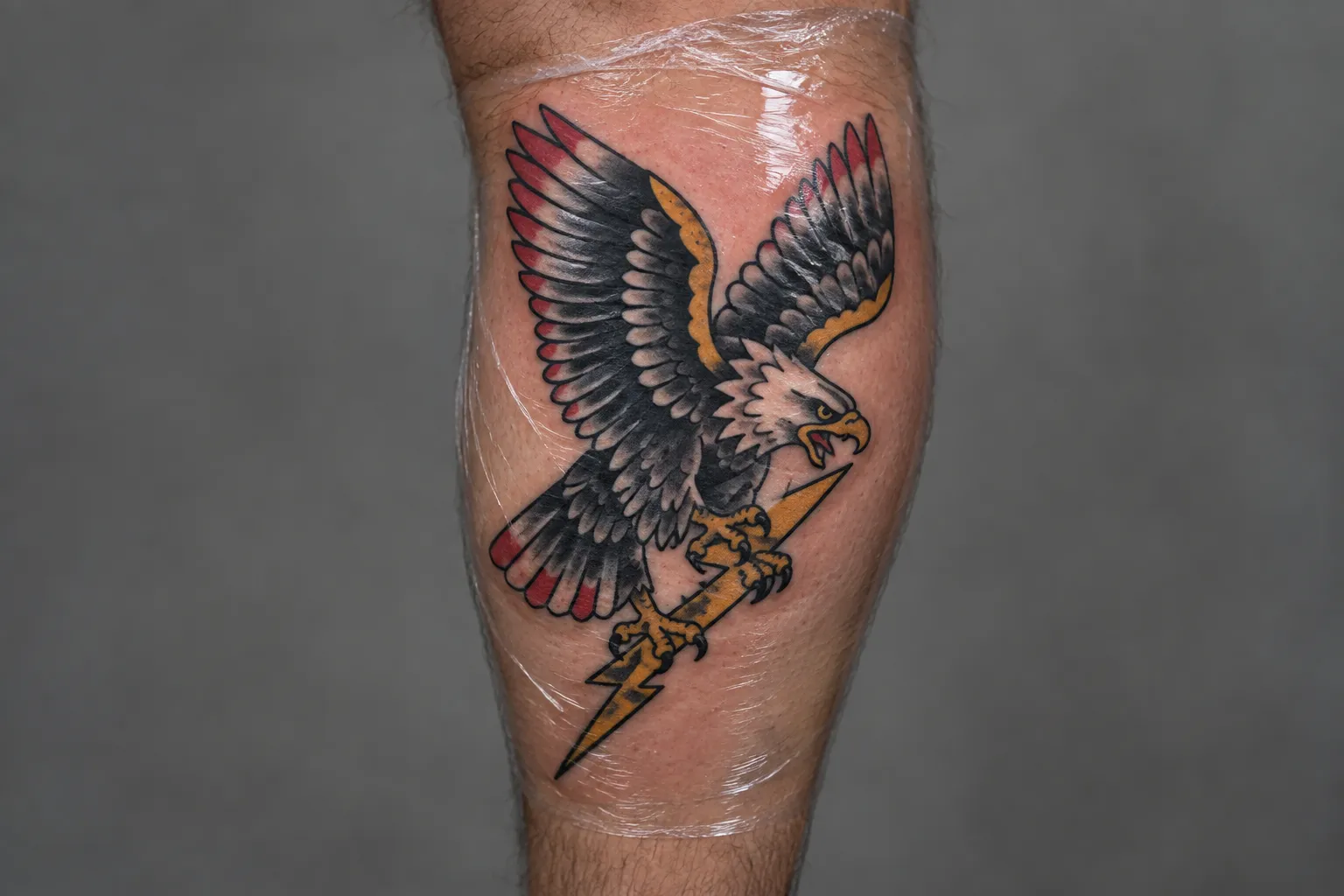
Before you book: hygiene and ink questions
Ask the studio questions they should be glad to answer:
- Are needles single-use, opened in front of you?
- What ink brands do they use, and do they pour fresh caps for each client rather than reusing ink?
- Is the studio licensed or inspected by your state or local health authority?
FDA points out that unsterile equipment can transmit infectious disease such as hepatitis, and that no color additives are approved specifically for tattoo use (9). State and local authorities oversee the practice of tattooing (7), and FDA points you to your state or local health department for tattoo safety information (10).
Healing week by week
Healing follows the standard tattoo aftercare timeline for most clean, well-cared-for pieces. Larger black-and-grey work heals slower than a small bolt because there’s more traumatized skin.
- Day 1-3: The tattoo weeps plasma and excess ink, and it feels warm and tender like a sunburn. Keep the first wrap on as long as your artist says, then wash gently with clean hands and a mild, fragrance-free soap, and pat dry. Large pieces on the thigh or back can make sleeping uncomfortable, so plan for loose bedding and clean sheets.
- Day 4-7: The surface tightens and starts to flake. Switch to a thin layer of fragrance-free lotion; when tattooed skin feels dry, AAD suggests a water-based lotion or cream (8). Don’t scratch or peel, because pulling flakes early can lift ink from shaded areas, which shows up as patchy grey in a portrait.
- Week 2: Peeling and itching peak. Keep moisturizing lightly and let the flakes come off on their own.
- Week 3-4: The surface looks healed, but it can still have a cloudy, milky sheen while the deeper layers settle; full integration takes about six weeks. Stay out of pools, baths, and the sea until about week 3, and keep the piece out of direct sun for the first 4-6 weeks, under loose, sun-protective clothing rather than sunscreen.
Know the warning signs. If a new tattoo develops a rash, redness, or bumps, or just doesn’t seem to be healing, FDA advises contacting both your tattooist and a health professional (7). FDA stresses this especially if you develop a fever (7). Don’t wait it out to see what happens. Your tattooist can tell you whether something looks normal for that stage, and your doctor can treat an infection or reaction before it damages the design.
Protecting color and detail long-term
UV light can fade tattoo inks (8), which matters most for the fine grey gradients of a realism portrait. Once the tattoo has healed, follow AAD’s sun advice for tattooed skin: a broad-spectrum, water-resistant sunscreen of SPF 30 or higher, applied 15 minutes before you go outside and reapplied at least every 2 hours (8). AAD also advises staying out of tanning beds and away from sunlamps, which fade ink as well (8).
Placement affects how much work this is. A forearm Zeus sees sun every time you wear short sleeves. A thigh or back piece rarely does. If you live somewhere sunny and want a detailed realism portrait, that’s a real argument for the thigh over the forearm.
Design Mistakes That Undercut the Symbolism
The most common Zeus tattoo mistake is forcing too much detail into too little skin, and close behind are overstated meanings and lightning-only defaults. Each of these is easy to avoid at the planning stage and hard to fix afterward.
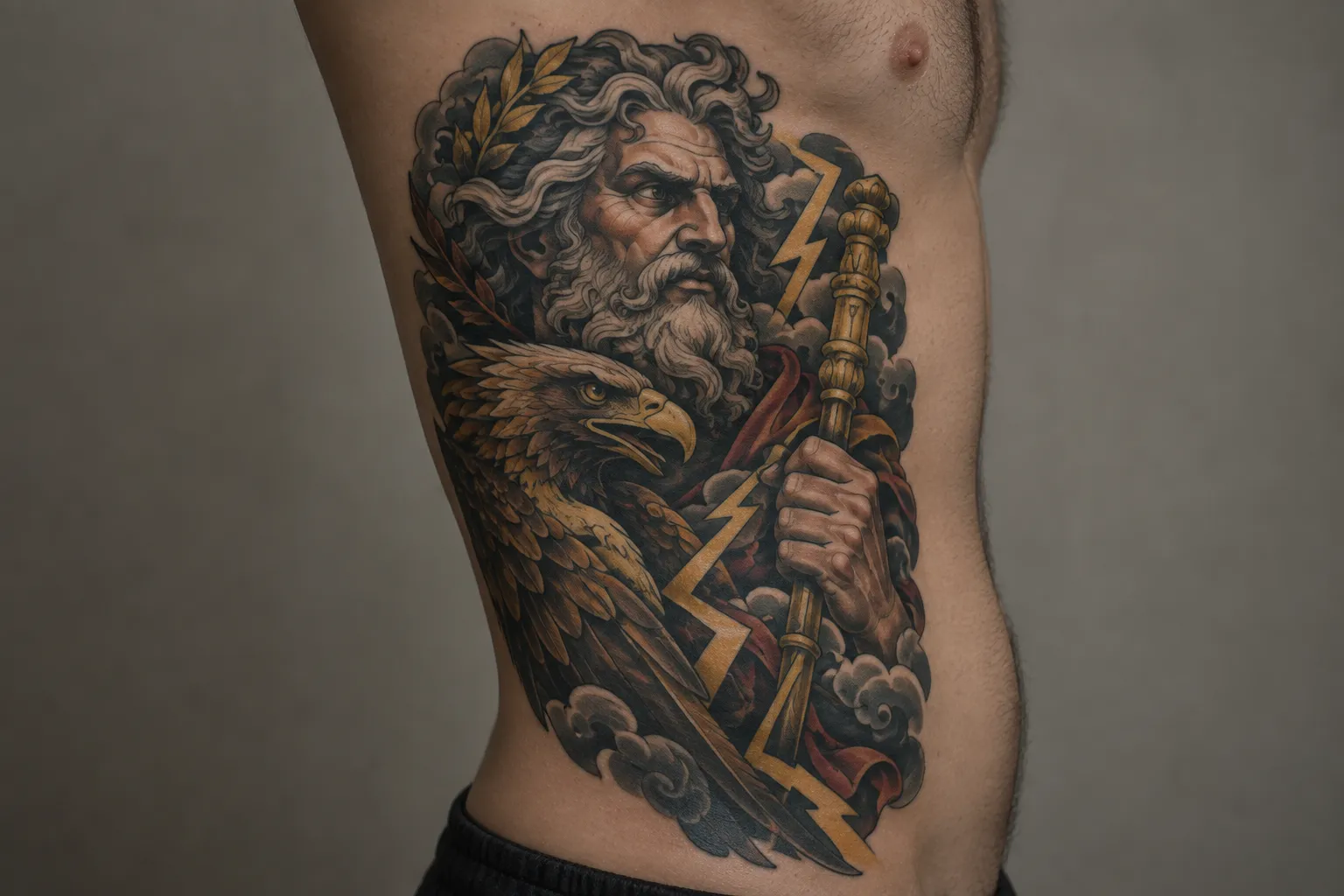
Cramming a portrait or scene into a small spot. A multi-figure myth scene squeezed onto the forearm loses the detail that makes the figures legible. Larger canvases belong to full scenes for that reason. Beard curls, eyes, and eagle feathers are the first details to blur. If your budget only covers a small spot, choose a design that fits that spot, like a bolt or an eagle-and-bolt emblem, rather than a miniature version of a big idea.
Presenting modern meanings as ancient symbolism. “Zeus means personal transformation” isn’t something the Greek sources say. Theoi’s summary of them supports rulership, protection, weather, and justice (6). Design guides add readings like “personal revolution” (2), and leadership-as-self-improvement and transformation are modern layers on top. Your personal reading is valid. Just don’t explain your tattoo as an ancient fact if it’s your own interpretation.
Skipping the stencil preview. Ask for a stencil with the bolt, eagle, and face arranged for your body area before the needle starts. A design that looks balanced on paper can twist on a curved forearm, or put Zeus’s face across the inner elbow where it will distort when you bend your arm. Placement determines whether a portrait or a narrative composition fits at all.
Defaulting to lightning when another attribute fits better. If your message is victory, a miniature Nike in Zeus’s hand says it directly (6). For settled authority, use the sceptre and throne. For storm power without the bolt, the aigis is the classical image: Theoi notes that shaking it produces storm and tempest (6). Lightning is the most popular attribute, which also makes it the least distinctive.
Choosing an artist from fresh photos. Black-and-grey realism looks its best on the day it’s finished. Ask to see healed portraits at a year or more, specifically bearded faces, before you book.
Frequently Asked Questions
- Are Zeus tattoos suitable for all skin tones?
- Zeus motifs can be designed for any skin tone, but contrast needs to suit the wearer; review healed examples on skin similar to yours before choosing soft grey shading.
- Should I choose a lightning bolt or a full portrait?
- Choose a bolt when you want a compact, personal reference; choose a portrait when recognizability matters and you can give facial detail enough room.
- How can I make a Zeus tattoo read as Greek rather than Roman?
- Work from Greek references such as Athenian vase paintings and Greek attributes like the thunderbolt, eagle, and sceptre; the Romans identified their own god Jupiter with Zeus, so Roman statuary shows Jupiter and frames the design as Roman.
- What should I check in an artist's healed portfolio for a Zeus portrait?
- Look for healed beards, eyes, and shadow transitions that remain separated; fresh photographs cannot show whether close facial detail has settled into a muddy area.
- Can an eagle tattoo represent Zeus without a portrait?
- An eagle alone can suggest Zeus through classical association, but pairing it with a thunderbolt or sceptre makes the mythological reference clearer to viewers.
Choosing Your Zeus Design Before the Consultation
Let your budget and the skin you’re willing to give it decide the design. A bolt or eagle-and-bolt emblem fits a forearm or ankle and the smallest budget. A black-and-grey statue bust needs an upper arm, shoulder, or outer forearm. A full myth scene needs the back, chest, or thigh, plus months of sessions. Treat the sceptre, throne, Nike, and aigis as real options, not obscure extras, especially if your message is rulership or victory, or storm power without the obvious bolt.
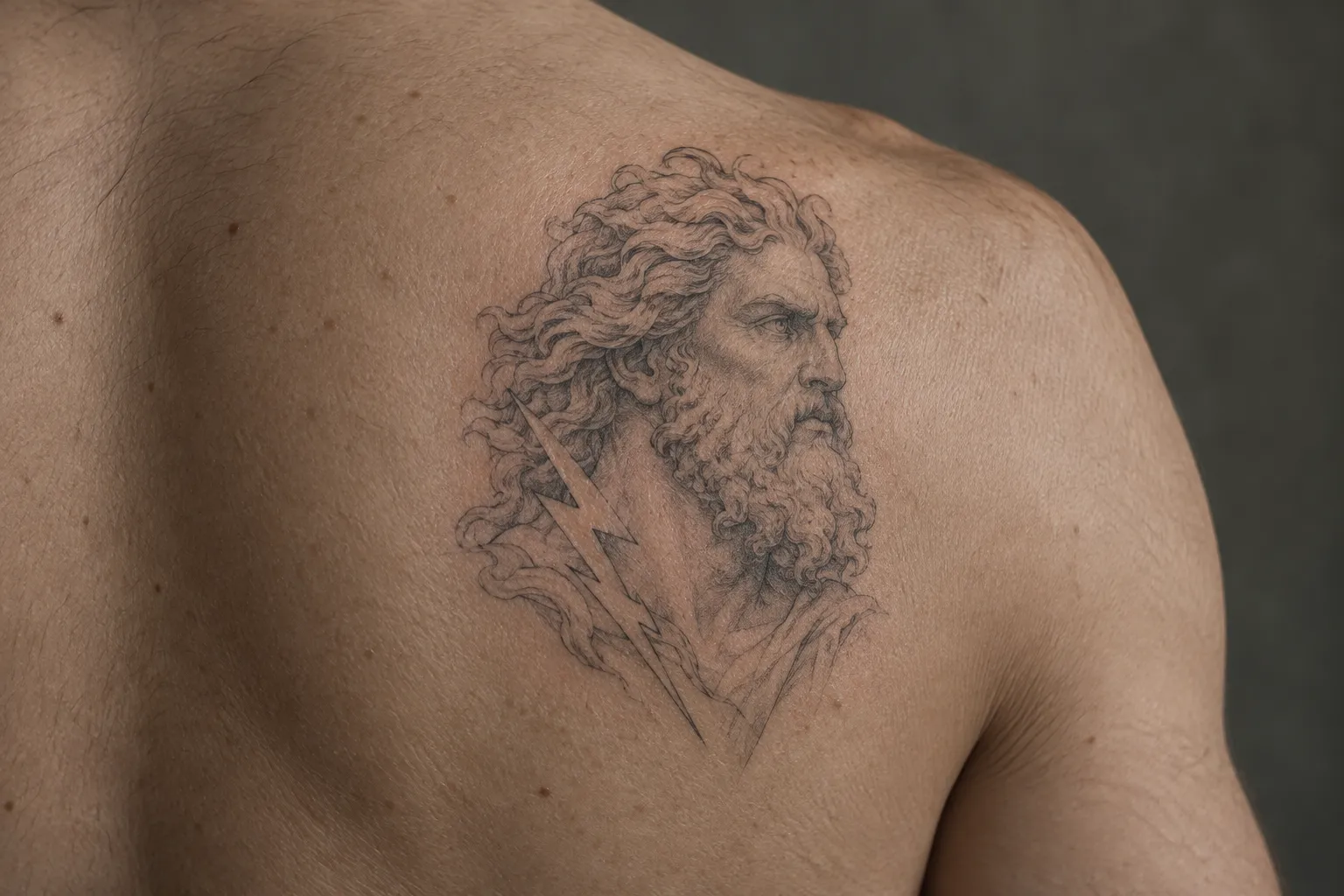
Bring three reference images and your preferred placement to the consultation, ask for a stencil preview on your body, and check the artist’s healed portraits. After the session, keep the piece clean through days 1-3, moisturize lightly with a fragrance-free lotion through the flaking and peeling of weeks 1-2, keep it out of pools and the sea until about week 3 and out of direct sun for 4-6 weeks, and contact your tattooist and a health professional if a rash, redness, or bumps appear. Once healed, apply SPF 30 or higher 15 minutes before going out and reapply at least every 2 hours, so the beard, the eagle feathers, and the bolt’s flames stay distinct for decades.