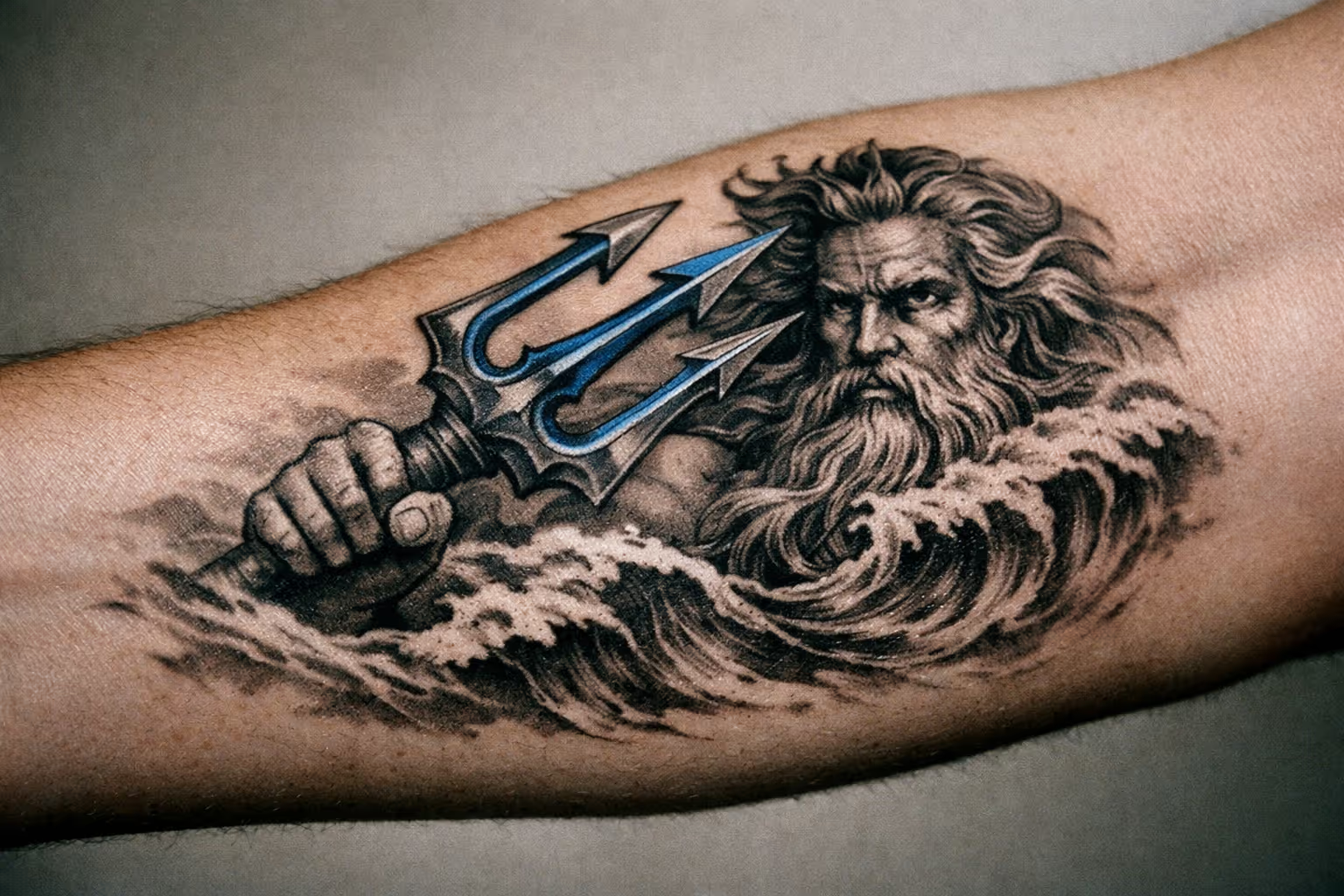
A bare trident on the wrist looks clean in the flash sheet and merges into one blurry prong within five years - the most common poseidon tattoo mistake is a mismatch between how detailed the design is and how much room the placement gives it. A simple trident wants a small spot; a full figure of the god commanding a storm wants a forearm or a back. Match the two and it lasts. Here’s how to pair Poseidon designs to placement, size, and price.
What a Poseidon Tattoo Actually Means
Poseidon is one of the twelve Olympian gods - brother to Zeus and Hades - and the source material describes him as god of the sea, earthquakes, and horses (1). That spread of domains is why the tattoo carries more than “I like the ocean.”
The symbolic readings that come up consistently across references are (6):
- Power and authority - the trident as command over chaos
- Protection for seafarers - historically an amulet for anyone tied to the water
- Balance between calm and chaos - the sea’s two faces in one image
- Connection to nature - earthquakes and tides, forces bigger than you
- Rebellion and independence - Poseidon was famously volatile, not a team player
One thing worth flagging: this is Greek mythology, not a modern Western invention, and the meaning hasn’t shifted much in the last decade. The changes are in how people execute the design, not what it stands for.
The Trident as a Symbol of Power
In a trident poseidon tattoo, the spear does the heavy lifting. It’s the fastest visual anchor - strip away the beard, the waves, the chariot, and a trident alone still reads as Poseidon (1).
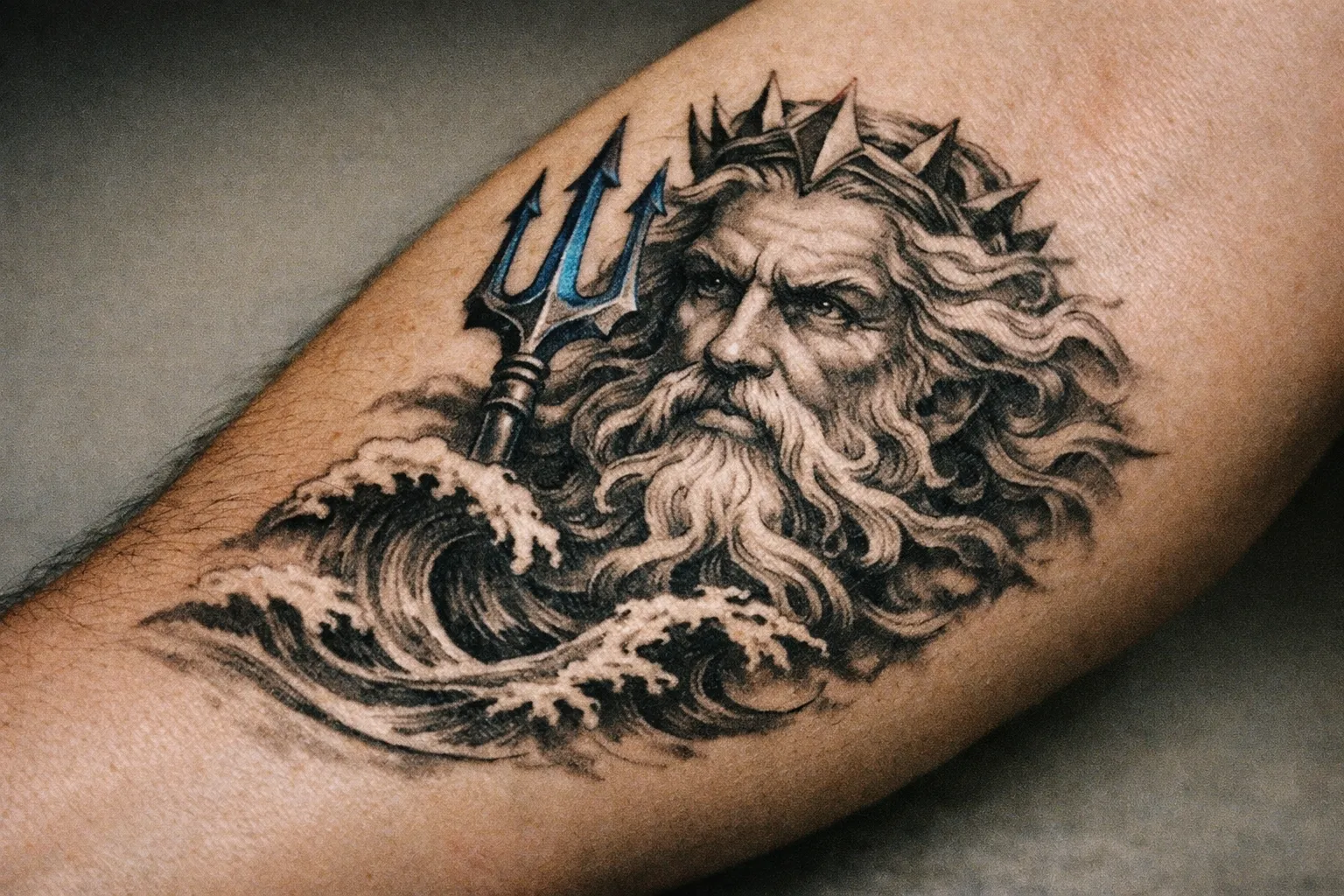
That makes it the smart minimalist choice. A clean trident outline works at 2-3 inches on the inner forearm or the back of the calf, and it holds up because there’s almost nothing to blur. If you want the theme without committing to a portrait, this is the route.
A few ways to build on it without losing legibility:
- Trident wrapped in a single wave - ocean identity, still compact enough for a 4-5 inch forearm piece
- Trident with subtle lightning to nod at brother Zeus
- Trident over a split calm/storm background if you have room for shading
A word on placement: a bare trident on the wrist ages worse than you’d expect. Thin parallel prongs sit close together, and over years the lines spread and start to merge. Give them space - forearm or calf over wrist if the design is line-heavy.
I’ve seen this go wrong more than once. A client comes in with a tight three-prong reference they want on the wrist, and five years later those prongs look like one blurry shape. The design itself was fine. The placement wasn’t.
Horses and Waves in Design
Ancient myth credits Poseidon with creating horses, and he carried the epithet “Earth-Shaker.” That’s why equine imagery belongs in these designs at all - it’s not a random aesthetic add. Horses charging through breaking waves give you freedom and ferocity in the same frame.
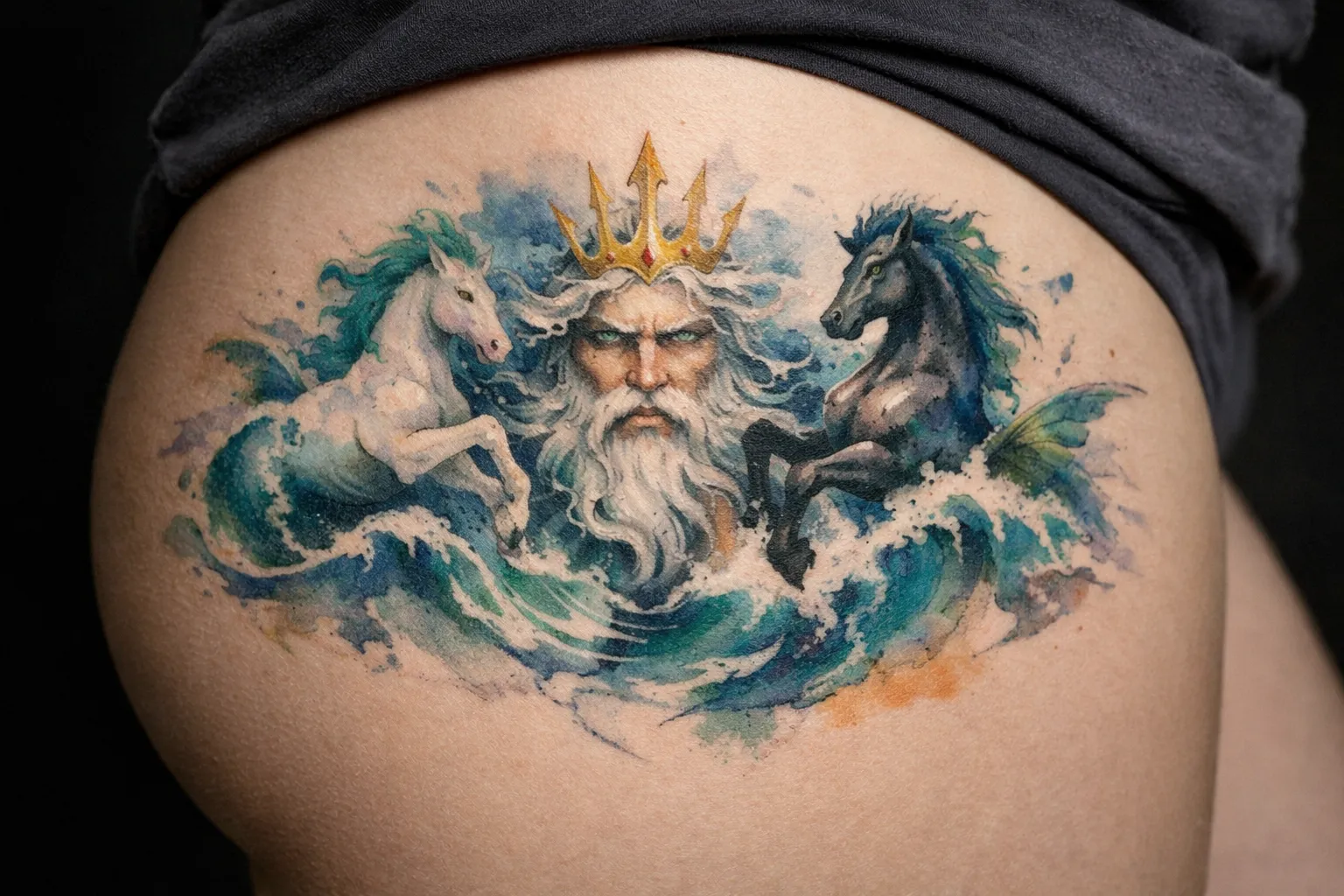
This is a larger-format idea. Horses and crashing surf need room to breathe. Cram them onto a small bicep patch and the manes and foam read as visual noise. Plan for a half-sleeve or thigh minimum if galloping horses are part of the composition.
You don’t have to chase strict mythological accuracy. Dolphins beside a chariot, hippocamps (the horse-fish hybrids from the myth), or simpler wave motifs all sit comfortably in the same world. Pick the elements that mean something to you rather than copying a reference whole.
Style Breakdown: Realism vs. Blackwork vs. Minimal
The biggest decision in any Poseidon design isn’t the elements - it’s the style, because style determines how it ages.
Black-and-grey realism with dotwork is the most visible current trend, beating out bright traditional color (5). A realism portrait captures every crease in the weathered face, the beard texture, the wild hair. The two technical hallmarks of good realism here are controlled contrast (the design reads at arm’s length) and layered shading that doesn’t go fully solid. One studio design leans on dotted detail rather than heavy fill precisely so the texture stays clean as it heals (5). The common pitfall: artists pack too much micro-detail into too little skin, and the face turns to mush within a few years.
Illustrative blackwork abstracts the god into sharp lines and shapes. It’s not chasing a likeness - it distills Poseidon to essence. The upside is aging: bold blackwork holds its edges far longer than saturated color in high-friction placements.
Minimal / fine-line strips it down to a trident, a single wave, or a clean profile. Best at 3-4 inches somewhere flat - forearm, outer calf, shoulder blade. Fine line on the ribs or hands is a bad bet. Those spots flex and rub, and thin lines blow out or fade fastest there.
If you want the design to survive future touch-ups gracefully, integrate the trident with waves rather than relying on a hyper-realistic face - simplified linework is easier to refresh down the line.
Sizing and Placement: Where Each Version Works
Match the design’s complexity to the canvas. The fastest way to ruin a Poseidon piece is choosing a portrait-level concept for a placement that can’t hold it (5).
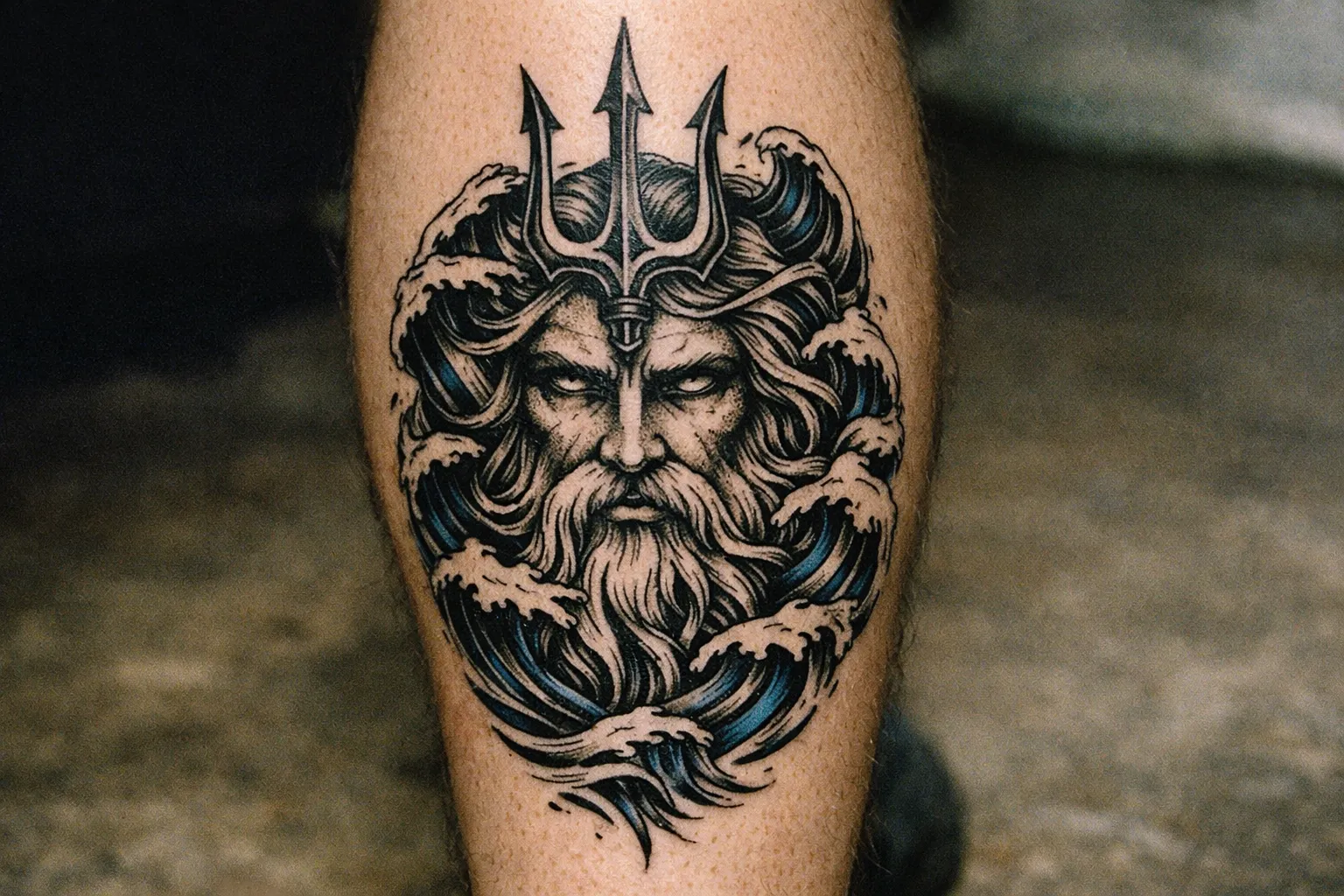
- Small (2-4 in): trident-only, minimal wave-and-trident icon. Inner forearm, calf, shoulder.
- Medium (5-8 in): black-and-grey bust - beard, hair, ocean elements. Outer forearm, upper arm, thigh.
- Large (10+ in): full deity figure with waves, lightning, or sea creatures. Chest, back, full sleeve. One featured concept uses a deliberately symmetrical chest layout to frame the god (1).
On pain: expect ribs and sternum > forearm and outer thigh. A chest centerpiece looks commanding, but the breastbone is one of the rougher sits - especially across a long shading session. If it’s your first big piece, an outer forearm or thigh placement is far more forgiving.
I generally steer first-timers away from the sternum for a piece this size. Not because it can’t be done, but because you want to know how you handle a long session before you’re four hours into bone-adjacent shading.
Building a Full Sleeve Around the Sea God
A sleeve is where the mythology gets room to stretch. You can run calm seas into turbulent waters, set the trident as the centerpiece, and scatter sea creatures or other Olympian references through the negative space (6).
This is the most compositionally complex route and almost always needs multiple sessions. Collaboration matters more here than on any small piece - the artist has to flow water symbols around the bicep curve and keep horses or waves from getting cramped at the elbow joint, where skin folds.
A workable approach: build the whole sleeve around the trident as the single anchor, then layer waves, lightning, and marine life outward so contrast stays manageable. The most common sleeve mistake is overloading. Waves plus lightning plus sea animals plus columns flattens the contrast, and in black-and-grey, contrast is your only tool(6). Pick three elements, not seven.
Greek God Poseidon Tattoo: Adding Other Mythological Elements
A Greek god poseidon tattoo doesn’t have to stand alone. The Olympian family gives you a built-in cast:
- Zeus with lightning bolts to nod at the brother who rules the sky
- Hades beneath the surface, hinting at the darker third of the trio
- Medusa, whose myth ties back to Poseidon, for an added layer of story
If you go this route, choose elements for what they mean to you, not just for density. A lighthouse worked into a fierce deity scene bridges modern maritime imagery with ancient myth - guidance through the storm rather than just decoration. Just keep the master rule in mind: every element you add competes for contrast and space.
Related Interests: Other Ocean and Mythology Tattoos
If the Poseidon god tattoo is pulling you in, a few adjacent motifs scratch the same itch and pair well in a larger composition:
- Neptune tattoos - the Roman counterpart of Poseidon, sharing key sea-god attributes and trident imagery, but with somewhat different historical associations, including a stronger link to freshwater and horses, often chosen for the name or the Latin association
- Trident tattoos as a standalone symbol, stripped of the god entirely
- Ocean and wave tattoos for the nature-connection angle without a deity
- Greek mythology tattoos more broadly - Zeus, Athena, Medusa, Kraken
- Kraken and sea-creature pieces that fit naturally into a Poseidon sleeve
These work as companion pieces in a half-sleeve or as separate small tattoos if you’d rather not commit to one big mythological scene. Demand for the whole category is steady - Adobe Stock currently lists 2,009 Poseidon tattoo assets according to their public search results, so reference material is not in short supply (3).
Aftercare: How to Heal
Black-and-grey realism and dotwork live or die on clean healing, so aftercare matters as much as the artist.
- Day 1-3: keep the bandage on as long as your artist directs, then wash gently with unscented soap and apply a thin layer of fragrance-free moisturizer. No soaking.
- Week 1: expect flaking and light scabbing - do not pick. Picking pulls ink and damages the fine dotwork texture you paid for.
- Week 2-4: itching fades, the surface settles. Keep moisturizing.
Two specifics for this motif. First, stay out of the ocean and pools for 2-3 weeks - fitting irony for a sea-god tattoo, but submerging a healing tattoo raises infection risk (1). Second, once it’s healed, UV exposure fades the work over time, so use sun-protective clothing or sunscreen on the piece long-term, especially for black-and-grey where contrast is the whole point (1).
✓ Pros
- Strong symbolic meaning tied to Greek mythology and sea power
- Versatile design options from minimalist tridents to full deity portraits
- Works well in various sizes and placements, especially forearm and thigh
- Black-and-grey realism and blackwork styles age well with proper aftercare
✗ Cons
- Large, detailed designs require multiple sessions and higher cost
- Fine-line designs on high-friction areas like ribs or hands fade quickly
- Wrist placement for trident tattoos ages poorly due to line merging
- Aftercare requires strict avoidance of water and sun exposure for weeks
Before You Book: Three References to Bring
Before you sit down with an artist, narrow the concept. Most Poseidon pieces need three decision inputs locked in: style, placement, and focus - god, trident, or ocean (5).
Bring three references: a portrait Poseidon, a trident-only version, and a wave-heavy composition. Showing the range lets the artist quote time and placement accurately instead of guessing (2)(3). Digital reference shopping is easy - Etsy currently lists dedicated Poseidon tattoo design products, and Adobe Stock returns 2,009 results to pull from for a reference board, according to their respective public listings (2)(3).
Frequently Asked Questions
- What does a Poseidon tattoo mean?
- It signals power and authority, protection for those tied to the sea, and the balance between calm and chaos - the ocean's two faces in one image. The trident is the symbol that anchors all of it. All of these readings are rooted in Greek mythology and haven't shifted much in modern Western tattoo culture.
- What does a Greek trident tattoo mean?
- The trident stands for command and mastery over the sea. It's Poseidon's signature attribute and reads as authority even without the god's figure attached. A clean trident outline holds up well at 2-3 inches on the inner forearm or back of the calf.
- How big does a Poseidon tattoo need to be?
- A trident-only or minimal wave icon works at 2-4 inches on the forearm, calf, or shoulder. A black-and-grey portrait needs 5-8 inches to hold the beard and shading detail - outer forearm or thigh. Full god-and-ocean compositions belong on the chest, back, or sleeve at 10 inches or more.
- Where does a Poseidon tattoo hurt most?
- Placement drives pain more than the design. A chest or sternum centerpiece sits over bone and ranks rougher than an outer forearm or thigh piece. Ribs and sternum are consistently harder sits than the forearm or outer thigh. First-timers do better starting on the forearm.
- Does a Poseidon tattoo age well?
- Bold blackwork and well-spaced linework hold up longest. Realism with too much micro-detail in a small placement blurs over the years, and thin fine-line on the wrist, ribs, or hands fades fastest. The key is matching complexity to canvas and choosing placement accordingly.
- How should I care for my Poseidon tattoo during healing?
- Days 1-3: keep the bandage on as directed, then wash with unscented soap and apply a thin layer of fragrance-free moisturizer - no soaking. Week 1: expect flaking and light scabbing - do not pick. Weeks 2-4: keep moisturizing as the surface settles. Stay out of the ocean and pools for 2-3 weeks, and use sun-protective clothing or sunscreen on the healed piece long-term.