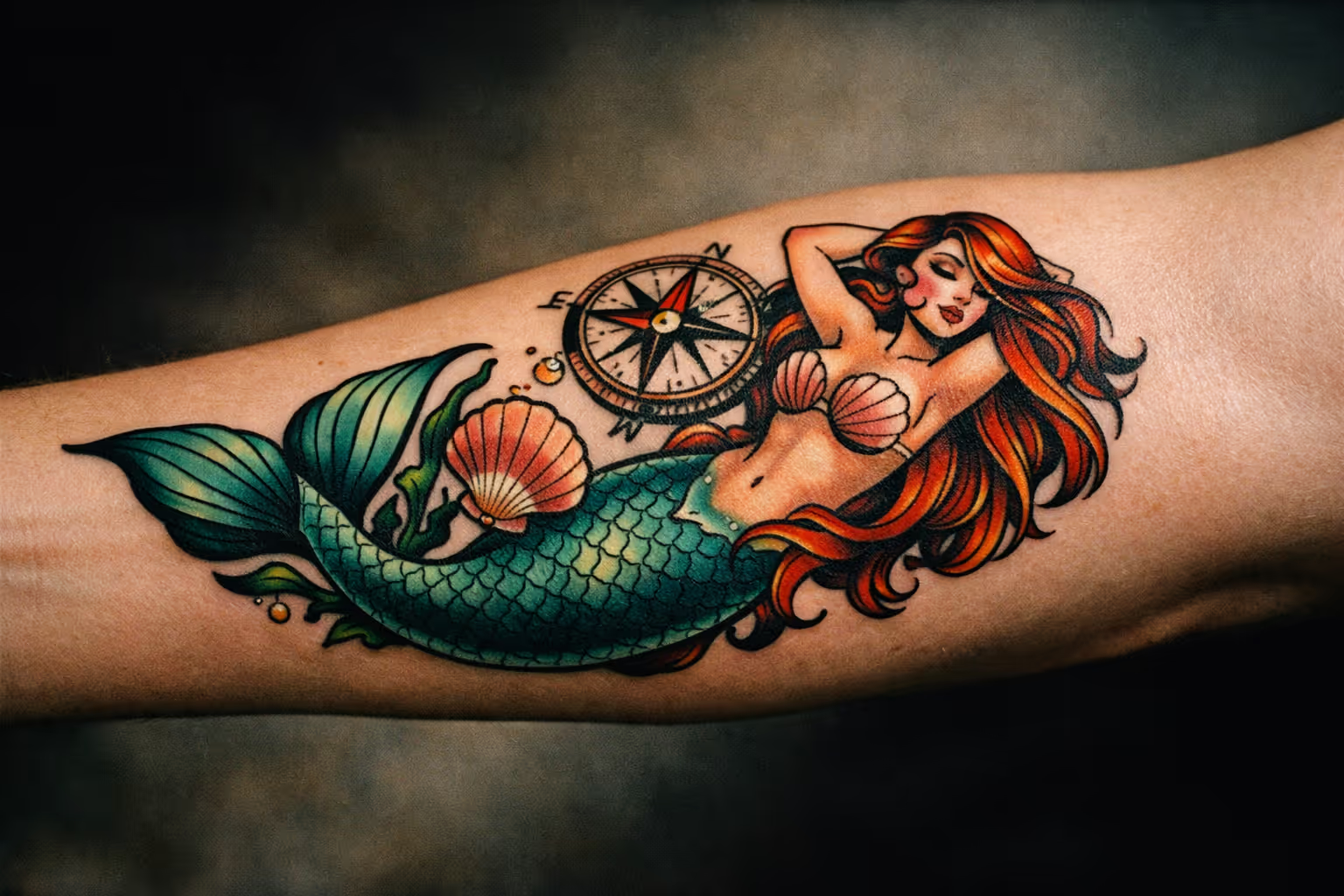
The same mermaid tattoo can say three very different things depending on who’s reading it: a sailor’s siren luring men to the rocks, a symbol of queer identity and self-acceptance, or - in some prison traditions - a marker with its own coded history. That’s a lot of range for one pretty design, and it’s worth knowing which reading yours leans into before you book. Here’s how the meaning splits, the scale pitfalls to dodge, and 2026 pricing.
Mermaid Tattoo Meaning: What the Design Actually Says
A mermaid tattoo carries more weight than the prettiness of the design suggests. It’s a hybrid figure - half human, half something else - which is why it’s been pulling double duty as a symbol of femininity, freedom, transformation, and (depending on which tradition you’re pulling from) outright danger. Whether you’re drawn to a small mermaid tattoo on the inner forearm, a full mermaid scale tattoo wrapping the calf, or a darker siren tattoo with shipwrecks and skulls, the meaning shifts hard depending on the details you commit to.
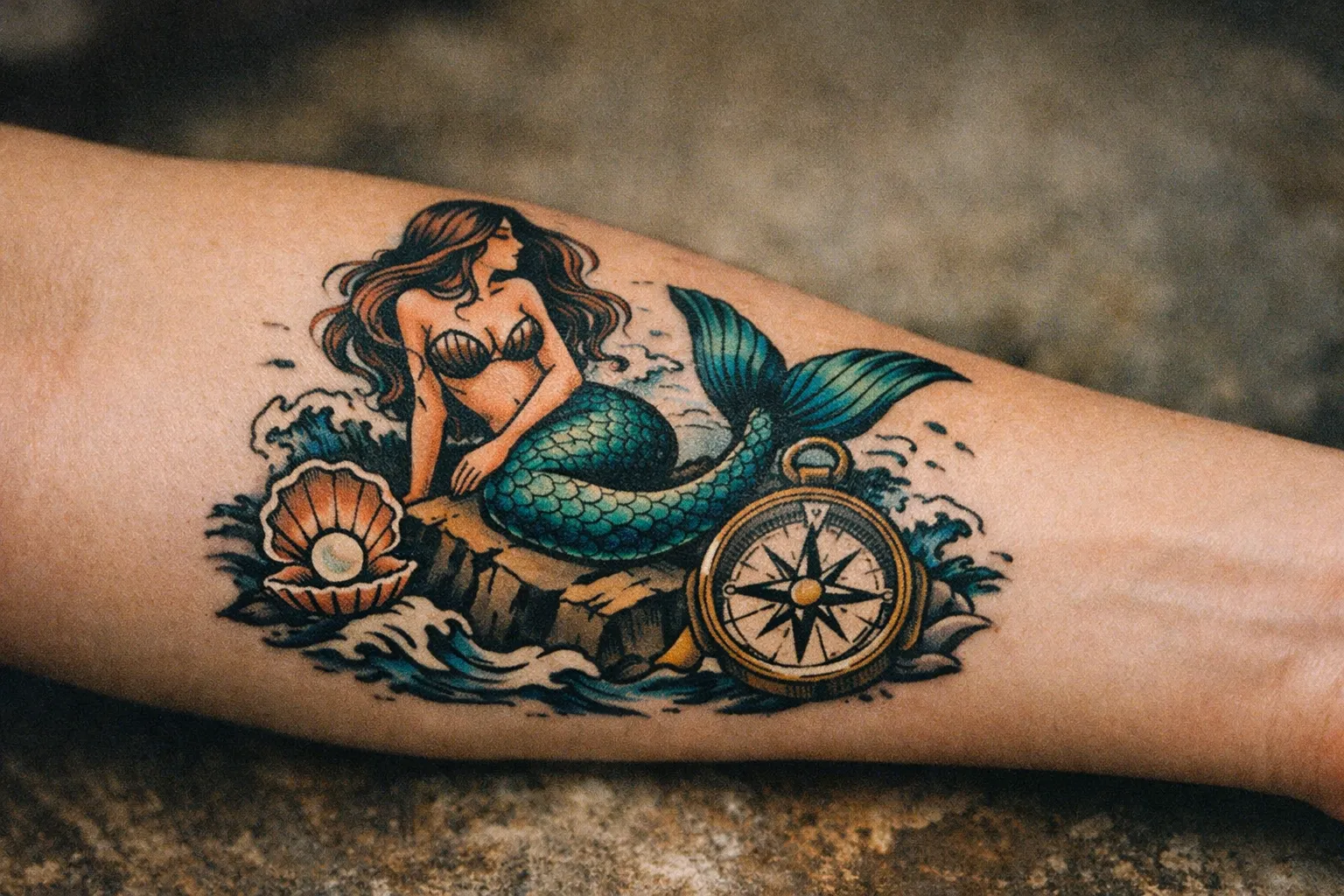
This guide covers what actually matters when you sit down with an artist: what the design says, where it ages well, what it costs in 2026, and which versions you probably want to avoid for reasons most Pinterest boards won’t tell you.
Across most modern Western tattoo culture, a mermaid reads as femininity, independence, sensuality, and a connection to the sea. The hybrid body - human above, fish below - is what gives the symbol its weight. It’s an image about living between two worlds, not fully belonging to either.
That duality is also why the meaning splinters depending on which tradition you pull from. In Northern European sailor folklore, mermaids were omens - sometimes protective, sometimes a warning that the crew was about to lose the ship. In Greek mythology, the line between mermaid and siren gets blurry fast; sirens were the dangerous ones, luring sailors onto rocks. By the time Hans Christian Andersen and then Disney got hold of the image, the mermaid had softened into a figure of longing and self-determination - wanting a different life than the one you were born into.
In modern Western tattoo practice, most clients lean on three layers of meaning:
- Freedom and transformation - the mermaid as someone who chose a different existence
- Feminine power that doesn’t apologize - sensual without being passive
- A literal love of the ocean - surfers, divers, sailors, marine biologists
If symbolism matters to you, tell your artist which layer you want emphasized before they design anything. A wistful mermaid on a rock reads completely differently than one dragging a skeleton into the surf. I’ve had clients come in wanting “freedom and independence” and hand me a reference image that was clearly a siren piece - skulls, wreckage, the works. Worth sorting that out before the stencil goes down.
✓ Pros
- Rich symbolism spanning femininity, freedom, and ocean connection
- Multiple style options from fine line to traditional
- Placement flexibility with clear guidance on aging and pain
✗ Cons
- Small detailed designs age poorly without planning
- Symbolism can be misread, especially siren or prison connotations
- Color palettes and scale size require technical care to hold over time
Sizing, Placement, and What Holds Up for a Small Mermaid Tattoo
A small mermaid tattoo usually falls in the 1-3 inch (2.5-7.5 cm) range and lives on the inner forearm, behind the ear, inner ankle, or the side of the ribcage. These are almost always linework or single-needle fine line - color rarely fits cleanly at this size.
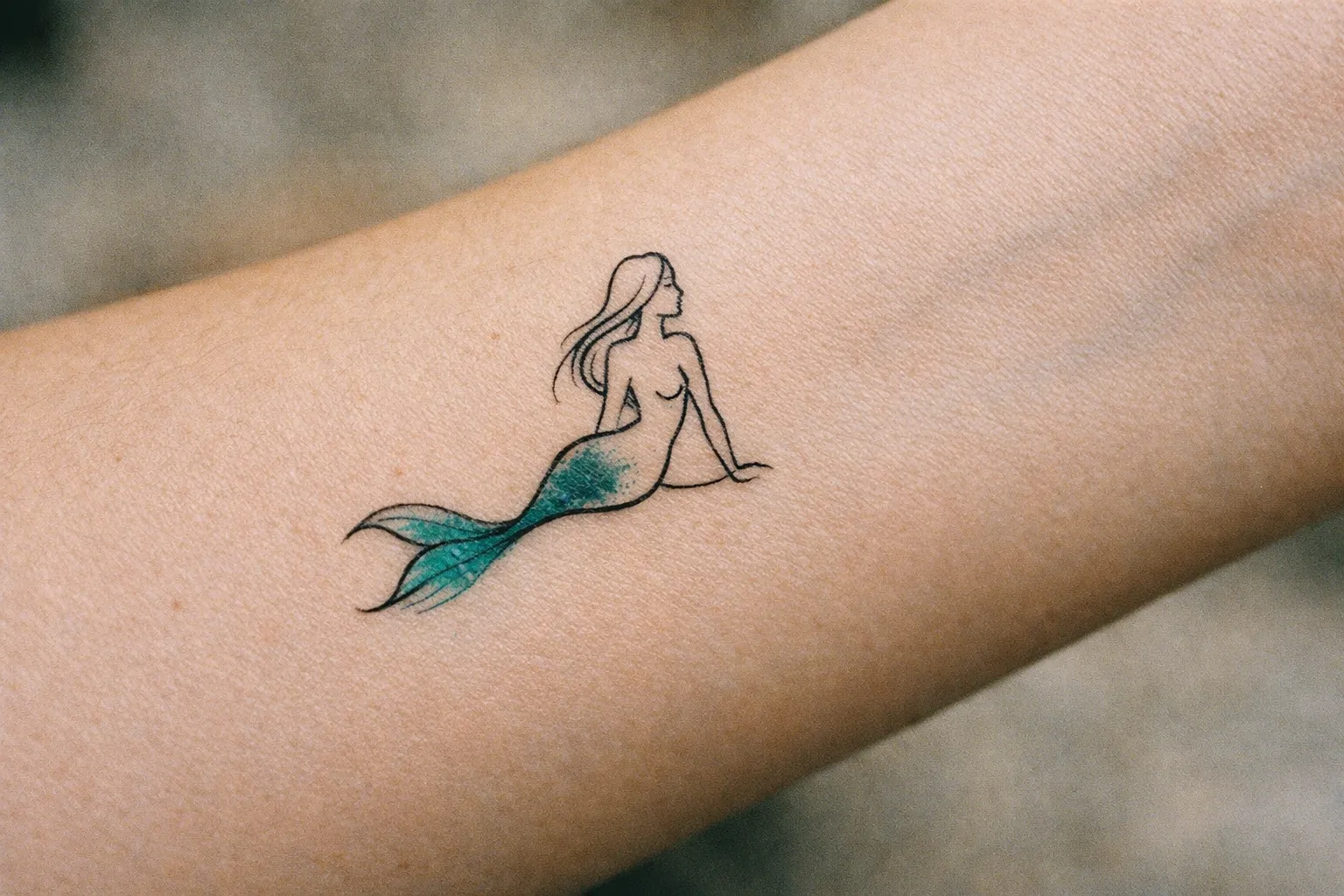
Here’s the honest part: a small mermaid is the design most likely to age badly if you don’t plan it right. The mistake I see constantly is clients asking for full facial detail, individual scales, and flowing hair inside two inches. Within 3-5 years, those micro details blur into a shape you can’t read. On fingers and feet, that timeline shrinks to about two years.
What works at small scale:
- Silhouette-first designs - a clean profile of a mermaid mid-dive, no facial features, tail curving up
- Single-needle linework with no shading packed inside it
- One color accent maximum - a teal tail tip, nothing more
Best placements for the small version:
- Inner forearm (2-3 in) - easy healing, ages well, lower pain than most spots
- Behind the ear (1-1.5 in) - keep it silhouette only, no detail
- Inner ankle (2 in) - expect a touch-up around year three
- Side of ribcage (2-3 in) - looks great healed, but the ribs are one of the more painful placements on the body, significantly worse than the forearm
Pricing for a small mermaid at a mid-tier US studio sits between $80 and $200, with most shops enforcing a $100-$150 minimum regardless of how quick the piece is.
The Pattern Piece People Underestimate: Mermaid Scale Tattoo
A mermaid scale tattoo is the repeating fish-scale pattern, usually rendered in teal, blue, purple, or pure blackwork. It can stand alone - covering a panel of the forearm, shoulder cap, or calf - or sit as the tail portion of a larger mermaid piece. Common coverage area runs 10-40 cm² on a single panel, and it scales up to a full sleeve.
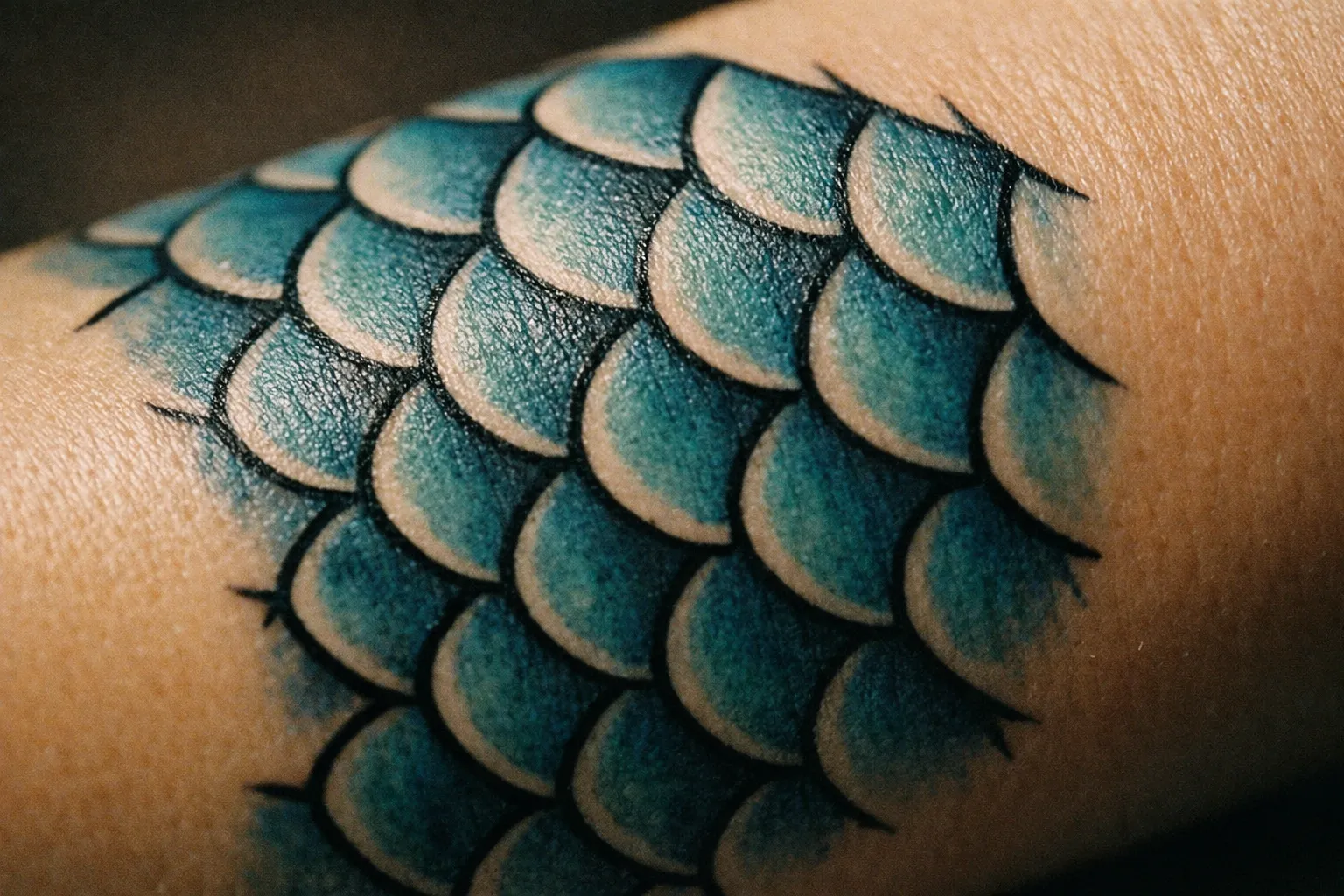
The symbolism here leans toward resilience and emotional armor - scales as protection, layered and overlapping. Surfers and divers also get scale patches as a quieter ocean reference, without the figurative mermaid. Much like a jellyfish tattoo, the mermaid scale design draws on themes of resilience and grace that resonate with ocean lovers.
The technical pitfall almost everyone misses: scale size. Individual scales smaller than about 0.3-0.4 inches (8-10 mm) tend to bleed together as the ink settles, especially on high-movement areas like the inside of the elbow or back of the knee. Healed, they look like a smudged blue patch instead of a pattern. I’ve seen this happen on pieces that looked immaculate fresh out of the wrap. Ask your artist for larger, bolder scales with clean negative space between them - it reads better at six feet away and holds cleanly for a decade or more.
Two technical hallmarks of a scale piece done well:
- Consistent shape geometry - every scale follows the same arc, not freehanded loosely
- Graduated saturation - darker at the edges of each scale, lighter toward the center, which gives the illusion of curvature
A common pitfall: artists who render every scale with equal saturation. The result looks flat, like wallpaper. The good ones treat the pattern almost like a fish fillet under light - some scales catch it, some don’t.
The Darker Cousin: Siren Tattoo
A siren tattoo isn’t just a mermaid with a meaner face. The siren comes out of Greek myth - originally part-bird, not part-fish, though the image fused with the mermaid over centuries - and the meaning sits closer to danger, seduction, and warning than to freedom or femininity.
Common design elements that signal “siren” rather than “mermaid”:
- Skulls or bones in the composition - drowned sailors, scattered ribs on rocks
- Shipwreck imagery - a half-sunken hull, broken masts
- Storm seas rather than calm water
- A direct, confrontational gaze instead of a wistful side-profile
- Tangled hair, sharp teeth, or claws on the figure herself
A siren design ages best at medium to large size - 5 inches and up - because the storytelling depends on the supporting elements: the wreck, the sky, the bones. Shrink it down and it just looks like a mermaid with bad lighting. Common placements are the outer thigh, ribcage, and upper back, where there’s room for a full scene.
This is also where the “what does my tattoo actually mean” question matters most. People walk in asking for a mermaid and walk out with a siren because they liked the moodier reference image - and then later realize they’ve committed to a symbol of seduction and destruction rather than the softer reading they originally wanted. Look hard at the references you bring in. If there’s a skull, a wreck, or a dying sailor in the frame, that’s a siren tattoo.
The Mermaid in LGBTQ Symbolism
Within queer communities, the mermaid has been quietly reclaimed as a symbol of gender fluidity, trans identity, and self-reinvention. The reasoning is structural: a mermaid is a hybrid body that doesn’t fit a single category, lives between two worlds, and - in the Andersen version - actively transforms herself to inhabit a body that matches her sense of self.
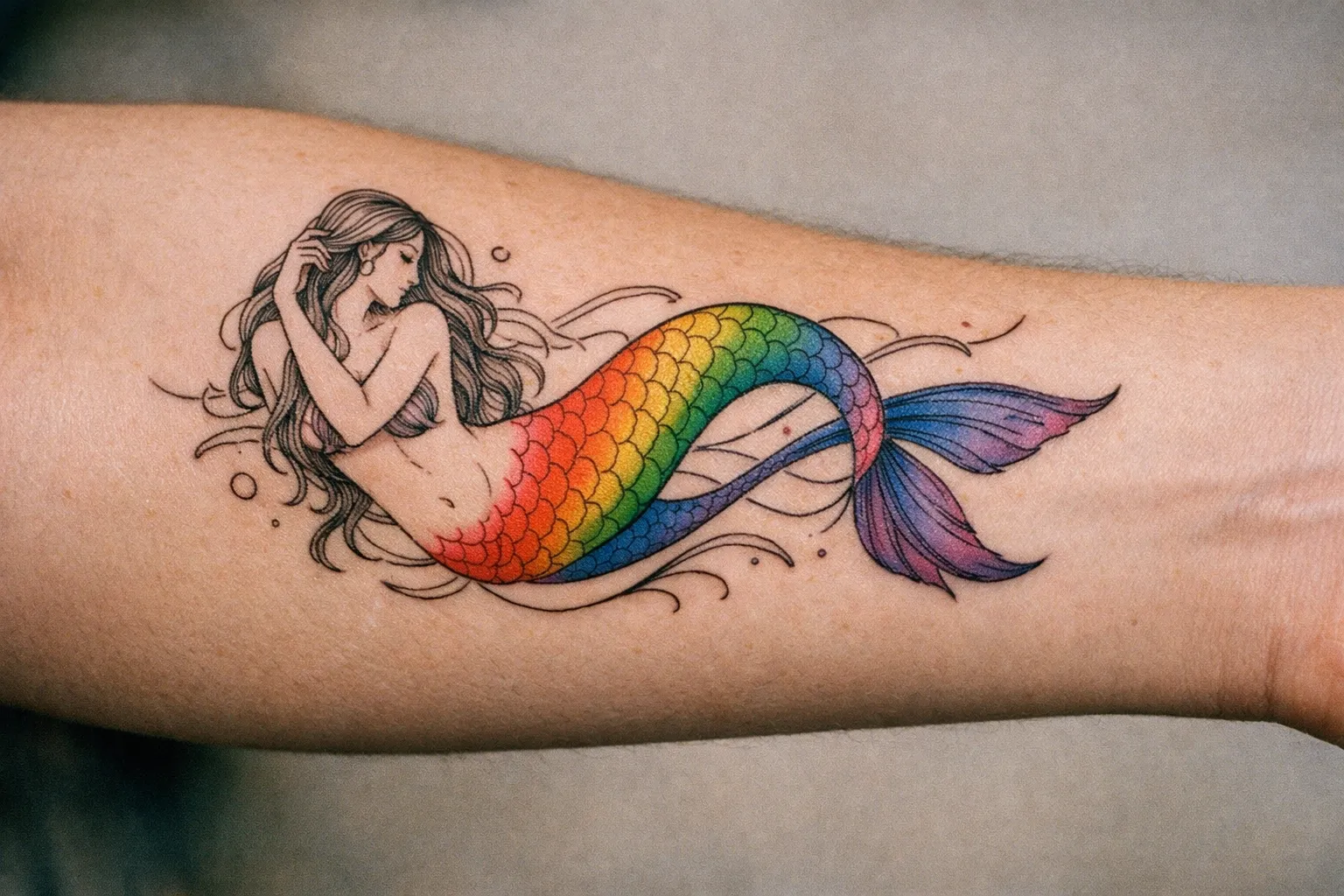
Common queer-coded design choices:
- Trans pride colors (light blue, pink, white) worked into the tail or hair
- Rainbow scales across the tail or as a partial sleeve
- Androgynous or non-feminine mer-figures - flat chests, masculine jawlines, beards on mermen
- Plus-size, muscular, or otherwise non-normative bodies rather than the default pinup silhouette
This reading isn’t universal - plenty of LGBTQ wearers pick a mermaid simply because they love the ocean. But if you want the design to read as queer symbolism specifically, the color palette and body type do most of the work. A traditional pinup mermaid with teal scales doesn’t carry the same signal as one with a trans flag tail and a non-feminine figure.
Mermaids in Jail and Prison Symbolism
This is the section most guides skip. In certain regional prison and gang contexts, a mermaid tattoo can read as a marker of sex work, manipulation, or a warning about seductive danger - essentially the siren meaning, pulled forward as a coded identifier. The associations are regional, inconsistent across systems, and not universal.
What this means practically for civilian wearers:
- The risk of misreading is highest on highly visible, traditional placements - neck, knuckles, side of the face - and on single-figure mermaids without softer context (no Disney elements, no ocean scene, no obvious decorative framing)
- The risk is low to negligible for decorative, scenic, or stylized pieces on the arms, legs, or torso
If you’ve spent time in a system where this reading exists, or you’re tattooing in a region where you know it carries weight, talk to your artist about placement and framing. Adding clear decorative elements - flowers, shells, a Disney reference, a watercolor wash - disambiguates the design from the coded version.
Tattoos to Avoid (Mermaid-Adjacent Concerns)
The question “what tattoos should I avoid” is broader than mermaids, but it intersects with this design family in specific ways. Things worth thinking twice about:
- Mermaid faces under 2 inches - the detail won’t survive five years
- Hyper-detailed scales on fingers, feet, or knuckles - friction zones blow out fast
- Siren imagery with shipwrecks placed across a joint - knees, elbows - because the scene distorts when the limb bends
- Copying a viral Pinterest pin verbatim - beyond the aging issues, it’s also a copyright concern; reputable artists won’t replicate another artist’s custom work
- Trendy micro-realism mermaid portraits at sub-2-inch size - they look sharp fresh and unrecognizable healed
- Pastel-heavy color palettes on medium-to-deep skin - mint, lavender, and soft peach often disappear into the skin tone; saturated teals, deep blues, and purples hold much better
The general rule: a tattoo to avoid is one where the design’s success depends on details that the format - size, placement, your skin tone, your skin’s movement - won’t let it hold. Mermaids are forgiving when the silhouette does the work and the small details are bonus rather than load-bearing.
Is the Mermaid a Standard ADHD Symbol?
Short answer: no. The widely recognized tattoo symbols associated with ADHD and neurodivergence are the neurodiversity infinity symbol (a rainbow or gold infinity loop), butterflies, and - more controversially within the autism community - puzzle pieces. Mermaids are not on that list.
That said, plenty of people with ADHD choose a mermaid as a personal metaphor - the “thoughts swimming in every direction at once” reading, or the sense of not quite fitting in the world you were born into. That’s valid as personal symbolism. It just won’t be readable as an ADHD signal to anyone else; it’ll read as a mermaid.
If you want a mermaid that doubles as a neurodivergence reference, the cleanest approach is to combine the figure with a recognized symbol - a neurodiversity infinity worked into the tail pattern, for example.
Nautical Elements That Pair Well
Once you’ve settled on the mermaid figure, supporting elements change the tone significantly. The common pairings and what they shift:
- Anchor - adds weight and stability; reads more “sailor traditional” than “fantasy”
- Compass rose - direction and navigation; pairs well with travel symbolism
- Ship’s wheel - control over course; popular in American traditional pieces
- Seashells, starfish, coral - softens the design, reads more decorative than mythological
- Waves and water - fills negative space; lets you anchor the figure in a scene without committing to a full background
- Skulls, bones, wrecks - flips the reading from mermaid to siren
For an American traditional mermaid specifically, the hallmarks are thick black outlines and a limited palette - usually red, yellow, green, and one blue. The common pitfall when artists do this style badly is using too many colors or letting the outline weight vary. Traditional reads strong because the outline is consistent and the color blocks are flat. When those two things go soft, the whole piece loses its clarity.
Style Breakdown: What Actually Holds Up
American traditional. Bold black outlines, limited color palette, classic pinup mermaid pose. Ages exceptionally well - twenty-year-old traditional pieces still read clearly. Best on upper arm, calf, chest, sized 4-8 inches.
Neo-traditional. Thicker linework, more shading, expanded jewel-tone palette. More room for dramatic hair, flowing fabric, ornate scales. Ages well if the outline stays bold. Good for 5-10 inch pieces on the thigh, upper arm, or back.
Realism. Photo-realistic faces, water, light. Requires an experienced realism artist - this is not the style to take a chance on with someone building their portfolio. Expect 6-16 hours total over multiple sessions, and a higher price (often $200+/hour). Ages reasonably with good aftercare but softer details fade first.
Watercolor. Painterly color washes, often without a black outline. Looks sharp fresh; the long-term concern is that without anchor linework, edges soften within five to seven years. Ask for selective black outline on key edges - face, tail tip - to keep the silhouette readable long-term.
Fine line / blackwork / minimalist. Single-needle silhouettes, small symbolic pieces. Best for clients who want a small mermaid tattoo with low visibility and short session times. Touch-ups every five to seven years are common, and worth budgeting for.
A 2026 trend worth flagging: hybrid pieces that mix blackwork with selective blue or teal accents - basically a blackwork mermaid with the tail or hair carrying one bright color. Reads cleanly, ages better than full color, and photographs well. I’ve been seeing this requested a lot lately, and honestly it’s one of the stronger design directions for mermaids right now.
Placement, Pain, and How Mermaids Sit on the Body
Most-frequent placements for mermaid tattoos, based on current galleries (4)(6):
- Forearm (~25-30% of pieces) - easy healing, low-to-moderate pain, ages well
- Thigh (~20%) - most room for large scenes, low pain on the outer thigh, easier to keep out of the sun
- Upper arm / shoulder (~15%) - good for medium pieces, moderate pain
- Ribcage / side (~10-15%) - beautiful for flowing tail compositions, but ribs are among the more painful placements on the body - significantly worse than the forearm or outer thigh
- Calf / ankle (~10%) - solid for vertical compositions, moderate pain
Relative pain ranking for mermaid placements, easiest to hardest: outer thigh ≈ forearm < upper arm < calf < ribcage < spine < ankle/foot.
The compositional point most people miss: mermaids look best when the tail follows a body curve. A side thigh placement lets the tail trace the hip-to-knee line. A ribcage placement lets the tail curl with the rib arc. Placing a mermaid flat across a wide area - upper back, full bicep - often kills the sense of movement that makes the design work. This principle of following the body’s natural lines is something forearms offer dynamic motion that animates tentacles, and it applies just as well to mermaid tails.
Avoid wrapping the mermaid’s face across a joint - knee, elbow, shoulder cap. The features distort every time the limb bends, and within a year the face reads as crooked even when the limb is straight. I’ve seen this go wrong more times than I can count, and it’s never a quick fix.
2026 Pricing and Booking Reality
What a mermaid tattoo costs at a reputable mid-tier US shop in 2026:
- Small mermaid (1-3 in, linework): $80-$200, often a shop minimum
- Medium color mermaid (4-7 in, forearm or thigh): $250-$600
- Large piece (8-14 in, multi-session thigh / rib / back): $800-$2,000+
Artist hourly rates run $120-$200/hour in most US cities and climb to $200-$300/hour for high-profile artists or detailed realism work. Wait times for popular artists currently sit at 4-12 weeks, and deposits are typically $50-$200 or 20-30% of the quoted price, non-refundable but applied to the final cost.
Flash events are worth watching if you want a faster, cheaper route - artists are increasingly dropping limited mermaid flash sets on Instagram with pre-drawn designs in the $150-$400 range (2). These usually book within hours of posting, paid via digital wallet.
Budget for aftercare on top of the tattoo itself: fragrance-free soap, healing ointment, and a film dressing if your artist uses one - roughly $15-$40 total for the supplies you’ll go through during the healing period.
Aftercare: Day 1 to Month 3
Color-heavy mermaid pieces and scale work are specifically vulnerable to fading. Here’s the timeline that actually matters:
Day 1-3. Leave the bandage or film dressing on as long as your artist instructed - typically 24 hours for traditional wrap, 3-5 days for Saniderm-style film. When you remove it, wash gently with a fragrance-free antibacterial soap and pat dry. Apply a thin layer of healing ointment two to three times a day. Expect plasma weeping and some color leaching onto your sheets - that’s normal.
Week 1. The tattoo will start to feel tight and itchy. Don’t scratch, don’t pick scabs. Switch from ointment to a fragrance-free moisturizer once the surface seals (usually day 4-7). No swimming, no soaking, no direct sun.
Week 2-4. Surface healing wraps up. Flaking finishes around day 14. The colors may look duller than fresh - this is normal; saturation returns as the deeper layers settle over the next month. Keep moisturizing daily.
Month 2-3. Deeper tissue healing finishes. This is when you’ll know if you need a touch-up - patchy color, soft lines, dropped-out areas. Most reputable shops include one free touch-up within 6-12 months.
Long-term. For color mermaids and scale work, sun protection is non-negotiable. SPF 30+ daily on exposed pieces, and sun-protective clothing for full days outdoors. Blues and greens shift noticeably within one to two summers of unprotected sun exposure. Swimmers and surfers should consider placement that stays under a wetsuit or rashguard whenever possible.
Working With Pinterest References Without Wrecking Your Design
A lot of mermaid tattoos start life as a Pinterest save. That’s fine as a starting point and a problem as a final brief. What top artists actually want from you:
- 3 to 8 reference images, not one - pose, tail style, hair, color palette, background
- A note on which element from each reference matters to you
- A clear sense of size and placement before the consultation
- An openness to the artist redrawing it as a custom piece
Copying a viral pin verbatim is both a creative dead end and a copyright issue. Reputable artists will adapt the concept - same vibe, different execution - which also lets them scale the design properly for your body and adjust details that won’t hold at your chosen size. When clients come in with a single saved image and no flexibility, the session usually takes twice as long and the design ends up weaker. Bring options.
Frequently Asked Questions
- What does a mermaid tattoo mean?
- Most commonly, femininity, freedom, transformation, and a connection to the sea. The exact reading shifts with the design - a wistful figure on a rock reads as longing and self-reinvention, while a darker version with skulls and shipwrecks reads as a siren tattoo and signals seduction or danger.
- What does the mermaid tattoo mean in jail?
- In some regional prison and gang contexts, it can mark sex work or manipulation - essentially the siren meaning used as a coded identifier. These readings are regional and inconsistent, not universal. The risk of misreading is highest on visible placements (neck, hands) and on plain single-figure mermaids without decorative or scenic framing.
- What does mermaid mean in LGBTQ?
- In queer communities, the mermaid is often read as a symbol of gender fluidity, trans identity, and self-reinvention - the hybrid body that doesn't fit a single category and actively transforms. Trans flag colors in the tail, rainbow scales, or non-feminine mer-figures are the most common visual signals.
- Is a mermaid the symbol for ADHD?
- No. The recognized neurodivergence symbols are the neurodiversity infinity loop, butterflies, and (more controversially) puzzle pieces. A mermaid can work as a personal metaphor for an ADHD experience, but it won't read as an ADHD symbol to anyone else.
- What are tattoos to avoid in the mermaid family?
- Sub-2-inch mermaid faces with detailed features, hyper-fine scales on fingers and feet, siren scenes placed across joints, direct copies of viral Pinterest art, and pastel-heavy palettes on medium-to-deep skin. The common thread: designs whose success depends on details the format won't preserve.
- How much does a mermaid tattoo cost in 2026?
- A small linework mermaid runs $80-$200, a medium color piece on the forearm or thigh runs $250-$600, and a large multi-session thigh or rib piece runs $800-$2,000+. Most artists charge $120-$200 per hour, with high-profile realism artists at $200-$300.
- How painful is a mermaid tattoo?
- Depends entirely on placement. Outer thigh and forearm are toward the easier end; ribcage, spine, and ankle are toward the harder end. Ribs are noticeably worse than the forearm - plan your session length accordingly if that's where the design lives.
The Decision That Actually Matters
Pick the silhouette first, the details second. A mermaid tattoo lives or dies on whether you can read the figure clearly from six feet away, ten years from now, after the small details have softened.
Get the pose, the tail line, and the placement right, and the rest is decoration - adjustable, replaceable, fixable in a touch-up. The detailed face you fell in love with on Pinterest will fade. The clean silhouette of a mermaid mid-dive across your forearm won’t. That’s the tradeoff worth making before you book the session.