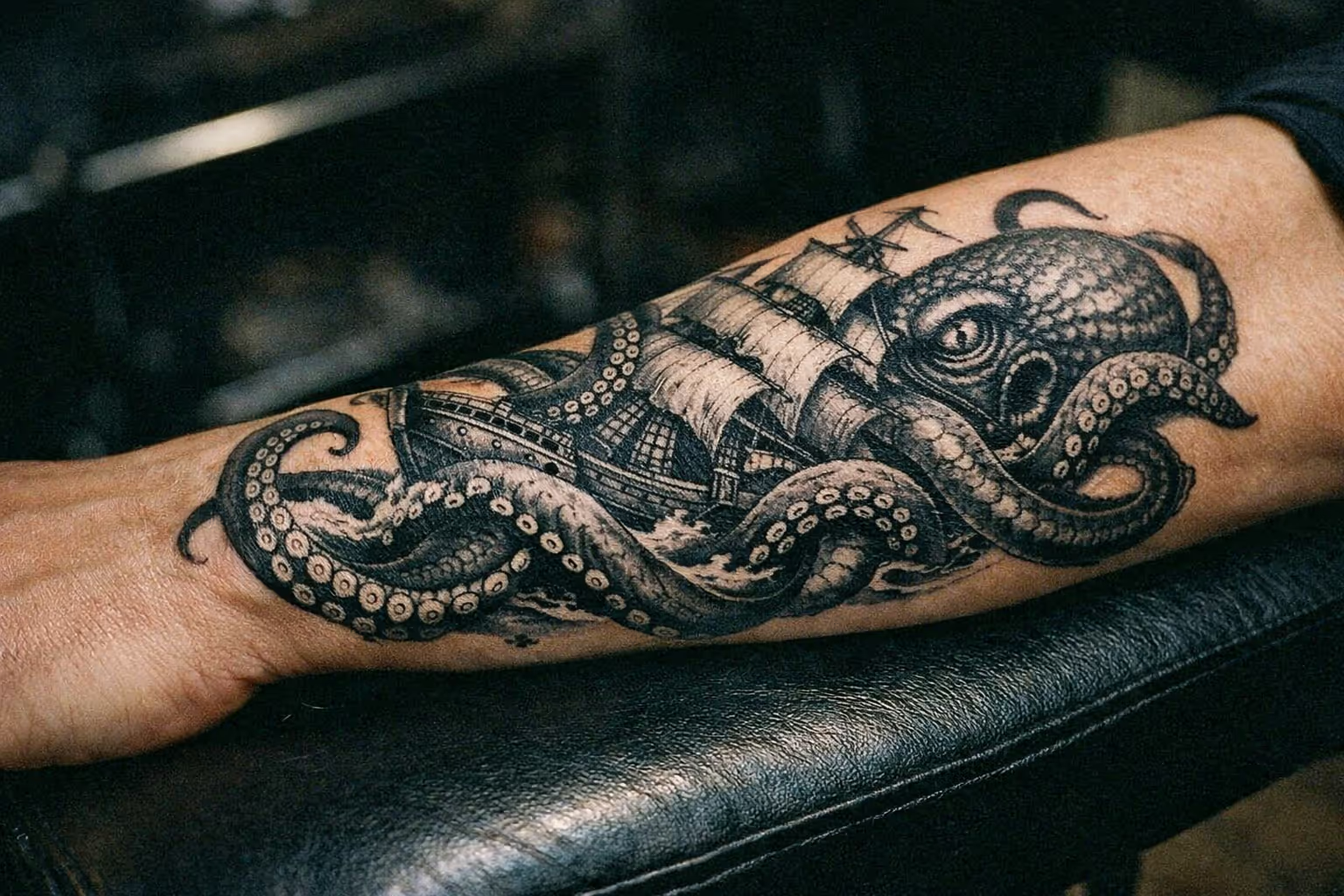
A kraken tattoo is one of the few designs that genuinely wants to be big. The whole point is the monster dragging a ship under - tentacles, suckers, chaos - and cram that onto a shoulder cap and it turns to mush; give it a back or a full sleeve and it comes alive. So the first real question isn’t style, it’s how much canvas you’re willing to commit. Here’s what a kraken costs at each size, and which styles actually age well.
Kraken Tattoo Meaning: What You’re Actually Wearing
The kraken comes out of Scandinavian and broader European sailor folklore - a giant squid- or octopus-like beast big enough to drag a ship under (1). That origin shapes the kraken tattoo meaning, and it’s not subtle.
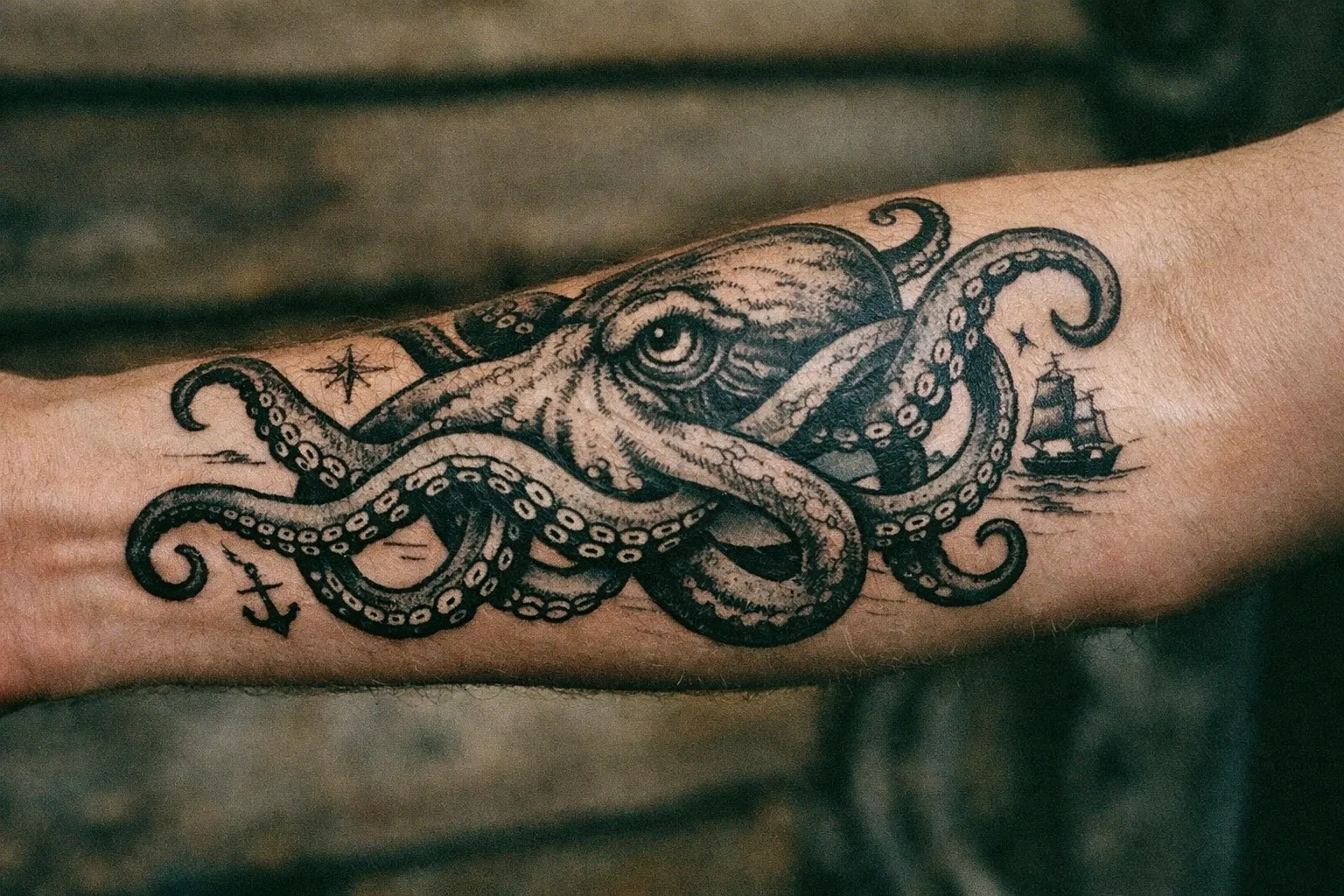
Most wearers land on one of these:
- Power and dominance. The kraken outmatches everything around it. People who pick it usually want a daily marker that they don’t fold under pressure (2)(5).
- Resilience through chaos. The ocean is the chaos; the kraken is what survives in it. A common read for people who’ve come through addiction, grief, illness, or career wreckage.
- The unknown and the dark. It lives in the deep where nothing is mapped - a good fit if you’re drawn to Lovecraftian or horror aesthetics (2).
- Rebellion. The kraken doesn’t follow rules. It eats the rules. Picked often by people who frame themselves as outsiders(5).
- Connection to the sea. Sailors, divers, fishermen, Navy, marine biologists - the kraken reads as ocean loyalty without being as common as an anchor.
One honest caveat: the kraken is not a “lucky” symbol. If you want luck or protection, a kraken is the wrong tool. It’s about facing bad odds, not avoiding them.
Traditional Kraken Tattoo: Old-School Sailor Lines
A traditional kraken tattoo runs on the American traditional formula: thick black outlines, limited palette (classic red, green, mustard yellow, navy blue), bold shapes, and minimal interior shading. The advantage is longevity - those heavy outlines read clearly at twenty feet and still read at twenty years. Healed traditional work from the 1980s still looks like traditional work. That’s genuinely not true for fine-line, which is worth knowing before you commit.
Common composition cues:
- Kraken framed against a flat sun or wave pattern, not a photographic ocean
- Banner text underneath (“Hold Fast,” a name, coordinates)
- Paired with an anchor, a clipper ship, or a swallow
- Eye exaggerated; suction cups simplified to circles
Two technical hallmarks tell you whether the artist actually knows the style: line weight hierarchy (outer outline thickest, interior lines thinner) and a disciplined palette (four to six colors, no gradients). A common pitfall is artists treating “traditional” as a synonym for “simple” and skipping the line hierarchy entirely - the result is a flat sticker that doesn’t hold up past a few years.
Size and placement that work: 4-6 inches on the upper arm, chest panel, or thigh. Smaller than that and the bold lines start to crowd each other.
Realistic: Cinematic Scale
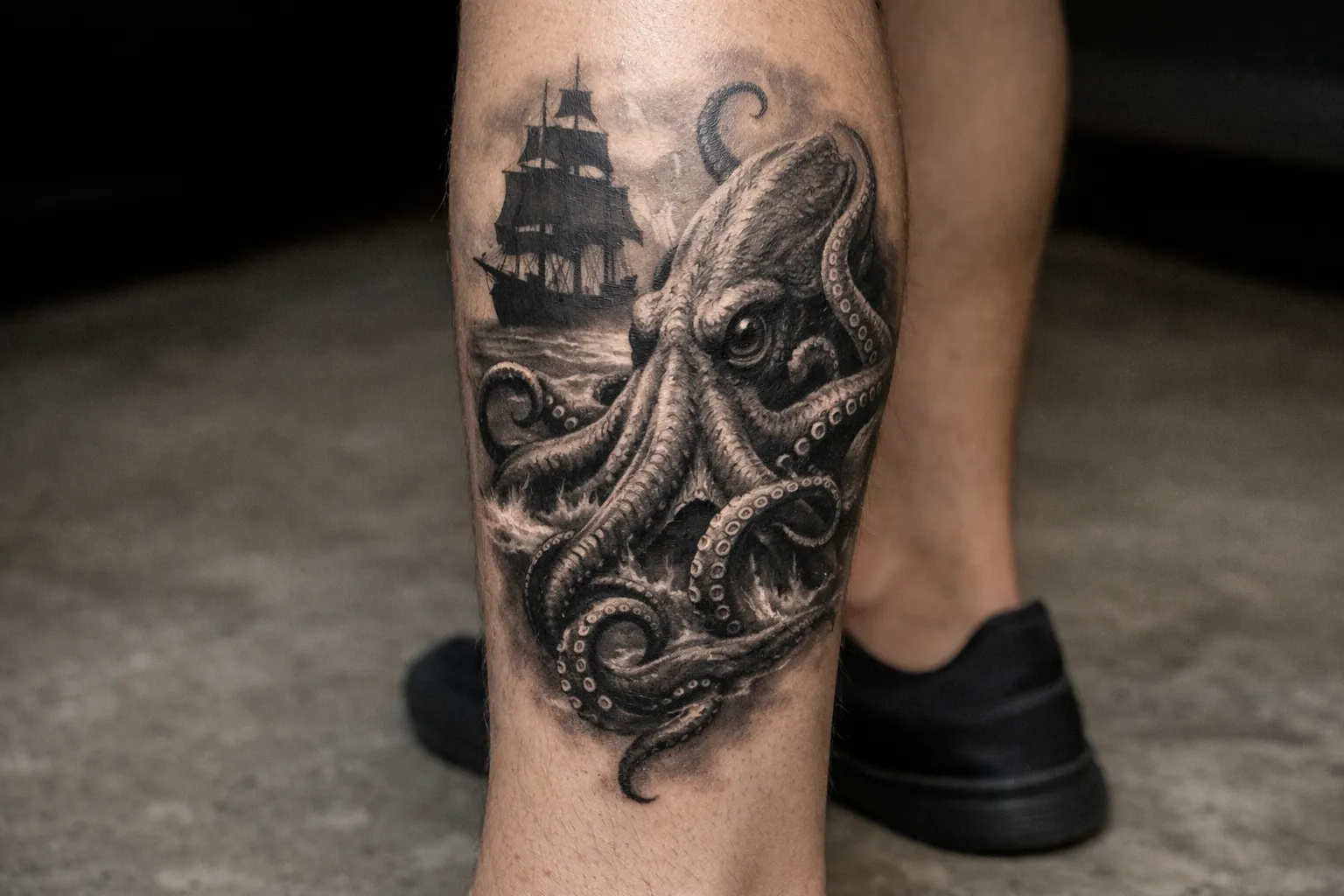
A realistic kraken tattoo is the opposite end of the spectrum - smooth gradients, photographic shading, lighting that suggests depth and water, often a full scene with a ship, storm, and underwater perspective. This is what TikTok and Instagram have been pushing hard in 2025-2026, framed as “raw power, untamable chaos” (5)(6).
What it actually demands:
- Real space. Minimum 8 inches for a full scene. Back, thigh, or full sleeve is honest territory. A realistic kraken crammed into a 4-inch forearm spot ages into a blur within five years.
- A realism specialist. Not a generalist. Ask to see at least three to five healed large-scale realism pieces, not fresh photos. Fresh tattoos lie. Healed tattoos tell you what your skin will actually carry.
- A focal-point decision up front. Either the kraken’s eye or the ship is the hero. The other element gets softer contrast. Equal emphasis on both reads as visual noise.
Color strategy matters here too. Deep blues, teals, and desaturated purples age better than neon hues, which can lose 20-30% of their intensity in two to five years without strict sun protection.
Kraken and Ship Tattoo: How to Build the Scene
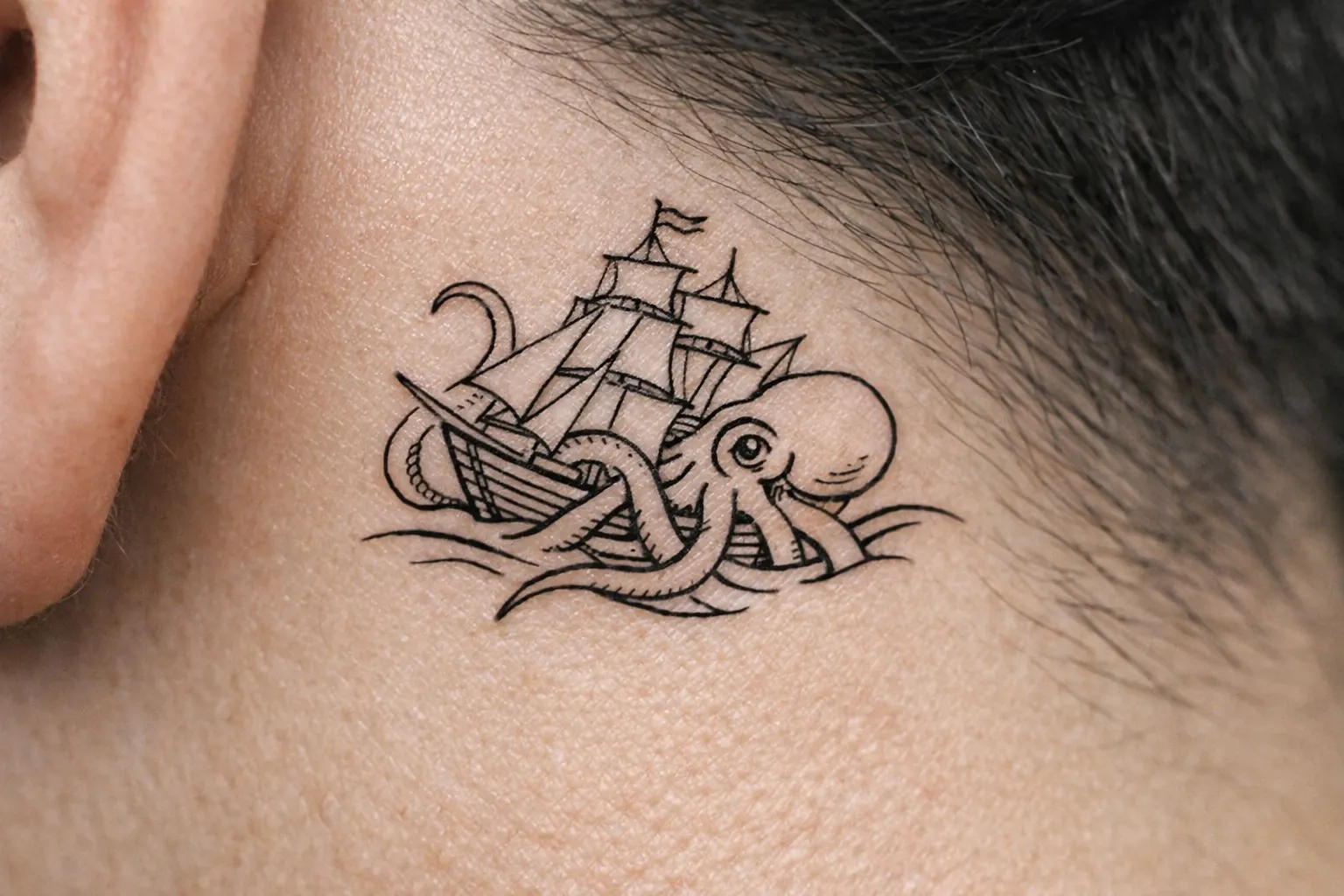
The kraken and ship tattoo is the most-requested kraken composition, and it’s a real design problem - not just two elements stacked together. The ship is usually you: your life, your direction, your mission. The kraken is whatever’s trying to take you down (1)(2).
Decisions to make before the artist sketches:
- Ship type. Galleon (classic pirate silhouette), Viking longship (Norse heritage angle), schooner, or modern vessel. Each carries different cultural weight.
- Moment in the story. First contact (tentacles rising), peak struggle (ship tilting, masts cracking), or aftermath (ship splintered, kraken descending). Peak struggle is the most dramatic but also the most cluttered to execute.
- Weather. Storm clouds and lightning add drama but eat space fast. A calm sea with the kraken lurking underneath is sometimes more menacing.
- Anchor stability angle. Some clients add an anchor holding firm while the kraken thrashes - meaning stability amidst chaos rather than pure destruction (1).
Size honesty: a full kraken and ship scene needs 8-12 inches minimum. Half sleeve, full back, or thigh panel. Anything smaller and the rigging on the ship - the part that makes a ship read as a ship - turns into mud within a few years.
Shoulder: Why It’s the Smart Starting Point
The kraken tattoo shoulder placement is the most-recommended starting point for clients who eventually want to expand, and there’s a real anatomical reason for it. The rounded mass of the deltoid lets tentacles wrap naturally over the shoulder ball into the chest or the upper back. The body does half the design work for you.
Specifics:
- Size range: 5-8 inches across the shoulder cap, often extending another 2-4 inches down the upper arm or onto the collarbone
- Cost range: $400-$1,000 depending on color, detail, and artist rate
- Time: Usually one to two sessions, 3-6 hours each
- Pain: Mid-range. The deltoid itself is forgiving; the closer you get to the collarbone or armpit, the sharper it gets. Shoulder cap is much easier than ribcage, harder than outer forearm.
The strategic move: ask your artist to design the shoulder piece with future expansion in mind. Even if you’re only doing the shoulder now, knowing whether you might extend into a chest panel, a half sleeve, or a back piece later changes how the tentacles are oriented. I’ve seen clients come back six months later wanting to add a ship scene, and without that planning conversation upfront, the seam between old and new work shows. Adding on without a plan creates awkward transitions that no amount of filler can fix cleanly.
Style Options Beyond the Two Extremes
Between bold traditional and full-color realism, there are a few kraken tattoo designs worth knowing:
- Neo-traditional. Bold outlines like American traditional, but with richer color gradients, more illustrative shading, and decorative elements (waves stylized like Japanese woodblock, ornamental frames). Good middle ground. Works at 5-7 inches on the upper arm or calf.
- Black-and-grey. No color, all contrast. Heavy on shading, light on outlines. Reads as moodier and more cinematic than traditional, less production-heavy than full realism. Excellent for forearms, inner biceps, and ribs.
- Japanese-influenced (irezumi style). The kraken substituted into classic Japanese sea-monster compositions, paired with stylized waves (often Hokusai-derived), wind bars, and cherry blossoms. Designed for full sleeves and back pieces - it doesn’t work small. Worth noting: the kraken itself is European folklore, so this is a stylistic crossover, not a traditional irezumi motif. That’s not a reason to avoid it, just something to know.
- Single-tentacle minimalist. One tentacle climbing out of a sleeve cuff, around a wrist, or over a collarbone. 3-5 inches. The starter kraken - cheap ($150-$300), low pain, and easy to expand later.
- Geometric / blackwork. Kraken silhouette built from heavy black shapes, dot work, or geometric line patterns. Modern aesthetic, ages well because there’s no color to fade.
Skip the hyper-detailed micro kraken on a 2-inch space. Suction cups and rigging at that scale blow out within a year or two - a blowout being when ink spreads under the skin past the intended line, turning crisp detail into a soft smear.
Placement Options and What Each One Costs
Quick reference for the most common kraken placements:
Common Kraken Tattoo Placements and Costs
| Shoulder | Upper arm / half sleeve | Full sleeve | Chest panel | Full back | Thigh | Forearm (simplified) | Calf | |
|---|---|---|---|---|---|---|---|---|
| Size Range (inches) | 5-8 | 6-10 | wrist to shoulder | 8-12 | 12-18+ | 8-14 | 4-6 | 5-8 |
| Cost Range (USD) | $400-$1,000 | $600-$1,500 | $1,500-$3,500 | $800-$1,800 | $1,500-$4,000+ | $700-$2,000 | $300-$700 | $400-$900 |
| Sessions | 1-2 | 2-3 | 4-6 | 2-3 | multiple | 2-3 | 1 | 1-2 |
Pain reality, ranked roughly worst to most tolerable for kraken placements: ribcage > sternum > inner bicep > back of knee > thigh > full back > shoulder cap > outer forearm. The ribcage is rough enough that some clients tap out partway through long sessions, which is exactly why most artists steer narrative kraken-and-ship scenes toward back, thigh, or sleeve instead.
Healing Timeline for a Large Kraken Piece
Aftercare is where realistic kraken tattoos quietly succeed or fail. Dense linework on suction cups and ship rigging is exactly the kind of detail that fades fast if you neglect the healing window.
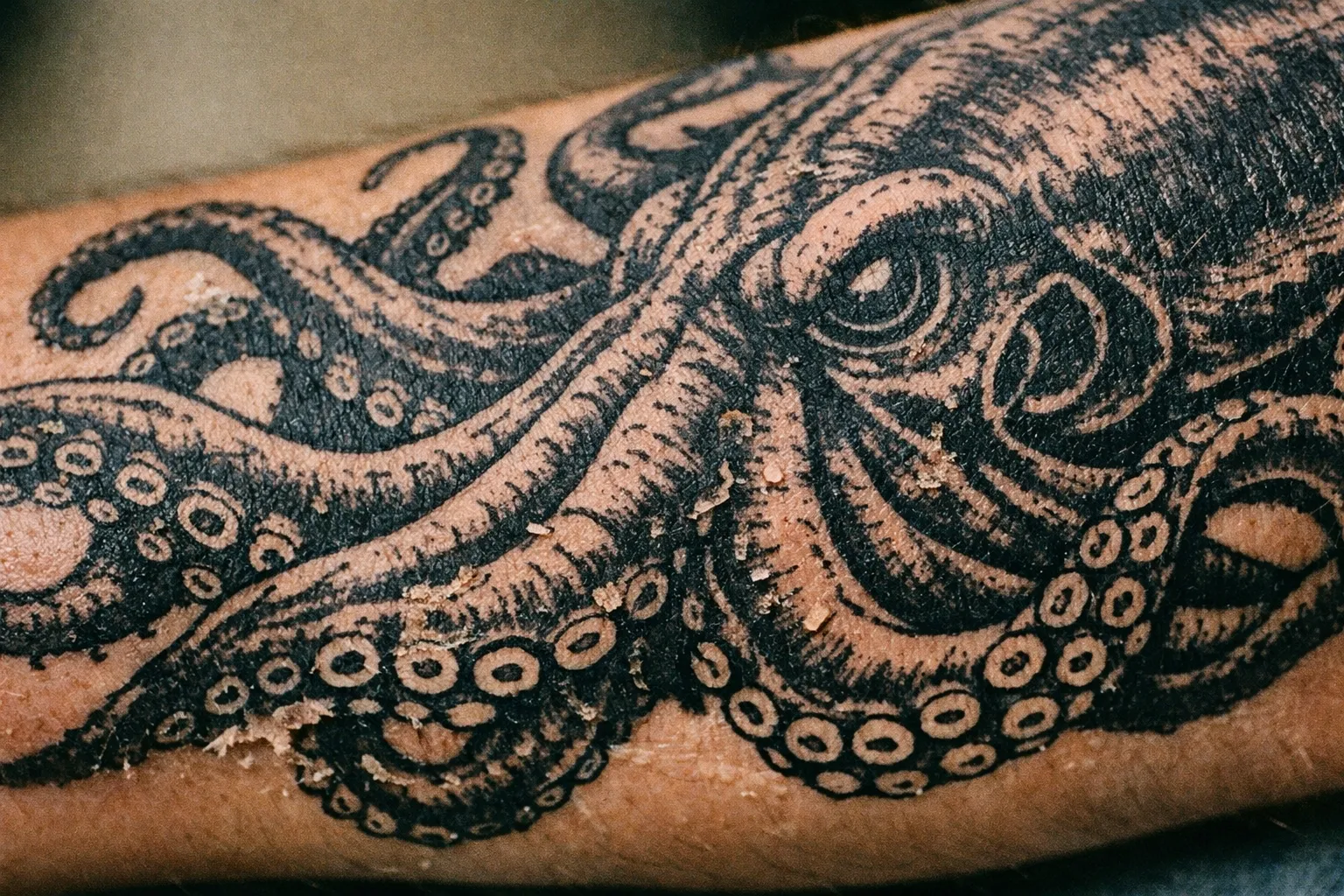
- Day 1-3: Keep the second-skin wrap on for 3-5 days if your artist uses one - current breathable films have made this the standard for large pieces. If no wrap, gentle washes with fragrance-free soap 2-3 times a day, then a thin layer of fragrance-free moisturizer.
- Day 4-14: Peeling and flaking. Do not pick. Continue moisturizer. No swimming, no soaking, no sauna, no heavy sweating.
- Week 2-4: Surface heals. Skin still looks slightly cloudy over the tattoo - that’s normal, the deeper layers are still settling.
- Week 4-6: Full healing. Skin tone evens out, color saturates to its final state.
- Forever: Daily SPF 30+ or sun-protective clothing over the tattoo. UV is the single biggest cause of fade - more than aging, more than weight change.
For multi-session work (back pieces, sleeves), space sessions 2-4 weeks apart. Most studios include one free touch-up within 6-12 months; after that, expect $50-$150 per touch-up.
Healing a Large Kraken Tattoo
6 weeksFollow this timeline to protect your tattoo's detail and color.
- 1
Days 1-3: Initial Care
Keep the second-skin wrap on for 3-5 days if used. If not, wash gently 2-3 times daily with fragrance-free soap and apply a thin layer of fragrance-free moisturizer.
- 2
Days 4-14: Peeling Phase
Expect peeling and flaking. Do not pick at the tattoo. Continue moisturizing and avoid swimming, soaking, saunas, and heavy sweating.
- 3
Weeks 2-4: Surface Healing
The skin surface heals but may look cloudy. This is normal as deeper layers settle.
- 4
Weeks 4-6: Full Healing
Skin tone evens out and color saturates to its final appearance.
- 5
Ongoing: Protection
Use daily SPF 30+ or sun-protective clothing to prevent UV fading, which is the biggest threat to tattoo longevity.
How the Kraken Compares to “Lucky” Tattoos
People weighing a kraken often compare it to symbolic tattoos with a luckier reputation. The differences are real and worth understanding before you commit.
The “luckiest tattoos for men” lists in tattoo media consistently feature:
- Koi fish - perseverance, good fortune (Japanese origin)
- Japanese dragons - wisdom, power, protection
- Four-leaf clover - Irish luck symbolism
- Horseshoe - Western superstition, protection
- Dice - risk and reward, gambler’s charm
The kraken belongs to a different category. It’s not protective and it’s not lucky - it’s about facing what isn’t in your favor and not flinching. If your goal is a charm or a talisman, pick from the list above. If your goal is a marker that you’ve already survived something most people couldn’t, the kraken fits.
The 777 tattoo is another common comparison. In Western numerology and Christian symbolism, 777 represents divine perfection, spiritual completion, or luck - often positioned as the opposite of 666. It’s small, cheap, easy to place, and tied to a specific spiritual or “lucky number” meaning. A kraken is the opposite end of every one of those axes: large, expensive, complex, and rooted in chaos rather than divine order. People do choose both. Just understand they don’t mean similar things.
Basic Tattoos to Avoid (and Why the Kraken Isn’t One)
Artists have a fairly consistent list of designs they wish clients would think twice about:
- Trendy micro-tattoos with hairline detail - they blur within 2-5 years because skin isn’t paper
- Foreign-language scripts the wearer can’t read and hasn’t had verified by a native speaker
- Low-quality infinity loops, generic feathers, and generic compass roses that flood every flash sheet
- Names of current romantic partners (this one is just statistics)
- Designs copied directly from Pinterest without checking whether the source is AI-generated or a heavily filtered photo - what looks good on a screen often doesn’t translate to healed skin
The kraken sidesteps most of this because it’s large enough to hold detail, rooted in real folklore, and visually distinctive. The risk with kraken work isn’t the motif - it’s getting it done too small, by the wrong artist, or copied verbatim from an AI-generated pin without translation to actual skin physics.
Avoiding the Pinterest Trap and AI-Generated References
A lot of “kraken tattoo” reference images circulating in 2026 are either AI-generated, heavily edited, or both. Platforms like BlackInk AI alone advertise 4,000+ kraken variations. That’s useful for sparking ideas. It becomes a problem when you walk into a shop and ask the artist to copy one exactly.
Three things to know:
- AI references often ignore body anatomy. A composition that looks great as a flat rectangle may not wrap a shoulder or follow muscle flow. Your artist has to redraw it for your body anyway.
- Skin can’t render what a screen can. Fine gradients, glow effects, and translucent water that look stunning in a render don’t exist on skin. A good artist translates the feel of the reference, not the pixels.
- Copyright is real. Directly copying another artist’s tattoo - or a recognizable digital illustration - is bad etiquette and, increasingly, a legal issue. Bring multiple references for mood and let your artist build something original.
The fix: bring 3-5 reference images that show what you like (mood, composition, color palette, tentacle style) and explicitly tell the artist you want an original design in that direction. Good artists prefer this anyway. In my experience, the clients who come in with a mood board rather than a single “copy this exactly” image almost always end up with better work.
Choosing the Right Artist for a Kraken Piece
The kraken is a portfolio test. Some specifics to look for:
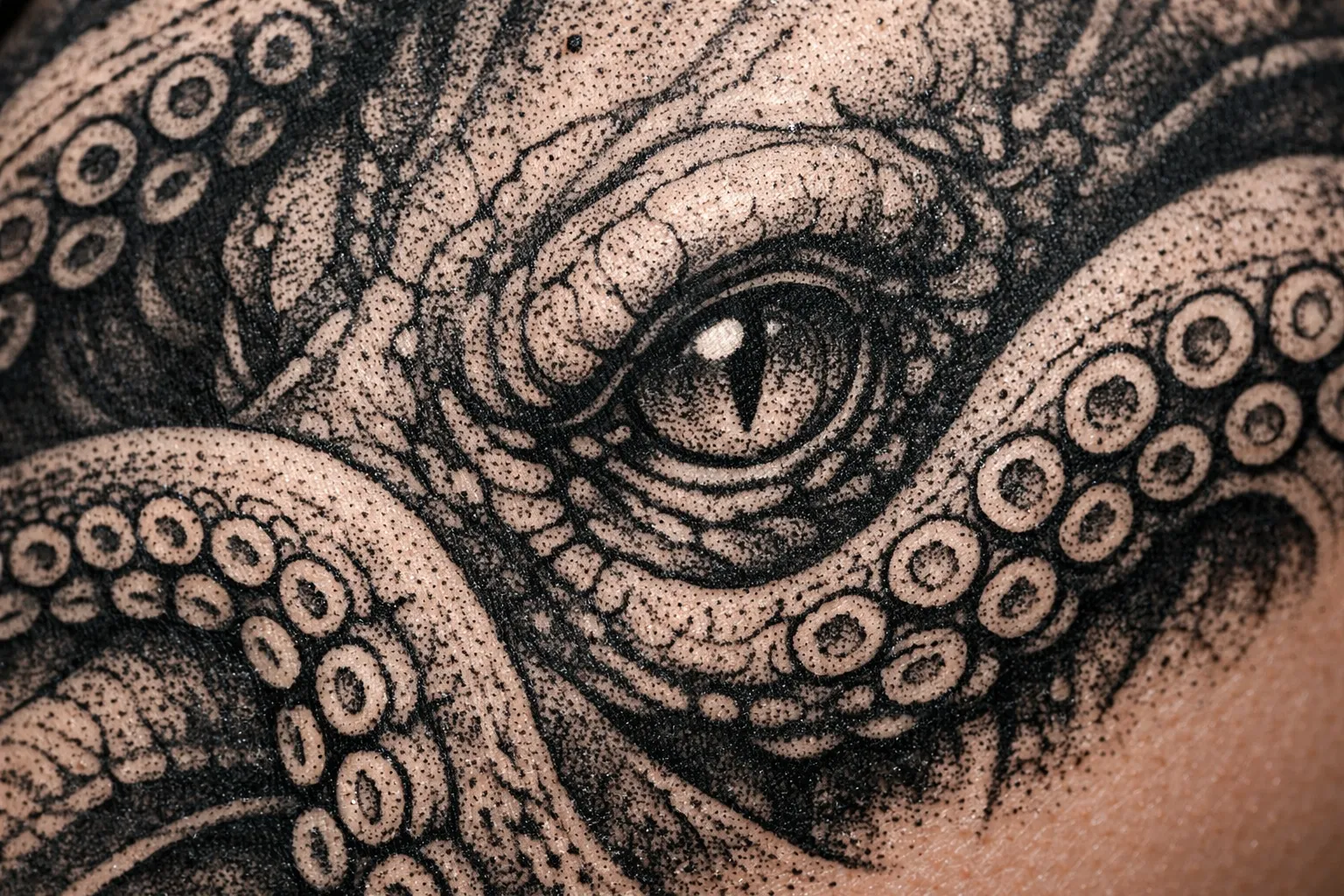
- Healed photos, not just fresh. Fresh ink is sharp and saturated for everyone. Healed photos reveal whether the artist’s lines hold and whether color settles cleanly.
- Complex tentacle work in their portfolio - octopus, squid, or kraken. Tentacles are foreshortening puzzles. Artists who haven’t done them tend to draw them flat.
- Ship rigging or architectural detail if you’re doing a kraken and ship tattoo. Rigging is where amateur ship tattoos collapse.
- Style match. A great traditional artist is the wrong choice for a realistic piece, and vice versa. Don’t ask someone to work outside their lane on a project this size.
- Consultation willingness. For anything over a few hours, a real consultation (paid or free) is standard. If a shop won’t sit with you to plan a back piece, that’s your answer.
Expect to put down a deposit (typically $100-$300, applied to your final cost) to book a large project. Most artists who do this kind of work are booked 1-6 months out.
Frequently Asked Questions
- Can I get a kraken tattoo smaller than 4 inches?
- Small kraken tattoos under 4 inches lose detail quickly, especially suction cups and rigging, and tend to blur within a couple of years. For longevity, aim for at least 4 inches, preferably more.
- Why is the shoulder the best starting point for a kraken tattoo?
- The shoulder's rounded anatomy lets tentacles wrap naturally and provides space for future expansion into chest or back pieces, avoiding awkward transitions later.
- How do I tell if a tattoo artist is skilled in kraken designs?
- Look for healed photos showing complex tentacle work and ship rigging if relevant. The artist should specialize in your chosen style and be willing to consult before large projects.
- Are AI-generated kraken tattoo references reliable?
- AI references can misrepresent anatomy and skin rendering. Use them only as mood boards and always work with your artist to create an original design tailored to your body.
- What aftercare product categories are essential for healing a kraken tattoo?
- Use fragrance-free soap and moisturizer during early healing, and protect the tattoo long-term with daily SPF 30+ sunscreen or sun-protective clothing to prevent fading.
- Can a kraken tattoo be considered a lucky charm?
- No. The kraken symbolizes facing adversity and chaos, not luck or protection. If you want a lucky charm tattoo, consider koi fish, four-leaf clovers, or horseshoes instead.
Bottom Line Before You Book
Decide three things before the consultation: the style (traditional, realistic, neo-traditional, black-and-grey), the placement with enough size to carry the detail (shoulder for a starting piece, back or thigh for a full scene), and the focal point (kraken’s eye or the ship - pick one). Bring real reference, not just AI renders. Vet healed work in your chosen style. Budget for at least one touch-up.
The kraken ages well when it’s done at the right scale by an artist who knows the style. It ages badly when it’s crammed into a small space, copied from a screen, or rushed through a single session that should have been three. That last mistake is the most common one I see - clients trying to get a back-piece concept done in a forearm footprint because they’re not ready to commit the time or money. The design always loses. Plan accordingly.