Here’s the myth-buster behind every pirate tattoo: while sailors hit tattoo rates near 90%, there’s almost no hard evidence that actual pirates were inked at all. The “pirate tattoo tradition” is largely romance and Hollywood, borrowed wholesale from sailor culture. That doesn’t make the design any less fun - it just means you’re choosing imagery, not heritage. Here’s which pirate motifs and placements warp or fade, and which style still reads in twenty years.
What a Pirate Tattoo Actually Symbolizes and How Designs Reflect Their Meaning
A pirate tattoo draws on imagery connected to the Golden Age of Piracy, roughly 1650-1725 (2), and ties into the broader history of sailor tattoos that spread through the 18th and 19th centuries. The meanings cluster around a few recurring ideas:
- Freedom and anti-authority. Pirates operated outside empires and rigid hierarchies, so the imagery reads as rebellion against control (2).
- Adventure and risk. A ship riding a storm or a Jolly Roger snapping in the wind stands for chasing fortune knowing the odds are bad.
- Outsider identity. For some wearers, the pirate is the trickster or the criminal - the figure who doesn’t fit and doesn’t want to.
- Seafaring heritage. Plenty of people get pirate or ship tattoos as a nod to a maritime job or a naval ancestor.
One honest caveat worth knowing before you commit: the idea that real pirates were heavily tattooed is weaker than the romance suggests. Historians note it’s genuinely unknown whether pirates were inked, though they sailed to regions - West Africa, Polynesia - with deep tattoo traditions (2). Sailor culture is the better-documented link. A 19th-century estimate puts tattoo rates among sailors at upwards of 90% (2). So when you wear a pirate tattoo, you’re really borrowing from sailor flash dressed in pirate clothing. That’s worth knowing before you build a whole narrative around it.
The Pirate Skull
The skull and crossbones is the most recognizable piece of pirate symbolism there is, and the pirate skull tattoo remains the most flexible design in the category. A skull reads as mortality, freedom, and nonconformity all at once - and it scales better than almost any other pirate motif. Designs that lean into mortality symbolism share DNA with the memento mori tattoo tradition, where skulls stand for the same reminder that life is finite.
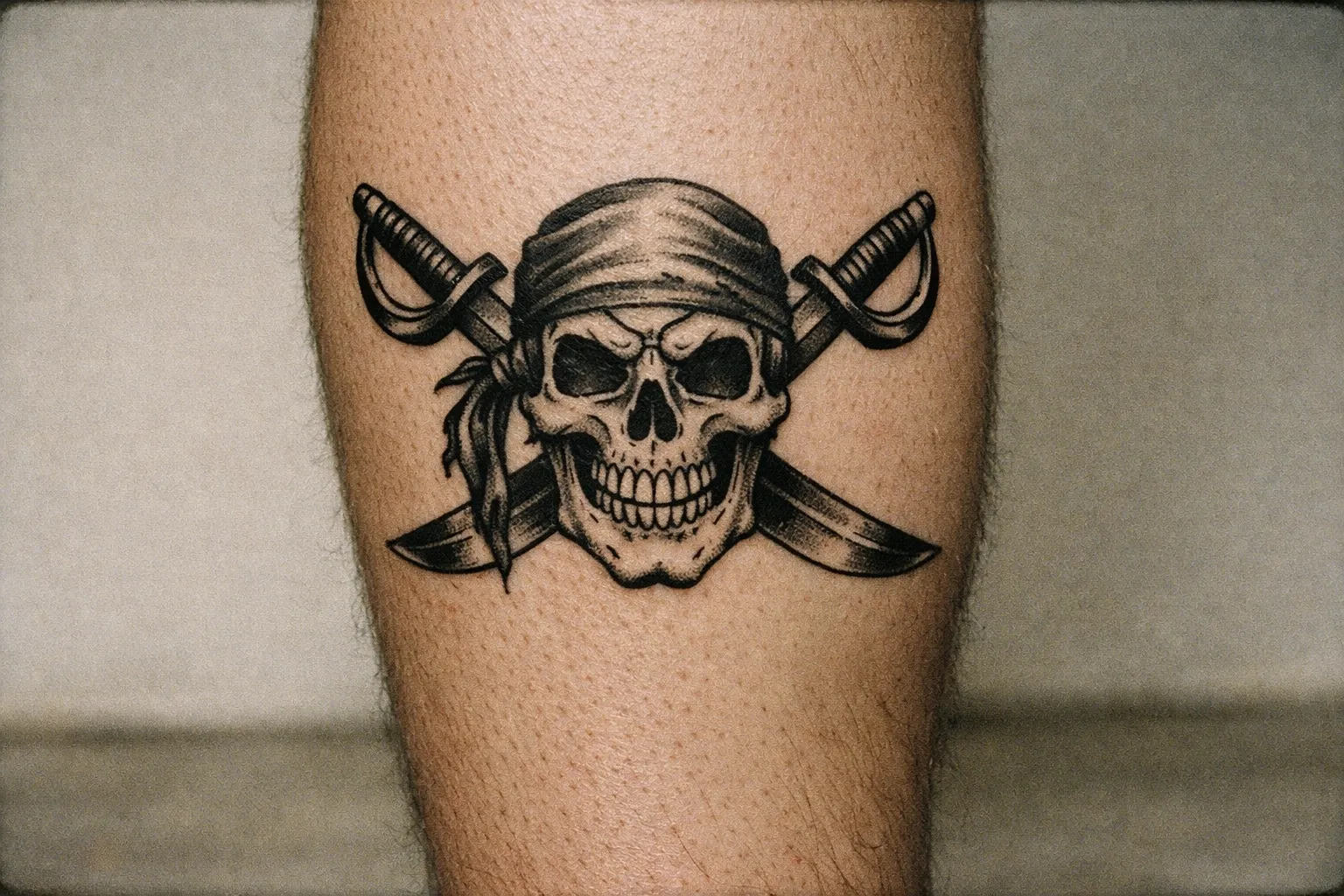
Two technical hallmarks make a skull design work: a clean, confident outline that defines the cranium and jaw without relying on internal detail to hold the shape, and deliberate shading in the eye sockets and under the cheekbones to give the skull actual weight. Done well, a skull in a tricorn hat with crossed cutlasses reads instantly even at small size. Done badly - too many tiny internal lines, over-rendered teeth - it muddies as it heals. I’ve seen plenty of skulls come back for touch-ups at the two-year mark because the artist tried to pack too much into the eye sockets. Keep the structure simple and let the shading do the work.
Placement and size options:
- Small wrist or outer-forearm piece: 2-3 inches, simple skull with hat, fast to heal, good first pirate tattoo.
- Forearm centerpiece: 4-5 inches, skull plus crossed swords or an eye patch, room for shading.
- Chest or sternum centerpiece: 6 inches and up, the skull as the anchor of a larger composition.
A note on pain: the sternum and ribs run hotter than the forearm or outer arm. If a large skull on the chest is the goal, expect a tougher sit than the same design on a thigh.
The Pirate Ship Tattoo
A ship under sail is the most narrative motif in the category. A pirate ship tattoo can mean resilience through rough water, the pursuit of something against the odds, or simply a love of the sea. Because it’s a long, vertical composition, it needs long, vertical real estate.
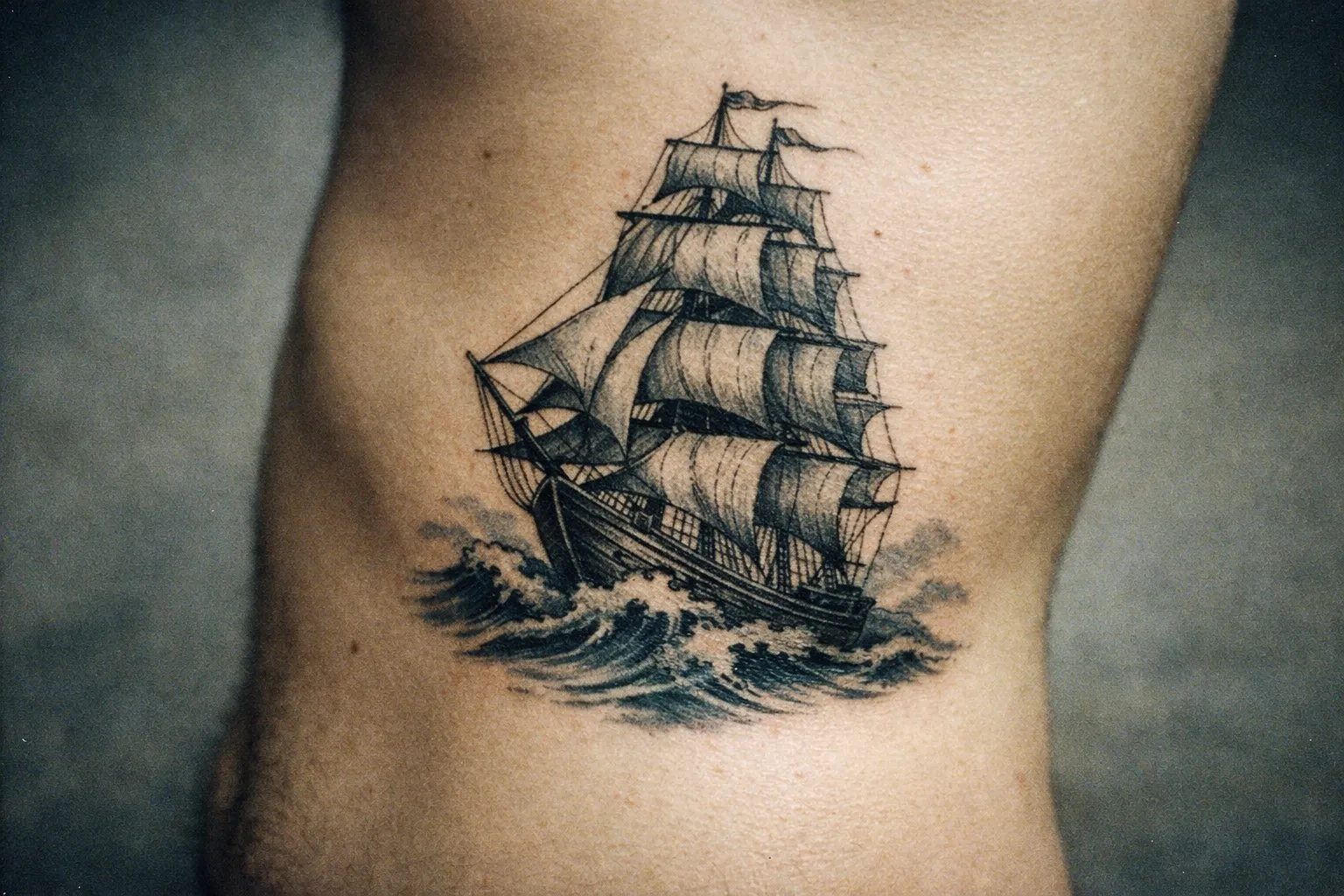
Best placements for a full-rigged ship are the forearm, outer thigh, or ribs (6-10 inches), where the masts and rigging have room to run straight. That last point matters more than most people expect. Detailed ships placed on high-movement areas - inner elbow, side of the hand - warp as the skin flexes, and over five to ten years the straight lines of masts and rigging start to bow. If you want a crisp ship, give it a stable canvas.
Style choices change the hour count significantly:
- Traditional: bold outlines, limited palette, a galleon with stylized waves and clouds. Fastest and ages most predictably.
- Black and grey realism: weathered hull, detailed rigging, a stormy sky in cool greys and desaturated blues to make the black sails pop. Often 2-3x the hours of a traditional piece the same size.
- Neo-traditional: thicker outlines, expanded color, ornate shading - good for a dramatic ship-and-kraken scene.
A half-sleeve pirate scene with a ship, clouds, and waves typically runs 5-10 hours across two or more sessions (7). I’ve done a few of these over multiple sittings, and the session that always takes longer than clients expect is the rigging - all those fine parallel lines need space and a steady hand.
Traditional Pirate Designs and Sailor Flash
The traditional pirate tattoo is where the style and the subject matter line up perfectly. American traditional’s two hallmarks - thick black outlines and a limited color palette (black, red, yellow, green) - are exactly what classic pirate flash was built on: ships, swallows, daggers, mermaids, and skulls in solid, readable shapes (2)(6).
The reason this matters beyond aesthetics: that limited palette ages gracefully. Solid black and red hold up and refresh easily; complex gradients and soft pastels fade into mud. If you want a pirate tattoo that still reads in twenty years, traditional is the safe bet. The common pitfall when artists do it badly is going too light on the outlines - thin borders in an attempt to look “refined” - and the whole design loses its structure after a few years of sun and skin movement.
Several classic sailor motifs carry specific, documented meanings worth knowing before you add them as filler:
- Swallow (sparrow): traditionally earned after sailing 5,000 nautical miles - one bird per major voyage (2).
- Anchor: marked a sailor who had crossed the Atlantic (2).
- Fully rigged ship: signified rounding Cape Horn, one of the deadliest routes (2).
- “Hold Fast” knuckles: worn by riggers for luck gripping ropes in a storm (2).
- Rooster and pig on the feet: a superstition that crates marked with these animals floated, so the tattoos were meant to protect against drowning (2).
If you want classic flash done right, look for an artist who explicitly references Sailor Jerry, Ed Hardy, or Picture Machine in their portfolio - some flash sheets descend directly from those lines (6).
✓ Pros
- Versatile symbolism that appeals to a broad range of wearers
- Works well in both small and large sizes
- Traditional style ages best and maintains clarity over time
- Strong cultural and historical roots in sailor tattoo traditions
✗ Cons
- Highly detailed designs can blur or warp if placed on high-movement areas
- Overcrowding elements leads to muddy, unreadable tattoos
- Complex shading and pastel colors fade faster and age poorly
- Real pirate tattoo history is murky, so symbolism is often borrowed from sailor culture
Ideas Beyond the Big Three
Once you’re past ships and skulls, there’s a wide field of pirate tattoo ideas that combine well or stand alone:
- Jolly Roger flag: simplified and high-contrast, this works small - outer arm or behind the shoulder, 2-4 inches. Easy to read, easy to heal.
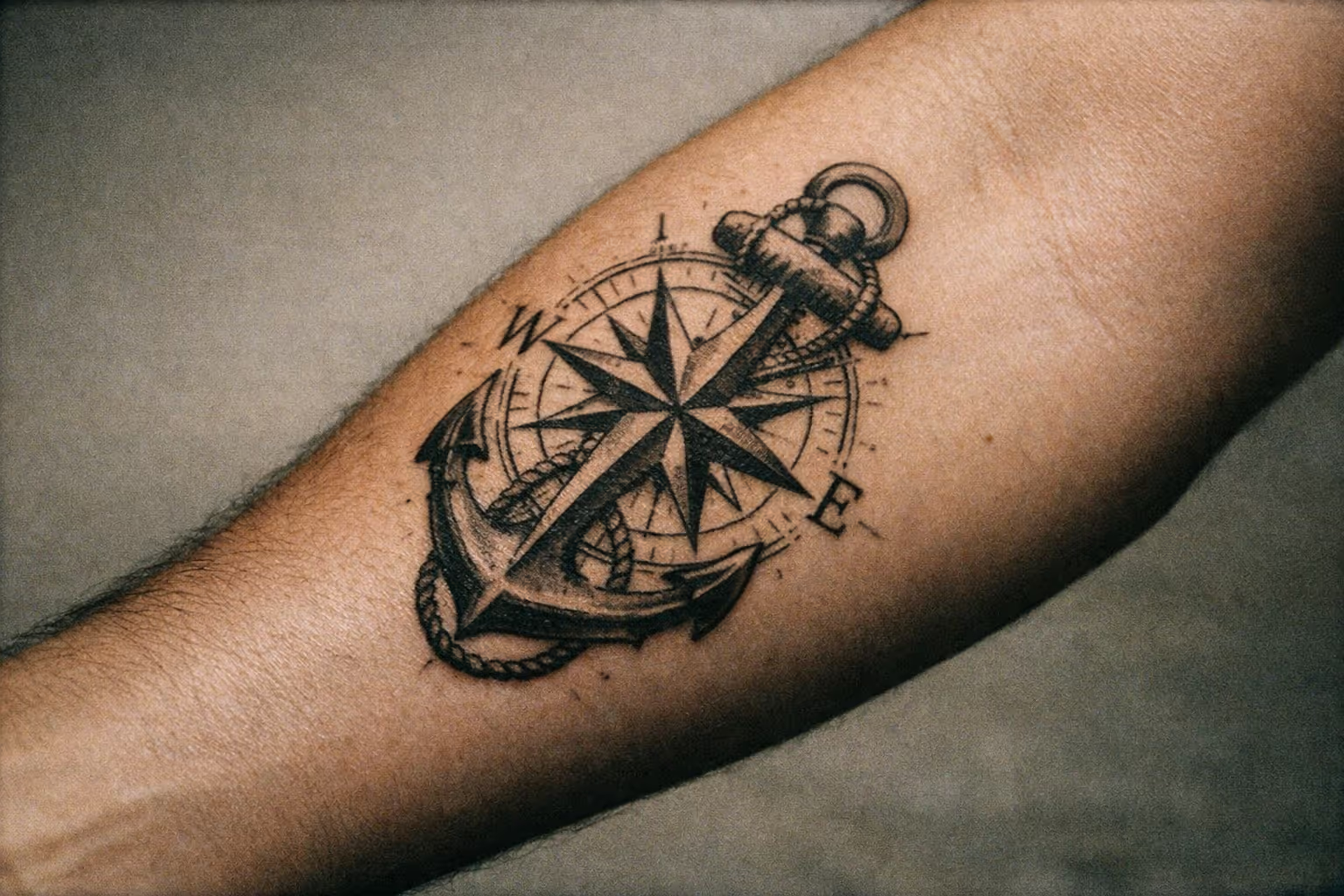
- Treasure map: dotted paths, a compass rose, and an “X marks the spot” can fill a forearm or build a background that ties other elements together. Personal milestones can replace the buried-loot premise.
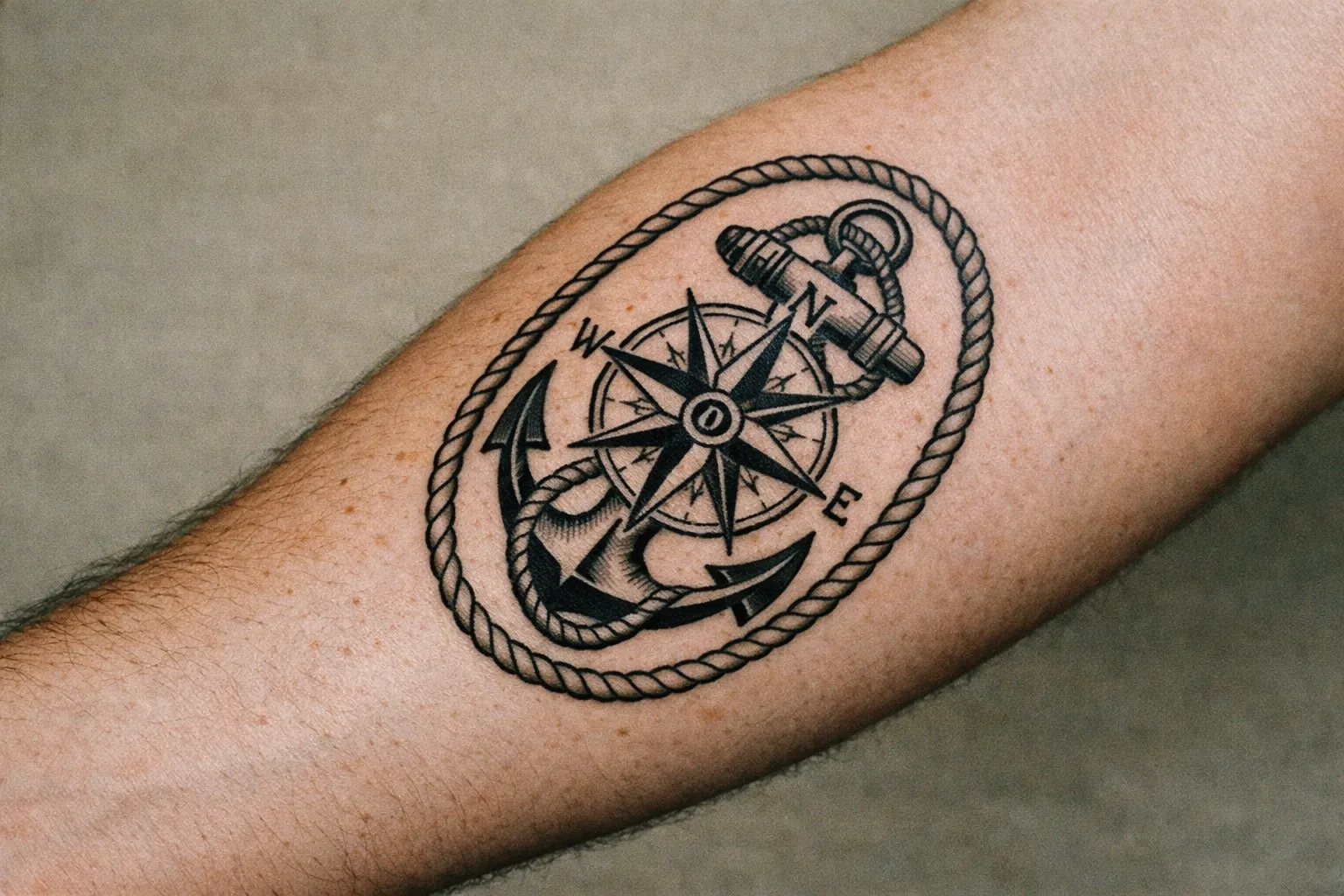
- Compass: a vintage compass rose pairs naturally with maps and ships and reads as direction or guidance.
- Character portraits: realistic or illustrative Jack Sparrow, a captain, or a pin-up pirate. These need room - upper arm, calf, or back - and benefit from realism or neo-traditional handling.
- Kraken and mermaid: sea-monster and pin-up motifs that anchor larger scenes and lean into the lore.
For a custom piece, the strongest move is to layer sailor tradition into pirate lore. A ship with two swallows quietly signals 10,000 nautical miles; an anchor plus a Jolly Roger reads as both experience and rebellion. Treat a large piece like a single panel from a graphic novel - pick the story (an escape, a raid, a final battle, a homecoming) and let the artist stage the ship angle, the characters, and the weather around it. I always ask clients to bring me three reference images they actually like, not just a Pinterest board of everything pirate-adjacent. It narrows the conversation fast.
Adjacent Motifs and Related Interests
People who save pirate tattoo designs rarely stop at the skull and flag. The adjacent motifs are worth knowing because they expand what a pirate piece can include without diluting the theme: nautical stars, compasses, lighthouses, anchors, mermaids, kraken, treasure chests, and rum bottles all sit comfortably inside the same visual world (2)(6). If the kraken appeals to you as a standalone centerpiece, the kraken tattoo has its own rich symbolism and design considerations worth exploring before you commit to a composition.
The broader interests that feed into custom pirate work are just as useful to consider. Sailing and scuba diving, tall-ship festivals, historical piracy, fantasy RPGs, and cosplay all push a design toward personalization - a specific ship from a game, a rope-and-knot detail from real rigging, a family connection to the sea. If you want a pirate tattoo that isn’t interchangeable with a thousand others, this is where the customization comes from. Tie the imagery to something you actually do, not just something you watched.
What a Pirate Tattoo Costs and How It Heals
Prices vary by city and artist, but U.S. ranges are predictable enough to plan around (most shops bill $100-$200 per hour):
- Small icon (1-2 inch Jolly Roger, tiny ship, small skull): $80-$200, roughly half an hour to an hour.
- Medium skull or ship (forearm or upper arm, palm-sized): $250-$600, about 2-4 hours.
- Half-sleeve pirate scene (ship, clouds, waves, a figure): $600-$1,500+, 5-10 hours across two or more sessions.
- Full sleeve or back piece (detailed battle or treasure map): $1,500-$4,000+, 15-30 hours over multiple sittings.
Healing follows the standard timeline, but pirate tattoos lean on dense blacks and saturated reds, which deserve extra attention:
- Day 1-3: keep it covered as the artist directs, wash gently with fragrance-free soap, and apply a thin layer of fragrance-free moisturizer. Expect some plasma and color weeping - that’s normal.
- Week 1: the surface tightens and starts to flake. Do not pick. Moisturize lightly; let the heavy black fills shed on their own.
- Week 2-4: flaking finishes and the skin remodels. Hold off on heavy sun exposure and swimming until around the four-to-six-week mark.
After that, sun is the enemy. Solid black fills and red banners fade fastest, so SPF 30+ or sun-protective clothing keeps the piece readable. Dense pirate tattoos often want a touch-up at the 3-5 year mark depending on exposure.
Mistakes to Avoid
A few errors come up again and again, and I’d rather flag them here than have you figure them out after the fact.
Overcrowding is the big one. Stuffing a ship, skull, compass, map, and a quote into a 3-4 inch forearm space produces muddy lines once healed. Detail under 2-3 mm tends to blur over time. Pick fewer elements and give them room.
Bad placement for detail is the second. Detailed rigging on the inner elbow or side of the hand warps as the skin moves. Save fine ships for stable, flat areas.
Ignoring how it ages is quieter but just as damaging. A design that depends on soft gradients and pastels will dull within a few years. The limited traditional palette holds up better and refreshes more easily.
And skipping the symbolism - skulls, Jolly Rogers, and sparrows carry specific meanings: death and rebellion, outlaw status, long voyages (2). Worth knowing what your design says before it’s permanent.
On the question of which designs read as generic: mass-reproduced clip-art skull and crossbones, tiny low-detail ships, and uncustomized flash pulled straight off a wall. Copying someone’s exact Jack Sparrow or Sailor Jerry piece line-for-line also reads as unoriginal and runs against many artists’ ethics. The fix is small and cheap - change the angle, swap a detail, add a personal element. That’s the difference between a design that’s yours and one that’s everyone’s.
Pirate Tattoo Trends in 2026
Two shifts are worth noting. First, AI tattoo idea generators now host thousands of pirate prompts and compositions - one platform lists over 9,900 pirate-related ideas in 2026 - which makes it easier to pre-visualize unusual combinations (a skeleton captain, a cyberpunk galleon) before you sit down with an artist. Use them as a brainstorming tool, not a final design. Bring the concept to a tattooer who can make it work on skin.
Second, short-form video has pushed demand toward small, simple pirate icons - quick sketch-style ships and skulls that work as starter pieces (4). At the same time, Instagram portfolios keep showing detailed black-and-grey pirate half-sleeves and ships, so mid-to-large work isn’t going anywhere (7). And in Rome, “The Last Pirates in Rome” project leans on pirate nostalgia and old-school convention culture to reconnect with traditional craft (3) - a reminder of how tightly pirate and sailor mythos is woven into tattooing’s roots.
Frequently Asked Questions
- What does a pirate tattoo symbolize?
- Pirate tattoos symbolize freedom and anti-authority, adventure and risk, outsider identity, or seafaring heritage. Different motifs emphasize different meanings, such as rebellion for a Jolly Roger or mortality for a skull.
- Why do sailors get sparrow tattoos?
- Sparrow (swallow) tattoos were traditionally earned after sailing 5,000 nautical miles, serving as both a milestone and a good-luck charm for safe return. Today, they can mark major journeys or sobriety anniversaries.
- What does the Jack Sparrow tattoo mean?
- Jack Sparrow's tattoo references his fictional pirate branding and sailor tattoos, including a sparrow and tribal designs, reflecting his life philosophy of balancing joys and troubles and preferring negotiation over fighting.
- Did real pirates have tattoos?
- Historical evidence is inconclusive on whether real pirates had tattoos. However, sailors from the same era had high tattoo rates, so pirate tattoo symbolism mainly derives from sailor culture.
- How should I choose placement for a detailed pirate ship tattoo?
- Choose stable, flat areas like the forearm, outer thigh, or ribs for detailed ships to prevent warping and blurring over time. Avoid high-movement areas like inner elbows or sides of hands.
- What aftercare is best for pirate tattoos with dense black and red ink?
- Use fragrance-free soap and moisturizer during the first week, avoid picking flakes, and protect the tattoo from sun exposure with SPF 30+ or sun-protective clothing for several weeks to preserve color and sharpness.
- Why do some pirate tattoos age poorly?
- Designs with thin outlines, overcrowding, or soft gradients and pastels tend to blur or fade faster. Traditional styles with thick black outlines and limited colors age best.