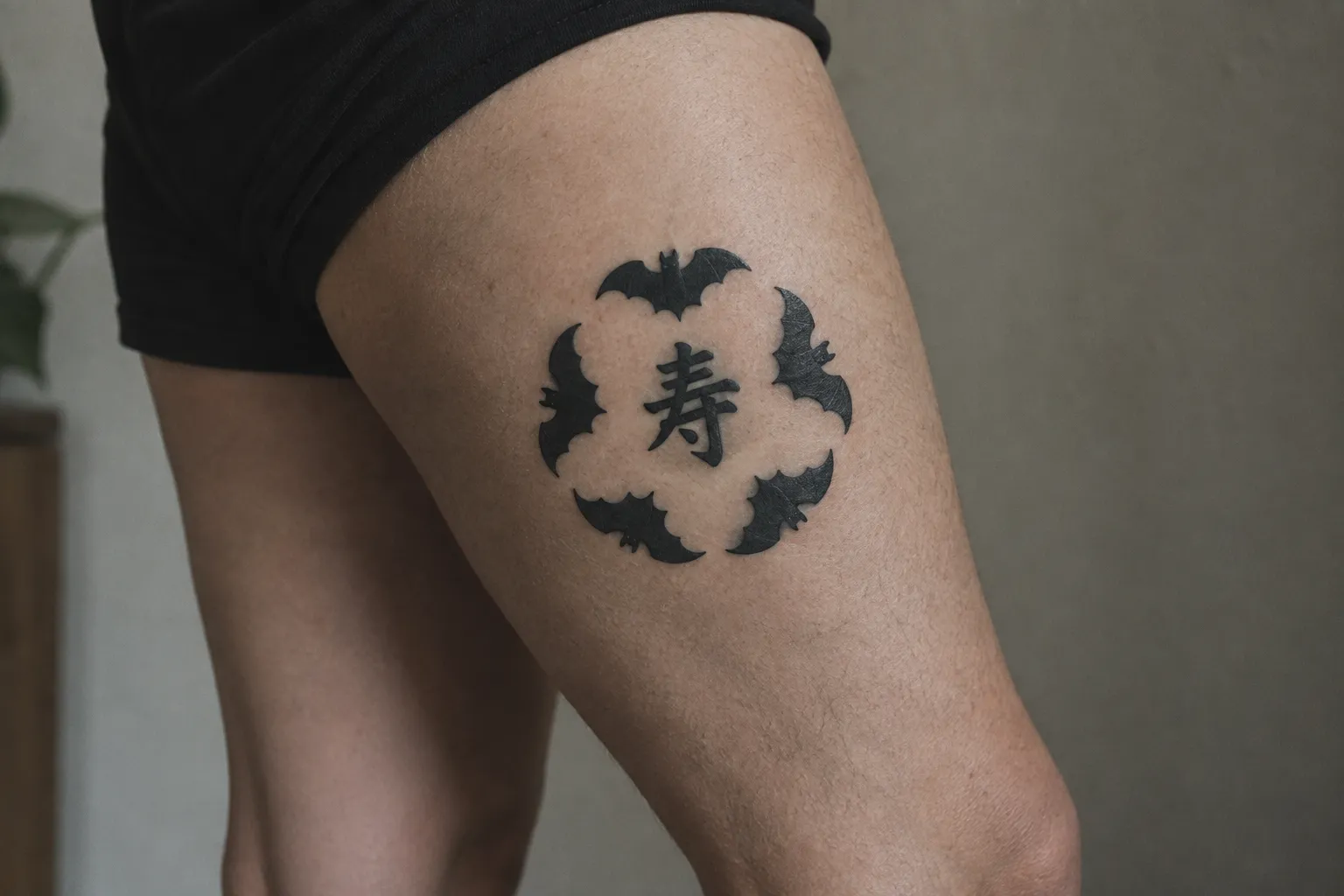
A bat tattoo can carry two unrelated meanings. A single bat silhouette usually stands for something personal, like transformation, intuition, or luck. Five bats circling a longevity character is a specific Chinese motif built on a pun between the words for “bat” and “fortune.” Decide which meaning you want first, because that choice sets how many bats go in the design, which style fits, and how much skin you need.
Bats have real strengths as a tattoo subject. You can make them personal or tie them to Chinese luck symbolism, they work in almost every style from fine line to American traditional, and a clean silhouette stays readable even when small. They also have weak points. Facial and wing detail disappears when the design is shrunk, gothic versions crowd easily, and any Chinese characters in a five-bat layout need checking by someone who reads them before the stencil goes on.
✓ Pros
- The bat's wing shape stays recognizable without relying on a specific species.
- A single bat can be adapted to a personal meaning without requiring a formal layout.
✗ Cons
- The same bat image can be read through very different cultural lenses.
- Choosing a meaningful design may require more reference-checking than the stencil suggests.
Bat Tattoo Meaning: Rebirth, Luck, and the Five Blessings
Bat tattoo meaning falls into two readings: a personal symbol of transformation, intuition, luck, or prosperity, and the formal Chinese five-bat motif representing the Five Blessings. They come from different traditions, and the design you pick should match the meaning you want, not the one you happened to see on a Pinterest board.
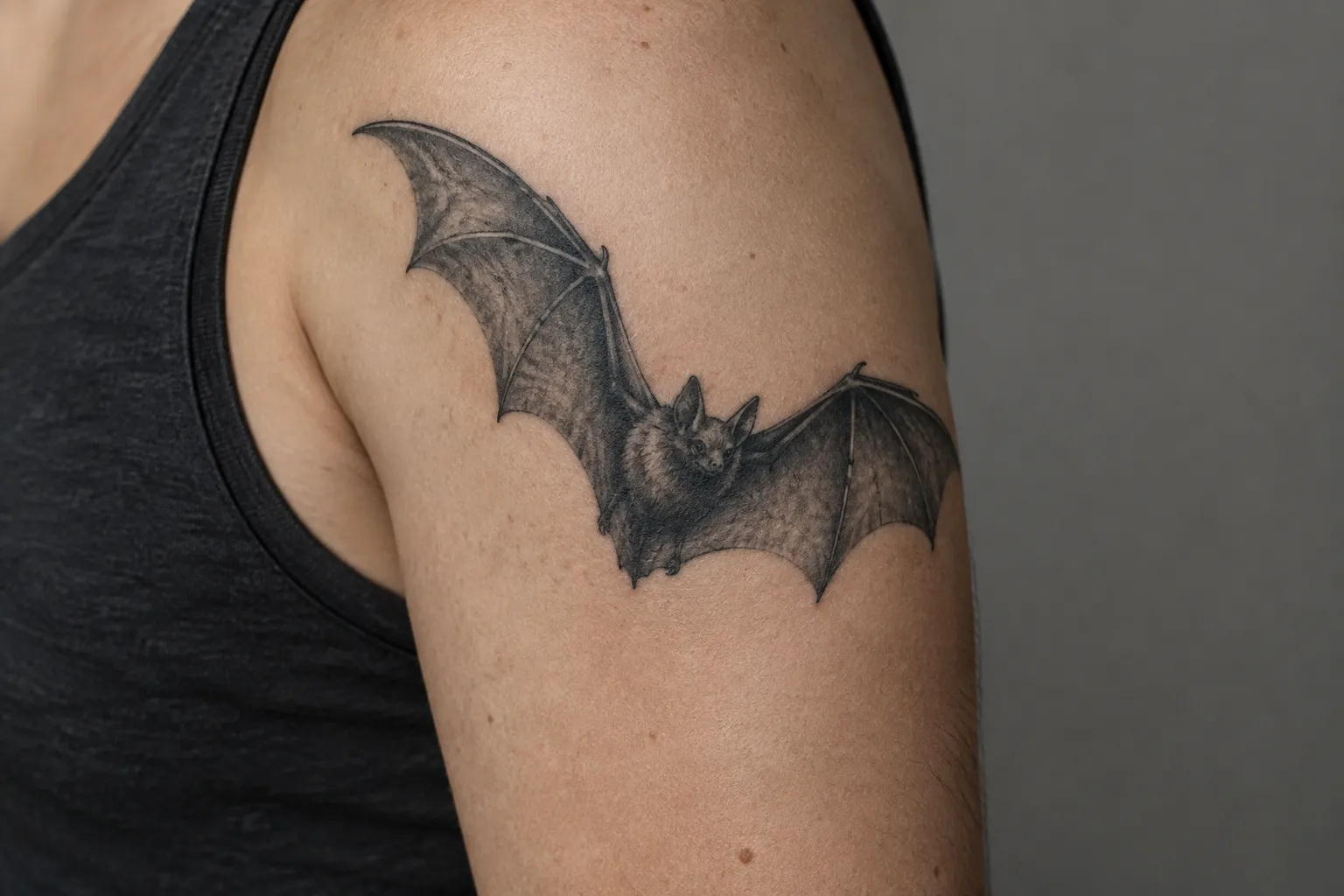
Neither reading is the “correct” one. There is no single fixed meaning for a bat, and a design that suits one tradition can say something different in another. In the West the bat has long stood for a dark, sinister creature of the night, while in China it often represents good fortune (6). Each reading is legitimate in its own context, and a bat design does not have to read as evil (1).
Personal symbolism: transformation, intuition, luck, prosperity
As a personal symbol, a bat can stand for transformation, intuition, good fortune, long life, or prosperity, depending on what the wearer brings to it (1). Some cultures read the bat as rebirth and adaptability, and because bats emerge at night and find their way through darkness, a bat tattoo can mark overcoming obstacles or embracing change (7): a recovery, a move, the end of something.
Echolocation, finding your way through the dark by something other than sight, gives the bat a reading of guidance and resilience in tough times (7). If you would rather wear a feathered night creature, the owl carries wisdom, night watch, and intuition among our bird tattoo ideas. Other traditions have their own bat figures. The Maya and Aztecs associated bats with the underworld, and some depictions of Camazotz, the Maya bat god, show him as a protector of souls while others show a figure of destruction (7). In the West, bats sit beside black cats and witches as Halloween symbols, partly because of their night habits and partly because of misconceptions about the common vampire bat (6). That is the reading many Western viewers will reach for first.
For a personal meaning, you need one bat, drawn in a style you like. Nothing about transformation or intuition requires a set number of bats or a particular layout.
Chinese Five Blessings: five bats around a longevity character
In Chinese symbolism, the bat is auspicious because fú 蝠, “bat,” sounds like fú 福, “good fortune” (5). That pun has run through Chinese decorative art for centuries, on vases, bowls, dishes, and snuff bottles (6), and on porcelain, fabric, and embroidery (5).
The formal version uses five bats for the Five Blessings, wǔ fú 五福 (5). The Asian Art Museum’s collection describes five bats surrounding the character for longevity as representing long life and the Five Blessings: longevity, wealth, health, love of virtue, and a peaceful death (3). In that motif the longevity character, 壽 (5), sits in the center and the five bats surround it (3).
You will see related puns in the same tradition. Red was associated with abundance, again through pronunciation, so red bats were especially emphatic signs of fortune, and a bat shown upside down means good fortune has arrived, because the phrase for “upside down” sounds like the word for “arrived” (6). The museum’s jade panel adds a background of wan symbols, a visual pun for “ten thousand” that repeats the wish ten thousand times (3). The museum’s label calls them swastikas (3), and in the West that form reads very differently from its meaning in Chinese art, so think twice before adding it to a five-bat tattoo.
The decision rule is short. If you want the Five Blessings, use five bats around a longevity character, laid out the way the traditional motif does it. If you want a personal symbol of luck or change, a single standalone bat is enough. Before tattooing any Chinese character, verify the character and layout with someone who reads Chinese or an artist experienced in the motif. A mirrored or wrong stroke on a longevity character is hard to fix once it is tattooed.
Minimalist and Small-Scale Bat Designs
A minimalist bat stays readable from four cues: two curved wings, a compact body, pointed ears, and a small nose (1). Get those right and a small bat tattoo reads as a bat from across a room. Lose one and it starts to look like a bird, a moth, or a smudge.
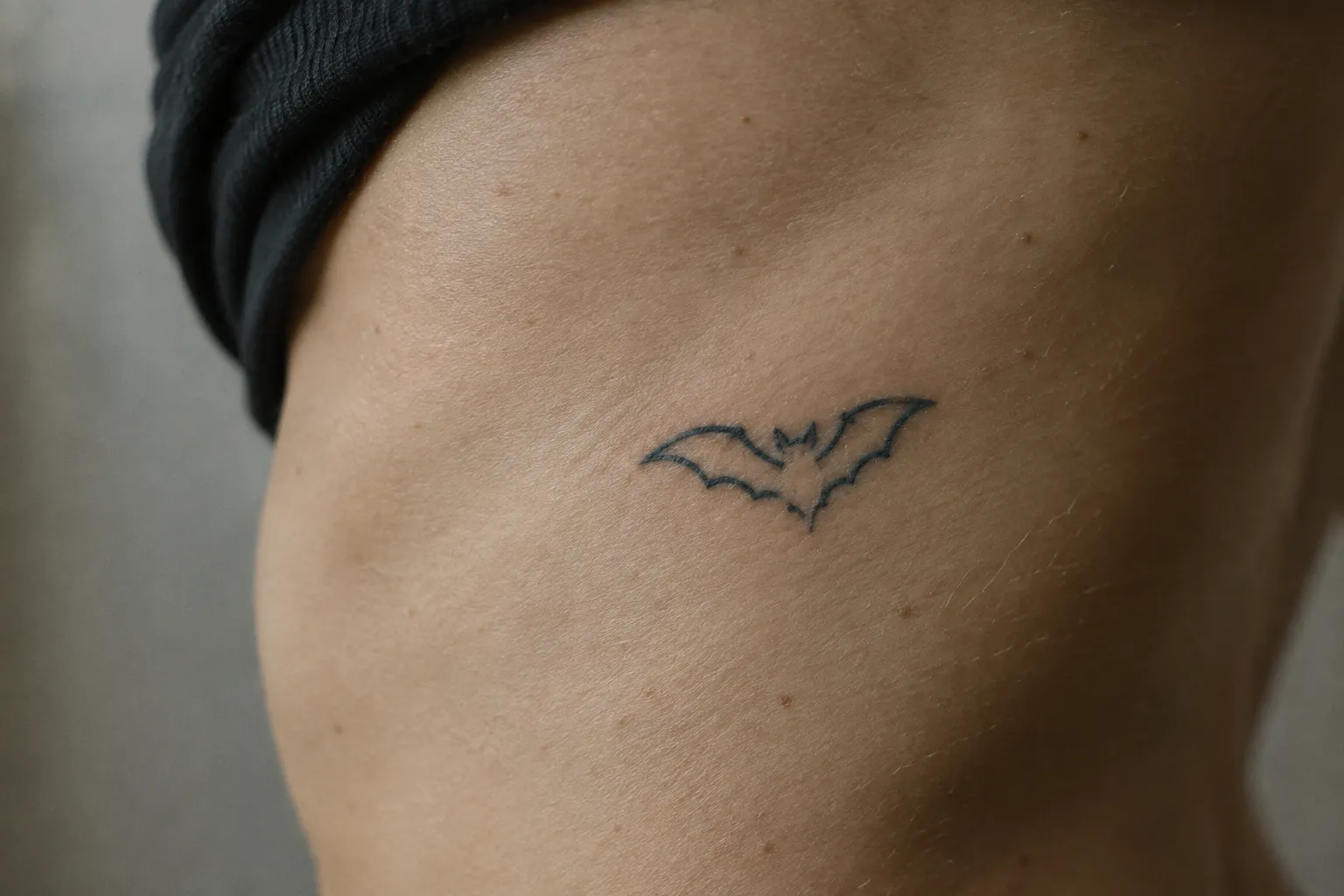
The two technical hallmarks of a good minimalist bat are a consistent line weight and deliberate negative space. Every gap between wing struts or between ear and head has to be wide enough to stay separate as the tattoo ages. The most common pitfall is the reverse. Artists draw a delicate, accurate bat at screen size, with finger bones in the wings and a textured body, then shrink it. Species-specific details disappear at small sizes, and lines that sit close together can soften or merge over time (1).
Where it works: wrist, ankle, finger, behind the ear
A compact silhouette or a sparse line drawing suits these spots (1):
- Inner wrist: flat and easy to show or cover. Pain sharpens toward the wrist, where flexor tendons and nerves run through. Keep the design bold, since fine details shrunk too far can soften or merge over time (1).
- Ankle (outer, above the bone): good for a bat sized to sit in the hollow beside the ankle bone. It sits over bone, where the machine’s vibration travels through and is hard to ignore, and socks and shoes rub it during healing.
- Finger (side or top): the tightest space and among the fastest to fade. Finger skin sheds often and takes constant friction, so expect touch-ups and keep the design to a closed silhouette.
- Behind the ear: easy to hide under hair, with a clear outline against the neck. It sits over the skull, where the machine’s vibration travels through the bone and is hard to ignore.
All four spots hurt more than the outer forearm, which sits in the low tier of our tattoo pain scale. If pain is the deciding factor, a small bat on the outer forearm is the easiest session of the bunch.
Keeping the outline readable at true size
Ask your artist for several minimalist versions: a closed silhouette (solid black fill), an open contour (outline only), and a selective black fill (outline with the body or wing membranes filled) (1). Then compare each one at the actual tattoo size, not enlarged on a screen (1). Print them at scale or hold the stencil against your wrist.
Here is how the three tend to behave:
- The closed silhouette is the most durable. Strong silhouettes and dense black keep their readability long-term (1), though you lose interior detail entirely.
- The open contour looks light and fine-line when fresh, but it depends on clean, separated lines. On a finger or wrist, the gaps can close up over time.
- Selective fill sits in the middle. A filled body with open wings, or filled wings with an outlined body, gives you contrast without the weight of full black.
Pay attention to the ears and nose. These small features are what separate a bat from a generic winged shape (1), so the artist should exaggerate them slightly rather than draw them anatomically small.
Gothic Bat Compositions: Roses, Thorns, and Skulls
A gothic bat tattoo pairs the bat with a restrained selection of roses, thorns, skulls, crosses, smoke, or pointed architectural forms (1), and it works only when one element clearly leads. Pile in everything on that list and the bat gets lost.
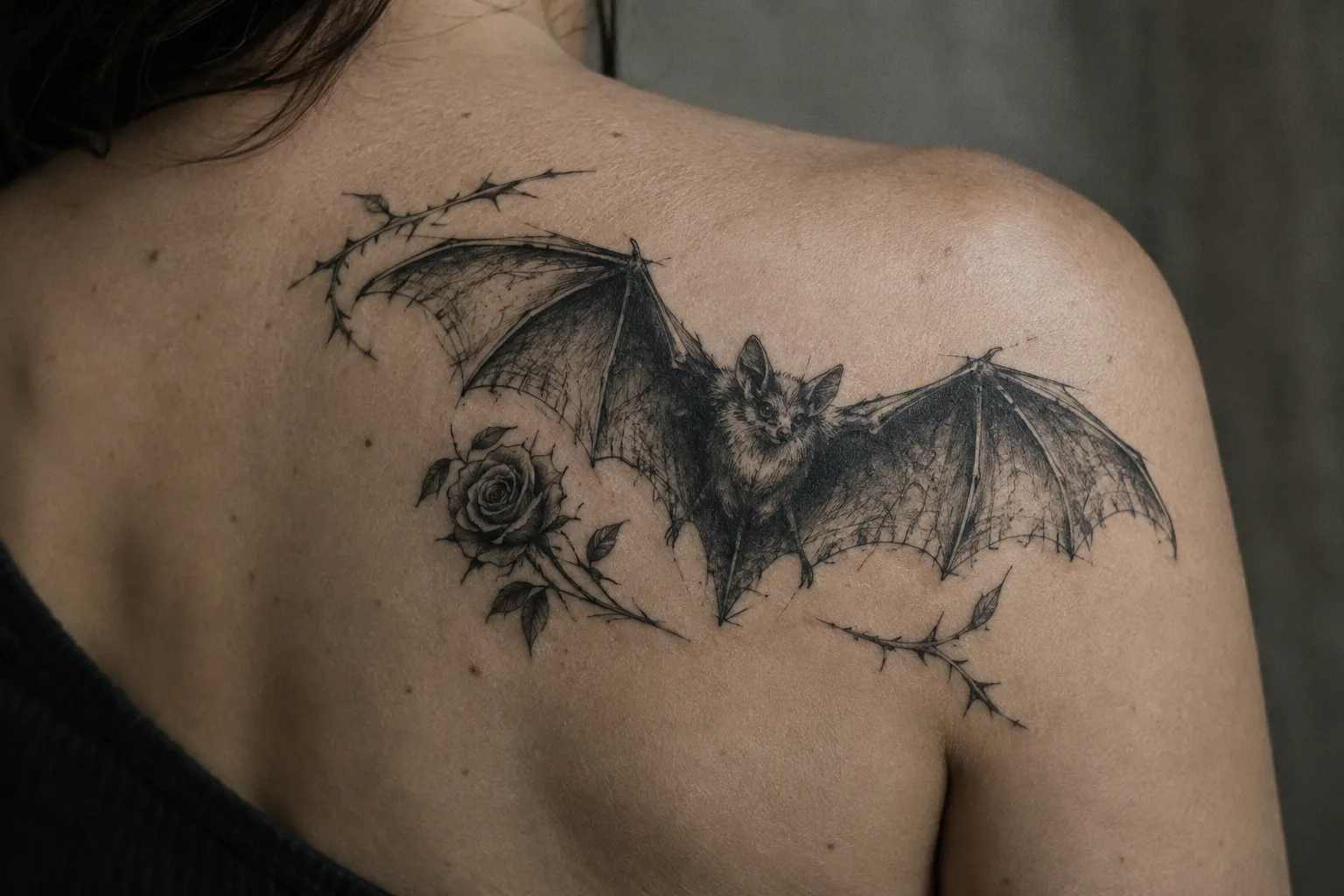
“Gothic” here means the tattoo style: dark, ornamental, high-contrast imagery drawing on Victorian ornament and pointed-arch architecture (1). It overlaps with goth subculture and with Gothic architecture, but you do not need a cathedral window or a link to the music scene to get one. If you mean the subculture aesthetic, bring references from that world. If you mean the architecture, bring photos of arches and tracery. Either way, tell your artist which one you mean.
The two technical hallmarks of the style are heavy black contrast (solid blackwork or deep black-and-gray) and ornamental framing that gives the bat a setting: arches, filigree, a border of thorns. The common pitfall is overload. Dense black and too many symbolic objects make the details compete (1), and the result reads as a dark blob from a few feet away.
Common gothic elements and picking a focal point
Decide which element should draw the eye first (1) and let everything else support it. Some pairings that work:
- Bat + rose: the classic. The rose’s soft curves contrast with the angular wings. Keep the rose smaller than the bat, or make the bat clearly the subject.
- Bat + thorns: thorns can frame the bat or wrap the composition, and they add line movement without heavy fill.
- Bat + skull: strong, but a skull is a focal point in its own right. Pick one to dominate. A bat perched on a skull works. A bat and a skull at equal size fight each other.
- Bat + architecture: a pointed arch or window behind the bat gives depth and a natural frame for a vertical placement like the forearm or calf.
- Bat + smoke: smoke fills space softly and leads the eye. Use it to connect elements, not as filler.
Before the design starts, decide whether the bat is a finished standalone piece or the center of a larger sleeve, back, or thigh composition. Then leave space for that (1). A standalone gothic bat can be fully framed. A sleeve centerpiece should have open edges that later work can flow into.
Avoiding an overcrowded composition
Preserve negative space and define the essential elements before adding extras (1). In practice:
- Limit yourself to the bat plus one or two additions. More supporting symbols will crowd anything smaller than a large back or thigh panel.
- Let skin show through. Gaps of bare skin between the bat and the rose, or between the thorns, are what make blackwork readable after it heals and softens.
- Vary the black. Solid black on the bat, softer gray on smoke or architecture, so the bat sits in front.
- Size up rather than pack in. If you want more elements, ask for more skin. Do not ask for smaller details.
Gothic compositions with add-ons need room. A larger thigh, back, or sleeve area keeps the extra symbols from competing with the bat itself (1). This is the piece to put on the outer thigh or shoulder blade, not the inner wrist.
Realistic, Traditional, and Vampire-Bat Style Options
Beyond minimalist and gothic, bat tattoos commonly go three other ways: bold American traditional, detailed realism, or a species-accurate vampire bat that skips the Halloween clichés. Each one needs a different amount of skin and a different artist.
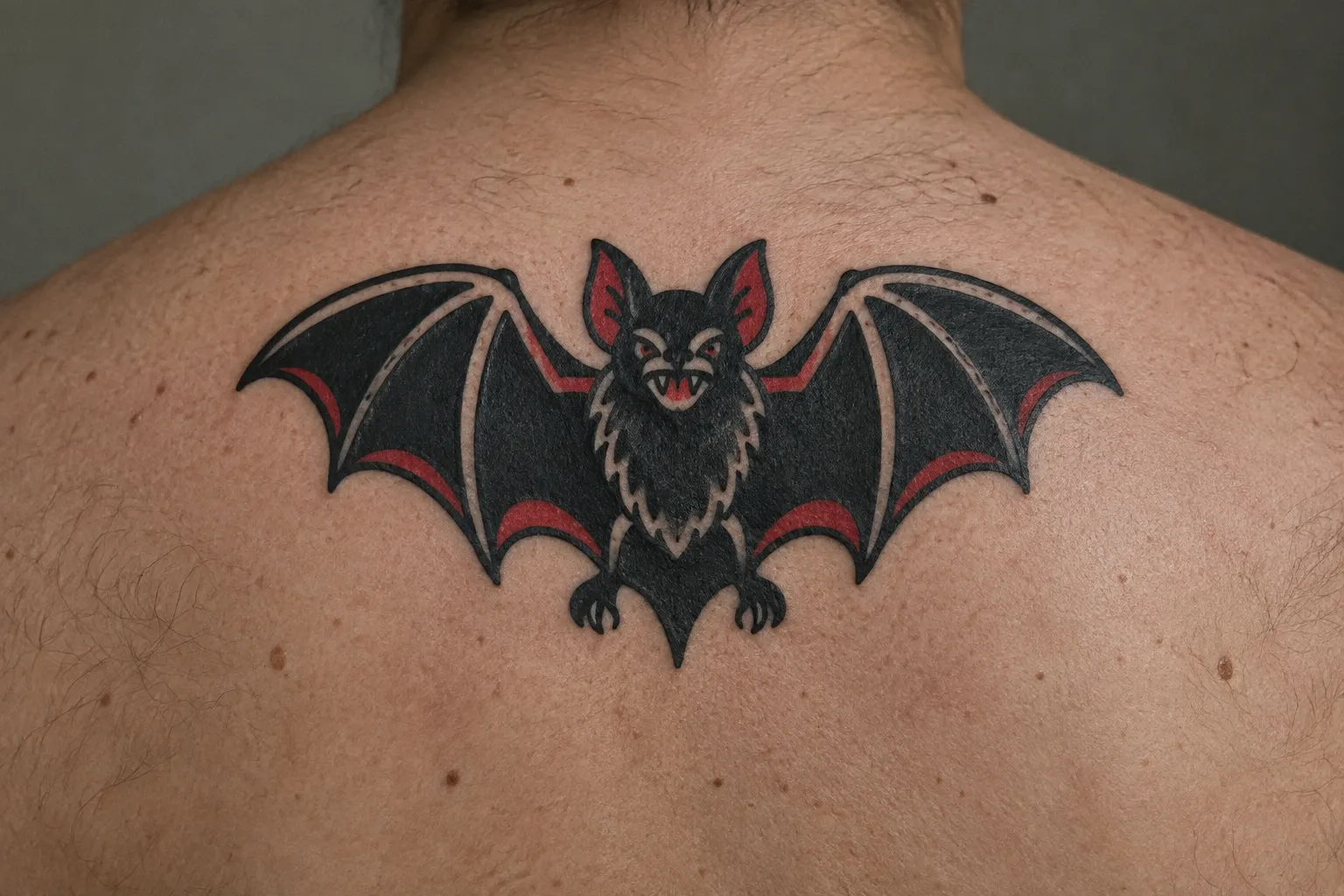
American traditional bat
American traditional uses bold outlines and compact color fields that prioritize quick readability (1). The two hallmarks are the ones that define the whole style: thick black outlines and a limited palette, here usually red and black. A banner, rose, or crescent moon can make a red-and-black design personal (1). A crescent moon behind the bat sets the night scene, and a banner gives you space for a name or date.
The common pitfall is an artist who draws the outline too thin or adds realistic texture inside the wings. Traditional work is rated very durable over time (1), and that durability rests on the heavy outlines, so it only works if the artist commits to them. A traditional bat with spindly lines and gradient shading heals into something that is neither traditional nor realistic.
The style suits the outer forearm, upper arm, calf, and chest, and it can go smaller than realism because the design is built from simple shapes (1).
Realistic bat portrait
A realistic bat portrait needs clear anatomical references, and the artist’s portfolio should show animal faces, black-and-gray shading, and soft transitions (1). Ask to see healed photos of animal work, not only fresh ones, because soft shading only shows its real quality once it has healed.
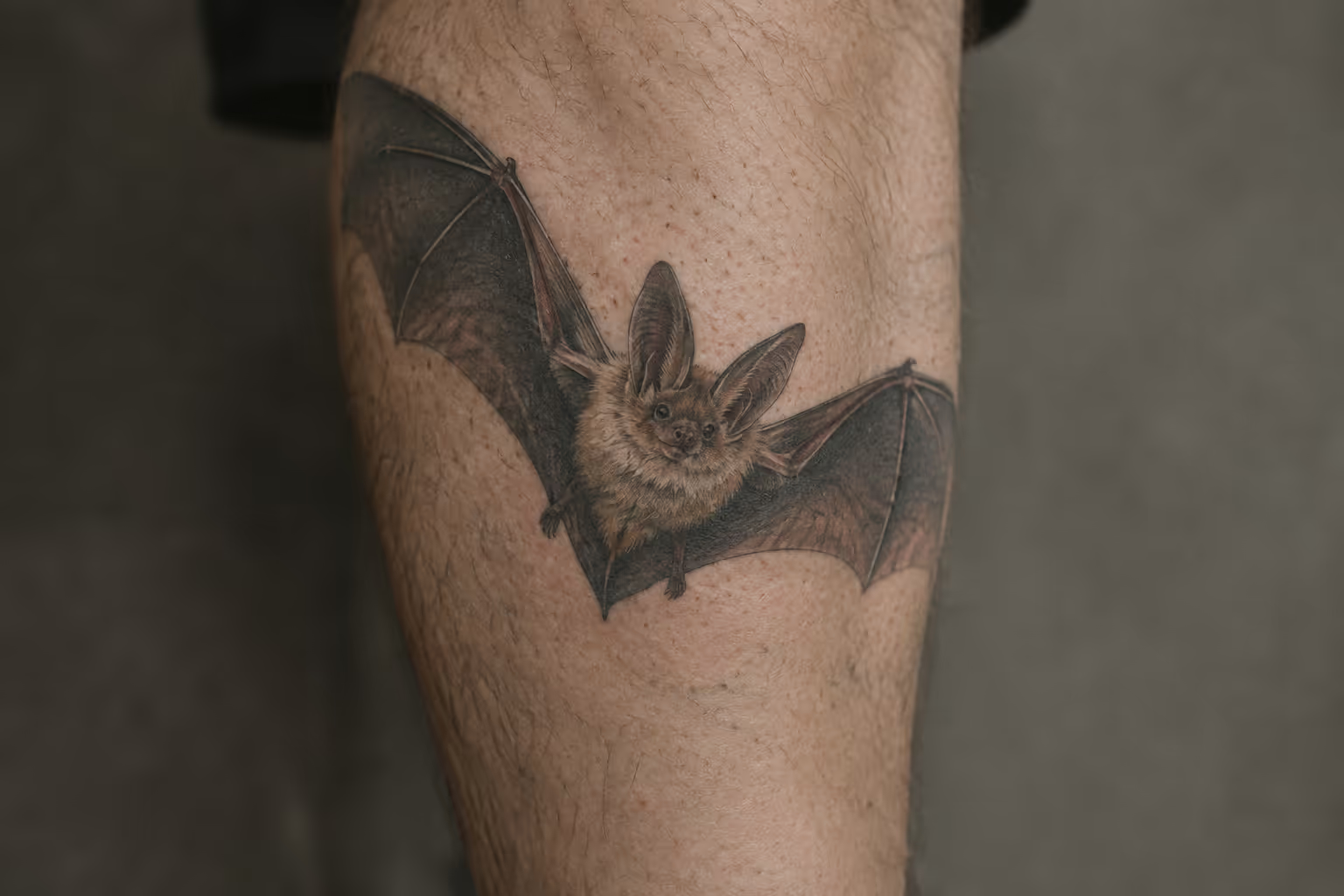
The two hallmarks are smooth tonal gradation (no hard edges where there shouldn’t be any) and accurate anatomy: the fold of the ear, the fur texture on the face, the finger bones running through the wing membrane. The pitfall is scale. Shrinking a detailed face, fine ornament, or tightly packed lines into a small tattoo risks losing separation (1). Choose a size that fits the facial expression and anatomy you care about, and when detail matters more than discretion, prioritize scale (1).
Realism needs broader, flatter areas: the upper arm, outer forearm, thigh, chest, or shoulder blade (1). For pain, the outer upper arm, outer forearm, and outer thigh sit in the low tier, while the chest hurts more, especially over the sternum. If you want a forgiving first long session for a realistic piece, the outer thigh or outer forearm is a good starting point.
Species-accurate vampire bat
Three true vampire bat species feed entirely on blood, and the common vampire bat is the only one that feeds entirely on the blood of other mammals (4). The horror mythology came later than the animal, and a vampire-bat tattoo doesn’t need exaggerated fangs to read as one (1). It looks sharper and less like a costume-shop decoration when it is drawn from the real animal.
Build the design from defining features such as a pronounced muzzle, a clear wing structure, or a grounded pose rather than generic fangs or a flying silhouette (1). Pull reference photos of the actual animal and bring them to the consultation alongside any mood images (1).
This approach works in realism, black-and-gray illustration, or a well-drawn traditional piece. It is weakest in tiny minimalist form, where the muzzle and posture details that make it a vampire bat are the first things to blur.
Comparing the five main bat tattoo routes
Here is how the main options compare:
- Minimalist silhouette: best on the wrist, ankle, finger, or behind the ear. Needs little detail. Small, and it reads well at that size. Usually a personal meaning such as transformation or luck.
- Gothic composition: best on the thigh, back, or as a sleeve center. Needs moderate to high detail. Takes a large area to make room for the add-ons. Leans dark, romantic, or subcultural.
- Realistic portrait: best on the upper arm, outer forearm, thigh, chest, or shoulder blade. Needs high detail. Palm-sized or larger. The emphasis is on the animal itself.
- American traditional: best on the outer forearm, upper arm, calf, or chest. Needs little to moderate detail. Medium-sized, though bold enough to go smaller. The meaning is direct, often personalized with a banner or moon.
- Five-bat Chinese motif: best on the upper back, chest, or outer thigh, where a circular layout sits flat. Needs moderate detail. Must be big enough for five distinct bats and a legible character. Means good fortune and the Five Blessings.
Placement Guide: Matching Size and Detail to Skin Space
Bat tattoo placement depends on how much detail the style demands relative to the skin available. Silhouettes suit small discreet spots, and realistic or gothic work needs broad, flat areas (1). The more detail you want, the more surface you need.
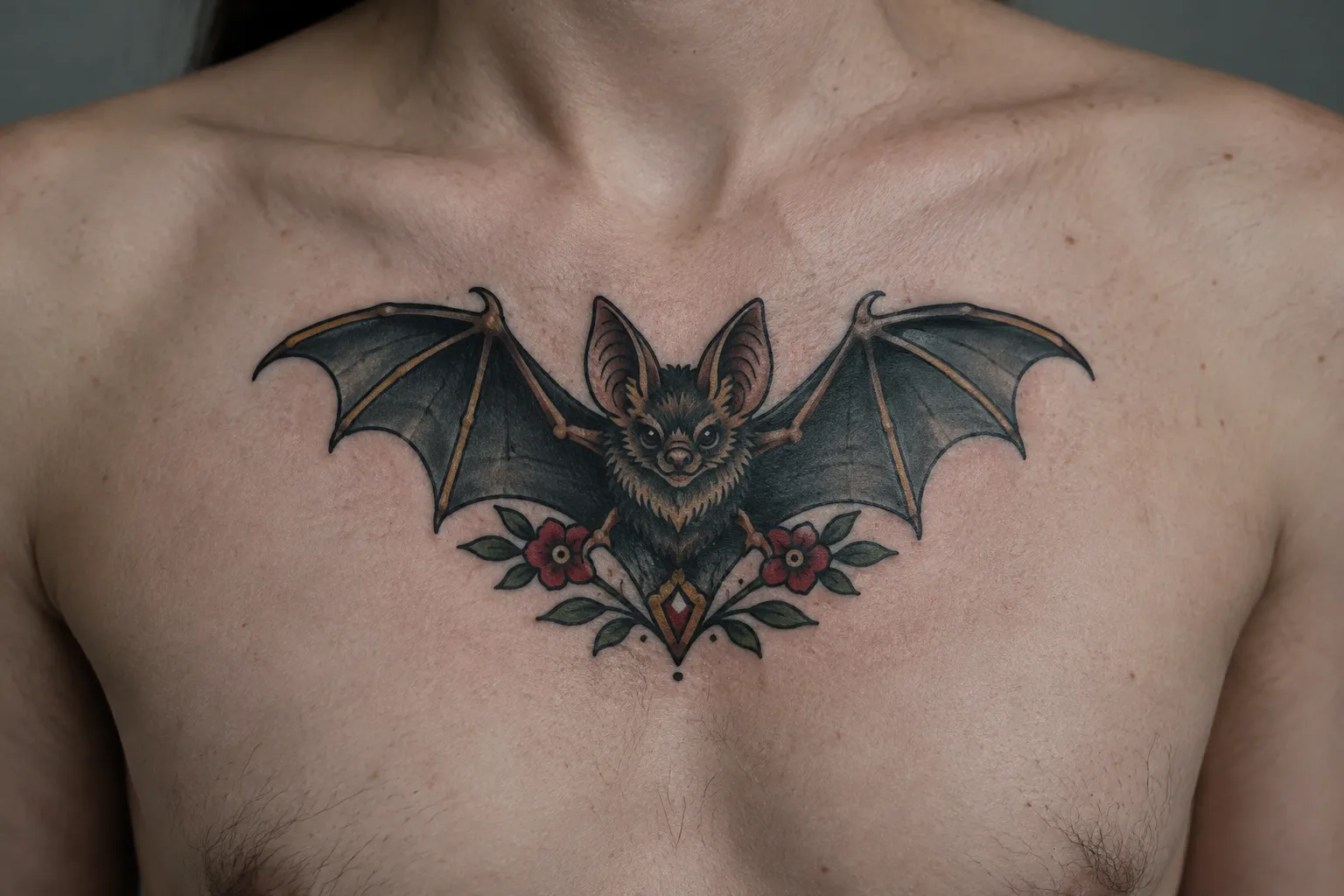
The 1/3 rule and sizing a detailed piece
The 1/3 rule treats roughly one-third of a limb segment as a natural visual unit for a standalone piece, as our tattoo placement guide explains. Push much larger or much smaller and the proportions read off.
The rule points the same way as the detail problem. A realistic or gothic piece needs a flatter, broader canvas, because the face, wing membranes, and add-ons need room to stay separated. A detailed bat squeezed onto a narrow wrist breaks that proportion, and once it blurs you lose the face too. A small silhouette on a large outer thigh looks lost. Pick the placement and the size together.
Before you book, settle the meaning, style, approximate scale, and placement, and bring reference images that show the direction rather than something to copy exactly (1).
Placement checklist by style
- Minimalist silhouette: inner wrist, outer ankle, side of finger, behind the ear (1). Keep it bold on high-movement or high-friction spots.
- American traditional: outer forearm, upper arm, calf, chest. Simple enough to sit on curved areas.
- Realistic portrait: upper arm, outer forearm, thigh, chest, shoulder blade (1). Flat and broad enough for facial and wing detail.
- Gothic composition: thigh, back, or as the center of a sleeve, sized to leave negative space around the add-ons (1).
- Five-bat motif: upper back, sternum and chest, or outer thigh. The circular, symmetrical layout needs a flat area so the five bats keep their spacing.
One check matters more than the rest. Symmetrical geometric wings can look distorted on curved or moving skin, so look at the stencil with the body relaxed and then moving before you commit (1). Raise and lower your arm, flex the forearm, sit and stand. A wingspan that looks level on a relaxed forearm can twist when you rotate your wrist. Ask your artist to adjust the stencil until it reads in the positions you are in most often.
Common Design Mistakes and Healing Aftercare
The bat tattoo designs most likely to fail are detailed faces, tight ornamental lines, and symmetrical geometric wings shrunk to a small, moving placement (1). Simple silhouettes handle small scale far better. Knowing this before you book, along with a realistic healing timeline, prevents most regrets.
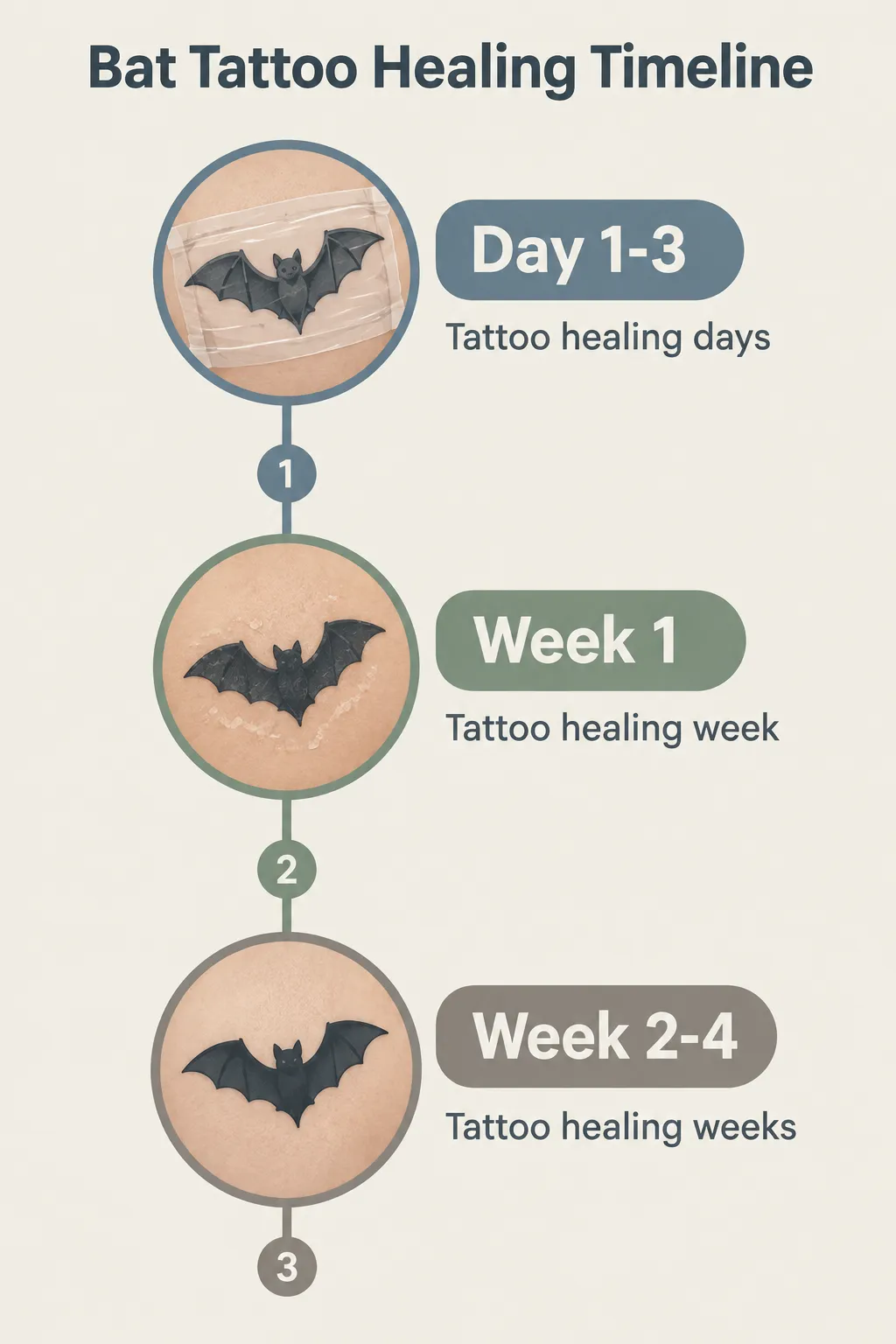 Bat tattoo healing timeline: days 1-3, week 1, and weeks 2-4.
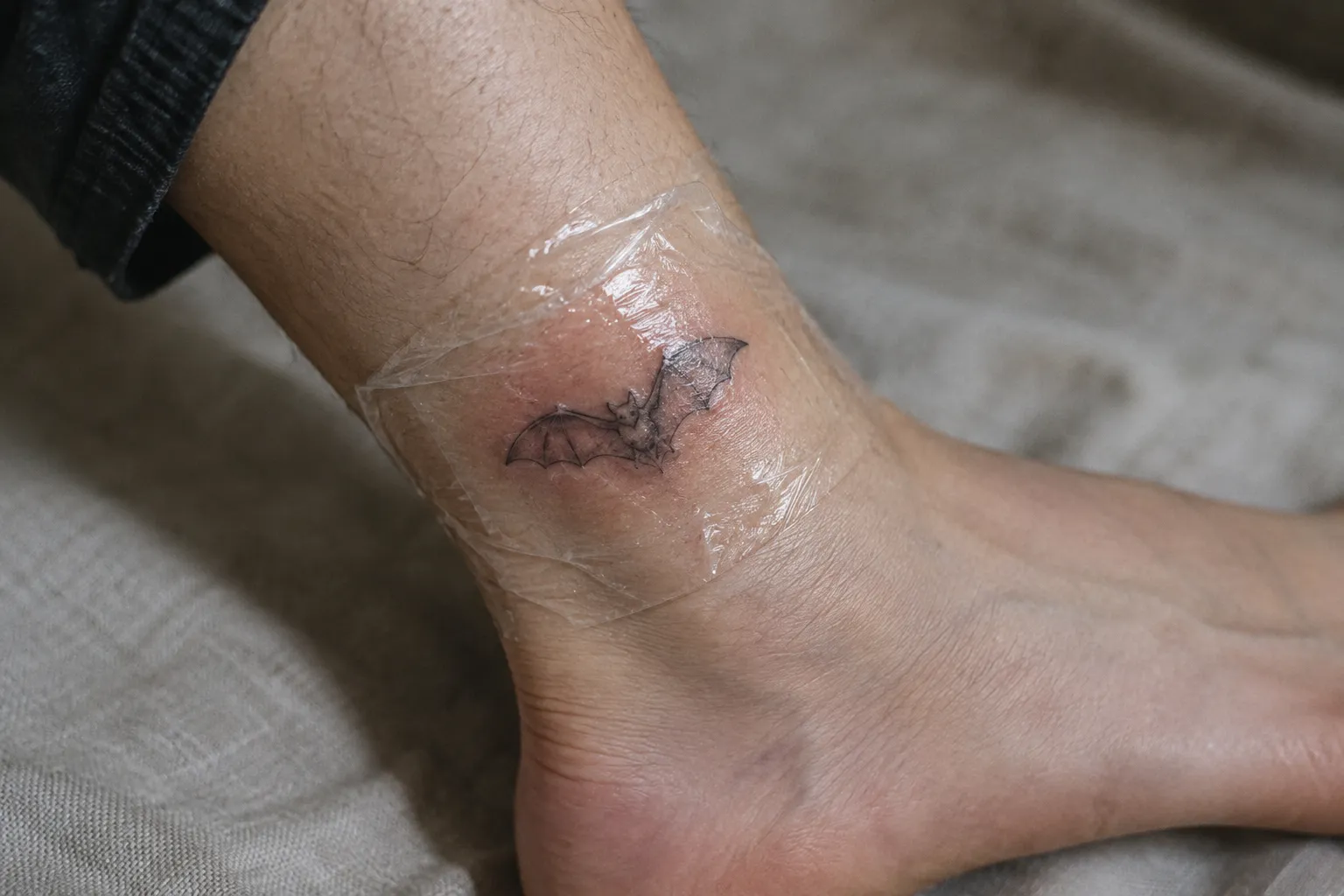
Tattoos to avoid: designs that don’t survive small scale
The biggest planning mistake is taking a design meant for a forearm and shrinking it to fit a wrist. Fine details and close lines may soften or merge over time (1). Lines that start a hair apart can end up touching, and the bat’s face becomes a dark patch.
Avoid these at small scale:
- Detailed bat faces with fur texture, individual teeth, or eye highlights. They need a palm-sized area or larger.
- Tight ornamental lines, such as gothic filigree or lace, packed into a small border (1).
- Symmetrical geometric wings on curved or moving skin, where any bend shows the asymmetry (1).
- Overloaded gothic compositions with dense black and too many objects (1).
- Unverified Chinese characters in a five-bat design.
Some designs to avoid aren’t about the bat. These include anything placed where friction will wear it down faster than you’d accept (finger, palm edge), and anything copied exactly from another person’s tattoo instead of adapted to your body.
Healing timeline and basic aftercare
A bat tattoo heals on the same calendar as any other: the surface looks healed around weeks 3-4, and the deeper skin keeps remodeling until full integration around week 6, as our tattoo aftercare guide lays out week by week. Tattoos also carry an infection risk: bacteria can come from the skin, the artist’s hands or equipment, the ink itself, or the environment, and contaminated ink has caused documented outbreaks (8). Choose a licensed studio that opens single-use needles from sealed packages in front of you (8). Skip alcohol for 24 hours before the session, since it thins the blood.
The step-by-step routine is laid out below. See a doctor for redness that spreads and worsens after day 5, yellow or green pus, or fever, rather than waiting it out.
How to care for a new bat tattoo
About six weeks to full integrationFollow your artist's wrap instructions, keep the tattoo clean and lightly moisturized, and keep it out of water and direct sun until it has fully settled.
- 1
Follow the wrap instructions
Leave the artist's wrap on for the amount of time they recommend, then remove it as instructed.
- 2
Wash gently
During days 1-3, wash 2-4 times daily with lukewarm water and fragrance-free soap, fingertips only; pat dry with a clean paper towel and apply a thin film of ointment.
- 3
Moisturize lightly
During week 1, switch to a thin layer of fragrance-free lotion from about day 3. Expect flaking around days 4-7 and don't pick it.
- 4
Leave the peeling alone and stay out of water
During weeks 2-4, expect peeling and itching in week 2; the surface looks healed around weeks 3-4. Skip swimming and soaking for at least the first 2-3 weeks.
- 5
Keep it out of the sun until it settles
Keep direct sun off the tattoo for 4-6 weeks; full integration comes around week 6, then use SPF 30 or higher whenever it is exposed.
Placement changes the healing. Ankle and finger tattoos take more rubbing from shoes and hands, and finger tattoos fade faster because the skin sheds so often, so plan on a touch-up, which most artists offer between weeks 6 and 12.
Frequently Asked Questions
- What does a bat tattoo mean?
- A bat tattoo can express a personal turning point without relying on a set cultural code; viewers may still read its night imagery as gothic or horror-related.
- What does the bat symbolize in Chinese culture?
- In Chinese decorative art, the bat is a good-fortune symbol through the fú 蝠 and fú 福 sound-pun; the five-bat layout adds the Five Blessings.
- What is the 1/3 rule for tattoos?
- On a limb, the 1/3 rule treats roughly one-third of a segment as a natural size for a standalone piece, so a detailed bat needs a segment big enough for that third to hold its face and wings.
- What are some tattoos to avoid?
- Avoid a design whose smallest gaps disappear at stencil size; ask to see the artwork at actual scale before approving fine lines or tiny facial details.
- Will a small bat tattoo lose detail over time?
- Small bat tattoos hold their silhouette better than their interior detail, so choose a design whose identity does not depend on tiny wing marks.
- Can a vampire bat tattoo look realistic instead of like a Halloween decoration?
- A vampire bat can read as natural history rather than horror when the reference emphasizes its muzzle, wing structure, and grounded pose instead of oversized fangs.
- Does the five-bat design have to include five bats to count as lucky?
- A single bat can represent personal good fortune, but the five-bat arrangement is the specific Chinese decorative motif associated with the Five Blessings.
Choosing Between One Bat and Five Before You Book
Start with the fork. One bat is a personal mark of transformation, intuition, or luck. Five bats around a longevity character carry the Chinese Five Blessings and need a checked character and a flat, circular placement. Next, match the style to the skin. A bold silhouette survives the wrist, ankle, finger, or behind the ear. Realistic, gothic, and five-bat compositions need the upper arm, outer forearm, thigh, chest, or back. Test the stencil with your body relaxed and moving, plan for about six weeks before the tattoo fully settles, with no swimming for the first 2-3 weeks and no direct sun for 4-6 weeks, and size the tattoo for the detail you want to still see years from now.