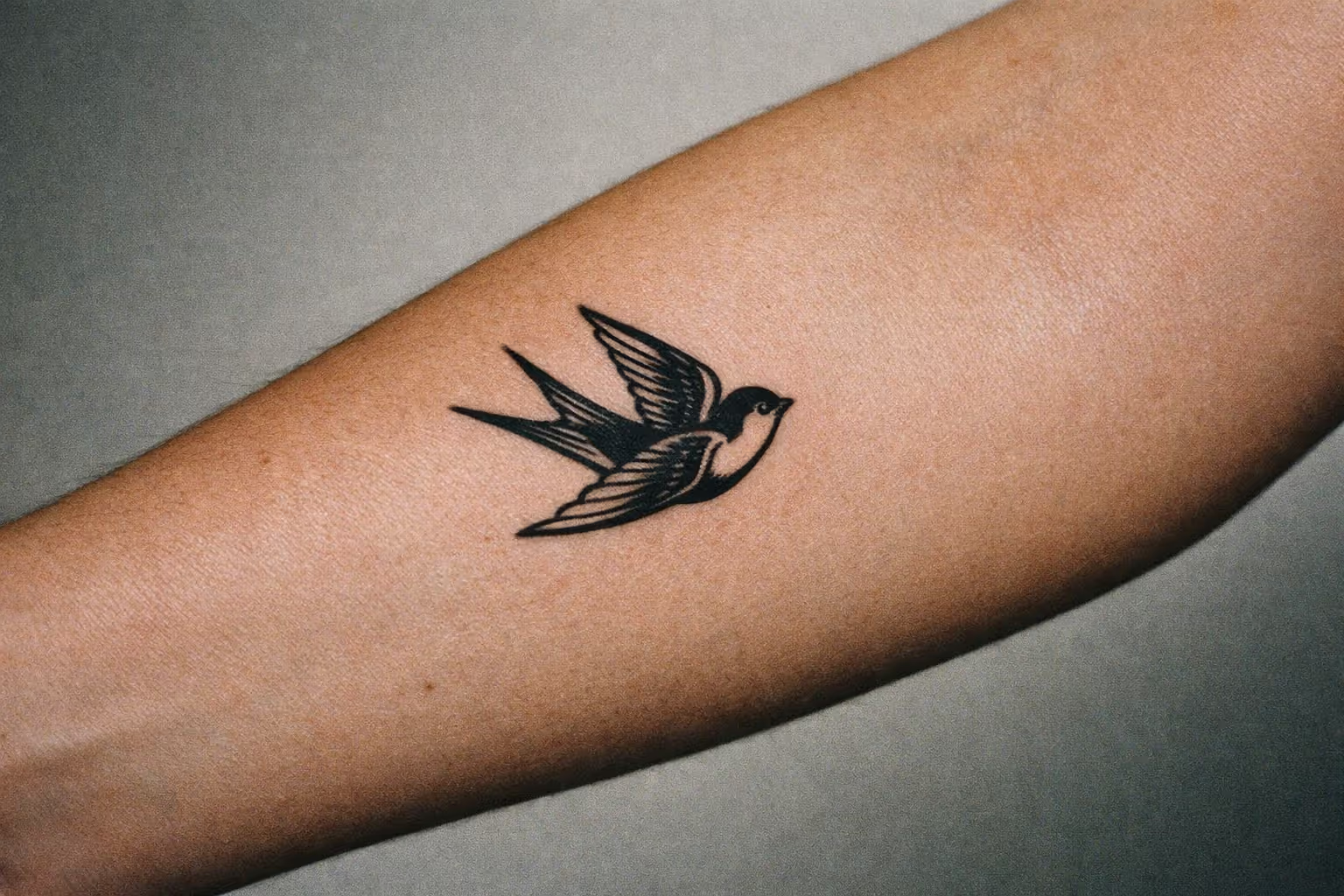
Not all bird tattoo ideas age the same, and that’s the part most galleries skip. A solid swallow at 2.5-4 inches still reads at 20 years; the same bird in hair-thin wrist lines is a grey smudge by year five. Before you fall for a design, it’s worth knowing which species and sizes actually survive the decade. Here are the ideas ranked by what holds up on skin - and what each one means.
Bird Tattoo Ideas: Exploring Small Bird Tattoos, Bird Tattoo Meaning, Swallow Tattoo, Feather Tattoo, and Sparrow Tattoo
When exploring bird tattoo ideas, it’s important to understand that the meaning of a bird tattoo depends on the species and the posture. A bird in flight reads as freedom and momentum. A perched bird reads as home, patience, or grounded watchfulness. A pair usually reads as devotion.
A few specific Bird Tattoo meaning anchors worth knowing before you commit:
- Small bird - perseverance and doing what looks impossible (1)
- Flying bird - optimism, ease, family (2); the Aztecs linked flying birds to messages from the gods (3)
- Three flying birds - joy, tied to the numerology of 3 (4)
- Swallow - peace, motherhood, safety; in sailor tradition, a safe return home
- Bluebird - happiness and luck
- Sparrow - loyalty, freedom in small things, traditional sailor symbolism
- Dove - peace, fidelity, often used in memorial pieces
- Raven / blackbird - intelligence, transformation, mystery
- Eagle - strength, vision, sovereignty
- Owl - wisdom, night watch, intuition
- Phoenix - rebirth after collapse
- Hummingbird - joy, lightness, the present moment
One thing worth flagging: meanings shift between cultures. The dove reads as peace in Western tattoo culture but as a messenger in older Mediterranean traditions. The owl is wisdom in Greek imagery and a death omen in parts of Latin America. I’ve had clients come in with a reference they found on Pinterest with zero idea that the symbol carries a completely different weight in the tradition it came from. If the symbolism matters to you, check the tradition you’re drawing from, not just the first image search result.
Why Small Bird Tattoos Dominate Right Now
If you scroll any artist’s recent work, small bird tattoos are everywhere - and they’re a fair answer to “what’s the most millennial tattoo?” alongside finger hearts, semicolons, and tiny mountain ranges. The single-silhouette swallow on the ribs or the trio of sparrows on the collarbone has been a default first tattoo for over a decade.
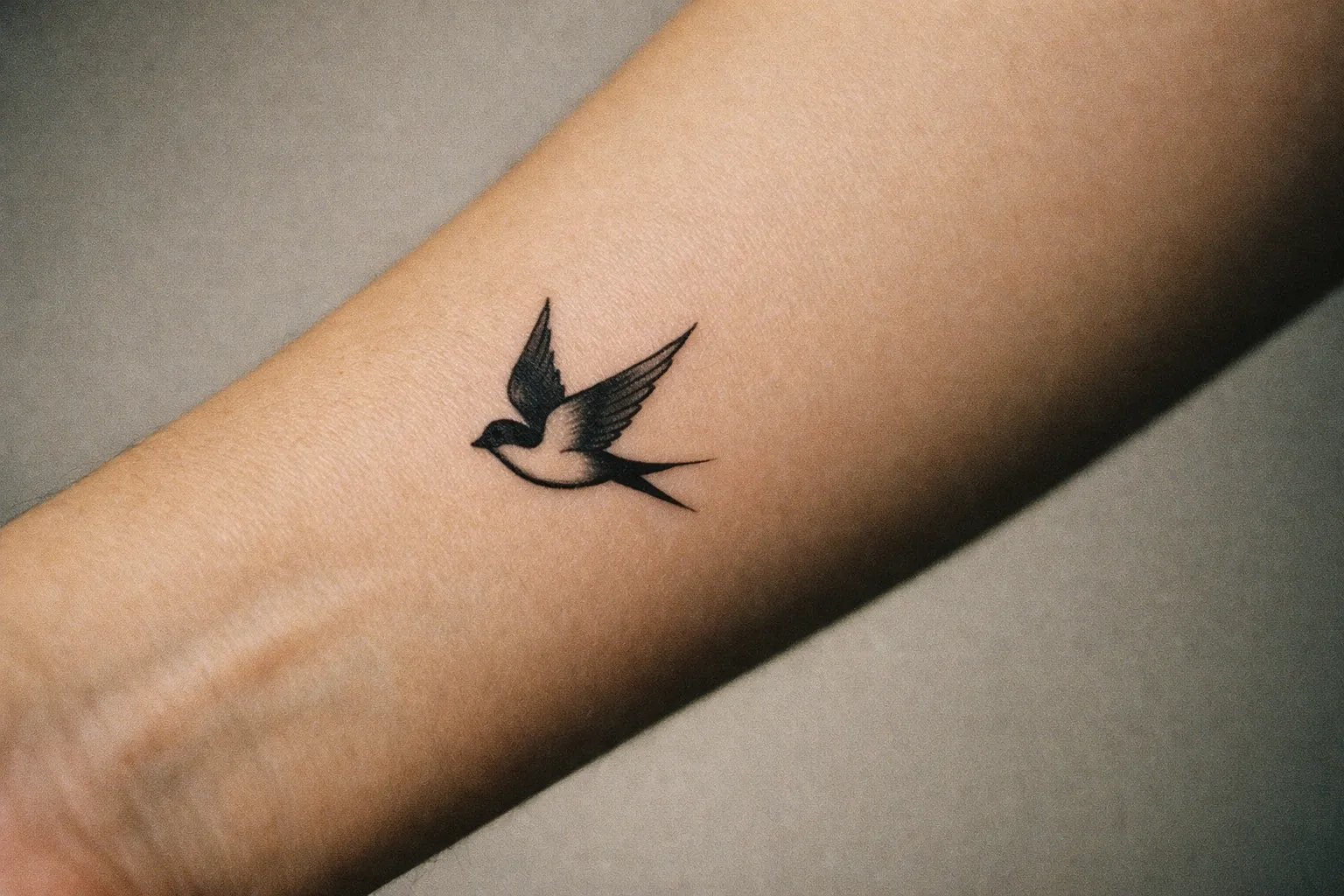
There’s a practical reason for it: small bird tattoos work. A bird silhouette is one of the few designs that stays readable at 1 to 2 inches because the shape - head, body, two wings - is recognizable even when stripped down to four or five lines.
Best placements for small bird tattoos:
- Wrist (inner or outer) - 1-1.5 inches, single bird or trio
- Behind the ear - 0.75-1.25 inches, single silhouette only
- Ankle / Achilles - 1-2 inches, fades faster here, plan a touch-up
- Collarbone - 1.5-3 inches, great for two or three birds in flight
- Sternum - 2-3 inches, centered single bird
- Back of the neck - 1-2 inches, tiny silhouette
One pitfall I see constantly at this scale: ultra-thin single-needle lines can heal too faint, especially on hands, feet, and ankles where skin sheds faster. Ask your artist to size the design 10-20% larger than your gut instinct, and ask to see their healed fine-line work - not just fresh-off-the-needle photos. Fresh linework always looks sharper than it will in two years.
The Swallow Tattoo: The Most Reliable Bird in the Flash Book
The swallow tattoo is the workhorse of bird designs. It’s been in American traditional flash for a century - pointed wings, forked tail, blue body, red chest, thick black outline - and it ages better than almost any small tattoo because the formula is built for it: thick black outline plus a limited palette of saturated colors. Same recipe that keeps anchors and roses looking sharp at year 20.
Meaning-wise, the swallow carries peace, motherhood, and safety, plus the sailor lineage: one swallow for 5,000 nautical miles, two for 10,000, a swallow on the chest for a safe return. Most modern wearers skip the maritime backstory entirely and read it as “I made it through something.” Both are valid.
Two technical hallmarks of a well-done traditional swallow tattoo:
- Bold 1.5-2mm outline that won’t blur into the color fill over time
- Solid color saturation with no gradients - blue is blue, red is red
Common pitfall: artists doing traditional in a fine-line style. A swallow with hairline outlines isn’t really a swallow - it’s a sparrow in disguise, and it loses the readability that makes the design hold up long-term. I’ve seen these come in for cover-ups at year seven looking like a smudge.
Sizing and placement: 2.5-4 inches on the chest, upper arm, or behind the ear. Pairs - one on each side of the collarbone or chest - are common and read as a balanced composition.
The Sparrow Tattoo: The Quieter Cousin
People confuse swallows and sparrows constantly, and I get it. The shorthand: swallows have pointed wings and forked tails (built for speed and distance); sparrows have rounded wings and short tails (built for hopping around). Visually, a sparrow tattoo reads softer and more domestic.
Sparrows show up in two main styles:
- American traditional sparrow - same flash treatment as the swallow, brown and cream body, thick outline. Sailor symbolism for loyalty and return.
- Fine-line sparrow - single-needle silhouette or sketchy linework, often perched on a branch. Reads modern and minimal.
Sizing: 1.5-3 inches works at most placements. The forearm and inner bicep are forgiving spots that hold detail longer than wrist or hand placements.
If you want a small, traditional-style bird that reads clearly without the maritime weight of the swallow, the sparrow tattoo is the cleaner pick.
Feather Tattoo: When You Want the Idea Without the Bird
A feather tattoo is the abstract version - the symbol stripped to one part. It reads as lightness, freedom, and sometimes loss (a feather is what’s left after the bird leaves). It’s also one of the most flexible designs for placement because a feather is long and narrow, so it follows the body’s lines naturally.
Strong placements:
- Forearm (along the bone) - 3-6 inches
- Ribcage (vertical) - 4-8 inches
- Spine - 4-10 inches, runs with the vertebrae
- Behind the ear down the neck - 2-4 inches
Style options:
- Black linework feather - ages best, holds detail for years
- Feather dissolving into birds - the “feather breaking apart into a flock” composition is popular but technically demanding; only book it with an artist whose healed work shows the small birds still readable, not blurred dots
- Watercolor feather - vibrant fresh, but watercolor without a black anchor line tends to fade and migrate; expect a touch-up around year 3-5
- Native or tribal feather - this is the one to think hard about. Eagle feathers carry specific ceremonial meaning in many Indigenous North American traditions and aren’t a neutral aesthetic choice. If you don’t have a personal connection to the tradition, pick a generic songbird feather instead.
Bird Tattoo Styles, From Traditional to Fine-Line
The bird is the subject. The style is how it ages.
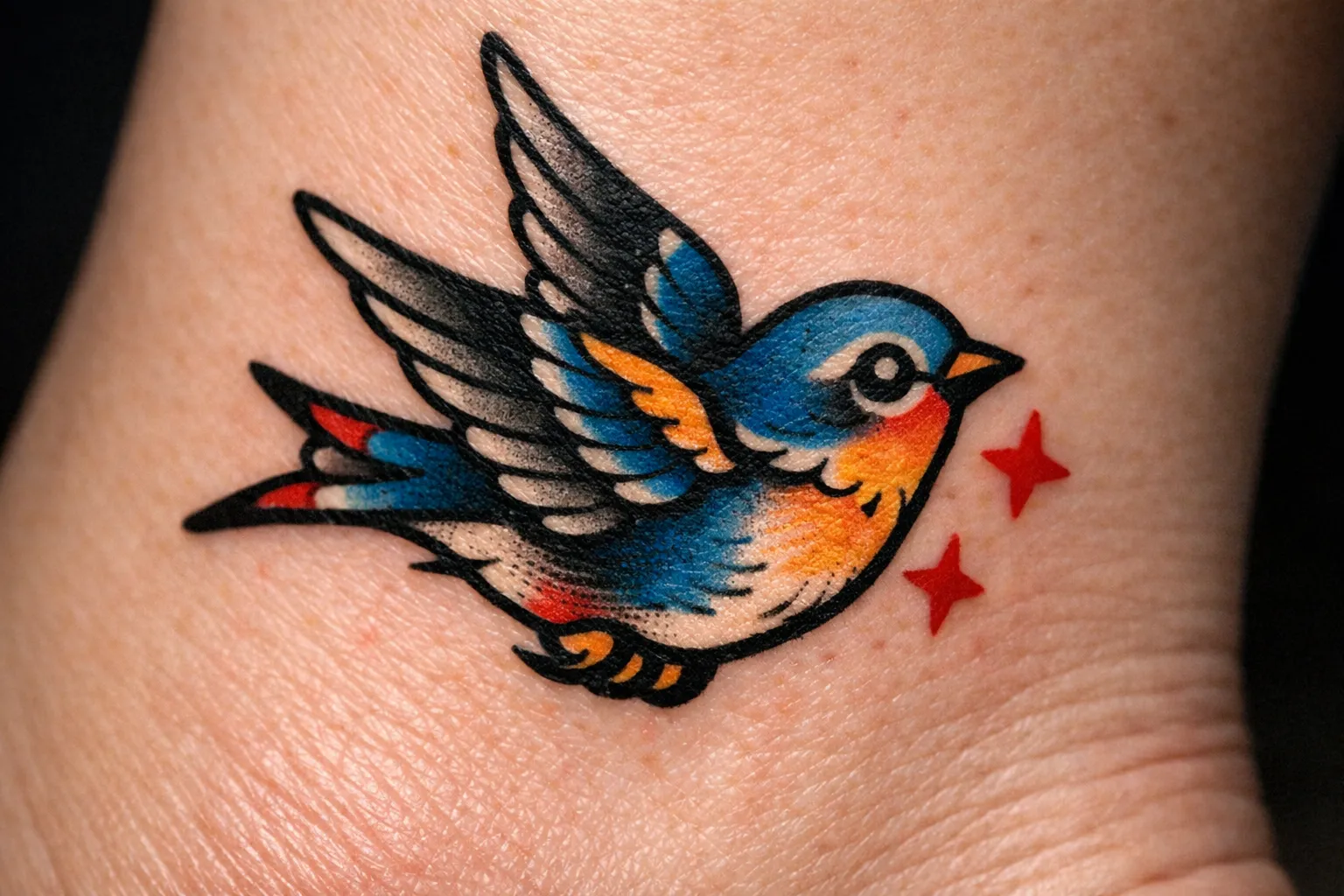
American traditional. Thick black outlines, limited saturated palette (red, blue, yellow, green), bold shapes. Swallows, eagles, and hawks are the classic subjects. Pitfall: artists who don’t commit to the outline weight produce a “neo-traditional-lite” version that blurs early. I’ve tattooed over a few of those.
Japanese (irezumi influence). Cranes, phoenixes, sparrows, and hawks rendered with wind bars, clouds, and cherry blossoms. Best for larger compositions - half sleeve, back, chest panel - not 2-inch wrist work. Pitfall: pulling Japanese motifs into a small piece without the supporting background elements; it reads as a sticker rather than a composed tattoo.
Fine-line / single-needle. Hair-thin black lines, minimal shading. Great for small birds, feather details, and delicate silhouettes. Pitfall: blowout on thin skin (inner arm, ankle, finger) when the artist pushes too deep - and these lines fade faster than traditional ones, so plan on a touch-up at year 5-7.
Geometric. Birds built from triangles, dot work, or stained-glass-style panels. Works well at 3-5 inches on the forearm or shoulder blade. Pitfall: complex geometry at small sizes loses its grid and reads as a blob.
Watercolor. Color washes without a black outline anchor. Vibrant on day one, but expect fading and edge migration over 3-10 years. Best paired with at least some black linework underneath to keep the shape intact.
Blackwork silhouette. Solid black, no detail. The most low-maintenance bird tattoo you can get - silhouettes read clearly forever because there’s no fine detail to lose.
Compositions Featuring Three or More Birds
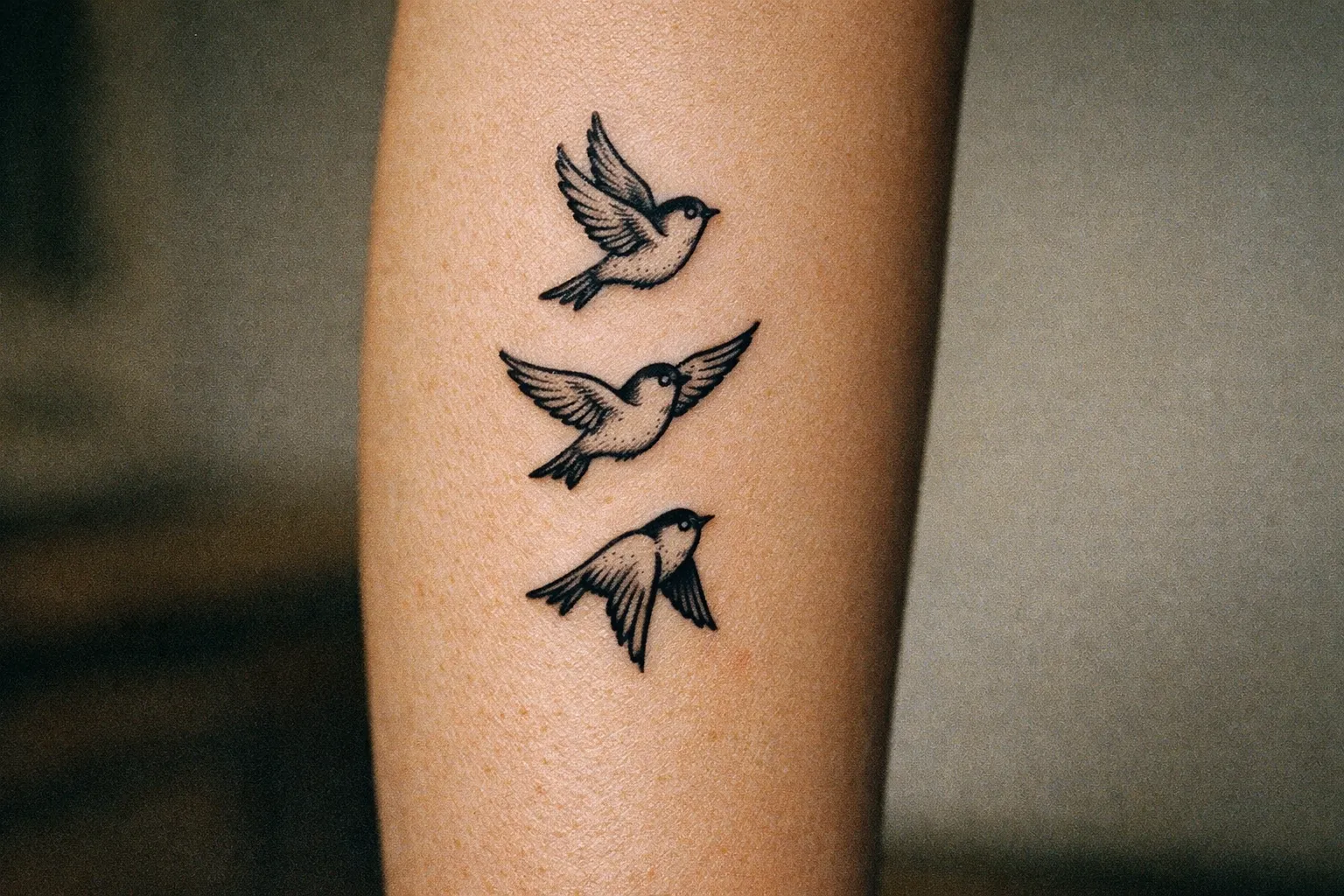
“What does the 3 bird tattoo mean?” is one of the top searches in this category. Simplest answer: a row of three flying birds is associated with joy through the numerology of 3, and in personal-meaning practice it usually represents three family members, three life stages (past/present/future), or three children.
A few real composition notes that matter more than people expect:
- Stagger the spacing. A perfectly straight line of three identical birds reads stiff. Vary the size slightly and offset the vertical position so it looks like a real flock.
- Different postures. One mid-flap, one gliding, one banking - small differences make the composition feel alive.
- Direction matters. Birds flying toward your heart (inward) reads differently than birds flying off the body (outward). Most artists default to outward; ask if you want the other direction.
For four birds, the common readings are family of four or the four directions (N, S, E, W). For larger flocks - 5-15+ birds - the composition is usually decorative rather than symbolic: birds emerging from a tree branch, scattering from a feather, trailing across the collarbone.
Bird Tattoo Placement by Type
| Small silhouette (sparrow, swallow) | Traditional swallow (color) | Realistic owl / eagle | Hummingbird (color) | Phoenix | Feather | Three-bird trio | |
|---|---|---|---|---|---|---|---|
| Best Placements | wrist, behind ear, collarbone, ankle | chest, upper arm, behind ear | forearm, calf, shoulder blade, chest | shoulder, forearm, upper back | back, full chest, thigh, half sleeve | forearm, ribs, spine, behind ear | collarbone, wrist, behind ear, ankle |
| Avoid | finger, palm | hand, foot | wrist, ankle | wrist (fades fast) | anything under 4 inches | finger, palm | ribcage (compresses badly) |
Pain, in relative terms: ribcage and sternum sting the most for bird placements, followed by ankle and behind-the-ear. Forearm, outer shoulder, and upper back are the most forgiving. Wrist sounds scary but lands in the mid-tier - short session, minimal nerve density on the outer side.
When Color Earns Its Place in Bird Tattoos
A bluebird tattoo asks for blue. A cardinal asks for red. A peacock feather asks for the whole spectrum. But for most bird designs, the honest question is: does color make the tattoo better, or just busier?
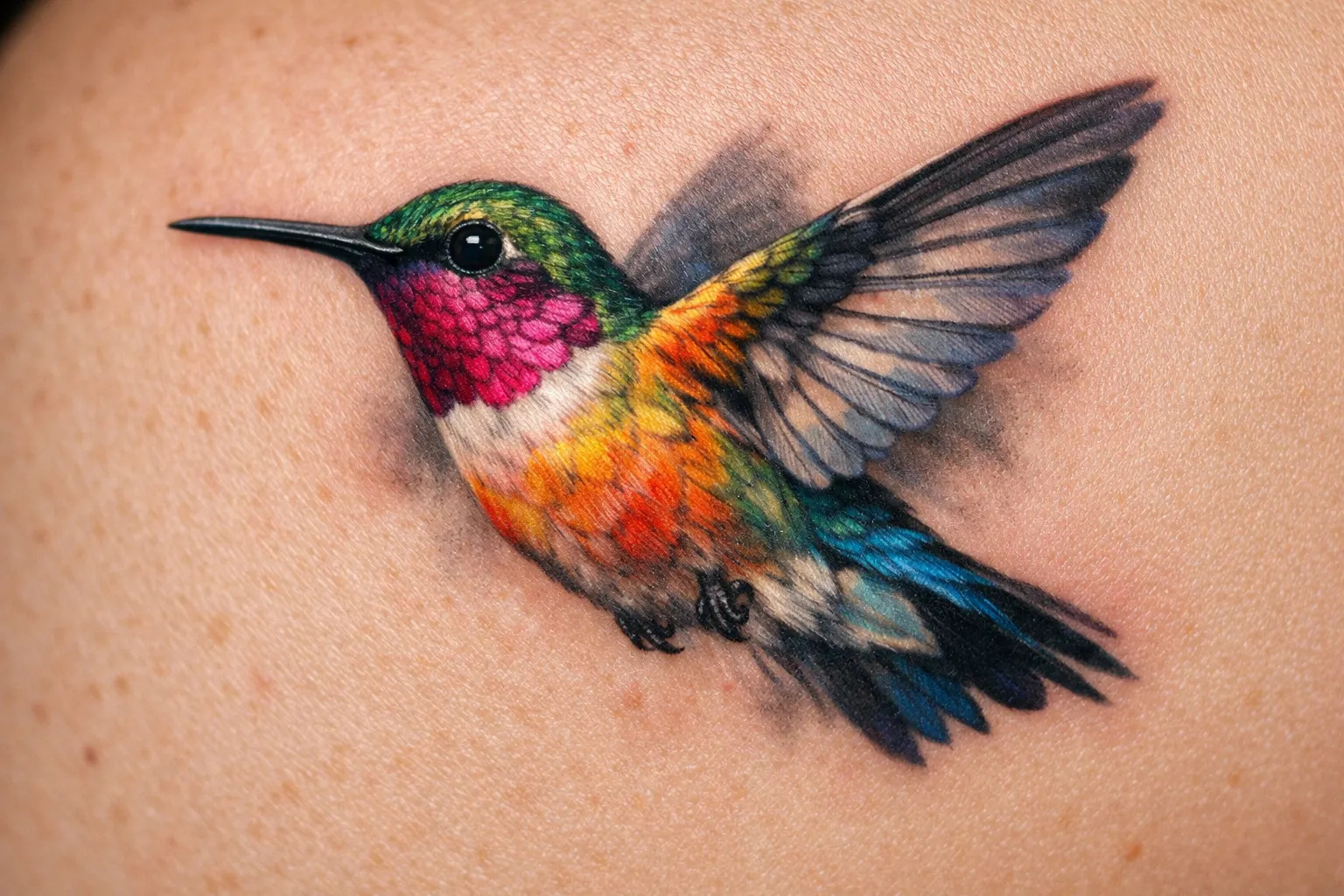
Color works well for:
- Hummingbirds - the iridescent green/blue/pink is half the point
- Traditional flash birds (swallow, sparrow) - color is built into the style
- Realistic species portraits where the bird is identifiable by plumage (cardinal, bluebird, blue jay, goldfinch)
Color is optional for:
- Silhouettes (black reads stronger)
- Geometric work (black + one accent color is usually plenty)
- Fine-line birds (color in fine line fades unevenly)
Color ages in roughly this order: black > red > green > blue > yellow > pastel. If you want a tattoo that still pops at year 15, anchor it with strong black work and use color as accent, not foundation. I’ve watched yellow and pastel pieces go completely invisible on fair skin within five years. It’s not a myth.
Aftercare Timeline for a Bird Tattoo
Bird tattoos heal like any other tattoo, but the fine detail in feathers and outlines means sloppy aftercare shows up faster. A blown-out wing line is more obvious than a blown-out solid shape.
Aftercare Timeline for a Bird Tattoo
6 weeksStep-by-step care to preserve your bird tattoo's fine details and color.
- 1
Day 1-3: Initial Healing
Keep the second-skin or wrap on as long as your artist instructs (usually 24 hours to 5 days). Wash twice daily with fragrance-free, dye-free soap and lukewarm water. Pat dry, don't rub. Apply a thin layer of fragrance-free moisturizer or healing ointment recommended by your artist.
- 2
Week 1: Peeling and Itching
Expect itching and light peeling around days 4-7. Avoid picking, scratching, or soaking the tattoo. No pools, baths, hot tubs, or ocean. Showers are fine but keep them short. Try to sleep without pressing the tattoo against sheets.
- 3
Week 2-4: Milky Healing Phase
The top layer of skin is closed but deeper layers are still settling. Continue applying fragrance-free moisturizer 2-3 times daily. The tattoo may look dull or cloudy; this will clear up. Avoid direct sun exposure.
- 4
Week 4-6: Visual Healing Complete
Most tattoos look fully healed now. Assess if any spots need touch-ups, usually small gaps in line saturation or corners where ink didn't take. Most artists offer free touch-ups within 6 months.
- 5
Long-Term Care
Sun exposure fades tattoos fastest. Use SPF 30+ sunscreen or cover the tattoo with sun-protective clothing. Small birds on wrists fade twice as fast as those on upper arms.
How to Pick the Right Bird and Artist for Your Tattoo
A few honest filters that cut down the indecision:
Start with meaning, not image. Decide what you want the tattoo to say. “Family of three” points you toward three birds. “I survived something” points you toward a phoenix or swallow. “I want it to look good and not mean anything heavy” is also a valid answer - pick a silhouette you like.
Match the bird to the size you want. A detailed owl needs 4+ inches. A silhouette needs 1.5+. Don’t try to fit a realistic eagle on a wrist.
Pick the artist for the style, not the convenience. Fine-line birds need a fine-line specialist. Traditional swallows need a traditional artist. Look for 10+ healed examples in the artist’s portfolio in the specific style you want, photographed in natural light - not just fresh work under studio lighting.
Bring two references. One for the shape (anatomy of the bird), one for the line quality and style. Artists prefer this over a single Pinterest screenshot because it lets them design rather than copy.
Don’t negotiate price down. A bird tattoo is small surface area but high precision. An artist quoting $250 for a tiny piece isn’t overcharging - they’re pricing in the years their lines have to stay clean. The cheap version costs more at the cover-up.
Frequently Asked Questions
- Are some bird species better suited for small tattoos than others?
- Yes. Species with simple, recognizable shapes like swallows, sparrows, and generic songbird silhouettes hold up well at 1-2 inches. Detailed birds like peacocks or exotic parrots lose clarity quickly at small sizes.
- How do cultural meanings affect bird tattoo choices?
- Some bird symbols carry specific cultural or ceremonial meanings, such as eagle feathers in Indigenous North American traditions. If you don't have a personal connection, it's best to avoid culturally sensitive designs or research thoroughly.
- What should I look for in an artist's portfolio for bird tattoos?
- Look for at least 10 healed examples in the style you want, photographed in natural light. Pay attention to line clarity, color saturation, and how the tattoo ages over time, not just fresh work.
- Can I combine multiple bird tattoo meanings in one design?
- Yes, combining elements like a swallow with a banner or a feather dissolving into birds is common. Just keep the composition balanced so no element overwhelms the design at a glance.
- Why do small bird tattoos sometimes fade faster?
- Small tattoos rely on fine lines that the skin can't hold as tightly, especially on high-friction or sun-exposed areas like wrists and ankles. Proper sizing and aftercare can slow fading, but touch-ups may be needed around year 5-7.
- Does the direction a bird faces in a tattoo matter?
- Symbolically, inward-facing birds can represent returning or protection, while outward-facing birds suggest departure. Practically, the design should flow with the body's natural lines and look correct from common viewing angles.