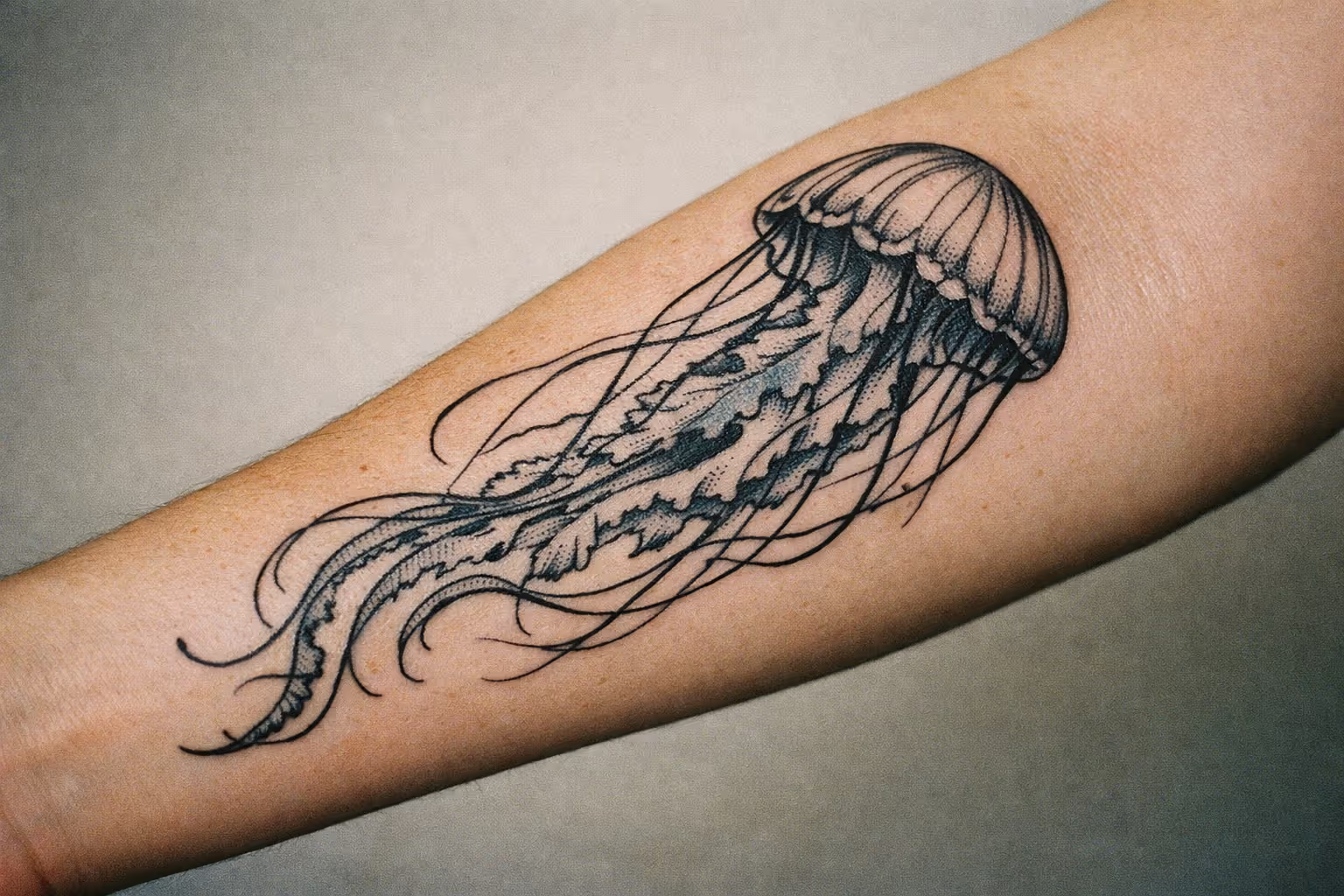
Here’s the fact that anchors a jellyfish tattoo: jellyfish have drifted through the oceans for over 500 million years, outlasting the dinosaurs by a wide margin. That survival arc is the backbone of the meaning - endurance, not fragility - even though the animal looks like the most delicate thing in the sea. Once that clicks, the styling choices make more sense. Here’s what a jellyfish can signify across traditions, and how to build one that keeps its glow.
Jellyfish Tattoo Meaning: Understanding the Symbolism Behind the Motif
The short answer: resilience, grace, transformation, mystery, and protection (2)(3)(4). The longer answer depends on which tradition you’re pulling from.
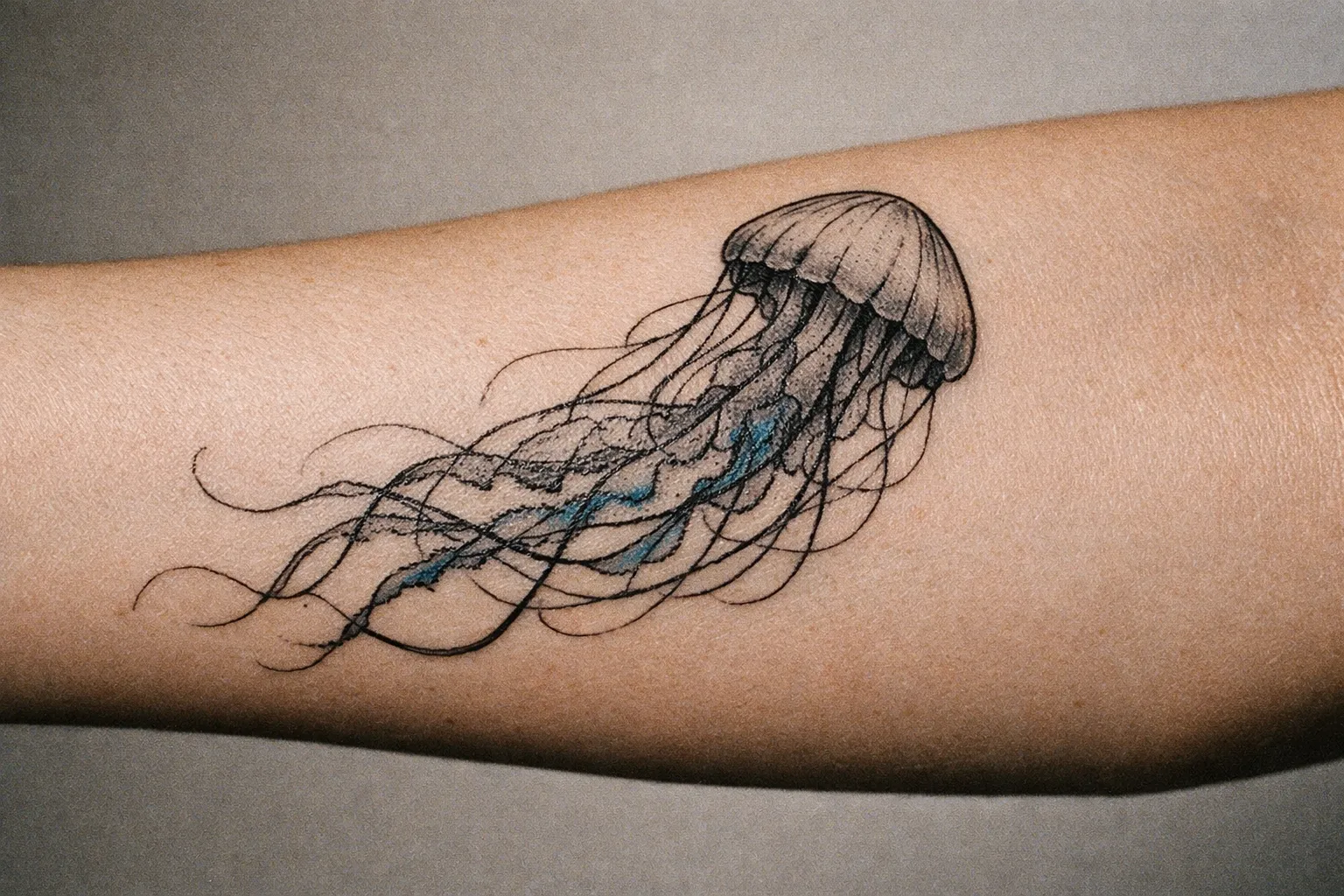
✓ Pros
- Extreme style flexibility - works in realism, watercolor, blackwork, minimalist, and geometric without losing coherence
- Natural placement versatility - tentacles follow long narrow areas (spine, forearm, calf) while the bell anchors round areas (shoulder, sternum)
- Layered symbolism - resilience, fluid identity, spirituality, and mystery can all live in the same image
- Built-in motion - even a static line drawing reads as moving, which forgives minor linework inconsistencies
- Rarely on any 'avoid' list - the motif itself is culturally neutral unless you borrow a specific tradition without understanding it
✗ Cons
- Realism and watercolor styles require specialist artists - a generalist will produce muddy bells and blown-out tentacles
- Fine-line tentacles on high-friction zones (wrists, fingers, sides of hands) blur within 3-5 years
- Watercolor versions need a touch-up around year 5-7 as soft edges fade faster than blackwork
- Glowing and UV-ink styles demand large real estate (20 cm+) and UV pigments may need touch-ups every 1-3 years
- Borrowing Polynesian or Haida motifs without an artist trained in those traditions is a legitimate cultural concern
Resilience and survival
Jellyfish predate dinosaurs, sharks, and trees. That’s the core reason they read as a survival symbol - they’ve outlasted multiple mass extinctions while doing essentially nothing aggressive. If you’re getting a jellyfish to mark coming through something hard, this is the meaning most people will read into it without you having to explain anything.
Grace, flow, and acceptance
Jellyfish don’t swim against the current - they pulse and drift. In Eastern and yoga-adjacent symbolism, the tattoo gets associated with inner peace, harmony, and surrendering to what you can’t control (5). The tentacles trailing behind the bell are often read as energetic flow or interconnectedness with people in your life (2)(3). It’s a quieter meaning than resilience, but I’ve had plenty of clients come in specifically for that “stop fighting it” reading.
Mystery and the deep
Most jellyfish live in places light barely reaches. That’s where the “mystery” reading comes from, and it’s why deep-blue and black backgrounds show up so often in this motif. The negative space around the body is doing as much symbolic work as the body itself.
Danger and protection
The bell looks soft. The tentacles will absolutely sting you. That duality - beauty with a built-in defense - is why some wearers choose jellyfish as a protective or guardian symbol rather than a passive one (5). It’s not the first meaning people think of, but it’s a legitimate one.
Cultural readings
- Japanese symbolism: jellyfish parallel cherry blossom imagery - transformation, impermanence, and sometimes punishment (4). The aesthetic is fragile and short-lived rather than eternal.
- Native American/Haida tradition: jellyfish appear as a “messenger of the sea,” tied to guidance, flexibility, and resilience (4). If you want to pull from this tradition, work with an artist who understands Haida formline rather than imitating the style from a Pinterest screenshot.
- Eastern/yoga contexts: peace, harmony, and spiritual development (5).
What does a jellyfish tattoo mean in LGBT contexts?
Among queer wearers, jellyfish are often chosen for three reasons:
- Survival through adversity - the resilience meaning carries directly.
- Fluid identity - jellyfish have no fixed shape; they pulse, drift, and adapt. That maps cleanly onto gender and sexual fluidity.
- A non-gendered, flowing animal symbol - unlike wolves, lions, or stags, jellyfish carry no masculine/feminine default.
Visual cues that signal queer identity without spelling it out: a subtle rainbow gradient along the tentacles, a pastel pride wash in the background, or pairing the jellyfish with a small triangle, lavender sprig, or progress-flag accent. Your artist can dial saturation up or down depending on how openly coded you want the piece.
Why Jellyfish Make Great Tattoos
A few practical reasons this motif keeps showing up in my consultation bookings:
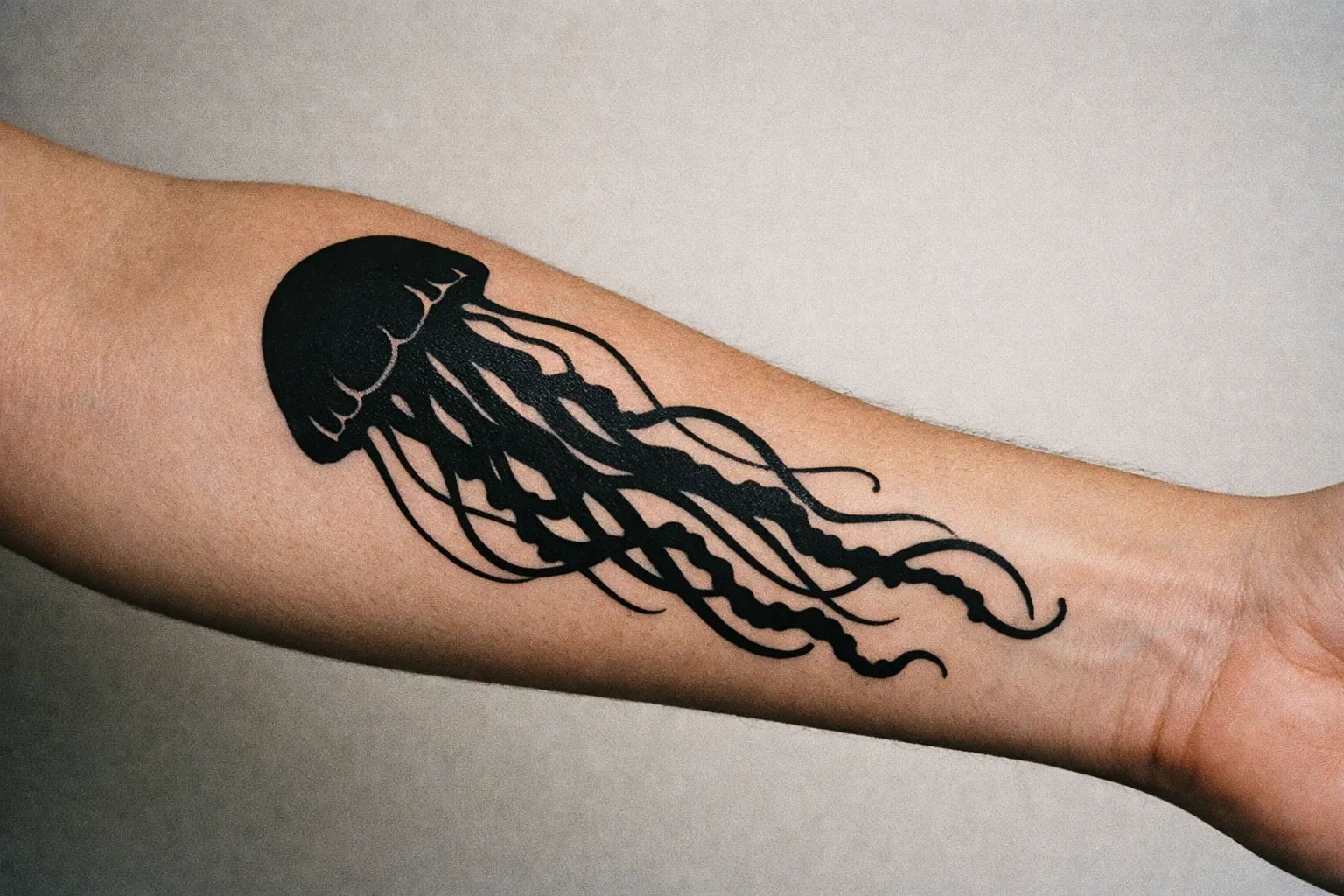
- Style flexibility. The same animal works in hyper-realism, watercolor splash, blackwork stipple, or three-line minimalist form. Few subjects span that range without losing coherence.
- Placement flexibility. Tentacles follow long, narrow body parts - spine, forearm, calf, ribs. The bell anchors round areas like the shoulder, sternum, or upper back.
- Built-in motion. Even a static line drawing reads as moving, because the tentacles imply drift. That hides minor inconsistencies in linework better than a stiff subject like an anchor or skull would.
- Layered symbolism. You can carry resilience, queerness, spirituality, or grief in the same image without explaining it to anyone.
Jellyfish Tattoo Designs: What Should You Go For?
Style choice changes the meaning more than people expect. A blackwork jellyfish reads “silent strength.” A watercolor one reads “fluidity and softness.” Same animal, different statement.
1. Realistic jellyfish tattoos
Hallmarks: translucent bell, light passing through the body, fine highlights mimicking water refraction, long flowing tentacles with depth shading. Done well, it looks like a still from a nature documentary.
- Best placement: thigh, outer forearm, upper back, calf - flat-ish planes give the artist room to render transparency.
- Size range: 15-25 cm (6-10 in) minimum. Smaller than that and you lose the translucent detail.
- Common pitfall: artists who oversaturate the bell with solid color instead of leaving negative space. A realistic jellyfish needs the skin to show through the body. If the portfolio shows opaque, flat bells, that artist isn’t a realism specialist regardless of what they call themselves.
- Budget: $300-$700 for a forearm piece; $800-$2,000+ for a half-sleeve or thigh.
I’ve seen this style botched more often than any other jellyfish design - usually because the client didn’t ask for healed photos and only saw the fresh work, which looks sharp on everyone. Ask for healed shots at 6-12 months. That’s where you find out who actually knows pigment retention.
2. Watercolor jellyfish tattoos
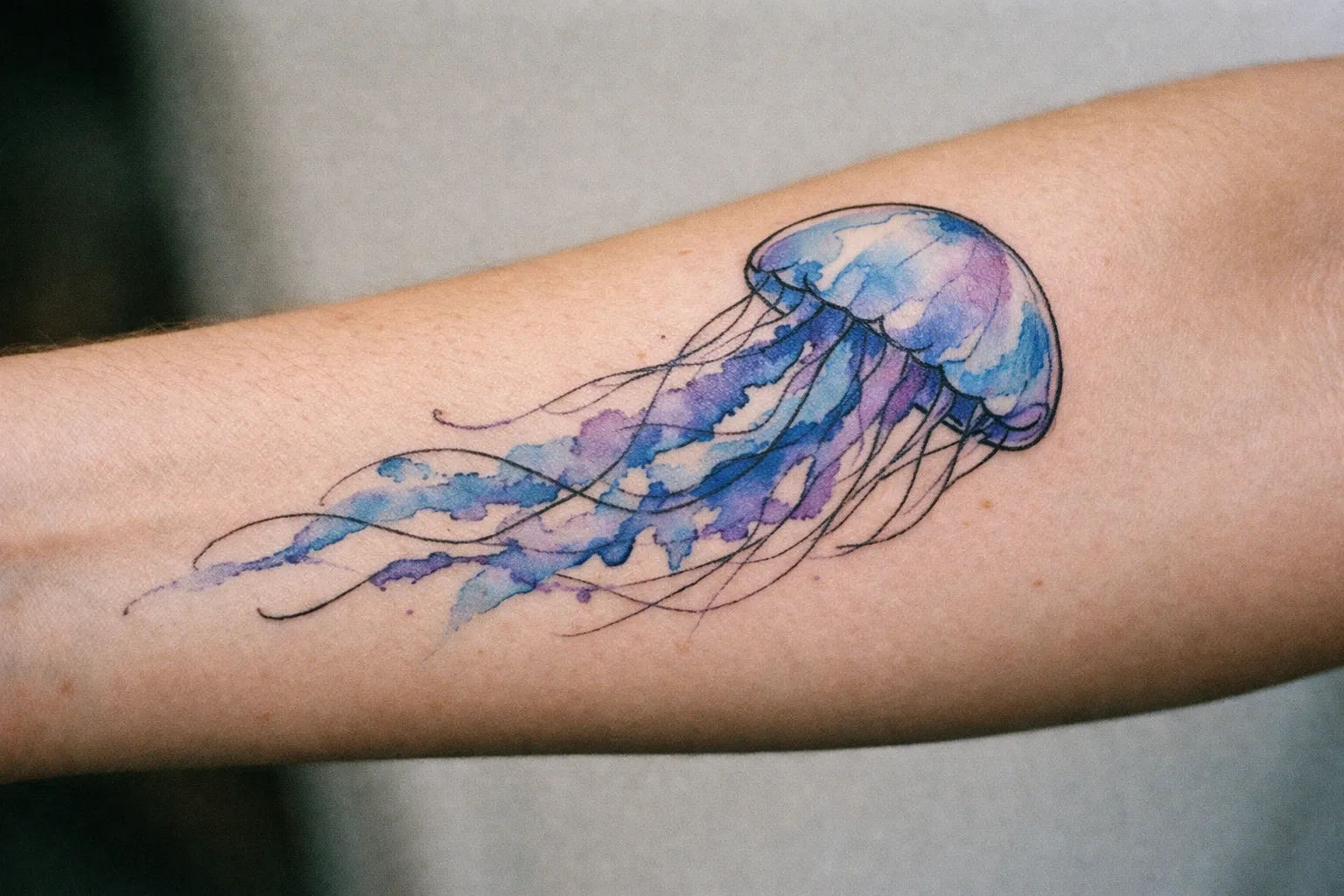
Hallmarks: minimal or no outlines, color bleeds and splashes around the body, soft gradients in blue/purple/pink. The watercolor jellyfish tattoo style suits the subject because the animal already looks like it’s dissolving into the water around it.
- Best placement: shoulder, upper arm, ribs, thigh - areas with low friction so the soft edges don’t blur.
- Size range: 10-20 cm (4-8 in).
- Common pitfall: watercolor without any anchoring black linework heals muddy. The good versions use subtle linework or a tight cluster of dark dots inside the bell to give the eye something to lock onto as the color fades over years.
- Longevity note: expect a touch-up around year 5-7. Watercolor fades faster than blackwork, full stop.
3. Minimalist and fine-line jellyfish tattoos
Hallmarks: single-weight black line, the bell drawn as a simple dome, three to seven tentacles. No fill, no shading.
- Best placement: inner forearm, behind the ear, ankle, sternum, back of upper arm.
- Size range: 3-8 cm (1-3 in).
- Pain: lower than color work because the artist is in and out faster.
- Common pitfall: placing very thin tentacles on high-friction zones - wrist, side of hand, fingers. Fine lines on those areas blur within 3-5 years. Move the design 2-3 cm inward toward the forearm and it’ll hold.
This is where most first-time jellyfish clients end up, and honestly it’s a reasonable choice. Clean, readable, ages decently if you place it right.
4. Geometric jellyfish tattoos
Hallmarks: the bell rendered as a polyhedron or dotted dome, tentacles as straight or angular lines, sometimes encased in a triangle, circle, or hexagon. Reads as analytical, structured - almost the opposite of the animal’s natural fluidity, which is the point. Fans of sacred geometry tattoo symbols often gravitate toward this style for its blend of mathematical precision and organic subject matter.
- Best placement: forearm, calf, upper back.
- Size range: 10-18 cm.
5. Traditional (American traditional) jellyfish tattoos
Hallmarks: thick black outlines, limited palette (red, yellow, green, navy), bold shading with no gradients. Looks like it could’ve been pulled off a 1950s flash sheet.
- Best placement: upper arm, calf, chest panel.
- Size range: 10-15 cm.
- Common pitfall: traditional only works if the artist commits to the line weight. Thin, timid outlines age into a blurry mess within a decade because the bold black is what holds the design together as ink spreads.
6. Tribal and Polynesian-influenced jellyfish
Hallmarks: solid black, repeating patterns, the tentacles broken into rhythmic motif segments. Be cautious here - Polynesian tatau carries specific cultural weight, and lifting motifs without understanding them is the kind of thing that ends up on “tattoos to avoid” lists. If this style appeals to you, find an artist with genuine training in the tradition rather than a generic “tribal” flash.
7. Cartoon jellyfish tattoo
Hallmarks: simplified bell, exaggerated eyes, pastel palette, often a small bubble trail. Think SpongeBob’s Jellyfish Fields residents, or a Studio Ghibli-style rendering.
- Best placement: forearm, calf - somewhere the playfulness reads.
- Size range: 5-12 cm.
- Meaning shift: this style usually drops the heavy symbolism in favor of nostalgia, childhood, or just “I like the way it looks.” Nothing wrong with that.
8. Dotwork jellyfish tattoos
Hallmarks: the entire image built from individual dots - denser for shadow, sparser for highlight. The technique (stippling) is slow and meditative to receive.
- Best placement: shoulder blade, thigh, ribs.
- Time investment: dotwork takes 2-3× longer than equivalent shaded work. Budget accordingly.
9. Blackwork jellyfish tattoos
Hallmarks: solid black fills, hard silhouettes, often negative space inside the bell rather than shading. Blackwork pairs well with jellyfish because the silhouette is already iconic - you don’t need color to recognize the animal.
- Best placement: forearm, calf, spine, chest.
- Size range: 12-25 cm.
- Why it works symbolically: blackwork carries connotations of strength and commitment (5). Combine that with jellyfish grace and you get “silent strength” as the read.
- Common pitfall: filling the entire bell solid black. Use negative space - let parts of the body stay skin-toned so the form still reads as translucent.
10. Glowing jellyfish tattoos
Hallmarks: high-contrast blues, teals, purples, and whites arranged to fake bioluminescence. The “glow” is an optical effect - bright color against dark background - not actual glow ink in most cases.
- Best placement: thigh, upper back, full back, half-sleeve. These need real estate to work.
- Size range: 20 cm+ minimum.
- UV ink caveat: UV-reactive inks exist and they do glow under blacklight, but they fade faster than standard pigments (often needing touch-ups every 1-3 years) and some formulations have raised safety questions. If you want UV, ask the artist for the brand name and the manufacturer’s safety data sheet before agreeing.
- White ink warning: heavy white highlights heal patchy or yellow-tinged and fade fast in sun-exposed areas. Use sparingly.
Placement Considerations for Your Jellyfish Piece
Match the design to the body part - not the other way around.
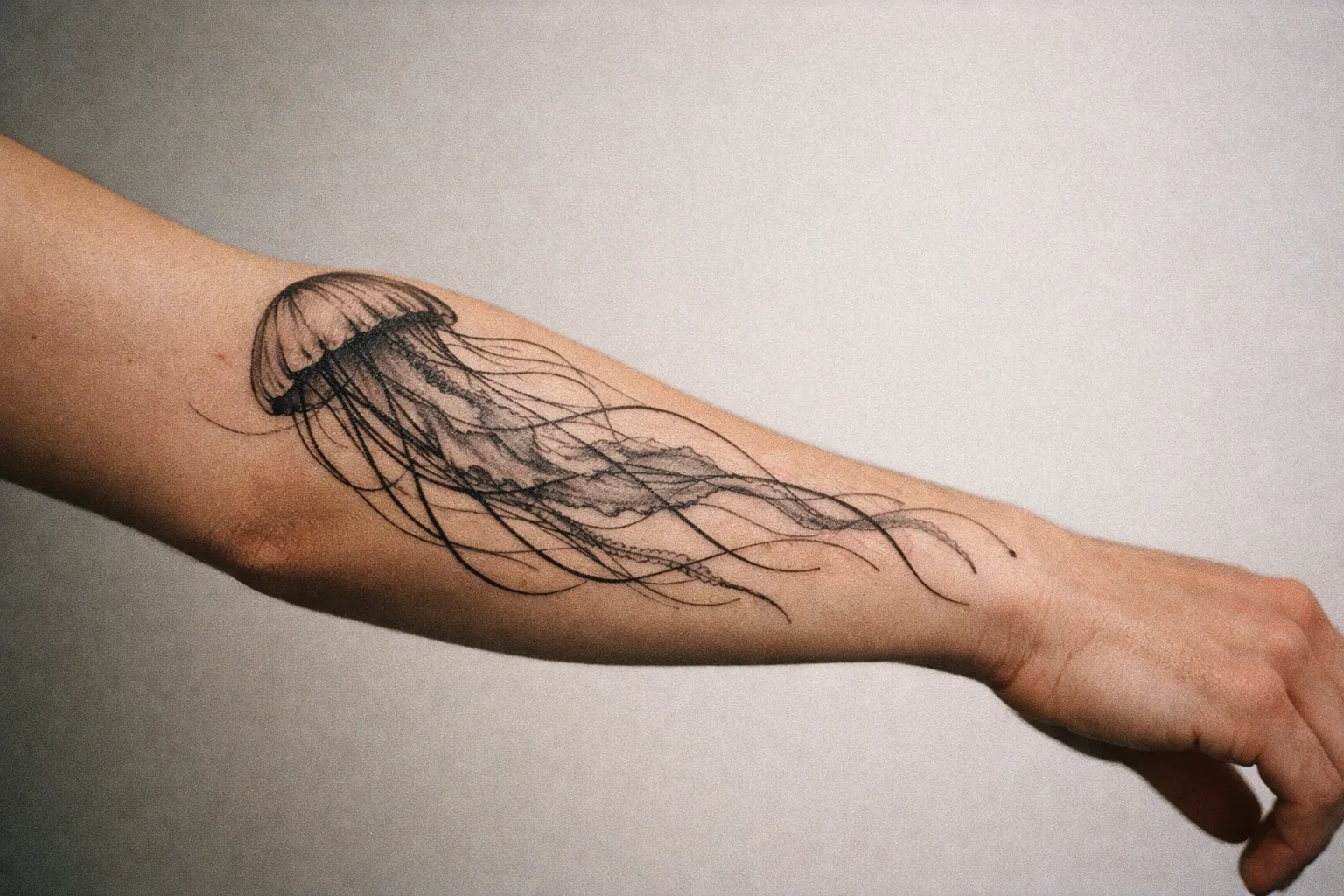
- Forearm: best all-rounder. Works for minimalist, blackwork, watercolor, or medium-sized realism. You see it daily, which suits resilience or reminder meanings. Pain level: moderate.
- Spine / sternum: tentacles can trail down the spine for an energy-flow reading; sternum placement works for spiritual or queer-coded designs. Pain level: ribcage > forearm. Significantly. Bring a snack.
- Thigh: room for large realistic or glowing pieces, easy to keep private. Healing is straightforward.
- Upper back / shoulder blade: ideal for round bell-focused compositions. Low movement, good color retention.
- Behind the ear / neck: small fine-line jellyfish only. Reads as personal and intuitive. Be aware of workplace visibility.
- Ribs: dramatic placement for long flowing pieces, but it’s one of the more painful zones and the skin moves with breathing, which can affect line precision.
- Hands, fingers, wrists: fine-line tentacles will blur here within a few years due to friction. Most reputable artists will push back on this placement for delicate work - listen to them.
Cost, Time, and What to Expect
Rough US/EU studio numbers:
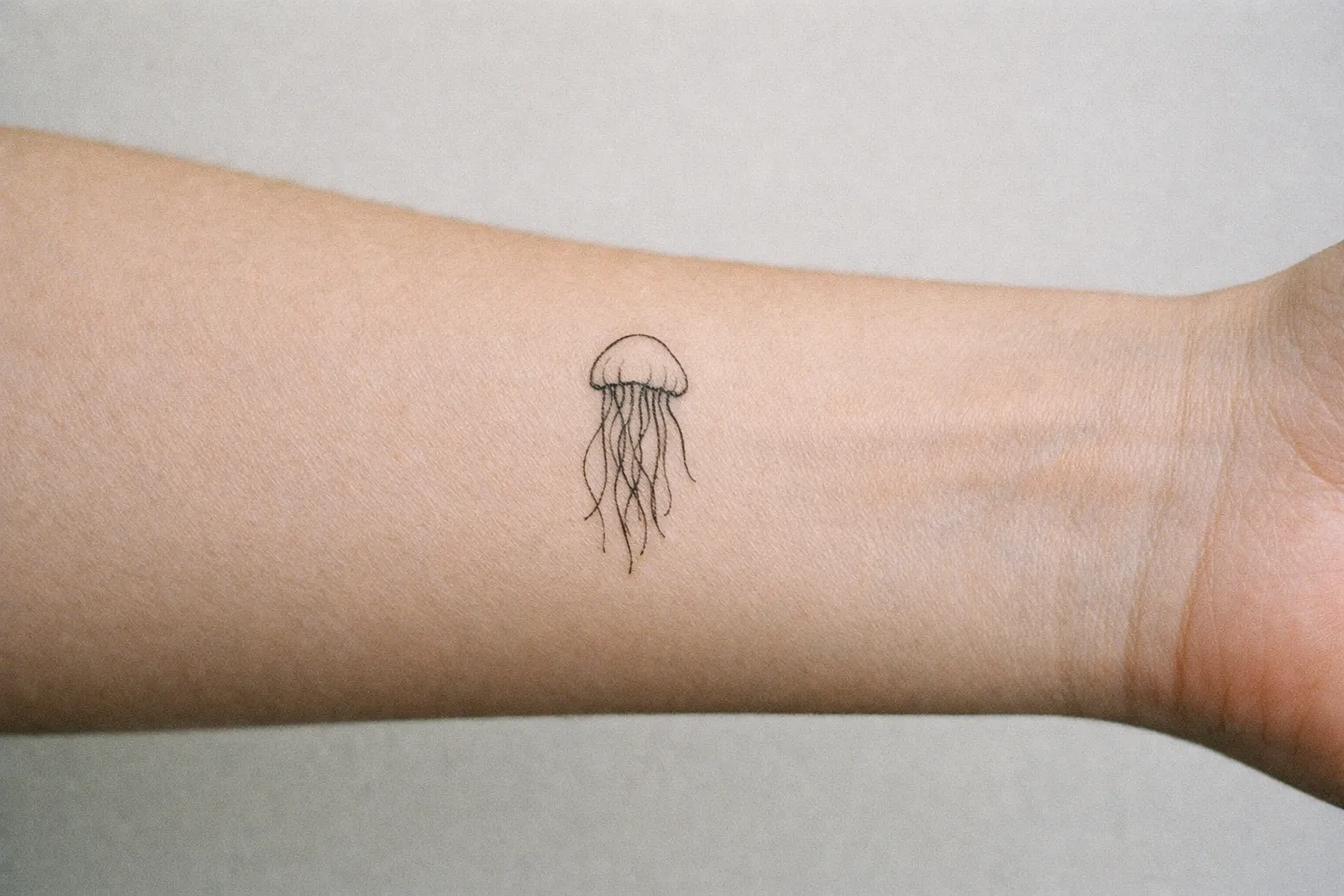
- Small fine-line jellyfish (3-5 cm): $100-$250, 1-2 hours, single session. Big-city minimums often start around $150.
- Medium watercolor or color jellyfish (10-15 cm on forearm): $300-$700, 3-6 hours, usually one session.
- Large realistic or glowing piece (half-sleeve or thigh): $800-$2,000+, 8-20 hours across 2-5 sessions spaced 3-6 weeks apart. Top realism specialists charge $200-$300/hour.
- Full back piece with multiple jellyfish: $2,000-$5,000+, 3-6 sessions.
Don’t haggle a realism artist down on price. The difference between a $300 forearm jellyfish and a $700 forearm jellyfish is whether the bell still reads as translucent in 10 years.
Aftercare Timeline
Jellyfish tattoos with color need stricter aftercare than blackwork because pigment retention determines whether the design still looks like a jellyfish in five years.
- Day 1-3: leave the second-skin bandage on per your artist’s instructions (typically 24-72 hours). When you remove it, wash gently with unscented soap, pat dry. Apply a thin layer of a fragrance-free healing ointment.
- Week 1: switch to a fragrance-free moisturizer 2-3× daily. Expect peeling and itching around day 5-7. Do not pick. No swimming, no soaking baths, no gym sweat sessions on the area.
- Week 2-4: peeling finishes, color may look slightly cloudy - that’s the “milky” healing layer, not faded ink. Keep moisturizing. You can return to normal exercise.
- Long-term: SPF 30-50 on the tattoo any time it’s exposed to sun, or cover it with sun-protective clothing. Blues, purples, and pinks fade fastest. A color jellyfish without sunscreen can lose noticeable saturation within 1-3 summers.
If you experience fever, chills, or fatigue in the first few days after your session, you may be dealing with tattoo flu - a short-term immune response that typically resolves within 72 hours and is distinct from infection.
Rose vs. Jellyfish: How the Meanings Compare
A quick disambiguation since “rose tattoo meaning” comes up alongside jellyfish in a lot of comparison searches - but they’re different motifs serving different intents.
Rose tattoos historically encode love, passion, secrecy, martyrdom, and remembrance. They’re the default “romantic” tattoo. Jellyfish, by contrast, lean toward adaptation, survival, spirituality, and mystery (1)(2)(4). Both share the “beauty with hidden danger” theme - rose thorns, jellyfish venom - so they pair well in combined pieces if you want both readings. If you’re choosing between them: pick rose for love or remembrance, pick jellyfish for resilience, transformation, or fluid identity.
Blackwork as a Framing Style
Blackwork as a category - solid black fills, geometric framing, stippled shading - carries its own symbolism of strength, commitment, and bold identity (5). It originated as a modern tattoo movement drawing from traditional tribal work, woodblock prints, and graphic design. When you combine blackwork technique with a jellyfish subject, you get a read that the color versions can’t deliver: silent strength, hidden depth, restrained power. That’s why a blackwork jellyfish often appeals to people who want the resilience meaning without the softness that watercolor brings.
What Are Tattoos to Avoid?
Worth answering plainly since it shows up alongside jellyfish searches. Designs to think hard about before committing:
- Hate symbols or anything with extremist associations - obvious but worth saying.
- Sacred religious imagery from traditions you have no connection to - particularly indigenous iconography. A jellyfish in Haida style done by an artist with no Haida training falls into this category.
- Another person’s name outside of family. Statistically the highest-regret tattoos in cover-up shop data.
- Trendy micro-script in stick-and-poke style on high-friction skin - wrists, fingers, sides of hands. Blurs within a few years.
- First-tattoo full back pieces without understanding the time, cost, and pain involved.
Jellyfish itself is essentially never on an “avoid” list. The cautions are about how you render it - particularly if you’re borrowing from a specific cultural tradition you don’t belong to.
Common Mistakes That Ruin Jellyfish Pieces
- Picking the artist for price, not portfolio. Realism, watercolor, and dotwork are specialties. A great traditional artist will produce a mediocre realistic jellyfish. Look for at least five jellyfish or comparable translucent/aquatic subjects in the portfolio.
- Not asking for healed photos. Fresh photos look amazing for everyone. Healed photos at 6-12 months reveal who actually knows pigment retention. Especially critical for watercolor and glowing styles.
- Cramming detail into a piece that’s too small. A 4 cm realistic jellyfish doesn’t exist - there isn’t enough room to render the transparency. Either go bigger or switch to a fine-line style.
- Overusing white ink for glow. Heals patchy, yellows over time, fades fast.
- Skipping sunscreen for the first year. Single biggest cause of color jellyfish looking dull within two years.
- Booking a glowing realism back piece as a first tattoo. Pain, cost, and session structure all hit harder than expected. Start with something smaller and see how your skin heals before committing to a multi-session project. People with reactive skin should also read up on tattoo for sensitive skin before booking a large color piece.
How to Brief Your Artist Using Pinterest
Pinterest is the most common reference source clients bring in, and using it well makes a real difference. Instead of sending your artist a wall of 30 saved pins, do this:
- Pick 3-5 jellyfish tattoo pins.
- For each one, note what specifically you like: bell transparency, tentacle length, color palette, background texture, line weight.
- Send the artist a short list: “From pin A, the bell transparency. From pin B, the tentacle motion. From pin C, the color palette.”
This gives them a coherent brief rather than 30 conflicting references. It also makes clear you’re not asking them to copy another artist’s work - you’re describing the design language you want.
Frequently Asked Questions
- What does a jellyfish tattoo mean?
- Most commonly: resilience, grace, transformation, mystery, and protection. The specific reading depends on style and personal context - a blackwork piece reads as silent strength; a watercolor piece reads as fluidity and acceptance.
- What does a jellyfish tattoo mean in LGBT contexts?
- Surviving adversity, fluid identity, and transformation. Jellyfish are non-gendered, shapeless, and adaptive, which makes them a natural fit for queer symbolism. Visual cues like a rainbow gradient in the tentacles or a pride-flag color wash can signal identity subtly.
- What are tattoos to avoid when considering a jellyfish design?
- Avoid hate symbols, sacred imagery from cultures you have no connection to, partner names, and overly fine-line work on high-friction body parts. The jellyfish motif itself is rarely problematic; the caution is about respectful rendering, especially with cultural styles.
- Does a jellyfish tattoo hurt?
- Pain depends on placement. Forearm and outer thigh are moderate pain zones. Ribs, sternum, and spine are significantly more painful. Size matters less than location.
- How long does a jellyfish tattoo take to heal?
- Surface healing takes 7-14 days. Full skin remodeling takes 4-6 weeks. Color pieces, especially watercolor, may need touch-ups around year 5-7.
- Can I get a jellyfish tattoo as my first tattoo?
- Yes, if you scale appropriately. A 5-10 cm fine-line or small watercolor jellyfish on the forearm is a reasonable first piece. Large glowing back pieces are not recommended for beginners.
Making the Decision
Write down three to five keywords that describe what you want the tattoo to carry - resilience, queer identity, grief, grace, deep sea, whatever it actually is for you. Show that list to your artist along with your reference pins. A good artist will build the composition around your meaning rather than handing you a generic jellyfish.
The animal works in almost any style, on almost any body part, at almost any size. What separates a strong jellyfish tattoo from a forgettable one is matching the style to the meaning, the size to the placement, and the artist to the technique. Get those three right and the design will still read clearly in 20 years - translucent bell, drifting tentacles, and whatever it is you needed it to say.