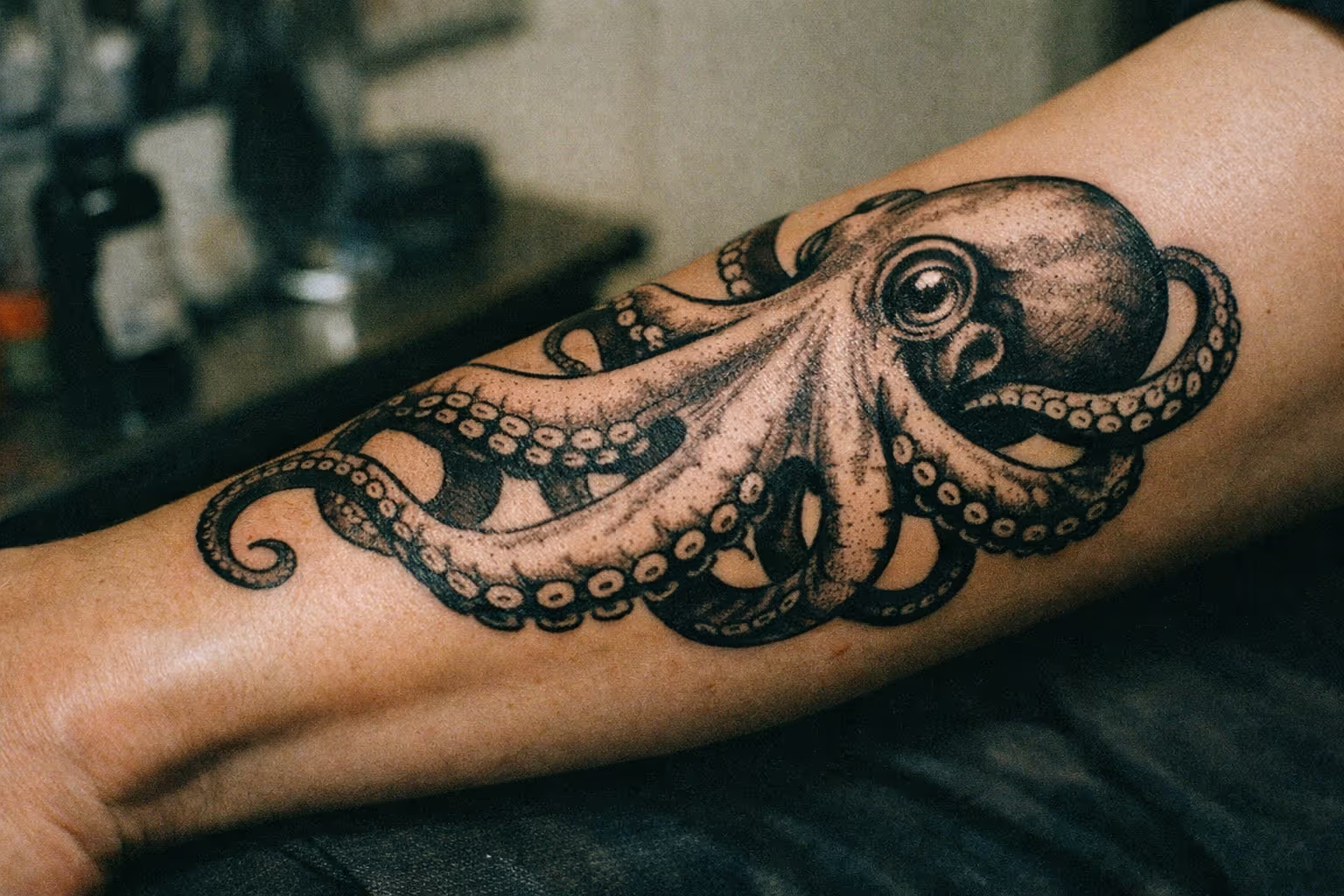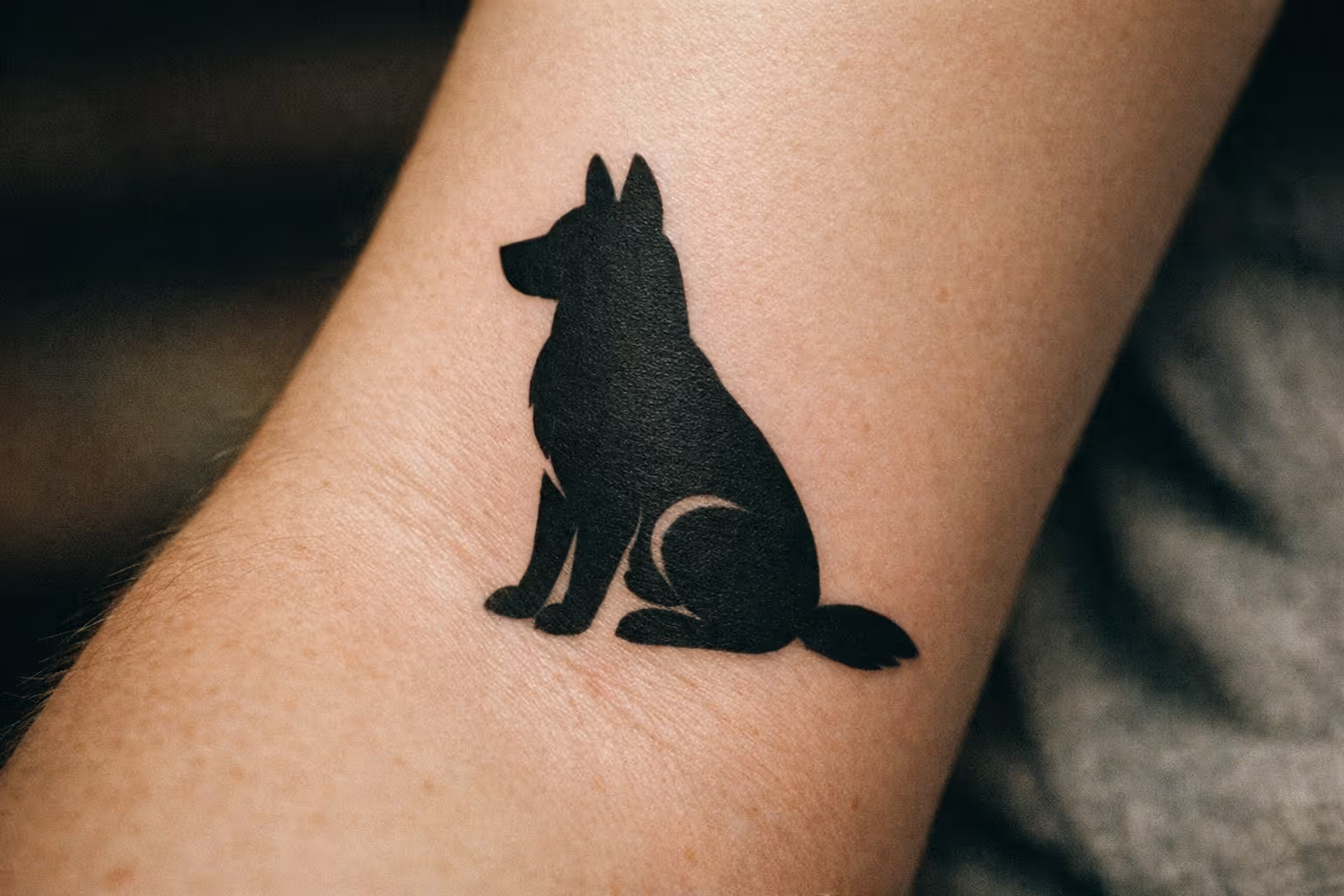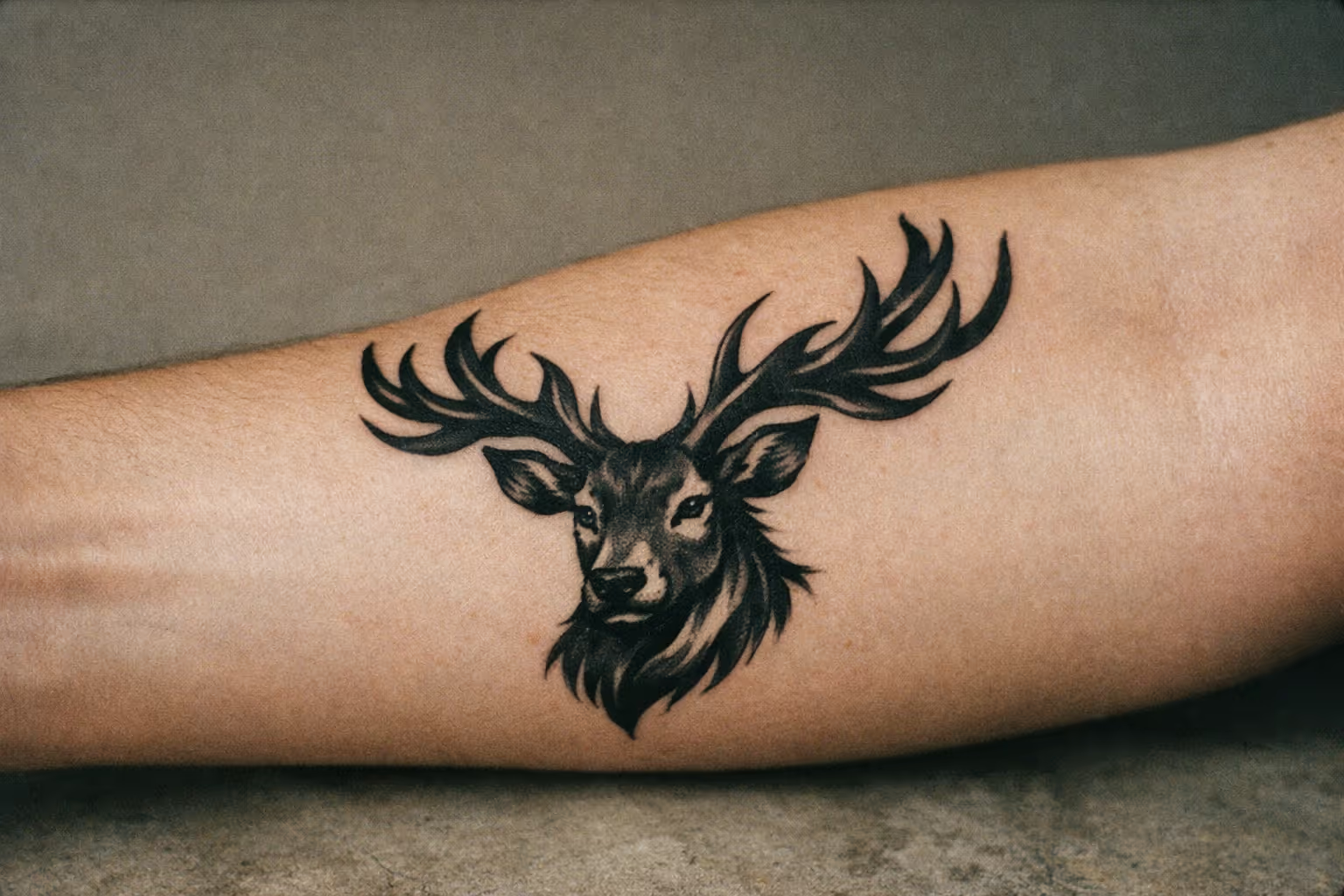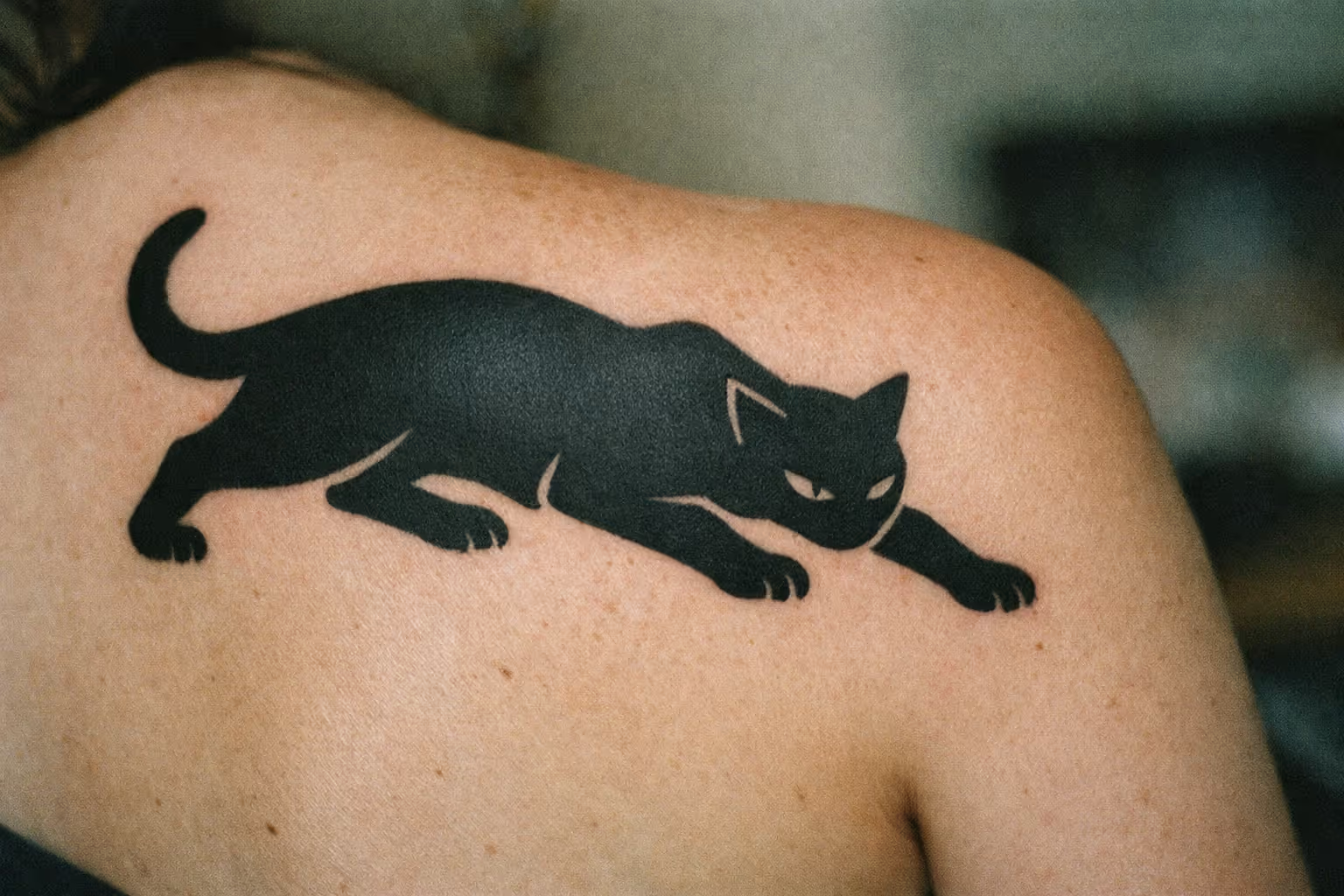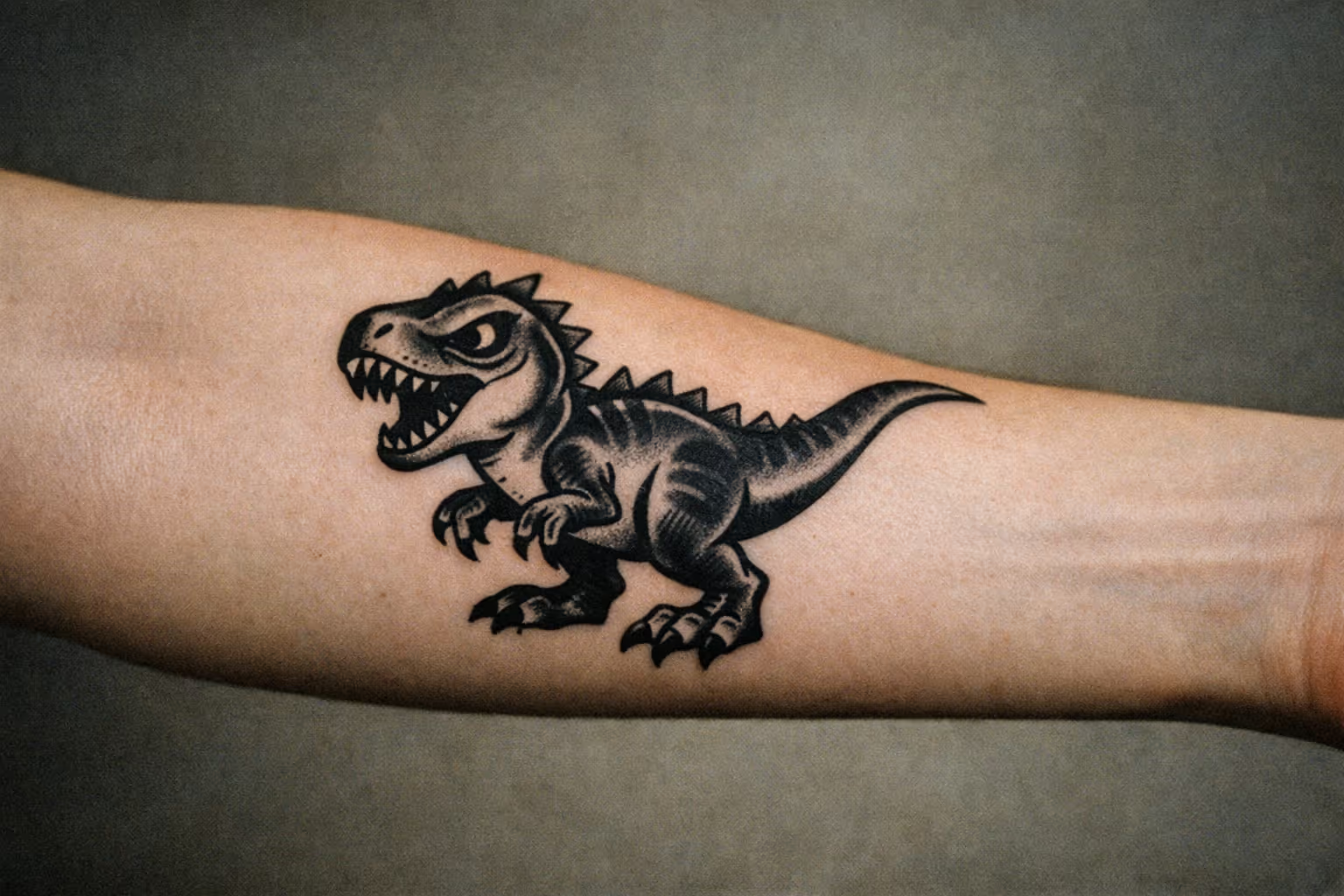
A dinosaur tattoo can be a $100 cartoon T-rex or a $2,500 anatomically detailed skeleton sleeve, and that range is the first real decision - bigger than which dinosaur. The little ones are cheap, fast, and age fine; the detailed skeletons are hours of fine work with a price and an aging risk to match. Here’s how dinosaur designs sort by size, style, and cost, and which ones actually hold up over ten years.
What a Dinosaur Tattoo Represents
A dinosaur tattoo does not carry a single fixed meaning the way some Celtic knotwork or Japanese irezumi motifs do. The symbolism is mostly modern and personal - built from pop culture and paleontology rather than one cultural tradition. That said, a few themes keep coming up.
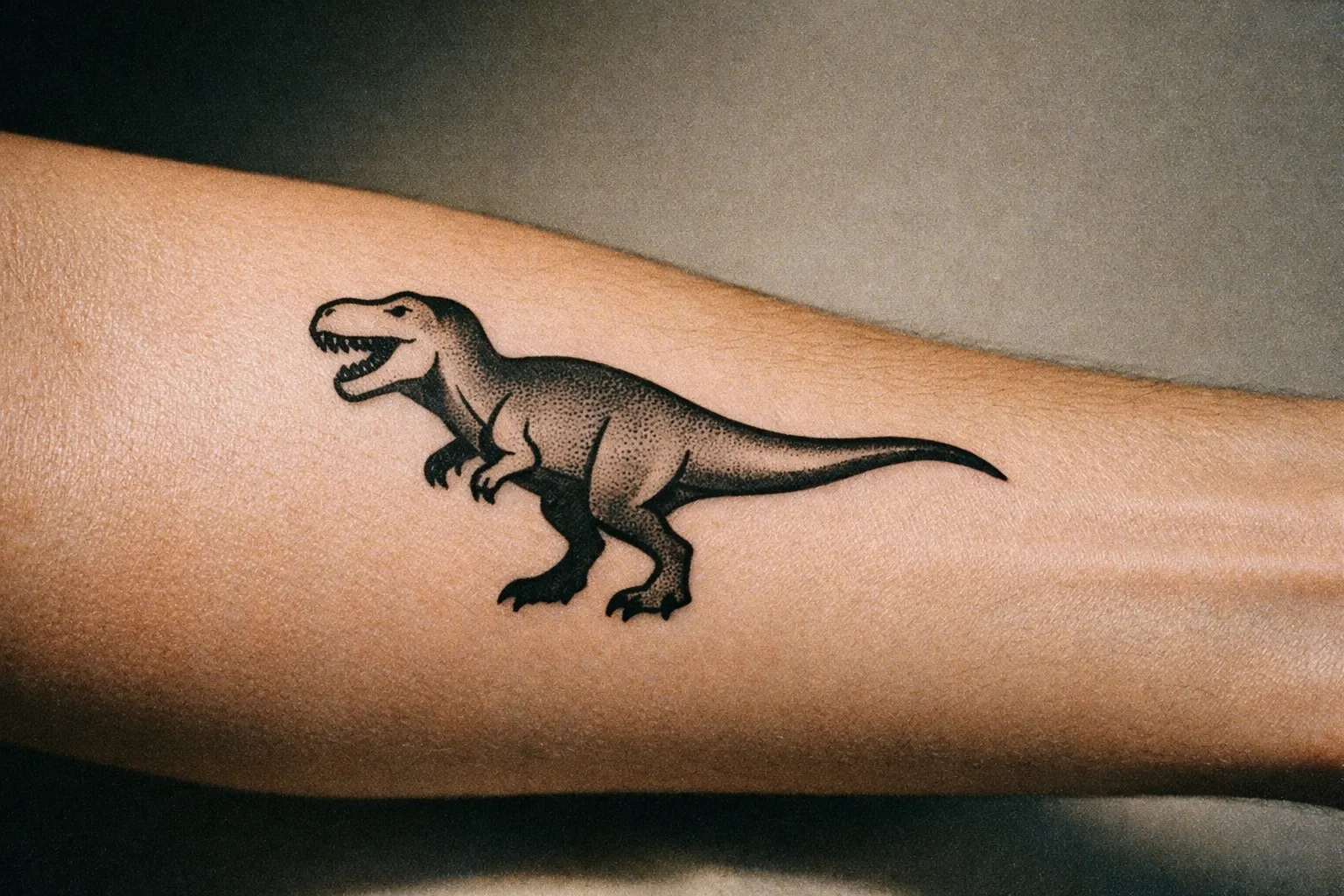
Strength and resilience is the most common reading. A T-Rex, an ankylosaurus, or any armored dinosaur stands in for toughness and the idea of surviving for hundreds of millions of years. People getting through a hard stretch often pick these for that “still standing” weight.
Survival and extinction make a natural pair. Add a meteor, fossilized bones, or breaks that read as healing fractures, and the dinosaur becomes about enduring catastrophe. The things that wiped out the dinosaurs didn’t wipe out the symbol.
Gentleness and loyalty show up in the long-necked sauropods. A brachiosaurus or brontosaurus reads as calm and protective rather than aggressive - popular for people who want the prehistoric reference without the predator energy.
Science and curiosity drive the skeleton and fossil designs. These lean toward a memento mori feeling and signal an interest in anatomy, paleontology, or just the academic side of the whole thing.
Childhood nostalgia is the quiet one underneath most dinosaur tattoos. For a lot of people the real meaning is a love of “Jurassic Park,” dinosaur toys, or a specific book from age seven. There’s nothing thin about that - nostalgia is one of the more honest reasons to get tattooed.
If you want the meaning to be specific to you, tell your artist. Asking them to work in extinction-versus-survival symbolism - a meteor overhead, bones knitting back together - turns a generic dino into something that actually marks a chapter of your life.
✓ Pros
- Wide range of styles from minimalist to full scenes
- Strong symbolic themes like resilience and nostalgia
- Works well for small and large placements
- Black and grey realism ages better than color
✗ Cons
- Small detailed designs blur quickly if lines are too thin
- Bright colors fade faster without diligent sun protection
- Large realistic scenes require significant time and budget
- Pain varies widely by placement, with ribs and sternum being harsh
Dinosaur Tattoo Ideas: From Minimalist Lines to Full Scenes
Dinosaurs translate across nearly every tattoo style, which is part of why the category runs so deep. Here’s how the main approaches actually look on skin.
Minimalist / fine-line dinosaurs use clean single-weight outlines and basic shapes to suggest a species - a T-Rex profile, a stegosaurus silhouette, a tiny brontosaurus. The two hallmarks are a continuous, confident line and almost no internal detail. The pitfall: artists who cram tiny shading or texture into a 3 cm fine-line piece. It looks crisp the day you get it and turns into a blurry smudge in five years as the ink spreads microscopically. Keep small line work simple.
Cute / cartoon dinosaurs lean into chibi proportions, pastel color, and add-ons like hearts, flowers, or a little hat. These run roughly 3-6 cm tall and sit well on the wrist, ankle, or forearm. Great for a first tattoo - forgiving and quick.
Neo-traditional / illustrative dinosaurs bring bold outlines and saturated color, often mixed with roses, daggers, or a banner. The hallmarks are a heavy black outline and a limited but rich palette. Done badly, the color packing is uneven and the piece looks muddy when healed - check an artist’s healed photos, not just fresh ones.
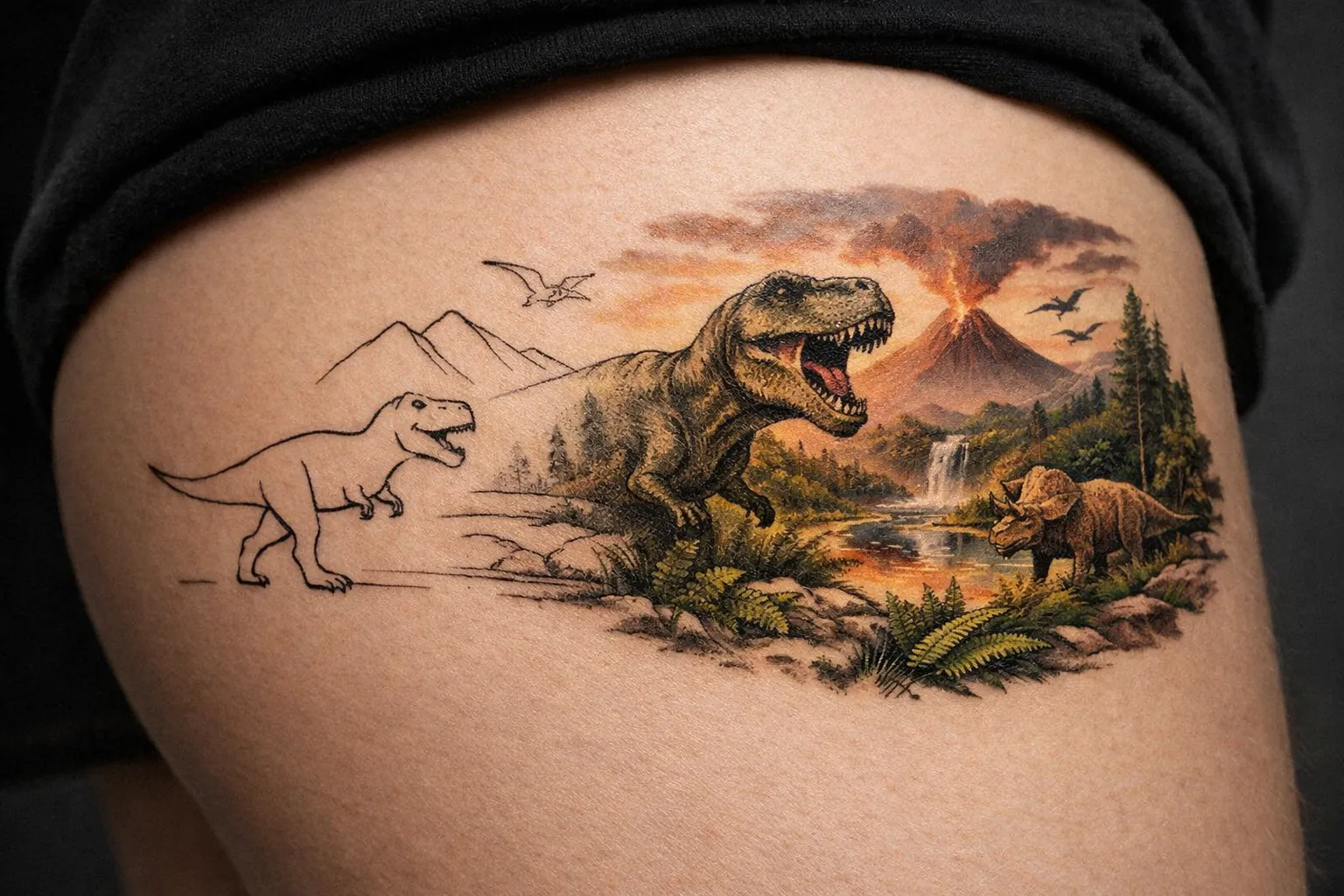
Realistic Jurassic scenes stack multiple dinosaurs into jungle, volcanoes, or a meteor strike. High time, high cost, and they need real estate. These belong on a back, thigh, or full sleeve, not a forearm panel.
For species breakdown, the T-Rex is the clear frontrunner in inspiration galleries - it shows up more than any other species by a wide margin, followed by triceratops and other ceratopsians, raptors, and the long-necks (brontosaurus, brachiosaurus, stegosaurus). Skeletons and fossils fill out the rest.
One practical note on color longevity: greens and yellows fade faster under sun exposure. I’ve seen bright primary-color dinosaurs look washed out after two summers. If you want a colored dinosaur that still reads in ten years, ask about muted olive, teal, and earthy tones rather than bright primaries - and commit to sunscreen once it’s healed.
Small Designs for First-Timers Featuring Dinosaurs
A small dinosaur tattoo is the easiest entry point into this whole category. At 2-5 cm on the wrist, ankle, or forearm, a simple outline takes 30-90 minutes and runs $80-$250 depending on your city and the artist’s rate. That’s a low-commitment way to test how your skin takes ink and how you handle the chair.
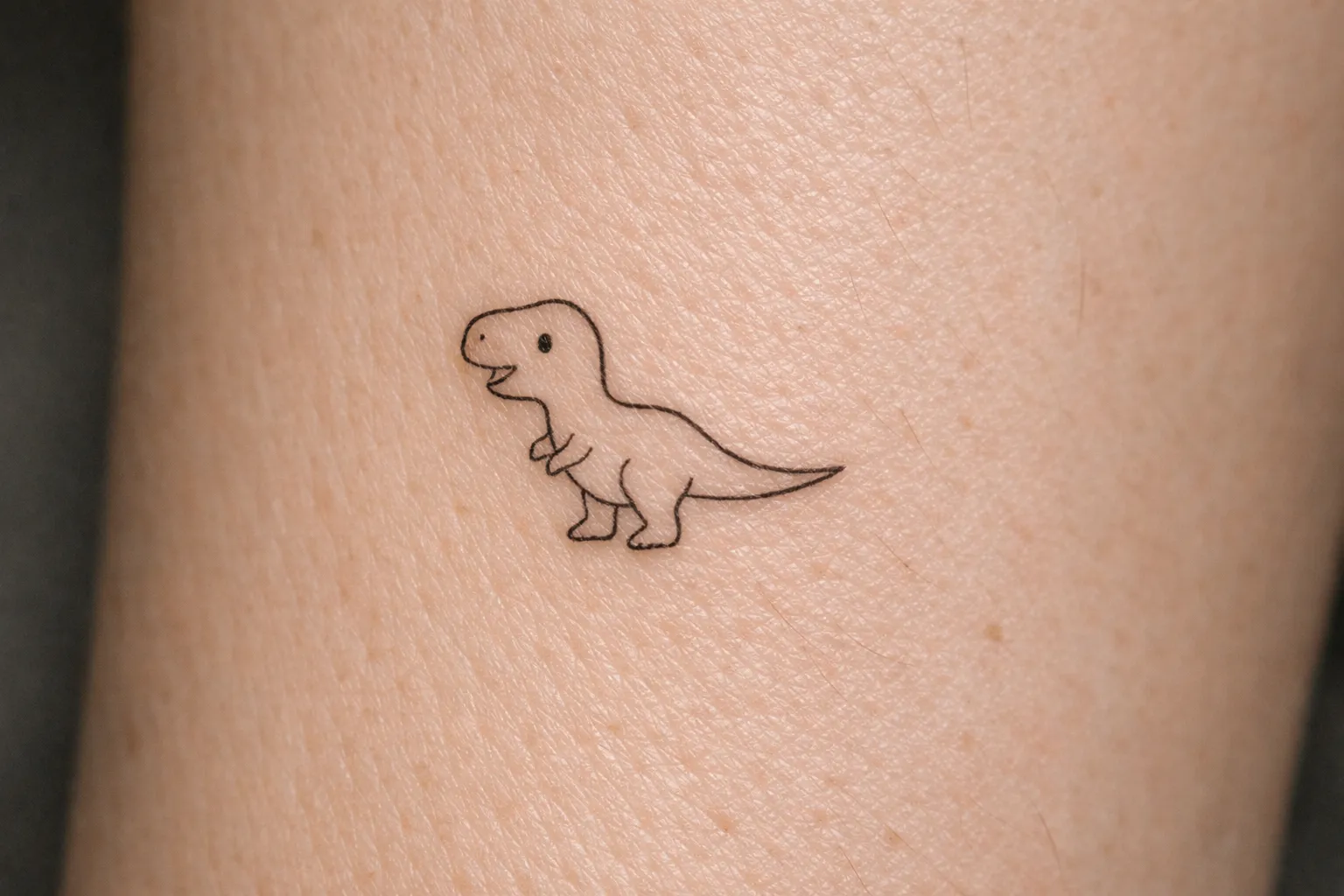
A tiny T-Rex is the obvious classic - the iconic stomping profile shrunk down to sit near a wrist bone or between the shoulder blades. The trick at this scale is editing. Drop the texture, drop the tiny teeth detail, and let a clean silhouette do the work.
A few small designs that hold up well over a decade:
- Stegosaurus silhouette - the back plates make it instantly readable even at 3 cm.
- Brontosaurus outline - the long neck and tail give it a recognizable shape with minimal line work.
- Velociraptor mid-stride - dynamic without needing internal detail.
- A single fossil footprint - abstract, subtle, and ages well because it’s mostly negative space.
One technical note worth more than it sounds: for anything under 4 cm, experienced artists usually go with a slightly thicker outline rather than hairline fine work. Thin lines on a small piece blow out and blur faster. A marginally heavier line keeps the dinosaur legible for 10+ years. I’ve had clients come back to show me fine-line pieces from other shops that had turned into soft blobs within three years - all of them were under 3 cm with hairline strokes. If an artist insists on ultra-thin line work on a fingernail-sized piece, that’s a flag.
The wrist and inner forearm hurt less than you’d think - flatter pain than ribs or feet. The ankle bone is sharper. None of these are high on the relative pain scale; ribcage and sternum are where dinosaur scenes actually sting.
Matching Tattoos Featuring Dinosaurs for Couples and Friends
Matching dinosaur tattoos work because the designs simplify cleanly into 2-4 cm outlines that read well even tiny (4). They’re popular for couples, siblings, and friend groups, and there’s more range here than just stamping the same dino twice. A lock and key tattoo follows a similar logic for couples who want complementary symbols rather than identical ones.
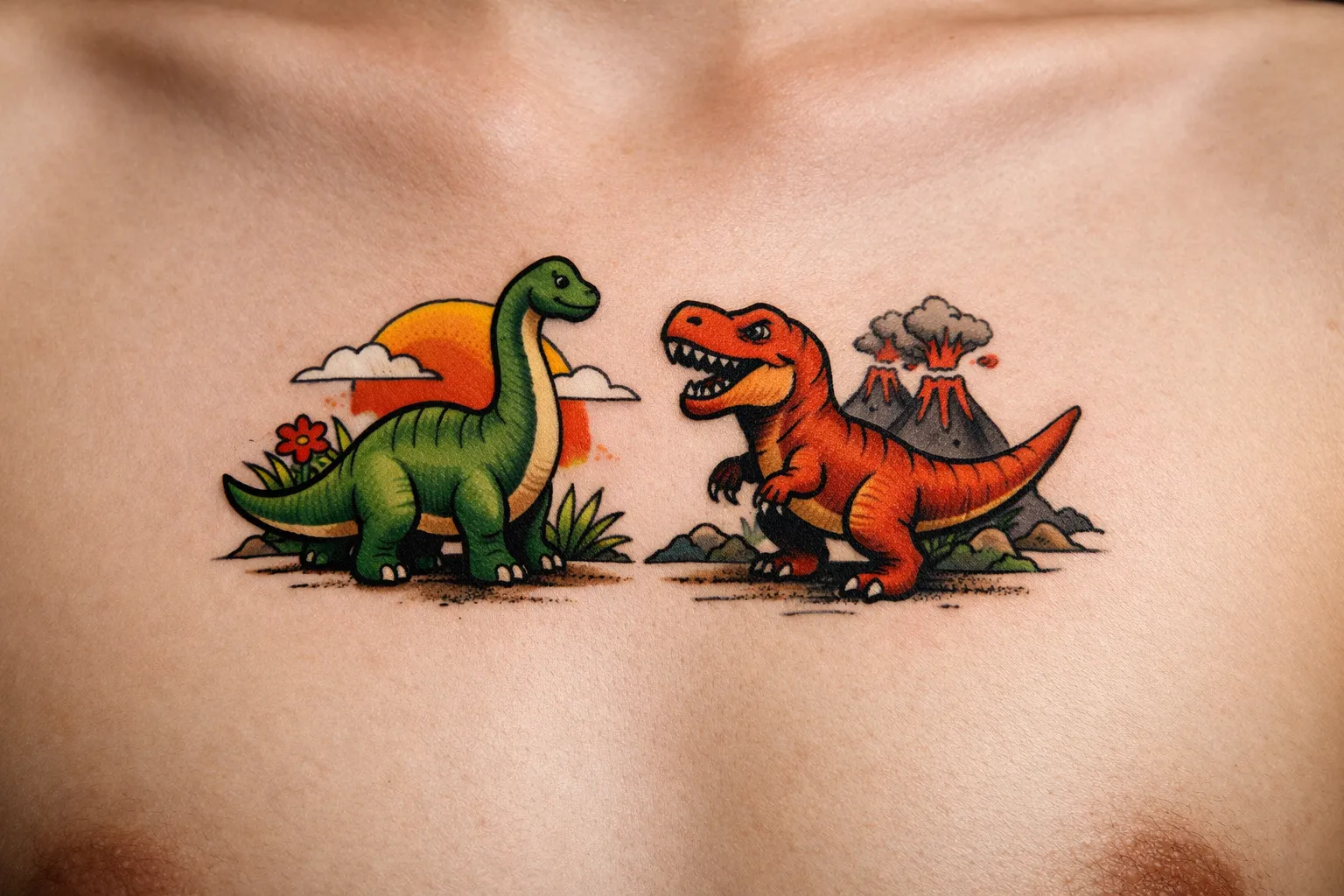
Better than identical: go complementary. A T-Rex paired with a Triceratops. Two long-necks turned to face each other. Mirrored skeletons that line up when you stand side by side. Each person keeps a little individuality while the pair still obviously belongs together. You can also differentiate by color or by small accessories - one with a flower, one with a heart, one in pastel and one in black and grey.
The logistics matter more than people expect:
- Both people usually need to be present for paperwork and ID checks before either gets tattooed.
- Book back-to-back 30-60 minute slots for small matching designs so you’re not waiting around for an hour with fresh ink.
- Ask whether the shop offers a small discount (5-10%) when multiple people get the same flash design in one visit - many do.
The “more about this pin” style captions you see online - “stay strong,” “never go extinct” - are usually attached to matching sets, and they’re a low-key way to mark a relationship without a name or date that can age awkwardly.
Dinosaur Skeleton Tattoos and Realism
A dinosaur skeleton tattoo pulls the design toward anatomy and the memento mori tradition - the bones as a reminder of deep time and survival rather than a cute mascot (4). These are typically done in black and grey realism or dotwork, and they need an artist whose portfolio actually shows skulls, animals, and realistic shading. A minimalist line artist asked to render a hyper-real T-Rex skull is a classic mismatch. I’ve seen it go wrong more than once - the client brings in a detailed skeleton reference, the artist works mostly in fine-line florals, and the result is a muddy compromise that satisfies neither style.
Placement-wise, skeletons want length and flat planes. The forearm, calf, or back all work because a skeletal spine and ribcage read best when they can stretch out. A full T-Rex skull does well on a thigh or the back of an upper arm where it has room to breathe.
These pieces are not small projects. A detailed skeleton half-sleeve runs 4-10 hours of work, usually split across 2-3 sessions, and lands around $800-$2,500 depending on detail and shading. Going black and grey instead of color saves time and ink - a skilled artist working in black and grey on a skeleton piece can often finish in fewer sessions than the same design rendered in full color, which is a smart way to keep a skeleton ambitious without ballooning the budget.
One advantage of black and grey realism: it ages more gracefully than color. No green or yellow to fade, so a well-done skeleton holds its contrast for years with basic sun protection.
Cute Dinosaur Designs and 2026 Style Mash-Ups
A cute dinosaur tattoo is the friendly cousin of the whole category - chibi proportions, soft pastels, a little roundness instead of teeth and claws. These sit happily at 3-6 cm on the wrist, ankle, behind the ear, or the inner forearm. They photograph well, which is exactly why they fill Pinterest and Instagram feeds.
The interesting development for 2026 is style fusion. Stars, planets, mushrooms, and nature motifs are showing up alongside dinosaurs in a wave of hybrid designs - a brontosaurus with a tiny galaxy in its silhouette reads differently than a straight dino portrait, and that combination is exactly what’s filling current design feeds. A brontosaurus with a tiny galaxy in its silhouette. A T-Rex among oversized mushrooms. A stegosaurus with star plates instead of bony ones. Combining a dinosaur with one of these related themes gives you something more personal than a stock dino - it sidesteps the “I’ve seen that exact tattoo before” problem. Fans of space-themed ink might also find inspiration in an astronaut tattoo for that same cosmic energy.
If you’re translating a saved Pinterest image into a real plan, ask your artist three things: the exact size in cm, where on the body it actually sits, and whether the reference photo is healed or fresh. Healed photos tell you the truth about how thick the lines will end up and how the color will settle. Fresh photos always look crisper than the tattoo will look in a month, and building expectations off a fresh-ink photo is how people end up disappointed.
Placement Ideas for Your Dinosaur Ink
Where the dinosaur goes changes how it looks and how it ages. A few guidelines tied to real placement behavior:
Forearm and upper arm are the workhorses - flat enough for detail, easy to show or cover, and lower on the pain scale. A velociraptor along the bicep moves with the muscle. A skeleton runs nicely down the inner forearm. These are the most popular placements in social galleries for good reason.
Calf and thigh handle bigger scenes. A brachiosaurus stretching hip to knee or a Jurassic landscape on the calf both have room to hold detail without crowding.
Back is the canvas for a full scene - multiple dinosaurs, terrain, sky. It also heals well and stays out of the sun under most clothing, which helps color last.
Wrist, ankle, and behind the ear are the small-and-cute zone. Keep designs simple here; these spots flex and rub, so over-detailed work breaks down faster.
Ribcage and sternum give space for dramatic compositions but hurt more than anywhere else on this list - bony, thin-skinned, and right over the lungs so every breath is felt. Worth it for the right piece, but go in knowing the relative pain: ribs > forearm, not even close.
The one mistake to avoid across all of these is jamming a detailed scene into a tiny area. A multi-dinosaur composition under 5 cm will turn into an unreadable smudge within a few years. If you want detail, give it size. If you want small, keep it simple.
What a Dinosaur Piece Costs in 2026
U.S. tattoo pricing in 2026 sits roughly here: shop minimums of $60-$100 for very small pieces, hourly rates of $100-$150 nationwide, and $200-$300/hour for high-demand artists in major cities. Here’s how that maps to dinosaur work:
- Small dinosaur outline (2-5 cm): 30-90 minutes, $80-$250.
- Cute color dinosaur (5-8 cm): $200-$400 including tip.
- Medium piece (10-20 cm, half-sleeve fossil or detailed single dino): 4-10 hours over 2-3 sessions, $400-$2,000.
- Detailed skeleton half-sleeve: $800-$2,500.
- Full back or leg Jurassic scene (25-40+ cm): 15-40 hours over 4-8 sessions, $1,500-$5,000+.
Three ways to keep the cost sane without cutting corners on quality:
- Choose black and grey over color - skeletons especially save time and ink this way.
- Pick from an artist’s existing flash instead of commissioning custom, which often saves $50-$150 and an hour or two of drawing time.
- Start with a small dino designed to expand later into a scene or sleeve, so you spread the cost over time.
The most common budgeting mistake I see is expecting a detailed skeleton sleeve for under $300. That number pushes people toward under-experienced or unlicensed artists, and bad line work on a big piece is expensive to fix or cover. Price the work realistically and you’ll get something that holds up.
Aftercare and Healing
Healing is where good tattoos get ruined. This part is not optional.
Days 1-3: Keep the wrap on as long as your artist says - a few hours to overnight. Wash the dinosaur tattoo gently 2-3 times a day with a fragrance-free antibacterial soap, pat dry, and apply a thin layer of a recommended healing ointment. Wear loose cotton that doesn’t rub the area. Don’t over-apply ointment - a tattoo that’s smothered can’t breathe and heals worse, not better.
Week 1: It’ll get tight, then start to flake and peel. This is normal. Do not pick or scratch - pulling scabs early lifts ink and creates patchy spots. Switch to a light, fragrance-free lotion once the worst of the weeping stops.
Weeks 2-4: Keep moisturizing with that fragrance-free lotion. The surface looks healed by now but the deeper skin is still recovering. Avoid pools, hot tubs, the gym, and direct sun on the area.
Full recovery: 6-8 weeks. Don’t book a touch-up or another session on the exact same spot until then. For large multi-session pieces, expect 4-8 weeks between sessions so each area heals fully before the next round.
Once it’s healed, the single biggest thing you can do for longevity is sun protection. SPF 30-50 on the dinosaur tattoo any time it’s exposed, plus sun-protective clothing when you can. UV is what fades ink - greens and yellows first. Skipping this is how a sharp tattoo turns washed-out in a few summers.
Frequently Asked Questions
- What does a dinosaur tattoo represent?
- Dinosaur tattoos mostly symbolize strength, resilience, and survival over millions of years, but meanings vary by species and personal context. They also often reflect childhood nostalgia or an interest in science and paleontology.
- How much should I tip for a $500 tattoo?
- Standard tipping in the U.S. is 15-25%. For a $500 tattoo, that means $75-$125, with 20% ($100) as a typical amount. For large multi-session projects, tipping per session (10-20%) is preferred by many artists.
- What dinosaur tattoos should I avoid?
- Avoid copying custom designs from known artists, meme-based jokes that age poorly, and cramming detailed multi-dinosaur scenes into tiny areas that will blur quickly.
- How do I ensure my dinosaur tattoo ages well?
- Choose appropriate size for detail, avoid ultra-fine lines on small pieces, use muted colors if opting for color, and protect the tattoo from sun exposure with SPF and sun-protective clothing.
- Are matching dinosaur tattoos good for couples?
- Yes, especially when designs are complementary rather than identical. Logistics like booking back-to-back appointments and ID checks are important to plan.
- What placements are best for detailed dinosaur skeleton tattoos?
- Forearm, calf, back, thigh, or upper arm provide enough flat space and length for skeleton designs to read clearly.