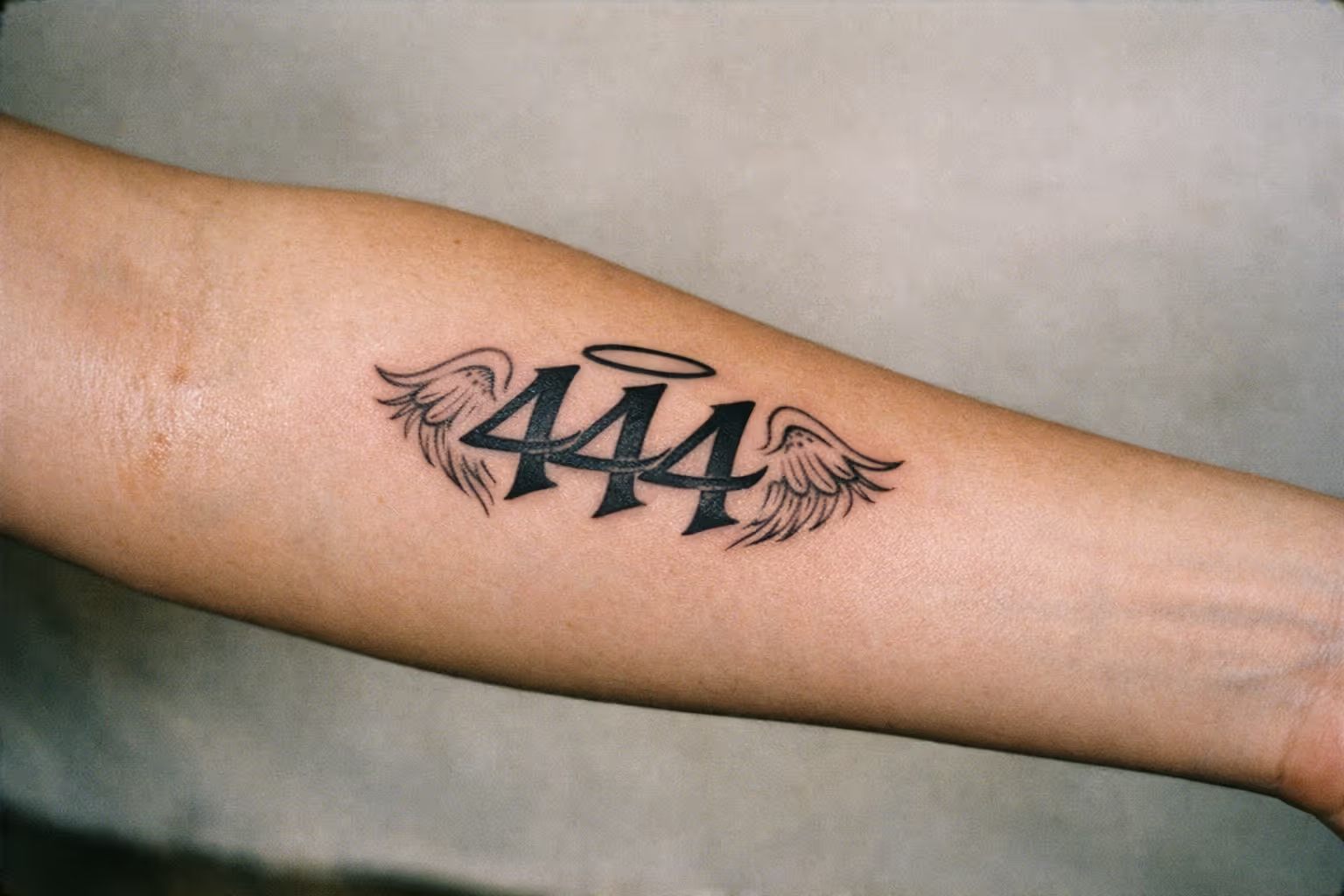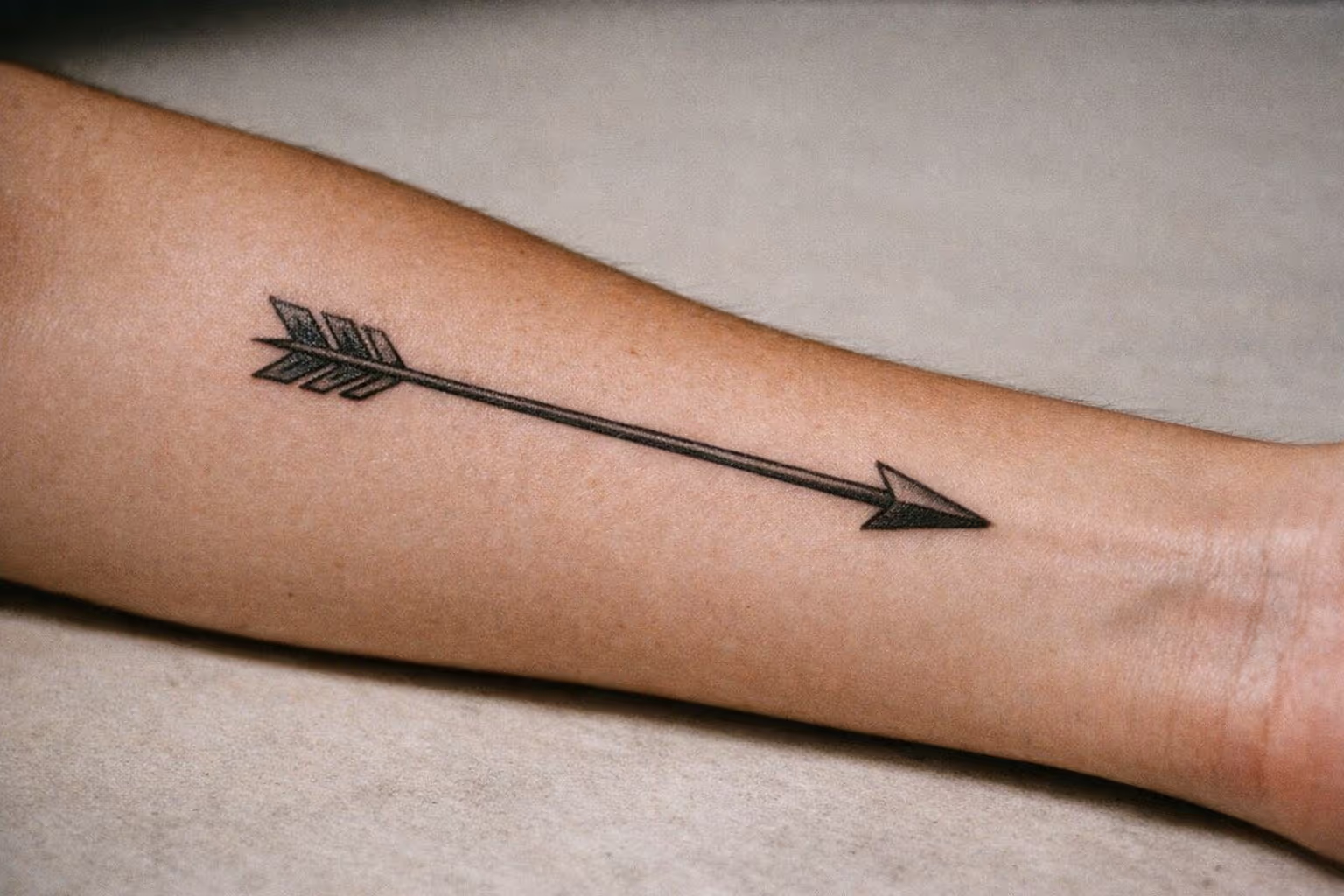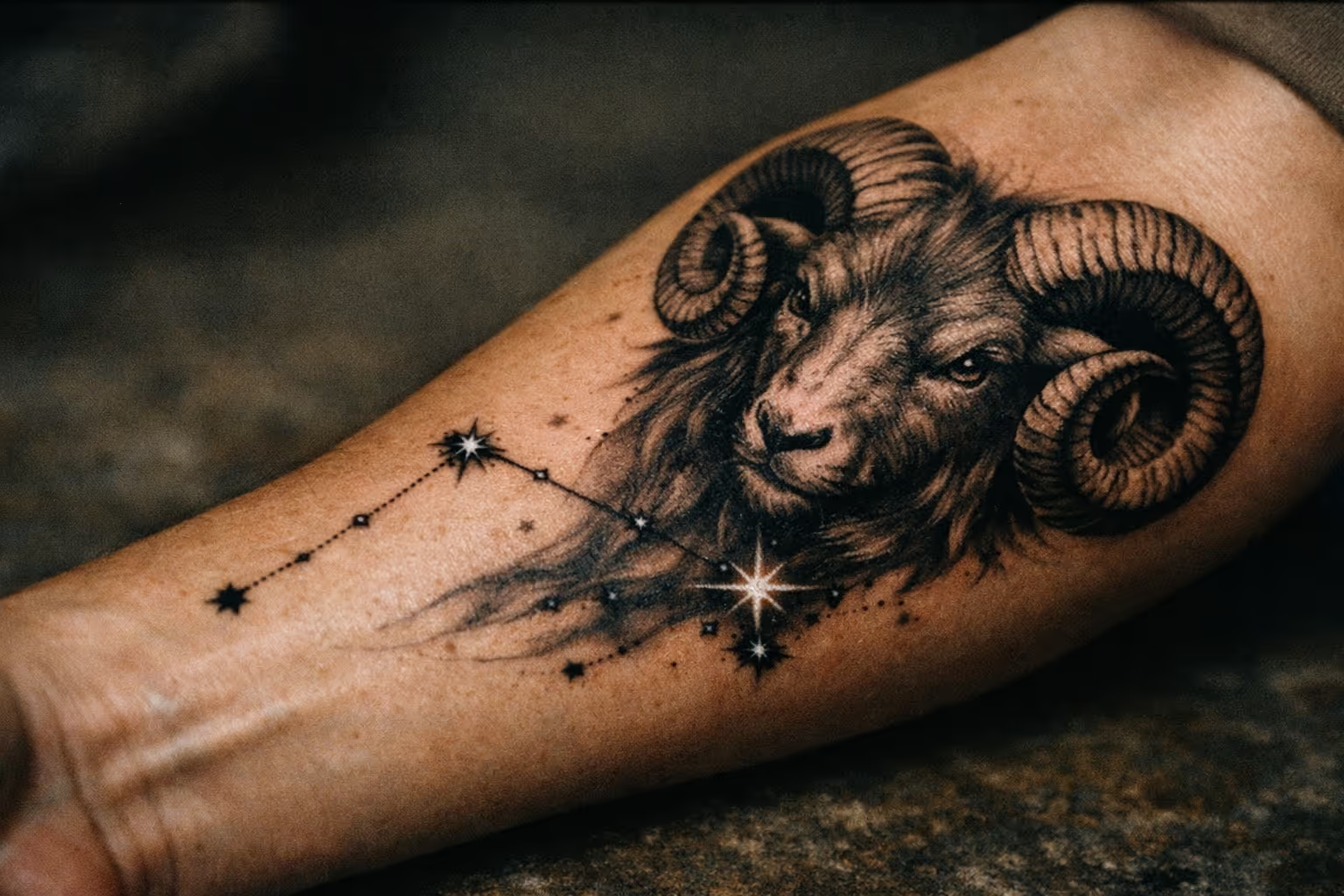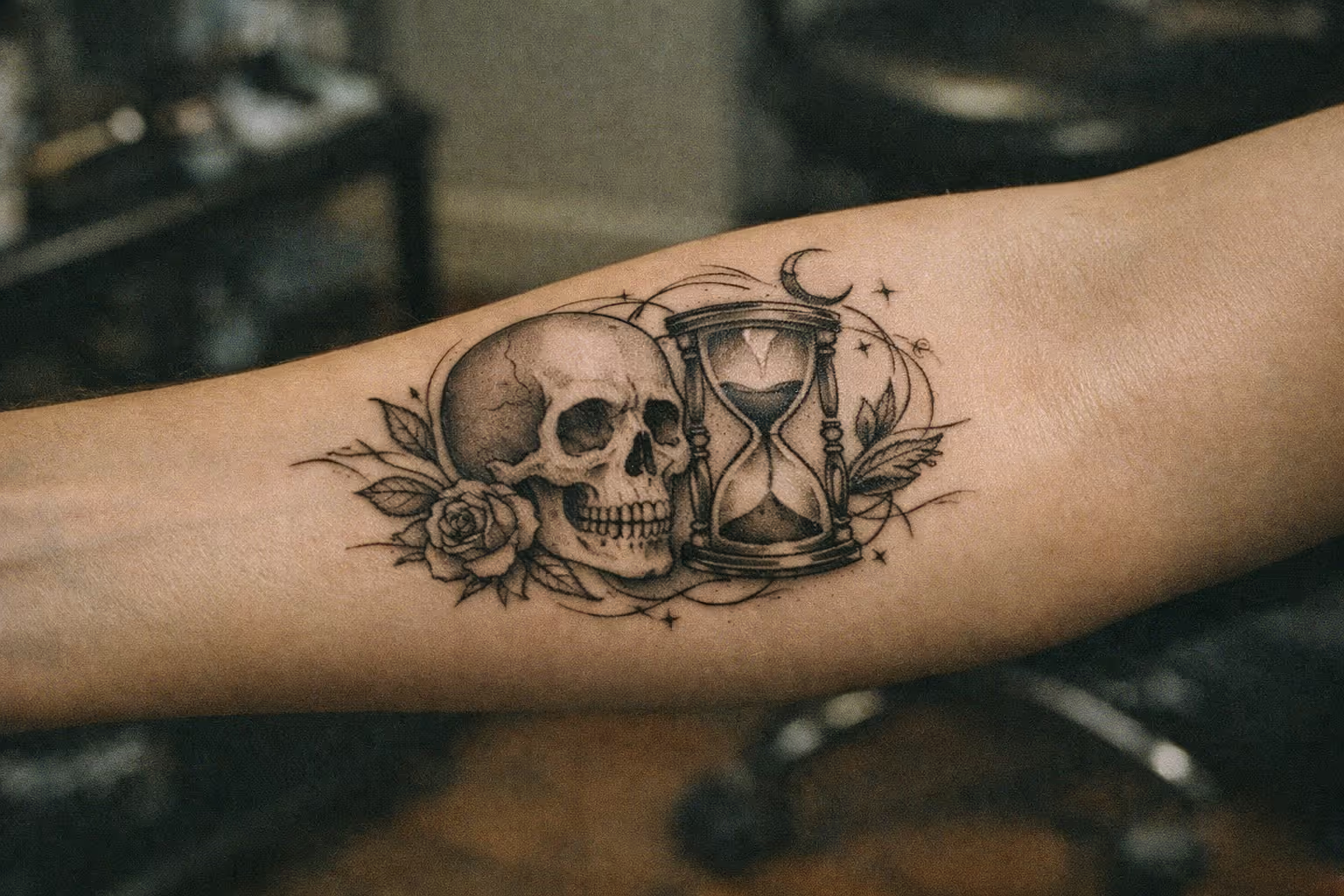
A memento mori tattoo is often chosen as script - a clean line of Latin down the forearm or ribs - and that’s the version most likely to disappoint you in a few years. Fine-line lettering blurs as the ink spreads; by year 3-7 the crisp phrase softens into something you have to squint at. Larger, bolder treatments hold, but they cost real time and money (a $3,000 piece can mean 12-20 hours in the chair). Here’s what the phrase means, and how to make it last.
What a Memento Mori Tattoo Means and How the Phrase and Symbolism Work
“Memento mori” is Latin for “remember you must die.” Not a death wish, not a goth aesthetic - a practical reminder that time is finite, meant to push you toward action now rather than later. The Stoics used it that way. Medieval Christians used it that way. Modern wearers do too (1)(5).
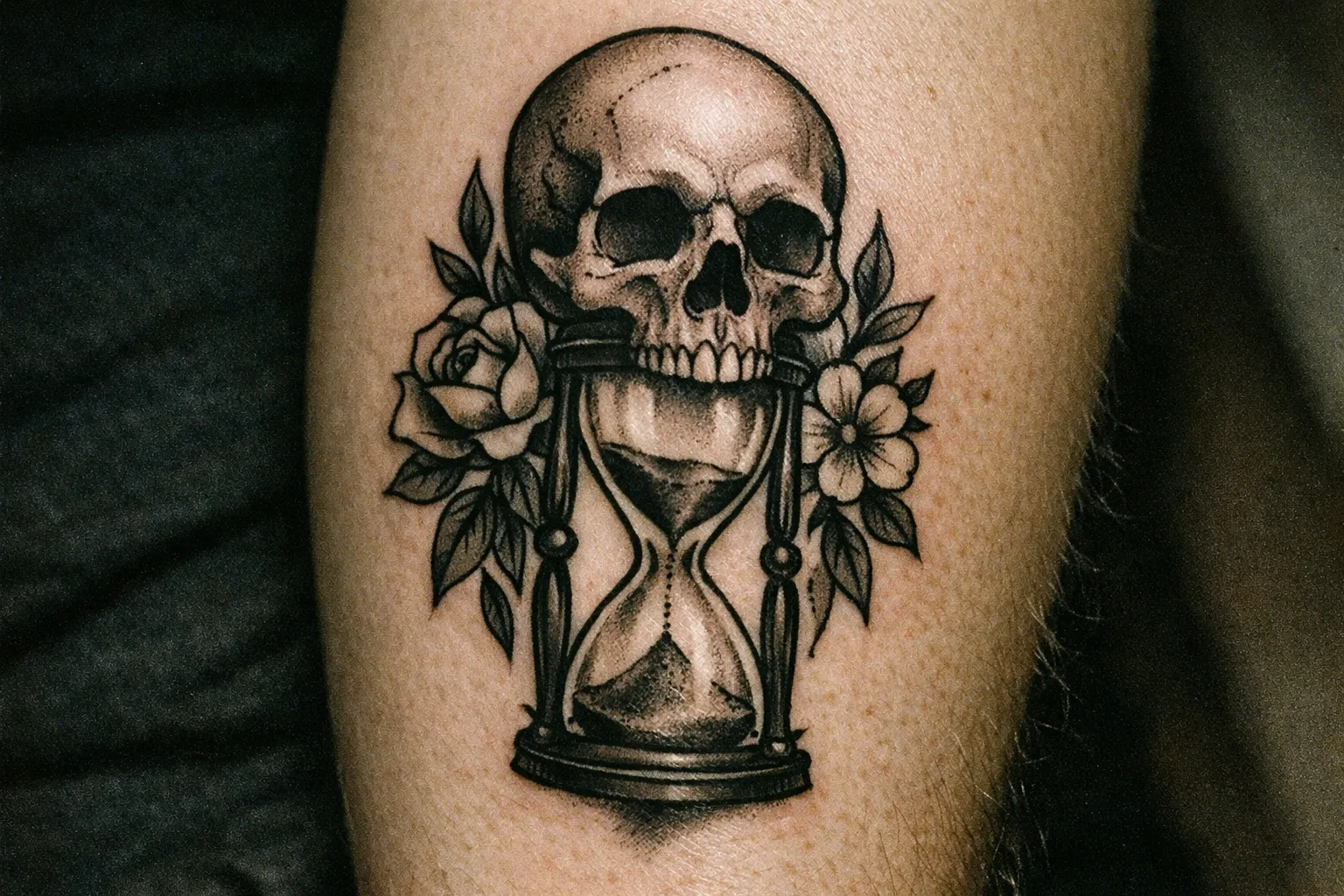
The phrase often travels with its companion: memento vivere - “remember to live.” Together they frame the same idea from both ends. Death is coming, so live deliberately. That pairing has grown into its own tattoo subcategory, and I’ll get to placement for it below.
When there’s no text, the imagery carries the weight. Classic symbols include skulls and skeletons, hourglasses and stopped clocks, extinguished candles, ravens, wilted flowers, coffins, and the grim reaper (4). Each one points at the same theme - time runs out - but the symbol you pick changes how the tattoo reads to other people and to yourself.
One honest caveat before you book anything: a constant visual marker of death sits well with some people and poorly with others. If you live with anxiety or depression, think hard about whether you want this in your eyeline every day. The philosophy is meant to sharpen focus on living, not amplify dread.
Skull Symbolism and Design for a Memento Mori Tattoo
The skull is the oldest and most direct memento mori symbol. It needs no caption - everyone reads it the same way.
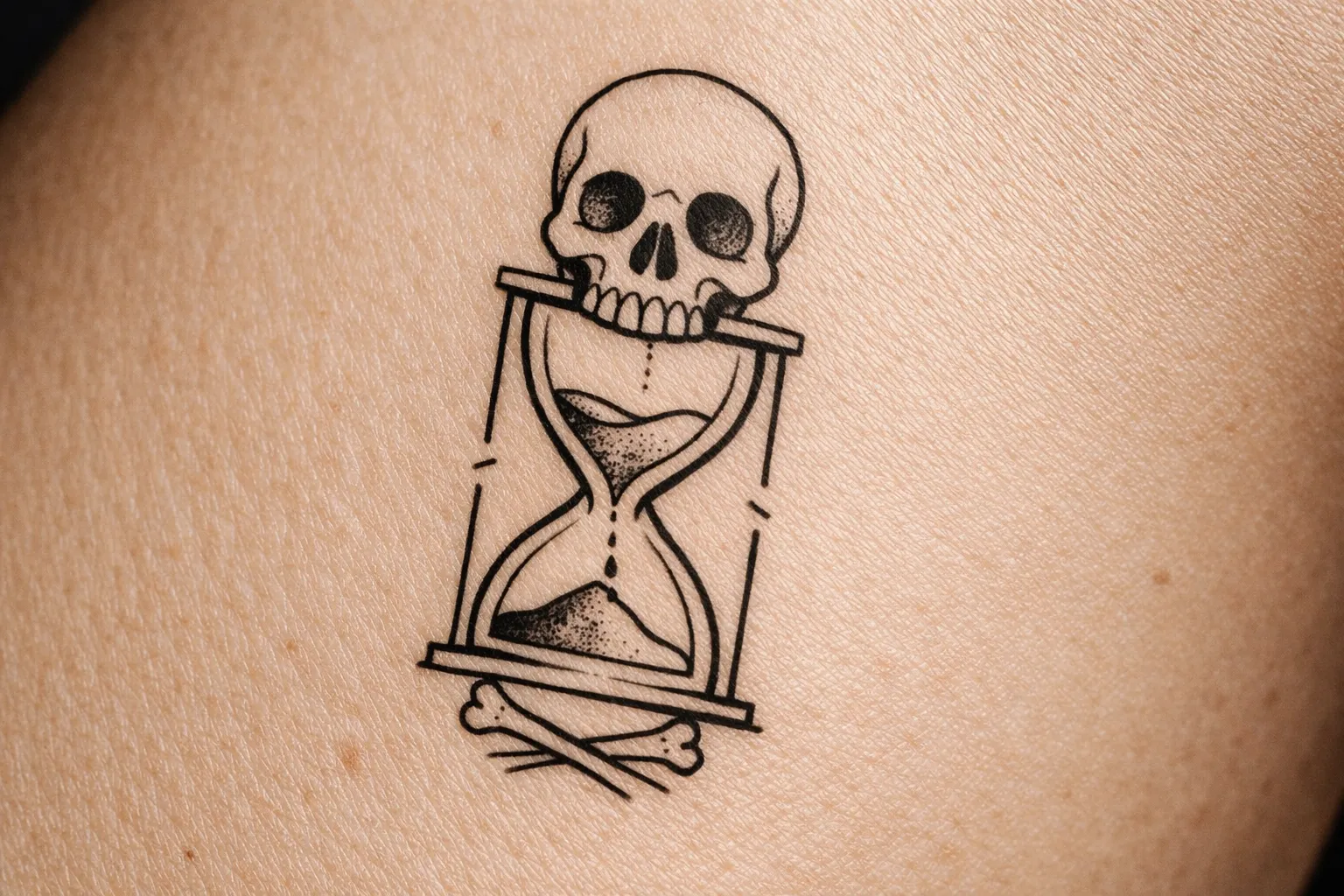
Two main approaches worth understanding before you sit down with an artist:
- Traditional skull: thick black outline, limited color palette, heavy fills. This is the version that ages best. Bold lines and strong black shading stay legible for 10-20+ years with sun protection, and touch-ups are simple because there’s no fine gradient to match.
- Realism skull: photorealistic detail, soft grey shading, depth. Striking when fresh, but it demands a specialist - expect $200-$300+ per hour - and it relies on subtle tonal work that can soften over a decade if you’re not protecting it from sun.
The common pitfall with skulls is clip-art. I’ve seen clients come in with a generic skull pulled straight off a search result, and they end up with the same tattoo dozens of strangers already have. Ask your artist to draw it custom, even if you bring a reference. Small changes - jaw angle, crack patterns, a crown or candle - make it distinct.
A skull and rose memento mori tattoo is one of the more balanced combinations: skull for mortality, rose for beauty and life. It reads as duality rather than pure darkness. Typical size runs 4-7 inches (10-18 cm) on the forearm, shoulder, or outer thigh - enough room for the rose petals to hold detail without crowding the skull.
Minimalist Approaches to Memento Mori Designs
If you want the message without heavy imagery, go small and clean. A minimalist memento mori tattoo is usually one of three things:
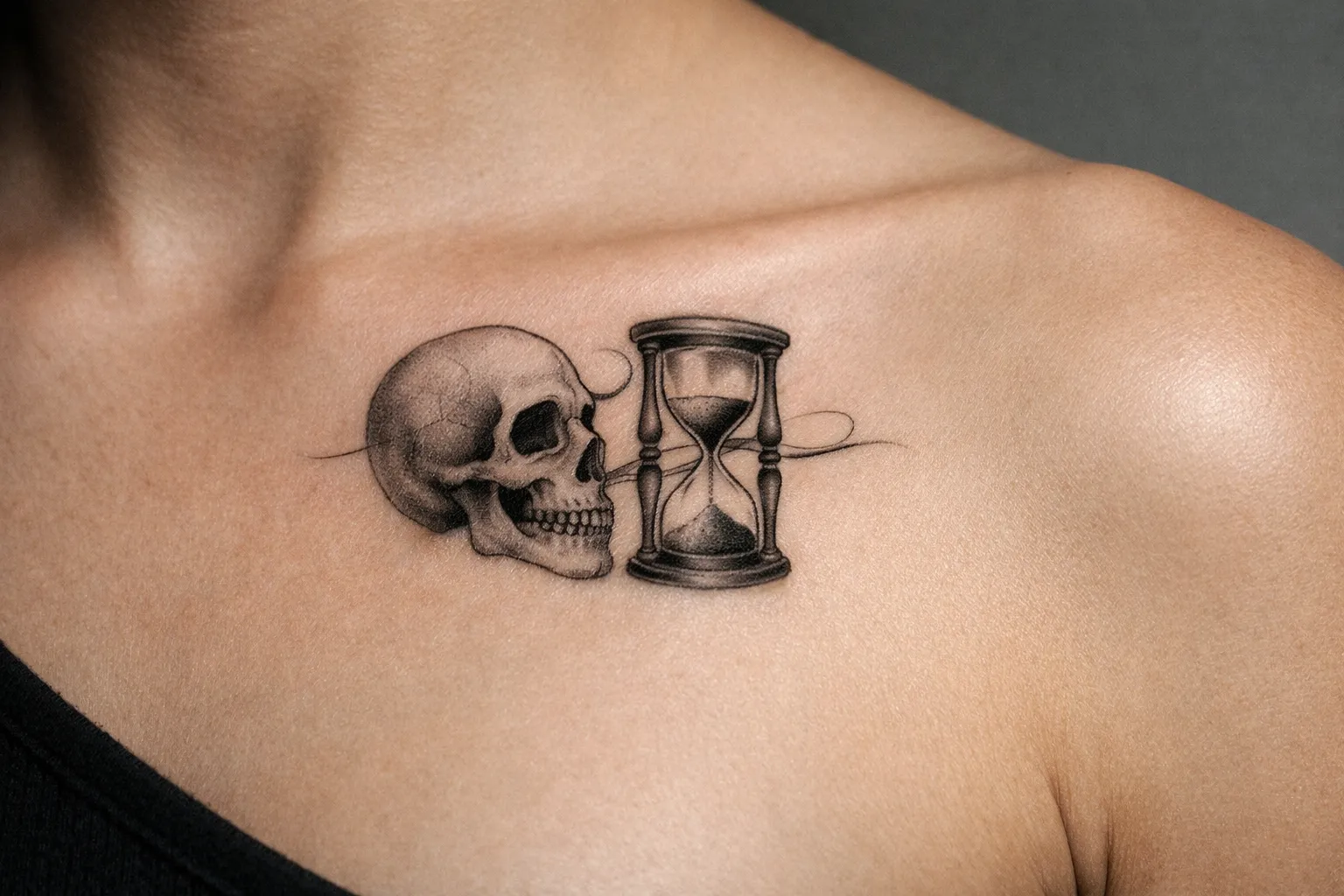
- Thin-line Latin script - “memento mori” on the wrist, inner forearm, or collarbone
- A single-line skull, often no bigger than 1-2 inches (2.5-5 cm)
- A tiny hourglass or candle in fine line
These are popular with first-timers and people who need discreet ink for conservative workplaces (2). They run cheap and fast - most are 1-2 hours and $80-$200, sometimes just the shop minimum.
Here’s the trade-off, and it’s a real one: fine-line work blurs. Fine-line letters smaller than 1 in (25 mm) tall, or standard script under 0.5 in (12-13 mm), can turn into illegible smudges within 2-5 years, especially on fingers and the sides of hands. Fine-line script in general can blur in 3-7 years without diligent aftercare and sun protection. To keep micro-text readable, hold line thickness at 0.1-0.12 in (2.5-3 mm) minimum and avoid the very smallest fonts.
Small and permanent is a tension you negotiate with your artist, not a free win.
Forearm Placement Tips
The forearm is the default placement for this design, and for good reason: you see it constantly. That makes it the natural home for a phrase meant to be a daily marker. A forearm memento mori tattoo typically runs 3-8 inches (7.5-20 cm) and takes 2-6 hours depending on detail.
Pain here is moderate. The outer forearm sits at the easier end of the scale - more tolerable than the inner forearm and wrist, which run higher near the tendons. For comparison, ribs and sternum are far rougher. The outer forearm is one of the more manageable spots for a longer session.
Orientation matters more than people expect. Decide before stenciling:
- If you want to read it yourself, the script should face you when your arm hangs relaxed.
- If you want others to read it, it faces outward.
You can’t have both, so pick the one that matches your intent. Also plan around your wristwatch and sleeve lines so the design doesn’t get cut off by clothing.
The downsides: the forearm catches a lot of sun, so fading is faster here than on covered areas. Use SPF 30-50 on it whenever it’s exposed. And visible blackwork can be a problem in conservative workplaces or some religious communities. If either is a concern, test the placement with a temporary version first - more on that below.
✓ Pros
- Strong symbolic reminder visible daily on forearm
- Forearm is a moderate pain area and manageable for longer sessions
- Traditional skull style ages well with bold lines and sun protection
✗ Cons
- Fine-line and small script tattoos blur and fade faster
- Forearm exposure to sun accelerates fading
- Visible tattoos may conflict with conservative workplaces or religious views
Script Tattoos Pairing Memento Mori and Memento Vivere
The memento mori memento vivere tattoo pairs “remember you must die” with “remember to live.” It’s the most literal version of the whole philosophy - death on one side, intentional living on the other.
Script is a specialized skill. Check that your artist actually does lettering well, not just imagery - those are different things. Common formats I’ve seen work well:
- Stacked script down the inner forearm or spine
- Mirrored placement - “memento mori” on the left forearm, “memento vivere” on the right, so each phrase stays readable instead of cramming both into one block
- Curved around the wrist or under the collarbone
A related Stoic pairing is the memento mori and amor fati coins tattoo - two coin designs (often a skull and a flame or wheel) inspired by the coins Daily Stoic popularized (5). They sit well on the inner forearms, one per arm, or stacked on a single forearm. This combination has grown noticeably across social feeds in the last year or two as Stoicism’s popularity climbed (5).
For any long text, keep it readable from 3-6 feet away. Three lines of micro-script stacked on top of each other won’t survive a decade.
Traditional Hourglass and Grim Reaper Designs
The traditional hourglass tattoo is the cleanest non-skull way to say “time is running out.” It works on the forearm, upper arm, or calf, and it scales well. Smart variations: sand draining into the shape of a skull, or “memento mori” running across a banner beneath the glass. Done in traditional style - bold outline, limited palette - it ages as reliably as a traditional skull.
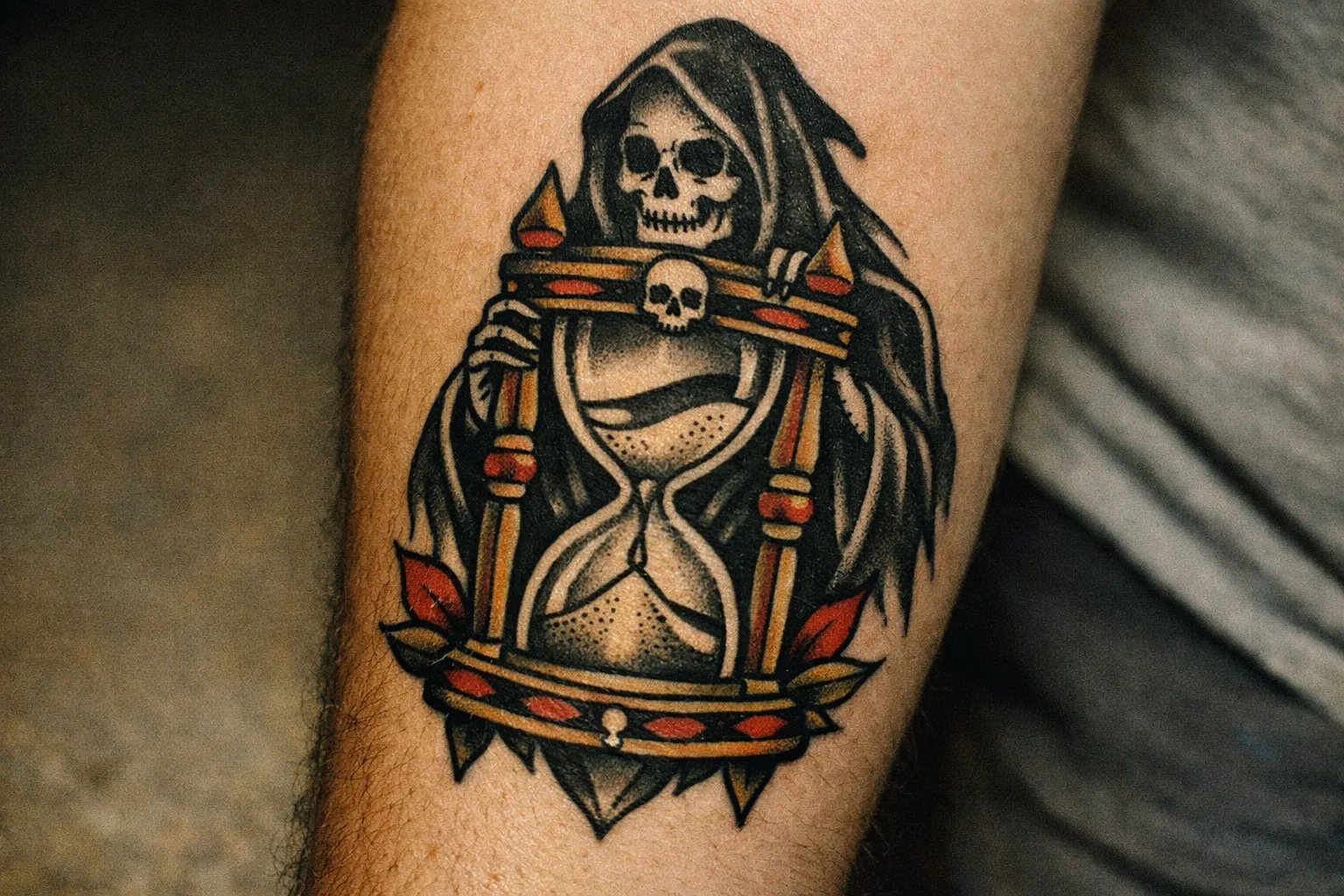
The grim reaper memento mori tattoo is the dramatic end of the spectrum. A cloaked figure with a scythe needs room: plan for 5-10 inches (13-25 cm) on a full forearm or calf, and 3-8 hours of work. It reads well in blackwork or neo-traditional with a colored background. The reaper isn’t about fear - it’s the figure that comes for everyone equally, which is the whole point of the memento mori idea.
The mistake people make with the reaper: cramming it into too small a space alongside three other elements. A reaper plus hourglass plus roses plus a banner of text crammed under 4 inches turns into mud. Give a complex figure the real estate it needs, or simplify.
Over 100 Ideas for a Memento Mori Piece: Mix and Match Elements
Most galleries just dump 40 images at you. Here’s a more useful approach - build your own design by combining one element from each category. The permutations alone yield well over a hundred distinct memento mori tattoo ideas:
Skull variants (10+): classic, cracked, crowned, half-mechanical, sugar skull, split-statue skull, candle-topped, vine-wrapped, weathered, flaming.
Time motifs (10+): hourglass, broken clock, sundial, pocket watch frozen at a moment, melting clock, sand forming a skull, stopped wristwatch, sundial with shadow, ticking-down digits, calendar pages.
Script placements (10+): inner forearm, collarbone, spine, under the pectoral, ribcage, inside the fingers, behind the ear, wrist, nape of neck, sternum.
Religious / philosophical pairings (10+): cross and skull, “amor fati,” “vita brevis,” Stoic quotes, a Roman bust, praying hands with a skull, a candle and cross, dates of a life, a scale, an ouroboros.
Minimalist line drawings (10+): single-line skull, line candle, line raven, line hourglass, line rose, line coffin, line moth, line scythe, line bust, line wilted flower.
Statue and bust concepts (10+): Roman bust split with a skull half, classical statue framed in geometric shapes, a fractured marble head, a bust with a draining hourglass - the geometric-classical hybrids trending on Lemon8 are a good reference here (6).
Pick one skull type × one time motif × one script placement × one style and you’ve got a design that isn’t sitting on a hundred other arms.
Temporary Tattoos for Testing Memento Mori Designs
Before you commit, a temporary memento mori tattoo is the smartest test run available. Artists and brands now offer art-history-inspired and optical-illusion temporary designs - Pablo Garcia’s memento mori temporary work is one example (3).
Water-transfer versions last 3-10 days; ink-into-epidermis products last 1-2 weeks. Multi-design sheets run $10-$25, and custom print-on-demand temp designs start around $15-$30.
Use the temporary version to answer three real questions:
- How does your workplace react to visible ink?
- Can you live with a death reminder in your eyeline every day?
- Does a 3-inch skull feel too small or too large on that spot?
This is also how you settle a forearm-vs-chest debate without paying for a tattoo you’ll regret. I tell clients who are on the fence to run a temp version for a week before booking. Most of them come back with a clearer head about what they actually want.
Pricing and Size Expectations
Pricing depends on size, detail, and your city. Rough US and European bands:
- Small script (1-3 in) or tiny skull: $80-$200; most shops have an $80-$100 minimum.
- Medium forearm design (3-6 in skull + hourglass): $250-$600, 2-5 hours.
- Large forearm or half-sleeve scene (8-12 in reaper, statue, collage): $600-$1,500+, 5-12 hours.
How big is a $3,000 tattoo? At the $150-$250/hour rates common in major cities, $3,000 buys roughly 12-20 hours of work. That’s a detailed half sleeve to near-full sleeve, or an intricate back or torso piece with realism and heavy detail. It is not a small wrist script - if someone quotes you $3,000 for a few inches of line work, ask why.
Budget for the extras too. Consultations run free-$50 and 15-45 minutes; deposits are commonly $50-$200 or 10-30% of the total. Tipping is standard at 15-25% in North America. Many artists include one free touch-up within 6-12 months; after that, touch-ups run $50-$200.
Don’t try to buy a full forearm reaper scene for “under $200” at a reputable shop. That expectation pushes people toward unlicensed or inexperienced artists, and that’s where blowouts and infections come from.
Selecting Your Artist and Following Aftercare
Look for portfolios that show healed black-and-grey work, not just fresh photos. Fresh always looks crisp; healed tells you how the artist’s lines actually settle. If you want script, confirm they do lettering specifically. Ask how many memento mori, skull, or grim reaper pieces they do a month - some artists essentially specialize in dark and Stoic themes, and that experience shows.
For aftercare, the timeline matters more than the product brand:
- Day 1-5: Keep the sterile bandage or second-skin film on as your artist directs. Wash gently with a fragrance-free soap and apply a thin layer of tattoo ointment 2-3 times a day (1).
- Week 1: Expect an itchy, flaky scab phase around days 5-10. Do not scratch or pick - that’s how fine detail gets lost (1).
- Week 2-4: Surface healing completes. Switch to a fragrance-free moisturizer to keep the skin supple. Deeper dermal healing continues for up to 3 months.
- Long term: Use SPF 30-50 on the area whenever it’s exposed, and skip tanning beds entirely. UV is the main killer of black and grey longevity (1).
Sunbathing or tanning within the first 4-6 weeks causes early fading of black and grey work, so cover the tattoo with sun-protective clothing while it heals.
Frequently Asked Questions
- What does memento mori mean as a tattoo?
- It's a tattoo that either literally reads "memento mori" - Latin for "remember you must die" - or uses related imagery like skulls and hourglasses to remind the wearer that life is finite, so they focus on what matters.
- Is memento mori against Christianity?
- Historically, no. Medieval and Baroque Christian art used skulls, hourglasses, and "memento mori" inscriptions constantly to encourage repentance and humility. The phrase itself aligns with Christian ideas, though pairing it with anti-religious imagery can cause conflict.
- How big is a $3,000 tattoo?
- At $150-$250 per hour in major cities, $3,000 typically covers 12-20 hours of work - enough for a detailed half sleeve to near-full sleeve, or an intricate back or torso piece with realism and heavy shading.
- Why do fine-line tattoos blur faster than bold ones?
- Fine-line tattoos have thinner ink deposits that spread and fade more quickly under the skin, especially in high-movement or sun-exposed areas. Bold lines hold pigment better and stay legible longer with proper care.
- Can I combine multiple memento mori symbols in one tattoo?
- Yes, but complex designs like a reaper plus hourglass plus roses need enough size to avoid blurring into a muddy mess. Simplify or give the tattoo enough real estate to keep details clear.
- How do I decide the orientation of a forearm script tattoo?
- If you want to read the script yourself, have it face you when your arm hangs relaxed. If you want others to read it, face it outward. You can't have both, so choose based on your intent.
What Actually Decides Your Memento Mori Tattoo
Strip away the philosophy and the practical decisions are simple. Pick a symbol you’ll read the same way every day - skull, hourglass, reaper, or plain script. Size it so it stays legible: nothing under 0.1 in line thickness if you want it readable in ten years. Put it where it ages well and fits your life - outer forearm if you want a daily marker, ribs or chest if you want it private.
Protect it from the sun and your fine-line work will outlast the cheap version by years.
If you’re on the fence about placement or about living with a death reminder, run a temporary version first. The meaning is yours to carry; the longevity is a function of these choices.