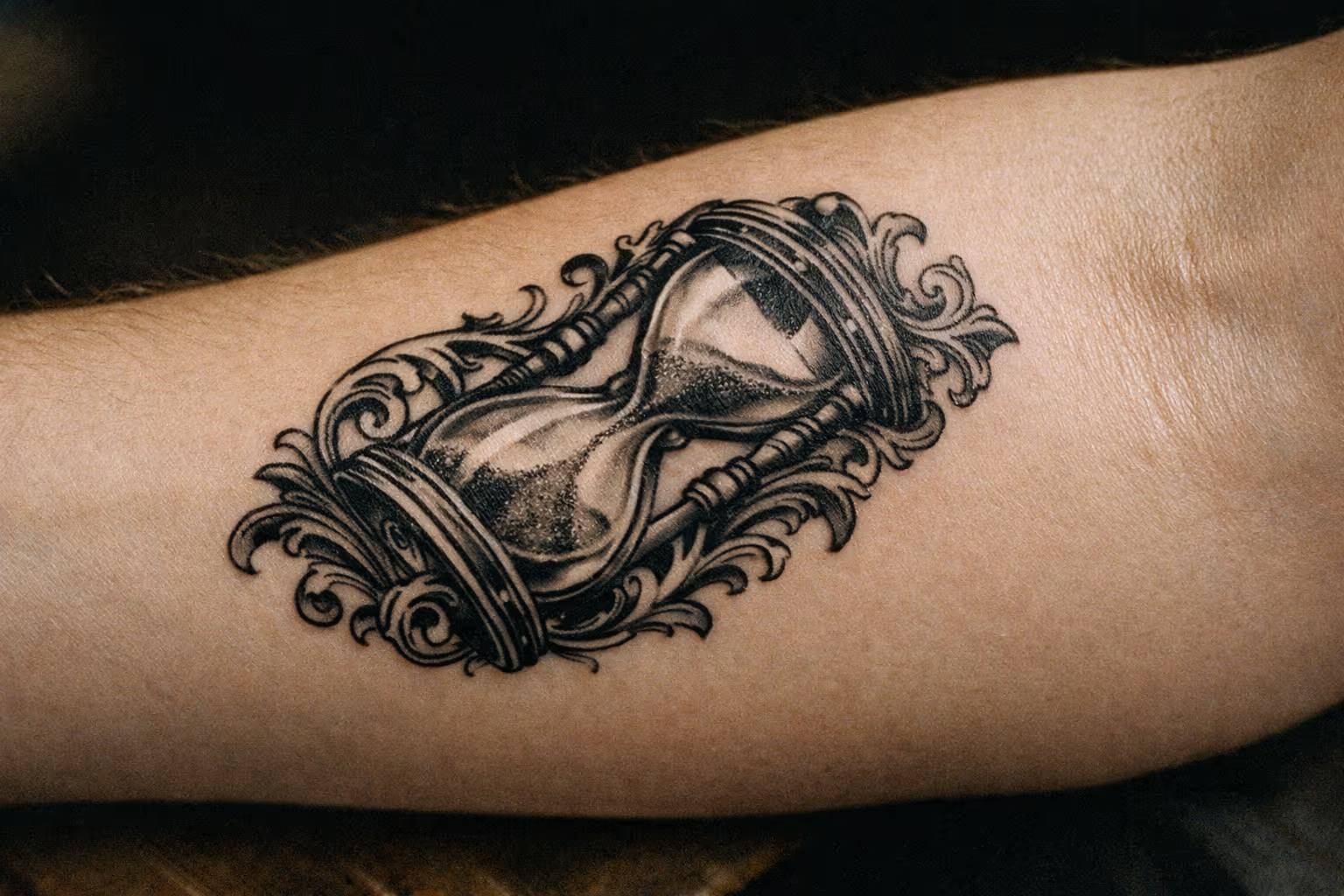
An hourglass tattoo has a built-in trap: it’s all thin parallel lines and fine sand, and lines under a millimeter blur into a grey shape within a few years. It ages best the way most people don’t picture it - bold, 5-8 inches, on the forearm - not as a delicate wrist piece. Get the scale right and the symbolism takes care of itself. Here are the size tiers ($80 to $3,000) and how to build one that survives.
Hourglass Tattoo Meaning: A Symbol of Life’s Impermanence
The hourglass has been used to represent the passage of time since roughly 2000 BC - long before it became a tattoo staple. That’s a lot of cultural weight sitting in a two-bulb shape. What makes it durable as a motif is that the core message doesn’t require explanation: sand drops, time passes, you can’t reverse it. According to historians of material culture, the hourglass became a standard memento mori symbol in European art by the 15th century, appearing in paintings, woodcuts, and funerary carvings well before it crossed into tattooing.
The Timeless Message of Hourglass Tattoos
Beyond the obvious “time is finite” read, I see clients come in with a few different angles on this one:
- Balance between opposites (top vs. bottom, past vs. future)
- Cycles - endings feeding beginnings
- Acceptance of change, rather than trying to control the clock (1)
None of these are wrong. The base symbol is consistent - time passes - but the condition of the hourglass (intact, cracked, shattered, melting) is where your specific meaning gets loud.
Memento Mori and the Hourglass
“Memento mori” - Latin for “remember death” - is tightly linked to hourglass imagery in Western art, and it carries straight into modern tattooing. It isn’t about being edgy. It’s about staying honest: you’re mortal, your time is limited, act accordingly.
This is also where variations matter. A broken hourglass tattoo - especially a shattered one - often reads as:
- a phase ending,
- grief or loss,
- “time ran out,” or
- “I survived something that should have ended me” (2)
That’s a completely different message from a clean, intact hourglass that reads more like “stay present.” When clients come in wanting a broken version, I always ask what happened - not to pry, but because the answer usually tells me whether we want sharp shards or something more worn down. The design should match the story.
Unique Designs and Styles for Your Hourglass
Hourglass designs show up everywhere right now - fine line, neo-traditional, illustrative realism - because they’re symbol-heavy and easy to customize (2). Stock libraries alone have 3,000+ hourglass tattoo graphics floating around online, which is both useful for references and a problem if you want something that doesn’t look like everyone else’s (3).
Here’s how the main styles actually behave on skin.
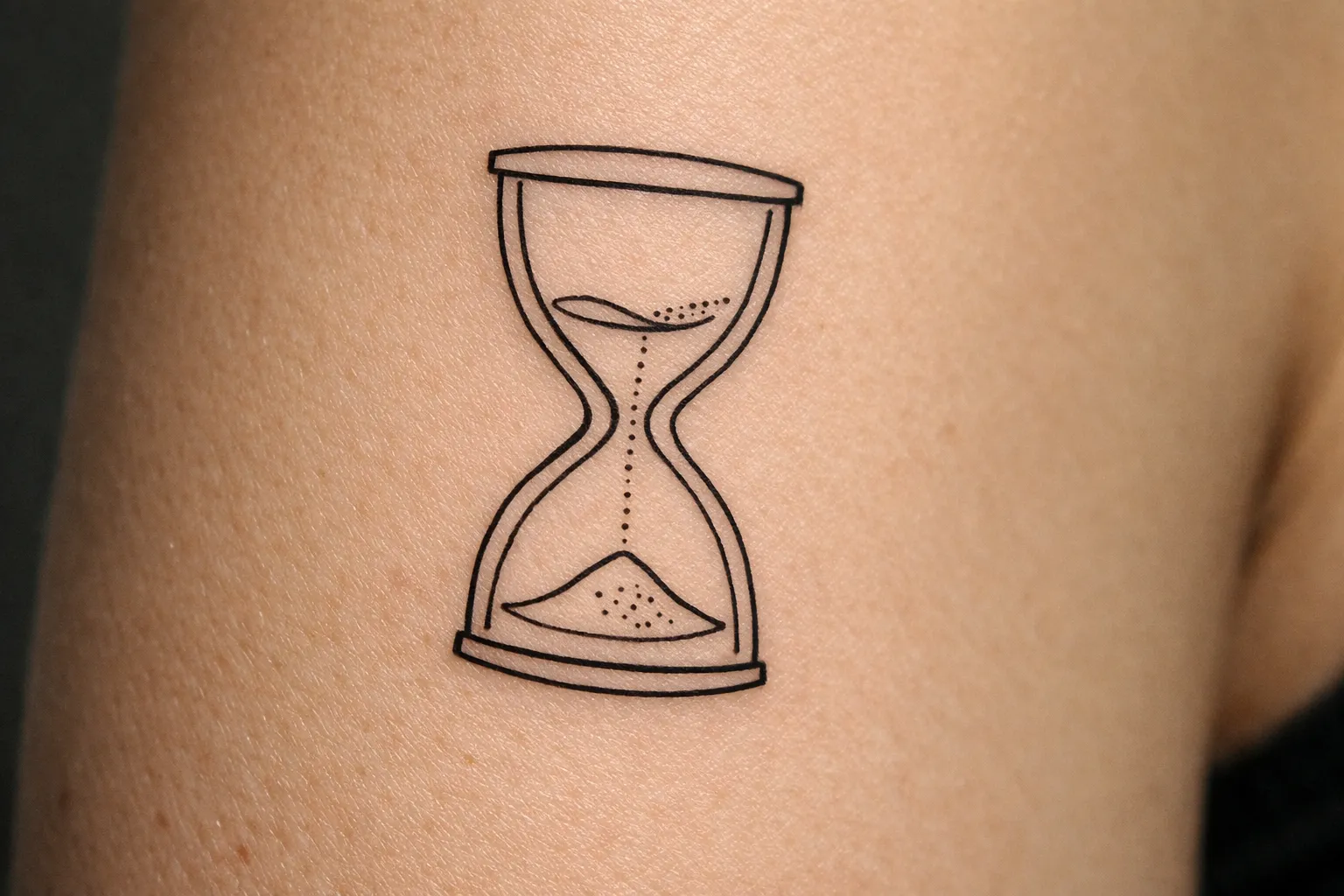
Fine Line / Minimalist Hourglass
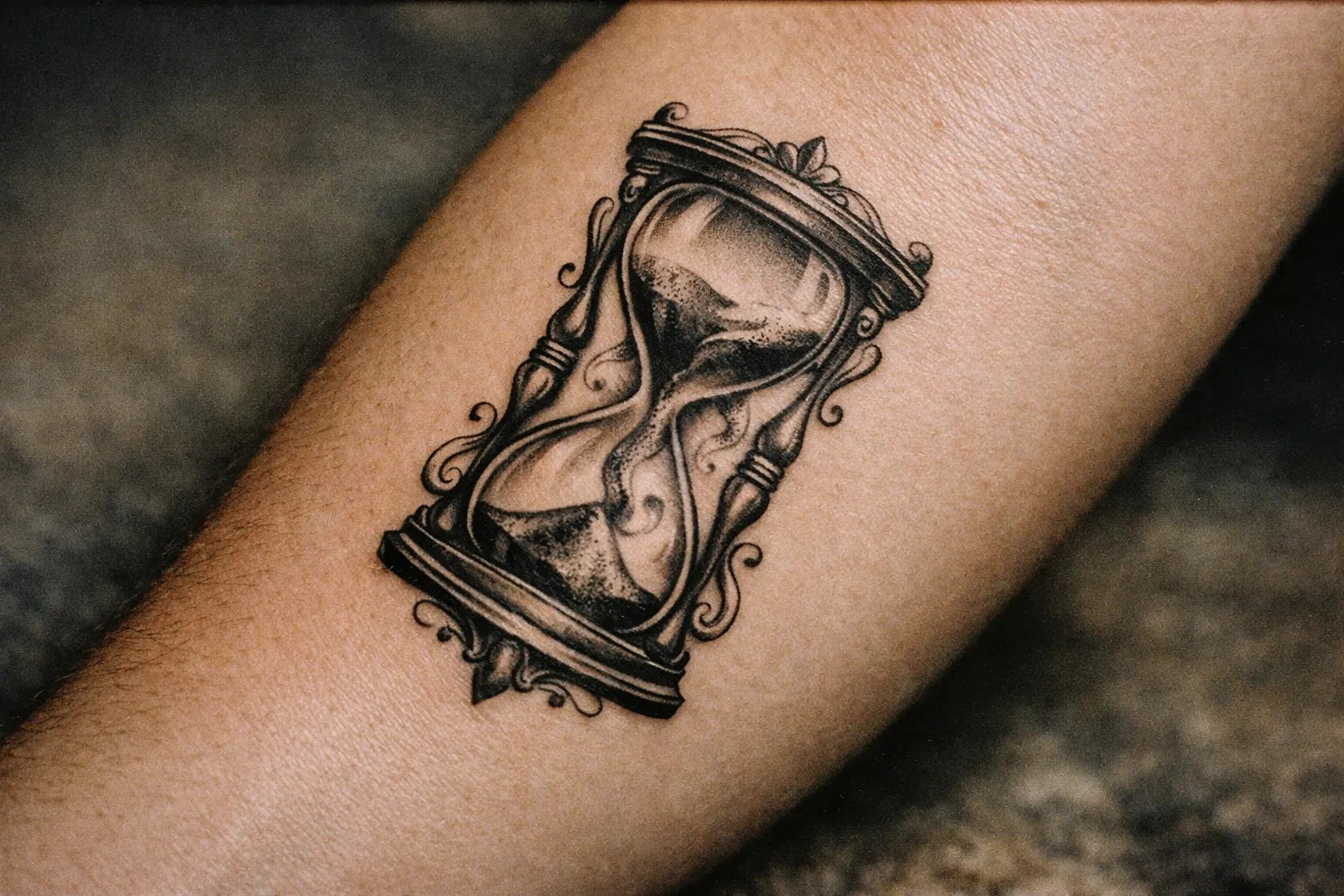
This is the micro-tattoo version: clean outline, light shading, minimal texture. It photographs beautifully. Healed is a different story if the artist goes too small.
- Best placements: inner forearm, outer forearm, upper arm, ankle
- Best size range: 2-4 in (5-10 cm) if you want it to stay readable
- Common pitfall: going under 1.5-2 in (4-5 cm) with hairline strokes on wrists, fingers, and ankles, then being surprised when it blurs in a few years
I’ve seen fresh fine-line hourglasses that looked incredible in the chair and were already softening at the 18-month mark because the neck detail was too tight for the placement. Fine-line work on high-movement areas like wrists and ankles fades noticeably faster than the same design on the outer forearm - the mechanical stress alone accelerates ink migration before sun exposure even enters the equation. If you’re set on micro, ask to see healed photos. Fresh fine line always looks crisp. Healed is the truth.
Traditional / Neo-Traditional Hourglass
Traditional and neo-trad are the longevity kings. The two technical hallmarks: thick black outlines and a limited, deliberate palette. Neo-trad usually adds more color blending, extra detail, and decorative framing - but the bones are the same. Dermatology research on tattoo aging consistently shows that bold-outline styles retain legibility significantly longer than fine-line work - one frequently cited reason is that lines wider than 1 mm resist the lateral ink migration that blurs detail over years of sun exposure and skin turnover.
- Best placements: forearm (5-8 in / 13-20 cm), upper arm (4-7 in / 10-18 cm), calf (6-9 in / 15-23 cm)
- Common pitfall: artists “over-realizing” a traditional hourglass with fussy glass reflections that don’t match the bold line language. It ends up looking confused - neither traditional nor realism, just muddy.
Realistic Hourglass Tattoo (Black-and-Gray or Color)
Realism shines when you want that literal glass feel: reflections, highlights, sand texture, maybe a skull rendered like an actual object sitting on a shelf.
- Best placements: outer forearm, calf, upper arm, side rib, sternum (bigger vertical runway)
- Best size range: 5-10 in (13-25 cm) so reflections and sand don’t turn into visual noise
- Common pitfall: reflections and “glass edges” done with weak contrast. If the artist can’t control values, the hourglass just becomes a shaded oval.
Blackwork / Geometric Hourglass
This is where the hourglass becomes a structure for pattern: dotwork shading, mandalas, heavy blacks, sacred-geometry framing.
- Best placements: forearm, calf, spine
- Common pitfall: too much solid black in tight areas without negative space. It heals like a dark sticker if it isn’t designed to breathe.
Combining Elements for Deeper Meaning
An hourglass can stand alone as a clean reminder. Pair it with one strong symbol and it becomes a story. Pair it with four symbols and it becomes a mess.
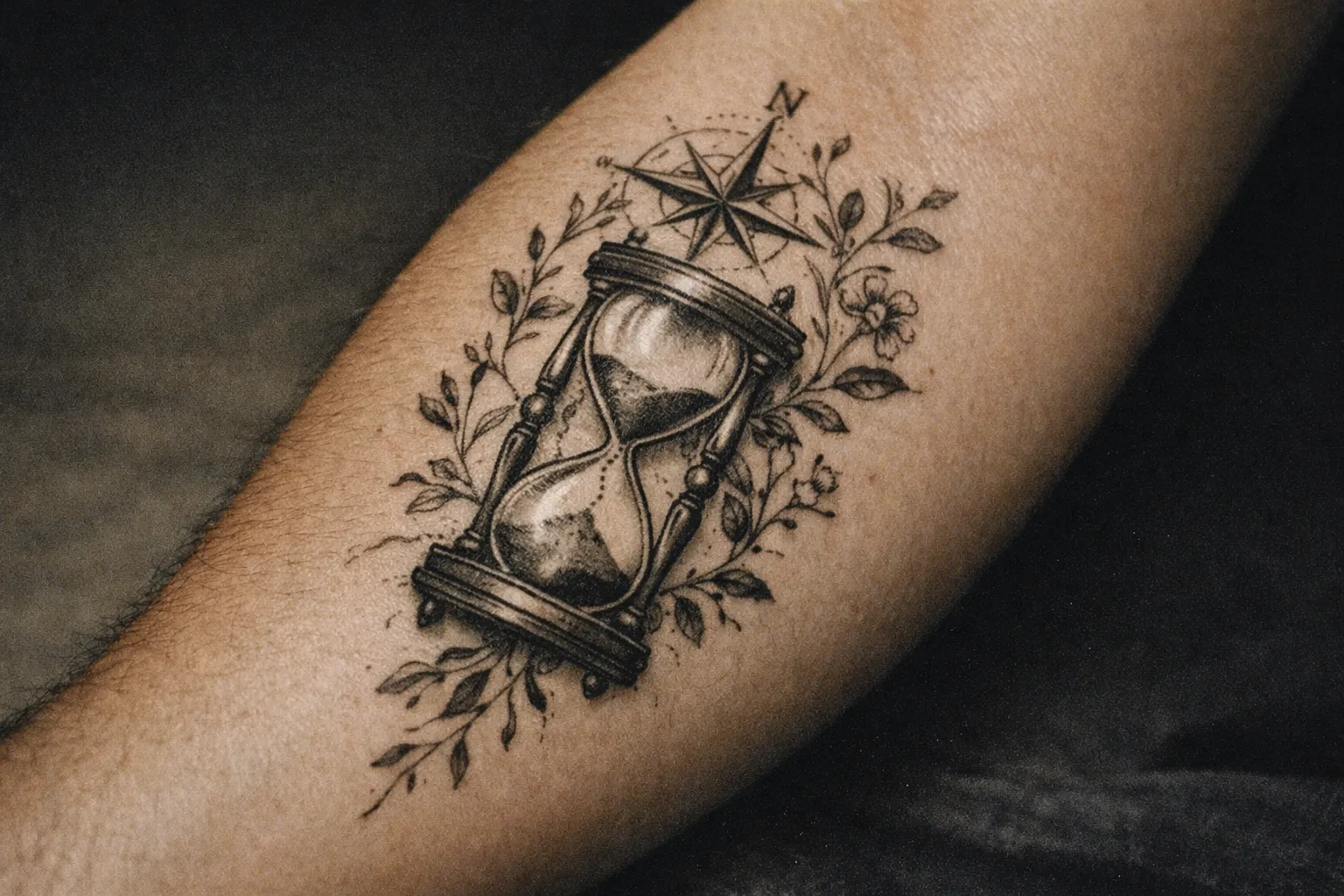
A breakdown that matches what I see in client references:
- Roses + hourglass = love or beauty that doesn’t last forever (4)
- Wings + hourglass = “time flies,” lost time, sometimes memorial context (5)
- Snake + hourglass = cycles, rebirth, temptation vs. limited time (6)
- Eye + hourglass = watchfulness, fate, judgment (7)
Roses and Skulls - A Contrast Between Life and Death
This pairing is popular because it reads instantly, even from across a room.
Roses give you life, beauty, desire. Skulls give you mortality, consequence, “this ends.” The hourglass is the timer sitting between them. It’s a clean three-part composition when it’s done right.
If you’re going traditional, commit to the rules: thick outline, simplified rose petals, clear skull silhouette, and sand that’s readable from a few feet away. If you’re going realism, budget the size for it. A realistic skull plus realistic glass plus readable sand in 3 inches is how you end up with gray soup after healing.
Skull Hourglass Tattoo: When to Choose It (and How Not to Overdo It)
A skull hourglass tattoo is basically memento mori turned up. People get it after addiction recovery, a serious accident, or a period where mortality stopped being theoretical. I’ve tattooed a few of these on clients who had genuinely close calls - it’s not a dark aesthetic choice for them, it’s a record of something real.
To keep it from looking like a Hot Topic poster:
- Pick one focal point: skull inside the glass or skull as the base, not both.
- Keep the sand simple. If the skull is detailed, the sand should be graphic.
- Let negative space do some work so the “glass” still reads as glass.
Placement Considerations for Your Hourglass Tattoo
Hourglasses are a vertical design problem. Treat them like you’d treat a dagger, a candle, or a sword: they want to run with the body’s lines, not fight them.
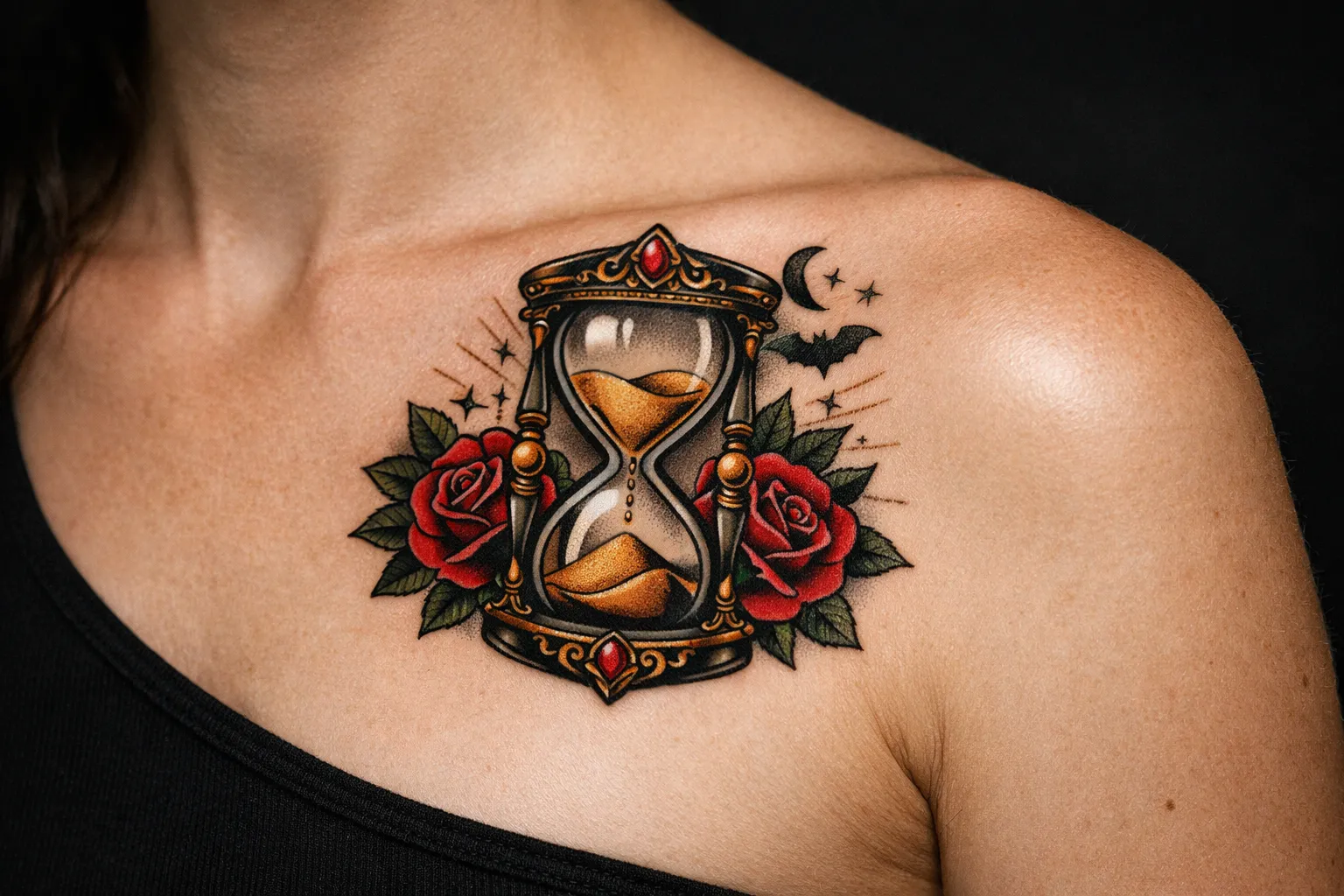
Match the Vertical Format to the Vertical Line of the Body
If you want your hourglass to look right in motion, align it with a vertical structure:
- Forearm: aligns with the radius/ulna; great for 5-8 in (13-20 cm) designs
- Calf: aligns with the tibia/fibula; great for 6-9 in (15-23 cm) designs
- Spine: natural vertical runway; great for 7-12 in (18-30 cm) designs
- Sternum / side rib: dramatic placement, but pain is higher (ribcage > forearm) and healing can be fussier with friction and breathing movement
What usually doesn’t work: forcing an hourglass into a wide horizontal zone like the upper back center or across the collarbones. You can do it, but it takes real design skill to avoid that squished look.
Small Tattoos: Subtlety on the Wrist and Ankle
Wrist and ankle work if you respect the limitations.
- Best size: 2-3.5 in (5-9 cm)
- Best style: simple outline, limited shading, strong negative space
- Watch-outs: these areas get sun and friction. Tiny fine line here can soften fast.
The Bold Forearm Statement
Forearm is the sweet spot for most clients because you can go simple and clean (fine line), bold (traditional), or detailed (illustrative realism) and it still stays readable. A typical forearm hourglass that looks good and ages well sits at 5-8 in (13-20 cm), centered so it runs straight when your arm is relaxed at your side.
Upper Arm: Room to Work
Upper arm gives you space, but it’s also easy to hide - good if you want a meaningful symbol that isn’t always on display.
- Typical size: 4-7 in (10-18 cm)
- Good for: framing an hourglass with roses, adding banners, adding a decorative border
- Ages well because it’s less exposed than wrist or hand
The Artistic Journey Through Colorful Hourglasses
Color can either elevate an hourglass or make it messy. The big trick: glass is about contrast and highlight control, not more color.
Color Tattoos: The Language of Emotion
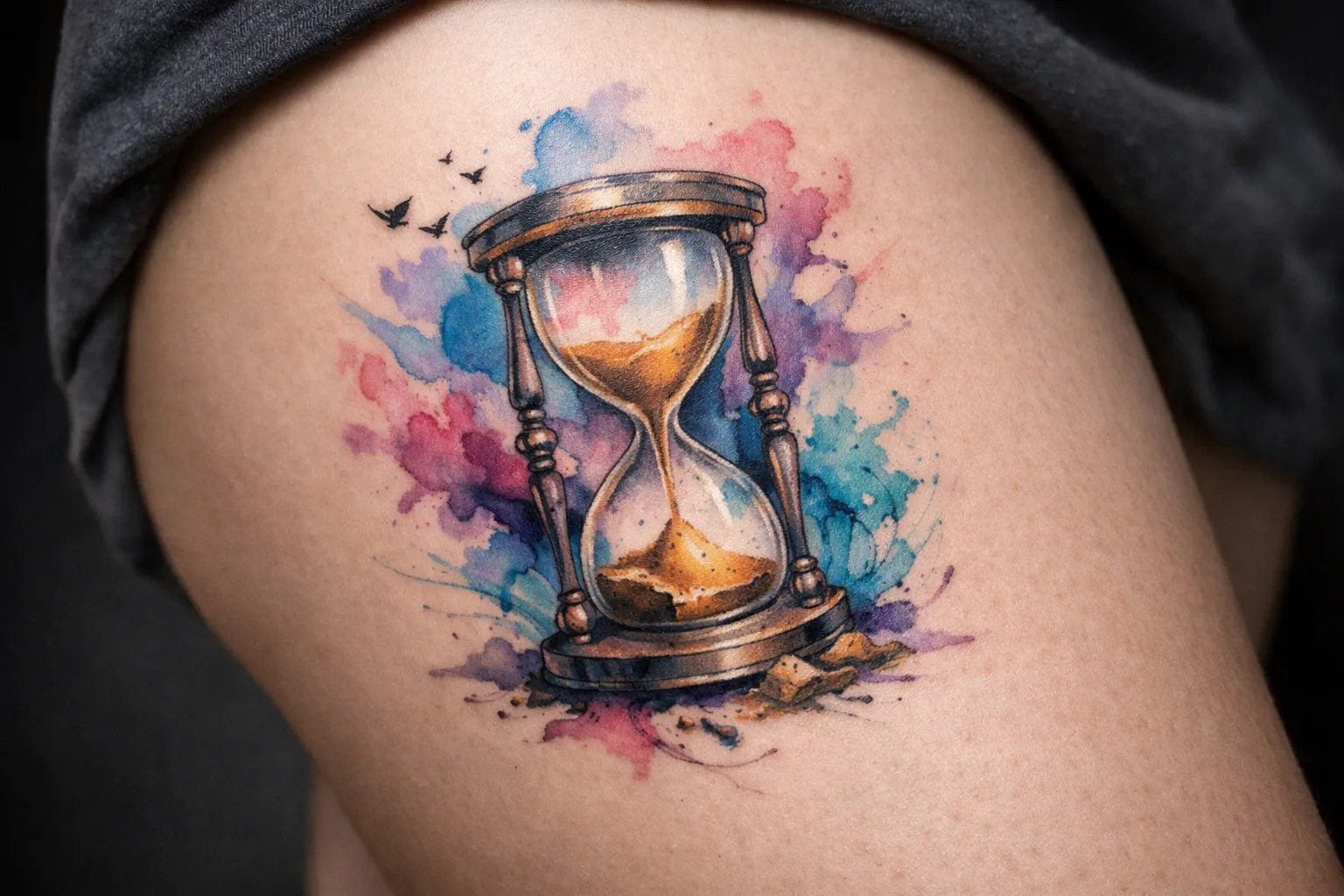
Watercolor-style splashes behind an hourglass can look great fresh, but watercolor relies on soft edges - which fade softer over time. If you want that style, build a solid skeleton first: a clear outline for the hourglass frame, or a strong black-and-gray hourglass with watercolor behind it.
Color reads commonly as:
- Red: urgency, passion, “don’t waste this”
- Blue/Purple: introspection, grief, wisdom
- Green: change, growth, turning a chapter
Diving Deeper with Common Hourglass Colors
If you’re doing a symbol mash-up, color can separate elements cleanly. My usual suggestion: keep the hourglass in black-and-gray, make the “sand” something surreal (stars, petals, ink), and reserve the brightest color for one element - like a rose - so the design has a clear focal point.
A common mistake is coloring everything evenly. It flattens the tattoo. Your eye doesn’t know where to land.
Navigating Size and Detail in Small vs. Large Hourglasses
Sizing isn’t just aesthetic - it’s physics. Ink spreads. Details merge. The smaller you go, the more you need to simplify.
Small Hourglass Tattoos: Elegance in Simplicity
Small works best when your hourglass is treated like an icon, not a scene.
- Good size: 2-4 in (5-10 cm)
- Best placements: wrist, ankle, inner forearm, behind the ear (with caution)
- Best execution: slightly thicker lines than you think you need, and open negative space in the bulbs so the “glass” reads
If you want text, keep it minimal. Tiny script under a tiny hourglass is how you get unreadable fuzz later.
Lavish Large-Scale Designs: Making Every Sand Grain Count
Large pieces let you do the “glass” correctly - reflections, refraction, texture, secondary elements, backgrounds.
- Good size: 8-12 in (20-30 cm) for narrative hourglass pieces
- Strong placements: calf, outer forearm into upper arm, side torso, spine
- Budget reality: large realism or neo-trad is multi-session work in most professional studios
If you’re thinking “I want everything” - skull, roses, clock, quote, wings - go large or cut elements. Cramming is the fastest way to get a tattoo you don’t like by year three.
Five Decisions That Narrow “I Want an Hourglass” to One Design
If you walk into a shop saying “I want an hourglass,” your artist has to drag the concept out of you. Do it yourself first. You’ll get a better tattoo.
1) Choose a Meaning Axis (Pick One Main Message)
Most people want five meanings at once. The tattoo gets cluttered. Pick the lead:
- Urgency / “time is running”
- Grief / memory
- Balance / duality
- Rebirth / change
You can layer meanings later, but you need one headline.
2) Decide: Solo Reminder or Paired Composition
An hourglass alone is clean and direct. Paired designs are louder and more narrative. Ask yourself: do you want a reminder or a story?
3) Pick the Style Before You Pick the Artist
This matters more than people want to admit. If you want realism, you need a realism portfolio. If you want traditional, you need someone who pulls clean bold lines all day. Choose your style bucket first - traditional/neo-traditional, realism, fine line, blackwork/geometric, or illustrative - then shortlist artists who live in that style.
4) Choose Scale Based on Composition (Not Bravery)
Your design complexity dictates size. Not your pain tolerance. Not your budget hopes.
If you want hourglass plus skull plus shards plus flowers plus background, you are not buying a 3-inch tattoo.
5) Place It Where It Fits the Body’s Vertical Lines
Hourglasses want forearm, calf, spine, sternum, ribs. They can work elsewhere, but these placements make the design easier to draw well and easier to read later.
The Working Catalog Clients Actually Browse
Most clients show up with a messy camera roll and expect the artist to interpret it perfectly. Here’s what actually helps.
What to Bring (and How Much)
Bring 10-20 reference images, not 200 - experienced artists consistently report that clients who arrive with a curated, focused reference set get more accurate custom designs than those who dump an entire Pinterest board. Include:
- 3-5 examples of the style you want (fine line vs. traditional vs. realism)
- 3-5 examples of hourglass structure (frame shape, bulb proportions)
- 3-5 examples of the pairing element (skulls, roses, wings, snakes)
People use Pinterest, Instagram tags, and stock previews as their working catalog, and that’s normal. The key is using them to communicate - not to copy.
Common Catalog “Types” Worth Naming to Your Artist
When you can label the type, your consult gets faster:
- classic wood-frame hourglass
- minimalist outline hourglass
- cosmic / galaxy “sand”
- melting hourglass (surreal, Dali-adjacent)
- shattered/broken hourglass with shards
- hourglass with skull integrated (base or inside glass)
- hourglass with florals (roses, lilies)
- hourglass with wings (“time flies”)
How to Avoid the “Pinterest Clone” Problem
Don’t ask for “this exact tattoo.” Ask for this composition (hourglass centered, rose wrapping left side), this line weight (bold outline vs. hairline), this level of shading (light pepper shading vs. smooth realism), this mood (clean icon vs. dark memento mori). That gives the artist permission to design something original that still hits what you liked.
Four Tiers: Your Composition Sets Your Scale
This is the simplest way to keep you from under-sizing - and under-budgeting - the idea.
Tier 1: Solo Hourglass (2-4 in)
- Minimal hourglass, maybe light shading
- Great for first tattoos
- Typical placements: wrist, ankle, forearm
- Cost range (US shop norms): $80-$150 for tiny linework, but many shops have a $100+ minimum, so plan for that
Tier 2: Hourglass + 1 Symbol (4-6 in)
Examples: hourglass + rose, hourglass + wings, hourglass + snake, hourglass + small skull.
- Minimum size: 4-6 in (10-15 cm) so elements don’t merge
- Cost: $200-$500 depending on detail and shop rate
Tier 3: Hourglass + 2-3 Symbols + Background (6-9 in)
This is where most “cool Pinterest hourglass tattoos” actually land.
- Size: 6-9 in (15-23 cm)
- Cost: $500-$1,200
Tier 4: Full Narrative Scene (8-12+ in)
Big vertical centerpiece: skull plus hourglass plus florals plus environment, or scenes inside and outside the bulbs.
- Size: 8-12+ in (20-30+ cm)
- Cost: $1,200-$3,000 and usually 2-3 sessions
An Hourglass Alone Is a Reminder. An Hourglass Paired Is a Composition.
You’re not just choosing symbols - you’re choosing how the tattoo reads at a distance.
Solo Hourglass: Clean and Honest
A solo hourglass reads as time is limited, stay present, balance and cycles. It’s also easier to place small and easier to maintain visually over decades.
Paired Hourglass: Story-First
Pairings change the headline:
- hourglass + skull = mortality front and center
- hourglass + roses = love and beauty don’t last
- hourglass + wings = time flying, memorial vibe
- hourglass + snake = cycles, rebirth, temptation
My rule: if you’re pairing, pick one companion element as the co-star. Everything else becomes supporting texture.
Six Questions to Bring With You
This is how you sound like someone who’s ready, not someone shopping impulse ink.
- “How small can we go while keeping this readable in 10 years?”
- “Which placement will let you do your best work for a vertical design?”
- “Do you have healed hourglass or similar vertical pieces I can see?”
- “How many hours and sessions do you estimate for this level of detail?”
- “If we have to simplify, what would you remove first?”
- “What aftercare do you recommend for this placement and size?”
Bring your references, but also bring your constraints: job dress codes, sun exposure, and whether you’ll actually commit to touch-ups later.
Eight Sand Patterns Worth Knowing
These are pattern-level ideas that keep the hourglass recognizable while making it yours:
- Sand flowing as stars/galaxies
- Sand flowing as petals
- Sand flowing as numbers (dates, counting down or up)
- Sand flowing as runes/sigils (be careful with symbols you don’t understand)
- Sand flowing as music notes
- Sand flowing as butterflies (transformation theme)
- Sand flowing as blood drops (darker urgency)
- Sand flowing as tiny skulls (memento mori amplified)
If you want the design to age well, keep the pattern bold enough that it still reads when the tattoo softens.
If This Is Your First One, Traditional Flash Is the Honest Answer
First tattoos don’t need to be a 12-hour realism marathon.
A traditional or neo-traditional hourglass - or a simplified custom design that behaves like flash - gives you strong readability, bolder lines that age better, lower cost, faster session time, and an easier heal. That’s not a compromise, that’s smart.
A solid first-timer setup:
- placement: outer forearm or upper arm
- size: 3-5 in (8-13 cm)
- style: traditional-ish line weight, limited palette or black-and-gray
- budget: $150-$400 depending on complexity and local minimums
You can always go bigger later. Cover-ups and reworks cost more than starting with a design that holds up.
Three Layers That Turn a Stock Hourglass Into Something Personal
A lot of hourglass tattoos look the same because the base shape is the base shape. Customization is how you get out of “stock.”
Layer 1: The Outer Frame
Make the frame specific - Gothic arches, Art Deco geometry, Baroque ornament, or a simple modern frame with negative space. This is where you can nod to architecture, family heirlooms, or a specific aesthetic without cluttering the interior.
Layer 2: The “Sand” Content
Swap the sand for something personal: stars (cosmic theme), petals (love or grief), bones (memento mori), a date broken into grains (subtle memorial). This is where the design stops looking like a stock graphic.
Layer 3: The Environment
Add a setting that supports the idea - smoke (transition), water (time as flow), vines (growth), constellations (guidance). This is also where you can place text if you must. My preference: keep text short and let the imagery do the heavy lifting.
What Makes Popular Hourglass Designs Actually Work
Pinterest and Instagram push a certain look, but popularity doesn’t equal longevity. Here’s how to judge a viral hourglass design like a tattooer.
Proportion: Bulb Size and Neck Width
If the neck is too thin in the drawing, it often heals shut - especially in micro sizes. A good tattooable design slightly exaggerates spacing so it still reads healed.
Line Weight Hierarchy
Great designs use a heavier outer contour (holds the shape), lighter interior lines (details), and controlled shading. If everything is the same thin line, it looks delicate fresh and mushy later.
Contrast: Can You Read It from 6 Feet Away?
Squint test: can you tell it’s an hourglass instantly? Can you tell what the paired element is - skull vs. rose? If not, it needs simplification or size.
Related Motifs (If You Like Hourglasses, You’ll Probably Like These)
People rarely stop at one symbol. If you’re building a theme, these motifs sit in the same neighborhood:
- Clock tattoos: more literal “time,” often used for specific dates or life events
- Compass tattoos: direction, choices, “finding your way”
- Scales: balance and justice (and they also read vertically well)
- Memento mori sets: skulls, candles, wilted flowers, Latin phrases
- Tarot imagery: The Hermit (time/wisdom), Death (change), The Wheel (cycles)
If you’re actually deciding between a clock and an hourglass, choose based on whether you want mechanical time (clock) or inevitable flow (hourglass). They feel different on the skin.
Drawing: How to Use a Sketch Without Copying
If you’re bringing an hourglass tattoo drawing to an artist, treat it like a blueprint, not a final.
Do:
- circle what you like (frame shape, sand idea, pairing element)
- note what you don’t want (too much shading, too realistic, too many shards)
- bring 3-5 references so the artist sees your taste range, not one exact copy
Don’t:
- ask for an exact replica of a viral design
- assume the drawing will fit your body without changes (forearm curvature changes everything)
Broken Hourglass Tattoo: Turning “Damage” Into Intention
A broken hourglass tattoo can read as grief, the end of an era, or refusing to be ruled by deadlines. If you’re worried people will read it as hopeless, you can steer the interpretation with a banner that reframes it (short phrase, not a paragraph), a growth element like new flowers or vines, or a “repair” detail - kintsugi-style cracks, stitches, metal binding.
Damage can be the point. Just make sure it’s designed, not accidental-looking.
Aftercare Tips: Keeping Your Hourglass Linework Clean
Proper aftercare is what separates a crisp healed tattoo from one that looks like it aged ten years in the first month.
Day 1-3: Protect It and Keep It Clean
- Leave the bandage on as directed by your artist.
- Wash gently with lukewarm water and mild soap.
- Pat dry with a clean towel or paper towel.
- Apply a thin layer of fragrance-free moisturizer - not a thick glob.
Avoid soaking, pools, hot tubs, heavy sweat sessions, and letting pets sleep on it.
Week 1: Peeling and Itch Management
This is when the tattoo gets flaky and itchy. Don’t pick. If you rip flakes off early, you can pull pigment with it.
- Keep washing 1-2x daily.
- Moisturize lightly when it feels tight or dry.
- Wear loose clothing over rib and side torso placements to prevent friction.
Week 2-4: Settle and Protect From Sun
Most of the surface healing happens here, but your skin is still rebuilding underneath.
- Keep moisturizing as needed.
- Avoid direct sun; use sun-protective clothing if you’re outside.
- After it’s fully healed, sunscreen becomes your long-term maintenance habit. Studies on UV-induced tattoo fading show that unprotected black ink can lose measurable optical density within two summers of regular sun exposure - fine-line work is hit harder than bold traditional outlines because there’s less ink mass to absorb the degradation.
If you went with fine-line hourglass details, sun protection is non-negotiable if you want it to stay delicate instead of fading fast.
Frequently Asked Questions
- What does the hourglass tattoo mean?
- The hourglass tattoo commonly symbolizes the passage of time, mortality, and impermanence. Depending on style and pairings, it can also represent balance, cycles, or acceptance of change.
- What does the shattered hourglass tattoo mean?
- A shattered or broken hourglass often signifies an ended chapter, loss, grief, or rejecting fate and deadlines. It can also be a survival marker for overcoming something that should have ended you.
- How big is a $3,000 tattoo?
- At typical U.S. rates ($150-$250/hour), $3,000 usually covers 12-18 hours of tattooing. For an hourglass piece, this often means a large, detailed composition around 8-12 inches tall, possibly spanning a torso or three-quarter sleeve.
- What are some tattoos to avoid?
- Avoid ultra-micro fine-line tattoos under 1.5-2 inches on high-wear areas, overstuffed small compositions, tiny script text, and copied viral designs. Undersized detailed realism or complex elements also tend to lose clarity.
- How do I keep my hourglass tattoo looking crisp over time?
- Proper aftercare is key: keep the tattoo clean and moisturized, avoid picking flakes, protect it from sun exposure with sun-protective clothing, and follow your artist's instructions carefully, especially in the first 4 weeks.
- Can I get a small hourglass tattoo on my wrist or ankle?
- Yes, but keep it between 2-3.5 inches with simple outlines and strong negative space. These areas get more sun and friction, so fine-line details may blur faster.
- What questions should I bring to my tattoo consult?
- Ask about minimum readable size, best placement for vertical designs, healed examples of similar tattoos, estimated hours and sessions, simplification options, and recommended aftercare for your chosen placement.