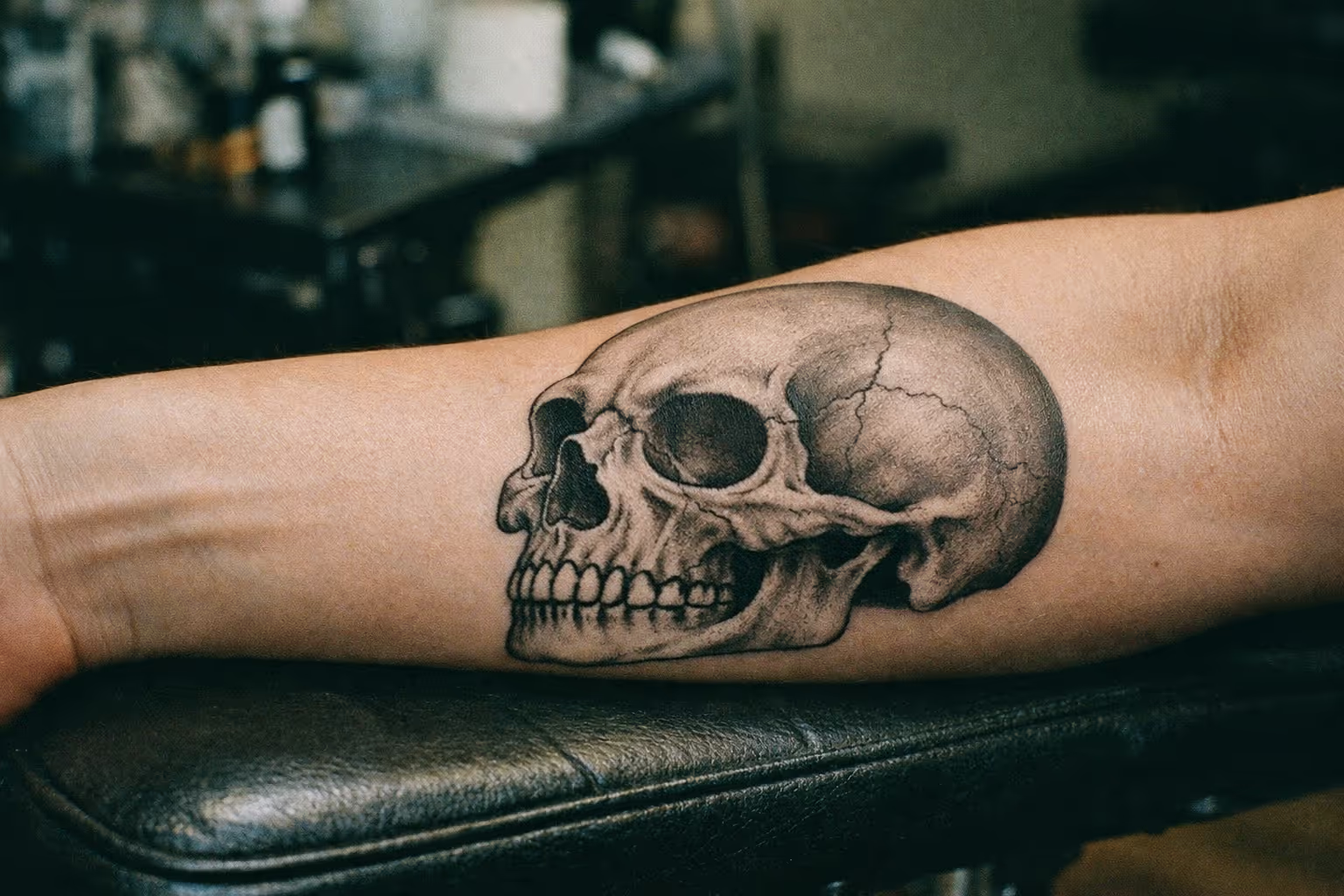
A skull tattoo is one of those pieces where the placement decision costs you later - literally. Hand skulls, one of the most popular spots, see 20-30% touch-up rates in the first year alone as the ink settles unevenly. And at $150-200 an hour, $500 buys you roughly a 4-6 inch piece, not the sprawling design Pinterest sold you. Here’s what a skull means across cultures, and what it actually costs to do right.
What Skull Tattoos Actually Symbolize
A skull tattoo is one of the most loaded motifs you can put on skin. It reads as memento mori, protection, defiance, or remembrance depending on the culture you pull from and the elements you pair it with. It’s also one of the most forgiving designs to execute well - and one of the easiest to wreck if the artist crowds it with detail or shrinks it past what the skin can hold.
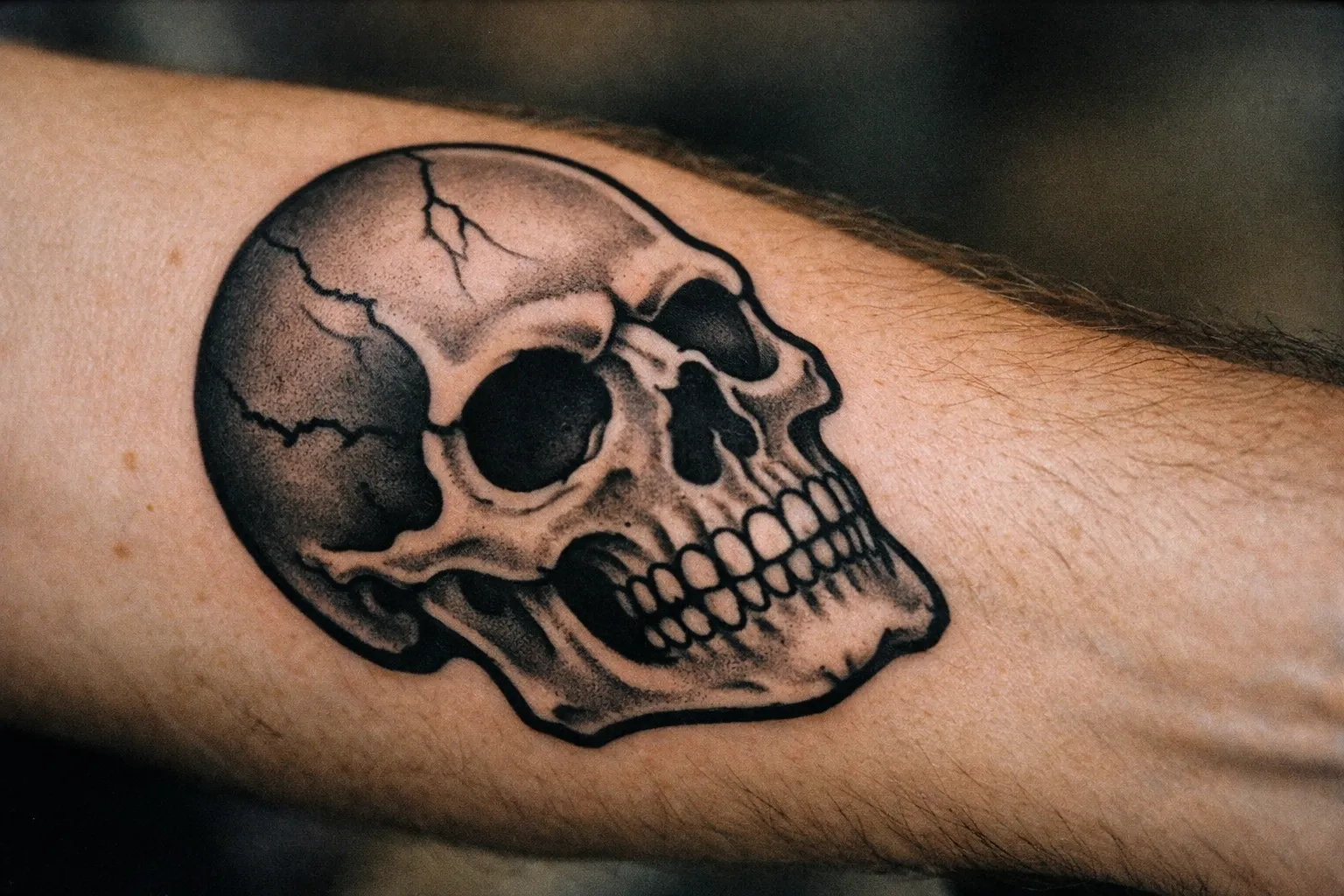
This guide covers skull tattoo meaning across traditions, which skull tattoo designs actually hold up across styles, where they sit best on the body, and what a realistic budget looks like in 2026.
The short answer on symbolism: mortality, but not only mortality. The skull predates modern tattooing by centuries, and different traditions push it in very different directions.
- Memento mori (European/Christian tradition): awareness of death, humility, “remember you must die.” This is where the skull-and-hourglass combination comes from.
- Mexican calavera and sugar skull tattoo (Día de los Muertos): remembrance and celebration of the dead. The skull here is decorative, joyful, often named - closer to a portrait than a warning. Treating it as generic “cool skull art” without acknowledging the cultural origin reads poorly, especially if it’s the only color skull in your collection.
- Sailor and old-school flash (American traditional): protection against death at sea, “lived through it” badges, outlaw identity. This is the traditional skull tattoo lineage - bold outlines, limited palette, designed to be read across a bar.
- Celtic and Polynesian variants: ancestral connection, warrior lineage, spiritual passage. Meanings shift by region and shouldn’t be flattened into one definition.
In modern Western tattoo culture, the skull tattoo meaning has loosened considerably. Most clients I tattoo aren’t invoking a specific tradition - they’re marking a survival (illness, addiction, a hard year) or just gravitating toward the imagery. That’s fine. Just know what you’re wearing if someone asks.
✓ Pros
- Rich symbolism across multiple cultures
- Versatile styles from bold traditional to fine-line minimalism
- Many placement options with varying pain and visibility levels
✗ Cons
- Fine-line and small designs age poorly without proper sizing
- Hand placement has high touch-up rates and professional visibility concerns
- Cultural meanings can be misinterpreted or appropriated if not respected
Designs That Actually Hold Up
Not every skull design ages the same. Here’s what’s worth knowing about each style, including where they tend to go wrong.
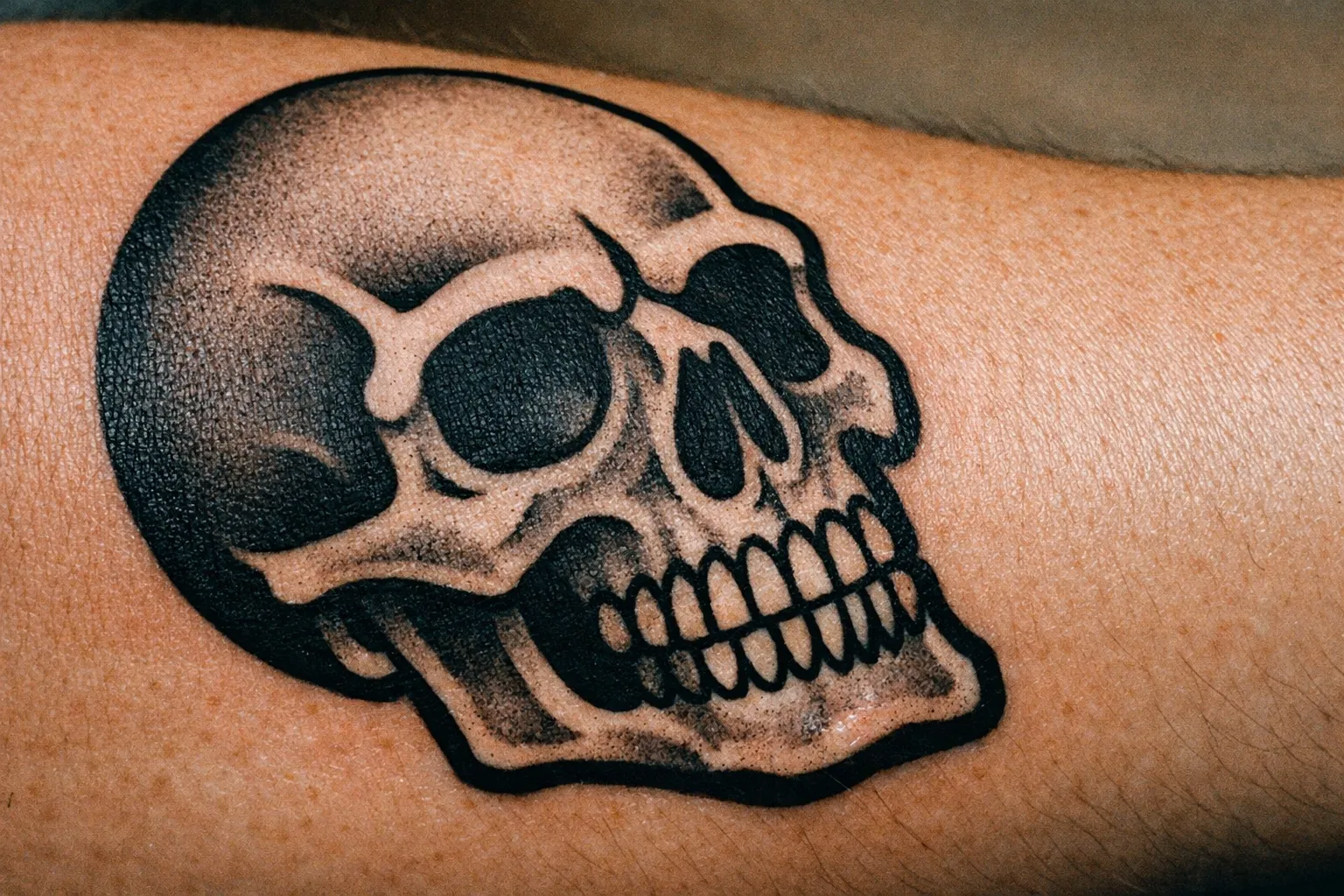
Traditional Skull Tattoo
The American traditional skull is the workhorse of this motif, and there’s a reason it’s been popular for over a century. Two technical hallmarks: thick black outlines (typically pulled with a 7-9RL liner) and a limited palette of 3-5 colors - usually red, yellow, green, and black. Shading is minimal and solid. Daggers, roses, snakes, banners with text - these are the classic pairings.
Why it holds up long-term: bold lines and saturated solid color age better than fine gradient work. A traditional skull tattoo done well at 25 will still read clearly at 55. The common pitfall is artists trying to “modernize” it by thinning the lines or adding micro-detail. That kills the style - you end up with something that’s neither traditional nor realism, and it blurs fast.
Best placement: forearm, bicep, calf, chest panel. Size range: 3-6 inches works best - large enough for the line weight to breathe.
Realism Skull Tattoo
Black-and-grey realism skulls rely on smooth gradients, white highlights, and anatomical accuracy. Done right, they look like a charcoal drawing healed into the skin.
The pitfall here is space - or the lack of it. Anything under 5 inches loses the gradient work within a few years as the ink softens. The white highlights - used sparingly, maybe 2-4 small spots - give the bone its dimension. Artists who overuse white end up with yellowed patches in five years. I’ve seen realism pieces that looked stunning fresh turn into muddy gray blobs by year six because the artist went too small and too light.
Best placement: forearm, thigh, upper arm, back. Size range: 5-10 inches minimum.
Sugar Skull Tattoo
The sugar skull tattoo comes out of Mexican Día de los Muertos tradition - decorative filigree, flowers (usually marigolds), and bright color. Often paired with a name and dates to honor a specific person.
Technically these need real estate. The petals, dots, and ornamental work need room to stay legible. Size range: 3-6 inches at minimum. Smaller than that and the decoration blurs into noise within five years.
Best placement: forearm, calf, thigh, upper back.
Small Skull Tattoo (Minimalist and Fine Line)
The small skull tattoo trend - micro skulls under an inch, fine-line work, single-needle stipple - has exploded over the last two years on Instagram and TikTok. They look great fresh.
Honest caveat: fine-line skulls under 1.5 inches lose detail faster than bold work. The lines soften, the tiny shading dots merge, and you’re left with a fuzzy gray shape by year seven or eight. If you want a small skull tattoo to stay sharp, go bolder than your artist initially suggests and skip the micro-shading. The reference photo you found online was taken the day it was done.
Best placement: behind the ear, inner wrist, ankle, sternum, ribcage. Size range: 0.5-1.5 inches.
Geometric and Neo-Traditional Skulls
Geometric skulls use mandala work, dotwork, and sacred-geometry framing around the skull. Neo-traditional sits between American traditional and realism - bold outlines, but expanded color range and more nuanced shading.
Both styles work well at 4-7 inches on the forearm, thigh, or shoulder cap. Neither ages as predictably as straight American traditional, but both hold up better than pure fine-line work.
Hand Placement: What to Know Before You Commit
The skull tattoo hand placement is one of the most-requested designs and one of the most problematic. Worth being honest about what you’re actually signing up for.
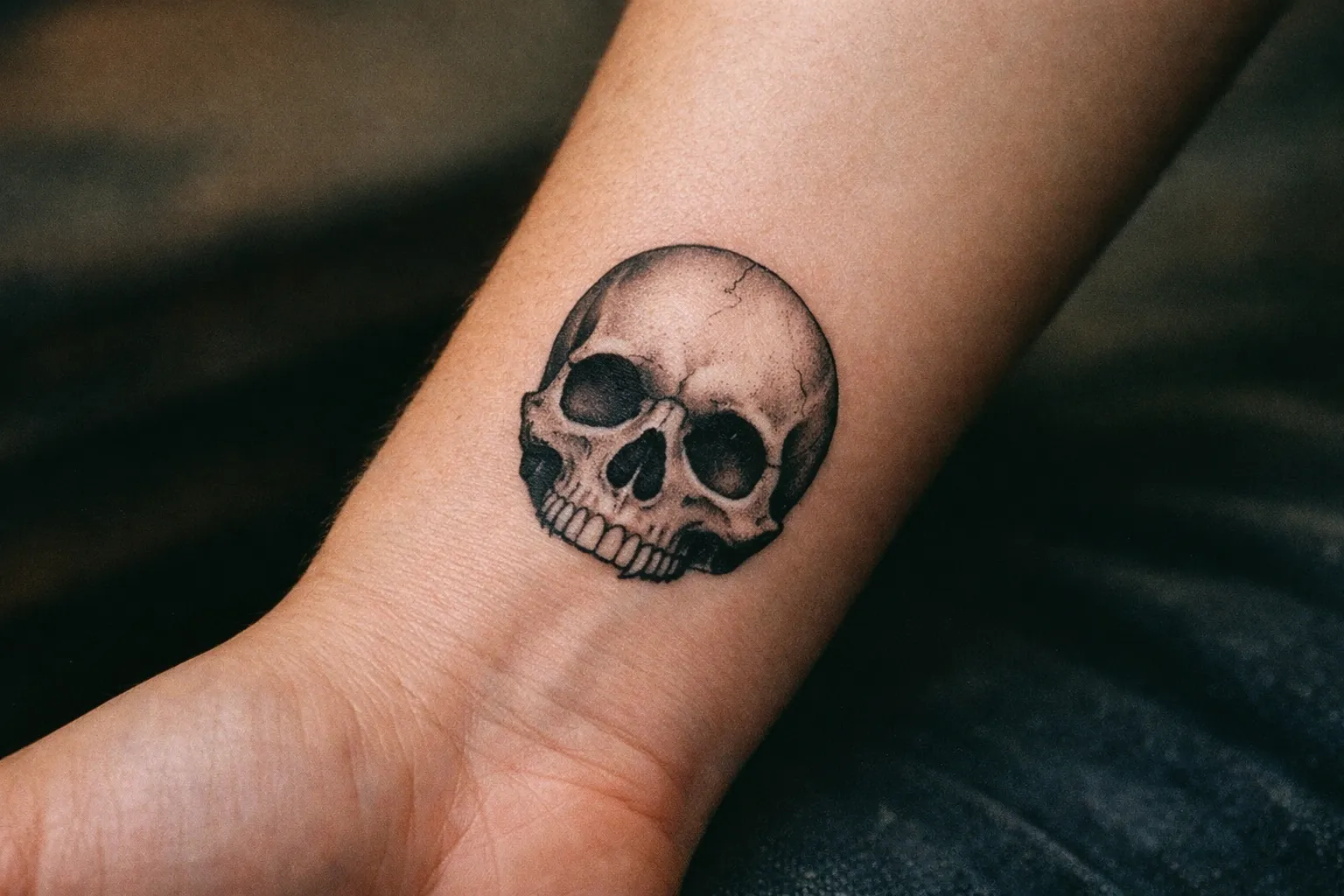
Visibility and professional impact. Hand tattoos are unhideable. Many tattooers - myself included - will turn down a hand piece if it’s a client’s first tattoo. Not because we’re gatekeeping, but because hand tattoos genuinely close doors in certain industries. That’s not a moral judgment, it’s just true.
Fading and touch-ups. Hands take more abuse than any other body part. You wash them constantly, expose them to sun, knock them against things. Many shops report 20-30% of hand pieces need at least one touch-up within the first year. Ask your artist’s touch-up policy before you book - not after.
Pricing. A small skull on the hand typically runs $150-$300 for a 1-2 inch piece, higher per-square-inch than the same design on the forearm. Hands are technically harder, the skin is uneven, and most artists charge a premium for it.
Pain. Top of the hand and fingers > forearm, mostly because there’s no fat layer and the bones are right there. Not the worst spot on the body (ribcage and sternum still win that category), but expect it to bite.
Recovery. Plan 1-2 days off heavy manual work. Expect visible peeling and dryness for 2-3 weeks and ongoing SPF 30-50 application to keep the detail crisp.
If you want skull imagery somewhere visible but aren’t ready for the hand, the inner wrist or the side of the index finger are softer commitments.
How Big Should a $500 Piece Be?
This is one of the most-asked questions in shop consultations and almost never answered straight.
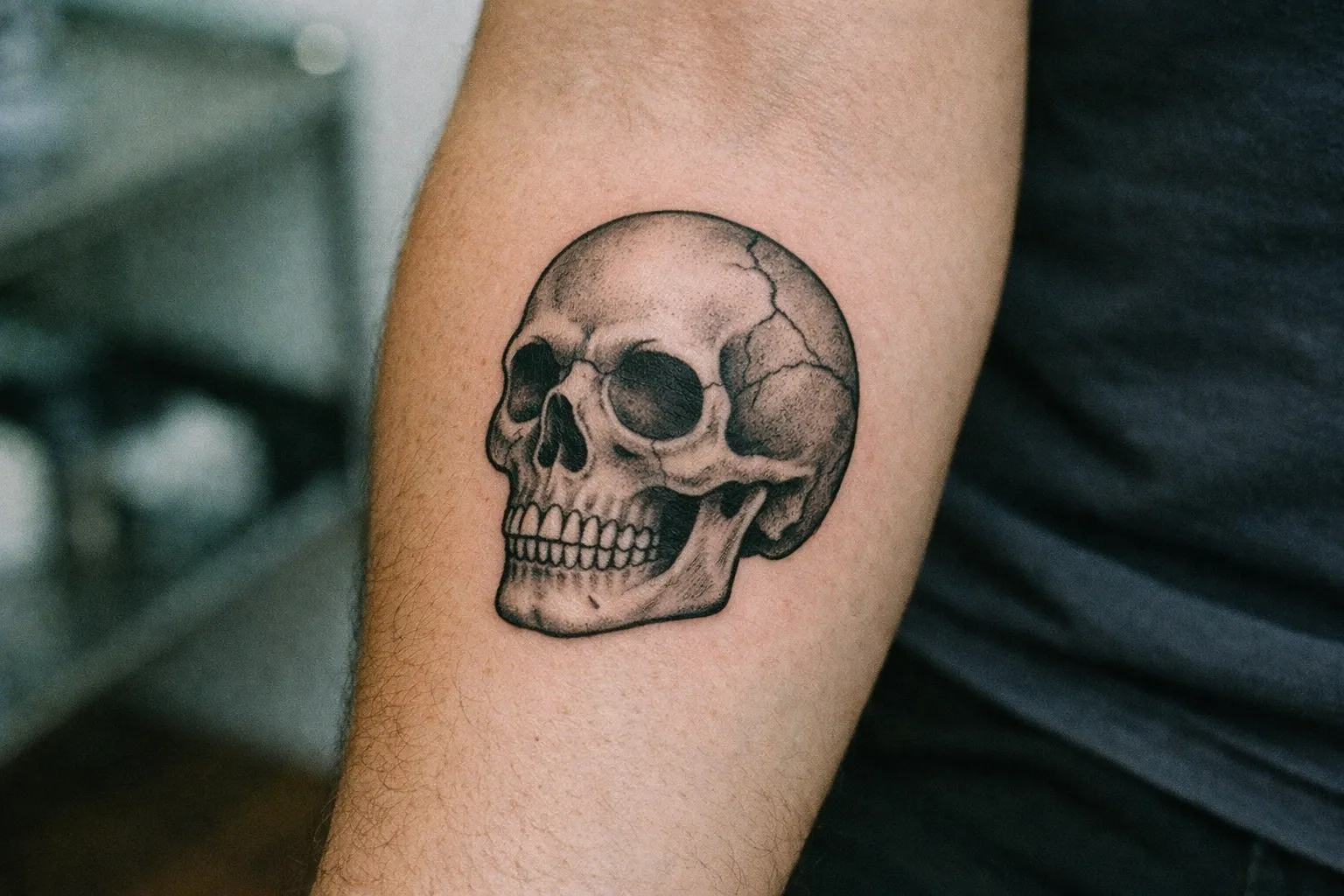
US shop rates currently sit around $150-$200/hour in most cities, higher in major markets (NYC, LA, Toronto can hit $250+). A $500 budget buys roughly 3-5 hours of chair time including setup and stencil.
What that realistically gets you:
- Black-and-grey skull, 4-6 inches, with proper shading, on a flat area like the forearm or calf - one session.
- Small sugar skull tattoo, 3-4 inches, with limited color (2-3 ink changes), single session.
- Traditional skull with rose or dagger, 4-5 inches, bold color, single session.
- Detailed small skull tattoo on the hand, 1.5-2 inches, accounting for the placement premium.
What $500 will not cover: a full forearm sleeve, a realistic skull larger than 6 inches with full background, or anything across the chest or back. Those projects start at $800-$1,800 and usually span 2-5 sessions.
Cost vs. Size Quick Reference
- Under $200: simple small skull tattoo, 1-2 inches, line work only
- $200-$400: small skull with light shading, or a small sugar skull tattoo
- $400-$800: medium black-and-grey skull (4-7 inches), forearm-scale work
- $800-$1,500: large realism skull or full sugar skull composition with color
- $1,500+: sleeve panels, chest plates, back pieces, multi-session work
Always budget 20-30% over the estimate. If your artist works faster than expected, great. If the shading runs long, you’re covered.
What Is the 1/3 Rule in Tattoo Composition?
The 1/3 rule is borrowed from visual art’s rule of thirds, and it’s the main reason some large skull pieces look balanced from across a room while others look like a cluttered mess up close.
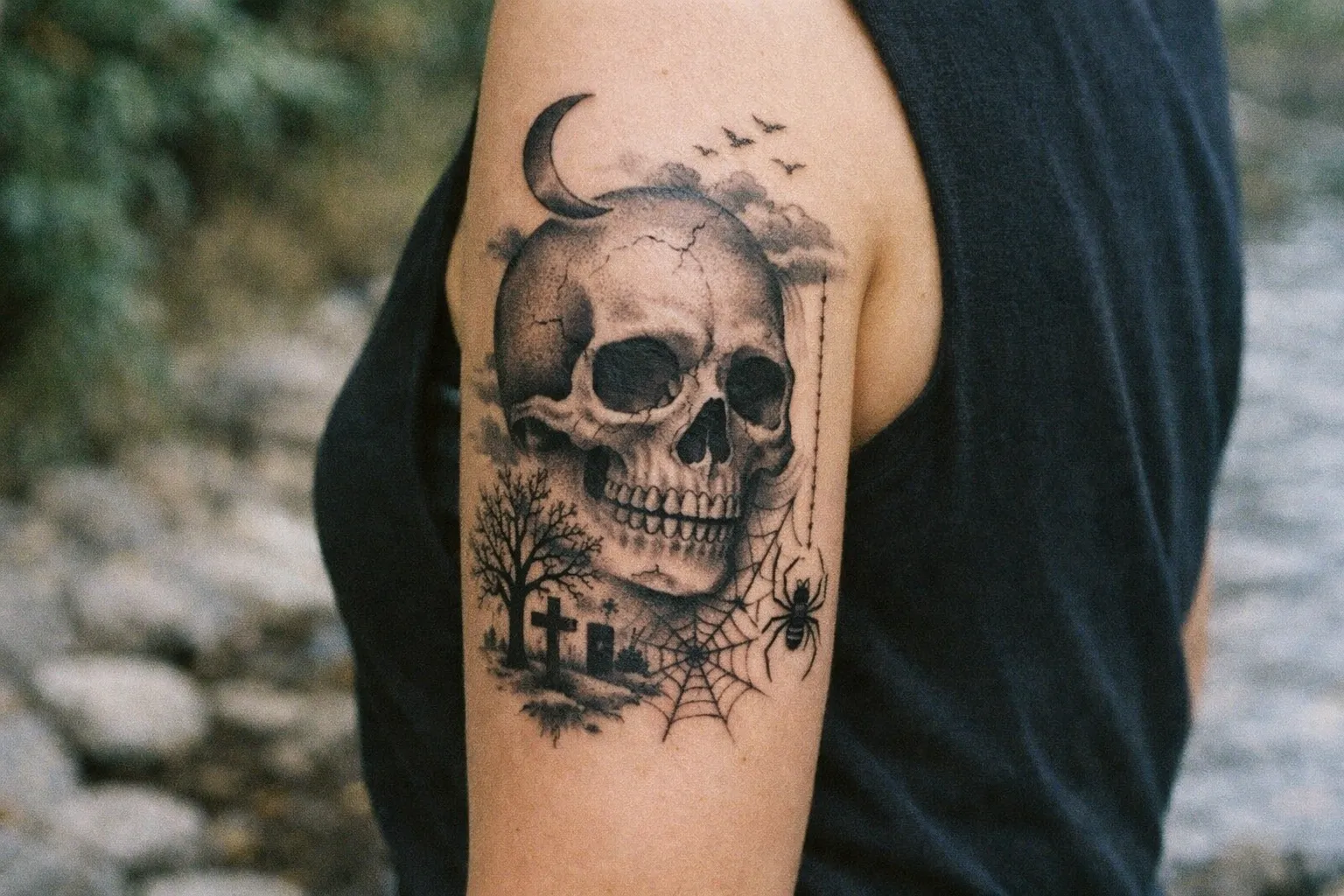
The breakdown for a large skull composition:
- One-third focal imagery - the skull itself, the primary element your eye lands on first.
- One-third secondary elements - roses, daggers, smoke, snakes, banners. These frame and support the skull without competing with it.
- One-third negative space and background - bare skin, light shading, or atmospheric fog. This is what most clients want to fill in. Don’t.
The rule matters most on large skull pieces - sleeves, back panels, chest plates. Without negative space, the design reads as a wall of ink from two meters away. With it, the skull stays the anchor and the supporting elements have room to breathe.
For small skull tattoos under 3 inches, the rule shifts - you can run closer to 60% imagery, 40% negative space, since there’s less competing for attention.
One more composition note from the chair: tilt the skull 15-30 degrees rather than placing it straight-on. A tilted skull creates natural lines for roses, snakes, or lettering to wrap around, and it looks less like a stamp.
Placement Guide: Where Skulls Sit Best on the Body
Placement is half the design decision. Here’s the practical breakdown.
Forearm (3-7 inches): the most versatile spot for skull tattoos. Visible when you want, coverable with a long sleeve when you don’t. Ages well, takes detail well, hurts moderately. Best all-around choice for a first skull piece.
Upper arm and shoulder cap (4-8 inches): office-friendly, easily integrated into future sleeve work, holds up to sun better than the forearm. Pain is lower than the forearm - one of the easier spots on the body.
Ribcage and sternum (3-6 inches): dramatic placement for vertical skull designs. Pain is the highest on the body for most people - ribcage > forearm by a wide margin. Plan for shorter sessions and more sittings.
Chest plate (6-10 inches): ideal for large symmetrical compositions, often skull-and-roses or skull-and-hourglass following the 1/3 rule.
Back (8-15 inches): maximum canvas for complex skull compositions with full background work. Multi-session by default.
Thigh and calf (4-10 inches): great for sugar skull tattoos and realism work - flat skin, low pain, lots of room. Slightly more fading on the calf due to sun exposure.
Hand and fingers (1-3 inches): highest visibility, highest touch-up rate, highest professional impact. Covered above.
Behind the ear, inner wrist, ankle (0.5-1.5 inches): the small skull tattoo zone. Subtle, easily hidden, but fine-line work fades faster here than on the forearm - the skin moves more and takes more daily wear.
Aftercare, Step by Step
Healing well is what separates a sharp skull at year ten from a blurred one.
- Day 1-3: keep the second-skin bandage on as long as your artist directs (usually 3-5 days), or if it’s traditional plastic wrap, remove after a few hours, wash gently with fragrance-free antibacterial soap, pat dry. Apply a thin layer of healing ointment (a fragrance-free petroleum-based or vegan balm).
- Day 4-7: switch to a fragrance-free moisturizer. Apply 2-3 times a day. Expect peeling and itching - do not pick or scratch. The tattoo will look dull and cloudy during this phase. That’s normal.
- Week 2: peeling finishes, deeper layers still healing. Keep moisturizing. No swimming, no soaking in baths, no saunas.
- Week 3-4: surface is fully healed. The color will start to look saturated again. Start using SPF 30-50 anytime the tattoo is in sun.
- Long-term: sun protection is the single biggest factor in how a skull tattoo looks at year ten. UV breaks down ink. Wear sun-protective clothing or sunscreen every time.
For skull tattoo hand placements, double the moisturizing frequency - hands dry out from constant washing and the skin there is thinner than most people expect.
How to Choose a Design
Working backwards from what actually matters:
- Pick a style first, not an image. Decide if you want traditional, realism, sugar skull, or minimalist. The style dictates which artists to look at.
- Find an artist whose portfolio shows that specific style. A great realism artist may not do traditional well, and vice versa. Look for healed photos, not just fresh ones - healed work shows how the artist’s lines and shading actually settle.
- Bring 3-10 reference images to the consult. Pinterest pins, vector references, photos of other tattoos. Not to copy - to communicate the vibe.
- Discuss size and placement honestly. Trust the artist when they tell you something needs to be bigger. They’re not upselling; they’re protecting the design from aging badly.
- Talk symbolism if it matters to you. If the skull is for someone specific, say so. It changes how the artist approaches the supporting elements.
If you’re sourcing inspiration from stock platforms - Adobe Stock has over 10,000 skull tattoo assets (2), iStock has around 599 simple skull illustrations (3) - use them as starting points, not final designs. A custom drawing from your artist will always sit better on the body than a stock vector.
Recent Trends
What’s actually moving in skull tattoo work over the last 12 months:
- Micro fine-line skulls under 1 inch - Instagram and TikTok driven, popular with first-time clients. Beautiful fresh, long-term aging still an open question.
- Pastel sugar skull tattoos - softer color palettes (pale pinks, lavenders, mint) replacing the traditional bright primary colors.
- Floral skulls - flowers replacing or overgrowing the cranium, emphasizing life rather than death.
- Neon and UV-reactive skull linework - a niche but growing trend, mostly in Europe and Asia.
- AI-assisted compositions - artists using AI to generate base layouts, then hand-redrawing them into tattooable form.
A note on EU regulations: if you’re getting tattooed in Europe, ask whether your studio uses REACH-compliant pigments, particularly for color sugar skulls. Several traditional pigments were restricted in 2022, and reputable shops have updated their inventory. Not all of them.
Common Mistakes to Avoid
- Going too small for the detail. A 1-inch sugar skull tattoo with filigree work will be a blur by year five. Match the size to the complexity.
- Treating the sugar skull tattoo as generic skull art. It’s Mexican, it’s tied to Día de los Muertos, and it has cultural weight. Know what you’re wearing.
- Picking the hand for your first tattoo. Visible, harder to heal, more touch-ups, harder employment conversations. Build up to it.
- Overloading with white ink. White yellows and fades. Use it for highlights, not large fill areas.
- Skipping the consult. A 20-minute conversation prevents a 20-year regret.
- Working through a flare. If you have lupus, psoriasis, or any immune condition in an active phase - reschedule.
Frequently Asked Questions
- What do skull tattoos symbolize?
- Skull tattoos symbolize mortality awareness but vary by tradition: European memento mori, Mexican Día de los Muertos remembrance, American traditional protection, and ancestral connections in Celtic and Polynesian cultures. Modern Western use often marks survival rather than specific cultural meaning.
- How big should a $500 tattoo be?
- At typical US rates, $500 covers roughly 3-5 hours of tattooing, enough for a 4-6 inch black-and-grey skull on forearm or calf, a 3-4 inch sugar skull with limited color, or a detailed 1.5-2 inch hand skull tattoo. Larger or more complex pieces require more budget.
- What is the 1/3 rule in tattooing?
- The 1/3 rule divides large tattoo compositions into one-third focal imagery (the skull), one-third secondary elements (roses, daggers, smoke), and one-third negative space or background to maintain balance and readability.
- Does a skull tattoo hand placement fade faster?
- Yes. Hands experience more sun exposure, washing, and wear, causing faster fading and higher touch-up rates. Bold linework fares better than fine-line or shaded styles on hands.
- Do small skull tattoos age well?
- Bold-line small skulls over 1.5 inches age well. Fine-line micro skulls under 1 inch tend to blur and lose detail within 5-10 years due to ink spreading in the skin.