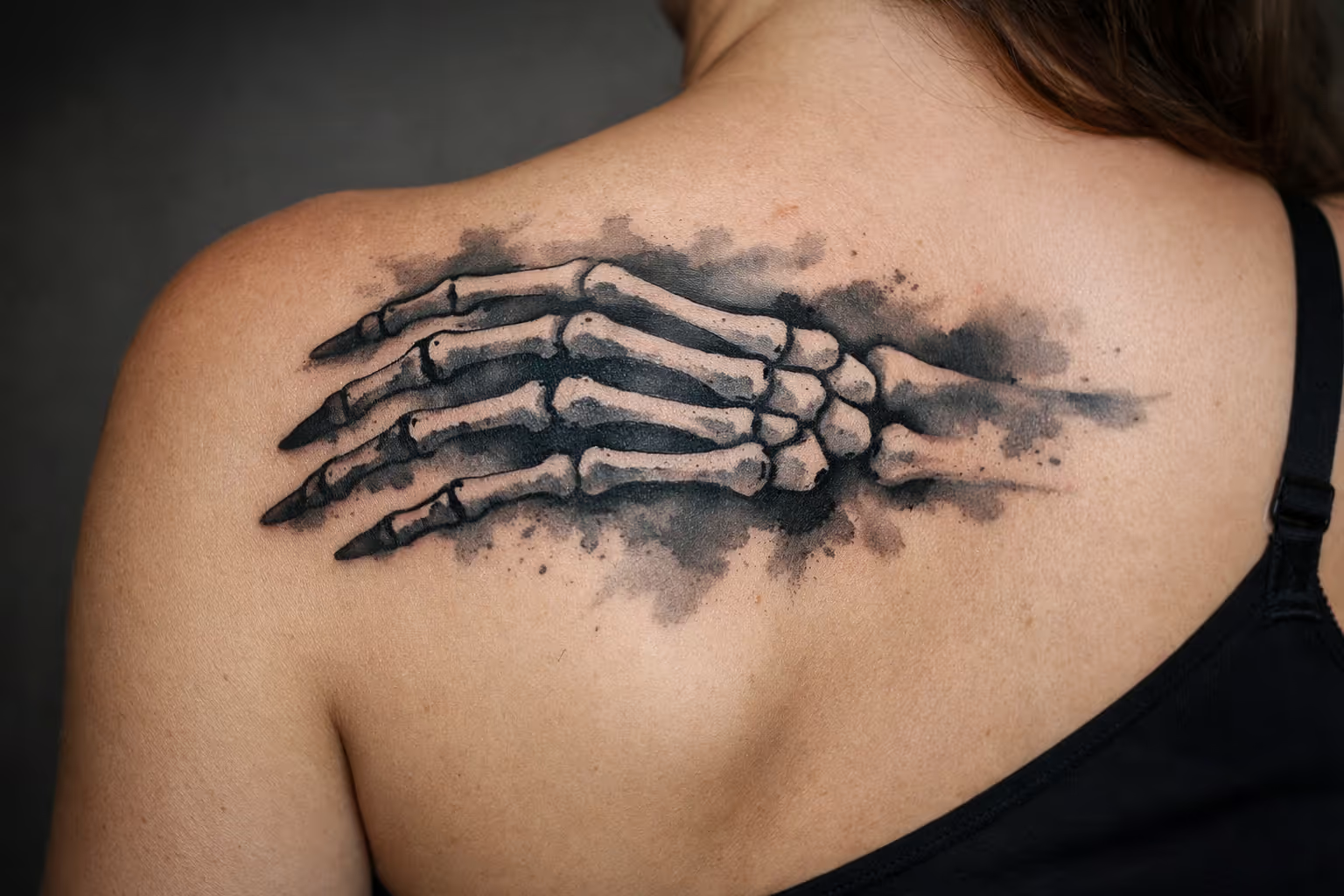
A skeleton hand tattoo is one of the highest-maintenance pieces you can book, and almost nobody’s warned about it upfront. The knuckles are among the most painful spots on the body, white ink can fade in 6-18 months, and touch-ups run every 2-5 years. There’s even a low-stakes way to test the placement first - jagua gel - before you commit for life. Here’s what it means, and what you’re actually signing up for.
What a Skeleton Hand Tattoo Actually Means
At its core, the skeleton hand tattoo meaning is memento mori - Latin for “remember you must die.” It’s a visual nudge that life is finite. Most people I’ve tattooed with this design say it reminds them to live intentionally, not in a morbid way (2)(4)(7).
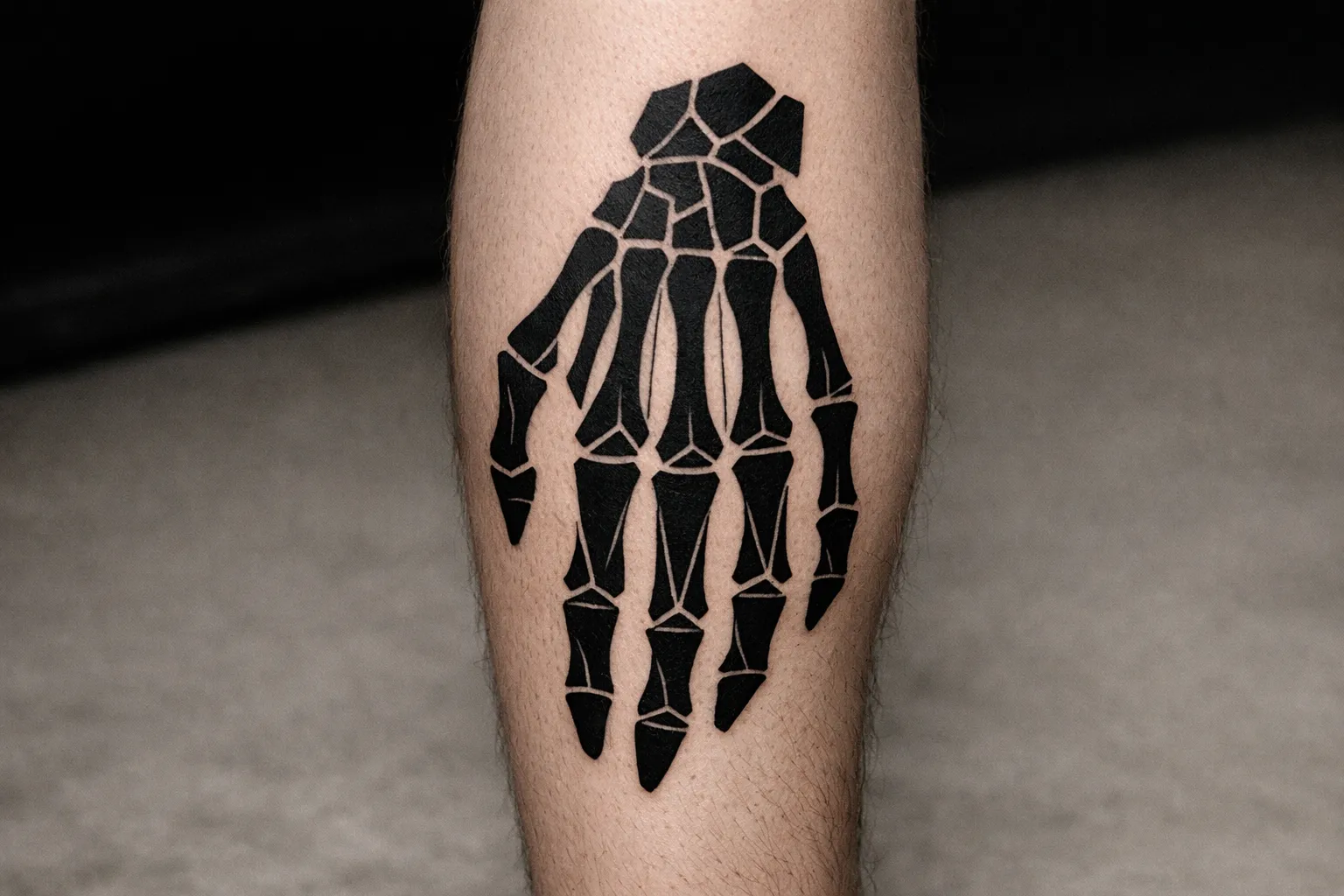
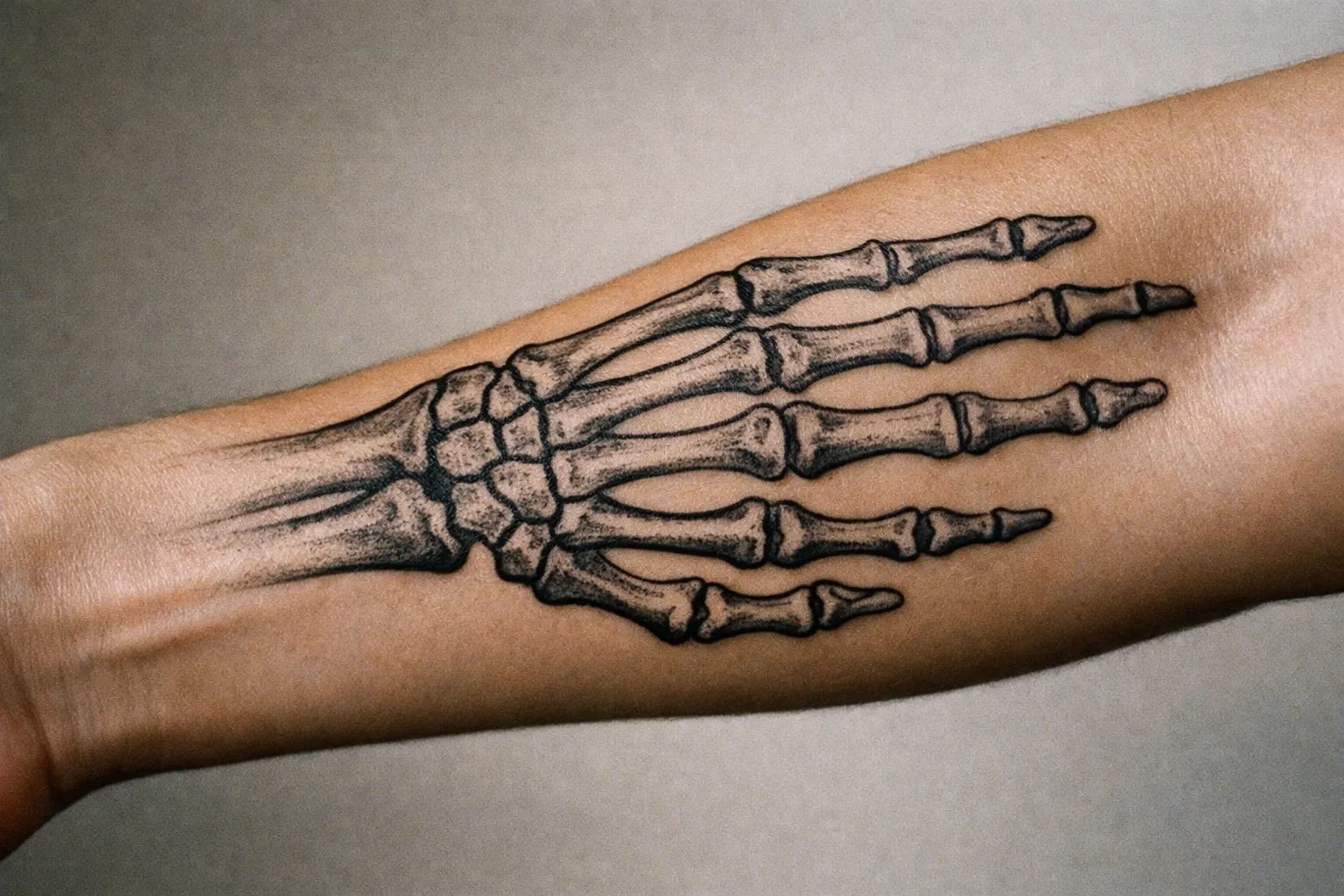
Beyond mortality, the design can carry several overlapping meanings depending on how it’s drawn or what’s added:
- Transformation and rebirth - bones as the structure left after the old self is stripped away (1)(2)(4).
- Resilience after hardship - especially when cracked bones, chains, or thorns are part of the design (3)(5).
- Rebellion and counterculture - this one’s strong in punk and goth circles, often a skeleton hand throwing the middle finger, horns, or peace sign (1)(2)(4).
- Protection - in some traditions, a skeleton hand can be a talisman warding off evil, especially paired with eyes, runes, or religious symbols (3)(7).
The origins aren’t tied to just one culture. European memento mori art - skulls, bones, hourglasses - dates back to medieval Christian iconography, but modern skeleton hand tattoos also pull from Mexican calavera imagery, Tibetan citipati skeletons, and Western punk culture. None of these owns the design outright. If you want one for a specific cultural reason - Day of the Dead, for example - talk to your artist about doing that style properly instead of mixing it into generic blackwork.
Skeleton Hand Paired with a Rose: What That Meaning Shifts To
The most common combo is a rose over the bones. On its own, a rose stands for love, beauty, and ongoing life. Put it over a skeleton hand, and it becomes a contrast piece: decay holding growth, grief carrying something living forward.
People often use this pairing to mark:
- A loss they’re still carrying - the bones represent the wound, the rose what blooms anyway.
- Survival of trauma or abuse - the past is the bare structure, the future is the soft part that gets to grow.
- A relationship ended by death - memorializing someone without pretending the loss isn’t permanent.
The classic look is a red rose against black-and-grey bones. White roses read softer and more memorial, but fade faster. Adding leaves and water droplets pushes the rose toward realism, which means more shading time and a higher price.
What 5 Dots on the Hand Mean (and Why It’s Not the Same)
Five dots arranged in a quincunx - four dots forming a square with one in the center - is a separate tattoo with a heavy coded meaning. It often gets confused with skeleton hand tattoos because both are common on the same placement.
In prison tattoo culture, the five-dot pattern is known as “four walls and me,” symbolizing time served. The center dot is the inmate, surrounded by the four cell walls. This pattern is documented across multiple prison systems internationally (6). Outside that context, the same pattern sometimes means “friends” or “family,” but the prison association is strong enough that it can be misread regardless of your intent.
If you want dots integrated into a skeleton hand piece - between knuckles or at finger joints - talk to your artist about pattern and placement. You don’t want it accidentally echoing the quincunx. This kind of cultural nuance is something more studios are flagging during consultations now (6).
Does a Skeleton Hand Tattoo Hurt?
Yes. Hand tattoos are consistently among the top three most painful spots because the skin is thin, there’s almost no fat between the needle and bone, and the hand is packed with nerve endings (2)(3). For context on placement alternatives: the forearm - a common choice for people who want visible skeleton work without the hand commitment - runs noticeably easier than the hand, and a 4-5 inch (10-13 cm) forearm piece gives you similar visual impact with better healing and longevity.
Here’s how the pain breaks down on a skeleton hand:
- Top of hand (metacarpals area): sharp and bony but manageable for most - similar to the inner forearm but with more vibration.
- Knuckles: the worst spot on the design. Needle hitting bone with almost no cushion.
- Finger sides and webbing: sharp, nervy pain; many ask for short breaks here.
- Wrist transition: the easiest section, especially on the inner wrist side.
The ribcage still beats the hand for pain overall, but a full skeleton hand piece will hurt more than a forearm or thigh tattoo of the same size. Eat a good meal before your session, stay hydrated, and skip alcohol the night before - it thins your blood and drags out the session.
How Long Does a Skeleton Hand Piece Last?
They’re permanent, but they don’t stay crisp. Hand tattoos fade noticeably faster than almost anywhere else on the body. A skeleton hand design depends on sharp linework to read as bones, so fading shows up more than it would in a soft watercolor piece (3).
Here’s a realistic fading timeline:
- First 6-12 months: initial settling. Lines should still look crisp.
- Year 2-3: first noticeable softening, especially on fingers and bone edges. This is when most clients book their first touch-up.
- Year 5+: without touch-ups, fine detail - small bones, white highlights, micro-shading - starts to blur or vanish. Expect touch-ups every 2-5 years to keep the piece sharp.
Fading happens because of sun exposure, constant hand washing, alcohol sanitizer, friction from gloves or gym gear, and the skin turnover on such a high-use part. A study published by the Journal of the European Academy of Dermatology and Venereology found that tattoos on hands and fingers fade significantly faster than those on the upper arm or thigh, with hand tattoos requiring touch-ups roughly twice as often over a five-year period. White ink highlights - popular on bone designs - often fade to off-yellow or nearly disappear within 6-18 months. If you want highlights, treat them as a maintenance item, not a permanent feature.
Design Variations Worth Considering
There’s more variety here than most flash boards show. A few directions that hold up well over time:
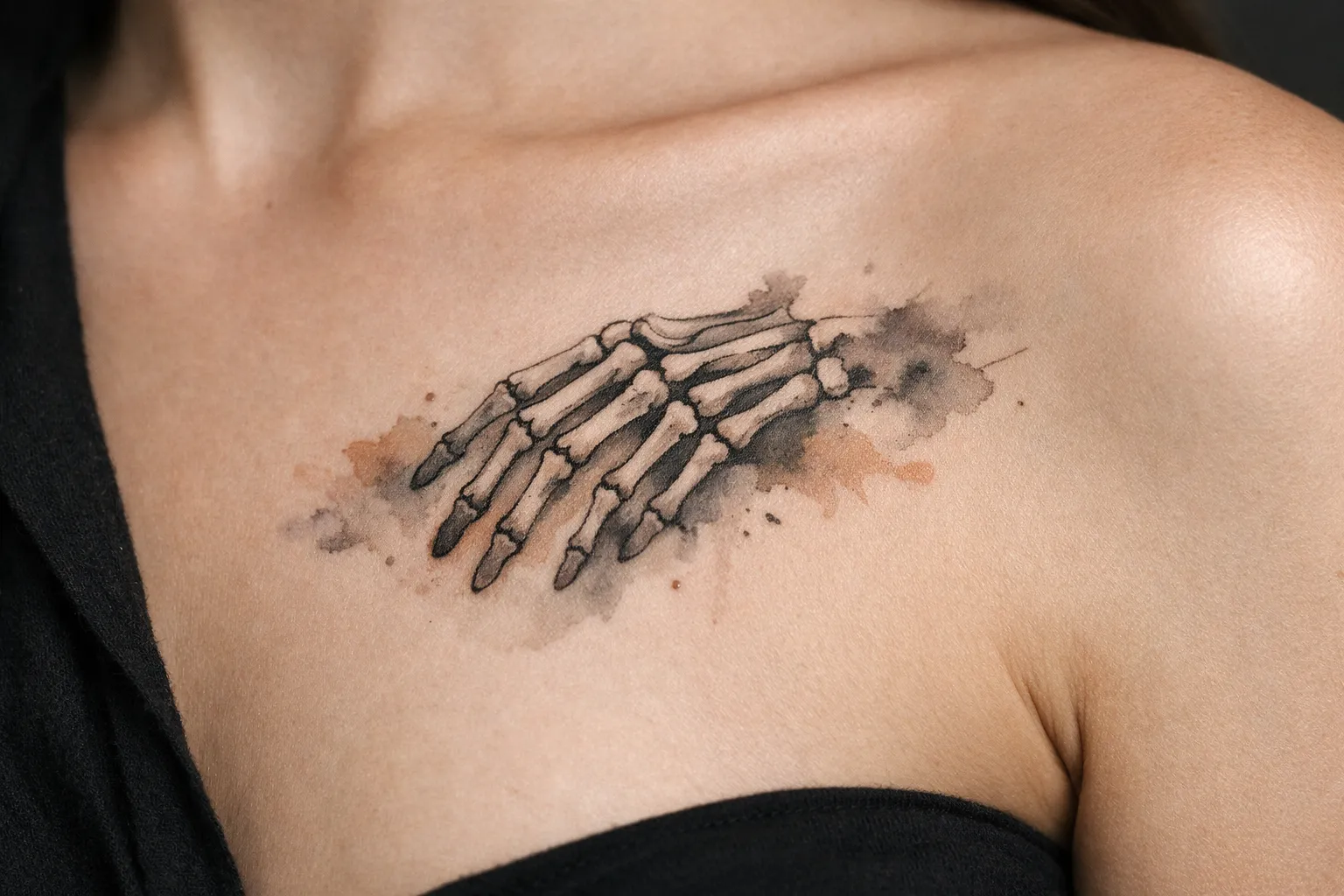
- Anatomical black-and-grey realism. Two technical hallmarks: smooth greywash gradients built up in layers, and bone structure drawn to match the client’s actual anatomy rather than a generic template. The common pitfall is artists rushing the shading - patchy greywash on healed hand skin looks blotchy within a year. Works best at 4-6 inches (10-15 cm) across the full hand. If you want a smaller version, the forearm at 3-4 inches (7-10 cm) gives the same visual impact with better longevity.
- Bold blackwork. Two technical hallmarks: heavy outlines (2pt or thicker) and solid black fills that frame the bone shapes. Tolerates fading better than any other style because contrast does the work. The pitfall is over-filling - too much solid black and the individual bones lose definition, especially on fingers. Reads clearly from a distance.
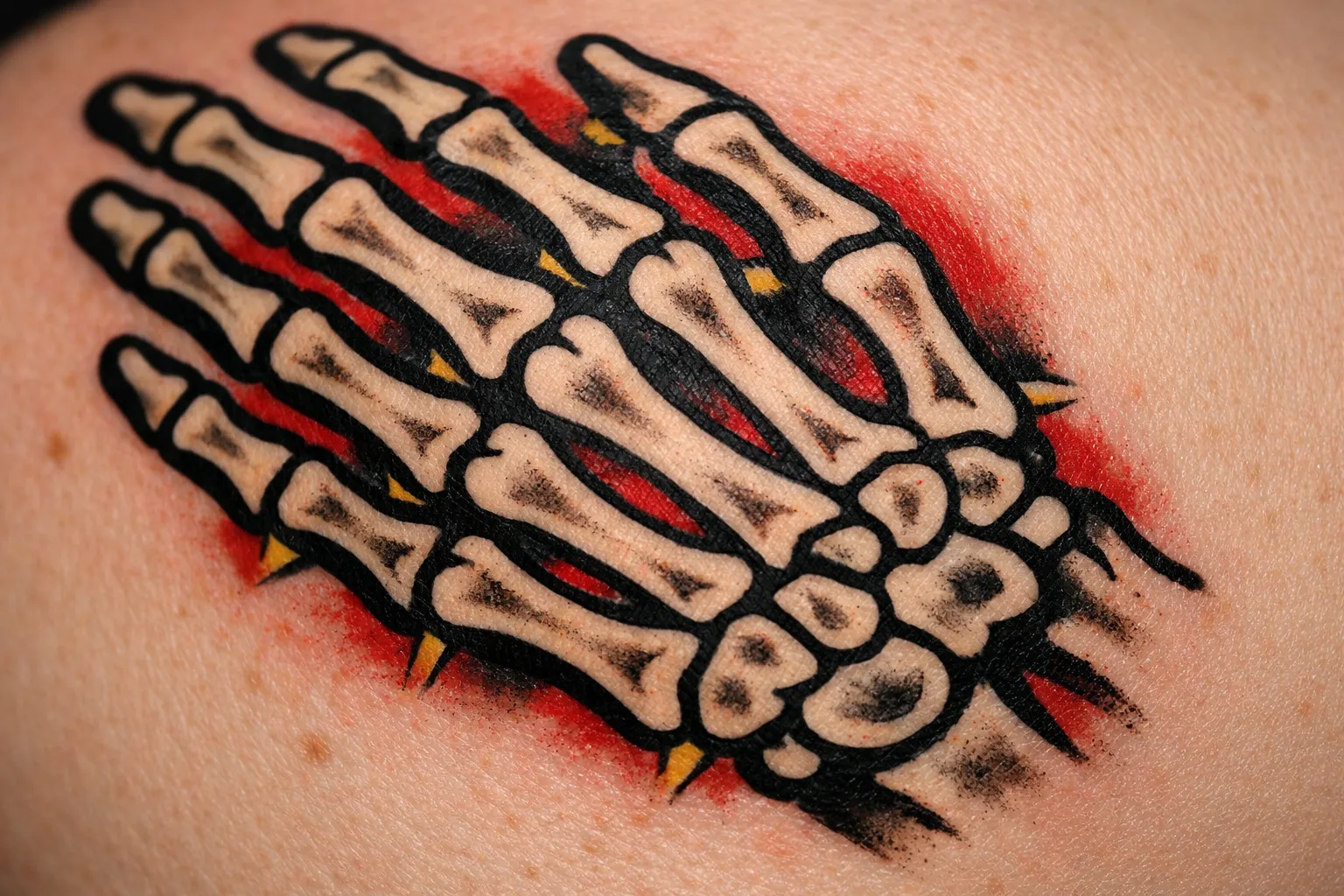
- Illustrative / neo-traditional. Stylized bones with thicker outlines and decorative elements like roses, daggers, hourglasses. More forgiving on healing, distinct look.
- Skeleton hand holding an object. A rose, cigarette, tarot card, hourglass - adds narrative and lets you spread the design from wrist to fingertip.
- Skeleton hand gestures. Middle finger, devil horns, peace sign, OK sign. Rooted in punk and goth - pick this if attitude is your point.
- Cracked or broken bones healing back together. Theme of resilience, often paired with thorns or chains.
- Biomechanical. Bones fused with gears or wiring. Higher difficulty, needs a specialist.
- Color skeleton hand. Less common but trending in digital neon and glitch styles on social media; expect faster fade and more touch-ups.
According to anatomy references used in professional tattoo training curricula, the hand contains 27 bones - any realistic skeleton hand piece has to account for all of them to read correctly. A common mistake I see is artists not accounting for how the hand moves. Good artists draw the stencil with your hand relaxed and flexed so the bones line up when you make a fist. Bad artists skip this, and you get knuckle bones that bunch or stretch wrong every time you grip something.
Realistic Skeleton Hands: What to Look For in an Artist
Realistic skeleton hand tattoos are the most requested and the most demanding to execute. The bones have to be anatomically accurate - correct number and proportion of phalanges, knuckle joints aligned with your actual knuckles, metacarpals fanning out the way real ones do.
Before booking realism, check your artist’s portfolio for:
- Healed photos at 3-12 months old, not just fresh shots. Fresh work always looks sharp; healed photos show how their black-and-grey settles on hand skin.
- Bone structure matching the client’s hand. A skeleton hand that ignores your anatomy looks like a sticker.
- Smooth greywash gradients. Patchy or stippled shading on healed hand pieces is a red flag.
- Specialization. Realism is its own discipline. A great American traditional artist isn’t necessarily your person for this.
Expect 2-4+ hours for a full realistic skeleton hand, sometimes split into two sessions. Both hands done realistically can run 4-8+ hours total.
Stencil Options: Custom Drawing vs. Pre-Made Skeleton Hand Design
The stencil is the printed bone map your artist transfers to your skin before tattooing. Most artists either build their own from anatomical references or buy digital stencil packs sized for tattooing.
Here’s how the stencil decision usually goes:
- Pre-made stencil pack. Fastest, most anatomically consistent, cheapest. Good if you want the classic X-ray look. Downloadable packs sell for $10-$40 online.
- Custom skeleton hand tattoo drawing. Your artist draws bones sized and shaped for your specific hand, adding personal elements (a rose between metacarpals, a name across the wrist, leaves wrapping a finger). Adds 1-3 days of design time and raises the price, but the fit is noticeably better.
- Hybrid. Artist starts from a base stencil and modifies it for your hand size and additions. This is the most common workflow now.
On appointment day, stencil placement takes 15-30 minutes to align properly. Don’t rush this. Ask your artist to show you the stencil with your hand relaxed, flexed into a fist, and spread wide before they start. If the bones look off in any of those positions, adjust before the needle touches your skin.
Temporary Options
If you’re not sure about the commitment - and on a hand, you shouldn’t be - a temporary skeleton hand tattoo is the smartest first step.
Options ranked by realism and how long they last:
- Stick-on temporary tattoo sleeves and decals. Cost $8-$20 for packs of 4-10 designs. Last 3-7 days with careful application. Best for Halloween, cosplay, or testing how a design looks on your hand.
- Jagua gel. Plant-based, stains skin blue-black. Lasts 1-3 weeks. Looks close to real black ink in photos. Good for testing visibility before committing.
- Henna. Stains orange-brown instead of black, so it doesn’t mimic real ink color. Lasts 1-2 weeks.
- Airbrush. Sharper than stick-ons but less durable - usually 1-3 days.
Wear the temporary version through a normal work week. See how your manager reacts, how clients respond, how it looks in photos, whether you like seeing it on your hand every time you reach for your coffee. That week of data tells you more than staring at Pinterest flash.
Digital Design and AR Try-On for Your Hand Piece
Most serious artists now use “digital ink” workflows to design and preview hand pieces. The skeleton hand tattoo drawing happens on a tablet, layered onto a photo of your real hand, so you get a close look at the final result before committing.
Common tools:
- Procreate, Adobe Fresco, or Clip Studio Paint for the design. Pro tattoo brush sets cost $5-$30.
- AR try-on apps that overlay a tattoo on your live camera feed. Useful to judge size and placement in real time.
- Photoshop overlays for a static, high-detail preview.
If your artist doesn’t offer digital previews, ask them to mock the design on a printout of your hand. Either way, you catch sizing problems - bones too small to read at arm’s length, fingers too detailed to age well - before you’re locked in.
What It Costs in 2025
Prices vary a lot depending on artist reputation and city, but current US ranges are roughly:
- Apprentice / entry-level artist: $80-$150/hour. Basic outline skeleton hand runs $150-$250.
- Experienced artist: $150-$250/hour. Realistic skeleton hand at 2-4 hours runs $300-$800.
- High-demand realism specialist: $250-$400/hour. Complex pieces or both hands can hit $800-$1,600+.
- Touch-ups: often free or discounted within 6-12 months, then $50-$200 depending on work needed.
Hand tattoos are not the place to save money. A blowout or anatomically wrong skeleton hand is obvious every day for the rest of your life. Laser removal plus cover-up can take 2-3 sessions and cost more than the original piece.
Aftercare Timeline
Hands are the hardest place to heal cleanly. You use them constantly, wash them constantly, and they’re exposed to sun, friction, and bacteria more than almost anywhere else. Follow the timeline closely.
Day 1-3: Keep the initial bandage or Saniderm on for 12-48 hours depending on your artist’s protocol. After removal, wash gently 2-3 times a day with a fragrance-free soap. Pat dry with a clean paper towel. Apply a thin layer of unscented aftercare ointment. Avoid alcohol-based hand sanitizer - switch to soap and water.
Week 1: Continue washing and moisturizing. Expect peeling and flaking, especially on knuckles where the skin moves most. Don’t pick at it. Switch from ointment to a light fragrance-free moisturizer once flaking starts. No pools, oceans, hot tubs, or long baths. If your job requires hand protection, wear loose cotton gloves - avoid tight latex or work gloves that trap moisture.
Week 2-4: Surface healing finishes around day 7-14, but full healing takes 4-6 weeks. Keep moisturizing daily. Avoid heavy lifting that drags skin across surfaces. Continue avoiding submersion for the first 2-3 weeks.
Long term: Apply SPF 30+ sun-protective sunscreen on your hand every 2 hours outdoors. UV is the biggest cause of skeleton hand tattoo fading. Daily unscented moisturizer keeps skin supple, which keeps lines sharp.
Common Mistakes to Avoid
- Underestimating visibility at work. Some fields (law, finance, hospitality, healthcare) still restrict visible hand tattoos. Confirm before booking.
- Picking a cheap artist without hand tattoo experience. Blowouts and distorted bones on a hand are obvious every day.
- Ignoring anatomy. Bones that don’t match your hand look off the moment you flex.
- Over-detailing fingers. Tiny bones with micro-shading blur within 1-3 years because ink spreads slightly under skin. Keep finger detail readable from arm’s length.
- Expecting white ink to last. It won’t. Treat highlights as a touch-up item.
- Copying a Pinterest pin exactly. Your hand isn’t the one in the photo. Differences in hand size, finger length, and skin tone change how the design reads. Use inspiration as a starting point, not a target.
- Skipping the temporary test. A week with a jagua skeleton hand shows you more than a month of thinking. If you’re drawn to skull tattoo imagery more broadly, that guide covers how symbolism shapes the entire design approach - worth reading before you finalize your concept.
✓ Pros
- Strong, meaningful symbolism with multiple cultural layers
- Highly visible and striking design that can be customized
- Temporary options allow testing before commitment
✗ Cons
- One of the most painful tattoo placements due to thin skin and bone proximity
- Fades faster than most tattoos, requiring frequent touch-ups
- High visibility can limit professional opportunities in some fields
Frequently Asked Questions
- Can I get a skeleton hand tattoo if I work in a conservative job?
- Many workplaces still restrict visible hand tattoos, especially in law, finance, hospitality, and healthcare. If your job has a dress code, check policies before booking.
- How do artists ensure the bones look natural when the hand moves?
- Experienced artists draw the stencil with your hand relaxed and flexed, so the bones line up correctly when you make a fist, preventing distortion.
- Are white ink highlights worth it on a skeleton hand tattoo?
- White ink fades quickly on hands, often turning yellow or disappearing within 6-18 months. Treat highlights as a maintenance feature, not permanent.
- What should I expect during the stencil placement appointment?
- Stencil placement takes 15-30 minutes to align properly. Your artist should show you the stencil with your hand relaxed, in a fist, and spread wide to ensure correct bone positioning.
- Is it better to get a custom stencil or use a pre-made one?
- Pre-made stencils are cheaper and anatomically consistent, but custom stencils fit your hand better and allow personal elements. Many artists use a hybrid approach.
- How can I test if I like a skeleton hand tattoo before committing?
- Try temporary options like jagua gel or stick-on sleeves for a week during your normal life to see how it looks and feels in real situations.
- Why do skeleton hand tattoos fade faster than other tattoos?
- Hands are exposed to sun, frequent washing, sanitizers, friction, and skin turnover, all of which accelerate fading compared to other body parts.
The Decision That Actually Matters
A skeleton hand tattoo is high-visibility, high-pain, and high-maintenance. The design can be striking - anatomical bones with a rose, a punk middle finger, a memorial for someone lost. The problems come when you skip the parts nobody likes to think about: how it looks healed at year three, whether your employer cares, whether your artist specializes in this work.
Test with a temporary version first. Look at healed portfolio photos, not fresh ones. Budget for touch-ups every few years. And spend time on stencil placement appointment day - a few extra minutes there make the difference between bones that move with your hand and bones that look wrong every time you make a fist.