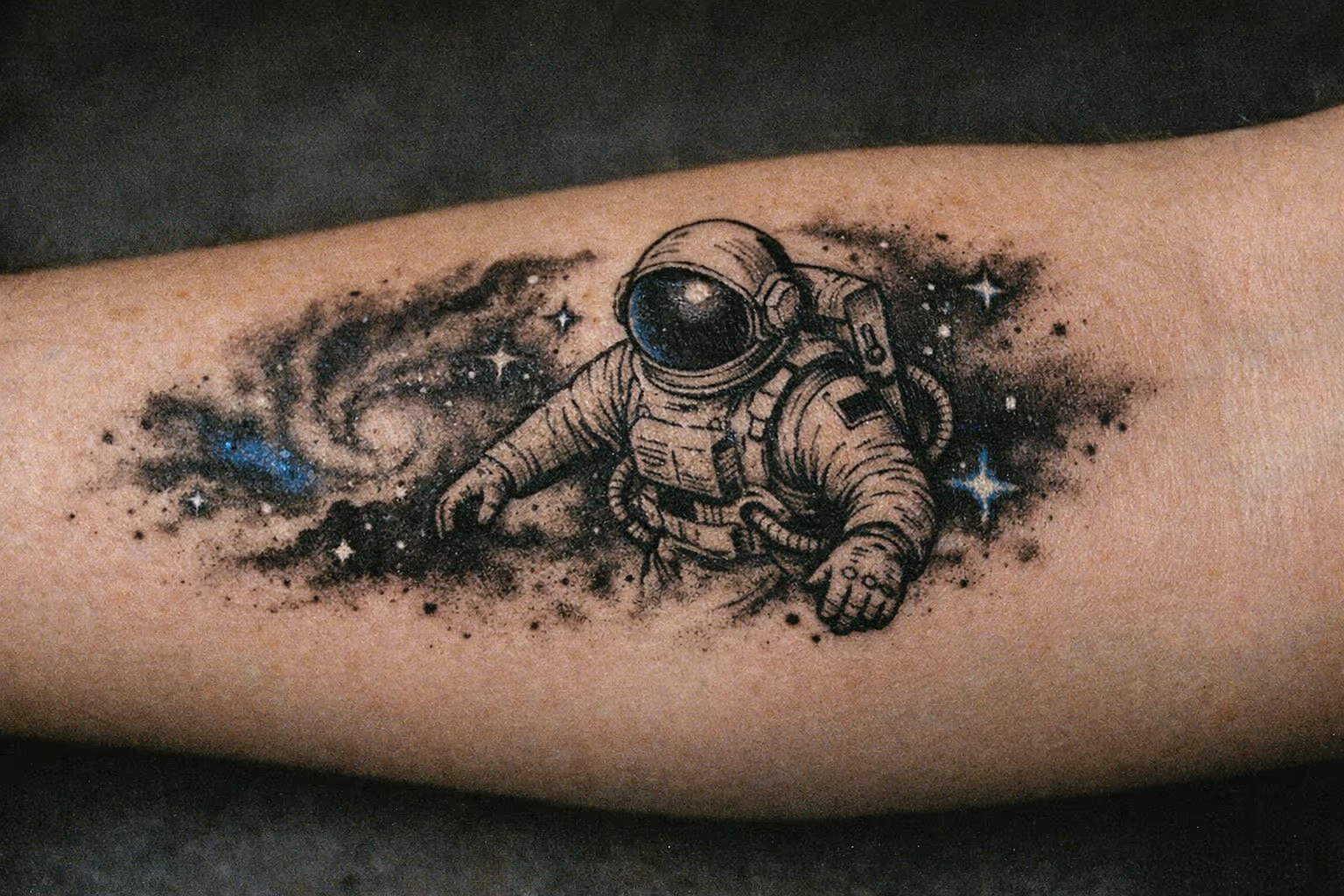
An astronaut tattoo is usually done in fine, delicate linework - the tether, the visor reflection, the little stars - and that’s exactly what dooms a lot of them. Lines under about half a millimeter blur within a decade, and a floating astronaut without crisp linework just becomes a grey smudge in space. Line weight is the whole game. Here’s the placement and pricing ($80-$1,200) that keep an astronaut tattoo sharp, and what the motif can mean.
What an Astronaut Tattoo Actually Means
Most people asking about astronaut Tattoo meaning want a single clean answer. There isn’t one. The symbolism shifts with the composition, and unlike a Japanese koi or a Celtic knot, this motif doesn’t come with centuries of fixed tradition behind it. It’s a modern Western image, so the meaning is mostly what you and your artist build into the design (1).
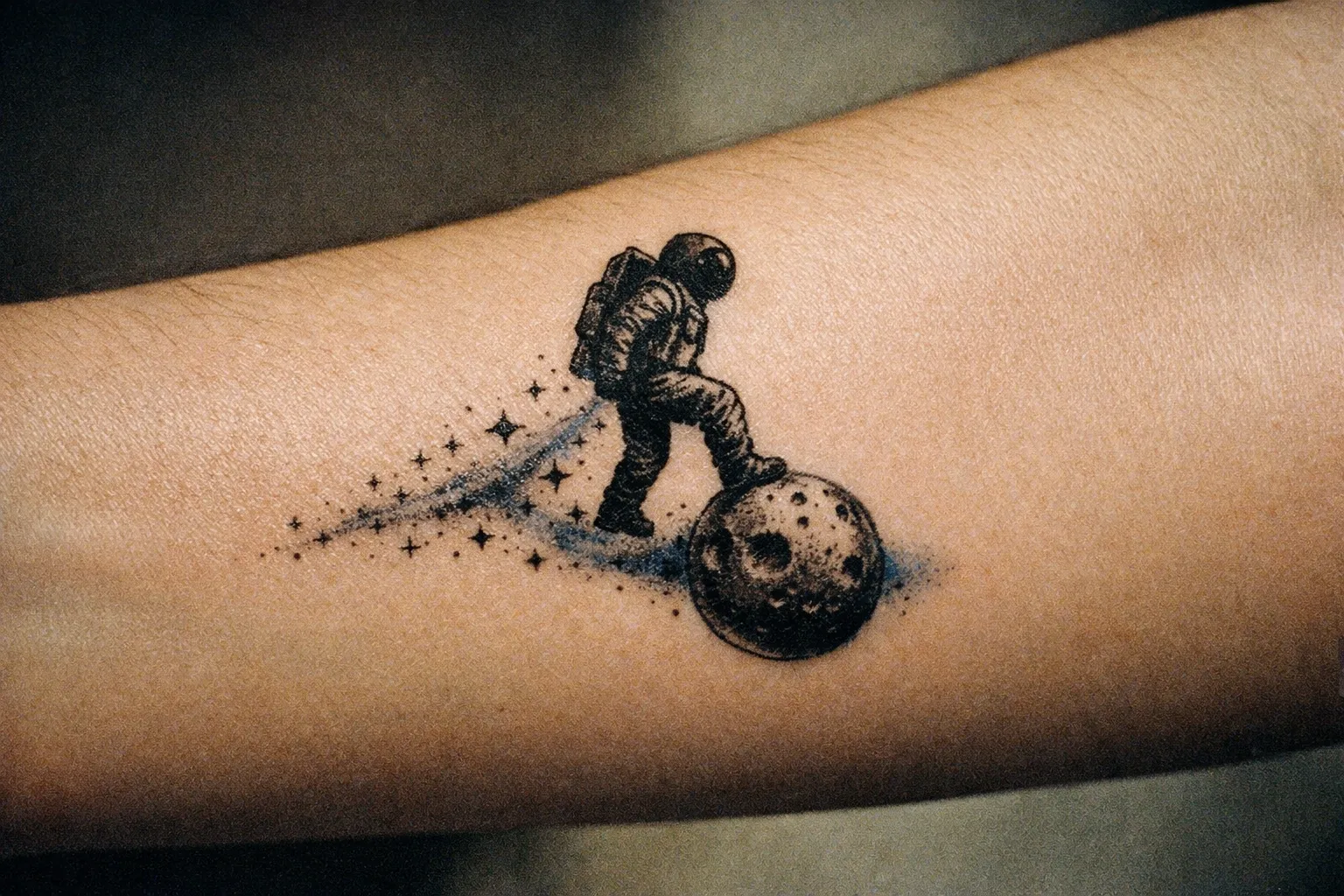
Here’s how the imagery actually reads in practice:
- Freedom and exploration. A floating, untethered astronaut reads as freedom - moving beyond limits, drifting where you want. Most common interpretation by a wide margin.
- Chasing dreams. “Aiming for the stars” made literal. An astronaut reaching toward a planet or star often marks a big, risky goal someone set for themselves (1).
- Courage and resilience. Real astronauts train for years and accept genuine life-threatening risk. The imagery borrows that - bravery, perseverance, doing the hard thing anyway (1).
- Patriotism. In the U.S., an astronaut paired with an American flag or a NASA-style suit signals national pride and respect for the space program (1).
- Love of science and the cosmos. For a lot of wearers it’s simpler than all that - fandom. Astronomy, sci-fi, space history, the whole nerd lineage.
A tethered astronaut reads differently than a floating one. An astronaut holding a balloon-planet reads as childlike wonder; an astronaut beside a skull reads as mortality and the danger of space. Decide what you want it to say before you sit down, because composition carries the meaning here - not the motif alone.
Popular Ideas for Astronaut Tattoos
Astronaut designs span a wide range, from clean single-line outlines to dense illustrative scenes. Idea libraries reflect that variety - StyleCraze breaks down eight trend-driven concepts (1), Our Mindful Life catalogs 43 designs across styles and placements (2), and BlackInk AI lists over 385 spaceman variations for 2026. I’ve seen most of these come through the shop at some point, and a few hold up much better than others as actual tattoos.
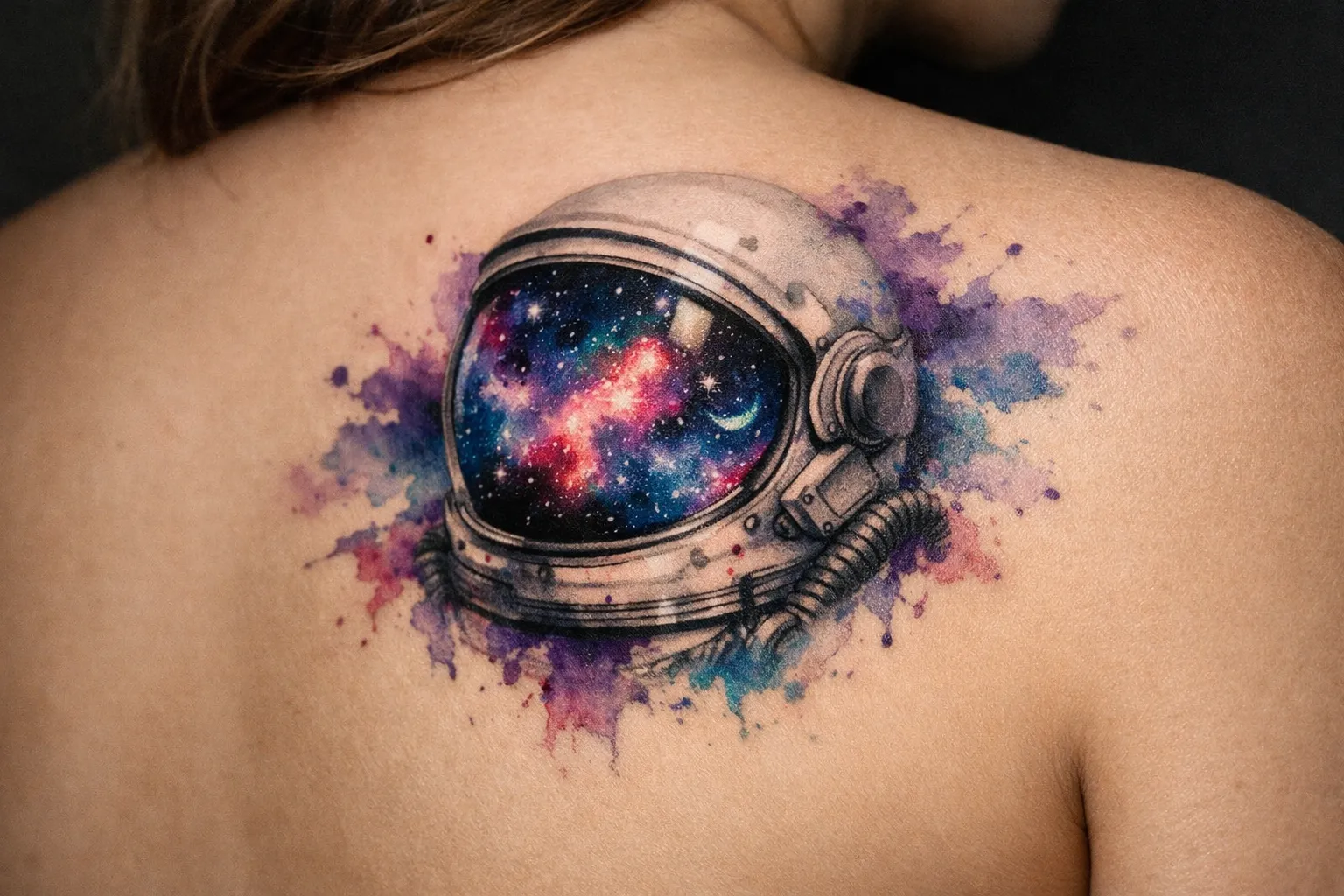
Floating Astronaut with Colorful Earth
An astronaut drifting above a saturated, colorful Earth. It plays both ways - fascination with what’s out there and the fragility of the planet you’re floating away from. Works well at 4-6 inches on the forearm or shoulder, or scaled up as a sleeve centerpiece. One thing I always flag: keep the Earth’s continents simplified. Cramming photo-real geography into a small space is exactly how the blue and green bleed together over time.
Astronaut Holding Balloon-Planets
A suited figure clutching a bundle of planets like balloons. Childlike, nostalgic, “dream big” energy. The contrast of the technical suit against the whimsy is what makes it land. Good at 3-5 inches on the upper arm or calf, where you have room for two or three distinct planet shapes without them merging into each other.
Astronaut Riding a Dinosaur
Prehistoric past meets futuristic dream - pure whimsy. It’s a conversation piece more than a meaning piece, and that’s fine. This one needs 5+ inches to read clearly; the dinosaur and the astronaut both need enough space to be recognizable. Don’t try to shrink this onto a wrist.
The Lonely Astronaut
A solitary figure gazing at stars against a large empty field of black or negative space. Leans into isolation and scale - feeling small in a vast universe. The negative space does the heavy lifting here, so it suits larger placements: thigh, back, or outer forearm at 6+ inches. Clients who ask for this one usually know exactly why they want it.
Couple and Romantic Astronauts
Two astronauts tethered together or holding hands - partnership through the unknown (2). Common as matching pieces between partners. Works small (2-4 inches) since the symbolism doesn’t depend on fine detail to come through.
Small and Simple Outline Designs
If you want your first tattoo, or something subtle, a small astronaut Tattoo is the easiest entry point - quick to do, cheaper, and forgiving on placement. The cleanest version is a simple astronaut Tattoo outline: a single-needle or fine-line drawing of the suited figure with no shading, usually 1-2 inches tall.
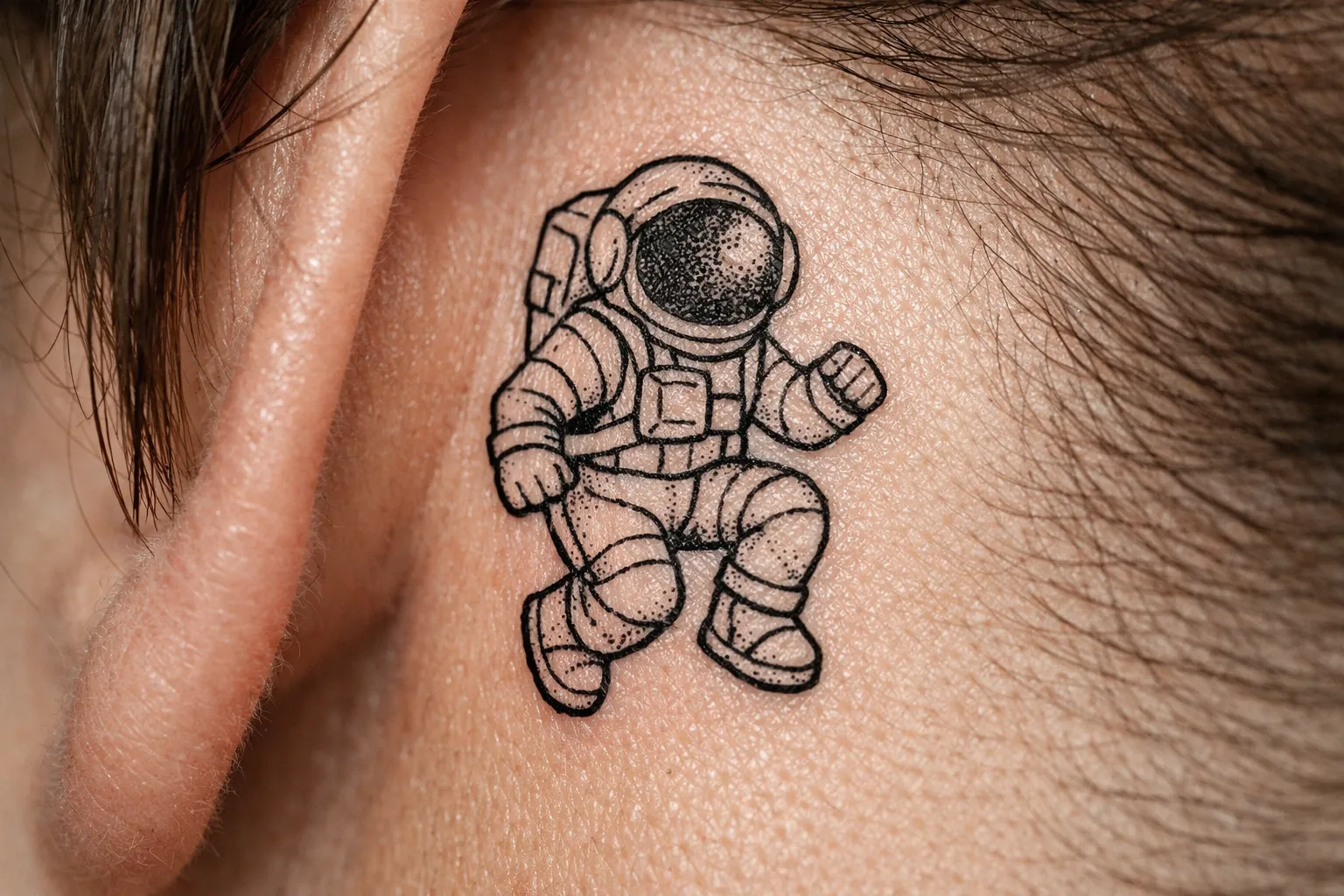
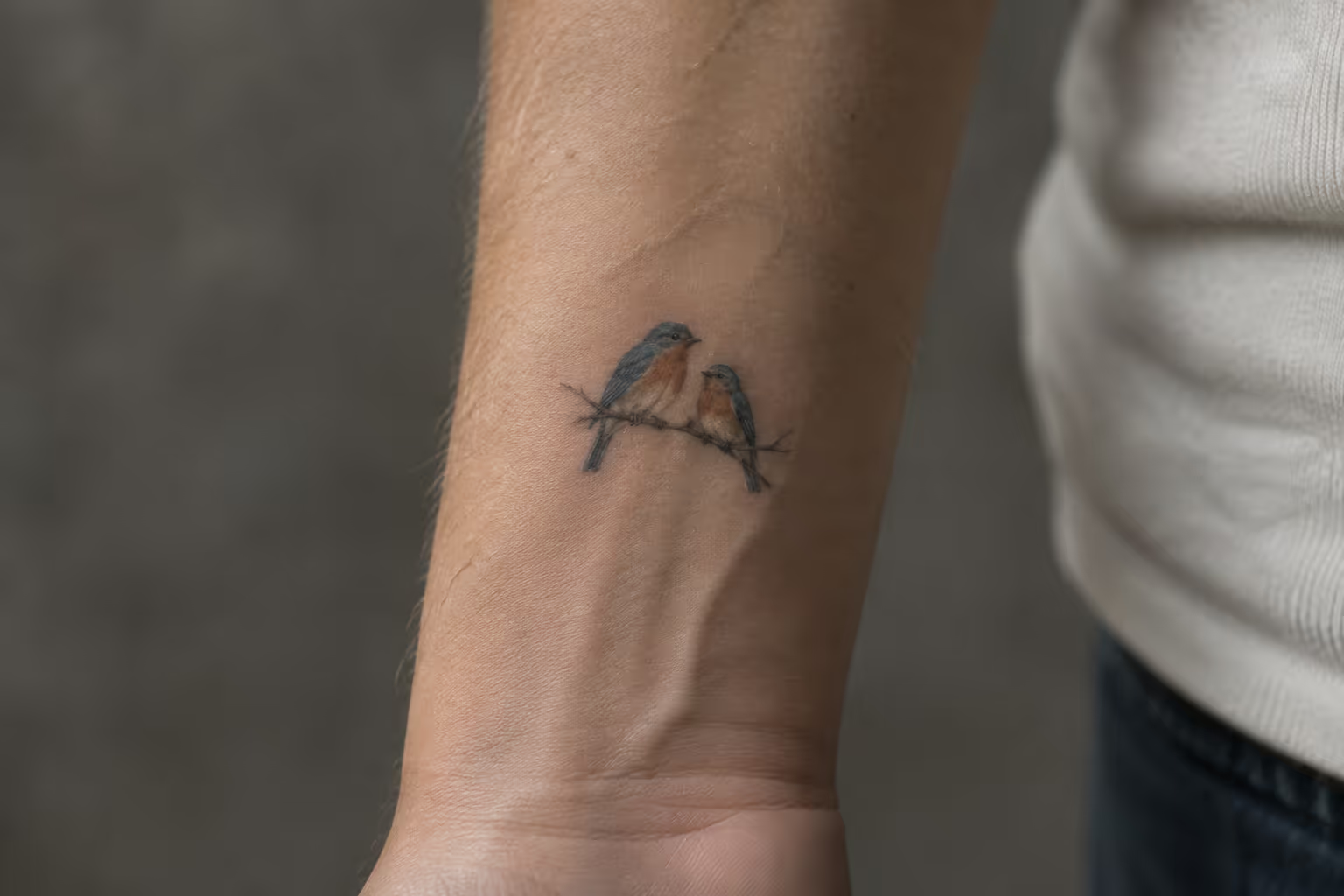
Here’s the part most viral Pinterest designs ignore: fine lines spread over time. Skin moves, ink migrates slightly, and ultra-thin lines that look crisp on day one can soften into a smudge over 5-10 years. I’ve touched up enough small pieces to say this with some confidence - for a simple astronaut outline, ask your artist for at least 0.5-0.7 mm line weight rather than the thinnest needle they own. It’ll look marginally heavier when healed and dramatically better in a decade.
Good placements for small and simple astronaut designs:
- Inner wrist - visible, flat, low pain. Lines spread a little here from wrist flex, so keep the design genuinely simple.
- Behind the ear - tiny, discreet, suits a 0.5-1 inch outline.
- Ankle - easy to conceal, but expect faster fade from shoes and friction.
- Side of the forearm - the most stable surface for fine line work; ages best of the four.
Don’t try to fit a full galaxy, lettering, and a detailed astronaut into a 1-2 inch space. It will blur. For small pieces, pick one element - the astronaut alone, or the astronaut plus a single small planet - and let it breathe.
Choosing a Style for Your Space-Themed Piece
Style determines how the piece ages as much as how it looks. Match the style to your size and, critically, to your artist’s actual portfolio.
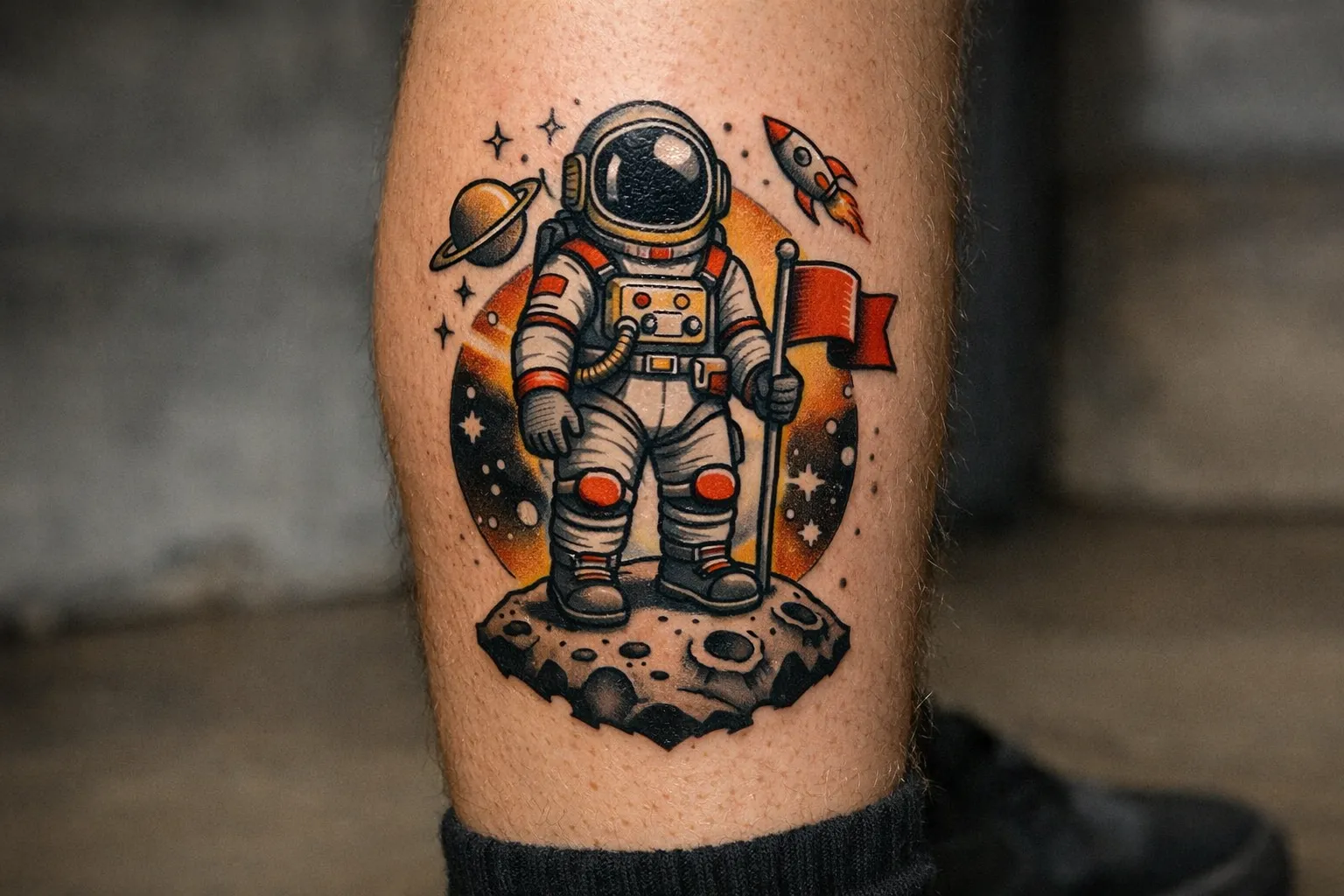
Fine-line minimalist. Thin outlines, little to no fill, lots of negative space. Two hallmarks: clean single-weight linework and restraint - no background clutter. The common pitfall is going too fine, so the lines blur within a few years (covered above). Best for small and simple astronaut outlines at 1-3 inches.
Illustrative / neo-traditional. Bold outlines, saturated color, decorative framing - flowers, planets, banners. The hallmarks here are thick readable outlines and a deliberate, limited color palette. Done badly, the colors get muddy and the outlines too thin to hold the fill long-term. Holds up well at 4 inches and up.
Realism. NASA-style suit, helmet reflections, photo-real shading. This is advanced work - the giveaways of a good realism piece are smooth gradient shading and accurate light on the helmet visor. The pitfall: realism crammed too small loses all its detail within a few years. Only book a proven realism specialist, and don’t go under 5-6 inches.
Watercolor. Color washes that bleed past the outlines like a galaxy or nebula. The hallmark is soft, blended color with minimal hard linework. The honest caveat: watercolor without any black anchor lines tends to fade and lose definition faster than other styles. If you want watercolor, ask for at least a light structural outline so the design still reads in ten years.
Cartoon. Stylized, playful, often the astronaut-on-a-dinosaur or balloon-planet variety. Forgiving and fun, scales well, and the bold simple shapes age nicely.
One rule across all of them: review the artist’s healed astronaut or space pieces, not just fresh photos. Fresh ink always looks sharp. Healed work tells you how their lines and color actually settle.
Placement and Sizing for Astronaut Pieces
Placement affects visibility, pain, and how the tattoo holds up over time. Astronaut galleries lean toward a handful of spots for good reason (2):
- Outer forearm - flat, stable, low distortion over time, moderate pain. The best all-around spot for a detailed astronaut at 4-6 inches.
- Upper arm / shoulder - room for larger scenes and sleeve work; ages well.
- Calf - good for medium-to-large pieces, holds detail, easy to conceal.
- Thigh / back - the place for big lonely-astronaut compositions with lots of negative space.
- Inner wrist, behind the ear, ankle - small and simple outlines only.
On the pain scale: ribcage and sternum hurt significantly more than the forearm or outer thigh, which are more tolerable for most people. If it’s your first tattoo and you want a larger astronaut, the outer forearm or upper arm keeps things manageable.
Avoid high-stretch areas - inner bicep, side of the stomach - if you’re concerned about weight changes or pregnancy distorting the design. Skin that stretches a lot pulls fine astronaut detail out of shape.
Size guidance by placement:
- Small (1-2 inches): ankle, wrist, behind the ear. Outline or minimal shading only.
- Medium (3-6 inches): forearm, upper arm, calf. Fits an astronaut plus one symbolic element with detail intact.
- Large (7-12+ inches): thigh, back, sleeve focus. Room for full scenes, multiple planets, realism.
How Much an Astronaut Piece Costs (and How Big a $500 Tattoo Is)
Pricing varies by city and artist seniority, but U.S. averages for astronaut pieces run roughly:
- Shop minimum (very small simple outline): $80-$150.
- Small blackwork astronaut, 1-3 inches: $150-$300.
- Medium detailed astronaut with planets or galaxy, 4-6 inches: $300-$600.
- Large color astronaut, 7-10 inches: $600-$1,200+, usually split across 2-3 sessions.
At a typical shop charging $120-$180/hour, $500 buys roughly 3-4 hours of work - a medium piece around 4-6 inches with solid detail, meaning an astronaut, a helmet with proper shading, and one main element like a planet or moon. On a high-end artist at $200-$250/hour, the same $500 is 2-3 hours, so you’d scale the design down or keep it blackwork to fit. Budget another $15-$40 for aftercare supplies on top.
If you’re working to a fixed $500 budget, the smart move is to prioritize one crisp focal point at 4-6 inches over a cramped, over-detailed piece. Size for clarity, not for cramming.
Create Your Own
You don’t have to walk in and point at a Pinterest screenshot. A better result comes from building the design with your artist. Here’s the workflow I walk clients through:
How to Create Your Own Astronaut Tattoo Design
3 hoursStep-by-step process to collaborate with your artist for a meaningful astronaut tattoo.
- 1
Pick 2-3 core themes
Decide on key meanings like courage, chasing dreams, or love of space. Bring these themes to your consultation to guide the design direction.
- 2
Use vector libraries as references
Browse platforms like Vecteezy and Adobe Stock for pose and shape ideas. Bring a few references but have your artist redraw and adapt them for your size and placement.
- 3
Add personal details
Incorporate mission numbers, dates, initials, or constellations that matter to you. This usually requires a dedicated 1-2 hour custom design session.
- 4
Set line hierarchy with your artist
Ask for thicker outlines on the astronaut figure and thinner lines for background elements like stars and planets to keep the design readable from a distance.
AI concept tools have entered this space too - platforms like BlackInk AI now generate hundreds of astronaut variations from text prompts. Useful for brainstorming compositions. Treat the output the same as a vector: a starting reference your artist refines, not a finished stencil.
Related Searches and Interests Worth Exploring
If the standard astronaut isn’t quite right, the surrounding search space has options. Related searches that come up alongside astronaut tattoo include space sleeve tattoo, galaxy tattoo, planet tattoo, cosmonaut tattoo, and astronaut helmet tattoo. Each shifts the emphasis - a galaxy or nebula piece foregrounds the cosmos and uses the astronaut as a small accent; an astronaut helmet alone (often with a reflection or floral fill) reads more graphic and abstract.
Related interests that can feed your design: astronomy (constellations, star maps), NASA history (mission patches, the Apollo and Artemis programs), spacecraft silhouettes, and sci-fi iconography. Pulling a real constellation or an accurate mission patch into the composition gives the piece specificity that a generic floating astronaut lacks. If you’re leaning toward a full cosmic scene rather than a single figure, that’s its own design conversation - and we cover broader space tattoo compositions separately.
Designs Worth Avoiding With This Motif
Not every astronaut idea ages well or sits right. A few worth steering clear of:
- Over-complex small tattoos. Full galaxies, multiple tiny planets, text, and an astronaut packed into 1-2 inches. The lines spread and merge within a few years. Simplify or size up.
- Micro-detail you can’t maintain. Tiny helmet reflections, minuscule stars, hairline suit creases under 3 inches. They blur over 5-10 years. Save the fine detail for pieces 3+ inches.
- Copied viral designs. Lifting a famous Pinterest or TikTok astronaut wholesale means the same tattoo as everyone else, with none of the personal reference. Use it as inspiration, not a stencil.
- Trademarked logos for resale. Personal body art using NASA-style imagery is generally tolerated, but copying exact official logos or mission patches into commercial flash you intend to sell is legally risky.
- Style/artist mismatch. Booking a realism specialist for a minimalist outline, or vice versa. Match the artist’s strengths to your design.
- Visible placements against your lifestyle. Hands, neck, and face tattoos still affect employment in conservative fields, and many studios won’t do them for first-timers anyway.
Aftercare: Keeping the Detail Crisp
Astronaut tattoos - especially ones with galaxy color or fine suit detail - live or die on aftercare. The timeline:
Day 1-3. Keep the bandage or second-skin on as long as your artist directs. Once it’s off, wash gently with a fragrance-free soap, pat dry, and apply a thin layer of healing ointment. The tattoo will weep a little - that’s normal. Don’t soak it, don’t drown it in product.
Week 1. Switch to a thin layer of fragrance-free moisturizer a couple times a day. Around days 3-7 it’ll start peeling and itching. Do not scratch or pick - this is exactly when small astronaut outlines and fine line detail get damaged. Let the flakes come off on their own.
Week 2-4. The surface heals in 7-14 days, but full healing takes 4-6 weeks. Keep moisturizing. No swimming, no saunas, no soaking until it’s fully settled.
Long term. Sun is the enemy of color. The deep blues and purples in galaxy backgrounds fade fastest - without diligent protection, a space scene can dull noticeably within 2-3 summers. Once healed, use broad-spectrum SPF 30-50 on the tattoo any time it’s exposed, or cover it with sun-protective clothing. This single habit does more for long-term vibrancy than anything else you’ll do.
✓ Pros
- Modern, versatile motif with a range of symbolic meanings
- Works well in various sizes and placements
- Strong visual impact when designed with proper line weight and style
- Wide availability of design references and artist portfolios
✗ Cons
- Fine line and micro-detail tattoos risk blurring over time
- Over-complex small designs age poorly
- Style mismatch with artist can ruin the tattoo's longevity
- Some placements have higher pain or fade risk
Frequently Asked Questions
- Can I use AI-generated astronaut designs directly for my tattoo?
- AI-generated designs are great for brainstorming, but you should always have your artist redraw and adapt them for your size, placement, and personal details to avoid generic or poorly fitting tattoos.
- Is it okay to get a detailed realism astronaut tattoo smaller than 5 inches?
- No, realism tattoos lose their detail quickly if crammed too small. For realism, plan for at least 5-6 inches to keep shading and reflections clear over time.
- How do I prevent my small astronaut outline from blurring?
- Ask your artist for a line weight of at least 0.5-0.7 mm and choose stable placements like the side of the forearm. Avoid cramming too much detail into a tiny space.
- Are there any legal issues with using NASA logos in my tattoo design?
- Personal tattoos using NASA-style imagery are generally tolerated, but using exact official logos or mission patches in commercial flash or for resale can be legally risky.
- What aftercare products are best for preserving color in galaxy astronaut tattoos?
- Use fragrance-free moisturizers during healing and apply broad-spectrum SPF 30-50 sunscreen or wear sun-protective clothing once healed to protect color vibrancy.
- Why do some placements hurt more than others for astronaut tattoos?
- Areas like the ribcage and sternum have thinner skin and more nerve endings, making them more painful than the forearm or outer thigh, which are more tolerable for most people.
What Actually Matters for Your Decision
Pick your meaning before you pick your design - the composition should serve it.
For anything small or fine-line, ask for 0.5-0.7 mm line weight and resist cramming detail into 1-2 inches. That’s the single biggest factor in whether your astronaut still reads clearly in a decade. Put detailed pieces on the outer forearm, upper arm, or calf where skin stays stable. Budget around $300-$600 for a clean 4-6 inch medium piece, use vectors and AI tools as references your artist redraws rather than finished stencils, and protect the color with SPF 30-50 once it heals.
Get those right and the astronaut floating on your arm will still read clearly long after the trend that inspired it has moved on. For more on tattoo symbolism and style choices, consider exploring the Gorilla Tattoo: Size, Cost, Placement, Aftercare and Monkey Tattoo: Meaning, Sizing, Placement, Cost articles to see how different animal motifs convey strength and personality. If you want to incorporate floral elements into your space-themed tattoo, the Magnolia Tattoo: Meaning, Placement, Cost, Aftercare offers insights on how flower symbolism can add depth to your design.