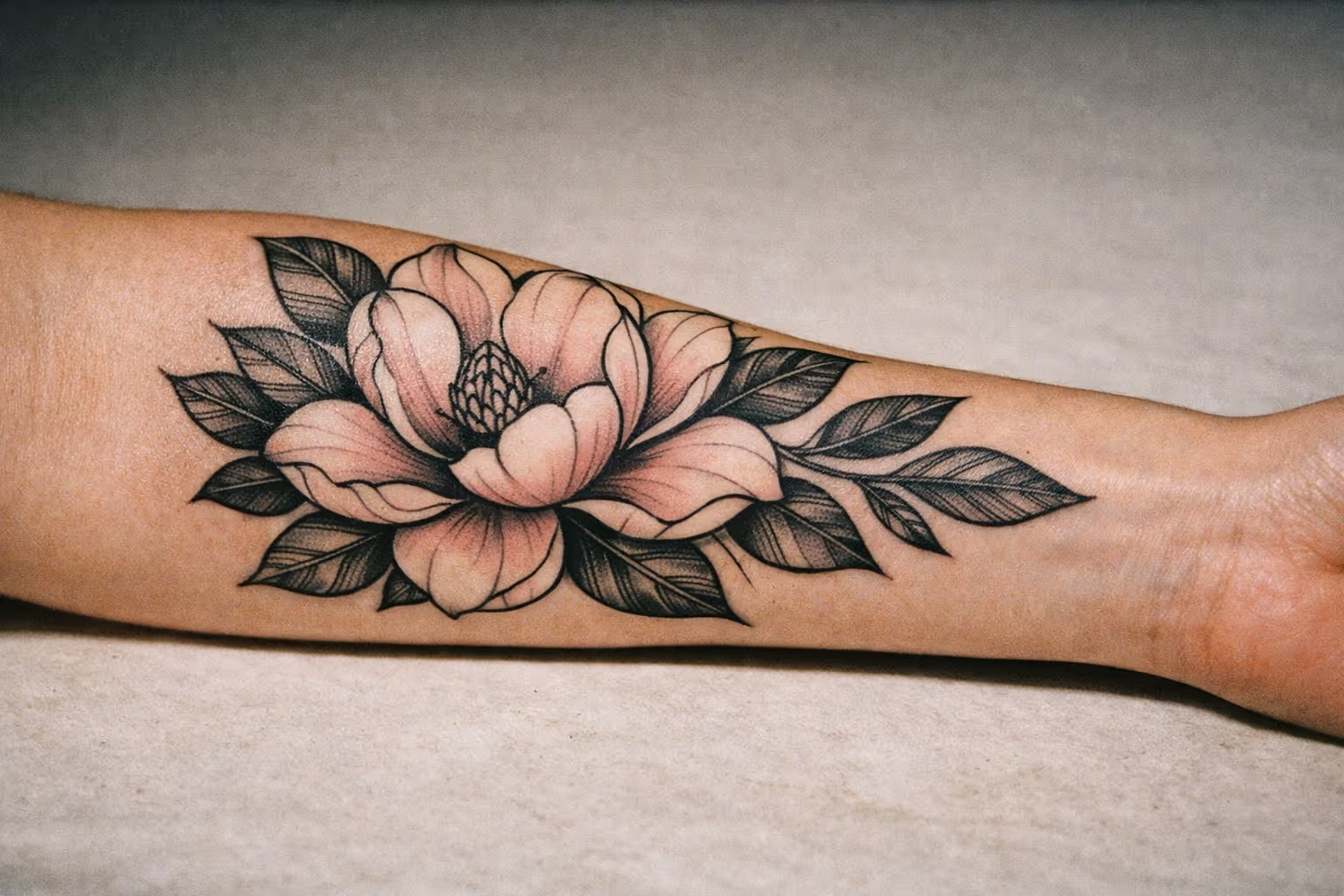
A magnolia tattoo changes its meaning with its color, and that’s a call most people make on looks alone without realizing they’re picking a message. White reads as purity and dignity, pink as youth and joy, and the choice stays with the piece for life. Beyond color, the flower’s large, simple petals actually age well - a rare thing in floral work. Here’s what a magnolia means shade by shade, plus the sizing and care that keep it clean.
What a Magnolia Tattoo Means
The magnolia is one of the oldest flowering plants on record - fossil evidence puts the genus at over 100 million years old (1), which is part of why so many people read it as endurance and survival rather than just a pretty flower. If you’re considering a magnolia tattoo, this guide covers what it actually means, how color shifts that meaning, where it sits and sizes well on the body, what it costs, and the practical stuff most studio pages skip: tipping, and how artists structure a floral piece so it holds up over the years.
The core symbolism is consistent across sources: endurance, nobility, beauty, purity, and love of nature (1)(2)(7). Because magnolias predate bees and survived ice ages - a fact documented in paleobotanical literature going back to the early 20th century - they carry a resilience reading that most flowers don’t, which is why they show up as “survivor” or transformation motifs more often than you’d expect (1).
There’s a strong feminine association too. The magnolia is repeatedly tied to womanly grace and dignified strength (1)(2), which is why I see it come up constantly as a memorial tattoo for a mother or grandmother. The flower looks soft but the symbolism is tough, and studios treat it as a unisex option even though the aesthetic skews feminine.
A few cultural threads worth knowing before you commit:
- In Asian traditions, the magnolia signals nobility and perseverance through hard times.
- In the American South, it stands for hospitality and regional heritage - more on the southern magnolia Tattoo below.
- In modern Western spiritual tattoo culture, it’s increasingly framed around spiritual awakening, growth, and crown chakra alignment (2)(6). That’s a recent layer, not an ancient one - worth flagging if you want the older meaning rather than the wellness-culture framing.
The magnolia tattoo meaning isn’t fixed to one tradition. Decide which thread matters to you and tell your artist. It changes nothing about the linework but everything about why the piece is yours.
Color Changes the Message
Color isn’t just an aesthetic call. Each shade carries its own meaning, and picking purely for looks can land you with symbolism you didn’t intend (1)(7). Color choices influence mood: white for purity; pink for romantic love and emotional healing; purple for royalty and luxury:
- White: purity, elegance, innocence, bridal devotion, spiritual clarity.
- Pink: romantic love, feminine softness, emotional healing - common for self-love or partner themes.
- Purple: royalty, luxury, plus health and luck.
- Green: good fortune, joy, and well-being.
If you want a clean, classic read, white blossoms with dark glossy leaves is the safest bet. Just know that white ink alone fades fastest and usually needs an outline or greywash structure underneath to hold shape.
Choosing Your Magnolia Tattoo Design
The flower’s bold petal shapes and layered structure make it flexible across styles. I’ve done magnolias in everything from fine line to neo-traditional, and when the style matches the placement, it works. The question is how long you want it to look sharp.
Small but Mighty
A small magnolia flower Tattoo at 3-4 inches sits well on the inner forearm, ankle, or behind the ear and is a solid first tattoo: limited color, easier healing, lower cost. A single bud or short branch at 1-3 inches reads as new beginnings, which suits recovery or transition themes.
One honest caveat: don’t shrink a detailed magnolia below 2-2.5 inches. Petals and stamens blur as lines spread over 3-5 years, and the micro-realism trend you see on social media often ages worse than it looks fresh. If you want tiny, go minimalist - a clean outline, not a packed realistic bloom. For more flower tattoo ideas across different sizes and styles, it helps to browse a range of floral work before committing to a placement.
Bold Black Magnolias
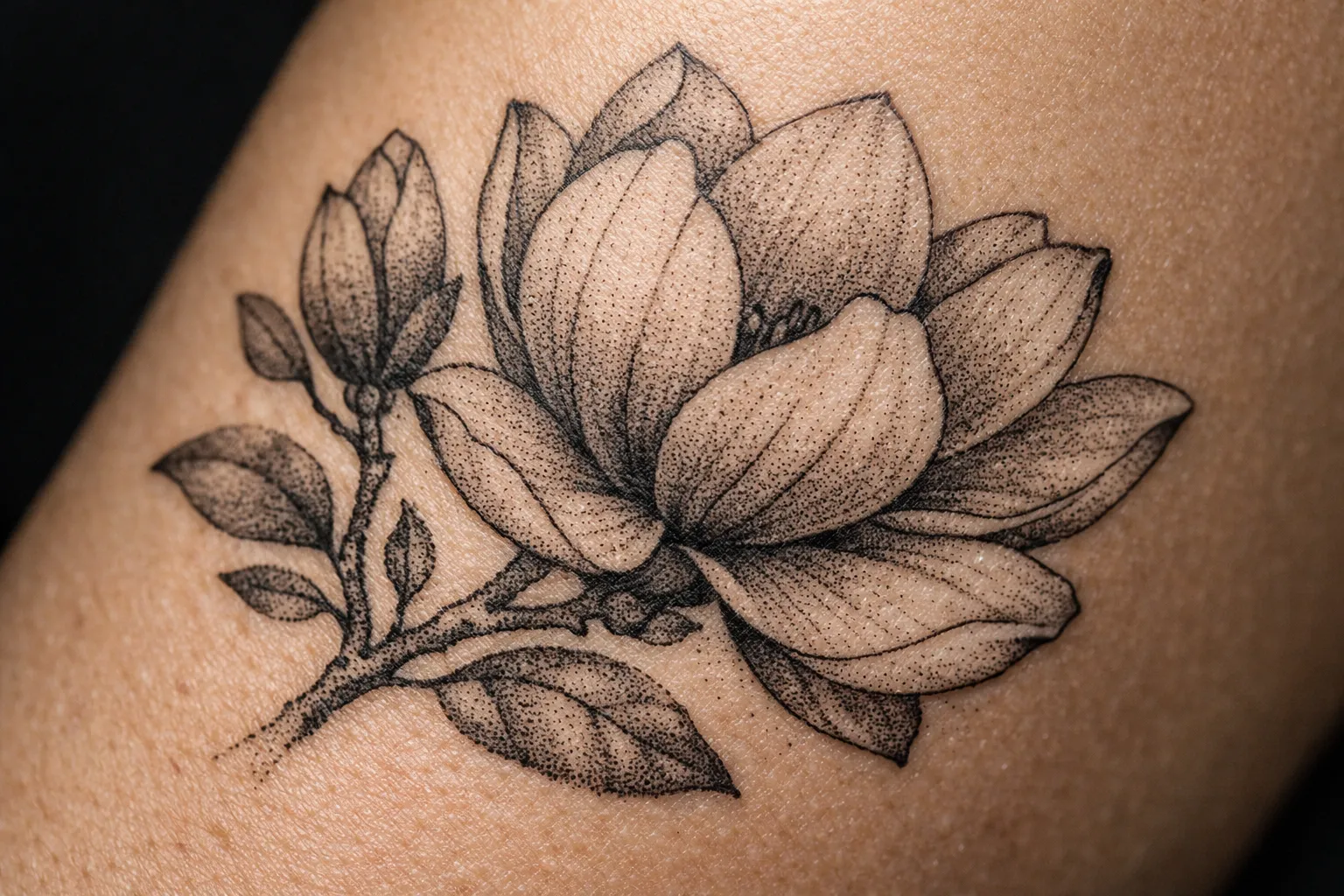
Black and grey realism leans on shading rather than color, so a black magnolia tattoo holds up well on larger placements - upper arm, ribs, thigh, or back at 5-10+ inches. Two technical hallmarks to ask for: a slightly thicker outline (0.35-0.40 mm) on the outer petals and thinner internal lines for depth. That line-weight contrast is what keeps the flower legible as it heals and ages.
The common pitfall with black and grey magnolias is flat, even shading with no tonal range - the petals end up looking like a sticker. A good artist plans three tones (light, mid, dark) before the needle touches skin.
Fine Line, Watercolor, and Traditional
Fine line / single-needle gives you delicate outlines and minimal shading, best at 3-5 inches. It’s hugely popular right now, especially with clients in their 20s and 30s driven by what they’re seeing on Instagram and TikTok. Ages fine if the artist resists going too thin.
Watercolor looks great fresh but needs structural linework underneath. Pure soft watercolor with no lines loses its shape as pigment fades. Color packing also adds time and cost, so factor that in.
Traditional / neo-traditional uses bold outlines and a saturated palette. Reads from a distance and ages most gracefully of all the options. If you’re unsure which style will still look clean in fifteen years, this is it.
Open vs. Closed Bloom
A small design decision with real symbolic payoff. An open magnolia reads as confidence and full strength, while a bud or half-open flower signals new beginnings or healing in progress. Tell your artist which one before they sketch - it’s hard to change later.
✓ Pros
- Strong, layered symbolism with cultural depth
- Flexible across multiple tattoo styles and sizes
- Works well in both small and large placements
- Ages well with proper line weight and tonal planning
✗ Cons
- White ink fades quickly without structural support
- Small detailed designs blur over time if too tiny
- Busy sacred designs need larger placements to avoid crowding
The Southern Magnolia as a Heritage Piece
The southern magnolia Tattoo is its own category. The flower is a regional symbol across Mississippi, Louisiana, and neighboring states, which makes it a popular heritage or hometown piece. The classic version pairs large white blossoms with dark, glossy evergreen leaves, sometimes worked around a state outline for regional pride.
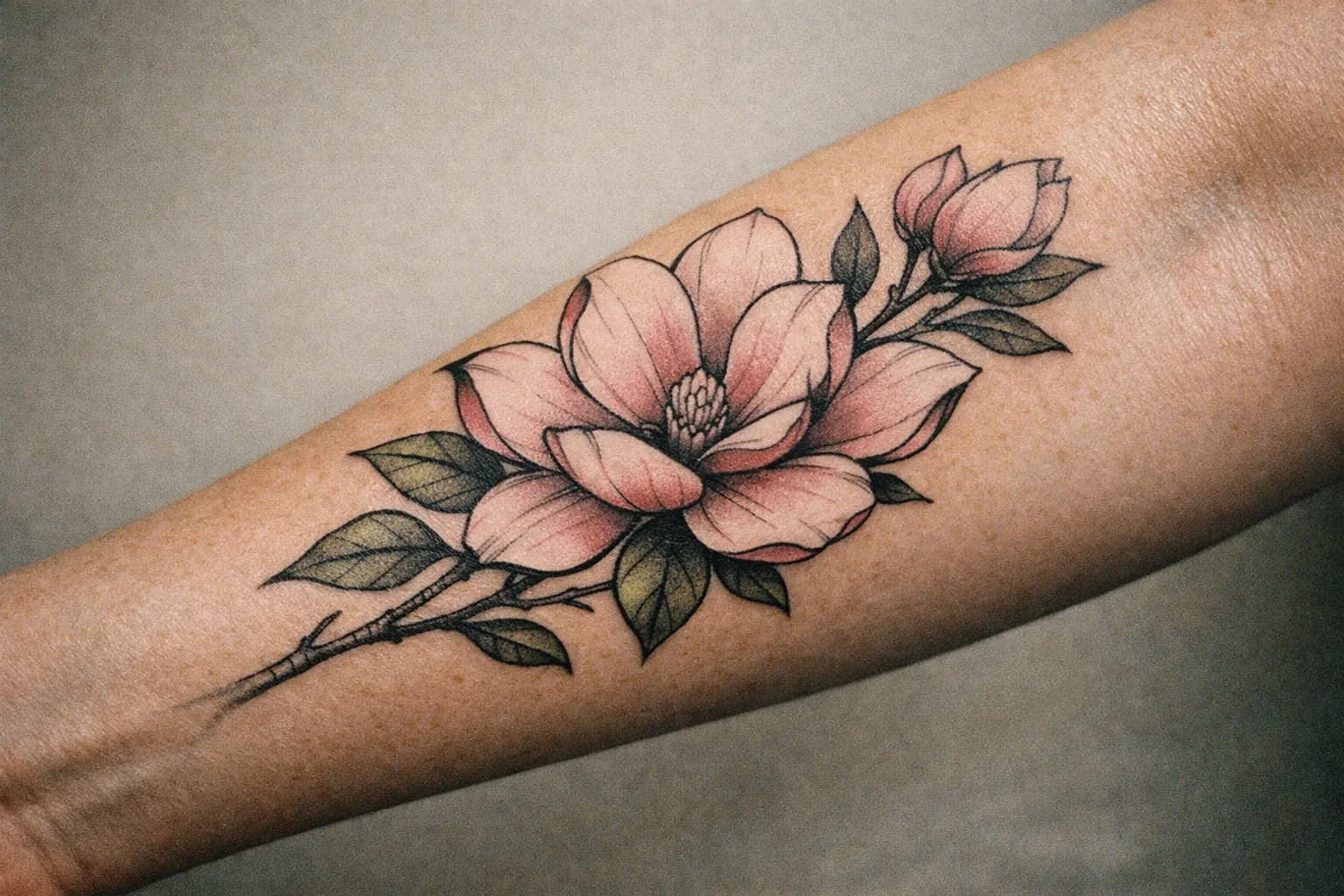
If you’re getting one for heritage reasons, the leaf detail matters as much as the flower. Southern magnolia foliage is thick and waxy, and skipping it for a generic bloom undercuts the whole point. Bring botanical reference photos so your artist nails the leaf shape and that heavy, layered petal structure. I’ve had clients bring in pressed leaves from their grandmother’s yard - that kind of reference makes a real difference.
Sacred Magnolia Designs
A sacred magnolia Tattoo combines the flower with spiritual symbols - mandala, halo, cross, rosary, or chakra imagery - most often referencing spiritual awakening and the crown chakra (2). This framing has grown noticeably in the last year or two, pushed by studios tied to yoga and meditation culture (2)(6).
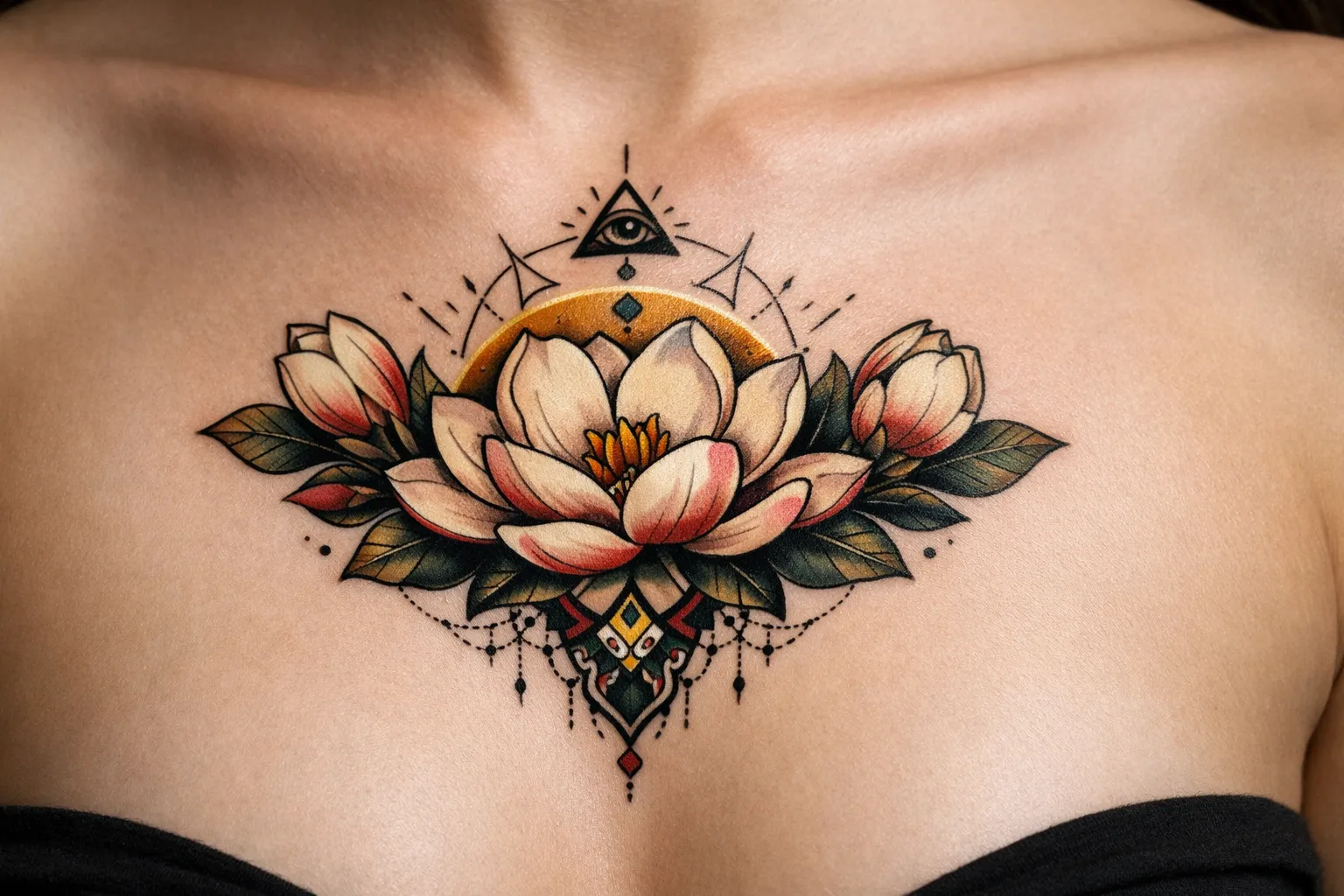
Two things to keep in mind. First, this is a modern Western spiritual reading, not an ancient one - don’t assume it carries the same lineage as a traditional Japanese or Celtic motif. Second, sacred compositions get busy fast. A magnolia plus a mandala plus a chakra symbol can crowd the skin quickly. Forearm, sternum, or center-back give you the vertical or symmetrical space these designs want. A small wrist won’t hold the detail.
Placement, Size, and How It Ages
Where you put a magnolia decides how often you’ll be back for touch-ups. The most common placements are the forearm, upper arm, shoulder cap, ribs and side, thigh, and back (5).
Size-to-placement guide:
- 1-3 in: wrist, ankle, behind the ear - minimalist buds and single branches.
- 3-4 in: inner/outer forearm, ankle - small single bloom with light shading.
- 5-7 in: upper arm, thigh, ribs - one main flower plus leaves, room for color.
- 8-10+ in: back, full side piece - multi-flower compositions with branches.
On pain, relatively: ribs and sternum hurt more than the outer arm or thigh - thin skin over bone is always sharper. For a first magnolia, the outer arm or calf is a forgiving mid-range spot. Save the ribs for when you know how you handle the chair.
Hands, fingers, and feet fade fastest and blow out most, needing touch-ups every 2-3 years versus 5-10 on the upper arm - that gap is driven by constant friction and UV exposure, not skin depth over bone. If you live somewhere with high UV - the American South, Australia - favor inner arm, ribs, or upper thigh. Covered placements like ribs and inner arms often retain pigment well because they get less sun exposure. And leave 1-2 inches of blank skin around the flower if you might expand it into a sleeve or chest panel later.
The Traditional Tattoo Rule of 3
People searching magnolia designs often run into the “rule of 3,” and it’s worth understanding because it explains why some floral pieces look balanced and others look cluttered.
The rule of 3 is a composition guideline, not a hard law. It shows up two ways:
Three elements - a subject, a background, and filler. For a magnolia that’s the flower (subject), greywash or geometric shapes behind it (background), and small leaves, buds, or dots (filler). A flower floating on bare skin with none of the other two often looks unfinished and ages worse.
Three tones - light, mid, and dark. Even a black and grey magnolia needs all three to read as three-dimensional. Flat two-tone shading is the most common reason a floral piece looks cheap, and I see it more often than I should.
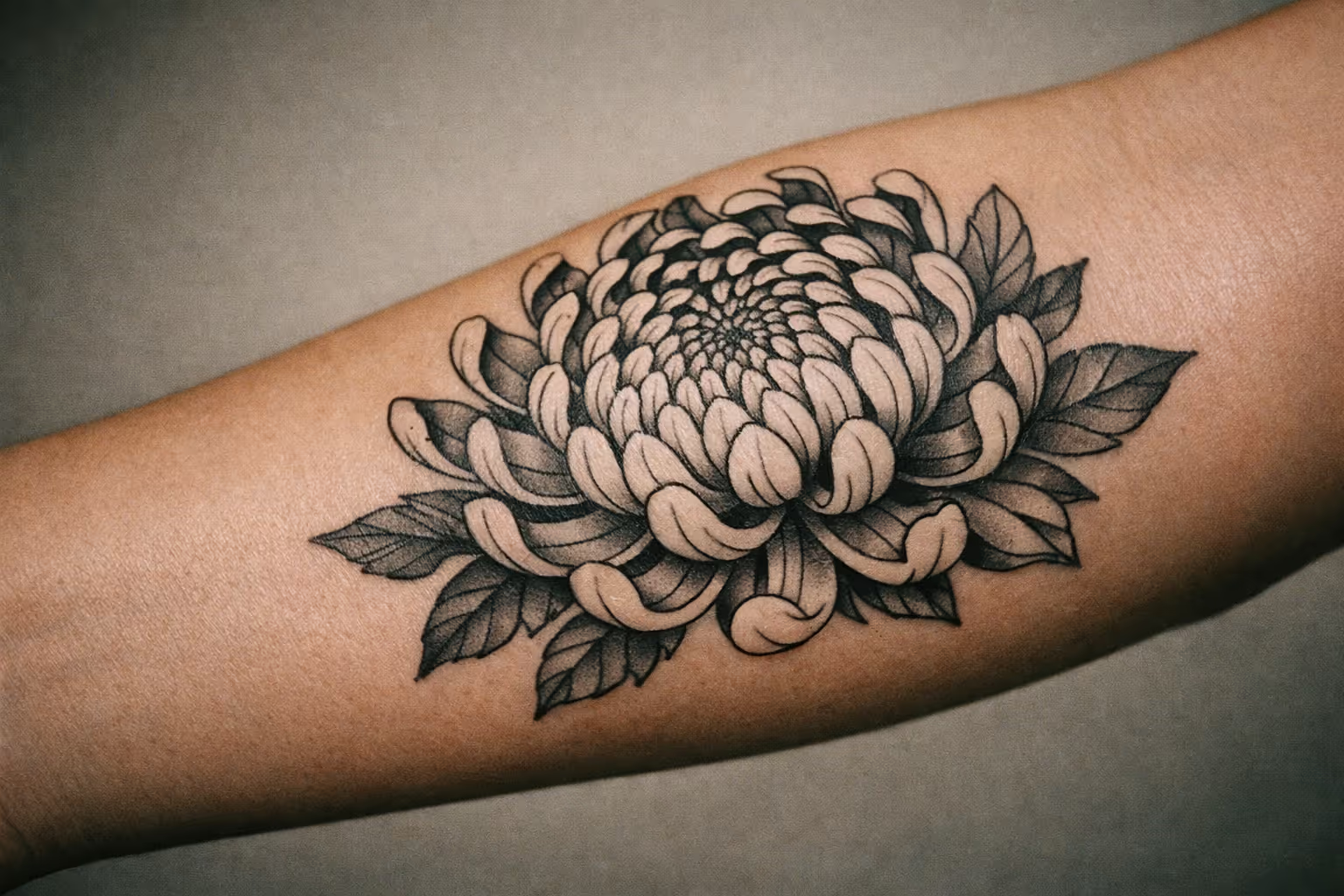
Ask your artist how they’re handling background and tonal range before you book. A good answer tells you they think in compositions, not just outlines. The same principle applies to other florals - a well-composed carnation tattoo or chrysanthemum piece uses the same three-tone logic to stay legible over time.
What a Magnolia Costs
Most ranking pages dodge real numbers. Here are current US benchmarks for 2024-2025:
- Shop minimum: $80-$100, even for a tiny tattoo.
- Small magnolia (3-4 in, linework, minimal shading): $150-$250 at $100-$150/hour.
- Medium magnolia (5-7 in, detail and color): 2-4 hours, $300-$700 depending on artist rate and city.
- Large rib or back piece (8-10+ in, full color with leaves and branches): 4-8 hours, $600-$1,600+.
- Full sleeve or multi-session composition: easily $1,500-$3,000+ across several appointments.
Budget approaches:
- Low: single small flower, linework only, one-hour minimum session.
- Mid: one main flower plus leaves with shading or soft color, 2-3 hours.
- High: large rib/thigh/back composition or sleeve built over multiple sessions.
Consultations usually run 15-30 minutes and are often free, though some shops take a $20-$50 design deposit that comes off the final price.
Before Your Appointment: Health and Safety
A few prerequisites that protect both the result and your healing:
- Be 18+ in most US states (some allow 16-17 with parental consent - check local law).
- Skip alcohol and blood thinners (aspirin, some NSAIDs) for 24 hours beforehand unless prescribed; ask your doctor.
- Hydrate - at least 64 oz (~2 L) of water the day before and day of. Hydrated skin takes ink better.
- Eat before you go and bring a snack for longer sessions.
If you have sensitive skin or react to jewelry and cosmetics, ask your artist to patch-test color inks with a small test spot before committing to a large multicolor magnolia.
How to Care for a New Magnolia Piece
A magnolia lives or dies on smooth petal gradients, so aftercare directly affects whether those blends survive. Full healing takes 4-6 weeks, even though the top layer closes by 7-14 days.
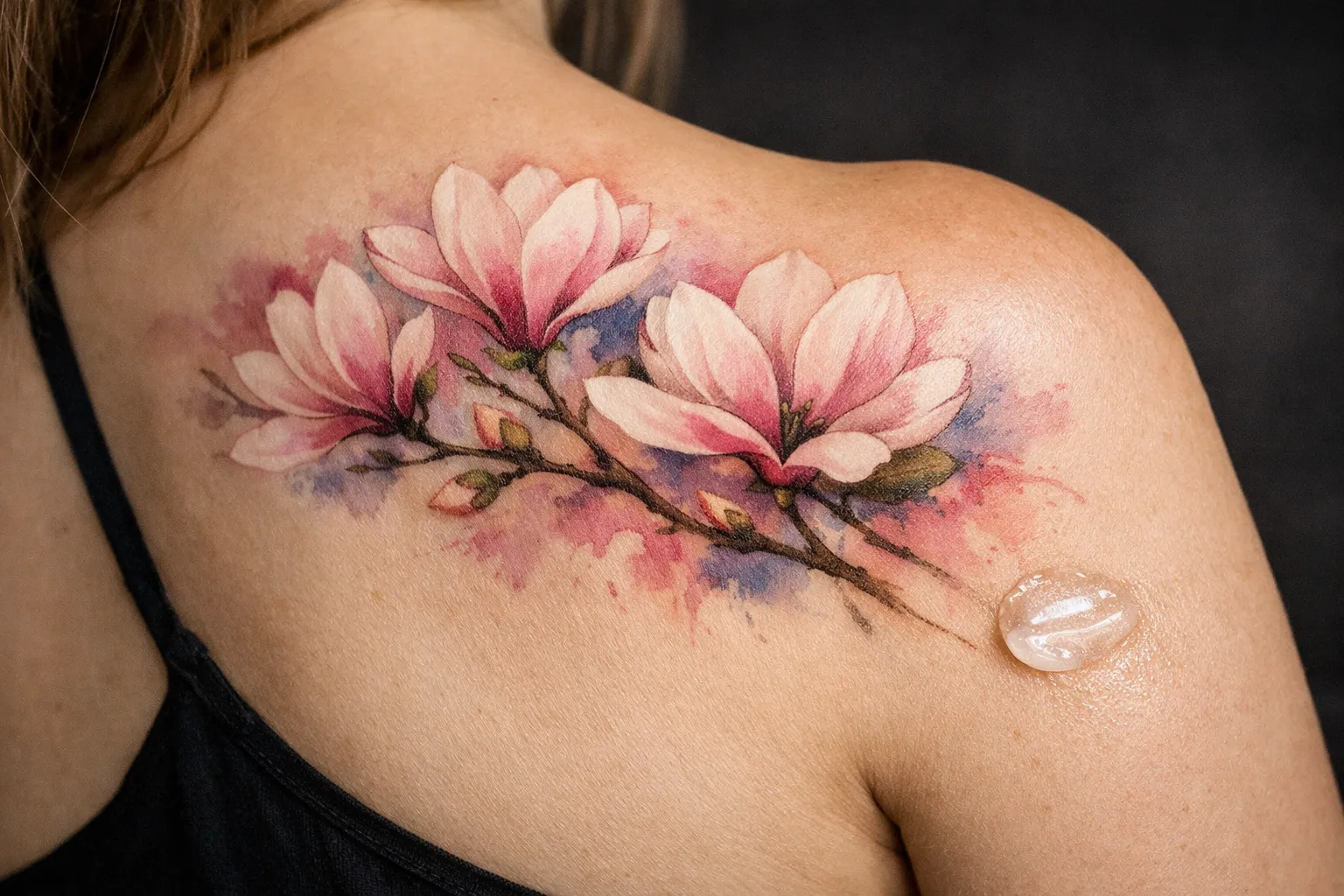
Day 1-3: Leave the artist’s wrap on as long as they tell you (a few hours to overnight). Then wash gently with a fragrance-free, gentle soap ($5-$10), pat dry, and apply a thin layer of healing ointment - a fragrance-free balm works well ($5-$15). Wash two to three times a day. Some plasma and weeping is normal.
Week 1: Switch from ointment to a fragrance-free moisturizer as the surface starts to dry. The tattoo will feel tight and look dull - that’s normal. Keep it out of pools, baths, and direct sun.
Week 2-4: Peeling and flaking start. Do not pick or scratch - pulling scabs is the fastest way to lose color and leave patchy gaps in your petals. Keep moisturizing lightly. Itching is normal; tap, don’t scratch.
Long term: Once healed, use SPF 30-50 sunscreen ($8-$20) on the tattoo whenever it’s exposed. UV is the single biggest cause of fading, and a magnolia’s subtle gradients are exactly what sunlight flattens first. In high-UV regions, sun-protective clothing over the spot during peak hours buys you years of vibrancy.
If you want vegan, cruelty-free options, more shops now stock balms and inks with no animal-derived glycerin - ask ahead, since it’s a common request now.
Choosing the Right Studio
The studio matters as much as the design.
Look for portfolio depth in floral work. Don’t just look for magnolias - look for clean line weight, healed photos (not just fresh shots), and consistent shading across pieces. Healed work tells you how the artist’s tattoos actually age. Fresh photos can hide a lot.
Style match matters more than people realize. A fine-line specialist and a neo-traditional artist are not interchangeable for a magnolia. Pick someone whose existing work already looks like what you want, not someone who says they can do it.
Check for basic hygiene and a willingness to actually talk through the piece. Single-use needles, a clean station, and an artist who’ll discuss placement, sizing, and aftercare before quoting you. If they won’t engage with composition questions, keep looking.
Bring high-resolution botanical reference photos or illustration plates to your consult. Artists capture accurate petal layering and leaf shape far better from real references than from memory or a vague description. The more specific your reference, the less guesswork ends up on your skin.
The decision that matters most isn’t the meaning or the color - it’s matching the design’s detail level to a placement that can hold it. A detailed magnolia wants at least 4 inches and a spot that stays covered from the sun. Get those two calls right, plan for three tones and a background, and the flower will still read clearly a decade from now.
Frequently Asked Questions
- What does the magnolia tattoo mean?
- While the article covers the symbolism broadly, the tattoo's meaning can also vary by personal context and artist interpretation, especially when combined with other motifs or colors. Some people use it to mark personal transformation or resilience beyond traditional cultural meanings.
- Is $50 a good tip for a $300 tattoo?
- Tipping norms vary by region and artist, but generally 15-25% is expected in the US. For a $300 tattoo, $50 is within the standard range and appreciated by artists as recognition of their work.
- What is the traditional tattoo rule of 3?
- It's a composition guideline involving three elements (subject, background, filler) and three tonal values (light, mid, dark) to create balanced, dimensional tattoos. It helps avoid flat or unfinished-looking floral pieces.
- How does placement affect tattoo aging for magnolias?
- Areas with thinner skin over bone like ribs and sternum hurt more - but fading there is driven by UV exposure and aftercare, not skin thickness. Hands, fingers, and feet need touch-ups every 2-3 years. Covered spots like inner arm and thigh protect color longer, especially in high UV regions.
- Why is line weight important in magnolia tattoos?
- Thicker outlines on outer petals combined with thinner internal lines create depth and keep the flower legible as it heals and ages. Too thin lines or flat shading cause blurring and loss of detail over time.
- What should I bring to my tattoo consultation?
- High-resolution botanical reference photos or illustration plates help artists capture accurate petal layering and leaf shapes, reducing guesswork and improving the final design's fidelity.