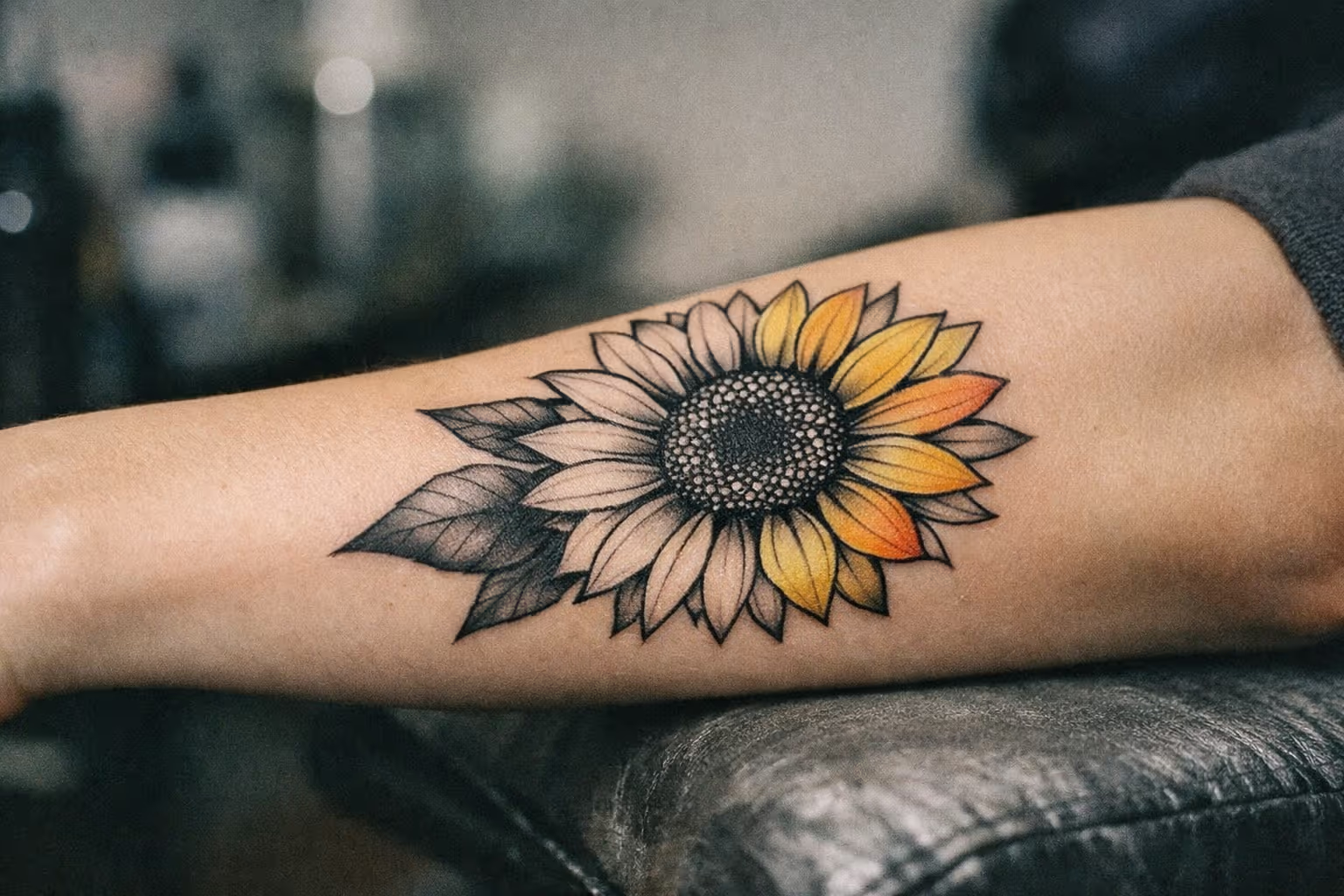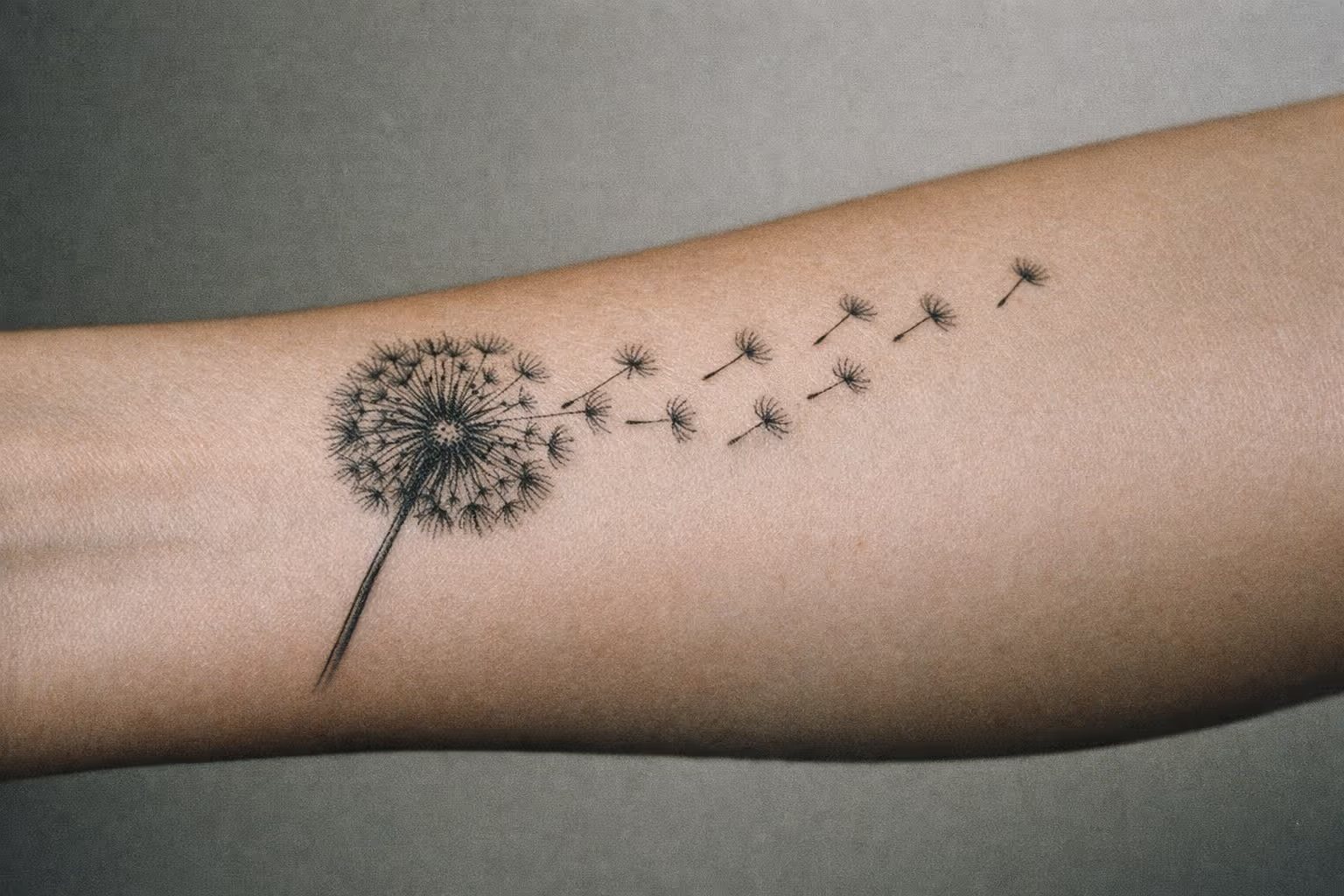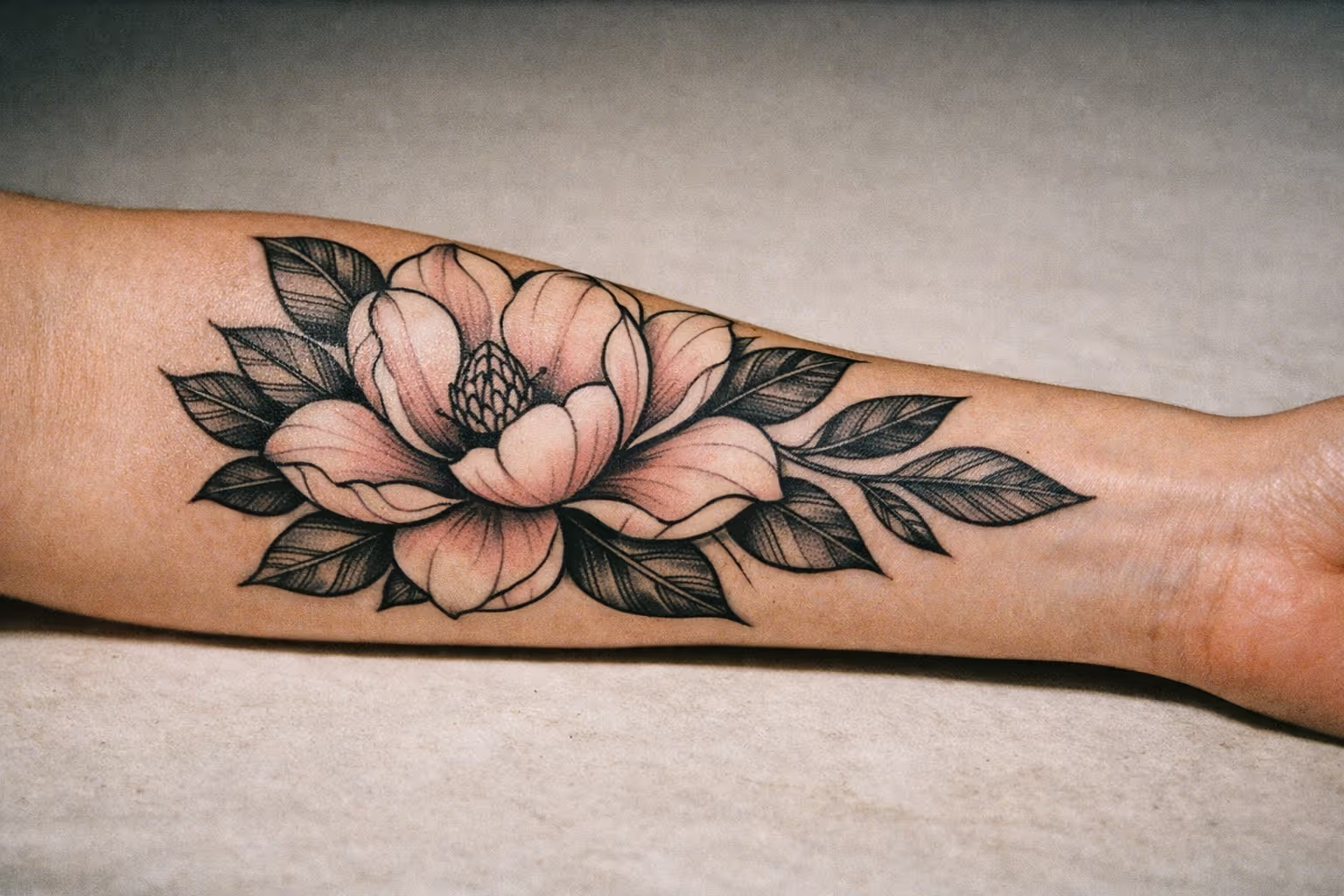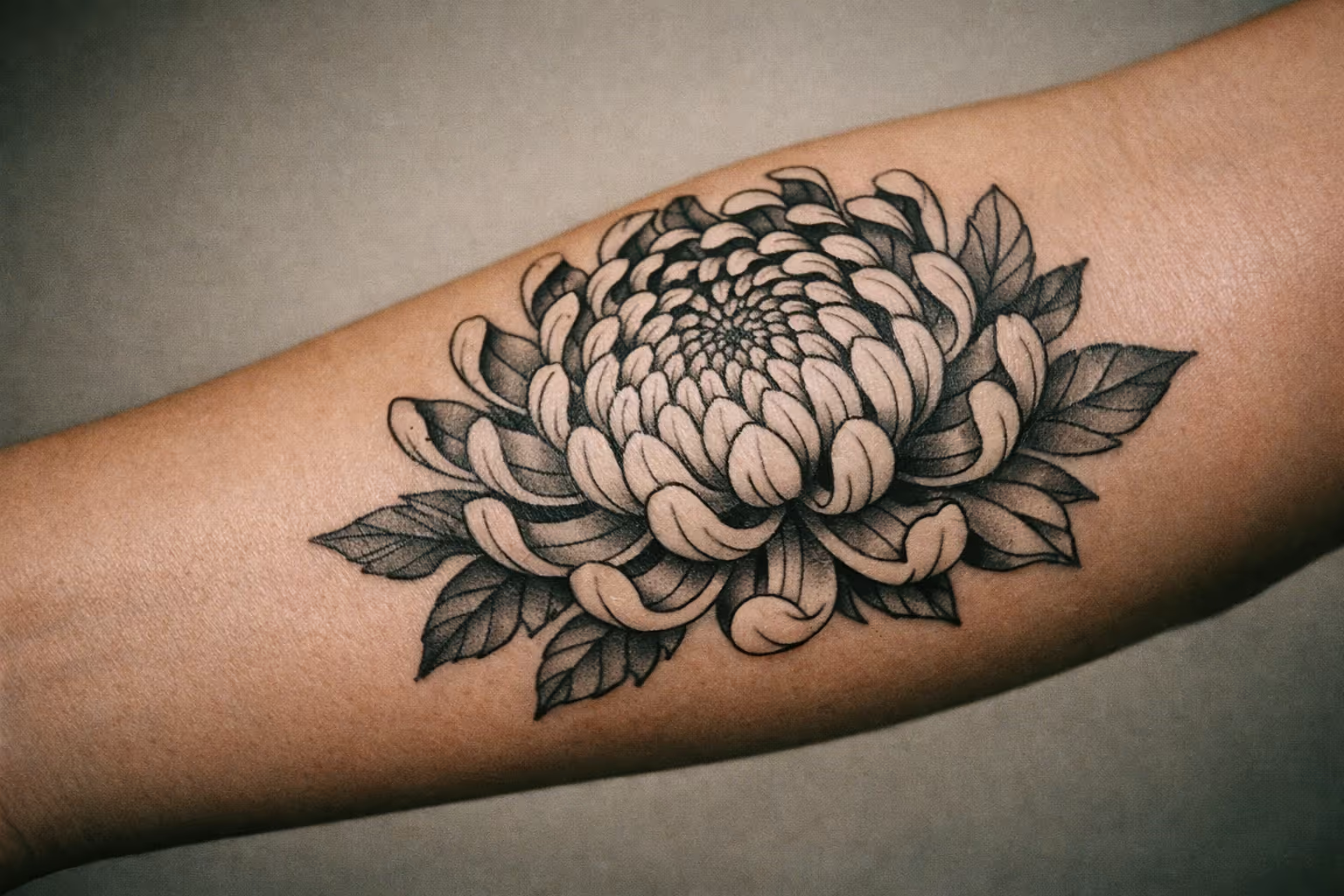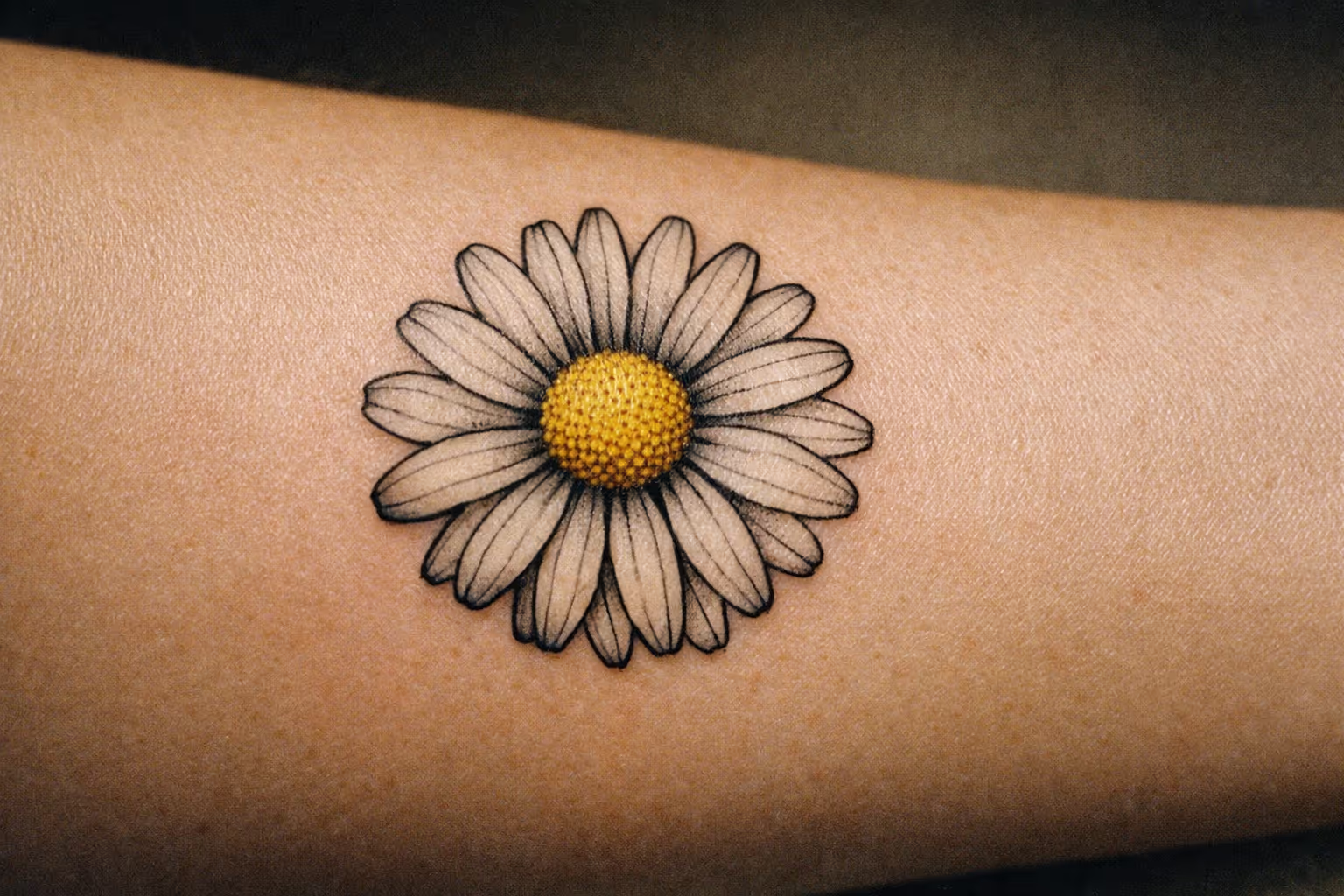
A daisy tattoo hides a practical problem behind a sweet symbol: its white and yellow pigments fade faster than almost any others, so where you put it and how you shield it from the sun matter as much as the design you pick. It’s a popular birth-flower and family piece, which makes the fade especially worth planning around. Here’s what the daisy represents - and how to keep it from washing out to a pale ghost in a few years.
What a Daisy Tattoo Actually Represents
A daisy tattoo is often chosen for its symbolism of innocence, loyal love, joy, and new beginnings (1)(3). Because the daisy is also the April birth flower, many daisy tattoo designs serve as birth-month or family tattoos (2)(3)(4).
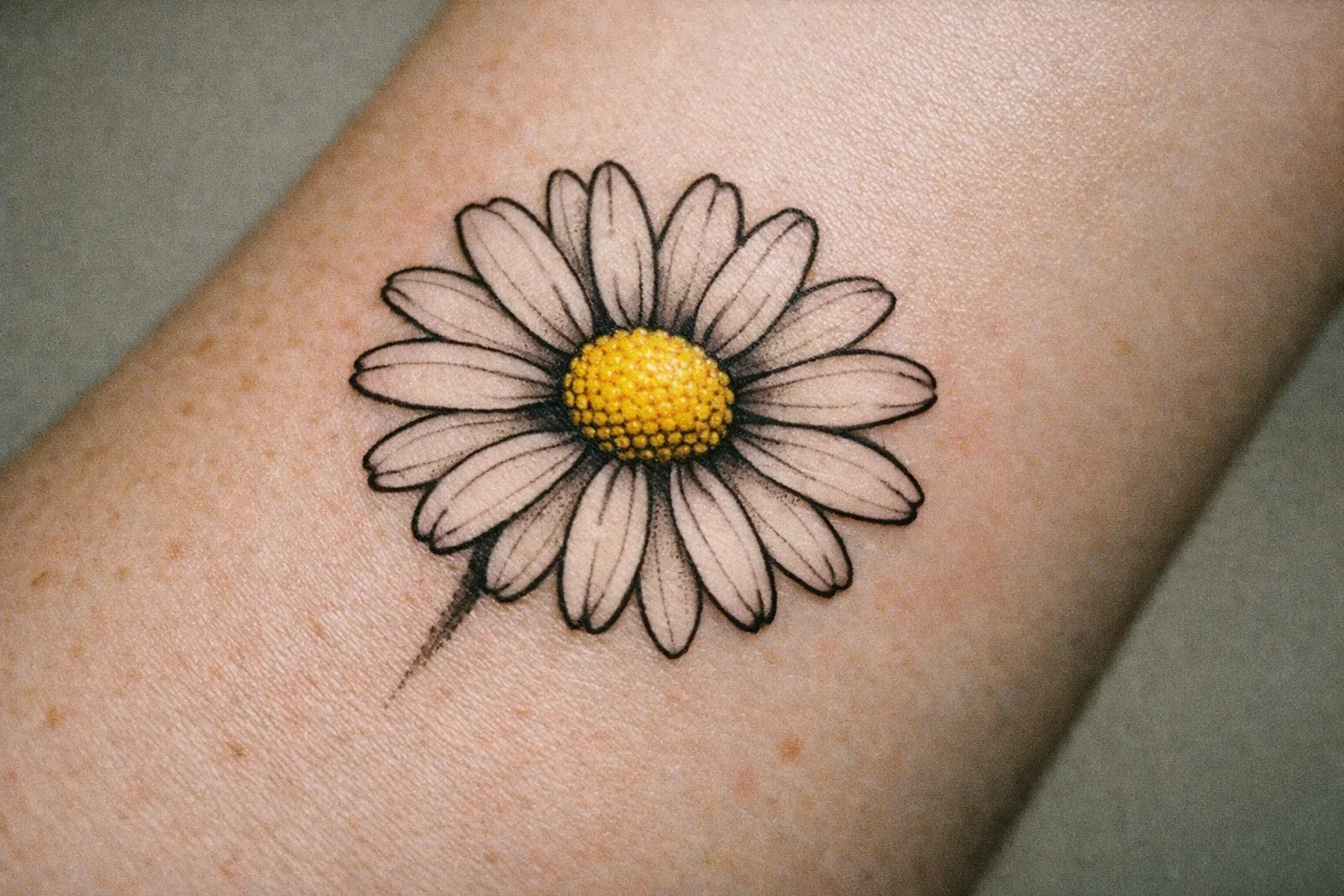
The longer answer pulls from four traditions:
- Celtic legend: daisies were said to be sent to comfort parents who lost a child - which is why modern motherhood and remembrance tattoos lean on this motif (3).
- Norse tradition: the daisy was sacred to Freya, goddess of love and fertility, adding layers of fertility, romantic love, and motherhood (5).
- Roman myth: the nymph Belides transformed into a daisy to escape Vertumnus - so the flower can also stand for escape, transformation, and autonomy.
- Christian symbolism: white daisies were tied to the Virgin Mary’s innocence and chastity (3)(7).
Pick the tradition that fits your reason for getting the piece. If you don’t have one, that’s fine - the default reading of innocence and joy is what most people will assume when they see it.
Color and What It Changes About the Meaning
The meaning shifts noticeably with the color you choose. This is where personalization actually happens, and it’s worth thinking through before your consultation rather than deciding on the day.
- White: innocence, purity, spirituality - often used for children or religious meaning (1)(3)(7).
- Yellow: friendship, happiness, encouragement - the go-to for friendship pieces (1)(2)(3).
- Pink: tenderness, feminine softness, romantic affection (1).
- Red (Gerbera): passion, courage, intense love (1)(3).
- Orange: responsibility, resilience, inner strength (1)(3).
- Green: wisdom, calm, inner harmony (1)(3).
- Blue: sentimentality, emotional depth, commitment (1)(2)(3).
- Purple: independence, mystery, ambition (1).
One technical note before you commit: white and yellow are among the fastest-fading tattoo pigments. On sun-exposed placements they can dull noticeably within one to two years without SPF protection. A yellow-center daisy on your forearm is a perfectly reasonable choice - just expect a touch-up cycle every few years, and use SPF 30-50 once it’s healed.
17 Daisy Tattoo Ideas
1. White Daisy Tattoo
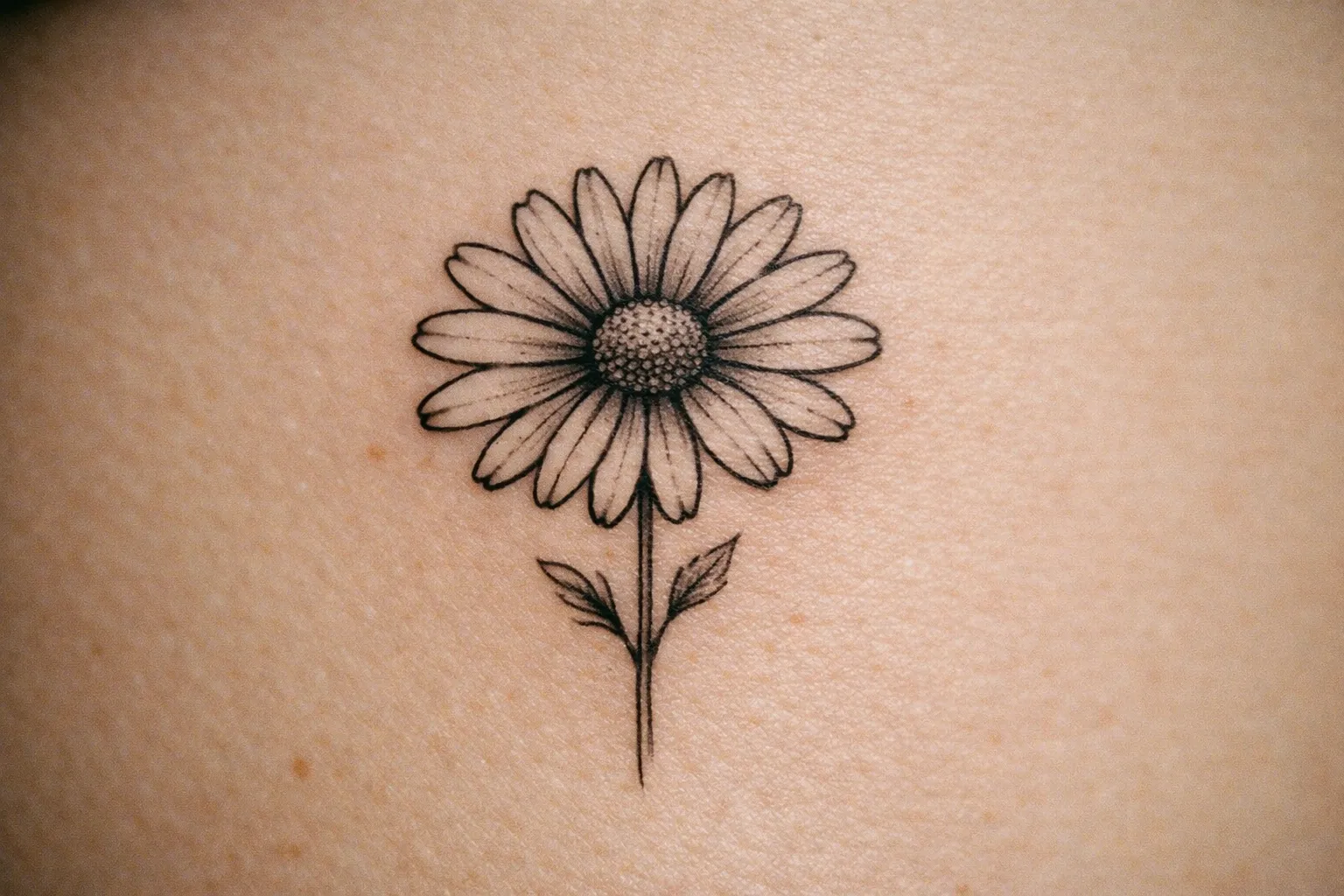
The classic: golden center, white petals, fine linework. Reads as innocence and purity (1)(3)(7). A nice variation is a single falling petal, which softens the symmetry and adds movement without complicating the design. Size range: 1.5-3 in (4-7.5 cm). Best placements: inner forearm, shoulder blade, behind the ear.
2. Gerbera Daisy Tattoo
Gerberas are the red cousin - same petal structure, very different reading. Red daisies signal passion and strong love (1)(3), so this works well as a memorial or relationship piece. Because it’s a saturated red, it holds up better long-term than a pure white daisy on the same placement.
3. Fine-Line Daisy Tattoo
Single-needle work, hair-thin petals, no shading. I’d ask for line weights around 0.25-0.35 mm - any thinner and the lines will blur or vanish within a few years as the skin moves and ages. The inner forearm and wrist hold fine line best because the skin moves less than fingers or feet.
4. Cluster of Purple Daisies
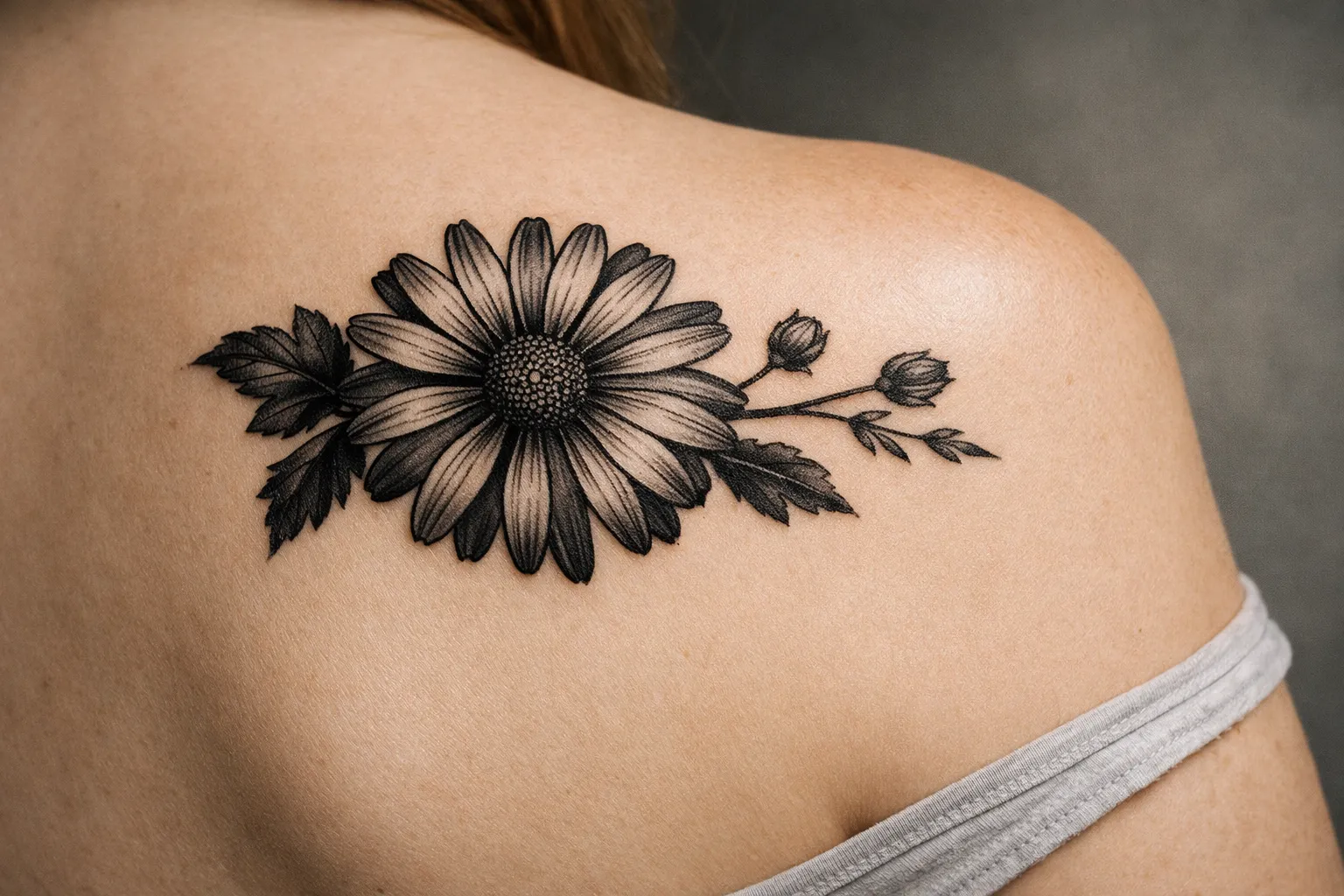
A hyper-realistic cluster - lavender to deep purple - pulls the meaning toward loyalty, independence, and protection. Plan for a larger footprint: 3-5 in (7.5-12.5 cm) to fit the detail without losing it. Outer shoulder, thigh, or upper back all work for this.
5. Dainty Blue Daisy Tattoo
Micro-realism with a stark blue palette. Blue reads as emotion, calm, and commitment (1)(2)(3). The collarbone and inner ankle are the sweet spots here - the contrast against skin is what sells the design. Keep it under 2 in (5 cm) and don’t over-detail the center.
6. Bee and Daisy Tattoo
The bee-and-daisy pairing means loyalty, hard work, and calm constancy. Visually, the yellow-black of the bee plays off the daisy’s white and gold in a way that feels balanced rather than busy. Keep the bee small and slightly above or beside the flower so neither competes for attention.
7. Minimal Daisy Tattoo
A simple daisy tattoo - five symmetrical petals, a dot center, no shading. This is the lowest-commitment way to get a flower tattoo and the easiest first piece. Size: 0.5-1 in (1.5-2.5 cm). Common placements: side of finger, behind the ear, ankle. Avoid the very tip of fingers - friction kills the linework within a year or two.
8. Sunflower and Daisy Tattoo
Two birth-flower-adjacent motifs (sunflower for August, daisy for April) work well together. Add fine green stems and a couple of leaves to tie the palette. Forearm or thigh gives you the room you need - minimum 4 in (10 cm) so the sunflower doesn’t visually crush the daisy.
9. Behind-the-Ear Daisy Tattoo
A single black-line daisy or a small arc of three daisies wrapping the curve of the ear. Concealable, healable, and clean. Just know the area is more painful than the forearm because the skin sits directly over bone with very little padding. Keep size under 1 in (2.5 cm).
10. Pink Daisy Tattoo
Pink reads as tenderness and feminine softness (1). Pinks fade closer to white over time than yellows do - so ask your artist to push the saturation slightly warmer than you want it to land. It’ll settle in correctly after healing.
11. Different Colored Daisies
Pairing colors lets you layer meanings - pink and purple together (tenderness plus independence), white and yellow (innocence plus friendship). Useful for tattoos representing two people or two distinct chapters of your life.
12. Butterfly Daisy Tattoo
Daisy plus butterfly equals transformation, freedom, the desire to change. The common composition is a butterfly hovering above or landing on a daisy. Works well as a recovery or new-chapter piece, and the two motifs balance each other visually without much effort.
13. Geometric Daisy Tattoo
A daisy enclosed in a diamond, hexagon, or circle. This is a good way to make a small daisy tattoo feel intentional and modern. The geometry also gives the artist a clean frame to anchor the petals - useful if you want tight symmetry.
14. Daisy in a Pot
Cartoon-style, often slightly wonky on purpose. The pot grounds the design and gives it personality. Works well as a wrist or inner-arm piece around 2-3 in (5-7.5 cm).
15. Daisy in a Glass Dome
A nod to the rose-in-a-glass-dome trope, swapped for a daisy. Reads as preserved beauty and the cycle of life. The dome adds structure, which helps this design hold up at medium sizes where a loose floral might feel unfinished.
16. Daisy with a Smiley Face
A daisy with a smiley face in the center - straightforward, cheerful, and very popular as a mental-health or recovery marker over the last couple of years. Keep it small (1-1.5 in / 2.5-4 cm) and avoid over-detailing the face. The charm is in the simplicity.
17. Matching Daisy Tattoo
Yellow daisies are the friendship color (1)(2)(3) - that’s the move for matching pieces with a friend. For partners, white or pink works better. Place them in the same anatomical spot (both inner wrists, both ankles) for the matching read to actually land.
Daisy Chain Tattoo: Sizing, Placement, and Meaning
A daisy chain tattoo - multiple linked daisies forming a bracelet, anklet, garland, or spine line - has surged in popularity over the last two years and deserves its own breakdown.
Meaning: chains amplify the symbolism of a single daisy. A chain of white daisies for innocence and a child. A chain of yellow daisies for a tight friend group. A chain incorporating different colors for a family with multiple children, sometimes sized by birth order. If you’re drawn to the idea of representing multiple family members through flowers, birth flowers tattoo designs offer a natural extension of this concept.
Sizing rule that matters: each daisy in a chain should be 0.6-1.0 in (1.5-2.5 cm) across so the petals stay readable as the tattoo ages. Smaller than that and the petals collapse into a blob within three to five years. I’ve seen this happen more times than I’d like - it’s a fixable problem at the design stage and a frustrating one after.
Best placements:
- Wrist bracelet: 6-8 small daisies linked by thin stems. Cost: $200-$400. Plan 2-3 hours.
- Ankle anklet: same structure as the wrist, slightly more painful because the skin sits over bone.
- Along the spine: linear chain running 4-8 inches down the upper back. Long session, but tolerable.
- Around the thigh as a garter: larger daisies, more room for detail, less fade risk because the area sees little sun.
A common pitfall: artists who overload the stems with extra leaves and curls. A daisy chain reads cleanest when the stems are simple connectors. Let the flowers do the work.
Best Placements and What to Expect
Where you put a daisy tattoo affects pain, longevity, and how often you’ll need a touch-up. These aren’t equal tradeoffs.
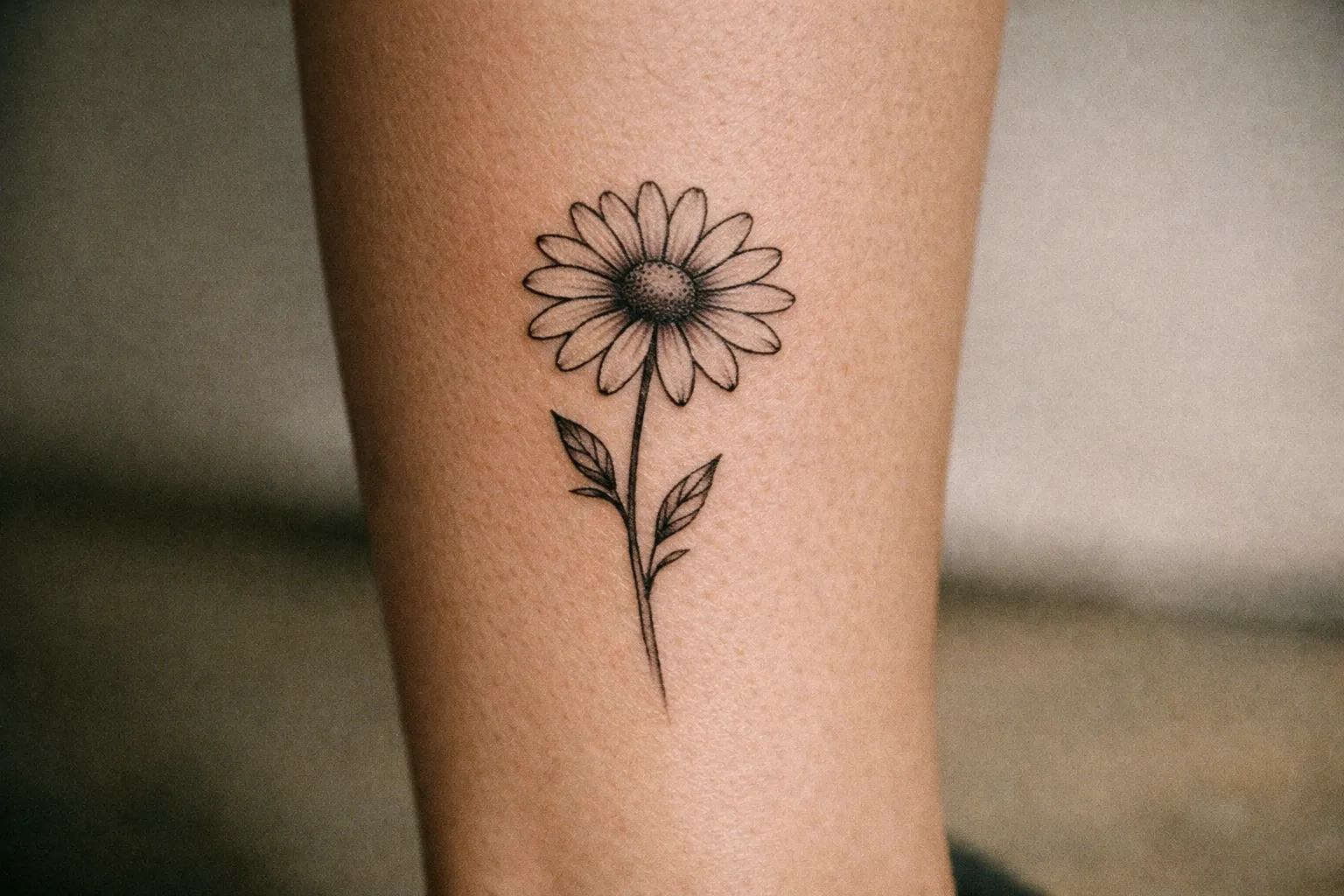
- Forearm: the default. Holds detail well, ages slowly, low to moderate pain. Good for fine-line, small, and medium daisies.
- Wrist: great for small daisy tattoos and chains. Slightly more painful than the forearm, and the inner wrist fades faster because of sun exposure when you’re driving or working at a desk.
- Ribs: good for medium-to-large pieces, easy to hide. Ribcage is significantly more painful than the forearm - bring water and snacks.
- Ankle: clean placement for a single daisy or chain. Healing is slower because of socks and shoes rubbing the area.
- Behind the ear: small daisies only. Painful because of the bone underneath, but concealable and quick to heal.
- Thigh: the best placement for color longevity - minimal sun exposure, plenty of flat space for detail.
- Collarbone: beautiful for blue or white daisies. Painful because of the bone, but heals relatively fast.
- Fingers and side of feet: avoid for daisies. High friction means touch-ups every one to three years.
Cost and Time Ranges
Rough US averages for 2024-2025, based on studio price lists. Major-city studios run higher; smaller markets run lower.
- Small daisy tattoo (1-2 in / 2.5-5 cm): $80-$150. Shop minimums sit around $60-$100. Time: 30-60 minutes.
- Medium daisy with shading or full color (3-5 in / 7.5-12.5 cm): $150-$350. Time: 1-2 hours.
- Daisy chain bracelet or anklet: $200-$400. Time: 2-3 hours.
- Larger floral compositions (forearm segment, back, shoulder bouquet): $400-$800+. Time: 3-6+ hours, sometimes split across two sessions.
Color daisies cost more than black-and-grey because of the extra time spent packing pigment and the cost of quality color inks. That’s not a studio markup - it’s just how color work goes.
How to Turn a Pinterest Save into a Custom Tattoo
Most people start with a saved pin. Don’t bring it to your artist and ask for a copy - reputable artists won’t replicate another artist’s work, and you don’t want an exact duplicate anyway.
Before your consultation, save 3-5 references and note three things about each one:
- Style - fine-line, traditional, blackwork, watercolor, realism.
- Placement - where on the body the example sits, and how that scales to your own anatomy.
- Color palette - which colors, how saturated, how many.
Then write one sentence about what the design means to you. That sentence is what your artist actually needs - it lets them build something custom that matches your reason instead of someone else’s. The pin shows the vibe; the sentence shows the intent.
How to Prepare Your Daisy Tattoo Reference for Consultation
15 minutesSteps to organize your saved tattoo ideas for a productive artist meeting.
- 1
Collect 3-5 Reference Images
Save images that show styles, colors, or placements you like.
- 2
Note Style, Placement, and Color Palette
Write down the tattoo style, where it sits on the body, and the color saturation.
- 3
Write a One-Sentence Meaning
Summarize what the tattoo means to you to guide the artist's custom design.
Aftercare Timeline
Daisy tattoos heal like any other tattoo, but white and yellow pigments are unforgiving if you skip aftercare steps. The color you paid extra for is the first thing to suffer.
- Day 1-3: keep the bandage or healing film on for the duration your artist recommends (2 hours for traditional wrap, up to 24 hours for second-skin film). Wash gently with unscented soap, pat dry, apply a thin layer of fragrance-free moisturizer. Expect plasma weeping and some redness - that’s normal.
- Week 1: wash and moisturize 2-3 times a day with a fragrance-free lotion or tattoo balm. Don’t pick at scabs - flaking is normal. No pools, hot tubs, ocean, or long baths.
- Week 2-4: the surface heals but the deeper layers are still settling. Keep moisturizing. Avoid direct sun completely. Submersion is still off-limits until at least the two-week mark.
- Month 2 and beyond: apply SPF 30-50 every time the tattoo is exposed to sun. This is the single biggest factor in keeping the yellow center and white petals from dulling out.
If you see warmth, spreading redness, pus, or fever, that’s infection - call a doctor, not the studio.
Common Pitfalls to Avoid
- Too much detail at micro size. A 0.5-inch daisy with shaded petals and a textured center will blur within three to five years. Simplify the design before you simplify the size.
- Skipping SPF on white and yellow petals. This is the single biggest reason daisy tattoos look dull at year three.
- Placement on high-friction areas. Fingers, side of feet, palm-side wrist - all need touch-ups within one to three years.
- Generic flash without personalization. Stock daisies feel meaningful for a month, then feel like wallpaper. Add a color choice, a date, or a paired motif that ties it to your actual reason for getting it.
- Going too thin on line weight. Fine-line under 0.25 mm often disappears entirely as the skin heals and ages.
Frequently Asked Questions
- What does a daisy tattoo represent?
- It symbolizes innocence, loyal love, joy, and new beginnings, with color and paired motifs shaping the specific meaning.
- What cultural traditions influence daisy tattoo meanings?
- Celtic, Norse, Roman, and Christian traditions all contribute different layers of meaning such as motherhood, fertility, transformation, and purity.
- Why do white and yellow daisies fade faster?
- These pigments are less stable and more prone to fading from sun exposure, so diligent SPF use after healing is essential.
- Which placements cause the most pain for daisy tattoos?
- Areas over bone with thin skin like the ribcage, sternum, behind the ear, and inner ankle are significantly more painful than forearm or thigh.
- How can I ensure my small daisy tattoo ages well?
- Avoid excessive detail, use proper sun protection, pick low-friction placements, and keep line weights above 0.25 mm.