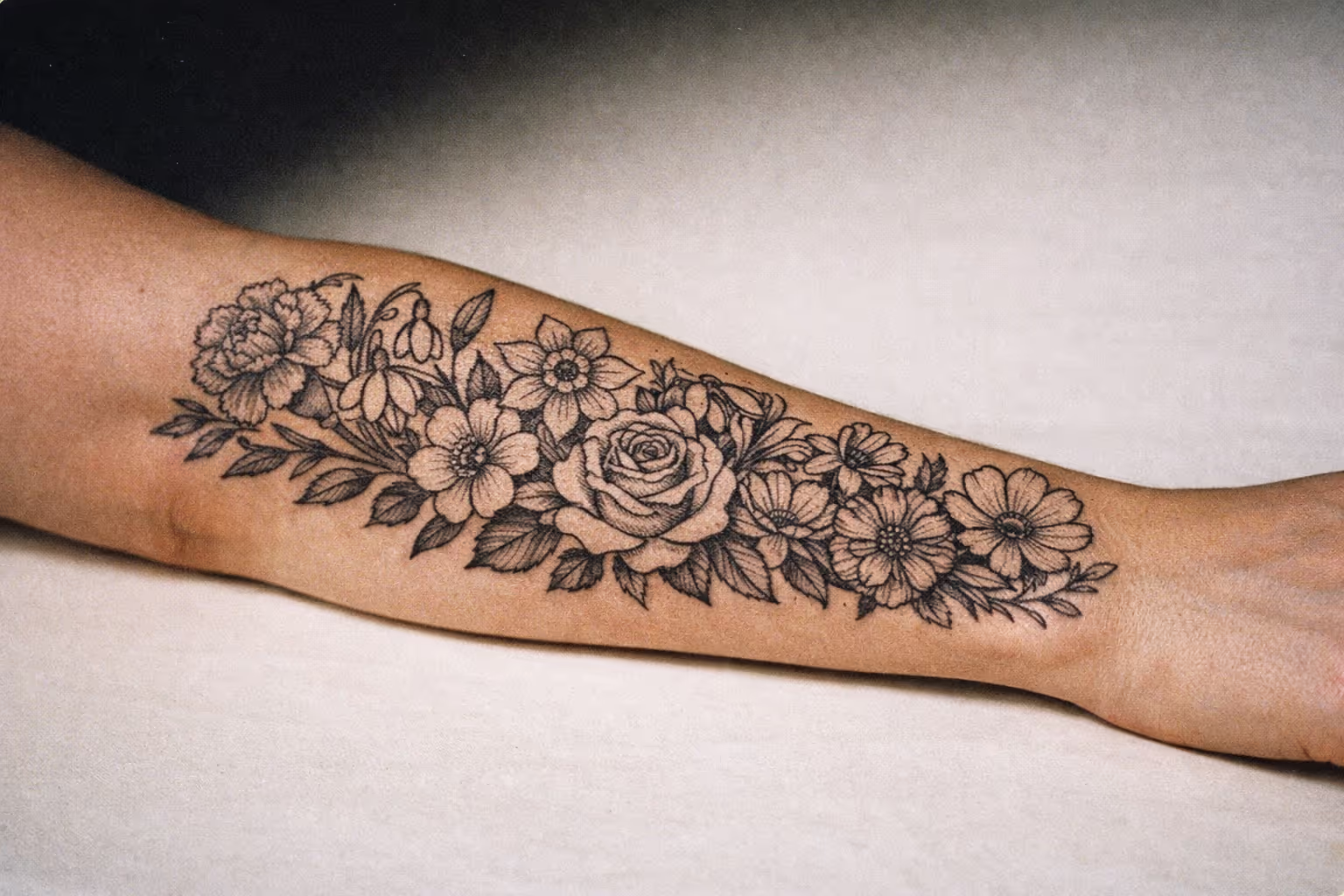
Here’s what trips people up with a birth flowers tattoo: most months don’t have one bloom, they have two. Like birthstones, every calendar month carries a flower (often a pair) with its own symbolic meaning - so the “right” flower for your month isn’t always the obvious one. This guide lists all twelve, both blooms where they exist, plus the sizing and aftercare that keep the piece healing clean.
What Are Birth Flowers?
Birth flowers work like birthstones - each calendar month has a flower (sometimes two) traditionally associated with it. The tradition is botanical and seasonal rather than religious, and most modern lists pair the flower with a symbolic meaning: love, hope, loyalty, remembrance, resilience (4).
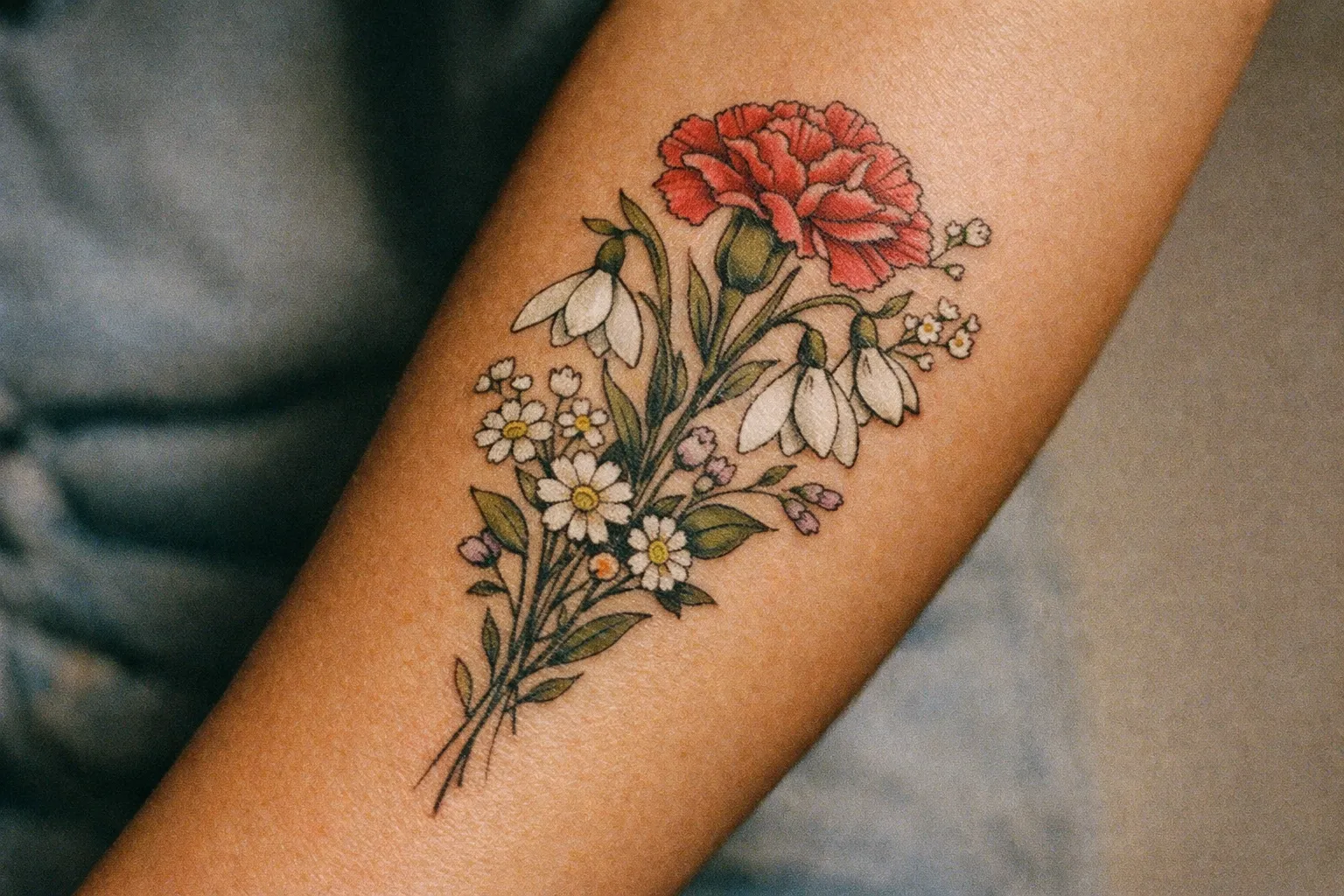
Two things matter before you commit one to skin:
- Most months have two flowers, not one. January is carnation and snowdrop. February is violet and primrose (1)(2)(3)(4). You’re not stuck with whichever one you saw first.
- Meanings aren’t perfectly standardized. “Love,” “purity,” and “hope” recur across several different flowers depending on the source (4). The flower is chosen mainly for the month link - treat the meaning as a bonus, not gospel.
For tattoo purposes, the practical advantage over a birthstone is flexibility. A flower can be drawn as clean linework, shaded black-and-gray, or full color, and it reads as a flower at almost any size. A gemstone tattoo at half an inch just looks like a blob.
The 12 Month Birth Flowers: Full List
Here’s the master list most sources agree on, with both the primary and secondary flower for each month (2)(4):
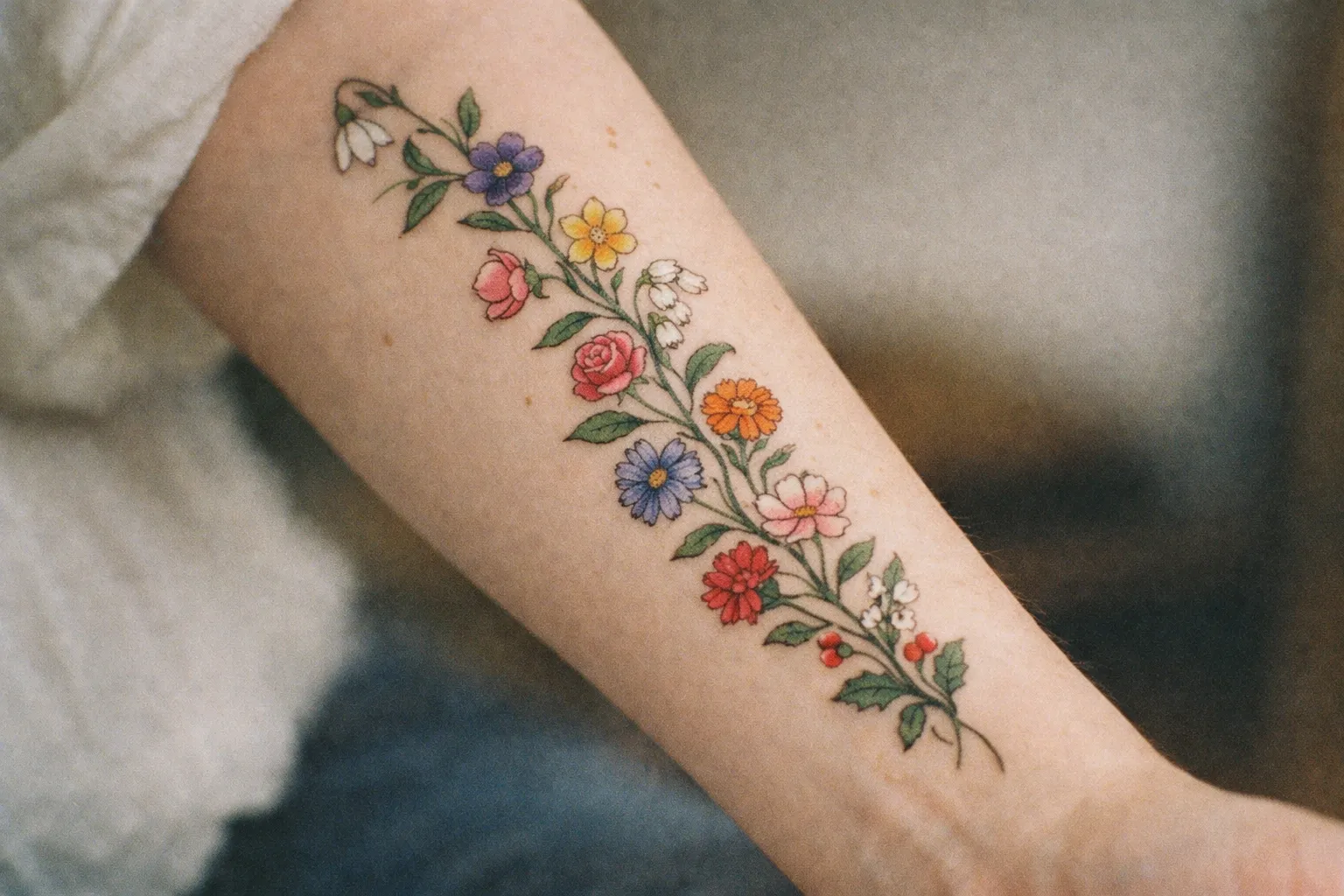
- January - carnation, snowdrop
- February - violet, primrose
- March - daffodil, jonquil
- April - daisy, sweet pea
- May - lily of the valley, hawthorn
- June - rose, honeysuckle
- July - larkspur, water lily
- August - gladiolus, poppy
- September - aster, morning glory
- October - marigold, cosmos
- November - chrysanthemum, peony
- December - holly, narcissus (poinsettia shows up in some lists as a holiday add-on)
If two people share a month but want different flowers, this is where the secondary option earns its keep. Sources vary most for February, April, July, October, and November, so check the alternate before you book if the meaning matters to you (2)(4).
✓ Pros
- Flexible design options from fine-line to full color
- Meaningful symbolism tied to birth month
- Scales well from small wrist tattoos to larger forearm or thigh pieces
✗ Cons
- Meanings vary between sources, so symbolism can be inconsistent
- Some flowers age poorly if tattooed too small
- Certain placements (sternum, ribcage) are more painful
January Birth Flowers: Carnation & Snowdrop
If January is your month, you get two flowers with very different visual weight - one ruffled and full, one delicate and spare.
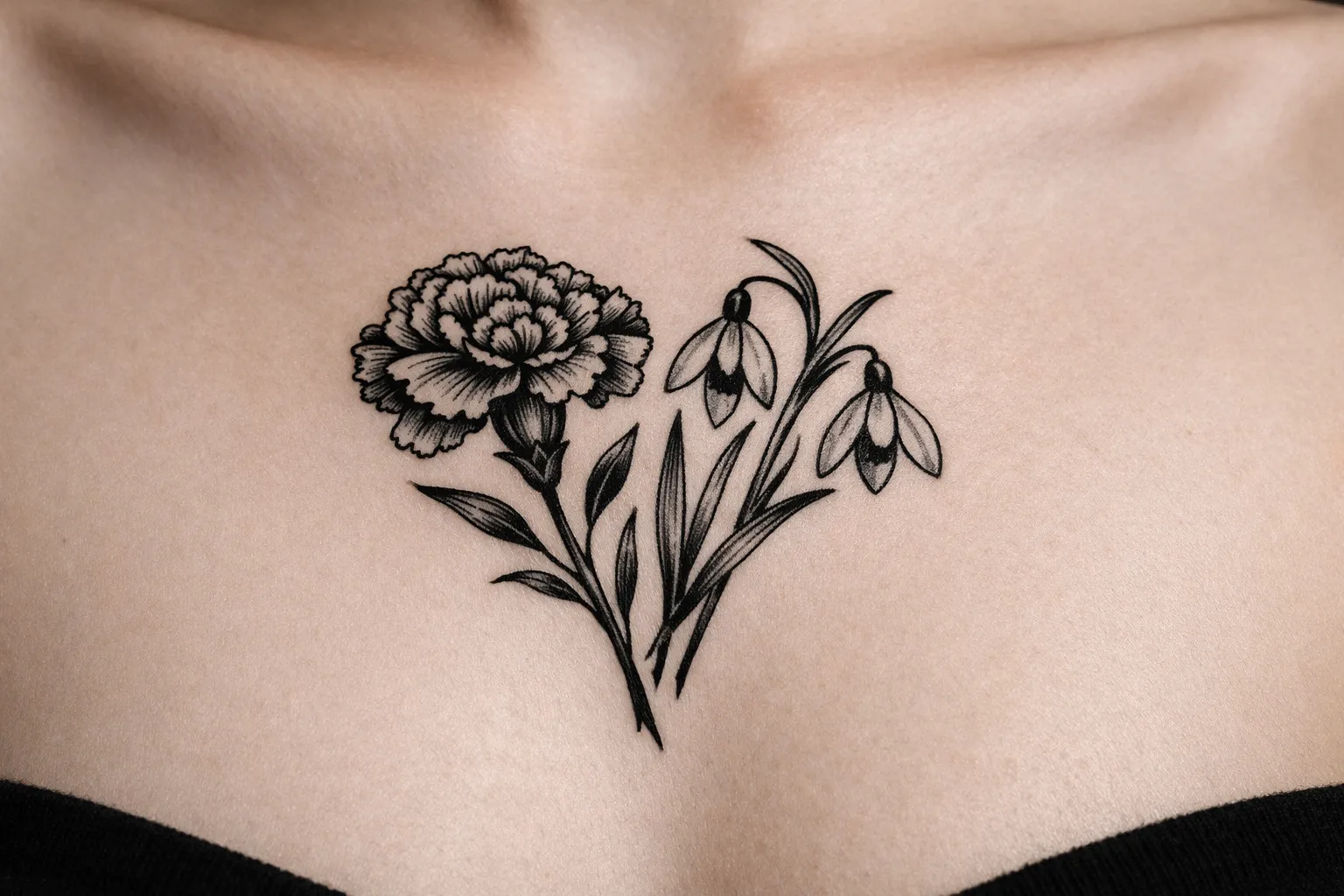
Carnation Tattoos - Deep Love and Saturation That Holds
The carnation’s ruffled, layered petals make it a strong candidate for shaded black-and-gray or color because there’s enough surface area to build saturation. Color carries meaning here: red reads as love and admiration, pink as gratitude, white as pure affection. A single carnation works well at roughly 2-3 inches on the forearm or outer bicep, where there’s room for the petal detail to stay readable as it heals.
The pitfall: cram a carnation under an inch and the petal layers blur into a dark mass within a few years. I’ve seen this happen more times than I can count - clients come back two years later wondering why it looks muddy. If you want it small, ask your artist to simplify the petal count rather than shrink a detailed drawing.
Snowdrop Tattoos - A Clean Fine-Line Option
Snowdrops are the opposite case. Three drooping white petals on a thin green stem - they’re built for fine-line work and small placements like the inner wrist, behind the ear, or the ankle, around 1-1.5 inches. Symbolically they read as hope and consolation, a fresh start pushing through winter.
Because they’re mostly negative space and thin outline, snowdrops age cleanly if the artist keeps the lines from sitting too close together. Lines under a couple millimeters apart can bleed into each other over time - that’s a blowout risk worth raising in your consultation.
February Flowers Tattoo Guide
February’s flowers are violet and primrose - both small, both well-suited to delicate work, both loaded with romance-adjacent meaning.
Violet Tattoos - Faithfulness and Modesty
The violet is repeatedly tied to modesty, loyalty, faithfulness, and in some traditions fertility (4). Visually it’s a small five-petal bloom in deep purple - which means color matters more here than with most birth flowers, because the purple is half the recognition. A violet tattoo holds up well at 1.5-2 inches on the wrist, ankle, or behind the ear, and pairs cleanly with its sister primrose if you want both February flowers in one piece.
Primrose Tattoos - Young Love, Kept Simple
The primrose reads as young love and early affection. Five rounded petals around a small center - simpler than the violet, which makes it forgiving in fine-line and single-needle styles. Good at 1-2 inches in the same small placements.
Pair them and you’ve got a tidy two-flower February composition. Keep the stems short and the layout balanced so it doesn’t read as a cluttered bunch on a small canvas.
March Birth Flower Tattoo Inspiration
March’s flower is the daffodil (with jonquil as its close secondary), and it carries one of the cleanest single meanings on the list: rebirth and new beginnings (3)(4).
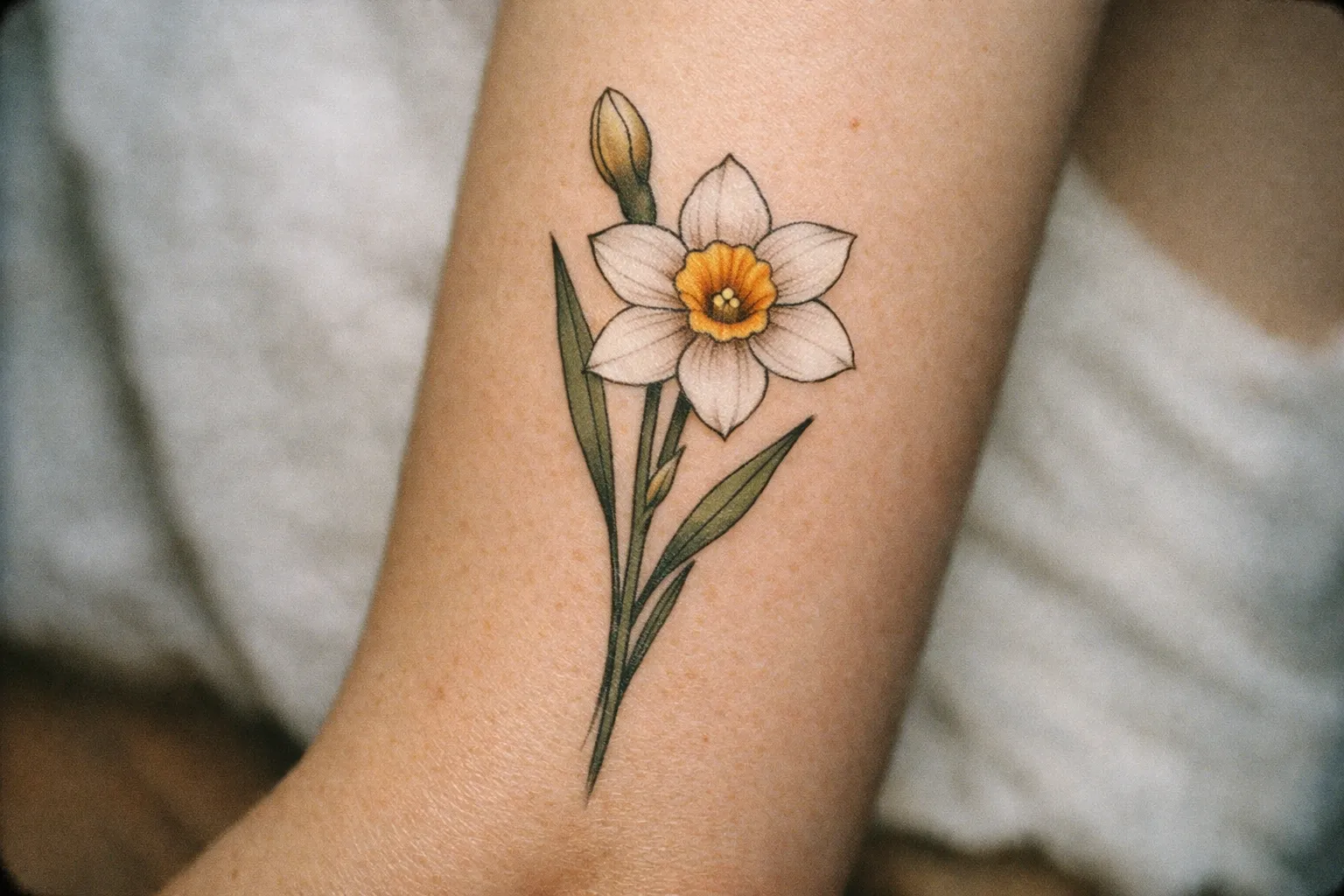
Daffodil Tattoos - Built for Negative Space
The daffodil’s trumpet-and-petal shape is instantly recognizable even in simple linework, which is why it survives small placements better than fussier flowers. A single daffodil works at 1.5-2.5 inches on the forearm, calf, or shoulder.
Color choice changes the read. Bright yellow is the default - happiness, spring. A softer white or a touch of green shifts it toward calm rather than cheer. If you’re marking a specific life change, the daffodil is a strong pick precisely because its meaning is narrow and unambiguous. I’ve drawn it for clients coming out of illness, out of grief, out of a bad few years - the “new beginning” read lands every time without needing explanation.
Personalizing the Daffodil
People often add a date or a name along the stem, or pair the daffodil with a small accent like a butterfly. Keep added text thin and short - script wrapped around a small flower is the first thing to blur as a tattoo ages. If you want script, give the whole piece a bit more size (3 inches plus) so the letters have room to breathe.
April’s Floral Tattoos - Daisy & Sweet Pea
April pairs the daisy with the sweet pea - innocence and fleeting joy, respectively (2)(4).
Daisy Tattoos - The Minimalist’s Flower
The daisy is about as clean as a flower gets: a ring of thin petals around a solid center. That simplicity makes it one of the best birth flowers for minimalist and single-needle work, and it holds at very small sizes - under 1 inch on the wrist, finger, or behind the ear. Symbolically it reads as purity, innocence, and new beginnings.
Because the petals are thin and evenly spaced, a daisy is forgiving as it heals - there’s enough gap between lines to avoid blowout. It’s a genuinely good first tattoo.
Sweet Pea Tattoos - Soft Edges, Soft Meaning
Sweet peas have ruffled, almost translucent petals that suit watercolor or soft-shaded color. They read as cherished goodbyes and brief, sweet moments. Color carries nuance: pink for tender care, purple for gratitude. Best at 2-3 inches on the forearm or shoulder, where the ruffled edges have room to register.
The pitfall is the same as the carnation’s: too much petal detail at too small a size collapses into mush. Sweet peas want a little room.
May Birth Flowers: Lily of the Valley & Hawthorn
May’s primary flower is lily of the valley, with hawthorn as the secondary (1)(4).
Lily of the valley is a row of small bell-shaped blooms on an arching stem - elegant, vertical, and a natural fit for a forearm or spine placement where the line of the stem can follow the body. It reads as happiness and a return to joy, but be aware: some sources also tie it to loss, which makes it a thoughtful choice for memorial pieces - but means you should pick the message deliberately rather than assume it reads as purely cheerful (1)(4). I always flag this to clients before they finalize the design, because the dual meaning surprises people.
Size it around 2-4 inches vertically. The little bells need just enough space to stay distinct; bunch them too tight and they merge. Hawthorn, the secondary, signals hope and is the better pick if you want a fuller, leafier composition.
June Birth Flowers: Rose & Honeysuckle
June gives you the rose and the honeysuckle (1)(3)(4).
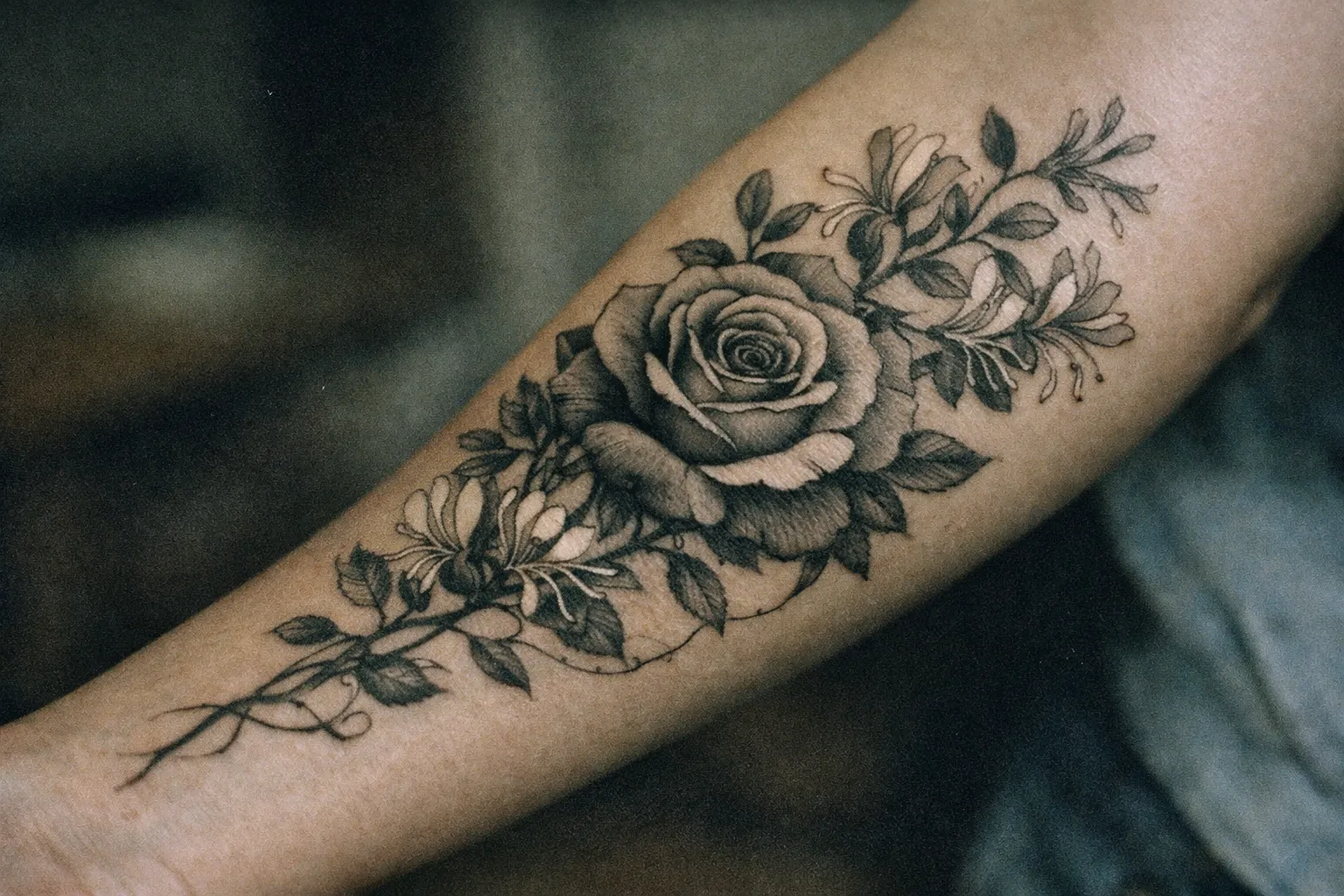
Rose Tattoos - The Reliable Classic
The rose is the most tattooed flower there is, and for good reason: it reads at almost any size, suits every style from American traditional (thick black outline, limited palette) to fine-line, and ages predictably. Color carries the meaning - red for love, white for innocence, yellow for friendship. A rose works at 1.5 inches as a small fine-line piece or scales up past 5-6 inches for a shaded centerpiece on the forearm, thigh, or shoulder.
The American traditional rose is a workhorse. The bold outline and solid fill are specifically built to stay legible for decades - that’s the whole point of the style, and it’s why traditional roses still look sharp on people who got them in the nineties.
Honeysuckle Tattoos - The Less Common June Option
Honeysuckle signals strong bonds and devoted affection. Its trumpet-shaped blooms and trailing vine make it a good choice if you want something flowing along a limb rather than a compact icon. Best at 3 inches and up so the vine has somewhere to go. It pairs well next to initials or a small date for a relationship or family piece.
July’s Larkspur & Water Lily Ink Ideas
A July birth flower tattoo draws on larkspur or water lily - and the two could not be more different in mood.
Larkspur Tattoos - Vertical and Color-Coded
Larkspur is a tall spire of small blooms, tied to open-heartedness, grace, and first love (4). Color does real work here: pink reads as fickleness, purple as first love, white as a happy nature. The vertical shape suits the forearm, spine, or the side of the calf, around 3-5 inches so the spire has length. It’s a strong pick if you want something less common than a rose but still recognizable.
Water Lily Tattoos - Calm and Symmetrical
The water lily reads as serenity and peace. Its symmetrical, layered petals sit best as a flat, open bloom - good on the shoulder blade, sternum, or thigh where there’s a wide flat plane, at 3-4 inches. People often add koi, ripples, or reflections around it; if you do, plan the whole composition up front rather than adding pieces later, or the negative space gets crowded.
Sternum placement hurts more than the forearm - it’s thin skin over bone. Worth knowing before you book a large flat water lily there.
August Florals: Gladiolus & Poppy Tattoo Artistry
August pairs the gladiolus with the poppy (3)(4).
Gladiolus - Tall, Strong, Vertical
The gladiolus is a tall spike of blooms tied to strength of character and integrity. Like larkspur, its shape wants length - forearm, spine, or back of the calf, 4-6 inches. Color ranges from purple (nobility) to white (purity). The spear-like form gives an artist a lot to work with in both linework and shaded styles.
Poppy - Remembrance in Red
Poppies carry two linked meanings: peace and sleep on one hand, remembrance on the other - they’re a long-standing memorial symbol. A single poppy reads beautifully in bold red color at 2-3 inches on the forearm or shoulder. Pair it with a date or short script for a memorial piece. Because the poppy is mostly a broad open bloom, it holds saturation well and ages cleanly compared with fussier flowers.
September Asters & Morning Glory Designs
September gives you the aster and the morning glory (3)(4).
Aster Tattoos - Star-Shaped Wisdom
The aster is a many-petaled, star-like bloom tied to wisdom. The dense, radiating petals suit fine-line work or dot shading, often in purple or blue. Good at 1.5-2.5 inches on the wrist, forearm, or behind the ear. The pitfall: too many thin petals packed too small will fill in over time - ask your artist to thin out the petal count for small placements.
Morning Glory Tattoos - Vines That Travel
Morning glory’s winding vine and daily bloom-and-fade cycle make it read as enduring (or unrequited) bonds. The trailing vine suits pieces that wrap a limb or weave around an existing tattoo, 3 inches and up. Watercolor effects suit the soft trumpet blooms. It’s a good connector flower if you’re building a larger composition over time.
October Flowers: Marigold & Cosmos
An October birth flower tattoo uses marigold or cosmos (1)(4).
The marigold is the stronger pick for most October designs - it’s commonly tied to warmth, creativity, success, and remembrance (4), and its dense ruffled head reads well in bold color or shaded black-and-gray. Its remembrance association also makes it a frequent memorial choice, especially in Día de los Muertos contexts. Size it 2-3 inches on the forearm or shoulder; the layered petals need the room.
The cosmos is the minimalist alternative - a simple eight-petal bloom on a thin stem, well-suited to fine-line work at 1-2 inches on the wrist or ankle. If you want October in a small, clean form, cosmos beats marigold. If you want warmth and saturation, go marigold.
November Flowers: Chrysanthemum & Peony
A November birth flower tattoo draws on the chrysanthemum or the peony (1)(4).
The chrysanthemum carries strong meaning across cultures - loyalty, friendship, longevity, and happiness (4). Worth flagging: in Japanese tradition (irezumi), the chrysanthemum (kiku) is a major motif associated with the imperial family, longevity, and nobility, and it shows up constantly in full-color Japanese sleeves. In modern Western fine-line tattooing it’s read more simply as the November birth flower. Both readings are valid - just know which tradition you’re drawing from before you sit down. The dense, layered bloom suits larger shaded work, 3-5 inches on the forearm, thigh, or back.
The peony is the softer, fuller alternative - big ruffled petals tied to romance and good fortune, and another anchor flower in Japanese tattooing. Color (pink, red, white) shifts the read. Peonies want size: 4 inches and up on the shoulder, thigh, or as part of a larger sleeve. Don’t try to shrink a peony. Its whole appeal is the volume of the bloom, and that’s lost small.
December Birth Flowers: Holly & Narcissus
December’s flowers are holly and narcissus, with poinsettia appearing in some lists as a holiday add-on (4).
Holly - spiked leaves and red berries - reads as foresight and protection, and suits minimalist blackwork with small color accents (the red berries) at 2-3 inches on the forearm or wrist. Narcissus signals respect and good wishes and works in clean linework similar to its cousin the daffodil. Holiday-month flowers like holly and poinsettia are commonly handled as simple blackwork rather than dense realism, which keeps them legible and seasonal without going kitsch. For more on this flower, see the Narcissus Flower Tattoo.
How to Choose Between a Month’s Two Flowers
Most months hand you a choice, so decide on these terms rather than defaulting to whichever you saw first:
- Placement and size. Small placement (wrist, finger, behind the ear)? Pick the simpler flower - snowdrop over carnation, cosmos over marigold, daisy over sweet pea. Bigger canvas (forearm, thigh)? The fuller flower has room to do its job.
- Style. Fine-line and minimalist favor clean shapes (daffodil, daisy, snowdrop). Shaded realism and Japanese-influenced color favor the layered blooms (peony, chrysanthemum, carnation).
- Meaning. If the symbolism is the whole point, pick the flower whose meaning fits - and verify it against more than one source, since meanings drift (4).
- Color dependence. Some flowers barely read without their color - violet (purple), poppy (red), larkspur (color-coded by meaning). If you want black-and-gray, lean toward flowers defined by shape rather than hue.
Family & Multi-Month Bouquet Tattoos
The fastest-growing version of this design isn’t a single flower - it’s a bouquet combining the birth flowers of a whole family (5)(6). Marketplaces now sell pre-drawn custom bouquet briefs you bring to a studio, which cuts down on in-chair design time when you’re representing three or more people (6).
If you’re building one:
- Organize by stem length or hierarchy, not at random - central figures (a parent, a child) get the longer central stems, accent relatives get shorter side blooms (6).
- Simplify before you scale up. A bouquet of 4-6 detailed flowers gets noisy fast. Ask your artist to reduce petal counts so the overall shape stays clean (6).
- Plan placement for the full size. Bouquets need real estate - forearm, upper arm, thigh, or down the spine, usually 5 inches and up. A six-flower bouquet on the wrist will blur within years.
This is the one case where doing design work before the appointment genuinely pays off, because balancing multiple flowers into one composition is harder than drawing any single one (6). I’ve had clients come in with a rough sketch they worked out at home and it saves everyone time - the artist can refine rather than start from scratch.
For inspiration on combining flowers, check out Flower Tattoo Ideas: Meaning, Placement, Style, Cost.
How These Tattoos Age - and Aftercare
Birth flower tattoos age well if the linework respects the placement and size. Dense petals (peony, chrysanthemum, carnation) need room or they fill in; fine-line stems (snowdrop, cosmos, daisy) need a little gap between lines or they blow out. Pick the version of your month’s flower that matches your canvas and you’ve removed most of the regret risk.
Aftercare runs on a predictable timeline regardless of which flower you chose:
- Day 1-3: Keep it covered as your artist directs, then wash gently with unscented soap and apply a thin layer of fragrance-free moisturizer. It’ll feel tender and look slightly raised - normal.
- Week 1: Light flaking and peeling. Don’t pick. Keep moisturizing thin; over-saturating slows healing.
- Week 2-4: The surface settles and the color/lines mute slightly as the skin closes - this is the difference between fresh and healed, and it’s why fine-line work should never look crowded on day one.
- Long term: Sun fades line and color tattoos alike. Once healed, use sun-protective clothing or sunscreen on the piece. This matters most for color flowers - violet purple and poppy red fade faster than black outlines.
For pain context: small flowers on the forearm or outer shoulder are the gentlest placements. Ribcage, sternum, and spine placements - common for vertical flowers like larkspur or lily of the valley - hurt more because the skin is thin over bone. Ribcage > forearm, every time.
Frequently Asked Questions
- What are the 12 month birth flowers?
- Each month has one or two flowers traditionally associated with it, such as January's carnation and snowdrop or November's chrysanthemum and peony. The full list includes all months with their primary and secondary flowers, but some months have more variation in sources.
- What are the birth month flowers best suited for tattoos?
- The same 12-month list applies, but the best tattoo choice depends on size and style. Simpler shapes like daisy or snowdrop work well for small fine-line tattoos, while layered blooms like peony or rose suit larger shaded or color pieces.
- Why do most months have two birth flowers?
- Having two flowers per month offers flexibility for people sharing a birth month to choose different blooms. It also helps tattoo clients pick a flower that fits their placement and style preferences better.
- Is forget-me-not a birth month flower?
- Forget-me-not is not part of the standard birth flower lists commonly used for tattoos. It carries its own symbolism of remembrance and true love but is considered a meaning-driven choice rather than a birth-month assignment.
- How can I avoid my birth flower tattoo aging poorly?
- Choose the flower version that fits your placement and size. Dense, layered flowers need enough space to avoid blurring, while fine-line flowers require gaps between lines. Also, follow proper aftercare and protect the tattoo from sun exposure.
- What placements are best for birth flower tattoos?
- Gentler placements include the forearm and outer shoulder. More painful spots like the ribcage, sternum, and spine are common for vertical flowers but have thinner skin over bone, increasing discomfort.
- Can I combine multiple birth flowers in one tattoo?
- Yes, family or multi-month bouquets are popular. They require planning for size and composition, usually on larger canvases like the forearm, upper arm, thigh, or spine, and benefit from simplified petal counts for clarity.