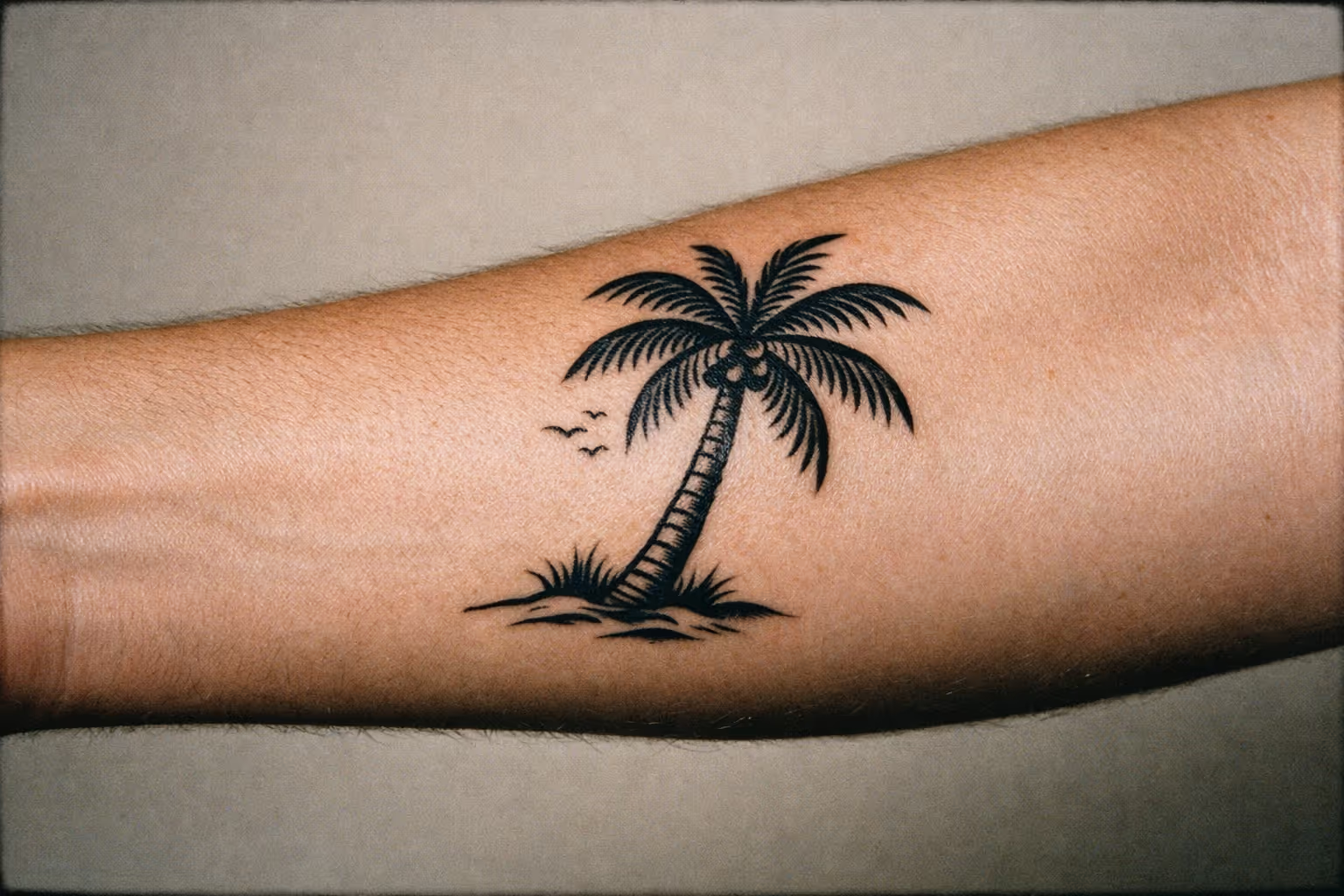
A palm tree tattoo lives or dies by where you put it and how much color you load in. A crisp 2 cm black silhouette on the forearm can still read in fifteen years; a 15 cm sunset gradient in a sun-blasted spot fades to a soft wash far sooner. Same motif, opposite lifespans. Here’s what a palm tree costs across that range, the placements that hold, and the ones that fade fast.
What a Palm Tree Tattoo Actually Means, Designs, and Placement Tips
A palm tree tattoo is one of those motifs that looks deceptively simple - a trunk, a few fronds, maybe a horizon line - but the design decisions behind it determine whether it ages into a clean silhouette or a smudged blob on your ankle in five years. It’s travel-coded, beach-coded, freedom-coded, and that’s exactly why it floods every small tattoo flash sheet in every street shop from Portland to Miami. Done right, it reads instantly from across a room. Done lazy, it looks like every airport gift-shop sticker.
This guide covers what palm Tree tattoo meaning actually carries, the design variants worth considering (including the palm Tree sunset tattoo, the minimalist palm Tree tattoo, and small palm Tree tattoo placements that hold up long-term), realistic pricing, placement trade-offs, and the questions people ask before they sit down in the chair.
✓ Pros
- Strong cultural and modern symbolism including resilience, travel, and peace
- Variety of design styles from minimalist to colorful sunset scenes
- Multiple placement options with guidance on longevity
- Clear aftercare timeline and realistic pricing info
✗ Cons
- Small or detailed designs risk blurring or fading quickly
- Color sunsets require careful sun protection and touch-ups
- Certain placements like fingers and inner palms fade fast
- Some popular variants can look generic if poorly executed
What a Palm Tree Tattoo Actually Conveys
The short answer: it usually signals a love of the beach and travel, a laid-back lifestyle, and personal resilience (1)(2). That’s the modern Western reading, and it’s what most clients walk in with.
The longer answer pulls from older symbolism that’s still woven into the motif:
- Resilience and endurance. Palms bend in storms instead of snapping. It’s the meaning a lot of clients reach for after a hard chapter (1).
- Victory and success. Palm branches were handed out as victory tokens in the Greco-Roman world - that’s where “palm of victory” comes from (1).
- Eternal life and immortality. Evergreen, long-lived, fruit-bearing. Palms show up in Egyptian, Greek, Christian, and Islamic religious art for exactly this reason.
- Peace and tranquility. A single palm on a quiet horizon is shorthand for “I need my nervous system to calm down” (2).
- Freedom and escape. The dominant 2020s reading - palms as wanderlust, as a souvenir of a specific trip, as a reminder that the cubicle is not the whole world.
Worth flagging: the meaning isn’t fixed across cultures. In Egyptian iconography, palms tied to the sun god Ra. In Greek myth, they marked Apollo’s birthplace on Delos. In modern American tattoo flash, they mostly mean California, Florida, or honeymoon. If you want a specific reading to come through, the surrounding elements - sunset, waves, coordinates, numbers - do that work. The palm alone doesn’t.
Designs Worth Considering for Your Palm Tree
Here are the variants that actually hold up over a decade, with the trade-offs spelled out.
Minimalist Palm Tree Tattoo
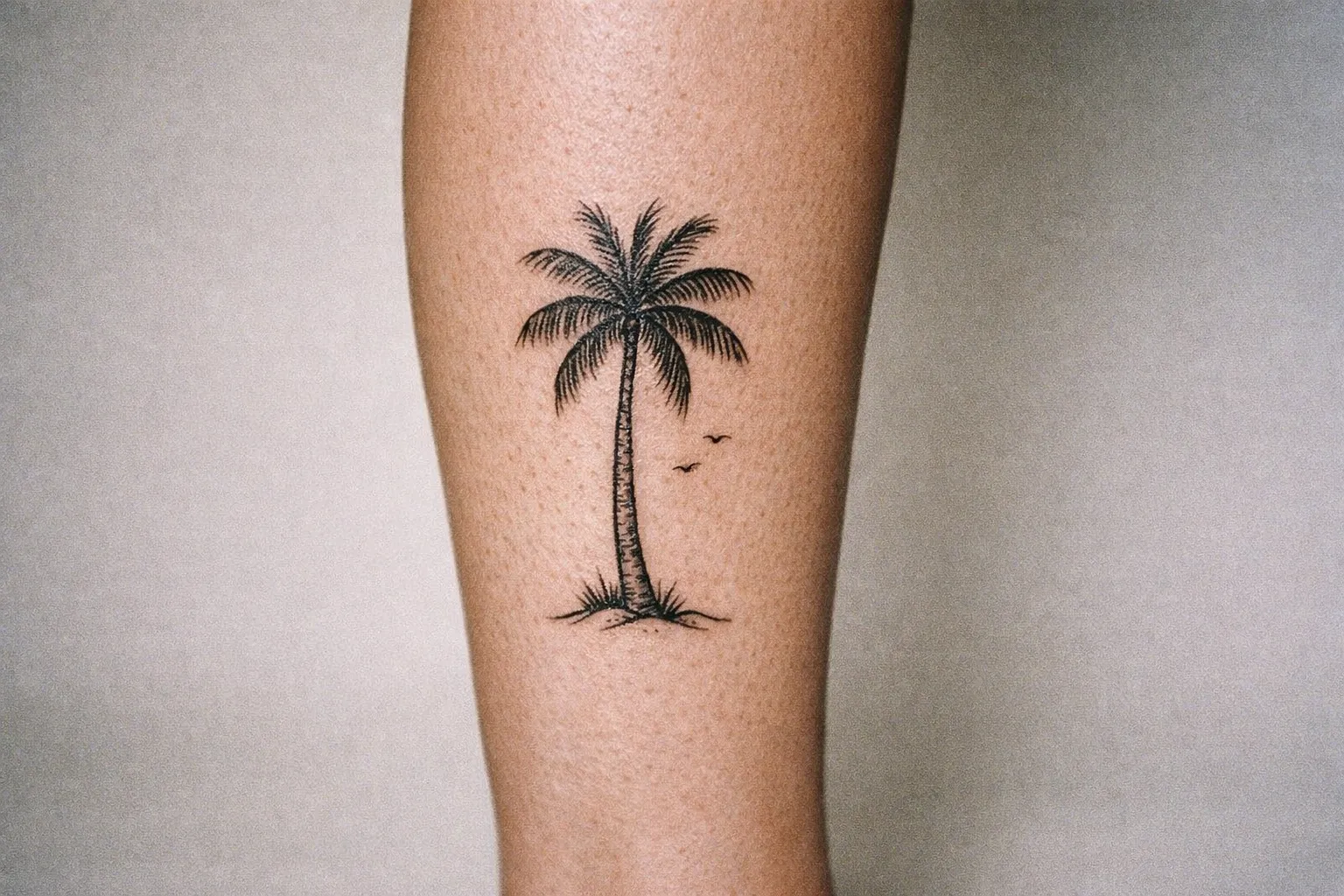
A minimalist palm Tree tattoo is a single fine-line silhouette - trunk, 5 to 7 fronds, no shading, no ground line. Line weight is typically 0.25 to 0.30 mm using a single-needle (1RL) or 3RL cartridge.
- Placement: wrist, ankle, behind the ear, inside of the bicep.
- Size range: 2 to 5 cm tall.
- Why it works: enough negative space to age without merging. A 3 cm palm with 1 mm gaps between the fronds will still read as a palm in ten years.
- Common pitfall: artists who cram too much detail into a tiny piece. Fronds packed tight will blur into a black smudge. Ask for fewer, cleaner fronds instead.
I’ve seen this design go both ways. When the frond spacing is right, a 3 cm fine-line palm is one of the cleanest small pieces you can get. When an artist tries to add botanical detail at that scale, it heals into a dark smear and nobody’s happy about it.
Small Palm Tree Tattoo with a Sun or Wave
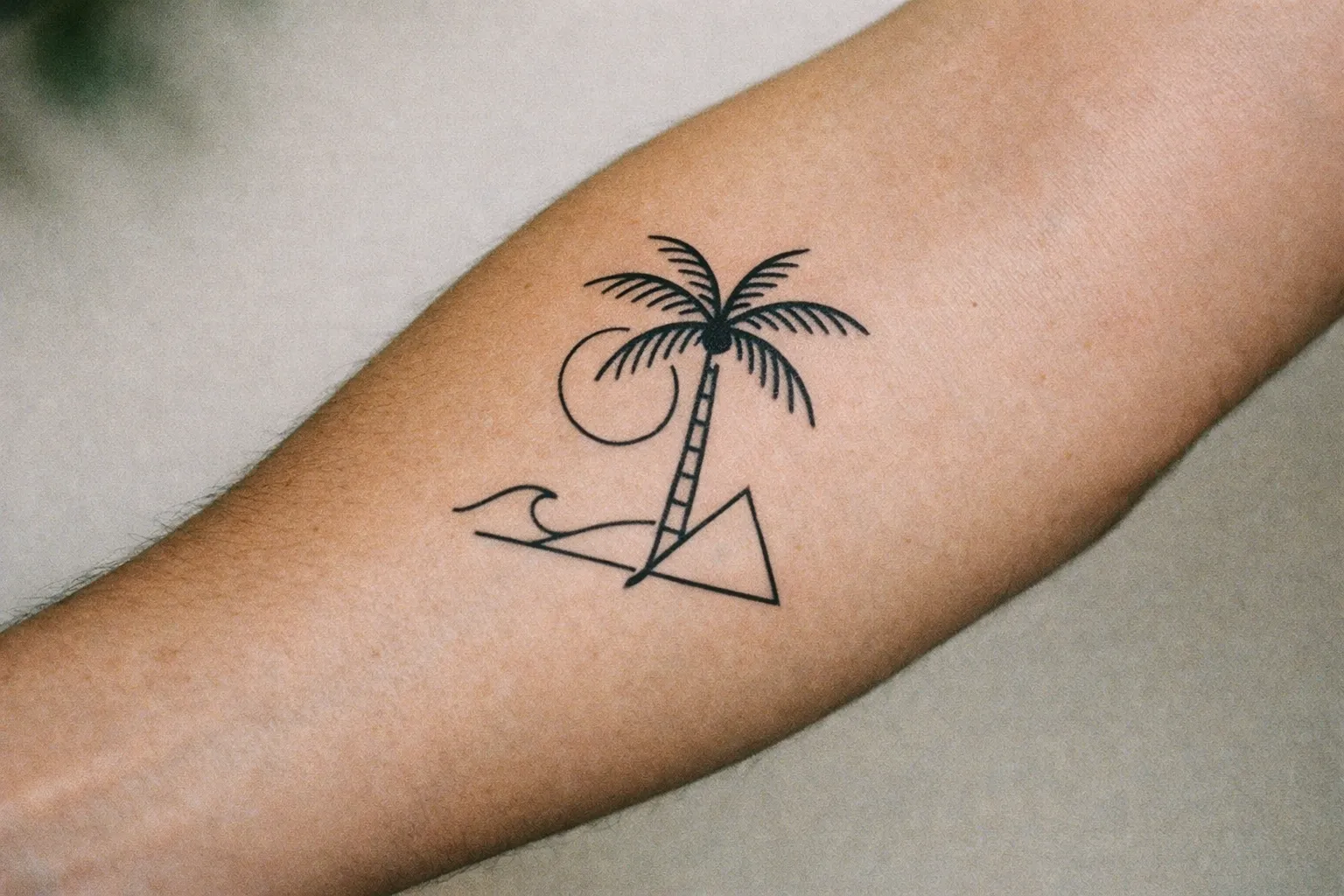
A step up from the bare silhouette. Add a small sun circle, a single wave line, or a thin horizon and the design suddenly tells a scene without needing more real estate.
- Placement: forearm, calf, rib edge. Behind the ear is a stretch at this size.
- Size range: 4 to 8 cm.
- Cost: $120 to $250 at standard U.S. shops.
- Tip: keep the sun as a clean outlined circle rather than a solid fill. Solid black circles at small sizes go muddy faster than linework does.
Palm Tree Sunset Color Design
The palm Tree sunset tattoo is the most-requested color version - a black palm silhouette against an orange, magenta, and violet gradient, often with a horizon line and water reflection. This is where the design earns its place on bigger real estate.
- Placement: upper arm, shoulder, thigh, back of calf. Do not attempt this under 8 cm - the gradient needs room.
- Size range: 8 to 15 cm.
- Cost: $250 to $600 depending on size and color complexity, at typical U.S. rates of $120 to $200 per hour.
- Session time: 2 to 4 hours, often split into linework and color packing across two sittings.
- Aging note: prioritize magenta, orange, and deep blue-violet in the gradient. Pale yellows and peaches fade fastest, especially on sun-exposed placements. A dark outline around the sun helps it hold shape past the five-year mark.
Color sunsets are genuinely satisfying pieces when they’re done well. The split-session approach - linework first, color a few weeks later - gives the skin time to recover and usually produces cleaner color saturation in the end.
Traditional / Neo-Traditional Palm Tree
Bold black outlines, saturated solid colors, often combined with banners, ships, anchors, or pin-up elements. The two technical hallmarks of American traditional: thick black outline + limited palette, with heavy black shading for depth. The common pitfall is artists doing “neo-trad” without committing to the bold outline - it photographs nicely fresh, then fades into mush within a few years.
- Placement: upper arm, calf, chest panel.
- Size range: 10 to 20 cm.
- Why it holds long-term: bold outlines and saturated color is the most battle-tested formula for tattoos that still read clearly at 30-plus years.
Geometric or Linework Palm
Palm fronds inside a circle, dotwork shading, a palm with a hexagonal sun, or a palm fitted into a triangle. Reads modern, leans more “artist signature” than “beach trip souvenir.”
- Placement: forearm, inner bicep, chest.
- Size range: 6 to 12 cm.
- Tip: ask for dotwork shading instead of solid black in tight spaces - it ages with considerably more grace.
Heart-Shaped Palm Pair, Coconuts, and Birds
Two palm trunks curving into a heart, palms with coconuts (fertility and cycle reading), or a palm with two birds on the horizon (freedom and independence reading). These work, but they push the design from “clean symbol” to “illustration.” Keep them at 6 cm and above, and accept that the meaning becomes more specific - which is fine if that’s the point.
Best Placements (and Where Not to Put a Palm Tree)
Placement decides longevity more than ink quality does. Friction, sun exposure, and skin turnover are the three killers.
Good placements for palm tree tattoos:
- Outer forearm - flat, low friction, easy aftercare, moderate pain.
- Outer calf / ankle - classic for small palms, but high sun exposure means SPF discipline.
- Upper arm / shoulder - best for sunset scenes; large flat surface, low friction.
- Behind the ear - fine for a 2 to 3 cm silhouette only.
- Ribcage - works for a vertical palm, but be ready for it.
Avoid for palm trees:
- Sides of fingers, inner palms, foot bottoms - fade noticeably within 1 to 3 years from constant friction. A finger palm tree is the kind of placement that looks rough fast - not because the design is bad, but because the location guarantees ink loss.
- Inner lip - fades in months.
Pain-wise, relative scale: ribcage > sternum > inner bicep > ankle > outer forearm > outer calf > shoulder. A small palm on the outer calf is a low-stress first tattoo. A sunset scene on the ribs is a different conversation entirely.
Pricing, Time, and Budgeting for a Palm Tree Piece
U.S. ballparks for 2025:
- Minimalist palm, 2 to 5 cm, black line: $80 to $200 at standard shops, $150 to $400 at fine-line specialists or high-demand studios.
- Small palm with sun or wave, 4 to 8 cm: $120 to $250.
- Palm tree sunset, 8 to 15 cm with color: $250 to $600.
- Half-sleeve beach scene: $600 to $1,800 and up.
Shop minimums in most U.S. cities sit at $80 to $150 - meaning even a 1 cm palm costs the minimum. Don’t try to negotiate it down. The minimum covers setup, needles, ink, and the artist’s time. If you want to spend less, scale up the design instead.
Time-wise: 15 to 45 minutes for a true minimalist piece, 1 to 2 hours for a small detailed palm, 2 to 4 hours for a full color sunset. Color sunsets are often split into a linework session and a separate color-packing session so the skin can recover between passes.
Two reliable ways to cut cost without cutting quality if budget is tight: choose black and grey over full color (saves 20 to 40 percent on time and ink), and pick a single palm instead of a full beach scene.
Aftercare and Healing Timeline
Timeline for any of these designs:
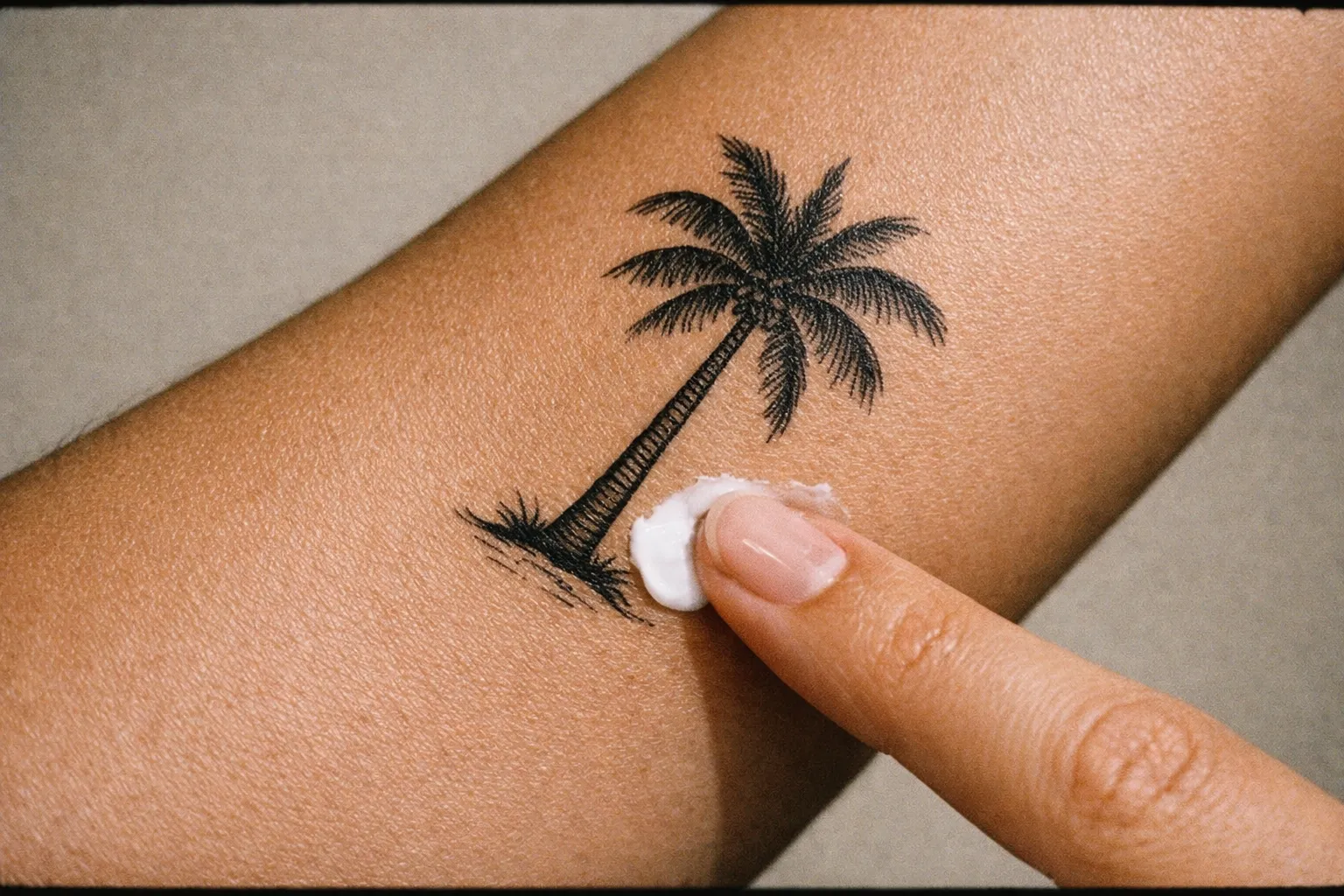
- Day 1 to 3: Plasma weeping, swelling, redness. Wash 2 to 3 times daily with fragrance-free soap, pat dry, apply a thin layer of healing ointment. No soaking, no swimming, no gym.
- Day 4 to 14: Peeling and itching phase. Switch from ointment to a fragrance-free moisturizer. Do not pick. Color sunsets will look temporarily dull and patchy during peel - this is normal and not a sign anything went wrong.
- Week 2 to 4: Surface is healed but the deeper dermis is still settling. Avoid prolonged sun, chlorine, and saltwater.
- Week 4 to 6: Fully healed. Now apply SPF 30 to 50 every time the tattoo sees daylight - this is the single biggest factor in whether color palms still look sharp at year five.
A specific note for ankle and foot placements: avoid tight shoes for the first 3 to 5 days. Friction during the peel phase causes real, measurable ink loss.
Expect to need a touch-up at year 3 to 5 on color sunset pieces, especially the yellows and oranges. Most artists do touch-ups on their own work free or at a small fee within the first year.
Related Tattoo Themes If You Like Palm Trees
If the palm tree appeals to you for the beach, travel, or freedom reading, these motifs sit in the same family and often pair well:
- Wave line tattoos - single-line ocean waves, often as a band around the wrist or ankle.
- Sun and moon silhouettes - work as a companion piece on the opposite side of the body.
- Coordinates - latitude and longitude of a specific beach, tucked under the palm.
- Compass rose - pairs with palms for an explicit wanderlust reading.
- Lighthouse, anchor, or ship - for a fuller traditional travel and seafaring set.
- Island silhouettes - multiple small palms on a sand line, reads as a specific place.
- 777 numerals - luck and spirituality angle, often hidden in the sand or on a surfboard.
- Lotus or four-leaf clover - if you want to layer in a lucky reading.
- Sunset gradient bands - a horizon-line band without a palm at all.
A palm tree alone is a generic symbol. The element you pair it with is what makes the tattoo specific to you. If you’re drawn to the freedom and escape angle, the infinity symbol works along similar lines - both motifs function as personal containers that take on meaning from what surrounds them.
Frequently Asked Questions
Frequently Asked Questions
- Can a palm tree tattoo be combined with other symbols to create a unique meaning?
- Yes, pairing palms with elements like coordinates, waves, or lucky symbols such as four-leaf clovers or 777 numerals can create a personalized and layered meaning beyond the generic palm symbol.
- What are the risks of getting a palm tree tattoo on high-friction areas?
- High-friction placements like fingers, inner palms, and foot bottoms cause rapid fading and blurring within 1 to 3 years, regardless of tattoo quality, making these spots poor choices for palm tree tattoos.
- How should I prepare for a color sunset palm tattoo session?
- Expect two sessions: one for linework and another for color packing spaced weeks apart to allow skin healing. Budget time accordingly and plan for diligent aftercare, especially sun protection, to maintain color vibrancy.
- Is it possible to get a palm tree tattoo smaller than 2 cm?
- Technically yes, but below 2 cm the fronds merge and the design loses clarity. Simplifying the design to a stylized triangle of fronds rather than detailed leaves is recommended for micro sizes.
- What aftercare product categories are essential for palm tree tattoos?
- Use fragrance-free soap for cleaning in the first days, switch to fragrance-free moisturizer during peeling, and apply SPF 30 to 50 sunscreen or wear sun-protective clothing after healing to preserve ink quality.
- How often do color sunset palm tattoos need touch-ups?
- Typically, a touch-up is needed around 3 to 5 years after the initial tattoo, especially for colors like yellows and oranges that fade faster without sun protection.
- Why do some neo-traditional palm tattoos fade into mush?
- Neo-traditional styles without bold black outlines lack the structural definition needed for longevity, causing the tattoo to blur and lose detail over a few years.
Picking Your Palm Tree Tattoo
Two decisions drive whether a palm tree tattoo holds up: the size-to-detail ratio (more detail means a bigger piece, no exceptions), and the placement (flat, low-friction, sun-protected real estate wins long-term). The symbolism layer is yours to assign - resilience, travel, peace, victory, a specific beach - and the smartest move is to pick the meaning first, then let the surrounding elements carry that reading. The palm alone can’t do all the work.
Bring 3 to 5 reference images to your consultation. Ask the artist to sketch a composite rather than copying any single image. Budget for the touch-up at year three if you go with color. That’s the practical difference between a palm tree tattoo that ages into a clean piece and one that ends up on a laser removal table at $200 to $500 a session.