A one-inch fine-line rose looks perfect on the day and fuzzes into an anonymous smudge by year eight - the single most common regret with rose tattoo designs. The flower is forgiving of style but unforgiving of scale and line weight: too small or too thin, and the layered petals merge into a blob. Here’s how color, size, and linework decide which rose designs actually survive a decade, and what each one means.
What Rose Tattoo Designs Actually Symbolize
The short answer: it depends on the color, the style, and what you bring to it. Rose tattoo designs vary widely, each carrying unique meanings and aesthetics depending on these factors.
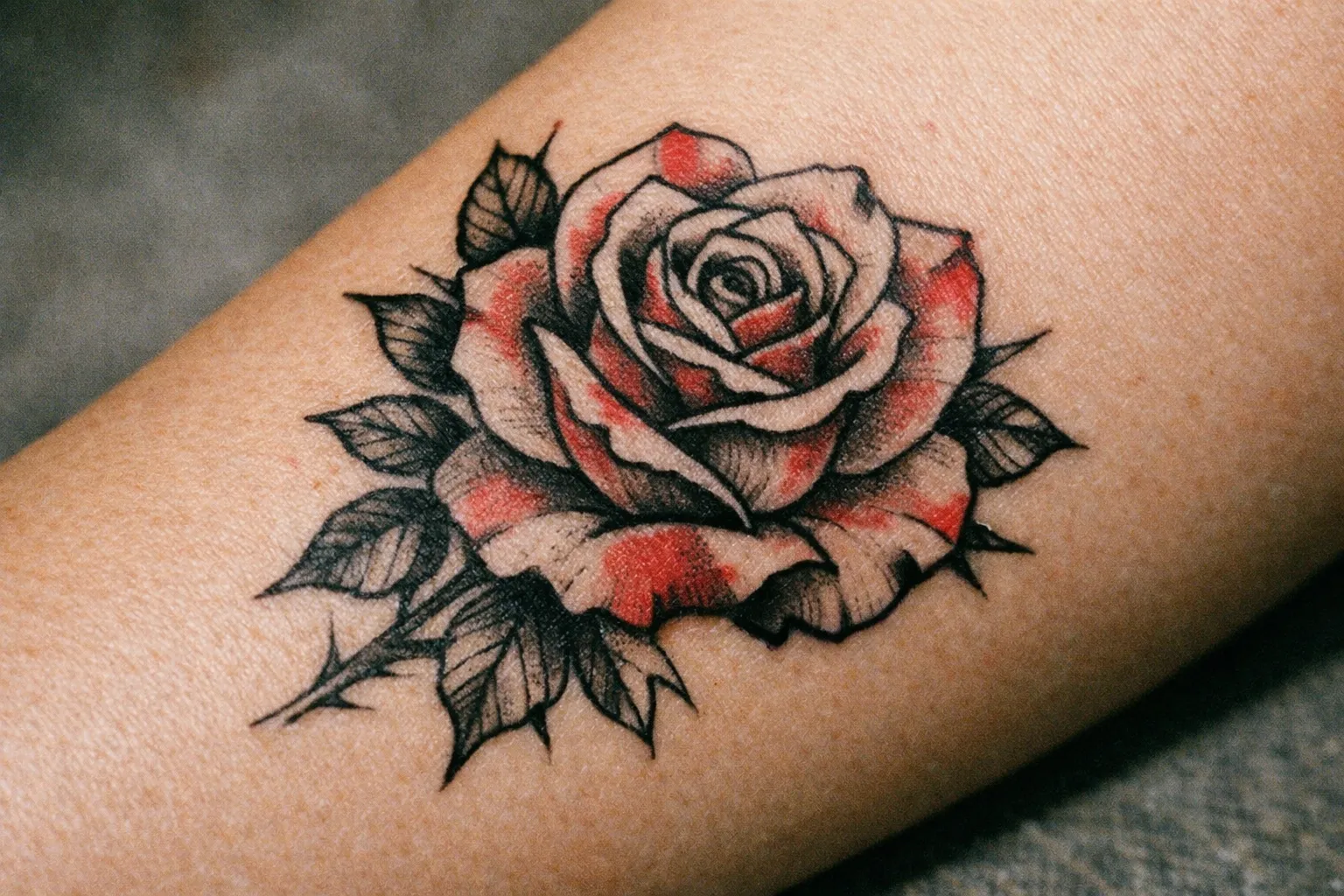
In classical Western symbolism, the rose is tied to love, beauty, and passion, largely through Greek mythology - Aphrodite, goddess of love, is closely associated with the flower, which is why “rose + classical statue” pieces remain popular in black and grey realism (1). In Christian iconography, the rose connects to the Virgin Mary and to martyrdom - that’s where the rose-and-sword imagery in religious tattoos (including Archangel Michael pieces) draws from.
In American traditional flash, the rose became a sailor’s motif: a promise of someone waiting at home. That’s the meaning most contemporary traditional artists still nod to. In modern tattoo culture, the meaning has broadened considerably. People get rose tattoos for memorial reasons, for self-love, to mark a birth month (rose is the June birth flower), or simply because they like how it looks. All of those are valid. Don’t let anyone tell you a rose has one fixed meaning.
A practical note: if symbolism matters to you, the color and the condition of the rose - bud, full bloom, wilting - communicate more than the rose shape itself.
Color Meanings - and How They Read on Skin
Color choice changes the entire message, and it also changes how the tattoo ages. Here’s what each color tends to signify and how it behaves technically:
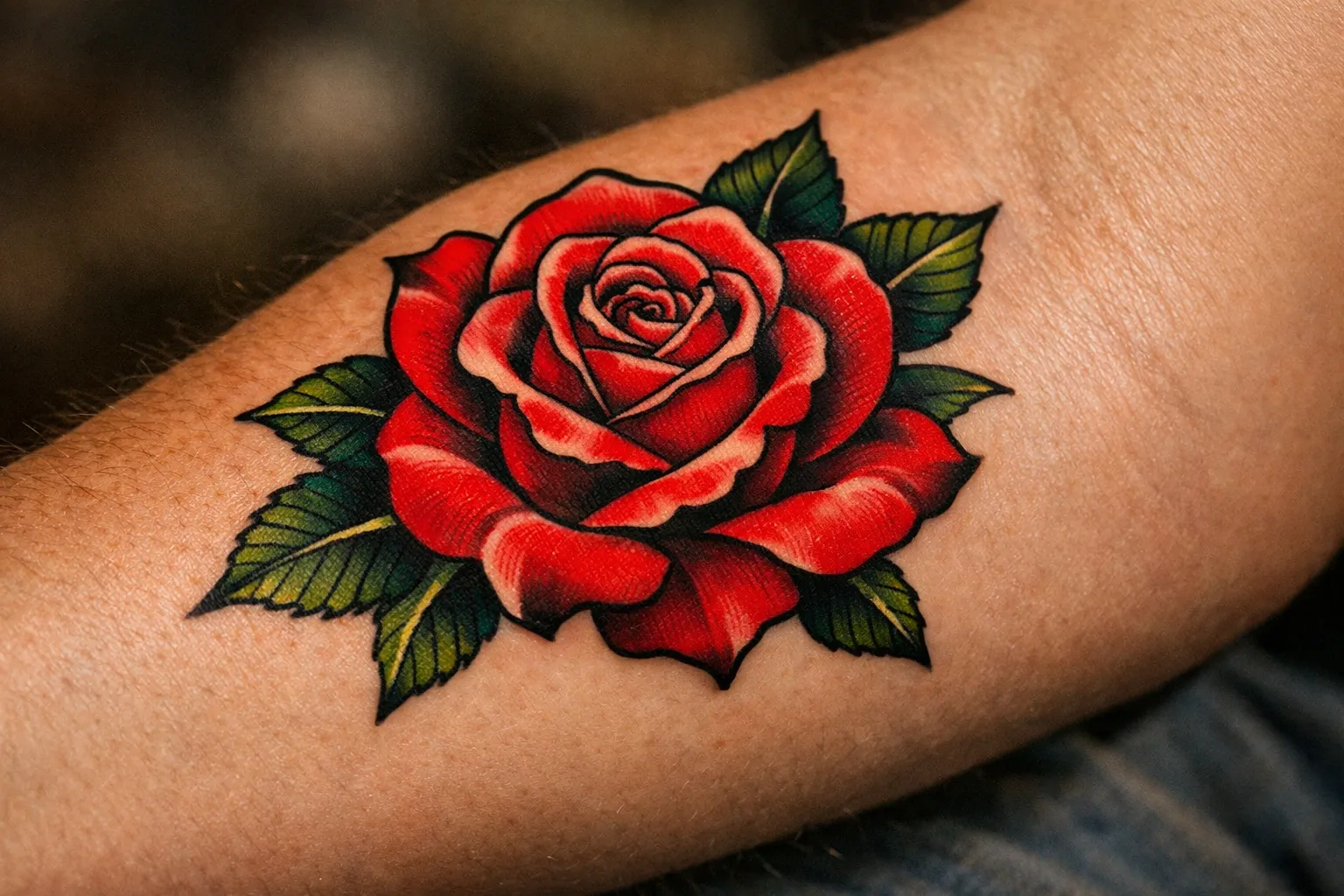
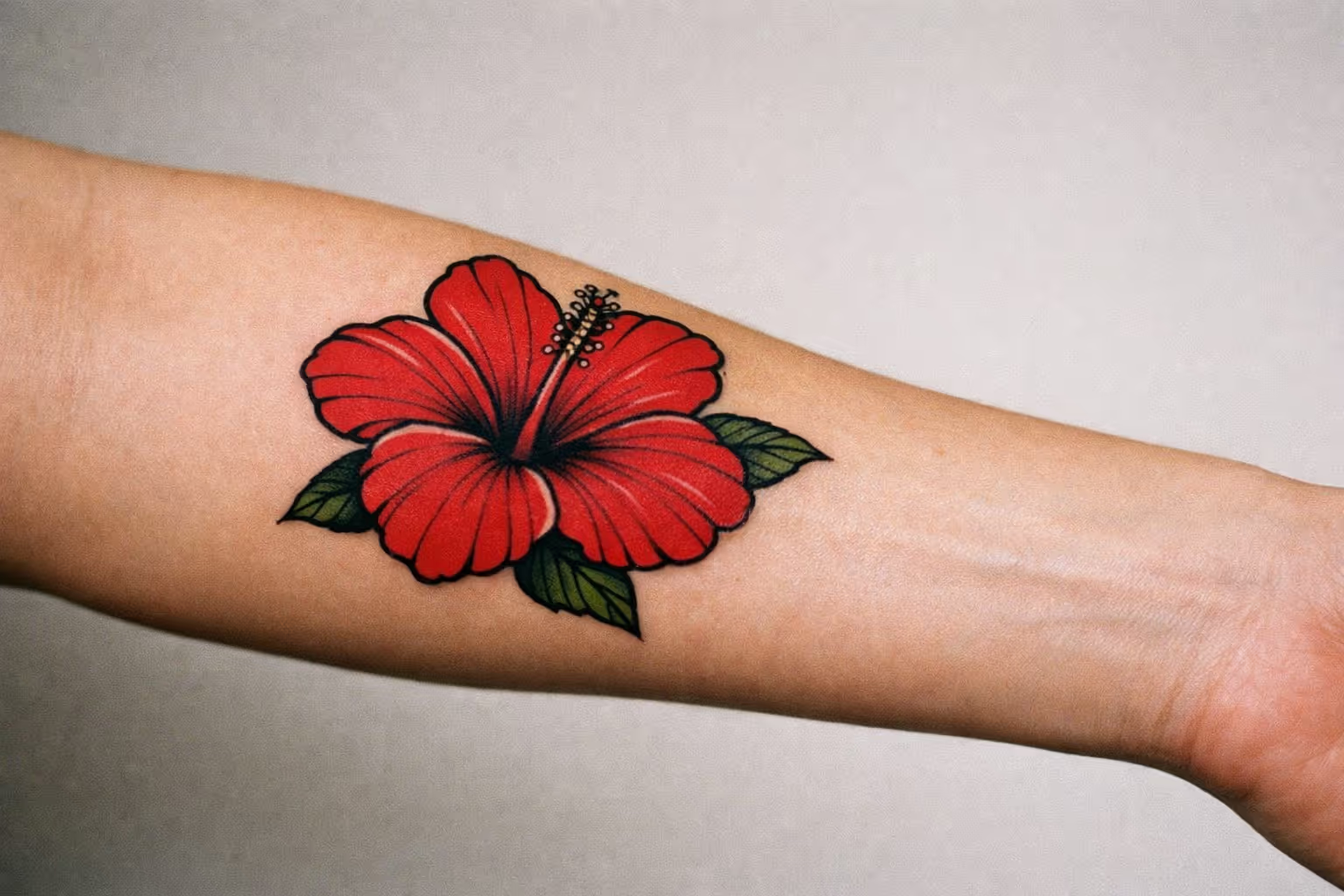
- Red rose: love, passion, romantic devotion. Reds heal vibrant but require quality ink and a skilled hand on saturation. Red ink can also be the most reactive - flag any past ink allergies during your consult.
- Black rose: mourning, remembrance, endings, sometimes rebellion (1)(4). Technically the trickiest - solid black across an entire flower heals flat. Good black rose tattoo work uses diluted grey washes and strategic negative space so individual petals stay legible.
- White rose: purity, new beginnings, sometimes memorial pieces. Pure white ink fades fastest and often heals as scar tissue rather than visible pigment on most skin tones. Better executed as black-outlined roses with minimal fill.
- Yellow rose: friendship, joy. Yellow is a weak pigment - needs heavy saturation and may dull over time on deeper skin tones.
- Blue rose: mystery, the unattainable. Modern symbolism, no traditional history. Blues age well.
- Pink rose: gratitude, gentleness, femininity.
- Purple rose: spirituality, enchantment.
Color meanings come from florography (Victorian flower language) and have carried into tattoo culture relatively intact (1)(4). Pick the color you want to wear for the next thirty years, not the one that matches your current mood.
Traditional Rose Tattoos
The traditional rose tattoo - American traditional, sometimes called old-school - is the most durable rose you can get. Two technical hallmarks define the style:
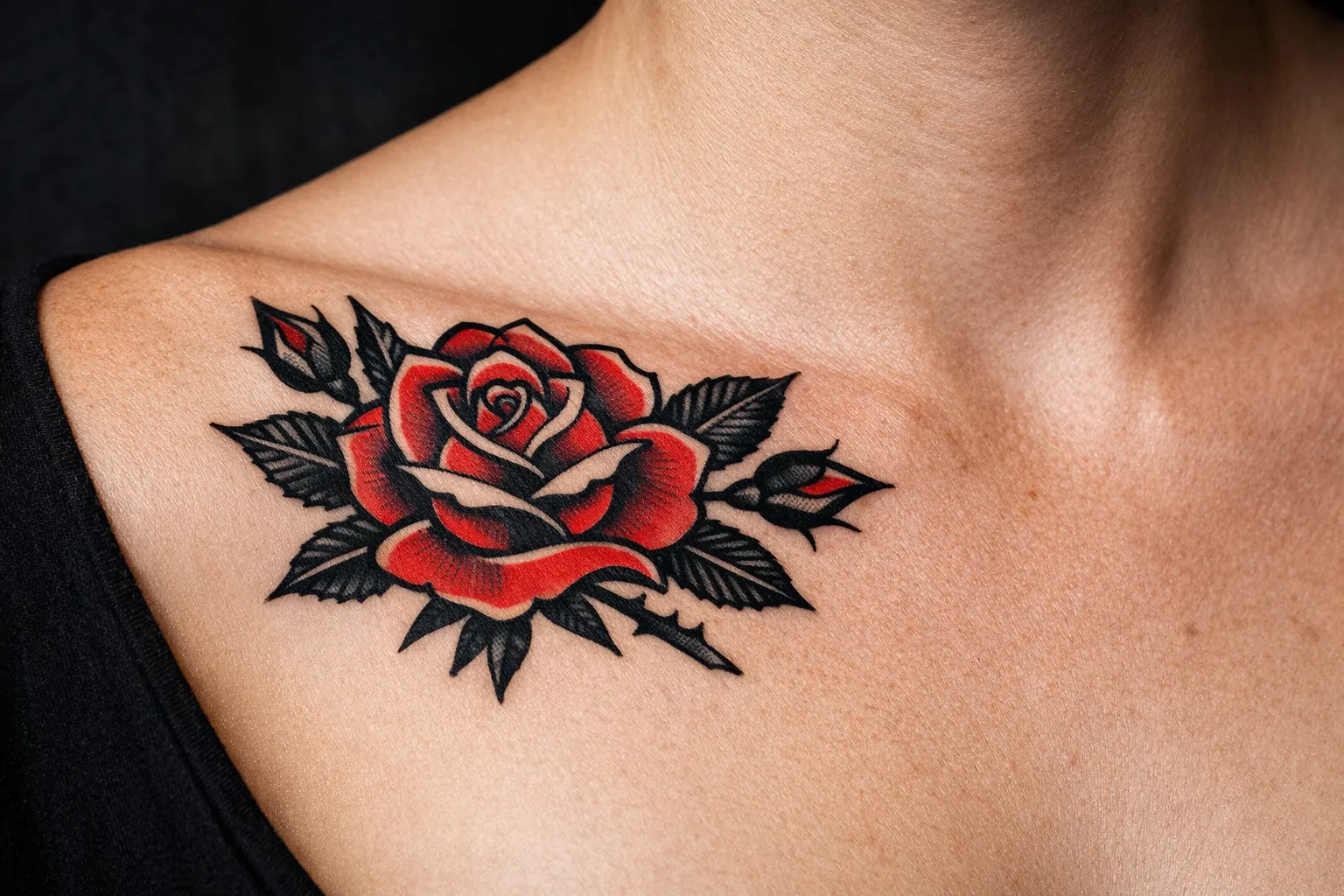
- Thick black outlines (usually a 7-9 round liner) that hold the shape even as the tattoo softens with age.
- Limited, saturated palette - typically red petals, green leaves, sometimes yellow highlights, with solid black shading rather than gradients.
A traditional rose at 3-4 inches on the forearm runs roughly $200-$400 in a mid-tier US shop and takes 1.5 to 3 hours. Add a banner with a name or date and you’re closer to $300-$500.
The common pitfall when artists do traditional rose tattoos badly: thin, modern-looking outlines that don’t match the heavy fill, or muddy shading that loses the petal separation. A real traditional rose should be readable from across the street in twenty years. If the line weight looks dainty in the stencil, it’ll look soft in five.
Neo-traditional rose tattoos take the same bones - bold outlines, defined shapes - and add a wider color palette, more rendering, and ornamental flourishes. They’re a good middle ground if you want something punchier than fine line but more contemporary than pure old-school.
Small Rose Tattoos
A small rose tattoo, in the 1-2 inch range, is one of the most-requested first tattoos. Common placements: inner wrist, behind the ear, side of finger, ankle, sternum, behind the bicep.
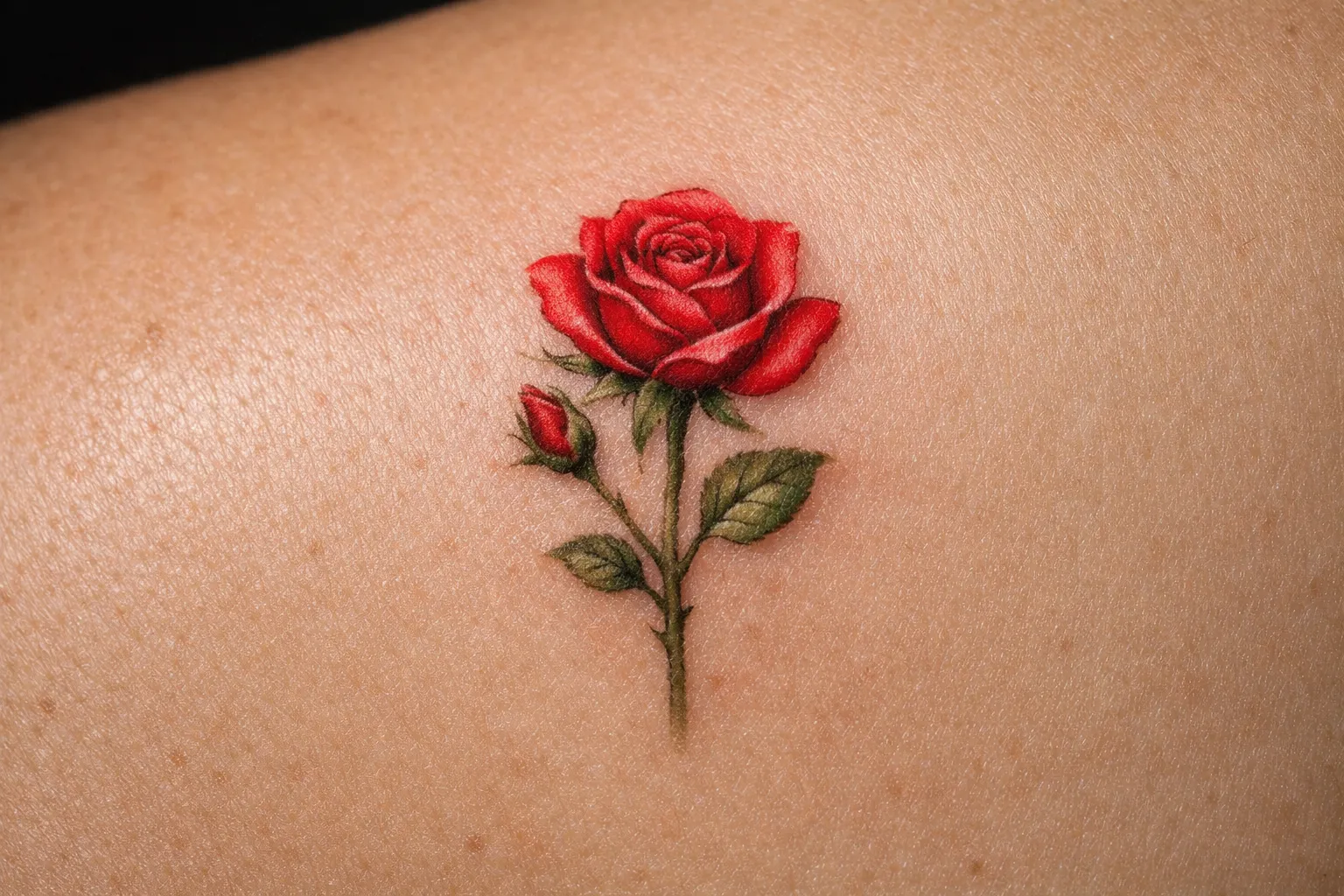
Pricing usually runs $80-$200 depending on shop minimums and detail level. Session time is 30 minutes to an hour.
The honest caveat: roses under 1 inch with delicate fine-line shading do not age well. Petals need a minimum amount of space between linework, or the lines will fuzz together over 5-10 years - a phenomenon tattooers call blowout or migration. I’ve seen plenty of clients come in with what used to be a delicate micro-rose on their wrist, now looking like a grey smudge. If you want something tiny, simplify the design: 5-7 petals max, a strong silhouette, and minimal internal detail. Skip the micro-shading.
Fine-line rose tattoos (done with a 1-3 round liner) look stunning fresh but require a touch-up timeline of every 5-8 years if placed on high-friction areas like fingers or wrists. Build that into your budget.
For longevity, a small traditional or blackwork rose will outperform a fine-line version every time. If you love the fine-line aesthetic, accept the maintenance.
Rose Forearm Tattoo
The rose forearm tattoo is the most-photographed, most-recommended placement for a reason: it’s flat, it heals well, and it lets you orient a stem along the long axis of the arm - which follows the body’s natural flow. I push clients toward the forearm for a first rose more often than anywhere else, and I rarely hear regrets about that call.
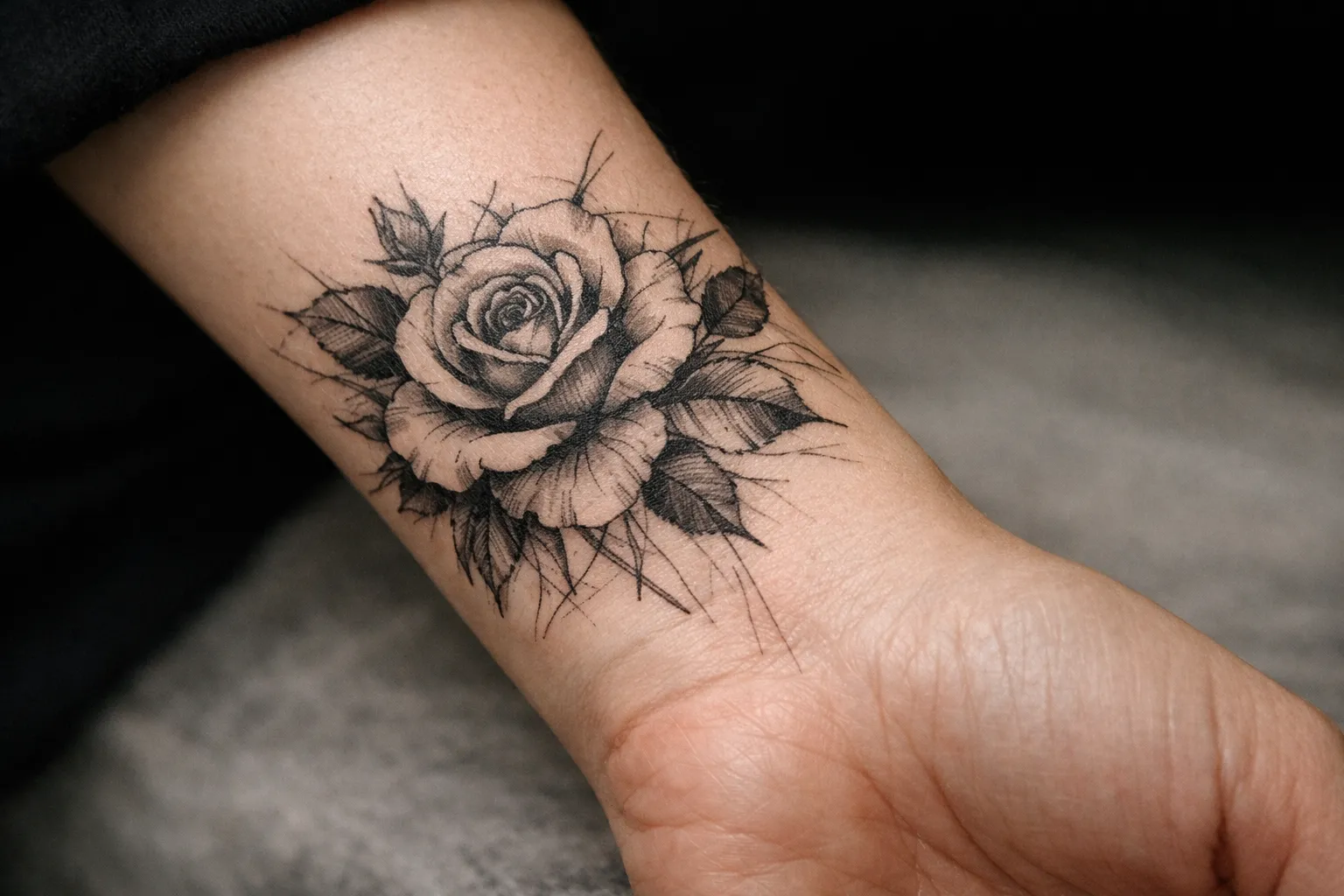
Size ranges that work on the forearm:
- Inner forearm, single bloom with short stem: 3-4 inches
- Outer forearm, vertical stem with multiple blooms: 5-7 inches
- Wrist to elbow, full forearm composition: 8-10 inches, often part of a developing sleeve
Pain on the forearm is on the lower end of the body map - manageable for a first tattoo, certainly easier than the ribcage or sternum. Cost for a medium black-and-grey forearm rose runs $200-$400; a fully colored traditional piece with leaves and banner sits in the $300-$600 range.
A planning tip worth taking seriously: if there’s any chance you’ll extend into a half or full sleeve later, ask the artist to leave breathing room around the rose. A standalone rose floating in the middle of the forearm is harder to integrate into a future composition than one anchored with a small element - a leaf cluster, a dagger, a piece of background - that can connect outward.
Rose Hand Tattoo
A rose hand tattoo is a commitment. Two truths to take seriously before you book:
- Hand tattoos fade faster than most placements because you wash your hands constantly, expose them to sun, and the skin on the back of the hand turns over quickly - feet, inner lip, and finger sides can rival or exceed that fade rate, but hands are consistently among the worst. Expect a touch-up every 1-3 years, especially on the side of the fingers and across the knuckles.
- Workplace visibility is real. Plenty of fields don’t care anymore, but some still do. Check before you sit down.
For hand placements, artists almost always recommend bolder traditional or blackwork styles rather than fine line. Thin lines blur fast on the hand. A solid black or traditional-color rose on the back of the hand (around 2.5-3.5 inches) will hold its shape longer than a delicate fine-line version. If you’re drawn to detailed hand work, it’s worth looking at hand skeleton tattoo designs for a sense of how bold linework performs on that placement over time.
Pain-wise: back of the hand is moderate, but the side of the fingers and the palm side of the wrist are noticeably sharper - there’s less padding over bone and more nerve endings. Palm tattoos specifically often don’t take well at all; the skin sheds the ink within a year on many people. Most reputable artists won’t do detailed palm work for that reason.
Cost: small hand rose $150-$300; full back-of-hand piece $300-$600.
Rose Sleeve and Larger Compositions
Sleeve work with roses gives you space to layer styles and stories. A few common directions:
- All-rose sleeve: blossoms in varying sizes connected with stems, leaves, and background filler - smoke, dot work, light shading. Cost: $1,500-$3,000+ across 3-5 sessions.
- Rose + dragon sleeve: Eastern dragon coiled around a long stem, often in Japanese irezumi style with the rose acting as the focal bloom. The rose isn’t traditionally Japanese flora, but it adapts well to irezumi conventions: heavy outlines, wind bars, wave backgrounds.
- Rose + script: name, date, or short phrase running along the stem or curved as a banner. Keep the text either clearly above or below the bloom - running script across petals makes both elements harder to read.
- Rose + dagger: the classic American traditional combination, symbolizing the duality of love and pain. Reads instantly to anyone familiar with the iconography.
Plan sleeves in pencil before committing to ink. A good artist will mock up the full composition, not just the next piece - that’s how you avoid awkward gaps when you decide to extend later. I’ve had clients come to me mid-sleeve from another shop, and filling in poorly planned negative space is always harder than building it right from the start.
Spine Rose Tattoos
Spine placements have surged for vertical rose designs - a single long-stem rose running from the base of the neck down, stacked blossoms along the vertebrae, or a rose paired with vertical script.
What to know before you book:
The spine is a high-pain placement, especially over the bony segments. The ribcage is worse, but spine outranks forearm by a wide margin. Spinal curvature also affects design - the stencil that looks straight when you’re standing will curve when you bend. Good artists account for this by stenciling with you in a relaxed posture, not standing at attention.
Session length usually runs 2-4 hours; long pieces often need two sessions because lying still on the stomach for that long gets brutal. Cost: $400-$1,000+ depending on length and complexity.
A long-stem rose along the spine works best when the stem stays close to the vertebrae and the bloom sits at either the upper back (between shoulder blades) or lower back. Centering the bloom mid-spine is harder to compose around if you ever extend the piece outward.
Neck Rose Tattoos
Side of neck, back of neck, front of neck - all three are trending placements, mostly in black and grey, often small to medium scale.
- Side of neck: a profile rose, usually 2-3 inches, vertical orientation following the sternocleidomastoid muscle. Pain is sharp because the skin is thin over the muscle.
- Back of neck: small central rose, 1.5-2.5 inches. Lower visibility, often covered by hair. Among the gentler neck placements.
- Front of neck / throat: the highest-visibility tattoo on the body short of the face. Pain is intense and healing takes longer because you can’t avoid moving the area.
Neck roses generally cost $200-$500 for small to medium work. Touch-ups are more common here than on the forearm because of sun exposure and clothing friction - collars, scarves.
If you’re considering a neck rose as a first tattoo, reconsider. It’s a placement that rewards collectors who already know how their skin heals and how they feel about visibility. I’ve talked more than a few people out of starting there, and none of them were upset about it later.
Rose Tattoos in Hybrid and Themed Designs
Roses fold into almost every major tattoo theme. A few that come up often:
- Viking and Norse tattoos: roses combined with runes, the Vegvisir, or Odin imagery, usually in blackwork with knot patterns surrounding the bloom. The rose softens the otherwise rigid geometry.
- Japanese irezumi tattoos: the rose isn’t traditional Japanese flora - cherry blossoms and peonies are - but contemporary irezumi artists incorporate roses with wave backgrounds, wind bars, and dragons. Purists will push back; if you want a fully traditional Japanese piece, choose peony instead.
- Greek mythology tattoos: rose paired with Aphrodite, classical sculpture heads, or Medusa imagery. Usually black and grey realism with a single colored rose as a focal point.
- Dragon tattoos: Eastern dragon coiled around a rose stem, or Western dragon clutching a rose - works in both styles, scales well to sleeve or back piece.
- Archangel Michael tattoo: rose placed near the sword tip or at the angel’s feet as a symbol of sacrifice or remembrance. Common in memorial pieces.
- Cybersigilism tattoos: a newer trend - symmetrical, glitchy linework drawn from digital occult aesthetics, often arranged around a central rose. High-contrast blackwork is the technique that holds up best here.
The rule for hybrids: pick one element to lead. If the rose is the focal point, the other imagery supports it. If the dragon or angel leads, the rose plays a supporting role. Trying to give two elements equal weight in the same composition usually produces visual clutter. I’ve seen it happen enough times that I now ask clients to rank their elements before we start sketching.
Cost, Time, and Healing - The Practical Layer
Quick reference for a US mid-tier shop:
Rose Tattoo Size, Time, and Cost
| Small fine-line rose | Medium black-and-grey rose | Traditional color rose with banner | Large composition / sleeve / back piece | |
|---|---|---|---|---|
| Size / Style | 1-2 in | 3-4 in, forearm | 4-5 in | Multiple sessions |
| Time | 30-60 min | 1.5-3 hrs | 2-4 hrs | Multiple sessions |
| Cost (USD) | $80-$200 | $200-$400 | $300-$600 | $800-$2,500+ |
High-demand artists charge day rates of $800-$1,500 and often have waitlists of 6+ months.
Healing timeline for a rose tattoo:
- Day 1-3: oozing plasma, mild swelling, redness. Keep wrapped per artist instructions - often second-skin bandages for 3-5 days. Wash gently 2-3 times daily with fragrance-free soap.
- Week 1: scabbing and tightness. Do not pick. Apply a thin layer of fragrance-free moisturizer 2-3 times daily.
- Week 2-4: peeling and itching. The tattoo may look dull or cloudy - this is normal. Keep moisturized and out of direct sun.
- Weeks 4-12: the deeper layers continue to heal. Avoid pools, ocean, prolonged sun exposure. Use sun-protective clothing or high-SPF sunscreen once fully healed.
Touch-up policies vary - many shops offer a free touch-up within 3-6 months for shading that didn’t take. Hand and finger pieces typically aren’t covered under free touch-up terms because of the placement’s fade rate.
Common Mistakes to Avoid
- Going too small with too much detail. A 1-inch rose with seven layers of shading will look like a smudge in eight years. Match detail to scale.
- Stacking too many symbols. Rose + clock + eyes + script + birds in a 3-inch space reads as noise. Each added element needs surface area.
- Ignoring body flow. A horizontal rose stem across the long axis of the forearm fights the arm’s natural lines. Vertical compositions follow the limb.
- Bringing reference art you can’t license. Don’t ask an artist to copy another tattooer’s work exactly - it’s a professional courtesy issue, and good artists will decline. Use references as inspiration, then let your artist build something original.
- Underestimating placement pain and visibility. A neck or hand rose as a first tattoo, without understanding how your skin heals or how it’ll affect your work, is a common regret.
- Skipping aftercare. Picking scabs, sun exposure in the first 4-6 weeks, and soaking in pools or baths during healing cause patchy results that touch-ups can only partially fix.
Frequently Asked Questions
- What does a rose symbolize in a tattoo?
- Most commonly love, beauty, and passion, with color shifting the meaning - red for romantic love, black for mourning or remembrance, yellow for friendship, white for purity or new beginnings. It can also symbolize balance (the rose with its thorns), the June birth flower, or simply an aesthetic preference. The meaning depends on color, design state (bud, bloom, wilting), and any imagery paired with it.
- What are the 10 most popular tattoos?
- Industry round-ups consistently list roses among the top ten, alongside hearts, skulls, dragons, butterflies, lions, crosses, snakes, anchors, and script lettering. Roses are widely cited as one of the most-requested floral motifs, though exact global rankings vary by source and region.
- Where's a good place to put a rose tattoo?
- The forearm is the most-recommended placement - flat, low-pain, heals well, and the stem follows the limb's long axis. Other strong options include the outer upper arm, shoulder, calf, and thigh. Higher-risk placements with faster fading and more pain include hand, fingers, neck, and ribs.
- Do small rose tattoos age well?
- They age well if you keep the design simple - 5-7 petals, strong outlines, minimal internal detail. Tiny rose tattoos under 1 inch with fine-line shading will fuzz over 5-10 years and need touch-ups. A traditional or blackwork micro rose lasts longer than a fine-line version.
- Is a rose tattoo painful?
- Pain depends entirely on placement. Forearm and outer upper arm are on the lower end. Ribs, sternum, and spine are sharp. Hand, fingers, and neck are moderate to high. Pain also depends on session length - a two-hour session anywhere starts to hurt more in the final thirty minutes.
- How much does a rose tattoo cost?
- A small rose runs $80-$200, medium forearm work $200-$400, traditional color pieces $300-$600, and large compositions or sleeves $800-$2,500+ depending on artist and city.
- What's a good flower tattoo besides a rose?
- Popular floral tattoos beyond roses include peonies (especially in Japanese irezumi), lotuses (spiritual symbolism, often in fine-line or mandala styles), sunflowers (positivity, large scale works well), cherry blossoms (Japanese tradition, scatter compositions), and lilies (often in memorial pieces). Choose based on symbolism and how the flower's shape fits your placement.
- Can I get a rose tattoo if I have sensitive skin or allergies?
- Red ink can be the most reactive pigment, so disclose any past ink allergies to your artist. Sensitive skin may require patch testing or choosing colors and styles that minimize irritation.
Final Thoughts on Choosing Your Rose
The rose tattoo earned its staying power because it does what good rose tattoo designs are supposed to do: read clearly, scale flexibly, and carry enough meaning to stay relevant for the wearer over decades.
Three decisions determine whether yours works - placement, style, and size. Getting those right matters more than the symbolism.
Pick a placement that matches your tolerance for visibility and touch-up frequency. Pick a style that matches how you want the piece to age - traditional and blackwork consistently outlast fine-line in healed work, because thick saturated outlines hold their edges while single-needle lines spread and soften; that’s not an opinion, it’s just how ink behaves in skin over time. Size the design to allow the linework to breathe. Then find an artist whose healed work (not just fresh photos) shows the qualities you want in your piece, and let them build something for your body rather than copying a reference exactly. If you’re still exploring your options, browsing flower tattoo ideas can help you compare how different blooms translate across styles and placements before you commit.
A well-planned rose at 3 inches on the forearm will outperform a poorly planned rose anywhere else on the body. Plan first, then book.