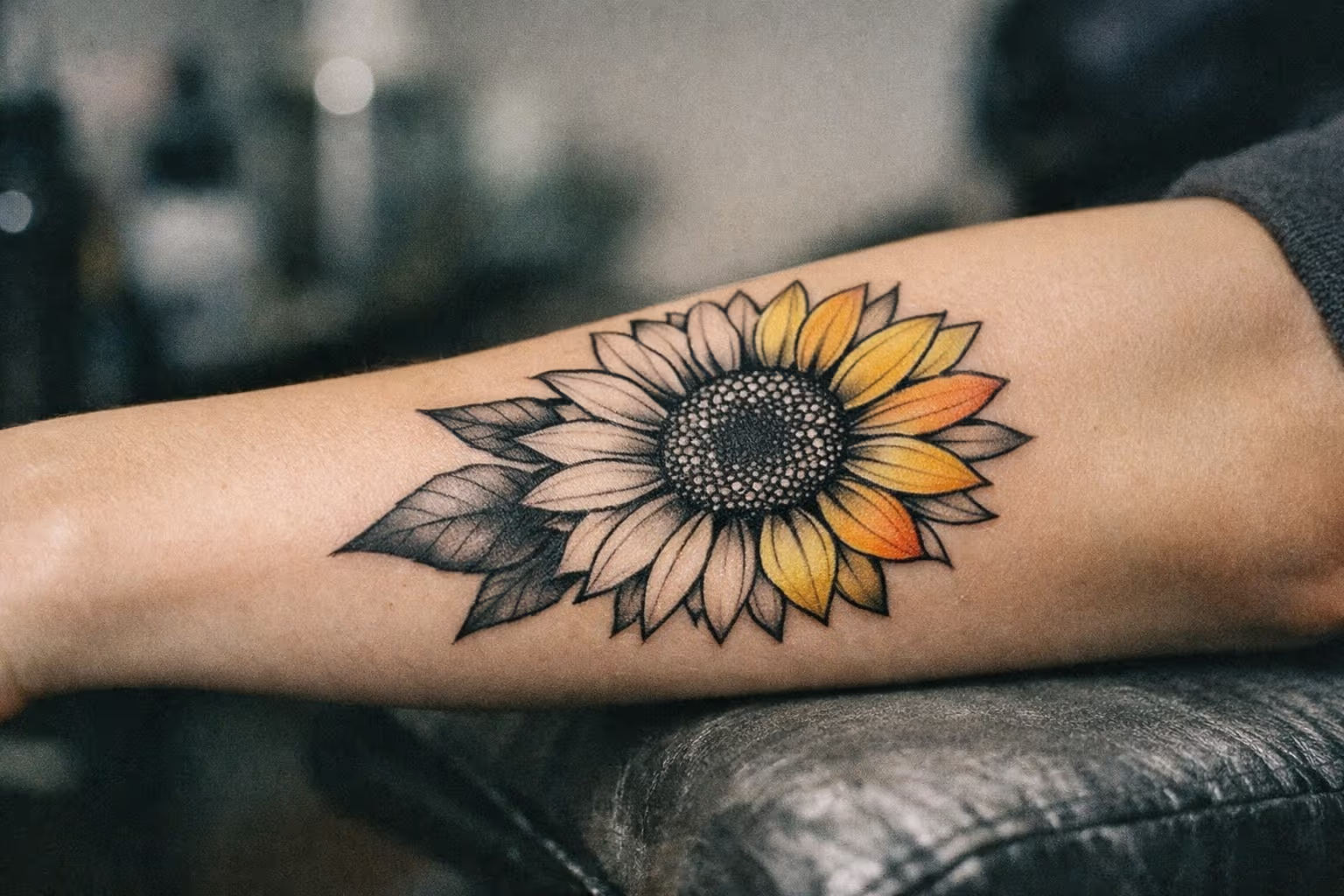
A sunflower tattoo looks like an easy, cheerful pick until the quote comes in: $500 buys a solid mid-size piece, not the sprawling shoulder-to-elbow bloom on your reference photo. And there’s an upkeep line nobody mentions - the signature yellow dulls 10-30% every summer it sees real sun. Plan the size to the budget and the placement to the light. Here’s the real sizing and cost math, plus what a sunflower actually means.
What a Sunflower Tattoo Actually Means
The short answer: positivity, loyalty, adoration, and growth. The longer answer depends on which tradition you pull from.
The Greek myth is the one most artists reference at the consult. The nymph Clytie fell for Apollo, the sun god, was rejected, and after nine days of grief transformed into a sunflower - still turning her face toward him each day. That’s where the “always facing the light” reading comes from, and it’s why an upward-facing sunflower reads as devotion or unrequited loyalty, while a drooping bloom reads as grief, memorial, or letting go.
In modern Western tattoo culture, the sunflower tattoo meaning has shifted noticeably toward mental health and recovery. Informal community surveys suggest 10-20% of sunflower tattoo posts mention healing, depression recovery, or “better days ahead.” Pairings reinforce this: a sunflower with the phrase “here comes the sun” or “choose joy” is now one of the most common script combinations I see clients bring in.
Other meanings worth knowing:
- Loyalty in relationships - turning toward one person the way the flower turns toward the sun
- Spiritual faith - the sunflower as a symbol of devotion in some Christian traditions
- Gratitude and warmth - often the meaning behind a tattoo memorializing a parent or grandparent
If symbolism matters to you, say so before the artist starts sketching. The pose of the flower (upright vs. tilted), number of blooms, and added elements (bee, dates, initials) all shift based on what you want it to carry.
Sunflower Tattoo Ideas Worth Considering
Here are the designs that actually hold up - visually and over time.
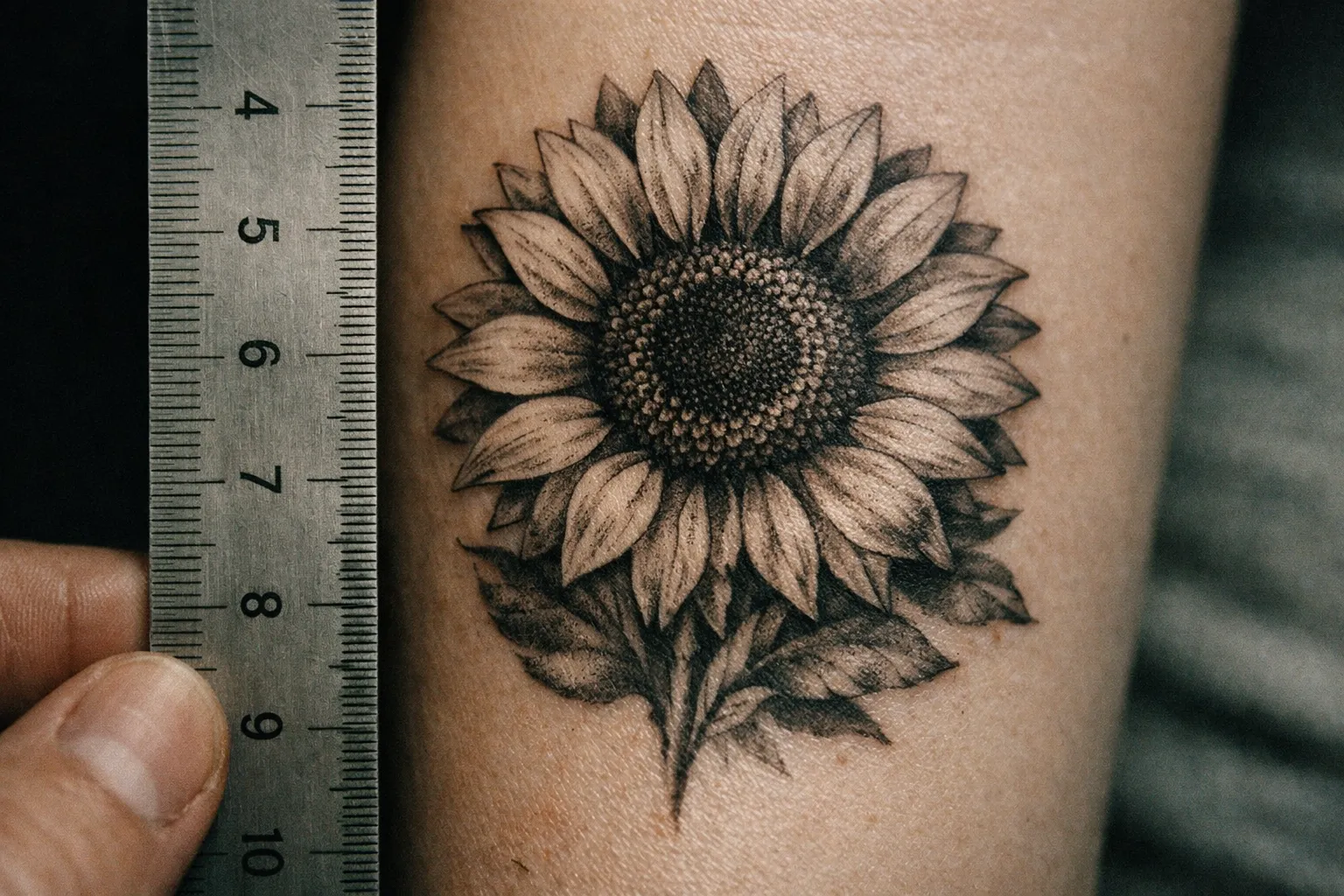
1. Small Sunflower Tattoo
A small sunflower tattoo usually runs 1-2 inches (2.5-5 cm) and accounts for 50-70% of sunflower requests at most shops. It works because the silhouette is recognizable even when simplified. Best placements:
- Inner forearm
- Behind the ear (2-3 cm max)
- Collarbone
- Ankle
- Side of wrist
Expect $120-$250 and 30-60 minutes in the chair. Skip the ultra-tiny version under 0.5 in - the seed center turns into a dot and the petals merge within 2-3 years. I’ve seen it happen more times than I can count, and it’s always the same story: looks perfect at the reveal, looks like a smudge by year three.
2. Minimalist Sunflower Tattoo
A minimalist sunflower tattoo uses single-needle or fine-line work, partial outlines, and almost no shading. Think a simple petal-and-circle silhouette or a continuous-line interpretation. Usually under 1.5 in (3-4 cm).
Two technical hallmarks of this style done right: clean linework with consistent weight, and negative space doing most of the work instead of ink packing. The common pitfall is artists going too thin - under 0.25 mm - which produces lines that fade or blow out within 3-5 years. Ask to see healed examples, not fresh photos. Fine line looks crisp on day one and tells a very different story at week six.
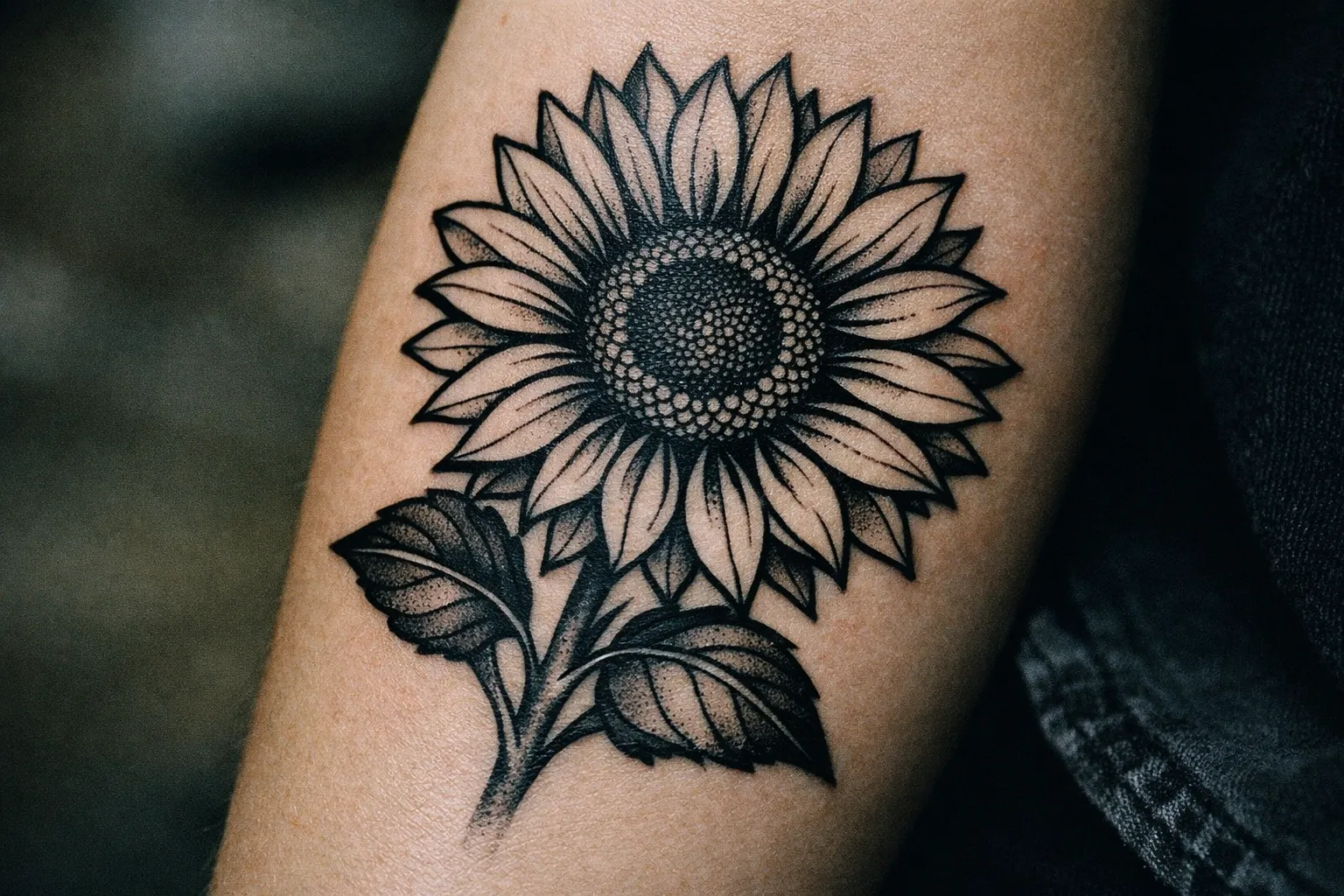
3. Black and White Sunflower Tattoo
A Black and white sunflower tattoo - also called blackwork or black-and-grey - skips color entirely and relies on linework plus shading for depth. It’s the version that ages best across every skin tone and stays legible for decades. Good size range: 2-5 in (5-13 cm), which gives the artist room to vary line weight between petal outlines and interior detail.
This is the version I recommend for anyone worried about touch-ups. Yellow pigment can lose 10-30% of saturation per summer if you skip sunscreen; black ink doesn’t have that problem.
4. Sunflower Outline Tattoo
Pure linework - a bold outline of the flower with no fill. It’s a great first tattoo because the artist’s skill shows immediately and there’s nowhere to hide a bad line. Works well at 2-4 in on the forearm, calf, or upper arm. Keep the outline weight at least 0.5 mm so it holds up over time.
5. Heart Sunflower
Two variations: petals bent into a heart shape, or a small sunflower tucked inside a heart outline. The first reads cleaner. The second can get cluttered under 3 inches - the elements start competing with each other. Forearm or shoulder blade gives it enough room to breathe.
6. Sunflower Skull Tattoo
A skull peering out from behind petals, or petals erupting from a skull’s eye sockets. Reads as beauty and mortality - a memento mori with warmth. Needs 4+ inches to handle the detail; works well on the upper arm, thigh, or sternum. Worth knowing: ribcage placement hurts significantly more than the forearm for the same design, so factor that into your placement decision.
7. Smiley-Faced Sunflower
The seed center drawn as a simple smiley face. It’s a doodle aesthetic and ages well because it’s intentionally low-detail. If you have a kid’s drawing you want to preserve, this is the one to consider - bring the actual drawing to the consult, don’t try to describe it.
8. Sunflower with a Name or Date
The flower wraps around handwritten script - a name, a date, coordinates. Keep the script and the flower at the same level of detail; mixing fine-line script with bold flower linework looks unbalanced. Forearm is the standard placement because both elements stay readable.
9. Sunflower and Rose
Yellow petals beside red ones. Visually strong, but only at 4+ in - anything smaller and the two flowers fight for the same space. Upper arm, thigh, or shoulder blade all work here.
10. Sunflower Sleeve
A sleeve built around sunflowers usually includes leaves, smaller wildflowers, bees, and sometimes script. Budget $1,500-$4,000+ across 3-6 sessions. The trick is letting the artist plan the full layout before starting - sunflowers added piecemeal to an existing arm rarely flow the way clients hope.
11. Van Gogh Sunflower
Recreating Van Gogh’s brushwork in tattoo form. Hard to do well - most artists who attempt it under 4 inches end up with something that reads as muddy rather than painterly. Look specifically for someone with an impressionist or painterly portfolio, not a traditional flash artist.
12. Mandala Sunflower
Geometric pattern work using the flower’s natural radial symmetry. Reads beautifully at 3-6 in on the shoulder blade, sternum, or outer thigh. Needs an artist comfortable with geometric precision - freehanded mandalas drift off-center faster than most clients expect.
13. Sunflower and Bee
Symbolism here: teamwork, productivity, pollination as a metaphor for showing up for people. The bee should be small relative to the flower - roughly a 1:4 ratio - so it reads as an accent rather than a competing focal point.
How Pose and Element Shift the Meaning
A quick reference on how small design choices shift the sunflower tattoo meaning:
- Upright, fully open bloom - joy, optimism, devotion
- Tilted or drooping - grief, memorial, or accepting endings
- With visible stem and roots - resilience, growth from hardship
- Multiple blooms (often 2-5) - family members, milestones, children
- With a bee - community, partnership, productivity
- With script - direct affirmation, mental health, recovery
- Inside a skull or with thorns - duality, mortality alongside beauty
- Wilted with a single fresh bloom - recovery after loss
If you want the meaning to be obvious to you (and not necessarily to strangers), one symbolic detail is usually enough. Stacking five symbols into one piece dilutes all of them.
The 1/3 Rule and Other Practical Design Considerations
The 1/3 rule comes up constantly in artist consults, and it actually means two different things depending on context.
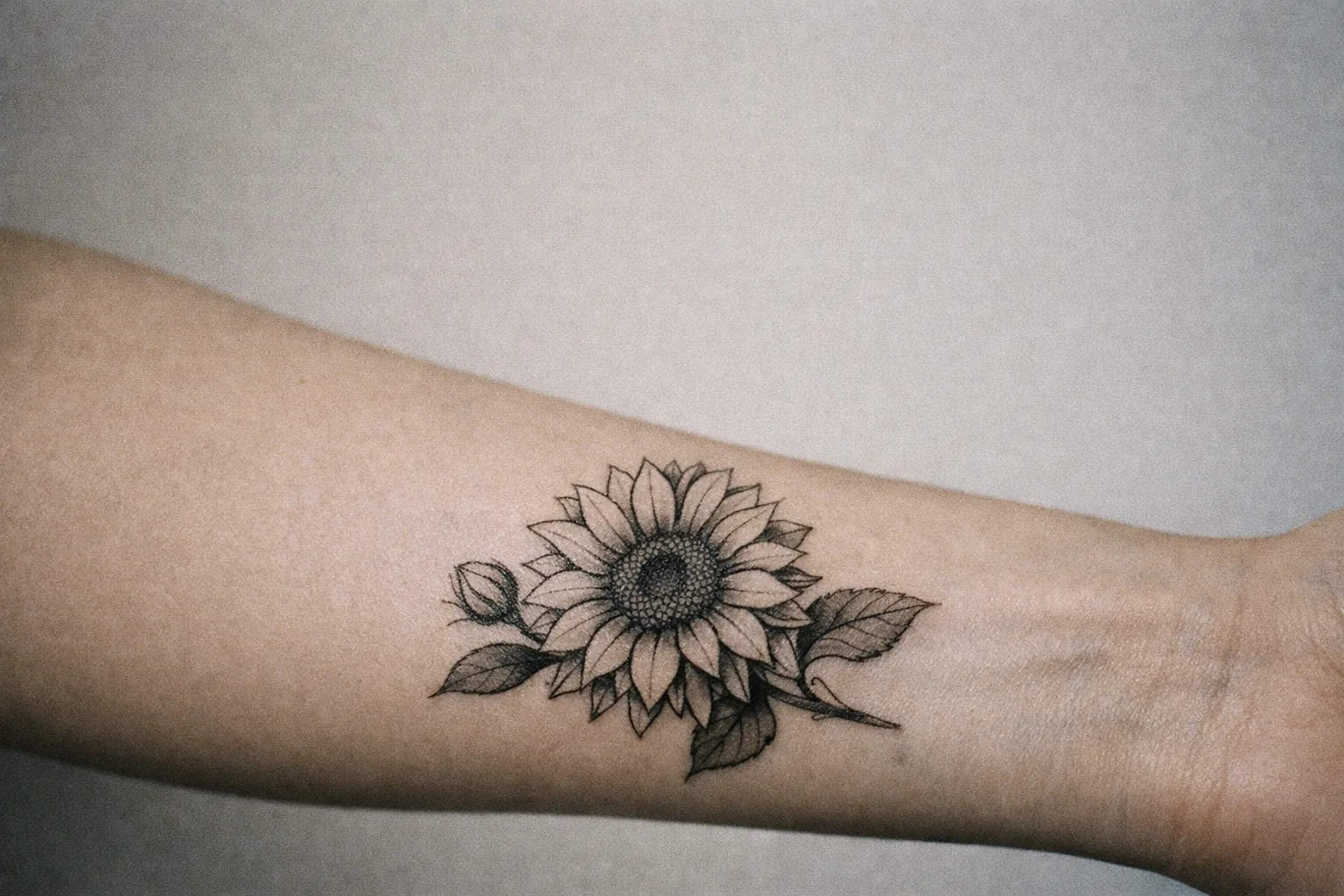
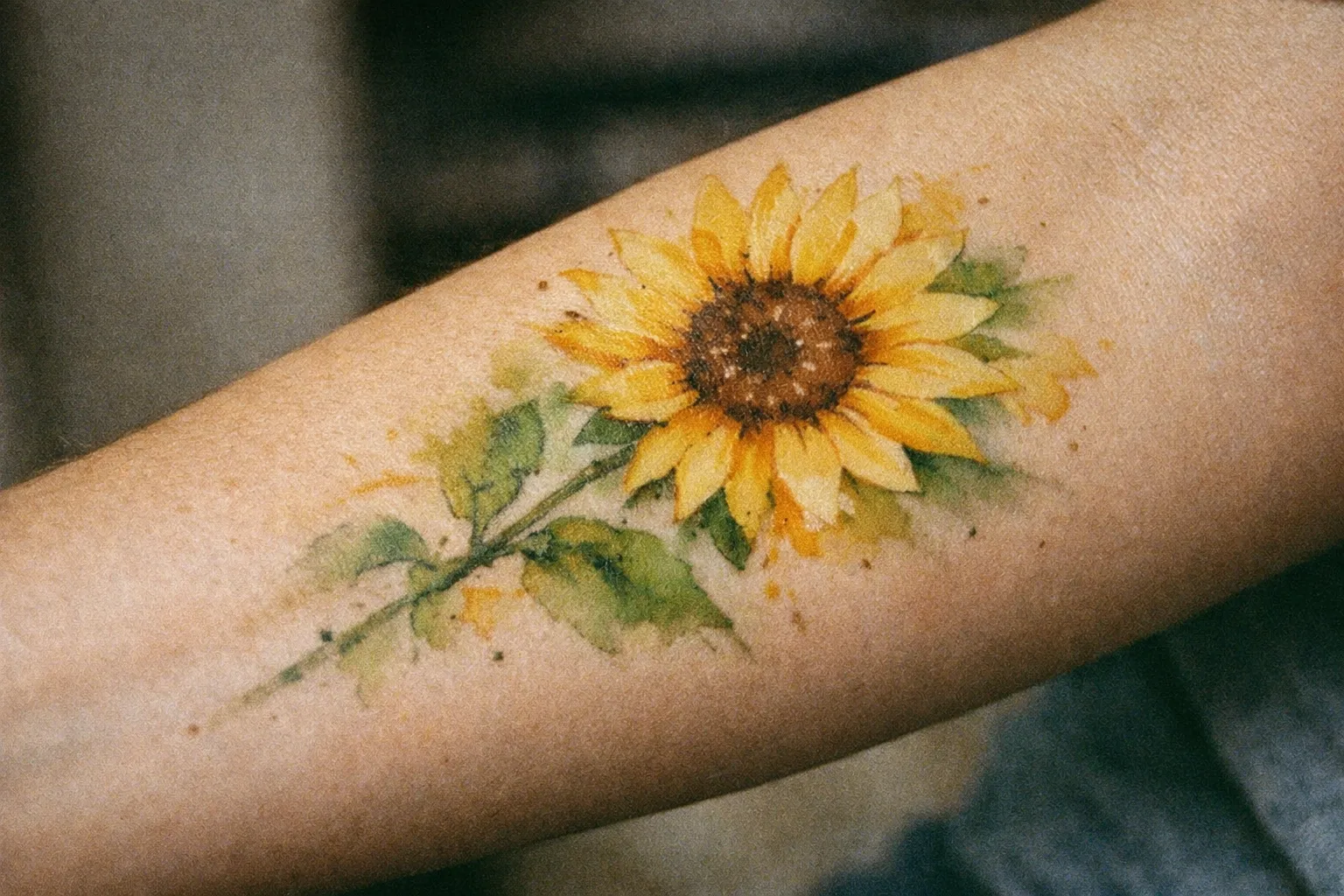
For composition: roughly one-third dark ink (linework and deep shading), one-third mid-tone (color or grey), and one-third skin showing through. This contrast ratio is what keeps a tattoo readable as it ages. A sunflower that’s 90% packed yellow with thin linework looks beautiful at week two and like a yellow blob at year ten. The dark outline anchors the shape - without it, you’re relying entirely on pigment that will shift.
For placement planning: if you’re thinking about more tattoos in the same area later, don’t cover more than about one-third of that region with your first piece. Otherwise you’ll have nowhere to add work that flows, and you’ll end up with a patchwork look instead of a planned composition.
A few other practical points:
- Bold holds. Thicker lines age better than thin ones. Always.
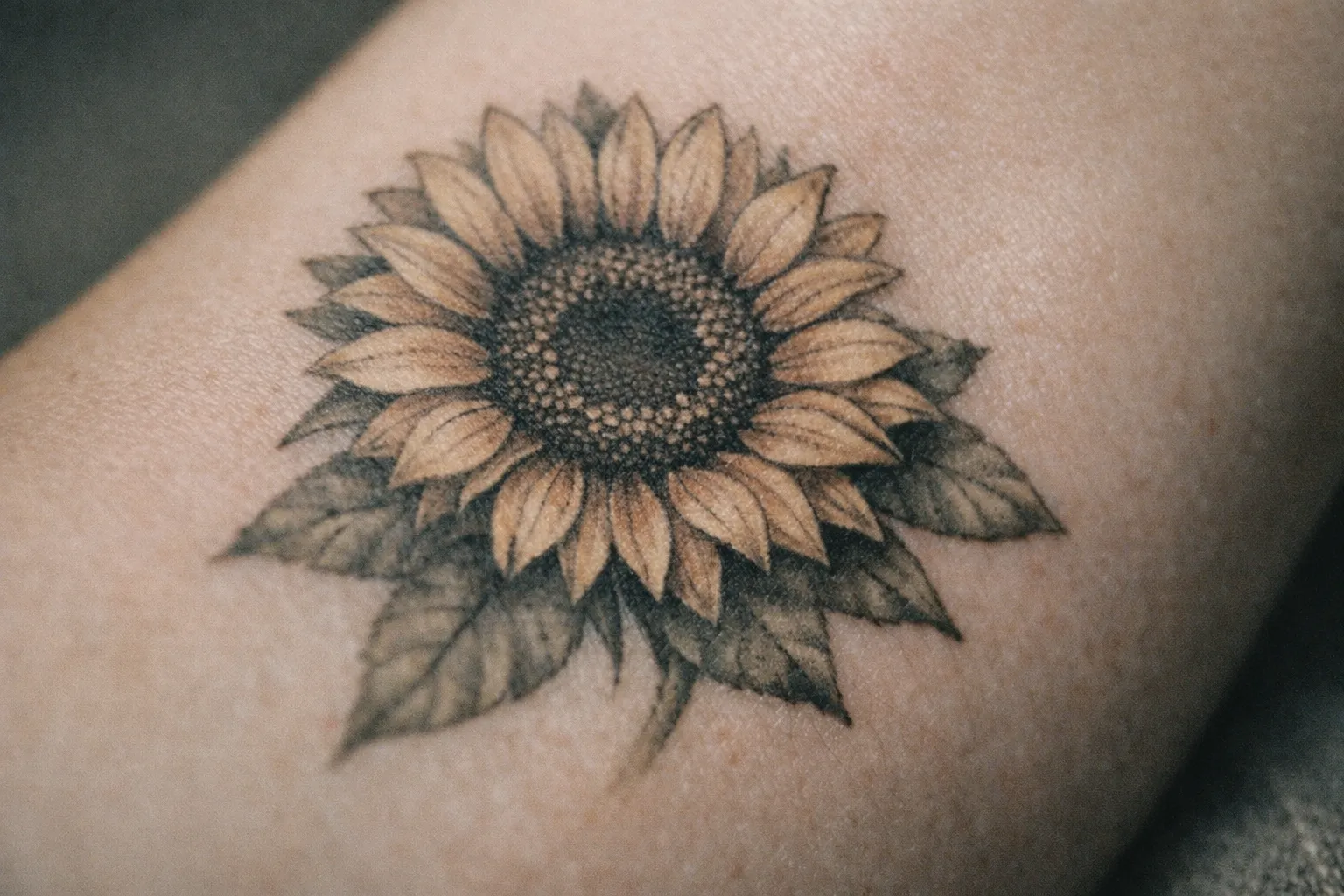
- Color costs maintenance. Yellows, light greens, and pastels usually need a touch-up every 5-8 years if sun-exposed.
- Healed photos tell the truth. Never judge an artist’s work from fresh photos alone.
Designs Worth Avoiding
This is the section most sunflower tattoo guides skip. Worth knowing before you book.
White-ink-only tattoos sound interesting and age badly - most yellow or fade to nothing within 6-24 months. Micro-tattoos with complex detail under 0.5 in (1.5 cm) blur into a smudge within 2-3 years. A tiny sunflower is fine; a tiny sunflower with bee, script, and shading is not.
Fingers, sides of hands, feet, and palms are high-fade placements for first tattoos - these areas regenerate skin constantly and fade 3-5x faster than the forearm. Expect 1-3 touch-ups in the first two years. Hand, neck, or face tattoos as a first piece are also worth thinking through carefully if you work in a conservative industry - surveys still show 30-40% of employers view visible tattoos negatively in those sectors.
Avoid exact copies from Pinterest. Beyond the ethics, the design was made for someone else’s body and skin tone. Bring pins as reference, not as the final design.
For sunflowers specifically: avoid packing the entire flower with light yellow and skipping linework. It looks airy and watercolor-pretty fresh, then ages into a vague yellow shape. Bold petal outlines plus selective color is the version that holds.
Also worth a quick Google: some geometric and numeric symbols have been co-opted by hate groups over the past decade. Check your design before committing.
How Big Should a $500 Piece Be?
Real numbers, 2025 US pricing:
- Hourly rates in major cities (NYC, LA, Chicago, Austin): $150-$250/hour for experienced artists. Top-tier portfolios charge $300-$400/hour.
- Shop minimums: $80-$150.
- $500 buys roughly 2-3 hours with a mid-to-high-level artist.
In that 2-3 hour window, a sunflower realistically covers:
- A color sunflower at 3-5 inches (8-13 cm) with moderate detail - forearm, calf, or shoulder
- A black-and-grey sunflower at 5-7 inches (13-18 cm) with good shading
- A small color sunflower plus a secondary element (bee, script, leaves) at 3-4 inches
- A fine-line minimalist sunflower plus a coordinated smaller piece elsewhere
Outside major cities, that same $500 often buys 3-4 hours and a noticeably bigger or more detailed piece.
Other budget tiers, for context:
- Under $200: small black linework sunflower, 1-2 in, behind ear or wrist
- $200-$500: medium piece with one or two added elements
- $500-$800: detailed color realism sunflower, or a starting piece for a planned sleeve
- $1,500+: half-sleeve floral composition built around a central sunflower
Tip 15-25% on top of whatever the tattoo costs - a $500 tattoo means a $75-$125 tip on top. Deposits ($50-$200) are usually non-refundable but applied to the final price.
Aftercare Timeline
Aftercare is what turns a $500 tattoo into something that still reads cleanly at year ten.
Day 1-3: Keep the bandage on as long as your artist recommends (often 2-24 hours; longer for second-skin wraps like Saniderm, up to 3-5 days). Once it’s off, wash gently 2-3x daily with fragrance-free soap, pat dry, and apply a thin layer of fragrance-free moisturizer or a tattoo balm. Expect some plasma weeping and color “bleeding” onto sheets - that’s normal.
Week 1: Itching and light scabbing kick in around day 4-7. Do not pick, scratch, or peel. Keep moisturizing 2-4x daily. No soaking - that means no baths, pools, hot tubs, or ocean. Showers are fine; just don’t blast the tattoo directly with hot water.
Week 2-4: Surface healing finishes around day 10-14. The tattoo may look dull or cloudy as the top layer sheds - that’s normal, the real color is underneath. Switch to once-daily moisturizing once the skin no longer feels tight. Avoid direct sun completely during this window.
Week 4-6: Deep healing finishes for heavily packed color work. Now you start the long-term protection routine: SPF 30-50 broad-spectrum sunscreen anytime the tattoo is sun-exposed, and sun-protective clothing when you can manage it.
Year 1+: Most reputable artists offer free or discounted touch-ups within 6-12 months if any areas healed unevenly. Take advantage of that window. After that, expect a touch-up every 5-8 years on color tattoos if you want them looking fresh - black-and-grey can go 10-15+ years between touch-ups.
The single biggest variable in how a sunflower tattoo ages: sunscreen compliance. Yellow pigment fades 10-30% faster per summer without it. I’ve watched clients come back two summers later genuinely surprised their color is gone. It’s always the same answer.
Related Motifs That Pair Well With Sunflowers
Most people saving sunflower tattoo ideas on Pinterest and Instagram also save these motifs - useful to know if you’re planning future work that flows with your sunflower:
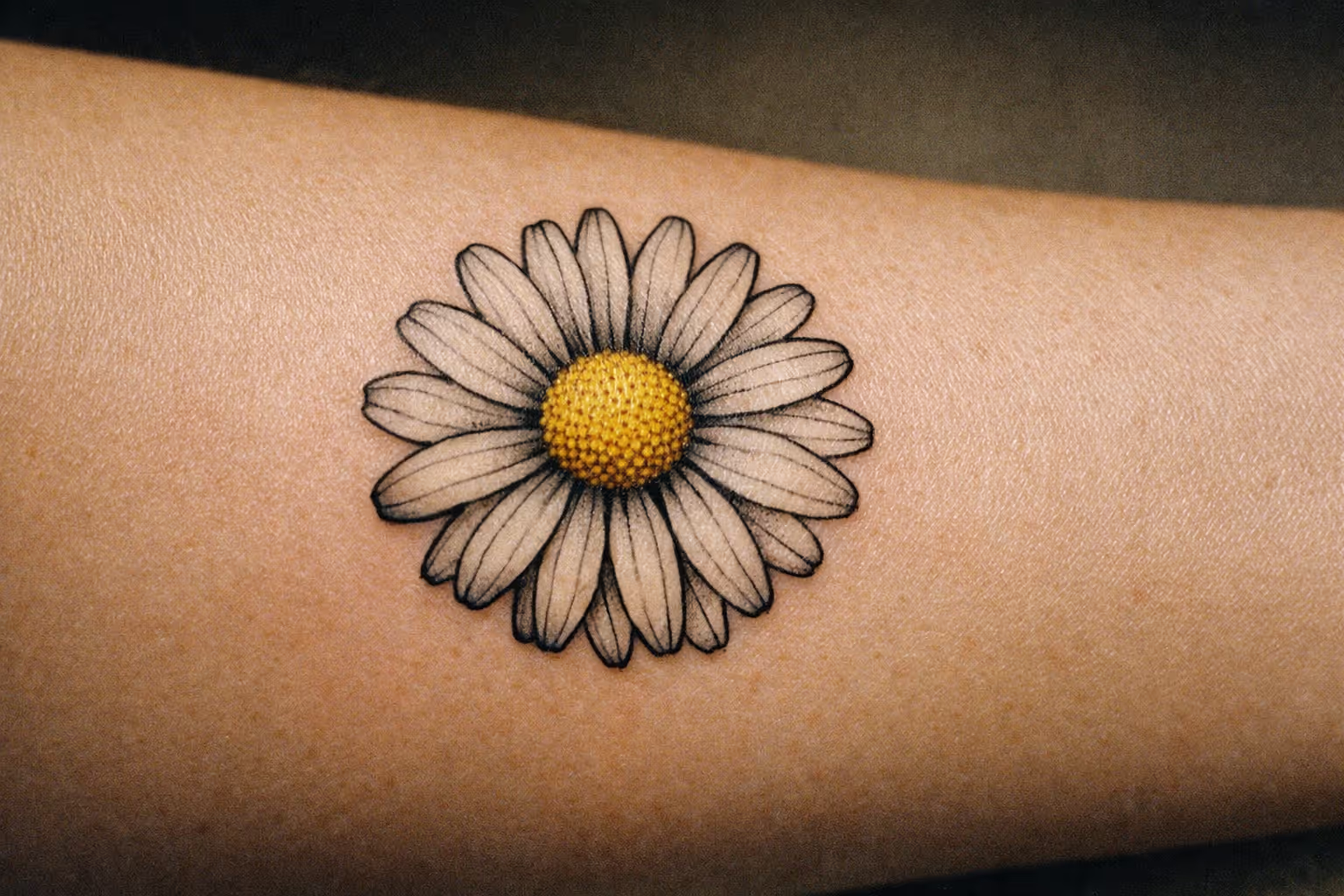
- Wildflowers (daisies, lavender, baby’s breath, poppies) - natural extensions for a floral half-sleeve
- Bees, butterflies, dragonflies, ladybugs - small accents that add narrative without competing
- Fine-line botanicals - ferns, eucalyptus, olive branches - anchor a minimalist sunflower in a larger composition
- Sun and moon imagery - plays on the sunflower’s “facing the light” symbolism
- Script and affirmations - short phrases like “stay golden,” “here comes the sun,” or meaningful dates
- Mandala and geometric work - frames the sunflower in radial symmetry
- Bird imagery - hummingbirds and finches especially, paired with a single bloom
- Honeycomb patterns - pairs naturally with bee accents
If you think you’ll want more tattoos in this cluster later, say so at the consult. The artist can plan the sunflower’s pose, scale, and placement so it sits inside a future composition instead of fighting it. That one conversation prevents a lot of patchwork arms five years down the line.
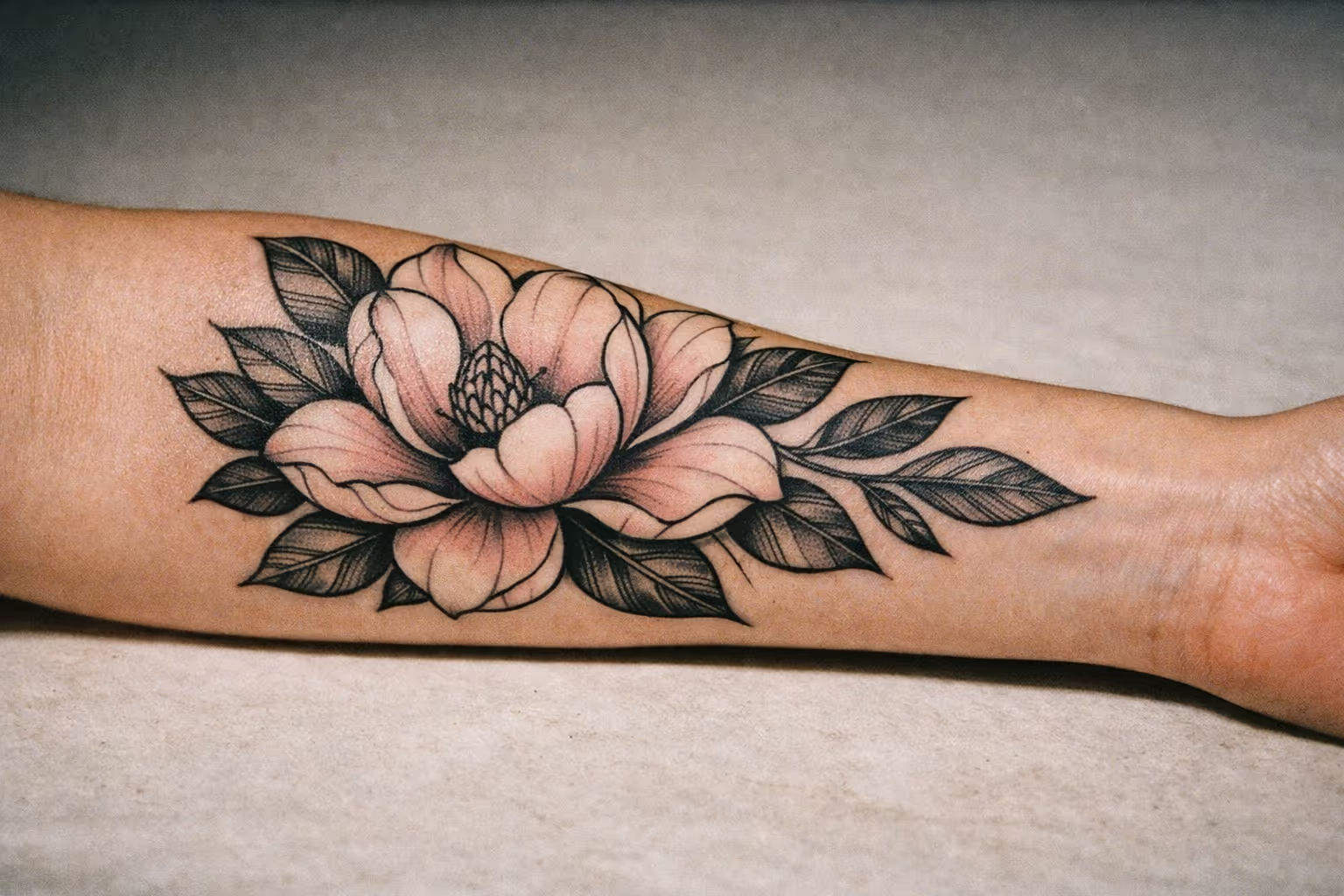
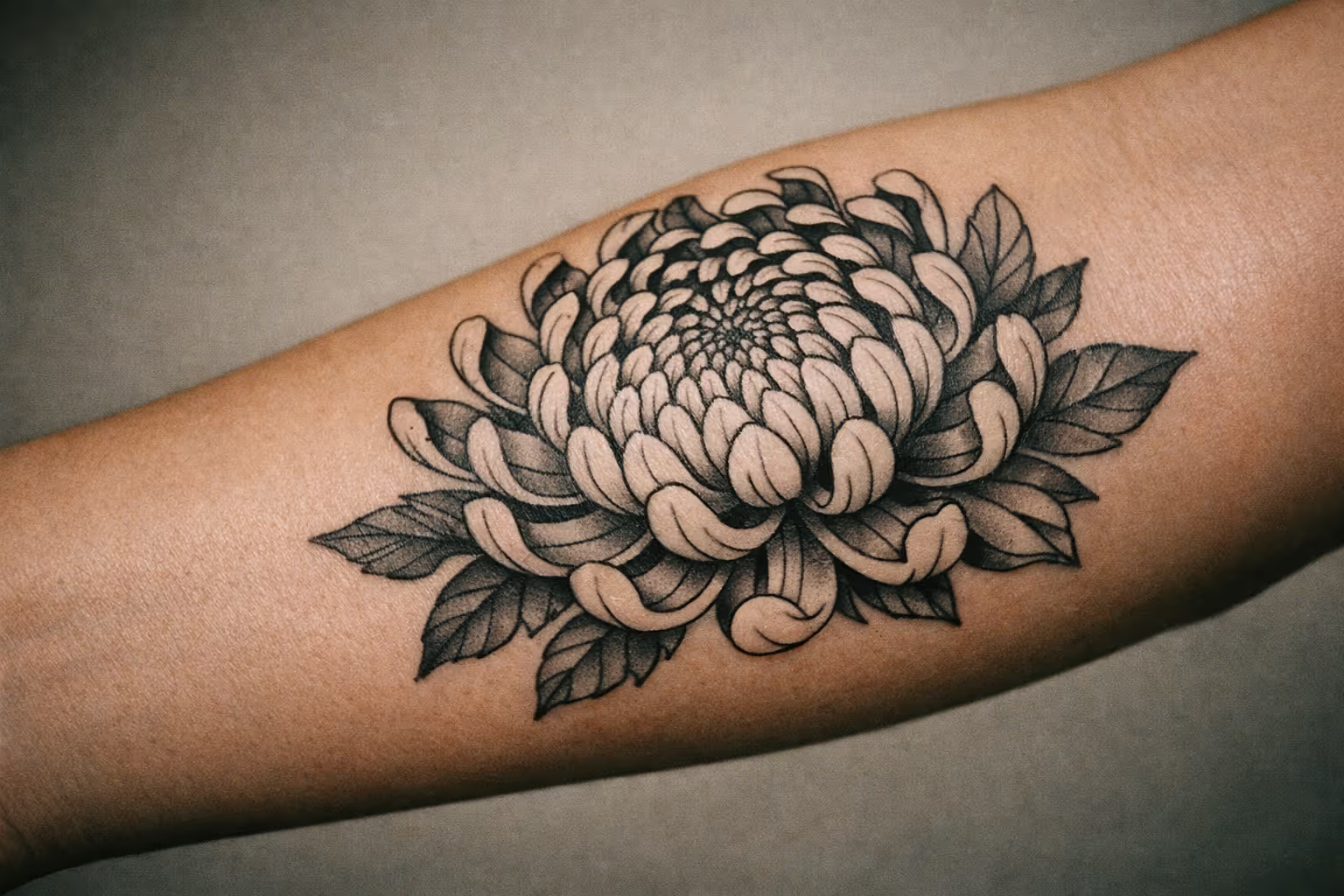
If you’re drawn to flower tattoo ideas more broadly, the same planning principles apply - pose, scale, and placement all need to work together before the needle touches skin.
How to Use Pinterest References Without Copying
A lot of sunflower tattoo planning happens on Pinterest, Instagram, and TikTok - pins of strong designs routinely hit 10k-500k saves. Used right, those references make the consult easier. Used wrong, they produce generic or copyrighted designs that don’t fit your body.
- Save healed photos, not just fresh ones. Healed (4+ weeks) is the only way to see real color and line weight.
- Match skin tone and placement to yours. A sunflower that looks vibrant on cool, pale skin will read differently on warm or deeper skin tones - pigments often need adjustment.
- Save 5-10 references, not 50. Pull the specific element you like from each: the petal style from one, the shading from another, the placement from a third.
- Never ask an artist to copy a tattoo exactly. It’s bad etiquette toward the original artist and the original client, and most reputable artists will refuse. Use the pins as a vocabulary, not a template.
- Print them out at actual size. Tape them to your body in the mirror. This is the single most useful thing you can do before a consult - a “small” sunflower on Pinterest is often 4 inches in real life.
- Bring references to the consult digitally, with notes on what you like about each. Artists work faster and design better when they understand your taste, not just your shopping list.
AI flash libraries have changed this part of the process too. Platforms like BlackInk AI now offer 28,000+ sunflower tattoo variations, which is useful for exploring directions but creates the same risk as Pinterest: generic, uncustomized designs that don’t account for your body or how the piece will age. Use them as starting points only.
Picking an Artist for Sunflower Work
Not every artist handles florals well. Look for:
- A portfolio with multiple sunflowers or similar florals - at least 3-5 examples, ideally healed
- Consistent linework across pieces - no wobbly outlines, no varying weight where it shouldn’t vary
- Style match. A traditional flash artist will do a great American traditional sunflower - thick black outlines, limited palette - but they’re usually not the right pick for a single-needle minimalist piece
- Healed photos posted publicly. Artists confident in their work show how it ages
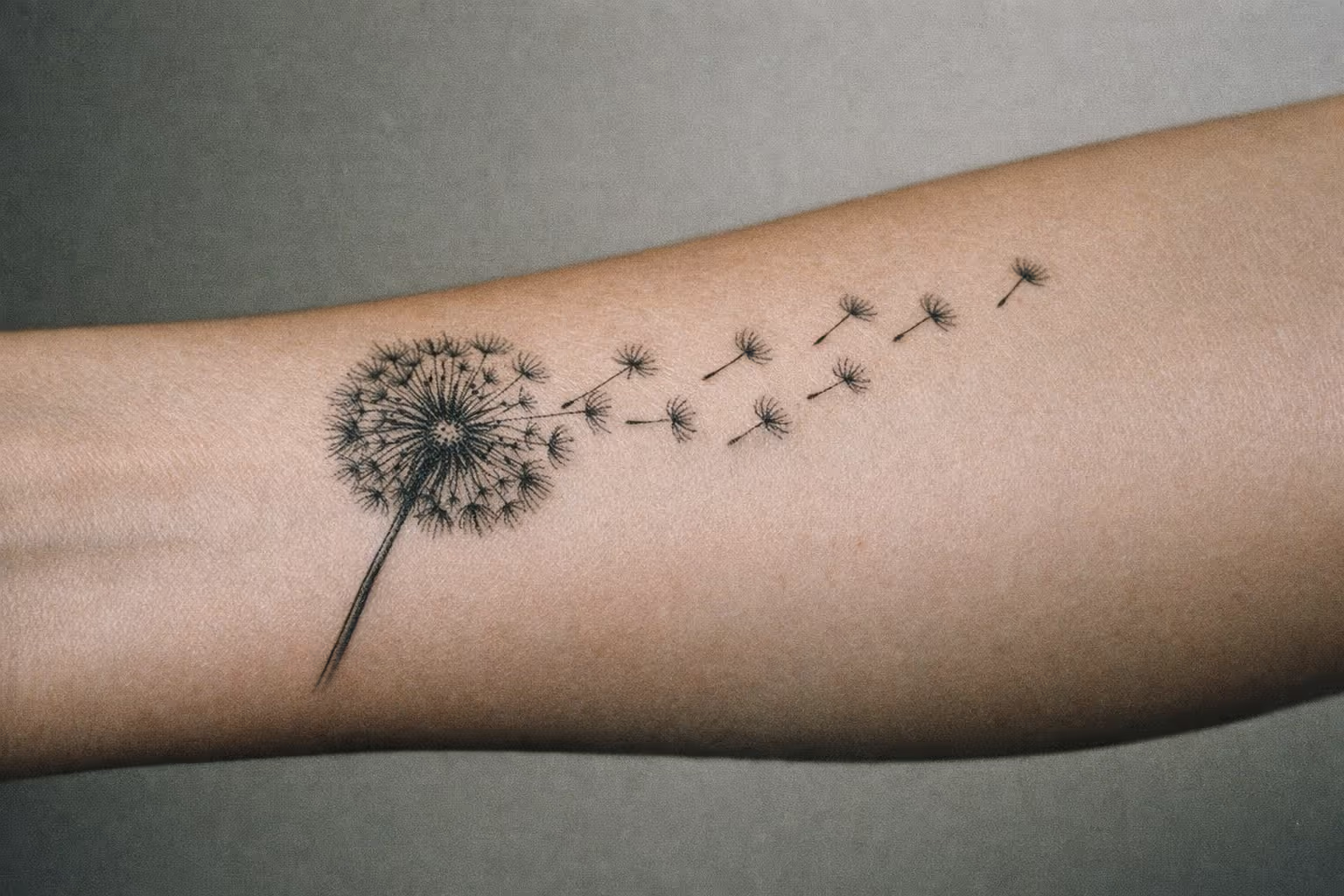
For fine-line and minimalist sunflowers specifically, search for “single-needle” or “fine-line” specialists. The needle gauge, hand pressure, and depth are all different from standard tattooing, and not every skilled artist can work that fine without blowouts. If you’re also considering a dandelion tattoo or similar wildflower motif, the same fine-line specialist criteria apply - the delicate seed structures demand the same level of technical precision.
Frequently Asked Questions
- What does a sunflower mean in a tattoo?
- A sunflower tattoo most commonly symbolizes positivity, joy, loyalty, growth, and devotion. Because sunflowers physically turn toward the sun, the tattoo often represents staying hopeful through hard seasons. In modern Western tattoo culture, it's also widely used as a mental-health symbol for recovery and resilience. The specific meaning shifts with pose and added elements: upright blooms read as optimism, drooping ones as memorial, a sunflower with a bee as community, and a sunflower with script as a direct affirmation.
- What is the 1/3 rule tattoo?
- The 1/3 rule refers to one of two things. For composition, it means balancing about one-third dark ink, one-third mid-tone (color or grey), and one-third bare skin - the contrast ratio that keeps a tattoo readable as it ages. For planning, it means not covering more than about one-third of a body region with a single piece if you want room to add cohesive work later. Both versions are aging-and-layout strategies, not hard rules.
- What are some tattoos to avoid?
- White-ink-only tattoos (they fade or yellow within 6-24 months), ultra-tiny detailed micro-tattoos under 0.5 in (the details blur within 2-3 years), trend symbols with unstable meanings, and high-fade placements like fingers, palms, sides of hands, and feet - especially as a first tattoo. Also avoid exact copies of someone else's tattoo, both for ethical reasons and because the design wasn't made for your body. For sunflowers specifically, avoid packing the whole flower with light yellow and skipping bold linework - that's the version that ages worst.
- How big should a $500 tattoo be?
- In major US cities, $500 buys roughly 2-3 hours with a mid-to-high-level artist at $150-$250/hour. That covers a color sunflower at about 3-5 inches (8-13 cm), or a black-and-grey sunflower up to 5-7 inches (13-18 cm). Outside big cities, the same budget often buys 3-4 hours and a noticeably larger piece. Detail level, color complexity, and placement difficulty all shift the size - a sternum tattoo takes longer than the same design on a forearm, so you'll get less coverage for the money.
- Do sunflower tattoos hurt?
- Pain depends entirely on placement. Forearm, outer thigh, and calf are on the lower end. Ribcage, sternum, inner bicep, and behind the knee are significantly worse. Ribcage hurts more than the forearm by a wide margin for the same design. Small sunflowers usually wrap up in 30-60 minutes, so even painful spots are manageable; sleeves across multiple sessions are a different conversation.
- How long does a sunflower tattoo take to heal?
- Outer healing finishes around day 10-14. Full internal healing - especially for color-packed pieces - runs 4-6 weeks. Keep it out of direct sun, soaking water, and tight clothing during that window. Plan touch-ups, if needed, after the 6-week mark when the artist can see the truly healed result.