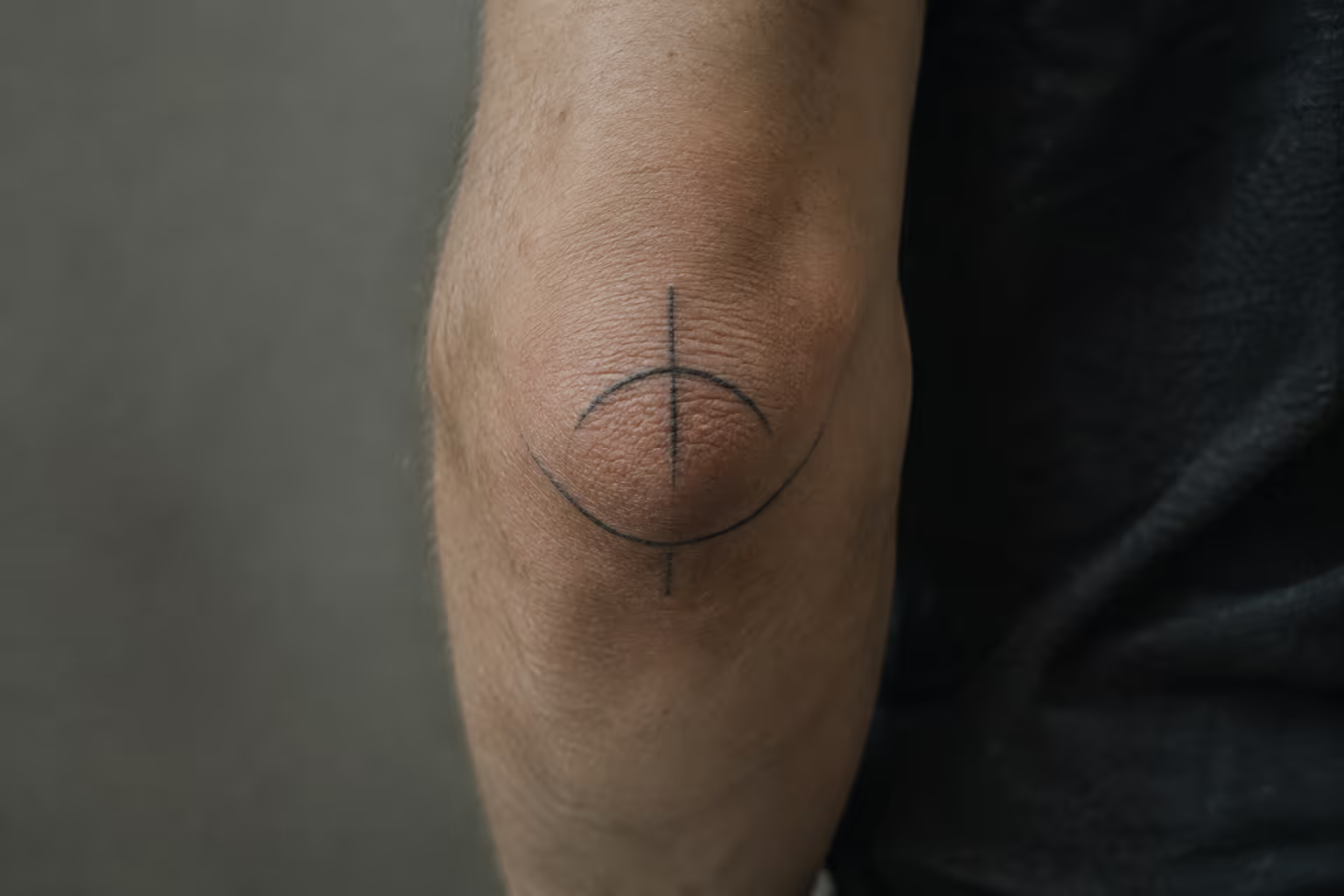
An elbow tattoo is two placements sharing one name. The point of the elbow is bony and barely shifts, while the ditch folds every time you bend your arm to pick up a coffee cup. Tattooers plan, price and heal these spots differently, so choose the exact location before you fall for a motif.
✓ Pros
- A compact joint can give a larger sleeve composition a clear visual hinge.
- The cap's rounded surface gives radial motifs a natural center.
✗ Cons
- The elbow is hard to keep out of everyday contact while it heals.
- A design placed across a moving crease can look different bent than it does straight.
Here is the trade-off in short. The elbow’s round shape suits radial designs, it reads from across a room, and it is the natural hinge for joining an upper-arm piece to a forearm piece. Against that, you get more pain and swelling than on the forearm, a higher blowout risk on thin joint skin, healing that is often uneven, friction from sleeves during recovery, and very little chance of hiding it in a short-sleeved shirt.
Elbow tattoo placement: point, ditch, or sleeve connection
The best position for an elbow tattoo depends on which of three zones you mean: the bony outer point, the folding inner ditch, or a design that connects into a sleeve (5)(9). Each zone moves differently, feels different under the needle, and asks for a different kind of design. Choose the zone first and let it narrow your motif options.
Point of the elbow (the cap)
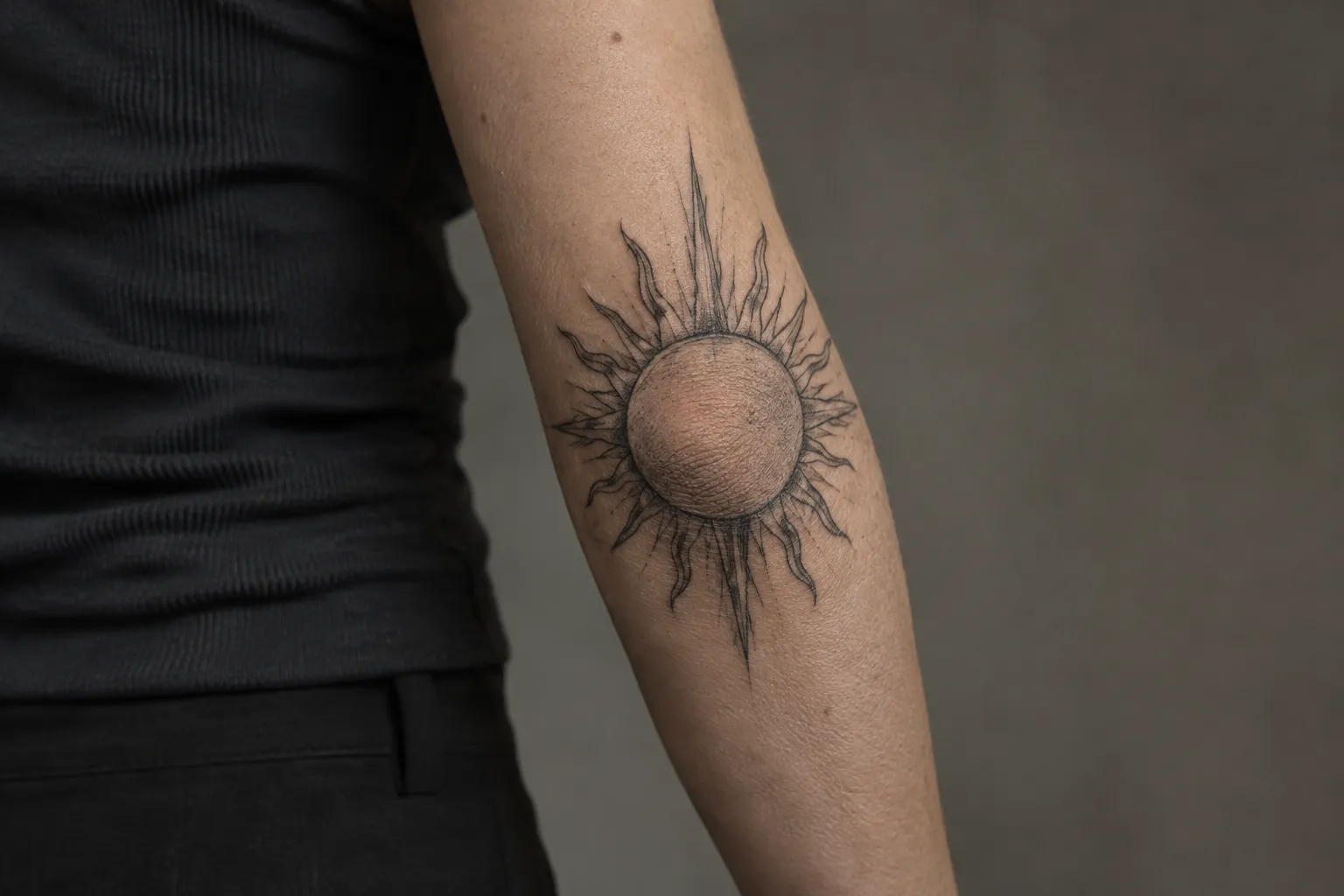
The cap sits over the olecranon, the bony knob at the back of the joint. The skin there is thin and has almost no fat underneath (5). When you straighten your arm the skin pulls tight over the bone. When you bend it, the skin wrinkles into loose folds. The bony knob stays the natural center of the joint in both positions, which is why circular layouts are the classic choice there, even though bending still compresses the middle of the design (5).
The ditch (inner crease)
The ditch is the soft fold on the inside of the arm, opposite the cap. It is less visible and more private (9). It also collapses on itself every time you bend your arm. A design that looks centered and crisp with your arm straight can pinch into a crease the moment you bend it.
Connecting to a sleeve
When the elbow joins a sleeve, treat it as part of the whole composition rather than a separate patch. A mandala can radiate out from the cap to connect the upper-arm and forearm work, and skin breaks (bare gaps left between elements) let the joint flex without distorting the image (14).
Point, ditch, or sleeve-connected elbow tattoo
| Point (cap) | Ditch (inner crease) | Sleeve connection | |
|---|---|---|---|
| Skin movement | Bony surface; skin shifts with bending | Folds deeply when the arm bends | Depends on the cap or ditch zone used |
| Pain notes | Often sharper than the forearm | Thin, sensitive skin; reports vary | Depends on the exact area tattooed |
| Design fit | Radial layouts, webs, mandalas, geometric work | Flowing motifs that avoid the deepest fold | Motifs integrated with work above and below |
| Healing and friction | Rubs on clothing; can heal unevenly | Repeated flexing pulls at the crease | Needs to account for clothing friction at the joint |
Pain at the point vs. the inner crease
Elbow tattoo pain depends on which spot you mean and on the person. The bony point generally hurts more than the forearm or upper arm because the needle works so close to bone (5). With almost no fat between the needle and the olecranon, the sensation is sharp and vibrating (5). The forearm, with more padding, feels dull by comparison.
The ditch hurts in a different way. The skin is thin and sensitive rather than bony, and one pricing guide describes the sensation there as a burning, nerve-type pain rather than the cap’s vibration (1). Some people find the crease worse than the cap and some find it easier, so don’t let one friend’s account set your expectations for both spots. If you know which areas bother you, ask your tattooer how the cap and the ditch compare for most of their clients. A tattooer who does a lot of elbows will have a better sense of this than any pain chart.
Swelling is a separate problem from pain, and the elbow is known for it: Inked Magazine notes there is even a nickname, “swelbow”, for how swollen the area gets after a tattoo (15). A joint that swells after a session can feel stiff and awkward to bend for a few days, even once the stinging has stopped. Plan the session before a few days when you won’t need to lean on your elbows, carry heavy bags in the crook of your arm, or wear tight sleeves. A desk job where you rest your forearms on the edge of the table counts.
On the day itself, eat beforehand (9), sleep properly the night before, and tell your artist about any medications you take. Skip alcohol before the session. Breaking a full cap into two sittings is a reasonable request if you are worried about lasting through it.
Elbow ditch tattoos: designs built for the bending crease
An elbow ditch tattoo should be drawn for a surface that folds. Flowing designs that bend with the skin, such as waves, suit the crease, and organic curves hold up better there than sharp angles or tight detail (9). The ditch spends half its life collapsed into a fold. Designs that follow the fold work with that movement: waves, vines, ornamental filigree that curves sideways, or a single flower whose petals open toward the forearm and bicep instead of sitting dead center.
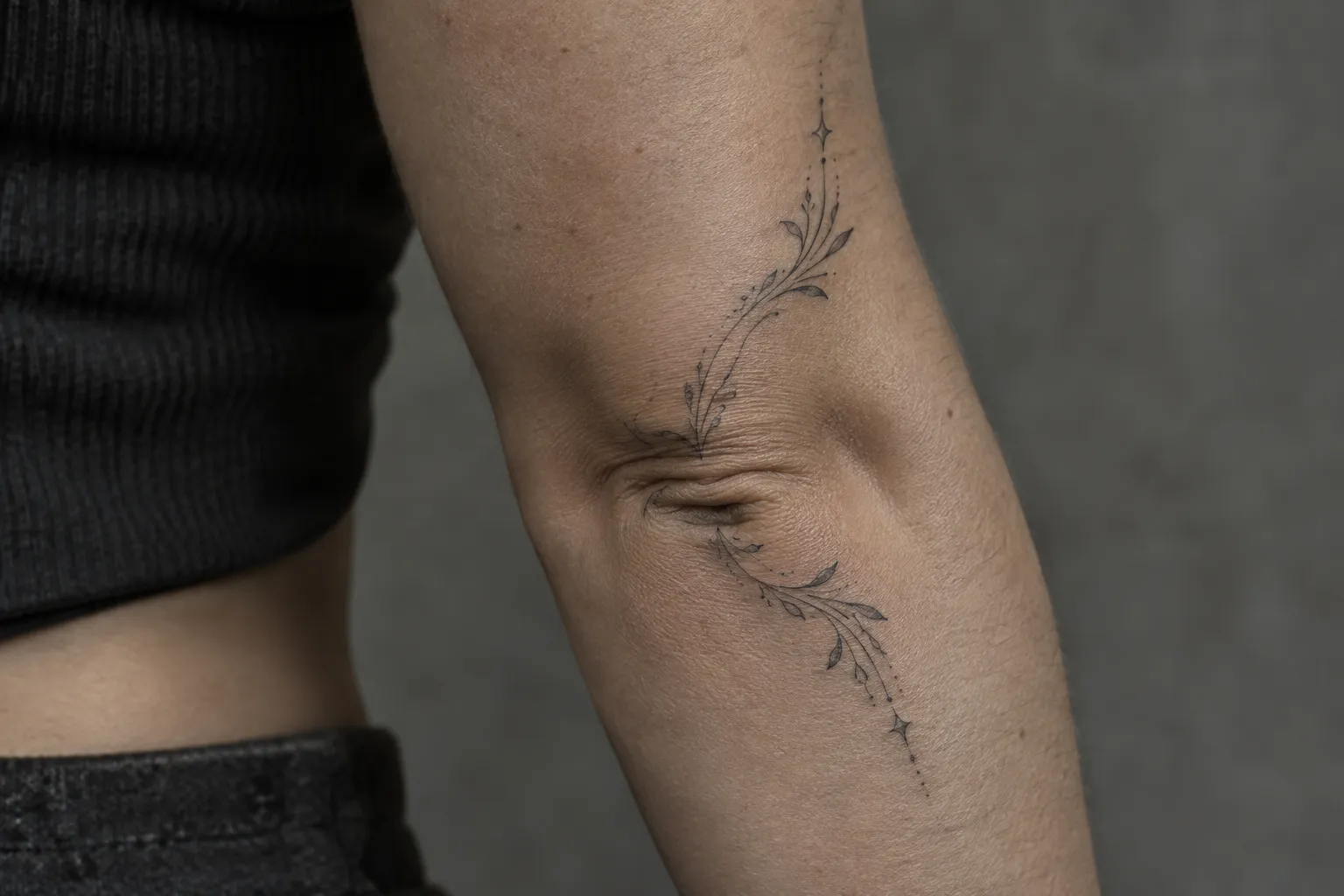
The crease line itself is the tricky part. Bold elements placed directly on the fold get squeezed and creased every time you bend your arm. During healing, that constant flexing pulls at the skin. Good ditch designs often leave the deepest part of the fold lightly worked or open, and put the heavier shapes just above and below it (9).
Why a mandala doesn’t always survive the crease
A mandala depends on symmetry. Every ring and spoke has to line up around a center point, and the eye picks up the smallest error. On the cap, the bone holds the center in place. In the ditch, the center folds in half every time you bend your arm. With your arm bent, the top half of the circle drops toward the bottom half and the rings stop looking concentric. With your arm straight, you see a stretched oval. If you want a mandala on the inner arm, ask the artist to scale it so the fold crosses its outer petals rather than its core, or move it to the point.
Design ideas for the point, the ditch, and sleeve tie-ins
Galleries of elbow work keep returning to the same four motifs: spiderwebs, mandalas, roses, and geometric patterns (7)(10). Each suits one zone of the joint better than another, and below is how they map.
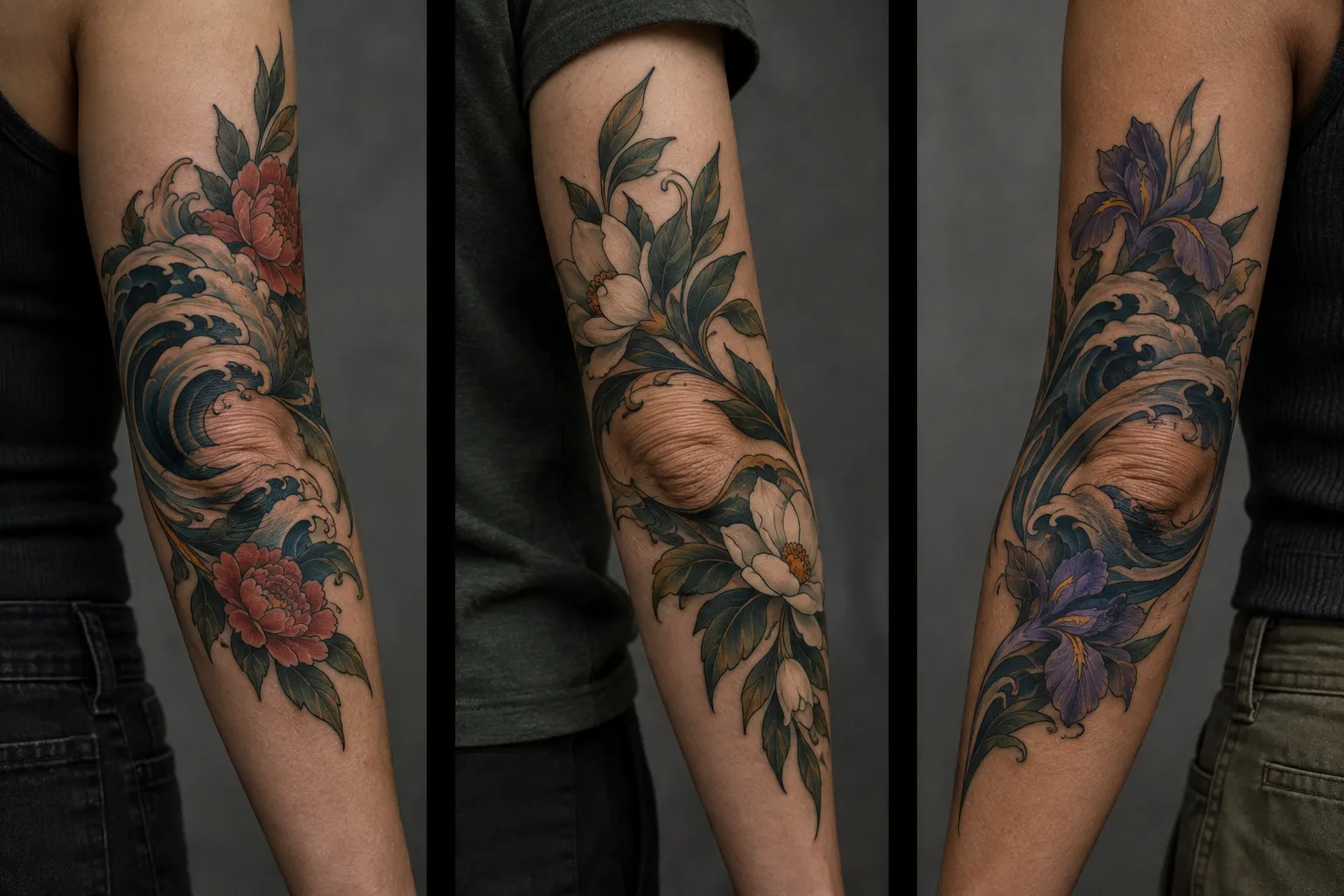
Point-of-elbow motifs: spiderwebs, mandalas, geometric work
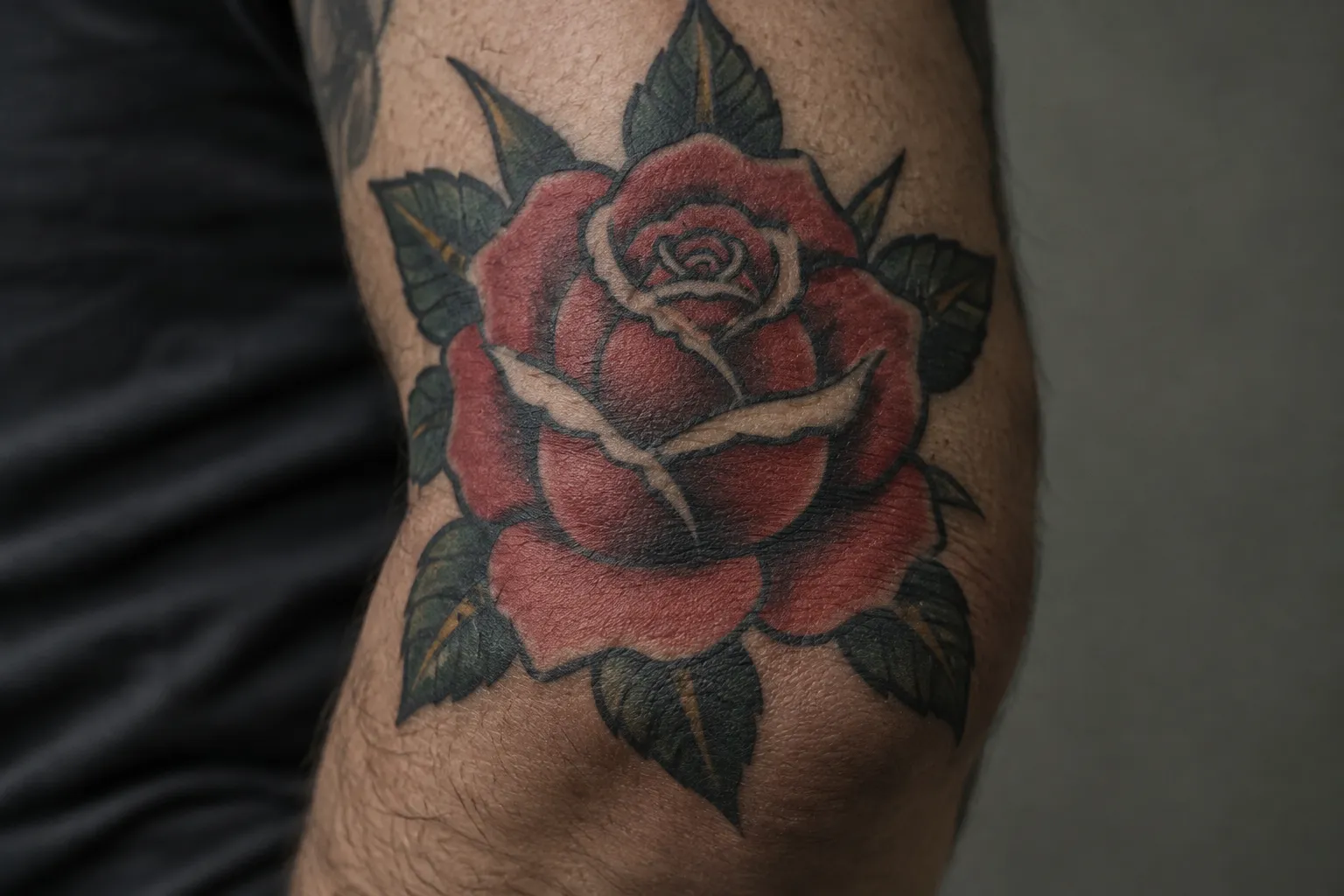
- Spiderweb on the cap: the classic. One design guide says the elbow web typically has 6 to 8 radiating spokes and favors bold black linework (7). In American traditional style, that means thick black outlines and a limited palette, perhaps a single red rose or a black spider hanging off one strand. The common pitfall when artists do this badly is spokes that wander off the bone’s center, so the web looks lopsided whenever your arm is straight.
- Mandala on the cap: the rings follow the curve of the bone. It suits blackwork and dotwork, and it can radiate outward into a sleeve.
- Geometric patterns: hexagons, concentric circles, sacred-geometry linework. These are strong on the point and need precise symmetry.
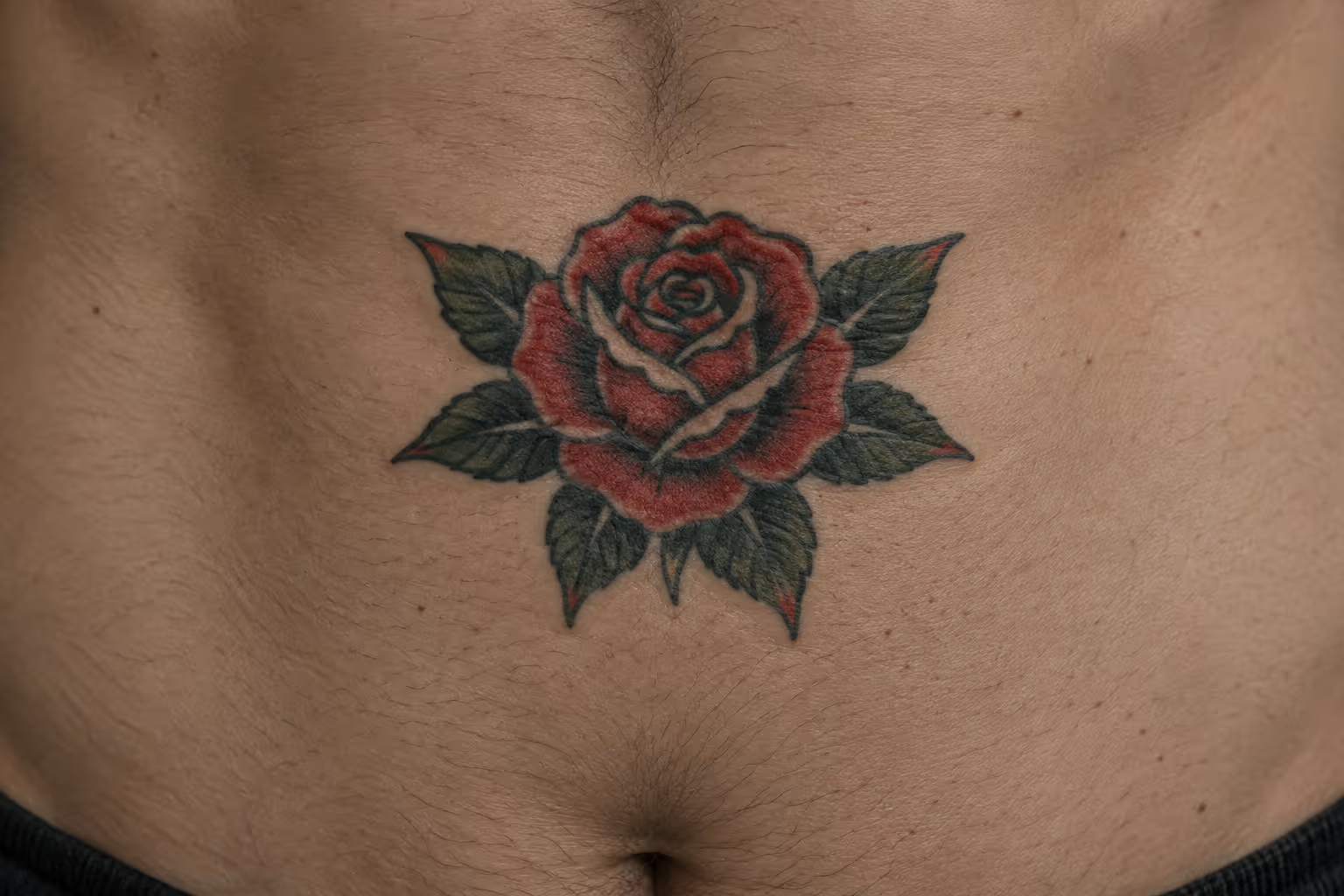
- Rose: works on the cap with the bloom centered over the bone, or in the ditch with the stem and leaves following the fold.
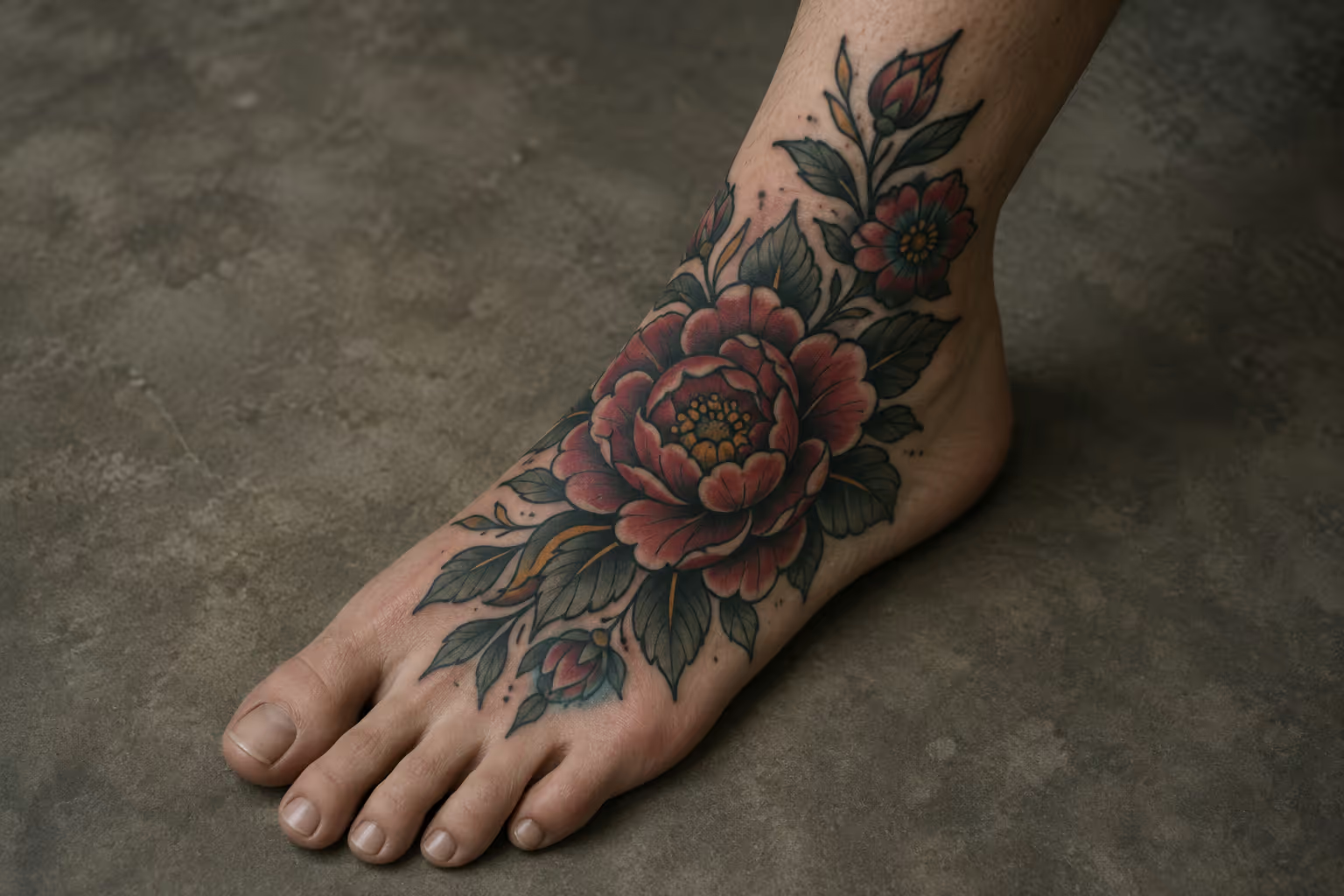
- Ditch-friendly options: waves, vines, filigree, and Japanese-style wind bars or water that can link into a larger sleeve.
Meaning depends on the motif, not on the elbow. The placement itself carries no fixed meaning. The spiderweb has the loudest history. By the mid-to-late 20th century it was closely tied to U.S. prison culture, and some people still read it that way (11). It is also widely worn in mainstream and alternative tattooing as a symbol of resilience and nonconformity (11). Modern interpretations favor the web for its radial symmetry, which fits the elbow cap (14). Mandalas come from Hindu and Buddhist religious art. In Western tattooing they are mostly chosen as geometric ornament, and that shift is worth knowing if the original meaning matters to you.
Keeping detail legible on a moving joint
Fine detail and thin lines are less forgiving on a joint, so the industry advice is consistent: keep the design simpler and bolder, with fewer fine details (5)(6)(13). A spiderweb guide recommends strong anchor lines and deliberately planned open areas so the design stays readable at joint placements (11). For a first elbow piece, a bolder layout is the safer bet. An experienced artist can adapt more complex work to the joint. Ultra-fine single-needle linework on the cap is the design most likely to look patchy once it heals.
Movement, blowout risk, and the stencil check
The elbow’s mobility and thin skin make stencil placement and needle depth harder than on flat skin, so the artist should check the stencil with your arm both bent and straight (8)(11).
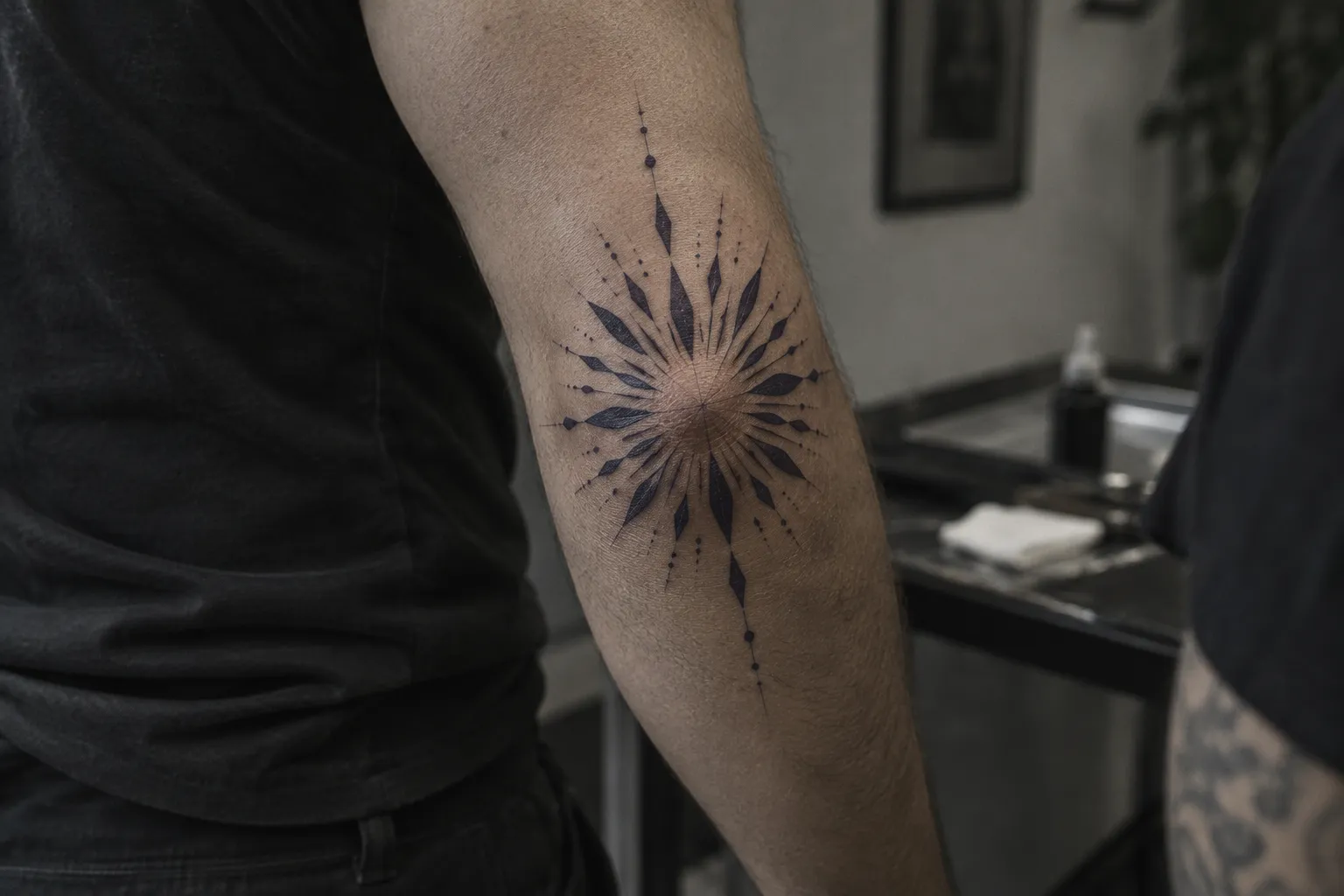
Checking the stencil bent and straight
A design placed on a straight arm can distort once you bend it, which is why sleeve artists ask the client to bend and straighten the arm once the stencil is on (8). A careful tattooer will have you bend and straighten several times and look at the stencil from behind and from the side. If the web’s hub slides off the bone or the ditch design folds through its focal point, the stencil comes off and goes back on. That costs a few minutes. Skipping it costs you a lopsided tattoo for life. If your artist doesn’t do this, ask them to.
Why blowout risk runs higher on joints
Blowout happens when ink is pushed too deep, past the dermis and into the fatty tissue below, where it spreads and blurs the lines (6). On the elbow, the skin over the olecranon is thin with almost no subcutaneous fat (5). That leaves very little margin between correct depth and too deep, and the uneven surface makes it harder for the artist to keep the needle at a steady depth. Joint tattooing calls for adjusting both the needle depth and the design’s complexity to fit the surface (5)(13). Blowouts are permanent and don’t heal away (6). The best prevention is an artist who tattoos joints regularly (6).
Healing timeline, normal signs vs. warning signs
On flat skin, a fresh tattoo passes through its visible healing stages in about two to three weeks: an NHS medical-tattooing leaflet describes 14-21 days for three stages of healing (3). That leaflet covers medical tattooing, not elbow work, and joints run slower. One joint-aftercare guide expects the surface of a joint tattoo to take 3 to 4 weeks to close instead of the usual 2 to 3, and notes that bending cracks the healing skin open dozens of times in the first 48 hours, which is why elbow tattoos often look patchy after peeling even when the work was clean (12). The stages follow the same order as any tattoo aftercare timeline; the joint mostly stretches them. Fading on the elbow comes from the placement as much as from the healing, since tables, armrests and sleeves keep rubbing the skin long after it closes (5). Plan on a touch-up for a cap or ditch piece (5).
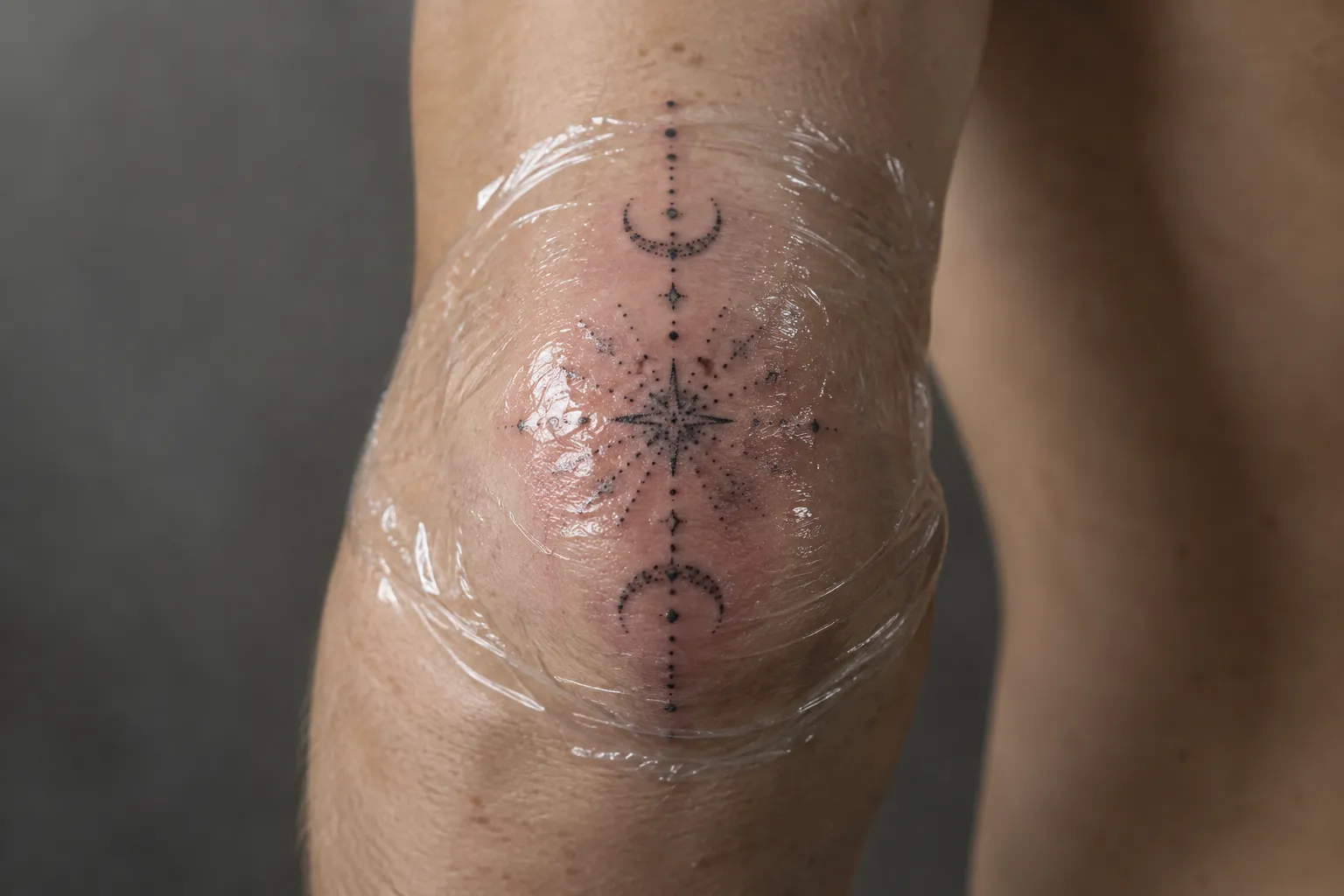
What’s normal in the first weeks
According to the American Academy of Dermatology, soreness, some redness and swelling, clear fluid, itching, flaking and scabs can all be part of normal healing (2).
- Day 1-3: soreness, warmth, swelling, and clear fluid. Bending the arm feels stiff. Follow your tattooer’s dressing instructions.
- Day 4-7: the surface turns tight and shiny and starts to flake. On the elbow, small cracks often open across the crease; cracks that don’t bleed usually close within a day if the skin stays lightly moisturized (12).
- Week 2: peeling and itching. The ink can look cloudy or patchy, especially at the point. Don’t scratch.
- Week 3-4: the surface closes, about a week later on a joint than on flat skin (12). Judge saturation around week 6, once the skin has settled, not mid-peel.
When to call a doctor
The AAD lists these warning signs of infection: redness that darkens or spreads instead of fading, pain that continues or gets worse, pus, open sores, fever, and chills (2). Hot skin and redness that keeps spreading also mean you should get medical advice rather than wait (2)(4). See a doctor or a board-certified dermatologist promptly. The sooner treatment starts, the less damage it can do to your health and your tattoo (2).
The routine below follows Cleveland Clinic’s dermatologist advice on washing, drying and moisturizing (4), with one joint-specific rule: keep the elbow moving gently through its normal range rather than holding it straight, because a joint kept still for days tends to crack when you finally bend it (12).
Keep the healing tattoo out of direct sun for the first four to six weeks. Once it has healed, protect it with clothing or a daily SPF 30 or higher so the black stays solid (12).
How to care for an elbow tattoo
Follow a gentle wash-and-monitor routine while the elbow heals, and reduce rubbing without immobilizing the joint.
- 1
Wash gently
Twice daily, wash with warm water and mild fragrance-free soap, following your tattooer's dressing instructions.
- 2
Pat dry and moisturize
Pat the area dry with a clean paper towel, then apply a thin layer of fragrance-free moisturizer or your tattooer's recommended ointment.
- 3
Leave peeling skin alone
Do not pick flakes or scabs; let them fall away on their own.
- 4
Limit rubbing while keeping the joint moving
Move the elbow gently as usual, but avoid tight sleeves, leaning on tables, and other friction against the fresh tattoo.
- 5
Check for warning signs
Watch for spreading redness, worsening pain, pus, open sores, fever, or chills, and contact a doctor promptly if they appear.
Cost and what to ask before you book
A July 2026 pricing guide puts a small standalone elbow piece at $150-$300 USD and a full elbow cap or ditch design at $400-$800 USD (1). Budget scales with scope, not just size: the same guide prices the elbow higher per square inch than a forearm or bicep, because the bone contour, the stretch and the extra passes all take chair time (1). Budget for a touch-up too.
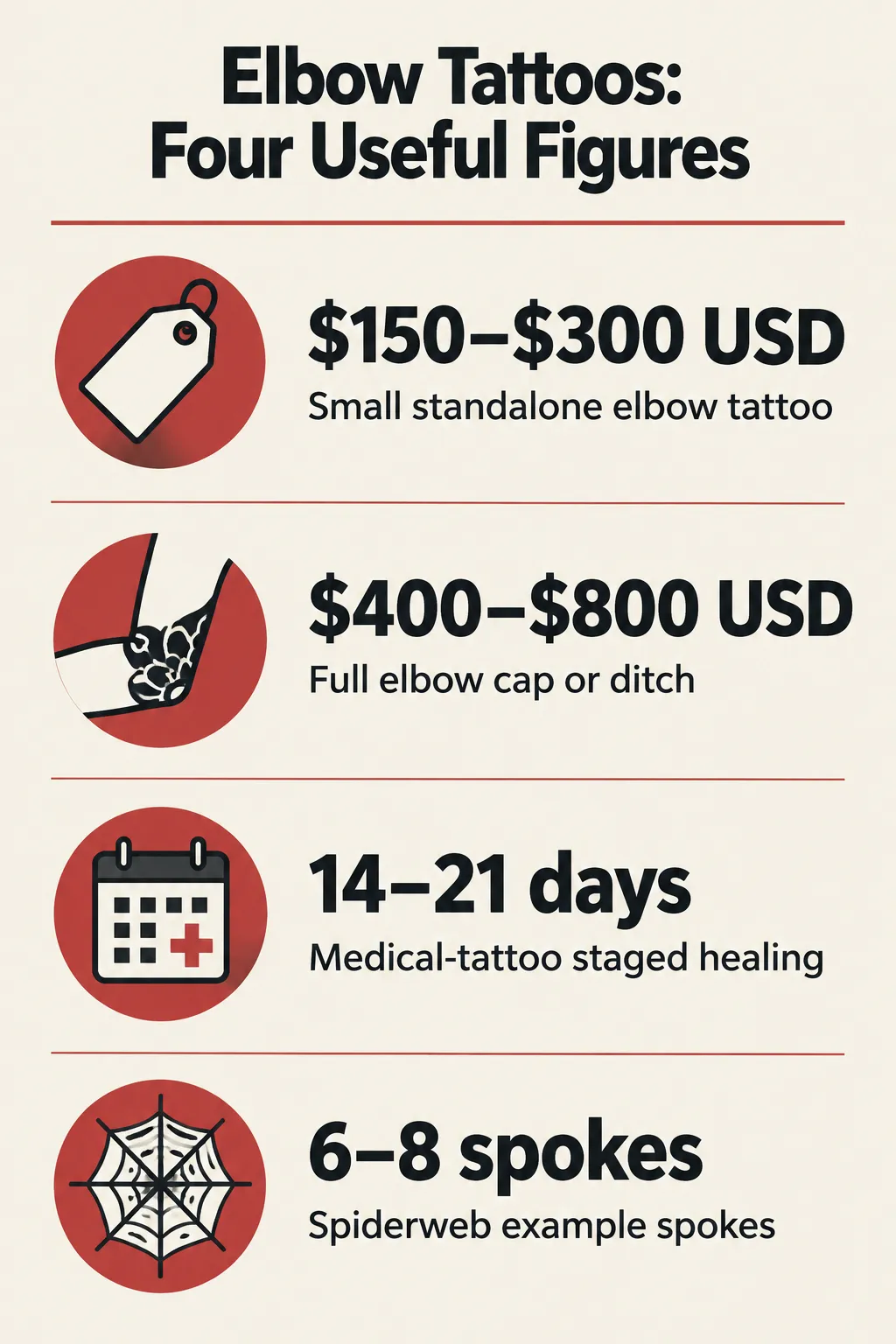 Four reference figures: $150-$300 USD for a small standalone elbow tattoo, $400-$800 USD for a full cap or ditch design, 14-21 days for the staged healing in an NHS medical-tattooing leaflet, and 6 to 8 spokes in a typical elbow spiderweb.
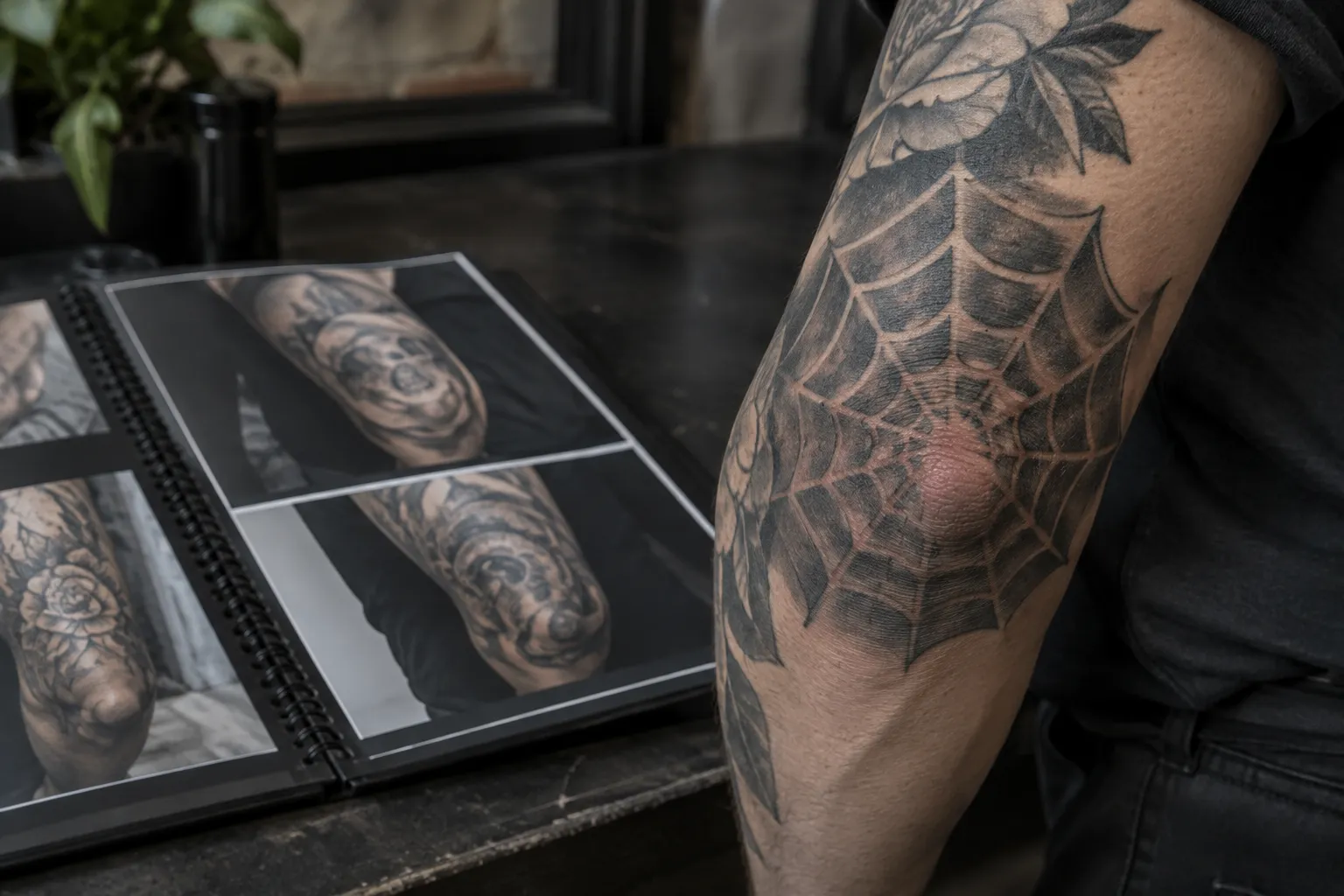
Pick an artist with healed elbow work in their portfolio, not just fresh photos. Ask to see healed caps and ditches, and talk through line weight, the level of detail, and the chance of uneven healing before you commit (5).
Before you book, confirm these three things:
- Location: cap, ditch, or sleeve connection, and a design drawn for that zone.
- Stencil check: placed and checked with your arm bent and straight before the machine starts (8).
- Aftercare plan: a twice-daily gentle wash with fragrance-free soap, a thin layer of moisturizer, no picking (4), and the warning signs that mean calling a doctor (2).
Frequently Asked Questions
- Is the elbow painful to tattoo?
- The elbow point is often sharper than a forearm tattoo because the skin sits close to bone; the ditch feels sensitive, and pain reports vary.
- What does an elbow tattoo mean?
- The elbow itself has no fixed tattoo meaning; spiderwebs carry a U.S. prison-culture history, while modern Western wearers may choose them for their radial shape.
- What is the best position to tattoo an elbow?
- Place radial designs on the cap and flowing work along the ditch; ask the artist to check the stencil with your arm bent and straight.
- Do elbow tattoos fade quickly?
- Faster than flat skin: bending can crack the healing skin and pull pigment out, and tables and sleeves keep rubbing the joint, so plan on a touch-up and judge the result once the skin has settled.
- What is swelbow?
- Swelbow is a nickname for the swelling an elbow often gets after a tattoo session; swelling that worsens along with spreading redness, heat, or fever needs medical attention.
- Why are elbow tattoos difficult to do?
- The elbow combines thin, uneven skin with constant movement, so the artist must control needle depth and check how the design shifts across positions.
- What elbow tattoos can cover an old tattoo?
- A dark radial design may cover some cap tattoos, but a consultation with clear photos is needed to assess the old ink's darkness and placement.
Picking the spot before the design
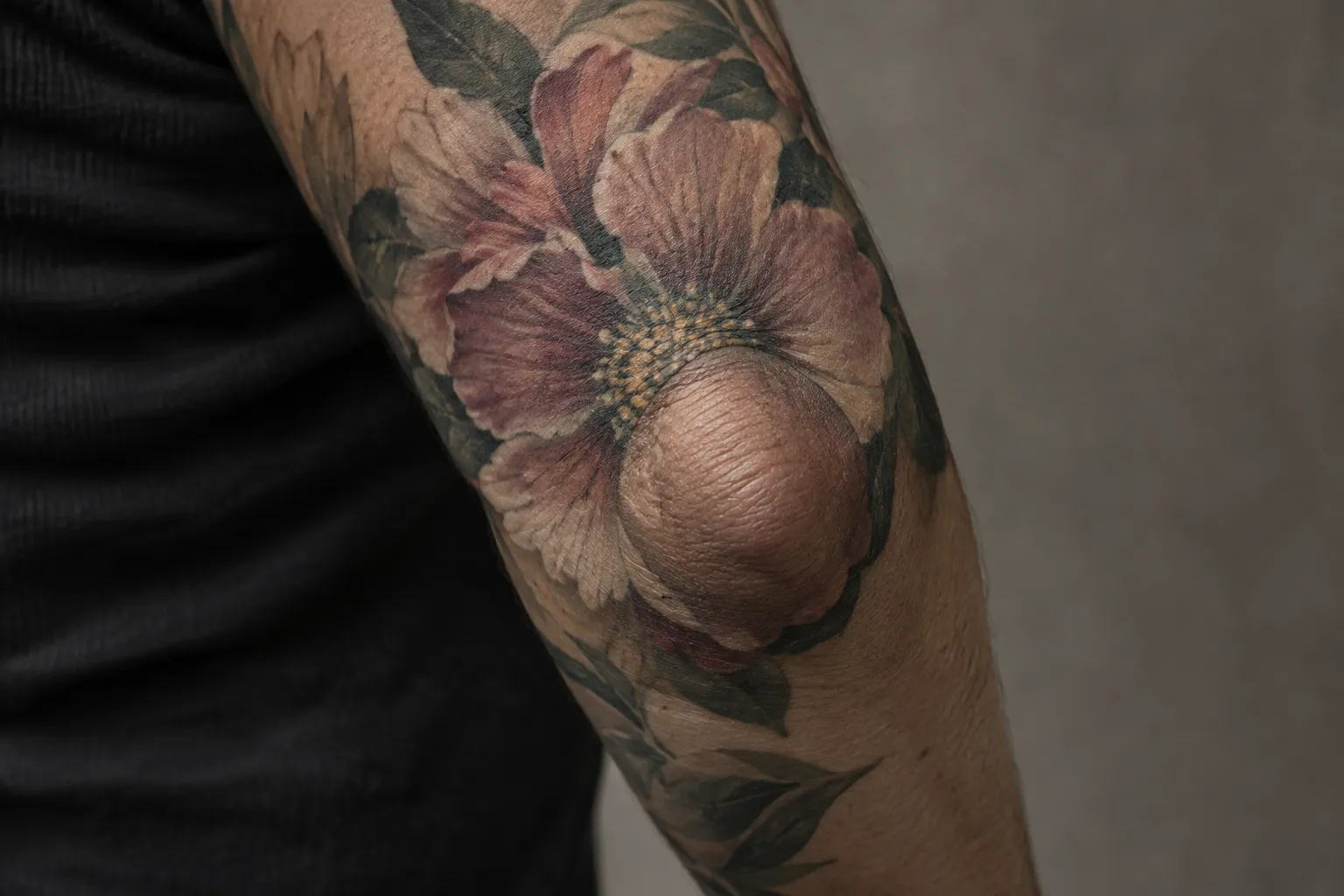
The point and the ditch are different placements with different pain, design fit, and healing demands. Let the location decide the design: radial and bold for the cap, flowing for the crease, and integrated into the sleeve when the elbow is a connector. Book an artist with healed joint work in their portfolio. If you are still weighing the elbow against other spots, the tattoo placement guide compares pain, visibility and aging across the body.