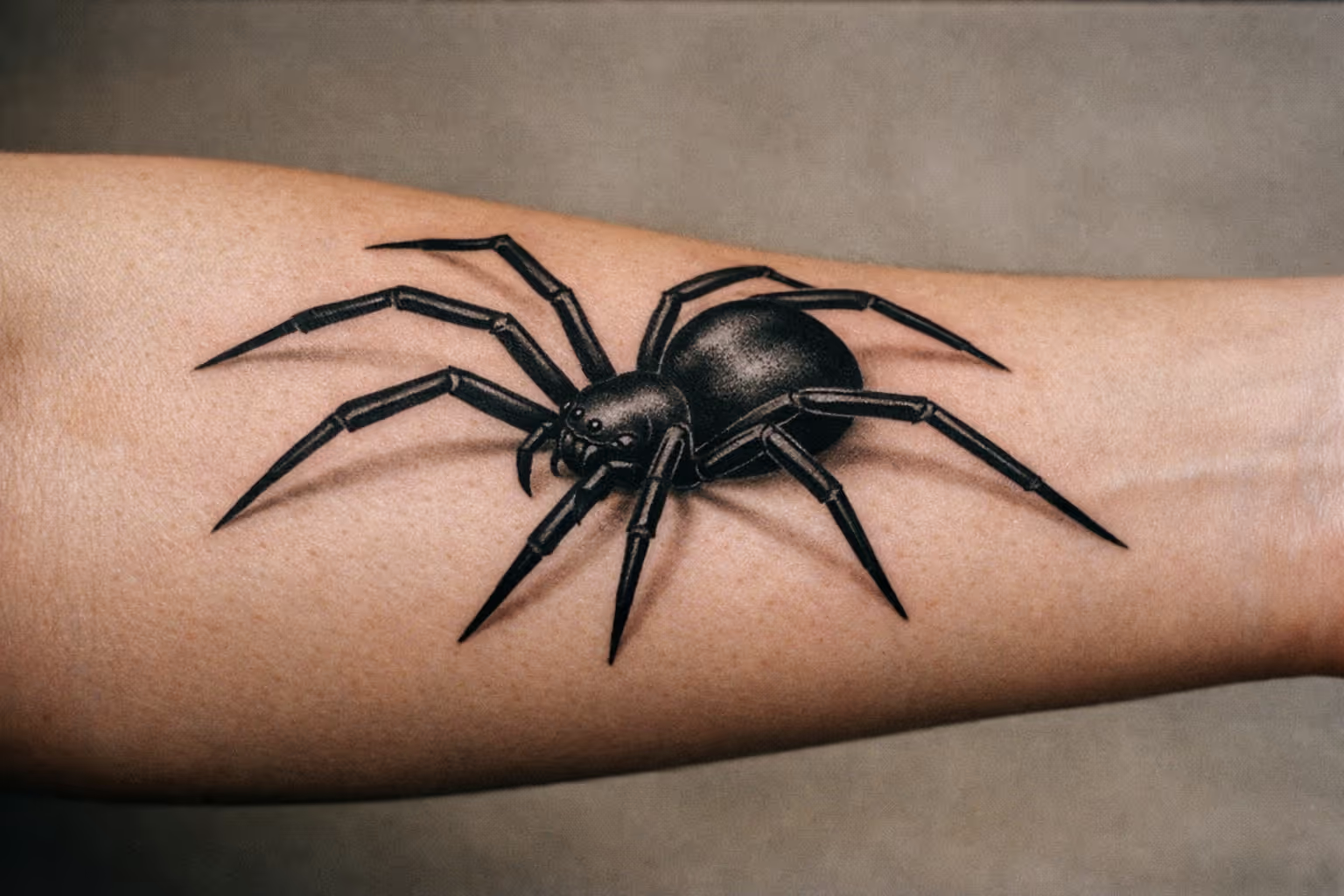
The spider tattoo meaning splits harder by design than almost any motif - and one version carries baggage worth knowing before you book. An elbow web reads, in prison culture, as time served; wear it casually and you may be claiming something you didn’t live. Elsewhere the spider is a benevolent creator: Anansi in West African lore, Grandmother Spider in Native American tradition. Here’s what each spider and web actually signals, so the piece says what you mean.
Why Spider Tattoos Are Trending Right Now
The rising interest in spider tattoos is not just about their striking visuals but also the rich spider tattoo meaning that resonates with many wearers. Spider and web designs sit comfortably in the top 10 animal motifs requested in Western studios, accounting for roughly 8-12% of “creature” requests in 2024. Pinterest and Instagram searches for “spider tattoo” have climbed 20-30% year-over-year since 2022, driven by three things hitting at once:
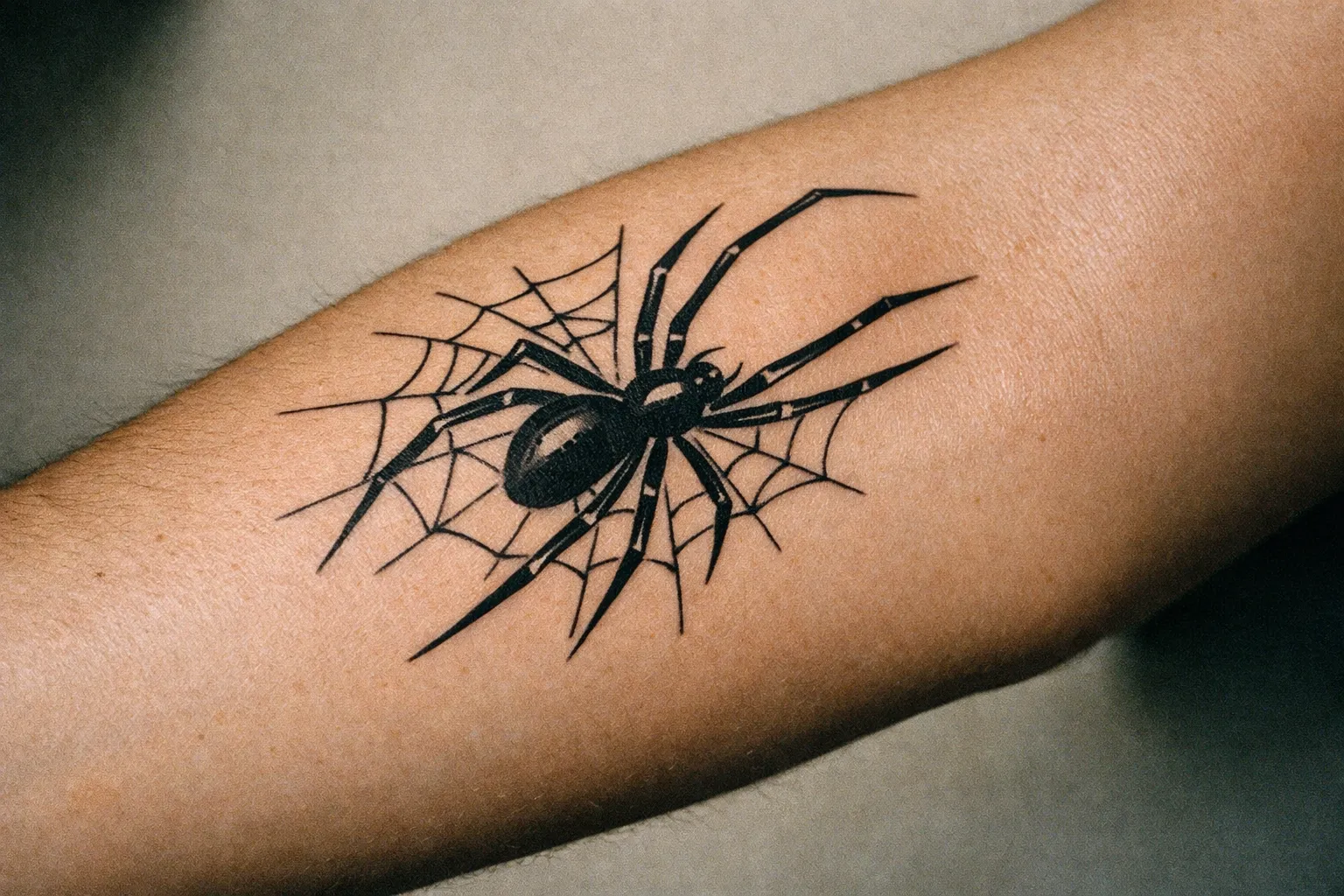
- Traditional and neo-traditional flash revival - bold black outlines, limited palettes, and old-school imagery are back in heavy rotation.
- Horror and alt aesthetics - goth, punk, and Halloween-adjacent imagery moving into mainstream tattoo culture.
- Small spider tattoos - fine-line micro designs that photograph well and read clearly on social media.
The spider is also one of the few motifs that legitimately works at every scale. A 1-inch fine-line piece behind the ear reads just as intentional as a back-piece web composition. That versatility is part of why it keeps showing up in consultations.
What a Spider Tattoo Means in Western Culture
In the US and Europe, the core meanings cluster around six themes:
- Patience and perseverance - spiders wait, rebuild webs every night, and don’t quit.
- Craftsmanship - they’re literal weavers, so makers, artists, and builders gravitate to the symbol.
- Feminine power - tied to the Greek myth of Arachne, the mortal weaver turned into the first spider after challenging Athena.
- Protection - a guardian sitting at the center of its web, defending territory.
- Transformation - molting, rebuilding, surviving.
- Mystery and fate - the spider as a quiet architect of what comes next.
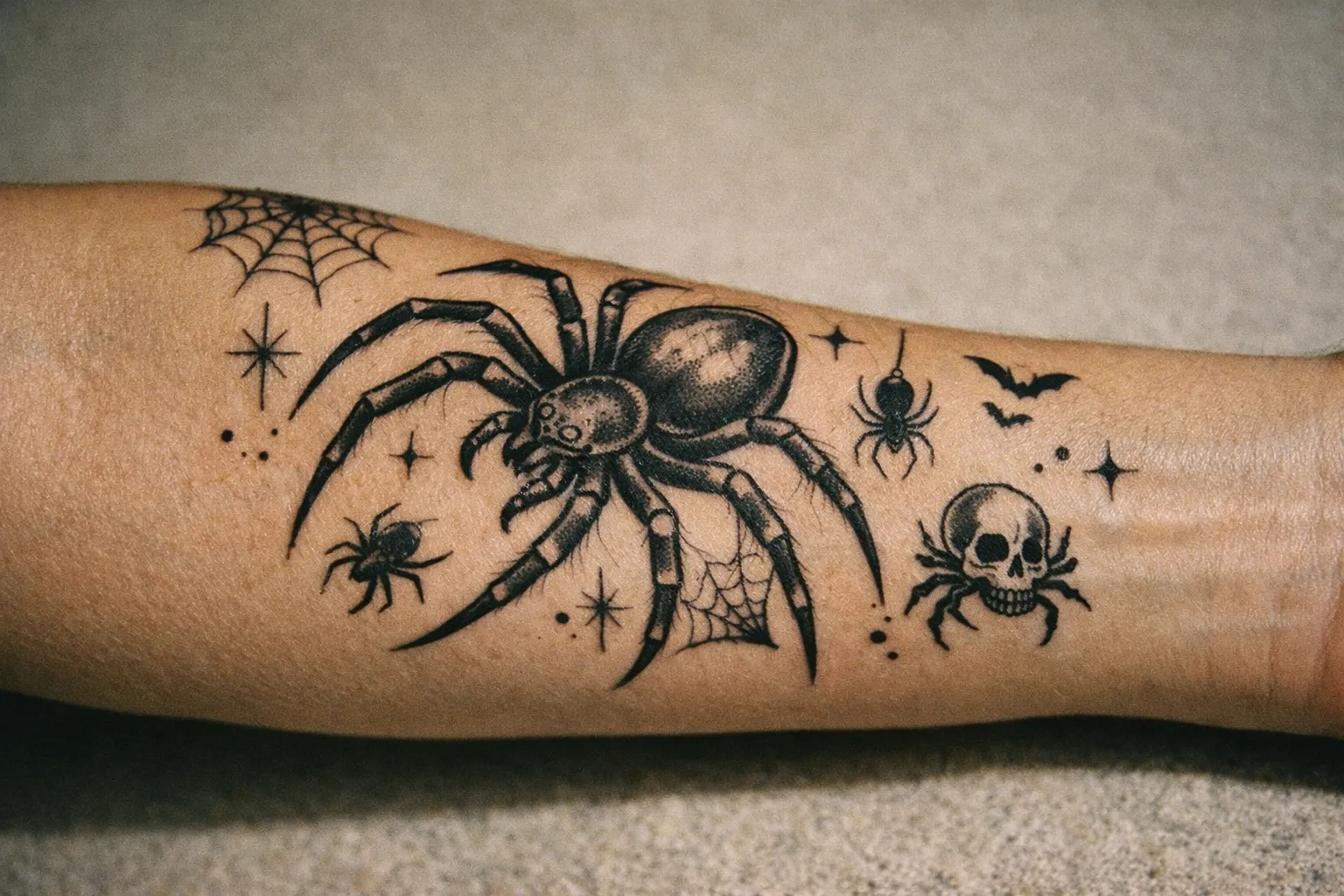
A traditional spider tattoo in the American old-school vocabulary leans on the first three. Two technical hallmarks define the style: thick, even black outlines and a limited palette - usually black, red, yellow, and green. Common pairings are roses, daggers, eight-balls, and skulls. The pitfall when artists do this style badly is thin, inconsistent linework that won’t hold up at 10 years. The whole point of traditional is that it ages well, and that only happens when the lines are laid heavy and saturated. I’ve seen plenty of “traditional” spiders come back for reworks at the five-year mark because the original artist went too light on the outline weight.
The Spider Web Meaning - Not the Same as the Spider
The web carries its own symbolism, and in a lot of contexts it’s the more loaded image of the two.
Across ancient cultures, the web has been read as the connection between everything that exists - fate, interconnection, the structure underneath visible reality (2)(4). Plenty of modern wearers use it for resilience, surviving hardship, or “everything is connected” symbolism.
But the web is also the image that carries prison and subcultural codes, and you need to know those before you commit. More on that below.
Spider Tattoo Meaning in Other Cultures
The spider is one of the few animals that shows up as a positive figure across most world traditions. If you want a meaning that isn’t horror-coded, this is where to look.
- Native American - Grandmother Spider is a creator and wisdom keeper in several traditions; the web is the web of life and a protective form (think dreamcatcher) (1)(3)(4).
- African (Akan/West African) - Anansi the spider is the trickster-storyteller, symbolizing intelligence, narrative power, and clever survival (1)(3).
- Hindu - the spider weaves cosmic reality; the web is linked to Maya, the illusion that veils the deeper structure of existence (4).
- Celtic - feminine energy, patience, persistence, and overcoming obstacles (3).
- Japanese - kumo can mean either good fortune or deception depending on context, so design choices matter here. A spider in a sun motif reads very differently than one rendered in yokai-style horror.
- Ancient Greek - Arachne, the weaver punished by Athena, ties the spider to feminine craft and hubris.
The eight legs themselves carry meaning in several systems - progression, infinity (a horizontal 8), or harmonic balance (4). Worth knowing if you’re drawing on a specific tradition rather than just the general Western reading.
Is a Spider a Demonic Symbol?
Short answer: no, not in any dominant tradition.
Most documented cultures treat spiders as creative, protective, or wisdom-bearing figures - Grandmother Spider, Anansi, the cosmic weaver of Hindu thought, the Celtic patience symbol (1)(3)(4). The “spiders are demonic” reading is mostly a modern Western horror association, reinforced by movies and Halloween imagery, plus some fringe Christian and occult interpretations that link them to trickery or dark forces.
If you want the protective or creator reading to come through clearly, pair the spider with mandalas, floral patterns, sun shapes, or dreamcatcher-style webs. Pair it with inverted crosses, skulls, and flames, and you’re deliberately leaning into the horror angle. Both are valid choices - but the supporting elements drive the read, not the spider itself.
What Does a Spider Tattoo Mean in Jail?
This is where the spider/web distinction gets serious.
In US prison culture, it’s typically the Spider web Tattoo - not the spider itself - that carries the carceral code (2)(3). The web, placed on the elbow, knee, or neck, historically marks long incarceration and being “caught in the system.” Some sources note that each concentric ring of the web can represent one year served (3).
Webs have also been associated, in specific US regions and decades, with white supremacist or gang affiliations (3)(5). That association isn’t universal and the code varies by era and region, but it’s well-documented enough that a lot of artists now require a consultation before putting a web on someone’s elbow. I’ve had that conversation more than once, and it’s not an awkward one - it’s just part of doing the job responsibly.
A few practical clarifications worth keeping straight:
- A spider sitting in a web on a forearm or shoulder generally reads as decorative - patience, protection, craft.
- A bare web wrapped around an elbow or knee, especially in stark black linework, is the placement that triggers the prison reading.
- A neck web reads as a hard subcultural statement regardless of intent.
Outside prison, spider web tattoos are also popular with bikers, punks, and goths as symbols of nonconformity and personal strength (2). Same image, different room - and people will read it based on the room you’re standing in.
Spider Web Tattoo on Elbow - What to Know Before You Get One
The spider web tattoo on elbow is one of the most recognizable old-school motifs in Western tattooing, and one of the most commonly misunderstood. Modern clients are increasingly choosing it for aesthetics rather than identification (2)(5), but if you’re getting one, plan for three things:
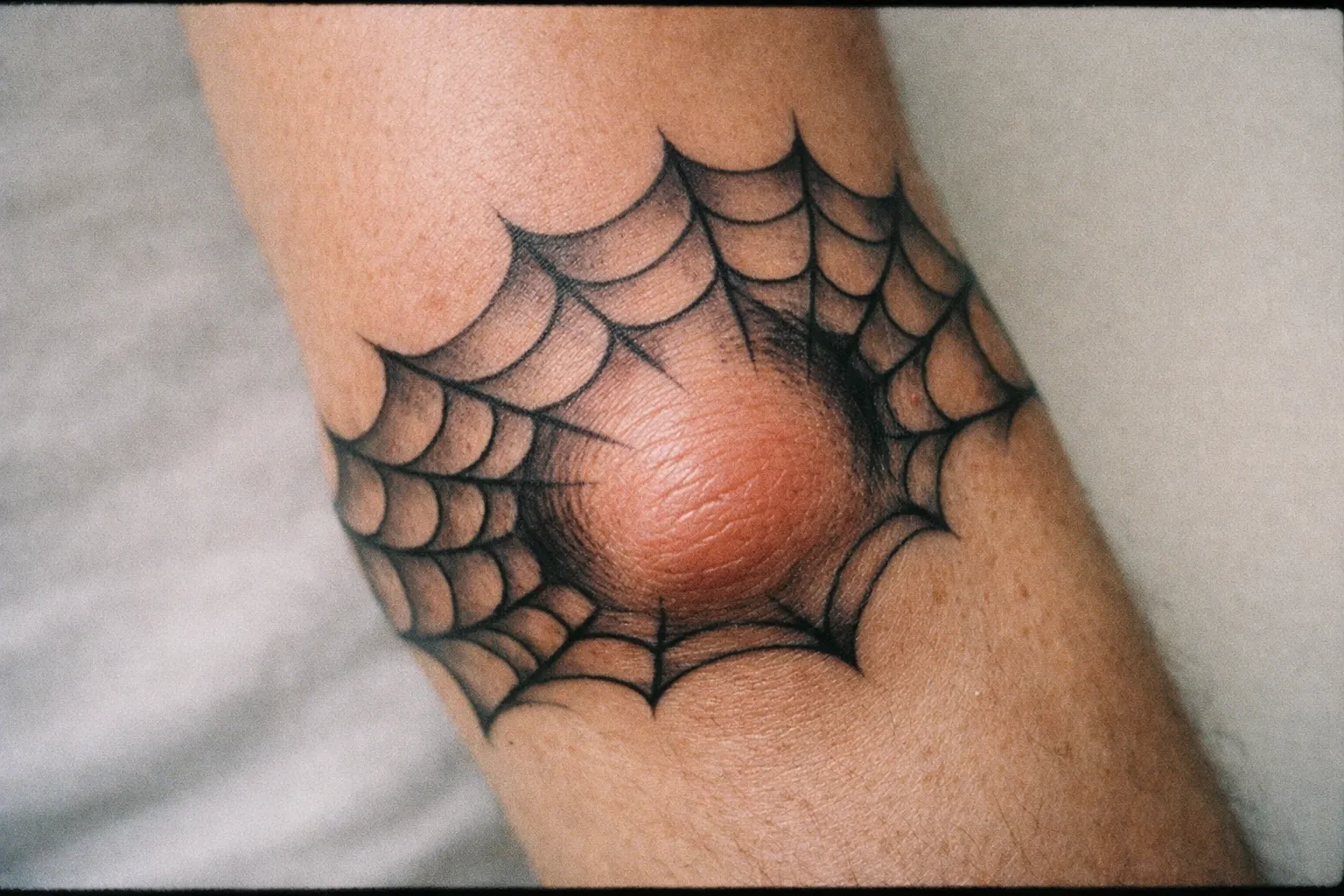
- The conversation. People will ask. Decide now whether you want to explain it every time, or whether you’d rather move the design to a less coded spot.
- The pain. Elbow placement sits at the high end - bone is directly under thin skin, with no fat or muscle to cushion. In relative terms: ribcage and sternum hurt more, but elbow and knee are firmly in the “you’ll remember this session” tier. Harder than a forearm, no question.
- The aging. Joint skin moves constantly, which means blowouts and line spread are more likely here than almost anywhere else. Lines can spread 0.5-1 mm over a decade, so dense web patterns can muddy badly.
If you like the look but want to dodge the prison association, a partial web on the upper arm, shoulder, or behind the ear reads as decorative rather than carceral. Same visual language, different conversation.
What Is the 1/3 Rule Tattoo?
The “1/3 rule” comes up a lot in connection with web tattoos, and it’s worth clarifying because it means two different things depending on who you ask.
In photography and visual composition, the rule of thirds is about placing focal points off-center. In tattoo design - particularly for dense black areas like web fills - experienced artists often use a working heuristic of roughly one-third solid black, one-third mid-tone or linework, and one-third bare skin. The goal is to keep the design readable as it ages: pure blackout sections lose detail and can blur into a single dark patch, while pure linework can look anemic at 10 years out. A balanced ratio gives the eye something to track over time.
Not every artist names it that way, and it’s not a hard rule. But if you’re getting a large web, ask your artist how they’re balancing solid black against negative space. If the answer is “I’ll just black it all in,” think carefully about whether that’s still going to read as a web in 15 years.
Why People Are Getting Spider Tattoos Now
Beyond the trend cycle, the modern motivations cluster around four things (1):
- Personal transformation. Recovery from something - addiction, grief, a long stretch of mental health work - using the spider as a symbol of solitary persistence.
- Craft identity. Artists, designers, writers, weavers, coders, builders. People who make things relate to a creature that builds nightly.
- Protection and boundaries. The spider’s venom and guarded web as a metaphor for self-defense and refusing to be walked over.
- Aesthetic and subculture. Punk, goth, alt fashion, Halloween-adjacent imagery - the spider just looks good on a body.
The first two are why spiders aren’t going to fade as a motif anytime soon. They map onto experiences plenty of people want to mark, and that kind of staying power doesn’t come from trend cycles.
Spider Tattoo Designs Worth Considering
Style choices drive how the meaning reads. Here are the spider tattoo designs that hold up best in practice.
Traditional Spider
Bold black outlines, limited palette, often paired with roses, daggers, or skulls. Reads as Americana, sailor-rooted, tough. Best placement: forearm, outer bicep, calf. Size: 3-5 inches for the linework to breathe properly.
Black Widow
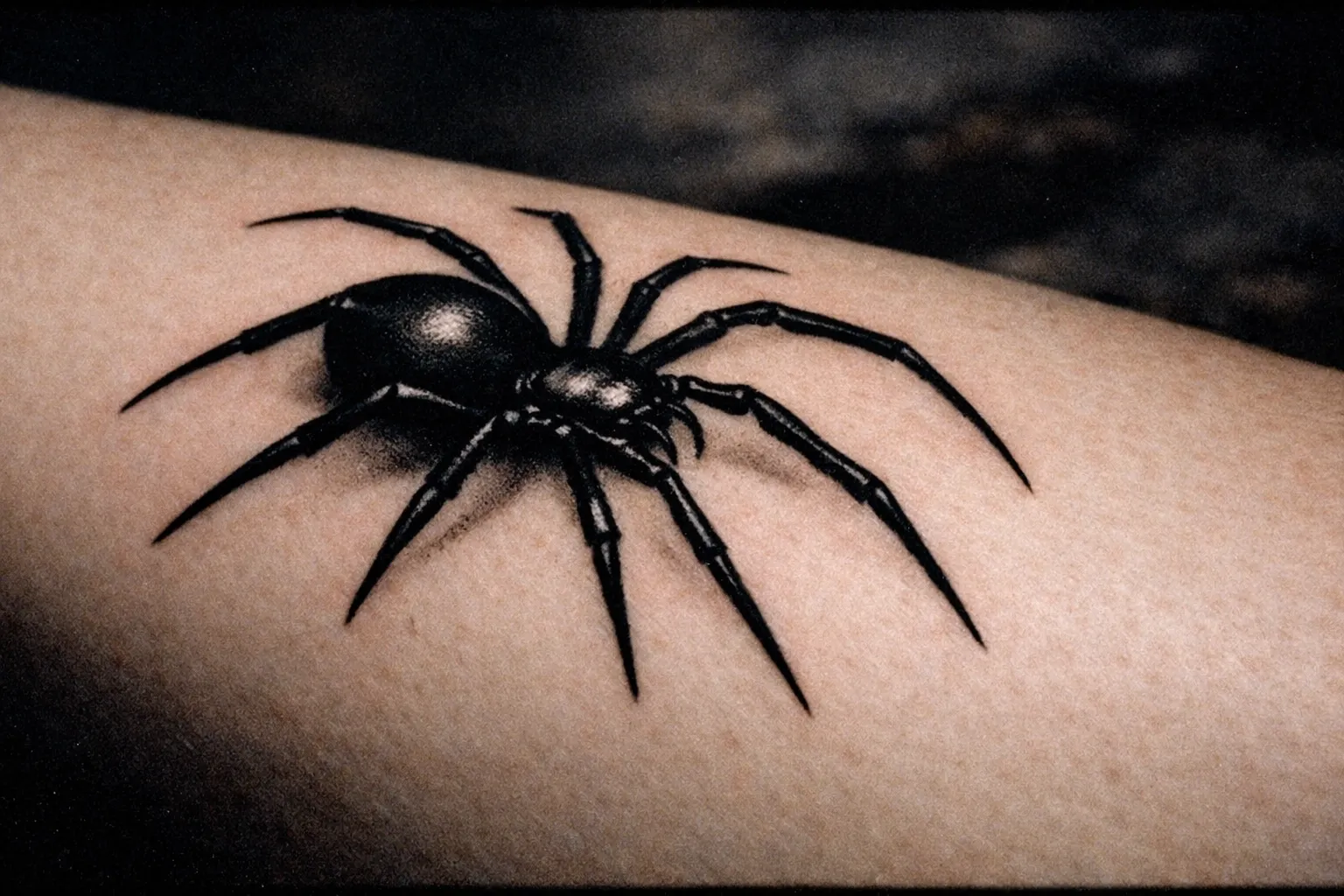
Realistic or semi-realistic, black body with the iconic red hourglass. Conveys danger, seduction, power. Black and grey with one strategic spot of red ages better than full color - I’ve seen full-color widows go muddy within a decade when the red starts to spread. Best placement: forearm, shoulder, sternum. Size: 3-6 inches.
Spider on Web
The full composition - spider as the focal point, web as the structure. This is the design that reads cleanly as “patience and craft” without prison associations, as long as the web isn’t sitting on an elbow or knee. Best placement: chest, upper back, outer thigh. Size: 6 inches and up so the web detail has room to survive.
Small Spider Tattoo
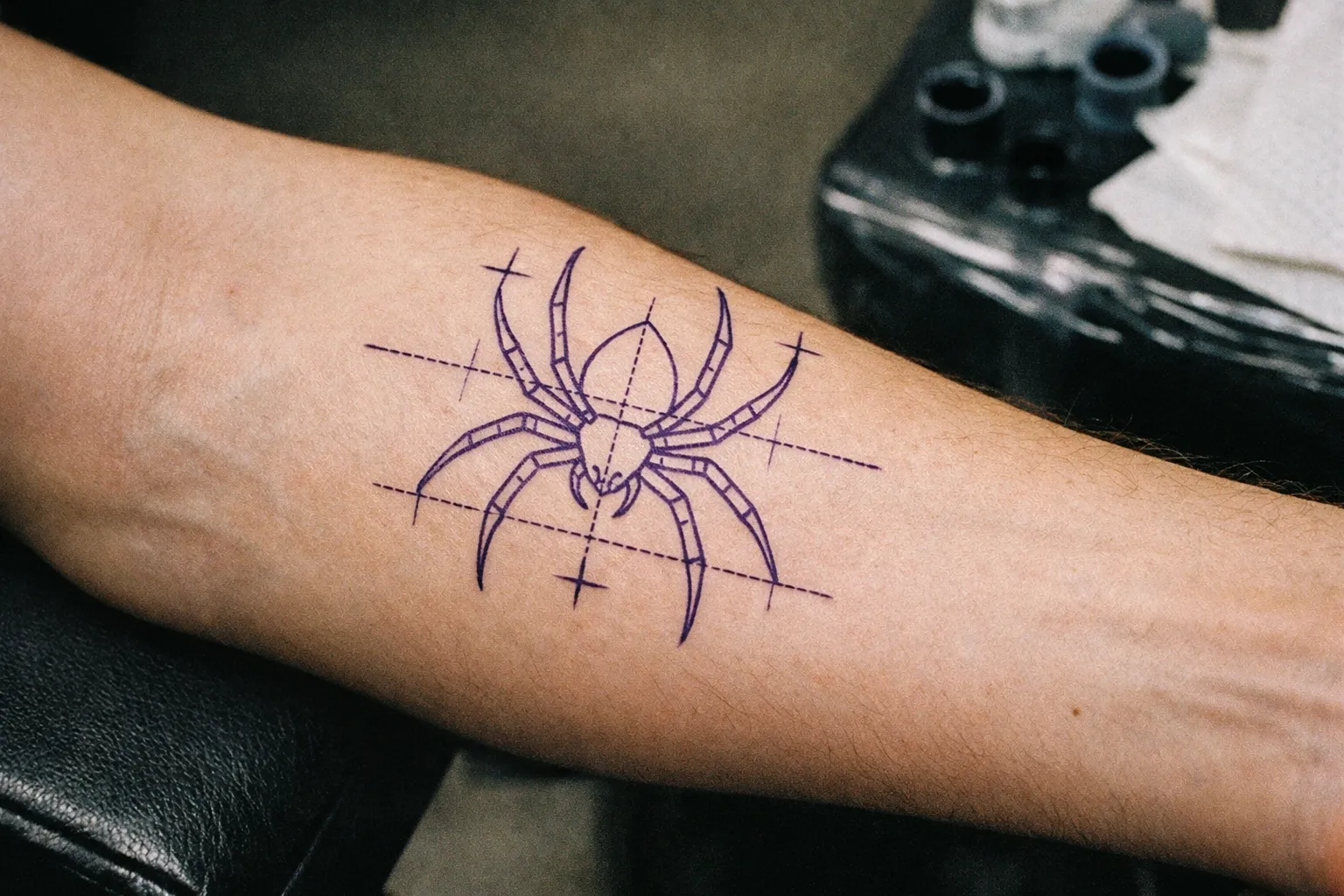
Fine-line, 1-3 cm, usually pure black. Keep it simple: eight clear legs, a recognizable body, maybe a hint of web. The pitfall is over-detail - micro-shading and tiny eyes blur out within a few years on most skin types. Best placement: behind the ear, inside the wrist, ankle, back of the neck. Size: 1-3 cm.
3D / Realistic Spider
Heavy shading, highlights, the “crawling on skin” illusion. Looks incredible fresh. Needs a confident artist because bad realism ages worse than bad traditional - there’s nowhere to hide when the shading starts to migrate. Best placement: forearm tattoos, back of hand, calf. Size: 2-4 inches.
Blackwork / Geometric
Heavy black, dotwork webs, mandala symmetry. Leans into the cosmic/interconnected reading rather than horror. Best placement: forearm, chest, thigh. Size: 4-8 inches.
Spider and Rose
Beauty plus the macabre. Works for contrast - the soft floral lines against the angular spider body. Strong in neo-traditional with rich color. Best placement: forearm, shoulder, ribs. Size: 4-6 inches.
Spider Skull
A skull with spider legs sprouting from it. Gothic and overt - this is the design that leans hardest into horror coding. Pair it with that intent or skip it.
Behind-the-Ear Spider
Discreet, easy to cover, holds up well at small scale. Best at 1-2 cm with minimal detail - this placement rewards simplicity.
Matching Spider Tattoos
Two small spiders, one per person, for patience and persistence in a relationship. Keep them identical and simple. Matching tattoos look best when the designs are clean enough to survive both wearers’ aging skin.
Spiderman / Radioactive Spider
The comic homage. Usually done in red and blue or as a stylized symbol. Treat it like any fandom piece - the meaning is personal, the aesthetic stands or falls on the artist’s linework.
Cost, Pain, and Healing - Plan Before You Book
What you’ll pay (US/EU urban studio, licensed artist)
- Small spider (1-2 in, simple linework): $80-$200, often the shop minimum.
- Medium traditional spider (3-5 in, color, shading): $200-$450.
- Elbow web wrapping the joint: $300-$600, depending on line density.
- Large chest or back spider + web composition: $600-$1,500+, usually 2-4 sessions.
- Temporary spider tattoos from brands like Tattoo for a Week (active since 2009) run roughly $3-$9 per piece, often with seasonal discounts of up to 30% on themed sets - a legitimate way to test placement and how you feel about the design before you commit.
Time in the chair
- Small spider: 30-60 minutes.
- Elbow web: 1.5-3 hours, longer than the size suggests because of the placement difficulty.
- Large detailed pieces: 3-8 hours, often split across 1-3 sessions.
Pain, in relative terms
Elbow, knee, hand, neck, and sternum placements all sit at the high end - bone-close, thin-skinned, nerve-dense. In relative terms: ribcage and sternum hurt more than elbow and knee, which hurt more than hand and neck, which hurt more than forearm and shoulder, which hurt more than outer thigh. If a small spider on the inside of your wrist is your first tattoo, you’ll feel it but you’ll be fine. If you’re going straight to an elbow web, eat a real meal beforehand and plan for the session to be harder than you expect.
Healing timeline
- Day 1-3: Plasma weep, redness, swelling. Keep it covered as your artist instructs, wash gently with fragrance-free soap, pat dry.
- Week 1: Scabbing and flaking start. Do not pick. Apply a thin layer of fragrance-free moisturizer 2-3 times daily.
- Week 2-4: Surface heals; the tattoo may look dull or cloudy as the top layer settles. This is normal - don’t panic about the color yet.
- Week 4-6: Full healing. Now you can actually judge the saturation. If anything healed light - common on elbows and hands - book a touch-up.
- Long term: Sun-protective clothing or SPF 30+ on the area whenever it’s exposed. UV fades tattoos faster than anything else, and web linework is particularly unforgiving when it starts to go grey-green.
Common Mistakes to Avoid
- Putting a web on your elbow without understanding the prison and extremist coding (2)(3)(5). Know what you’re signing up for, or move the design.
- Choosing horror imagery when you wanted protective symbolism. Skulls and inverted crosses say one thing; mandalas and sun motifs say another. The supporting elements drive the read.
- Dense web linework in small areas. Lines spread over time. A web crammed into a 2-inch space will look muddy at year 10.
- Tiny spiders on fingers and palms. High-friction areas blur fast - expect to touch up every 1-3 years or accept the fade.
- Cheap work on a design that needs clean lines. Web tattoos live or die on consistent linework, and spider bodies need anatomically clean geometry. A cover-up costs 2-3x more than doing it right the first time.
- Using culturally specific motifs without context. Native American dreamcatcher webs, Anansi-inspired designs, and Hindu cosmological symbols carry weight. If you’re drawing on them, know why.
How to Steer the Meaning Toward What You Actually Want
If you want the spider to read as creator, protector, or web-of-life rather than prison or horror:
- Pair the spider with sun shapes, mandalas, dreamcatcher patterns, or florals.
- Choose shoulder, upper arm, behind-the-ear, or chest placement instead of elbow or neck.
- Lean into neo-traditional color or fine-line black rather than stark blackwork webs.
- Keep skulls, flames, and overt horror imagery out unless that’s the read you want.
If you want the spider to read as gothic or alt-aesthetic, do the opposite - lean into the supporting imagery, choose darker palettes, and don’t apologize for the design. Both directions are legitimate. Just be deliberate about which one you’re choosing.
Frequently Asked Questions
- Is a spider tattoo demonic?
- No, not in any dominant tradition. Most documented cultures - Native American, West African, Hindu, Celtic, Greek - read the spider as creative, protective, or wisdom-bearing. The 'demonic' association is mostly modern Western horror imagery and Halloween marketing. The supporting elements in your design (mandala vs. inverted cross) determine which reading comes through.
- What does a spider tattoo mean in jail?
- It's usually the web, not the spider, that carries prison meaning. A spider web on the elbow, knee, or neck historically signals long incarceration - 'caught in the system' - and some sources note that each concentric ring can represent one year served. The image has also been linked to white supremacist groups in specific eras and regions. A spider sitting in a web on a forearm or chest doesn't carry the same code.
- What is the 1/3 rule tattoo?
- In tattoo design - particularly for dense pieces like web fills - it's a composition heuristic: roughly one-third solid black, one-third mid-tone or linework, one-third bare skin. The goal is to keep the design readable as it ages, since pure blackout sections blur and pure linework can look weak. Ask your artist how they're balancing those ratios on any large piece.
- Why are people getting spider tattoos?
- Four main reasons: marking personal transformation or recovery; identifying with craft and making; symbolizing protection and boundaries; and alt-fashion aesthetics. The spider is one of the few motifs that maps cleanly onto multiple modern experiences without feeling forced.
- Does a spider web tattoo on the elbow always mean prison?
- No, but it's read that way by enough people that you should expect the question. Modern clients increasingly choose it for the old-school aesthetic, but the historical meaning hasn't gone away. If you don't want the association, move the design to your upper arm, shoulder, or behind your ear.
- What's the best placement for a small spider tattoo?
- Behind the ear, inside the wrist, the ankle, or the back of the neck. Keep the design at 1-3 cm with eight clear legs and a recognizable body - skip the micro-details that won't survive healing.
- How much does a spider tattoo cost?
- $80-$200 for a small simple piece, $200-$450 for a medium traditional spider, $300-$600 for an elbow web, and $600-$1,500+ for a full chest or back composition with 2-4 sessions.