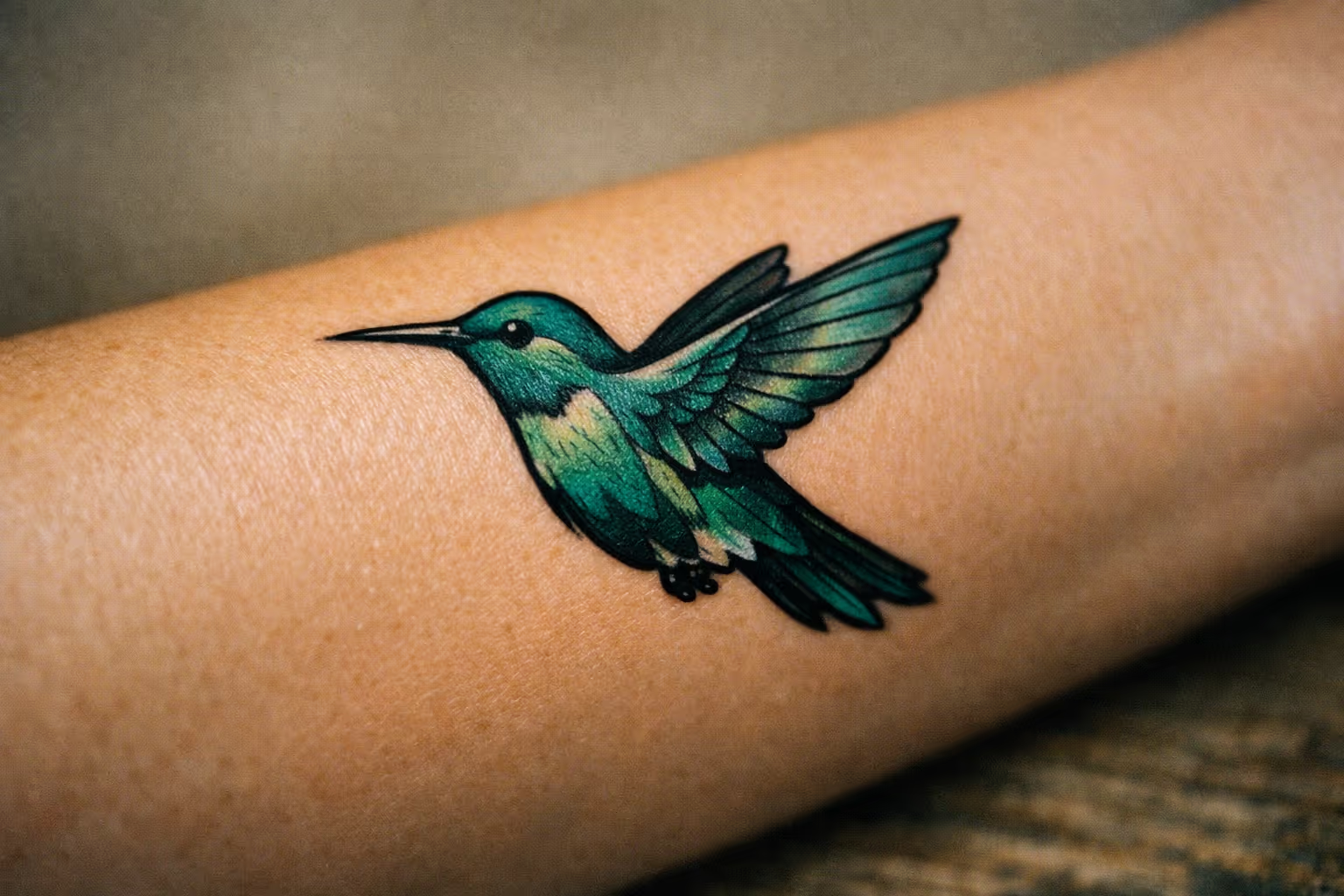
A hummingbird tattoo packs more fine detail than almost any small design - the iridescent throat, the blurred wings, the needle-thin beak - which means it punishes going too small harder than most. Under a certain size those details merge and you lose the bird. The hummingbird tattoo meaning is rich, and older than the Pinterest captions suggest (its Aztec roots run deep), but the sizing is what makes or breaks it. Here’s what it means, and how big it needs to be.
Hummingbird Tattoo Meaning: What It Symbolizes
When exploring the hummingbird tattoo meaning, a consistent core emerges beneath the Pinterest captions: joy, freedom, resilience, love, and transformation (1)(2). These five meanings appear in nearly every serious conversation about this motif because they map directly onto the bird’s behavior. A creature that hovers in place, then darts sideways, then crosses a continent - that’s a body in motion as metaphor.
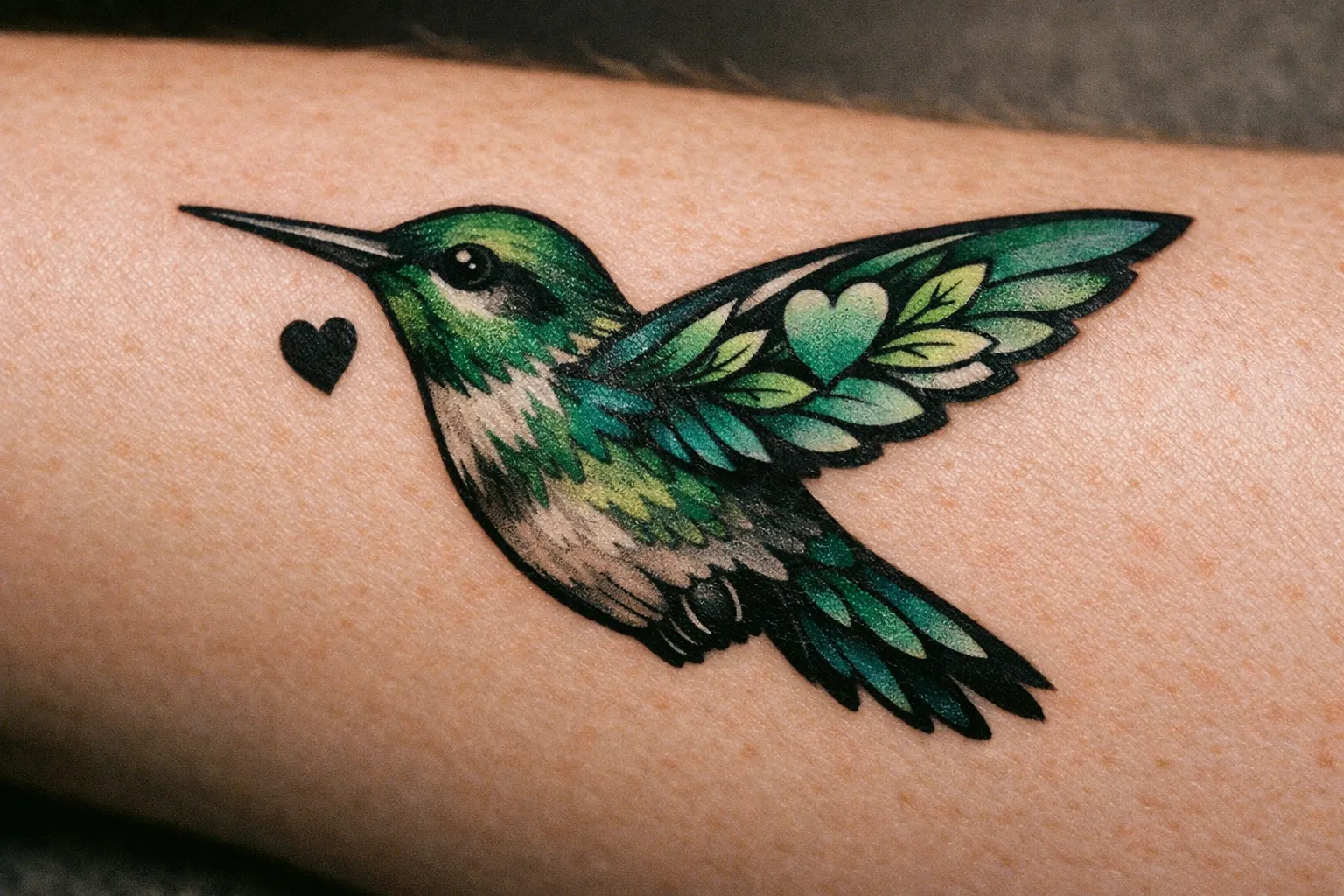
Modern wearers tend to lean on one specific reading:
- Joy and the sweetness of life. The hummingbird drinks nectar. The tattoo becomes a small daily marker to chase what feeds you.
- Resilience and survival. Used increasingly for mental health recovery, sobriety milestones, and getting through hardship (1)(5).
- Freedom and independence. A single bird in flight, usually facing forward, often chosen after a divorce, a move, or a major career pivot.
- Love and connection. Especially in hummingbird and flower tattoo compositions, where the two motifs feed each other literally and symbolically.
- Spiritual connection or memorial. A loved one who fed hummingbirds, gardened, or simply loved them - the bird becomes the placeholder.
If you’re getting one, decide which of these is doing the heavy lifting before you sit down for the consultation. The meaning drives the style. Solemn memorial work doesn’t want neon watercolor splashes. A celebration of recovery probably doesn’t want stark blackwork.
Hummingbirds Across Cultures: Aztec, Mayan, and Native American Roots
The hummingbird isn’t a modern invention as a symbol. Several traditions assigned it serious weight, and that history is worth knowing before you commit one to skin.
Aztec. Fallen warriors were believed to return as hummingbirds in the afterlife, drinking nectar in a sun-soaked paradise (3)(4). The Aztec war and sun god Huitzilopochtli - whose name roughly translates to “left-handed hummingbird” - was depicted as a hummingbird or eagle. The bird carries warrior and reincarnation associations that go far beyond “cute.”
Mayan. In Mayan tradition, hummingbirds are linked to love and were sometimes believed to be messengers carrying thoughts and wishes between people.
Native American. Multiple tribes view the hummingbird as a healer, a harbinger of harmony, and a symbol of love and good fortune (1)(3). Some Hopi and Zuni traditions credit hummingbirds with bringing rain.
A note on cultural borrowing: if you’re drawn to a specifically Aztec hummingbird design - feathered serpent details, Huitzilopochtli iconography, codex-style linework - understand what you’re wearing. The motif is sacred and warrior-coded, not decorative. If you have heritage ties, go for it with a knowledgeable artist. If you don’t, it’s worth a conversation with your tattooer about whether a more universal design serves you better.
Hummingbird Tattoo Designs and Styles That Hold Up
Most hummingbird tattoo designs fall into five style buckets. Each has technical hallmarks and at least one common pitfall.
Traditional Hummingbird Tattoo
American traditional is defined by thick black outlines and a limited primary color palette - usually red, green, yellow, and a touch of blue. A traditional hummingbird tattoo reads cleanly from across a room, ages predictably over decades, and often includes a banner with a name or date.
I’ve seen a lot of artists soften the black outline to make the piece look “more modern,” and it almost always backfires. The bold line is doing structural work - it’s what keeps the tattoo legible at year fifteen. Lose the outline and you lose the whole point of the style.
Best placements: outer forearm, upper arm, calf. Size: 3-5 inches for full effect.
Watercolor Hummingbird Tattoo
A watercolor hummingbird tattoo uses soft color washes, splashes, and bleeds to mimic actual watercolor painting. It leans into the bird’s iridescence and is the style that’s grown the fastest in the last several years (2)(5).
Two technical hallmarks: visible “paint splash” edges outside the bird’s silhouette, and color gradients without traditional outlines. The trade-off is that watercolor without a confident underlying structure ages poorly - the soft edges blur further, and depending on skin type, sun exposure, and how well the piece was executed, you can end up with a colorful smudge where a bird used to be sooner than you’d expect.
Common pitfall: tiny watercolor hummingbirds on the wrist or finger. Watercolor needs room. Anything under 2.5 inches loses definition fast.
Best placements: forearm, upper arm, shoulder blade, calf. Minimum size: 2.5-3 inches.
Fine-Line and Minimalist Hummingbird
Single-needle work, minimal or no shading, often just a flying silhouette or a contour drawing of the bird in motion. This is the style driving the small hummingbird tattoo trend on wrists, behind ears, and along ribs.
Common pitfall: fine-line tattoos blow out easily on thin skin - inner wrist, ankle bone - and can fade noticeably within three to five years. Choose an artist who specifically specializes in single-needle work. Generalists tend to push too hard, and the lines spread.
Realistic and Micro-Realistic
Full color or black-and-grey rendering with photographic detail - every feather, the eye, the iridescent throat patch. A small hummingbird tattoo done in micro-realism can be stunning at 1.5-2 inches, but it requires a specialist.
Don’t ask a traditional or neo-traditional artist to do realism. The skill sets don’t transfer. Check the artist’s healed portfolio specifically for realism work - fresh tattoos always look great, healed ones tell you what you’ll actually wear.
Blackwork and Silhouette
Solid black hummingbird in flight, sometimes with negative-space wings or geometric framing. Ages extremely well because there’s no color to fade and the outline is the whole design. A good option if you want the symbolism without the visual loudness of color work.
Hummingbird and Flower Tattoo Combinations
The hummingbird and flower tattoo is one of the most common compositions in the category, and the meaning compounds in a specific way: mutual dependence, resilience through connection, harmony in relationships (3).
The flower you pick changes the reading:
- Rose. Love, passion, sometimes grief - pairs with the hummingbird for a romantic or memorial piece.
- Hibiscus. Tropical, often tied to Hawaiian or Polynesian heritage. Brings warmth and a “welcoming spring” feel.
- Sunflower. Optimism, looking toward the light. Reads cheerful and works well with watercolor.
- Cherry blossom. Impermanence, the fleeting nature of beauty - a thoughtful pairing given the hummingbird’s own brief lifespan.
- Lily. Renewal and rebirth, common in memorial pieces.
- Lavender or wildflowers. Healing, calm, often chosen for mental health recovery tattoos.
Composition tip: the flower usually anchors the bottom of the design and the hummingbird hovers above or to one side, beak toward the bloom. This reads as feeding and works at sizes from 2 inches up through full sleeve sections. Below 2 inches, simplify to one flower and a minimal bird outline - anything more clutters.
Small Hummingbird Tattoo: How Small Can You Go?
A small hummingbird tattoo is one of the most-requested first tattoos in the bird category, and there’s a real lower limit before the design stops reading as a hummingbird and starts reading as a smudge.
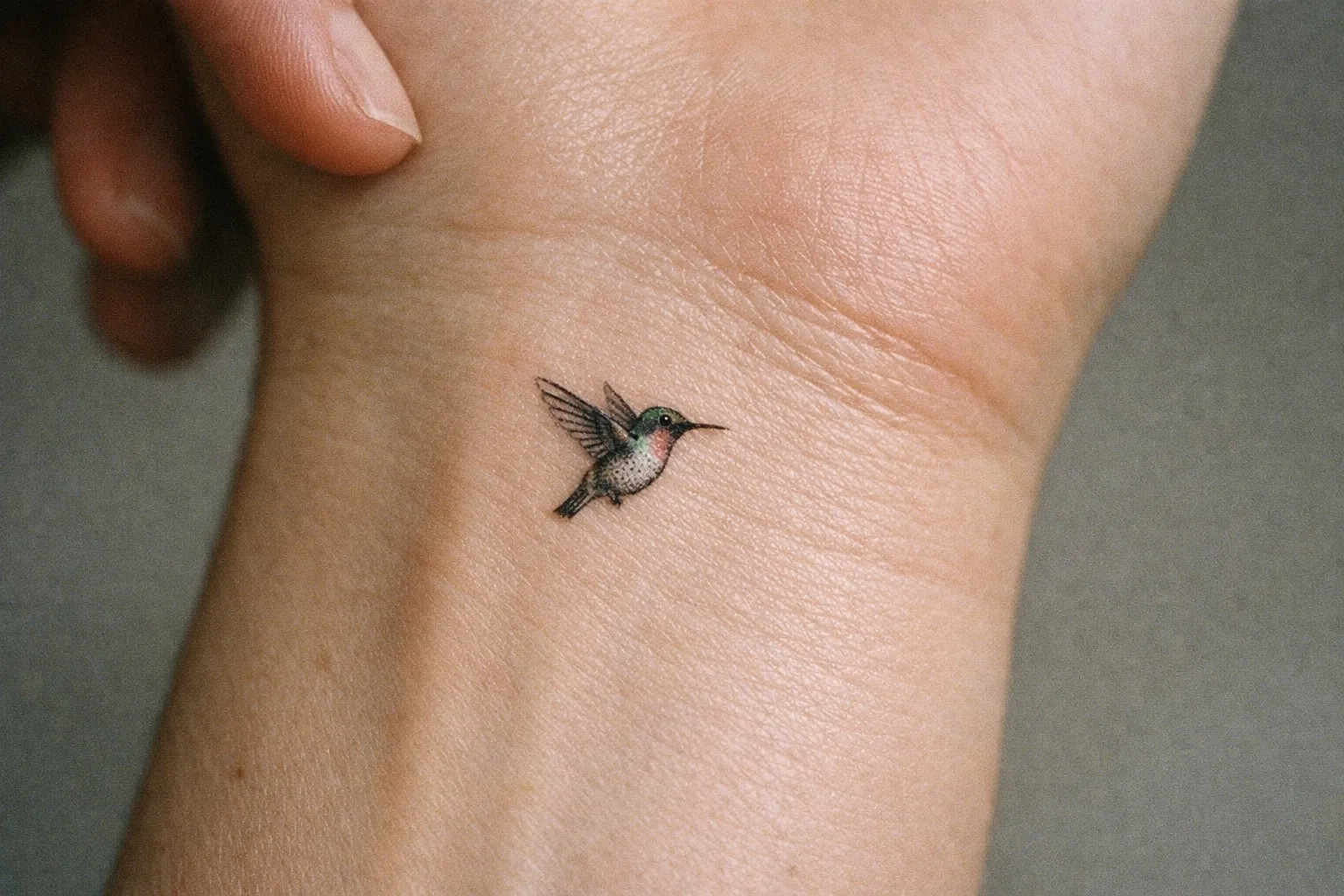
Minimum viable sizes by style:
- Fine-line silhouette: 1 inch
- Black outline with light shading: 1.5 inches
- Micro-realism with color: 1.5-2 inches
- Watercolor: 2.5-3 inches
- Traditional: 2.5 inches
If you want the beak, eye, and individual wing feathers to remain identifiable five years out, keep the bird at least 1.5-2 inches tall. Skin stretches, ink spreads slightly over time, and what looks crisp at the shop will soften.
Best placements for small hummingbirds: inner forearm, outer wrist, behind the ear, back of the neck, ankle, ribs. Behind-the-ear and finger placements look great fresh but fade fastest because of friction and thin skin.
Hummingbird Tattoo Forearm Placement: Why It’s the Most Requested
The hummingbird forearm placement leads the category for a reason: it’s visible to you, moderately painful (not brutal, not nothing), and gives the artist enough flat real estate to work with detail.
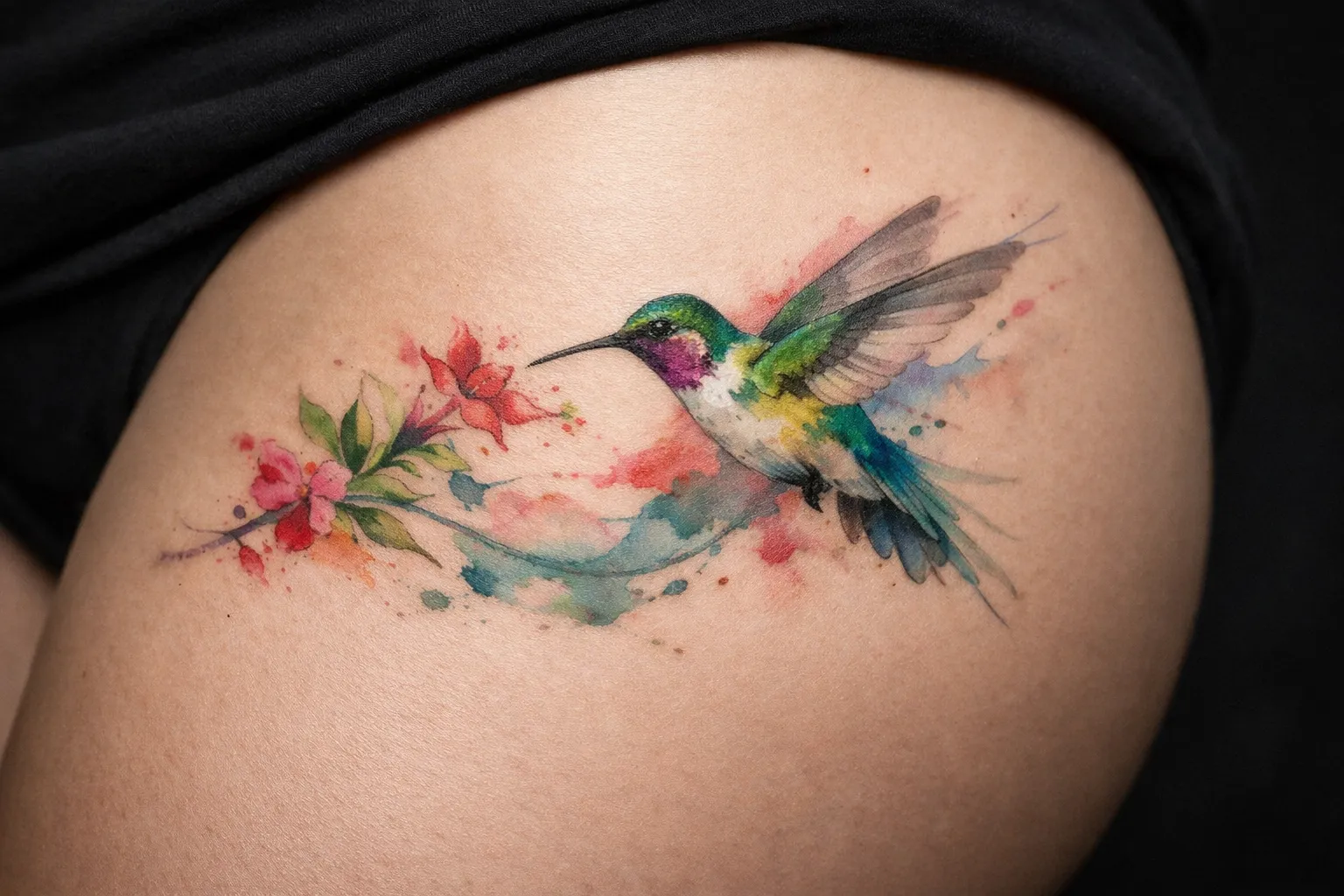
Inner forearm reads as more personal - you see it every time you check your phone. Outer forearm reads as more public - it’s what other people see when you gesture. Both work for hummingbirds, and you can fit:
- A 2-3 inch standalone hummingbird vertically along the inner forearm
- A 4-5 inch hummingbird and flower composition horizontally across the outer forearm
- A traditional or watercolor piece without crowding existing tattoos
Pain on the forearm is moderate - the outer forearm sits in the easier range, while the inner forearm gets slightly tender near the elbow crease. Compare that to ribs or sternum, which are dramatically worse, or the back of the upper arm, which is easier. Ribcage > forearm by a significant margin.
Forearms also heal well. The skin isn’t subject to constant friction like ankles or fingers, and you can keep it out of the sun under a long sleeve during the first month.
Where to Place a Hummingbird Tattoo
Best placement depends on three things: how often you want to see it, how much pain you can sit through, and how visible you want it to others.
For daily visibility:
- Inner forearm or wrist - you’ll see it constantly
- Outer wrist - visible to you and to others when you gesture
- Collarbone - visible to you in the mirror, easy to cover with a shirt
For discretion:
- Ribcage - only you and people who know you well see it; high pain
- Upper thigh - easy to cover; low pain
- Behind the ear - small only; covered by hair
- Back of neck - covered by hair, peeks out occasionally
For larger compositions:
- Upper back or shoulder blade - room for detailed watercolor or scenes
- Chest - close to the heart, common for memorial pieces
- Calf - flat canvas, low-moderate pain, ages well
Pain ranking, low to high for typical hummingbird placements: outer upper arm < outer forearm < calf < inner forearm < shoulder blade < collarbone < behind ear < ankle bone < ribcage < sternum.
Placements to think twice about: tops of hands and feet (high sun exposure, fast fading), fingers (blowouts and fading within two to three years), and anywhere you’re planning a future sleeve or back piece that a standalone bird would interrupt.
Is a Hummingbird Tattoo a Good First Tattoo?
Yes - and it’s one of the better first-tattoo choices in the animal category, for four practical reasons.
- Designs work at small sizes. You can get a meaningful hummingbird at 2 inches, which keeps the cost low and the session short.
- Sessions are short. A small black-line hummingbird takes 45-90 minutes. A 2-3 inch color piece runs 1.5-2.5 hours. You’re not committing to a six-hour ordeal on day one.
- Low-to-moderate pain placements are available. Outer forearm, outer upper arm, or shoulder blade are all forgiving for someone who’s never been tattooed.
- The motif scales. If you fall in love with tattooing, you can add flowers, a second bird, or a background scene in a later session and build outward.
What to do as a first-timer: pick a 2-3 inch design, place it on the outer forearm or upper arm, and start with bold lines and a limited color palette rather than fragile fine-line work. Eat a real meal beforehand, hydrate, skip alcohol for 24 hours, and bring headphones.
Hummingbird as a “Lucky” Tattoo
There’s no single “luckiest” tattoo, but hummingbirds consistently appear on the short list alongside butterflies, four-leaf clovers, koi fish, and elephants (2). The luck association comes from a few specific traditions: Aztec belief in protection from evil spirits, Native American associations with good fortune and healing, and modern Western readings of the bird as a sign of unexpected joy or a visit from a passed loved one (3).
If “luck” is the angle you want, three design choices reinforce it:
- Pair the hummingbird with a lucky flower - cherry blossom for fortune, lotus for spiritual luck, or a four-leaf clover for the direct symbol.
- Use odd numbers if you’re doing multiple birds - three hummingbirds reads more intentionally than two.
- Place it somewhere you touch or see regularly - wrist, collarbone, inner forearm - so the symbol stays active rather than hidden.
Memorial Hummingbird Tattoos
Memorial hummingbirds have grown significantly as a category, often chosen for someone who fed hummingbirds, gardened, or had a personal connection to the bird (3)(5). These pieces typically include:
- A name, initials, or a date in a script font near the bird
- A specific flower the person loved
- Sometimes a quote in small text - short ones age better than long ones
Keep the script at least a quarter inch tall for legibility, and position it somewhere you can see it - forearm, wrist, ribs. Think about whether you want the tattoo to face inward (for you) or outward (visible to others). Memorial pieces tend to accumulate meaning over time, so err toward placements that won’t fade fast. Avoid hands, feet, and fingers.
What a Hummingbird Tattoo Costs
US shop pricing for a single hummingbird in 2026, with most shops sitting at a $100-$120 minimum:
- Small outline, 1-2 inches, minimal or no color: $100-$150
- Small-to-medium detailed color, 2-4 inches: $150-$300
- Traditional hummingbird, 3-5 inches: $200-$400
- Watercolor hummingbird with flowers on forearm: $250-$500
- Large compositions - sleeve segment, thigh scene, shoulder-to-chest: $500-$1,200+
Hourly rates from specialized watercolor and realism artists in major US cities now commonly start at $150-$250/hour, which pushes complex compositions into the $400-$800 range fast. Budget another $20-$40 for aftercare: a fragrance-free cleanser, a fragrance-free moisturizer, and SPF 50 for once the tattoo is fully healed.
Tip the artist 20% on the total. If your tattoo is $300, that’s $60 on top.
Aftercare Timeline for a Hummingbird Tattoo
Same protocol as any tattoo, but worth knowing the timeline before you sit down.
Aftercare Timeline for a Hummingbird Tattoo
6 weeksFollow these steps to ensure proper healing and color retention.
- 1
Day 1-3: Initial Care
Keep the initial bandage on for 2-24 hours or as your artist specifies. Wash gently twice daily with a fragrance-free, unscented cleanser. Expect plasma and ink to weep. Apply a thin layer of fragrance-free moisturizer after washing.
- 2
Days 3-10: Peeling and Itching
The tattoo will flake like a sunburn. Do not pick or scratch. Keep moisturizing lightly; avoid over-moisturizing to prevent bacteria buildup.
- 3
Week 2: Surface Healing
The tattoo may look dull or cloudy as deeper layers settle. This is normal.
- 4
Weeks 3-6: Full Healing
Color clarity returns. You can resume swimming, soaking, and normal activities.
- 5
Long-term Care
Use SPF 50 sunscreen whenever the tattoo is exposed to sun. Sun-protective clothing like UPF sleeves offers even better protection to preserve color.
Things to Consider Before Getting a Hummingbird Tattoo
Before you book the appointment, work through these.
What’s the primary meaning? Joy, freedom, resilience, love, memorial, spiritual? Pick one. It drives the style - playful watercolor for joy, solemn blackwork for memorial, traditional for permanence and resilience.
What size do you actually want? Measure it on your body with a pen before the consultation. People consistently underestimate how big a 4-inch tattoo looks on a forearm.
Does the style age well at this size? Watercolor under 2.5 inches softens fast. Fine-line on fingers fades within three years. Traditional with bold black lines and blackwork tend to age more predictably than color-heavy or fine-line styles - the thick outline holds structure even as ink settles.
Is this placement going to interrupt future tattoos? If you might want a sleeve in five years, don’t put a standalone hummingbird in the middle of the upper arm. Either commit to building the sleeve around it or place the bird somewhere modular.
Are you choosing the right artist for the style? A traditional specialist will not do good watercolor. A realism artist will not do good fine-line. Check healed work in the artist’s portfolio - fresh tattoos look great; healed tattoos tell you what you’ll actually wear.
Do you understand the cultural weight? If you’re drawn to Aztec or Native American iconography, know what you’re carrying. Your artist should be willing to discuss it.
Are you ready for aftercare? Two weeks of careful washing and moisturizing, six weeks of restricted sun, and a lifetime of SPF if you want the color to last.
Frequently Asked Questions
- What do hummingbirds symbolize?
- They symbolize joy, beauty, freedom, love, resilience, spiritual connection, and the sweetness of life. In Aztec, Mayan, and Native American traditions, they also represent reincarnation, love, healing, and good fortune.
- What is the luckiest tattoo for females?
- While there's no universal luckiest tattoo, hummingbirds rank high alongside butterflies, four-leaf clovers, koi fish, and elephants. Their luck associations come from Aztec and Native American traditions of protection and good fortune.
- Where is the best place to put a hummingbird tattoo?
- For daily visibility, inner forearm, outer wrist, or collarbone work well. For discretion, ribcage, behind the ear, or upper thigh are good. Larger compositions fit best on shoulder blade, chest, or calf.
- Is a hummingbird tattoo a good first tattoo?
- Yes. The design works well at 2-3 inches, sessions are manageable in length, and low-to-moderate pain placements like outer forearm or upper arm are ideal for beginners.
- How much does a hummingbird tattoo cost?
- Small black-line hummingbirds typically cost $100-$150. Color pieces 2-4 inches run $150-$300. Watercolor forearm compositions are $250-$500, and large detailed scenes can reach $500-$1,200+.
- Do hummingbird tattoos age well?
- Traditional and bold blackwork styles tend to age more predictably because the thick outline holds structure over time, though placement, skin type, and execution all factor in. Watercolor is more vulnerable to fading and blurring - especially pieces under 2.5 inches - with the timeline depending on sun exposure, skin type, and artist execution. Fine-line tattoos on fingers and behind ears fade fastest due to skin friction and thinness.
- Can I get a hummingbird tattoo if I want a sleeve later?
- Yes, but avoid placing a standalone hummingbird in the middle of an area you plan to sleeve. Either build the sleeve around the bird or choose a modular placement that won't interrupt future work.
- What aftercare products are essential for a hummingbird tattoo?
- Use fragrance-free cleansers and moisturizers during healing, and apply SPF 50 sunscreen or wear sun-protective clothing to protect the tattoo long-term.