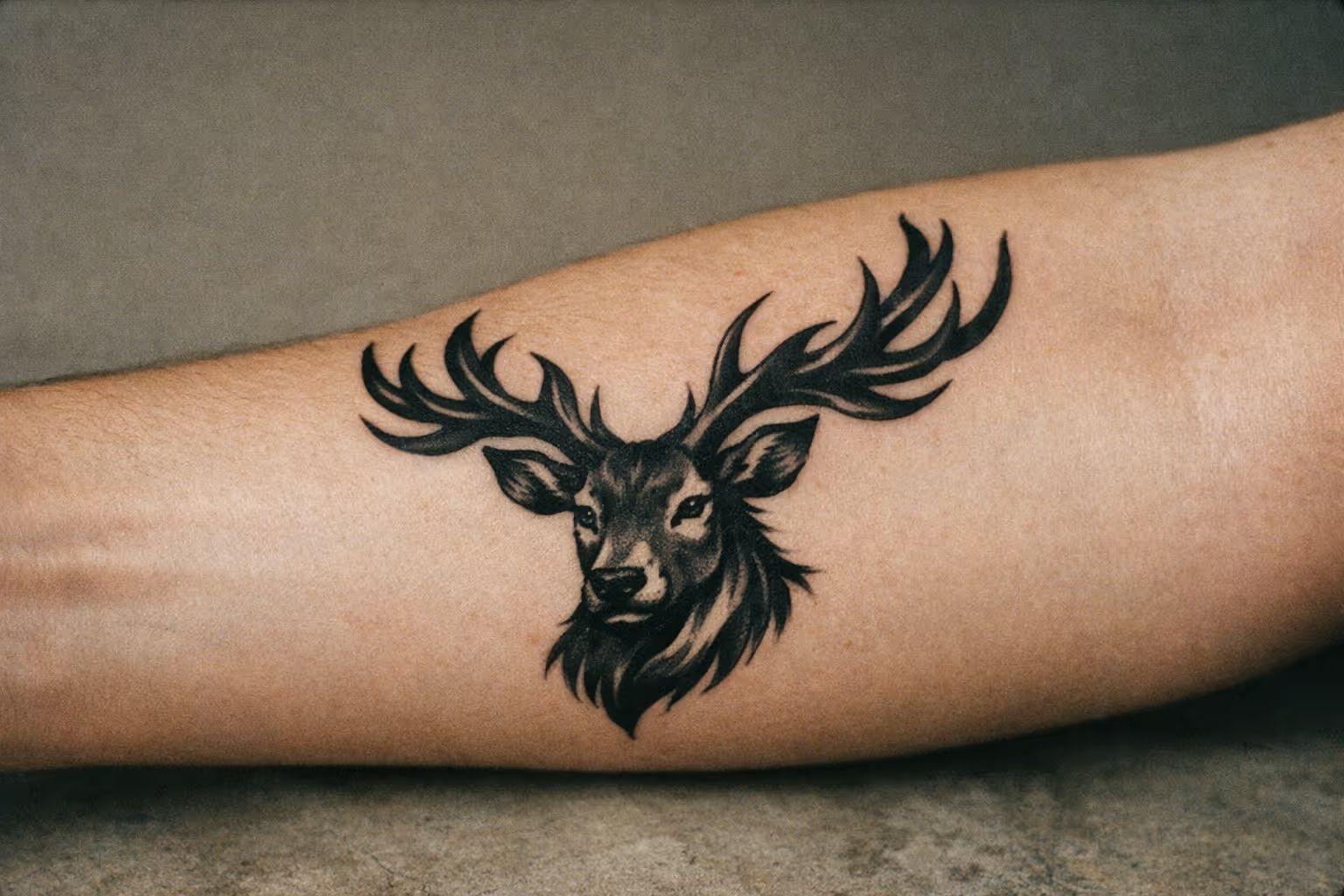
The make-or-break detail on a deer tattoo is the antlers. All those fine branching tines are the first thing to blur, and there’s a rule of thumb for it: under about three inches, they merge into a shapeless mass and your deer starts reading as an anonymous animal. Antlers need room. Here’s the three-inch rule in practice, plus the six motifs and five styles that decide whether a deer still reads cleanly at year ten.
What a Deer Tattoo Symbolizes
Across most traditions, a deer tattoo points to the same cluster of meanings: grace, gentleness, intuition, spiritual guidance, and a quiet kind of strength (2). It’s one of the reasons the motif keeps coming back - it carries weight without being heavy-handed.
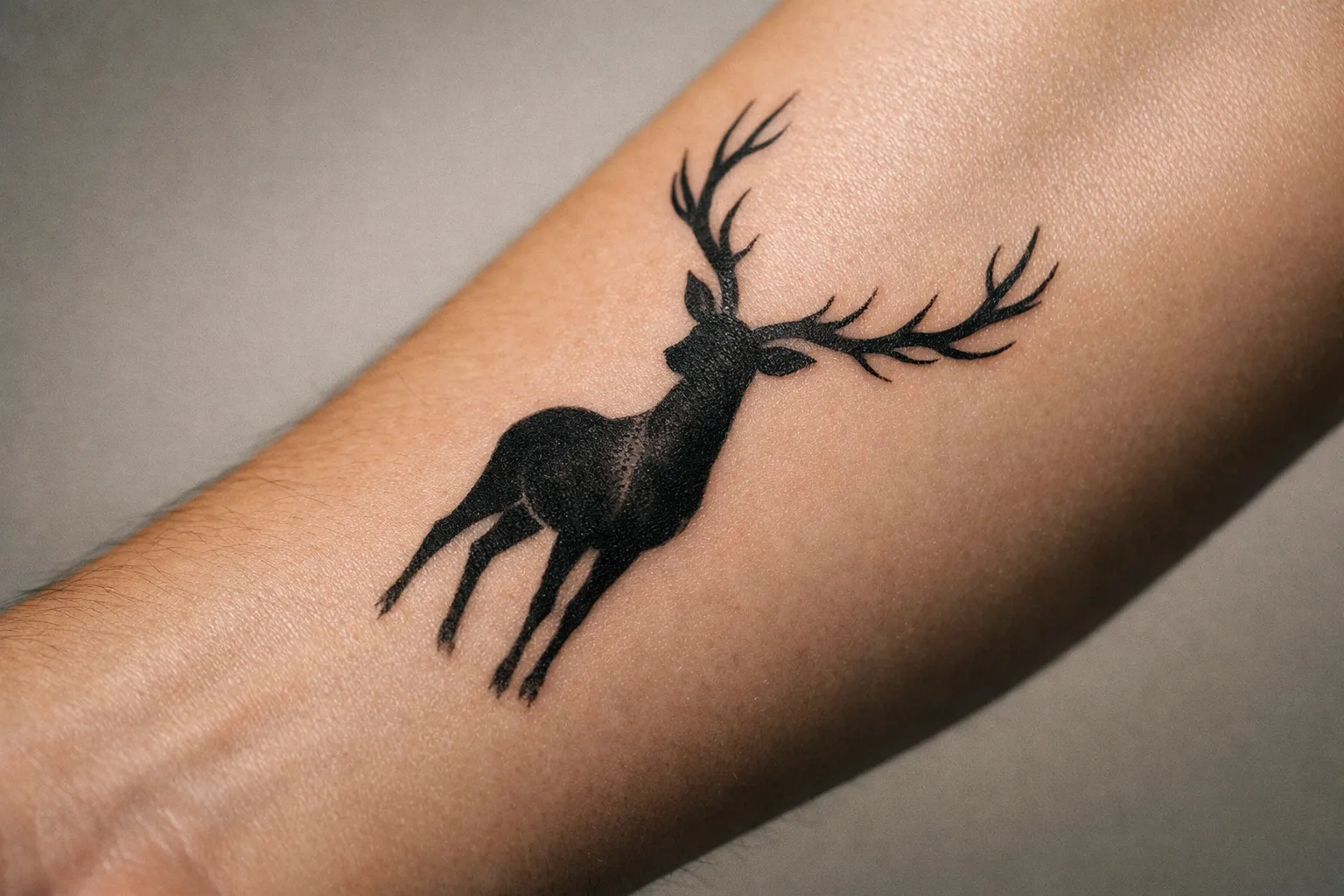
The cultural roots run deep. In Celtic tradition, the deer acted as a guide to the mystical world, a marker of high spirituality (1). Native American symbolism treats it as an emblem of harmony, peace, and intuition (1). In Chinese culture, deer are tied to longevity and prosperity (1). In ancient Greece and Rome, the animal was linked to Artemis and read as a sign of intelligence, courage, and overcoming obstacles (2). None of these meanings cancel each other out - they layer.
Modern Western tattoo culture has flattened some of this. A stag head on a forearm today usually reads as “nature, calm, strength” without the specific Celtic or Artemisian context the wearer might not even know about. That’s fine - meanings drift - but if you want the older symbolism to stay legible, you need to support it with secondary elements: a moon, a triskele, a forest backdrop.
The deer tattoo meaning also shifts noticeably by the type of animal you choose. That’s where most planning mistakes happen.
✓ Pros
- Broad, layered symbolism across cultures
- Motif suits many tattoo styles and sizes
- Generally ages well when sized and placed properly
✗ Cons
- Symbolism can be flattened or lost without supporting elements
- Fine-line details like antlers blur quickly if undersized
- Cultural variants require research to avoid misappropriation
Meaning by Motif: Stag, Doe, Fawn, Skull
The single most useful thing you can do before booking is decide which deer you’re actually getting. I ask every client this before we talk placement or style, because the symbolism breaks down cleanly and the answer changes everything:
- Stag (male, antlered): strength, virility, leadership, independence, solitude (2). The default choice for “power” energy.
- Doe (female): gentleness, intuition, motherhood, feminine strength, love (1)(2). Common in parent-child or partner pieces.
- Fawn: innocence, youth, new beginnings. Often chosen for memorial pieces or to mark a child.
- Deer skull: transformation, respect for nature’s cycles, the line between life and death (1). Reads heavier and works well in neo-traditional or blackwork styles.
- White deer (Shinto): messenger of the gods, sacred status (5). Loaded - research before you wear it.
- Sak Yant deer (Thai): protection, intuition, wisdom, harmony with environment (3). Traditionally blessed by a monk; a decorative version on Western skin is contested.
Mismatches are the most common pitfall I see. A deer skull does not mean “gentleness” - it means death and rebirth. A doe is not a leadership symbol. If your artist asks “stag or doe?” and you shrug, you’re not ready to book yet.
Deer Skull Tattoos
The deer skull tattoo is the heaviest motif in the family. It pulls in the full life-death-rebirth cycle (1), which is why it works as a memorial piece, a sobriety marker, or a tribute to someone who hunted, farmed, or lived close to the land. It carries the broader skull tattoo symbolism of mortality and rebirth into a wildlife motif.
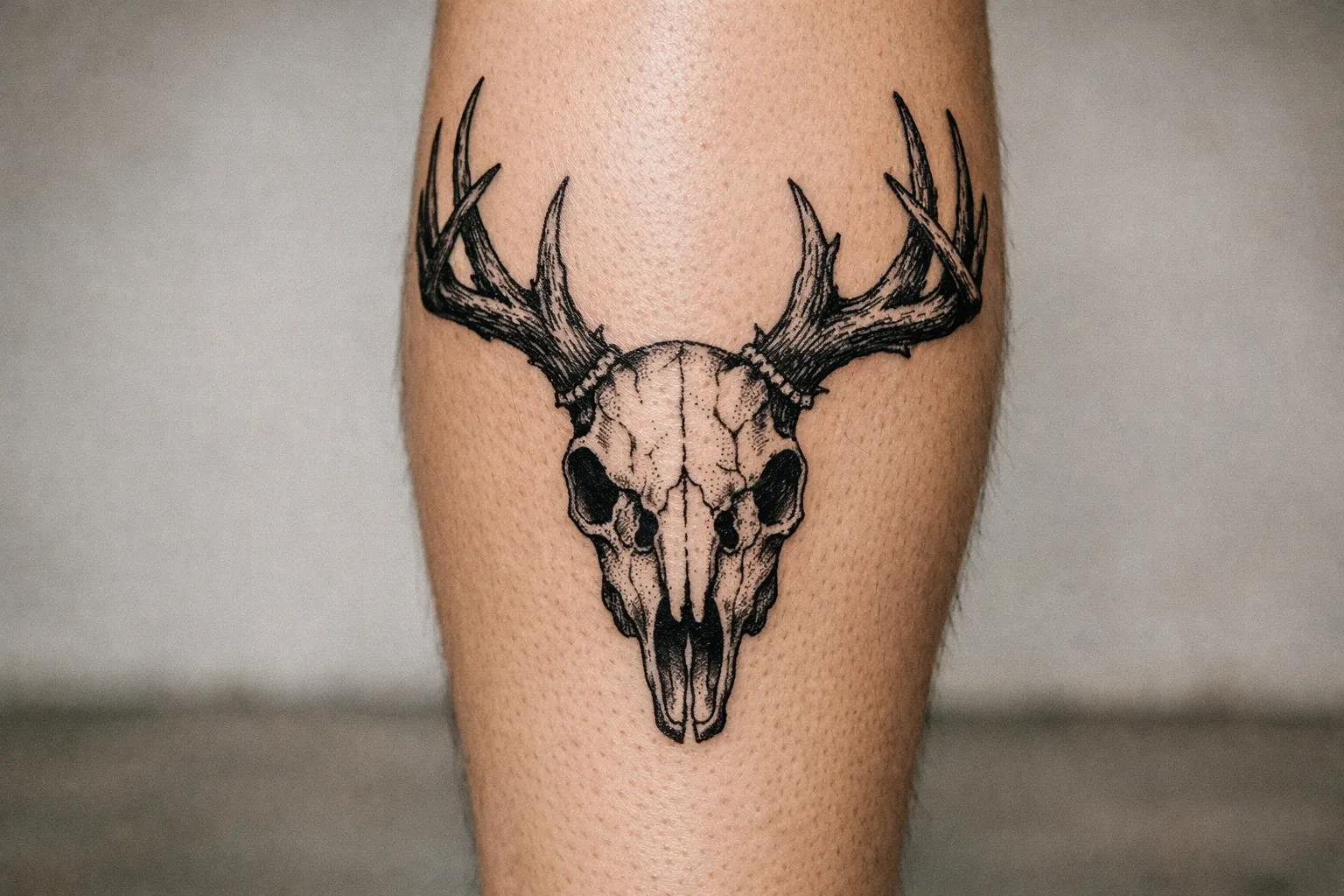
Two technical hallmarks of a good deer skull tattoo: a cleanly rendered nasal cavity and eye sockets (these are what make the skull read as a skull and not a generic horned shape), and antler tips that taper to a real point rather than dying into a soft line. The common pitfall is artists who shade the skull surface uniformly gray. Real bone has texture, hairline cracks, and slight color variation. Without that, the skull looks plastic.
Pairings that work:
- Roses or peonies woven through the antlers (neo-traditional standard)
- A geometric mandala or moon behind the skull (modern blackwork)
- Sacred Heart-style rays for a memorial read
- Forest silhouette inside the negative space of the skull
Placement: sternum (5-7 inches), center back (6-10 inches), or outer thigh (5-8 inches). The skull needs symmetry to land, so curved areas like the outer calf will distort it. Pain-wise, sternum is noticeably more intense than thigh, which is more intense than the back.
Deer Antler Tattoos
A standalone deer antler tattoo is one of the cleanest motifs available. Antlers shed and regrow every year, so the cyclical quality - growth, loss, regeneration - is built right into the symbol. That’s the whole point.
Antlers also work well as a framing device. Skilled artists use them to wrap around text, dates, small initials, or a secondary element (a compass, a flower, a coordinate) without crowding the piece. A pair of antlers around a child’s birth date is a much more readable memorial than a full stag with the date floated underneath.
Sizing matters more than people think. Antlers have a lot of fine branching, and if you go too small the tips blur within a couple of years. Minimum 3 inches tall for linework antlers, 4 inches if you want any internal shading. Under that, the tines merge.
Good antler placements:
- Forearm, vertical, 4-6 inches - follows the limb flow, ages well
- Behind the ear or back of neck, 2-3 inches - small but readable if kept to bold lines
- Sternum, 4-5 inches wide - symmetrical pair, frames the chest
- Spine, 5-8 inches - single vertical antler or a paired set
Avoid the inner wrist for fine-line antlers. The skin there turns over fast and the tips will fade first.
White-Tailed Deer Tattoos
A white tailed deer tattoo is a specific subset - not a generic deer with a white tail tacked on. The species has identifying features that need to be in the design, or it just reads as “a deer”:
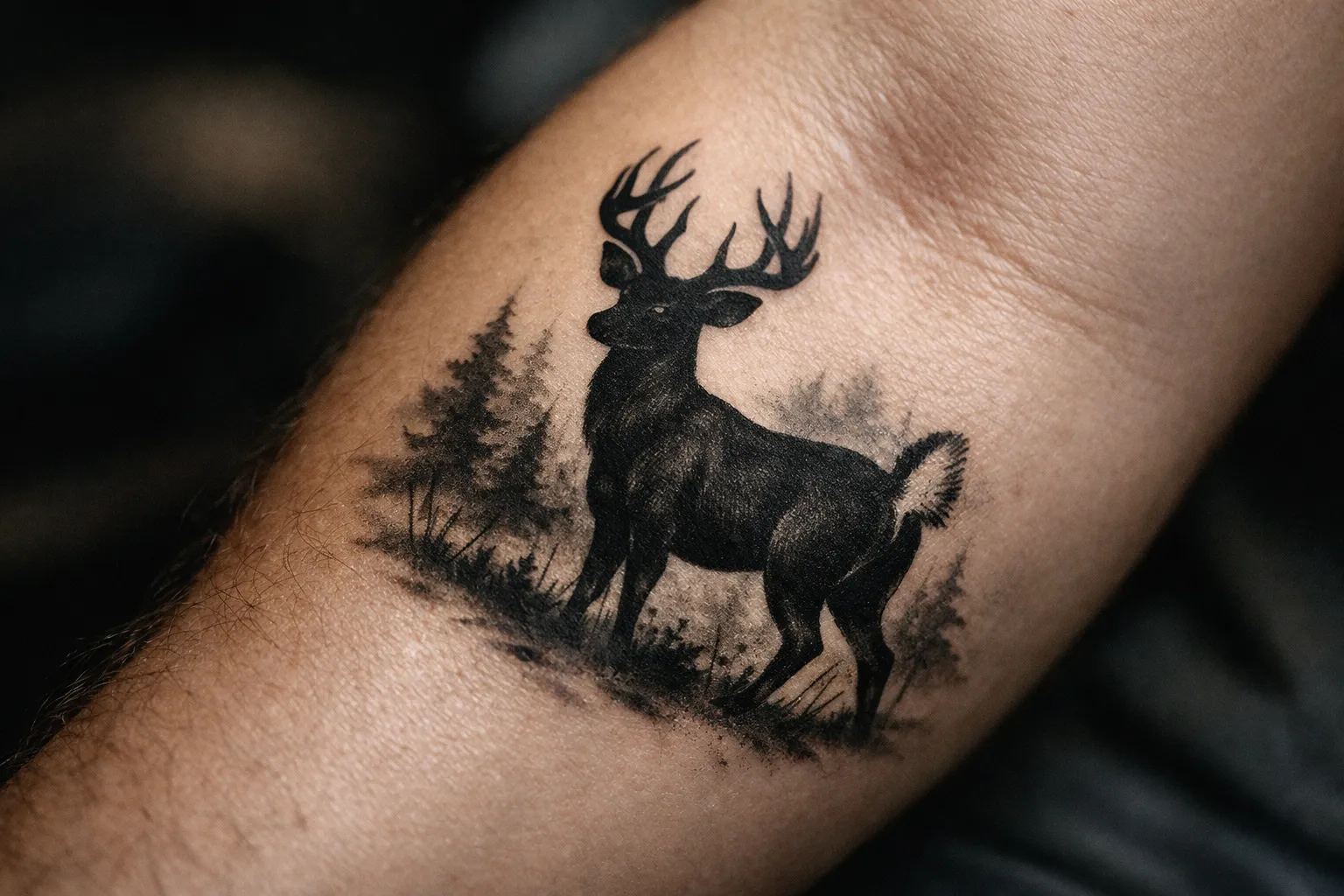
- The white underside of the tail (the “flag”) - often shown raised in alert posture
- White rings around the eyes and white throat patch
- A more compact body than elk or red deer
- Antlers that branch upward from a single main beam (not the palmate shape of moose)
In my experience, this is the design hunters and outdoor folks in North America actually want, even when they ask for “a deer.” Bring reference photos - three to five clear wildlife shots - and tell the artist the species explicitly. Mixing features from red deer, elk, and white-tailed deer in one tattoo produces an uncanny animal that doesn’t read as anything.
Placement for a realistic white-tailed deer head: shoulder (6-8 inches), outer thigh (7-10 inches), or upper back (8-12 inches). You need surface area for fur detail and eye realism. A 3-inch realistic deer head will blur within 2-3 years no matter how good the artist is.
Deer Hunting Tattoos
A deer hunting tattoo is its own category, and it’s the one most likely to be misread if you don’t plan it carefully. Hunters generally want a piece that honors the animal and the practice - not something that looks violent or trophy-room blunt.
What works:
- A white-tailed deer in silhouette at a tree line, with a tree stand subtle in the background
- The buck mid-stride, no human or weapon shown
- Topographic lines, a state outline, or GPS coordinates of a hunting spot woven around the deer
- A pair of antlers with a small rifle cartridge or arrow detail integrated as a design element, not as an act in progress
- Memorial pieces for a hunting dog - the dog and the deer in the same scene
What doesn’t work: a gun pointed at the deer’s head, blood, or “in the moment” kill imagery. These age into something most people regret, and they’re hard to cover. The “respect for the animal” reading collapses when the composition shows the kill itself.
For hunting sleeves, the forearm and outer upper arm are the lowest-pain areas with enough room. Ribs are the highest pain in this category - skip the ribcage if this is your first piece.
Style Breakdown for Ideas
The deer tattoo ideas people save most often fall into five style buckets. Each has its own technical hallmarks and its own failure mode.
Geometric / low-poly deer. Bold, modern, flat color or pure linework. Hallmarks: clean angular facets, controlled line weight, mathematical symmetry in the antlers. Pitfall: artists who pile on hundreds of triangles without a clear focal point - the deer disappears into noise. Best at 4-6 inches on the forearm or calf.
Fine-line / minimalist deer. Single-needle work, often a stag head outline or a small fawn silhouette. Hallmarks: consistent thin line, no shading, lots of negative space. Pitfall: fine line on bony or high-friction areas (wrist, ankle, fingers) fades and blurs within 3-5 years. Best at 2-4 inches behind the ear, on the inner bicep, or sternum.
Neo-traditional. Bold black outlines, saturated color, often a stag head with florals or a deer skull with roses. Hallmarks: thick outline that holds the design together as it ages, limited palette, decorative framing. Pitfall: artists who treat it like American traditional but add gradients - neo-trad shading is structured, not soft. Best at 5-8 inches on the upper arm or thigh.
Black-and-gray realism. Photographic-feeling deer portraits, every fur detail rendered. Hallmarks: smooth gradients, sharp eye highlights, depth in the fur. Pitfall: needs size to survive - under 5 inches, the fur detail mushes together within a few years. Best at 6-10 inches on the shoulder, thigh, or back.
Watercolor. Splashes of color behind or bleeding from a linework deer. Hallmarks: loose, painterly color washes, often without a containing outline. Pitfall: watercolor without any black anchor fades fastest of any style - within 5-8 years it can look like a bruise. Ask the artist to include some black structure (the deer itself in clean line) so the piece doesn’t dissolve.
Sak Yant deer is a sixth category, but it’s a spiritual practice as much as a design (3). If you’re drawn to it, the respectful path is to receive one from an ajarn in Thailand, not to copy the design in a Western shop.
Feminine and Floral Deer Designs
A doe or fawn surrounded by wildflowers, peonies, or wild cosmos is one of the most-saved deer compositions on Pinterest. The pairing works because the doe carries gentleness and motherhood (1)(2), and the flowers push the piece toward themes of memory, growth, or specific people - birth-month flowers are common.
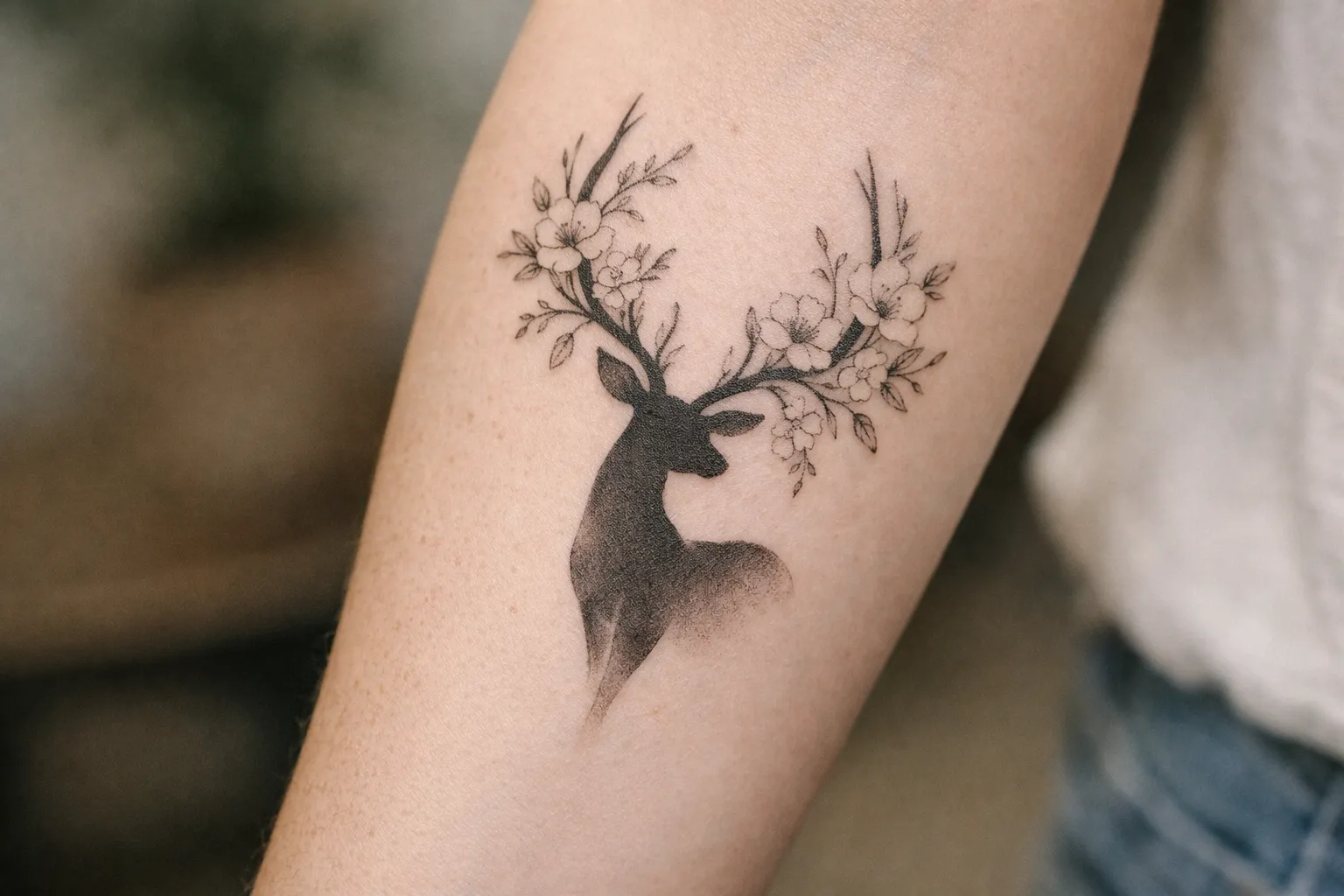
Specific combinations that land well:
- Doe with peonies along the spine, 6-8 inches
- Fawn curled inside a wreath of forget-me-nots, 3-4 inches on the upper arm
- Antlers wrapped with wild roses and the dates of a child’s birth, 4-5 inches on the forearm
- Stag silhouette with a moon behind and lavender at the base, 5-7 inches on the calf
If you want this style to age, ask for a stronger black foundation than the Pinterest reference probably shows. Pastel-only tattoos look beautiful at week two and tired at year five. I’ve seen enough of them come back for touch-ups to say this with confidence.
Forest Scenes and Sleeves with Deer
Sleeve and half-sleeve deer compositions usually build out from one anchor: a stag in the foreground, with pine trees, mountains, a moon, and sometimes a secondary animal (an owl, a fox) filling the negative space. If you enjoy exploring animal motifs beyond the deer, a monkey tattoo is another example of how a single animal can carry surprisingly layered symbolism across cultures.
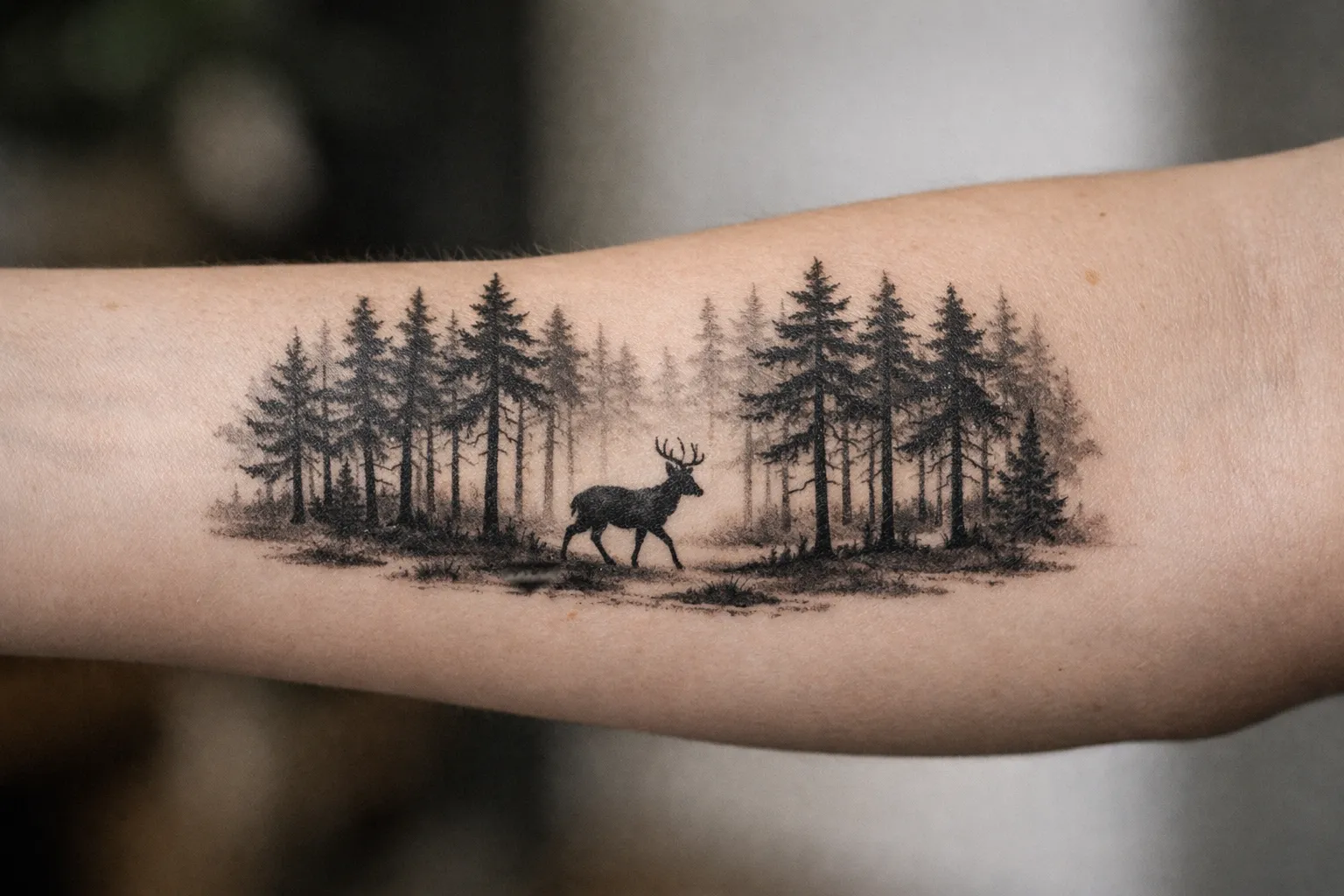
For a half-sleeve, plan on 5-8 hours total across one or two sessions. A full sleeve is 15-25 hours spread over multiple sessions, with healing weeks between. The deer should be roughly the size of your palm at minimum to remain the focal point as the rest of the scene fills in.
Forearm placements work well for a single deer head with a light background. The forearm has a flat, relatively low-pain surface and ages slowly compared to the inner bicep or wrist. A stag head facing forward, 5-6 inches tall, with a faint mountain line behind it, is one of the more durable compositions in the deer category.
Body flow matters. A forward-facing stag on a curved area like the outer calf can look distorted when the muscle flexes. Profile views generally wrap a limb better than head-on portraits.
Cost and Time: What a Deer Piece Runs in 2025
Pricing varies by region and artist demand, but typical 2025 US shop rates land roughly here:
- Small minimalist deer outline (2-3 in): $80-$150, 30-45 minutes
- Medium forearm deer head with shading (4-6 in): $200-$400, 1.5-3 hours
- Realistic white-tailed deer shoulder piece (6-8 in): $400-$700, 3-6 hours
- Color hunting back piece or forest half-sleeve: $800-$2,000+, 6-12+ hours across multiple sessions
- Specialized wildlife realism or Sak Yant masters: $150-$250/hour
Custom designs typically need 1-2 weeks of lead time for the artist to draw the piece, plus a $50-$200 non-refundable deposit credited toward the final price. Booked-out artists run 1-6 month waitlists.
Reputable shops require age 18+ with valid ID. Tell the artist if you have a bleeding disorder, are on blood thinners, are pregnant, or have eczema or psoriasis near the placement. Avoid sunburn, fake tan, and heavy exfoliation in the 48-72 hours before your session.
Aftercare and Healing Timeline
A deer tattoo heals the same as any other piece, but the fine antler tips and fur detail are the first things to suffer if you skip steps. Picking is what destroys antler tips - I’ve seen it happen enough times that I say it to every client before they walk out the door.
Day 1-3: Keep the second-skin bandage on as long as the artist instructs (usually 24-72 hours). Once removed, wash gently with fragrance-free soap, pat dry, apply a thin layer of fragrance-free moisturizer or a healing balm. Expect plasma weeping and slight swelling.
Week 1: Wash twice daily, moisturize thinly 2-3 times a day. No swimming, no soaking, no gym sweat sessions on the area. The tattoo will start to flake and itch - do not pick.
Week 2-4: Flaking finishes, the surface looks dull and slightly cloudy (“milky healing”). This is normal - the deeper layers are still settling. Keep moisturizing. Cover with sun-protective clothing when outdoors; UV at this stage fades color permanently.
Week 4-6: Surface healing complete. Full internal healing takes up to six weeks. Once healed, use SPF 30+ on the tattoo any time it sees direct sun. Touch-ups for minor fading or small blowouts are often free or low-cost within 3-12 months - check your studio’s policy.
Total aftercare spend usually lands at $10-$40 for soap and moisturizer.
Choosing the Right Artist
Don’t book based on overall portfolio quality - book based on the specific style your deer needs. A great Japanese-style artist may not be the right call for a fine-line minimalist fawn. A black-and-gray realism specialist will struggle with neo-traditional saturation.
Look for these specifics in their healed work (not just fresh):
- For realism: clean fur direction, crisp eye highlights, no muddy gradients in healed photos
- For geometric: ruler-straight lines, consistent line weight, symmetry that actually lines up
- For fine line: thin lines that are still thin in healed photos, not blurred
- For neo-traditional: bold outlines that hold up, saturated color that didn’t go patchy
Bring 3-5 references, but be clear they’re for direction, not for copying. Most reputable artists won’t replicate another artist’s exact piece - they’ll use it to understand what you’re after and design something for your body. That’s a feature, not a problem.
Tattoos to Avoid (and Why Deer Is a Safer Pick)
The question “what are tattoos to avoid” comes up alongside deer searches because people are looking for a design that won’t age badly or carry unintended weight. The categories generally flagged:
- Hate symbols and gang iconography - obvious, but worth saying.
- Partner names of recent relationships - covers and removal are expensive.
- Trend-driven micro-tattoos with no personal meaning - they read as dated within a few years.
- Sacred symbols from cultures you have no connection to - especially closed-practice symbols. Sak Yant and Shinto white deer fall in this gray zone (3)(5); a generic stag does not.
- Poorly planned finger, lip, and inner-ear tattoos - high friction, fast fade, rarely worth the money.
A deer tattoo is generally a safe pick because the symbolism is broad, the motif suits many styles, and the animal isn’t tied to a closed cultural practice the way some other designs are. The exception is the cultural variants (Sak Yant, Shinto white deer) which deserve genuine research before use (3)(5).
Frequently Asked Questions
- What is the best placement and size for a deer tattoo to age well?
- Forearm placements for stag heads (4-6 inches) and sternum or back for symmetrical skulls and antlers work well. Avoid fine-line antlers on the wrist due to fast skin turnover. Realistic deer need at least 6 inches to preserve detail over time.
- Can I get a Sak Yant deer tattoo in a Western shop?
- Sak Yant deer tattoos are traditionally blessed by monks in Thailand and carry spiritual significance. Getting a decorative version in a Western shop is contested and may be seen as cultural appropriation. Research and respect are advised.
- How do I prevent fine-line antler tips from blurring?
- Size matters: keep antlers at least 3 inches tall for linework and 4 inches if shading is involved. Avoid placing fine-line antlers on high-friction or fast-turnover skin like the inner wrist. Follow strict aftercare to avoid picking.
- What should I tell my artist when briefing a deer tattoo?
- Specify the exact deer motif (stag, doe, fawn, skull, white-tailed), preferred style, and placement. Bring 3-5 reference images for direction, not copying. Discuss sizing to ensure longevity and clarity of details.
- Why are some deer tattoo designs considered culturally sensitive?
- Certain deer motifs like the Shinto white deer and Sak Yant deer have religious or spiritual significance in their cultures. Using these designs without understanding or permission can be disrespectful or inappropriate.
- What is the typical healing timeline and care for a deer tattoo?
- Healing spans 4-6 weeks with key phases: day 1-3 bandage and gentle washing, week 1 moisturizing and avoiding water exposure, weeks 2-4 flaking and sun protection, and weeks 4-6 full internal healing. Use fragrance-free moisturizer and sun-protective clothing.
Putting It Together
Decide first which deer you actually want - stag, doe, fawn, skull, or species-specific white-tailed. That single decision determines symbolism, size, placement, and which style of artist to book. Then pick a style (geometric, fine line, neo-traditional, black-and-gray realism, watercolor) and match it to a placement that suits the animal’s natural flow: forearm and outer arm for forward-facing stag heads, sternum or back for symmetrical skulls and antlers, shoulder or thigh for full realistic deer, and behind the ear or inner bicep for small minimalist pieces.
Bring real references, expect a custom redraw, and don’t undersize a detailed piece. The deer is forgiving as a motif but unforgiving on scale. Give the antlers and the eyes the room they need, and the tattoo will still read clearly at year ten.