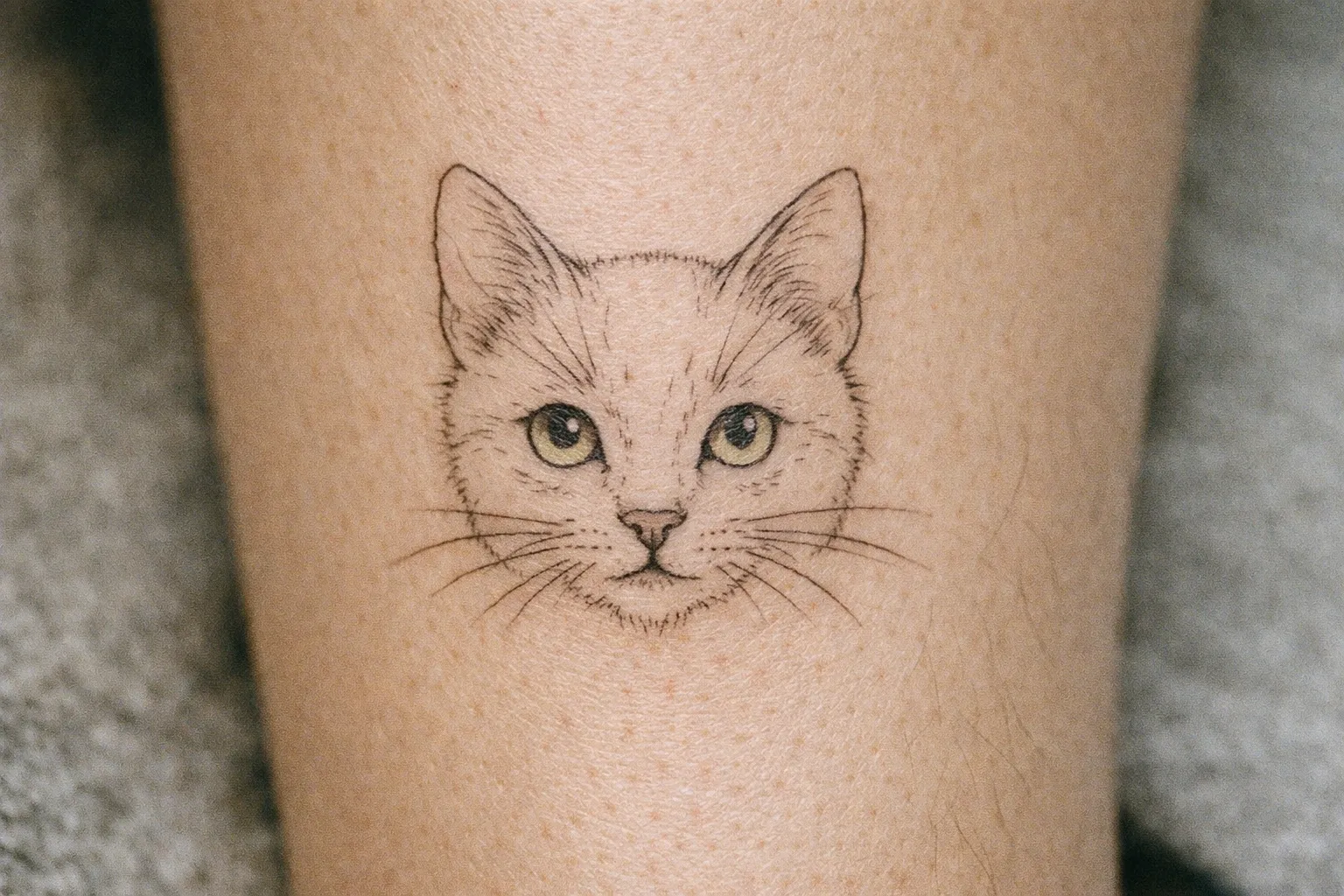
Most people book a cat tattoo picturing something small and cute - a fine-line silhouette behind the ear or a single-line profile on the wrist. What they don’t picture is the whisker problem: a 1-inch cat face loses its whiskers within a year or two as the lines spread slightly in the skin, and by then the “cute minimalist cat” reads as a fuzzy blob. Cat tattoos span a wider range than most guides admit, from that 1-inch silhouette to a 20-hour sleeve stacking maneki-neko, Bastet, and geometric facets. This guide covers what actually matters before you book: meaning, style, size, placement, session length, aftercare, and how to vet an artist. The honest caveat up front - a cat looks deceptively simple, but the style you pick determines your session length, your healing, and your long-term maintenance more than almost any other design decision.
✓ Pros
- Enormous style range - works from micro fine-line silhouette to full sleeve
- Strong symbolic depth across Egyptian, Japanese, and Celtic traditions
- Scales for first-timers (small, single-session) and collectors (large compositions)
- Black silhouettes and blackwork age reliably with minimal touch-up
✗ Cons
- Realism under 3 inches loses fur and whisker definition within 1-2 years
- Watercolor and pastel color fades noticeably after 3-5 years without strict sun protection
- High-movement spots (inner wrist crease, finger sides, ankle front) accelerate distortion
- Multicolor realistic portraits are among the harder designs to remove - often 10+ laser sessions with residual ghosting
What a Cat Tattoo Actually Means
A cat tattoo most often reads as independence, mystery, and duality - the domestic companion that never fully loses its wild edge - along with protection and luck depending on the design. That symbolism lands with a big audience: the American Pet Products Association’s 2023-2024 National Pet Owners Survey reports that 46.5 million U.S. households own a cat, so feline symbolism is personal for a large slice of potential clients.
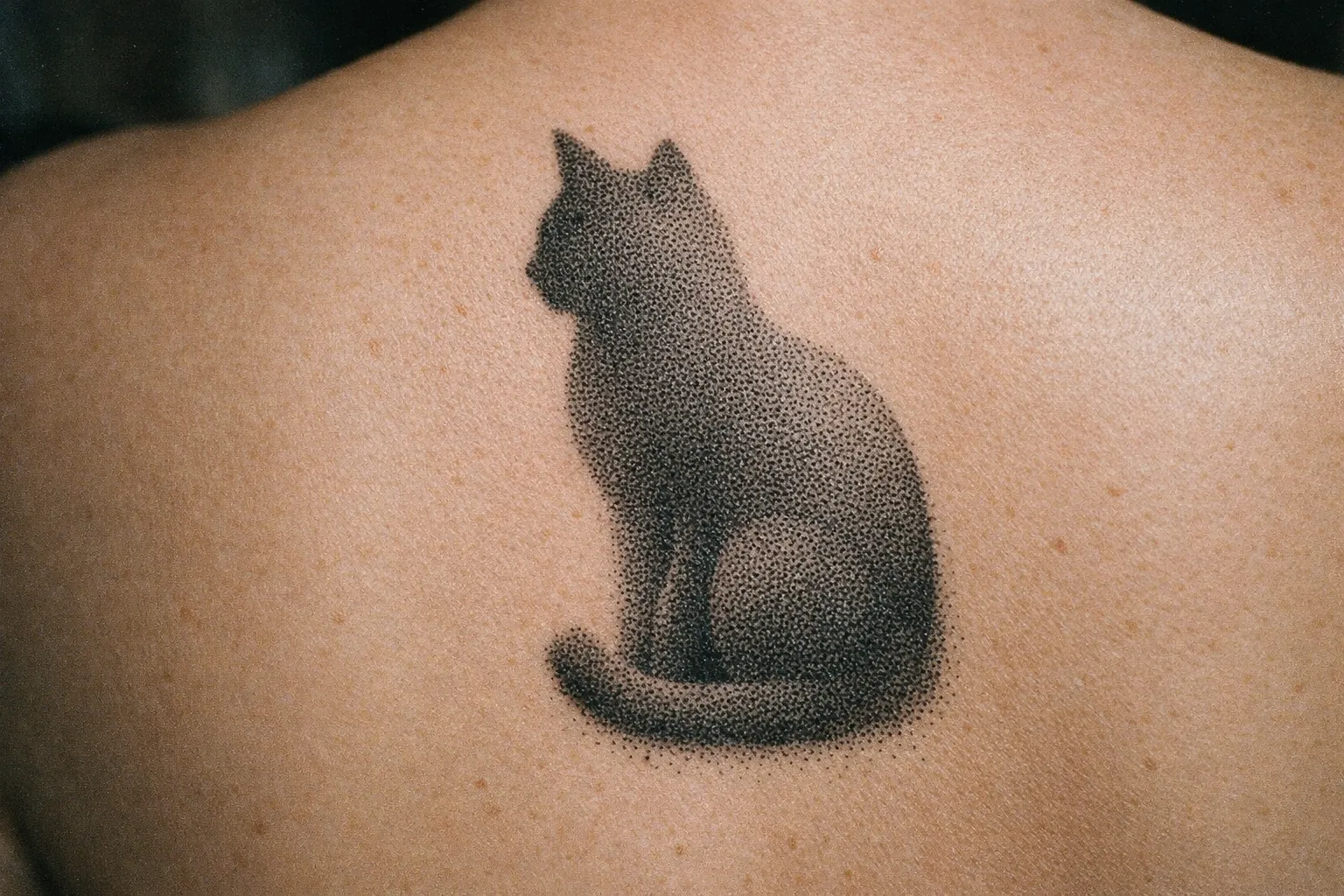
Meaning here isn’t fixed. It shifts by culture, by color, and by what you pair the cat with. A black cat next to a crescent moon and a pentagram reads occult; the same silhouette alone stays ambiguous. That flexibility is a feature - but it means you should decide what you want the piece to say before you sit down.
Black Cat Symbolism: Superstition, Witchcraft, and the Counter-Reading
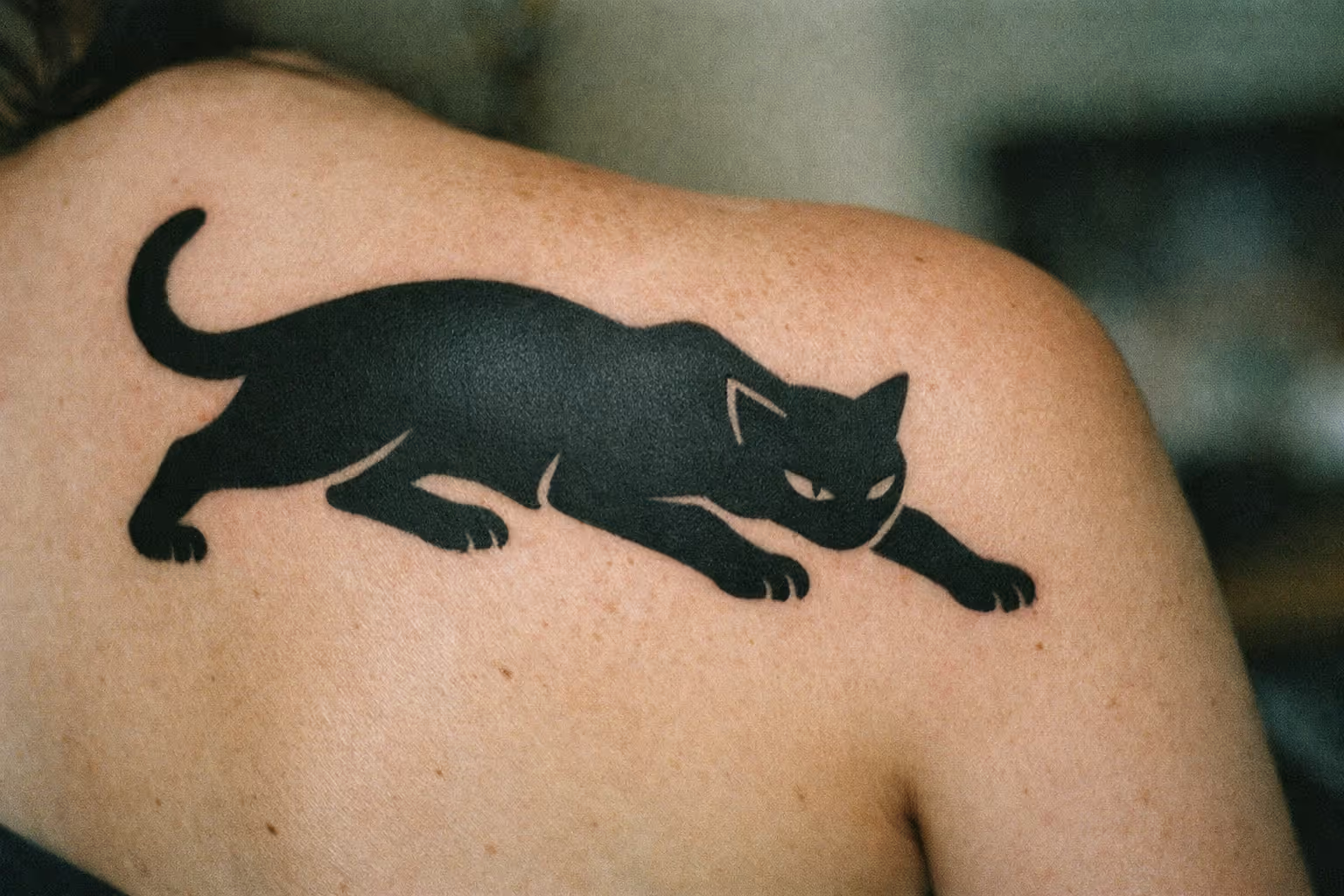
Black cat tattoos carry Western superstition - bad luck, witchcraft, the occult - but that’s only half the story. In British folklore and Japanese tradition, black cats are good luck, and most people getting one today lean into that reversal. Cats Protection in the UK reports that black cats wait significantly longer for adoption than other colors because of superstition, and the charity frames them as loyal, overlooked companions - a modern counter-reading a lot of clients are consciously choosing. In Japanese tradition more broadly, black cats appear in Edo-period folklore as auspicious figures - protectors who bring luck to travelers and single women - though the specific tales vary by region and source.
So if someone tells you a black cat tattoo is “bad luck,” that’s one tradition, not the tradition.
Maneki-Neko and Bastet: Cultural Roots Worth Knowing
Maneki-neko - the beckoning cat. Developed in mid-19th-century Edo (roughly the 1840s-1860s), the figurine’s raised left paw is associated with attracting customers, while the raised right paw invites money and general prosperity. That paw choice isn’t decorative - it sets the intention of the tattoo.
Bastet comes from a much older tradition. The Egyptian cat goddess of home, protection, and fertility is one of the earliest recorded cat-as-deity motifs, and she shows up most often in neo-Egyptian and blackwork styles. Both maneki-neko and Bastet carry specific cultural weight, which is worth knowing so the piece doesn’t read as generic.
Memorial Designs and the Pet Portrait Angle
Memorial cat tattoos - paw prints, a name, a date, or a full portrait - are the fastest-growing sub-category, driven largely by pet-portrait content on social platforms. These mark a specific animal and a specific loss, which is why size and artist choice matter even more than usual here. A blurry memorial portrait is worse than none.
One note readers ask about: in some prison tattoo traditions, particularly in Eastern European and Russian systems, a cat silhouette has signaled a thief or someone who “moves quietly.” That reading varies by region and era and is not universal - outside that context it carries none of that meaning.
Styles - Which One Actually Fits Your Idea
Five styles cover almost every cat tattoo people actually book, and each carries a different trade-off in size minimum, session length, and how it ages. Here’s how they compare before we get into the detail:
Comparison of Cat Tattoo Styles
| Fine-line / minimalist | Realistic portrait | Watercolor | American / neo-traditional | Blackwork / geometric | |
|---|---|---|---|---|---|
| Typical Size | 1-3 in | 3-6 in | 3-5 in | 3-5 in | 2-5 in |
| Session Time | 15 min-2 hr | 4-8+ hr | 3-5 hr | 2-4 hr | 2-5 hr |
| Aging | Blurs under 1 in | Good if sized right | Fades in 3-5 yr | Excellent, 10-15+ yr | Excellent |
| Best Placement | Wrist, ankle, behind ear, sternum | Upper arm, thigh, upper back | Upper arm, shoulder blade, outer thigh | Outer forearm, upper arm, calf | Forearm, upper arm |
| Complexity Level | Low | High | Medium-high | Medium | Medium |
Minimalist and Fine-Line Cats
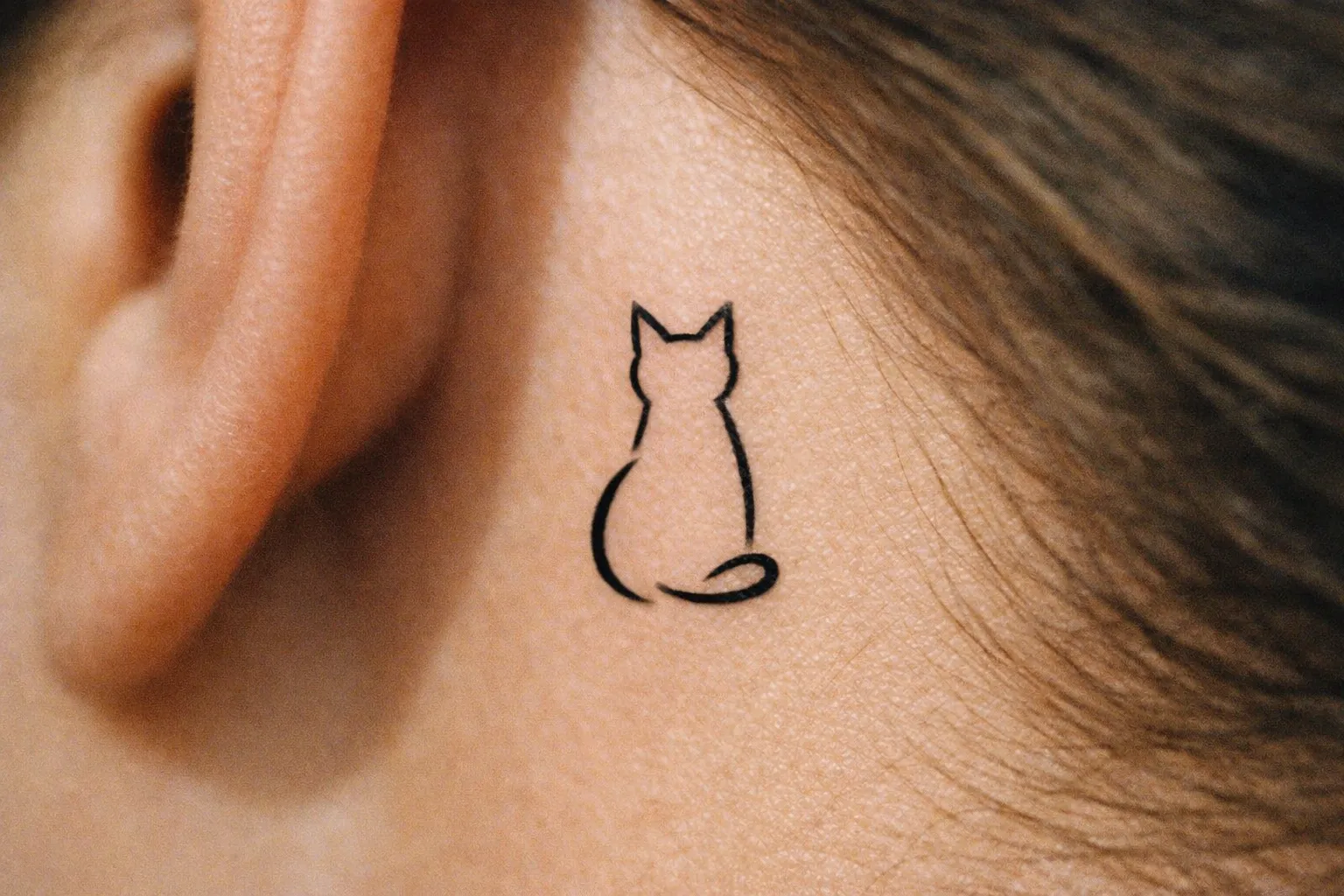
Single-needle or 3RL linework: sitting silhouettes, single-line profiles, geometric outlines. Typical size runs 1-3 inches, and these suit the wrist, ankle, behind the ear, and sternum. Micro tattoos up to 1 inch take 15-30 minutes, while small pieces of 2-4 inches run 1-3 hours - which matches the fine-line cat range well.
The aging caveat is the whole story with this style. Lines under 1 inch can blur and spread within 1-2 years. If you want whiskers to survive, size up slightly. These work well as first tattoos, and a competent generalist can execute them.
Realistic Cat Portraits
Hyper-detailed fur, eye shine, depth - this style demands advanced shading and real feline anatomy knowledge. The minimum recommended size is 3-4 inches for a face, and 4x4 inches for a head-and-shoulders portrait. Session time runs 4-8+ hours; large pieces on the upper arm or thigh may need two or three sessions.
Artist selection matters more here than anywhere else. I always tell clients to ask for healed portfolio photos specifically of animal fur and eyes - fresh work hides blowouts and patchy shading. And know going in that multicolor realistic portraits are the hardest cat design to remove if you change your mind, averaging 12+ laser sessions.
Watercolor Cats
Color splashes behind a simple outline - painterly and soft. Typical size runs 3-5 inches, suiting the upper arm, shoulder blade, or outer thigh. The aging reality is the catch: pastel and light colors fade noticeably after 3-5 years without SPF discipline, so plan touch-ups every 5-7 years. Sessions run longer than blackwork and use more consumables, which nudges the per-session cost up.
American Traditional and Neo-Traditional Cat Heads
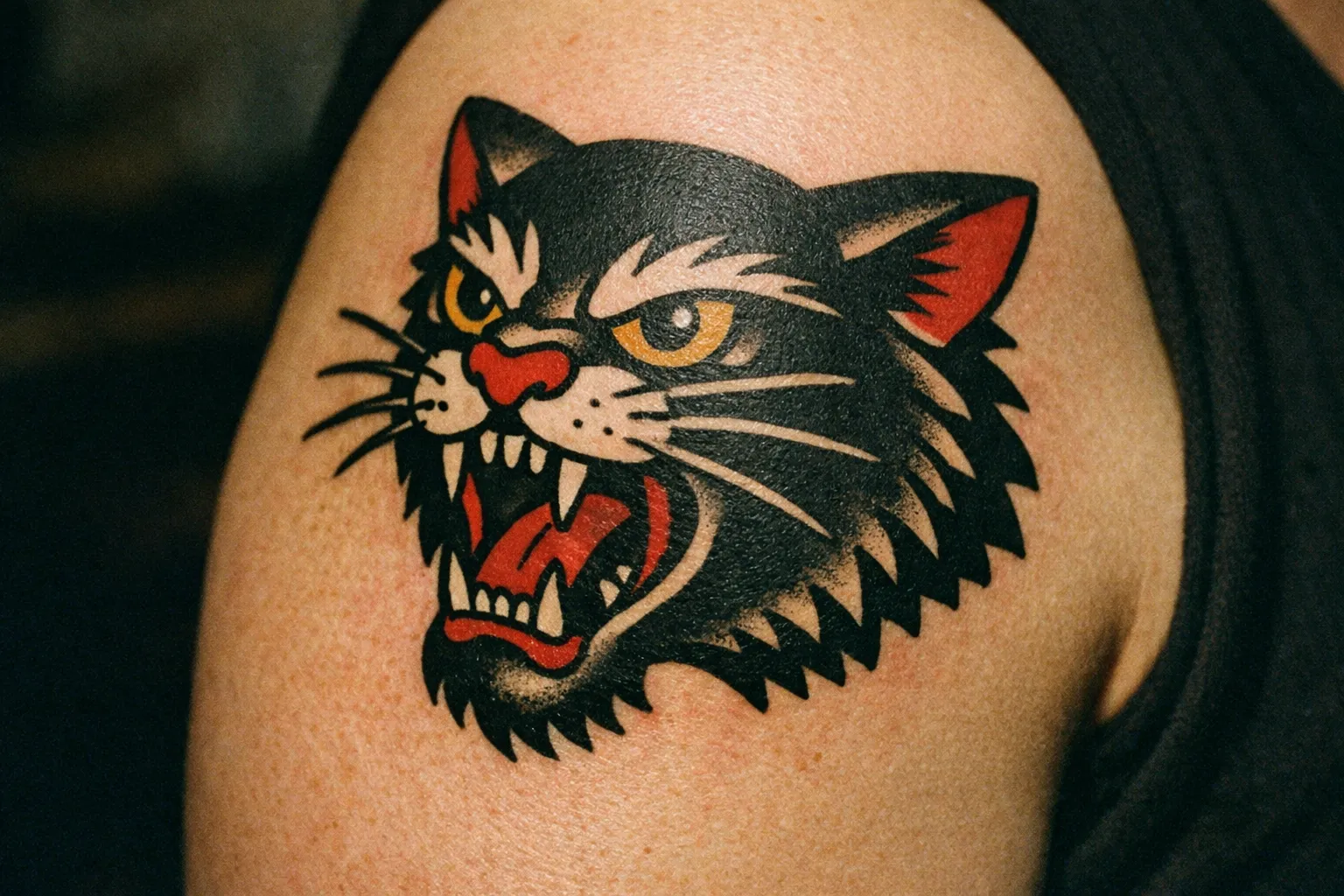
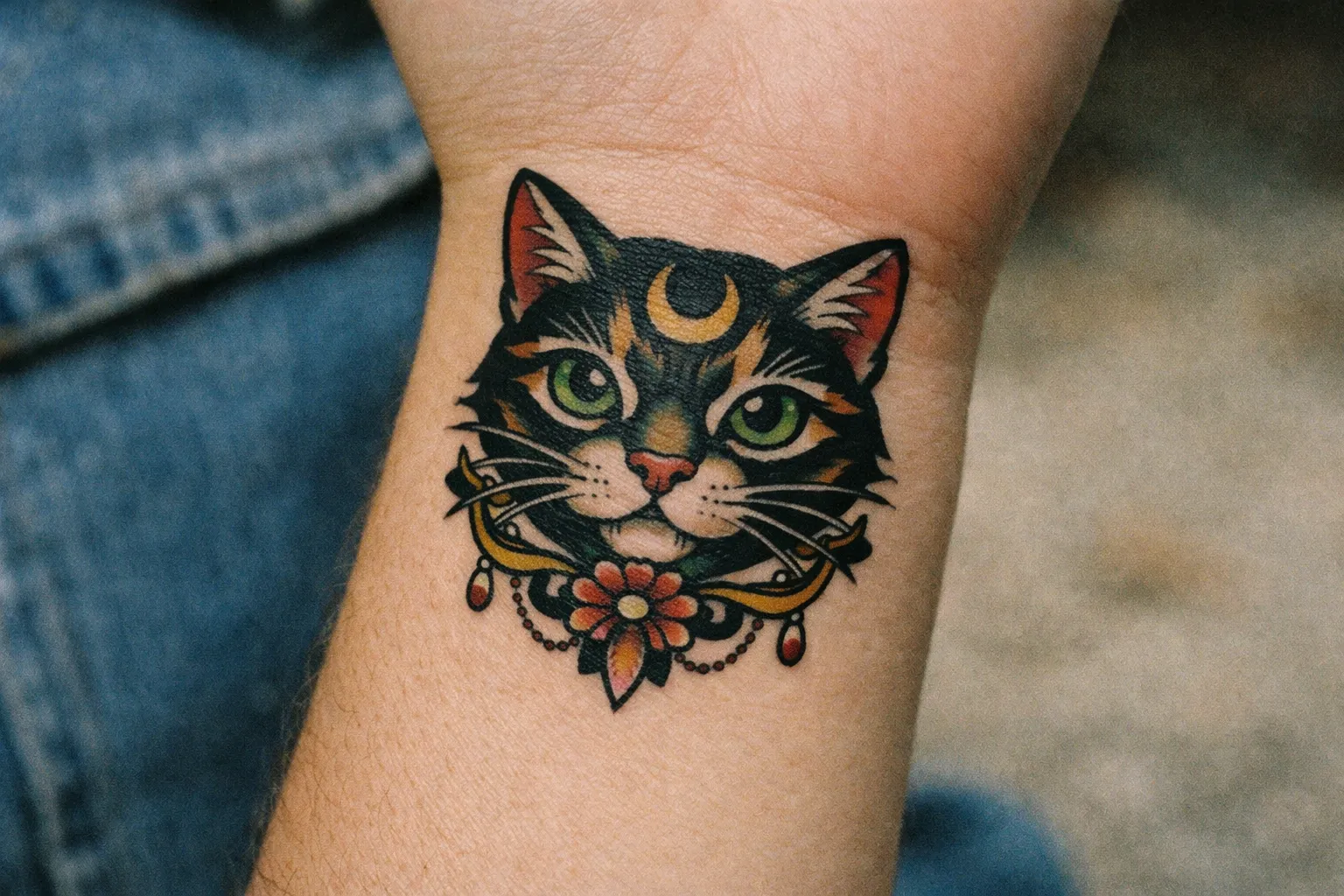
American traditional has two clear hallmarks: thick black outlines and a limited, saturated palette (black, red, green, yellow), with stylized anatomy rather than realism. Neo-traditional keeps the bold linework but adds richer color gradients and more anatomical accuracy. The common pitfall is pushing realism inside a traditional frame - it goes muddy and loses the clarity that makes the style work.
Typical size is hand-sized, 3-5 inches, and it suits the outer forearm, upper arm, or calf. Those bold outlines hold clarity for 10-15+ years, making this one of the more durable choices you can make. It’s also the natural home for Cheshire cat designs, where the exaggerated grin fits the stylized aesthetic.
Blackwork, Geometric, and Sphynx Cat Designs
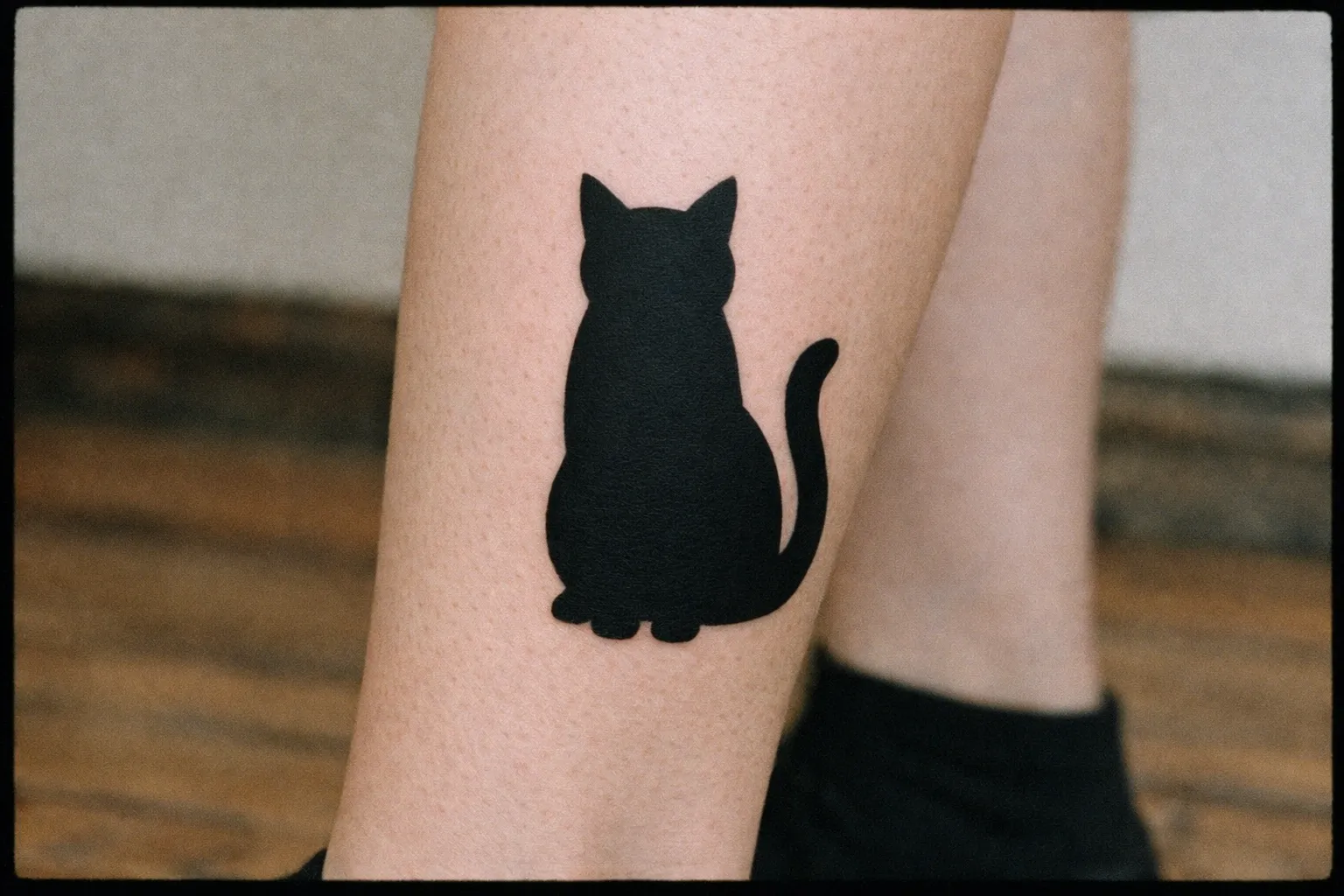
Blackwork means solid black fill and high contrast, no color - it ages reliably and covers well if you ever need it to. Geometric cats use polygonal facets, dotwork, and sometimes mandala integration, reading as modern and conceptual.
Sphynx cat tattoos land especially well in these styles. The hairless anatomy - wrinkled skin, large ears, visible musculature - translates to detailed linework without the fur-texture demands of a furry breed, which makes it more accessible for fine-line and blackwork artists. Hairless cat tattoos more broadly are a growing niche for the same reason: the distinctive silhouette works at smaller sizes than a furry cat, and the skin folds create interesting negative space. Both suit the forearm and upper arm at 2-4 inches.
Placement, Size, and What Actually Ages Well
The rule that governs cat placement is simple: flat, lower-movement areas preserve faces, and curved or high-movement areas warp them over time. A cat face needs at least 3-4 inches to hold whiskers, eye shine, and fur direction - go smaller and you’re choosing a stylized or silhouette design whether you meant to or not.
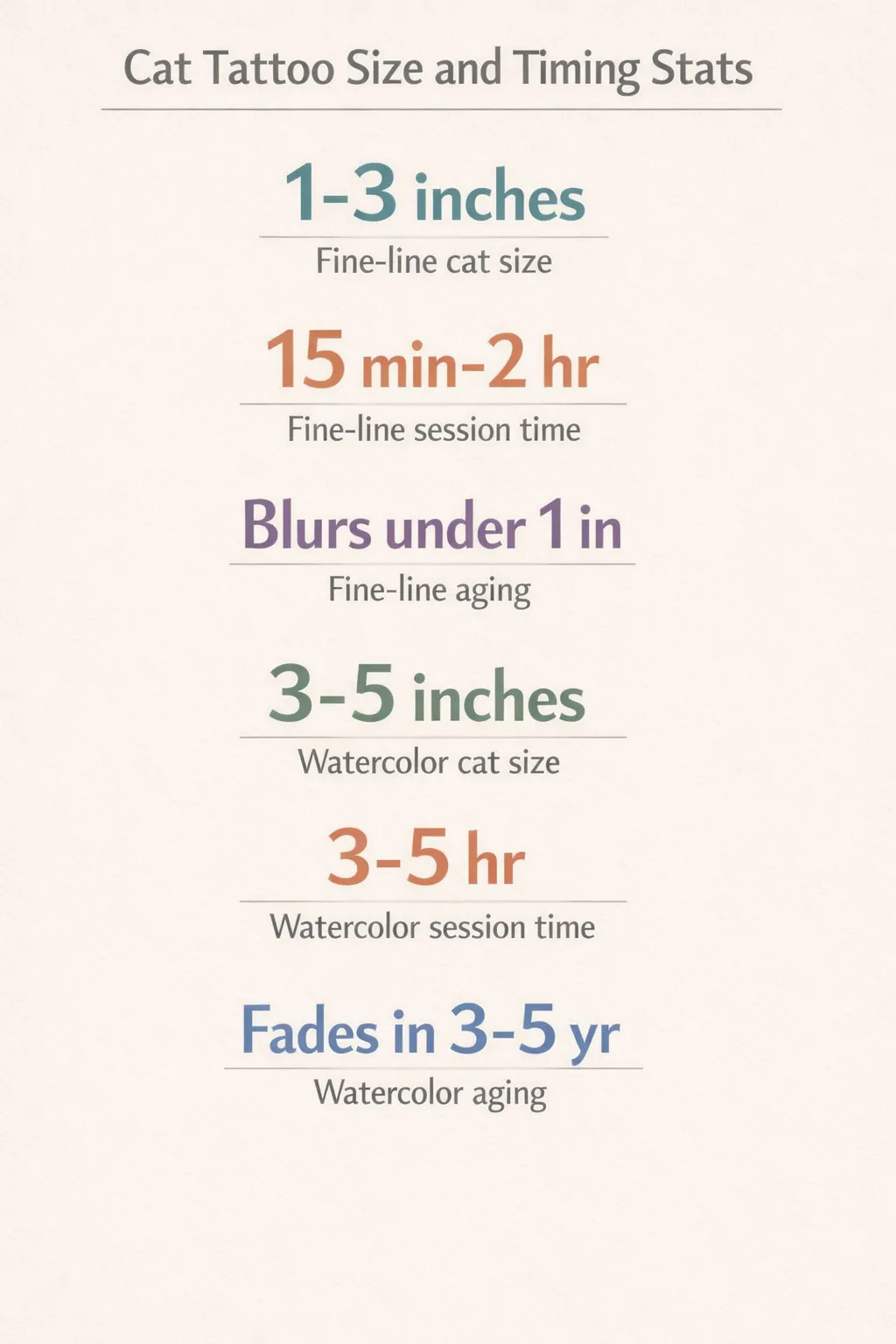 Cat tattoo size and timing ranges: Fine-line 1-3 inches (15 min-2 hr); Watercolor 3-5 inches (3-5 hr); aging notes included.
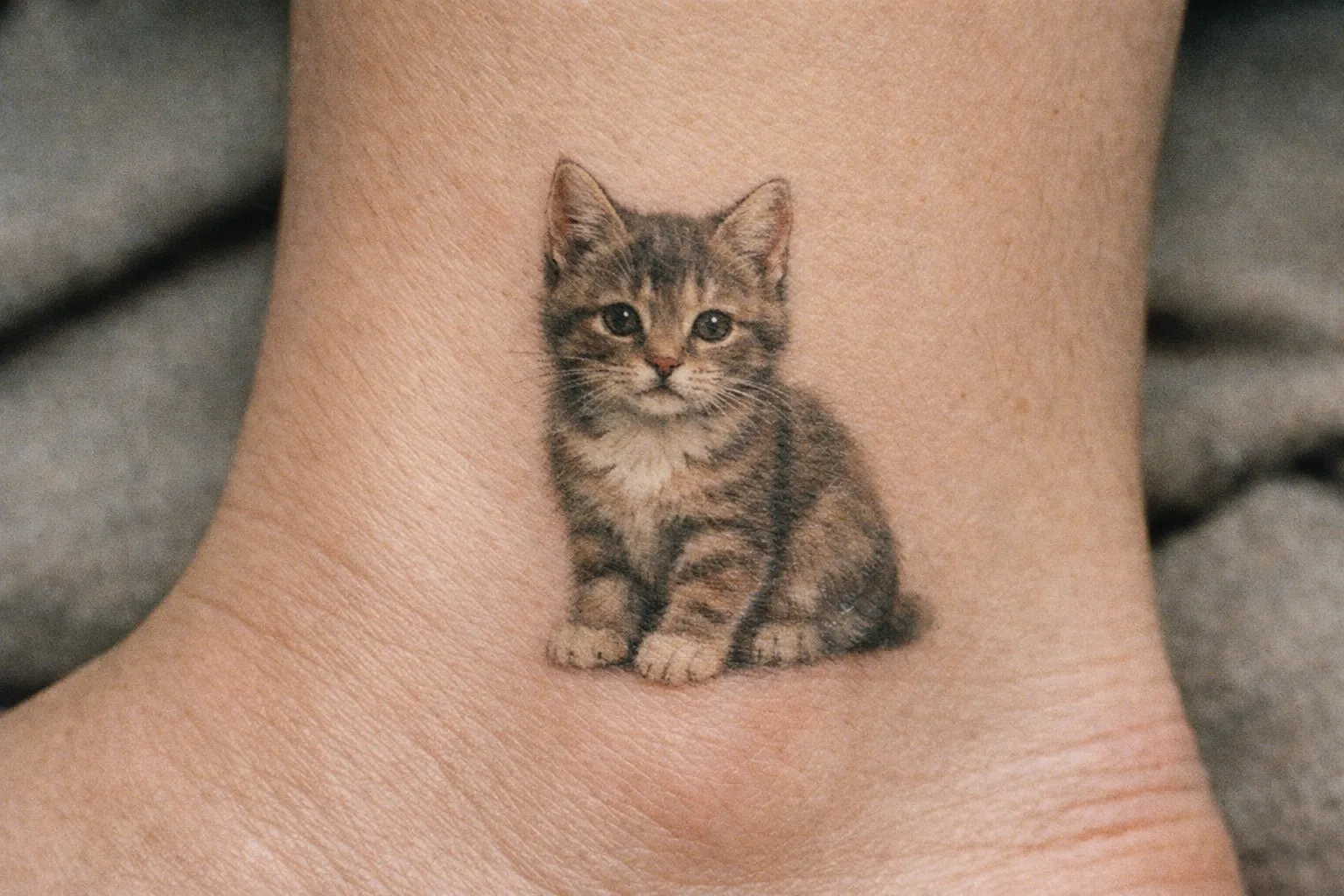
Small Cat Placements: Wrist, Ankle, Behind the Ear, Sternum
Very small silhouettes live on the wrist, ankle, behind the ear, and sternum - spots where a 1-2 inch piece reads cleanly. There’s a trade-off baked in, though. Dermatologists writing in the Journal of Clinical and Aesthetic Dermatology report that tattoos on hands and feet fade and distort faster than upper arm and thigh placements because of constant friction and motion, and the American Academy of Dermatology notes that UV exposure accelerates fading on sun-exposed spots like forearms, wrists, and ankles. A small cat behind the ear is fine. A small detailed cat on the ankle front is asking to blur.
Medium and Large Placements: Forearm, Upper Arm, Thigh, Shoulder Blade
Main cat faces belong on the upper arm, outer thigh, or upper back - flat, lower-movement canvases that don’t warp features over time. Pain scales with placement here: the ribcage is the worst, followed by the sternum and inner bicep, with the outer forearm and calf sitting at the mild end. That matters for session planning too. Sensitive areas like ribs and sternum realistically cap a sitting at 2-3 hours, while the outer forearm and calf let you push to 3-5 hours - which is why detailed pieces tend to land on the arm.
Placements to Reconsider for Detailed Designs
Skip the inner wrist crease, finger sides, and ankle front for anything detailed. The AAD flags high-movement zones over joints - wrists, elbows, ankles, fingers - as the most likely to blur and distort, which is exactly where whisker and eye-line stability falls apart. Hands and feet also carry higher infection risk from friction and contamination.
A single-line silhouette can survive these spots. A realistic cat face cannot.
How Long It Takes - Session Time by Design Type
A cat tattoo can take anywhere from 15 minutes to 30 hours depending on size and style, so it helps to anchor the ranges concretely:
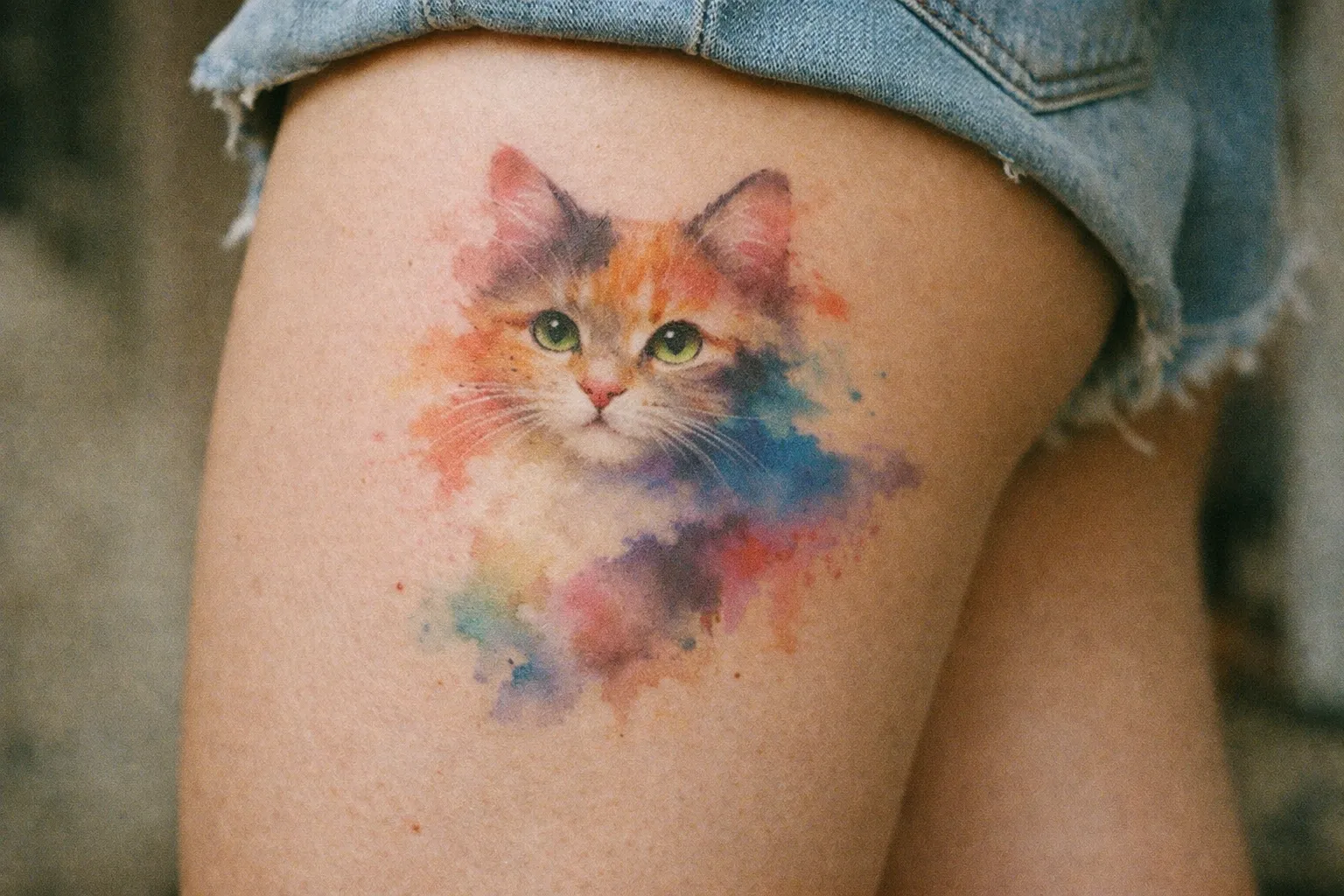
- Micro silhouette under 1 inch: 15-60 minutes total, including setup
- Small cat, 1-3 inches (forearm, ankle): 1-3 hours total appointment
- Medium realistic portrait, 4x4 inches: 2-3 hours of needle time, 2-4 hours total per session
- Large sleeve with multiple cats and symbolic elements: 20-30 hours of needle time across 5-8 sessions
These size-time ranges line up - micro tattoos at 15-30 minutes, small tattoos at 1-3 hours, medium 4-6 inch pieces at 3-5 hours. For the upper bound, a realistic animal-head quarter sleeve can run 3.5-6 hours in a single sitting for an experienced black-and-grey artist.
Most clients sit comfortably for 1-4 hours; anything past 5 is usually reserved for large projects. For big pieces, the smart strategy is shorter initial sessions (2-3 hours) to lay in linework, then longer shading sessions (4-6 hours) once you know your pain tolerance.
One honest note: clients routinely underestimate session length for realistic pieces and tap out mid-shading, which creates awkward breaks and drags out completion. If you’ve never sat before, don’t book a full-day realistic cat as your first.
Choosing the Right Artist for Feline Work
Cat anatomy is harder than it looks - fur direction, eye shine, whisker placement, and ear structure all have to read right, and a generalist who’s great at lettering may flatten all of it. Minimalist work is safe with most competent artists; realism and watercolor require demonstrated feline anatomy in a healed portfolio.
The single most useful thing you can do is ask to see healed photos, not just fresh work. The American Academy of Dermatology advises exactly this, because healed examples reveal blowouts, patchy shading, and poor line retention that fresh photos hide - and that’s precisely where fur texture and whisker clarity live or die. I’ve seen plenty of fresh cat portraits that looked sharp in a photo and turned into soft, patchy messes six months later. Look for consistent fur texture across multiple pieces and accurate eye anatomy, not one lucky shot.
Bring references. Realism artists typically want 3-5 high-resolution photos of the cat under different lighting to avoid flat or inaccurate fur coloring - the Alliance of Professional Tattooists commonly advises the same for animal portraits. For large compositions like multi-cat sleeves, look for an artist experienced in large-composition planning, and ask how they handle background integration on curved body areas.
A few red flags: anyone quoting a very short time for a detailed realistic cat, and anyone without healed animal-portrait examples. And to be a good client - which keeps artists on your side - avoid the things that genuinely create problems: vague references (“something like this but different”), last-minute design changes after the stencil’s placed, requesting fine detail in sizes that can’t hold it, and not disclosing skin conditions or medications that affect healing.
On rate: experienced custom artists in major U.S. cities typically charge $150-$250 per hour - so $200 an hour sits squarely in the mid-to-upper professional range - normal, not a rip-off, especially for a niche skill like animal realism.
Specific Designs Worth Knowing
Beyond style, a handful of specific designs come up again and again, and each carries its own rules on paw position, size, and placement. These are the cat tattoo ideas worth understanding before you commit.
Lucky Cat Tattoo (Maneki-Neko): What the Paw and Color Mean
The lucky cat tattoo carries meaning in both its paw and its color, so neither is a throwaway choice. A raised left paw is traditionally said to attract customers or guests; a raised right paw attracts money and financial fortune. Match the paw to your actual goal - paw choice reflects the wearer’s primary intention, not decoration.
Color adds another layer. White cats signal general good luck, gold means wealth, black means protection from evil, and red is associated with health. A maneki-neko works in American traditional, neo-traditional, and Japanese styles, and sits well at 3-5 inches on the forearm or upper arm.
Cheshire Cat, Moon Cats, and Combination Designs
Cheshire cat tattoos have a canon-anchored hook: the disappearing grin. Literary analyses of Alice’s Adventures in Wonderland note that the grin remaining while the body vanishes is the central visual motif, which is what makes a grin-only tattoo identifiable rather than a generic smiling cat. The floating grin alone works at around 2 inches; the full character suits neo-traditional or illustrative styles at 3-4 inches on the upper arm or calf.
Combination designs open the meaning up. A cat with a moon reads as mystery, cycles, and nocturnal symbolism, and sits well on the sternum, forearm, or upper back. A cat with flowers - roses, peonies, cherry blossoms - softens an otherwise sharp read and is standard in neo-traditional and Japanese-influenced work. For multi-cat compositions, the planning rule holds: put the main faces on flat areas and reserve curved areas for background motifs.
Sphynx and Hairless Cat Tattoos: Why the Anatomy Works
Sphynx cat tattoos suit fine-line and blackwork because the hairless anatomy removes the fur-texture problem entirely. Large ears, wrinkled skin, and lean musculature give an artist clean shapes and folds to work with instead of thousands of hairs to render - which is why these hold up at 2-4 inches on the forearm where a furry breed would need more room. Hairless cat tattoos more broadly are a growing niche for the same reason: the visible muscle and skin folds translate into interesting negative space in blackwork, and the distinctive silhouette stays recognizable even small.
Healing, Aftercare, and Long-Term Maintenance
Surface healing takes 2-3 weeks, full dermal healing up to 3 months, and infection risk is highest in the first 7-10 days - the American Academy of Dermatology confirms all three timelines. Those first 10 days are when aftercare discipline actually matters, and it matters more than most people think: a 2023 review in the Journal of Clinical and Aesthetic Dermatology reported a 77% increase in tattoo-related infections since 2000, with 72% of infections arising from the tattooing process itself rather than aftercare or ink (7). That means a sterile studio counts as much as your washing routine - but your routine still counts.
Breathable film dressings (Saniderm-type second skins) are worth using for the first 24-72 hours to cut early contamination. Saniderm’s own guidance suggests leaving the first bandage on up to 24 hours, then continuing with film for several days while washing at least twice daily. If your cat sits on your wrist or ankle, be extra diligent - hands and feet carry higher infection risk from contamination and friction.
How to Care for a New Cat Tattoo
3 weeksStep-by-step aftercare to ensure proper healing and color retention
- 1
Day 1-3
Keep the breathable film dressing on as directed (24-72 hours). After removal, wash gently 2-3 times a day with fragrance-free antibacterial soap, pat dry, and apply a thin layer of fragrance-free moisturizer.
- 2
Week 1
Expect peeling and itching - do not pick. Avoid soaking, swimming, and direct sun. Moisturize 2-3 times daily.
- 3
Weeks 2-4
Surface healing wraps up and the tattoo may look slightly cloudy as new skin settles. Hold off on SPF until the skin is fully healed (around 4 weeks), then apply SPF 30+ consistently outdoors.
- 4
Months 2-3
Full dermal healing; color reaches final saturation. Book a touch-up consultation now if anything needs it.
- 5
Long-term
For watercolor and pastel cats, plan touch-ups every 5-7 years. Blackwork and traditional styles can often go 10-15+ years before needing attention.
Sun is the primary long-term threat, especially for watercolor and pastel pieces. The AAD recommends broad-spectrum SPF 30+ for any tattoo regularly exposed to sunlight - and sun-protective clothing is worth considering for placements like the forearm or shoulder blade that get direct exposure without you thinking about it.
Design Decisions That Affect Removal (If You Ever Need It)
This isn’t a scare section - it’s a planning note, because the design you pick today determines how easy it is to undo later. Small black silhouettes under 10 cm² are the easy case: laser removal statistics show 67% fully cleared in under 6 sessions with picosecond lasers (4). Black and dark blue inks respond best, generally clearing in 6-10 sessions according to the American Society for Dermatologic Surgery.
Multicolor realistic portraits are the hard case. They average around 12 sessions for 90% clearance, and residual ghosting is common. A clinical study in Lasers in Surgery and Medicine found amateur tattoos clear at over 90% after eight sessions versus roughly 70-80% for professional work, because professional pieces use more saturated pigment at greater depth - so a detailed professional cat portrait is objectively harder to remove. The AAD also warns that complete removal is never guaranteed, and ghost images or hypopigmented patches can remain with dense shading and multicolor work.
The practical takeaway: if you’re uncertain about a large realistic portrait, a blackwork or traditional version gives you far more options later. Cover-ups follow the same logic - blackwork silhouettes cover cleanly, while watercolor and light-color cats are hard to bury because the background color bleeds through a dark cover design.
Common Mistakes Cat Tattoo Clients Make
- Going too small for the detail. Requesting realistic eyes and whiskers in a sub-1-inch cat is the classic error - small lines are more prone to blurring, and they spread within 1-2 years. Size up or simplify.
- Ignoring fading timelines. Light pastel watercolor fades significantly after 3-5 years, and people badly underestimate the SPF commitment that keeps it alive.
- Poor placement for detailed work. Finger sides, inner wrist creases, and ankle fronts combine high movement with higher infection risk - the AAD flags hands and feet for more friction, fading, distortion, and infection.
- Booking a full-day realistic piece as a first tattoo. Tapping out after 2-3 hours mid-shading forces awkward breaks and slows completion. Build up to it.
- Skipping aftercare steps. With 72% of infections tied to the process and early healing window, scented lotions or missed washes in the first 7-10 days meaningfully raise your risk (7).
- Not planning for removal. A large multicolor portrait can need 10+ sessions and still ghost - and at $150-$250 an hour, a full-day realistic piece adds up fast before you even consider undoing it later. Factor that in upfront.
Frequently Asked Questions
- What does a black cat tattoo symbolize?
- Black cats symbolize bad luck and witchcraft in Western superstition, but in British and Japanese cultures, they are good luck. The design's meaning depends on accompanying symbols.
- What does a cat tattoo mean in jail?
- In some prison traditions, a cat silhouette signals a thief or someone who moves quietly, but this varies widely and is not a universal meaning.
- What annoys tattoo artists the most?
- Tattoo artists dislike vague references, last-minute changes, unrealistic detail requests for size, and undisclosed skin conditions affecting healing.
- How small can a cat tattoo realistically be?
- A silhouette or single-line cat tattoo works at 1 inch, but detailed features need at least 3 inches to avoid blurring within 1-2 years.
- Is $200 an hour a lot for a tattoo artist?
- Experienced custom artists in major U.S. cities typically charge $150-$250 per hour, so $200 an hour is solidly mid-to-upper professional range - not unusual for specialized realism or watercolor work.
- How long does a cat tattoo take to heal?
- Surface healing takes 2-3 weeks; full dermal healing up to 3 months. Infection risk is highest in the first 7-10 days, requiring careful aftercare.
- Is a lucky cat tattoo culturally appropriate?
- The maneki-neko is a commercial symbol from Edo Japan, widely adopted and generally respectful to tattoo, provided its meaning is understood.
Before You Book
Three variables decide whether your cat tattoo still looks good in a decade. Style: blackwork and traditional outlast watercolor without maintenance, so pick your durability up front. Size: go bigger than you think for any realistic detail - 3 to 4 inches minimum for a face, or accept a silhouette. Placement: flat, lower-movement areas like the upper arm, outer thigh, and upper back preserve faces, while high-movement spots distort them.
Then do the one thing that separates artists who can actually render feline anatomy from those who can’t: ask to see healed photos of animal portraits specifically, not just fresh work. That single portfolio check tells you more than any consultation pitch will.