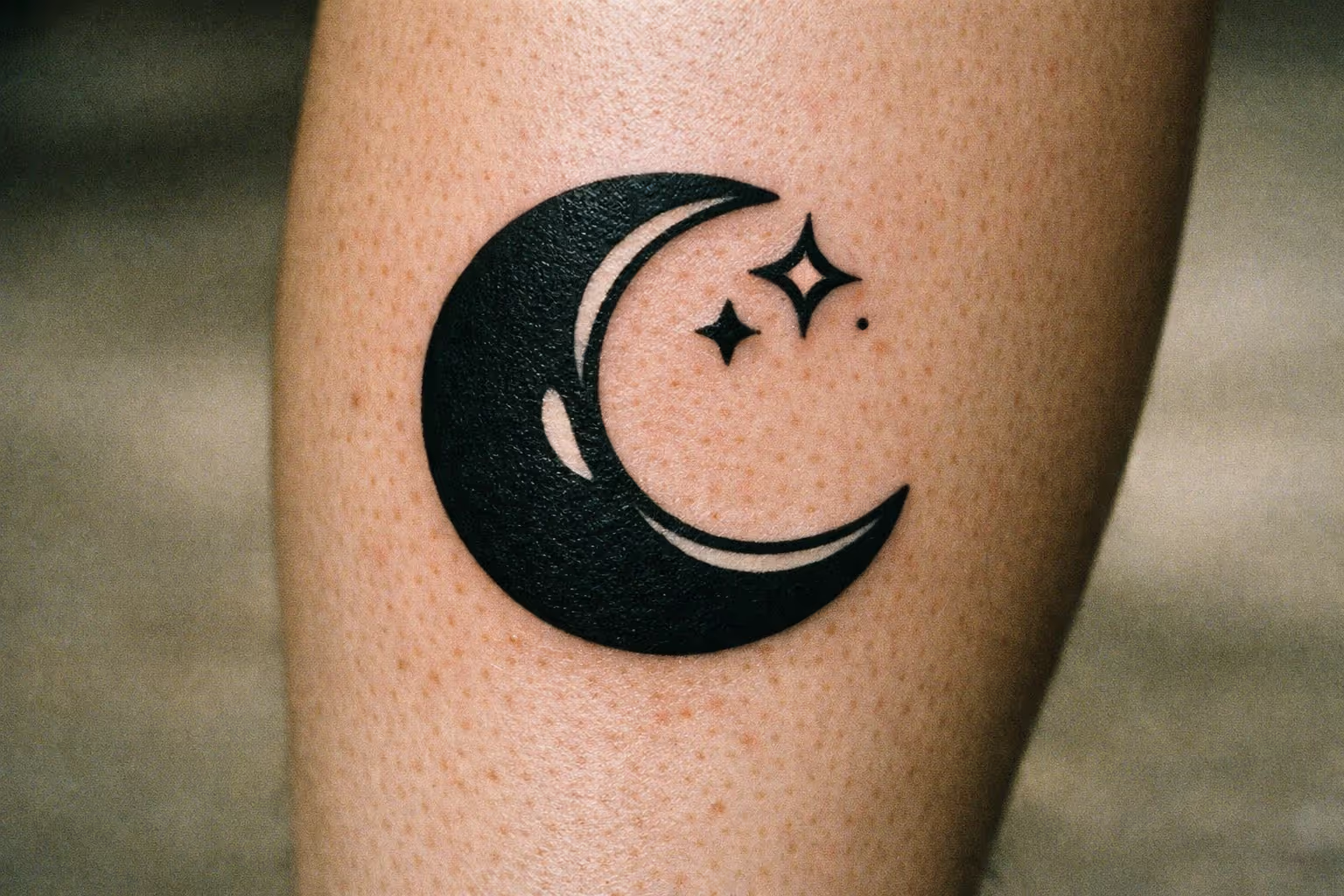
A 1 cm crescent behind the ear takes fifteen minutes and heals in a couple of weeks. A full eight-phase sequence running the length of a spine is a multi-session commitment on one of the more painful placements you can choose. Both are a moon tattoo, and that range is the whole point: the moon is one of the few subjects that scales from a wrist doodle to a back panel without losing coherence. What actually determines whether yours works isn’t the meaning you assign it. It’s size, placement, and whether the style you chose will still read in ten years.
This guide covers meaning by phase, the four design families people actually book (crescent, phases sequence, moon and stars, moon moth), the placement trade-offs nobody explains honestly, and the healing realities that decide long-term clarity.
The quick version: the moon carries genuine cross-cultural weight - lunar goddess traditions, cyclical symbolism - and works in nearly every style from fine line to blackwork, across a wide range of sizes and budgets. The catches: it’s an overused motif, so a generic design reads as generic; fine-line crescents are among the fastest tattoos to fade at small sizes; detailed versions like a realistic full moon or a full phases sequence need far more skin than most people plan for; and crescent symbolism gets misread as having one fixed meaning when it doesn’t.
✓ Pros
- Scales to any budget and pain tolerance
- Works in nearly every style (fine line, blackwork, geometric, illustrative)
- Strong cross-cultural symbolism that doesn't require explanation
- Phases give built-in narrative structure
- Pairs cleanly with other motifs (stars, moths, botanicals)
✗ Cons
- Overused motif - requires deliberate design choices to avoid generic results
- Fine-line crescent moons are among the fastest to fade at small sizes
- Highly detailed versions need more canvas than most plan for
- Crescent symbolism is widely misread as having a single fixed meaning
What a Moon Tattoo Actually Symbolizes
A moon tattoo most commonly represents cycles, change, intuition, femininity, mystery, and transformation - and it carries all of these at once because the moon itself visibly changes shape on a predictable schedule, night after night. That built-in rhythm is why the same image reads as growth, as letting go, and as “this too shall pass” without contradicting itself.
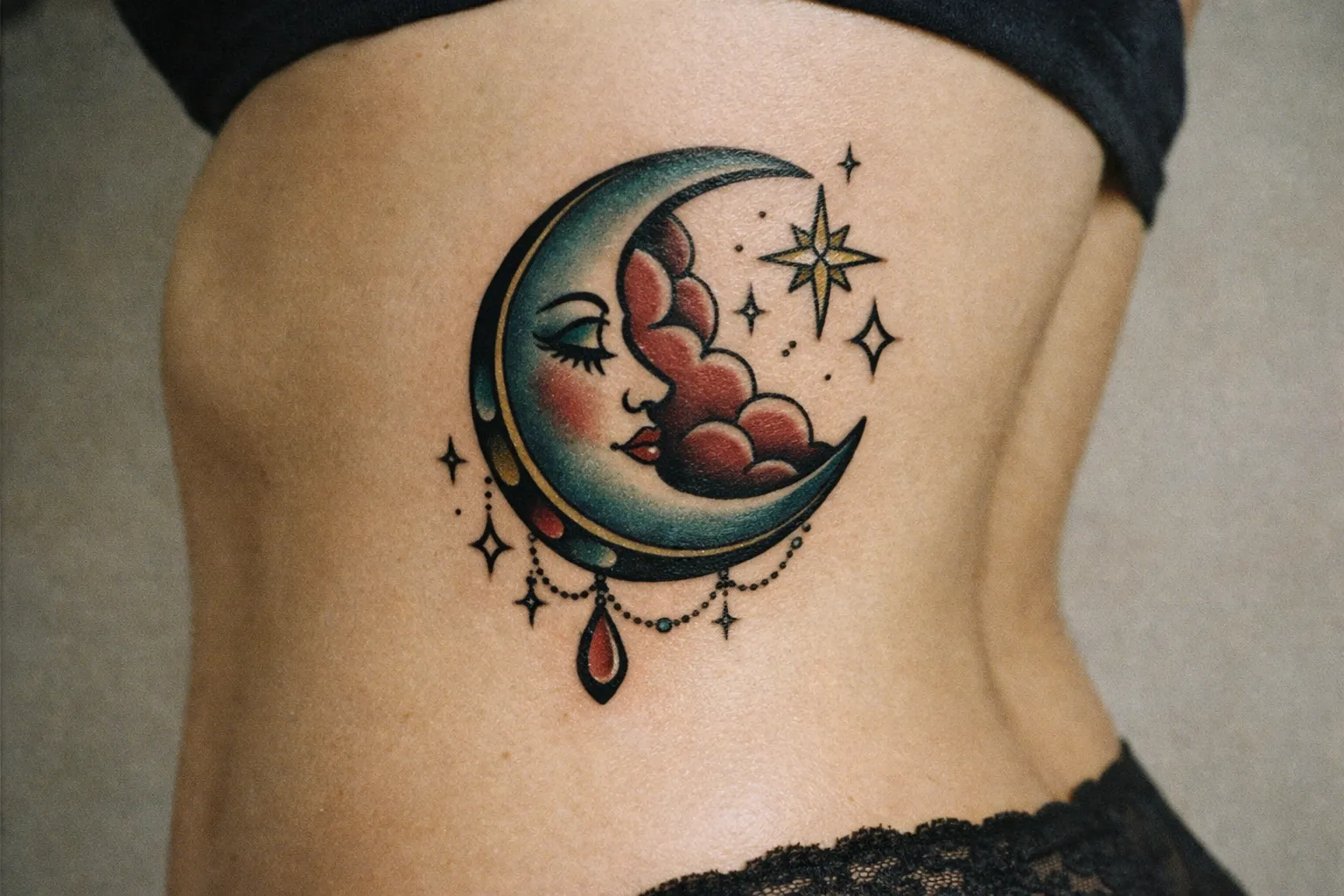
The feminine association runs deep and it isn’t arbitrary. The moon’s glow and its cycle have long been tied to goddesses and to the divine feminine (1). In Greek myth Artemis, Diana in the Roman version, is a goddess of the moon and the hunt (3), and Selene is the moon itself in personified form. That’s the root of how Western tattoo culture reads the moon today. Other traditions widen the picture: ancient Egyptian mythology linked the moon to Thoth, the god of wisdom and time (4), and many Eastern cultures read it as harmony, yin energy, and immortality (3). That breadth is why intuition, the unconscious, and transformation all attach to it cleanly.
Is a moon tattoo feminine? In Western pop culture, yes, it skews feminine - mostly because of those goddess associations. But it isn’t gender-exclusive. In Japanese irezumi, full moons and crescents appear in designs for all genders, usually alongside waves and seasonal motifs, and geometric blackwork moons are common across the board. If you like the image, the “feminine” tag is a cultural default, not a rule.
One thing worth understanding before you design: the moon’s meaning shifts by phase, and it shifts again depending on what you pair it with. Stars add direction and guidance. A moth adds nocturnal instinct and mortality. Botanicals add growth. The base symbol is flexible - what you build around it is what makes the reading specific.
How Moon Phase Changes the Meaning
Each phase of the moon carries a distinct reading, which is why picking a specific phase rather than a generic crescent makes a tattoo mean something rather than just decorate skin. The moon’s full cycle from new moon to new moon lasts about 29.5 days (29.53 on average) and runs through eight distinct phases, as the Farmers’ Almanac’s moon-phase explainer lays out (19), and the phase you choose maps onto where you are in whatever the tattoo marks.
- New moon: new beginnings, a blank slate, intention-setting. Astronomically the moon is almost invisible from Earth at this point, which is exactly why it reads as a starting-over phase.
- Waxing crescent: growth, momentum, early intention - the “in-between” that a crescent specifically captures. The thin arc that becomes visible in the days just after the new moon.
- Full moon: completion, illumination, peak energy. It’s the most visually dramatic phase, reached when the moon sits opposite the sun and is fully lit, which is why it’s the usual pick for realistic, detailed designs.
- Waning moon: release, reflection, letting go. Less common as a standalone, but it earns its place in a full sequence.
A new moon tattoo symbolizes new beginnings and a clean slate - the phase most associated with a significant reset, starting a project, or closing one chapter to open another. If that’s your reason for the tattoo, the new moon is the phase that says it most directly.
Reading the Full Sequence: What a Moon Phases Tattoo Communicates
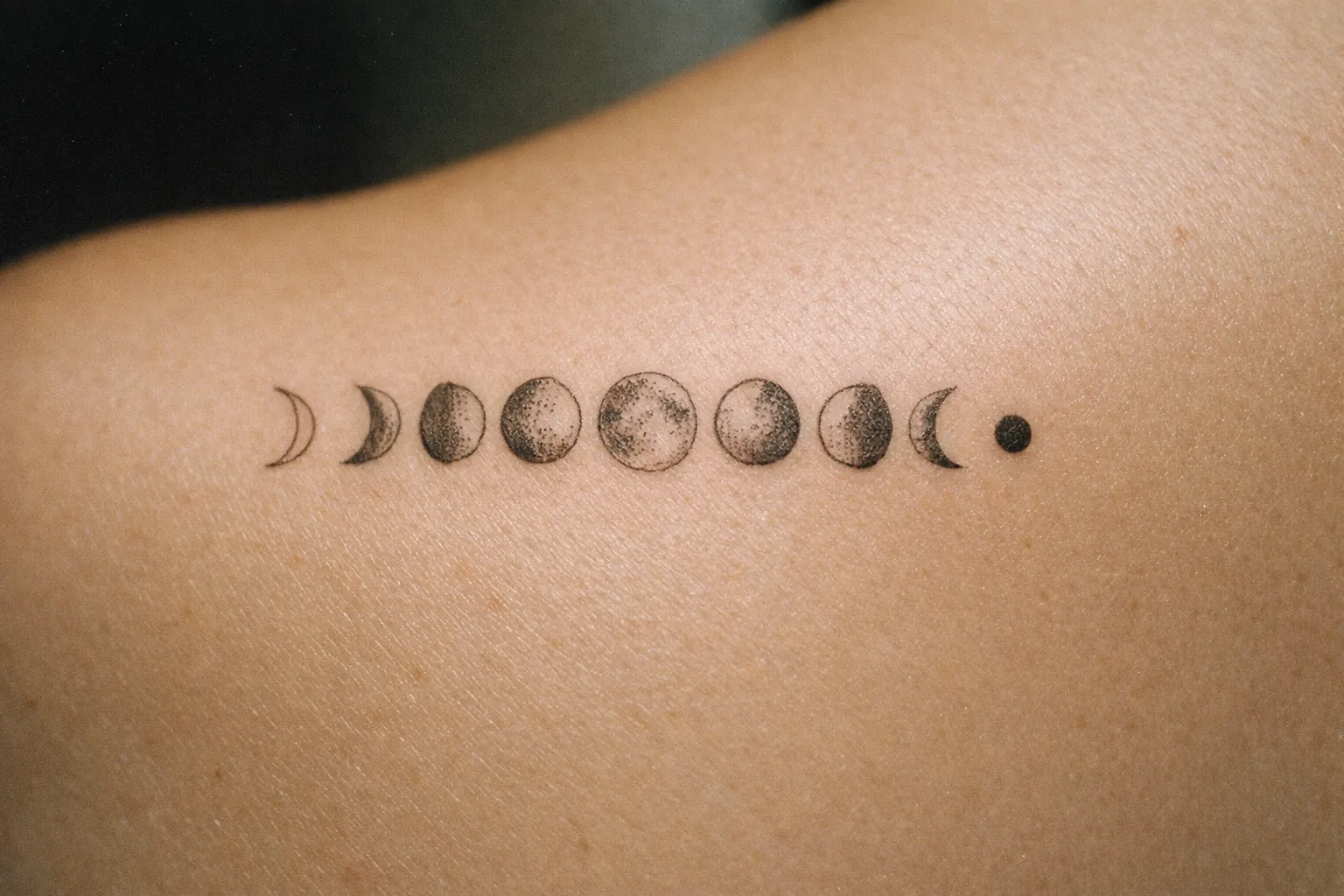
A moon phases tattoo reads as a life-cycle image, not a calendar. Running the sequence from new to full and back shows change as a progression, which is why people choose it for rebirth, personal growth, and the idea that everything moves in cycles rather than straight lines. A standard diagram shows 8 principal phases - new moon, waxing crescent, first quarter, waxing gibbous, full moon, waning gibbous, third quarter, and waning crescent - and a legible sequence needs room to show all eight discs at a consistent diameter.
Orientation changes the visual weight. A vertical sequence down the spine reads as a dramatic column; a horizontal arc along the forearm reads softer and stays easier to glance at. Either way, the two things that make or break it are equal spacing and consistent moon diameter. Uneven spacing looks accidental, not intentional. I always ask clients to let me mock the sequence up at actual size before we book - it takes ten minutes and prevents a lot of regret.
Minimum space is real here. A forearm sequence needs at least 15-30 cm (6-12 in) to keep each disc distinct; a spine sequence typically runs 30-40 cm (12-16 in); a ribcage arc needs comparable length. Anything shorter compresses eight moons into a row of smudges that stops reading as phases at all.
The Four Main Moon Tattoo Designs
Most moon tattoos fall into four design families, and picking the right one is mostly about matching detail to the space you actually have. Here’s what each looks like, what it means, and the one mistake that ruins it.
Crescent Moon Tattoo: Small Canvas, Specific Meaning
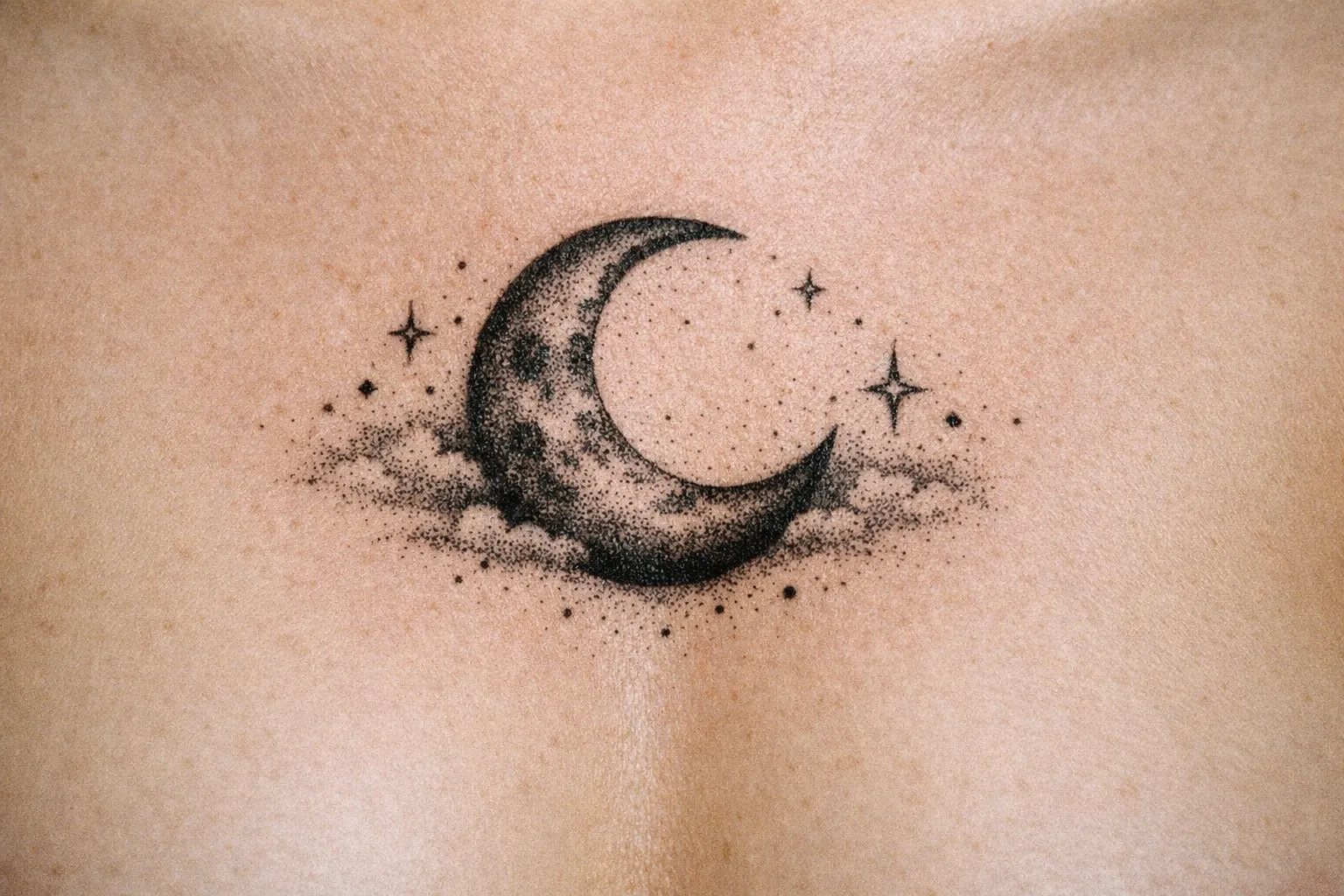
The crescent moon tattoo is the waxing or waning arc, rendered as a simple outline, a fine-line curve, a solid blackwork fill, or an ornamental version dressed with dots and linework. Its meaning centers on transition, creativity, intuition, and the “in-between” - potential rather than completion. This is the design most often misread as having a single fixed meaning, when it actually shifts between new beginnings, creativity, femininity, and transition depending on context.
Best styles are fine line, minimalist, and ornamental. Size and placement: 1-4 cm works on the wrist, behind the ear, ankle, collarbone, or inner forearm. Under about 1.5 cm, keep it to a single clean outline: fine detail at that scale blurs together as the lines spread over the years.
The pitfall is overcrowding. Cram a small crescent with stars, dots, and decorative fill and the contrast collapses over a few years as everything migrates slightly and merges. A clean crescent ages far better than a busy one.
Moon and Stars Tattoo: Adding Direction to the Design
A moon and stars tattoo pairs the moon - any phase - with a single star, a small cluster, or a full constellation. The moon carries inner change and cycles; the stars add guidance, hope, ambition, and navigation. The combination reads as moving through change with direction, which is why it’s more symbolic than a solo crescent, not just more decorative.
Best styles are fine line, illustrative, and American traditional. If you want a bolder version that ages well, American traditional is the pick: thick black outlines plus a limited palette, the two hallmarks that keep the piece reading clearly for decades. The pitfall there is weak outline weight - too thin and the whole thing blurs early.
Size and placement: this needs more room than a solo crescent - 3-6 cm minimum so the stars don’t crowd the moon. Forearm, collarbone, shoulder, and thigh all work. The common failure is too many stars at small scale: the moon loses visual dominance and the composition muddies after healing. A single crescent with one or two stars is more legible than a miniature moon surrounded by a dozen tiny embellishments.
Moon Moth Tattoo: Nocturnal Symbolism, Higher Technical Demand
A moon moth tattoo pairs a moth - usually a luna moth or a death’s-head moth - with a moon, wings arcing around it or the moon sitting behind as a background element. It fuses the moon’s cyclical, intuitive symbolism with the moth’s transformation, mortality, and nocturnal instinct. The combined reading lands somewhere around “trusting the dark.”
This design lives or dies on contrast. Fine-line-only moth wings next to a pale moon lose definition as they heal, and the moth silhouette disappears into the shading. Blackwork wings or a stronger outline keep the moth readable long-term. Best styles are blackwork, illustrative, and fine line with deliberate contrast management.
Size and placement: 5-10 cm minimum to keep both wing texture and moon detail legible. Sternum, outer thigh, upper arm, and forearm all give enough canvas. The pitfall is sizing too small - under about 4 cm the wing detail and moon shading compete for the same space and both lose. I’ve seen this design folded into broader celestial trend posts and given half a paragraph, which doesn’t do it justice. The contrast requirement is specific and easy to get wrong.
Realistic Full Moon and Geometric Moon Designs
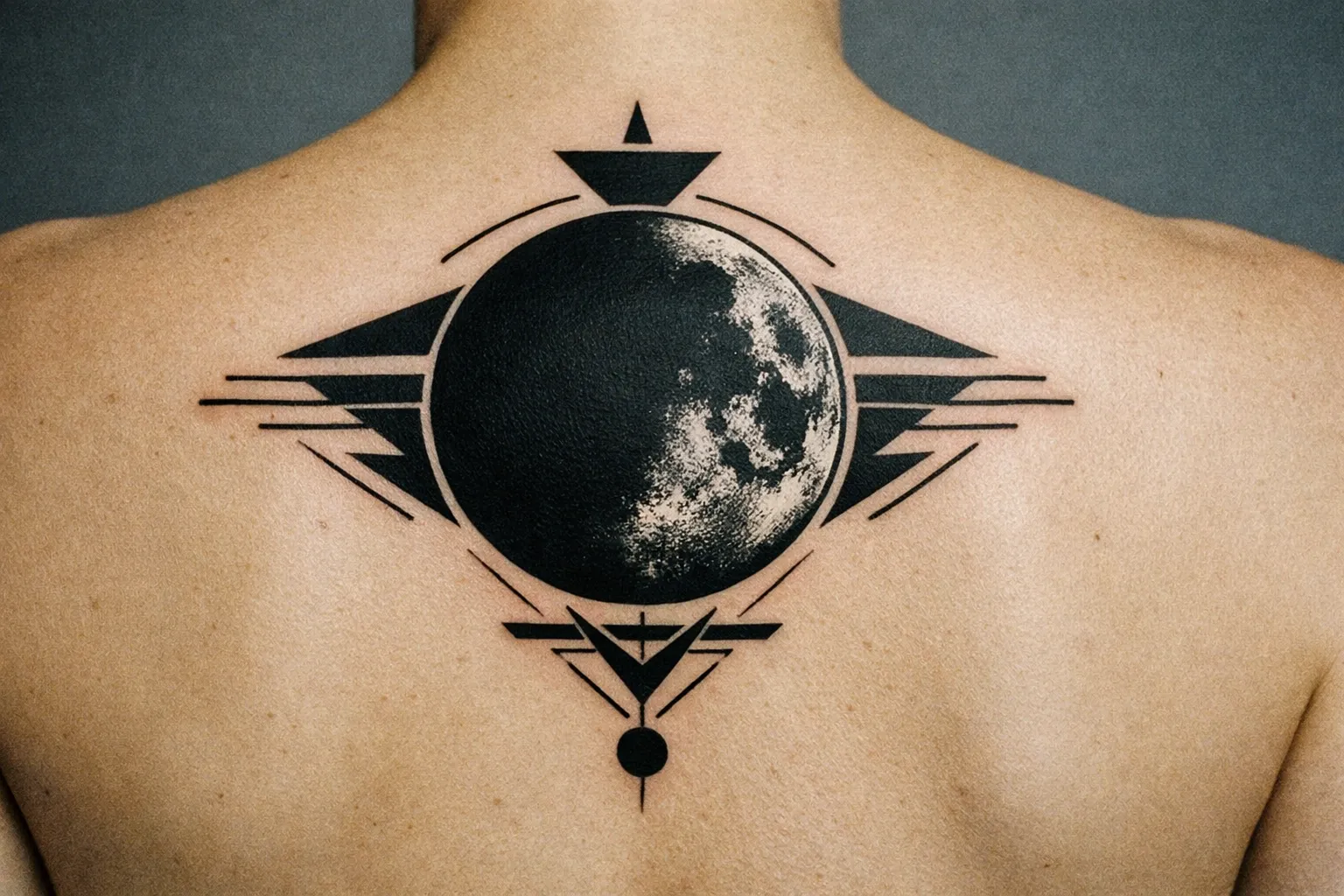
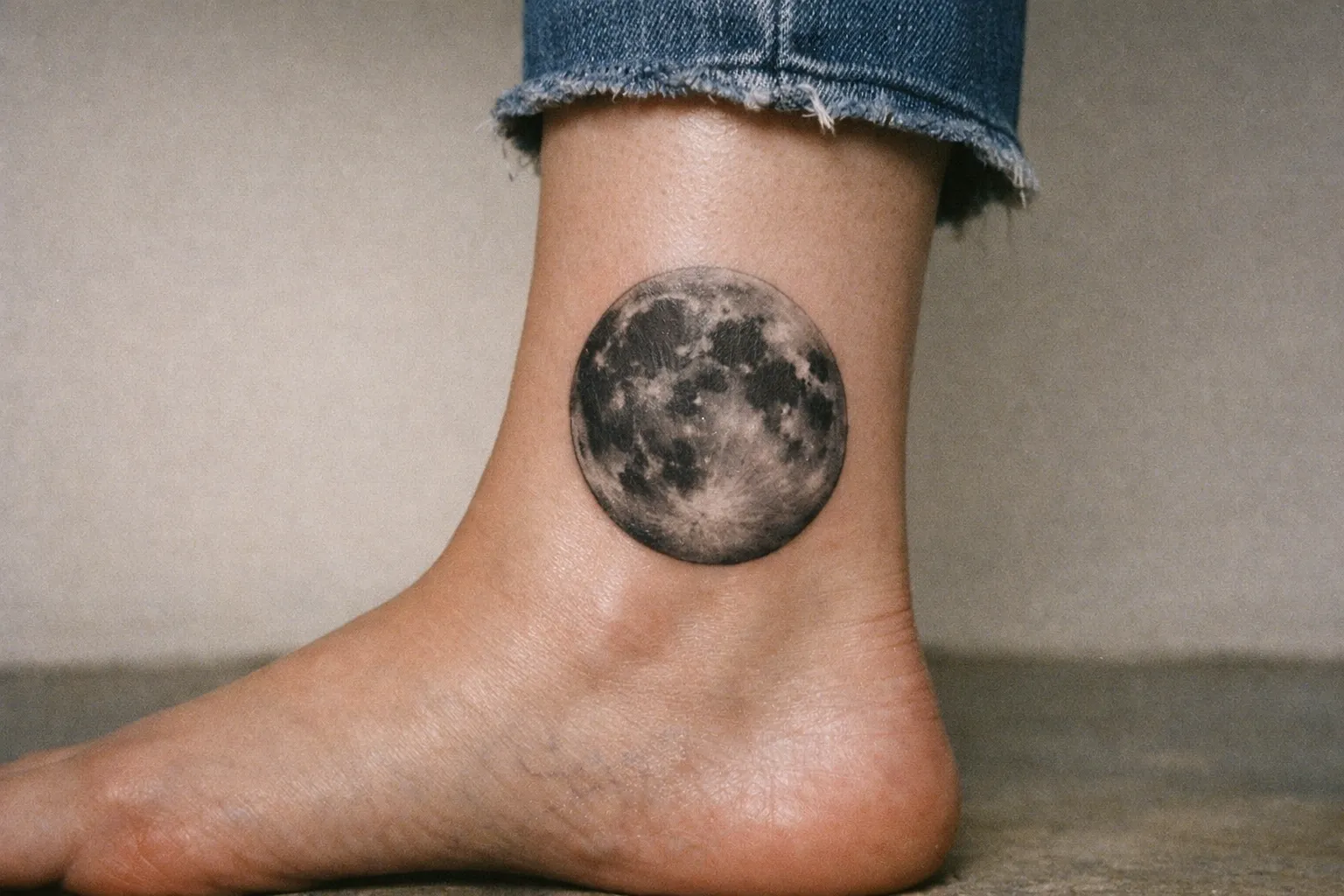
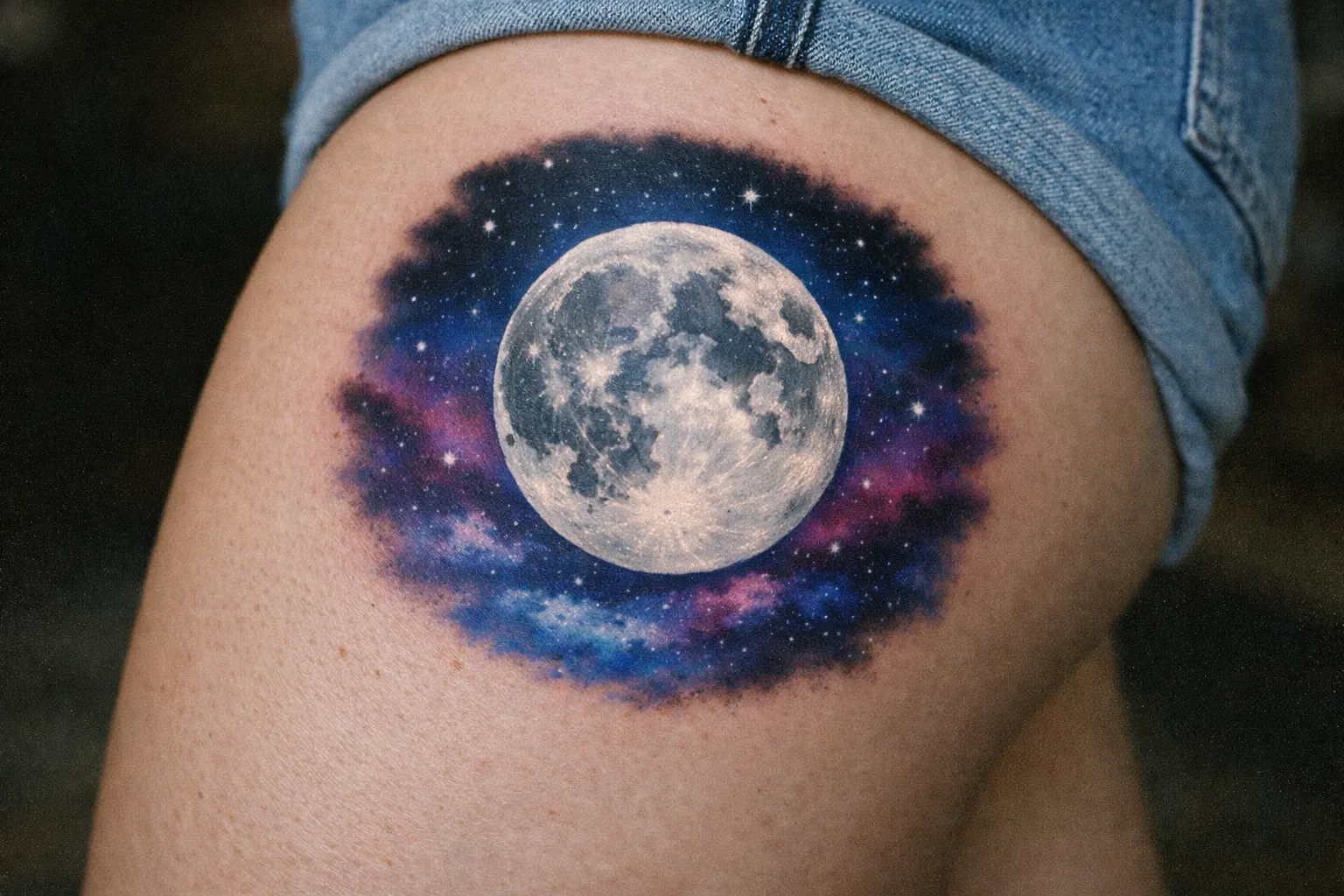
A realistic full moon uses grey-wash shading and crater detail; a geometric moon uses polygonal facets, dotwork, or mandala integration. The realistic version emphasizes completion and illumination. The geometric version layers a structured, analytical feel over the cyclical symbolism.
Size is the hard constraint for realism. Crater detail needs 8-15 cm minimum - smaller than that and the shading reads as a grey smudge instead of a moon. Geometric versions can go slightly smaller if the line weights stay clean. Best placements are the shoulder, thigh, upper back, or chest for realistic work, and the inner forearm or upper arm for geometric.
One thing separates a good realistic full moon from a bad one: the artist’s shading skill. Check healed work in their portfolio, not just fresh photos - grey-wash that looked crisp on day one can flatten into a smudge if the saturation was pushed wrong.
Placement: Practicality Over Visibility
The best placement for a moon tattoo balances four things: visibility (do you want to see it every day?), pain (bone proximity means more of it), healing friction (high-movement areas heal slower and riskier), and detail retention (thicker tissue holds fine lines longer). Choosing purely for how visible it is, or purely because a photo looked good, is how people end up with a blurred piece on a bad canvas.
Here’s how the common placements actually compare:
Moon Tattoo Placement at a Glance
| Wrist | Ankle | Forearm | Collarbone | Behind the ear | Spine | Ribcage | Sternum | Thigh / upper arm | |
|---|---|---|---|---|---|---|---|---|---|
| Pain Level (relative) | Moderate-high | Moderate-high | Low-moderate | Moderate | Moderate | High | High | Moderate-high | Low |
| Detail Retention | Fair | Fair | Good | Fair | Poor | Good | Fair | Good | Very good |
| Healing Friction Risk | High (watches, sleeves) | High (socks, shoes) | Low | Low-moderate | Low | Moderate-high | High (moves with breath) | Moderate | Low |
| Best Design Type | Small crescent | Small crescent | Crescent, phases, moon and stars | Small crescent, moon and stars | Very simple crescent only | Vertical phases sequence | Phases arc, moon moth | Moon moth, moon mandala | Realistic, geometric, large pieces |
| Typical Size Range (cm) | 2-4 | 2-4 | 4-30 | 3-6 | Under 1.5 | 30-40 | 10-20 | 5-15 | 8-20 |
A few honest notes on the trade-offs:
Wrist and ankle are visible and low-commitment, but they’re high-friction. Tight socks, watch straps, and jewelry rub a healing tattoo raw during weeks 1-2. Keep the design simple and keep the area clear while it settles.
The forearm is the most forgiving canvas you’ll find: good detail retention, moderate pain, easy to keep clean and out of friction. It handles a crescent, a phases sequence, or a moon and stars equally well.
The collarbone is elegant and visible with a low neckline, moderate on pain. It suits small crescents and moon and stars designs at 3-6 cm.
The spine is dramatic for a vertical phases sequence and genuinely painful - skin sits thin over bone, and spine placements rank near the top of the pain scale (16). Reaching the area for aftercare is awkward; plan on someone helping you.
The ribcage is high pain, the skin moves with every breath, and it heals slowly. It suits a larger phases arc or a moon moth, but only if you’re committed. Ribcage is well above forearm on the pain scale (16) - not a placement to choose because a photo looked good.
The sternum runs moderate-to-high on pain and suits moon moth and moon mandala designs that benefit from centerline symmetry.
Thigh and upper arm are the most forgiving for large, detailed pieces - lower pain, good tissue depth, and reliable aging.
Behind the Ear and Wrist: When Small Works and When It Doesn’t
Behind-the-ear moon tattoos work only when they stay very small and very simple - a single crescent under about 1.5 cm, no stars, no dots, no fill. The skin texture there and the sun exposure both accelerate fading, so anything with fine detail will soften fast. A minimalist crescent survives; a tiny detailed scene does not.
The wrist tolerates slightly more - a small crescent or a crescent with one star at 2-4 cm - but it stays a high-friction spot. If you want a piece to hold sharp lines for a decade, the inner forearm a few inches up is a far safer bet.
Matching Style to the Design
Style choice affects longevity as much as placement does, because different techniques age at completely different rates. A bold-outline moon on the forearm will still read clearly in 15 years. A single-needle crescent on the ribs may need a touch-up in four. Here’s how the main styles map onto moon designs:
- Fine line / single needle: best for minimalist crescents and small moon and stars. Elegant, but it relies on thin epidermal detail that sheds and fades - high-friction placements accelerate that process, and most fine-line work will need a touch-up sooner than bolder styles, often within a few years.
- Blackwork: best for moon moth and geometric designs. High contrast holds shape over time and there’s no color to fade, which makes it the low-maintenance choice.
- Illustrative / neo-traditional: works for moon and stars and moon moth. American traditional hallmarks - thick black outlines plus a limited palette - are among the most durable looks you can pick.
- Geometric / dotwork: suits phases sequences and mandala moons. Dots hold better than thin lines over the long run, so a dotwork moon outlasts a fine-line one at the same size.
- Micro-realism / grey-wash: best for a realistic full moon, and only worth it with an artist who specializes in shading. This is the one style where the tattooer’s skill is the primary variable - check the healed portfolio specifically, because grey-wash is where under-saturated work turns to smudge.
The reason this matters comes down to skin biology. The surface looks healed by weeks 3-4, but the deeper layers - where the ink actually sits - keep remodeling until full integration around week 6. Thick lines and solid black survive that process and years of sun and shedding; delicate thin lines that depend on epidermal detail don’t hold as well.
If you’re weighing a showier layout - a triple moon, a vertical spine sequence, a sternum-spanning moon mandala - pick for longevity, not just for what’s trending - a design you’ll still like and still be able to read in a decade beats a fashionable one that blurs.
Healing Timeline and Aftercare
A moon tattoo looks healed on the surface by weeks 3-4, but the deeper skin keeps remodeling until full integration around week 6. During weeks 2-4 the tattoo often looks dull, cloudy, or patchy - that’s a normal stage, not fading, and it’s not a reason to panic or book an early touch-up.
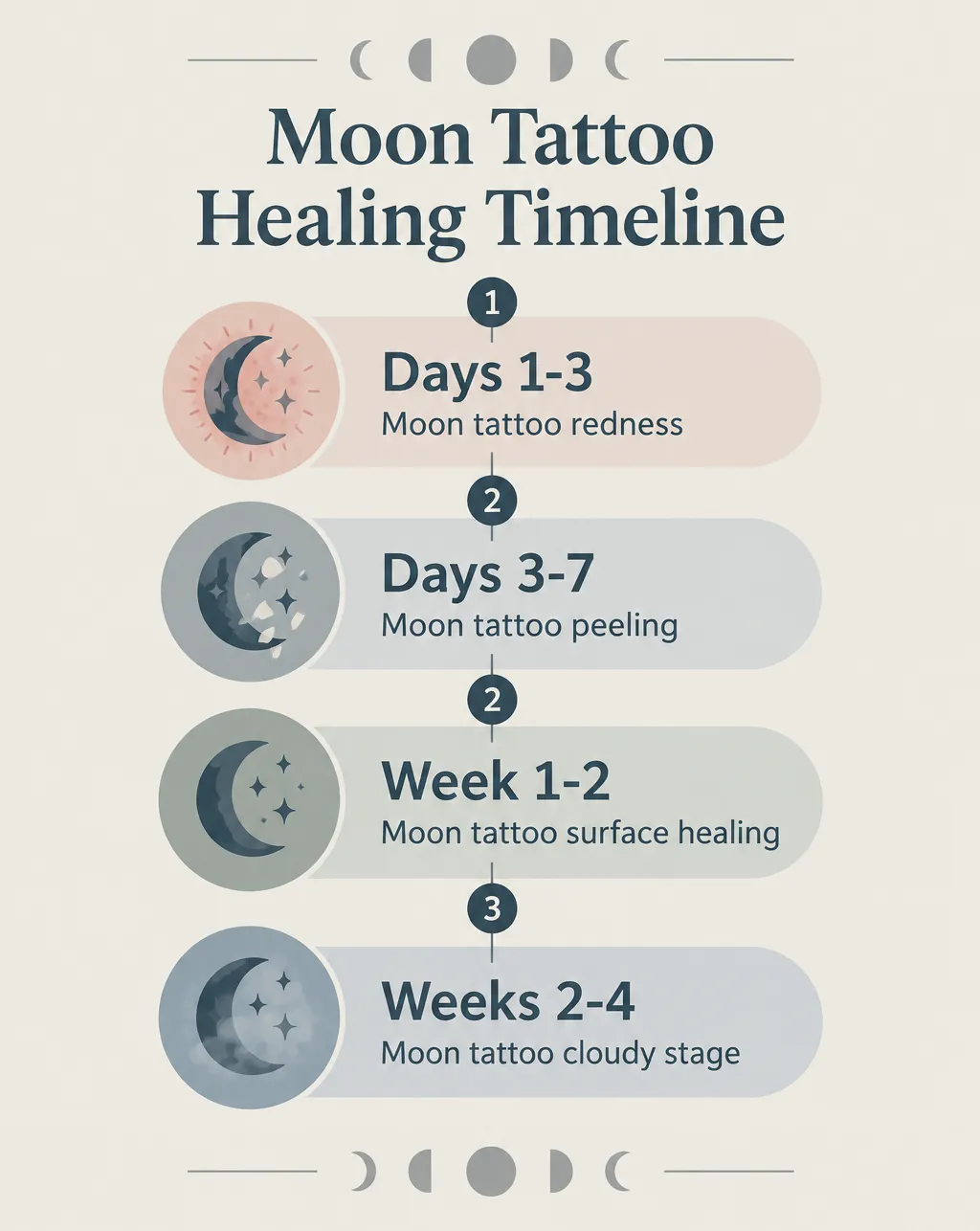 Four healing stages for a moon tattoo, from redness in days 1-3 to the cloudy stage in weeks 2-4, before full integration around week 6.
Day-by-Day: What to Expect as Your Moon Tattoo Heals
6 weeksFollow this timeline to care for your moon tattoo through the key healing stages.
- 1
Days 1-3
Expect redness, swelling, and weeping plasma. Wash gently with fragrance-free soap twice daily, apply fragrance-free moisturizer, and avoid submerging the tattoo.
- 2
Days 3-7
Peeling and itching begin. Do not pick or scratch, especially critical for fine-line work to avoid ink loss and visible breaks.
- 3
Week 1-2
Surface healing continues. Keep high-friction placements free of tight socks, watches, bracelets, or waistbands.
- 4
Weeks 2-4
The surface closes while the deeper layers keep remodeling; the tattoo may look faded or cloudy, which is normal. Once the surface is healed, start using SPF on the area.
- 5
Weeks 4-6
Full integration. Assess if a touch-up is needed, especially for fine-line or single-needle tattoos.
Placement dictates the friction risks: ankles fight socks, wrists fight watches and jewelry, spines and ribs fight waistbands and bra straps. Plan your clothing around the healing tattoo for the first two weeks, not the other way around.
Sun avoidance is non-negotiable while healing and matters long-term for fine-line and grey-wash work specifically. UV light is one of the main drivers of early fading, and the subtle contrast those styles rely on is the first thing to go without consistent use of sun-protective clothing or SPF once the surface is closed.
Common Mistakes That Ruin a Moon Piece
Most moon tattoos that go wrong fail for the same handful of reasons, and every one of them is avoidable at the planning stage.
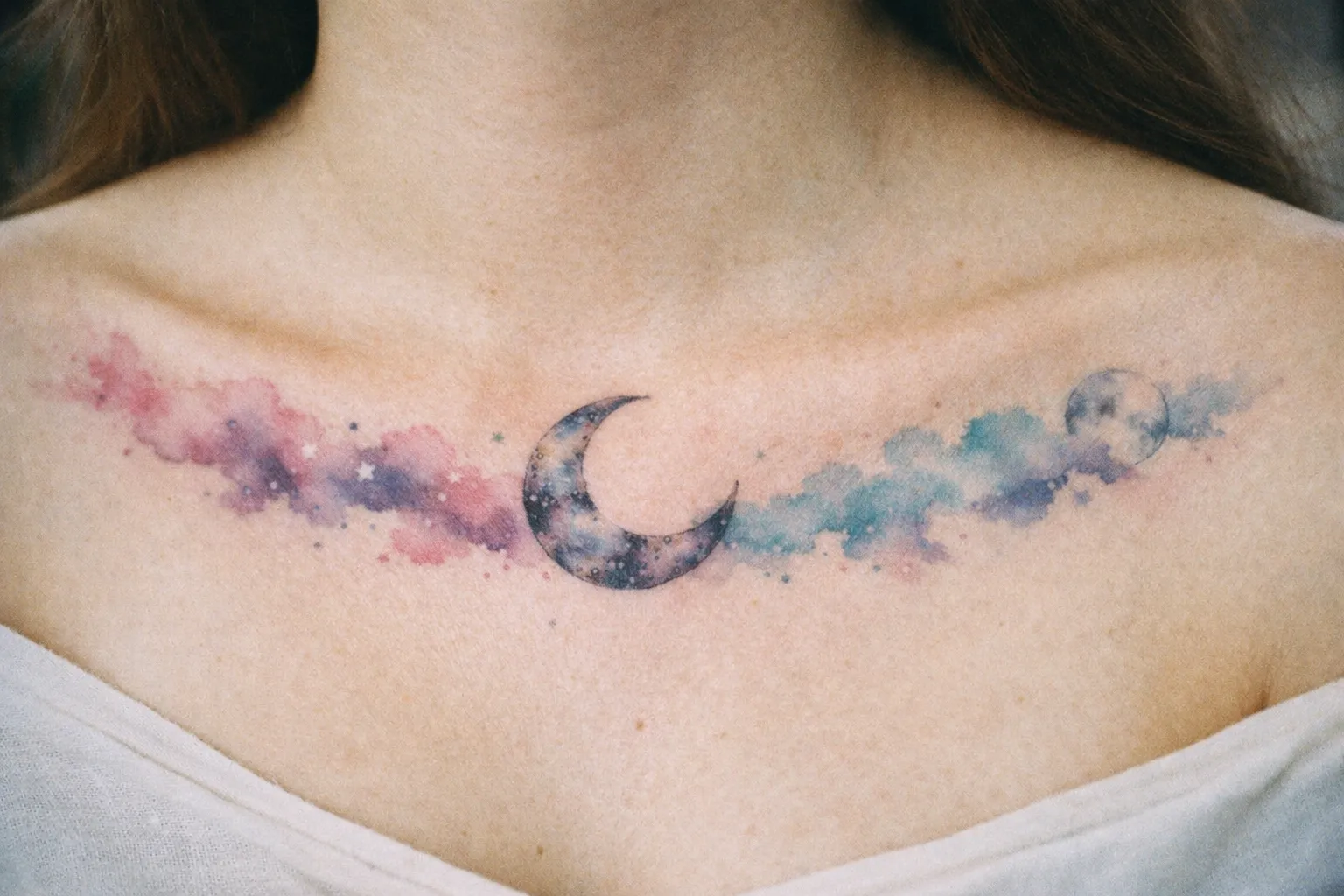
- Choosing a design too detailed for the size. Craters, moth wings, and eight moon phases all need more skin than a wrist provides. Detail crammed into a small canvas blurs into mush within a few years.
- Putting high-detail work on a high-friction area. Ankle, wrist, fingers, and ribs all heal harder and hold detail worse. A busy design on any of them is fighting an uphill battle from day one.
- Overcrowding with stars, dots, and fill. Contrast collapses over time as everything migrates slightly and merges - the effect is worst in small compositions where there was never much space between elements to begin with.
- Choosing placement for visibility alone. A forearm or shoulder ages more reliably than any bone-exposed area. Picking a spot because it photographs well, rather than because it heals well and holds detail, backfires within a few years.
- Not seeing the design at exact intended size before booking. A moon tattoo loses its legibility when line weight or spacing collapses at small scale. Ask for the actual-size printout - this one step prevents most sizing regret.
- Ignoring sun protection. Grey-wash and fine-line moons fade markedly faster than bold blackwork without consistent SPF. If you’re not going to protect it, pick a style that tolerates neglect.
Frequently Asked Questions
- What does a moon tattoo symbolize?
- A moon tattoo symbolizes cycles, change, intuition, femininity, mystery, and transformation; meaning shifts by phase and pairing element.
- What does a new moon tattoo symbolize?
- A new moon tattoo symbolizes new beginnings and a blank slate, associated with starting over or a significant life reset.
- Is a moon tattoo feminine?
- It skews feminine due to lunar goddess associations in Western culture but is not exclusively feminine; common across all genders in other traditions.
- What is the best placement for a moon tattoo?
- Placement depends on size and design; forearm and upper arm are most forgiving; spine and ribcage suit phases sequences but involve more pain and slower healing.
- How big should a moon phases tattoo be?
- A full eight-phase sequence needs at least 15-30 cm on the forearm or 30-40 cm on the spine to keep phases distinct and legible.
- What style works best for a moon moth tattoo?
- Blackwork or illustrative with deliberate contrast; fine-line-only wings lose silhouette as they heal; size minimum 5 cm for detail clarity.
- Do moon tattoos age well?
- Bold blackwork and neo-traditional outlines age best; fine-line and single-needle work on high-friction spots tends to need touch-ups sooner than bolder styles, particularly on areas like the wrist or ankle.
Putting It Together
Three decisions determine whether a moon tattoo works, in this order: which phase or design type fits the meaning you want, which placement fits that design’s size and your pain tolerance, and which style will hold that design’s detail over the years. Get those three right and the rest is aftercare.
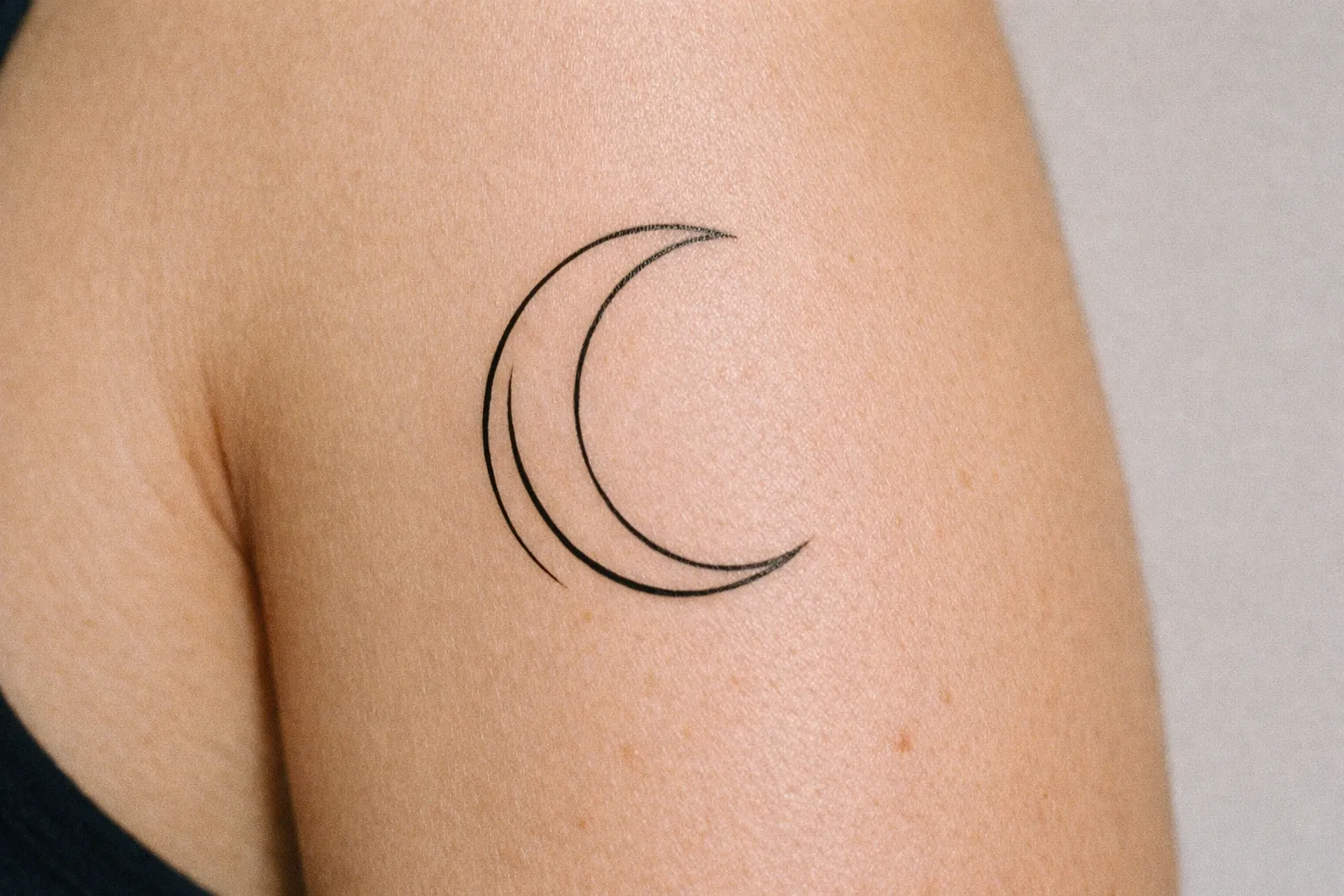
If you’re undecided, a fine-line crescent on the forearm at 4-6 cm is the lowest-risk starting point - enough canvas for clean linework, forgiving to heal, moderate on pain, and easy to build on later with stars or a phases sequence if the design grows with you.
One last practical step: ask the artist to print the design at actual size and hold it against the placement before you book. Line weight and spacing that look fine on a screen can collapse on skin at small scale. Thirty seconds with a paper printout tells you more than any reference photo.