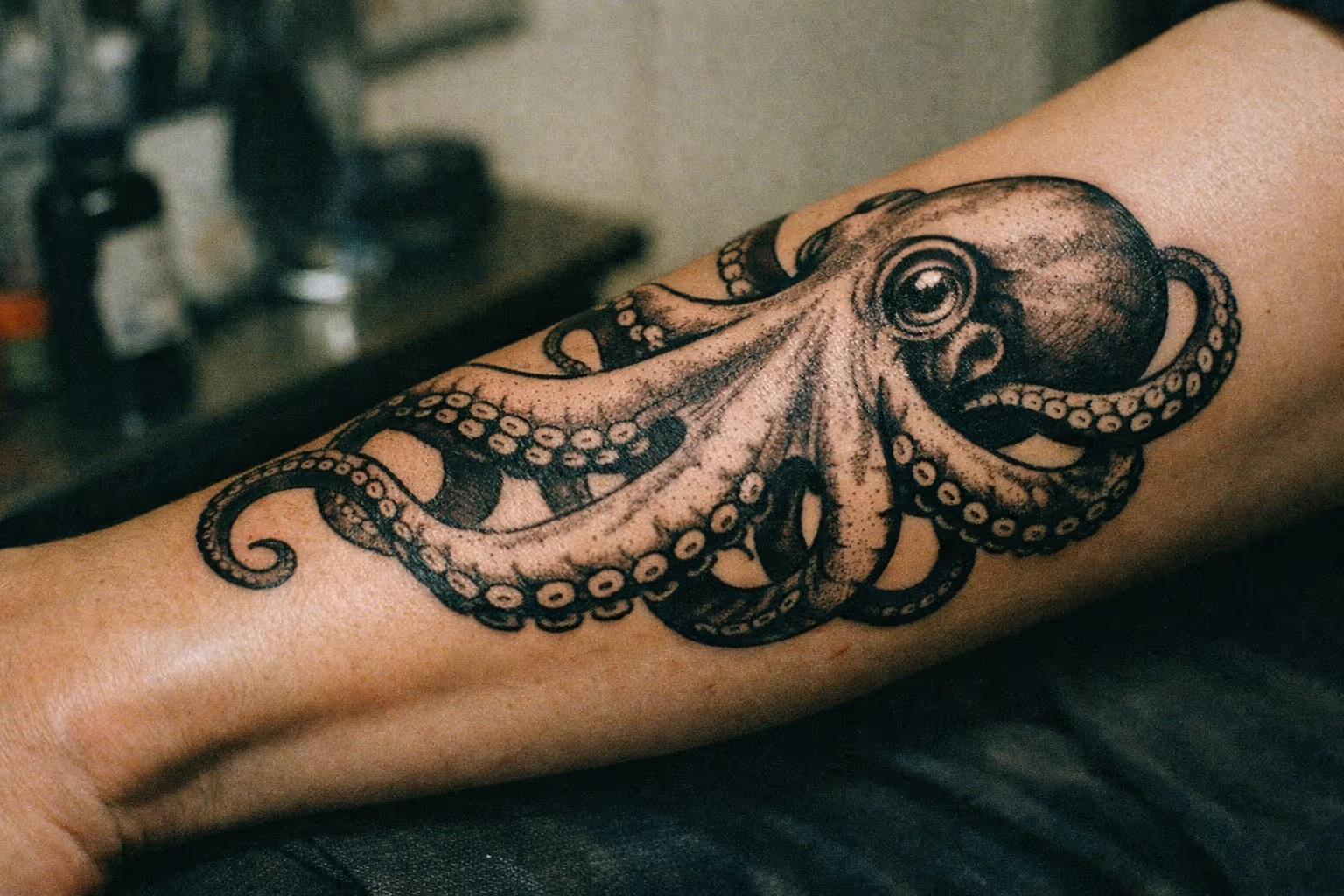
Two numbers should shape your octopus tattoo before the artist even sketches it. Bright red ink flattens toward a dull pink within two to five years, and every tattoo line spreads five to ten percent over a lifetime - so an octopus packed with fine suckers and thin tentacle tips will slowly lose them. Choose the color and the scale with that in mind and it stays sharp. Here’s what an octopus symbolizes, and how to size and shade one that lasts.
Octopus Tattoo Meaning and Symbolism: What the Octopus Tattoo Actually Means
The octopus tattoo meaning that shows up most consistently across traditions: intelligence, adaptability, mystery, and the ability to regrow what’s been lost (1)(2)(3). The animal backs the symbolism on its own terms - octopuses solve puzzles, escape sealed tanks, and regenerate severed arms. The metaphor isn’t borrowed from mythology. It’s biological.
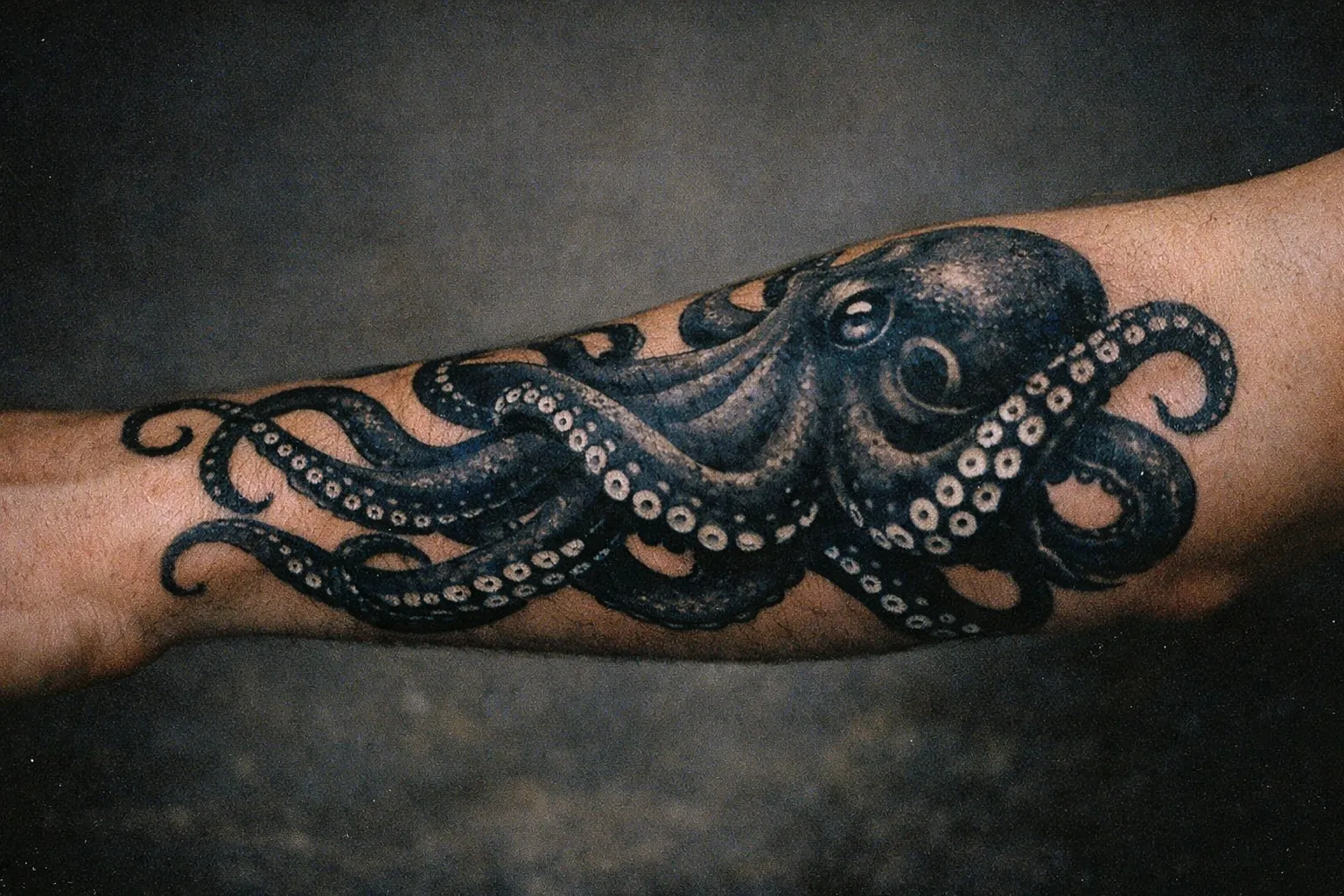
A few specific readings worth knowing before you commit:
- Regrowth and recovery. Because the octopus regenerates limbs, it’s a common choice for marking recovery from addiction, illness, grief, or a hard chapter. Some designs lean into this with a visibly regrowing tentacle, or pair the octopus with a lotus or phoenix.
- Intelligence and adaptability. The “many arms” motif works for people who juggle roles - parent, professional, creative - and want a symbol of handling several things at once without losing the center.
- Mystery and the unknown. Deep water, things that aren’t quite visible, intuition. This reading draws people toward dark blues, purples, and Lovecraftian Kraken-style designs.
- Protection. In some Polynesian and Pacific traditions, the octopus is treated as a spiritual guide or protector.
The octopus tattoo symbolism shifts noticeably with style and color choice - and that’s the part most articles skip. A blue-ringed octopus reads as lethal beauty; the real animal (Hapalochlaena genus) carries enough tetrodotoxin to kill an adult human, making it one of the most venomous creatures on the planet according to marine biology sources including the Australian Institute of Marine Science. A bright red octopus reads as power and danger. A small black linework octopus reads as quiet appreciation for the animal itself. Decide what you actually want the tattoo to say before you decide what it should look like.
What It Means in a Relationship
This question comes up enough to deserve its own section. An octopus in a relationship context usually points to emotional depth, support, and the capacity to hold many things at once - the partner who shows up in eight different ways. Couples sometimes get paired octopuses with tentacles intertwined, or a single octopus holding two initials, dates, or small hearts in different arms.
Read the imagery honestly before you book it. Tentacles wrapped around another figure can read as protective and connected, or as possessive and entangled, depending on tension in the linework and the pose. If you want the positive reading - support, partnership, multi-armed care - keep the body language relaxed, the curves open, and skip horror references. If the design starts looking like one creature crushing another, that’s how it’ll read to everyone who sees it.
Japanese Octopus Tattoo (Tako)
The Japanese octopus tattoo - called Tako in irezumi - has the deepest established tradition behind it. In Japanese tattoo symbolism, the octopus represents complexity, intelligence, mystery, and resilience, particularly the ability to recover and regrow after loss. Hokusai’s famous woodblock prints - most notably “The Dream of the Fisherman’s Wife” (1814) - feed directly into the modern visual vocabulary, and any artist working in this style knows them. Scholars of ukiyo-e, including those writing for the Journal of Japanese Studies, have documented how these images shaped the Western reception of irezumi as an art form.
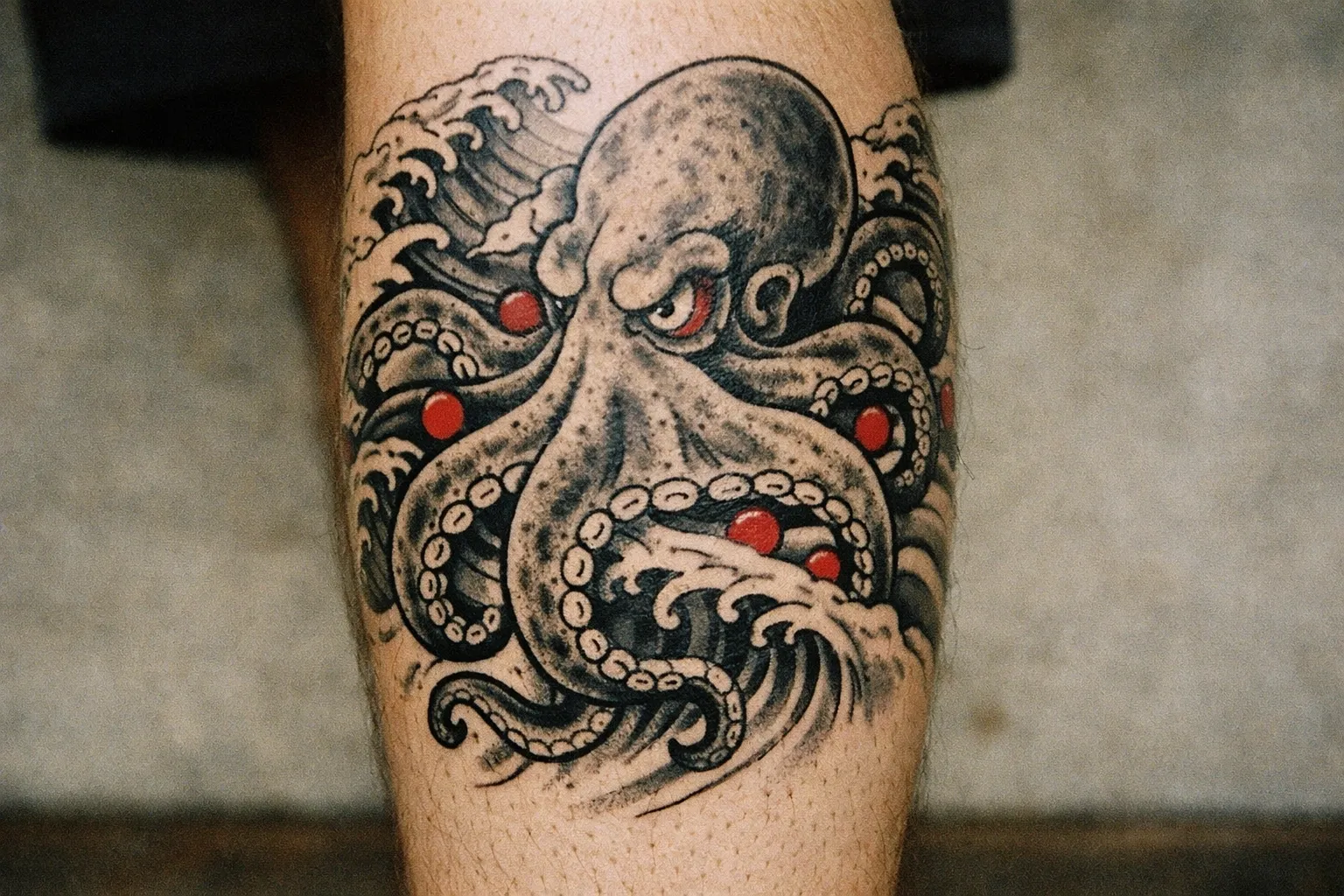
Two technical hallmarks of a real irezumi-style octopus: bold black outlines with strong, saturated color fill (typically red, indigo, and black), and background elements that complete the composition - finger waves, wind bars, cherry blossoms, or a dragon or koi for contrast. The octopus is rarely floating in empty skin. The background is part of the symbolism, not decoration.
Common pitfall: a Westernized “Japanese-style” octopus with thin lines and pastel watercolor splashes. It looks fine fresh. It isn’t irezumi, and it doesn’t age the way a properly outlined and saturated piece does. I’ve seen these come back in three years looking like a bruise. If you want a Japanese octopus tattoo, look for an artist whose portfolio shows healed irezumi work - not just fresh photos - and at least 10-20 examples of similar complexity.
Best placements for a Japanese octopus: back panel, full sleeve, thigh, or side panel. The size range that does the style justice is 10-16 inches, usually split across 3-6 sessions of 2-4 hours each.
The Red Octopus
A red octopus tattoo carries different weight than a black or blue one: passion, power, danger, sometimes transformation. It’s also the design that requires the most thought - both for symbolism and for how it ages.
Pigment considerations. Red ink has the highest reported allergic reaction rate of any tattoo pigment - a finding consistent across dermatology literature, including research published in journals like Contact Dermatitis - and in some jurisdictions, certain red and blue pigments are facing tighter regulation over heavy metal content and allergens. If you have sensitive skin, ask the artist for a patch test before committing to a long session. Ask which ink brand they use and whether they have safety data sheets available.
How to make red age well. Pure bright red on its own flattens and turns pinkish over 2-5 years. The fix is anchoring the red with deep maroon shadows and solid black linework around the eyes, suckers, and tentacle outlines. That contrast is what keeps the design readable from across a room three years in.
Placement that suits red. Forearm, calf, shoulder cap, or thigh - anywhere with enough flat skin to let saturated color breathe. Avoid hands and feet. The constant friction and sun exposure burns red pigment faster than anywhere else on the body.
Small Octopus Designs
A small octopus tattoo - roughly 1-3 inches (2.5-7.5 cm) - works well for first-timers, low-visibility placements, or anyone who wants a quiet nod to the symbolism without committing to a sleeve. Common spots: inner wrist, behind the ear, back of the upper arm, ankle, sternum, behind the bicep.
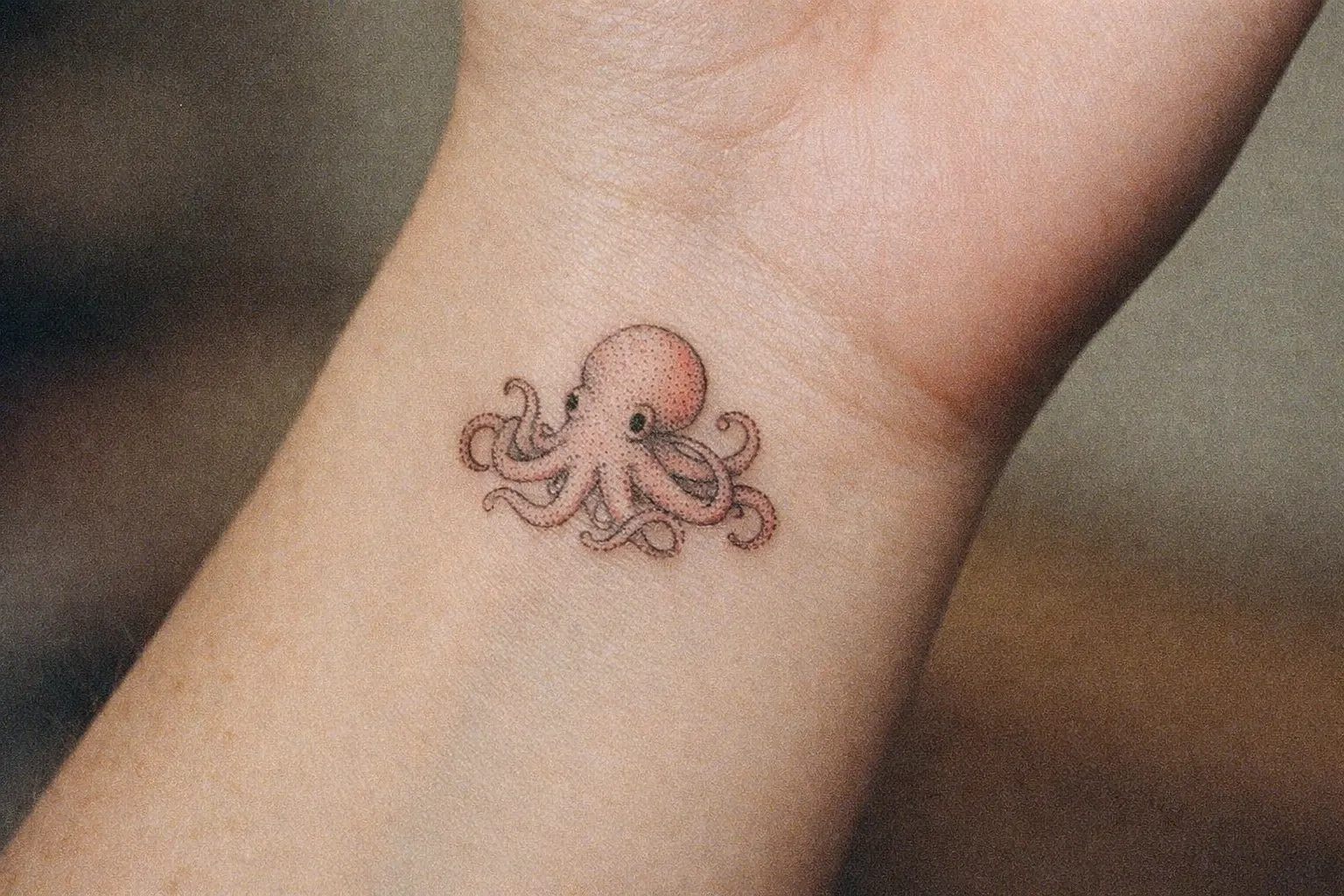
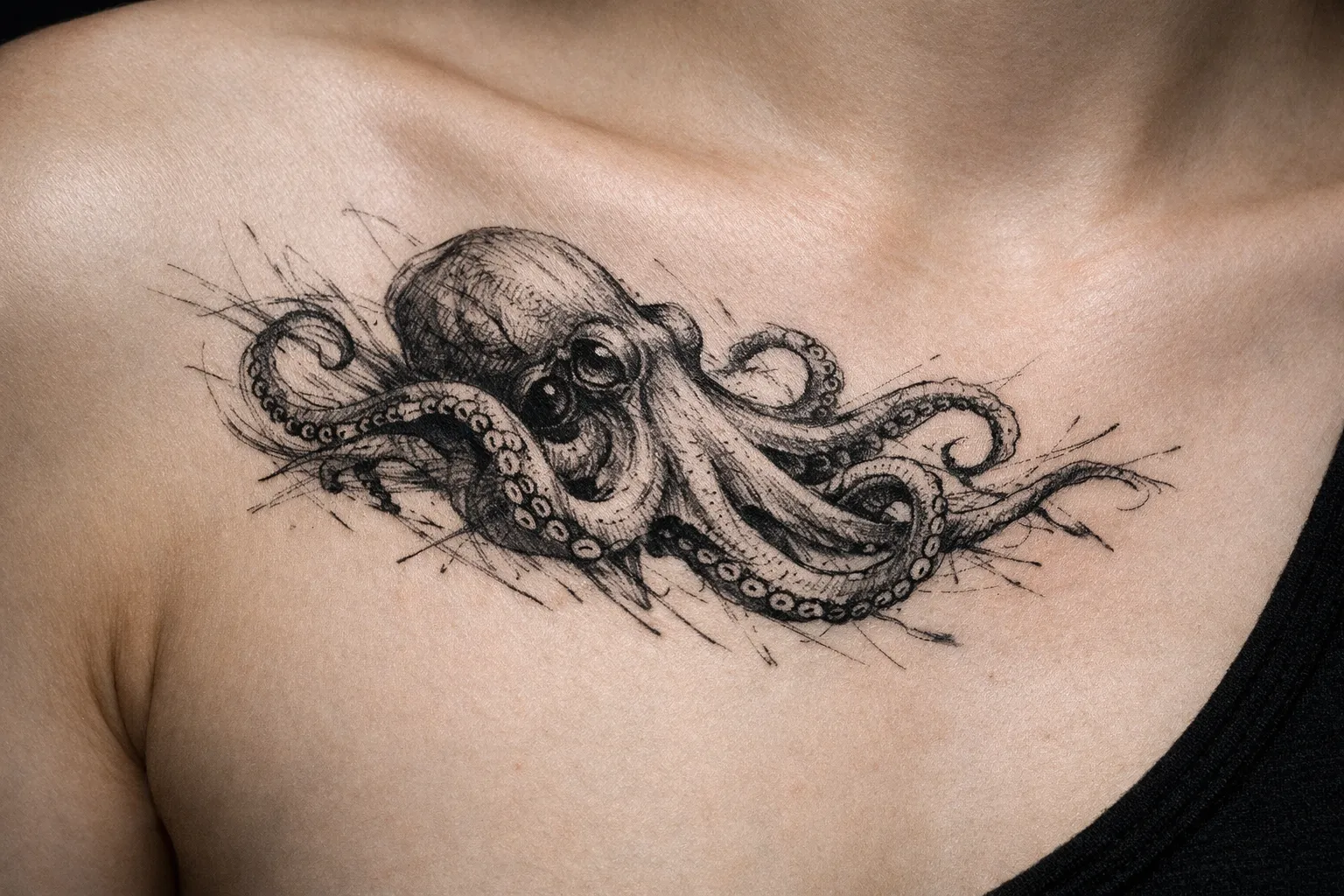
Here’s the honest design constraint: a full hyper-detailed octopus does not work at 2 inches. Lines spread roughly 5-10% over the years as ink settles in the dermis, and a tiny realistic octopus with eight detailed tentacles and visible suckers will blur into a smudge within a decade. I’ve seen it happen. It’s not a question of if, it’s when.
What actually works at small scale:
- Silhouette only - solid black or single-color shape with no internal detail
- A single tentacle curling around a wrist or behind the ear
- A stylized head with abstract tentacle suggestions - three or four flowing lines rather than eight
- Minimalist linework with a clean outline and one or two interior accents
Price for a small octopus runs $80-$200 at typical US shop rates of $100-$200/hour. Most small designs finish in a single sitting of 30-90 minutes.
Best Placements
Tentacles want to flow with muscle, not across it. The animal’s anatomy gives the artist room to follow your body’s natural lines, which is why octopuses make some of the best wrap-around designs available. When I’m mapping a larger piece, I’ll usually spend 10-15 minutes just tracing the tentacle paths on the client before we stencil anything.
- Shoulder and upper arm - the head sits on the deltoid, tentacles flow down the bicep and chest. Comfortable to sit through. Pain: moderate.
- Forearm - full octopus or a single arm reaching toward the wrist. Highly visible, ages well thanks to limited sun exposure compared to hands. Pain: low to moderate.
- Back - the only placement that fits a full Japanese-style 10-16 inch piece with background. Pain varies, with the spine being the worst zone.
- Thigh - large canvas, low visibility for work, easy to heal. Pain: low on the outer thigh, higher on the inner.
- Ribs and side - dramatic, follows the curve of the torso. Pain: ribcage is the worst common placement, considerably more intense than forearm or thigh.
- Sternum - central, symmetrical designs work well here. Pain: high.
- Hand and fingers - high visibility, but ink fades faster from friction and washing, often needing touch-ups every 2-4 years.
- Behind the ear or ankle - best for small octopus tattoos. Pain: surprisingly sharp on bone, but quick.
Relative pain ranking for context: ribcage > sternum > inner thigh > forearm > outer thigh > shoulder.
Design Ideas
Anchor and Octopus
Tentacles wrapped around an anchor - stability paired with adaptability. The anchor reads as steadiness; the octopus reads as flexible intelligence. Works well at 5-8 inches on the forearm or calf, and the shapes complement each other naturally without crowding.
Skull Octopus
A skull replacing the bulbous mantle. Reads as mortality, cunning, survival. The design needs strong black work to keep the skull legible against the tentacles - a common pitfall is letting the two elements blur together into an unreadable mass.
Realistic Octopus
Photo-realistic shading, accurate anatomy, visible suckers, beady eyes. Demands an artist with a strong realism portfolio. Bring 2-3 high-resolution reference photos and be prepared for 2-4 sessions depending on size. Don’t book a realism octopus with someone whose portfolio is mostly lettering.
Kraken and Ship
Giant octopus pulling down a sailing ship - classic maritime storytelling. Usually rendered large, 8-14 inches, on the back, thigh, or full sleeve. The Kraken reads as facing impossible challenges, not as villainy, which surprises some people.
Blue-Ringed Octopus
Real animal, real danger - one of the most venomous creatures alive. Symbolically: lethal beauty, hidden threat. Bright electric blue rings against a tan or yellow body. Looks genuinely unique, but the bright blues need anchoring with strong linework to age cleanly.
Watercolor Octopus
Splashes of color, soft or absent outlines, fluid suggestion of motion. Reads as creativity and emotional fluidity. Honest warning: watercolor tattoos without underlying line structure fade and lose definition faster than traditional styles. Plan on a touch-up every 5-7 years, possibly sooner.
Geometric and Blackwork Octopus
Heavy black fills, dotwork shading, symmetrical tentacle arrangements that read almost like a mandala. Ages extremely well because there’s no color to fade and the contrast stays high. Good choice for back, sternum, or full thigh panel.
Polynesian-Style Octopus
The octopus - he’e in Hawaiian, fe’e in Samoan - holds genuine cultural meaning in Polynesian traditions, often tied to creation stories and the underworld. Ethnographic records, including documentation by the Bishop Museum in Honolulu, confirm the octopus as a significant figure in Hawaiian cosmology, not a decorative motif. If you’re not from those cultures, get the piece from a Polynesian artist working within tradition rather than copying a Pinterest design. The symbols inside the geometric panels carry specific meaning and aren’t decorative filler.
Space Octopus
Galaxy fill inside the body, stars and nebulae around the tentacles. Reads as cosmic mystery, the unknown, imagination. Color-heavy and needs an artist who’s done galaxy fills successfully - bring healed examples, not just fresh ones.
Octopus with Florals
Tentacles weaving through peonies, roses, or chrysanthemums. The floral pairing softens the design and shifts the symbolism toward growth and beauty. Strong choice for anyone looking for a less menacing version of the motif, and the organic shapes work well together compositionally.
Cost, Time, and Sessions
Real budget ranges from US shops in 2026:
- Small octopus (2-3 in, simple linework): $80-$200, one session, 30-90 minutes.
- Medium forearm or calf piece (4-7 in, color): $250-$700, one or two sessions, 2-4 hours each.
- Large Japanese octopus back or side panel (10-16 in, full color, background): $800-$2,500+, usually 3-6 sessions of 2-4 hours, total 6-15 hours of work.
Hourly rates vary by city: $100-$200/hour in most US metros, $200-$350/hour for established artists in New York, LA, and similar markets. Tip 15-25% on top of the artist’s quoted price. Expect a non-refundable deposit of $100-$300 to book.
One budget move worth knowing: choose black and gray instead of full color. Same size, 20-40% less time and money, and the design ages slower - black and gray work skips the multiple passes required to build saturated color, which is where most of the session hours go on a large piece. Not always the right call aesthetically, but worth considering.
How to Pick the Right Artist
Octopus designs look manageable until they’re not. Eight limbs, foreshortening, suckers, organic flow - a wrong proportion or a stiff tentacle path turns the piece into something that doesn’t quite read as an octopus. I’ve corrected enough of these cover-ups to know it’s a style that punishes the wrong artist.
What to look for in a portfolio:
- 10-20 healed examples of work at similar complexity (not just fresh photos - healed tells the truth about line stability and color retention)
- Specifically: marine life, Japanese irezumi, or illustrative realism, depending on what you want
- Clean line consistency at varying scales
- Color saturation that holds in healed photos
Red flags:
- Portfolio is mostly fresh shots with no healed work
- Shop won’t show you the autoclave or single-use needle setup
- Artist won’t draw a custom design and insists on copying your reference exactly
- No willingness to redesign 30-50% of a pin you bring in
If you bring a Pinterest pin or saved image, the artist should treat it as reference, not a template. Ask them to redesign 30-50% to fit your anatomy and to avoid directly copying another artist’s work.
Aftercare and Healing Timeline
Octopus tattoos - especially larger color pieces - hold a lot of ink in dense areas. Aftercare matters more here than it does for simple linework, and the healing window is when most people sabotage an otherwise solid piece.
Octopus Tattoo Aftercare and Healing Timeline
2 monthsStep-by-step care instructions to ensure your octopus tattoo heals well and retains color.
- 1
Day 1-3: Initial Care
Leave the artist's wrap on for the specified time (2-24 hours). After removal, wash gently with fragrance-free antibacterial soap and lukewarm water 2-3 times daily. Pat dry with a clean paper towel. Apply a thin layer of fragrance-free moisturizer or tattoo-specific ointment. Expect some heat, shine, and slight oozing.
- 2
Week 1: Peeling and Itching
Peeling starts around day 4-7. Do not pick or scratch. Keep moisturizing with a thin layer; avoid heavy ointments that can suffocate skin and cause reactions.
- 3
Week 2-4: Surface Healing
Surface healing finishes around day 10-14. Tattoo may look cloudy or dull due to new skin. Continue using fragrance-free lotion. Avoid pools, hot tubs, ocean, and soaking until at least week 3.
- 4
Month 1-2: Full Settling
Color and lines soften and settle over 4-8 weeks. Once healed, apply SPF 30+ sunscreen when exposed to sun. Use sun-protective clothing for covered placements.
- 5
Long-term Maintenance
Most octopus tattoos benefit from touch-ups at 2-3 years to refresh color saturation. Hand and finger tattoos may need touch-ups every 2-4 years due to friction.
Common Mistakes to Avoid
- Cramming too much into a small space. A 3-inch octopus with a ship, anchor, compass, and script will blur within five years. Pick one element and let it breathe.
- Fighting your body’s flow. Tentacles that cut perpendicular to muscle lines look stiff and dead. The artist should map 4-8 primary tentacle curves before stenciling.
- Copying a viral pin exactly. Bad ethics, and the design wasn’t drawn for your anatomy. Use it as reference and let the artist redesign.
- Underestimating color longevity. Heavy reliance on light blues, pinks, and yellows without strong black line structure means faster fading. Anchor color with blacks.
- Skipping the symbolism check. A blue-ringed octopus is not a generic “cute small octopus.” It’s a venomous animal, and the symbolism reads that way to anyone who recognizes it.
- Booking the wrong artist for the style. A great American traditional artist isn’t automatically a great irezumi artist. Match the artist to the style, not just to the shop.
Frequently Asked Questions
- Can I get a custom octopus tattoo design if I bring a Pinterest reference?
- Yes, but a good artist will treat your reference as inspiration, not a template. Expect them to redesign 30-50% to fit your anatomy and avoid copying another artist's work directly.
- How does the healing timeline change for large color octopus tattoos?
- Large color pieces split across multiple sessions extend the total healing timeline. Plan on 6-12 weeks between sessions to allow each area to heal fully before continuing.
- Are there specific cultural considerations for Polynesian-style octopus tattoos?
- Yes. The octopus holds genuine cultural meaning in Polynesian traditions. If you're not from those cultures, get the tattoo from a Polynesian artist working within tradition rather than copying generic designs.
- What should I do if I have sensitive skin and want a red octopus tattoo?
- Red ink has a higher allergy risk. Ask your artist for a patch test before a long session and inquire about the ink brand and safety data sheets.
- Why do some octopus tattoos fade faster on hands and fingers?
- Hands and fingers experience constant friction and washing, which causes ink to fade faster and often requires touch-ups every 2-4 years.
- What is the best size range for a Japanese irezumi octopus tattoo?
- The ideal size is 10-16 inches, typically done over 3-6 sessions of 2-4 hours each, to allow for bold outlines, saturated color, and background elements.
Before You Book
Pick the symbolism first, the style second, the placement third, the artist fourth - in that order. That sequence matters because every decision downstream depends on the one before it. A regrowth meaning points toward different design choices than a mystery meaning, and both point toward different artists.
Match the style to an artist with healed examples in that exact style, not just adjacent ones. Choose a placement that follows muscle flow and gives the tentacles room to move. Then commit to the aftercare - fragrance-free wash, fragrance-free moisturizer, no picking, sunscreen once it’s healed - because an octopus tattoo with strong lines and saturated color is one of the better-aging designs you can get. But only if the first month doesn’t undo it.