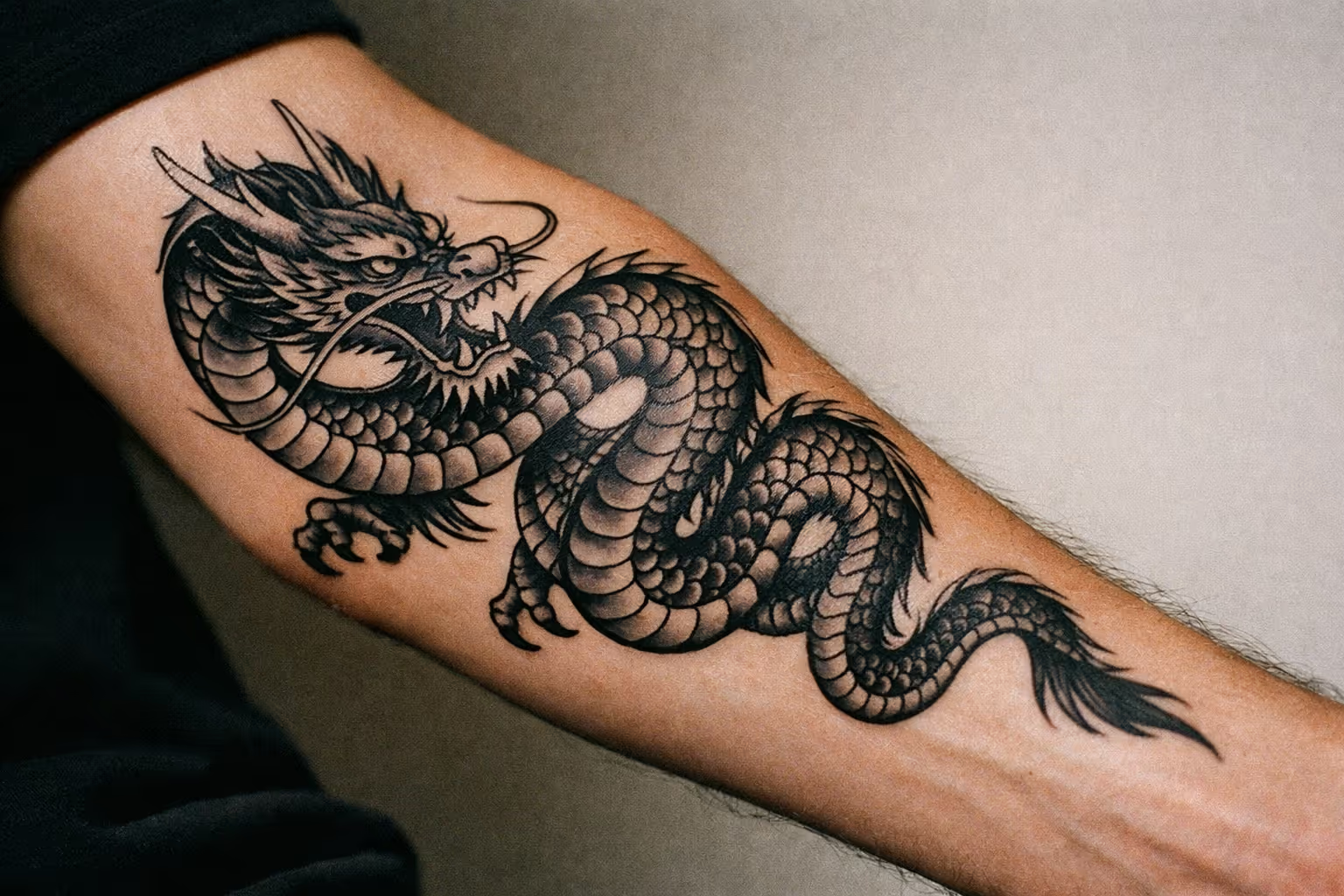
Dragon tattoo meaning turns on details most people never notice - claw count, which way the head faces, East versus West. The same beast reads as a benevolent rain-bringer in one tradition and a hoard-guarding menace in another, and a five-clawed dragon once meant something specific enough that commoners couldn’t wear it. Miss those cues and your dragon says something you didn’t intend. Here’s how the meaning actually breaks down before you commit to a back piece.
What Is Dragon Tattoo Meaning, Really?
At its core, dragon tattoo meaning clusters around five themes you’ll see across almost every tradition: power, wisdom, protection, transformation, and luck. What shifts is which of those gets the spotlight and whether the dragon is a friend or a foe.
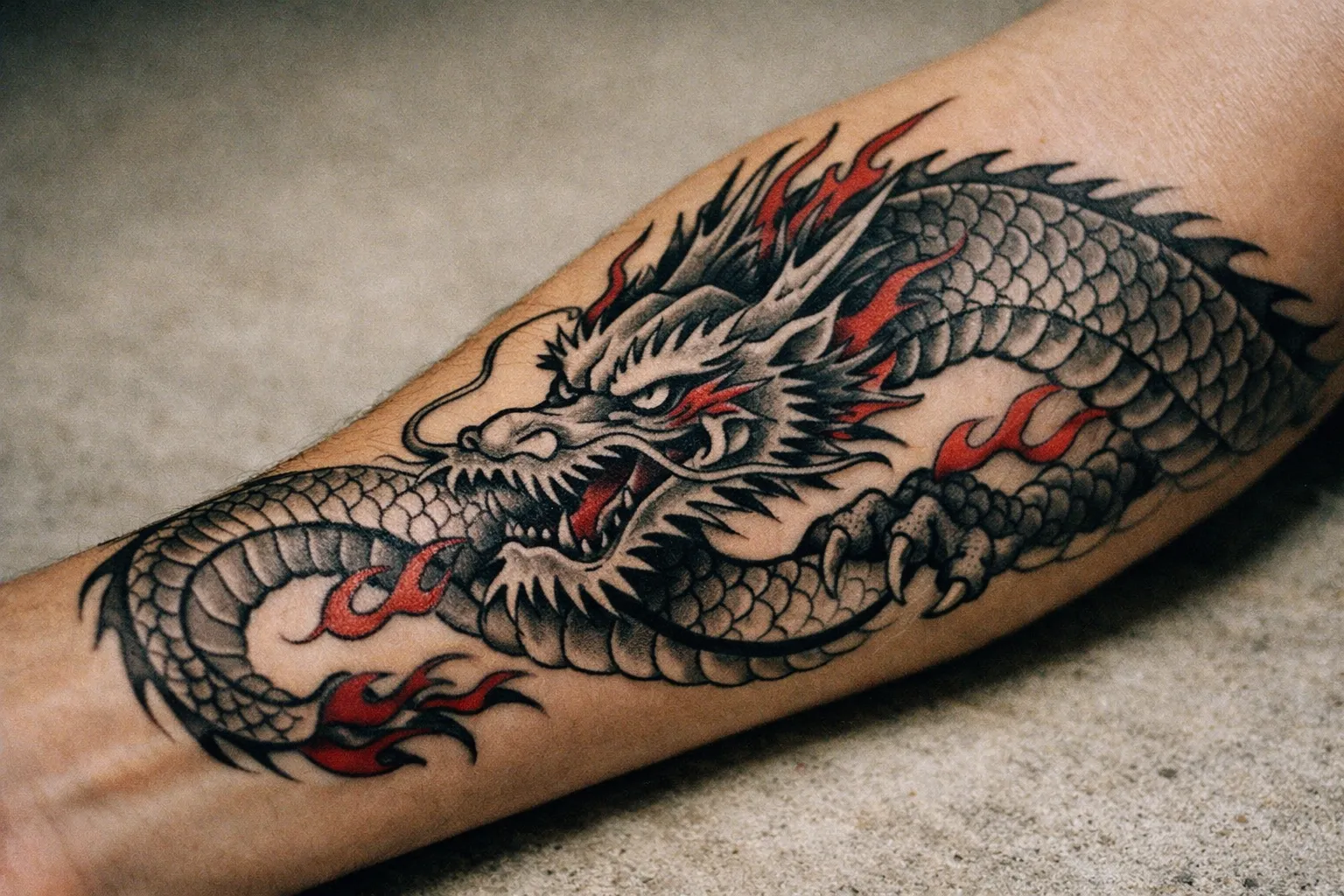
- East Asian dragons (Chinese, Japanese, Korean, Vietnamese) are almost always positive - protectors, rain-bringers, symbols of imperial authority and good fortune.
- European dragons tend to be hostile - hoarders of treasure, beasts to slay, sometimes tied to apocalyptic or devil imagery. Modern Western tattoo culture often flips this into “overcoming the dragon” - beating addiction, illness, or a tough chapter.
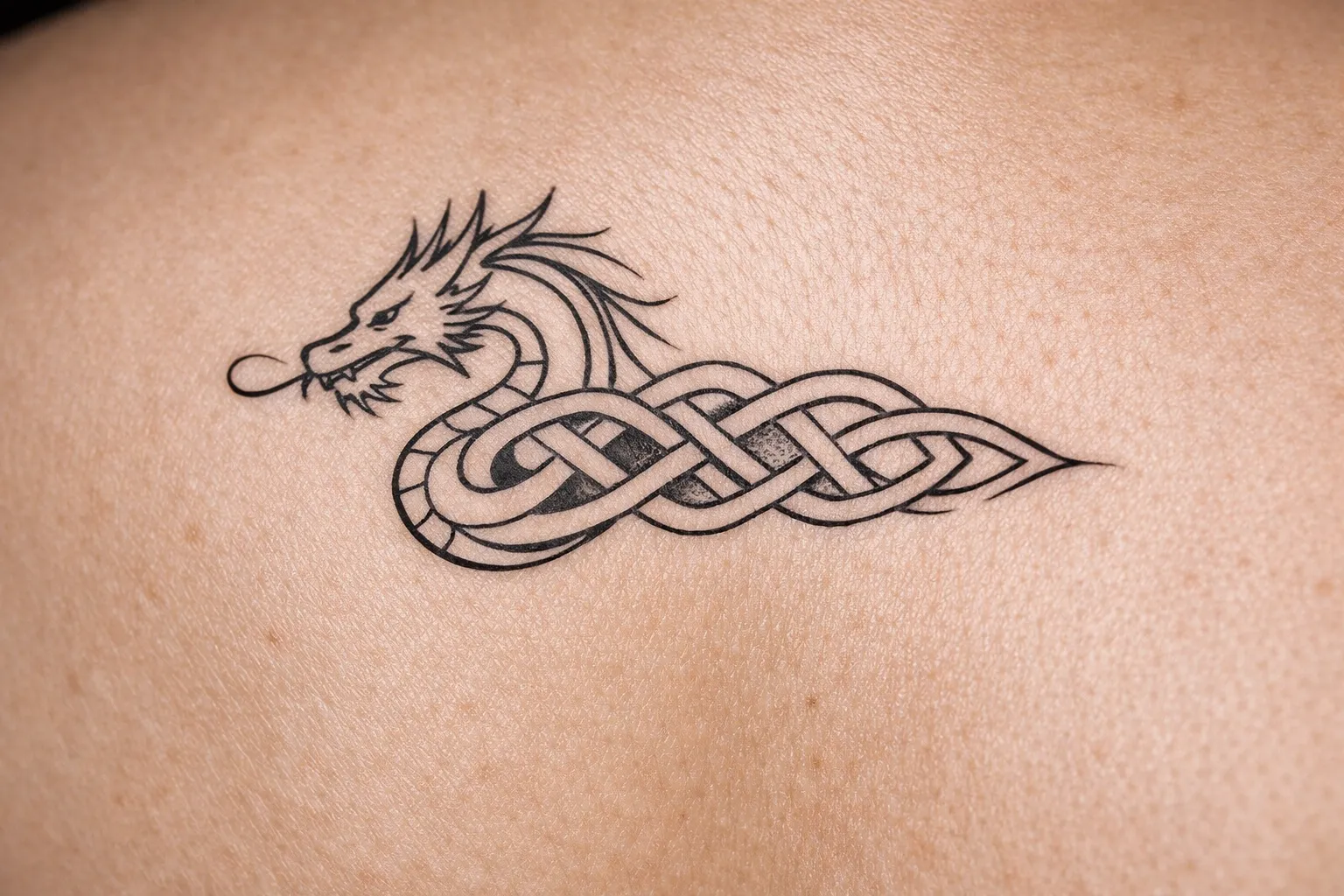
- Celtic dragons sit somewhere in the middle - guardians of thresholds, linked to life, death, and rebirth through knotwork (2).
So when someone asks “what does this dragon mean?” the honest answer is: it depends on which dragon you picked.
Symbolism of Dragon Tattoos Across Different Cultures
This is where most design decisions actually happen. Pick the wrong cultural context and your tattoo might say something you didn’t intend.
Chinese Dragon Tattoos
The Chinese dragon (lóng) is the go-to for auspicious symbolism: imperial power, prosperity, wisdom, and spiritual authority (1). In legend it’s the form a koi fish takes after climbing the Dragon Gate. It’s serpentine, usually drawn with four or five claws (five claws historically reserved for the emperor), and often paired with a flaming pearl representing wisdom or spiritual energy. If you want a tattoo that speaks to luck, ambition, or Chinese heritage, this is the lineage to study.
Japanese Dragon Tattoo
The Japanese dragon, or ryū, is probably the most tattooed dragon worldwide. Its hallmarks: a long, sinuous body, three claws, and often drawn with water, clouds, or wind to show motion. The meanings center on wisdom, protection, and balance - historically, Japanese firefighters wore dragon tattoos as talismans against fire, since dragons command water (4).
If you want a Japanese dragon tattoo done right, get familiar with Hokusai and ukiyo-e prints before your consultation. The traditional Irezumi dragon isn’t a sticker slapped on your forearm; it’s designed to wrap and flow with your body. A serious Japanese specialist will almost always redraw your reference to fit your anatomy.
Celtic Dragon Tattoo
Celtic dragons mix the beast with interlocking knotwork. The dragon acts as a guardian - of treasure, thresholds, ancestral knowledge - and the knotwork emphasizes the endless loop of life, death, and rebirth. Visually, expect heavy blackwork, geometric symmetry, and a stylized, not realistic, body.
Vietnamese Dragon Tattoos
Vietnamese dragons (Rồng) often curve in a long S shape, surrounded by clouds, fire, or storms. They stand for royalty, divine authority, and the link between earth and sky. The style is closer to Chinese dragons than Japanese but has its own distinct head shape and mane.
Western and European Dragons
The Western dragon - with bat wings, fire breath, and a gold hoard - is the one Saint George famously slayed. In medieval Christian imagery, the dragon got tied to Satan, which is where the “is a dragon tattoo satanic?” question comes from (more on that later). Plenty of modern Western dragon tattoos lean into this as a symbol of “demons I’ve defeated.”
Tribal Dragon Tattoo
A tribal dragon tattoo takes the bold black silhouette style of Polynesian or neo-tribal work and applies it to a dragon form. Key features: thick solid black lines, repeating curves and spikes, no shading or color. Meanings focus on raw strength, fearlessness, and personal power. One big caveat - if you want patterns specific to a closed tradition like Maori tā moko, get a tattooer from that culture or skip the specific patterning. Neo-tribal dragon silhouettes are fine; lifting sacred motifs isn’t.
Core Symbolic Meanings
Strip away the cultural layers and you’re left with a handful of recurring themes. Most dragon tattoos lean on one or two of these:
- Power and strength - the most common across all traditions.
- Wisdom and knowledge - dragons as ancient, all-seeing creatures.
- Protection and guardianship - especially strong in Japanese, Celtic, and Norse traditions.
- Good fortune and prosperity - central to Chinese symbolism (1).
- Transformation and rebirth - fire as purification, the koi-to-dragon legend, the Celtic life cycle.
- Spiritual connection - dragons as messengers between worlds.
If you’re not sure which meaning to focus on, have that conversation with your artist before any drawing starts. Trying to cram all six into one piece usually just looks busy and ends up meaning nothing.
How Dragon Tattoo Elements Influence Their Meaning
Here’s where most people under-research and later end up with a tattoo that “feels off.” Elements like color, companions, and direction shift meaning as much as the cultural style.
Color Symbolism
- Red dragon - power, passion, good fortune, happiness; in Chinese tradition tied to summer and celebration.
- Blue dragon - healing, peace, forgiveness, spiritual calm; often linked to water.
- Black dragon - wisdom, ancestral respect, mystery; in blackwork or tribal pieces, it reads as raw strength.
- Gold/yellow dragon - imperial Chinese symbolism, wealth, divine authority.
- Green dragon - nature, growth, life force.
Element Combinations
- Dragon + fire - passion, destruction, rebirth.
- Dragon + water (waves, splashes) - adaptability, emotional depth, classic Japanese pairing (4).
- Dragon + clouds - heaven, ascension, classic Chinese combo.
- Dragon + pearl - wisdom, spiritual energy.
Companion Symbols
- Dragon + tiger - yin and yang, heaven and earth, balanced opposing forces (3).
- Dragon + koi - transformation and perseverance, from the legend of the koi swimming upstream to become a dragon (/koi-fish-tattoo/).
- Dragon + lotus or cherry blossom - strength balanced by impermanence or purity.
- Dragon + phoenix - masculine/feminine balance, often a couples’ piece or a single tattoo representing partnership.
Claw Count - the detail people miss
- Three claws = traditional Japanese dragon (5)(4).
- Four claws = common in Chinese and Korean dragons.
- Five claws = historically reserved for Chinese imperial dragons, the most prestigious (1).
If your artist draws five claws on what’s supposed to be a Japanese-style dragon, that’s a red flag. Worth flagging during sketch review.
Gender-Specific Interpretations
There’s no rule that dragons belong to a particular gender - but tattoo culture has developed some patterns worth knowing.
Dragon Tattoo for Men
Dragon tattoos for men often lean into themes of strength, courage, leadership, and ambition - dragons as symbols of facing challenges head-on (3). Common placements include chest, shoulder, full back, half-sleeve, or a Dragon forearm tattoo running elbow to wrist. Artists usually orient the head forward so the dragon “looks where you’re going,” tying the symbolism to your stance.
Dragon Tattoos for Women
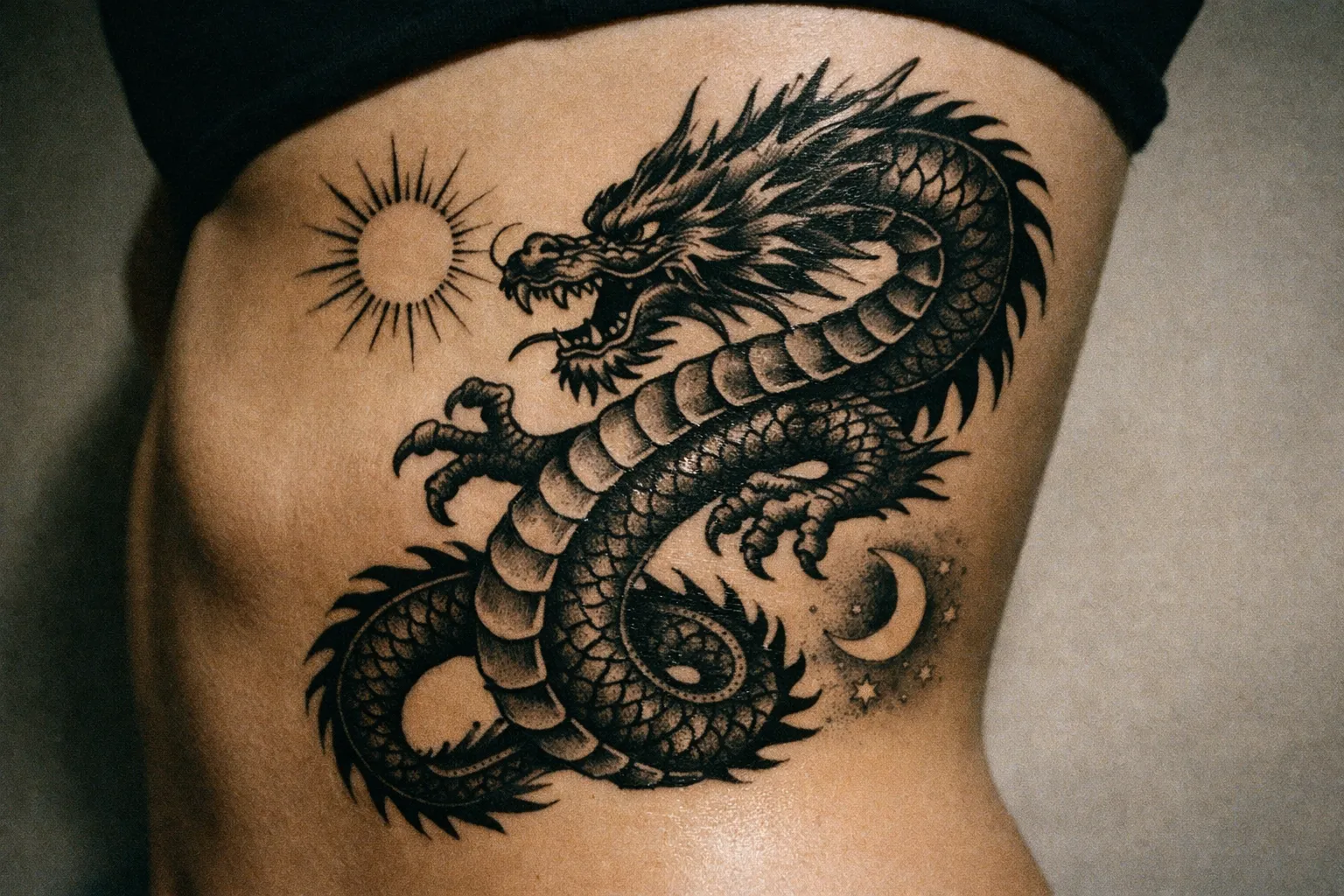
On women, dragon tattoos tend to emphasize grace, independence, intuition, and inner strength (3). Popular spots are the spine, side ribs, thigh, and hip - places where a long, sinuous body can echo natural curves. Fine-line and watercolor styles have surged in popularity here in the last few years.
That said, plenty of women want a roaring Irezumi backpiece, and plenty of men want a delicate fine-line small dragon tattoo behind the ear. Skip the clichés - pick the piece that fits you.
Popular Dragon Tattoo Designs and Their Unique Symbolisms
Some layouts show up repeatedly because they work. A few worth knowing:
- Coiled dragon - protection, contained power. Reads well on the chest, shoulder cap, or as a circular thigh piece.
- Rising dragon - ambition, growth, ascending. Common in full sleeves where the body wraps up the arm.
- Descending dragon - bringing blessings or power down to earth; also reads as grounded strength.
- Dragon and koi - perseverance through transformation. Great half-sleeve composition.
- Dragon head only - when you want the symbol without committing to a 14-inch body. Works on forearm, calf, shoulder.
- Small dragon tattoo in fine line - minimalist outline, usually 1-3 inches, suited to wrist, ankle, behind the ear, collarbone. Pick this if you want something subtle and personal rather than a big statement.
- Yin-yang dragon and tiger - balance, opposing forces, popular as a back or chest piece.
Dragon Tattoo Placements: Where the Design Actually Lives
Placement is half the design decision. A dragon that looks great on paper can look cramped or distorted on the wrong spot.
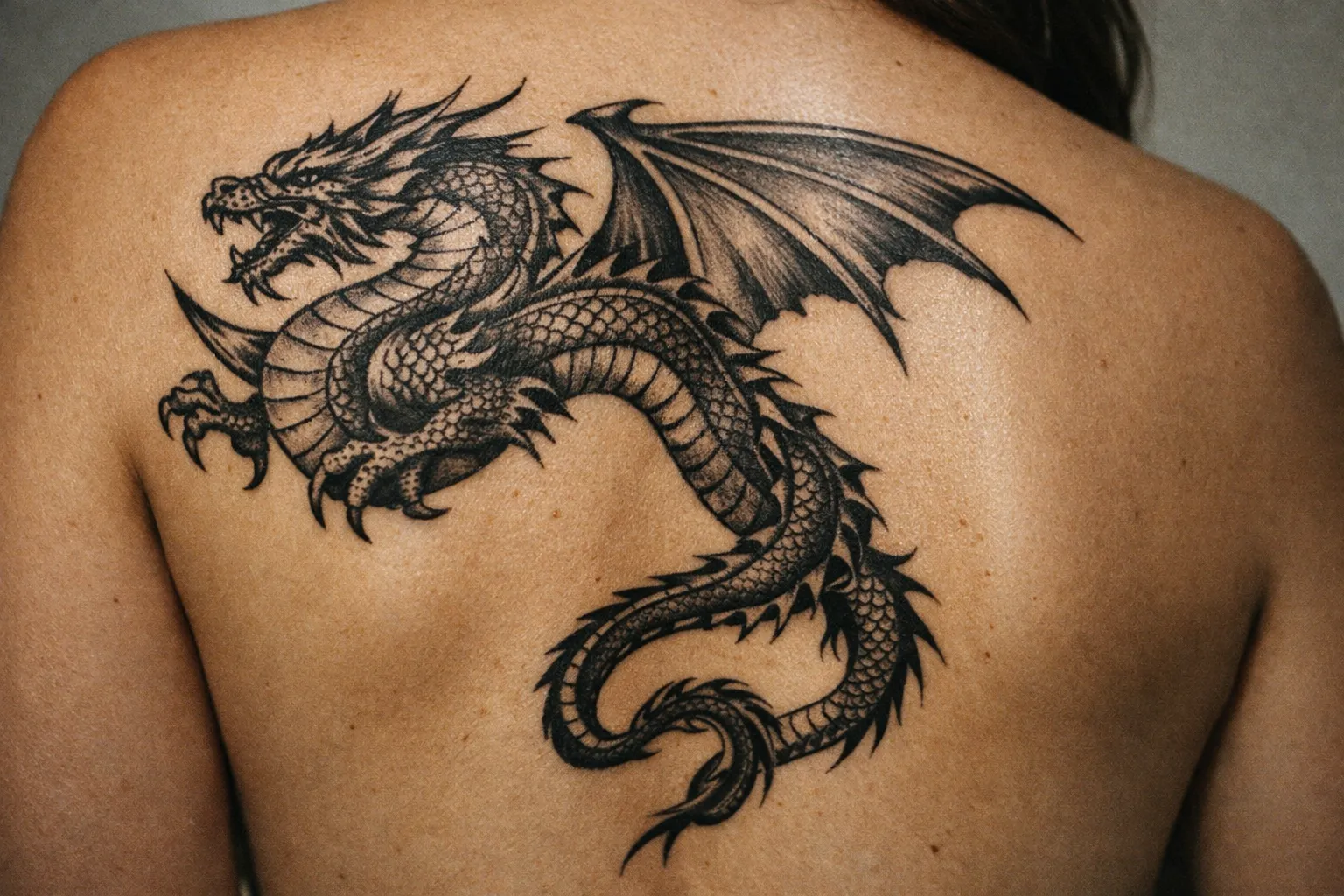
Dragon Forearm Tattoo
The forearm is the most popular spot for medium dragons. Pros: high visibility, runs lengthwise with your arm’s natural shape, works for men and women. Size: typically 4-8 inches, often wrapping slightly around the arm. Pain: low to moderate - bony spots like the wrist and inner elbow sting more than the fleshy forearm. Expect 2-4 hours over one or two sessions.
Sleeve (Full or Half)
The classic home for a Japanese dragon. Half-sleeves run 8-12 inches, full sleeves cover shoulder to wrist. Expect 6-20+ hours over multiple sessions. This is where you commit to full compositions with clouds, water, or wind.
Back and Full Torso
Traditional spot for a full Japanese or Chinese dragon. A full back piece can take 20-40+ hours over 6 to 18 months. Pain is moderate over most of the back; the spine and lower back are the worst zones.
Chest and Sternum
A dragon curving across the chest with its head over the heart makes a strong protective statement. Sternum pain is brutal - ribcage > forearm by a wide margin. Plan shorter sessions here.
Calf and Thigh
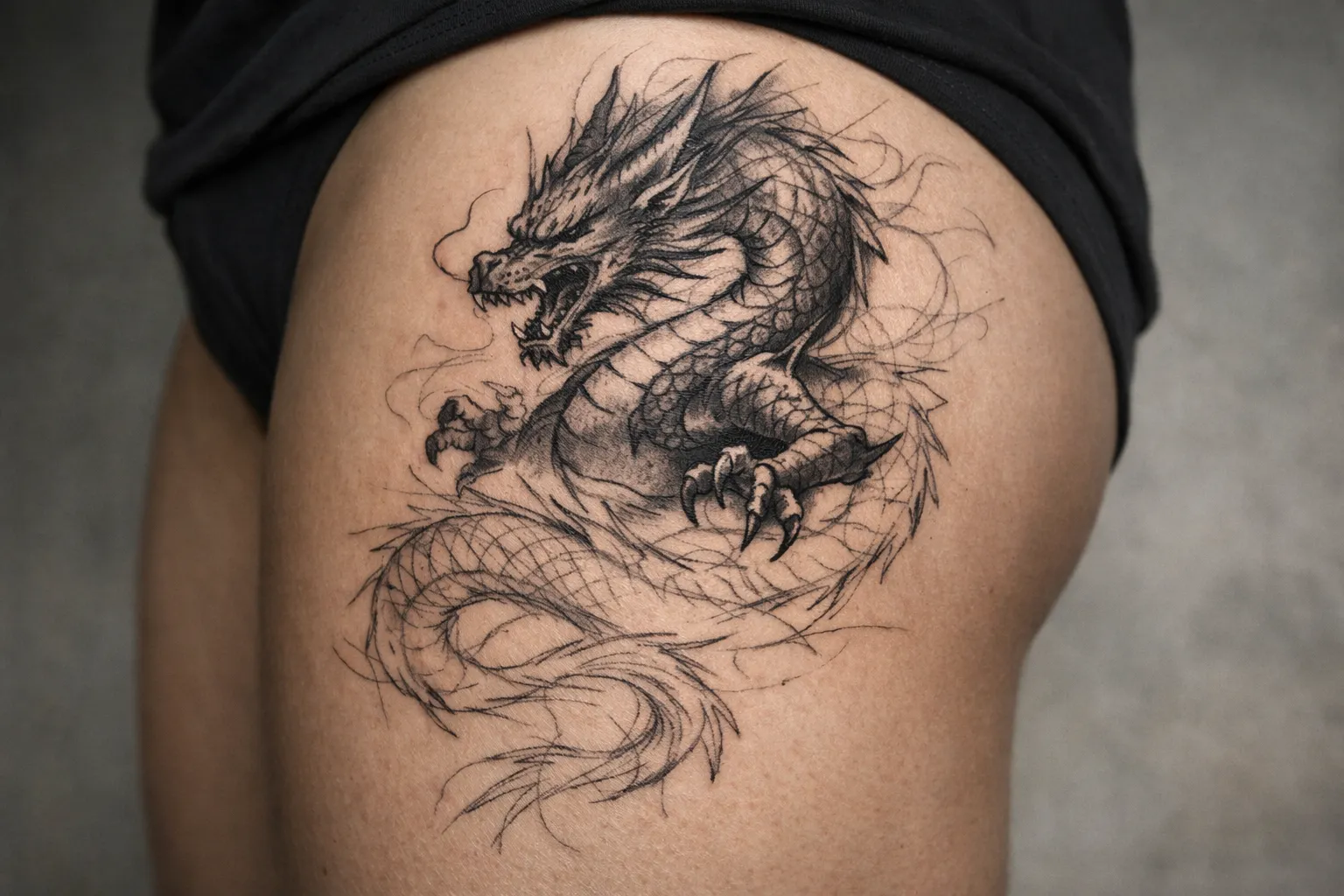
Both are workplace-friendly, allow medium to large pieces, and heal well. The thigh is especially forgiving for long, flowing dragon bodies.
Ribs
High pain, slow healing, usually broken into 2-3 short sessions. The payoff is real for women wanting a long dragon along the side - the ribcage’s natural curve echoes the dragon’s movement.
Small Placements (Wrist, Ankle, Behind Ear, Collarbone)
For a small Dragon tattoo of 1-3 inches, the design has to be simplified - scales and fine detail don’t survive at this scale and blur within 5-10 years. Stick to clean linework with minimal shading.
Should a Dragon Tattoo Go Up or Down?
This question comes up a lot because it actually matters for symbolism, not just composition.
- A rising dragon (head up) traditionally stands for ascension, ambition, growth, and reaching toward the heavens - common in Chinese and Japanese symbolism.
- A descending dragon (head down) reads as bringing power, blessings, or wisdom down to earth - grounded strength.
- Some artists like the dragon facing inward toward the heart or torso so it “guards” you; others prioritize what looks best with the body’s flow.
No universal rule here. The questions to ask your artist: what symbolism do you want, and where does the dragon’s head naturally land on your body?
Is a Dragon Tattoo Good or Bad? Is It Satanic?
Short answer: a dragon tattoo’s meaning depends entirely on the cultural lineage you pull from.
In Chinese and Japanese traditions, dragons are overwhelmingly positive - protective, lucky, wise, tied to water and rain. Nothing satanic about them. Japanese firefighters wore dragons for protection, much like a modern Christian wears a cross.
The “dragon = devil” idea comes from European Christian imagery, where dragons got tangled with the serpent of Eden and the beast of Revelation. That’s a real strand of symbolism, but only one cultural lens among many.
If you’re worried about family or social reactions, the practical move is to pick a style that signals the lineage clearly. A Japanese dragon riding clouds reads as folklore to almost anyone. A horned, fanged Western dragon clutching a skull tells a different story. Style does the explaining.
How Has the History and Evolution of Dragon Tattoos Shaped Their Symbolism?
Dragon tattooing as we know it today traces mostly to Japanese Irezumi, which formalized large-scale dragon compositions from the 17th to 19th centuries, drawing on woodblock print traditions. From there it spread west through sailors and post-WWII American tattooing - which is why “Japanese dragon” is the default mental image for most Western tattooers.
Chinese dragon imagery has a longer documented history but entered Western tattoo culture later, mainly through diaspora artists and the rise of Asian-American tattoo culture in the 1990s and 2000s.
The Celtic dragon revival is more recent - late 20th century, driven by interest in Celtic knotwork and pagan revivalism.
Recent shifts to know:
- House of the Dragon (HBO, 2022+) and ongoing anime dragon iconography (Demon Slayer, Dragon Ball) have pushed forearm, sleeve, and back dragon bookings up in Western studios.
- Fine-line small dragon tattoos have boomed on TikTok and Instagram among under-30 clients - driving more 1-2 hour bookings instead of only big traditional pieces.
- Studios in 2023-2024 are openly discussing cultural appropriation concerns, especially around Japanese and Chinese designs paired with random kanji that don’t mean anything.
Choosing Your Dragon Tattoo Designs
Here’s a practical way to narrow down dragon tattoo designs:
- Pick the cultural lineage first. Japanese, Chinese, Celtic, tribal, or Western. This decides most of the visual language.
- Choose one or two core meanings. Protection? Transformation? Power? Resist cramming them all in.
- Pick the placement. This sets size limits and dictates how much detail will hold up.
- Select one or two companion elements. Clouds, water, pearl, koi, tiger - not all of them.
- Decide on the color palette. Full color, black and grey, or pure blackwork.
- Let your artist redraw it. A specialist will rework your reference for body flow. That’s what you’re paying for.
Cost Expectations (US studios, 2024)
- Small fine-line dragon (1-3 in): $80-$200 flat, or one shop minimum.
- Forearm dragon, medium detail (4-8 in): $250-$800, 2-4 hours at typical $120-$200/hour rates.
- Half-sleeve color dragon (8-14 in): $800-$2,400+ across 2-3 sessions.
- Full Japanese backpiece (Irezumi): $2,500-$8,000+ over 6-18 months of sessions, more with top specialists.
Deposits for larger work usually run $50-$300 and apply to your first session.
Finding a Dragon Tattoo Artist Who Actually Knows the Style
The biggest factor in whether your dragon ages well is the artist’s specific experience with dragons in your chosen style. A great American Traditional artist isn’t automatically a great Irezumi specialist.
What to look for:
- A portfolio with at least 8-10 healed dragon pieces in the style you want. Healed shots tell you how the work actually looks long term.
- They redraw, don’t trace. If an artist wants to copy your Pinterest reference exactly, they’re not right for a permanent piece.
- They ask about meaning before sketching. A specialist wants to know what the dragon means to you so the composition supports it.
- For Japanese work - look for tattooers trained in or seriously studying Irezumi composition. Ask who they apprenticed under or study.
- They charge fairly for their level. Bargain pricing on a 12-hour dragon is a red flag, not a deal.
Bring 5-10 reference images to your consultation - not to copy, but to communicate the vibe you want. Be ready to leave with a custom sketch you didn’t expect.
Aftercare: Keeping a Dragon Tattoo Crisp Long-Term
Dragon tattoos - especially black-heavy and color-saturated ones - live or die on aftercare. Here’s the timeline:
- Day 1-3: Keep the bandage on as your artist tells you (some use Saniderm-style film for 3-5 days, others go traditional with plastic wrap for a few hours). Wash gently 2-3 times daily with fragrance-free soap. Expect some plasma and ink weeping - normal.
- Week 1: Apply a fragrance-free moisturizer or tattoo balm lightly and often. Avoid soaking - no baths, pools, or ocean. Showers are fine.
- Week 2-4: Peeling and flaking stage. Don’t pick. Keep it moisturized. Surface heals around day 10-14; deeper skin layers take 4-6 weeks.
- Month 2+: Use daily sunscreen (SPF 30-50) on any sun-exposed tattoo like a dragon forearm or calf piece. UV is the biggest factor in fading.
For large black-fill work like a tribal dragon tattoo, expect a touch-up at 6-12 months to even out spots where ink didn’t fully settle. Many artists include one free touch-up; budget $50-$150 if not.
Common Mistakes That Ruin the Design
- Picking a design before the meaning. Leads to a cool-looking piece that doesn’t mean what you wanted.
- Mixing cultural elements that don’t belong together. A Japanese-bodied dragon with five Chinese imperial claws and Celtic knotwork reads confused, not deep.
- Tracing a Pinterest design. You’ll see the same dragon on three other people, and skilled tattooers might refuse the job.
- Underestimating surface area. A long, flowing Japanese dragon crammed into a 3-inch wrist patch will blur into a blob in a decade. Match design complexity to skin real estate.
- Loading too many elements. Dragon + tiger + koi + cherry blossoms + waves + kanji on one forearm - pick two.
- Skipping sun protection. A vivid red dragon fades to pink in five years without SPF.
- Choosing a generalist for a specialist piece. A traditional Japanese sleeve needs an Irezumi-experienced artist, not whoever’s got the soonest opening.
Frequently Asked Questions
- What is dragon tattoo meaning?
- It centers on five recurring themes: power, wisdom, protection, transformation, and luck. The specific reading depends on cultural style (Japanese, Chinese, Celtic, Western), color, and companion elements.
- Is a dragon tattoo good or bad?
- In East Asian cultures, dragons are overwhelmingly positive - protective, lucky, wise. Medieval European Christian imagery cast dragons as beasts or stand-ins for the devil - where the 'bad' reading comes from. The piece means whatever cultural lineage you choose.
- Should a dragon tattoo go up or down?
- A rising dragon symbolizes ambition, ascension, and growth. A descending dragon symbolizes bringing power or blessings to earth, or grounded strength. There's no universal rule - pick based on the symbolism you want and what works with the placement.
- Is a dragon a satanic symbol?
- Only in specific European Christian contexts, where the dragon got tangled with the serpent and the beast of Revelation. In Chinese, Japanese, Korean, Vietnamese, and Celtic traditions, dragons are protective, divine, or auspicious - not satanic.
- How much does a dragon tattoo cost?
- A small fine-line dragon runs $80-$200, a medium forearm dragon $250-$800, a half-sleeve $800-$2,400+, and a full Japanese backpiece $2,500-$8,000+ over multiple sessions.
- How long does a full back dragon tattoo take?
- A traditional Japanese backpiece typically takes 20-40+ hours of tattoo time spread over 6-18 months of sessions, often booked weekly or monthly.