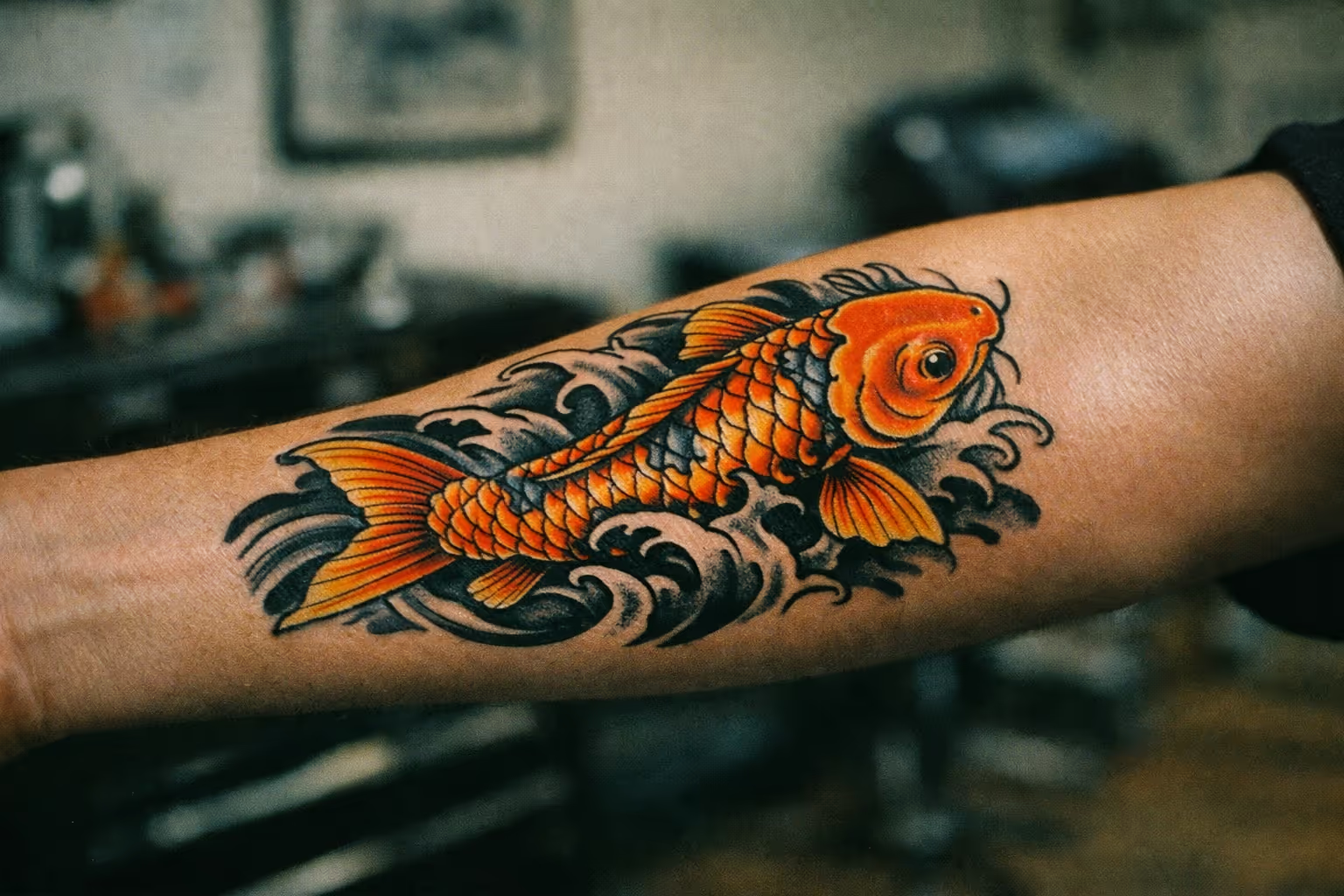
Koi fish tattoo meaning isn’t one thing - it’s a code. Black reads as hardship overcome, red as passion or the mother, and a koi swimming upstream says the struggle is still on, while downstream says it’s behind you. Get the color or the direction wrong and you’ve committed to the opposite story for life. Here’s what each choice actually says, before you book what can become a 15-hour sleeve.
What a Koi Fish Tattoo Actually Means
The koi fish tattoo meaning comes down to one thing: swimming upstream when everything in the current says stop. It’s the most-requested Japanese motif most studios will book this year, and the symbolism - perseverance, transformation, luck after hardship - has held up across roughly 2,500 years of folklore, from the Chinese Dragon Gate legend to modern irezumi sleeves. Whether you’re considering a small koi fish tattoo on the wrist or a full koi fish sleeve tattoo with a dragon-koi transformation across the shoulder, the design choices you make - color, direction, placement, companion elements - change the story your skin tells. This guide walks through what each variation actually means, what it costs, where it ages well, and how to avoid the pitfalls that turn a good koi into a muddy patch by year ten.
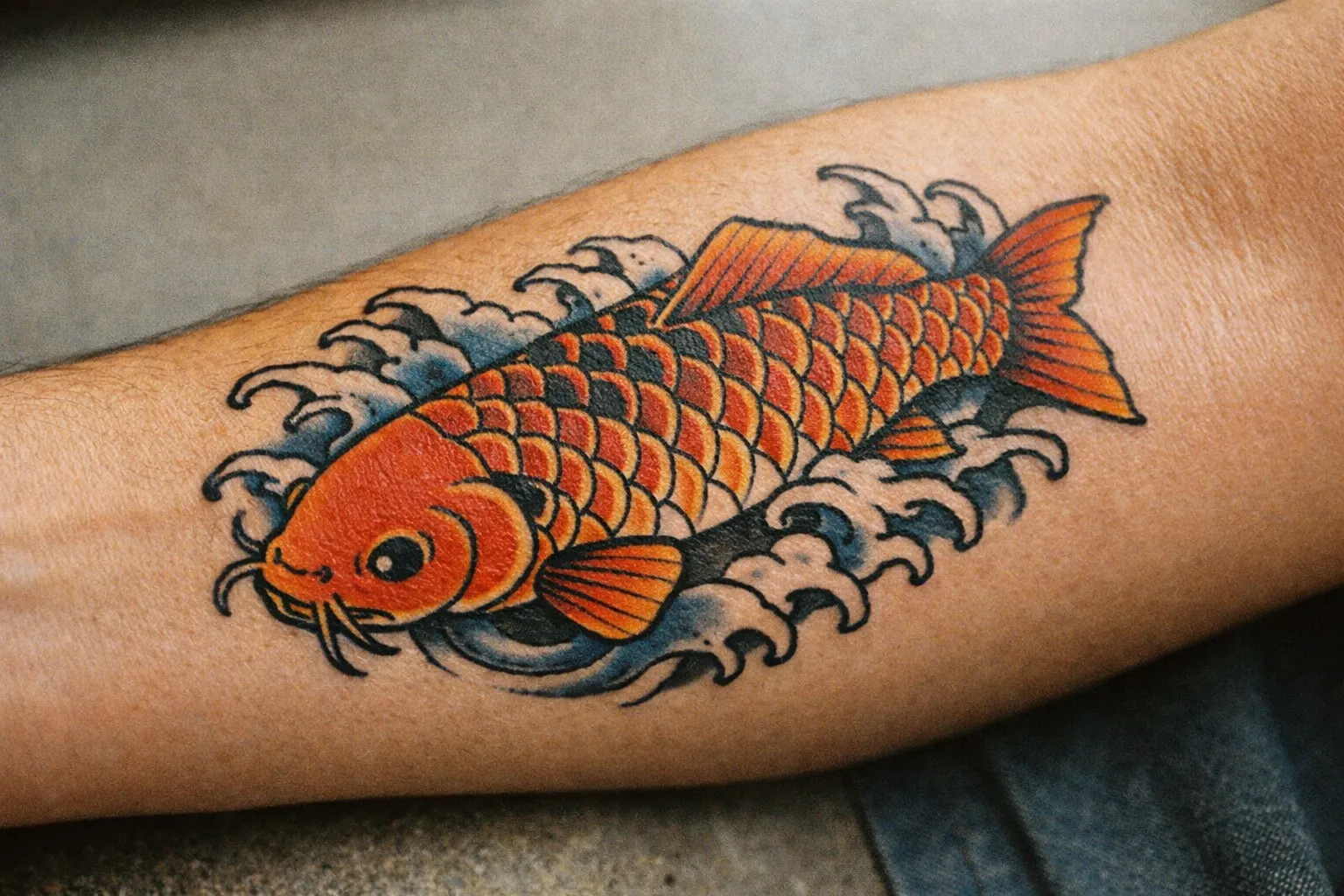
The symbolism roots in a Chinese legend about the Dragon Gate: a waterfall at the top of the Yellow River where schools of koi gather and try to leap upward. Most fail. The few that make it are transformed into golden dragons by the gods(4). When that story crossed into Japan, koi became fixtures of irezumi and a national symbol of strength - they’re the fish on the koinobori flags flown for Children’s Day on May 5 to celebrate kids’ growth and resilience (2)(4).
That’s the core. Everything else - color symbolism, direction, the dragon transformation - branches off that root (1)(3).
So when someone gets a koi fish tattoo today, they’re usually marking one of three things:
- An ongoing struggle they’re currently fighting through
- A hardship overcome - recovery from illness, addiction, divorce, grief
- A transformation - career change, becoming a parent, spiritual growth
Modern Buddhist readings add another layer: the koi swimming against the current represents perseverance in spiritual practice, refusing to drift along with ignorance (1). That’s why you’ll see koi paired with lotus flowers in some designs - both motifs sit in the same conceptual neighborhood.
✓ Pros
- Strong cultural symbolism with centuries of history
- Versatile in size and placement for different meanings
- Bold colors and linework age well when done right
✗ Cons
- Color fading is a real issue on sun-exposed areas
- Complex designs require large, costly tattoos
- Misinterpretation possible if design choices aren't deliberate
Koi Fish Tattoo Color Meaning
Color is where koi tattoos get specific. Picking a color purely because it looks nice can backfire - a black koi has a defined meaning in traditional Japanese symbolism, and you’ll wear it for life.
Here’s the breakdown most Japanese-style artists work from (1):
- Red koi - Love, passion, courage, intense emotion. In family color coding, red represents the mother.
- Black koi - Overcoming a major obstacle, rebirth after struggle. Traditionally the father. This is the koi people choose to mark sobriety, recovery from illness, or surviving something heavy.
- Blue koi - Calm, peace, career success. Often associated with the first son in family symbolism.
- Gold/yellow koi - Wealth, prosperity, success. Direct callback to the golden dragon transformation at the Dragon Gate.
- White koi - Purity, new beginnings.
- Pink koi - Daughter, femininity, soft love.
- Orange/multicolor koi - Vibrant personality, energy, a complex life journey with multiple chapters.
The family color coding (black father, red mother, blue son, pink daughter) is the most common reason people get a set of koi rather than a single fish. If you want Japanese viewers to immediately read your tattoo as a family piece, stick to that color logic.
One practical note on aging: bold, saturated colors hold up better than pastels. Pink and pale blue koi soften noticeably after 10-15 years, especially on sun-exposed placements. I’ve seen pink koi on forearms that looked almost white a decade out. If you want a pink koi for a daughter and need it to look sharp at 20 years, ask your artist to push the saturation harder than feels right in the chair.
Koi Fish Tattoo Japanese Style: Two Technical Hallmarks
The koi fish tattoo Japanese style - traditional irezumi or wabori - has two technical hallmarks that separate it from Western interpretations:
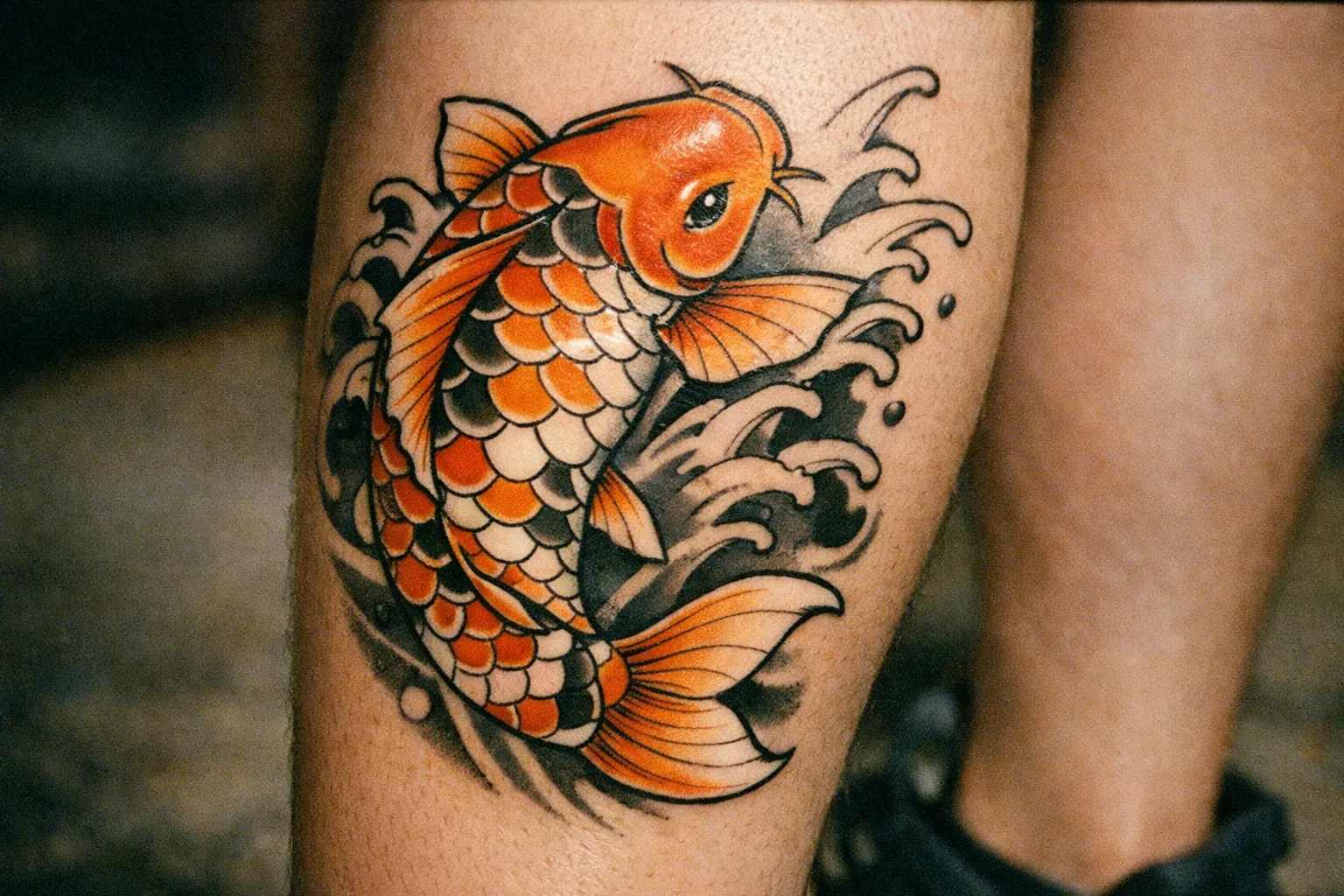
- Bold black outlines with strong negative space. The linework carries the whole design. Color is layered inside, but the black holds the shape across decades.
- Background as narrative. Water (currents, waves, whirlpools), seasonal flowers (cherry blossoms for spring, maple leaves for autumn), and wind bars aren’t decoration - they tell you what season the koi is swimming through, which changes the emotional reading of the piece (4).
A common pitfall when artists do Japanese koi badly: thin, illustrative outlines and watercolor-style backgrounds. It looks great healed in week three. By year eight, the outlines have blurred into the color and the whole piece reads as a smudge. If you want a Japanese koi, hire someone whose portfolio shows healed irezumi work, not just fresh photos.
The seasonal pairing is worth thinking about consciously:
- Koi swimming upstream + maple leaves = autumn struggle, the climb is happening now
- Koi swimming downstream + cherry blossoms = spring renewal, the hardship is behind you (4)
- Koi + peonies = wealth, honor, strong feminine energy
- Koi + lotus = spiritual perseverance, rising from murky water clean
Dragon Koi Fish Tattoo Meaning
The dragon koi fish tattoo meaning is the Dragon Gate legend rendered visually: a koi mid-transformation into a dragon, or a koi paired with a fully-formed dragon swimming alongside or above it. The symbolism is ambition, ultimate achievement, rebirth, and power earned through struggle (2)(5).
Two common ways artists handle the transformation:
- Half-and-half - the head and front body have become dragon (horns, whiskers, claws emerging), while the tail end is still koi with scales. This is the literal Dragon Gate moment.
- Pair composition - a full koi at the bottom swimming up toward a full dragon at the top, with waves and a waterfall between them. Tells the whole story in one piece.
A dragon koi is almost never a small tattoo. The detail required for both creatures’ scales, claws, and facial features doesn’t compress below about 8 inches without losing the dragon’s readability. If you want this symbolism in a smaller piece, ask the artist for a single koi with one small dragon claw or eye worked in - implication over depiction.
Ribcage > forearm for pain on a dragon koi backpiece, by a lot. The back itself sits in the middle - flesh over the lats is tolerable, but spine and shoulder blade sessions get sharp.
Two Koi Fish and the Yin Yang Reading
The “two koi swimming in a circle” question comes up constantly, and the answer is specific: it’s a yin-yang composition. Two koi (usually one light, one dark) circling each other, each one’s eye forming the dot in the opposite color’s field. The reading is balance, duality, complementary opposites - light and dark, masculine and feminine, struggle and ease, all coexisting (1)(6).
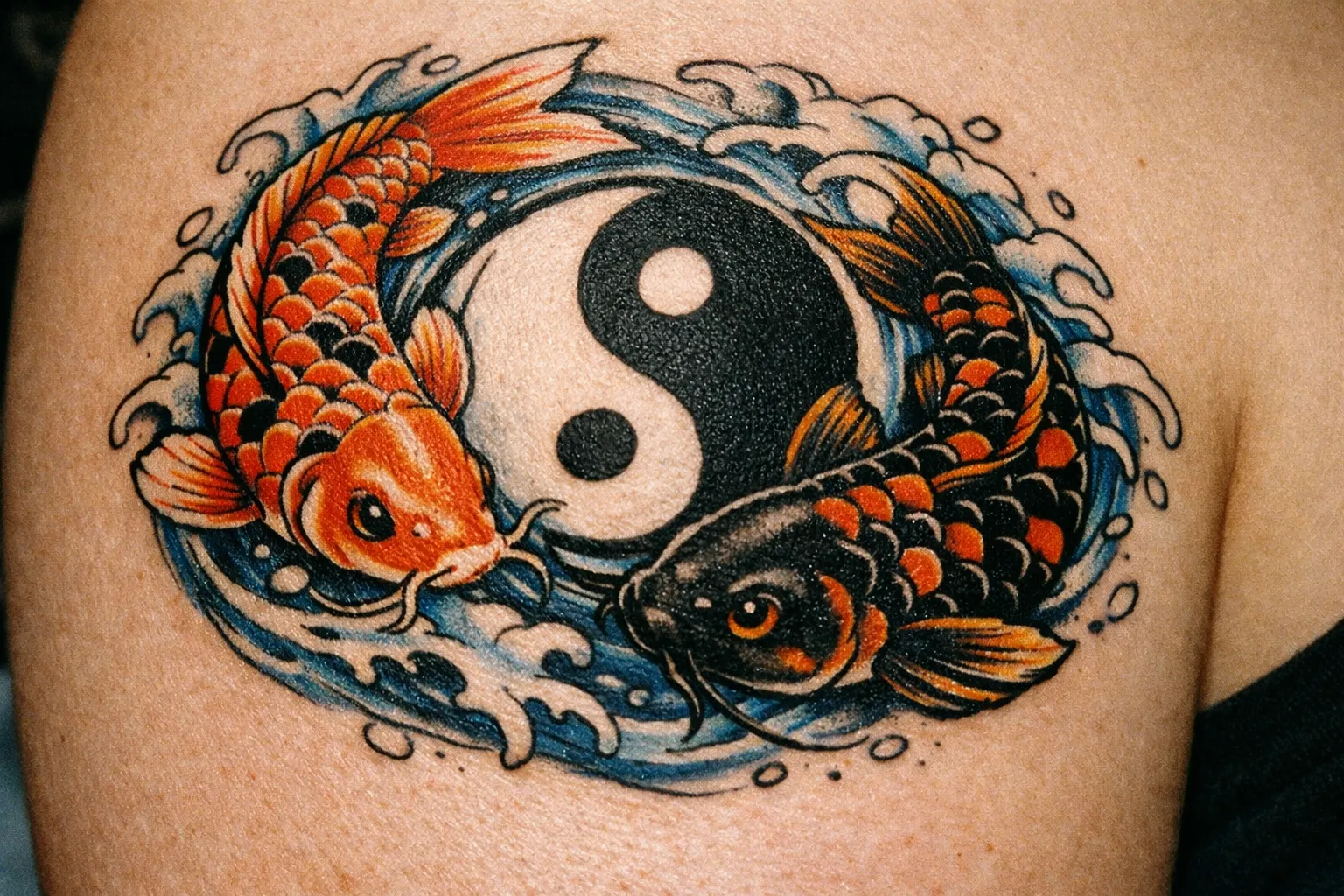
Why people get two koi tattoos, more broadly:
- Romantic partnership - two koi often represent a relationship, especially with one red (passion) and one black (steadfastness)
- Internal duality - the two sides of yourself, or the tension between ambition and acceptance
- Twins or siblings - two koi with different family colors to mark a sibling bond
- A “before and after” - one koi swimming upstream (the struggle) and one downstream (the resolution), shown together as a complete life chapter
The yin-yang two-koi design works best as a circular composition on flat real estate: shoulder blade, upper back, chest plate, outer thigh. It struggles on the forearm because the circular flow gets distorted when the arm bends.
Koi Fish Sleeve Tattoo: What to Expect
A koi fish sleeve tattoo is the most ambitious koi project, and the one most likely to become a multi-year commitment. Here’s the realistic scope:
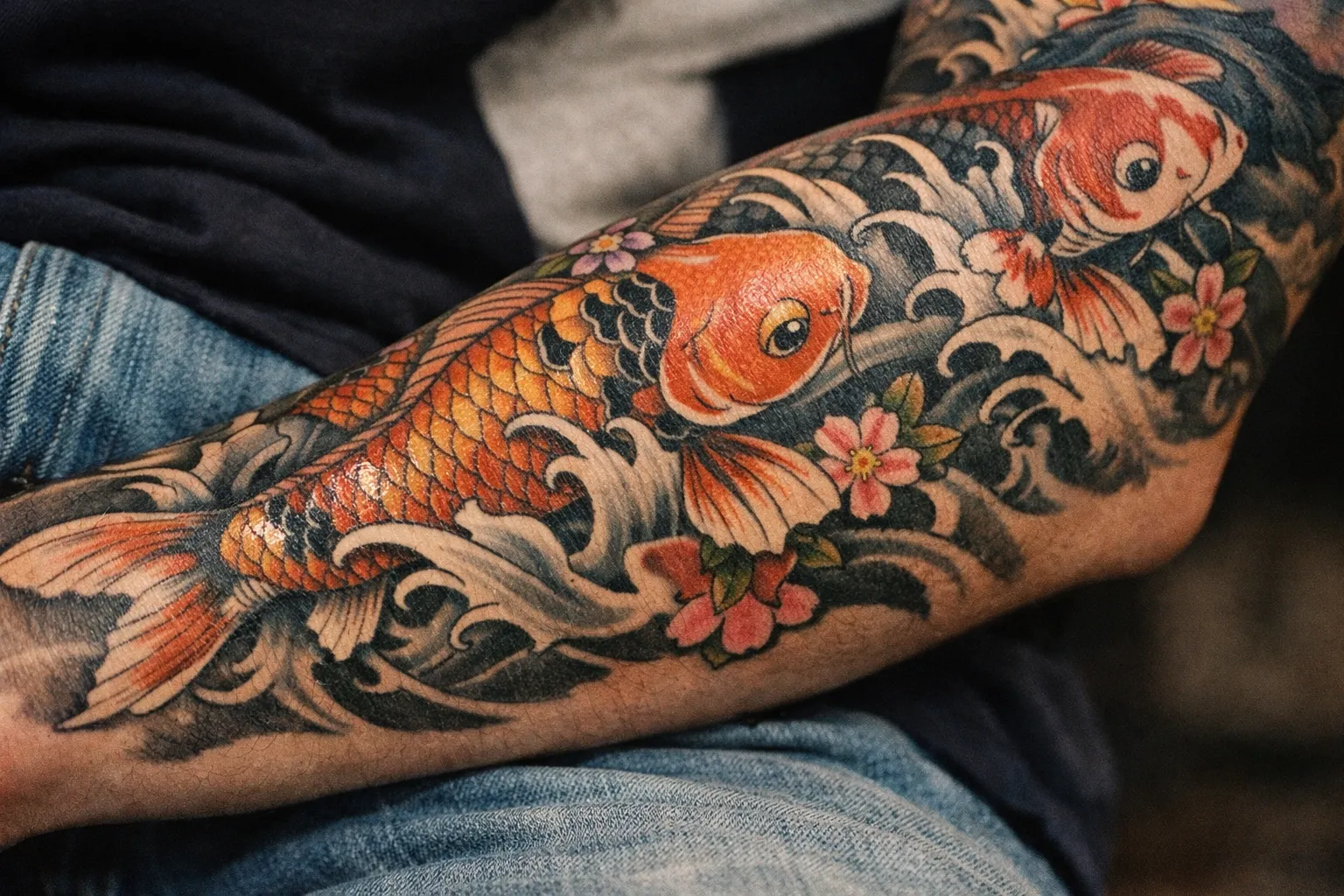
- Time: 15-30 total tattoo hours, split across 3-8 sessions
- Sessions: 3-5 hours each, spaced 2-6 weeks apart for healing
- Cost: $2,500-$6,000+ in the U.S., depending on artist tier and color complexity. Japanese-specialist artists in major cities run $200-$300+ per hour
- Order of work: Most traditional artists do all linework first (1-3 sessions), then black shading, then color last
What goes into a full sleeve beyond the koi itself: water (almost always), at least one seasonal flower, often a secondary creature (dragon, phoenix, tiger), and connecting wind bars or finger waves that tie the whole panel together. The koi is usually the focal piece, but it occupies maybe 30-40% of the visual real estate.
Plan the orientation early. Koi on a sleeve should swim along the arm’s axis, not wrapped around it. A koi wrapped horizontally around the bicep looks distorted from every angle except the one the artist drew it from. A good Japanese-style artist will draw directly on your arm with markers before stenciling to confirm the flow follows your muscles. I’ve watched clients insist on a horizontal wrap and regret it by the second session when they see it in a mirror.
Pain across a sleeve: outer upper arm and outer forearm are the easiest. Inner bicep, elbow ditch, and wrist are the spikes. Budget a longer session for the easy zones and a shorter session for the elbow.
Koi Fish Forearm Tattoo: The Most Versatile Placement
A koi fish forearm tattoo is the placement most people land on when they want something meaningful and visible without committing to a full sleeve. The forearm gives you 6-10 inches of vertical real estate that follows the limb’s natural axis - perfect for a koi swimming up or down with a band of water.
Typical scope and cost:
- Single koi, 6-8 inches, full color, with water and one flower: 4-7 hours, $700-$1,500
- Half sleeve (elbow to wrist): 6-10 hours, $900-$2,000
- Black and grey version of the same: Often 20-30% less because color sessions add hours
The forearm reads as a daily marker placement - you see it every time you wash your hands, type, or eat. That makes it the right pick for koi that represent an ongoing commitment (sobriety, recovery, an active goal) rather than a closed chapter you want to keep private.
Two things to avoid on the forearm:
- Koi smaller than 3 inches. Scale detail muddies fast as forearm skin ages and sun exposure accumulates.
- Fine-line minimalist koi on the inner wrist. The skin there is thin and stretchy; fine lines blow out or migrate within 5-7 years.
Small Koi Fish Tattoo: Where It Works and Where It Doesn’t
A small koi fish tattoo (2-4 inches) is the most accessible entry point - typically $120-$300, one sitting, minimal background. It’s a good fit if you want the symbolism without the time commitment of a larger piece.
Placements where small koi age well:
- Outer forearm (above the wrist)
- Outer calf
- Shoulder blade
- Back of upper arm
Placements where small koi struggle:
- Inner wrist (skin stretch, sun exposure)
- Top of foot (heavy fading)
- Fingers (lines migrate badly)
- Ribs (small detail gets distorted by breathing and skin movement)
The design rule for small koi: simplify. A small koi with bold outlines, two or three flat colors, and minimal water reads cleanly at 5 feet and stays readable at 20 years. A small koi packed with detailed scales, gradient color, and elaborate waves becomes a blurry oval by year ten.
If you want to leave the door open for expansion, ask your artist to design a small koi that anchors a future half-sleeve. They’ll position and orient it so water and additional elements can grow around it later without the original piece looking awkward.
Direction: Upstream vs Downstream Koi
The direction your koi swims changes the tattoo’s meaning, but the reading isn’t fully consistent across traditions - modern guides openly acknowledge this contradiction (2)(4).
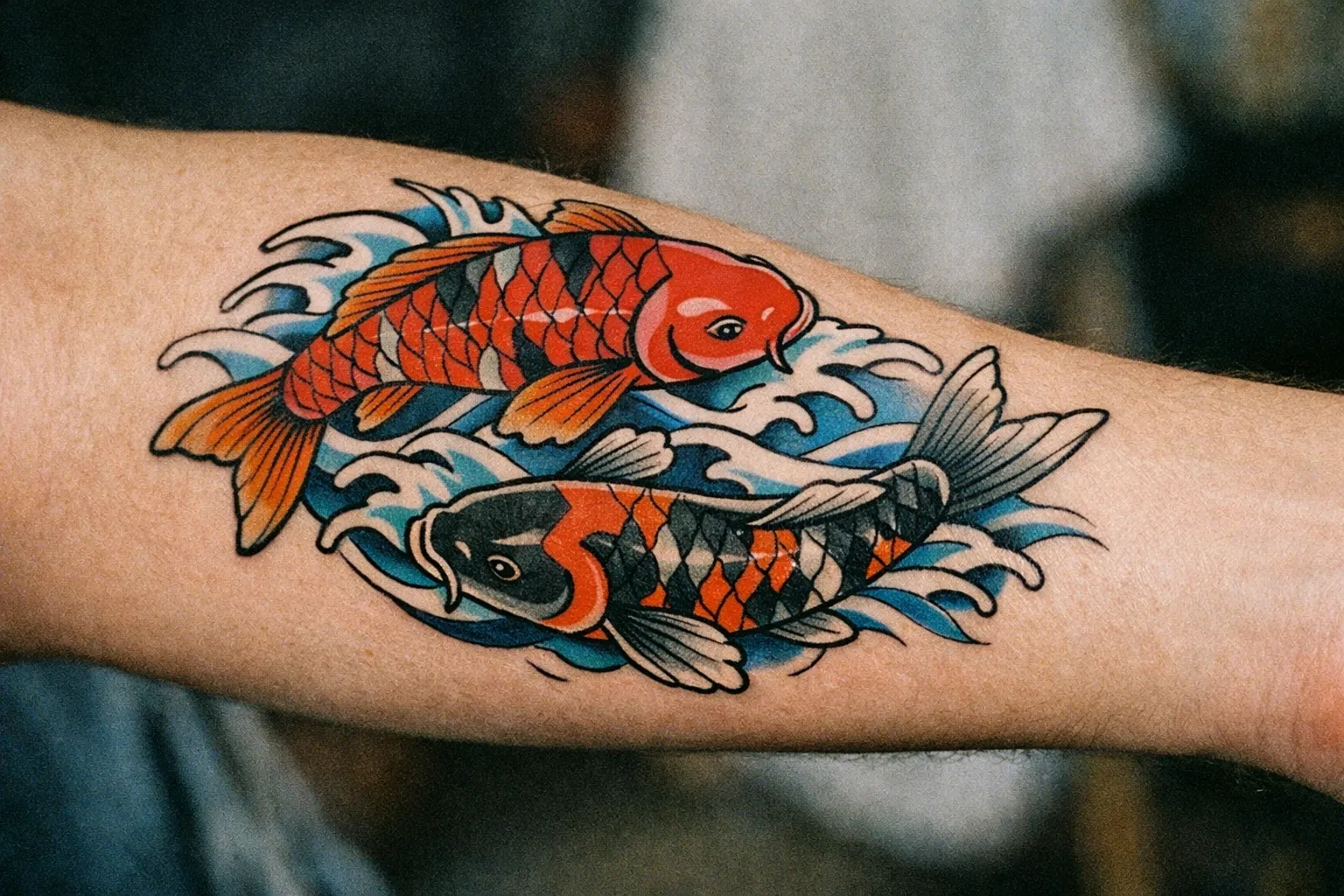
Upstream koi (swimming up, against the current):
- Active struggle, currently fighting
- Ambition, climbing toward a goal
- Determination, refusal to give up
Downstream koi (swimming down, with the current):
- Two readings, take your pick:
- Reading A: Hardship overcome, the koi has already made it past the waterfall and is moving on
- Reading B: Acceptance, going with the flow of life
Most traditional Japanese artists lean toward Reading A - downstream means “after the climb.” Modern Western interpretations often use Reading B. Neither is wrong, but it’s worth deciding which reading you want before you commit, because an upstream koi can permanently signal “I am in struggle” if that’s not what you meant.
Popular Body Parts for Koi Tattoos
Beyond forearm and sleeve, here’s how the common placements map to the symbolism:
- Back (full back or upper back): The biggest canvas. Best for Dragon Gate scenes with waterfall, dragon, and multiple koi. Reads as a private piece - you don’t see it often, others see it rarely. Good for life-story tattoos.
- Chest plate (pectoral): Single large koi swimming upward toward the shoulder. Heavy symbolic placement - close to the heart, often used for koi marking family loss or major personal change.
- Ribcage/side: Vertical koi swimming up the side. The most painful koi placement by a wide margin. Often chosen for koi tied to intimate or private struggles.
- Thigh: Excellent for vertical compositions. Lower pain than ribs, lots of real estate, easy to hide. Popular for color-realism koi where the artist wants to show off scales.
- Calf: Single koi with water. Visible in shorts, hideable in pants. Ages well because calf skin is relatively stable.
- Behind the ear / nape of neck: Only works for very small, very simple koi outlines. Detail gets lost.
Getting Your Own Koi Fish Tattoo: Prep Checklist
Once you know what your koi means and roughly where it’s going, here’s the prep sequence:
Before the consultation:
- Pull 3-5 reference images that show the style you want (not designs to copy - examples of linework weight, color saturation, composition)
- Write down the specific meaning in one or two sentences (“black koi for sobriety since March 2022, swimming upstream because I’m still actively in recovery”)
- Decide on color vs black-and-grey
- Take photos of the body area in good light
At the consultation (30-60 minutes, sometimes $50-$100 and credited toward the tattoo):
- Show references and explain meaning
- Let the artist suggest size and placement based on your body - don’t fight them on flow
- Get a written quote with hour estimate and total range
- Pay the deposit ($50-$300, usually non-refundable, applied to final cost)
Before the appointment:
- Eat a real meal 1-2 hours before
- Hydrate the day before, not just morning-of
- No alcohol 24 hours prior (thins blood, more bleeding = washed-out color)
- Wear clothing that exposes the area without you having to strip
- Bring snacks and water for sessions over 3 hours
How to Prepare for Your Koi Fish Tattoo Appointment
2 hoursSteps to get ready for your consultation and tattoo session to ensure the best experience and outcome.
- 1
Gather style references
Collect 3-5 images showing linework, color saturation, and composition styles you like, not exact designs to copy.
- 2
Clarify your tattoo's meaning
Write a clear one- or two-sentence statement about what the koi symbolizes for you.
- 3
Consult with your artist
Bring references and meaning to the consultation, discuss size, placement, and get a quote.
- 4
Prepare for the session day
Eat well 1-2 hours before, hydrate the day before, avoid alcohol 24 hours prior, wear accessible clothing, and bring snacks for long sessions.
Aftercare Timeline for a Koi Tattoo
Color koi need disciplined aftercare to keep saturation. Here’s the standard timeline:
Day 1-3 (acute healing):
- Keep the bandage on for the time your artist specifies (2 hours for plastic wrap, up to 5 days for second-skin)
- Wash 2-3 times daily with fragrance-free antibacterial soap and lukewarm water
- Pat dry - don’t rub
- Apply a thin layer of tattoo-specific ointment (the petroleum-based kind) 2-3 times daily
Week 1:
- Switch from heavy ointment to fragrance-free moisturizer once the tattoo stops weeping
- Itching starts around day 4-7 - do not scratch, do not pick scabs
- No swimming, no soaking baths, no saunas
- No direct sunlight
Week 2-4 (peeling and settling):
- Scabs flake off naturally - let them
- Color will look dull and patchy during this phase. This is normal. The final color settles around week 4-6
- Continue moisturizing daily
- Still no sun exposure to the healing tattoo
Week 4+ (long-term):
- Apply broad-spectrum SPF 30+ to the tattoo any time it’s in the sun
- Use sun-protective clothing for extended outdoor time
- Schedule touch-ups every 5-10 years for sun-exposed pieces ($100-$300 per session)
Sun is what kills koi tattoo color. A red koi on the forearm of someone who spends weekends outside without sunscreen will lose 30-40% of its saturation in a decade. The same tattoo on a chest plate under a shirt will look nearly fresh. I’ve seen both side by side on clients who got tattooed the same year - the difference is stark.
Common Mistakes to Avoid
Five things that turn a good koi into a regret:
- Choosing color for aesthetics, not meaning. Black koi for “edgy” without knowing it traditionally marks overcoming hardship can create unintentional readings (1)(2).
- Mixing too many color symbolisms in one small piece. Red, black, gold, and blue koi crammed into a 5-inch patch reads as visual noise. The narrative gets lost.
- Going too small on a detailed design. A traditional Japanese koi with scale detail needs at least 5-6 inches to hold up over time. Below that, you’re paying for detail that will blur.
- Wrapping koi horizontally around limbs. Koi swim along the limb’s axis or the design distorts. Insist on a markered draw-on before stenciling.
- Copying a specific tattoo from Instagram. You’re wearing someone else’s personal reference, and a lot of artists won’t duplicate a colleague’s work. Use references for style, not design.
How Much a Koi Fish Tattoo Costs in 2026
U.S. averages from mid-tier urban studios, with Japanese-specialist artists at the higher end:
- Small koi (2-3 in, single color, forearm/ankle): $120-$250
- Medium koi (4-6 in, color, upper arm/forearm): $450-$900, 3-5 hours
- Forearm half-sleeve with koi, water, and flowers: $900-$2,000, 6-10 hours
- Full sleeve with koi, dragon, seasonal elements: $2,500-$6,000+, 15-30 hours across 3-8 sessions
- Backpiece with Dragon Gate scene: $4,000-$10,000+, 25-40+ hours
- Touch-ups (5-10 years later): $100-$300 per session
Hourly rates run $150-$250 for experienced tattooers and $200-$300+ for Japanese-style specialists in major U.S. cities.
Frequently Asked Questions
- What does a koi fish tattoo mean?
- It symbolizes perseverance through adversity, rooted in the Dragon Gate legend where a koi transforms into a golden dragon after leaping a waterfall. Modern meanings include strength, courage, good fortune, and personal growth.
- What do koi fish symbolize?
- Koi represent resilience, ambition, transformation, and good luck. In Japanese culture, they appear on koinobori flags for Children's Day as symbols of children's strength. In Buddhism, they signify perseverance in spiritual practice.
- Why do people get two koi fish tattoos?
- Two koi often represent romantic partnerships, internal duality, sibling bonds, or a before-and-after life chapter, emphasizing balance and complementary forces.
- What does two koi fish swimming in a circle mean?
- This yin-yang composition symbolizes balance, duality, and the coexistence of opposing forces, with each koi's eye forming the dot in the opposite color's field. It works best on flat placements like shoulder blade or chest.
- Is it cultural appropriation to get a Japanese koi tattoo?
- Respectful koi tattoos done by artists who understand the tradition are appreciation. Using Japanese symbols without understanding or mixing conflicting motifs leans toward appropriation. Research and honest intent matter.
- How painful is a koi fish tattoo?
- Pain varies by placement: ribcage is most painful, followed by sternum and inner bicep; outer forearm, calf, and upper arm are more tolerable. Small forearm koi are among the easier tattoos to get.
Translating Symbolism into Your Design
Lock in the meaning first - what specifically is this koi marking? Then pick the color that matches that meaning, choose the direction, and place it where the size and visibility match how publicly you want to carry the reference. A black koi swimming upstream on the forearm reads “I’m actively working through something heavy and I want to see it every day.” A pair of red and black koi in a yin-yang on the shoulder blade reads “this is about a relationship that balances me.”
The koi fish tattoo meaning is flexible enough to carry your specific story - but only if you make the design choices deliberately instead of pulling a generic reference from Pinterest. Bring a written one-sentence meaning to your consultation. The artist will do better work with that than with twenty images.