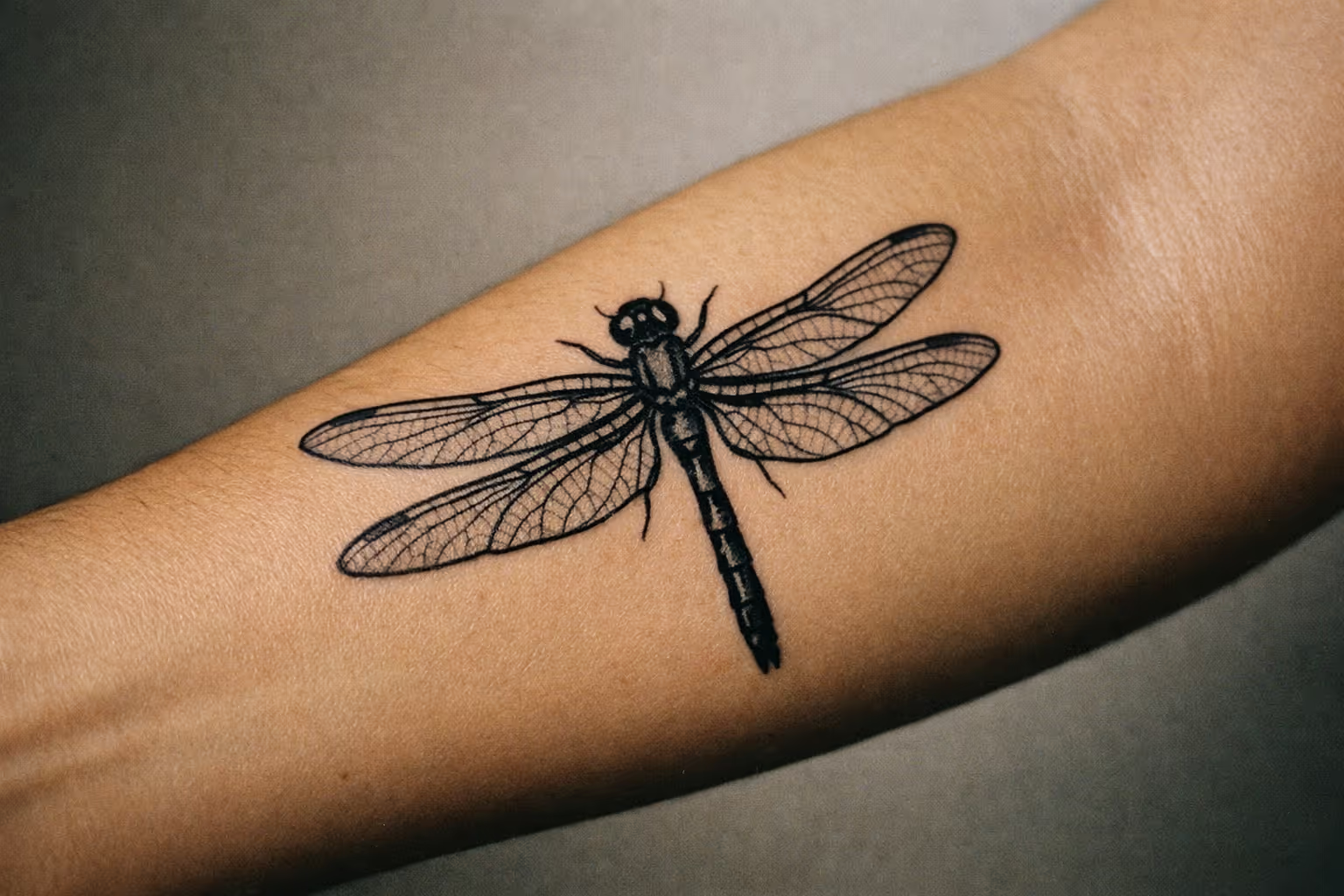
The dragonfly tattoo meaning stretches further than most people expect - from the Japanese kachimushi, the samurai’s “victory insect,” to a contemporary emblem of LGBT identity and change. It’s rare for one small motif to carry readings that different, which is why the culture, style, and scale you choose quietly pick the meaning for you. Land on the wrong one and your piece says something you didn’t intend. Here’s what the dragonfly actually means, and how it holds up on skin.
What the Dragonfly Tattoo Meaning Actually Is
The dragonfly tattoo meaning centers on transformation and change you’ve chosen to embrace. At its core, this tattoo symbolizes the insect’s life cycle - spending most of its life underwater as a nymph before breaking the surface and taking flight. That metamorphosis is why the symbol keeps showing up on people marking a turning point (1)(2).
The five meanings that come up most often:
- Transformation - leaving one version of yourself behind
- Adaptability - moving through change without breaking
- Freedom - dragonflies fly in six directions, including backward and hovering, which fuels the “no fixed path” reading (3)
- Living in the present - adult dragonflies live only a few months, so the symbol gets attached to impermanence and presence (4)
- Spiritual awareness - a messenger between worlds in several traditions
None of these are mutually exclusive. Most people who book a dragonfly piece are layering two or three of them - and that’s fine. The design holds all of it.
What Does a Dragonfly Symbolize Beyond the Ink?
Outside the tattoo chair, the dragonfly carries the same baseline symbolism - change, lightness, swiftness - but picks up specific weight depending on the culture you ask. The insect is fast (some species cruise around 45 mph), maneuverable in six directions, and visually iridescent. Nearly every culture that lives near water has folklore about it.
That cross-cultural consistency is part of why it works as a tattoo: you can carry a personal meaning without it being illegible to everyone else.
Dragonfly Symbolism in Other Cultures, from Japan to Navajo Traditions
The symbol shifts depending on which tradition you’re pulling from. If you want the meaning to be culturally specific, tell your artist which frame you’re working in - it changes the composition (lotus vs. reeds vs. cherry blossom vs. geometric). I’ve had clients come in with a vague sense they want “something Japanese” and end up with a design that’s actually closer to Celtic knotwork because nobody clarified the reference. That conversation matters.
Japanese: Victory and Courage
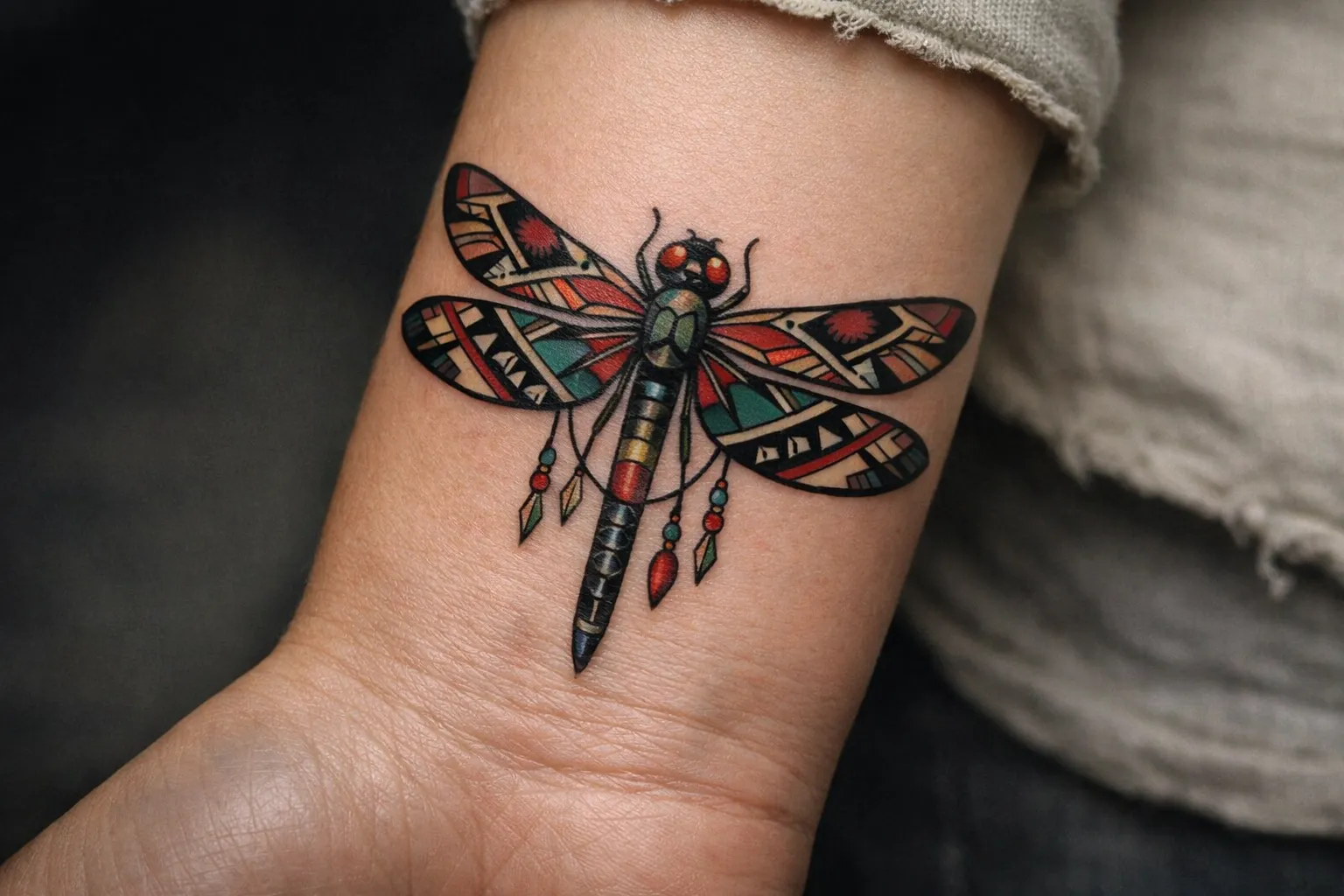
In Japan, the dragonfly is called kachimushi, the “victory insect.” Samurai wore the motif on armor and helmets because the dragonfly only flies forward - never retreats. The associated meanings are victory, power, speed, and agility. A Japanese-style dragonfly tattoo usually leans into bold black outlines, a traditional irezumi color palette (red, indigo, ochre), and supporting elements like cherry blossoms, waves, or chrysanthemums.
One pitfall I see regularly: pulling Japanese iconography into a watercolor piece. The two technical languages fight each other. Irezumi relies on hard black outlines and flat saturated fills; watercolor relies on bleeds and soft edges. You can’t really have both without the design looking confused.
Chinese: Luck and Prosperity
In Chinese symbolism, the dragonfly stands for harmony, good luck, and prosperity. It’s a gentler reading than the Japanese one - less warrior, more good-fortune charm. Pieces in this tradition often pair the dragonfly with lotus or water lily. This is similar to how the dragon tattoo symbolizes imperial power and good fortune in Chinese culture.
Native American: Purity, Speed, and Spirit Messenger
Across several Native American traditions, the dragonfly is associated with purity, happiness, swiftness, and acts as a messenger between the physical and spiritual worlds. In Navajo iconography specifically, the dragonfly is connected to pure water.
Worth being direct about this: if you’re not Indigenous, getting a dragonfly tattoo in a style that copies specific tribal iconography - Navajo geometric patterns, Zuni motifs - crosses into appropriation territory. The symbol itself is fine to wear. Copying the visual language of a closed tradition is not. If the spirit-messenger meaning is what draws you, ask your artist for a naturalistic or contemporary design that carries that idea without lifting closed-culture visual codes.
Celtic and New Age: Wisdom and Maturity
In Celtic-inflected interpretations, the dragonfly represents wisdom that comes from maturity and a connection to nature spirits. New Age readings often layer in spiritual awakening and emotional growth. These two traditions get blended constantly in modern Western tattoo culture, so if you’re after something specifically Celtic, you’ll want to brief your artist on that distinction.
How the Dragonfly Tattoo Meaning Plays Out in LGBT Contexts
There is no standardized “this is the LGBT meaning” for a dragonfly tattoo. Unlike the rainbow flag or specific reclaimed symbols, the dragonfly hasn’t been adopted as a universal community emblem.
What it does work well for - and why a lot of queer and trans people choose it - is that the metamorphosis story maps cleanly onto coming out, transition, and self-acceptance. The nymph-to-adult arc is one of the most literal “becoming who you are” symbols in nature.
If you want the LGBT reading to be visible, common design moves are:
- Rainbow-spectrum wings instead of single-color
- Trans flag palette (light blue, pink, white) layered into the wing fills
- Paired dragonflies to signal partnership or chosen family
- Bi/pan/ace flag accent stripes along the body or wing edge
If you want the meaning to stay personal and not read as a flag at a glance, keep the design naturalistic and let the symbolism live in your head, not in the colorway. Both are valid. It’s a question of how legible you want the meaning to be to strangers.
Masculine or Feminine? The Gender Question Around Dragonfly Tattoos
Neither, despite how they get marketed.
The symbol itself has no gender. What’s gendered is the design convention that’s grown around it: small fine-line dragonflies with floral elements get sold as “female dragonfly tattoo” inspiration, while larger pieces with geometric framing or heavy blackwork get sold as masculine. Those are styling choices, not meaning rules.
Practically speaking:
- A 1.5-inch fine-line dragonfly on the inner wrist reads delicate regardless of who wears it.
- A 6-inch Japanese-style dragonfly on the forearm with bold outlines reads bold regardless of who wears it.
Pick the scale and style that fits the message you want the piece to carry, not the gender label attached to the inspiration board.
Dragonfly Tattoo Designs: Style by Style
The dragonfly is one of the more style-flexible motifs out there because its silhouette is recognizable even when stripped down to a few lines. Here’s how the main styles actually behave on skin - and where they tend to fail.
Traditional Dragonfly Tattoo
A traditional dragonfly tattoo in the American traditional style means thick black outlines, a limited palette (red, yellow, green, navy), and flat saturated fills. No gradients, no soft shading. The wings get broken into stained-glass-style segments separated by hard lines.
Why it works: this style ages better than almost any other approach. Thick outlines hold up over decades even as the skin softens the linework. If you’re picking a dragonfly because the meaning matters long-term, traditional is the safest technical bet.
The common pitfall is artists who do “neo-traditional” but call it traditional - softer outlines, more colors, more rendering. That’s a different style with different aging behavior. It can blur faster, especially in the wing detail.
Size and placement that works: 3-5 inches on the forearm, outer bicep, or calf.
Watercolor Dragonfly Tattoo
A watercolor dragonfly tattoo uses ink the way watercolor uses paint - bleeds, splashes, soft edges, color running outside the body of the insect. It looks expressive on day one.
The honest caveat: watercolor pieces without any black outline fade faster and lose definition as they heal and age. Color sits shallower than black, the skin softens edges, and within 3-5 years a pure-watercolor piece often needs touch-ups.
The fix is straightforward - ask for a black outline under the color. You keep the watercolor expression and the dragonfly silhouette stays sharp as the color softens.
Size and placement that works: 4-7 inches on the shoulder blade, upper back, thigh, or outer forearm. Skip the wrist and ankle - too small, and the color fields blur together.
Small Dragonfly Tattoo
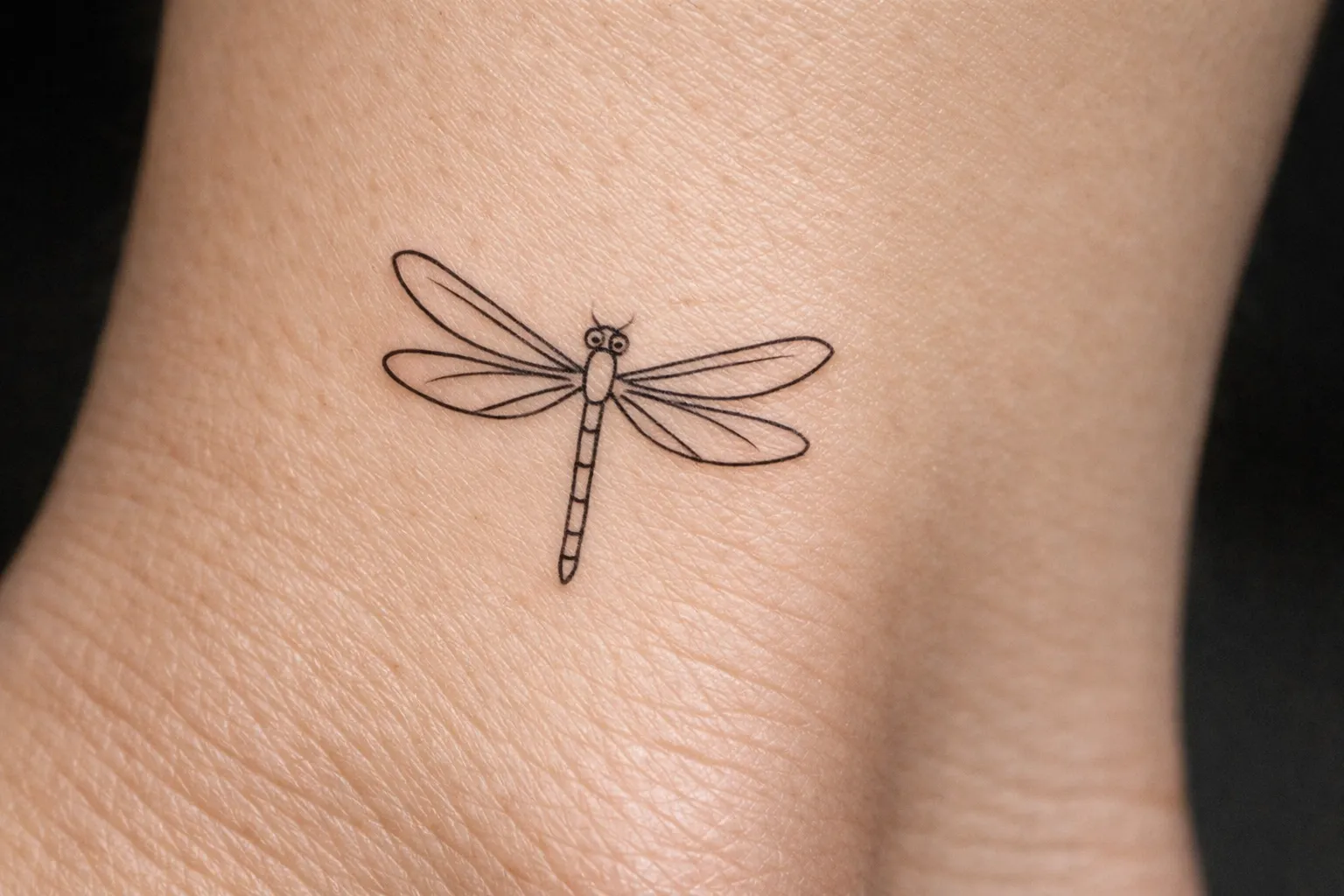
A small dragonfly tattoo is the most-booked version of this design. It’s affordable, takes 30-60 minutes, and works in placements that bigger pieces can’t reach.
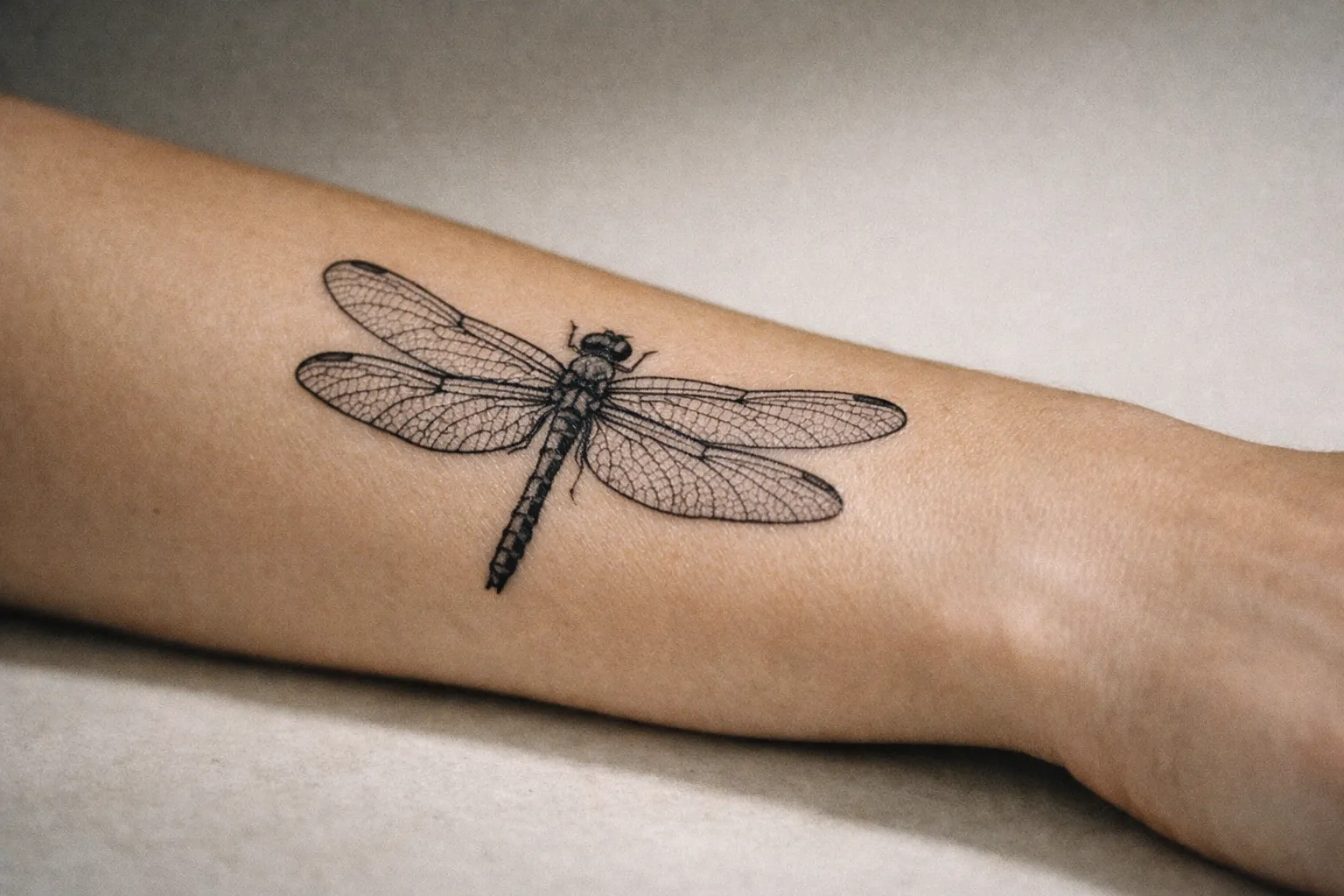
The technical trap is detail at small scale. Below 2 inches wide, ultra-fine wing veining will blur within a year because the lines sit too close together. The artist needs to simplify the wing pattern - fewer veins, slightly thicker linework, more negative space. I’ve seen plenty of tiny dragonflies come in for touch-ups at the six-month mark because the artist tried to cram a full wing map into an inch and a half of skin.
Size and placement that works:
- 1-1.5 inches: inner wrist, behind the ear, ankle, finger
- 1.5-2 inches: collarbone, sternum, back of neck, inner forearm
Stick to a clean outline or outline plus one accent color at this scale. Save the full color wash for bigger pieces.
Fine-Line and Minimalist Dragonfly
A close cousin of the small dragonfly - single-needle, hairline black work, sometimes just a silhouette. Looks elegant fresh, but fine-line pieces have the shortest lifespan of any style. Hairline work in friction zones (wrist, fingers, side of hand) can fade noticeably in 2-4 years.
If you go fine-line, pick a low-friction placement: inner bicep, ribcage, shoulder blade.
Geometric and Blackwork Dragonfly
Heavy black fills, geometric framing (triangles, dot mandala, sacred geometry), high contrast. Reads bold and ages well because there’s a lot of saturated black holding the design together. Works at 4-8 inches on the forearm, calf, or upper back.
Realistic Dragonfly
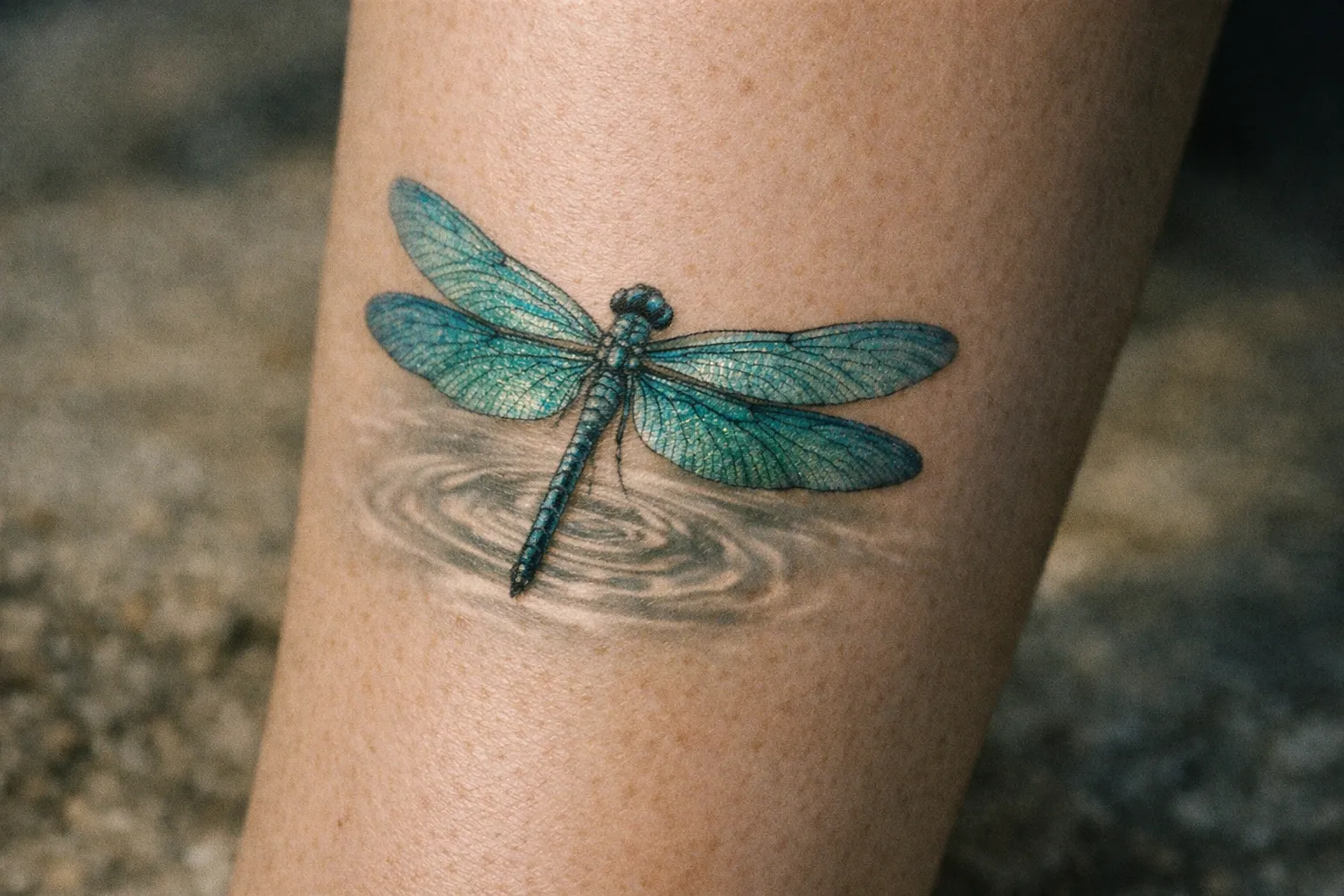
A photorealistic dragonfly with iridescent wing rendering and translucent shading. Stunning when fresh, but realism is the second-fastest style to lose definition after watercolor without outlines, because it depends on soft gradients that blur with age. Book a touch-up plan with your artist for year 3 and year 7 - not because something went wrong, but because that’s just how this style behaves on skin.
Placement: Where Each Size Actually Works
Placement isn’t just aesthetic - it changes how the tattoo ages and how much discomfort you sign up for. Pain runs roughly ribcage > sternum > ankle > inner bicep > forearm > outer shoulder, so factor that in alongside the design.
Small (1-2 inches) - inner wrist, behind the ear, back of neck, ankle, finger, collarbone. Good for personal meaning that stays mostly private.
Medium (3-5 inches) - forearm, outer bicep, calf, shoulder blade, sternum. The sweet spot for most dragonfly designs: enough room for wing detail without overwhelming the body part.
Large (6+ inches) - upper back, thigh, full sleeve panel, chest. Reserved for statement pieces with background elements (lotus, water, moon phases, reeds).
A note on the wrist for first-timers: it’s visible, which is great for a daily marker of personal transformation, but it’s also a high-friction area. Fine wing detail blurs there faster than on the inner forearm. Worth knowing before you commit.
What a Dragonfly Tattoo Actually Costs
Most people overspend because they ask for a 1-inch design with a 4-inch level of detail. Here’s the realistic range:
- Small simple dragonfly (under 2 inches, black outline): $80-$200, often hitting the shop minimum of $50-$150 rather than being priced by time.
- Small with one accent color: $120-$250.
- Medium traditional dragonfly (3-5 inches, full color): $250-$500.
- Medium watercolor dragonfly with outline: $300-$600 - color layering takes longer, expect a 20%-60% premium over a comparable black-and-grey piece.
- Large custom piece with background: $600-$1,500+ depending on artist reputation and studio location.
Most pieces are one session. Large back or thigh compositions may need two.
Budget benchmark for a polished small custom piece in a U.S. urban studio: $150-$300. If a quote comes in dramatically below that, check the artist’s healed portfolio - fresh photos can hide a lot.
Color Choices and What They Add to the Meaning
Color isn’t decorative. It modifies the symbolism, and it affects longevity.
- Black - strength, resilience, longevity. The most stable choice over decades.
- Blue - tranquility, calm, emotional clarity. The most-booked color for dragonflies because it matches the iridescent blue of real species.
- Green - growth, renewal, connection to nature. Good for tattoos marking recovery or new beginnings.
- Red - passion, vitality, courage. Pairs well with Japanese-style compositions.
- Purple - spirituality, intuition, transformation. Common in personal-meaning pieces.
- Rainbow or multi-color wings - identity, self-acceptance, often chosen for LGBT-affirming designs.
If you want the meaning to read clearly across decades, black outline plus one accent color holds up better than full-color rendering. That’s not an aesthetic opinion - it’s just how ink behaves in skin over time.
Common Mistakes to Avoid
A short list of decisions that cause regret or expensive touch-ups:
- Cramming detail into a sub-2-inch piece. Wing veining blurs. Simplify the design or go bigger.
- Pure watercolor with no outline. Looks great healing, soft within 3 years.
- Copying closed-culture iconography (specific Navajo, Zuni, or sacred Japanese ceremonial motifs) without context.
- Picking the design based on gender marketing instead of the meaning and scale you actually want.
- Assuming the meaning is universal. A dragonfly can mean victory (Japanese), luck (Chinese), purity (some Native traditions), or personal transformation (modern Western). Specify which you’re drawing from when you brief the artist.
- Skipping healed reference photos. Fresh tattoo photos are misleading - always ask to see the artist’s work at 6 months or older.
Aftercare: Day 1 to Year 1
Dragonfly tattoos live or die on wing detail, which makes aftercare more important than on a chunky blackwork piece. Treat the healing window as part of the design budget.
Day 1-3: Keep the bandage on as long as your artist instructed (usually 2-24 hours, longer for second-skin wraps). Wash gently with fragrance-free soap, pat dry, apply a thin layer of fragrance-free moisturizer or the ointment your artist recommended. No soaking, no swimming, no sun.
Week 1: The tattoo will scab lightly and start to peel. Do not pick. Continue washing 2-3 times a day and moisturizing. Wear loose clothing over the area.
Week 2-4: Itching peaks here. Keep moisturizing. The top layer is healing but the deeper layers are still settling - colors may look dull or cloudy. That’s normal and temporary.
Months 2-3: The tattoo settles into its final look. This is when you can assess whether any spots need a touch-up - most reputable artists offer one free touch-up within the first 3-6 months.
Long-term: Sun-protective clothing or SPF 30+ on the tattoo whenever it’s exposed. UV is the single biggest cause of fading, especially for colored work. Watercolor and fine-line pieces need stricter sun discipline than traditional or blackwork - that’s not optional if you want the wings to stay sharp.
Diet and lifestyle matter more than most people think. Staying hydrated and not smoking during the healing window genuinely affects how sharp the wings come out.
Frequently Asked Questions
- What does a dragonfly tattoo mean?
- It commonly symbolizes transformation, adaptability, freedom, and living in the present, but the exact meaning depends on cultural context and personal life events.
- What cultural meanings does the dragonfly have beyond tattoos?
- Meanings vary: Japanese associate it with victory and courage; Chinese with luck and prosperity; Native American with purity and spirit messaging; Celtic and New Age with wisdom and emotional growth.
- How should I approach cultural symbolism to avoid appropriation?
- Avoid copying closed tribal iconography without permission. Instead, opt for naturalistic or contemporary designs that convey the spirit meaning without replicating sacred visual codes.
- Why do fine-line and watercolor dragonfly tattoos fade faster?
- Because they rely on shallow ink saturation and soft edges, which blur and fade more quickly, especially in high-friction areas without bold outlines.
- What size and placement work best for a dragonfly tattoo?
- Small tattoos (1-2 inches) suit low-friction spots like inner wrist or behind the ear; medium (3-5 inches) fit forearm or calf; large (6+ inches) go on upper back or thigh for detailed work.
- How should I care for my dragonfly tattoo to preserve detail?
- Follow a strict aftercare routine with fragrance-free moisturizer, avoid sun exposure with SPF or protective clothing, and keep hydrated to maintain sharp wing details.
- Is there a gender to dragonfly tattoos?
- No inherent gender exists; perceived masculinity or femininity comes from style choices like size, line weight, and surrounding elements.