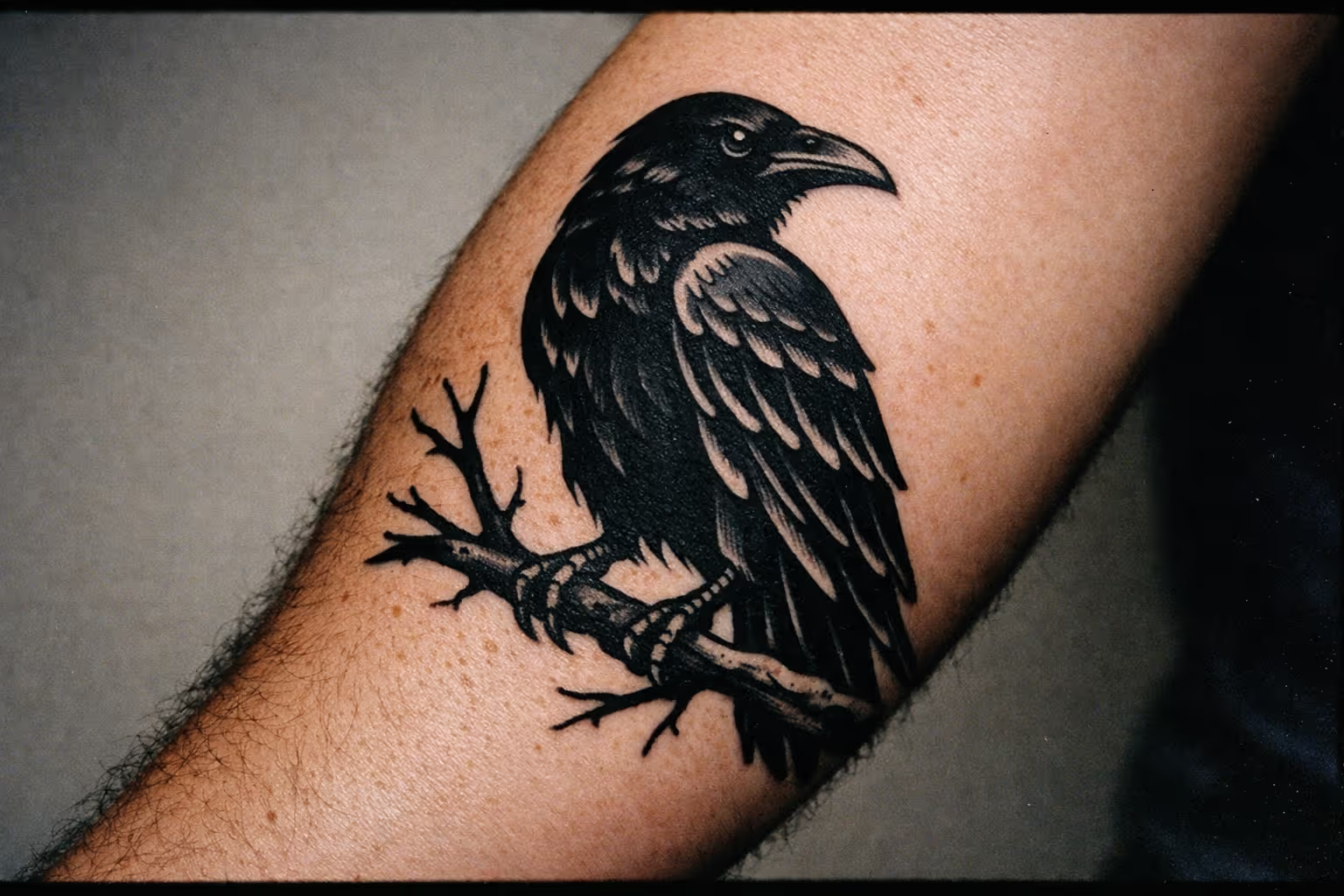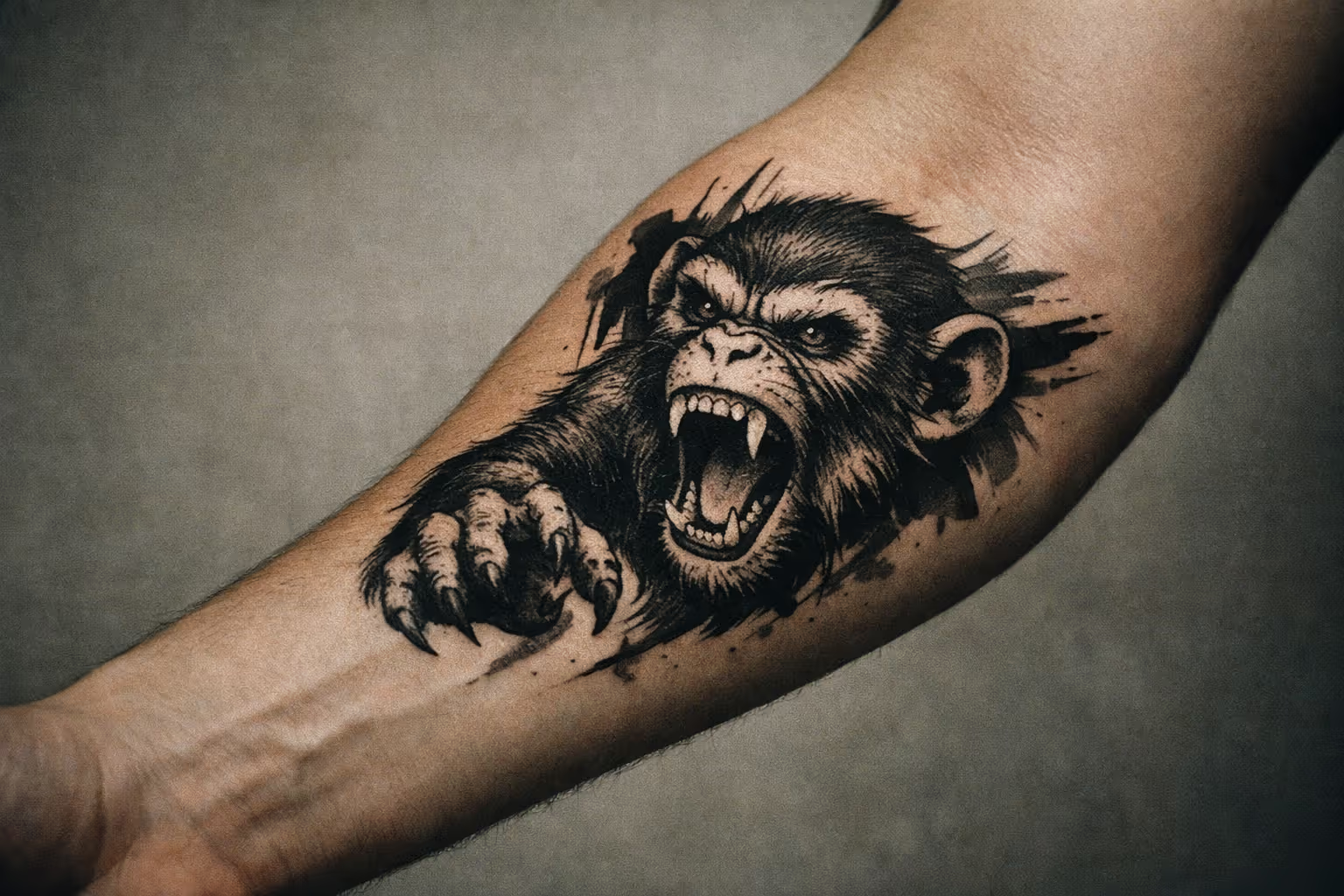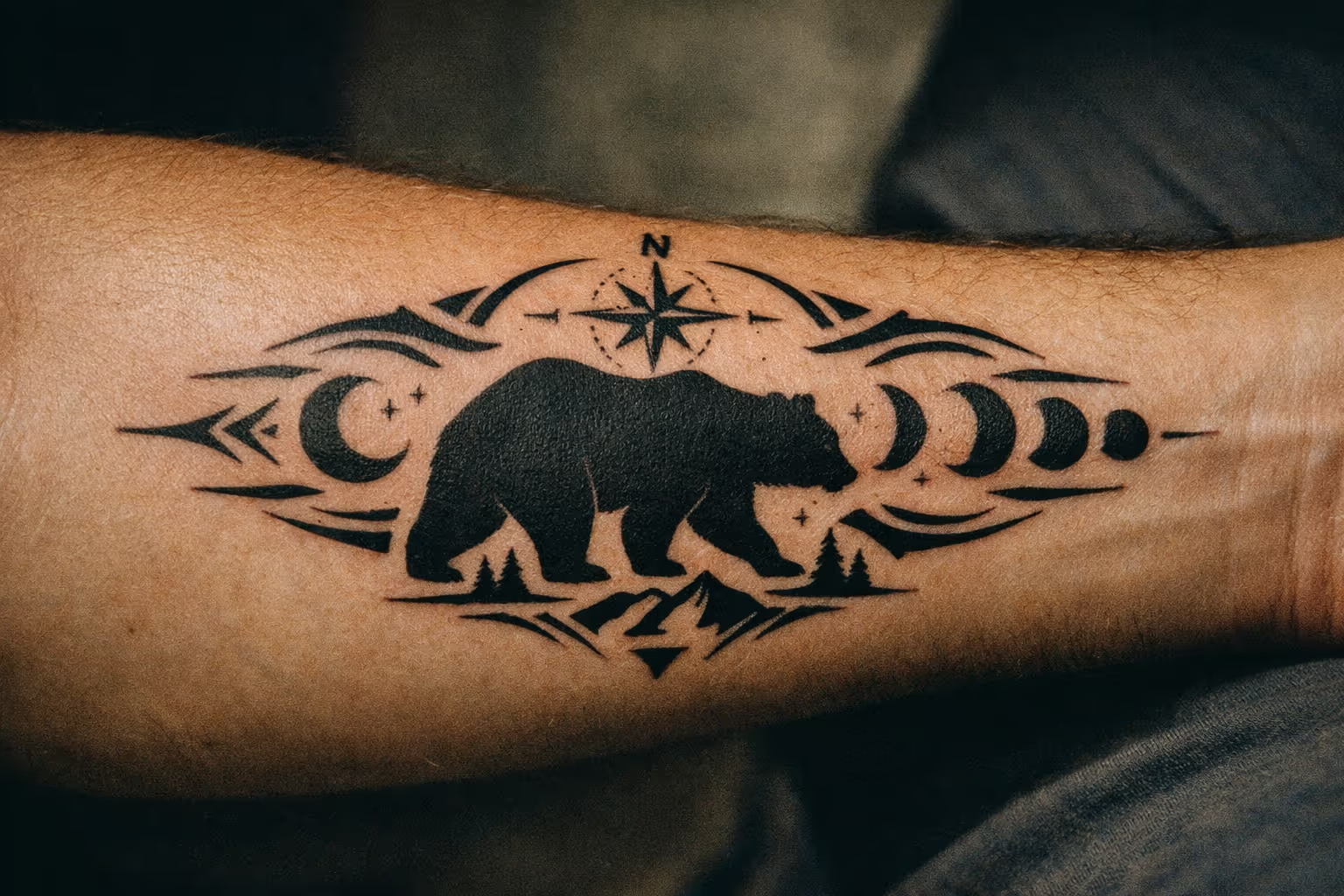
Most small bear tattoos are dead within five years, and there’s a rule of thumb behind why: the one-third rule. A bear’s power is in mass and texture - thick fur, heavy shading, deep contrast - and when the design shrinks past a point, that detail collapses into a dark shape you can’t read. Bears need room. Here’s what the one-third rule means for sizing, plus the styles and placements that let a bear tattoo hold up long-term.
Every Tattoo Has a Story - Bear Tattoo Symbols and Meanings
A bear tattoo carries more design complexity than most animal motifs - strength, family, survival, and a deep connection to the wild are woven into this image across nearly every culture that has lived alongside bears. Whether you’re drawn to a roaring grizzly bear tattoo across the chest, a small bear paw tattoo on the wrist, or a soft teddy bear tattoo tied to a specific memory, the design decisions matter more than the symbolism alone. Line weight, placement, size, and style determine whether the piece reads cleanly at arm’s length in five years - or turns into a fuzzy blob.
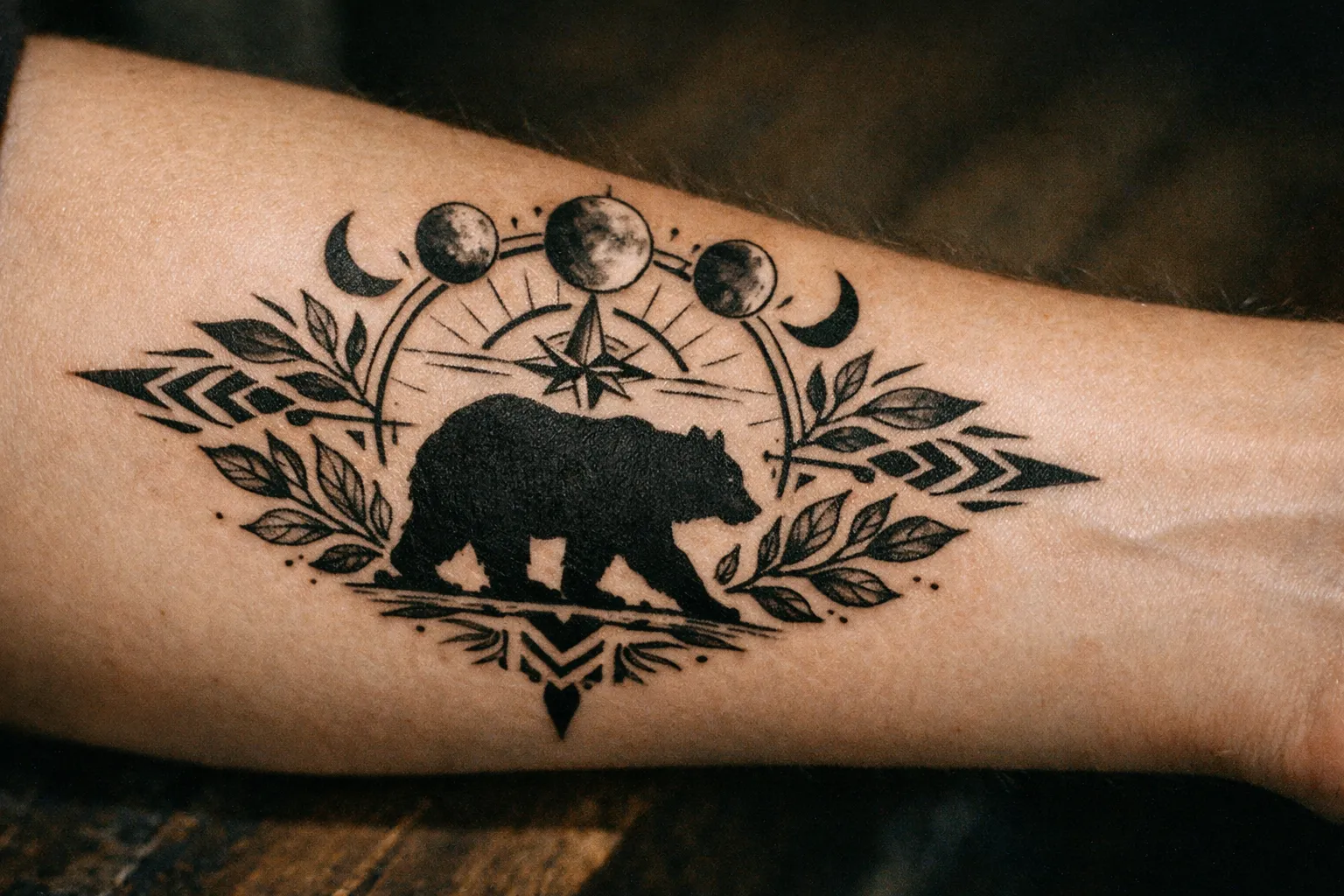
This guide covers what a bear tattoo actually means, the variations that work (panda bear tattoo, black bear tattoo, polar bear, mama bear), where they sit best on the body, what they cost, and the design mistakes that age badly.
The bear shows up as a symbol of strength, courage, protection, and resilience in nearly every cultural tradition that has documented it (1)(3)(4). That’s the baseline. But the symbolism splits depending on what kind of bear you choose and what story you’re telling.
- Strength and power - the most cited meaning, tied to the bear’s raw physicality.
- Protection and family - especially in mother-and-cubs imagery; the “mama bear” motif (1)(4)(5).
- Resilience, patience, rebirth - drawn from hibernation cycles; a bear emerging from a cave is a recurring metaphor for recovery, sobriety, or grief (1)(2)(4).
- Connection to nature - popular among hikers, hunters, conservationists, and people who spend real time outdoors.
- Healing - in Native American traditions, the bear is often described as a healer and protector (4).
The meaning shifts hard with the style. A snarling grizzly reads as power and survival. A teddy bear reads as comfort and childhood. A sleeping bear curled in a cave reads as recovery. Pick the posture and expression that matches what you’re actually going for, not just the species.
✓ Pros
- Rich symbolism across cultures including strength, protection, and healing
- Wide range of styles from realistic to minimalist and traditional
- Adaptable to many placements and sizes
- Strong longevity in bold styles like American traditional
✗ Cons
- Highly detailed realism requires larger sizes to age well
- Cultural appropriation risks with sacred or tribal motifs
- Small, intricate designs risk blurring over time
- Some placements (ribcage, sternum) are more painful
Bear as a Spirit Animal
In spirit-animal frameworks, the bear is described as a teacher of sovereignty, balance, intuition, and instinct - sitting in the same tier as lion or wolf totems (3). The recurring lesson: knowing when to stand your ground and when to retreat into the cave.
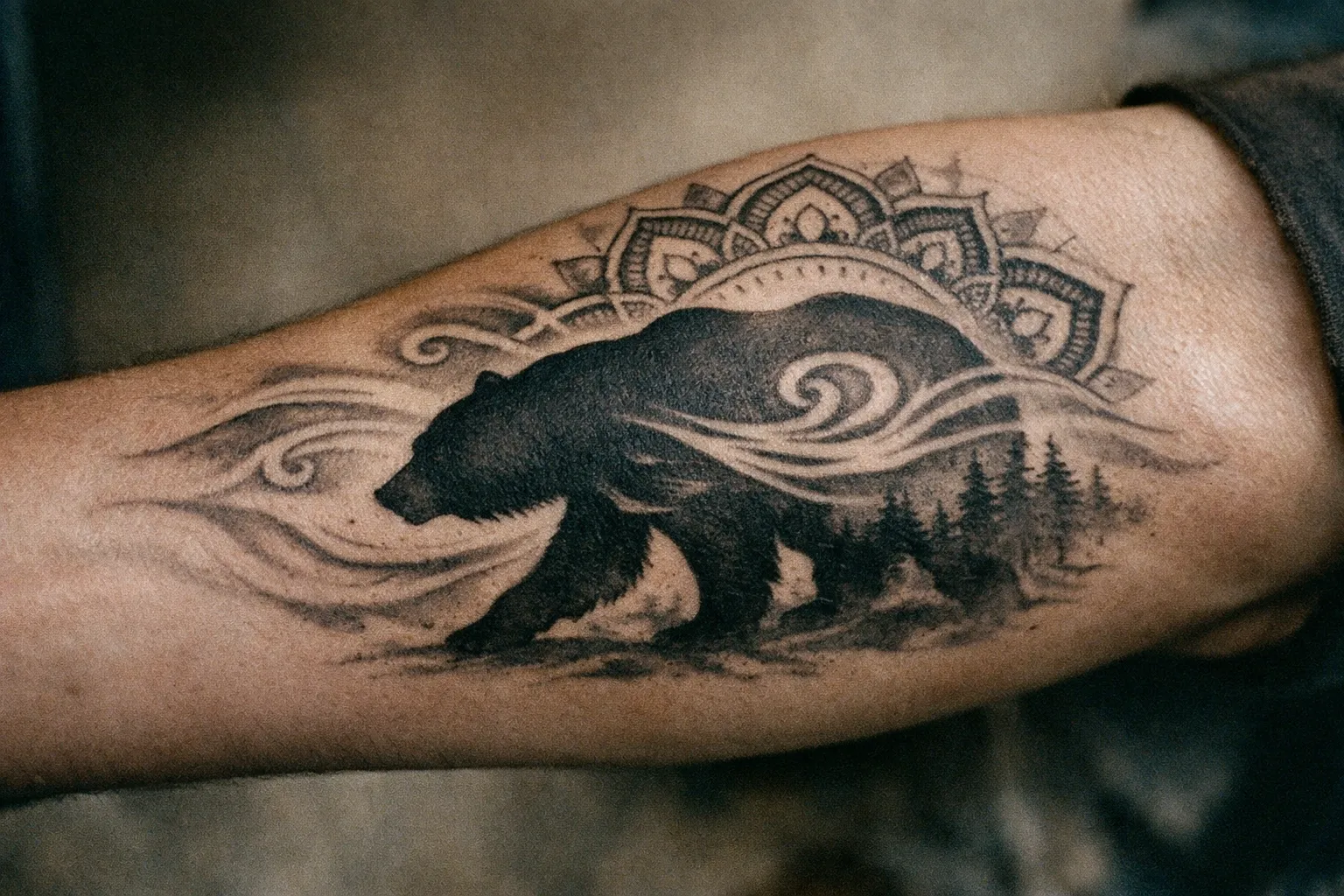
People who connect with the bear as a spirit animal tend to gravitate toward specific design choices. A single, grounded bear in profile or standing posture rather than an action scene. Subtle framing - a circle, a moon phase, a constellation - rather than tribal patterns borrowed from cultures the wearer doesn’t belong to. Eye contact in the design, which reads as presence rather than aggression.
If the spiritual angle is the core reason for the tattoo, tell your artist upfront. It changes the energy of the piece. A spirit-animal bear is usually calmer, more centered, and less theatrical than a “look how fierce this is” grizzly.
Bears in Mythology
Bears appear in mythology across Native American, Celtic, Norse, Slavic, Ainu, and Greek traditions (3)(4). A few highlights worth knowing before you commit a mythological motif to skin:
- Greek: Artemis and the myth of Callisto, transformed into a bear and placed in the sky as Ursa Major. A constellation reference - small dots forming the Big Dipper near a bear silhouette - nods to this without requiring literal Greek iconography.
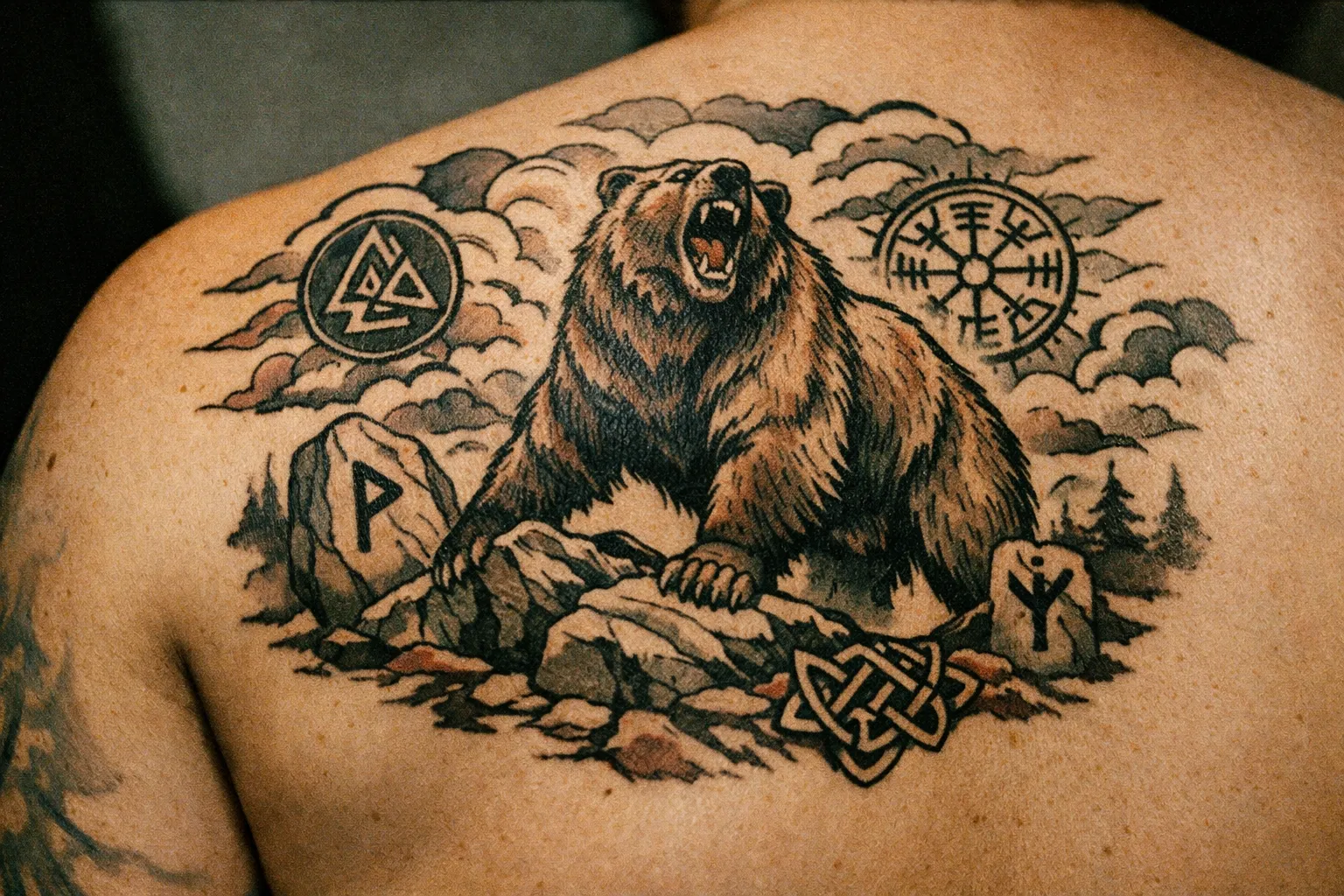
- Norse: berserkers, warriors said to fight in a bear-like trance. Often referenced with runes, though be careful: certain runes (Othala, Sowilo doubled) have been co-opted by extremist groups and read very differently now than their historical origins.
- Celtic: the bear was associated with warriors and kingship; the name Arthur is linked to the Proto-Celtic word for bear.
- Ainu (northern Japan): the bear was considered a sacred messenger.
- Sak Yant bear (Southeast Asia): symbolizes harnessed brute strength and territorial protection (2). These are sacred designs traditionally given by a monk or Ajarn, and copying one as flash without context is a real cultural sore point.
If mythology is the angle, work with it rather than copy-paste. Ask your artist to draw inspiration from the tradition - a Celtic knot framing the bear, a constellation backdrop, runic-style line accents - without lifting sacred iconography directly.
Traditional Style
American traditional bear tattoos lean on two technical hallmarks: thick black outlines and a limited color palette (red, yellow, green, black, sometimes a muted blue). The bear is usually rendered head-on or in three-quarter view, often roaring, often with a banner, mountain, or knife element.
This style ages exceptionally well. The bold linework holds up for decades because there’s nowhere for the design to soften into mush. The common pitfall I see: artists who try to execute American traditional with thin lines or modern shading miss the point entirely. The style is built for longevity through saturation and weight - thin lines undercut both.
Size range that works: 4-8 inches on the upper arm, chest panel, or thigh. Smaller than that and the palette compresses badly.
Black Bear: Introspection in Black and Gray
A black bear tattoo usually leans into black-and-gray realism - the species lends itself to high-contrast shading, and the simpler coat compared to grizzly fur makes for cleaner work. Common framings:
- Black bear in profile against pines or mountains (forearm or calf, 5-7 inches)
- Black bear silhouette filled with a forest scene - the double-exposure approach (upper arm or back)
- Cub on the shoulder, parent on the bicep - a quieter “mama bear” alternative without any text
Black bears read as introspection and wilderness more than aggression. They’re less theatrical than grizzlies, which makes them a better fit for people who want the meaning without the snarl.
The Grizzly: Fur Texture, Facial Expression, Raw Power
The grizzly is the loudest bear in the lineup: raw power, wilderness, survival. A grizzly bear tattoo works best when the artist nails two specific things - fur texture and facial expression. A bad grizzly looks like a brown blob. A good one shows individual fur direction, real weight in the shoulders, and an expression that reads from across a room.
Best placements for grizzlies:
- Chest panel (8-12 inches): a grizzly over the heart reads as protection of the people behind it
- Outer thigh or calf (6-10 inches): plenty of canvas for fur detail
- Back (10-14 inches): pairs naturally with a landscape
Avoid shrinking a realistic grizzly below 4 inches. The detail that makes the design work - eyes, nose, fur direction - collapses at that scale, and you’ll get blowout on the fine lines within a few years.
The Polar Bear: Solitude and Resilience
Polar bear tattoos pull double duty: a symbol of solitude and resilience in extreme conditions, and increasingly a quiet nod to conservation and climate awareness. The design challenge is the coat. White fur on skin doesn’t pop the way black or brown does. Artists handle this with heavy negative space (the bear is mostly implied by the shading around it), cool gray washes with pale blues for fur shadows, and backgrounds like aurora, ice, or water that contrast the body.
Placement: upper arm, calf, or back at 5-8 inches gives the artist enough room for the shading work to breathe. Smaller than that and the bear loses definition fast.
The Panda: Peace, Balance, and a Design Pitfall
A panda bear tattoo reads as peace, balance, and gentleness - sometimes paired with yin-yang or bamboo for a more deliberate East Asian aesthetic. Pandas sit slightly apart from true bears in the symbolism toolkit, and the meaning is softer across the board.
Two style approaches work well. A watercolor panda uses soft washes of black ink around a clean outline - good for the upper arm or shoulder blade at 4-6 inches. A minimalist linework panda uses a single continuous line or simple geometric framing - good for the forearm, wrist, or behind-the-ear at 2-4 inches.
The pitfall I see most with panda designs: too much fine facial detail at small sizes. The black eye patches and nose are the whole identity of the design. Keep them solid and readable, or the whole thing falls apart.
Nostalgia in Stitches: The Teddy Bear Design
A teddy bear tattoo trades raw symbolism for personal meaning. It’s nostalgia, comfort, childhood, a lost loved one, a name added in stitch-style script. Common variations include a stitched or patchwork teddy with visible seams (often memorializing someone, with a date or initial worked into the stitching), a classic plush teddy in American traditional style with bold outline and soft brown fill, or paired teddies for couples or siblings.
Placement: inner forearm, bicep, ribcage, or upper thigh at 3-5 inches. The teddy needs enough space to read as soft, not as a cartoon outline.
Honest caveat: very tiny teddies under 2 inches with detailed faces tend to blur within a few years. The whole charm of a teddy is the expression - give it room to exist.
When Soft Bears Make Sense: Panda, Teddy, and Care Bear Designs
Not every bear tattoo needs to roar. Care Bear tattoos, teddies, and pandas all live in the softer half of the bear spectrum. They work because they’re honest about what they mean - comfort, nostalgia, a person you loved, a quality you want to carry with you.
Care Bears in particular have come back into fashion with the resurgence of 80s and 90s imagery. The belly symbols (rainbow, heart, sunshine) let you encode a specific quality without writing it out. Best as 3-4 inch pieces on the forearm, calf, or upper arm in flat color with bold outlines. The traditional style holds these designs together better than fine line work.
Bear Paw Tattoo
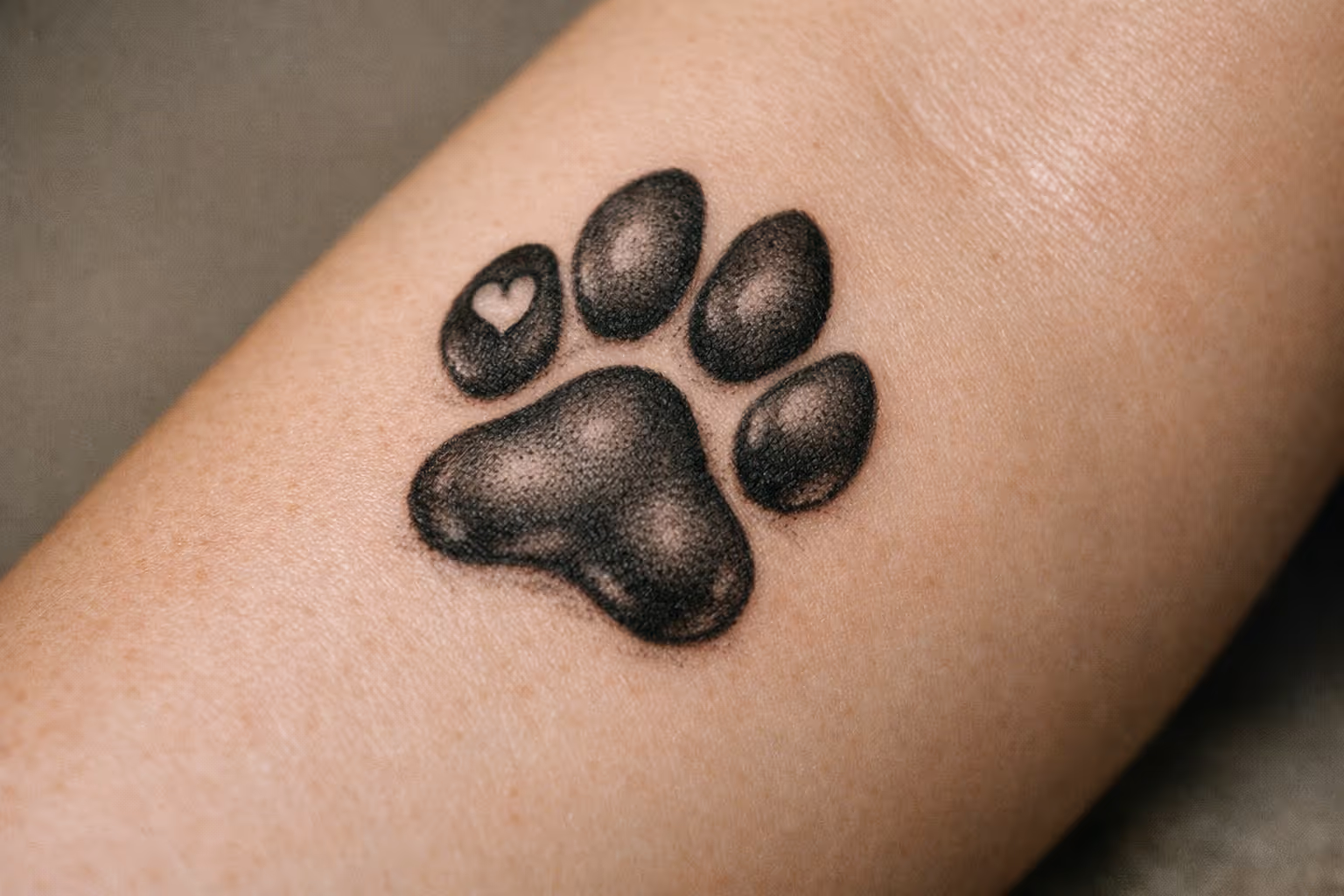
A bear paw tattoo is the most adaptable bear motif. It works at 1.5 inches behind the ear and at 6 inches across the chest. Common readings include a single paw print as a personal totem, multiple small paws for children (one per child, easy to expand later), paw plus claw marks for a more aggressive read, or a paw filled with a landscape, constellation, or coordinates.
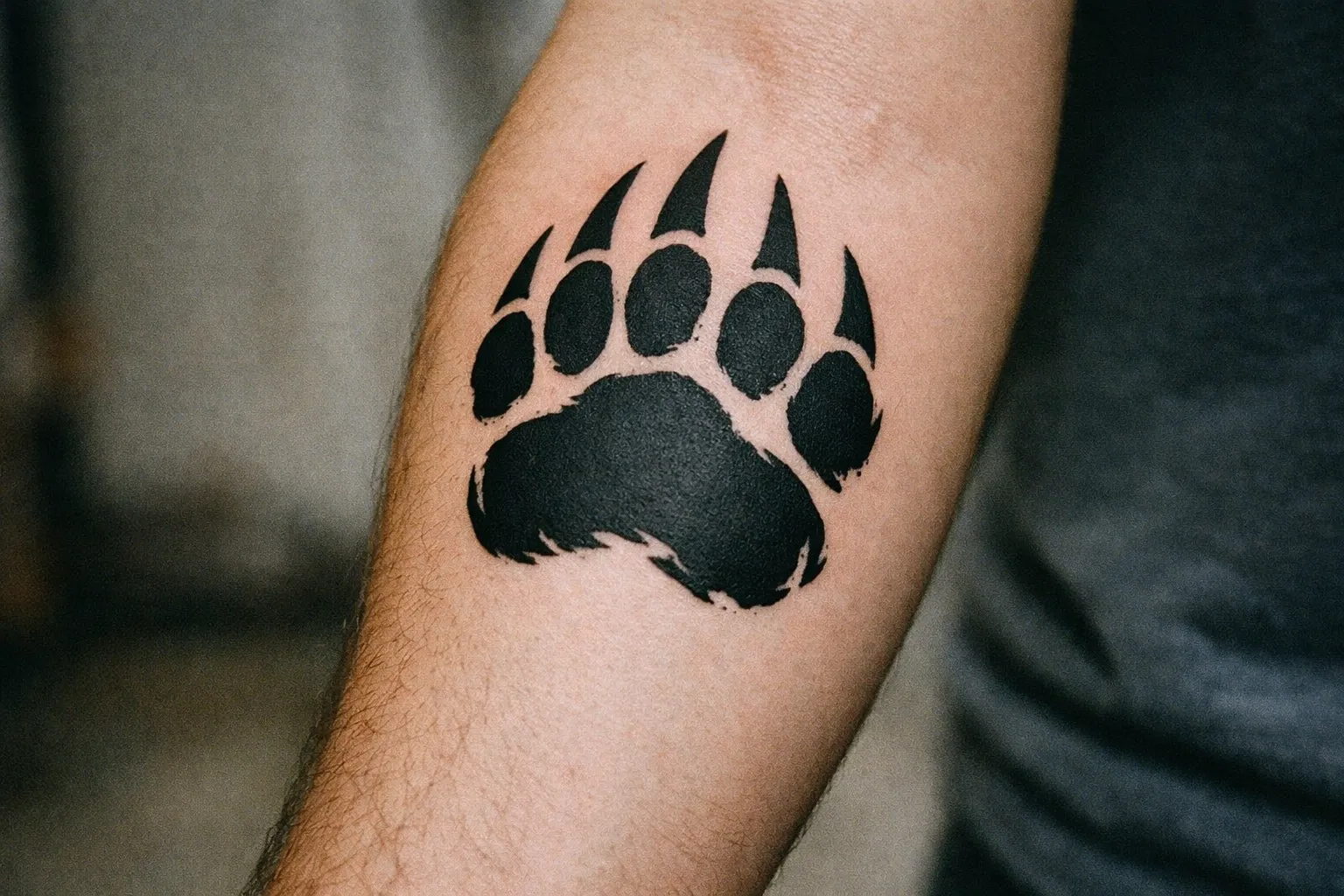
The paw pad and claw shape carry most of the design’s weight. Avoid overly stylized paws that look more like a cartoon hand than an actual bear print. Reference real tracks if realism matters to you - the difference is immediately obvious to anyone who’s spent time outdoors.
Designing for Protection: The Mother Bear Motif
The mama bear motif has become its own category: a mother bear with cubs, paw prints with children’s names or dates, or simply the words “mama bear” in script. The symbolism is direct - fierce protection, advocacy, the willingness to do whatever it takes for your kids.
A few practical design tips worth taking seriously:
- Plan for more kids if there’s any chance. Use a layout (a line of paws, a row of small cubs) where additions don’t disrupt the composition. Trying to fit a fourth cub into a tight illustration years later is a real problem I’ve seen clients navigate badly.
- Skip the script-only version if you want something that reads as a tattoo rather than a slogan. Illustration ages better than trendy fonts.
- Placement: forearm (4-6 inches), ribcage (5-7 inches), upper back between the shoulders, or inner bicep.
Geometric and Linework Designs
Geometric bears combine an animal silhouette with triangles, polygons, or sacred-geometry framing. The style photographs well, which is part of why it took off on Instagram. Two things to watch: line consistency (geometric work lives and dies on clean, even lines - an artist who’s strong on realism may not be strong on geometric, so check the portfolio specifically) and body mapping (straight lines wrapped around a curved bicep distort, so geometric pieces work best on flatter areas like the outer forearm, shoulder blade, calf, or sternum).
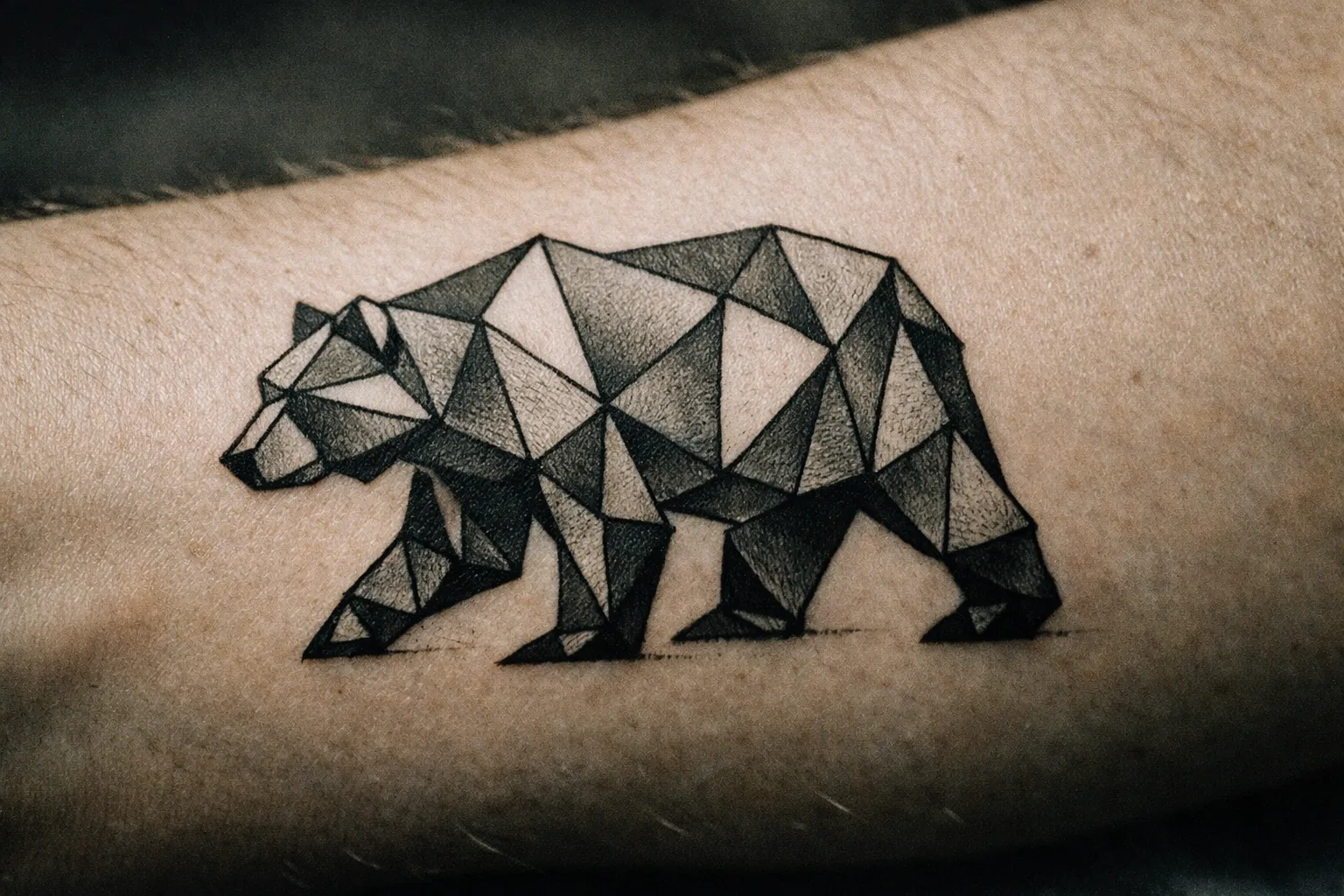
Size range: 4-7 inches. Smaller and the line weights compress into each other. Larger and the geometric framing can overpower the bear entirely.
The California Bear
The California bear - drawn from the state flag’s grizzly silhouette - is a regional pride piece. Most versions stick close to the flag silhouette (profile bear walking on grass), sometimes incorporating mountains, a poppy, or coordinates.
Best as a 4-6 inch piece in black-and-gray or with a single accent color (the red star from the flag, or a poppy orange). Forearm, calf, or upper arm work well. Keep the silhouette recognizable. The strength of this design is that other Californians read it instantly - over-elaborate it and you lose that.
Best Placements for Bear Tattoos
A quick map from design intent to placement:
- Chest (over heart) - large grizzly or black bear; courage and protection of loved ones; 8-12 inches
- Upper arm / shoulder - medium bear head or forest scene; easy to cover for work; 5-8 inches
- Forearm - vertical bear with trees, mountains, or moon; high visibility; 4-7 inches
- Back - mythological scenes, multi-bear family, or full landscape; 10-14+ inches
- Ribs / side - discreet mama bear script or minimalist bear; more painful (ribcage > forearm in relative pain); 4-6 inches
- Calf - bear with landscape or geometric framing; good aging because the calf doesn’t stretch much; 5-8 inches
- Wrist / ankle / behind ear - tiny bear paw, teddy, or single-line bear; 1.5-3 inches
Pain scale, relative: ribcage and sternum are the toughest of these placements. Forearm, calf, and upper arm are the most tolerable. Behind-the-ear is brief but sharp.
What Is the 1/3 Rule in Tattooing?
A useful sizing heuristic: the smallest meaningful detail in your tattoo should be at least 1/3 the width of the main subject for it to stay readable as the tattoo ages. For a bear face, that means eyes and nose shouldn’t be tiny relative to the head - otherwise they blur into a single dark patch within five to ten years.
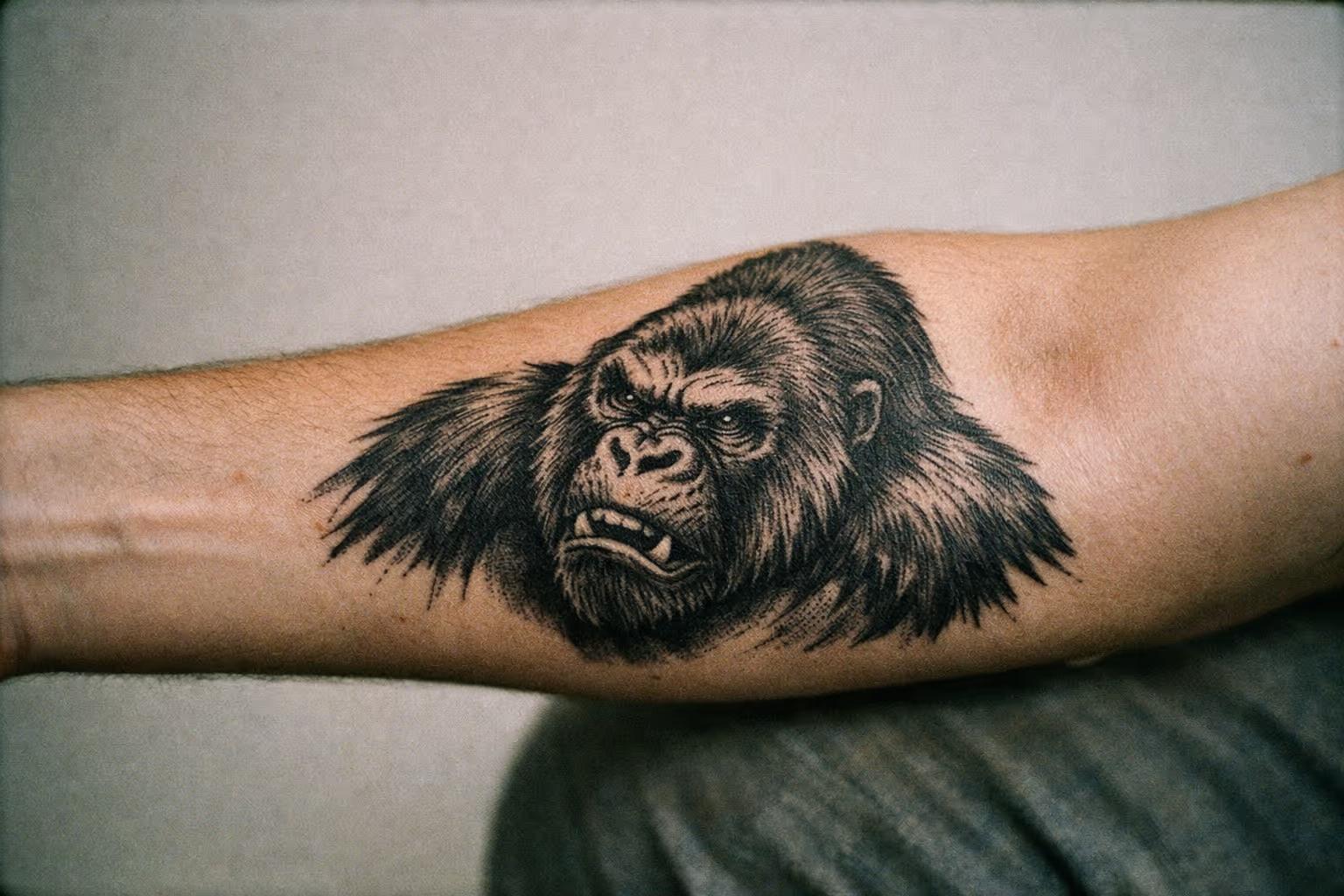
This is why a realistic grizzly under 3-4 inches almost always disappoints over time. The fur, eyes, and snout all need real estate. If you want something small, simplify the design: paw, silhouette, or a minimalist linework bear, not a detailed realistic head. Much like a gorilla tattoo, the power of a bear design depends on giving the artist enough canvas to render the animal’s defining features with clarity.
I’ve watched clients come back five years after a tiny detailed bear and not recognize what it was supposed to be. The 1/3 rule isn’t abstract - it’s what separates a design that holds from one that needs a cover-up.
Tattoos to Avoid in Bear Designs
Bears themselves are nearly always positive in symbolism, but a few traps are worth naming clearly:
- Copying sacred designs - Sak Yant bears traditionally come from a monk or Ajarn (2), and Native American-style tribal patterns belong to specific tribal traditions. Copying these as flash without context reads as appropriation and is actively discouraged by the communities they come from.
- Trademarked logos and sports mascots - fine for personal wear, but they can become a problem if your image is ever used commercially.
- Bears combined with extremist or politically loaded symbols - runes, certain flags, and specific number combinations have been co-opted in ways that override your intended meaning entirely.
- Hyper-detailed realism at small sizes - see the 1/3 rule above. A tiny detailed bear is not a feature; it’s a future cover-up.
- Direct Pinterest copies - bring references to show the direction you want, then ask your artist to design something original. Artists see the same five copied pins every week.
Cost and Time Investment
Realistic ranges from mid-tier US/UK shops:
- Small bear paw or teddy outline (1.5-3 inches): $80-$300 (often shop minimum)
- Small-to-medium simple bear (3-5 inches): $200-$500
- Medium realistic bear head, black and gray (4-6 inches): $300-$700, roughly 4-6 hours at $80-$150/hour
- Large realism chest or back piece (8-12 inches): $800-$2,000+, usually 2-3 sessions of 4-6 hours
- Sak Yant bear through a traditional Ajarn: $50-$300+ depending on the master (2)
Booking lead time for established realism animal artists in major cities runs 1-6 months, so plan early for any substantial bear piece. Custom design iteration with a good artist typically takes 1-3 weeks between consultation and the appointment.
Aftercare Timeline
Bear tattoos - especially realism with fur detail - live or die on healing. The black-and-gray shading that makes a grizzly’s coat look real is also the most vulnerable to fading and scab damage. A practical timeline:
- Day 1-3: keep the bandage on as your artist instructs (often 24 hours, or 3-5 days if Saniderm). Wash gently with fragrance-free soap, pat dry, apply a thin layer of aftercare ointment 2-3 times a day. No soaking, no gym.
- Week 1: peak peeling and itching. Do not pick or scratch. Switch to a fragrance-free moisturizer as the skin transitions from raw to flaky. Loose clothing over the area.
- Week 2-4: surface healing wraps up. The tattoo may look slightly hazy - what artists call “the milky stage” - as the new skin layers settle. No swimming, no saunas, no direct sun.
- Week 4-8: full internal healing. Now is when you can resume sun exposure, with SPF 30+ or sun-protective clothing over the tattoo. UV is the single biggest factor in long-term fading, especially for color work like a panda’s nose or a Care Bear’s belly symbol.
Standard pre-appointment rules: no alcohol or blood thinners for 24 hours before, eat a real meal beforehand, and reschedule if you have an active skin condition (eczema, sunburn) on the area.
Frequently Asked Questions
- What does a bear tattoo mean?
- A bear tattoo most commonly symbolizes strength, courage, protection, family, and resilience. The exact meaning shifts with the bear type and posture: a grizzly leans toward raw power, a polar bear toward solitude and survival, a teddy toward comfort and memory, a panda toward peace and balance.
- What tattoos should you avoid with bear designs?
- Avoid copying sacred designs like Sak Yant or tribal-specific motifs without context, trademarked logos if you plan commercial use, runic or symbolic combinations co-opted by extremist groups, and overly detailed realism shrunk below 3-4 inches. Also, skip direct Pinterest copies and work with your artist on a custom design.
- Does a bear tattoo have a spirit animal meaning?
- Yes. In spirit-animal frameworks, the bear represents sovereignty, balance, intuition, and knowing when to stand your ground versus retreat. Spirit-animal bear designs tend to be calmer and more centered rather than aggressive.
- How long does a bear tattoo take to heal?
- Surface healing takes 2-3 weeks, with peeling and itching peaking around days 5-10. Full internal healing takes 6-8 weeks. Detailed realism and color work require full sun protection for 4-6 weeks to set properly.
- What is the 1/3 rule in tattooing?
- The 1/3 rule means the smallest important detail should be at least one-third the width of the main subject to remain readable as the tattoo ages. For bears, eyes, nose, and claws need enough size to avoid blurring. This rule helps prevent future cover-ups.
- How should I plan a mama bear tattoo if I expect more children?
- Design layouts that allow easy additions, like a line of paw prints or cubs, so adding more later doesn't disrupt the composition. Avoid tight illustrations that can't expand gracefully.
- Why do some bear tattoos age poorly on the wrist?
- Small bear tattoos on the wrist often suffer from blurring because of thin skin and frequent movement. Designs with fine detail or thin lines lose clarity faster there compared to thicker, bolder styles on less mobile areas.