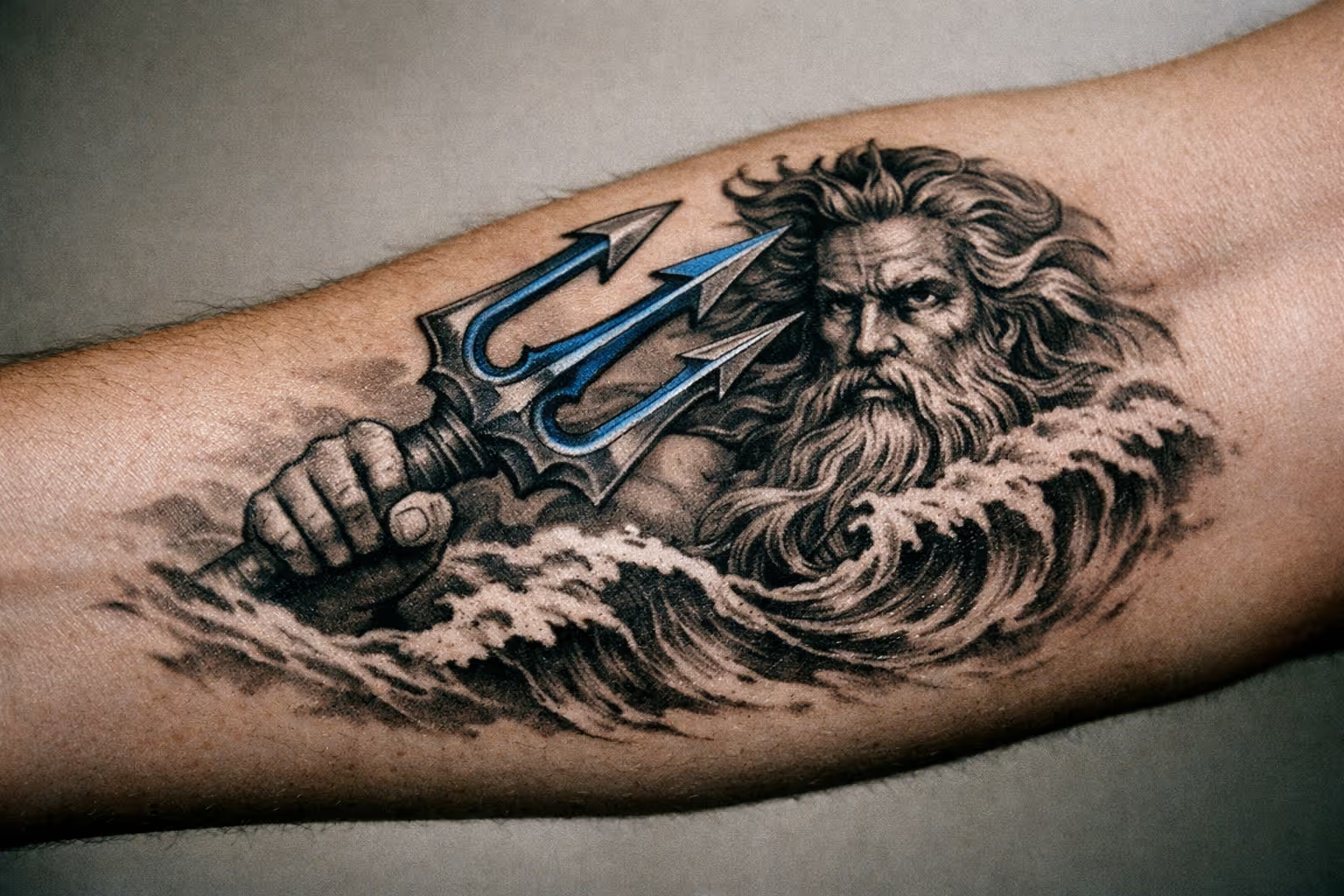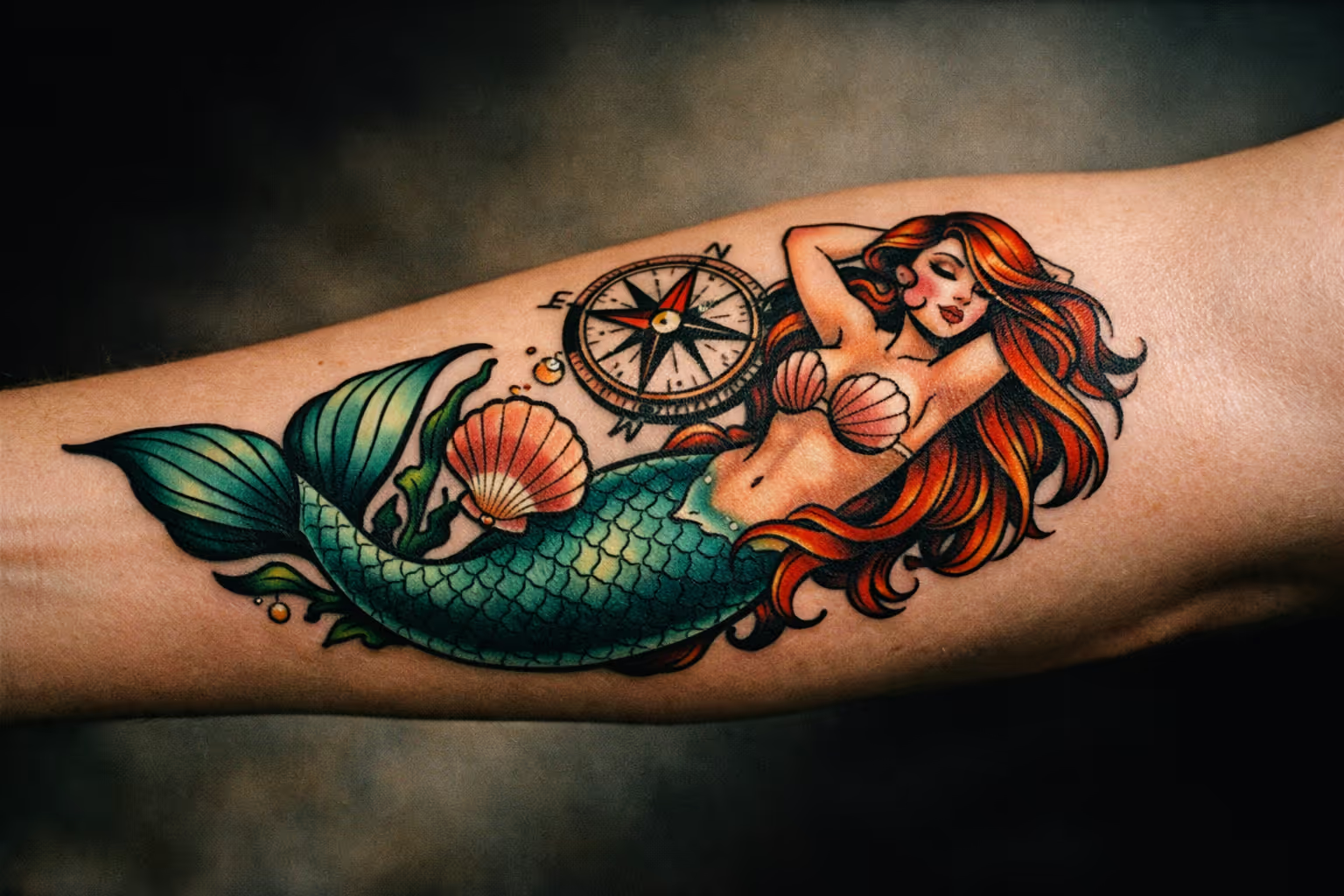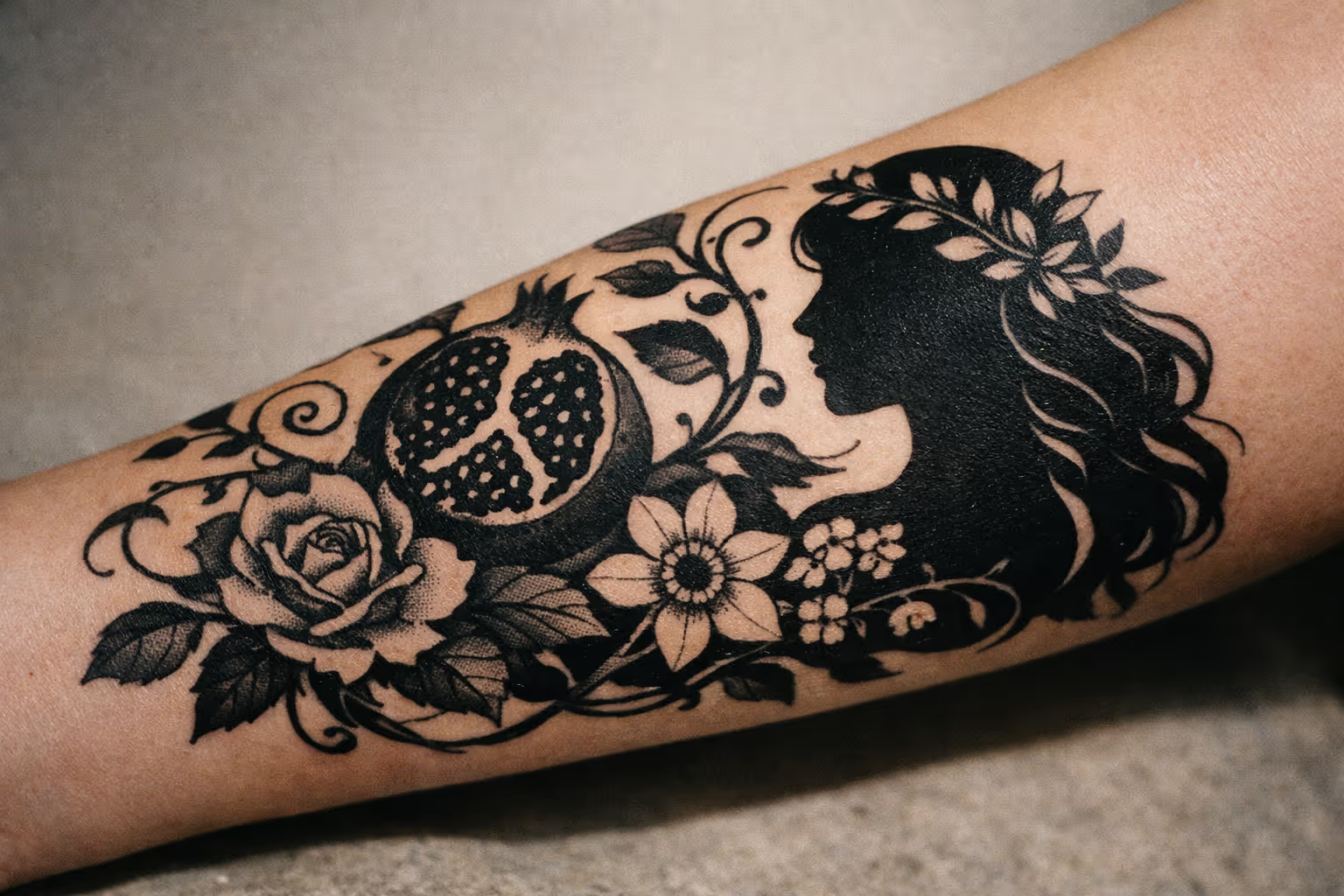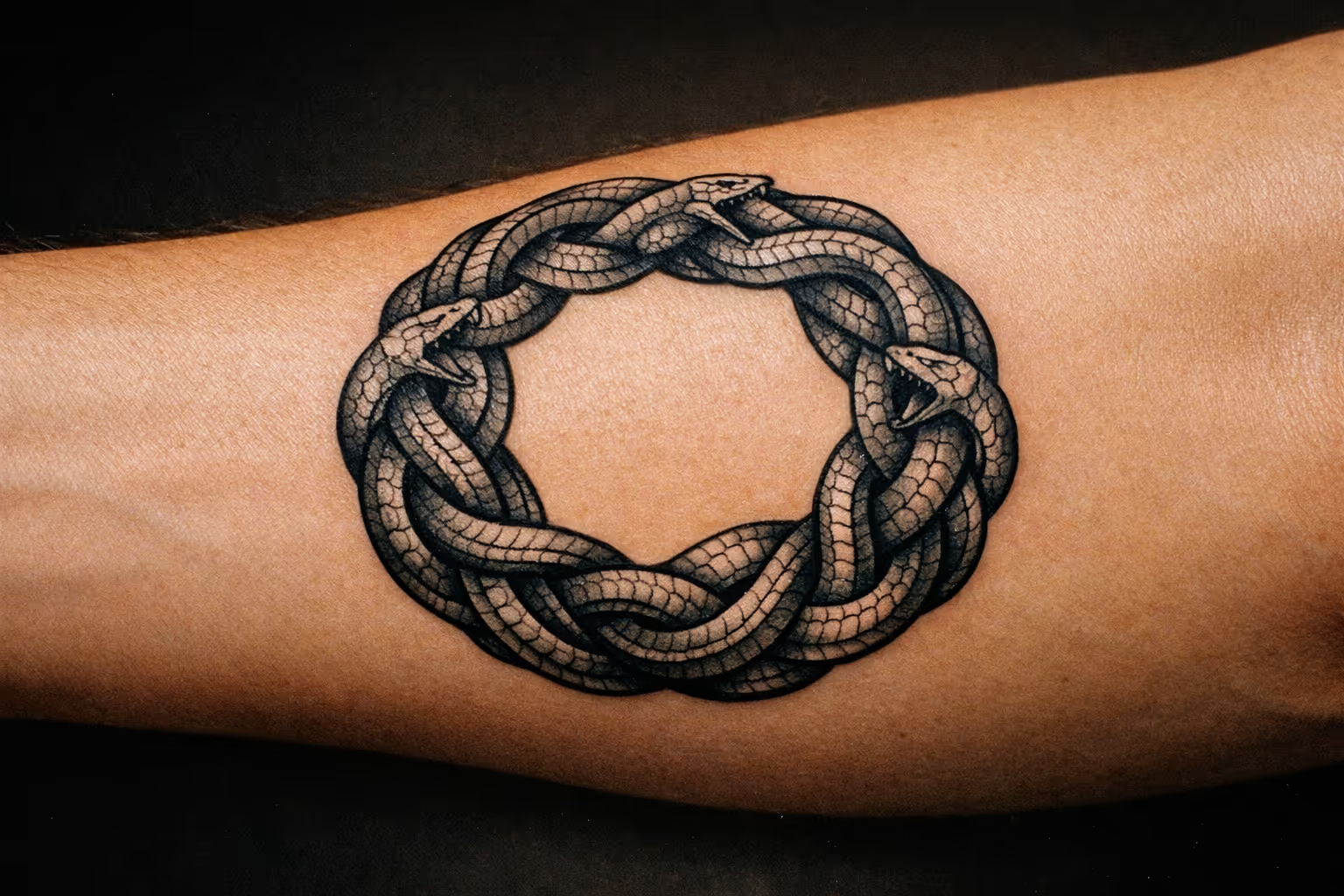
The Medusa tattoo meaning has flipped in the last decade. Where the myth cast her as a monster to be slain, a whole generation now wears Medusa as a survivor - a reclaiming of the gaze by people who’ve lived through assault and refused to be defined by it. That shift is why the design carries the weight it does, and why the version you choose matters. Here’s what each style, placement, and size actually signals.
Core Elements of Medusa Tattoo Meaning and What They Symbolize
The Medusa tattoo meaning often draws from the Ovidian version of the myth rather than the older Hesiod account where Medusa is simply born a Gorgon. In Ovid’s telling, Medusa was a mortal woman - often described as a priestess of Athena - assaulted by Poseidon inside Athena’s temple. Athena then transformed her hair into snakes and gave her the petrifying gaze (4). Perseus later beheaded her in her sleep.
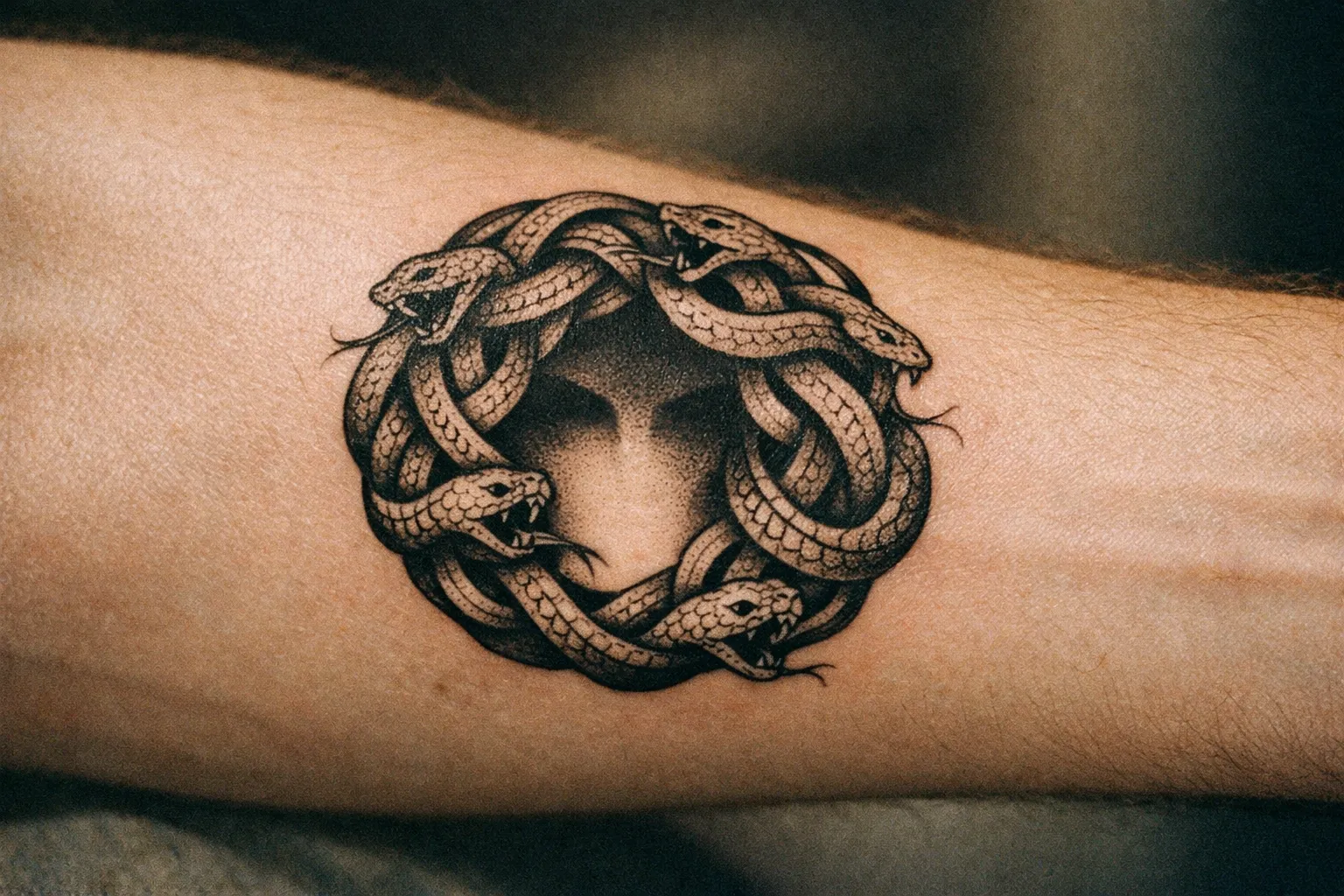
Each piece of that story carries weight in a tattoo:
- The snakes - transformation, danger turned outward, resilience. Some wearers count snakes intentionally to represent specific hardships survived (1).
- The petrifying gaze - boundaries. Anyone who looks at her with intent to harm turns to stone. This is the apotropaic (evil-warding) function the Greeks themselves used when they carved Medusa’s face - the Gorgoneion - onto shields and temple pediments (3).
- Beauty before the curse - a reminder that beauty was the thing punished, not the assault. This is where the victim-blaming reading comes from.
- The beheading - silencing. Perseus removed her head while she slept; she never got to defend herself.
When a Caravaggio-style severed head shows up in a tattoo, that’s usually about the silencing piece. When the bust is upright and meeting your eyes, it’s about reclaiming the gaze.
Common Meanings of Medusa Tattoos
Most pieces land on one or more of these.
Survival after trauma. The dominant modern reading. Medusa survived divine violence, an unjust curse, and the rest of mythology calling her a monster. Wearers - particularly survivors of sexual assault and domestic abuse - use her as what Golden Child Tattoo calls “spiritual armor”.
Female empowerment and refusing shame. Medusa was blamed for being beautiful and for being assaulted. The tattoo flips that. It’s a refusal to apologize, to shrink, or to perform “healed” for anyone else’s comfort (1).
Protection. Her gaze is a warning. Worn somewhere visible - forearm, hand, sternum - it functions as a “don’t” sign aimed outward.
Rage and justice. Righteous anger, specifically. Not generalized fury but the kind directed at people who harm and walk away (1)(2).
Transformation and rebirth. Human to Gorgon to symbol. For some wearers the curse is the point - what was meant to destroy her made her untouchable (2)(3).
Mythology and art-history appreciation. A smaller but real subset. People who love Greek myth, Caravaggio, or the Versace head and want the imagery without the survivor framing. This is valid, but be ready for assumptions - the survivor association is strong enough now that strangers will read it that way by default.
✓ Pros
- Strong symbol of survival and female empowerment
- Multiple design styles suit different aesthetics and pain tolerances
- Forearm placement balances visibility and healing well
- Meaning is personal and adaptable to wearer's story
✗ Cons
- Fine line and hand placements fade quickly and need touch-ups
- Survivor association can lead to assumptions about wearer's history
- Realistic portraits require skilled artists to avoid distortion
- Hand tattoos have higher pain and maintenance
What Does a Medusa Tattoo Mean for a Woman
The Medusa tattoo meaning for female wearers tends to cluster around four ideas: surviving sexual violence, rejecting victim-blaming, claiming female rage as legitimate, and protecting bodily autonomy. Dictionary.com explicitly notes the tattoo’s pop-culture association with survivors of sexual violence (4).
That doesn’t mean every woman with a Medusa is a survivor. Many wear it as a feminist symbol more broadly - a counter to the cultural habit of treating powerful or angry women as threats to be neutralized. Some wear it because they were blamed for something that wasn’t their fault and want a daily marker that the blame was wrong.
For men, the same design tends to read as solidarity with survivors, inner strength, or appreciation for the myth itself (2). Non-binary and queer wearers often connect to Medusa as a reclaimed-monstrosity figure - the outsider who was made monstrous by other people’s stories.
Crying Medusa Tattoo: What the Tears Change
The crying Medusa tattoo meaning is more specific than the standard bust. Tears change the read from “I will turn you to stone” to “I survived this, and I’m still grieving it.” It’s vulnerability inside the armor.
Three crying styles you’ll see:
- Realistic tears - subtle, beading down the cheek. Reads as quiet grief, healing in progress.
- Black ink tears or smeared “painted” streaks - dramatic, theatrical. Rage that can’t be hidden, or grief that refuses to be polite about itself.
- Blood tears - anger and harm, less about healing and more about what was done.
A common pitfall I see constantly: artists make the eyes look defeated to match the tears. When you’re in consultation, ask specifically for strong, direct eyes with tears - the whole point of the crying Medusa is that she’s grieving and still dangerous. If the gaze goes soft, the piece reads as victimhood, which is usually the opposite of what the wearer wants.
Why a Medusa Tattoo Is Associated With SA Survivors
This is the question people search most. The connection works on three layers:
- The myth itself. Medusa was sexually assaulted by Poseidon and then punished for it by Athena (3)(4). She is, in the modern reading, the archetypal SA victim who was blamed instead of protected.
- The transformation. What was meant as punishment became power. The gaze that “ruined” her could now stop anyone who tried to harm her again. For survivors, that maps directly onto the lived experience of using what happened as a source of strength rather than shame.
- Visibility as boundary. A visible Medusa - particularly on the forearm or hand - is a non-verbal statement. Golden Child Tattoo describes it as saying “this body is no longer for your harm” (3).
Important: not every Medusa tattoo means the wearer is a survivor, and asking is rude. Dictionary.com is clear that the meaning is personal and varies (4). But if you’re getting one and you are a survivor, know that the symbol is strong enough now that you don’t have to explain it - other survivors will recognize it on sight.
Was Medusa Evil or a Victim
Both, depending on which century you ask.
Classical sources (Hesiod, earlier Greek tradition) treat her as a monster - one of three Gorgon sisters, dangerous by nature, killed heroically by Perseus. In this reading she’s antagonist, not victim.
Ovid’s Metamorphoses and most modern interpretations treat her as a victim - a mortal woman assaulted in a temple and punished by a goddess who should have protected her. The “monster” status was imposed on her by a god’s anger, not something she earned.
The modern tattoo almost always uses the second reading. When people get a Medusa, they’re usually saying: she was wronged, and the world called her the villain for surviving it. That’s the meaning that drives the design’s popularity right now (1)(2)(3).
Medusa Tattoo Design Styles and What Each One Signals
The style you pick changes the read as much as the subject does.
Black and gray realism. The default for survivor pieces. A detailed bust, 4-7 inches, usually forearm or upper arm. Reads serious, personal, grief-aware. Needs a portrait specialist - generalist artists often distort the face, which lands badly when the piece is tied to healing. I’ve seen this go wrong more times than I can count, and a distorted face on a survivor piece is a hard thing to sit with.
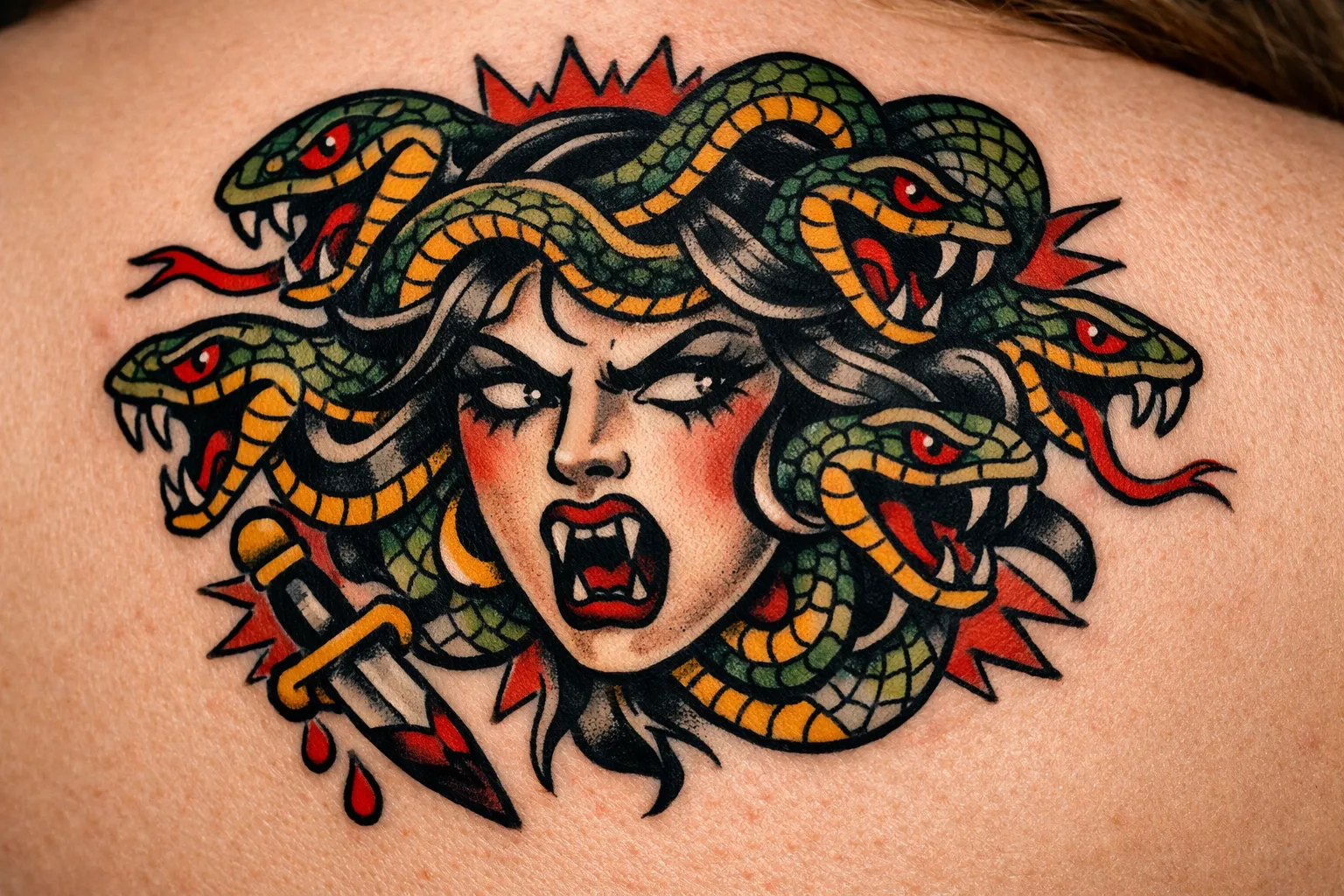
Neo-traditional. Bold black outlines, saturated color (often green snakes, gold accents, deep red), stylized rather than realistic. Reads as defiant and aesthetic. Ages well - the thick outlines hold up over decades.
Blackwork. Heavy contrast, solid black fills, pattern-driven. Reads protective and graphic. Works well on hands and necks where realism would blur.
Illustrative linework / simple Medusa. Single-weight lines, minimal shading. A simple Medusa tattoo strips the imagery to face, a few snakes, and the gaze. Reads modern and understated. Good for first tattoos.
Fine line / micro. 2-3 inches, single needle, often on the inner forearm or behind the ear. Reads quiet and personal. The pitfall: fine line on hands or fingers fades fast - within 3-5 years you may need touch-ups.
Two technical hallmarks to look for in a good Medusa piece: clean snake definition (each snake reads as separate, not a tangled mass) and eye placement symmetry (the gaze is the whole point - if the eyes are off, the piece fails). The most common failure mode when artists do it badly is muddy snakes that blur into hair-like texture within two years, and faces that look generic rather than specifically Medusa. Ask to see healed examples of portrait work, not just fresh photos.
Medusa Forearm Tattoo: Placement, Size, and Pain
The Medusa forearm tattoo is the most common placement for a reason. The forearm gives you 3-7 inches of working space for a bust, the curvature flatters the shape of a face, it’s easy to show or cover, and it heals well. When clients ask me where to start with a Medusa, forearm is almost always my first answer.
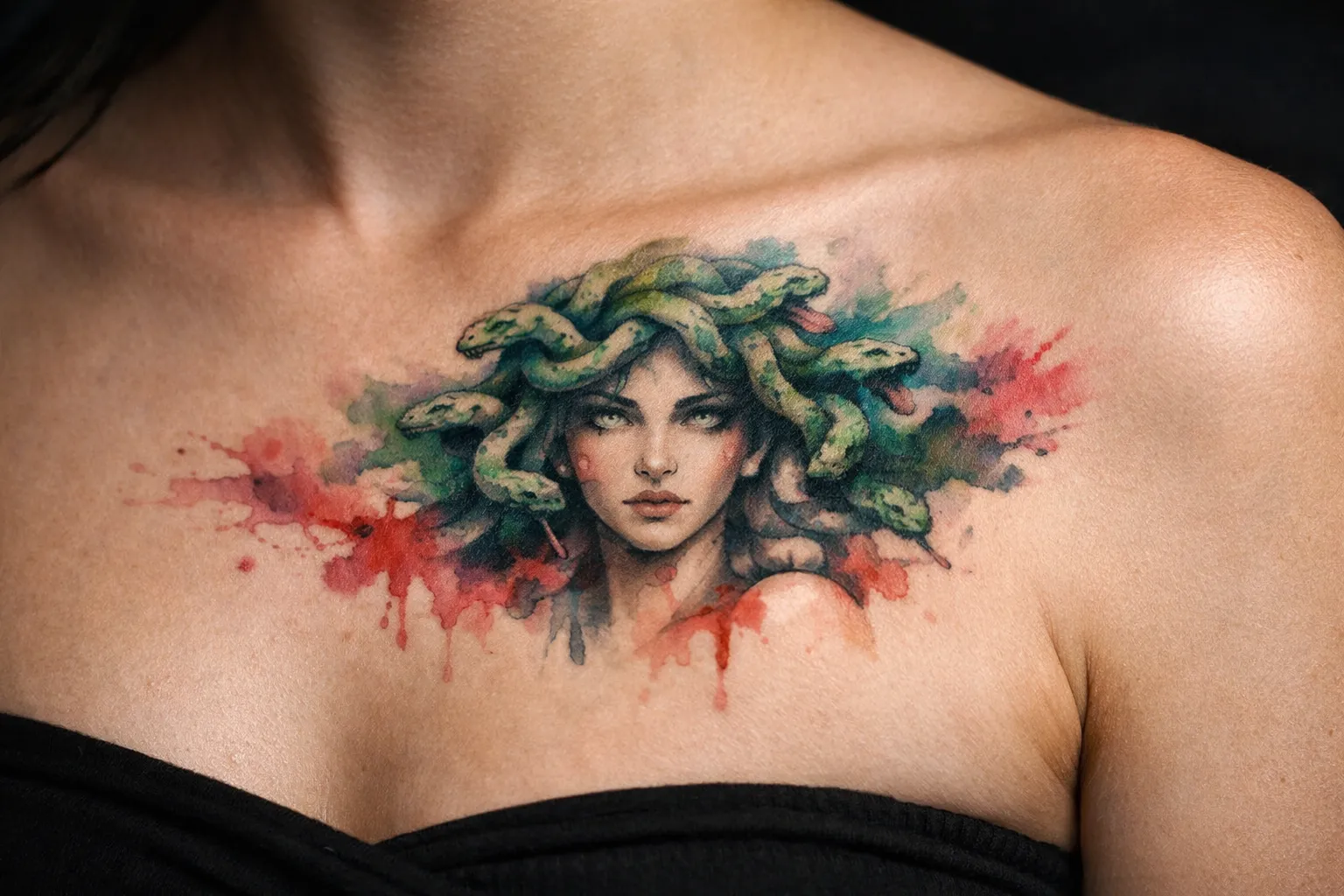
- Size range: 4-7 inches for a detailed portrait, 2-3 inches for simple linework.
- Pain: moderate-low. Forearm is one of the easier placements. Inner forearm is slightly more tender than outer.
- Session length: 2-5 hours for black and gray realism, 1-2 hours for simple linework.
- Visibility: easy to cover with a long sleeve, easy to show in a t-shirt. Good for people who want control over when the symbol is visible.
Pain ranking, roughly: ribcage > sternum > hand > forearm. If you’re choosing between a forearm and a hand or rib piece for your first significant tattoo, forearm is the kinder call. For a deeper look at how these pieces age and what to expect from the process, the forearm tattoos guide covers design options, pain levels, and long-term care in detail.
Medusa Hand Tattoo: What to Know Before You Commit
A Medusa hand tattoo is the most direct version of the design - a face on the back of the hand, snakes wrapping toward the wrist or fingers. It functions as a literal boundary: anyone reaching for you sees her first.
Real talk on hand tattoos:
- Fading is fast. Hand skin regenerates more aggressively than arm skin, and you wash your hands constantly. Expect to touch up every 3-7 years, sooner for fine detail.
- Blowouts are common. The thin skin and tendon movement make hand work technically harder. Book a specialist, not whoever’s available.
- Employment. Still a factor in conservative industries. Cover-up makeup exists but is a hassle.
- Size: usually 3-4 inches across the back of the hand, sometimes extending onto fingers.
- Pain: higher than forearm. Bony, thin-skinned, lots of nerves.
If the boundary symbolism is what you want but the maintenance worries you, the inner wrist or back of the forearm gives you 80% of the visibility with much better longevity.
Simple Medusa Tattoo: Small and Minimalist Options
A simple Medusa tattoo strips the design to its core: face, a few snakes, the gaze. No background, minimal shading, often single-needle linework.
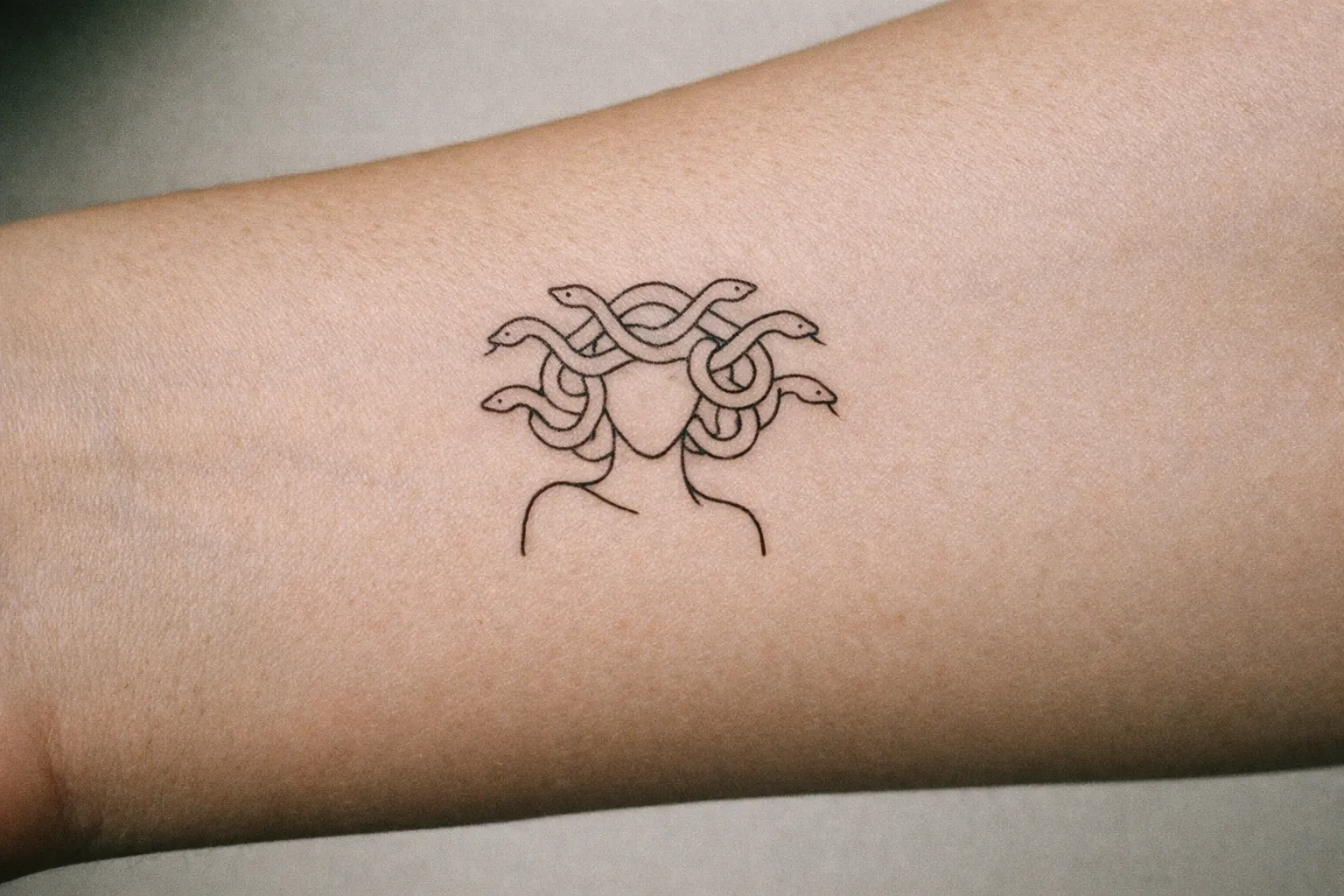
Good size ranges:
- 2-3 inches behind the ear, on the inner wrist, or on the ankle.
- 3-4 inches on the inner forearm or back of the upper arm.
- 4-5 inches on the sternum or shoulder blade.
Cost runs $150-$300 at most shops, completed in 1-2 hours. Best for people who want the symbolism without a portrait commitment, or as a first tattoo before deciding on something larger.
One pitfall worth flagging: don’t oversimplify the face. A Medusa without recognizable features is just a woman with snake hair - the gaze is the meaning. Keep the eyes detailed even when everything else is reduced. I tell clients this in every minimalist Medusa consultation, and the ones who ignore it are the ones who come back wanting a rework.
Cost, Time, and What to Expect at the Shop
US shop pricing in 2024-2025:
- Shop minimum: $80-$150 (tiny linework, single snake, etc.)
- Simple Medusa, 2-4 inches: $150-$300
- Medium forearm bust, 4-7 inches, black and gray realism: $300-$700, 2-5 hours
- Large realism, upper arm or back, 7-12 inches, color: $700-$1,500+, 6-12 hours across multiple sessions
- High-demand artists in major cities: $200-$300/hour - complex sleeves climb past $2,000
Consultations are usually 15-60 minutes, often free or with a $50-$100 deposit credited toward the tattoo. Bring 3-5 reference images and notes on what specifically you like in each - the eyes from one, the snake arrangement from another. That specificity saves everyone time.
Aftercare and Healing Timeline
A Medusa with detailed snakes and eye work is exactly the kind of tattoo where bad aftercare shows up later as muddy linework. The eyes especially - if you’re not keeping the area clean and moisturized in week one, you’ll see it in the healed piece.
- Day 1-3: Keep the second-skin bandage on if your artist used one (Saniderm or similar, $10-$25 per pack). If wrapped traditionally, remove after 2-4 hours, wash gently with fragrance-free soap, pat dry.
- Week 1: Wash 2-3 times daily with fragrance-free soap. Apply a thin layer of fragrance-free moisturizer ($8-$15) after each wash. No swimming, no soaking, no gym.
- Week 2-4: Itching and peeling phase. Do not pick. Keep moisturized. Avoid direct sun.
- Month 1-3: Tattoo looks healed on the surface but skin is still remodeling underneath. Use SPF 30+ sun-protective clothing or sunscreen any time it’s exposed - UV is the single biggest cause of long-term fading.
- Touch-ups: Most artists offer one free touch-up at 6-8 weeks. Take them up on it if any lines look soft.
Budget another $20-$40 beyond the tattoo cost for healing supplies.
Trauma-Informed Sessions: What to Ask For
If you’re getting a Medusa tied to assault or abuse, the session itself can be heavy. Many artists now work in a trauma-informed way, and it’s worth asking directly during consultation rather than hoping for the best. Ask:
- Are you comfortable with this being a survivor piece, and have you done others?
- Can we agree on a hand signal or safe word if I need to pause?
- Can we plan breaks every 20-30 minutes?
- Do you prefer minimal conversation, or are you happy to talk?
- Is there a private room or a less-trafficked time slot?
A good artist will treat these requests as normal, not as a special accommodation. If they get weird about it, book someone else.
Frequently Asked Questions
- Why is a Medusa tattoo for SA?
- Because the myth itself is a sexual assault story - Medusa was raped by Poseidon and then punished by Athena for it (3)(4). Modern survivors use the tattoo to reclaim that narrative: she was blamed and called a monster for surviving what was done to her, and the gaze that was meant as a curse became her protection. Wearing her is a way of saying the same thing about your own survival.
- What does a tattoo of a Medusa mean?
- Most commonly: survival after trauma, female empowerment, rejection of victim-blaming, protection, and rage at injustice (1)(2)(3). The exact meaning is personal to the wearer. Some get it for the mythology and art history rather than the survivor framing - both are valid, but the survivor reading is now the default in Western tattoo culture.
- Was Medusa evil or a victim?
- Both, depending on the source. Classical Greek sources treat her as a monster killed heroically by Perseus. Ovid and most modern readings treat her as a victim of sexual violence and unjust divine punishment. Tattoos almost always use the second interpretation - she was wronged, then blamed for surviving.
- What does a Medusa tattoo mean in mental health?
- In a mental health context, the tattoo usually represents recovery, resilience, and the refusal to let trauma define you as broken. It can mark a turning point - a survivor moving from shame to anger to ownership. For some wearers it's tied specifically to PTSD recovery, therapy milestones, or finally telling someone what happened.
- Do I have to be a survivor to get a Medusa tattoo?
- No. Dictionary.com is explicit that the meaning is personal and varies (4). Plenty of people get Medusa for the mythology, the aesthetic, the feminist symbolism more broadly, or out of solidarity with survivors. Just know that strangers may read it as a survivor mark by default.
- Where does a Medusa tattoo age best?
- Outer forearm, upper arm, shoulder blade, and back. These spots get less friction, less sun, and less skin turnover than hands, fingers, feet, or inner wrists. A detailed Medusa portrait on the forearm can hold sharp for 10-15 years with sun protection and one or two touch-ups. The same piece on a hand will need touch-ups every 3-5 years.