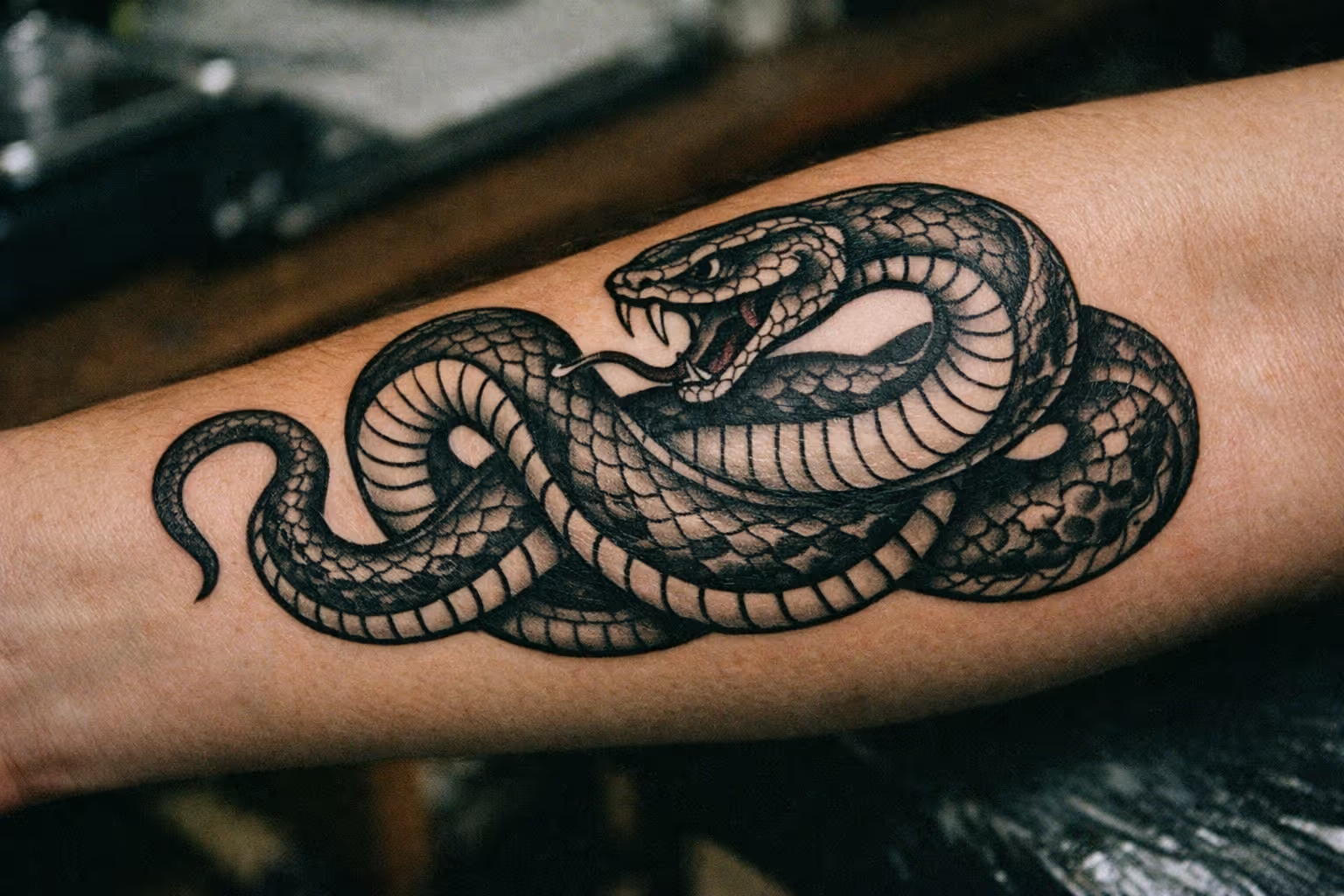
The direction a snake faces, what it’s coiled around, how big it is - these small design choices quietly decide what your snake tattoo means, and most people pick them by looks alone. That matters more here than almost any other motif, because the snake’s symbolism swings between opposites: healing and danger, rebirth and temptation. Land on the wrong combination and it says the reverse of what you meant. Here’s how the snake tattoo meaning works, and how the design pins it down.
Snake Tattoo Meaning: What Snakes Symbolize
Snake tattoo meaning isn’t fixed - it pulls from at least a dozen traditions that don’t agree with each other. Shedding skin reads as rebirth in one culture, temptation in another, healing in a third. That’s the whole appeal: a serpent on your forearm carries whichever story you load into it, and the design choices (head up or down, coiled or striking, paired with a flower or a dagger) shift the meaning more than most people realize. This guide covers what snakes actually symbolize across cultures, the snake tattoo designs that age well, placement and size by experience level, and the practical stuff - cost, healing, what to skip.
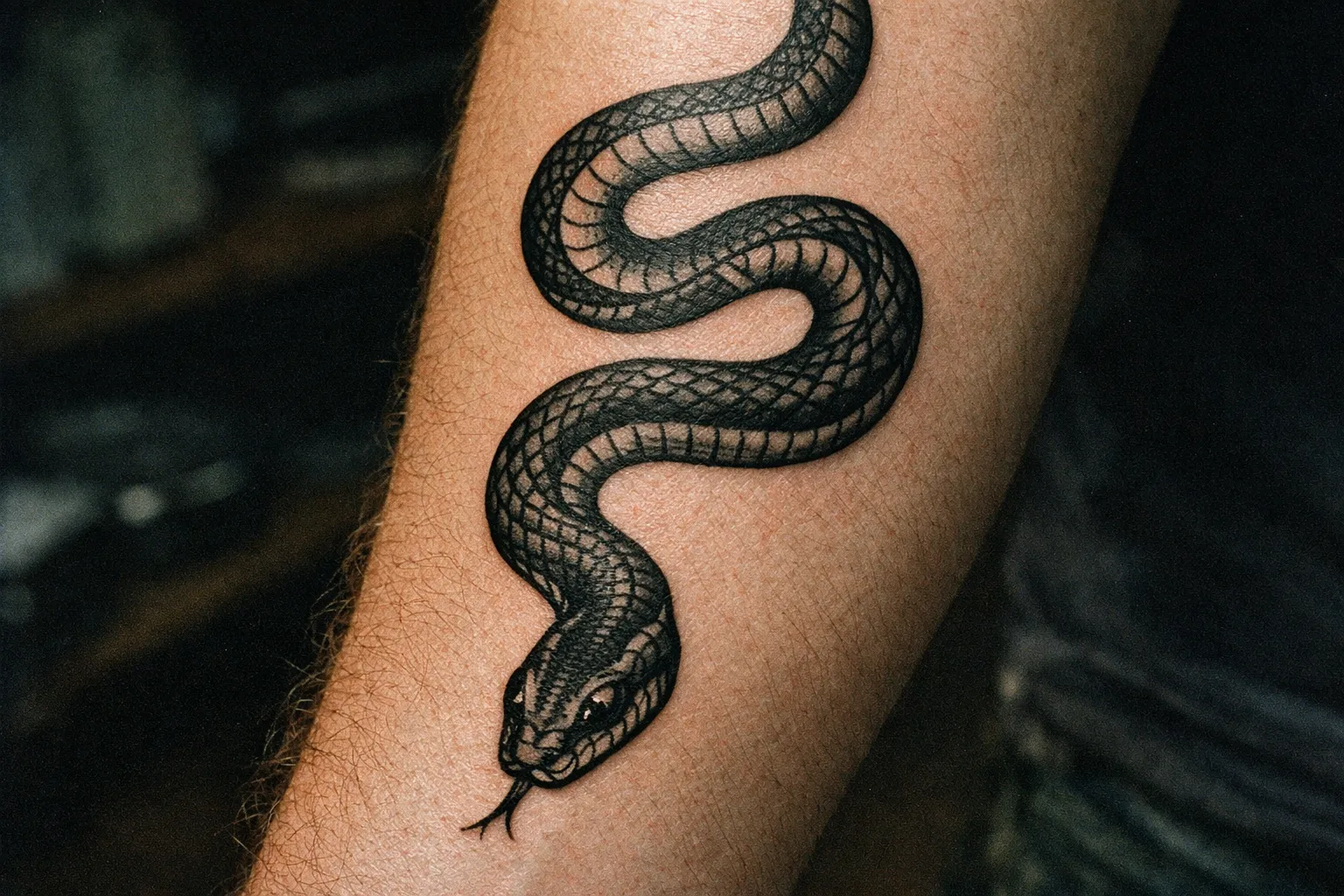
The shortlist of meanings most artists hear from clients:
- Transformation and rebirth - the snake shedding its skin is the most universal reading, cited across nearly every modern tattoo guide (1)(2)(3)(4).
- Duality - life and death, healing and poison, protector and threat. Snakes carry both sides at once, which is why they suit complicated personal stories (5)(6)(7).
- Protection and power - guardians of thresholds, temples, and treasures in Greek, Egyptian, and Mesoamerican myth (8).
- Wisdom and hidden knowledge - Greek, Celtic, and Gnostic readings frame the serpent as a bringer of knowledge rather than a villain.
- Healing and medicine - the rod of Asclepius (one snake on a staff) and the caduceus are still used as medical insignia. Healthcare workers commonly get a subtle Asclepius snake to mark the profession.
- Temptation and sin - the Biblical Eden reading is real, and in some Christian contexts a snake tattoo still reads that way.
- Sexuality and fertility - the phallic shape and the snake’s role in creation myths feed this one. It comes up often in feminine-power designs.
If you want the tattoo to land cleanly, pick one or two of these as your anchor before you talk to an artist. Trying to fit all of them into one piece is how designs end up muddled.
✓ Pros
- Rich symbolism with multiple cultural meanings
- Versatile design options that can suit many placements and sizes
- Strong longevity in traditional styles with bold lines and colors
✗ Cons
- Symbolism can be conflicting or misunderstood depending on viewer
- Small detailed designs risk blurring and loss of clarity over time
- Certain cultural motifs require careful respect to avoid appropriation
Snake Symbolism Across Cultures
Cultural context matters because the same coiled serpent on your ribs reads very differently to a Buddhist neighbor, a Catholic grandmother, and a Norse pagan friend. I’ve had clients come in with the same reference image carrying completely opposite intentions - which is fine, but you should know what you’re working with.
Ancient Egypt - the cobra (uraeus) sat on the pharaoh’s crown as a symbol of sovereignty and divine protection. Wadjet, the cobra goddess, guarded Lower Egypt. Snake = royalty and guardianship here, not evil.
Ancient Greece - Asclepius, the god of medicine, carried a staff with a single snake. That image is still the legitimate medical symbol (the caduceus with two snakes belongs to Hermes and got mixed up with medicine by mistake in the U.S.). Snakes in Greek myth also guard sacred groves and oracles.
Christian / Biblical tradition - the serpent in Eden is the source of the “snake = temptation, sin, evil” reading. This is the dominant Western association and the one most likely to cause friction in conservative settings.
Norse and Celtic - Jörmungandr, the world serpent, encircles the earth in Norse cosmology. Cernunnos, the Celtic horned god, is often depicted with a ram-headed serpent representing fertility and the underworld.
Japanese (irezumi) - the snake (hebi) protects against illness and disaster and is tied to wisdom and good fortune. Japanese snake tattoos usually flow large across the back, sleeve, or thigh, paired with peonies or chrysanthemums.
Hindu and Buddhist - the naga is a serpent deity, often protective. Shiva wears a cobra. Kundalini energy is a coiled serpent at the base of the spine.
Mesoamerican - Quetzalcoatl, the feathered serpent, is a creator god. Mayan and Aztec snake imagery skews toward cosmic power and creation.
Modern Western tattoo culture - the meaning has largely shifted away from purely Biblical readings. Most collectors today frame snakes as duality symbols: transformation, resilience, reclaiming power after something hard.
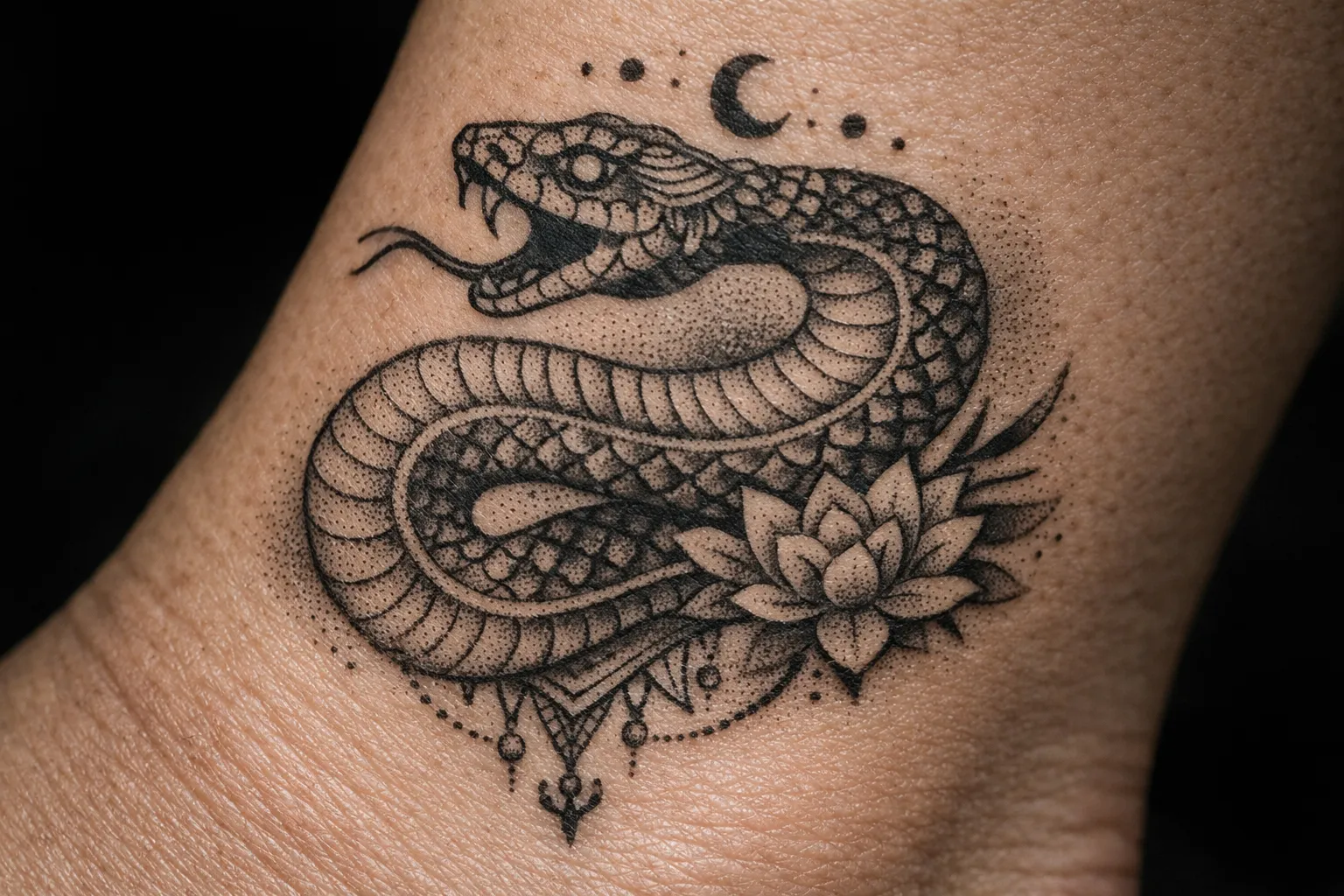
If you’re tied to a specific tradition, anchor it in the design elements. A snake with a lotus reads Eastern. A snake with a rose and dagger reads American traditional. A snake wrapped around Asclepius’s staff reads medical. The symbolism lives in the details as much as the serpent itself.
Snake Tattoo Designs That Actually Work
Snake tattoo designs reward thought because the snake’s body is one long line - that line has to make sense on your anatomy or the whole thing looks stiff. I’ve seen technically clean snakes that look completely wrong because they fight the limb’s direction. A few combinations that come up constantly, and what they actually mean:
Snake and flower tattoo - the most-requested combination right now, especially for women. Roses pair with American traditional snakes; peonies and chrysanthemums pair with Japanese-style serpents; lotuses lean spiritual; wildflowers and ferns lean fine-line. The reading is balance - danger and beauty, healing and growth, softness and edge. Good size for a snake and flower tattoo on the forearm: 5-7 inches (13-18 cm). Smaller than that and the flower loses its petals within a few years.
Snake and dagger - American traditional staple. The dagger is sacrifice, betrayal, or hard-won courage; the snake wrapped around it adds protection or overcoming deception. Reads strong as a 4-6 inch piece on the forearm or upper arm.
Snake and skull - mortality, the cycle of life and death. Heavy imagery, usually best at 5+ inches so the skull doesn’t blob out.
Ouroboros (snake eating its tail) - eternity, cyclical renewal, self-sufficiency. Works small (1.5-3 inches) on the wrist or behind the ear because it’s a closed shape. One of the few snake designs that actually holds up tiny.
Medusa - reclamation of power after trauma is the modern reading, especially among women. Usually 4-8 inches, placed on the thigh, calf, or upper arm.
Coiled rattlesnake or cobra - readiness, defense, raw power. Works well on the chest or shoulder where the coil shape fits muscle.
Asclepius staff - medical / healing profession. Often small (2-3 inches) on the inner forearm or wrist.
Traditional Snake Tattoo: Style Hallmarks
A traditional snake tattoo - American traditional, the Sailor Jerry lineage - has two technical hallmarks: thick black outlines (often 1.5-3mm) and a limited color palette (red, green, yellow, and black, with minimal blending). The shading is solid blocks, not gradients. Scales are stylized into simple curved lines rather than rendered realistically.
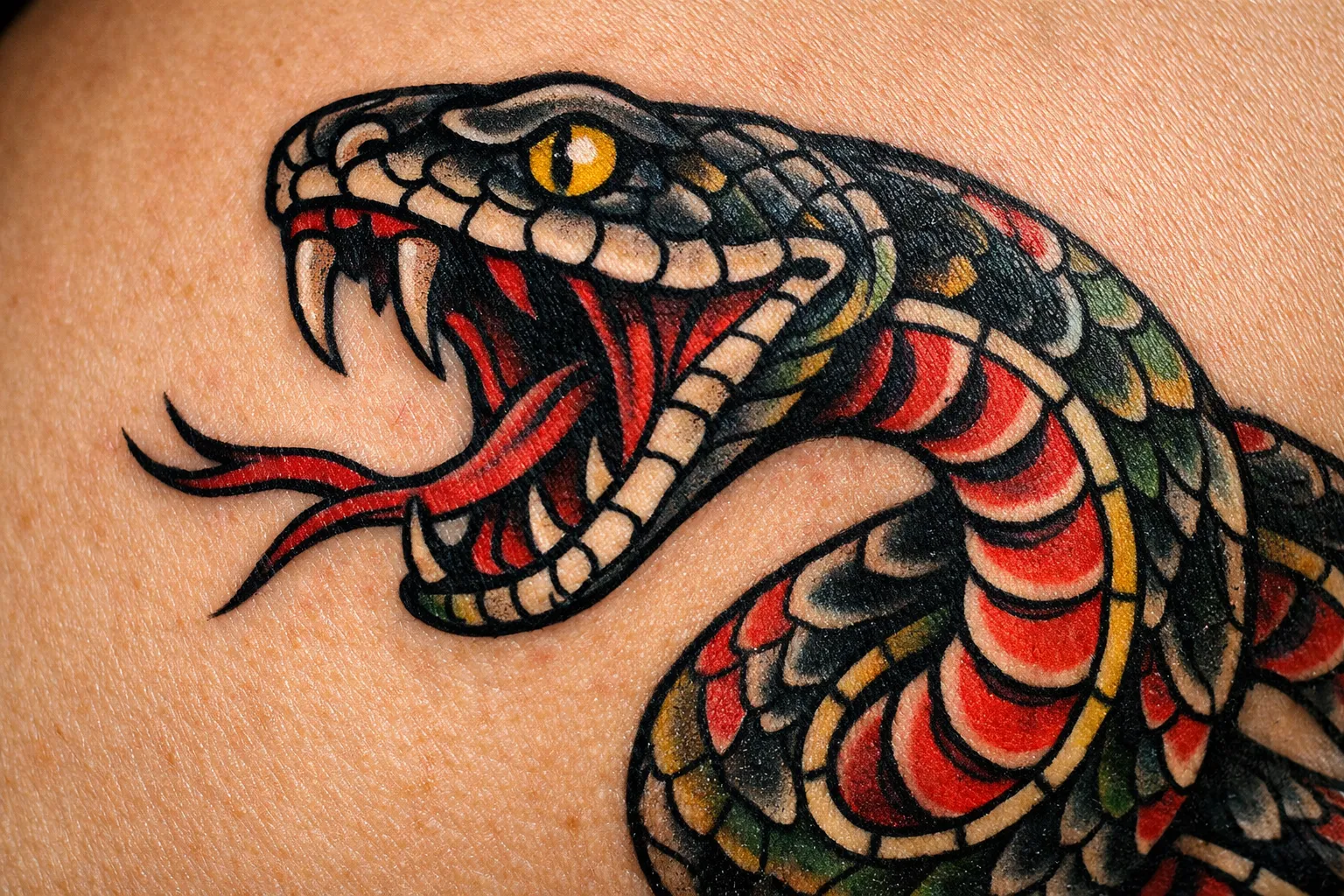
This style ages the best of any snake approach. A well-executed American traditional snake on the forearm will still read clearly at 20 years. The thick lines compensate for the slow blur every tattoo gets, and the bold color holds up under sun exposure better than fine pastel work.
Common pitfall: artists who try to “modernize” traditional by thinning the outlines or adding soft gradient shading. That’s neo-traditional, not traditional, and it ages more like fine-line work - meaning the crispness fades faster. If you want a traditional snake, commit to the bold-line, flat-color look. Don’t let an artist talk you into something in between.
Japanese-style snakes are the other long-lasting option. Hallmarks: flowing S-curves following body anatomy, heavy black background (often with wind bars or waves), and a harmonized color palette anchored by one or two strong flowers. These work best at scale - half-sleeve, full back, thigh - and look weak when forced small. Much like a tiger tattoo, Japanese snake work rewards large canvases where the artist can render full texture and expression.
Serpent Designs for Women: What’s Actually Being Requested
A snake tattoo for women has shifted hard in the last few years toward feminine power, reclamation, and resilience narratives. The figures most often referenced: Medusa (survivor symbolism, particularly tied to sexual assault recovery in modern usage), Cleopatra and the Egyptian cobra (sovereignty), the Minoan snake goddess (creation and fertility), and Eve reframed as knowledge-bringer rather than sinner.
Design directions that come up most:
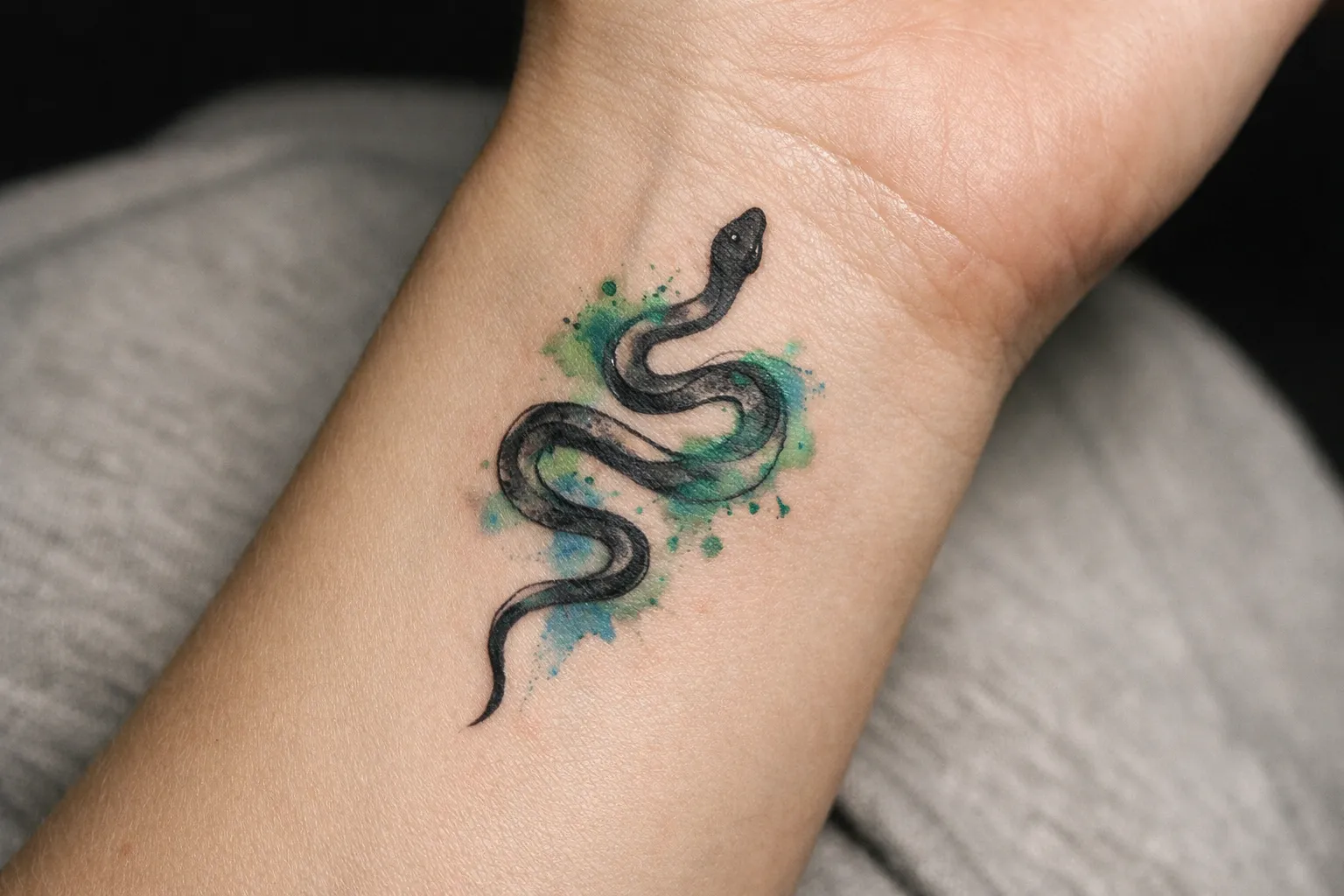
- Fine-line small snake - wrist, ankle, behind the ear, sternum. Size: 1.5-3 inches. Reads delicate, easy to conceal for work.
- Snake wrapping a forearm with flowers - 6-10 inches, follows the wrist-to-elbow line. Popular for first significant pieces.
- Medusa portrait - thigh or upper arm, 5-8 inches. Heavy emotional weight, takes 4-6 hours.
- Snake around the spine - long vertical piece, 8-14 inches, follows the vertebrae. Private placement, deep transformation symbolism.
The meaning isn’t inherently gendered - these designs work for anyone - but the framing in modern tattoo culture has tilted feminine, and most artists now have a portfolio section specifically for these requests.
One honest note: Medusa pieces are everywhere right now. If the symbolism matters to you personally, get it. If you just like the look, know that in 5-10 years it may feel as trend-marked as the infinity symbol does now.
Small Snake Tattoo: What Holds Up at Size
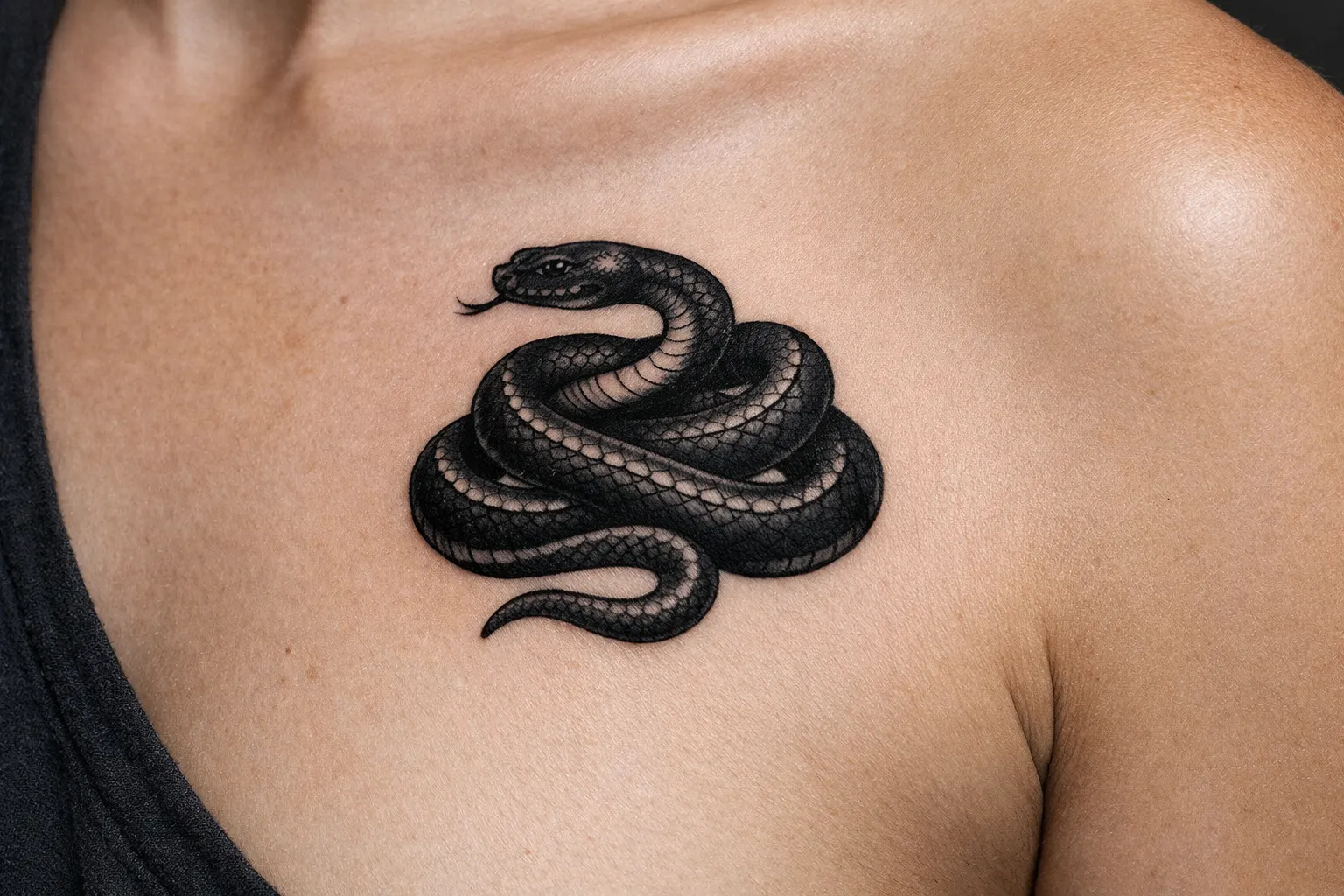
Small snake tattoos (under 3 inches / 7.5 cm) have exploded in popularity, especially on wrists, fingers, behind the ear, and the inner ankle. They’re appealing - low cost ($100-$200), short session (30-60 minutes), low pain on most placements. They also fail more often than larger pieces if you don’t design for the size.
What works small:
- Single-line outline snakes with no scale detail
- Ouroboros circles (the closed shape holds)
- Tiny coiled snake with simplified geometry
- Snake silhouettes in solid black
What doesn’t work small:
- Detailed scales - they blur into a smudge within 3-5 years
- Realistic shading - needs at least 4 inches to render
- Tiny flowers paired with a tiny snake - both lose definition
- Ultra-fine lines (under 0.5mm) on fingers - fingers are the worst placement for line retention because of constant skin movement and washing
The fix if you want small but lasting: ask for slightly thicker lines than the trend dictates (around 0.8-1mm minimum) and simplify the design. A clean silhouette ages better than a detailed miniature. I’d rather talk a client into a cleaner 2-inch piece than watch a fussy one turn to mush in four years.
Snake Tattoo Forearm: Why It’s the Default Choice
The forearm is the most-recommended placement for a first snake tattoo, and there’s anatomy behind that. The forearm is a long, slightly curved surface that matches the snake’s natural body shape - you can run a serpent from wrist to elbow following the muscle line, and it looks dynamic when the arm moves.
Practical specs for a snake tattoo forearm placement:
- Size range: 5-9 inches (13-23 cm) for inner or outer forearm
- Session time: 2-4 hours for a medium piece, 4-6 for full forearm with color
- Cost (US, 2024-2025): $250-$700 depending on complexity and city
- Pain: relatively low - forearm sits in the easier half of the body, well below ribs, sternum, or inner bicep
- Visibility: high - consider work environment before committing
Direction matters here. Head pointing up (toward the elbow or shoulder) reads as growth, protection, and aspiration - the snake is “rising.” Head pointing down (toward the hand) reads as grounding, descent, or readiness to strike at what’s in front of you. There’s no fixed rule, but most artists default to head-up for the protective/aspirational read unless the client has a specific reason otherwise.
If you’re unsure, ask the artist to print stencils both ways and hold them against your arm in a mirror. Photograph both. Look at them an hour later. The answer becomes obvious.
Should a Snake Tattoo Go Up or Down?
This comes up enough to deserve its own answer. There’s no universal rule, but the working logic among artists:
Head up - growth, protection, alertness, the snake “ascending.” Most common default. Suits transformation and resilience themes.
Head down - striking position, grounding, danger, descent. Works well when the snake’s head should point at something specific (hand for action, hip for sensuality).
Anatomical flow trumps symbolism. A snake that fights the limb’s direction looks awkward. On a forearm, both directions work. On a calf, head-down often looks more natural because it follows the leg’s taper. On the spine, head-up is nearly universal.
Ask your artist to show you both options in stencil form before committing.
Is It Okay to Get a Snake Tattoo?
Yes, for most people in most contexts. Snake tattoos are among the top 10 most-requested motifs in Western studios and are read as artistically serious rather than edgy or transgressive by default.
The friction points:
- Strongly Christian or conservative families and communities - the Eden association can land as occult or anti-religious. If this matters, either choose a different motif or anchor the design in healing imagery (Asclepius staff, snake with medical cross, snake with dove) that reads explicitly positive.
- Customer-facing professions with conservative dress codes - visible hand, neck, or face snakes can be a problem. Forearm, calf, and back placements give you concealment options.
- Specific cultural contexts - some indigenous serpent motifs (Mesoamerican deities, Aboriginal Rainbow Serpent imagery) carry weight you shouldn’t borrow without understanding. Stick to designs from your own cultural background or generic styles (American traditional, Japanese with permission to use the iconography, blackwork).
The tattoo itself is fine. The reaction depends on who’s looking at it and where it lives on your body.
Basic Snake Tattoos to Avoid
If you’re reading this article, you probably don’t want the generic version. A few designs that have aged into cliché:
- Pinterest-clone tiny ankle snake - the same figure-8 line on the ankle with two dot eyes. It was fresh in 2020, generic by 2023, and will read as a dated trend within a few more years.
- Low-effort tribal snakes - pseudo-Polynesian or pseudo-Aztec patterns drawn by artists with no training in those traditions. Reads as cultural appropriation and usually looks technically poor.
- Bargain-basement realistic snakes - realism is the hardest tattoo style. A cheap “realistic” snake will look like a smudged photograph within five years. Either pay for a real realism specialist or pick a style with stronger linework.
- Tiny snakes with full scale detail - under 2 inches, scales blur into noise. Skip the scales or upsize.
- Snake plus four other elements crammed into 3 inches - snake, rose, dagger, banner, script, all on the wrist. The composition fails. Pick two elements max for anything under 5 inches.
The fix for any of these: go custom, work with an artist whose portfolio shows healed snake work (not just fresh photos), and let the design breathe. Similar principles apply when choosing a dragonfly tattoo - clean linework and appropriate sizing matter far more than cramming in detail.
Cost and Time: What to Expect
US studio pricing in 2024-2025, ballpark:
- Small fine-line snake (1-3 in): $100-$200, 30-90 minutes (most U.S. shops carry a $100-$150 minimum in 2024-2025, so $80 is rarely realistic)
- Medium forearm snake (4-8 in, black/grey with light detail): $250-$600, 2-4 hours
- Color traditional snake on forearm or calf: $400-$900, 3-5 hours
- Large wrap or half-sleeve snake: $600-$1,500+, often 2-3 sessions of 3-4 hours each
- Full back or full sleeve Japanese-style snake: $3,000-$12,000+, 20-40 hours over multiple sessions (specialist rates of $200-$300/hr across 30-40 hours push totals well past $6,000 in major markets)
Hourly rates in major markets (NYC, LA, London): $150-$300/hr for established artists, $250+ for sought-after specialists. Expect a non-refundable deposit of $50-$200 to book custom work.
Cheaper isn’t a saving on a piece you’ll wear for decades. A blown-out $150 forearm snake costs more to cover or remove than a clean $500 one costs to get right.
Choosing the Right Artist
Snake work exposes technical flaws faster than most subjects. The long continuous body shows every wobble in the line. The curves need confident, single-pass strokes. Scale detail needs a steady hand and clean dots. I’ve seen otherwise skilled artists produce shaky snake work simply because they weren’t used to drawing elongated animal forms - it’s a specific skill. The same holds true for other animal subjects: a dragon tattoo demands the same kind of specialist who understands how a long, sinuous body should flow across the skin.
What to look for in a portfolio:
- Healed photos, not just fresh. Fresh tattoos look crisp; healed ones reveal blowouts, patchy color, and faded lines. Any artist serious about quality will show healed work.
- Specific snake or serpent work - animal anatomy is its own skill. An artist great at lettering may not nail a snake.
- Consistent line weight across pieces - wobbly lines that vary in thickness are a tell of inexperience or rushed work.
- Style match - don’t ask a fine-line specialist to do American traditional, or vice versa.
Find artists through word of mouth, Instagram tags (#snaketattoo, #traditionalsnake, #snaketattoodesigns), and tattoo conventions. Read reviews specifically about line quality and healing, not just personality.
When you meet the artist, bring 3-5 reference images, list the symbolic meanings you want, and let them propose a custom design rather than copying a reference exactly. Good artists won’t replicate another artist’s work - they’ll build something for your body.
Aftercare: Keeping a Snake Tattoo Clean as It Heals
Snake tattoos depend on clean linework, so aftercare matters more here than for solid blackwork or large color fills. Blowouts and faded lines often come from healing neglect as much as from the needle. The standard timeline:
Day 1-3: Keep the bandage on as long as your artist recommends (anywhere from 2 hours to 4 days depending on the wrap type). Wash gently 2-3 times daily with fragrance-free soap and lukewarm water. Pat dry. Apply a thin layer of fragrance-free moisturizer or the aftercare ointment your artist gave you. Expect oozing, redness, and some plasma - normal.
Week 1: Itching and tightness peak around day 4-7. Do not scratch. Do not pick scabs. The tattoo will look duller as the surface skin starts to flake - also normal. Continue washing 2x daily and moisturizing 2-3x daily with a fragrance-free moisturizer.
Week 2-4: Flaking and peeling subside. The tattoo may look cloudy or matte while deeper layers heal - this is called the “milky” stage. Full surface healing usually completes by week 3-4. Deeper dermal healing takes 2-3 months.
Throughout healing:
- No soaking - no swimming pools, hot tubs, baths, or oceans for 3-4 weeks. Showers are fine.
- No direct sun for 4-6 weeks. After healing, sun-protective clothing or SPF 30-50 sunscreen every time the tattoo is exposed. UV is the single biggest cause of tattoo fading.
- Don’t over-moisturize - a thin layer 2-3x daily, not a thick coating. Over-moisturizing can blur fine scale work or cause prolonged scabbing patterns that break up lines.
If you see spreading redness, pus, fever, or red streaks radiating from the tattoo, contact a doctor - infection is rare but serious.
Frequently Asked Questions
- What do snake tattoos symbolize?
- Snake tattoos commonly symbolize transformation, duality, protection, wisdom, healing, temptation, and sexuality, but the exact meaning depends on cultural context and design elements paired with the snake.
- Is it okay to get a snake tattoo?
- Generally yes, but in strongly Christian or conservative settings the snake can be read as negative. Concealable placements or healing imagery can soften this reading.
- Should a snake tattoo go up or down?
- No fixed rule; head-up usually means growth and protection, head-down means grounding or striking. Anatomical flow is more important, so try stencils both ways before deciding.
- What are basic snake tattoos to avoid?
- Avoid generic tiny ankle snakes, low-effort tribal designs, cheap realism, tiny detailed scales, and overcrowded compositions. Custom work with an experienced artist is best.
- Does a snake tattoo hurt more than other tattoos?
- Pain depends on placement, not the snake itself. Forearm and outer calf are easier; ribs and sternum hurt more. A 4-hour forearm snake is uncomfortable but manageable.
- How long does a snake tattoo take to heal?
- Surface healing takes 2-4 weeks; deeper dermal healing continues for 2-3 months. Final color and line clarity settle by 3 months.
- Will a small snake tattoo last?
- Simple outlines and silhouettes under 3 inches can last 10+ years. Detailed small snakes blur faster. Thicker lines and simplified design improve longevity.