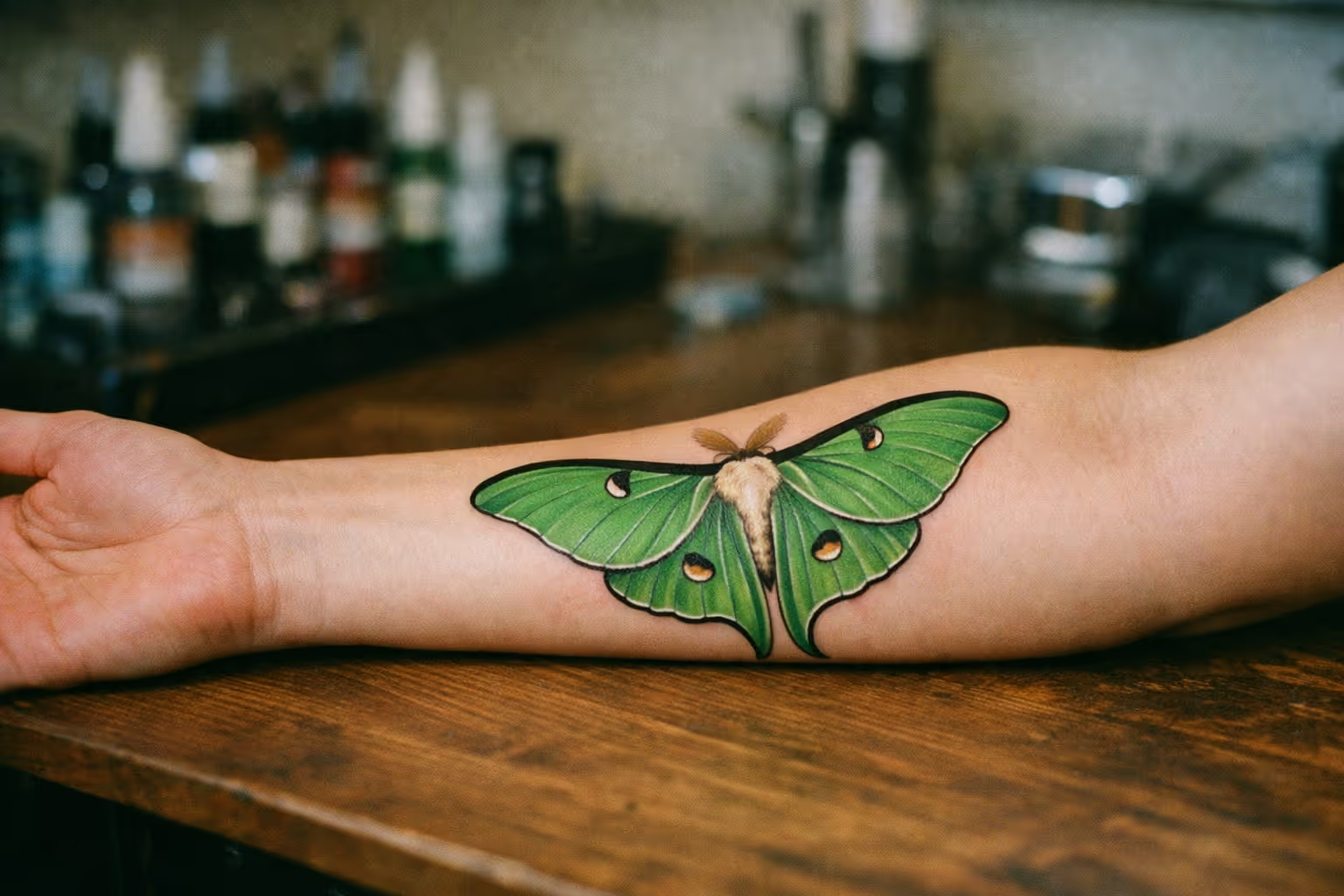
The moth tattoo meaning runs deeper and more personal than the soft design suggests - people reach for it to mark sobriety, a coming-out, a survived stretch of depression, any passage made through darkness toward light. Which is why the moth you pick matters: a delicate Luna moth and a death’s-head with a skull on its back send very different signals. Here’s what the moth carries symbolically, how the two big design families differ, and the sizing, pain, and aftercare that keep it clean.
What the moth tattoo meaning actually covers
The moth tattoo meaning centers on four core themes: self-acceptance, faith, personal transformation, and death (3). These symbolic layers come together in the moth, which tends to resonate with people undergoing significant life changes rather than those simply drawn to a pretty insect.
The core associations break down like this:
- Transformation and rebirth - same caterpillar-to-cocoon-to-flight cycle as the butterfly, but the moth’s version happens in the dark. Read as: change you went through the hard way.
- Intuition and the moon - moths are nocturnal and orient by moonlight, which is why they’re linked to intuition, hidden knowledge, and trusting instincts even when it looks risky (1).
- Mortality and life-death duality - short lifespan, folklore baggage, the skull on the death’s-head. Less “memento mori on a coffee mug,” more honest acknowledgment.
- Compulsion and desire - the flame thing. One artist quoted in The Rocky Mountain Collegian describes the moth as having a “certain vanity… craving light,” which makes it useful shorthand for surviving an attraction that almost cost you - a toxic relationship, addiction, a pattern you finally broke (1).
If you can’t finish the sentence “my moth is about ___” before the consult, you’re not ready to book. The meaning drives the type, and the type drives the style.
Why people are actually getting moth tattoos right now
Searches for “moth tattoo meaning” and “death moth tattoo” have climbed steadily since around 2020, and the reasons showing up in consult notes and tattoo blogs are specific:
- Sobriety milestones - moth often paired with a date or numerals.
- Mental health recovery - therapy graduation, diagnosis acceptance, surviving a depressive episode.
- Grief and memorial work - particularly the death’s-head moth, often with botanicals tied to the person lost.
- Major life pivots - divorce, leaving a religion, moving countries, ending a career.
- Gender transition and coming out - covered in its own section below.
- Shadow work and “witchy” aesthetics - moon phases, herbs, occult symbolism (1)(3).
The butterfly used to carry most of this load. The moth took over because moving through darkness is a more accurate description of what transformation actually feels like than “pretty winged thing emerges into sunshine.”
I’ve had clients come in with a butterfly reference, sit down, and after ten minutes of talking about what they actually wanted to mark, we’d both land on a moth. It happens more than you’d think.
What a moth tattoo means in LGBT contexts
This question shows up in Google’s People Also Ask and is rarely answered straight, so here it is:
In queer tattoo discourse, moths commonly read as coming out, gender transition, and resilience through a period of hiding. The metaphor is direct - flying toward your own light despite the risk, even when you’ve spent a long time in the dark. Some specific patterns:
- Transition pieces - moth dated to the start of HRT, a name change, or a top-surgery date.
- Coming-out anniversaries - often a luna moth, sometimes paired with the moon phase of the date.
- Nonbinary identity - moths are increasingly chosen over butterflies because the imagery is less gendered and less “girly fluttery.”
- Subtle pride integration - rainbow, trans, or bi-flag colors blended into the wing gradient instead of stamped on as flags. Reads queer to people who know, stays versatile in professional settings.
There’s no single fixed LGBT meaning - moth doesn’t carry the same coded history as, say, a labrys or a green carnation. It’s a personal symbol the community has adopted heavily in the last few years because the transformation metaphor fits the lived experience better than the butterfly version does.
Luna moth tattoo
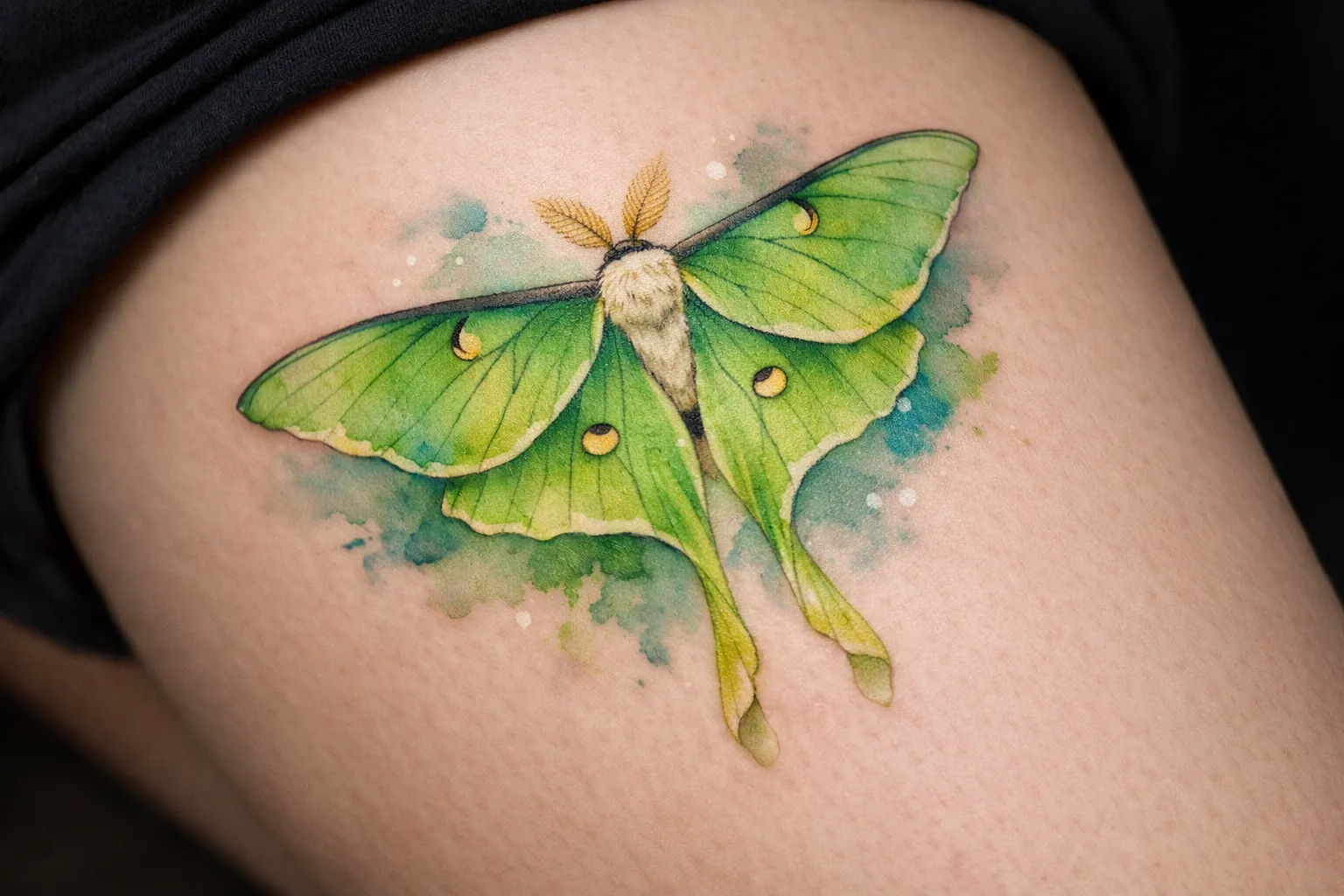
The luna moth is the soft-spoken cousin. Pale mint-green wings, long curved tails, large eyespots, and a fuzzy body. In tattoo work it carries femininity, lunar symbolism, intuition, and mystical rebirth (1).
Placement and size notes:
- Sternum, 5-7 in wide: the classic. Symmetrical body lines up with the breastbone, wing tails follow the rib curve. High pain - ribcage and breastbone are significantly more intense than forearm work.
- Upper back / nape, 4-6 in: wings spread across the shoulder blades or sit just below the hairline. Lower pain than sternum.
- Outer thigh, 6-9 in: room to let the tails extend. Mid-range pain, ages well because the area doesn’t take heavy sun.
Technical hallmarks of a good luna piece: smooth gradients in the green (pale to deeper jade), crisp eyespot rendering, and the long tails kept thick enough not to fade. Common pitfall: tails done too thin. Fine-line luna tails under 1 mm tend to break up within two to three years, especially on flexing skin like the ribs. I’ve done touch-up work on luna moths where the tails had basically dissolved - it’s a fixable problem, but it’s avoidable if the artist sizes them correctly from the start.
Death’s head moth tattoo
This is the heavy one. The death’s-head hawkmoth (genus Acherontia) carries a skull-shaped marking on its thorax, and it showed up in European folklore as a bad omen for centuries before Silence of the Lambs put it on a movie poster (2).
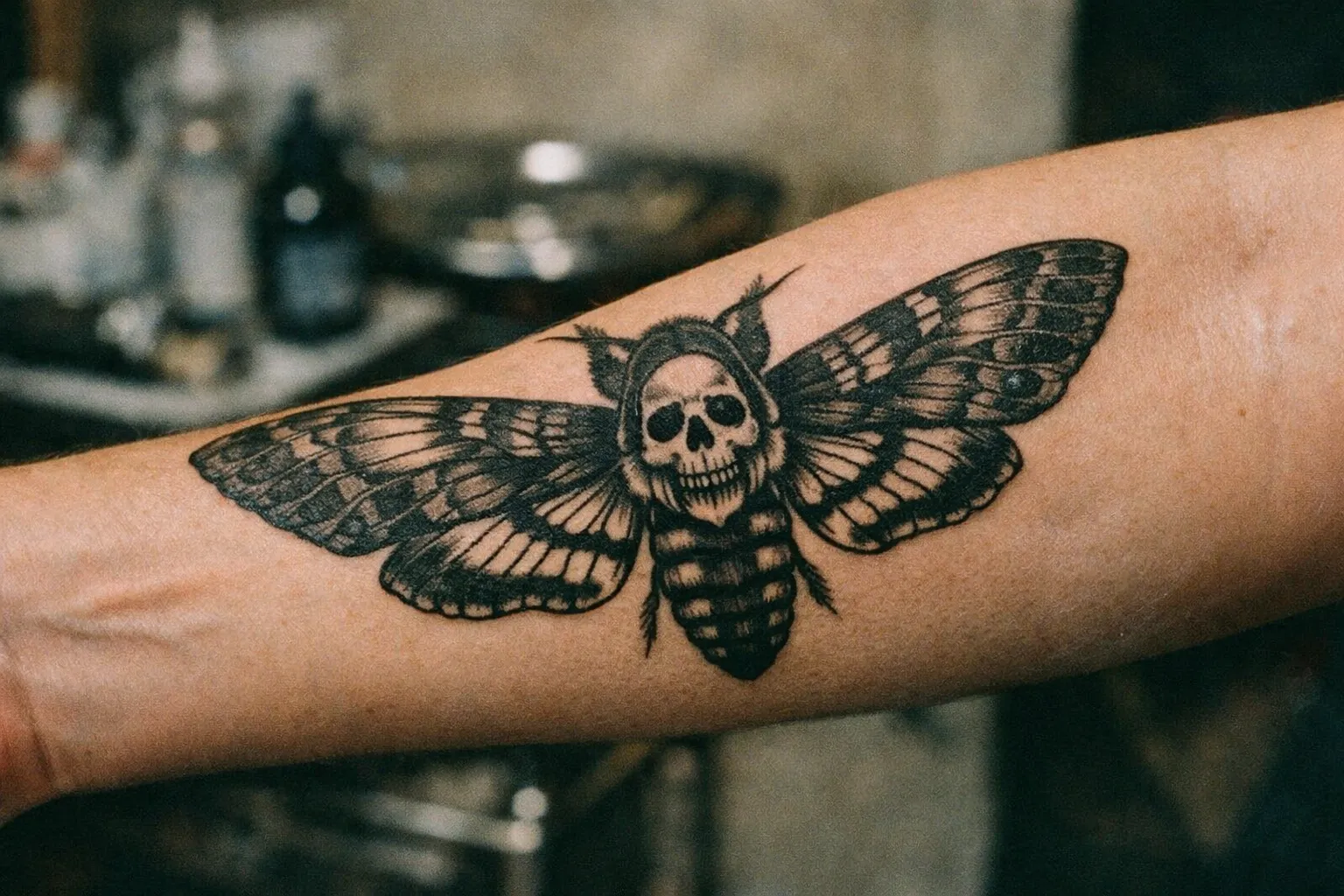
The modern tattoo reading has shifted. Contemporary artists frame the death’s head moth tattoo as the juxtaposition of life and death, the transient nature of existence, and personal rebirth through accepting mortality (2) - not pure doom. Used for:
- Grief and memorial work (often paired with the deceased’s birth flower or a date).
- Sobriety and surviving an overdose.
- “I made it through” pieces after serious illness.
- Pure aesthetic - gothic, occult, witchcraft-adjacent work.
Style choices for a death moth tattoo:
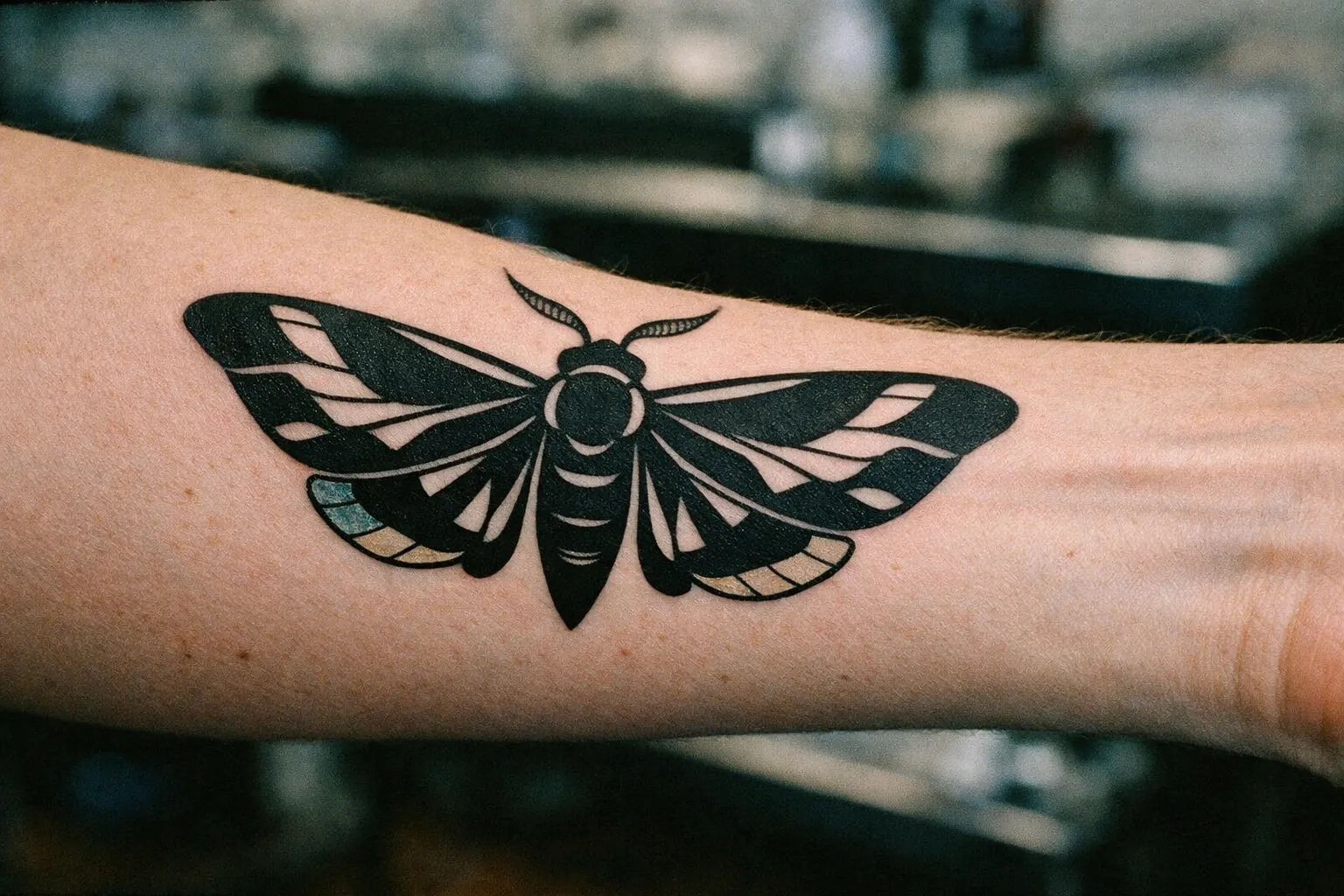
- Blackwork, 5-8 in: solid black wings with the skull picked out in negative space. Reads from across a room. Best on forearm, outer thigh, or back.
- Neo-traditional, 6-9 in: bold outlines, limited palette (deep red, mustard, black), often integrated with daggers, snakes, or candles. Ages well if the artist packs color properly.
- Realism / fine-line, 4-6 in: anatomical accuracy on the skull marking, soft shading on the wings. Higher maintenance - expect a touch-up around year five.
Pitfall: the skull detail crammed into a piece under 4 inches. The marking blurs within a couple of years and you’re left with a generic dark moth. If you want the skull to read as a skull long-term, give it room.
Traditional moth tattoo
The American traditional moth tattoo comes out of the Sailor Jerry lineage. Two technical hallmarks define it: thick black outlines and a limited, saturated color palette - typically red, yellow, green, and black, with sparing blue. Wings are stylized rather than anatomical. Think bold symmetry, clean shape language, decorative elements like banners, daggers, or roses.
Why it works as a moth: the bold outlines lock in the silhouette, so the piece still reads clearly at twenty feet thirty years from now. This is the style that ages best, full stop.
Common pitfall: an artist who doesn’t pack color solidly. Traditional work depends on dense, even saturation - patchy yellow or red in moth wings looks tired within five years. Vet the artist’s healed work, not just fresh photos. Fresh traditional always looks good. Healed traditional tells you whether the artist can actually pack.
Typical sizing: 4-7 in on the forearm, upper arm, or calf. Chest panels run 8-10+ in. Sternum traditional moths are possible but the symmetry has to be exact - a millimeter off-center on a bold-line piece is obvious forever.
Moth tattoo designs worth considering
A short list of concrete moth tattoo designs that actually work, not just “moth + something”:
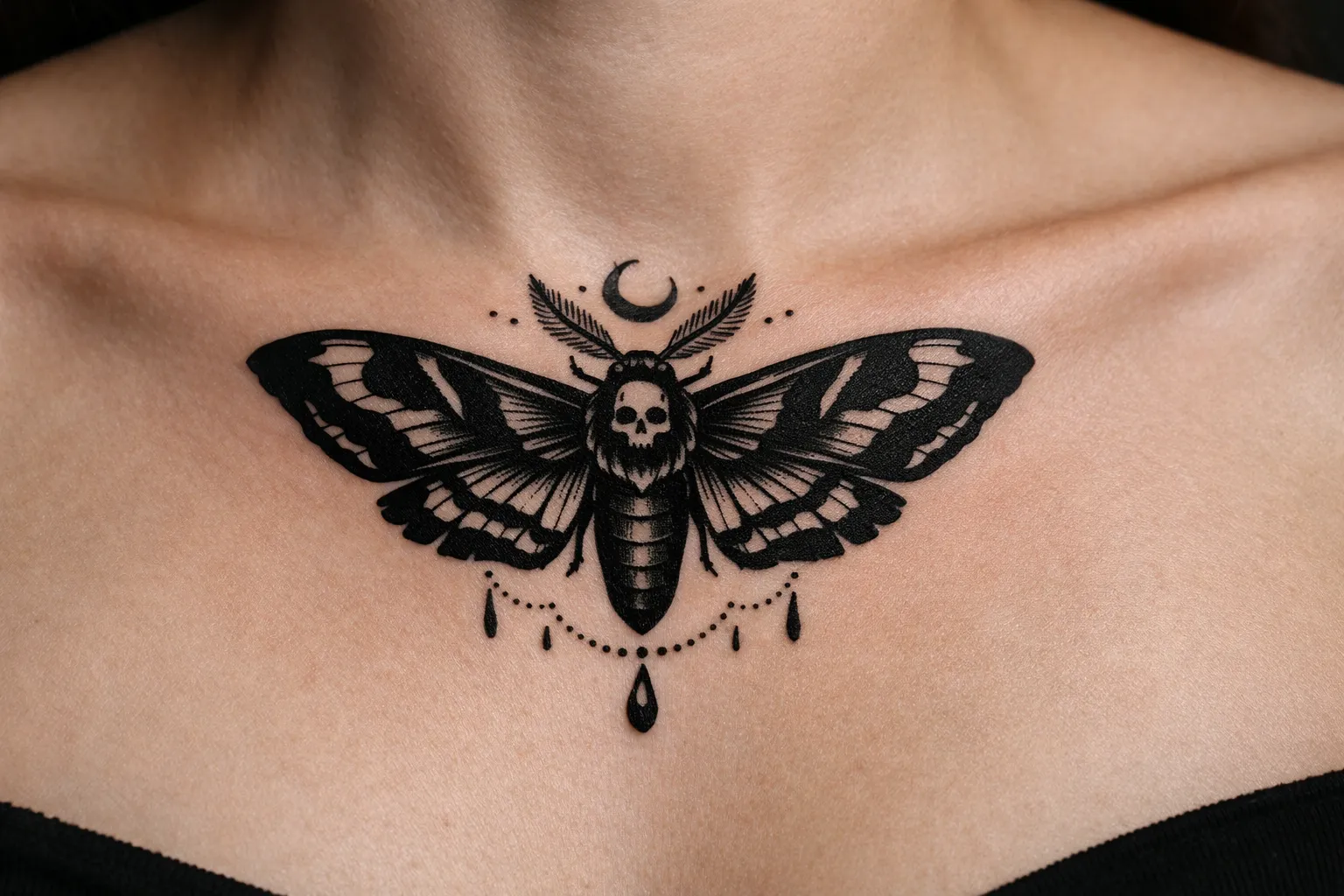
- Luna moth with moon phases across the wings, 6 in sternum - lunar symbolism doubled. Fine-line.
- Blackwork death moth with rosemary or olive sprigs, 5 in forearm - memorial piece. Rosemary = remembrance.
- Traditional moth holding a dagger, 5 in upper arm - Sailor Jerry energy, reads “survived something.”
- Atlas moth across the upper back, 9-12 in - the largest moth species, used when you want scale and presence. Works in blackwork or muted color.
- Tiger moth on the calf, 4-5 in - orange, black, and cream wings for people who want color without going full neo-trad.
- Hummingbird moth on the forearm, 3-4 in - the daylight-flying species. Reads softer, more whimsical.
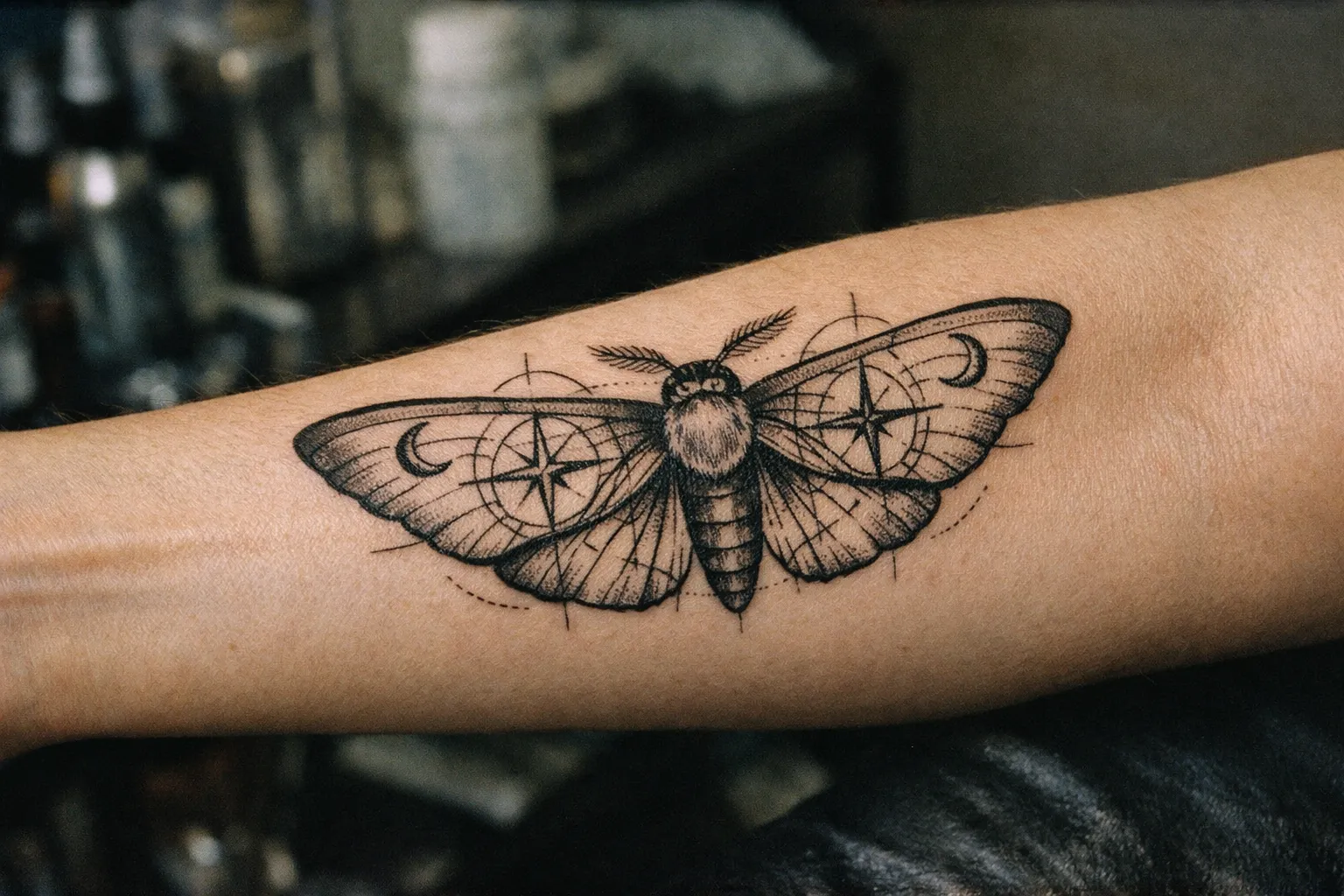
- Dotwork luna with crescent moon, 4 in inner forearm - stippled shading instead of solid black, very fine, ages slowly if the artist knows dot density.
- Moth and butterfly pair, 5-6 in each, symmetrical placement - night and day, two sides of the same transformation.
- Geometric moth with crescent moon framing, 4 in inner bicep - clean lines, minimal shading, fast to heal.
- Watercolor luna, 5 in thigh - pastel washes around a fine-line skeleton. Honest warning: watercolor tattoos fade faster than any other style; expect touch-ups every three to five years.
One placement I’d steer you away from: the wrist. A moth on the wrist looks great fresh and ages badly. The skin flexes constantly and fine wing details blur faster there than almost anywhere else on the body. Inner forearm or back of the upper arm is a better bet if you want something small.
Placement, size, and pain
Moth wings are symmetrical, which means the body wants a centerline. Off-center placements are noticeable in a way that asymmetric designs aren’t.
Best symmetrical placements:
- Sternum (4-7 in) - high pain, ribcage and breastbone.
- Upper back / between shoulder blades (6-10 in) - moderate pain.
- Nape of neck (3-5 in) - moderate, but very visible.
- Lower stomach (5-7 in) - high pain, ages poorly with weight changes.
Asymmetric-friendly placements (moth at an angle, in flight):
- Outer forearm (3-5 in) - low-moderate pain, ages well.
- Outer thigh (5-9 in) - moderate pain, lots of room.
- Calf (4-6 in) - moderate pain.
- Upper arm / shoulder cap (4-6 in) - moderate pain.
Pain ranking, roughly: sternum > ribs > spine > sternum-adjacent chest > inner upper arm > calf > outer thigh > outer forearm. If a sternum luna is your first tattoo, that’s a hard start. Not impossible - just know what you’re signing up for before you book a four-hour session on your breastbone.
A useful low-effort test: print the design at exact size, tape it on, take photos sitting and standing. A lot of people discover a sternum moth disappears under almost every shirt they own, or that a forearm piece doesn’t fit the curve of the arm the way they imagined. I recommend this to every client who’s unsure about placement - it takes ten minutes and it’s saved more than a few people from a decision they’d have regretted.
Cost and time investment
Pricing varies by city and artist tier, but current US averages:
- Small black-ink moth, 2-3 in, simple linework: $80-$200, 45-90 minutes.
- Medium luna or death moth, 4-6 in, shading and some color: $250-$600, 2-4 hours, usually one session.
- Large traditional chest panel or sternum piece, 8-10+ in, color: $600-$1,500+, 4-8 hours, sometimes split across two sessions.
Major-city studios (San Diego, LA, NYC, Chicago) typically run $150-$200/hour for experienced artists, with shop minimums of $100-$150 for small pieces. Custom design fees for personalized symbolism (sobriety dates, LGBT meaning, memorial elements) usually add $50-$150.
Deposits for larger or sensitive-area work (sternum, ribs) commonly run $100-$200, non-refundable, applied to the final session.
Aftercare timeline
Moth tattoos live or die by their fine wing details, so aftercare matters more here than on chunkier designs. A blurred luna tail at year two is almost always a healing problem, not an artist problem.
- Day 1-3: Keep the bandage on as instructed - most artists use Saniderm-style adhesive for 3-5 days. If wrapped in plastic film, remove after 2-4 hours, wash with fragrance-free antibacterial soap, pat dry. Light layer of healing ointment, two to three times a day.
- Week 1: Switch to a fragrance-free moisturizer. Expect flaking and itching - do not pick. Scabs ripped off fine wing lines take pigment with them and leave gaps.
- Week 2-4: Surface healing is mostly done by end of week two. Keep moisturizing. Avoid pools, ocean, saunas, and direct sun until the skin no longer feels dry or shiny.
- Month 2 onward: Skin is fully healed underneath. Daily SPF 30+ or sun-protective clothing over the tattoo is the single biggest factor in how the moth looks in ten years. UV destroys fine linework and color saturation faster than anything else.
Touch-ups: most reputable shops offer one free touch-up within 3-6 months. Take it. Fine-line luna moths in particular often need one minor pass to re-seat any thin lines that didn’t hold on the first go.
Designs and choices to avoid
A common PAA question worth answering directly: which moth-adjacent design choices to skip.
- Micro moths under 2 inches with complex internal detail. The detail blurs within a year. If you want small, keep it geometric or single-weight linework.
- Appropriated sacred symbols layered onto the wings - non-contextualized religious sigils, Indigenous patterns you have no connection to. Many artists will decline, and rightly so.
- Exact copies of Pinterest pins. Most are another artist’s custom work and are copyrighted. Bring references for direction, not for tracing. A good artist will draw you something original from your reference pile.
- Hate symbols disguised in wing patterns. Obvious, but it happens - vet any “rune” or “sigil” suggestion you don’t fully understand before it’s on your skin permanently.
- Trendy script overlays inside the wings. Tiny script on top of detailed wings turns into a smudge within a few years. If you want a word or date, put it adjacent to the moth, not inside it.
- Moth + butterfly + dragonfly + skull + moon + roses in a 4-inch piece. Pick two elements. Three at most. Overcrowded moths are the most common regret I see in this category.
Sensitive placements and studio etiquette
Sternum, ribs, under-bust, and lower abdomen moths are some of the most-requested centerpieces - and the most physically and emotionally exposed sessions to book. A few things worth asking up front:
- Whether the studio offers same-gender artist options on request.
- How draping and positioning are handled during the session.
- Whether a consult is required before booking a sensitive-area piece (most reputable studios require one).
- The non-refundable deposit amount and reschedule policy.
Eat a full meal 2-3 hours before. Skip caffeine that morning - it tightens muscles and makes you shake. Bring water and a snack. Sessions on the sternum or ribs are physically taxing in a way forearm work is not; tapping out at hour three is common and expensive if it means rescheduling.
Machine choice and what to ask your artist
Most clients never ask about this, but it affects how a moth heals - especially the fine wing details.
Rotary vs coil: Modern rotary machines are quieter, lighter, and generally better suited to fine-line and dotwork moths. Coil machines still dominate for traditional bold-line and color packing work. Neither is “better” - they’re tools for different jobs. If you want a fine-line luna with delicate antennae, asking whether your artist uses a rotary tuned for liner work is fair game. If you want a saturated traditional moth, a coil-savvy artist will pack the color denser.
The blowout question: Blowouts - ink spreading under the skin into a blurry halo - happen when the needle goes too deep, often on thin-skinned areas like the sternum, inner arm, and ankle. Ask to see the artist’s healed photos on similar placements, not just fresh. Healed work is the only honest portfolio. If you’re drawn to bird tattoo ideas for the same reasons you’re drawn to moths - freedom, transformation, flight - the same vetting process applies: always ask for healed examples before you book.
Frequently Asked Questions
- What does a moth tattoo mean in LGBT contexts?
- Most commonly: coming out, gender transition, and resilience through a period of hiding. The metaphor of flying toward your own light despite the risk maps directly onto the queer experience. Some people add subtle pride colors to wing gradients; others keep it personal and let the symbol speak only to them.
- What does a moth symbolize in a tattoo?
- Four overlapping themes: self-acceptance, faith, personal transformation, and death. Add intuition and lunar symbolism from the moth's nocturnal nature, and compulsion or surviving a dangerous attraction from the flame association.
- Why are people getting moth tattoos?
- Sobriety milestones, mental health recovery, grief, divorce, gender transition, leaving a religion, and a broader cultural shift toward symbols that honor going through darkness rather than skipping past it. Moths have largely displaced butterflies for clients who want the transformation symbol without the saccharine version.
- What's the difference between a luna moth and a death moth tattoo?
- A luna moth tattoo leans feminine, lunar, intuitive - mint-green wings, long tails, mystical rebirth. A death moth tattoo (death's-head hawkmoth) carries the skull marking and the heavier symbolism - mortality, life-death duality, rebirth through accepting impermanence. Same insect family, very different read on the body.
- Are some tattoos to avoid when designing a moth piece?
- Yes - micro moths under 2 inches with crowded detail, exact Pinterest copies (copyright issues), appropriated sacred symbols layered into the wings, tiny script inside the wing pattern, and overcrowded designs that pack five elements into a small piece. Keep it to two or three elements and give the wing details room to age.
- How long does a moth tattoo take to heal?
- Surface healing is mostly done by the end of week two. Full healing underneath the skin takes about a month. Fine-line work needs the most careful aftercare - no picking, fragrance-free moisturizer, and SPF for life once it's healed.
- Where does a moth tattoo hurt the most?
- Sternum and ribs are the highest-pain placements and also the most-requested for symmetrical moth pieces. Outer forearm, outer thigh, and calf are far more manageable, especially for a first tattoo. Ribcage pain is significantly higher than forearm - not a small difference.