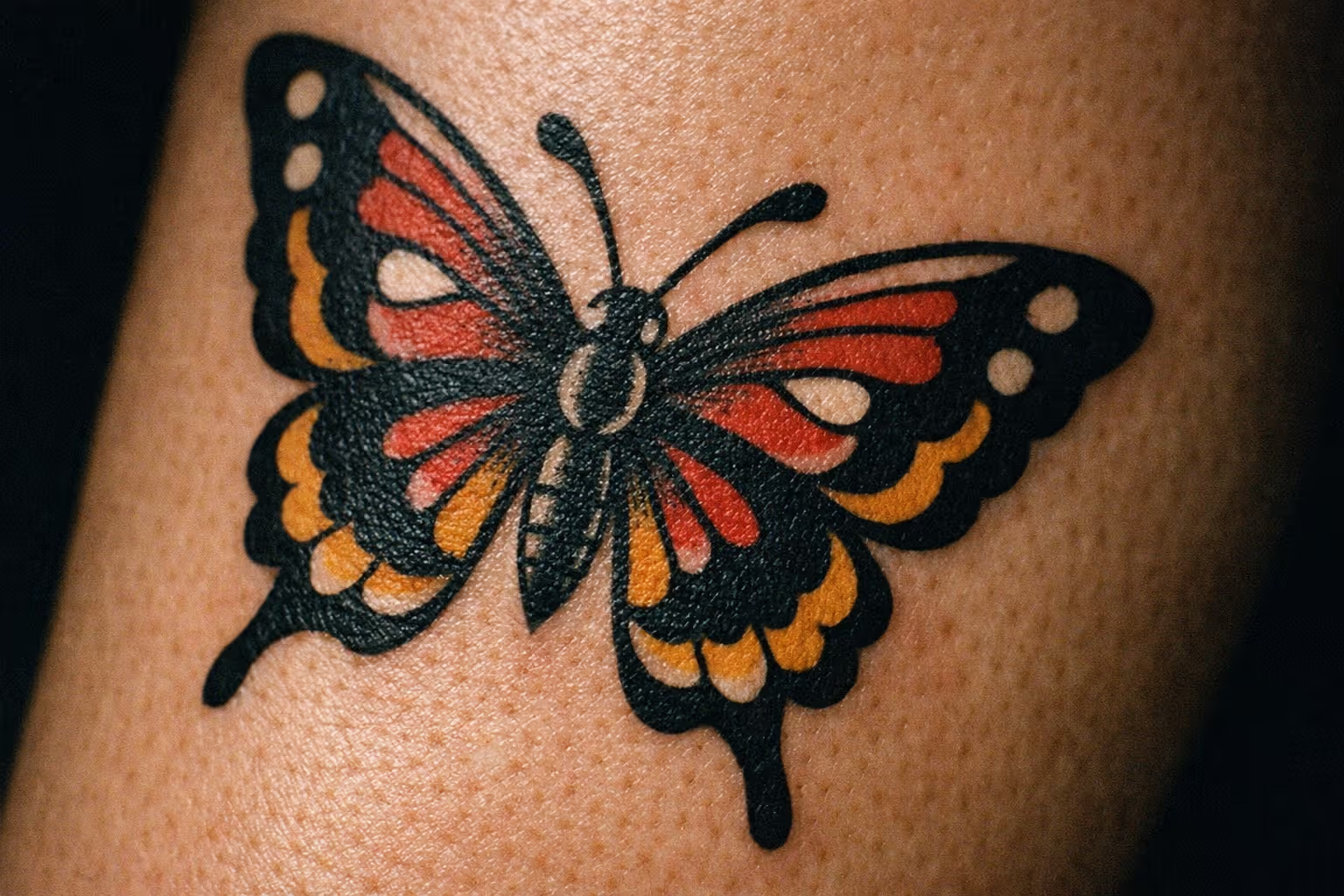
The butterfly tattoo is one of the few motifs that works equally well as a 1-inch wrist piece and a full sleeve centerpiece, which is exactly why it tops studio request lists year after year. I’ve done well over two hundred of them across twelve years, and the design decisions still matter every single time. The same symbol reads completely differently depending on style, size, and placement. This guide covers the full decision stack: what the symbol actually means (including the darker readings most people don’t mention), which styles age well and which fall apart within a few years, where it hurts, and how size changes what’s even possible. By the end, you’ll have enough to walk into a consult with a clear brief instead of a vague “I want a butterfly.”
Butterfly Tattoos at a Glance
✓ Pros
- Scales from 1 inch to full sleeve: one motif, many formats
- Strong symbolic range: transformation, grief, rebirth, freedom
- Works across all major styles (fine-line, neo-traditional, blackwork, watercolor)
- One of the most artist-friendly motifs for cover-up work
- Beginner-accessible at small sizes on low-pain zones
✗ Cons
- Ultra-fine linework on high-friction zones (wrist, ankle) blurs faster than heavier styles
- Watercolor versions require stricter sun discipline to preserve color
- Ribs and spine placements (popular for larger pieces) are among the more painful zones
- Overused motif means design differentiation matters more than with rarer subjects
- Sleeve compositions require upfront planning: wings that don't connect to surrounding elements look disjointed
What a Butterfly Tattoo Actually Symbolizes
A butterfly tattoo most commonly symbolizes transformation, rebirth, freedom, and personal growth, rooted in the insect’s metamorphosis from caterpillar to winged adult. The life cycle runs through four distinct stages (egg, larva, pupa, and adult), which makes it a direct, observable metaphor for change rather than a purely abstract idea. That’s the core of the butterfly tattoo meaning, and it’s why the motif shows up so often on memorial and recovery pieces.
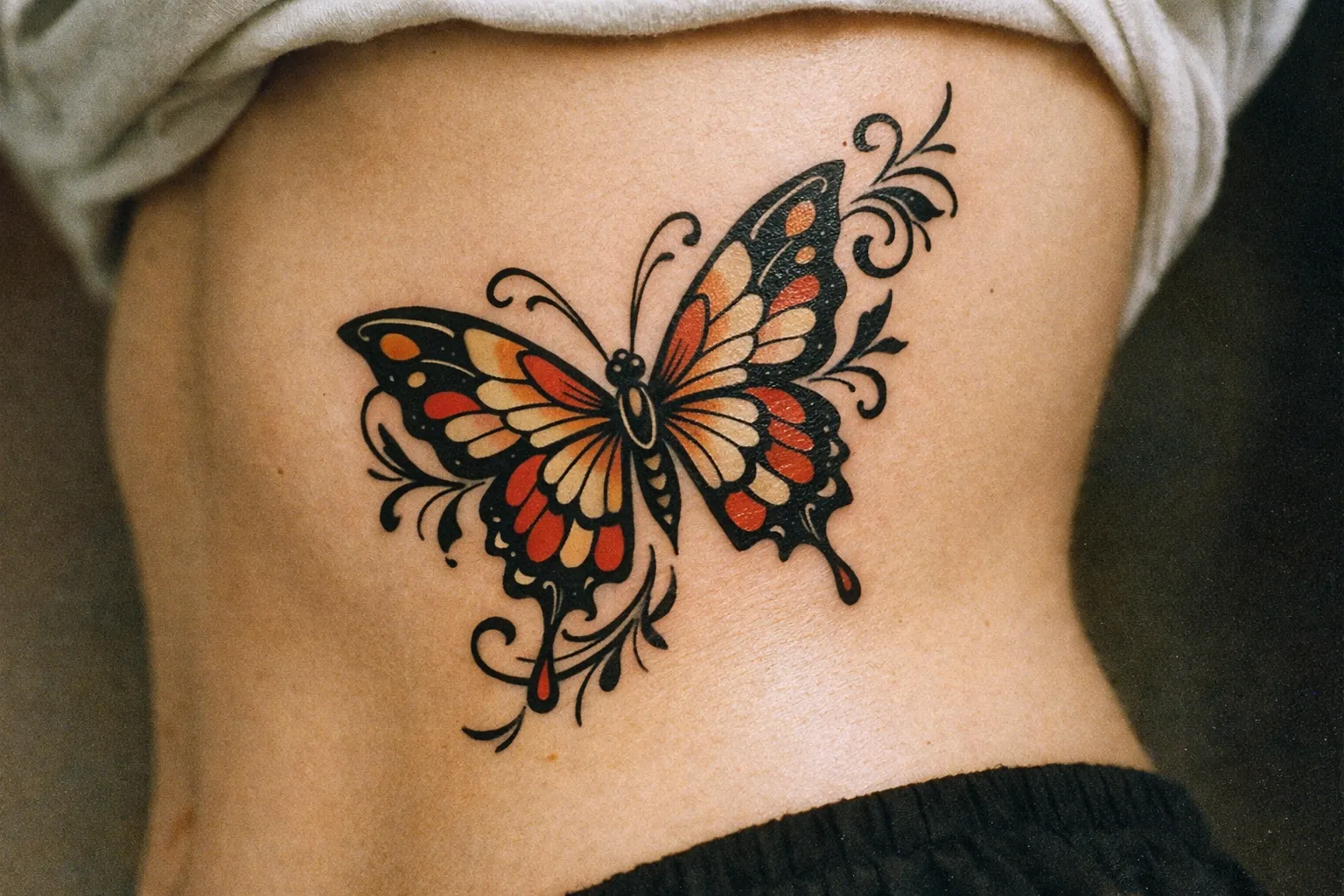
Beyond the four core readings, current guides layer on secondary meanings: hope, resilience, beauty, and new beginnings. These often attach to pieces marking a specific turning point: leaving a job, getting sober, surviving an illness. The symbol carries the weight; the personal reference is what you bring to it.
The transformation reading isn’t a Western invention. In Japanese culture, butterflies have long been used as symbols of the soul, and two butterflies together can represent a couple or marital happiness. In several European folk traditions, a butterfly near a dying person was read as the departing soul. In Mesoamerican art (including Aztec and Mixtec work), butterflies appear alongside warriors and deities as emblems of change, the soul, and the fragility of life. When I ask clients where their reference is coming from, it’s not a philosophical question. It changes the styling. A Japanese soul-butterfly reads very differently from a Celtic transformation symbol, and a good artist will build that difference into the piece.
The Dark Side of the Symbol
The dark meaning of a butterfly tattoo comes from European folklore, where a butterfly seen near the dying or recently dead was interpreted as the soul leaving the body. In modern tattoo culture, that translates to pieces marking grief, loss, or the end of a chapter rather than a hopeful start. A butterfly can be a memorial, a marker of something left behind, or an acknowledgment of impermanence. The symbol is not inherently optimistic, and plenty of people choose it precisely because it isn’t.
What a Blue Butterfly Tattoo Means
A blue butterfly tattoo is associated with spiritual connection, good luck, and wish-granting across several traditions. For women specifically, blue is frequently chosen to represent rare beauty, emotional clarity, or a sense of calm after a hard stretch. The shade does real work here: deep navy reads heavier and more grounded than soft sky blue. Neither has a fixed meaning; the color reinforces whatever personal intention sits behind the piece.
Butterfly Tattoo Designs: Four Styles Worth Knowing
The four butterfly tattoo designs worth understanding are fine-line, watercolor, neo-traditional, and blackwork/tribal, and they age very differently. American traditional and neo-traditional construction, built on bold outlines of roughly 1-2 mm line weight and limited palettes, ages more predictably than ultra-fine or watercolor work because high-contrast edges stay legible over 10+ years. That single fact should shape your choice more than the reference photo you fell in love with.
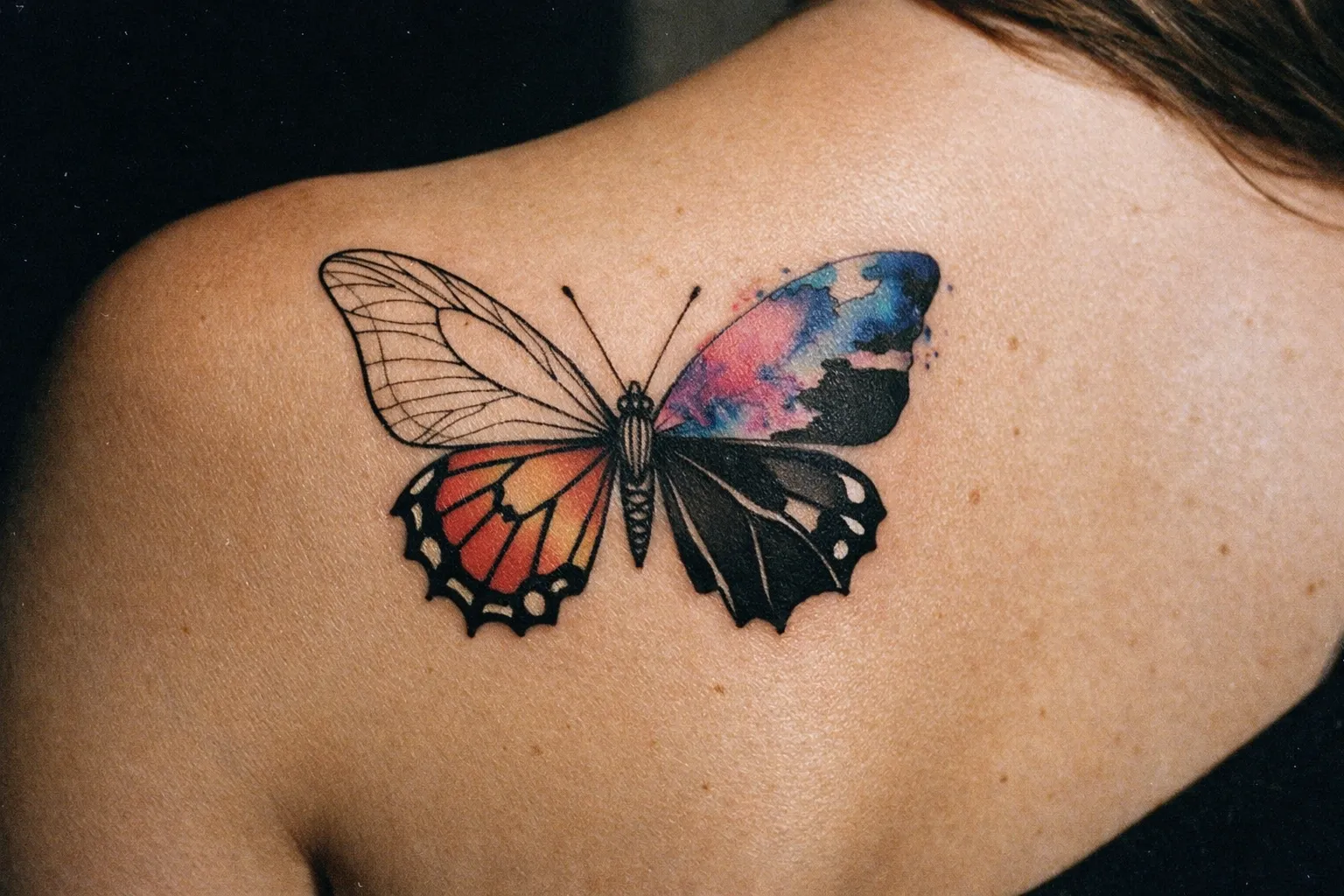
I’ve watched clients come back three years after a hairline-stroke watercolor butterfly on their inner wrist, genuinely surprised at how much it had softened. The piece looked beautiful fresh. It just wasn’t built to last on that placement. Style choice is a longevity decision, not just an aesthetic one.
Fine-Line Butterfly Tattoos
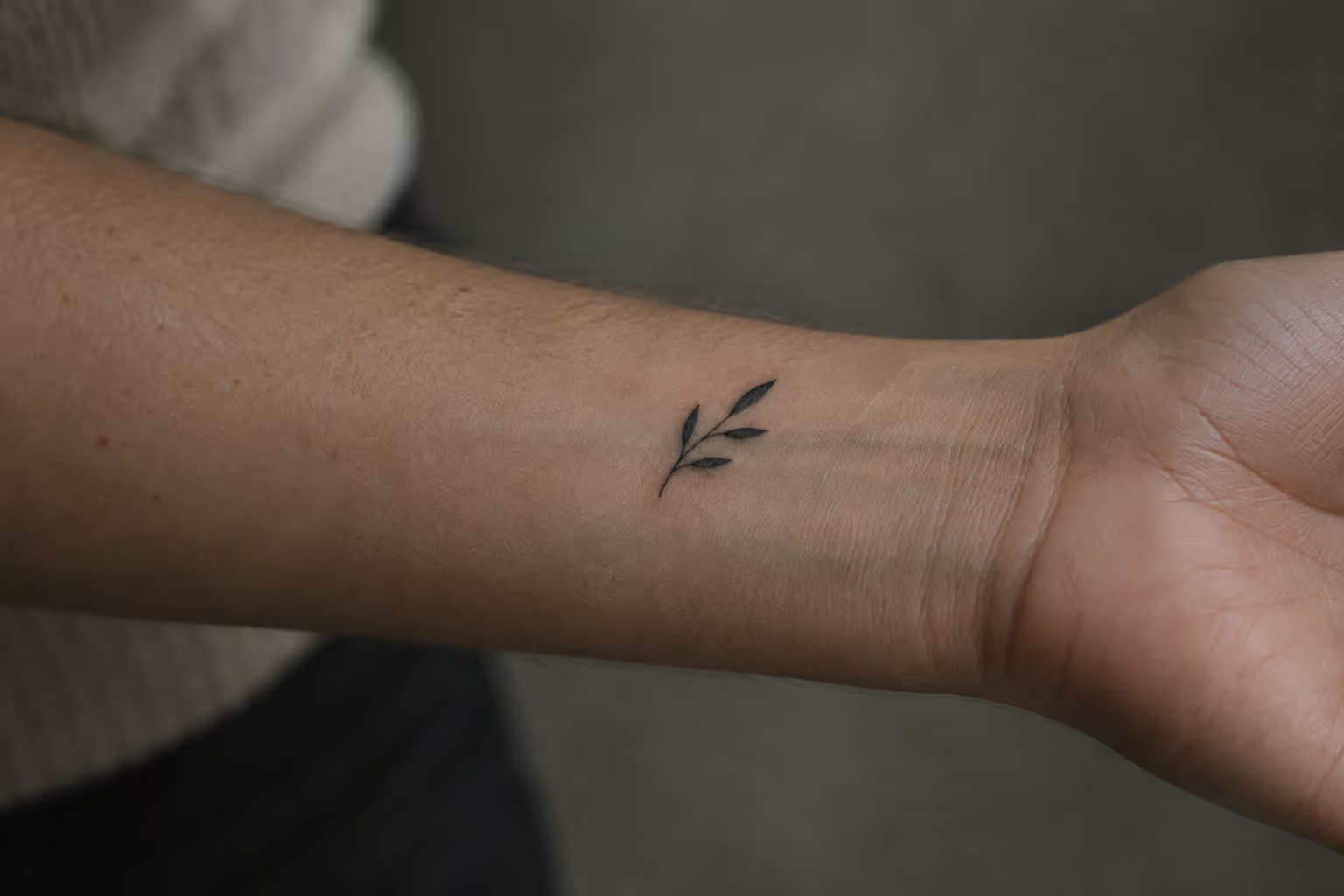
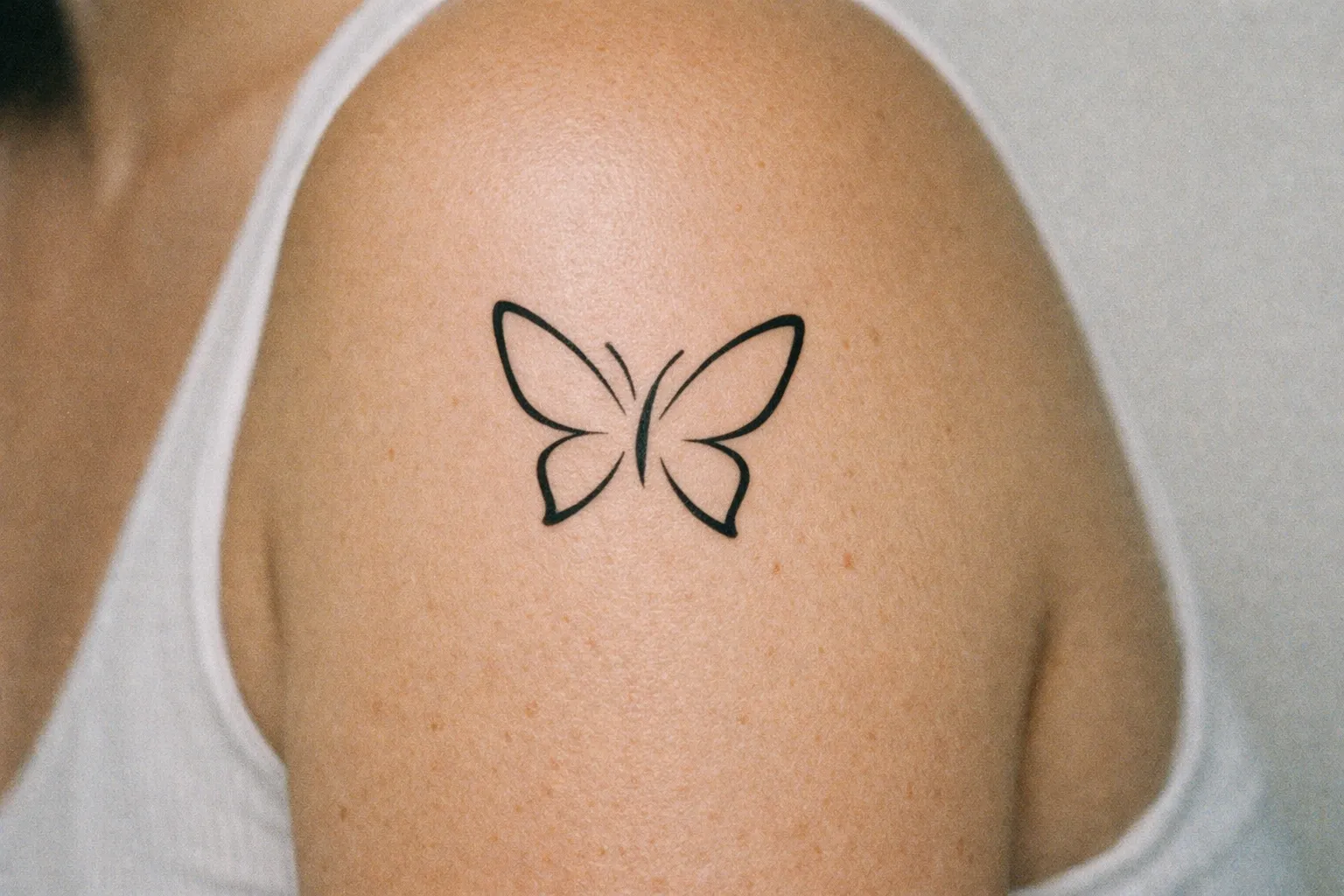
Fine-line and single-needle work uses needles as small as 0.20-0.25 mm, producing hair-thin lines that read as delicate and minimalist. It’s the dominant look for compact pieces in the 2-5 inch range, and it sits well on the collarbone, inner wrist, or behind the ear.
The honest caveat: those hairline strokes blur faster on high-friction areas than heavier linework would. If you want fine-line, put it somewhere low-motion (the shoulder blade or inner bicep), not the wrist you flex all day.
Watercolor Butterfly Tattoos
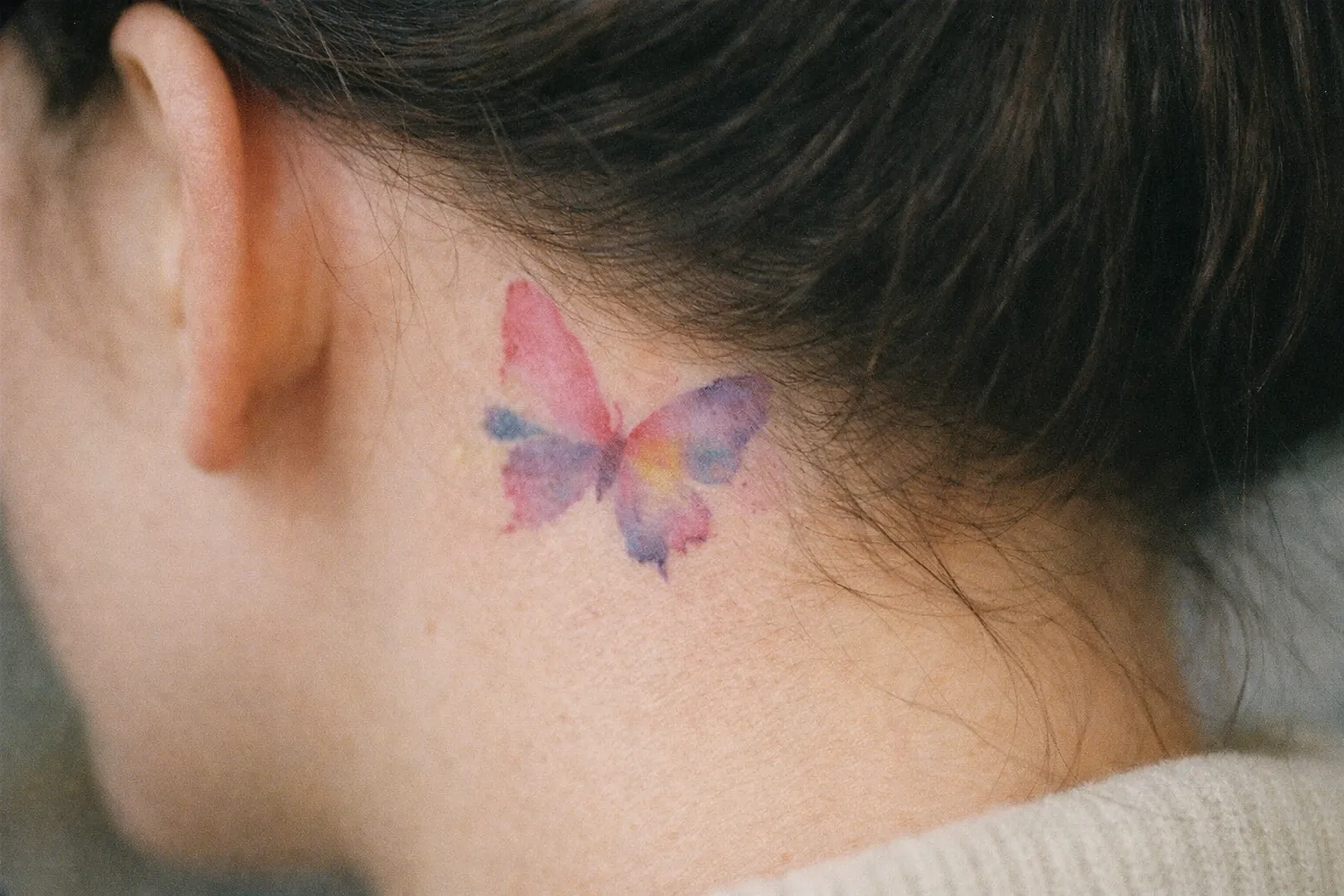
Watercolor butterflies use soft color washes, splash effects, and trailing pigment that runs outside the wing silhouette. Fresh, they’re striking. Over time, they’re the least predictable style to age, because pastel color sits shallower and fades without a dark anchor.
The fix is simple and worth insisting on: a light black outline under the color wash to hold the silhouette. Watercolor reads best at 4-7 inches on the thigh, upper back, or outer forearm, enough space that the color gradient doesn’t collapse into blur.
Neo-Traditional Butterfly Tattoos
Neo-traditional pairs bold outlines with richer interior color blocks, and it ages better than fine-line or watercolor. If your priority is a piece that still reads clearly at ten years, this is the safest color style. Typical size runs 3-6 inches on the forearm, upper arm, or calf.
Tribal and Blackwork Butterfly Tattoos
Blackwork and tribal designs trade softness for graphic contrast and structure. Saturated black fills use higher pigment-load formulations built for solid application, which typically need fewer touch-ups than the light pastels in watercolor work. This style shifts the emotional tone away from “delicate” entirely, good for anyone who wants the motif without the cute read. It holds up well at 4-8 inches on the forearm, calf, or upper back.
For longevity, the ranking is clean: American traditional, defined by its thick black outlines (roughly 1-2 mm) and limited palette, ages most predictably because high-contrast edges stay legible as skin changes; the most common pitfall when artists do it badly is going too heavy on fill color inside those outlines, which muddies the palette and kills the style’s signature graphic clarity. Blackwork comes close behind, neo-traditional next, and pure watercolor without an outline dead last. Keeping detailed fine-line designs within roughly 2-5 inches and watercolor compositions at 4-7 inches or larger helps gradients and wing veining stay legible as skin changes with age.
Butterfly Tattoo Style Longevity Comparison
| Fine-Line | Watercolor | Neo-Traditional | Tribal / Blackwork | |
|---|---|---|---|---|
| Style | Delicate, minimalist | Soft washes, splash effects | Bold outlines, rich colors | Graphic, high contrast |
| Typical Line Weight | 0.20-0.25 mm | Light or no outline | 1-2 mm | Bold, heavy fills |
| Color Palette | Usually black or minimal color | Pastels, soft colors | Richer, saturated colors | Solid black |
| Ideal Size Range (inches) | 2-5 | 4-7 | 3-6 | 4-8 |
| Best Placements | Collarbone, inner wrist, behind the ear, shoulder blade | Thigh, upper back, outer forearm | Forearm, upper arm, calf | Forearm, calf, upper back |
| Longevity | Moderate; blurs faster on high-friction zones | Low without black outline; fades faster | High; holds detail well over 10+ years | Very high; fades least, needs fewer touch-ups |
Small: Size Constraints and Where They Work
A small butterfly tattoo is generally defined as under 3 inches (roughly 7.6 cm) on its longest side, with micro pieces under 1 inch (roughly 2.5 cm) flagged as high-risk for detail loss (5). That size threshold isn’t arbitrary: it’s where fine internal detail starts merging as lines spread slightly over the years.
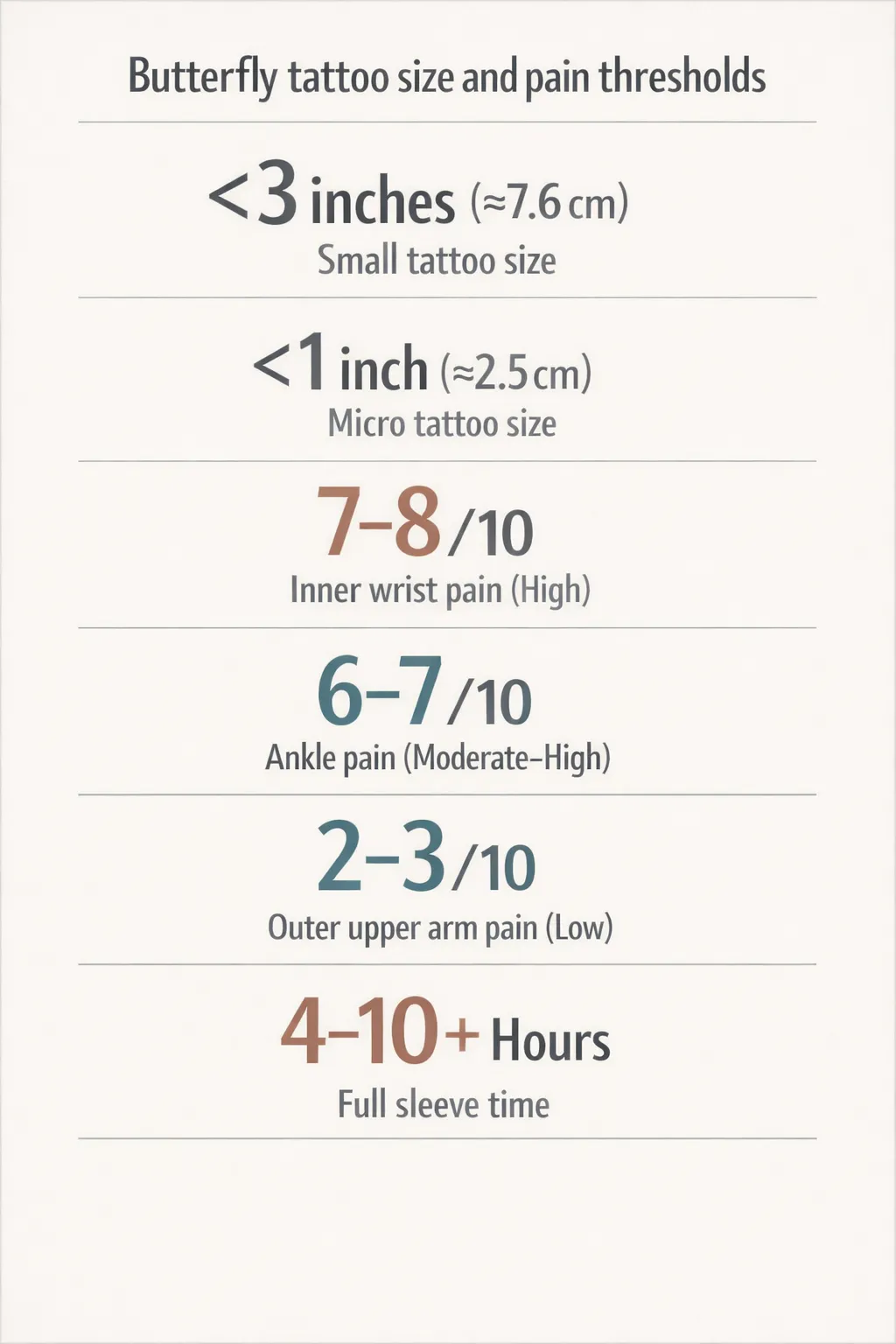 Canonical size thresholds and placement pain levels for butterfly tattoos (small/micro sizes; inner wrist, ankle, outer upper arm).
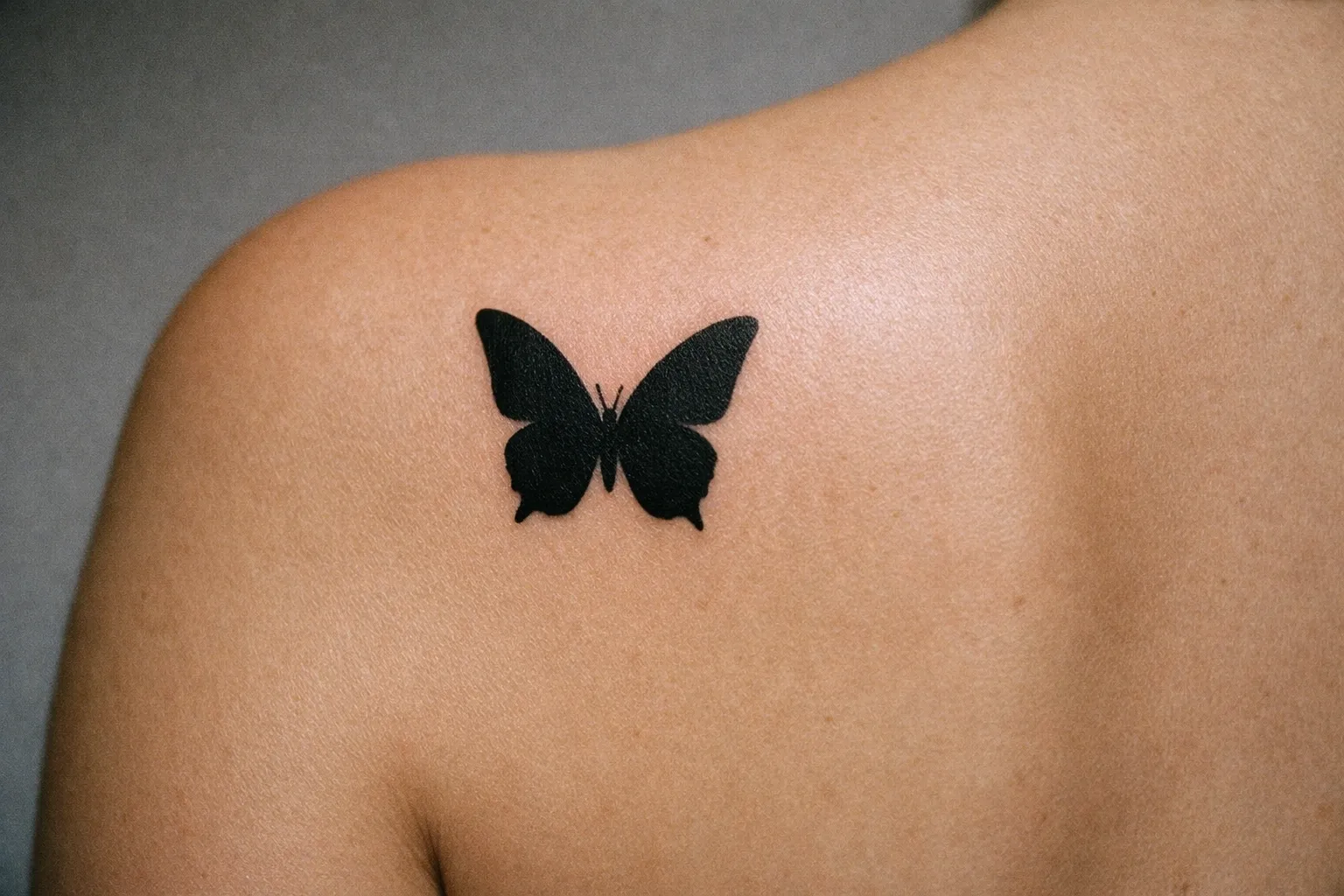
The main problem at small scale is durability. Fine details blur faster when they’re small, and the two most-requested placements (wrist and ankle) are also the most demanding on ink longevity because of constant motion. The practical fix is slightly heavier linework than you think you need. A small butterfly with hairline veining will soften within a few years; a small butterfly with a confident outline holds.
The Wrist and Ankle Trade-Off
Pain charts generally put the inner wrist in the high-pain range (around 7-8/10) and the ankle not far behind (around 6-7/10), while the outer upper arm and shoulder area sit in the low range (around 2-3/10). Those are approximate bands, not fixed values (individual anatomy shifts them), but the direction is consistent across charts. The wrist and ankle give you visibility but cost you more discomfort and faster wear; the outer arm costs you almost nothing on either front but hides more easily under clothing.
Neither is wrong. Just know which one you’re choosing.
Best Small Butterfly Placements at a Glance
- Outer upper arm: lowest pain (around 2-3/10), excellent longevity, best first-timer option; 2-5 in
- Inner wrist: high pain (around 7-8/10), visible, moderate longevity; 1-3 in, session time varies by design
- Ankle: high pain (around 6-7/10), visible, moderate longevity; 1-3 in, session time varies by design
- Behind the ear: moderate pain, discreet, but fast-fading; keep to a clean silhouette
- Collarbone: moderate pain, visible, good longevity; 2-4 in
The lowest-complexity entry point is a small, black, fine-line butterfly on the outer upper arm or shoulder: less painful than wrist or ankle, heals predictably, and gives the artist enough room to keep lines clean. Under 1 inch, drop the veining entirely; at that scale, wing detail blurs and a clean silhouette is the only thing that survives.
Women: Placement Trends and Design Choices
Demand for butterfly tattoos among women clusters around a handful of placements: wrist, ankle, collarbone, behind the ear, sternum, and thigh, each suited to a different size. Before anything else, a caveat worth saying plainly: “butterfly tattoo for women” is market language. The symbol has no gender. Styling, scale, and surrounding elements drive the perceived tone, not the motif itself.
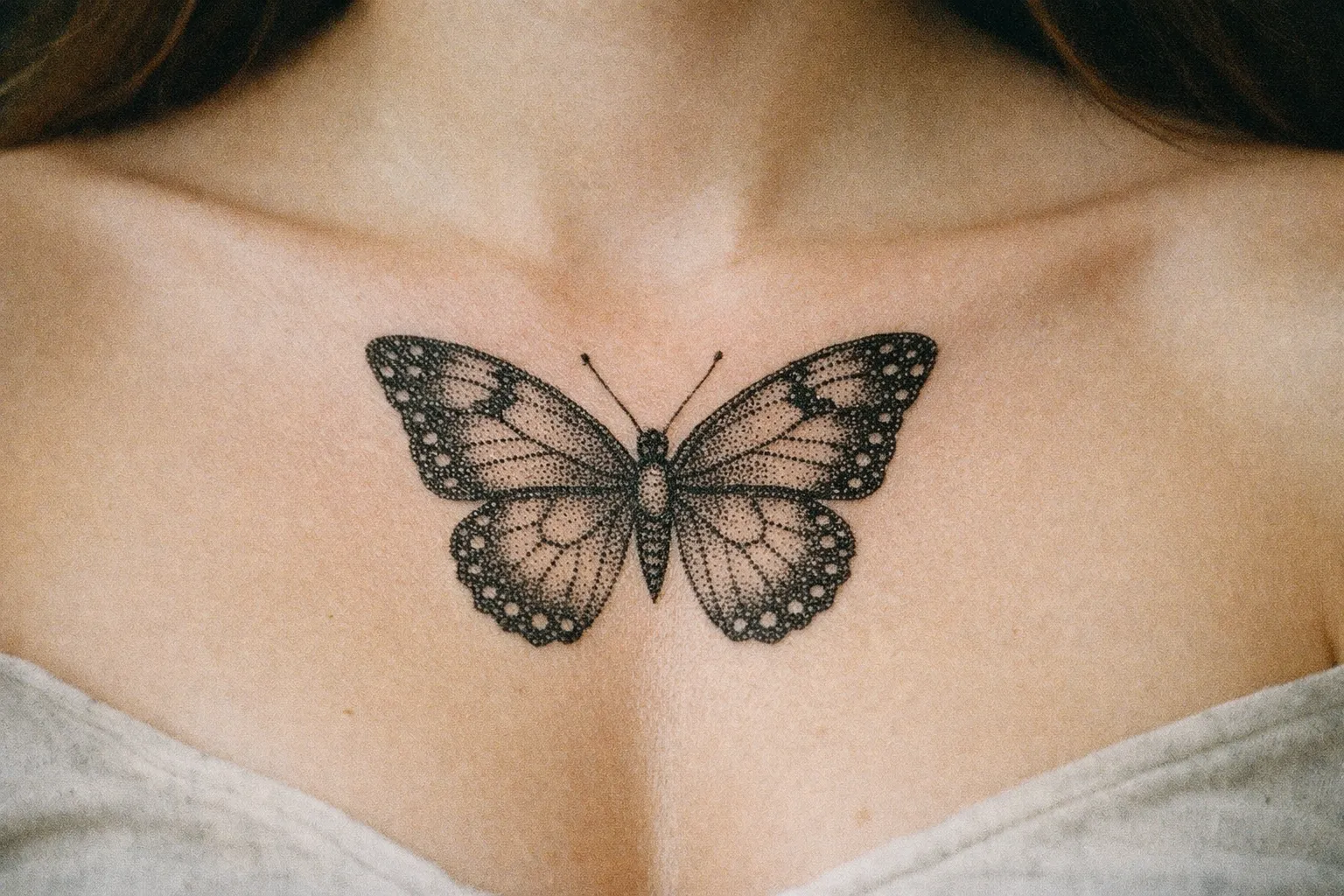
For statement placements, the sternum and collarbone play different roles. A larger butterfly centered on the sternum at 4-7 inches uses the chest’s natural symmetry for a dramatic centerpiece, but the sternum sits among the most painful zones, rated 7-9/10 on most charts. The collarbone works better for smaller, single-wing or silhouette designs at 2-4 inches, where curvature and clothing friction stay manageable.
The thigh is the most forgiving large-format option. Pain charts put it around 3-6/10 (well under the ribs or spine), with 1-3 hour session estimates for medium-to-large pieces. That extra skin surface gives the artist room for wing symmetry and color gradient work, making the thigh a strong home for 5-9 inch designs.
Behind-the-ear and finger placements show up constantly in searches, and both come with an honest warning: thin skin plus high friction means fast fading, and fine-line work in these spots needs touch-ups sooner than an arm or thigh piece would.
One framing worth flagging: butterflies paired with a date, a floral element, or a name are increasingly chosen for grief, recovery, and major life-change pieces, not as a default “feminine” aesthetic. If the piece marks something specific to you, say so at the consult. It changes what the artist builds around the wings.
Building a Butterfly Sleeve Tattoo: Composition and Planning
A butterfly sleeve tattoo lives or dies on composition. The butterfly can’t float alone up an arm, so it needs connecting elements (florals, vines, geometric frames, stars, or script) that carry visual flow from shoulder to wrist. Successful sleeves are pre-designed as cohesive compositions, with a full-arm mockup drawn before the first needle session to avoid the “sticker sleeve” look of disconnected pieces. That planning step is the single most common thing people skip, and it’s the one that wrecks the result.
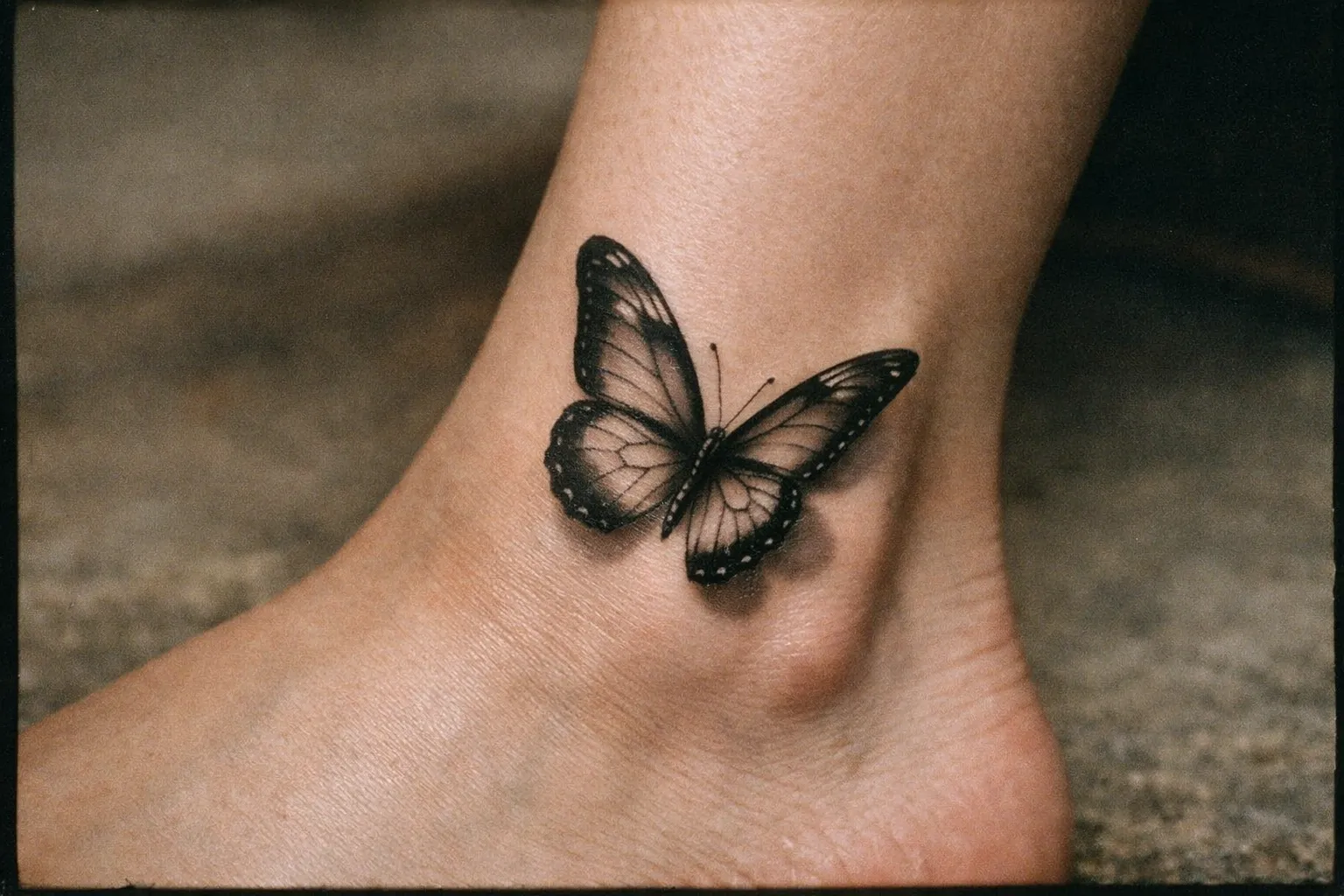
Map the wings, flow lines, and ornamental additions up front. A sleeve built piecemeal (session by session with no overall plan) reads as a collection of separate tattoos rather than one piece. Decide early whether the butterfly is the focal centerpiece on the upper arm or forearm, or a repeating motif scattered through a larger botanical or celestial composition. Those are two very different builds, and mixing them up mid-sleeve is expensive to fix.
On style, neo-traditional and blackwork hold up best at sleeve scale because bold outlines keep individual elements legible as the piece ages. Fine-line sleeves are possible, but only with an artist who genuinely specializes in cohesive fine-line composition; it’s a narrower skill than it looks.
Set realistic expectations on time. A full sleeve is multiple sessions across months, totaling 4-10+ hours of work depending on detail and coverage, and complex color or blackwork sleeves often run well past that. A single medium element (say a 3-6 inch neo-traditional butterfly) commonly takes 1-3 hours on its own. When reviewing artists, look at healed portfolio photos of a completed sleeve, not just fresh individual panels. Fresh work always looks sharper than it will at year two.
What to Bring to Your Sleeve Consult
- Reference images for direction (not to trace)
- A size preference and rough placement map
- A clear style direction: neo-traditional, blackwork, fine-line
- Whether the butterfly is the centerpiece or a repeating element
- Photos of any existing tattoos the sleeve has to work around
Placement Guide: Pain, Size, and How Each Zone Heals
Placement drives three things at once: how much it hurts, how long the session runs, and how well the piece ages. Ribs, spine, and sternum sit among the most painful zones, commonly rated 8-10/10, while the outer thigh, calf, and outer arm cluster in the 2-4/10 range thanks to more fat and muscle padding. Areas with thin skin over bone and dense nerve endings (ankle, ribs, spine, collarbone) score higher because anatomy, not toughness, sets the pain level.
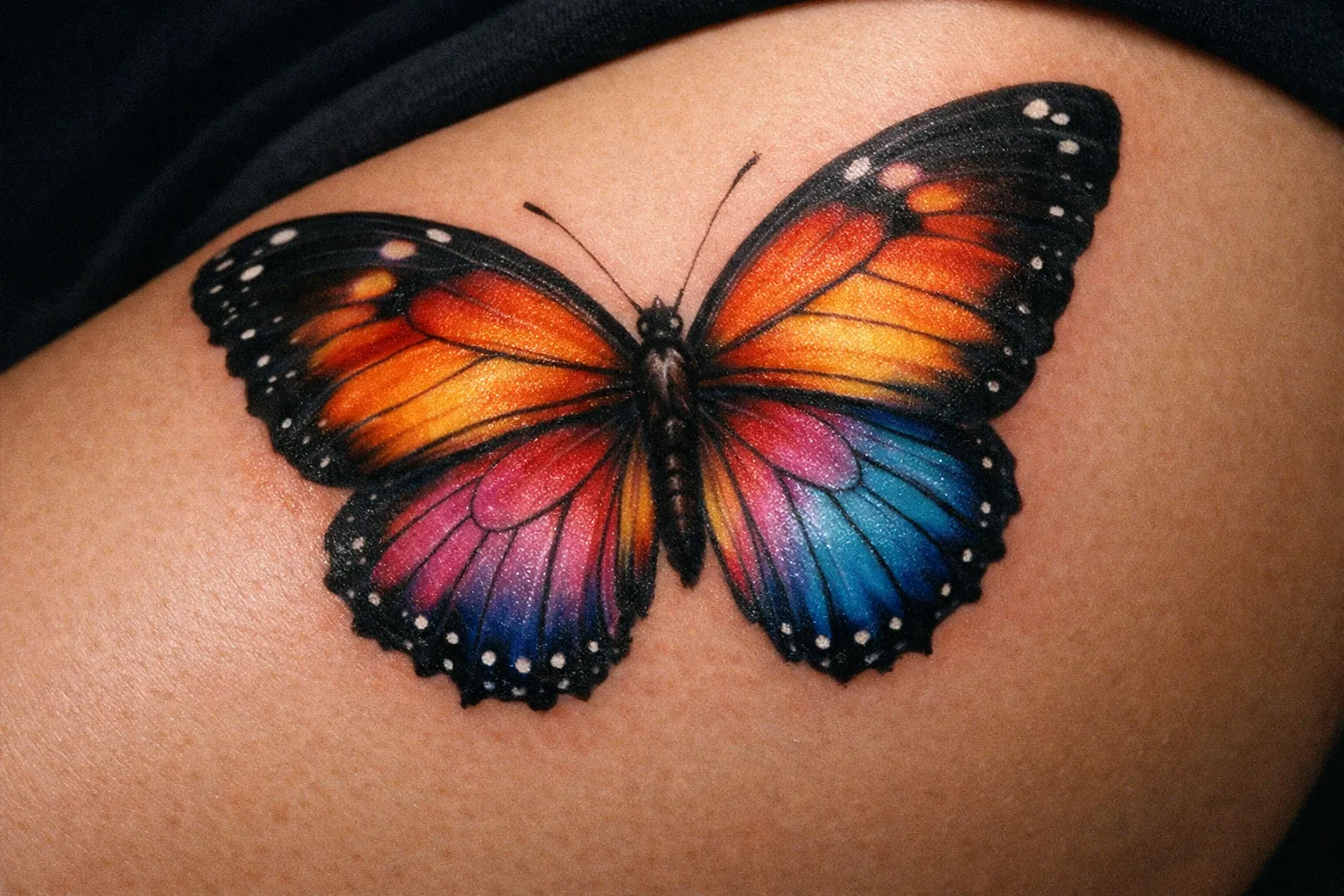
Pain by Placement: What to Expect
For a first tattoo, the outer upper arm and shoulder blade are the most manageable: lower pain than the inner wrist or ankle, predictable healing, and enough flat space for clean linework. The inner wrist and ankle sit in the high-pain range (ribs and spine are worse still, but wrist and ankle are no walk in the park either). Ribs and spine are the hardest to sit through, full stop.
Skin-over-bone spots hurt more because there’s less tissue cushion between needle and bone. That’s the plain mechanical reason, and it’s why the ankle bone outranks the calf every time, and why the sternum outranks the outer chest.
Session time tracks both placement and size: roughly 0.5-1 hour for a small inner-wrist piece, 0.5-1.5 hours for an ankle tattoo, 1-2 hours for ribs, and 1-3 hours for a medium-to-large thigh or shoulder blade design (11).
Which Placements Age Best
High-friction zones (wrist, ankle, finger, behind the ear) wear ink faster because they move and rub constantly. Low-friction zones (shoulder blade, upper back, outer thigh) preserve detail longest. Match size to zone: small (1-3 inches) suits wrist, ankle, behind the ear, and collarbone; medium (3-6 inches) suits forearm, outer bicep, calf, and shoulder blade; large (6+ inches) wants the thigh, upper back, chest, or a sleeve panel.
Butterfly Tattoo Placement Comparison
| Outer upper arm | Inner wrist | Ankle | Collarbone | Ribs | Shoulder blade | Thigh | Behind the ear | Spine | |
|---|---|---|---|---|---|---|---|---|---|
| Pain Level (Relative) | Low | High | Moderate-High | Moderate | Very High | Moderate | Moderate | Moderate | Very High |
| Ideal Size (inches) | 2-5 | 1-3 | 1-3 | 2-4 | 4-8 | 3-7 | 5-9 | 0.5-1.5 | 4-10 |
| Session Time Estimate | 0.5-1.5 hr | 0.5-1 hr | 0.5-1.5 hr | 0.5-1 hr | 1-2+ hr | 1-3 hr | 1-3 hr | 0.5 hr | 1-3+ hr |
| Longevity | Excellent | Moderate | Moderate | Good | Good | Excellent | Excellent | Low-Moderate | Good |
| Best Style Match | Any | Fine-line, blackwork | Fine-line, blackwork | Fine-line, neo-trad | Neo-trad, blackwork | Any | Watercolor, neo-trad | Silhouette only | Blackwork, neo-trad |
Healing Timeline and Aftercare
Surface healing on a butterfly tattoo takes about 2-4 weeks, while deeper skin repair continues for 6-12 weeks depending on size, placement, skin type, and aftercare, meaning the final healed look often isn’t settled until well past the one-month mark. The first two weeks are the most critical window for color retention and line sharpness; sun exposure and soaking during that stretch cause the most damage.
Wrapping varies by artist. A plastic wrap comes off after a few hours; a Saniderm-style adhesive bandage is typically worn 8-24 hours on the first application, with some protocols running up to 3-5 days depending on your skin. Whatever the wrap, the routine afterward is the same: wash gently 2-3 times a day with fragrance-free soap and apply only a thin moisturizer layer. Over-moisturizing or picking at peeling skin between days 4 and 14 is a leading cause of lost color and blurred fine lines, and on a fine-line butterfly wing, pulling a scab pulls pigment with it.
How to Care for a New Butterfly Tattoo
6 weeksFollow this staged aftercare routine to protect your butterfly tattoo's color and line sharpness.
- 1
Days 1-3
Keep the initial wrap on as instructed: a few hours for plastic, up to 3-5 days for Saniderm. When you remove it, wash gently with fragrance-free soap, pat dry, and apply a thin layer of fragrance-free moisturizer or your artist's recommended ointment. No soaking, no swimming, no direct sun.
- 2
Days 4-14
Light scabbing and peeling is normal. Do not pick or scratch. Wash 2-3 times daily, moisturize lightly, and wear loose clothing over the area.
- 3
Weeks 2-4
Surface healing is mostly complete. Colors may look dull or cloudy as deeper layers settle; this is normal. Keep moisturizing and stay out of pools, ocean, and saunas until the skin is no longer dry or shiny.
- 4
Weeks 3-6
Deeper repair finishes and the final look becomes visible. Assess for touch-ups: most reputable artists offer one free touch-up within 3-6 months.
- 5
Long-term
Apply SPF 30+ or use sun-protective clothing whenever the tattoo is exposed. Watercolor and fine-line pieces need this discipline more than blackwork. Staying hydrated and avoiding smoking during healing both improve edge sharpness.
Tattoos to Avoid, and What That Means for Butterfly Designs
The butterfly tattoos that fail are almost always avoidable with a few decisions made upfront. The most common mistake I see is ultra-thin linework on a small butterfly placed on a high-friction zone. Hands and fingers, and feet and ankles, are consistently flagged as high to very high pain zones, not a uniform 7-9/10 across all of them, but consistently among the hardest areas to sit, due to thin skin, dense nerve endings, proximity to bone, and slower healing. All of those factors compound the fast-fading problem from constant movement. Beautiful on day one, blurred by year two or three.
A close second is the pure watercolor butterfly with no black outline. Watercolor without a dark anchor has the least predictable aging and often needs earlier touch-ups than blackwork or neo-traditional pieces. The fix costs nothing extra: a light outline under the color.
The rest of the list is short and practical:
- Too much detail in a sub-2-inch piece. Wing veining, gradient fills, and fine shading all blur at micro scale. Complex detail in tattoos under 1 inch on high-motion areas is disproportionately likely to blur within 2-3 years. Keep micro designs to clean silhouettes.
- Copying a Pinterest image exactly. Reference is for direction, not tracing. An exact copy raises intellectual-property and consent questions, and the original artist optimized that design for someone else’s skin and placement, not yours.
- Placement-style mismatch. A watercolor butterfly on the inner wrist is a double risk: high friction plus a color-heavy style. A blackwork butterfly on the same spot ages far better.
- Sleeve designs with no composition plan. Wings that don’t connect to surrounding elements read as separate tattoos, not one piece.
Frequently Asked Questions
- What does a butterfly tattoo symbolize?
- The butterfly most commonly represents transformation, rebirth, freedom, and personal growth, rooted in the metamorphosis from caterpillar to winged adult. Secondary readings include hope, resilience, and new beginnings. The exact meaning shifts with color, style, and any paired elements: a butterfly with a date reads as memorial; one with florals reads as growth; one in solid black reads as strength.
- What is the dark meaning of a butterfly tattoo?
- In European folklore, a butterfly near the dying or recently dead was read as the soul departing the body. In modern tattoo culture, this translates to pieces that mark grief, loss, or the end of a chapter, not a hopeful beginning. A butterfly tattoo can be a memorial piece, a marker of something left behind, or an acknowledgment of impermanence. The symbol is not inherently optimistic.
- What does a blue butterfly tattoo mean for a woman?
- Blue butterfly tattoos are associated with spiritual connection, good luck, and wish-granting in several traditions. For women specifically, blue is frequently chosen to represent rare beauty, emotional clarity, or a sense of calm after difficulty. The shade matters: deep navy reads differently than soft sky blue. Neither has a fixed meaning; the color reinforces the personal intention behind the piece.
- Where is the least painful place to get a butterfly tattoo?
- The outer upper arm and shoulder blade are consistently the most manageable placements: lower pain than the ribs, spine, inner wrist, or ankle because there's more tissue cushion and fewer nerve endings near the surface. For a first tattoo, these zones also heal predictably and give the artist enough room to keep linework clean.
- How long does a butterfly tattoo take to heal?
- Surface healing takes approximately 2-4 weeks. Deeper skin repair continues for 3-6 weeks. The first two weeks are the most critical for color retention and line sharpness; sun exposure and soaking during this period cause the most damage. The final healed look isn't fully visible until around weeks 4-6.
- Do butterfly tattoos age well?
- It depends entirely on style and placement. Neo-traditional and blackwork butterfly tattoos age best because bold outlines hold the silhouette over decades. Fine-line and watercolor pieces fade or blur faster, especially on high-friction zones like the wrist or ankle. A slightly heavier outline than you think you need is almost always the right call for longevity.
- What size butterfly tattoo should I get?
- Small (1-3 inches) works well on the wrist, ankle, collarbone, or behind the ear. Medium (3-6 inches) suits the forearm, shoulder blade, or calf. Large (6+ inches) needs space: thigh, upper back, or as part of a sleeve. The rule: don't go smaller than the design's detail level can support. A 1-inch butterfly with wing veining will blur; a 1-inch clean silhouette will hold.
- What are some tattoos to avoid?
- In the context of butterfly designs: avoid ultra-thin linework on high-friction placements, pure watercolor with no outline, and micro designs with excessive internal detail. More broadly: avoid exact copies of other people's tattoos, designs chosen in under 24 hours, and placements on hands or fingers if you want the work to last; these areas fade and blow out faster than almost anywhere else on the body.
Three decisions do most of the work before you book: style, which determines how the piece ages; placement, which determines pain and longevity; and size, which determines what detail is even possible. The butterfly is one of the most versatile motifs in tattooing precisely because it scales from a wrist silhouette to a full sleeve, but that same versatility means a vague brief gets you a generic result. Walk into the consult with a style reference, a size in inches, and a placement in mind. That’s the brief. From there, a good artist can handle the rest: line weight, color balance, and how the wings sit on your specific anatomy.