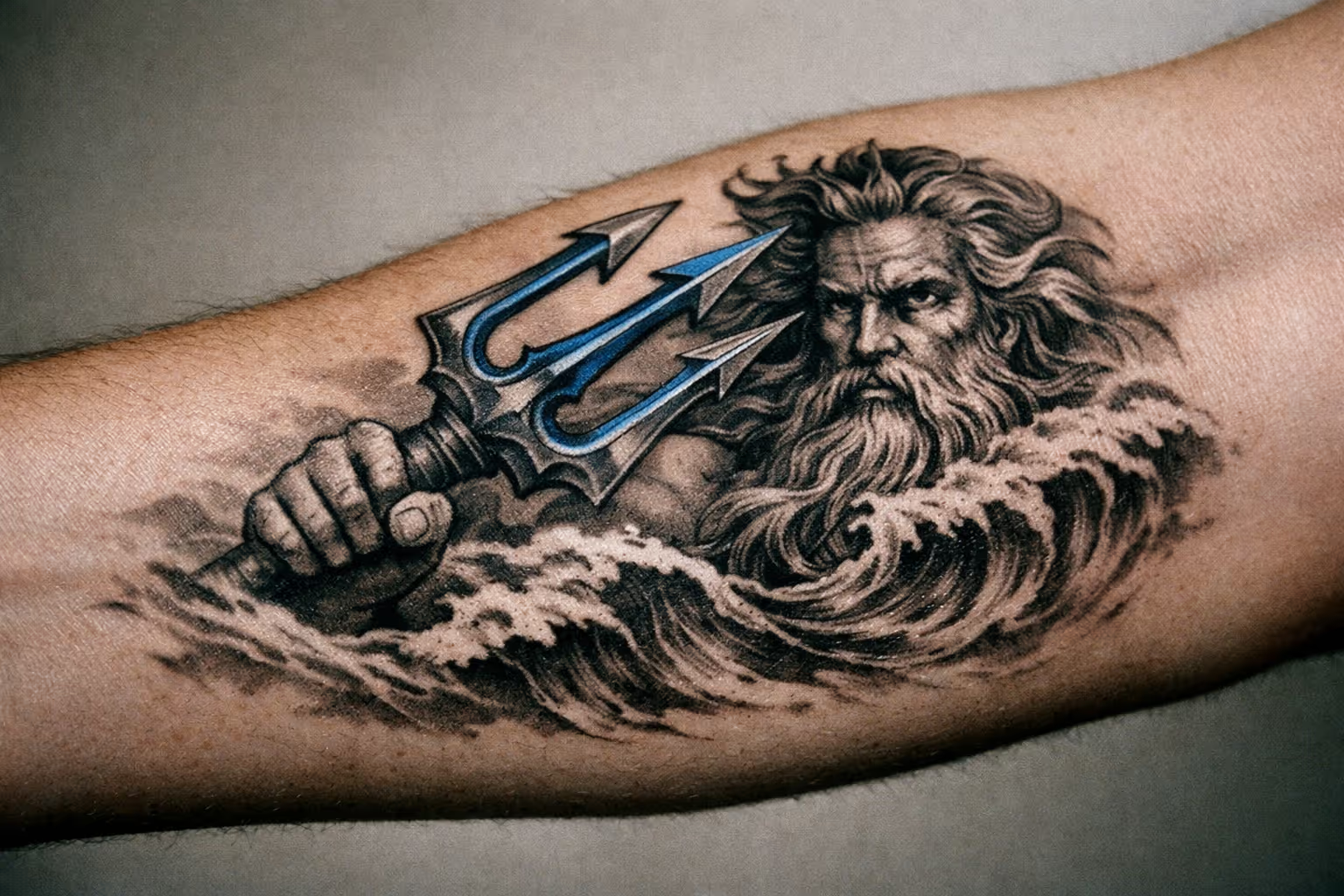
Here’s a fact that catches a lot of people mid-booking: the Vegvisir - the “Viking compass” all over Pinterest - isn’t Viking at all. It first appears in the Huld manuscript in 1880, roughly 800 years after the Viking Age ended. A Viking tattoo built on a symbol that’s secretly Victorian isn’t the end of the world, but you should know before it’s permanent. Here’s how to tell the genuinely old symbols from the invented ones, and pick designs that age well.
Viking Tattoo Meaning: What the Symbols Actually Stand For
Before you pick a Viking tattoo design, you need to know what you’re putting on your skin. Most Norse symbols come loaded with specific meanings tied to mythology, the sagas, or medieval Icelandic magic - and some of the popular ones aren’t Viking at all.
The Helm of Awe (Ægishjálmur)
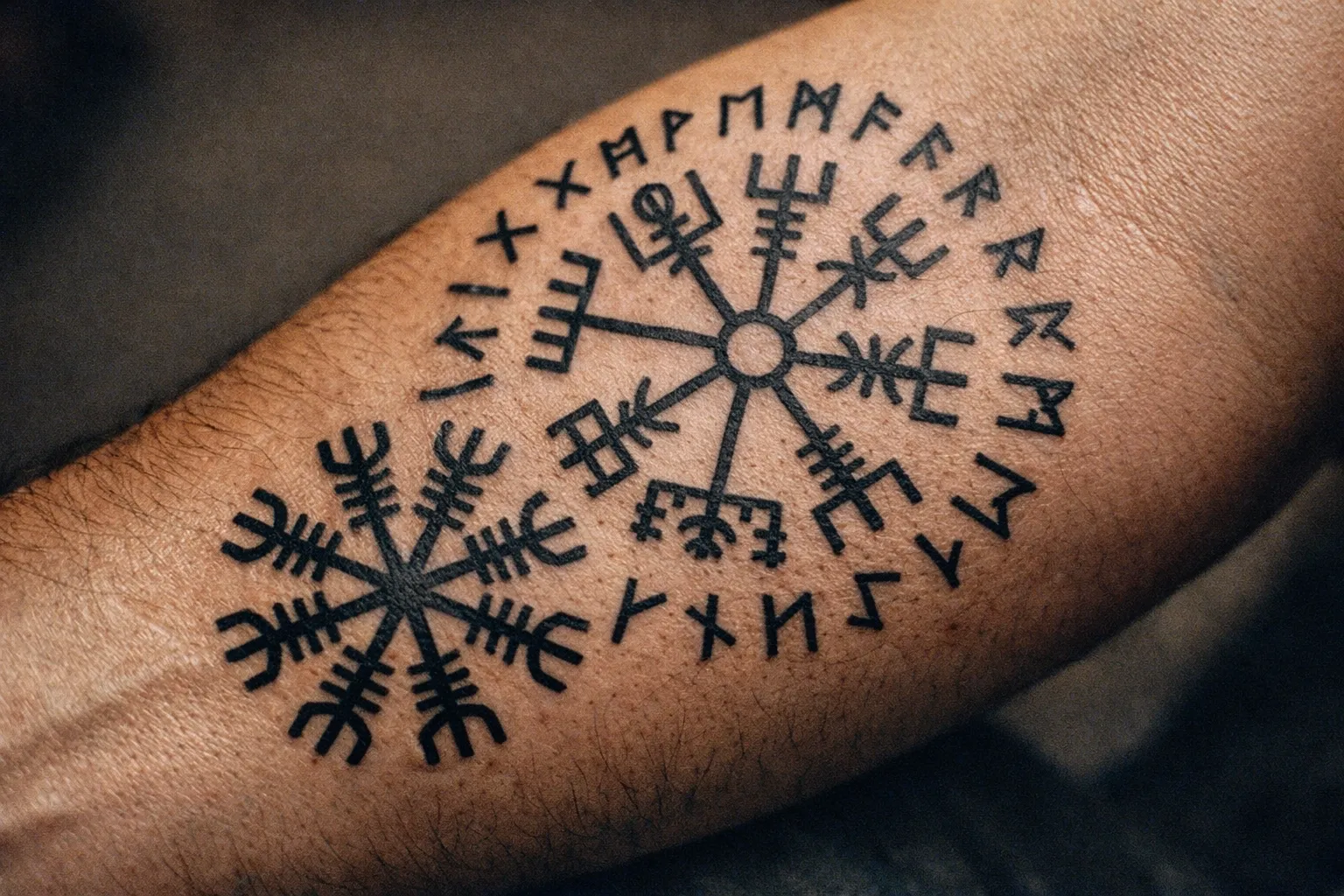
Picture eight tridents shooting out from a center point. The Helm of Awe appears in the Poetic Edda as a kind of mental armor - it was meant to strike fear into your enemies and protect you. But here’s the kicker: the version you see floating around online actually comes from Icelandic grimoires written centuries after the Viking Age ended (3). Still, the meaning holds up - protection and courage when it counts.
I’ve seen this work best on the chest, centered over the sternum at about 4-6 inches, or on the upper back. The back of the hand also works if you want it visible, but keep it at least 2 inches wide - smaller than that and the radiating spikes just become a smudge after a few years.
The Valknut: Odin’s Knot
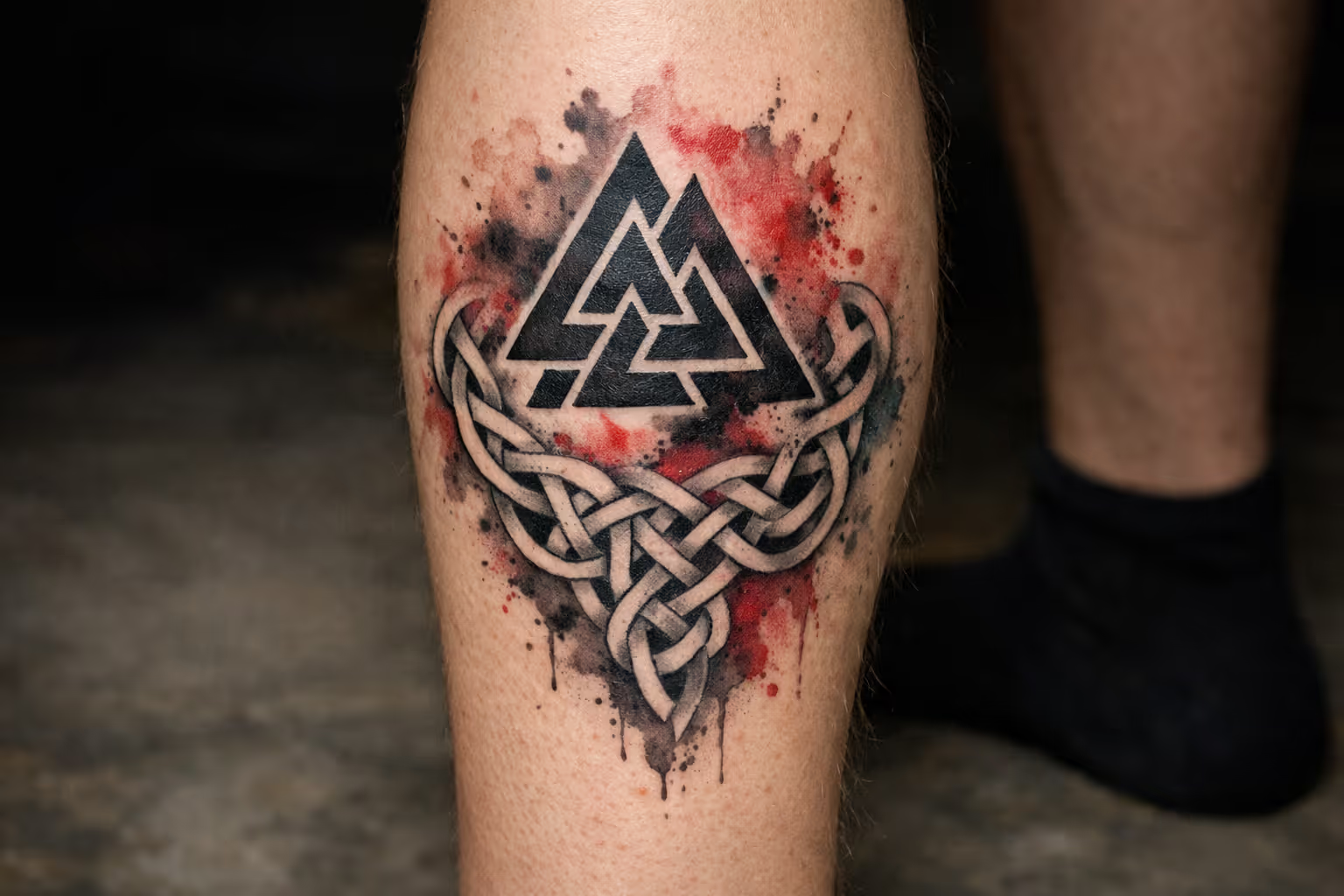
Three interlocking triangles. You’ll find it on Viking Age picture stones like the Stora Hammars stone on Gotland. The Valknut is tied to Odin and slain warriors, often showing up in scenes of death and the journey to Valhalla (1)(2).
Today, it’s taken to mean death, sacrifice, transformation, or devotion to a chosen path. One heads-up: some far-right groups have co-opted the Valknut. That doesn’t mean you can’t wear it, but if it’s somewhere visible, be aware of the potential association.
Good spots are the forearm, calf, or shoulder blade, sized around 3-5 inches. The design demands clean linework - a shaky hand turns those triangles into a tangled mess.
Mjölnir: Thor’s Hammer
Thor’s hammer stands for protection, strength, and defending the human world from chaos (1)(2)(4). Archaeological finds of Mjölnir pendants from the 9th to 11th centuries make this one a solid Viking-era symbol.
It looks strongest at 4-6 inches on the forearm, chest, or upper back. If you want more depth, add lightning or knotwork details - a flat silhouette tends to look like merch.
Vegvisir: The “Viking Compass”
You’ve probably seen this eight-spoke stave called the “Viking compass” on tons of Pinterest boards. Here’s the catch: it’s first documented in the Huld manuscript from 1880, an Icelandic magical text written roughly 800 years after the Viking Age. It’s real Norse-Icelandic folk magic, just not Viking.
That doesn’t kill it as a tattoo. The meaning still works - guidance, not losing your way through storms. Just don’t fall for the “ancient Viking navigation symbol” sales pitch. It holds detail well at 3-5 inches on the inner forearm or back of the neck. If you’re drawn to navigation imagery more broadly, the compass tattoo tradition offers related symbolism around guidance and finding your path.
Yggdrasil: The World Tree
The ash tree connecting the nine realms - Asgard, Midgard, Helheim, and the rest. Yggdrasil stands for interconnection, cycles, and the structure of existence (1)(2). This is one of the few Norse designs that actually benefits from going big.
Think spine piece. A vertical Yggdrasil running from the base of your neck to your lower back, about 25-40 cm tall, lets the branches and roots breathe. Half-sleeves work but compress the symbolism.
Viking Mythology Tattoo Ideas: Gods, Beasts, and Sagas
If you want a viking mythology tattoo that goes beyond stand-alone symbols, start with the cast of characters.
Odin - the Allfather who traded an eye for wisdom. Portraits on the chest or upper back, sized 6-10 inches, suit him. Black and grey realism works best for the beard and missing eye - color tends to distract.
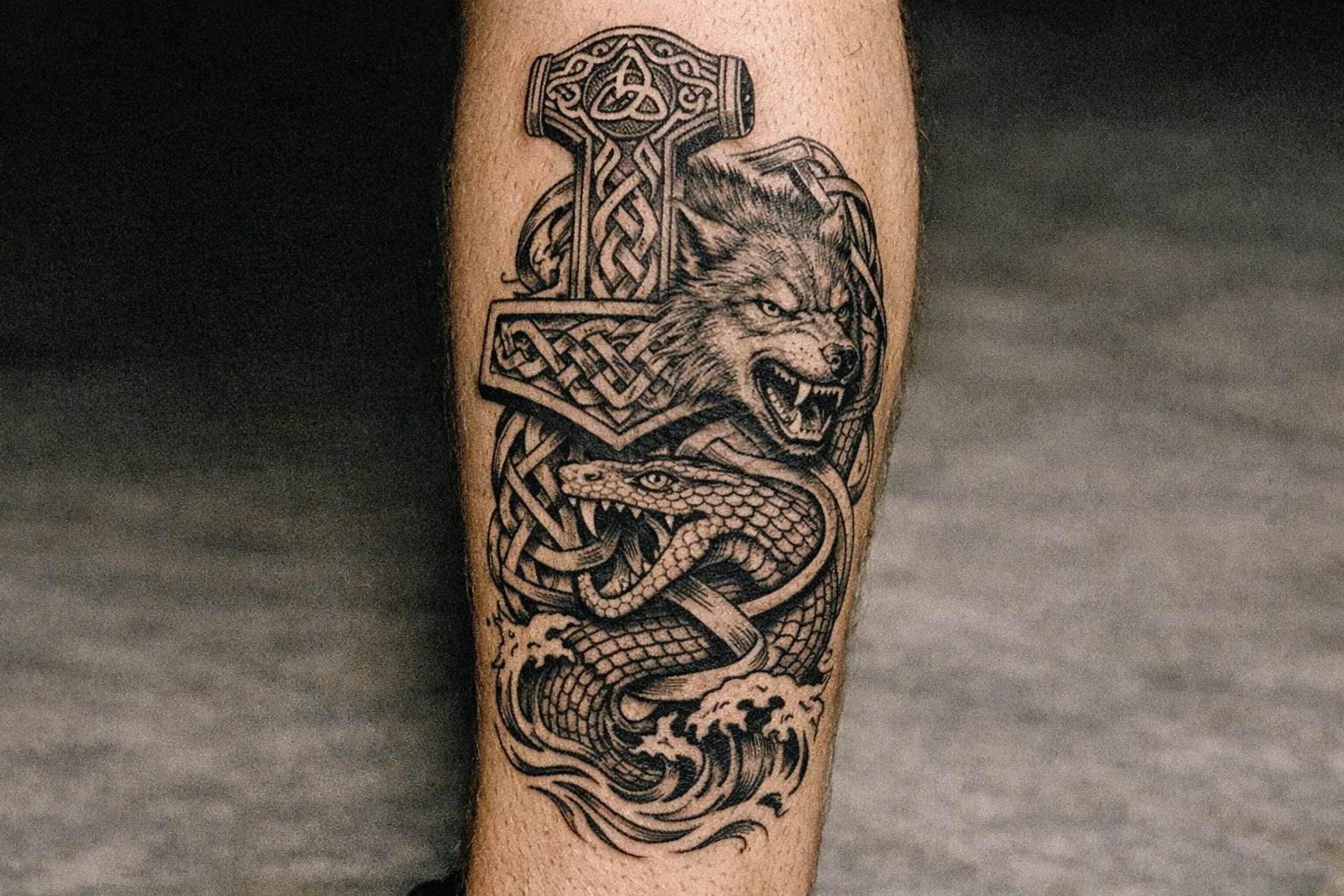
Thor - usually depicted with Mjölnir mid-swing, often battling Jörmungandr, the world serpent, at Ragnarök. Perfect sleeve material.
Loki - the trickster and shapeshifter, eventual antagonist at Ragnarök. Loki tattoos tend to be abstract: faces emerging from flames, chains, or a half-stitched mouth referencing his punishment by dwarves. Not a Marvel reference - treat the source material with respect.
Fenrir - the wolf bound by the gods, destined to break free and devour Odin at Ragnarök. Snarling Fenrir with broken chains reads as raw power and rebellion. Outer forearm, calf, or chest at 6-8 inches works well.
The Valkyries - choosers of the slain. Modern Valkyrie tattoos lean into warrior femininity: armor, winged helmets, swords. The “Valkyrie aesthetic” is heavily mass-produced; if you want something that doesn’t look like every other Pinterest result, push your artist toward Urnes-style line patterns instead of generic fantasy armor.
The Norns - the three fate-weavers (Urðr, Verðandi, Skuld). Underused and visually rich: three figures weaving threads at a well. Great for a back piece if you want something people won’t recognize immediately.
Viking Raven Tattoo: Huginn, Muninn, and the Raven Banner
The viking raven tattoo is a popular pick for good reason. Ravens carry serious mythological weight without needing a lot of space.
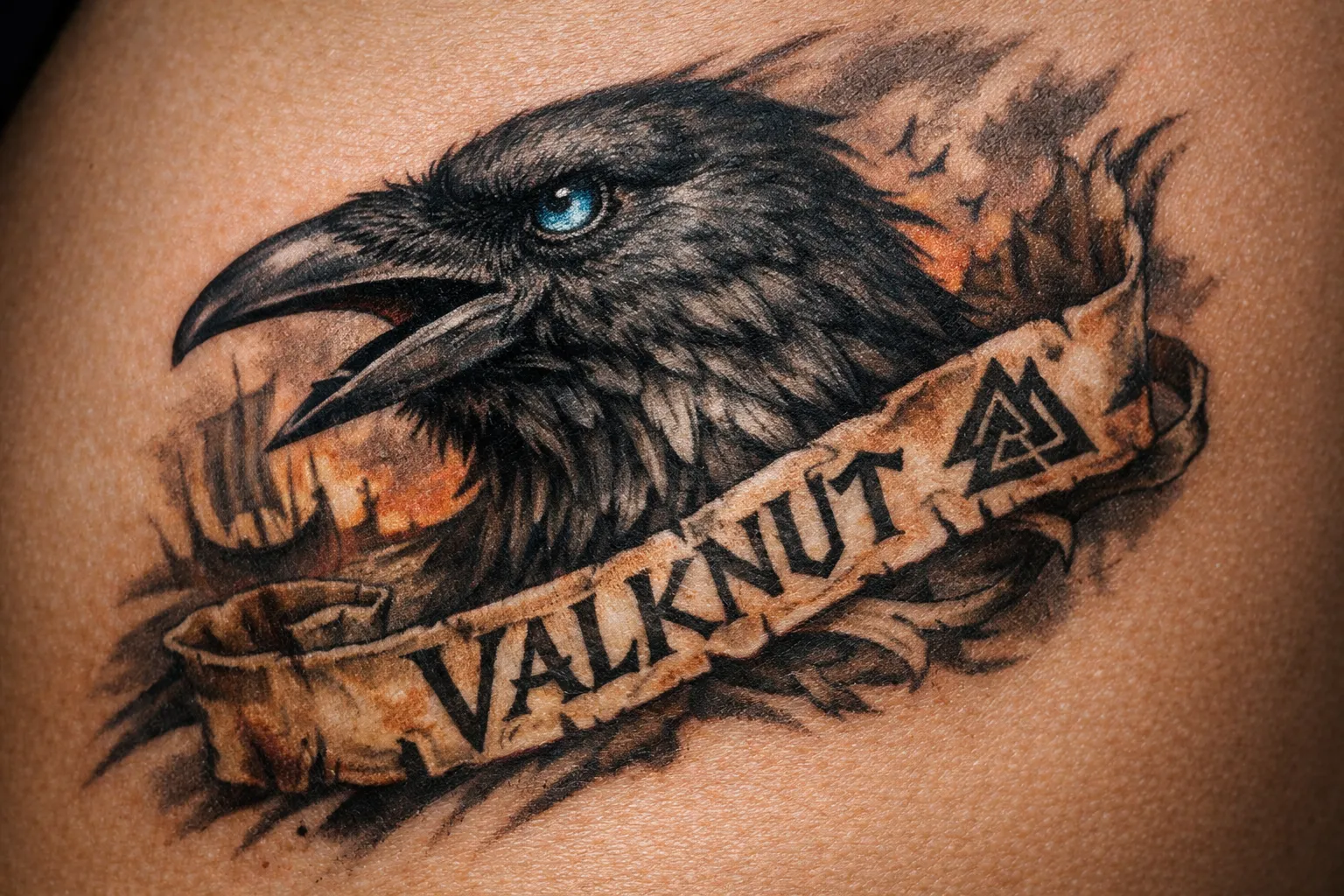
Huginn and Muninn are Odin’s two ravens - “Thought” and “Memory” - who fly across the nine worlds and report back. They work well as a matched pair: one on each pectoral, shoulder blades, or perched on a branch across collarbones. Pairing them creates natural symmetry that a single raven can’t match.
The Raven banner (Hrafnsmerki) was a real war flag flown by Viking leaders, including Ragnar Lothbrok’s sons. Inked, it works as a small heraldic piece on the upper arm or chest, 3-5 inches.
Style-wise, you’ve got three solid directions:
- Black and grey realism - best for naturalistic ravens with feather detail. Needs 5+ inches to hold up.
- Nordic knotwork - the raven’s body filled with Urnes or Jellinge-style interlace patterns. More historically grounded than photo-realism and arguably more interesting.
- Silhouette with rune detail - solid black raven shape with a small rune nearby. Ages well, even small.
Common mistake: a “raven” that’s actually a crow. Ravens have a heavier beak, a shaggier throat ruff, and a wedge-shaped tail. Ask your artist to reference actual ravens - most “raven” photos online are crows.
Norse Tattoo vs Viking Tattoo: The Difference Worth Knowing
People often use “Norse tattoo” and “Viking tattoo” interchangeably, but they cover different ground.
Viking refers to a time period - roughly 793 to 1066 CE - and a specific Scandinavian seafaring culture. A strict Viking tattoo draws from archaeological evidence of that era: runic inscriptions, Mjölnir pendants, picture stones, ship burials, animal-style art (Urnes, Jellinge, Borre, Ringerike).
Norse is broader. It includes the entire Norse mythological and cultural tradition - pre-Viking, Viking-era, and post-Viking Icelandic and Scandinavian folk magic. The Vegvisir, Helm of Awe, and most bind runes fall into this broader Norse category, not strict Viking (3).
If historical accuracy matters, ask your artist to root the design in actual Viking Age art styles (Urnes interlace, Jellinge animal forms, runestone layouts) instead of generic “Pinterest Norse.” A Norse tattoo done in genuine Urnes style is rarer, more interesting, and less likely to look like everyone else’s.
Runes and the Old Norse Language on Skin
Runic tattoos are popular Viking-adjacent designs - and often misspelled.
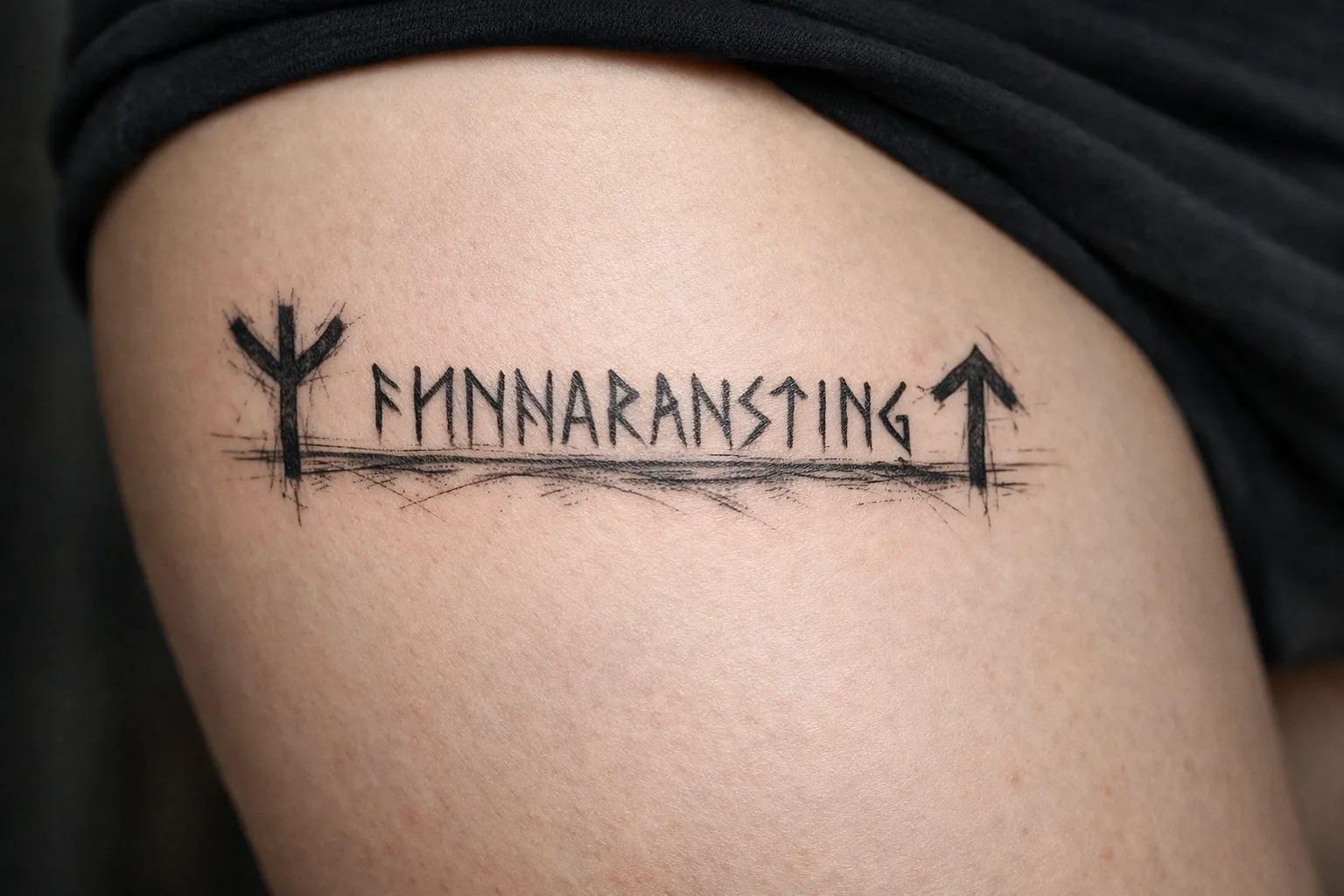
The Elder Futhark (24 runes) was used roughly 150-800 CE - pre-Viking. The Younger Futhark (16 runes) is what actual Vikings used from about 800 CE on. If you want historical accuracy, go with Younger Futhark. Most rune charts online show Elder Futhark because it has more characters.
Don’t just transliterate English letter-by-letter into runes. Old Norse and English don’t map one-to-one. “Ek elska þik” is the reconstructed Old Norse for “I love you,” a popular matching tattoo phrase in Younger Futhark. But double-check spelling with at least two scholarly sources or someone fluent in Old Norse before committing. Cover-ups on runic tattoos are pricey and rarely clean.
Bind runes - combining multiple runes into one symbol - are a real tradition, but many “ancient bind runes” floating online are 20th-century creations. That’s fine if you like the design, just don’t pretend it’s a thousand years old.
Placement: Where These Designs Hold Up on the Body
The symbol matters, but placement decides if your tattoo still reads in five, ten, or twenty years.
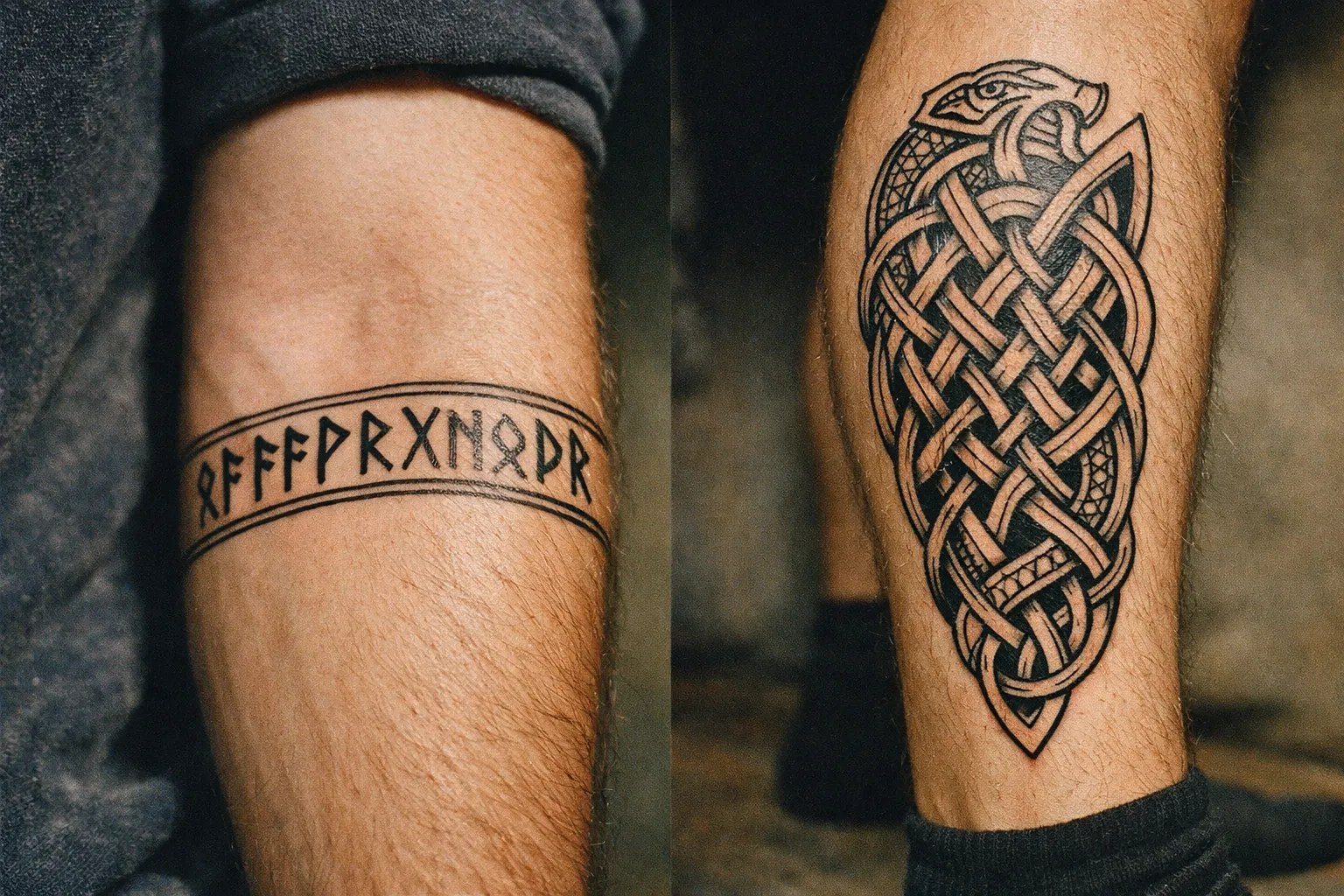
Sleeve and Forearm
A Viking sleeve gives you room for a story: Odin on the shoulder, Yggdrasil down the bicep, ravens near the inner elbow, Mjölnir on the forearm, runes around the wrist. Plan it as one composition with your artist - don’t just bolt random Norse symbols together. Budget $1,500-$4,000 across 6-15 sessions with a solid artist. Hourly rates run $150-$250 in major US and European cities.
Chest and Back
The chest suits large central pieces - Mjölnir, Helm of Awe, Valknut, or Odin’s portrait. The back gives space for full mythological scenes: Ragnarök, Yggdrasil, Baldr’s death. These are 20-40+ hour projects.
Spine
Vertical only. Yggdrasil from neck to lower back is the obvious pick; a column of runes down the spine is the minimalist take. Spine pain outpaces forearm pain - the vertebrae are close to the skin and nerves react. Expect $600-$1,500 over multiple sessions.
Neck (Front, Side, Back)
Highly visible. Small Vegvisir or Helm of Awe on the back of the neck (2-3 inches) is common. Runes down the side fade noticeably within 5-7 years - plan for touch-ups every few years. Front-neck pieces are bold and affect job interviews and first impressions, fair or not.
Hand: Palm, Finger, Knuckle
Single runes across knuckles, tiny Mjölnir on the back of the hand, or a Valknut on the inner finger. Hand tattoos fade and blow out faster than anywhere else - expect touch-ups every 1-3 years. Palm tattoos almost never hold; skin sheds too fast. If you want a hand piece, size it so you can re-line it later without losing the design.
Sternum
Centered Valknut, Helm of Awe, or Mjölnir at 4-6 inches works here. Pain is rough - sternum > ribcage > forearm - but the placement frames chest pieces nicely.
Cost, Time, and What to Expect at the Studio
Here’s what you’ll pay in 2025-2026:
- Small rune, finger Mjölnir, or 3-5 cm Vegvisir: $80-$200, 1-2 hours
- Forearm Valknut, raven, or Mjölnir (10-15 cm): $250-$600, 3-5 hours
- Half-sleeve Norse scene: $600-$1,500, 6-15 hours across 2-4 sessions
- Full Viking mythology sleeve or back piece: $1,500-$4,000+, 20-40+ hours over 5-10 sessions
- Top-tier artists in NYC, LA, London, Berlin: $150-$250/hour
Healing follows a standard timeline. Day 1-3: keep the wrap on the first night, then wash twice daily with fragrance-free soap and apply a thin layer of fragrance-free moisturizer or healing balm. Week 1: expect peeling and itching - do not pick. Weeks 2-4: the surface looks healed but deeper layers are still settling. Avoid soaking (pools, hot tubs, ocean) for at least three weeks, and use SPF 30-50 sun-protective clothing or sunscreen on healed Viking tattoos forever. Heavy black ink plus direct sun is how crisp linework turns into a fuzzy bruise. For a full breakdown of what to expect during recovery, the tattoo aftercare guide covers each healing stage in detail.
✓ Pros
- Rich historical and mythological symbolism with deep cultural roots
- Wide variety of motifs suitable for different placements and sizes
- Strong visual styles from realism to knotwork and silhouette
✗ Cons
- Some symbols have modern extremist associations requiring caution
- Fine details can blur or fade quickly on small or high-movement areas
- Pain and healing vary widely by placement, with some spots very sensitive
Viking Symbols to Avoid (Or At Least Understand Before Getting)
This is the part most “best Viking tattoo” lists skip. It matters.
- The Sonnenrad (Black Sun): twelve runes radiating from a center, often confused with the Helm of Awe. Sonnenrad is not a Viking symbol - it was designed for the SS and features in the floor of Wewelsburg Castle in the 1930s. It’s a recognized hate symbol. Avoid (3).
- The Othala/Othila rune (ᛟ): a genuine Younger Futhark rune meaning “ancestral homeland” or “heritage.” Also adopted by neo-Nazi groups, especially in its angular variant. Wearing it is a personal call, but know the modern association before you commit.
- The “Tyr” rune as a stand-alone arrow: historically fine but used as a Nazi paramilitary insignia. Context matters - in a runic inscription it reads differently than alone.
- Generic “Aryan” Viking iconography: if a design source sells Norse art with white-nationalist branding, the symbols might be fine but the style is loaded. Find better references.
None of this means Norse symbols are off-limits - it means you need to know what you’re putting on your body and be ready to explain it.
Cross-Style Collections: Viking Alongside Other Mythologies
Many collectors don’t stop at one pantheon. If you’re planning a long-term project, here’s how Viking work pairs with others.
Japanese irezumi. The bold black outlines and flowing composition of traditional Japanese tattoos can absorb Norse motifs surprisingly well - Jörmungandr as an irezumi-style serpent across the back is a striking hybrid. The key is committing to one structural language; don’t mix Japanese cloud and wind patterns with literal Viking knotwork in the same piece unless your artist knows both styles well.
Greek mythology. Odin and Zeus, Valkyries and Nike, Yggdrasil and Mount Olympus - collectors often put these on opposite limbs or panels. Stylistic consistency matters more than the pairing.
Dragon tattoos. Norse serpents (Jörmungandr, Níðhöggr at Yggdrasil’s roots) sit comfortably alongside Eastern dragons because both traditions use confident, flowing linework. If you’re considering that direction, the dragon tattoo guide covers how different cultural traditions handle serpentine forms. Western European dragons (four-legged, reptilian) belong to a different visual family - pick a lane.
Cybersigilism. A recent trend (last 12-18 months) merges runic and bind-rune forms with abstract, glitchy linework. If you want runes that don’t look like every other Younger Futhark inscription, this is where the style is going.
Archangel Michael and religious motifs. Some collectors pair Odin with Archangel Michael as opposing “divine warrior” figures. It’s theologically incoherent but visually balanced - decide based on what the piece means to you, not what looks tidy.
Family, Partner, and Memorial Pieces
Norse symbols handle kinship themes well, but most viking tattoo ideas lists miss this.
Partner tattoos: “Ek elska þik” in Younger Futhark, split between two people (one wears “Ek elska,” the other “þik”). A matched pair of Huginn and Muninn - one raven each - works the same way. The Valknut sometimes appears here, but its death-and-sacrifice meaning makes it a heavier choice for couples.
Mother-daughter and family designs: family initials in Younger Futhark on inner forearms, or a shared Yggdrasil with each family member carrying a branch. Dates of birth encoded in runes (one rune per number) make understated matching pieces.
Memorials: the Valknut as a tribute to a fallen loved one carries real mythological weight (slain warriors, Odin’s hall). A small raven with a name in runes beneath it is a quieter option. Avoid English script names if the rest is Norse styled - the typography clash kills the flow.
- What is the most famous Viking tattoo?
- There's no single 'most famous' design, but the Valknut, Mjölnir (Thor's hammer), and Vegvisir dominate Viking and Norse tattoo galleries. The Helm of Awe and Odin's ravens are also popular but less ubiquitous.
- What is the 1/3 rule tattoo?
- The '1/3 rule' is studio shorthand, not a Norse concept. It can refer to dividing a sleeve into thirds for staged work or budgeting roughly a third of the cost each for outline, shading, and finishing. Some artists also use it to place focal elements compositionally.
- What age did Viking girls marry?
- Medieval Scandinavian law codes and sagas suggest Viking women typically married around 15-18, while men married later, often in their early 20s. This historical context sometimes influences shieldmaiden or Valkyrie tattoo themes.
- How does a Viking say 'I love you'?
- Reconstructed Old Norse is 'Ek elska þik,' often rendered in Younger Futhark runes for partner tattoos. Always verify runic spelling with scholarly sources or fluent speakers to avoid costly mistakes.
- Did real Vikings have tattoos?
- Evidence is thin but suggestive. The 10th-century Arab traveler Ahmad ibn Fadlan described Rus traders as tattooed with dark green or blue-black tree and figure patterns, though it's unclear if these were tattoos or body paint. No preserved Viking inked skin has been found archaeologically.
- Is it disrespectful to get a Viking tattoo if I'm not Scandinavian?
- Norse mythology and Viking Age art aren't closed traditions like some indigenous cultures. The key concerns are historical accuracy and awareness of extremist symbol co-option. Treat the source material with respect and avoid misrepresentations.
Choosing Your Viking Tattoo: The Practical Order
Start with the story, then pick the symbol, then the placement, and lastly the artist - but choose that last one carefully. A Valknut honoring a fallen friend means something different than one you got because it looked cool - both valid, but the design flows from the intent. Decide what the piece means, then pick a symbol that expresses it, then find a placement that fits the scale, then find an artist with a portfolio that proves they can nail the style.
For Viking work, that means looking for an artist who knows the difference between Urnes and Jellinge animal styles, won’t sell you a Vegvisir as Viking Age, and can spell Younger Futhark without copying a Pinterest chart. They’re out there. Worth the wait.