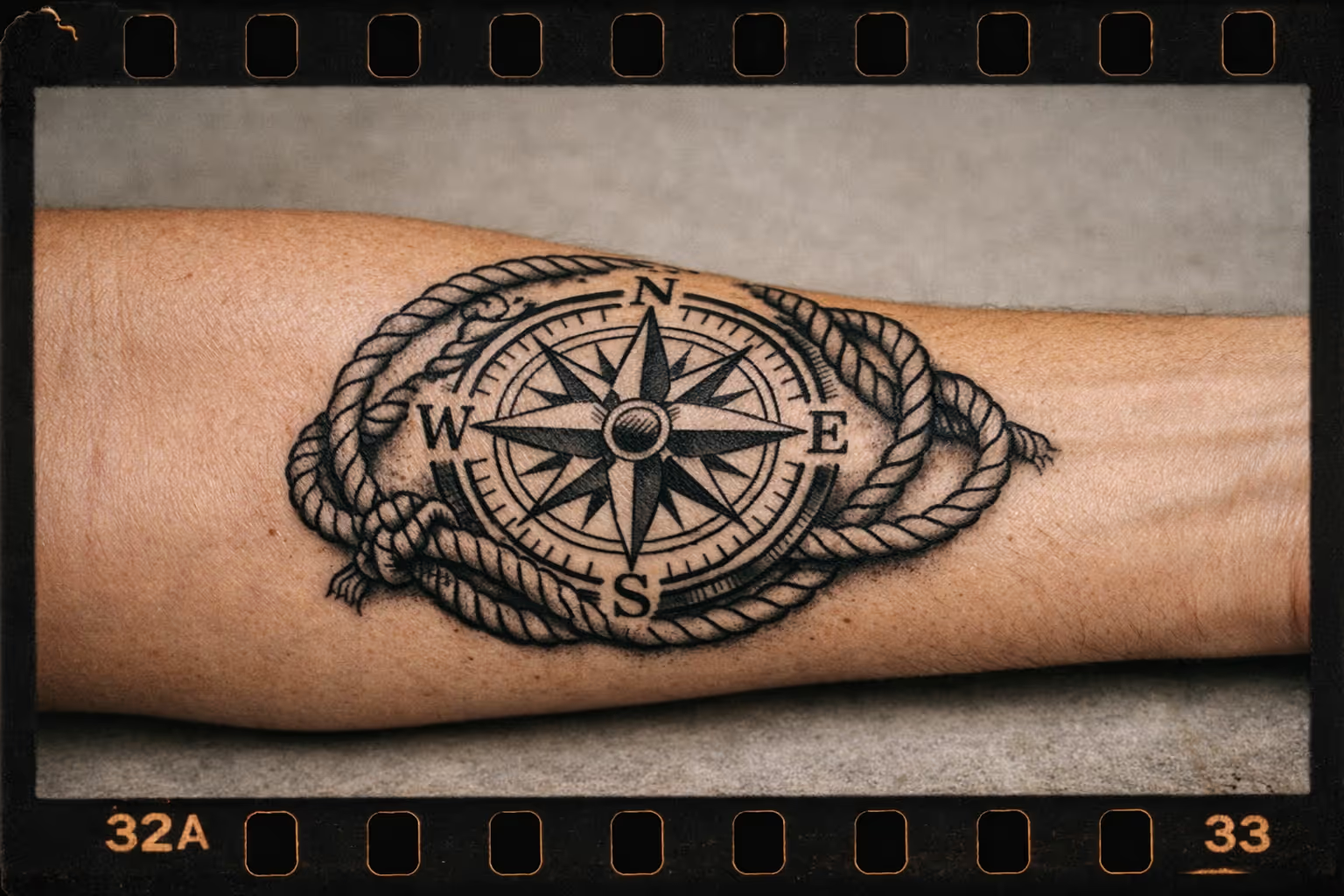
A compass tattoo scales from a one-inch wrist piece to a full chest plate without losing its structure - which is exactly why it’s so easy to under-build. Go too fine, under a millimeter of line, and it softens into a grey smudge within 5-10 years. The symbolism is broad enough to mean something personal without getting preachy, but the linework is what decides whether it survives. Here’s the sizing, style and aging math before you sit down.
Compass Tattoo Meaning and Symbolism
A compass tattoo points to one idea more than any other: knowing where you’re going, even when you don’t. The shape is instantly readable from across a room, the symbolism is broad enough to mean something personal without getting preachy, and the design scales from a 1-inch wrist piece to a full chest plate without losing its structure. What follows is a practical guide to compass tattoo designs - what they actually mean, where they age well on the body, and what you should know before you sit down in the chair.
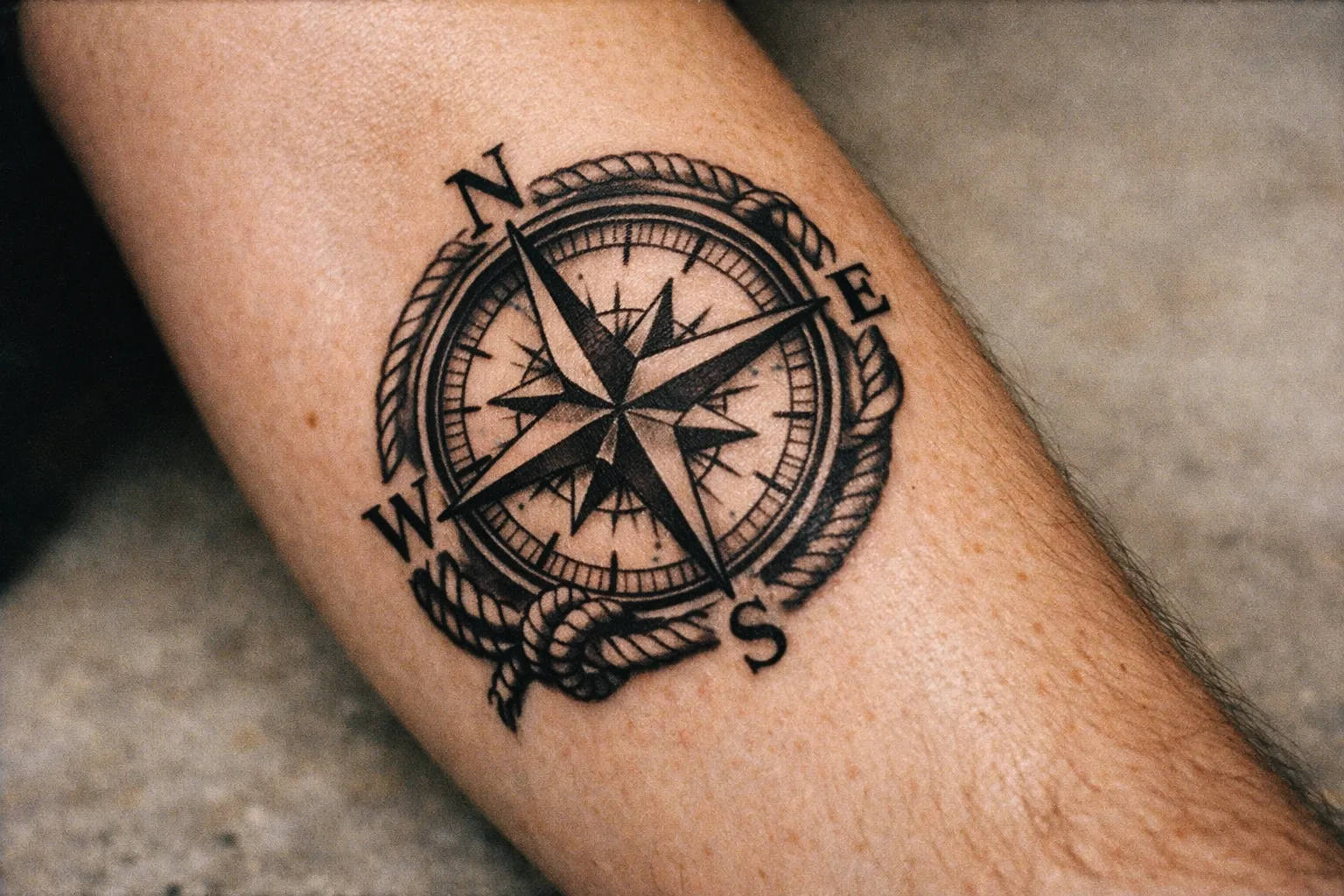
We’ll cover meaning and history, popular styles (nautical compass tattoo, Viking, watercolor, geometric, minimalist), placement specifics including the compass forearm Tattoo, small compass Tattoo options under two inches, design notes for compass Tattoo for men and gender-neutral layouts, realistic costs and healing timelines, and the questions people ask most often before booking.
At its core, compass Tattoo meaning revolves around direction - finding it, keeping it, returning to it. The four cardinal points (N, S, E, W) are a visual shorthand for staying oriented, which is why the design resonates with such a wide range of people: travelers, sailors, people in recovery, anyone marking a move, anyone who wants a daily marker to keep their bearings.
Beyond the obvious, the compass carries a few specific layers:
- Guidance and decision-making - the most common reading, often paired with phrases like “stay true north.”
- Protection - a holdover from sailor superstition, where the compass on the skin was a talisman for safe return.
- Adventure and exploration - usually emphasized when the design includes maps, mountains, or coordinates (1).
- Family or anchor points - the four cardinal points sometimes represent four important people, four homes, or four life chapters.
The reading is flexible, which is a feature, not a bug. Two people can wear nearly identical compass tattoos and mean very different things by them.
✓ Pros
- Symbolically rich and flexible meaning adaptable to personal stories
- Works well at a wide range of sizes from small wrist pieces to large chest plates
- Strong visual structure that ages well with proper line weight and placement
✗ Cons
- Fine-line and small tattoos can blur or fade noticeably over time
- Overcrowding with secondary elements can ruin clarity and longevity
- Certain placements like fingers and feet age poorly and require frequent touch-ups
The History Behind Nautical and Traditional Compass Tattoos
The compass as a body-art motif comes out of maritime tradition. Sailors in the 18th and 19th centuries - particularly British and American navy and merchant crews - wore tattoos as practical talismans tied to specific milestones: a swallow for every 5,000 nautical miles sailed, an anchor for crossing the Atlantic, a fully rigged ship for rounding Cape Horn. The nautical compass Tattoo, often rendered as a compass rose or a nautical star (a stylized eight-point compass), sat in this same vocabulary and stood for “always finding your way home.”
The nautical star itself is largely a stripped-down compass rose. You’ll still see it in American traditional flash sheets - thick black outlines, limited palette, bold red or yellow center - which is how the motif crossed from sailor culture into mainstream tattooing in the early 20th century via artists like Sailor Jerry. American traditional’s two technical hallmarks are exactly that: thick black outline weight and a deliberately restricted color palette. When artists do it badly, they soften the outlines trying to be subtle, and the whole thing loses its structure within a few years of healing.
In the modern era the compass has detached from its strictly maritime context. Today it’s just as likely to mark a personal milestone - emigration, sobriety, the birth of a child - as it is to reference the sea. The shape stuck because it works visually at almost any size and reads cleanly even after a decade of healing.
Compass Designs by Type
There’s a lot of variation under the same umbrella. These are the compass Tattoo designs that show up most often in studio portfolios, and what each one actually delivers on skin.
Nautical Compass Tattoos
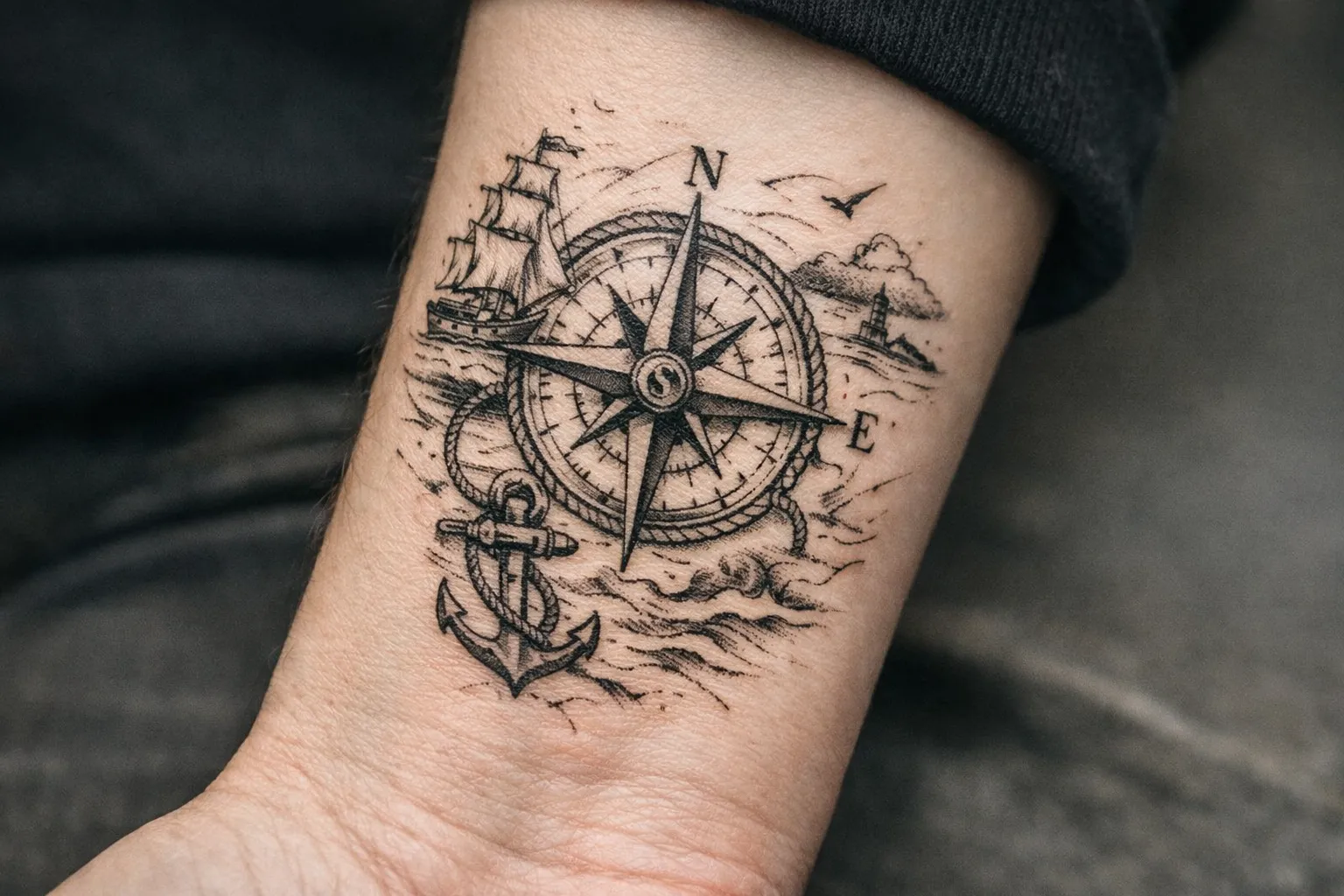
The classic. Usually a circular compass rose with eight points, often combined with rope borders, anchors, ship wheels, or a partial world map in the background. Works at medium to large sizes - 4 to 8 inches - because the detail (rope twist, anchor flukes, map linework) needs room to breathe. Below 3 inches, the secondary elements turn to mush within a few years.
A well-done nautical piece has clean compass geometry (the points are actually symmetrical), distinct black outline weight, and shading that reads as nautical chart rather than photorealism. I’ve seen plenty of these go wrong when artists overcrowd the design with every maritime symbol available - anchor, rope, ship wheel, lighthouse, all at once. Pick two supporting elements, not five.
Nordic and Viking Compass Tattoos (Vegvísir)
The Vegvísir is an Icelandic stave made up of eight runic arms radiating from a center. It’s not technically Viking - the earliest documented sources are 17th-century Icelandic grimoires, post-Viking-age - but it’s been absorbed into the broader Norse-inspired tattoo vocabulary. The stated purpose in those sources was guidance through bad weather.
It tattoos well at 3 to 6 inches on the forearm, upper arm, or back of the calf because the eight arms need enough space to stay distinct. Smaller than that and the runic terminals blur together. One thing worth knowing: the Vegvísir has been adopted by a wide range of groups, some of them political. If you want it for personal symbolism, that’s fine, but it’s not the neutral signifier it was ten years ago.
Watercolor Compass Tattoos
Watercolor uses splashes of color - blues, teals, purples, occasional warm reds - around or behind a black-line compass to mimic paint bleed. The technique is striking when fresh and divisive long-term. Watercolor color work fades faster than solid traditional color because the pigment is laid in lower saturation. Expect noticeable softening within 5 to 7 years, sometimes sooner without sun protection.
If you want one, insist on a strong black-ink compass underneath the color. When the watercolor fades - and it will - you’ll still have a readable tattoo instead of a vague bruise.
Geometric and Mandala Compass Tattoos
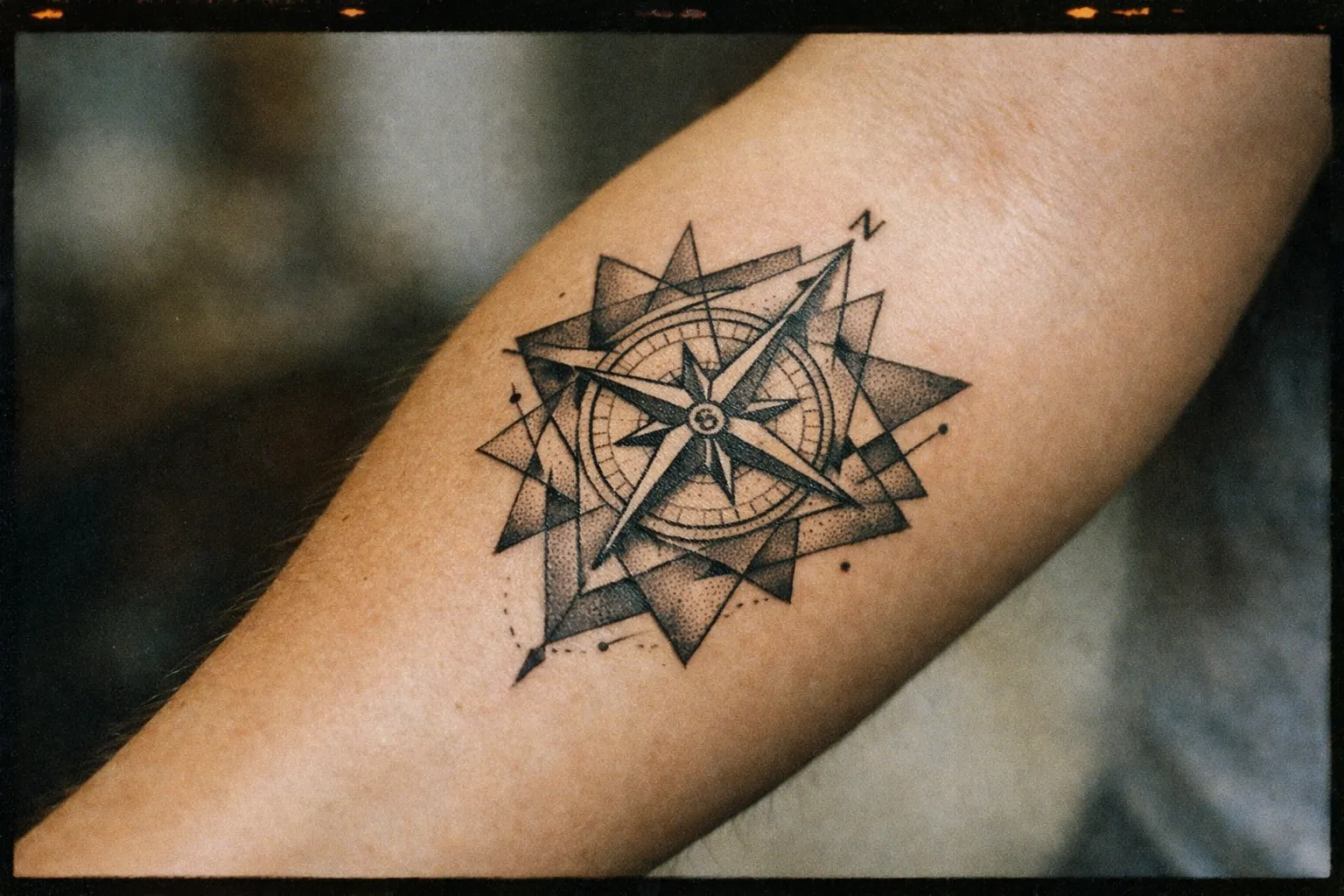
Geometric compasses use triangles, circles, and dotwork to build the compass shape, often layered with mandala patterns. Best at 4 to 7 inches - the symmetry and dotwork need precision that small sizes can’t preserve. Works particularly well on the forearm, upper arm, and chest plate where the surface is flat enough for the geometry to read as intended.
The pitfall here is artist skill. Geometric work exposes any wobble in the linework immediately. Look at healed photos of dotwork specifically before booking - not fresh photos, healed ones.
Minimalist and Fine-Line Compass Tattoos
A small compass Tattoo in fine-line style - clean black outline, no shading, sometimes just the directional points and a circle - runs 1 to 3 inches and sits comfortably on the wrist, inner forearm, behind the ear, or back of the ankle. It’s the most popular first-tattoo version of this motif.
Honest caveat: fine-line tattoos under 1 mm line weight soften over 5 to 10 years. They’re not as permanent-looking as people assume. I’ve had clients come back years later genuinely surprised by how much the lines had spread. If you want crisp lines a decade in, push for slightly thicker linework even on a small piece - closer to 1 to 1.5 mm.
Designs for Men
The phrase compass Tattoo for men shows up in search because the motif is heavily represented in masculine-coded portfolios - American traditional nautical, Viking, blackwork, and bold geometric pieces. A few practical observations:
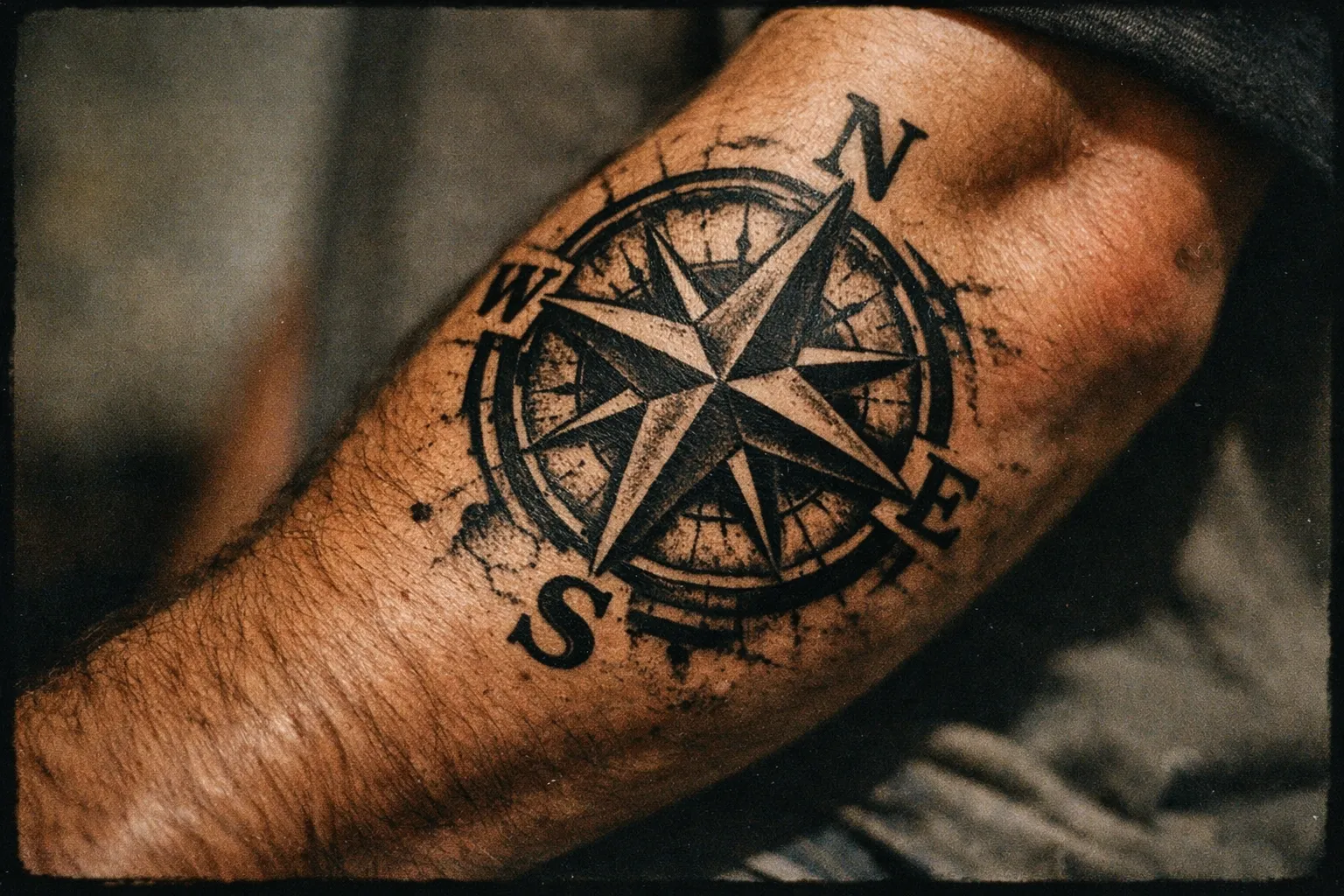
- Upper arm and shoulder cap are the most common placements in men’s portfolios, usually at 5 to 7 inches and often built out into a half-sleeve over time.
- Chest plate centered on the sternum, 6 to 10 inches, works for a symmetrical compass rose paired with banner lettering or coordinates.
- Outer forearm at 4 to 5 inches is the workhorse choice - visible, ages well, easy to extend into a larger piece later.
That said, none of these are gendered designs. The same layouts work for anyone. The label is a search artifact more than a design rule.
Choosing the Right Placement
Placement decides how the tattoo looks at five years, not five days. The compass is a circular design, which means it needs a relatively flat surface to stay round.
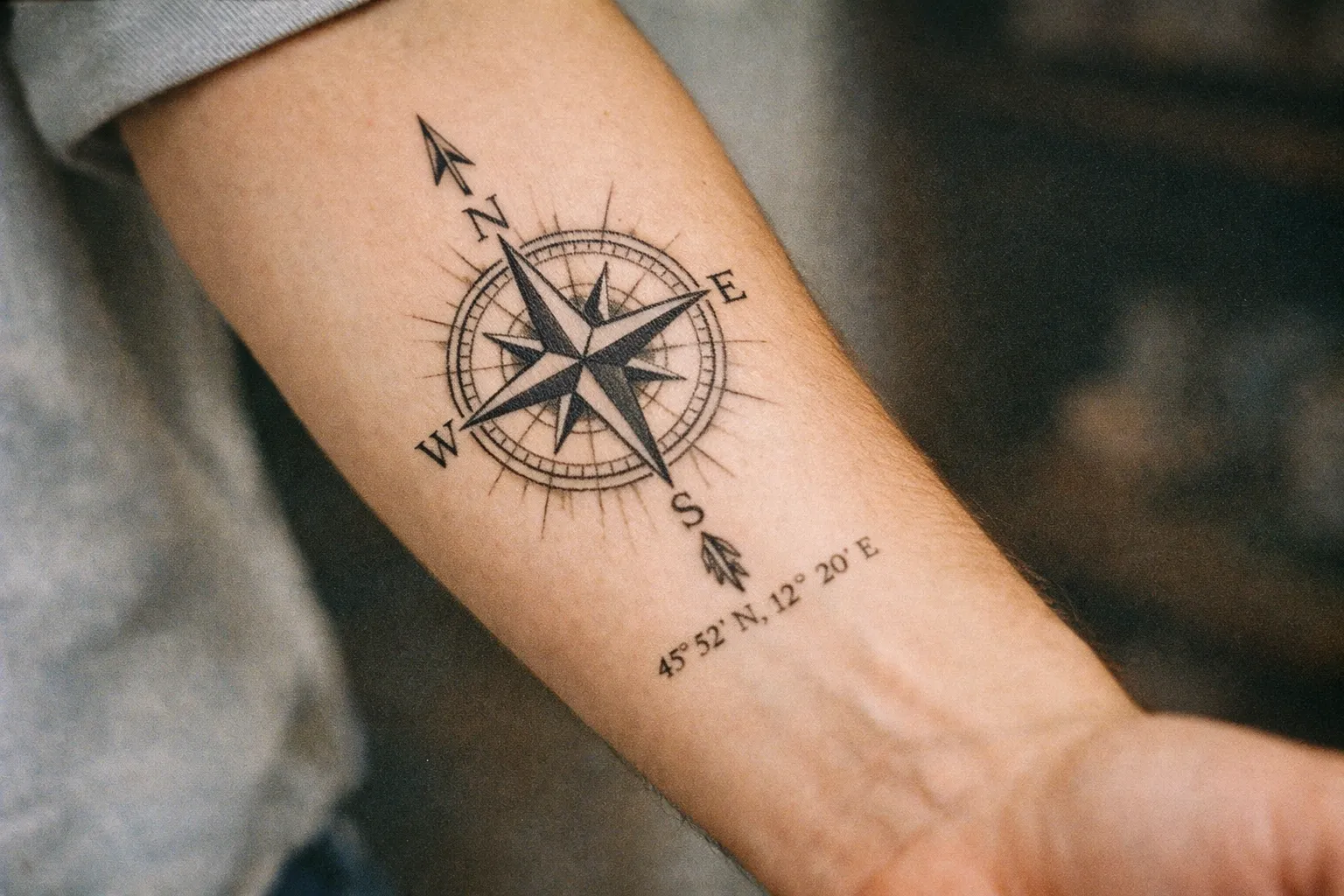
Forearm
A compass forearm Tattoo is the most-requested placement for a reason. The inner forearm gives you a flat, low-distortion canvas. The outer forearm gives you visibility and a slightly less painful sit. Size range that works well: 3 to 5 inches in diameter. Pain is low to moderate - well below ribcage or sternum work.
Orientation matters here. A compass pointing toward your hand reads as “moving forward, looking out.” Pointing toward your body reads as “returning, inward.” Decide before stencil placement, not after.
Upper Arm and Shoulder
The deltoid is a forgiving placement: low pain, flat enough surface, easy to cover with a t-shirt. Works for 4 to 6 inch pieces and is the natural starting point if you plan to extend into a sleeve.
Chest and Sternum
Centered chest pieces look striking but the sternum is one of the more painful placements - bone directly under thin skin. Plan a 5 to 8 inch compass here, often with banner text or coordinates underneath. Pain-wise: sternum is noticeably harder than forearm work. Not the place to test your tolerance.
Back (Shoulder Blade or Upper Back)
The shoulder blade is a flat, slow-aging canvas - skin here doesn’t stretch or sun-expose as much as the forearm. Good for 5 to 8 inch detailed nautical or geometric pieces.
Smaller Placements: Wrist, Ankle, Behind the Ear
These are the home of the small compass Tattoo - 1 to 2 inches, usually fine-line. Wrist and ankle take more wear from clothing and movement, so expect faster softening. Behind the ear is more sheltered but harder for your artist to work on. The linework can vary in quality depending on positioning and how cooperative the client is at holding still.
Pain Ranking, Roughly
From least to most: outer upper arm, outer forearm, shoulder blade, inner forearm, calf, chest, inner bicep, ribcage and sternum, ankle. The ankle’s high pain relative to its small size catches people off guard every time.
Placements to Avoid
Fingers, palms, and feet for any compass design with internal detail. These areas heal unevenly and fade fast - often needing touch-ups within 6 to 12 months. The circular geometry of a compass amplifies any patchy healing.
Popular Techniques: Watercolor, Geometric, Dotwork
A few technical notes worth knowing before you commit to a style.
Dotwork shading ages better than solid grey fill for vintage-map and nautical compass tattoos. The texture softens gracefully rather than turning into a grey haze.
Watercolor requires an artist who specializes in it. Generalists tend to lay color too thin, which accelerates fading. Ask for healed photos at the one-year mark, not fresh shots.
Cool greys and desaturated blues age better than bright primaries for nautical work. Bright blues can shift toward green with sun exposure over a decade - I’ve seen this happen more than once on forearm pieces that clients didn’t protect consistently.
Line weight is the single biggest predictor of how a compass tattoo will look at year ten. Push for 1 to 1.5 mm minimum on key structural lines, even for small pieces.
Combining the Compass With Other Symbols
The compass pairs well with a lot of things. The most common combinations in studio portfolios:
- Compass + map - the most travel-coded combination, often with a partial world map as background fill.
- Compass + anchor - classic nautical pairing, especially in American traditional.
- Compass + rose - the literal “compass rose,” but also a separate floral rose intertwined for a guidance-plus-beauty reading.
- Compass + mountains - adventure-coded, popular as a forearm piece.
- Compass + coordinates - latitude and longitude under or around the compass marking a meaningful location, usually two lines of small lettering (1).
- Compass + ship or lighthouse - for genuine nautical history, often in larger back or chest pieces.
One specific note on coordinates: double-check them yourself before the session. Artists work from what you give them, and a transposed digit is the most common preventable regret in this category. I’ve seen it happen. Verify the numbers twice.
Cost, Time, and Aftercare
Real numbers based on US studio averages, 2024-2025:
Cost ranges
- Shop minimum: $80-$150 for very small pieces under 2 inches.
- Small compass (1-2 in., line only): $120-$250.
- Medium compass (3-5 in., with shading): $250-$600.
- Large nautical or color compass (6-10 in.): $600-$1,500+.
- Established artists in major US cities: $150-$300/hour, with top artists charging more.
Black and grey runs roughly 20-40% cheaper than full color for medium designs, mostly because color takes longer to saturate properly.
Session time
- Small forearm fine-line: 1 to 2 hours.
- Medium shaded compass: 2 to 4 hours.
- Large nautical scene: 4 to 8 hours, often split across 2 to 3 sessions.
Healing timeline
- Day 1-3: oozing and tenderness. Wash gently 2-3 times daily with a fragrance-free cleanser, apply a thin layer of fragrance-free moisturizer or a tattoo-specific balm.
- Week 1: peeling and flaking starts. Do not pick. The skin will look dull and cloudy - this is normal and temporary.
- Week 2-4: surface heals and the tattoo looks brighter again. Keep moisturizing, avoid soaking (no pools, baths, ocean) for the first 2 to 3 weeks.
- Week 4-8: deeper layers settle. Final color and line clarity emerge by week 8.
Aftercare essentials
- Fragrance-free cleanser and fragrance-free moisturizer throughout the healing period.
- Sun-protective clothing or SPF 30+ once fully healed - UV is the single biggest cause of long-term fade.
- Avoid heavy ointment after the first 3-5 days. Over-moisturizing can clog healing skin and cause small breakouts that pull pigment out with them.
Common Mistakes to Avoid
A short list of regret-makers specific to this motif:
- Overcrowding small pieces. A 1.5-inch compass with N/S/E/W lettering, a map background, and three coordinates will be a blurry circle in five years. It’s not a question of if, it’s when.
- Skimping on line weight. Ultra-fine lines look elegant on day one and faded on year seven.
- Wrapping tightly around the bicep or calf. A circle that wraps around a curved muscle distorts when flexed. Keep it on flatter planes.
- Trend-stacking. Watercolor splash plus infinity sign plus birds plus feather plus compass reads as a 2015 Pinterest board. Pick a lane.
- Sun exposure in the first 6 weeks. Black linework can fade 10-20% before it’s even fully healed if you sunburn it during the peeling stage.
Frequently Asked Questions
- What is the 1/3 rule tattoo?
- The 'rule of thirds' is a photography and composition guideline, not a tattoo-specific rule. Some artists use it informally for larger pieces like sleeves, but it's not standard or related to compass tattoos.
- What are some tattoos to avoid?
- Avoid micro-tattoos under half an inch with internal detail, names of romantic partners, short-term trend symbols, and any design you haven't researched fully. For compass tattoos, avoid coordinate tattoos tied to new partners, overcrowding small designs, and placements like fingers, palms, and feet that fade quickly.
- What is the tattoo symbol for ADHD?
- Common symbols include the neurodiversity infinity loop and dopamine molecule designs. These can be combined with a compass for personalized meaning. The puzzle piece symbol is generally avoided by neurodivergent communities.
- How long does a compass tattoo take to heal?
- Surface healing takes 1 to 2 weeks, with full healing of deeper layers and final appearance emerging by 4 to 8 weeks. Avoid soaking, sun exposure, and heavy exercise for the first 2 to 3 weeks.
- How much does a compass forearm tattoo cost?
- A medium 3 to 5 inch compass forearm tattoo typically costs $250 to $600 in the US, depending on location and artist. Small fine-line versions under 2 inches usually range from $120 to $250.
- Does a small compass tattoo age well?
- Small compass tattoos can age well if structural lines are at least 1 to 1.5 mm thick and placed on flat, sheltered areas like the inner forearm or upper arm. Fine-line work under 1 mm and under 2 inches tends to soften noticeably within 5 to 10 years.
Before You Book
A compass tattoo earns its popularity because the symbol is open enough to mean something specific to you and visually strong enough to hold up across sizes and styles. But the decisions that actually determine whether you’ll like it in ten years aren’t about meaning - they’re about line weight, placement on a flat enough canvas, restraint with secondary elements, and an artist whose healed work you’ve actually looked at.
Pick the size that lets the detail you want survive aging. Put it somewhere the circle won’t distort when you move. Use a fragrance-free moisturizer and stay out of the sun while it heals.
Everything else is style preference.