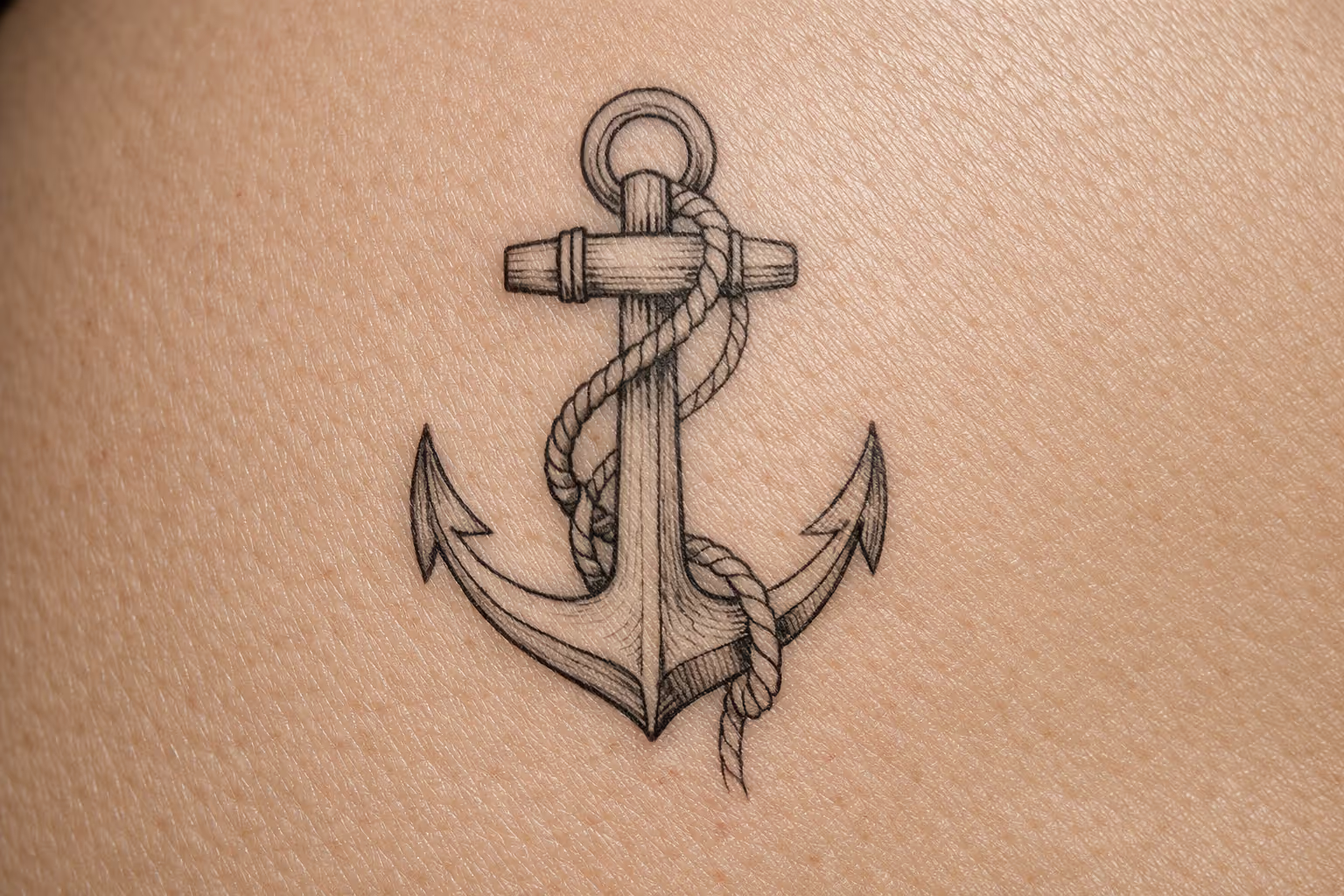
An anchor tattoo looks simple, which is exactly why so many of them age badly. The design forgives nothing: the same anchor can hold clean for ten years or blur into a blob in six months, depending entirely on line weight, size, and placement. The symbolism matters too, but the build is what decides whether you still recognize it later. Here’s the full breakdown - meaning, sizing, and what to tip on a $500 piece.
Anchor Tattoo Meaning: More Than Sailors
The anchor tattoo meaning sits on three layers, and which one you’re tapping into changes the design. Worth noting upfront: this is one of the oldest continuously popular tattoo motifs in Western culture - traditional anchor designs predate most other flash staples by at least a century, which is part of why the symbol has accumulated so many distinct readings.
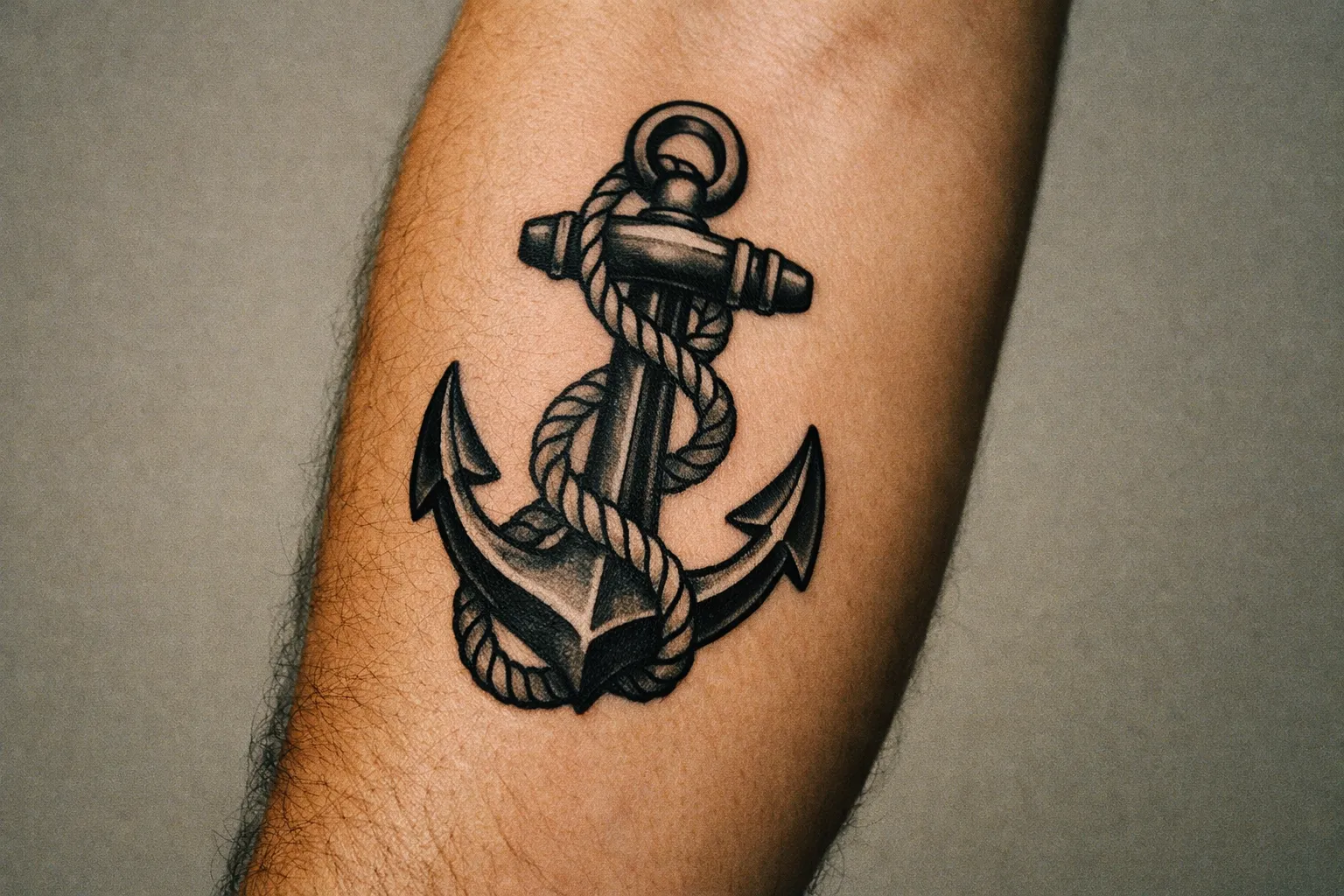
Nautical and naval. Historically, sailors used the anchor to mark significant voyages - crossing the Atlantic, completing a tour, surviving a wreck. It signaled safe harbor and a successful return. According to the Naval History and Heritage Command, anchor imagery has appeared in U.S. Navy tattoo tradition since at least the early 19th century. Sailors still get them today, often with rope, a banner, or a ship’s wheel.
Stability and steadfastness. The modern read. An anchor holds a ship against current and wind, so it reads as “I stay put” - useful as a reminder of sobriety, a commitment to a person, or simply staying grounded under pressure (1).
Faith. Hebrews 6:19 - “we have this hope as an anchor for the soul” - is why anchor tattoos sometimes function as a discreet Christian symbol. Early Christians used the anchor as a coded cross when displaying one openly was dangerous.
A small but useful distinction: a lifted anchor (chain trailing, not set) tends to read as hope or new beginnings, while a grounded anchor (stock down, flukes buried) reads as permanence and commitment (1). Most artists will follow your lead on this - mention which side of the meaning matters to you when you book.
One caveat worth saying out loud: the “Refuse to Sink” anchor was everywhere from about 2012 to 2016 and is now the kind of design artists gently steer clients away from. It’s not bad - it’s just dated, and a lot of people end up covering or reworking it. If the phrase genuinely means something to you, fine. If it just looked cool on Pinterest, pick a different banner or skip the script.
The Traditional Style That Makes Anchor Tattoos Age Best
If you want a tattoo that still looks crisp in 20 years, the traditional anchor tattoo is the safest bet in this category.
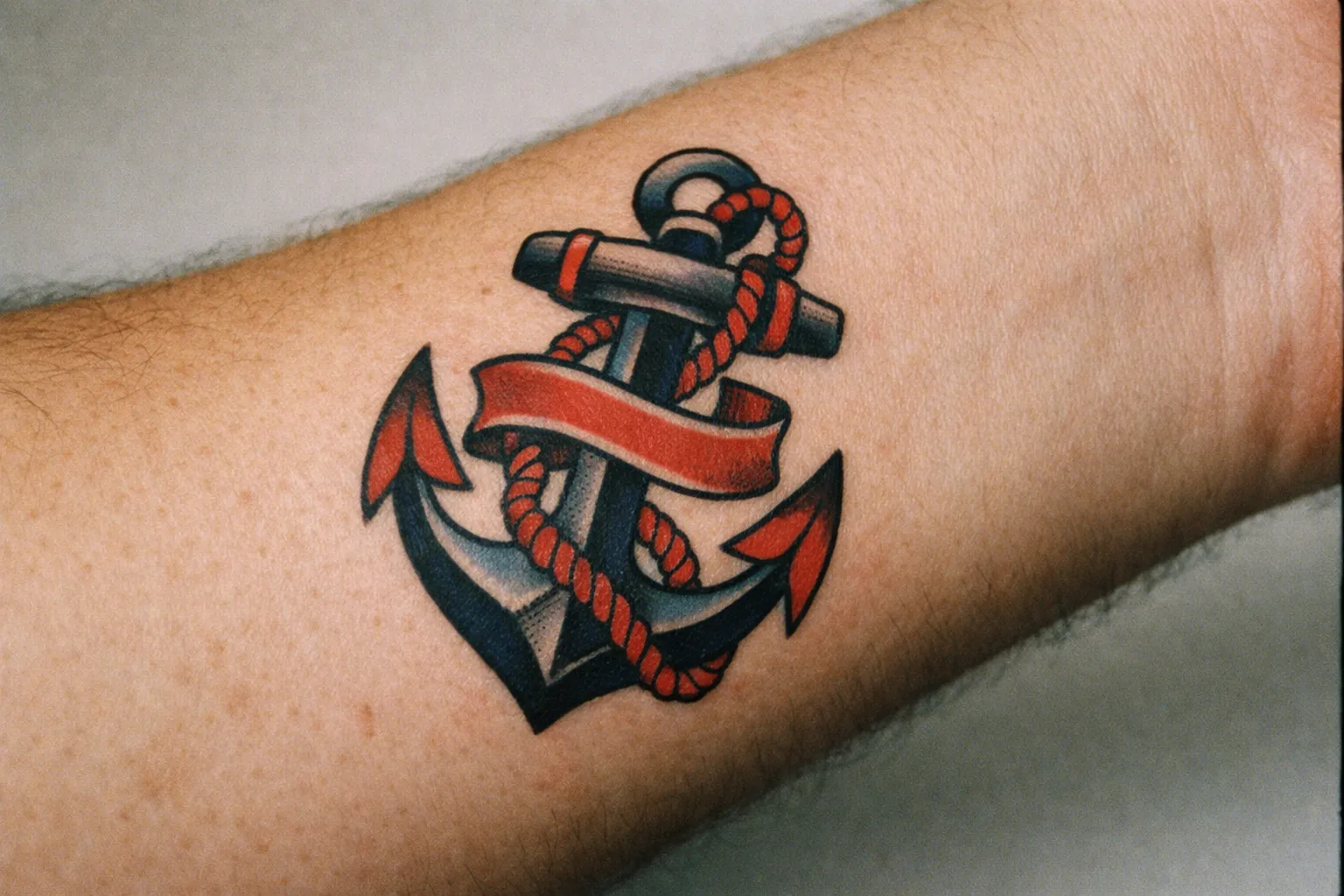
The two technical hallmarks of American traditional: thick black outlines (usually 1.5-3mm linework) and a limited palette - red, blue, yellow, green, occasionally a soft pink. No gradients, no realism. Color is packed solid, not faded. The anchor itself is usually drawn with the stock (top crossbar), shank (vertical post), and two flukes clearly defined, often with a rope wrapping the shank or a banner across it.
Why it ages well: thick lines and saturated color tolerate the natural softening that happens as ink spreads slightly under the skin over decades. I’ve seen traditional anchors done at 25 that still read cleanly at 55 - the same cannot be said for fine-line or watercolor anchors of the same age, where the detail has typically blurred into a soft wash. The structure is built for it.
Common pitfall when it’s done badly: artists who haven’t drilled American traditional often produce thin, wobbly outlines and patchy color packing. The result looks fine healed at six months and muddy at five years. Look at an artist’s healed photos, not just fresh ones, before booking a traditional piece. This is where people usually get it wrong - they fall in love with a fresh photo and don’t ask what it looks like after it’s settled.
Good placements for traditional anchors: outer forearm, upper arm, chest, calf - flat-ish areas with enough real estate for the bold silhouette. Sizes usually run 3 to 6 inches for a standalone anchor; bigger if you’re adding a rose, ship, or banner.
Anchor and Rose Tattoo: Stability Meets Love
The anchor and rose tattoo is one of the most-requested combinations in flash, and the symbolism is straightforward: the anchor for steadiness, the rose for love or for someone specific. Common as a memorial piece, a partner tribute, or just because the composition works visually.
A few design notes from the chair:
- Keep the anchor slightly larger than the rose, or roughly equal. If the rose dominates, the anchor reads as decoration and you lose the symbolism.
- The classic traditional version uses a red rose with green leaves crossed over the shank, with the anchor in solid black. Easy to read, ages well.
- Neo-traditional versions add more petal detail, color blending, and decorative elements - pearls, ribbons, gems. More visually rich, but harder to keep crisp over time.
- A fine-line black-and-gray anchor and rose is on-trend right now, but the detail in the rose petals will soften within 5-10 years. Worth knowing going in.
Size and placement: anchor and rose works at 3-5 inches on the inner forearm, 5-7 inches on the outer bicep or thigh, or larger as a chest or back centerpiece. Below 3 inches the rose loses petal definition.
Cost range in U.S. studios: a medium color anchor and rose on the forearm usually runs $200-$400 depending on artist rate and how heavily the color is packed.
Small Anchors: What Works and What Doesn’t
A small anchor tattoo is often someone’s first tattoo - and according to surveys by tattoo industry publications like Inked Magazine, simple nautical motifs consistently rank among the top five first-tattoo choices in the U.S. There are two honest categories here: ones that hold up, and ones that don’t.
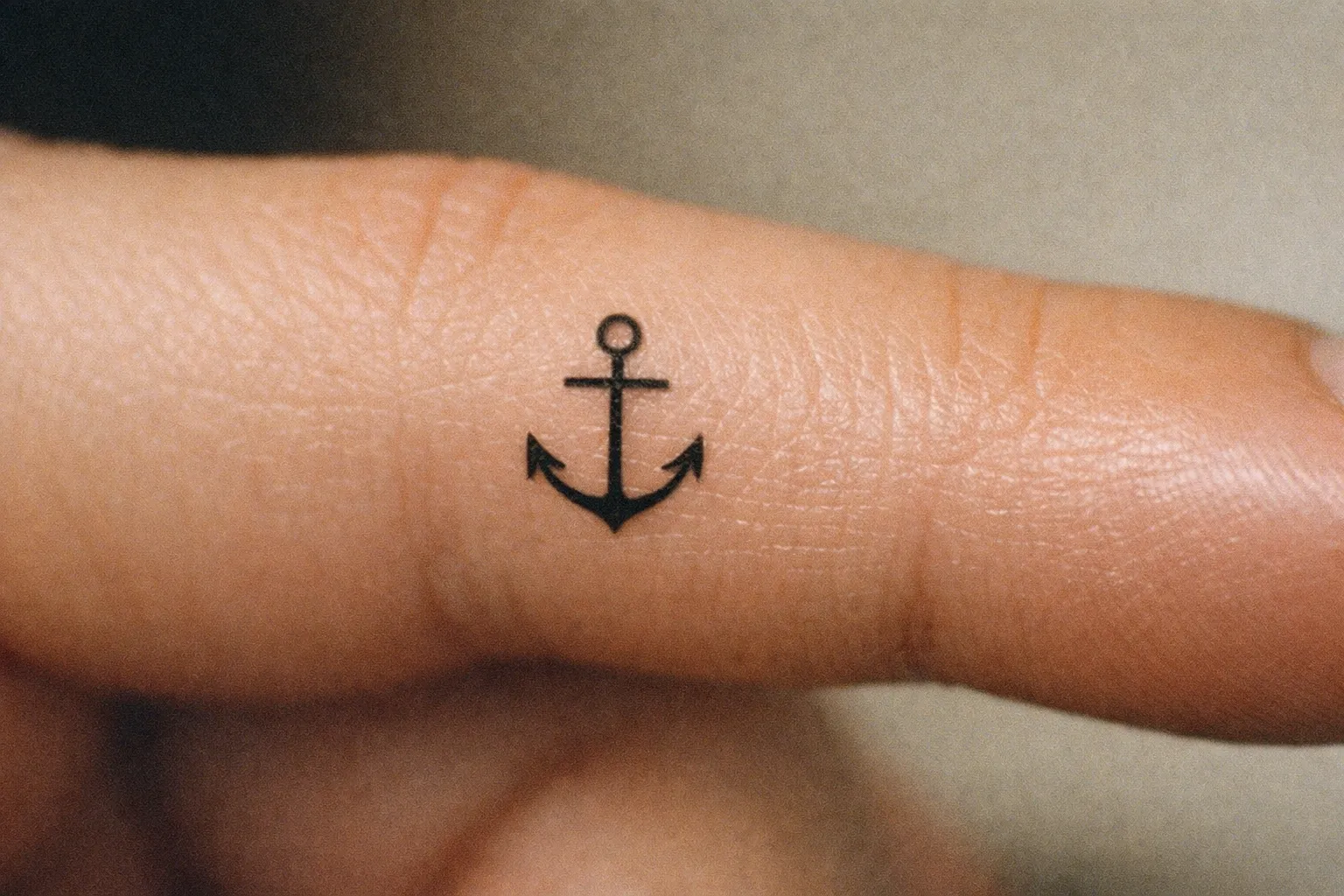
Works well at small sizes (1-2 inches):
- Inner forearm
- Inner wrist (the soft underside, not the bony top)
- Behind the ear
- Back of the upper arm
- Ankle (inner, not over the bone)
These spots have enough skin stability and low enough friction that a 1-inch anchor in solid black holds its lines for a decade or more.
Risky at small sizes:
- Fingers (more on this below)
- Side of the hand
- Top of the foot
- Inside of the lip
Studio minimums for a small anchor tattoo usually start around $80-$150 in most U.S. cities, more in major metros. That’s not size pricing - it’s the minimum any artist will charge to set up for a session.
Detail at small scale is the main thing to watch. A 1-inch anchor with rope, banner, and shading will look muddy within a few years because the spacing between elements is too tight to survive ink spread. Keep small anchors simple: clean silhouette, maybe one decorative element, no script under 8pt.
Finger Anchors: Reality Check
The finger anchor tattoo deserves its own section because it’s the placement that disappoints people most often.
The visual is striking - a tiny black anchor on the side of the index finger, or across a knuckle. Photos go viral. But the skin on fingers is thin, constantly exposed to washing, sun, and friction, and the ink simply doesn’t sit the way it does on a forearm.
What actually happens to most finger tattoos:
- Visible fading within 6-12 months
- Blowouts common on the sides of fingers where skin is thinnest
- Touch-ups needed every 1-2 years if you want it to stay crisp
- Some sections (especially near knuckles and fingertips) may never fully take
I’ve watched clients come back six months after a finger tattoo looking genuinely surprised at how much it’s faded. It’s not a fluke - it’s just how that skin behaves.
If you want one anyway - and people do, and many love them - here’s how to give it the best shot:
- Place it on the outer side of the finger or on the flat top of a finger segment, not over a knuckle joint
- Go slightly bigger and bolder than you think you need; tiny micro anchors fade fastest
- Pick an artist with a healed finger tattoo portfolio, not just fresh photos
- Budget for a touch-up at the 12-month mark
- Avoid finger placement entirely if you work with your hands in harsh conditions - kitchens, construction, frequent sanitizing
Workplace visibility is the other thing to think about. Fingers are hard to hide.
Minimal and Abstract Anchors
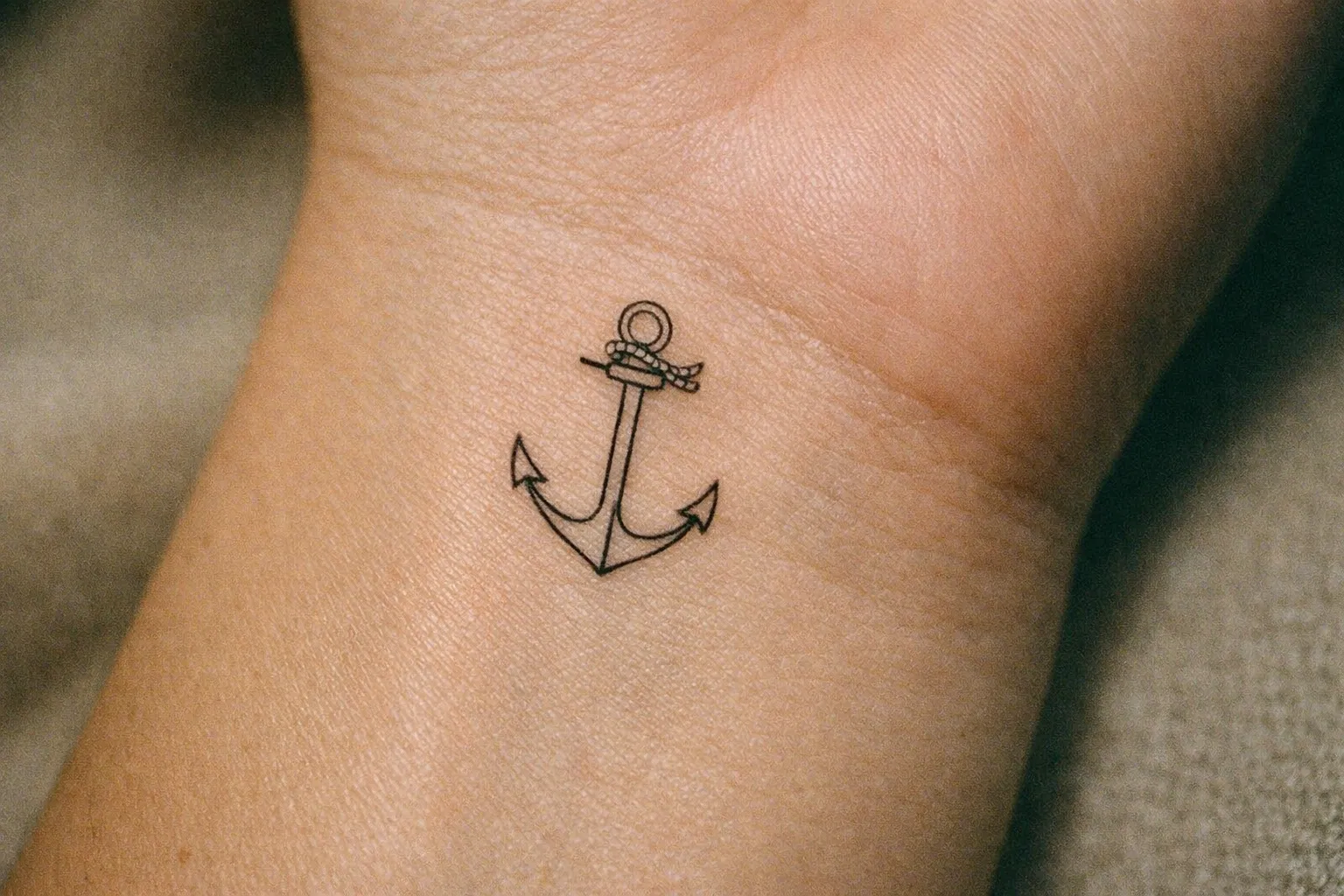
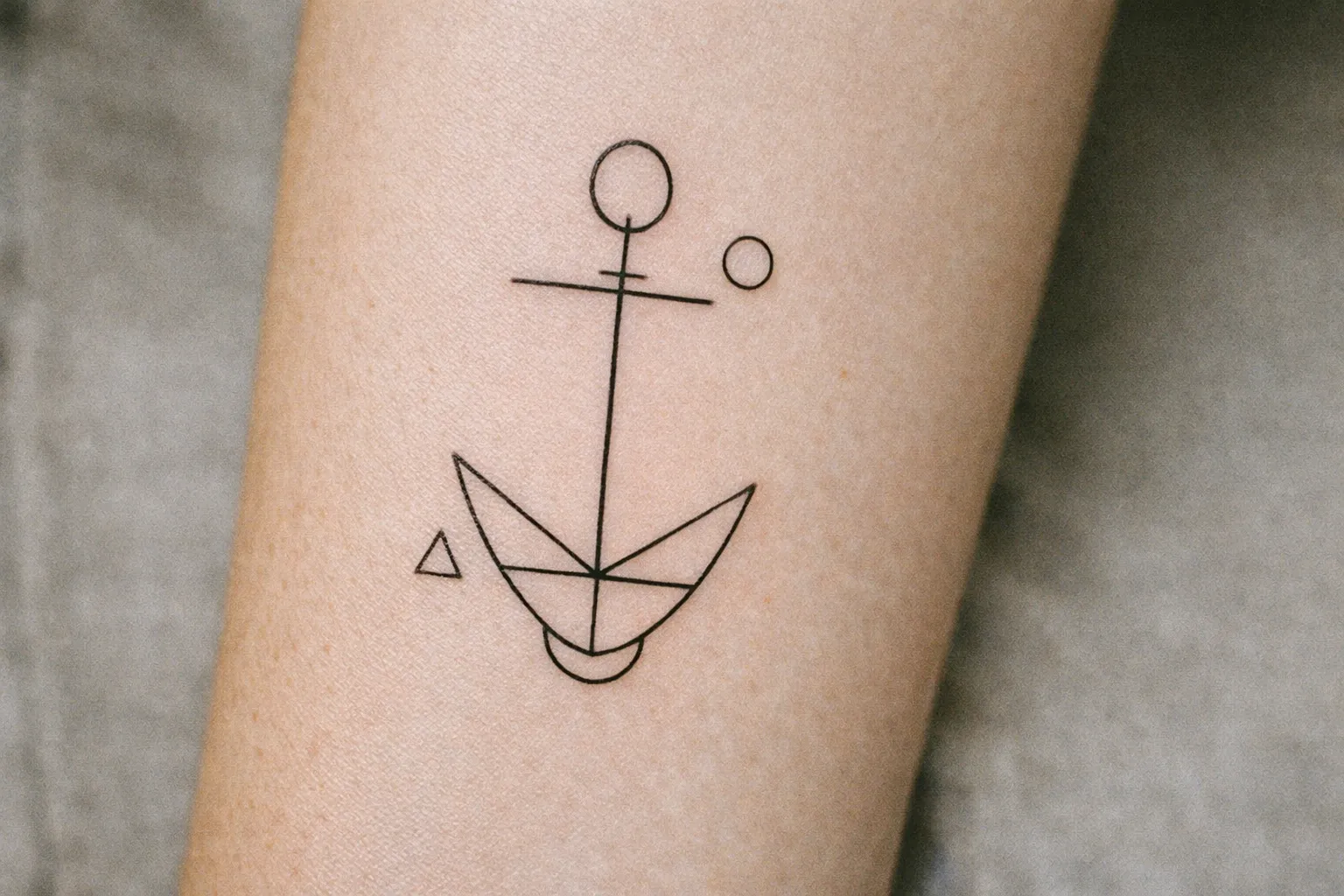
The minimal abstract anchor tattoo strips the design down to its essentials: a single continuous line, a geometric silhouette, or just the suggestion of the form. This is where current micro-tattoo and fine-line trends meet the classic motif.
A few approaches you’ll see:
- Single-line anchor: the entire shape drawn without lifting the needle, usually in a thin black line. Elegant, modern, but technically demanding for the artist.
- Geometric anchor: the anchor reduced to triangles and straight segments, sometimes inside a circle or hexagon.
- Negative-space anchor: the anchor formed by the area around a black shape, rather than the lines themselves.
- Dotwork anchor: the silhouette built from stippled dots instead of solid lines.
These look great fresh. The honest aging note: ultra-thin lines (under 0.5mm) on small designs will soften and may blur within 5-10 years, especially on areas with sun exposure or friction. A minimal abstract anchor at 1.5-2 inches with line weights around 0.8-1mm holds up far better than a 0.5-inch micro version with hairline strokes.
Best placements for minimal abstract designs: inner forearm, behind the ear, back of the neck, sternum, upper thigh. Avoid hands, feet, and the sides of fingers.
Nautical Theme Combinations
Beyond the anchor and rose, the combinations that come up most often:
Anchor and compass. Anchor for stability, compass for direction. The visual reads as “stay grounded, but keep moving.” Compass usually sits above or behind the anchor. Works well at 4-6 inches on the inner forearm or upper back.
Anchor and ship’s wheel. More overtly nautical, often chosen by people with naval service or sailing background. Heavier composition - usually 5+ inches to fit both elements clearly.
Anchor and rope. The classic. Rope wraps the shank in a flowing curve, sometimes with a frayed end. The most traditional combination and the one that ages best because the elements are bold and well-spaced.
Anchor and banner. Banner across the shank or below carrying a name, date, or short phrase. Watch the font size - anything under 8pt will blur within years. Keep the banner text to 15 characters or fewer for a forearm-sized piece.
Anchor with waves or birds. Waves below the anchor or birds above add movement to an otherwise static silhouette. Common in neo-traditional work.
Placement Guide: Where the Anchor Actually Lives
Placement affects three things: how the design ages, how much it hurts, and how visible it is at work.
Inner forearm (3-6 inches). The default for medium anchor tattoo designs. Low pain (forearm < ribcage), good aging, easy to cover with long sleeves. Best all-rounder.
Outer forearm (3-6 inches). Same as inner but more visible day-to-day. Good for traditional anchors where you want the bold silhouette to read across a room.
Inner wrist (1-2 inches). Good for a small anchor tattoo. Pain is moderate - the underside has less nerve density than the bony top. Stays visible to you, which matters if it’s a personal reminder.
Behind the ear (under 1.5 inches). Discreet, easy to hide with hair. Pain ranges from moderate to sharp depending on how close to bone the needle gets.
Sternum (4-8 inches). Dramatic placement for larger anchors, especially with floral or rope elements running vertically. Pain is significant - ribcage > forearm by a wide margin. Plan for a longer session and breaks.
Upper back / shoulder blade (5-10 inches). Best for large traditional anchors or anchor-and-ship scenes. Flat canvas, moderate pain, hides easily.
Chest (5-8 inches). Classic placement for sailors. Pain varies - over the pec is manageable, over the sternum or collarbone is sharper.
Calf (4-7 inches). Underrated. Lots of flat real estate, low pain, ages well. Good for traditional anchors with full color.
Ribs (4-8 inches). Visually striking for an elongated anchor design. Painful - ribs are one of the rougher placements, period. Worth it if you want the placement, but go in caffeinated and fed.
The 1/3 Rule for Placement
The 1/3 rule is a planning guideline some artists use, especially when building toward a sleeve or larger composition. The idea: when designing a half- or full-sleeve, roughly one-third of the area should remain skin (negative space), one-third should be your main subject (the anchor and primary elements), and one-third should be supporting detail and background - rope, waves, banner, shading.
Why it matters for an anchor: a single anchor floating alone on a forearm looks great. But if you plan to add to it later - and many people do - placing the anchor too central or too large limits what else can flow around it. Talk to your artist about future additions before you commit to size and placement, even if you only want the anchor for now.
For a standalone piece with no sleeve planned, ignore the rule and place the anchor wherever the composition feels balanced to you.
How to Apply the 1/3 Rule for Anchor Tattoo Placement
10 minutesA step-by-step guide to planning your anchor tattoo layout for future additions.
- 1
Assess your tattoo area
Look at the area where you want the tattoo and visualize the total space available for a sleeve or larger piece.
- 2
Divide the space mentally into thirds
Imagine one-third as bare skin (negative space), one-third as the main anchor design, and one-third as supporting elements like rope or banners.
- 3
Position the anchor accordingly
Place the anchor so it occupies roughly one-third of the space, leaving room for future details around it.
- 4
Discuss with your artist
Bring your plan to your tattoo artist and get their input on size and placement to ensure flow and balance.
How Much to Tip on a $500 Tattoo
Standard U.S. tattoo tipping runs 15-25%, with 20% the common target. On a $500 tattoo, tips typically land between $75 and $125, with $100 being the most common amount.
A few practical notes:
- Cash directly to the artist is standard, even if you paid the tattoo itself by card. Shops often take a percentage of card payments, so cash tips put more in the artist’s pocket.
- Tip on the full price, not the post-tax amount.
- If the artist did extra work - drew custom flash for you, accommodated a last-minute schedule change, stayed late to finish - tipping at the higher end (25%+) is appropriate.
- If you’re doing multiple sessions on a larger piece, you tip each session, not just the final one.
The tip isn’t built into the quoted price. Budget for it from the start.
Basic Tattoos to Avoid (Including Some Anchors)
Artists generally steer clients away from a handful of common tattoo mistakes. For anchor designs specifically:
- Ultra-micro finger anchors under 0.5 inches - fades fast, blows out easily
- “Refuse to Sink” banner anchors - heavily dated, often covered later
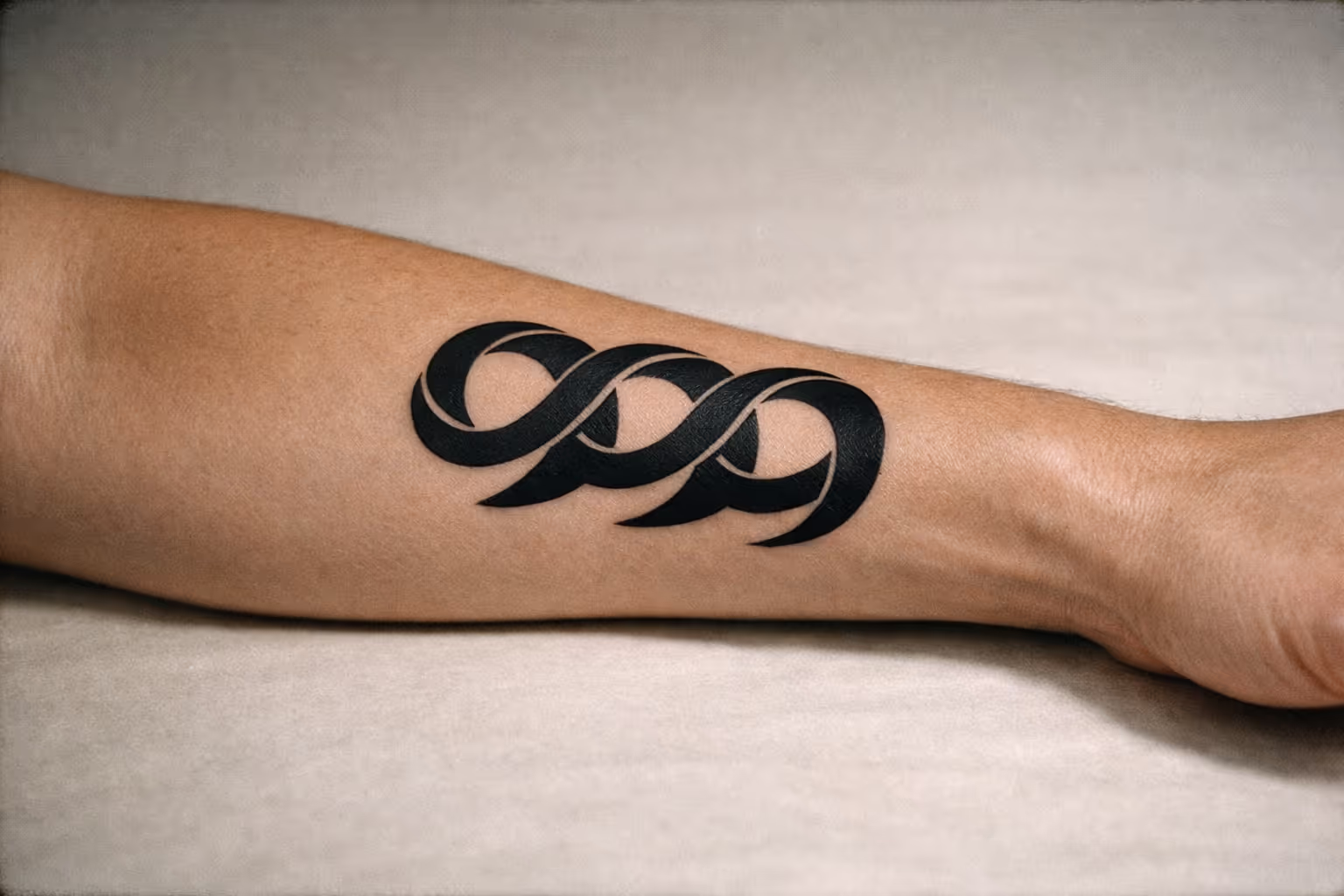
- Generic infinity-symbol mashups - the infinity-anchor combo was a 2014 trend that aged poorly
- Highly detailed micro designs (rope + banner + rose) packed into under 2 inches - the elements blur together within years
- Watercolor anchor tattoos with no black linework - without a black anchor framework, they fade into formless color washes within 5-10 years
- White-ink anchors - they yellow, fade unevenly, and often look like scars rather than tattoos
This isn’t about taste. It’s about which designs survive a decade and which become regrets. Bold silhouettes, sensible sizing, and styles with strong black structure are the safest path.
Aftercare: Day 1 to Week 4
Anchor tattoos heal like any other tattoo, but the bold lines that make traditional anchors look great also mean any aftercare slip-up - sun, scabbing, picking - shows clearly. Stick to the timeline.
Day 1-3.
- Leave the bandage or second-skin on for the time your artist specified (usually 2-24 hours for plastic wrap, 3-5 days for second-skin)
- Once removed, wash gently with fragrance-free antibacterial soap and lukewarm water, 2-3 times a day
- Pat dry with a clean paper towel - no rubbing, no cloth towels
- Apply a very thin layer of fragrance-free ointment (a tattoo balm or basic petroleum-based ointment)
- Expect some redness, slight swelling, and clear or lightly tinted ooze - all normal
Week 1.
- Switch from ointment to fragrance-free moisturizer around day 3-5, or whenever the skin stops weeping
- Continue washing 2x daily
- The tattoo will start to flake and feel itchy by day 5-7 - do not scratch, do not pick, do not peel
- Sleep with the tattoo uncovered and clean sheets
Week 2-4.
- Flaking finishes around day 10-14; the tattoo may look slightly dull or cloudy underneath - this is normal, the deeper skin is still healing
- Keep moisturizing daily
- No swimming, no hot tubs, no saltwater (yes, ironic for a nautical tattoo), no soaking baths until at least week 4
- Avoid direct sun on the fresh tattoo for the full first month; once healed, SPF 30+ sunscreen on the tattoo is non-negotiable if you want the lines to stay crisp
Total heal time at the surface: 2-3 weeks. Full deep-tissue heal: 6-8 weeks. Most touch-up appointments are scheduled at the 6-8 week mark if needed.
Privacy-Conscious Placement
If you want an anchor tattoo but need to keep it out of view at work or in certain settings, the easiest placements to hide are:
- Upper thigh (covered by shorts and pants)
- Ribs / side torso (covered by any shirt)
- Upper back / shoulder blade (covered by t-shirts)
- Inner bicep (covered by short sleeves)
- Sternum / chest (covered by any top)
Avoid hands, fingers, neck, and forearms if discretion matters - these are the placements that conservative employers notice first.
If your anchor design marks something personal - a memorial, a recovery, a faith reference - think about who you want to see it and how often. A wrist tattoo means strangers will ask about it. An inner thigh tattoo means only you will.
Temporary Anchors: Test Before You Commit
Before committing to permanent ink, temporary anchor tattoos are a legitimately useful tool. Etsy sells dozens of anchor tattoo sets - usually $5-$15 for a pack of 5-20 designs - that last anywhere from a few days to two weeks (3).
What this gets you:
- A real sense of how the size looks on the actual placement you’re considering
- A chance to see if you actually want to look at the design every day
- An idea of how it sits with your existing tattoos, if any
Semi-permanent ink products that use a fructose-based dye to stain the upper dermis - a reputable temporary-tattoo brand is the most widely available example - last roughly 1-2 weeks and give a slightly more realistic preview of line weight and saturation than standard transfer paper. Worth the $15-$25 if you’re unsure about a placement.
Henna and jagua won’t give you a realistic preview of a black-line anchor - henna is brown, jagua is blue-black with soft edges - but they’re fine for sizing tests.
Frequently Asked Questions
- What does the anchor tattoo mean?
- The anchor tattoo means stability, safe harbor, and steadfastness, with roots in sailor and naval tradition (1). Modern interpretations have expanded to include emotional grounding, commitment in relationships, hope, and Christian faith (the "anchor of the soul" from Hebrews 6:19). A lifted anchor tends to read as hope or new beginnings, while a grounded anchor signals permanence and commitment (1).
- What are basic tattoos to avoid?
- Designs that age badly include ultra-thin fine-line work on high-friction areas (fingers, sides of hands, feet), watercolor without a black linework framework, white-ink tattoos, micro tattoos crammed with detail, and trend pieces tied to a specific phrase or year - the "Refuse to Sink" anchor being a common one. Anything relying on extreme delicacy or trendiness tends to disappoint within 5-10 years.
- What is the 1/3 rule tattoo?
- The 1/3 rule is a sleeve and large-composition planning guideline: roughly one-third bare skin (negative space), one-third main subject, one-third supporting detail and background. It keeps the composition readable instead of becoming a solid wall of ink. For standalone anchor tattoos with no sleeve plans, the rule doesn't apply.
- How much should I tip on a $500 tattoo?
- Standard tipping is 15-25%, so on a $500 tattoo, tip between $75 and $125. The common target is 20% ($100). Cash directly to the artist is the norm, even if you paid the tattoo by card.
- Do small anchor tattoos fade faster than large ones?
- Yes, smaller tattoos use thinner lines and tighter detail spacing, which soften as ink spreads under the skin over years. Placement matters more than size though - a small anchor on the inner forearm will outlast a large one on the side of a finger.
- Can I get an anchor tattoo if I've never been on a boat?
- Yes. The nautical origin is the history, not a rulebook. Most people getting anchor tattoos today tap into stability and grounding meanings rather than naval tradition (1). The symbol doesn't require credentials.
Pick the meaning first, then the style, then the size, then the placement - in that order. A traditional anchor at 3-5 inches on the inner forearm is the design that gives most people the fewest regrets a decade in. Bring 3-5 reference images to your consult, ask to see healed photos of your artist’s work in the style you want, and budget for the tattoo plus a 20% tip plus aftercare supplies. The anchor has survived three centuries of tattoo trends because the basic design works. Yours will too if you don’t overcomplicate it.