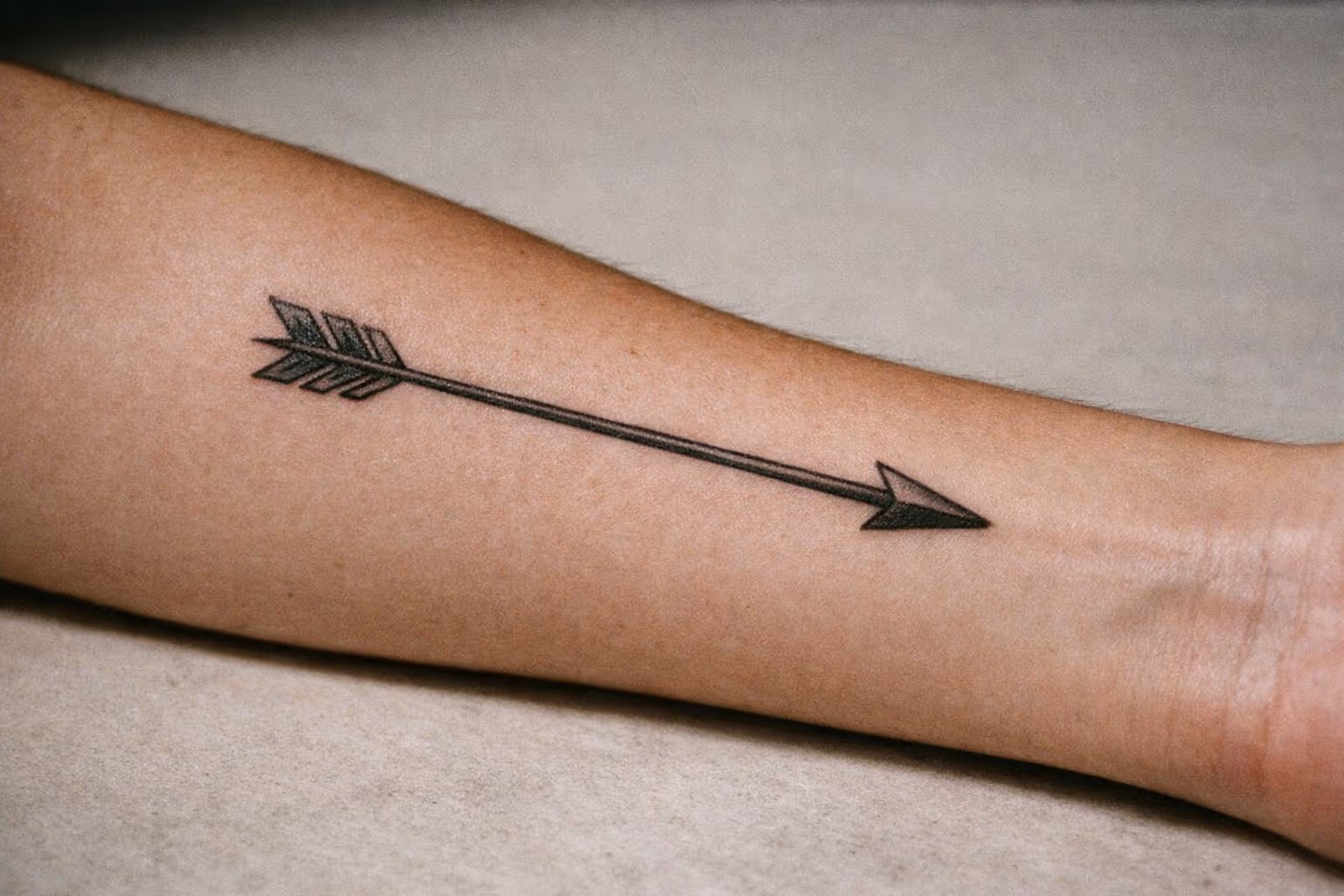
With an arrow tattoo, which way it points isn’t a style choice - it’s the meaning. Aimed up, it reads as progress and ambition; aimed down, as peace or putting conflict to rest; drawn back on the bow, as tension before a breakthrough. Most people pick the direction by how it sits on the body and accidentally say something they didn’t mean. Here’s what each orientation signals, plus the sizing and placement that keep a clean arrow clean.
What An Arrow Tattoo Actually Means
An arrow tattoo works because the shape does the heavy lifting. A straight line, a head, sometimes fletching - and you’ve got a symbol that reads instantly at 1 inch or 12. That visual economy is why arrow designs sit comfortably alongside fine-line script and minimalist geometry, and why they still book solid even after a decade of being “trendy.” This guide covers what an arrow tattoo actually means across direction and design (single, broken, bow and arrow, crossed, bundled), where it places best on the body, what it costs, and how to plan one that ages well.
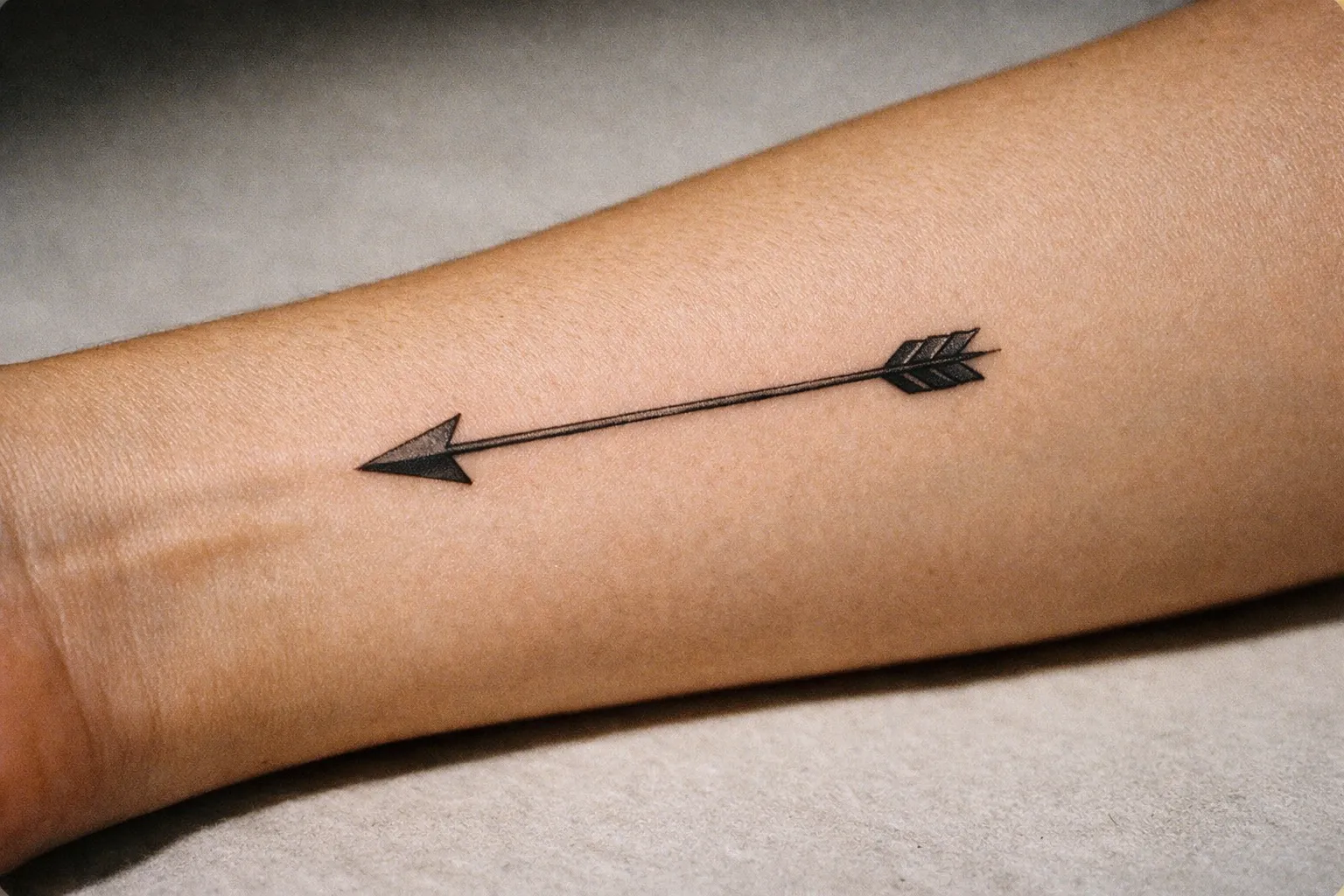
We’ll cover arrow Tattoo meaning in detail, walk through broken arrow Tattoo and bow and arrow Tattoo variations, and break down placement, size, and aftercare with specifics - not vibes.
✓ Pros
- Simple, recognizable design that works well at small sizes
- Strong symbolic meanings tied to direction, protection, and peace
- Versatile placement options with clear guidance on sizing and aging
- Minimalist style ages better than many fine-line tattoos
✗ Cons
- Fine-line micro arrows on fingers and feet fade quickly and need touch-ups
- Directional meaning can be misunderstood if placement or arrow orientation is off
- Bow-and-arrow designs on ribs and sternum are painful and prone to stretching
- Cultural appropriation risk if tribal motifs are used without connection
What The Arrow Symbol Is Actually Doing
An arrow needs tension before it flies. That’s the core of the symbolism, and it’s the reason the design resonates with people marking a turning point - sobriety, a career switch, leaving a relationship, surviving something. The arrow has to be pulled back to launch forward (3).
Beyond that headline meaning, the symbolism splits along a few clear lines:
- Direction and life path - you’re pointing toward something specific (1)(3)(4).
- Protection and self-defense - a single arrow historically read as a weapon at rest, ready if needed (2)(3)(4).
- Struggle and focus - a drawn bow signals tension before action (3)(4).
- Peace or closure - a broken arrow or a downward-pointing arrow signals the fight is over (2)(3)(4).
- Friendship and alliance - crossed arrows or bundles, drawn from heraldic and indigenous traditions.
The arrow has roots across cultures: hunting and warfare tools in Native American traditions, signs of military service and accuracy in medieval European heraldry Sagittarius Tattoo, and the bow-and-arrow of Sagittarius in Western astrology. Modern Western tattoo culture has flattened most of that down to “moving forward” - useful shorthand, but the older meanings are still doing work in the background when you choose a specific design. Worth knowing before you commit.
Direction Changes Everything
The way the arrow points is not decorative. It’s the single biggest variable in what your tattoo communicates, and it’s the one most people overlook until they’re sitting in the chair.
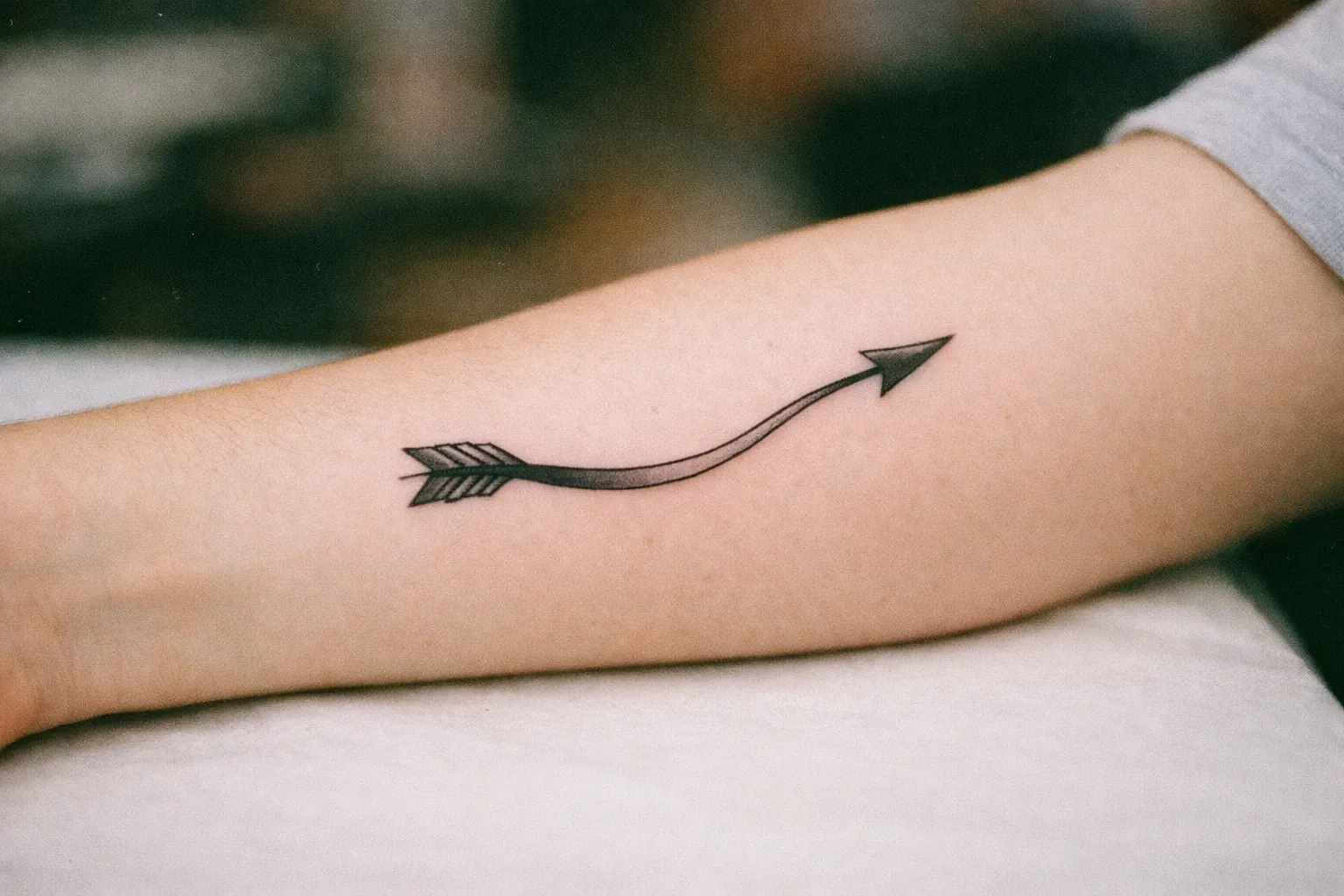
- Upward arrow - progress, growth, ascension. The default “moving forward” read (1).
- Downward arrow - peace, grounding, letting go. Often misread as negative; it actually signals the fight is finished(4).
- Right-pointing arrow - future, forward motion, active energy (1).
- Left-pointing arrow - past, intuition, sometimes “chasing something away.” Quieter and more introspective (1)(2).
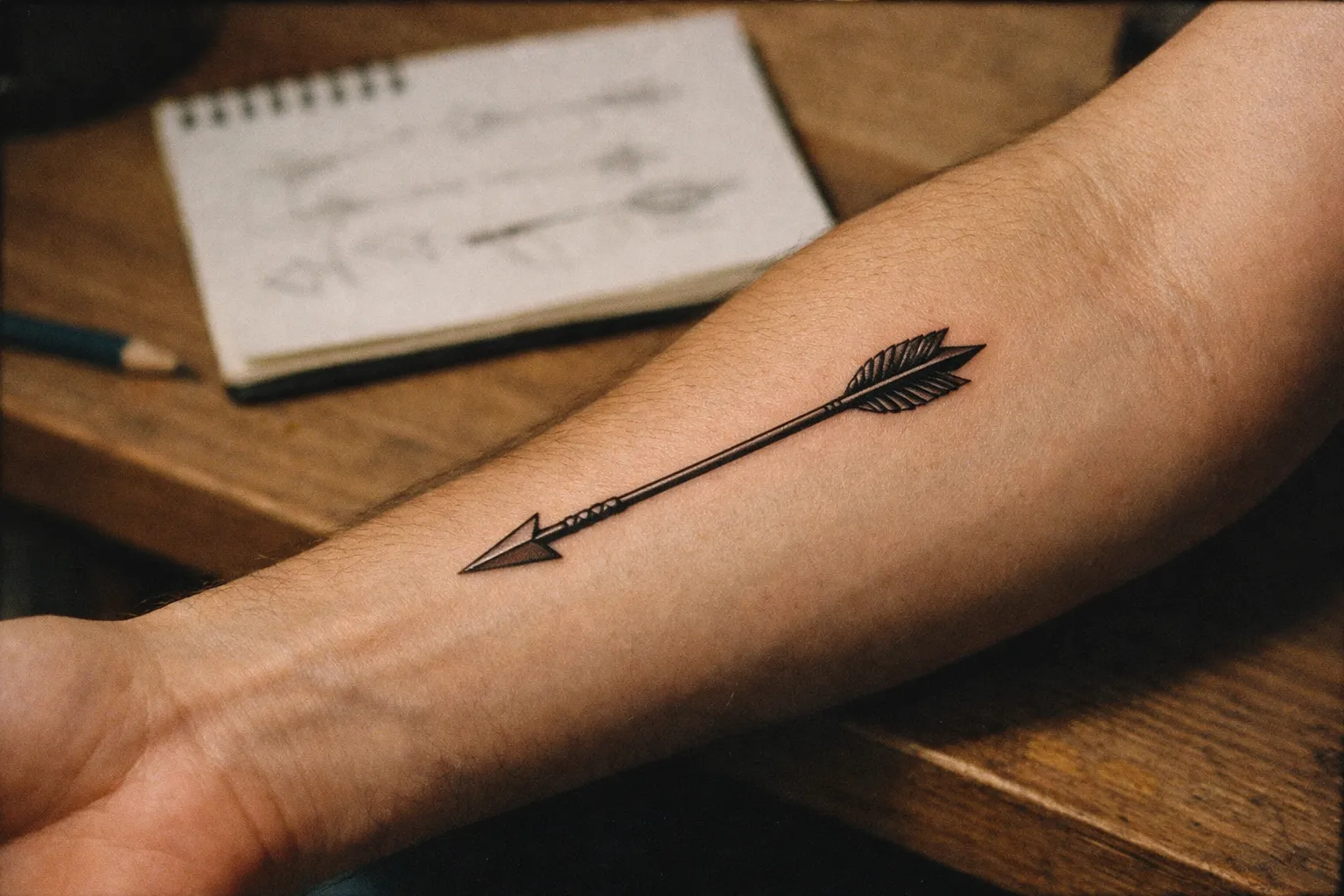
A practical move: if your arrow sits on your forearm, point it toward your hand so the line of the design follows the line of your body in motion. An arrow pointing back toward your shoulder reads as retreat, even if that wasn’t the intention. The same logic applies to legs (point toward the foot), the spine (most people choose upward), and ribs (toward the heart, if you want that read).
I’ve had clients come in with a reference photo where the arrow was pointing the wrong direction and they hadn’t noticed until I mentioned it. Takes 10 seconds to catch in consultation. Costs nothing to fix before the stencil goes on.
Single Arrow Tattoo
The simplest version, and the one I’d recommend if it’s your first tattoo. A single line arrow, 1-3 inches, no shading. It carries the protection-and-direction symbolism cleanly without committing you to a specific cultural reference or relationship narrative (2)(3)(4).
Placement that works: inner forearm, outer wrist, behind the ear, side of finger, ankle. Aligned with the limb, the arrow reads as forward motion every time you move.
Size range: 1-4 inches for the wrist and forearm, 0.5-1 inch for finger and behind-the-ear placements.
Common pitfall: going too thin. A 0.2 mm liner looks delicate the day it’s done, but on fingers and feet it can blur or drop out within 3-5 years. Ask for a slightly heavier line weight - a 5-needle liner instead of a 3. Still delicate, ages noticeably better. This is where people usually get it wrong, because they’re comparing fresh tattoos online and not thinking about what the same tattoo looks like at year four.
Broken
A broken arrow tattoo is the peace symbol of arrow designs. The traditional reading, drawn from indigenous symbolism, is “the fighting is over” - laying down a weapon by snapping the shaft (3)(4). It’s frequently chosen to mark the end of an internal battle: sobriety milestones, recovery from an eating disorder, leaving an abusive situation, finishing a long stretch of grief.
The break itself is the design’s emotional anchor, so don’t bury it in ornament. A clean snap at roughly the midpoint, with the two halves slightly offset, reads more clearly than an elaborate fracture full of splinters. I’ve seen artists over-render the break into something so decorative you can barely tell it’s broken - defeats the whole point.
Placement that works: inner forearm (3-5 inches), ribcage (4-7 inches), upper back (5-8 inches). The longer canvases let the break breathe.
A broken arrow paired with a semicolon - popularized as a mental health continuation symbol - is one of the more common combinations I see for sobriety and survivor tattoos. The two symbols reinforce each other: the fight ended, the story continues.
Bow
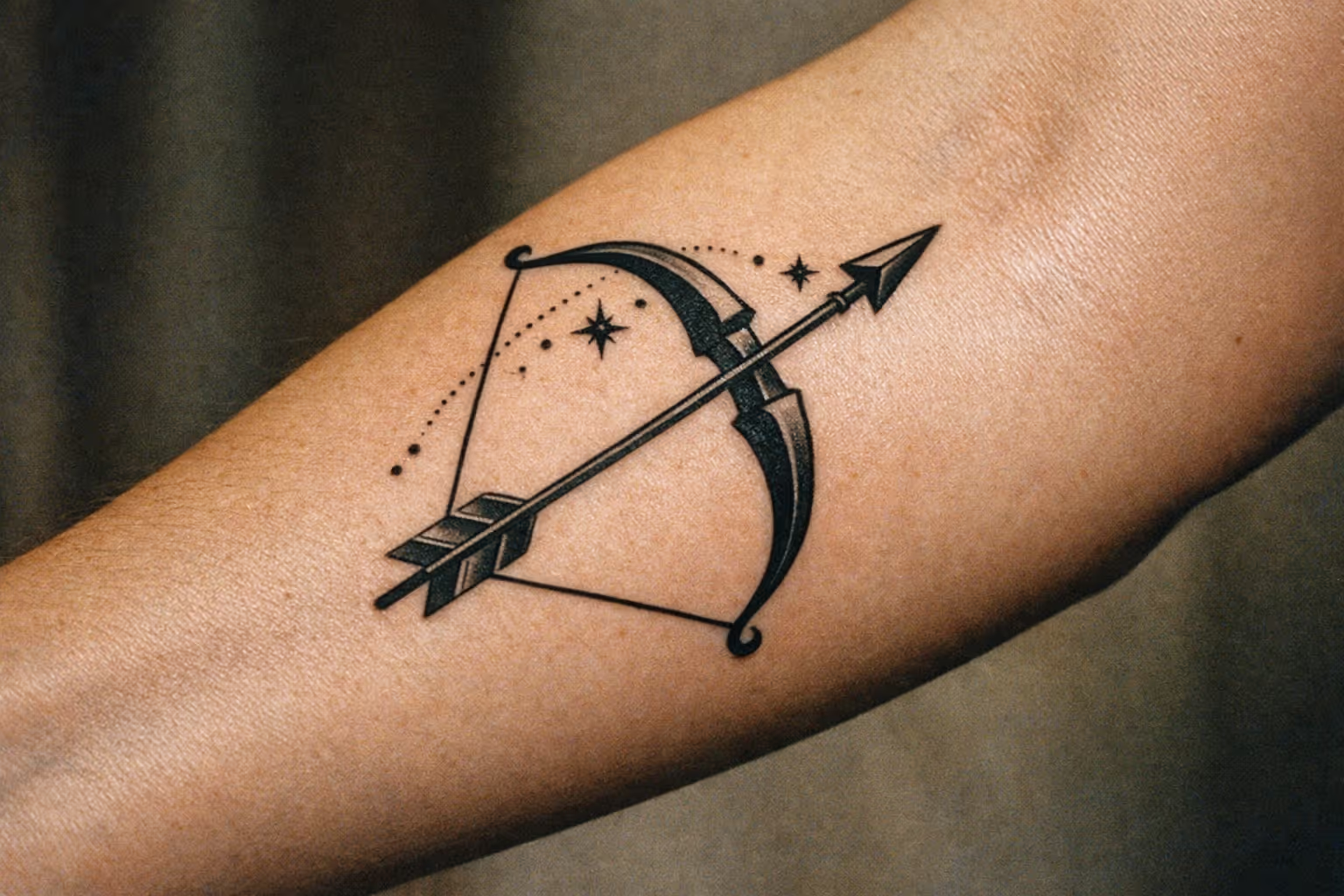
A bow and arrow tattoo introduces tension into the symbolism. Unlike the single arrow, which has already been chosen and pointed, the bow-and-arrow design captures the moment before release - focus, preparation, the pull-back that precedes any forward movement (3)(4).
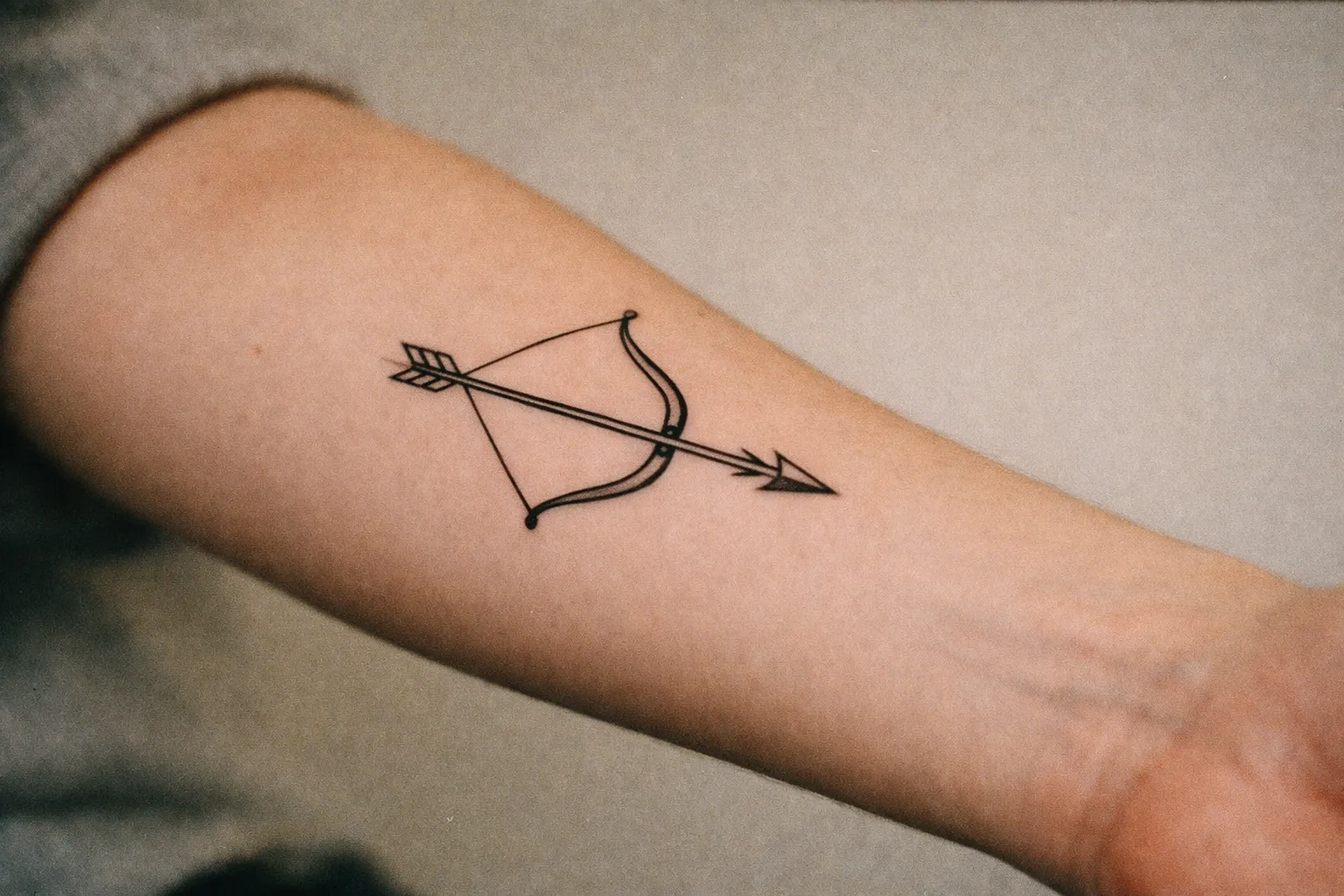
Two distinct reads depending on what the design shows:
- Drawn back, arrow nocked - struggle, readiness, the discipline of waiting until the shot is right.
- Arrow just released, bowstring still vibrating - transition, commitment, no going back Joker tattoo.
This is also the Sagittarius zodiac symbol, so a bow-and-arrow piece often doubles as a birth-sign tattoo without looking like one (3)(4). I’ve done several where the client never mentioned astrology at all - they just liked the tension in the image.
Placement that works: the curve of the bow sits naturally along body contours. The ribcage arc, outer thigh, and along the spine all let the bow follow your anatomy rather than fight it. Expect 4-8 inches for ribs and thigh, 6-12 inches for a back piece.
Pain note: ribs and sternum are significantly more painful than most placements - ribcage is well above forearm on any honest scale. Outer thigh and forearm are noticeably easier. The ribs-versus-forearm gap holds across almost everyone I’ve tattooed, regardless of how they describe their pain tolerance beforehand.
Crossed Arrows And Matching Tattoos
Crossed arrows are the friendship design. In heraldic and indigenous traditions, two arrows crossed signaled alliance or truce - a visual handshake. That meaning carried straight through into modern matching tattoos.
How matching arrow tattoos actually work:
- Split crossed arrows - each person gets one arrow at the same angle. Held next to each other, the two tattoos form the full crossed pair. Strong choice for siblings, best friends, or co-survivors of something shared.
- Mirrored single arrows - two arrows pointing toward each other when partners stand side by side. Common for couples, often placed on inner wrists or ankles.
- Bundles of 3-5 arrows - for groups. Historically tied to the Iroquois League’s five arrows representing five nations (3); modern groups use the same logic for families, recovery cohorts, or graduating classes.
Coordination is the most common failure point. Matching tattoos done at different shops, different sizes, or different line weights almost never look matching. If you’re planning this with someone, agree in advance on: same artist if at all possible, exact size in inches, line weight, ink (some shops carry different black pigment), and direction. Send the design to each other before the appointment. I’ve had people come in for “matching” tattoos where one person had already gotten theirs done somewhere else at a completely different scale. There’s no fixing that without a redesign.
Best Placement
The “best” placement depends on three things: how visible you want it, how much pain you can tolerate, and what direction makes sense for the meaning. Here’s the practical breakdown.
Inner forearm - visible to you constantly, easy to show or cover with a sleeve. Pain is moderate (forearm is one of the more manageable spots). Best for 2-6 inch arrows pointing toward the hand. My default recommendation for a first arrow tattoo.
Outer forearm - more public-facing. Same pain range, same size range. Reads well from across a room.
Spine - long vertical canvas, ideal for 4-10 inch arrows pointing upward. Pain is significant directly over the vertebrae. Heals slowly; expect to baby it for the full three weeks.
Ribcage / under breast - best for bow-and-arrow designs that follow the rib arc, 4-7 inches. Among the more painful spots and prone to stretching with weight changes. Worth it for the design fit, but not a first-tattoo recommendation.
Sternum - center-chest, deeply personal placement. Works for symmetrical bow-and-arrow or downward arrow designs, 3-6 inches. Pain is high, but heal is generally clean.
Ankle - 1-3 inch arrows, often pointing toward the foot. Pain is moderate-to-high over the bone. Fades faster than most placements due to shoe friction and sun exposure.
Behind the ear / side of neck - discreet, 0.5-1.5 inch arrows. Pain is sharp but brief.
Side of finger - micro arrows (0.25-0.5 inch). Honestly, the placement I’m most cautious about recommending. Fingers blur, drop ink, and need touch-ups within 2-4 years almost universally. If you want a micro arrow, behind the ear holds better Tattoo for Sensitive Skin.
The directional rule applies everywhere: align the arrow with the limb or bone axis. Diagonals across muscle groups look fine in a stencil and weird in motion.
Cultural Background And When To Be Careful
The arrow’s symbolism didn’t appear in a vacuum. Native American and First Nations cultures used arrows as hunting and warfare tools, and developed specific symbolic vocabularies - broken arrows for peace, bundles for unity, directional meanings tied to particular tribes. Medieval European heraldry assigned arrows to military service, swiftness, and accuracy (1). Greek and Roman mythology gave us Cupid’s arrow as a love symbol, and Sagittarius the archer in the zodiac (3)(4).
Where modern tattooing gets uncomfortable is when generic arrow designs slide into specifically tribal motifs - particular feather patterns, headdresses paired with arrows, sacred symbols from nations the wearer has no connection to. That’s appropriation territory, and most reputable artists will steer you toward a non-tribal arrow design unless you have direct cultural ties.
A clean fine-line or geometric arrow doesn’t carry that baggage. It reads as “arrow” without claiming a specific lineage. If the broader symbolism of an indigenous design is what draws you in, the most respectful move is to research the specific nation’s traditions, find an artist of that heritage if possible, and accept that some designs aren’t yours to wear.
Cost, Time, And What To Expect At The Shop
Pricing for arrow tattoos in U.S. urban shops, 2025-2026:
- Shop minimum (applies to most micro arrows): $80-$120.
- Small line arrow, 1-2 inches, black ink: $80-$200.
- Medium arrow or simple bow-and-arrow, 3-6 inches, some detail: $200-$400.
- Large, detailed, or color piece (forearm wrap, ribcage bow-and-arrow): $400-$800+.
Time in the chair scales similarly:
- Micro arrow (0.5-1 inch): 15-45 minutes.
- Medium forearm or spine arrow (3-6 inches): 1-2 hours.
- Large bow-and-arrow with shading: 2-4+ hours.
Booking lead time at busier shops runs 2-8 weeks. For custom symbolic pieces, send your reference images, intended size in inches, and placement notes when you book - it saves consultation time and helps the artist quote accurately.
Age requirements: most reputable studios require 18+ with ID. Some regions allow 16-17 with documented parental consent; this varies by state and country.
Aftercare Timeline
The healing process is the same for any small-to-medium black ink tattoo. Specifics matter more than products.
Day 1-3: Leave the second-skin bandage on as long as your artist instructed (typically 24 hours to 5 days for Saniderm or similar). Once it’s off, wash gently twice a day with a fragrance-free soap and pat dry with a clean paper towel. Expect plasma weep and some swelling.
Week 1: Apply a thin layer of fragrance-free moisturizer or tattoo-specific ointment 2-3 times a day. Do not over-moisturize - drowning a healing tattoo causes patchy ink and slows healing. No swimming, no soaking, no gym sweat sitting on the tattoo. Itching starts around day 4-5; do not scratch or pick.
Week 2-4: Surface is closed but the deeper layers are still healing. Continue light moisturizing. You can resume normal exercise. The tattoo may look slightly dull or flaky - this is the top layer shedding and is normal.
Month 2-3: Fully healed. Now the long-term care starts: SPF 30+ sun-protective coverage on the tattoo whenever it’s exposed. Sun is the single biggest factor in fine-line arrows fading prematurely. A 1-inch arrow on an unprotected wrist can lose noticeable line crispness within 2 years of daily sun exposure. I’ve seen it happen faster on people who work outdoors and skip the sunscreen.
Touch-ups on fine-line work are common at the 6-12 month mark. Most reputable artists include one free touch-up within the first year.
Planning Your Design: Building A Reference Set Before You Book
Most placement regret comes from rushing the design conversation. Before your appointment:
- Decide what the arrow points to. Goal, person, place, date. This sets direction and placement.
- Pick the design variant - single, broken, bow and arrow, crossed, bundle. Each carries different meaning, and switching mid-consultation usually means the size and placement assumptions break.
- Build a small reference set. 3-5 images of arrows in the style you want (fine-line, blackwork, geometric, illustrative). Send them with your booking. Most studios now do tablet mockups in Procreate or similar so you can preview the arrow at your chosen angle and size on a photo of your body before any needle touches skin.
- Confirm size in inches, not “small” or “medium.” Artists hear “small” and think 1.5 inches; you might mean 3.
- For matching tattoos, coordinate with your partner or group before booking - same artist if possible, identical specs.
Frequently Asked Questions
- Can I get an arrow tattoo if I'm under 18?
- Most reputable studios require you to be 18 with valid ID. Some regions allow 16-17 with documented parental consent, but this varies widely by location and studio policy.
- How do I make sure matching arrow tattoos actually look the same?
- Coordinate with your partner or group to use the same artist, exact size in inches, line weight, ink type, and arrow direction. Sharing the design and specs before booking avoids mismatched results.
- Why do finger arrow tattoos fade so fast?
- Fingers experience constant movement, skin shedding, and exposure to water and friction, which cause fine lines to blur or drop out within 2-4 years. Thicker lines and alternative placements like behind the ear age better.
- Is it cultural appropriation to get an arrow tattoo with tribal elements?
- Using specific tribal motifs, feather patterns, or sacred symbols without direct cultural connection can be appropriation. A clean, non-tribal arrow design is safer unless you research and have ties to the culture.
- How long should I expect my arrow tattoo to take?
- Micro arrows take 15-45 minutes, medium-sized arrows 1-2 hours, and large bow-and-arrow pieces with shading 2-4+ hours. Booking lead times can be 2-8 weeks depending on the shop's busyness.
- What aftercare products are best for arrow tattoos?
- Use fragrance-free soap for cleaning, fragrance-free moisturizer or tattoo-specific ointment during healing, and SPF 30+ sun-protective coverage after healing to prevent fading.