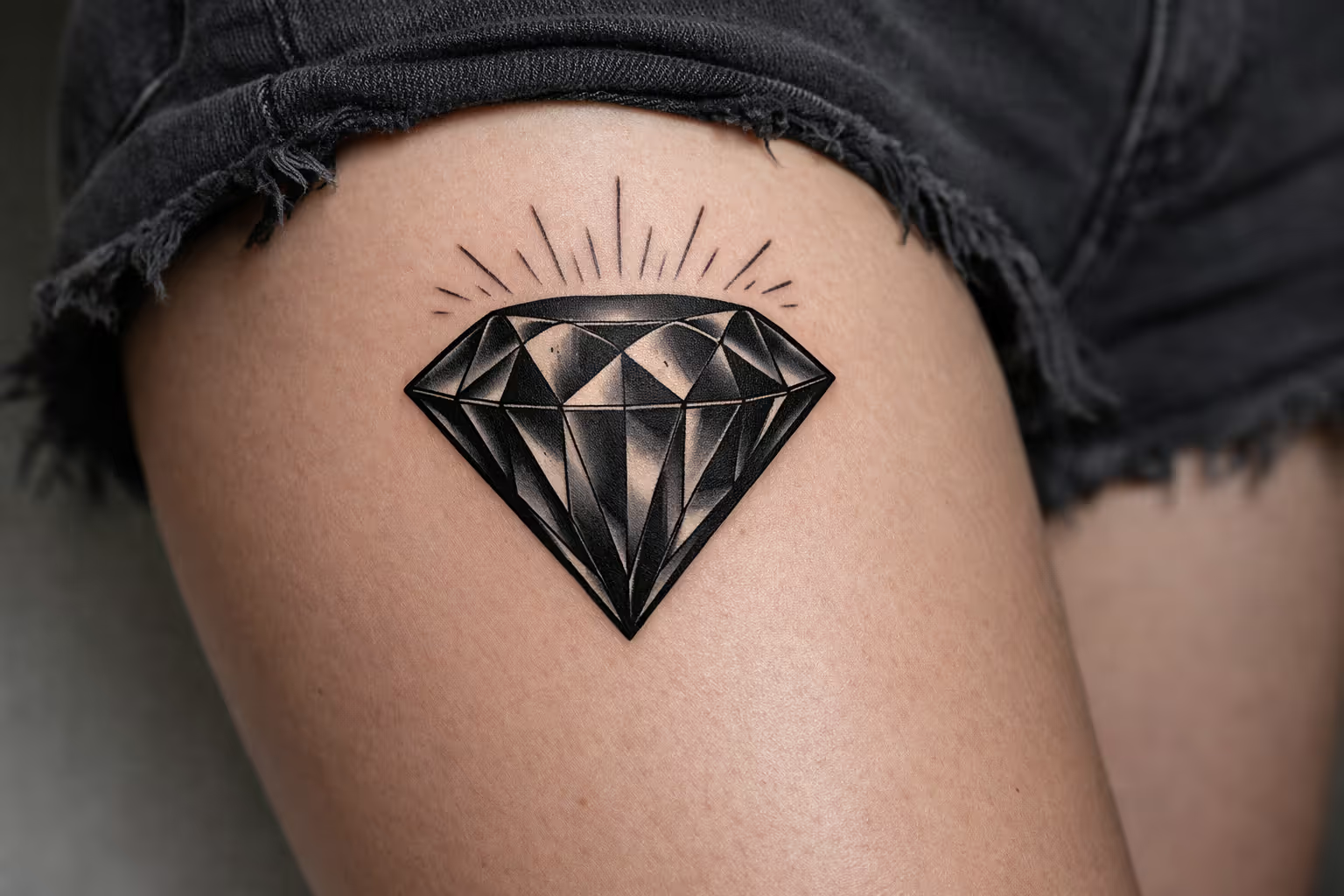
A diamond tattoo is famously forgiving of size - a clean geometric shape holds down to about half a centimeter - with one big exception: fingers. Finger placement blurs faster than almost anywhere on the body, and a crisp little diamond there can go fuzzy within a year or two. So the design isn’t the risk here; the spot is. Here’s what a diamond means, the imagery to keep it clean, and the placements and prices that actually last.
What a Diamond Tattoo Actually Means
A diamond tattoo works at almost any size - from a 1 cm outline tucked behind the ear to a fully shaded 15 cm gemstone on the ribs. It’s geometric, it carries real symbolic weight, and it ages reasonably well when the artist gets the line weight right. What follows covers what diamond tattoos actually mean across different traditions, the design variants worth considering, realistic prices and placements, and a few things - including some loaded imagery - you want to know about before you book.
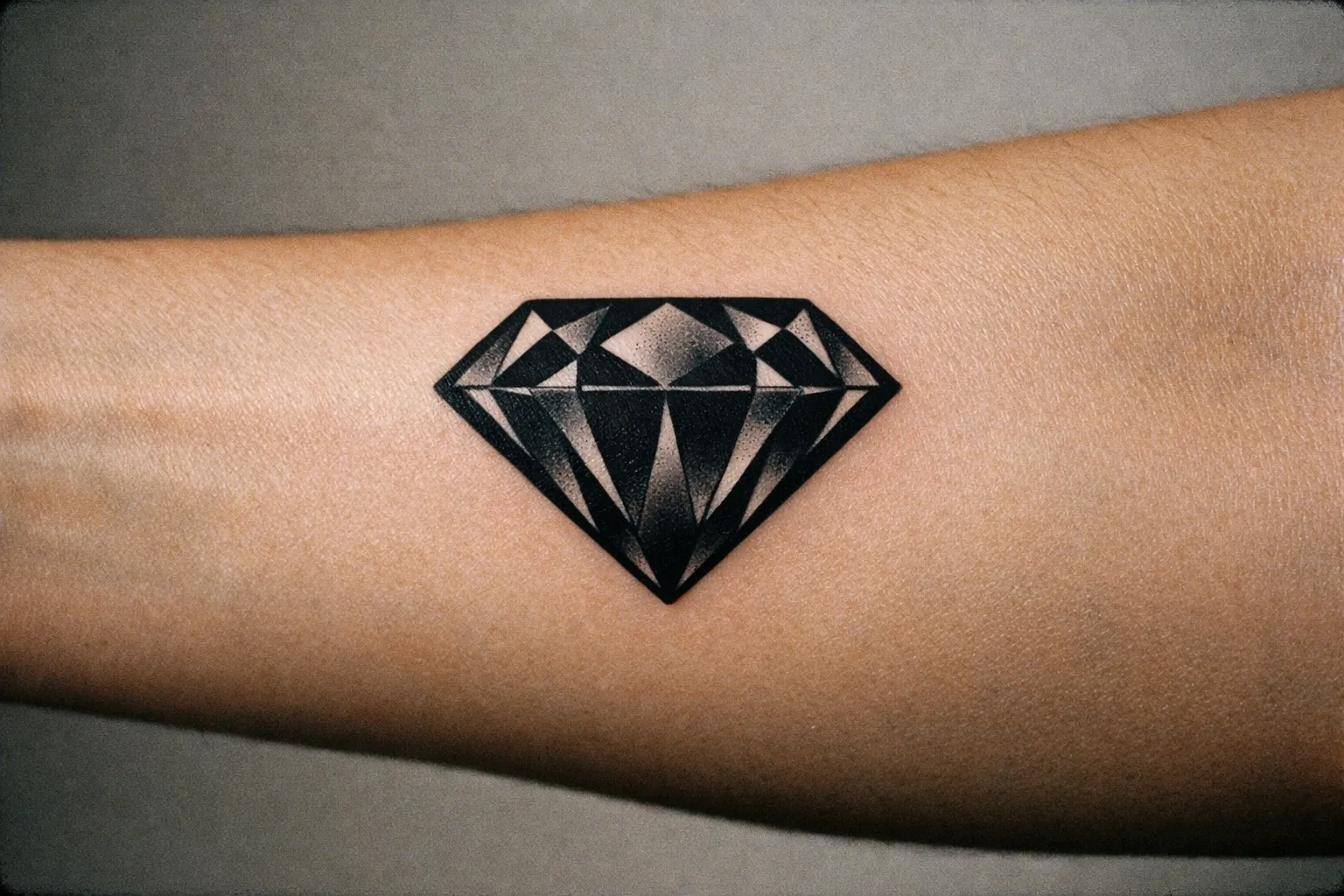
The most common readings center on strength, resilience, and transformation under pressure. Diamonds rate 10/10 on the Mohs hardness scale - the hardest natural material on earth - so the symbolism of “indestructible” is built into the stone itself (1). The word “diamond” comes from the Greek adamas, meaning unconquerable.
Beyond hardness, the recurring meanings are:
- Transformation through pressure - carbon becomes diamond over time and heat, which reads as personal growth through adversity (2)
- Clarity and purity - the transparency of a cut stone maps to mental clarity, honesty, inner light
- Wealth and status - the engagement-ring association is hard to avoid (3)
- Love and commitment - particularly with paired or matching designs (4)
- Inner value - “rough diamond” as a metaphor for unrecognized worth
These meanings overlap, which is part of why the motif stays popular. You can wear the same shape and tell three different people three different stories about it without lying to any of them.
✓ Pros
- Strong symbolic meanings including resilience and transformation
- Works well at a wide range of sizes and placements
- Aging is manageable with proper line weight and placement
- Versatile color options allow personalized meanings
✗ Cons
- Fine lines and pastel colors fade faster and require touch-ups
- Certain placements like fingers and inner wrist blur quickly
- Some diamond imagery can carry unwanted cultural or gang associations
- Large realistic diamonds are technically challenging and costly
What Does a Diamond Tattoo Signify in Different Traditions?
Most modern Western diamond tattoos lean on the “pressure makes diamonds” narrative - self-improvement, mental resilience, surviving something difficult. In older European tattoo culture and Middle Ages folk symbolism, diamonds were sometimes used as protective amulets against evil. In some ancestral textile traditions, diamond patterns symbolize the all-seeing eye, family lineage, or safe travel (5).
The Western tattoo meaning has drifted away from the protective amulet reading toward the personal-growth reading. If you want the older meaning to come through, you usually need to pair the diamond with another motif - an eye, a rune, a family crest element - rather than rely on the diamond alone to carry it.
What Color Does to the Read
Color shifts the read of the design more than people expect. The black-outline diamond is the default, but once you add color, you’re committing to something more specific.
- Black diamond - endurance, commitment, mystery; common in American traditional flash with thick outlines and limited palette (6)
- Blue diamond - peace, calm strength, sometimes worn to mark overcoming depression or grief (7)
- Red diamond - passion, intensity; “melting” red diamonds often signal heartbreak or lost love
- Green diamond - overcoming envy, nature, growth
- White/clear diamond - purity, subtle elegance, often used on fingers as a ring-replacement piece
- Pink diamond - softer romantic reading, increasingly popular in fine-line work
One thing I flag with clients regularly: pastel colors and watercolor splashes fade faster than black linework. Expect a touch-up every 3-7 years on red, pink, or yellow tones, especially on sun-exposed placements like forearms and shoulders. I’ve seen pink watercolor diamonds on forearms lose most of their saturation within two summers. It’s not a reason to avoid color - just a reason to plan for it.
Simple and Outline Designs Worth Knowing
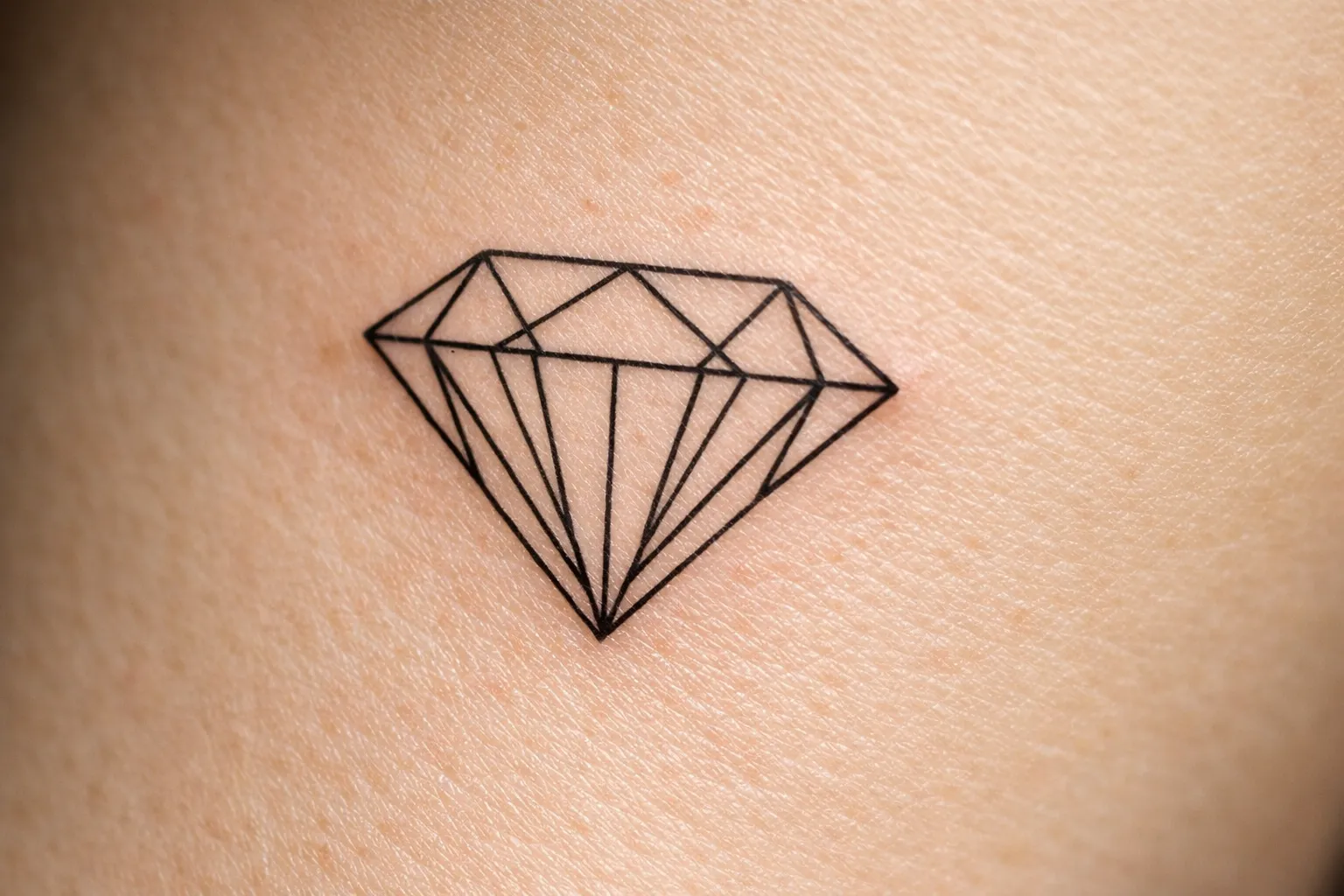
A simple Diamond Tattoo is usually pure linework - four to eight lines forming the gem’s silhouette, no shading, no color. These work because the geometry is forgiving and the design reads clearly even at small sizes.
A Diamond outline Tattoo is the most common starting point: a clean 1-3 cm shape, often a kite-cut or brilliant-cut silhouette, sometimes with a single internal line to suggest a facet. Two technical hallmarks of a good outline diamond: even line weight throughout (no thick-thin wandering) and clean, sharp corners at the table and culet - the top and bottom points. The common pitfall when artists rush it is that the corners round off, and the diamond ends up looking like a generic kite. I’ve had to fix a few of these over the years. The geometry looks simple until you’re actually doing it.
Variants worth knowing:
- Single-line / one-continuous-line diamond - minimalist, fine-line style, usually under 2 cm
- Geometric facet diamond - internal triangular facets drawn in, no shading; reads as a stylized gem
- Dotwork diamond - stippled shading inside the outline instead of solid black
- Broken or cracked diamond - symbolizes healing, scars, learning from damage
- Diamond with crown or wings - royalty, freedom, “earned” status
For a clean outline, ask the artist for lines around 0.3-0.5 mm thick. Ultra-thin lines under 0.2 mm look sharp fresh but tend to blur within 3-5 years, especially on the wrist or fingers.
Small Placements and Size Ranges That Actually Work
A small Diamond Tattoo is one of the better first-tattoo options - fast, relatively cheap, and easy to build around later if you want more. Realistic size ranges:
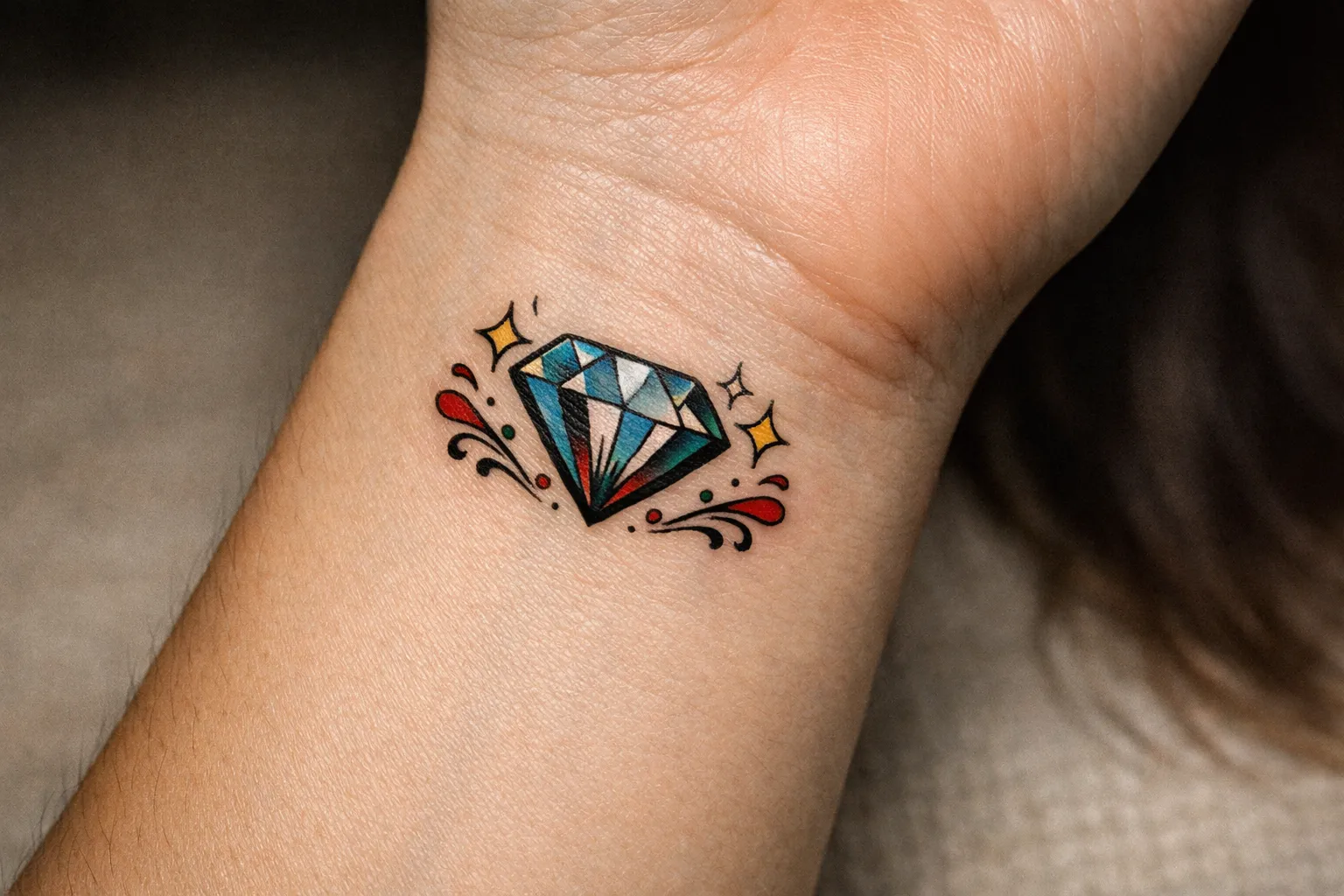
- Micro (0.5-1.5 cm) - finger sides, behind the ear, base of the neck, inner wrist
- Small (1.5-3 cm) - outer wrist, ankle, sternum, forearm
- Medium (3-6 cm) - forearm, upper arm, shoulder blade, ribcage
Placements with strong long-term aging: outer forearm, upper arm, calf, shoulder blade. The skin doesn’t shift as much, sun exposure is controllable, and the line weight holds.
Placements that look great fresh but age harder: fingers, palms, feet, inner wrist. Fingers regenerate fast and rub against everything - expect blurring and gaps within 1-3 years, and budget for touch-ups at $40-$150 each. I tell every client considering a finger diamond to go in with eyes open on this. It’s not a reason to skip it, but it is a reason to have a touch-up fund.
For a small diamond tattoo, pain is usually mild - wrist and forearm sit at the low end of the relative scale, while sternum and ribs sit significantly higher. A finger diamond hurts more than people expect because the skin is thin and close to bone.
Diamond Tattoo Placement: Sizing It to the Body
Sizing is where a lot of diamond tattoos go wrong. The geometry needs enough room to read as a faceted gem rather than a black blob.
- Finger or behind-ear: keep it 1-2 cm, minimal internal detail
- Wrist or ankle: 2-4 cm works, you can add one or two internal facet lines
- Forearm: 4-8 cm opens up shading, color, or paired motifs (rose, banner, name)
- Ribs, sternum, back: 8-15+ cm allows full realistic facet work or watercolor
A diamond chest tattoo centered on the sternum reads well at 6-10 cm and gives you room for added elements like wings or a banner. The ribs hurt significantly more than the forearm - if it’s your first tattoo, this is not where to start.
For couples doing matching diamond tattoos, the cleanest option is identical small outlines (2-3 cm) on the same spot - inner wrist or outer forearm - rather than two halves of one design that only work when you’re standing next to each other.
Cost: What You’ll Actually Pay
Prices have shifted with inflation. Old “$50 tattoo” flash specials are mostly gone in major US cities - most reputable shops now sit at a $60-$100 minimum, which covers a small outline diamond.
Realistic 2025 price ranges in the US:
- Tiny simple diamond outline (1-2 cm): $60-$150
- Small diamond with light shading (2-4 cm): $100-$250
- Medium diamond with color or watercolor (5-8 cm): $150-$400
- Large detailed gemstone piece (10-15+ cm): $400-$800+
On top of the sticker price, plan for a 15-25% tip in US shops, and budget for a touch-up at the 3-5 year mark if you went with color or fine lines.
What Is a $50 Tattoo?
A $50 tattoo today usually means one of three things: a flash-day special at a shop running a promotion (common around Friday the 13th), a very small piece in a low-cost region, or an underground/home setup. The third option is where infection and scarring risk spikes - unsterile needles and untrained hands aren’t worth the savings. If a price feels far below market rate, ask about sterilization procedures and check that the shop is licensed in your state.
Tattoo Sheets: Diamond Designs in Different Colors and Sizes
Before committing to permanent ink, ordering a sheet of temporary diamond tattoos in different colors and sizes is one of the smartest planning moves. Temporary tattoo sheets typically come with 10-50 diamond designs ranging from 0.5 cm to 5 cm, priced at $6-$20 on most online marketplaces.
What you actually get out of testing:
- Placement check - wear the temporary version for a week, see if you keep noticing it or forget it’s there
- Size calibration - what looks right on a screen often looks too small (or too big) on actual skin
- Color trial - see how blue, red, or green diamond designs read against your skin tone
- Orientation - vertical, horizontal, angled; this matters more than people realize on the wrist and behind the ear
Temporary sheets are also useful for events - weddings, bachelorette parties, group trips - where everyone wears the same matching design for a night without anyone committing to ink.
Designs to Avoid: Loaded Diamond Imagery
This is the section most diamond tattoo guides skip entirely, and it matters.
Certain diamond-shaped designs carry meanings you almost certainly don’t want attached to you. Prison card-suit diamonds - when combined with playing-card motifs in specific configurations - can carry meanings tied to informants in some prison tattoo traditions. Standalone diamonds are fine; diamonds-as-card-suit paired with other suits can read differently in certain contexts. If you’re drawn to luck, risk, and fortune symbols in your design, it’s worth understanding how card-suit imagery reads before combining it with a diamond shape.
The more serious one: the Aryan Circle “diamond” patch. The Aryan Circle, a white supremacist prison gang, uses a diamond-shaped shield containing a swastika and the letters “AC,” sometimes called “The Diamond”. According to the Anti-Defamation League, this is an active hate symbol. Avoid diamond shapes that contain runes, lightning bolts, or letter combinations like “AC” inside them.
Three-dot or tear configurations near a diamond carry separate gang-associated meanings independent of the diamond itself.
A clean geometric diamond on its own carries none of this baggage. The issue is specific combinations. If you’re working with an experienced artist, raise the question directly - they’ll know what to steer clear of.
What Is the Hardest Tattoo to Get?
“Hardest” splits into two questions: most painful and most technically difficult.
Most painful placements - relative to a forearm baseline - are ribs, sternum, spine, armpit, ankle bone, and fingers. A large diamond shaded across the ribs sits firmly in this category. The pain isn’t constant; it spikes when the needle crosses bone-close skin.
Most technically difficult designs for a diamond specifically: a large realistic faceted gemstone with smooth color gradients and sharp geometric symmetry. Geometric tattoos are unforgiving - any wobble in the line shows immediately because the eye has a reference shape to compare against. I’ve watched clients pick an artist based on a gorgeous fresh photo, only to come back disappointed when the piece healed with soft corners and uneven facets. This is why checking healed work matters more than fresh photos for geometric designs. It’s also why a senior artist will charge meaningfully more for a realistic diamond than for an organic floral piece of the same size. If you’re comparing styles, flower tattoo ideas show how organic shapes give artists more room to work with imperfection than strict geometry does.
Healing Timeline
Healing is the same regardless of motif, but a few details matter more for geometric work because any distortion shows in the lines.
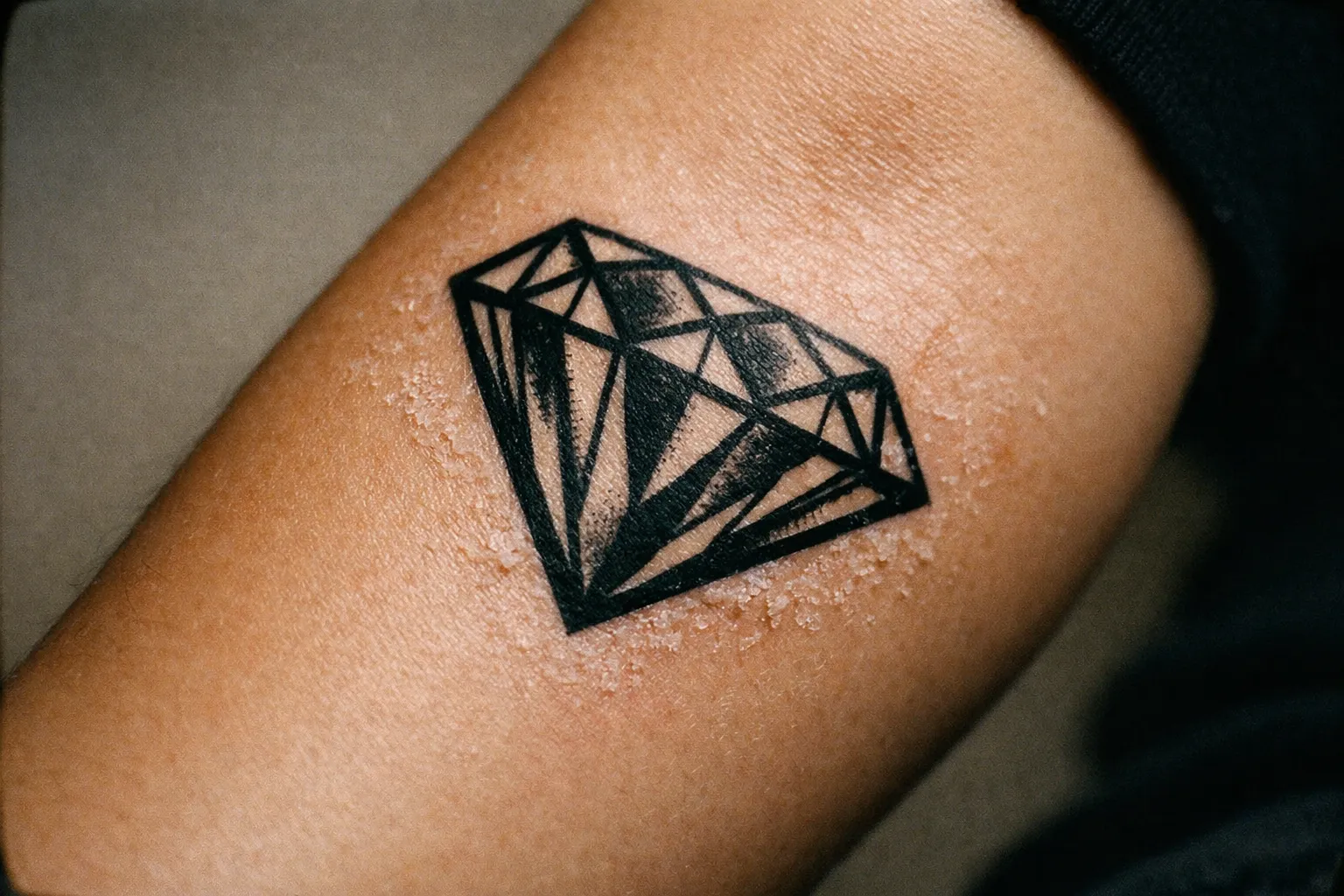
- Day 1-3: Plasma weeping, redness, slight swelling. Keep the second-skin wrap on as long as your artist instructed (usually 24 hours to 5 days). After removal, wash gently with fragrance-free soap twice daily, pat dry, apply a thin layer of fragrance-free moisturizer or a dedicated tattoo balm.
- Week 1: Scabbing and flaking begins. Do not pick - pulling a scab off a sharp diamond line will leave a gap in the outline that needs a touch-up. Moisturize 2-3 times daily.
- Week 2-4: Flaking finishes, the tattoo may look slightly cloudy as the top skin layer settles. Avoid swimming, hot tubs, and long sun exposure. Once fully healed, apply SPF 30+ to keep facets crisp and colors from washing out.
For watercolor diamonds, sun protection isn’t optional - UV breaks down lighter pigments fast. A pink or blue diamond left unprotected on a forearm can lose noticeable saturation within two summers. I’ve seen it happen enough times that I now tell clients to treat sun protection as part of the design cost.
How to Choose Your Design
Three questions worth answering before you book:
- What meaning do you want this to carry for you specifically? Strength, a relationship, a phase you got through, an aesthetic preference. Any of these is valid, but the answer drives the style and color choices.
- Where on your body, and how big? Use a temporary version for at least a few days. Most people change their mind on size at least once during this test.
- What’s your aging tolerance? If you want it crisp at 20 years, choose black linework on a low-friction placement. If you’re fine with touch-ups, open up to color and fingers.
Bring at least three reference images to your consultation, not one. Artists work better when they see the range you’re considering - what you like about each image and what you’d change. For every saved image, note the placement, style, and size relative to anatomy, not just the design itself. “It looked good on Pinterest” is a starting point, not a brief.
Diamond Tattoo Ideas for Couples
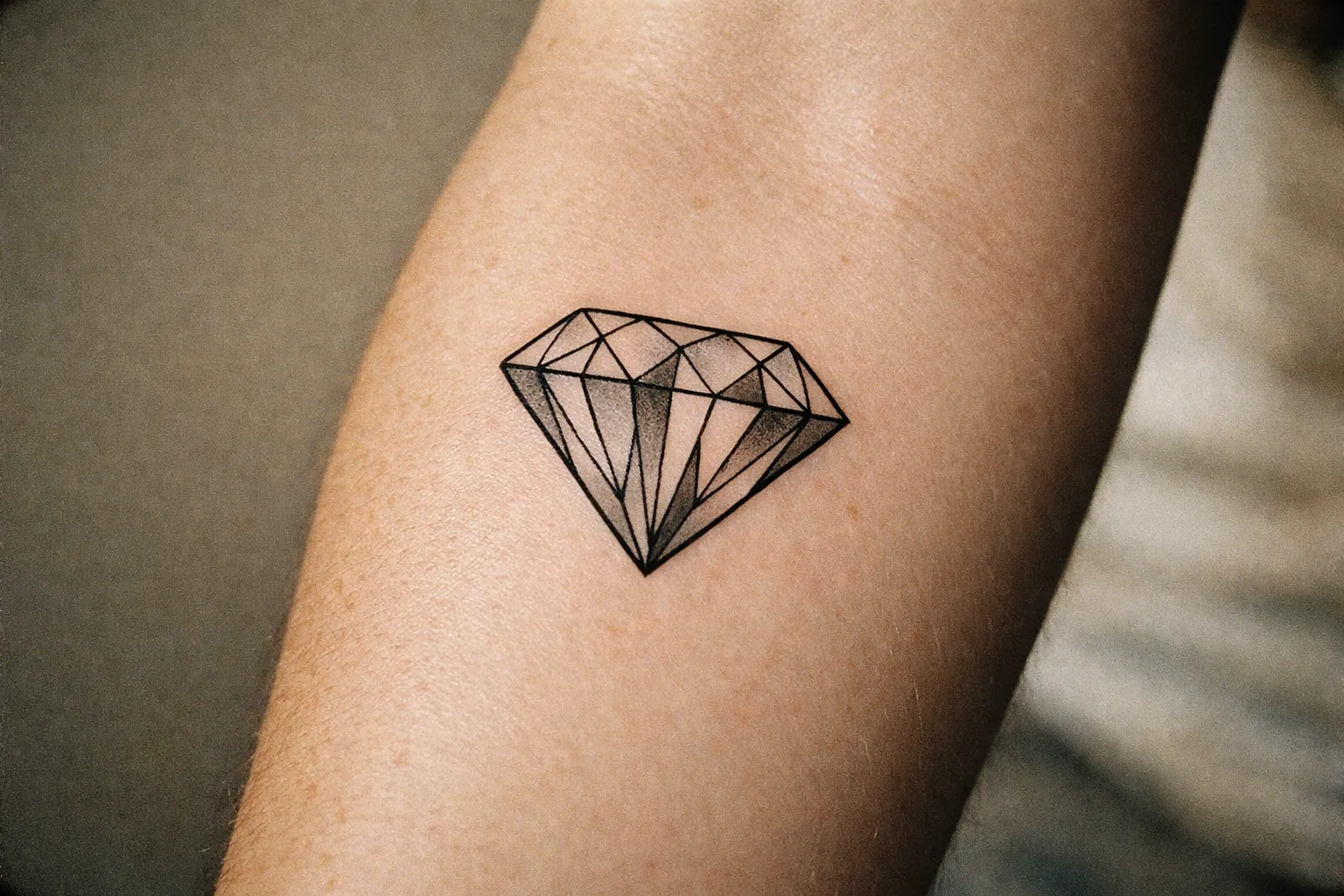
Matching diamond tattoos work well precisely because the shape is symmetrical and the symbolism - endurance, commitment - fits the context without being heavy-handed.
A few approaches that hold up:
- Identical small outlines on matching spots (inner wrist, ring finger, behind the ear) - clean and easy to maintain
- Same diamond, different colors - one blue, one red, same outline shape; works if you want individuality within the matching set
- Diamond + initial - small diamond with a tiny initial or date below; reads as personal rather than generic. Some couples pair this with roman numerals tattoo work to encode a meaningful date alongside the diamond shape.
- Eternity-style diamond rings - a continuous diamond-pattern band around the ring finger; needs touch-ups every 1-3 years due to finger wear
Avoid two-halves-of-one-design tattoos that only make sense when you’re physically next to each other. They photograph well. They don’t hold up as standalone pieces if life changes.
Frequently Asked Questions
- What does a diamond tattoo signify?
- It commonly symbolizes strength, resilience, transformation under pressure, inner worth, and luxury or commitment. The meaning can shift based on color and accompanying motifs, so a standalone diamond carries the meaning you assign to it.
- What is a $50 tattoo?
- Typically a flash special or a very small piece in a low-cost region. Prices below market rate often indicate unlicensed or unsterile setups, which carry infection and scarring risks.
- What is the hardest tattoo to get?
- Pain-wise, ribs, sternum, spine, and fingers are the most painful relative to the forearm. Technically, large realistic geometric diamonds are hardest due to the need for perfect symmetry and clean lines.
- How small can a diamond tattoo be?
- Practically, about 0.5-1 cm is the smallest size that still reads as a diamond. Behind the ear and finger sides handle this size best.
- Do diamond tattoos fade quickly?
- Black outline diamonds on low-friction placements can last 10+ years with sun protection. Color diamonds, especially watercolor and pink/red tones, usually need touch-ups every 3-7 years. Fingers blur within 1-3 years regardless of color.