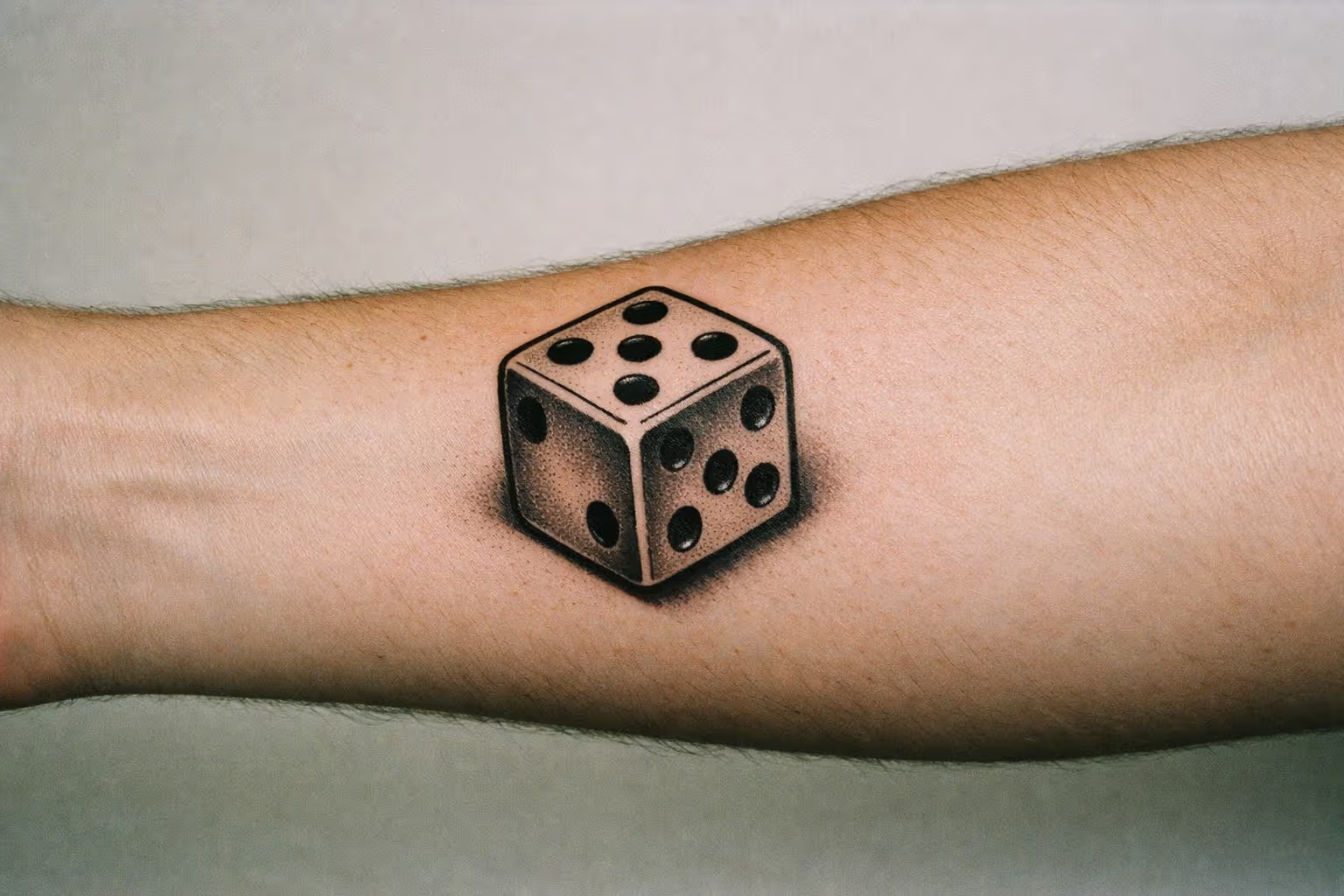
A dice tattoo fails in two small ways most people never consider: the pips and the perspective. Cram the dots too small and they blur into grey blobs; get the 3D angle wrong and the cubes look flat or lopsided forever. It’s a simple-looking design that’s surprisingly easy to botch. Here’s what a dice tattoo means, the numbers worth thinking twice about, and the placements and sizing that keep the cubes crisp.
What a Dice Tattoo Actually Means, Designs, and Ideas
Dice are universally read as tools of chance. That’s why they land so naturally as a tattoo about luck, risk, and fate. The core meaning is straightforward: you’re acknowledging that outcomes aren’t fully in your control, and you’re choosing to roll anyway.
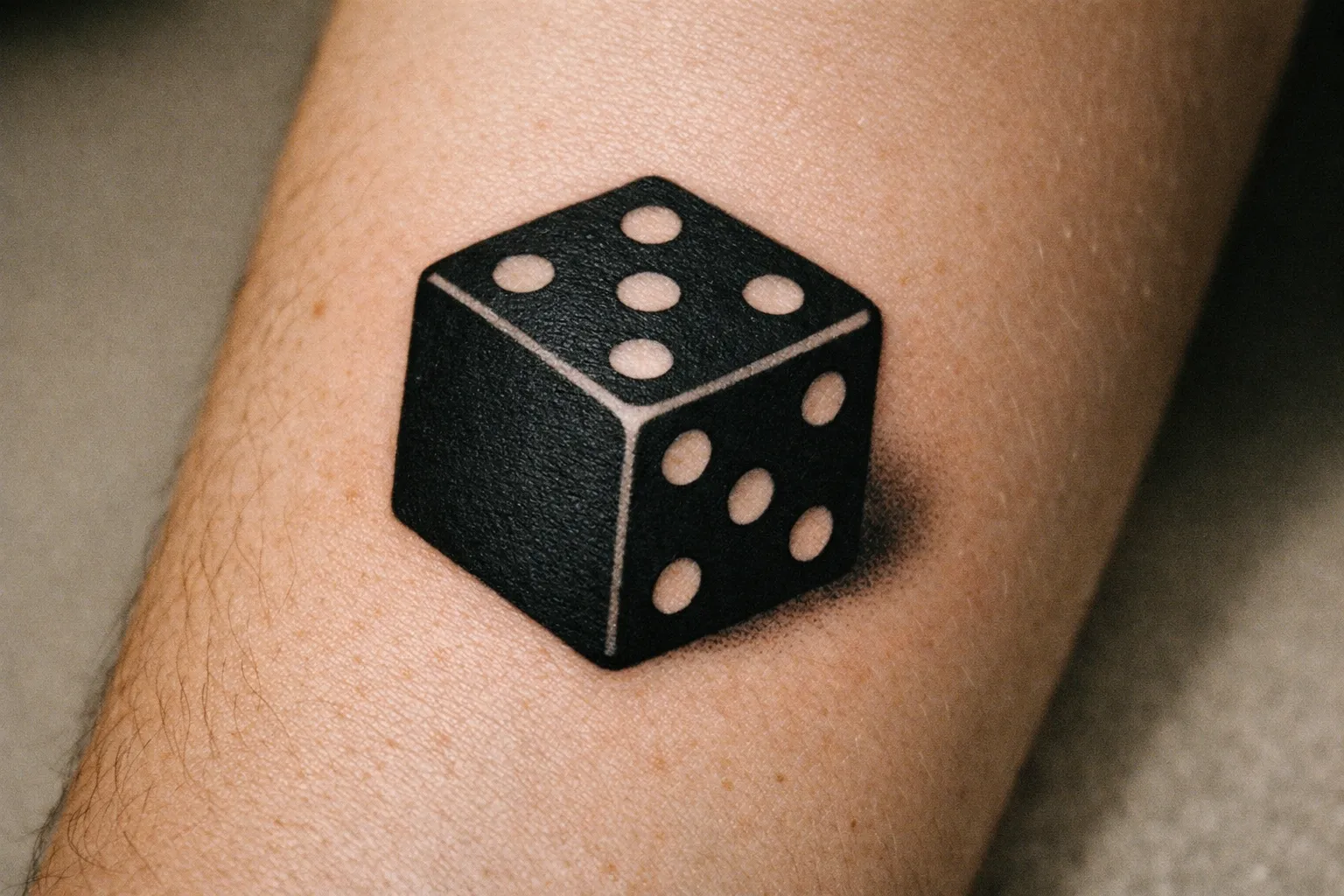
The symbolism splits into two distinct emotional registers, and most people lean toward one:
- Luck and fortune. The dice as a talisman - a small bet that good things will land your way. This is the reading behind dice paired with horseshoes, “Lucky” banners, or the number 7.
- Taking chances. The dice as a statement about your relationship with risk. Entrepreneurs, gamblers, anyone who’s bet on themselves and either won or learned something. Less about hoping for luck, more about owning the decision to play.
The numbers showing on the dice matter, and this is where a lot of meaning gets packed in. Seven (often shown as 5+2 or 6+1) reads as the classic lucky number from craps, where a 7 on the come-out roll wins. Eleven (6+5) is the other natural winner in craps. Snake eyes - two ones - is the opposite: in most dice games it’s a losing roll, so people who choose it are usually signaling that they embrace the downside, not just the upside.
Then there’s 666, sometimes called the number of the devil. Some risk-takers wear it precisely because it’s loaded, treating bad luck as a dare rather than a warning. If you go this route, know that the cultural baggage travels with the tattoo.
What Does a 2 Dice Design Symbolize?
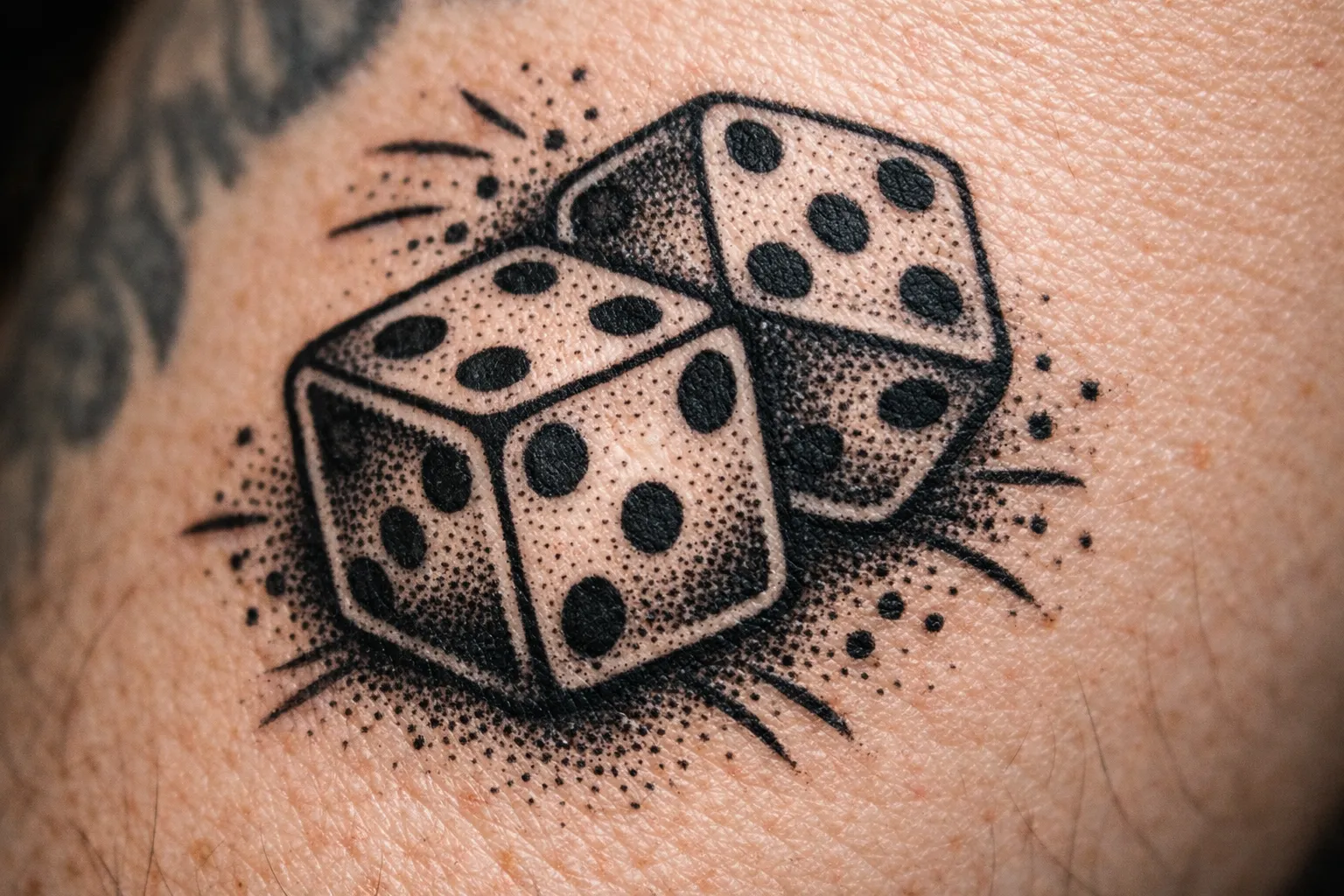
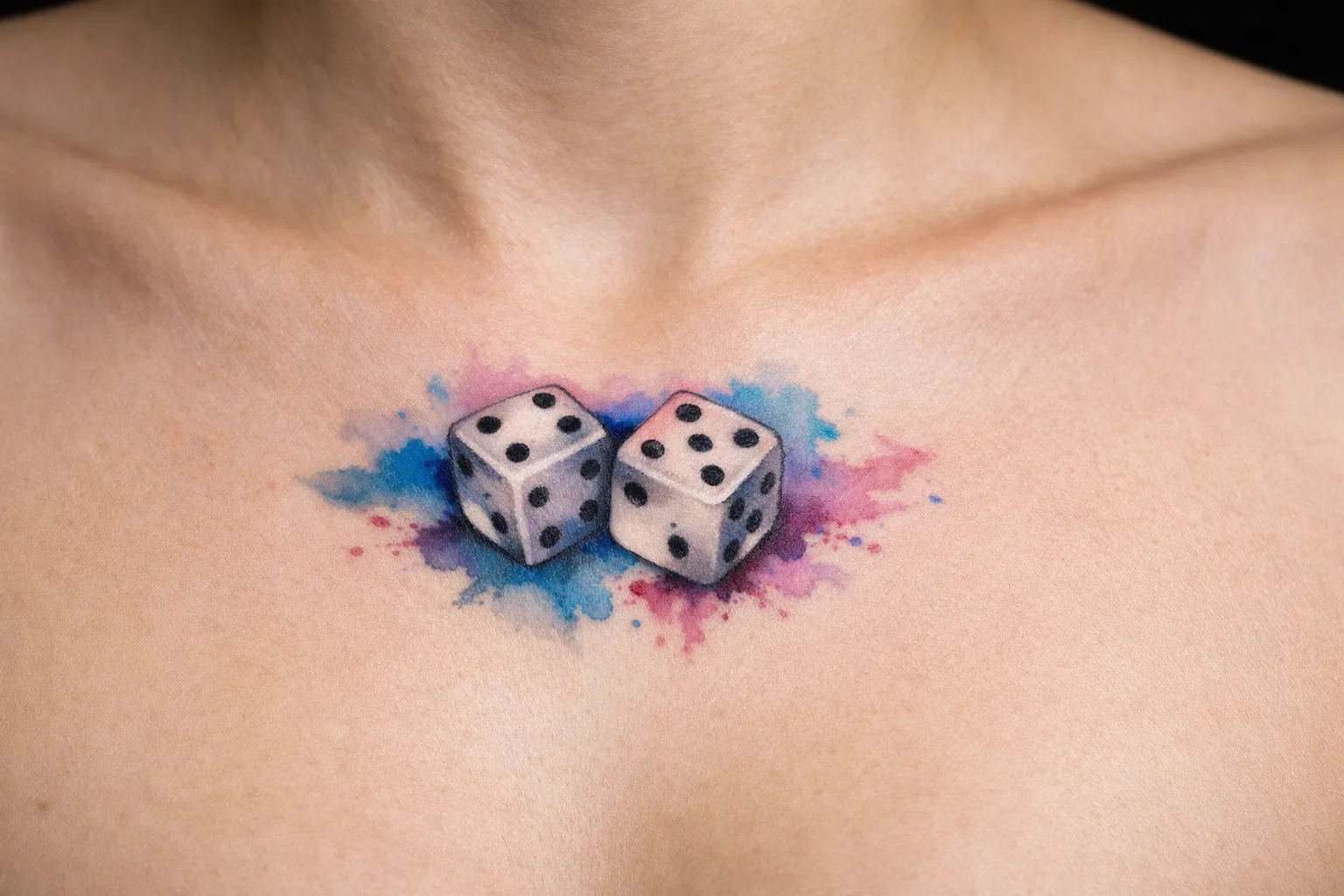
Two dice are the default - and the meaning shifts from the single die’s solo gamble toward something shared. A pair references rolling in pairs, the way you actually throw in craps, so the two-dice design often symbolizes partnership, joint risk, or “double the luck” (1).
I’ve had clients come in specifically wanting two dice because one felt too solitary for what they were trying to say. A couple marking a shared risk, business partners who went all in together - the pair carries that relational weight in a way a single cube doesn’t.
The total still does the heavy lifting:
- 7 or 11 - winning rolls, optimism, betting on a good outcome
- Snake eyes - embracing the long shot or the worst-case
- A specific date - anniversary, birthday, or a day something changed, split across both cubes
If your meaning is relational - a marriage, a business partnership, a friendship that survived a gamble - two dice carry that better than one.
What Does the 5-Dot Dice Pattern Mean?
The five-dot pattern is the quincunx: four dots in the corners with one in the center. It looks like the 5 face of a die, and it carries meaning that depends heavily on context - which is exactly why you should understand it before committing.
In prison tattoo lore, the five-dot pattern often means “four walls and one person inside” - a marker of time served, usually placed on the hand between thumb and forefinger. In some traditions it signals being surrounded, or it’s tied to specific affiliations.
Outside that context, the same five dots read very differently. People use the quincunx for balance, a center point, or a tight group of five - family, a crew, a five-person D&D party. The visual is clean and minimal, which makes it appealing for small placements like behind the ear or on a finger.
The problem is that the casual reader can’t tell your intended meaning from the prison-coded one. If you want the “family of five” reading, be aware the design is ambiguous in a way most dice tattoos aren’t. Talk to your artist, and if the prison association concerns you, a small full die or a different layout sidesteps the issue entirely.
Styles and Designs for Dice Tattoos That Hold Up Over Time
Style determines how your dice tattoo ages more than almost anything else. Dice are a geometric subject - straight edges, parallel lines, evenly spaced pips - which means sloppy work shows immediately. Here are the styles worth knowing.
Traditional / Old School
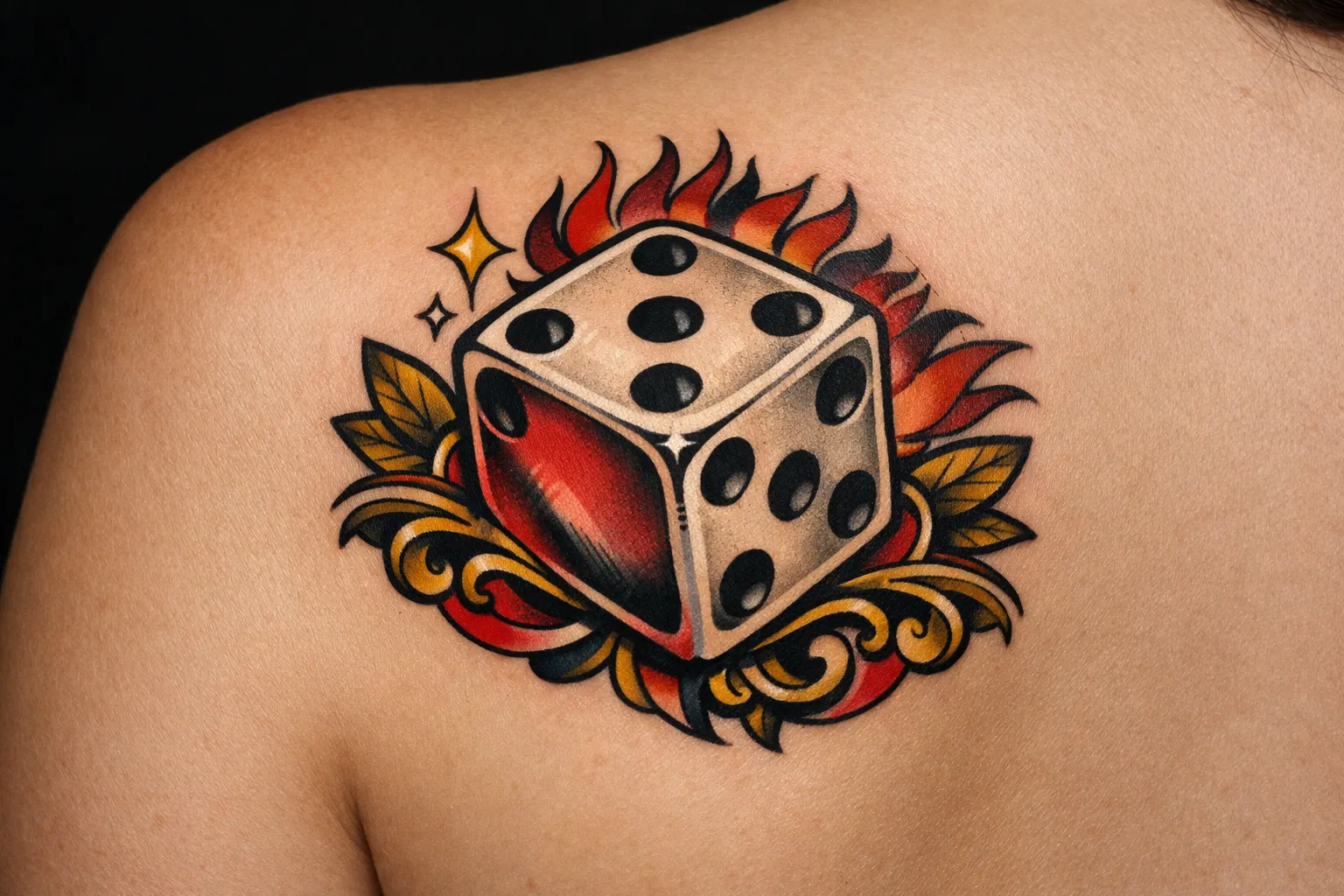
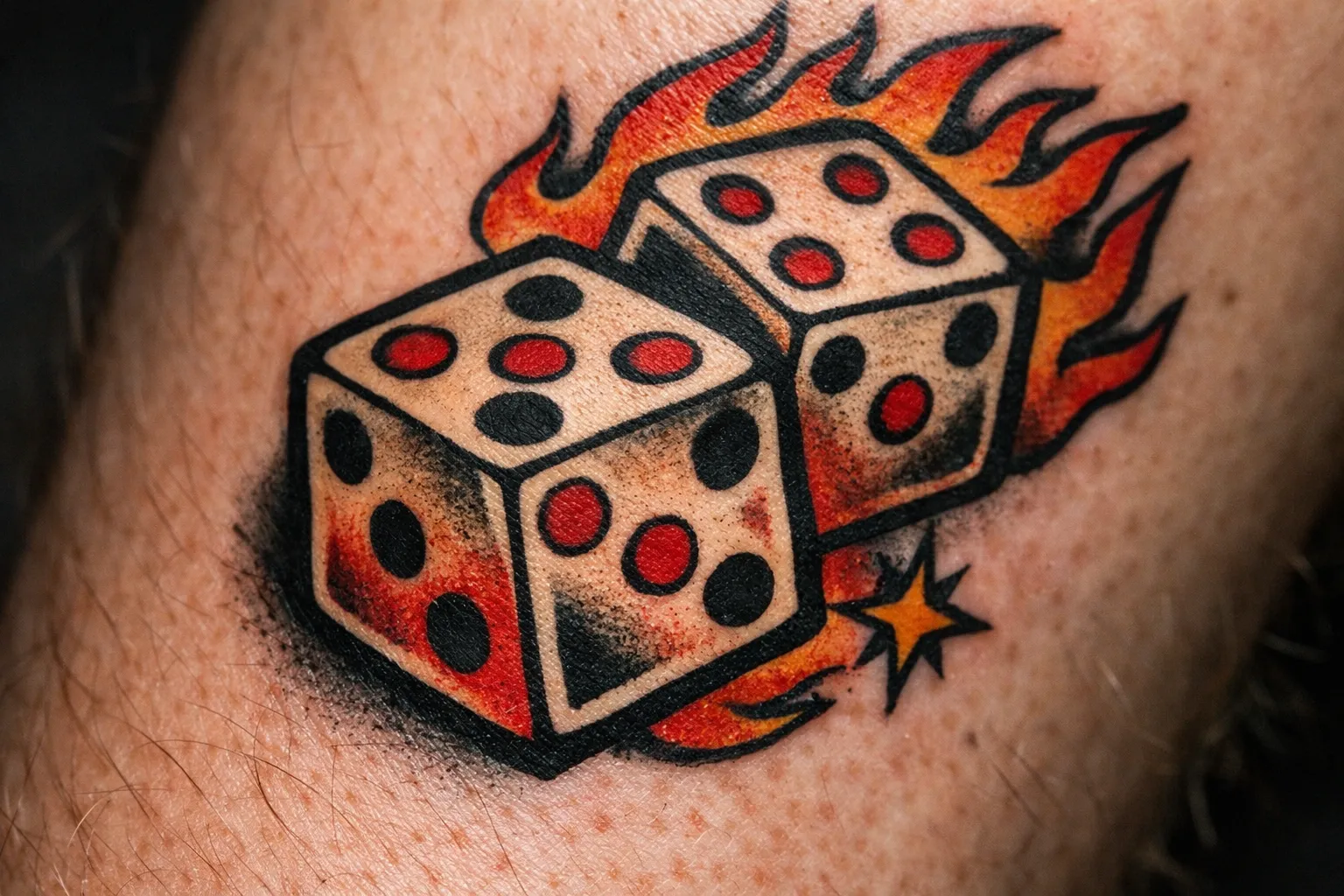
The dominant style for dice, and for good reason. Thick black outlines and a limited palette - red, green, yellow, black - make for a tattoo that stays readable for decades. Traditional dice often come with banners (“Lucky,” “Roll the Dice”), flames, or a pair of cards. The bold outline is what carries the design as the skin ages and the color softens.
I’ve seen traditional dice from the 1980s that still read clean. The outline does the work.
Pitfall: When an artist goes too thin on the outline to fit “more detail,” the whole thing loses the punch that makes traditional work last. If you want old school, let it be old school.
Neo-Traditional
More illustrative than traditional - richer shading, a broader color range, and room for roses, skulls, or detailed flames wrapped around the dice. It reads as a more painterly version of the classic. Two technical hallmarks: smoother gradient shading and a wider tonal range compared to old school, while still keeping a visible outline structure.
Pitfall: The added complexity needs more space. A neo-traditional dice-and-skull composition crammed into a small area heals into mud.
Realistic / 3D Dice
Precise perspective, accurate reflections, and cast shadows make the dice look like they’re physically sitting on the skin. This is the hardest style to do well - the edges have to be parallel and the pips correctly placed in perspective, or the cube looks broken. A medium realistic piece runs 2-3 hours of work (3).
Pitfall: Bad perspective. In a geometric subject, the eye instantly catches edges that aren’t parallel or dots that drift off the face. Only book this with someone whose healed portfolio shows clean 3D geometry - and I mean healed, not fresh off the needle.
Minimalist / Fine-Line
A single outlined cube with simple pips, no shading. Fast, affordable, and ideal for a first tattoo or a small placement. Behind-the-ear and finger dice have shown up more in 2025-2026 feeds as part of the broader micro-tattoo trend laugh-now-cry-later-tattoo (4)(5).
Pitfall: Fine-line work on high-friction spots (fingers, hands) fades and blurs fast. Minimal dice last longest on flat, low-friction skin like the inner forearm.
Theme-Based Ideas
The dice are the anchor; one supporting element sets the meaning. Keep it to a single theme per piece - overloading the design is the fastest way to make it unreadable.
- Luck and gambling: dice with playing cards, a roulette wheel, dollar signs, or Las Vegas icons (6). The most common pairing, and the most cliché - make it personal or it blends into thousands of identical flash designs.
- Fate and life choices: dice with a compass, a clock, or a fork in the road. This reads as the “taking chances” interpretation rather than straight gambling.
- Gamer / tabletop: D20s and polyhedral sets instead of casino dice, often with a class symbol or character name. Online galleries show a clear uptick in RPG dice as tabletop gaming grows 4-leaf-clover-tattoo.
- Love gamble: dice with a heart or showing an anniversary date - pairs naturally with the two-dice partnership meaning.
- Rolling / motion: instead of static cubes, the dice mid-throw with motion lines, blurred edges, or trailing pips. In small tattoos, clean motion lines read better than hyper-realistic blur.
Create Your Own
A custom dice tattoo beats flash because the numbers and elements actually mean something to you. Here’s a framework you can take straight to a consultation.
1. Pick the numbers first. This is the step most people skip, and it’s the one that defines the tattoo. Decide exactly which faces show. Options:
- A lucky total (7 or 11)
- A date split across the dice (a 6 and a 4 for June 4th, for example)
- A jersey number, an address, an age you turned a corner
- Snake eyes if your meaning is about the long shot
2. Choose one symbol for your theme. One. A heart for a love gamble, a briefcase or compass for a career risk, a D20 for gaming identity. Adding three symbols dilutes all of them.
3. Decide black-and-gray or color. Black-and-gray ages predictably and suits realistic 3D work. Color suits traditional. If you go black-and-gray, a small white highlight on the corners or pips makes the dice pop - just know white ink fades faster and may need a touch-up after 1-3 years.
4. Set the size and placement before you draw. Numbers and elements have to fit. Two dice with cards and text need room (see sizing below).
When clients come in with Pinterest references, I always ask them to bring high-resolution screenshots and stay flexible. An artist won’t copy another person’s tattoo exactly - that’s an ethics and copyright line in the industry - but they’ll happily reinterpret the concept into something that’s yours. AI idea platforms now list 6,000+ dice tattoo ideas if you need a wider reference pool than a shop’s flash book.
Placement and Sizing
Dice scale from tiny to a full forearm composition, but the design has to match the space. Cramming detail into a small area is the single most common dice tattoo mistake - the pips blur, the edges merge, and within a few years you’ve got a dark smudge.
- Small (0.5-1 in): single die, 5-dot pattern, or a minimal pair. Works behind the ear, on a finger, on the inner wrist. Keep it line-only - no fine shading at this size hourglass-tattoo.
- Medium (2-4 in): a pair of dice with light supporting elements (cards, a banner, small flames). The forearm and calf are the sweet spot - visible, readable, and roomy enough for color and shading. Most curated dice tattoos sit here.
- Large (6+ in): full casino or narrative scenes with multiple dice, cards, skulls, and lettering. These belong on the forearm, calf, thigh, or as part of a half-sleeve, where there’s enough room for the perspective work to breathe.
On pain: dice tattoos are usually small-to-medium, so the location matters more than the design. The forearm and outer calf are on the gentler end. Ribs, sternum, and the top of the foot run hotter - ribcage > forearm by a wide margin. The hand and fingers hurt and also fade fastest, a double reason to think twice about hand dice.
For workplace considerations: forearms are increasingly accepted in most fields, but hand, neck, and finger dice remain risky in conservative environments. If you’re unsure, ask your artist to mock up a forearm version against an upper-arm version so you can see the concealable option.
Tattoos to Avoid When Considering Dice
Dice tattoos are low-controversy as a category, but a few specific choices can backfire.
Misread prison and gang codes. The 5-dot quincunx and certain number combinations carry coded meanings in some contexts. If you don’t intend those meanings, you can still be read that way. Research the numbers you choose, and when in doubt, ask your artist - many shops now post safety content warning about misused dots and numeric layouts.
Generic Vegas flash with no personal connection. Thousands of near-identical lucky-7 and casino designs exist in stock libraries american-flag-tattoo. Copying one straight off a sheet tends to age into something that feels dated and impersonal. Add a real number, a real symbol, or skip it.
Complex scenes jammed into tiny placements. Two or three dice plus cards plus text under 2 inches will not hold detail. Either size up or strip the design down. No exceptions.
Heavy solid-black dice with dense backgrounds on a small area. These heal into an unreadable dark patch over time. The geometry needs negative space to stay crisp.
White or pale-yellow highlights as the main element on deeper skin tones. They barely show and fade fast. Lean on outline and contrast instead, and talk through ink choices with an artist experienced on your skin tone.
Cost, Sessions, and Aftercare
Cost (U.S. averages):
- Small simple dice (1-2 in, line, minimal shading): $80-$150, often the shop minimum
- Medium forearm scene (2-4 dice with cards or flames, color): $200-$400, at roughly $120-$200/hr
- Large half-sleeve casino composition: 3-6 hours, $500-$1,200+ depending on city and artist
Budget for a 15-25% tip in North America and $10-$25 for aftercare supplies. Some walk-in shops run flash days with set-price dice sheets if you want something spontaneous.
Session time: a 15-45 minute consultation to lock in numbers, orientation, and style; 30-60 minutes for small dice; 1.5-3 hours for medium; multiple sessions for large narrative pieces.
Prerequisites: 18+ in most U.S. states (some allow 16-17 with parental consent and ID), no active skin infection or fresh sunburn at the site, and a firm decision on the numbers and orientation before you sit down.
Aftercare timeline: because dice live or die on crisp geometry, healing matters more here than with softer designs. Picking scabs or sun exposure blurs the edges and merges the pips.
- Day 1-3: keep the bandage or adhesive film on as your artist directs, then wash gently 2-3 times a day with a fragrance-free soap and pat dry.
- Week 1: apply a thin layer of fragrance-free moisturizer; expect light flaking. Don’t scratch or pick.
- Week 2-4: keep moisturizing, avoid submersion (pools, baths, ocean), and keep it out of direct sun. Use sun-protective clothing over the area.
Full healing runs 3-6 weeks depending on size and location. Schedule at least 2 weeks clear of any beach or pool-heavy trip - fresh dice are sensitive to both sun and water, and soft edges on a geometric piece are hard to fix after the fact.
One technical tip worth asking for: many experienced artists stencil the dice from a digital 3D model or isometric grid rather than drawing the cubes freehand. For a geometric subject, that’s how you get parallel edges and correctly placed pips that still look right ten years out. Ask your artist if they work this way - it’s a reasonable question and a good sign when the answer is yes.
A Quick Note on Cultural Roots
Dice as luck symbols aren’t a modern invention. They appear in Roman and Greek imagery as emblems of fate’s unpredictability, in Chinese fortune traditions tied to chance, and in Egyptian contexts as tokens for good luck. In modern Western tattoo culture, those origins have largely collapsed into a single broad reading - luck, risk, and gambling - so don’t assume a viewer connects your dice to any specific ancient tradition. If a particular cultural meaning matters to you, it’s worth making that explicit in the design rather than relying on the dice to carry it alone.
✓ Pros
- Strong symbolic versatility: luck, risk, partnership, and personal milestones
- Classic design styles like traditional and neo-traditional age well
- Fits a range of placements and sizes, from subtle to statement pieces
✗ Cons
- Fine-line and small dice tattoos fade quickly on high-friction areas like fingers
- Certain number/dot combos can be misread as prison or gang codes
- Complex designs don't hold detail well in small sizes
Frequently Asked Questions
- Can I combine dice tattoos with other symbols without losing clarity?
- Yes, but keep it to one supporting element per piece. Overloading with multiple symbols or cluttered scenes especially in small sizes makes the tattoo unreadable over time.
- Is it safe to get a five-dot dice tattoo if I want the family meaning?
- The five-dot quincunx has prison tattoo associations that can cause misinterpretation. If this concerns you, consider a full die face or a different layout and discuss it with your artist.
- How do I ensure my dice tattoo ages well?
- Choose styles with bold outlines like traditional or neo-traditional, avoid fine-line on high-friction spots, size the tattoo so pips remain distinct, and follow strict aftercare to preserve crisp geometry.
- Are dice tattoos painful compared to other placements?
- Pain depends more on placement than design. Forearms and calves are gentler, ribs and sternum hurt more. Fingers and hands hurt and also fade faster, so consider placement carefully.
- How long should I avoid sun and water after getting a dice tattoo?
- Avoid direct sun exposure and submersion in pools, baths, or ocean for at least 2 weeks. Fresh dice tattoos are sensitive and sun or water can blur edges and merge pips.
- Why do some artists use 3D models or grids for dice tattoos?
- Dice require precise parallel edges and pip placement. Using digital 3D models or isometric grids ensures the geometry stays accurate and the tattoo looks sharp even years later.
Decide your numbers before you book. Pick a style your artist can keep clean as it heals - traditional outlines for longevity, realistic 3D only with a proven healed portfolio - and size it so the pips stay readable in ten years. A pair of dice on the forearm at 2-4 inches in solid traditional work is the safest bet for a piece that still makes sense when you’re sixty. Everything else is negotiable.